Hurricane

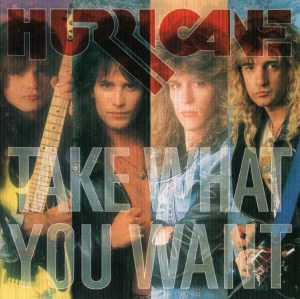
REVIEW: Hurricane – Take What You Want (1985 EP, 1989 reissue with bonus tracks)

HURRICANE – Take What You Want (1985 Enigma EP, 1989 reissue with bonus tracks)

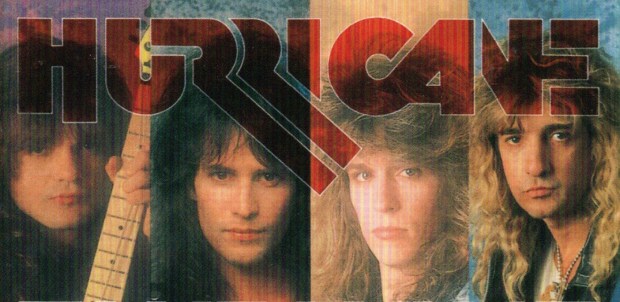
Hurricane attracted my attention initially because I was a Quiet Riot fan.  I considered Hurricane to be a “brother” band to Quiet Riot.  Bassist Tony Cavazo’s brother Carlos was in Quiet Riot.  Guitarist Robert Sarzo also had a brother, in Rudy.  I loved that Carlos played bass, and Robert played guitar.  I just knew that they chose those instruments so they could have jammed with their brothers, on guitar and bass respectively.

Perhaps Hurricane are best known as a band that launched its members into higher orbits.  Robert Sarzo has been a member of Geoff Tate’s Queensryche.  Drummer Jay Schellen is in Yes.  Singer Kelly Hansen is with Foreigner.  Big names!

Their debut EP was not a bad start.  It boasted one single/video that impressed me as a kid, but we’ll get there.  The original EP opened with “Take Me In Your Arms”, a tough little rock crooner with a great chorus.  Right from the get-go, it’s the singer that impresses.  The production buried him a bit too far back in the mix.  It may be a case of “too many cooks”, as Kevin Beamish, Mike Clink and Hurricane all get co-production credits, with Bob Ezrin in an executive role!  The swampy backing vocals don’t really help, but fortunately Hansen was more than capable of driving a chorus home.  It was also obvious that Jay Schellen was going to go places.  His drumming here is far from simplistic, standard rock cliches.

The second track gives Tony and Jay a chance to jam a bit before Robert comes in with some squealing guitar.  “The Girls Are Out Tonight” is not especially remarkable, but like the preceding song, it has a great little chorus to go with some pretty poor lyrics.  “Laughin’ and talkin’ about the boys, with whom you want to be seen.”  You don’t see the word “whom” in rock lyrics very often, I’ll concede.  The MVPs on this track are Tony Cavazo with a rollicking bassline, and Robert Sarzo with some great 80s excess on guitar.

The title track “Take What You Want” goes third, with an ominous little riff to open it.  There’s a vibe here somewhere between Journey and Kiss.  Hansen impresses thoroughly with those pipes!  The mood of the song isn’t consistent however, going for a more cliched rock vibe on the verses, while the chorus just smokes.  Almost a great song, but not quite.

Hurricane’s eponymous track was the single/video back in the day, and immediately impressed with the riff.  Traditional metal with a hint of exotic, “Hurricane” was my favourite song for two weeks straight.  “You’re like a hurricane comin’, you don’t forgive!”  Get pumped up and rock this tune on repeat.  It’s great.

“It’s Only Heaven” features Robert Sarzo and Tony Cavazo making really cool, atmospheric sounds with their instruments.  Then Schellen comes in with a classic drum beat, followed by Kelly Hansen.  This ballad could have been a Scorpions song, perhaps.  Vocally it’s very different from the Scorps, but Klaus can sing anything he wants.  Though slow, this ballad could have gone down in history like similar songs by Dokken…except for a really bad key change almost six minutes into the song.  Otherwise, it’s pretty epic and spectacular.  Somebody should have chopped the last minute and a half of it though.

Back to the hard rockin’, “Hot and Heavy” was the closing song on the original EP.  It gets the job done.  It’s fast, rippin’ with shout along hooks, and ready to tear it down.  Robert Sarzo illuminates the sky with guitar pyrotechnics.  Good little tune.  Nothing remarkable of course, but adequate for the task.  The whole EP is above average, because of the skill of the players and some occasional production goodness.  It’s just a nose above the rest of the bands that didn’t quite have the same level of musicianship.

Old CD copies came with a bonus track, “La Luna”, a beautiful classical guitar piece by Sarzo.  There is some really clever backwards guitar mixed in with the forwards.  It’s almost like next level Randy Rhoads.  The entire band got credited for writing, which means the band had an agreement to split writing credits.

This CD reissue has three bonus tracks, all from the next album Over the Edge.  The first is a single version of “Over the Edge” itself.  This hard rocker opens and closes with cool acoustic guitars, which caught my ear back in the day.  I loved this tune.  The production is still a bit wanting, but you can hear the talent shine through.  Schellen’s got a great groove going, and Kelly was so underappreciated as a singer back in the day.

“I’m On To You” was another great single from that album.  This is just an edit version.  This “super stormin’ hook edit” opens straight away with the chorus, which may or may not be to your taste.  “Na na na na na na, I’m on to you!” croons Kelly Hansen.  You’ll love it or hate it.  Finally, the CD ends with “Baby Snakes” (not a Zappa cover)…and finally it’s an instrumental version, without the phone call stuff!  That part of the song was amusing for a few minutes, but hindered re-plays.  This instrumental version remedies that!

Hurricane could have gone further than they did.  Unfortunately for them, Robert Sarzo departed after Over the Edge, replaced by a guy named Doug Aldridge that you might know from some other bands.  They started using outside writers, and that’s rarely a good sign.   They have since reunited, but never with this original lineup again.  An album and an EP was all we got.  At least they were both decent.

3/5 stars for the original EP
3.5/5 stars with bonus tracks

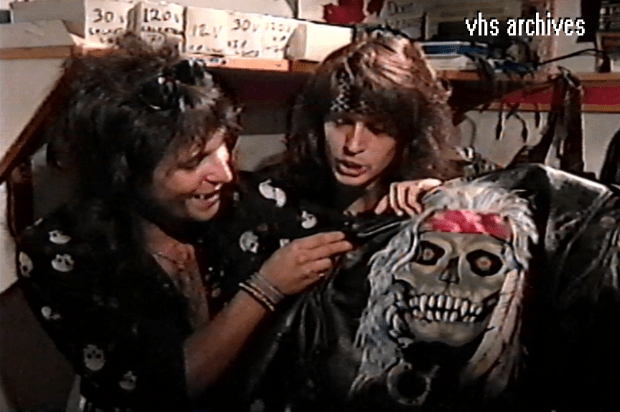
VHS Archives #121: Hurricane’s Kelly & Jay show off new mascot

A quick clip with Kelly Hansen and Jay Schellen of Hurricane, talking about following trends and showing off their new mascot.

#523: Columbia House

GETTING MORE TALE #523: Columbia House

How many of you were members of the Columbia House music club?  Tapes or CDs?

The concept was simple.  Get 12 tapes or records for one penny.  Then agree to buy “X” more at “regular club prices” within a year.  They would usually offer all sorts of incentives, such as getting your first regularly priced item for half price.  Their “regular club prices” were fairly high, but if you played your cards right you could make joining the club worthwhile.

Every few weeks after signing up, Columbia House would send you a catalogue and an order form.  The order system was controversial, because it required a negative response if you didn’t want to buy something.  When you signed up, you could pick your favourite genre of music (I chose “metal”).  Each time a catalogue came out, your selected genre would have a “selection of the month”, usually a new release but not always.   If you did not respond with an order form expressing that you didn’t want it, they would automatically mail you the “selection of the month” and bill you for it too.  (The Columbia Record Club system was worked into a sub-plot of the movie A Serious Man by the Coen Brothers.)

For many people this wasn’t a problem.  Our parents let my sister and I sign up when I was in grade 11.  We split the membership and free tapes 50/50.  We paid for everything ourselves and diligently sent in our order forms each time.  We were both already massive music fans, so we poured over every single page.  Most times, one of us ended up buying something, if not the selection of the month itself.

I can still remember every album I received in that first shipment. Seven tapes.  These tapes went into immediate and constant rotation, which is why I remember them all so well today.

  1. Leatherwolf – Leatherwolf
  2. Motley Crue – Girls, Girls, Girls
  3. Hurricane – Over the Edge
  4. Stryper – To Hell With the Devil
  5. Stryper – In God We Trust
  6. White Lion – Pride
  7. Sammy Hagar – VOA

Our musical world opened up in a massive way, and not just because of the new music we were listening to.  The catalogues introduced us to names and album covers that we’d not experienced yet.  What is this Bitches Brew thing?  Why did Deep Purple albums have so few songs?  Did Iron Maiden copy their Maiden Japan from Purple’s Made In Japan?  Holy crap, Hank Williams Jr. has three greatest hits albums?

Everything was absorbed.  Five years later, when I started at the Record Store, my boss was surprised that I knew who most of the artists were, what sections they should go in, and even what record labels they were on.

“I read the Columbia House catalogue cover to cover every month,” was my answer!

The catalogue provided knowledge, and pictures to cut out for locker or wall.  We made the most of that catalogue every time.  It was rare when pictures were not cut out!

I was even able to acquire things that might have been considered rarities back then.  I had never seen Leatherwolf stocked in a store, but Columbia House had it.  When vinyl was being discontinued, I was still able to get Skid Row’s Slave to the Grind (1991) on LP.  They had most of the Savatage albums.

It all sounds wonderful, but Columbia House had flaws too.  The biggest one was horrendous quality control.  They licensed and manufactured the tapes themselves, which were simply not as good quality wise as the ones you could find in a store.  They would be warbling within weeks (if not right out of the case) and the J-cards were sometimes shoddy, with printing not lining up with fold lines, or just they’d just start falling apart along perforations.  They also didn’t carry certain record labels.  While they had everything Warner Bros and Columbia Records, they had nothing from EMI.  Finally, bands made next to nothing on albums that were sold through Columbia House.  Some bands such as the Tragically Hip refused to sell their music via Columbia House.  We didn’t know all of this as kids, of course.  I started to pick up on the quality issues when they seemed to take a serious dive around 1991.

The key to not getting ripped off by Columbia House was to order smart.  The 12 free tapes sounds like a great deal, but when you balance in buying the rest of your selections at full price, most people ended up on the losing side.  Get in and get out, buying the bare minimum.  That was the way to do it.  Of course, we didn’t.  We just enjoyed the convenience and stayed members for years!  No regrets since this led directly to a 12 year career in the Record Store!

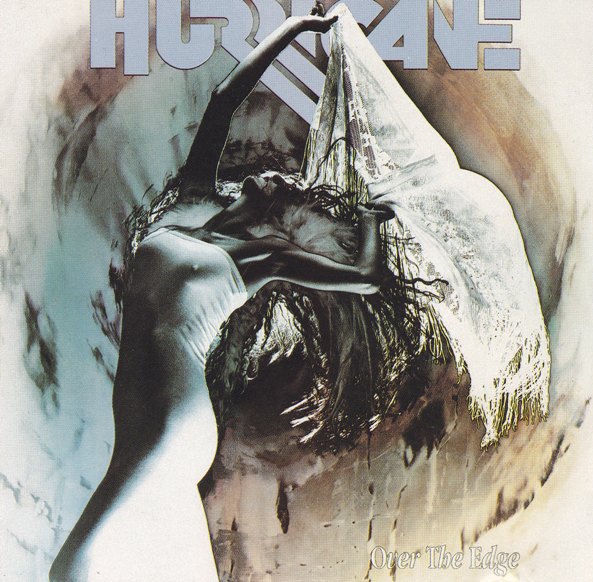
REVIEW: Hurricane – Over the Edge (1988)

HURRICANE_0001HURRICANE – Over the Edge (1988 Enigma)

I was aboard on the ground floor with Hurricane, as soon as I heard of them.  I was already a huge Quiet Riot fan, and Hurricane had in their roster the brothers of Rudy Sarzo and Carlos Cavazo.  On guitar was Robert Sarzo (now in Operation: Mindcrime), and on bass Tony Cavazo.  Their first video ever, “Hurricane”, was in near-constant rotation at Chez LeBrain.  When I joined the Columbia House record club, Hurricane’s first full length Over the Edge was in my introductory first order.

I loaned Over the Edge to my buddy Bob, who did not like it.  I was surprised because I thought it was right up his alley, but he didn’t care for the singer Kelly Hansen (now in Foreigner).  I was digging it at the time, and although there were some tracks that were undoubtedly filler, I thought it had quite a few killers too!  The first single “I’m On to You” for example was memorable, tough enough, and catchy as anything that major bands had been releasing.

There were two big names attached to the album: Mike Clink produced it, with Bob Ezrin acting as executive producer.  You would expect it to sound a lot better than it actually does.  Vocals and guitars often seem distant, the drums don’t have enough snap, and there are weird distracting keyboard overdubs that cramp the mix.  Over the Edge is not horrible sounding by any stretch, but it sure is not up to the standards of Mike Clink and Bob Ezrin.

It’s not always your best bet to open an album with a slow-building semi-rocker like “Over the Edge”, acoustic intro and all.  Thankfully, Robert’s electric riff kicks in and the track begins to rock like an old Europe anthem.  It’s a little more dark and foreboding than most of the hard rock making the charts in ’88 — it has some weight to it, and that’s what I liked about it.  But I also get what my friend Bob didn’t like about Hansen’s vocals.   He has powerful lungs but when he’s pushing, his voice can sound a little uneven.  As an album opener, “Over the Edge” implies there will be drama and twists and turns ahead.

The first twist is a bizarre cover of Alice Cooper’s “I’m Eighteen” that slows down and unnecessarily modernizes the track.  Maybe this cover was Ezrin’s doing.  I don’t know and I advise that it’s a track for skipping as it just kills the momentum.  “I’m On to You” is way, way better.  A bright hard rocker with a catchy na-na-na chorus and fiery guitar licks is a fast way to the heart.

“Messin’ With a Hurricane” is a pretty cool song, sounding a bit like 80’s-era Ace Frehley lyrically and musically, but without Ace!  Then “Insane” (a song title Ace also used in ’88) ends the side with a boring “blues” rock jam.  Nope, sorry, no sparks happening for me here.  Even worse though, side two opener “We Are Strong”…oh man.  I am struggling to describe how bad this song is.  Imagine swimming in a jar of lukewarm Cheez-Wiz.  Nothing about this sounds good to me.

Hurricane salvage the situation with “Spark in My Heart”, a decent hard rocker with an anthemic chorus.  It has some balls to it and Hansen’s singing here is great.  “Give Me an Inch” is really good.  It uses the guitar sparingly and has an unusual construction that I am immediately attracted to.  It’s very different, and still hits the spot today.  Likewise, “Shout” is still a good song, although Kelly Hansen pushes the limits of his range on it.

One thing about Kelly Hansen that I need to point out is that since 1988, his voice has barely changed at all!  He has lost nothing.  Singing with Foreigner is a serious gig, and he does it.

The best and worst track on the album is the instrumental closer “Baby Snakes” (no relation to Frank Zappa).  In an unexpected left turn, the band crank out a fast-paced metal shuffle with smoking drums and solos.  But…but but but!  These amazingly smoking instrumental passages are then lowered in volume as we listen to some guy named Jeff calling up some girl named Jenny and constantly asking her out, while she blows him off.  It gets tired fast, especially when, for a brief moment, the volume comes back on and Robert Sarzo rips out a killer solo only to be interrupted by Jeff and Jenny again.  Bad call, guys.  Bad call.

MVP: Drummer Jay Schellen, a serious talent with chops and creative fills.  The guy smokes all over this record.

3/5 stars

HURRICANE_0002

REVIEW: Whitesnake – Good to Be Bad (2 CD & Japanese versions)

Here’s my second review from the The Toronto Musical Collectibles Record & CD Sale! It was Japanese import Heaven!

For the last installment of this series, click here.

WHITESNAKE  – Good to Be Bad (2008 Warner/SPV)

Whitesnake disbanded in 1990.  Coverdale did his album with Jimmy Page, but that didn’t prove to last either.  Although they’d started writing for a second album, the affair ended and David Coverdale assembled a new Whitesnake for a Greatest Hits tour in 1994.  This reformation eventually led to an album in 1997 called Restless Heart (billed as “David Coverdale and Whitesnake”.  This R&B flavoured album, a personal favourite, did not resonate with some fans of 80’s ‘Snake.

After another hiatus, and a solo album (2000’s Into the Light), David once again formed a new group of ‘Snakes, a mixture of old and new members.  After several years of touring (and lineup changes), the long awaited new Whitesnake album, Good to Be Bad, hit the shelves in 2008.  Former Dio guitarist Doug Aldrich and Winger’s Reb Beach had been a formidable guitar duo since 2002.

GOOD TO BE BAD_0003

Similarly to his partnership with Adrian Vandenberg, David has retained his writing style of co-writing with just one co-writer; in this case, Aldrich. It seems to be evident that the guys have gone for a John Sykes guitar sound and style.  You can certainly hear a lot of trademark sounds and tricks that Sykes used to do, that gave the 1987 album such a cool sound.  This isn’t to say that they don’t play plenty of their own style too, but the retro stuff is frequent.

So similar is the direction of this album to 1987, that you can play “name that tune” with all the new songs:
“Can You Hear The Wind Blow” for example directly references moments on 1987, right down to those flares that Sykes used to do.  “All I Want, All I Need” equals “Is This Love” Part Deux.  Basically, every song on Good To Be Bad is a mash-up of songs from Coverdale Page1987 and Slip Of The Tongue, and you can hear the references quite distinctly. “A Fool in Love” is “Crying in the Rain”.  “Lay Down Your Love” is “Shake My Tree”, without Jimmy Page.  Throw in a little “Kashmir” during “‘Til The End Of Time” (which seems to be based off “Till The Day I Die” from Come An’ Get It) too.

Having said that, despite the lack of originality, Good To Be Bad is still a very enjoyable listen, and a very welcome return. A world without David Coverdale’s voice is like a world without crème brûlée.  That voice is in fine form, perhaps even stronger than it was on 1997’s Restless Heart. The album has a lot more life to it than Restless Heart, although it does lack that album’s subtlety and R&B moments. The band play great, kicking it on every tune, even the ballads. The melodies are strong and memorable.  It’s just…too contrived.

The bonus live disc is the the Canadian special edition is highlights from Live: In The Shadow Of The Blues. No big deal.  It’s nice to hear Whitesnake playing “Burn/Stormbringer” from David’s Deep Purple days, and cool to hear the old 70’s classics.

The real cool version to have is the Japanese release with two bonus tracks.  And a sticker!  Can’t forget the sticker.  The bonus tracks are both remixes (a “Doug solo” version of “All For Love”, and a stripped down version of the lovely “Summer Rain”).  For $20, I wasn’t complaining.

3.5/5 stars