Iron Maiden

Paul Di’Anno Tribute on Grab A Stack of Rock with Harrison, Johnny Metal, and Metal Roger

GRAB A STACK OF ROCK With Mike and the Mad Metal Man
Episode 75:  Paul Di’Anno Tribute

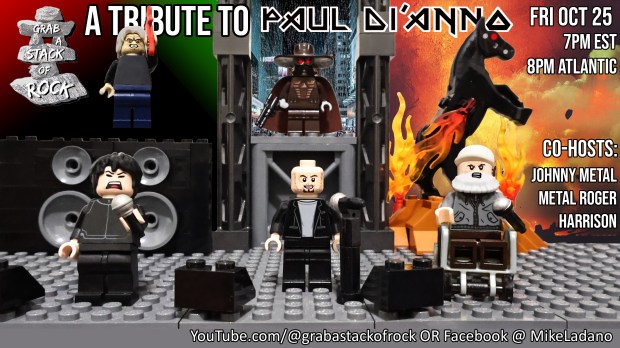
We had a completely different show planned this week.  Then, in the early hours of Monday morning, John Snow informed us that former Iron Maiden singer Paul Di’Anno had passed.

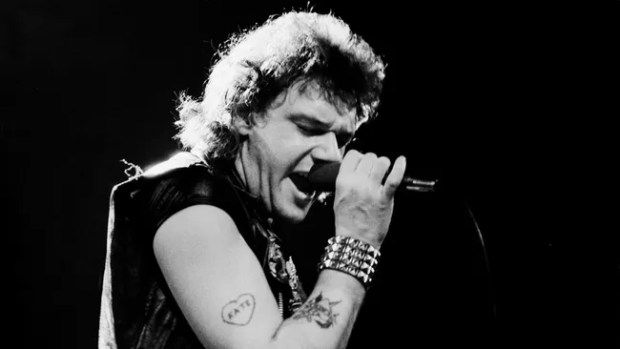
It was like that moment the record scratches and the needle comes off.  The shock set in, and then I realized, we need to change the show this week.  We need to pay tribute to (not the original singer, but) the first recorded Iron Maiden lead singer.  Paul filled some shoes:  Paul Mario Day and Den Wilcock preceeded him in Iron Maiden, but it was Di’Anno who helped put them on the center stage.  Paul’s punk look and snarl differentiated Iron Maiden from the rest of the New Wave of British Heavy Metal.  They were clearly different from the pack, and their intense and sweaty live shows proved it.

This week on Grab A Stack of Rock, Harrison Kopp will make an early unscheduled return, joining myself, John Clauser, and Metal Roger in tribute.  24 hours after our show, Roger will be seeing Iron Maiden themselves in Toronto.  All of us will be talking about the man, the myth, and the albums!  As an added bonus we will also be running a clip from my 2021 interview with his former guitar player Steph Honde, on playing live with Paul!  We will also be playing Bruce Dickinson’s tribute to Paul from Minnesota.

“I know you’d have gone insane if you saw what I saw,” but tonight, please join us and see our Tribute to Paul Di’Anno.  As usual there will be lots of physical products, including two VERY RARE Iron Maiden box sets, some vinyl, and double CD sets.

Friday October 25 at 7:00 P.M. E.S.T. / 8:00 P.M. Atlantic.   Enjoy on YouTube or on Facebook!

Rest in Peace Paul Di’Anno (1958 – 2024)

Paul Di’Anno was one of the first singers I knew and loved. He’s running free now, with Clive Burr, and no longer in pain.

Paul has clearly not been in good physical shape lately. Once walking with a cane, Paul had been in a wheelchair for some time now. Paul has now lost his wheels, and is free to fly.

When Iron Maiden released their debut album in 1980, they were building on five years of battles in the clubs, building their repertoire and their reputation. Much of it had to do with Paul Di’Anno, the short(er) haired lead singer with the punk rock attitude. His sneer was embedded in those first two Maiden albums, both legendary.  Replacing him seemed impossible at the time!

I can’t believe we have to do this, but on Friday we will be paying tribute to Paul on Grab A Stack of Rock.

This sucks!

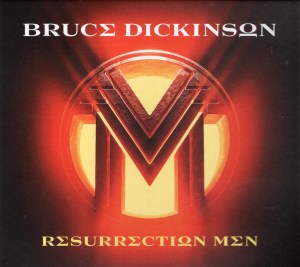
REVIEW: Bruce Dickinson – “Resurrection Men” (2024 CD single)

BRUCE DICKINSON – “Resurrection Men” (2024 BMG CD single)

The Mandrake Project is a dense album.  It takes a lot of time to absorb and understand.  The concept goes way over my head, but the songs are heavy and the direction is metal.  Bruce Dickinson is nothing if not ambitious, and of course that means taking the new album on the road.  His live band this time out includes the always reliable Dave Moreno on drums, and Whitenake bassist Tanya O’Callaghan.  Bruce has released two singles from the album with exclusive B-sides, and the second is “Resurrection Men”.

“Resurrection Men” is long for a single, at almost six and a half minutes.  It is loaded with drama, and the acoustic intro really sets a mood.  Then it goes into something more western, like from a Clint Eastwood film, with interesting percussion.  That soon subsides and we go full electric.  This song lunges all over the place, from slow grinding verses to quiet bass-driven parts, and a powerhouse chorus.  Ultimately it’s not really single material, but that’s one thing that makes this release so interesting.  It’s also impressive how Bruce continues to sing with such lung power.

Live from Sao Paolo comes “Afterglow of Ragnarok“, the first single from The Mandrake Project.  A song about “what happens after the end of the world,” according to Bruce.  It is tight, and does not deviate far from the original cut.  The live setting is unforgiving, but even without multitracked vocals, Bruce nails it.  The stage energy is palpable, and Moreno kills it on drums.

The most exciting track is the very first live version of “Abduction” from Tyranny of Souls.  This one absolutely smokes, with breakneck pace, lightning drum fills, and melodic guitar harmonies.  A lot of solo Bruce stuff could almost be considered Iron Maiden made modern, louder and more intense.  “Abduction” falls into that category.  This live version has some really cool guitar solo work, very different from Roy Z’s on the album.

It is truly wonderful to see artists such as Def Leppard, Deep Purple, and Bruce Dickinson releasing physical singles with actual B-sides in 2024.  Keep it up.

4.5/5 stars


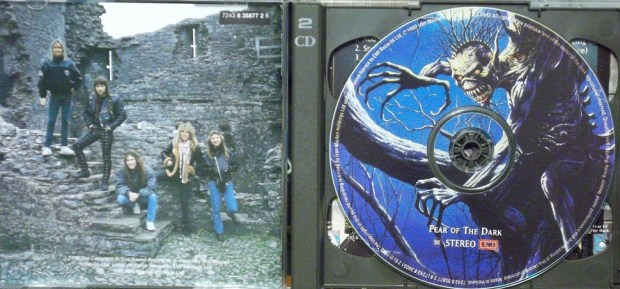
Make An Album Better Vol. 1: Iron Maiden’s Fear of the Dark (1992)

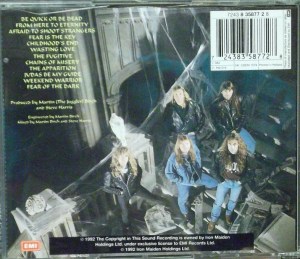
In 1992, we gave Iron Maiden’s Fear of the Dark album a generous 3.75/5 star rating.  Fear was the second in a row of underwhelming Iron Maiden albums.  After losing melodic songwriter Adrian Smith, the band struggled to achieve the heights of Seventh Son of a Seventh Son.  New member Janick Gers was also a songwriter, but Maiden struggled to match their previous mojo.  Several songs from Fear were never played live:   “Fear Is the Key”, “Childhood’s End”,  “The Fugitive”,  “Chains of Misery”,  “The Apparition”, “Judas Be My Guide”, and “Weekend Warrior”.  Meanwhile, the title track is a concert staple, played on almost every tour since.

What can we do to improve this album?

1. Tone down the keyboards

As the last Maiden album co-produced by Martin Birch, perhaps the metal maven was getting a little tired.  Fear isn’t as punchy as past albums.  Since Somewhere in Time, Maiden had become increasingly reliant on synths or keyboards.  Even the back-to-basics No Prayer for the Dying had keyboards.  Let’s not get rid of all the keyboards, let’s just tone them down.  On some tracks, such as “Afraid to Shoot Strangers”, they are little more than sonic wallpaper.  Let’s mix them a little lower for this experiment, and bring the drums up in the mix.

2. Remix the drums

Something about Nick McBrain’s drums on this album sound a little dead.  A tad too much like they’re in the back of a cave.  We should try making them a little more lively, and maybe just a tad louder in the mix.  Aim for something more like the Piece of Mind era drums sound.

3. Edit the album down, and re-sequence it

Let’s go for a nine track song list.  Clearly, the 12 on Fear were too many since they didn’t play the majority live.  Fear was a long album.  As the CD rose to dominance, albums grew longer.  CDs were initially made to be 74 minutes long so you could put long classical pieces on it without breaks.  74 minutes was never intended to be the standard album length, though Fear is shy of that at 58:34.  Still too long for a single record.  Classic Maiden albums were shorter than this.  We’ll go with nine songs.  Number of the Beast had eight, and Piece of Mind had nine.  Fear already had the perfect openers and closers, so we won’t touch those.

Side one

  1. “Be Quick or Be Dead”
  2. “Chains of Misery”
  3. “From Here to Eternity”
  4. “Judas Be My Guide”
  5. “Wasting Love”

Side two

  1. “Afraid to Shoot Strangers”
  2. “The Fugitive”
  3. “Weekend Warrior”
  4. “Fear of the Dark”

It was a real struggle to include “Weekend Warrior”, as I don’t think this ode to soccer hooliganism is a particularly good song.  However, I committed to nine, and I find “Fear is the Key” and “The Apparition” a tad dull.  “Childhood’s End” is the other deleted song, and really it could have been one or the other.  I went with “Weekend Warrior” because it’s different for Maiden.  (Not that “The Apparition” isn’t, but these songs aren’t really that great.  That’s why they weren’t played live.)

We maintain the kicking opener, high speed and going for the throat of big business.  Then we have anthemic shout-along rock in “Chains of Misery”.  “Wasting Love” acts as a side closer as it does on the proper album.  Kicking off side two with “Afraid to Shoot Strangers” is a bit of a risk, as it is a bit ballady to start, and coming off a ballad gives you two in a row.  However, it would work brilliantly as a side opener.  “Fear of the Dark” of course should close.  That’s what it’s built for.

This makes the album a perfect 44 minutes and 24 seconds!

4. Get rid of the tree Eddie!

Regular Maiden artist Derek Riggs had a falling out with Maiden’s management over his sketches for this album.  Instead, for the first of many times, Maiden went with the legendary sci-fi and fantasty artist Melvyn Grant, who didn’t really understand Eddie yet, or the continuity established on prior album covers.  From Number of the Beast to No Prayer for the Dying, there seemed to be an ongoing story with Eddie being manipulated, captured, and killed.  He is reborn, borgified, and gives birth, only to be reborn again.  Then, suddenly he’s a tree.  The lightning from Eddie’s eyes is gone, replaced by evil red peepers.  For our improved version of this album, the cover has to go.  Cover art is so important to Iron Maiden, and Fear had one of their most disappointing covers to date (with No Prayer by Riggs coming in second).

In Sum

Little can be done to improve some of the actual songs on this album.  Fear had filler, and a lot of it.  Even at nine songs, tracks like “The Fugitive” and “Weekend Warrior” are dangerously close to filler material.  Perhaps our hypothetical remix can liven them up, but shortening the album will do it some wonders.  Maiden rarely record original material for B-sides, and don’t put cover songs on their records.  There is no extra material we can substitute.

Doing the best with what we have at hand, what would you do to improve Fear of the Dark?

#1151: An Egg of a Deal: End of August Scores

RECORD STORE TALES #1151: An Egg of a Day: End of August Scores

I have a coworker whose parents recently passed.  This is always sad, but the time came for my coworker to purge her mom’s music collection.  Periodically when this happens, people come to me to ask my opinion.  Essentially, she wanted to know:  “is there anything here that I shouldn’t take to the local Beat Goes On because it might be worth more?”  She didn’t think much of her chances, but wanted to be sure.

“Sure, I’ll pop over and have a look,” I said.  “I can’t promise you anything but I can at least have a look.”

That was good enough for her.

“I bet I find a bunch of Lawrence Welk!” I joked to Tim Durling and Jex Russell.  You know the kind of record collection I mean.

Indeed, I did find Lawrence Welk in the very first box of vinyl.  I had a laugh and kept digging.  To everyone’s surprise, I found things that might indeed have been valuable, and they had no idea how it got into that collection.

First of all, she had a really nice stack of 78s.  Big Crosby was the first one I saw.  I have no idea on value of 78s, but this were stored well and all seemed in good condition.  It might have been my first time handling a stack of 78’s like that.  They are thicker than an LP, and much heavier.  They require a special stylus as well as a turntable that can go up to 78.  I used to have that equipment.  She even had a cylinder, whether Edison or a competing brand, that was out for professional appraisal.  So, this collection I was looking at had these formats:

  • LPs
  • 45s
  • 78s
  • Cassettes
  • 8-tracks
  • CDs
  • and one cylinder

Pretty wild scope.  The genres were all over the place, from easy listening and country (the usual suspects) to disco, jazz, oldies, and even progressive rock and heavy metal, as you’ll see.  This, I did not expect.

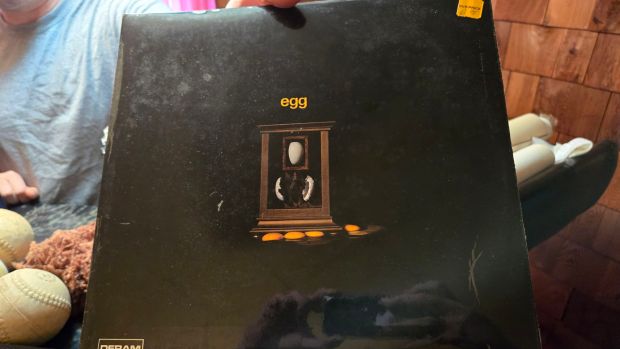
Then I spied an album called Egg.  Something about it jumped out at me.  I flipped it around and there were black and white photos of long haired guys jamming.  That struck me as out of place in this collection, so I set it aside.  Somebody looked it up, and it can sell for easily over $100.  Everyone seemed really impressed by my ability to sniff this out.  I am no expert, folks.  Not at all.  But it looked out of place, which is why I took a second glance.  It turns out Egg were an English progressive rock band, and the album was released in 1970.  Very surprising, but they felt that this one find justified me coming over and looking at their records, so I was happy.

Original price:  $6.99

I found some things I wanted for myself and made an offer.  I left with the following titles:

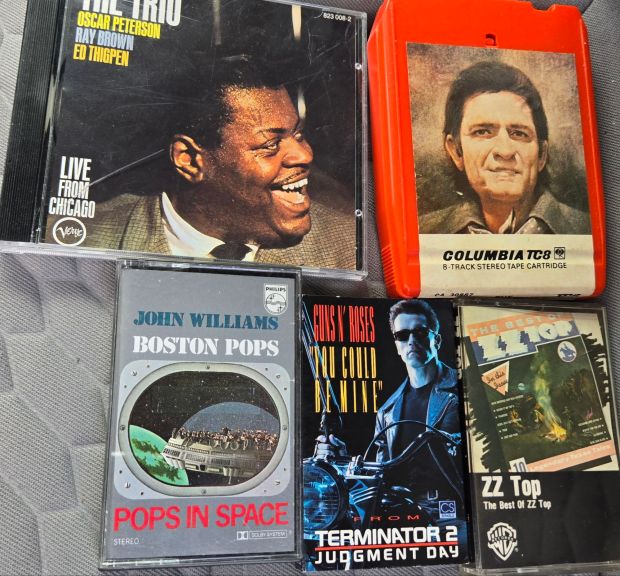
  • Guns N’ Roses – “You Could Be Mine” 1991 Geffen cassette single.  I own it on CD, but never on cassette.  Why not?  In this day and age of owning everything on every format, why not?
  • The Best Of ZZ Top 1977 Wea Music cassette.  A staple, but one that I somehow have never owned before on any format.  Stone cold classic compilation.
  • John Williams and the Boston Pops – Pops In Space 1980, Philips, made in Holland.  This contains music from some of Williams science fiction classics:  Superman, The Empire Strikes Back (which was brand new in 1980), Star Wars, and Close Encounters.  I haven’t seen this one before.
  • Oscar Peterson – The Trio – Live from Chicago 1961 Verve/1986 Polygram CD.  My second Oscar Peterson score this summer.  You rarely find Oscar in the wild, and never this one.
  • Johnny Cash – His Greatest Hits, Volume II 1971 Columbia 8-track.   This was the Cash album I grew up with in the car with my dad, albeit on cassette.  This cartridge is in great shape, and resides in a bright red shell.  This is my first red shell 8-track tape.

When I called my dad to tell him of my musical scores, he was surprised at the 8-track.  While he clearly remembers that Cash album, he asked me “Do you have anything that plays an 8-track?”  This is a common question that we collectors get.  No I do not.  I don’t have a way to play a Minidisc, a DAT, or a DCC either but I would love to have some in my collection.  My collecting desires are no longer strictly just to have music to play.  Now I collect music I can’t even play too!  Just to have a piece of history.

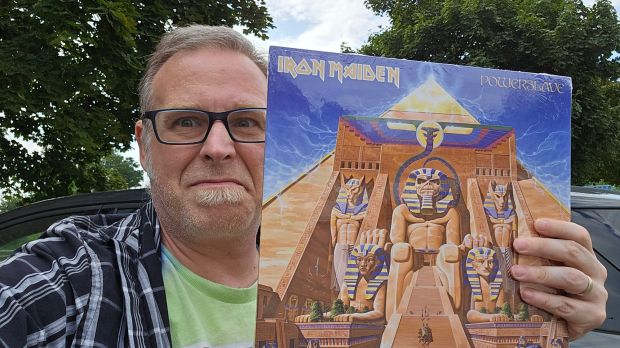
After we completely examined the collection and left some advice, I departed with my treasures.  Since we were in the neighbourhood, I decided to visit the old Toys R Us/HMV store.  There, I finally decided to pick up Iron Maiden’s Powerslave on vinyl, edging me closer to completing the 1980s collection.  Now, all I should need are the first two Di’Anno albums (I think).  Powerslave was $36 and hard to pull the trigger on, since I can distinctly remember a time when Sam the Record Man was swinning in new copies for $6.99 each, and that sticks with you.  I finally have it now.

A successful Saturday.  Time to listen to some music!

#1149: Eddie’s Story – The Narrative of Derek Riggs’ Iron Maiden Art

RECORD STORE TALES #1149: Eddie’s Story – The Narrative of Derek Riggs’ Iron Maiden Art

Edward T. Head, better known as “Eddie”, has been Iron Maiden’s mascot since the late 1970s.  He was just a mask then, made by roadie Dave Lights, to hang on the band’s live backdrop.  Why “Eddie”?   Because the mask was essentially just a head, or “‘ead” in British slang.  Therefore:  Eddie the Head!  When Iron Maiden were signed to Capitol Records, manager Rod Smallwood wisely surmised that the band would do well with an identifiable “stamp”…like a mascot.  He contacted artist Derek Riggs, and before too long, Eddie made his painted debut on the cover of Iron Maiden’s 1980 single “Running Free”.

Eddie’s impact cannot be overstated.  He is more recognizable than any single member of the band.  He is seen on T-shirts worn by diehards, casual fans, and even those who have never heard an Iron Maiden song in their lives.  He is ubiquitous.  Needless to say, Rod Smallwood was very wise, and Derek Riggs very talented.  Riggs did the cover art for every Maiden album from 1980 to 1990, and almost every single and EP in the same time frame.

As young impressionable kids growing up in suburban Ontario, we certainly knew who Eddie was.  My friends and I collected not just the albums and singles, but also the buttons.  We were intimately familiar with Eddie, his different outfits, settings, and crimes!  We attempted to draw our own Eddies.  I took a shot at a single cover for “The Duelists”, a favourite song.  It featured Eddie and the Devil fencing at the edge of a cliff.  The Devil was a foe of Eddie’s going back to the “Purgatory” single cover.  Derek Riggs eventually built an extensive mythology for Eddie and associated characters.  He focused on “Easter Eggs”, hiding characters and symbols within the artwork.  Powerslave and Somewhere In Time were chock full of such goodies.  References to the bars Maiden played, the Reaper, and even a TARDIS can be found on those albums.  One of the great pleasures of being an Iron Maiden fan was opening up an album and looking for all the secret images and messages while you played the records.

By 1986, some of us had noticed that the album covers, not including the singles, seemed to a tell a continuing story.  There was a continuity to the cover art, and Eddie in particular, that made us think there was an actual story unfolding with each album release.  This story seemed to run through Derek Riggs’ entire tenure as Iron Maiden’s cover artist, from 1980 to 1990.  While I am certain that this is entirely something made up in our heads, it does seem to hold water.

Let’s have a look at the album covers, and the story they may tell.
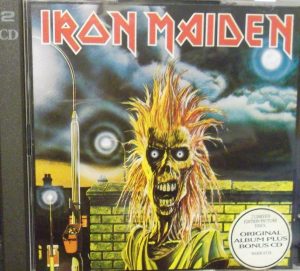
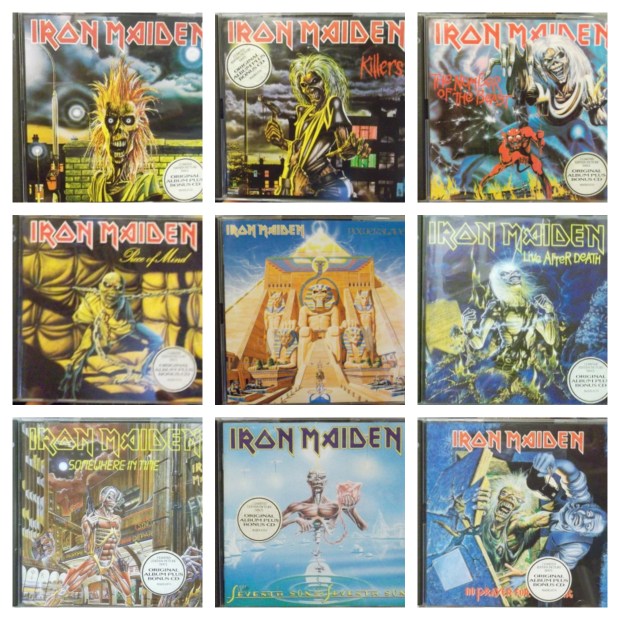
IRON MAIDEN -1980

Just an introduction to the character.  Eddie is a street punk, in a loose T-shirt, standing on a London street at night.  Behind him is a lit doorway, and a window with a red light – a reference to “Charlotte the Harlot”.  You can also see two of the streetlamps behind Eddie form an arc, with the moon.  Eddie’s eyes are just black sockets with light behind.  Later artists would change Eddie’s eyes, but Riggs always painted them black with some kind of illumination.  Eddie’s skin appears yellowed and stretched, like that of a mummy.  His hair is pure punk rock.

The story has yet to begin, but Eddie is clearly someone you don’t want to mess with on a London street at night.
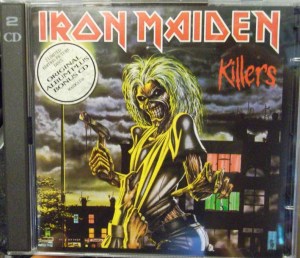
KILLERS – 1981

Eddie appears much more refined in this image.  You get a better look at the character, including a belt and blue jeans.  The punk rock hair is gone, though Eddie remains on the streets.  It could be the same neighborhood as the first album.  The black clouds in the sky are similar.  This time, Eddie has a bloody hatchet in hand, while his victim grips his shirt in dying desperation.  Eddie seems to have no mercy.  He even seems to relish killing.  Fitting, for an album called Killers.  Our interpreted story begins here, with a murder.
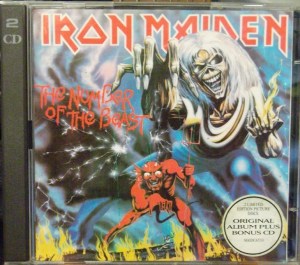
 THE NUMBER OF THE BEAST – 1982

The plot thickens.  In Riggs’ best album art to date, Eddie appears a giant over a scorched, hellish background.  The rear cover had more of this scenery, indicating we were indeed in hell.  Eddie’s eyes are now lit by flames, matching the ground below.  He also has a fire in his hand, a reference perhaps to Montrose’s “I’ve Got the Fire” which was an earlier B-side.  The most striking feature here though is the appearance of the red Devil himself!  Eddie appears in control, manipulating the evil one with green puppet strings.

This was the first cover that really had us squinting at the details, on our little cassette J-cards.  For if you look closer, you will see Eddie is not in control at all.  Satan himself has his own puppet, and it is Eddie!  Our minds were boggled.  What could this mean?  We began pulling together the threads that seemed to be telling a story.  Derek Riggs had outdone himself, but he was only getting started.

 PIECE OF MIND – 1983

Imprisoned!  Captured, chained in an asylum, and lobotomized to boot!  Now bald, Eddie bore a scar across his head!  He had been cut open like an egg, and this scar would remain for the next several album covers.  Two more details were added:  a stream of blood going down his nose (always his right side), and a metal bracket holding his head together.  The screws in the bracket would always be in the same orientation.

Clearly, Eddie was in trouble.  We saw this as the punishment for his crime of murder.  The Devil came to take his due, and now Eddie is stuck in a cell.  Would he escape?  The next album told us no.

Of course, the real life inspiration for the artwork was the title Piece of Mind.  On the inner sleeve, the band members are preparing to dine upon a brain!  It doesn’t look tasty, and Adrian Smith in particular doesn’t look hungry.  In our childhood fantasy world, the Devil had served up a particularly brutal punishment for our favourite Metal mascot.
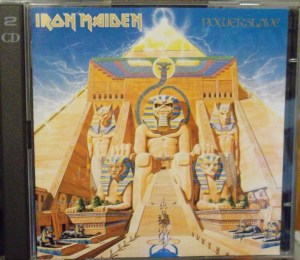
 POWERSLAVE – 1984

It appears that Eddie did not survive his brain surgery and imprisonment, for here he was being laid to rest in an ancient Egyptian setting.  In Riggs’ best artwork to date (again), a multitude of Easter eggs were hidden on the front, back and inner sleeves.  The Great Pyramid appears as it once did in antiquity, smooth and topped by a golden capstone.  Eddie’s sarcophagus can be seen, carried up the stairs, to his eternal resting place.

Or was it?

It seems pre-destined that Maiden’s next album would be called Live After Death.  It was really at this point that we started to put together that there was a story unfolding here.  Live After Death, and Eddie was buried on the previous album?  It all made sense!
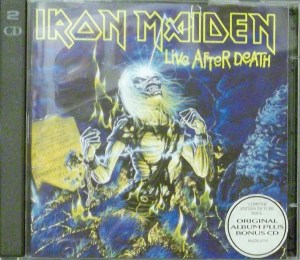
 LIVE AFTER DEATH – 1985

Now this was an album that simply had to be owned on vinyl.  There was text to be read on the tombstones (“Let It RIP”), and so many Easter eggs on the back cover, including a black cat, the Reaper, and a visible “Edward T. H…” on his tombstone.  For many of us, this was the first indication that Eddie did have a last name!

With a bolt of lightning re-animating the already dead corpse, Eddie was back!  Still wearing his chains from the Piece of Mind album cover, Eddie’s hair had grown back while his T-shirt has seen better days.  Flames can be seen bursting from the ground, hinting at his hellish past.  On the rear cover, a city can be seen, surrounding the pyramid from the last album.  The continuity seemed clear.  The only issue here was that on the prior album, Eddie was laid to rest inside the pyramid.  Here, he is seen bursting out of a normal grave.  It would seem that Eddie’s remains were re-located between albums.  A minor issue easily explained away.

The city on the back cover calls to Eddie!  He was back, and up to his old ways again…
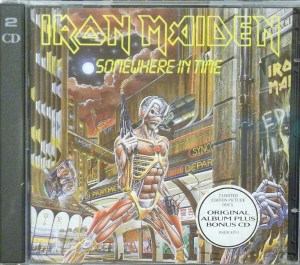
 SOMEWHERE IN TIME – 1986

Riggs outdid himself again, with the Blade Runner inspired Somewhere In Time.  Owning this album on vinyl is simply a must, for there is so much going on.

Still lobotomized, but bearing a new brain of circuitry, Eddie was technologically enhanced.  The blood, scar and bolts holding his head together are still visible despite the modifications.  On his chest, Derek Riggs’ signature emblem can be seen clearly.  It was always hidden somewhere on his albums, but here it was plainly visible.  A poster that reads “EDDIE LIVES” can be seen on the right, with the dying hand of a victim that he has just exterminated.  Back to his old killing ways from the Killers album!  Instead of a blade, Eddie now wields a pair of blasters.  Eddie seems to have arrived in a “Spinner” vehicle, similar to Blade Runner.

The same familiar moon from previous albums blazes behind, but there is so much on the back cover to discover too.  A reaper, red-lighted windows, and the names of things important to Iron Maiden’s lore are present.  As far as our story went, we imagined that Eddie emerged from his tomb centuries in the future.  This time, the Devil would not stop him!  But despite the cybernetic enhancements he underwent, his body was not whole…and soon it would be time to be reborn.
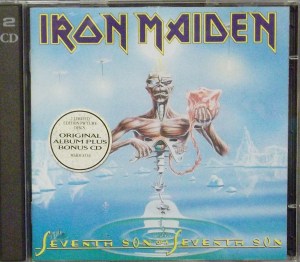
 SEVENTH SON OF A SEVENTH SON – 1988

This is where things got weird.  Really weird.  Not content to keep drawing Eddies with axes through people’s heads, Riggs went abstract on Seventh Son of a Seventh Son.  Eddie was now little more than a torso, with his skull ripped open and aflame!  The scar, bolts and blood are still present (though the blood would be replaced by a mustard-like substance on the single cover for “Can I Play With Madness”).  The remnants of his cybernetic enhancements are still present, with one eye replaced by a robotic one.  He also still has a metal throat.  An apple can be seen within his ribcage, but most striking is the Eddie-infant he’s holding in some kind of embryonic sac!  This sac is attached to his ribcage with an umbilical cord.  An arc of lamps recalls the first album.  A “book of life” is present on the back cover, tying into the album’s concept.  There are also ice statues of past Eddies on the back cover, for a total of seven Eddies.

Look closely and you can see that the surface below is both solid and liquid, and the icebergs do not touch the surface.  In our story, this represented Eddie on another plane, as he gave birth to his successor – a new Eddie.
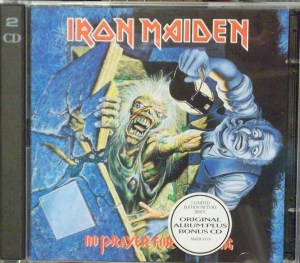
 NO PRAYER FOR THE DYING – 1990

For the first time, we felt disappointed by an Iron Maiden cover.  Gone were the layers of Easter eggs.  The art felt unfinished, and indeed, Derek Riggs would remake it for a 90s reissue.  The album was sonically a “back to basics” affair for Iron Maiden, with simpler lyrics and shorter, harder songs.  The artwork reflected this, with a simple Eddie just back to killing again.

Reborn, and without scars, bolts or lobotomies, Eddie emerges from a stone coffin.  Because why not?  The undead should surely be reborn in a grave!  Grasping the poor gravekeeper by the throat, Eddie is seconds away from his first killing in his new body!  Looking at his coffin, the name plate is unfinished, with no clever names or puns.  The fragments of the shattered coffin don’t even fit together properly.  The blue and yellow colour scheme definitely links the album to Seventh Son, Live After Death, Powerslave and The Number of the Beast, but there is far less to keep you looking at the cover.

And this is the end of our Eddie story, for Derek Riggs would not do another Maiden cover for years, and by then there was no point in any continuity.  The next time we see Eddie, he has red bug-eyes and is half-tree.

Iron Maiden would continue to produce fascinating album covers in the future, always featuring Eddie in some way.  Notable artists included Mark Wilkinson, Melvyn Grant, and Hugh Syme.  For most fans, the original run of Derek Riggs covers will remain the pinnacle of Maiden artwork, primarily the period of 1981 to 1988.

Did Riggs have a story that he was telling with his covers?  Probably not; he probably just liked keeping Eddie consistent from cover to cover.  He would probably appreciate the fact that a bunch of Canadian kids in the suburbs had interpreted this entire saga from his artwork.  I think he’d like that a lot.



#1148: No Drone Movies

RECORD STORE TALES #1148: No Drone Movies

With my mom and sister visiting Japan in August, my dad didn’t want to spend his weekends at the cottage.  By that stroke of luck, Jen and I had the cottage for three weekends in a row.  I can’t remember the last time I was at the cottage for three weekends in a row.  I was probably a teenager.

I spoke to my mom after she got back from Japan, jet-lagged by about 12 hours.  My sister managed to catch a case of Covid, but my mom was luckier.  Even so, she was too worn out to use the cottage on the weekend of August 9.  At the last minute, they decided to stay home that weekend.  Therefore, Jen and I could go if we wanted to.

It’s a shame to let the cottage stay empty on a summer weekend.  We had planned on staying home and working on organizing the music collection, but at the last minute, we got out of town and hit the road.

I went with Iron Maiden’s Piece of Mind on the way up, followed by War Within Me by Blaze Bayley.  I had been immersed in an Iron Maiden writing project and decided to keep the vibe going on the road.  It was fascinating to hear how recording and production had changed between the two albums.  Piece of Mind was an organic sounding listen, with natural drums and lots of room sound.  War Within Me was modern, clean and technical.  While I prefer the analog, organic sounds, I realize that it is of the past.  A good double bill for the road.

Upon arrival on Friday night, I got the drone out, which is a good thing, because the theme for the rest of the weekend would be “No Drone Movies”!

Editing to the music of “80 Days” by Marillion, it was incredibly hard to fly at sunset with the sun in my eyes.  I could not see my drone from the ground.  I was flying by camera the whole time.  It was a good flight, with great visuals, but it was to be the only flight of the weekend, for within an hour, the gale-force winds rose!  The winds would last all weekend, and would not let up at all.  The drone was boxed for all Saturday and Sunday.

And this is when things got weird for me.

With the air cool, the wind high, and the skies dark, my seasonal affective disorder kicked in.  Big time.  It felt exactly like fall at the cottage.  Even though it was early August, and the previous week had a beach packed with kids and tourists, this was a cold deserted weekend.  All the feelings came rushing back, from years of “back to school” ads and activities.  The memories came back too:  listening to White Lion on a cold wet day on my Walkman by the river, wondering what the next school year would bring.  All back like a Polaroid picture.

My counselor told me specifically it’s too early to worry about fall, but here I am.  Unable to get it off my mind.

I am glad we went to the lake this weekend.  It’s wasteful to leave it empty on an August weekend.  My mental health is better there, than home.  But I can’t shake this foreboding feeling of fall.


We have a winner – Powerslave vs. Defenders of the Faith (Maiden vs. Priest)

It was a marathon, but it was never dull!  With Pete Jones on board, we completely dissected every track on these two 40 year old albums:

  • Judas Priest – Defenders of the Faith – 13 January 1984 – peaked at #18 in the US and went platinum.  Produced by Tom Allom, his fifth with Priest.
  • Iron Maiden – Powerslave – 3 Sept 1984 – peaked at #21 in the US and went platinum.  Produced by Martin Birch, his fourth with Maiden.

Harrison Kopp arrived at the end of the show and between he, Peter and myself, we chose a winner.  It was a 2-1 vote.

Lyrically and musically we broke down each track to the individual parts.  We shone light and appreciation on all the players, for what they contributed to each of these epic metal masterpieces.  At the end of the day, it was clear that though both bands are often lumped together, these two albums are completely different.  They have different moods, different directions, and different lyrical themes.  Both are important albums to 80s metal, and to the respective band catalogues.

Subject matter broken down in detail:

  • The bass, drum, and guitar parts to each song.
  • Lyrical themes to each song and album.
  • The B-sides and bonus tracks.
  • The true and hilarious story behind Mission From ‘Arry.
  • Connections between Becket and Iron Maiden.
  • Personal stories and impact of these records.
  • Live performances and songs that have never been played live.

You will also be treated to a live performance of “Freewheel Burning” by Mike!

They call Peter the Professor and for good reason.  He came prepared with tour information and intimate knowledge of the construction of these songs.

Though it pained me to have to pick a winner, we did!

We hope you enjoyed the show, and a big thank-you to Peter for contributing two hours of your Friday night!  Of course, always nice to see Harrison.

This is likely the last evening show of the summer of 2024.  Afternoon shows occur at 3:00 PM on Fridays, when I have an available co-host.  Thanks for watching, and stay tuned…

The next show is an interview with author Angie Moon, regarding her debut music/true time book, Crime of the Century, June 21 on Grab A Stack of Rock!

The Battle of ’84: Iron Maiden – Powerslave vs. Judas Priest – Defenders of the Faith

GRAB A STACK OF ROCK With Mike and the Mad Metal Man
Episode 62: The Battle of ’84: Iron Maiden – Powerslave vs. Judas Priest – Defenders of the Faith

It is finally time:  the Battle of ’84 has arrived!  40 years ago, two metal monsters released crucial albums:

  • Judas Priest – Defenders of the Faith – 13 January 1984 – peaked at #18 in the US and went platinum.
  • Iron Maiden – Powerslave – 3 Sept 1984 – peaked at #21 in the US and went platinum.

But which album, track for track, is better?

Tonight, Peter Jones and I will attempt to answer that question.  After appearing once with Pete on a favourite episode of Rock Daydream Nation, he finally joins Grab A Stack of Rock.  Peter is a musician, who understands the vocabulary of drums and will explain it all tonight.  (Check out his latest Contrarians episode with Martin Popoff!)  Will the drumming colour his impressions of these two landmark albums of the 80s?  We shall see tonight.

We shall dissect each and every track, including the bonus tracks & B-sides.  Who shall reign?  Find out tonight…live!


Friday June 7 at 7:00 P.M. E.S.T. / 8:00 P.M. Atlantic.   Enjoy on YouTube or on Facebook!

This is likely the last evening show of the summer of 2024.  Afternoon shows occur at 3:00 PM on Fridays, when I have an available co-host.  Thanks for watching, and stay tuned…

The next show is an interview with author Angie Moon, regarding her debut music/true time book, Crime of the Century, June 21 on Grab A Stack of Rock!

#1130: If I Had A Million Dollars? A Top Five List

RECORD STORE TALES #1130: If I Had A Million Dollars? A Top Five List


If I had a million dollarsWell, I’d buy you a fur coatBut not a real fur coat, that’s cruelAnd if I had a million dollarsIf I had a million dollarsWell, I’d buy you an exotic petYep, like a llama or an emu


Fur coats?  Exotic pets?  No thank you!  If I had a million dollars, I’ll tell ya exactly what I’d buy!


1. AV Designhaus Derenville VPM 2010-1

There goes half my money in one shot ($650,000)!  What do I get for my money? A belt-driven turntable on a Corian chassis, that rests on four feet that are supported and balanced through an air suspension system. Has an ethernet connection, and a HD-TV camera that monitors the diamond stylus.  Why?  To watch it on a high resolution monitor and make necessary adjustments. It would probably take two engineers to set up and test; I certainly couldn’t do it myself!  I doubt there is much you could do to improve the sound of a vinyl record that this turntable doesn’t already have packed in.

2. Vintage 1982 Nakamichi Dragon 3 Head Autoreverse Cassette Recorder

This one will cost me another $10,000 Canadian, but some consider it the Rolls Royce of tape decks. If you ever wanted to make a tape sound almost as good as a CD, this is the way to do it. It requires tuning, maintenance, and knowledge. But money is no object in this exercise, so why not? Dare I say why not? It’s a sleek, beautiful looking beast of 80s esthetics.  Just look at all those buttons and LEDs!  Might be more work than it’s worth, but the sound you can get from a high-quality blank tape and this machine are better than what my ears can discern anyway.

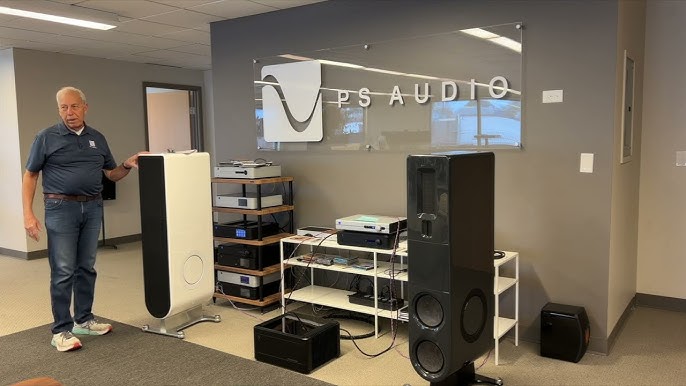
3. PS Audio FR30 speakers

$40,000 for the pair. Then I’d need the amplifiers and Paul McGowan himself to set it all up.  I’d also need to move into a bigger house.  They require a large, neutral listening space.  Which I’d like to have anyway!  By all accounts, these speakers (when set up correctly) provide a very real sounding experience, as if you’re in the room with the musicians.  The low end is supposedly amazing, aided by eight passive radiators.  Plus, don’t they just look gorgeous?

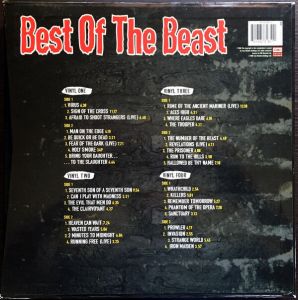
4. Iron Maiden – Best of the Beast vinyl (1996)

Needed for just a handful of tracks!  A live version of “Revelations”, and technically the Soundhouse Tapes EP.  In the condition I want it, it’ll cost me upwards of $1000.  Wish I bought it for $300 new when I had the chance back in 1997.  It’ll sound as good as CD, over my new AV Designhaus Derenville VPM turntable and PS Audio speakers!

5. Marantz SA-10

May as well grab a new CD transport while I’m at it!  This Super Audio player boasts a high-end DAC, and will play files from FLAC to MP3 via a USB stick.  It won’t connect easily with your iPhone, which means nothing to me anyway.  I’ve always wanted a Super Audio player, so why not go with the best?   This will set me back about a grand, and I’ll probably never use most of its features.  But that’s what dreaming is all about!


There you go.  500 words on what I could do with a spare million bucks just kicking around.  What would you buy?  Keep it fun – this is a fantasy exercise, so no need for serious answers.  Drop your comment below!