Polygram

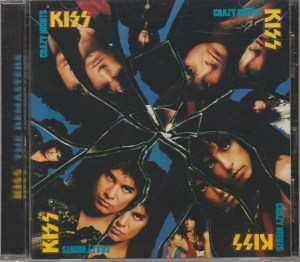
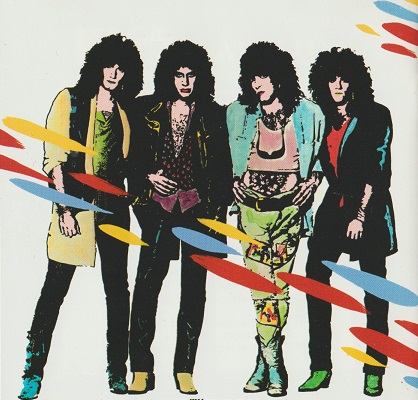
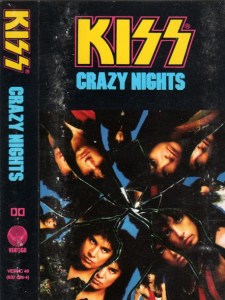
RE-REVIEW: KISS – Crazy Nights (1987)

The KISS RE-REVIEW SERIES Part 29 

 – Crazy Nights (1987 Polygram, 1997 Mercury remaster)

Here’s a little song for everybody out there.

It’s a song that is a recurring theme for Kiss in the 1980s.  It’s a down and out song: Asylum failed to live up to commercial hopes and the band only  toured in North America.  Paul Stanley was still firmly in control of Kiss.  His partner Gene Simmons was now a record label mogul.  He signed Loz Netto and House of Lords.  Meanwhile, Paul observed bands like Bon Jovi who once opened for them, now eclipsing their success.

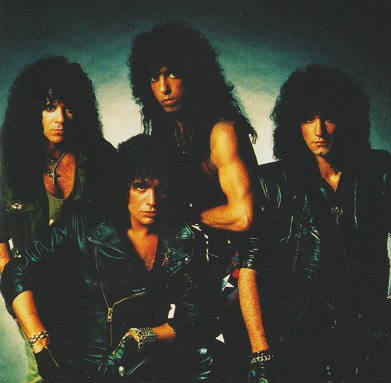
Kiss chose producer Ron Nevison for their next album tentatively titled Who Dares Wins.  Nevison had recently produced big hits for Heart and Ozzy Osbourne, and Kiss aimed to follow along.  The new music was the most commercial they’d written since 1980’s Unmasked.  Big name songwriters participated on all but two songs.  Much to the chagrin of Kiss fans, keyboards were brought on heavily for the sessions.  Paul had been writing on keyboards for the first time.  (In concert, keys were played offstage by Gary Corbett.)

The album was renamed Crazy Nights, preceded by first single and video, “Crazy Crazy Nights”. From the first “Woo!”, it’s far too bright and shiny. It’s one of those “gosh, this is so inspiring!” tunes that you’re embarrassed to like.  “They try to tell us that we don’t belong, but that’s alright, we’re millions strong.”  The awkward change to a higher key at the end is annoying as Paul hits absurd notes.  Bruce Kulick’s guitar playing is exemplary, a showcase of true technical mastery, but not the kind of playing associated with classic Kiss.

A pretty stinky song called “I’ll Fight Hell to Hold You” is a mish-mash of mismatched parts and very high notes.  It inspired my neighbor George to say, “If a song this poor made the album, can you imagine the songs that didn’t?”  Gene wrote about 25 songs for Crazy Nights.  Shudder.  “Bang Bang You” is pretty weak too, keeping things in “park” rather than “drive”.  It’s also the second time Paul referrs to a previous Kiss song in the lyrics.  This time Paul states that he’s gonna “shoot you down with my Love Gun, baby.”  On “Crazy Crazy Nights”, Paul stated that we “Love It Loud”.  Reminding fans of better songs from more nostalgic times?

Bruce Kulick gets a smoking guitar into on Gene’s first track, “No No No”.  Every trick in the book is thrown down in a mere 45 seconds.  The track is a sudden fast thrash into heavier territory.  However it’s track 4, and it’s Gene’s first song?  That’s problem numero uno.  The second issue is Gene’s newfound smooth singing style.  The demonic growl is gone, and Gene adopted a clean voice that does not really sound much like Gene Simmons.  He continues that style on “Hell Or High Water”, a pretty good tune in fact.

Things go a ridiculous extreme on “My Way”, another one of Paul’s “inspirational” tunes.  “I’m gonna talk like I talk, walk like I walk, My Way.”  Sinatra this is not.  What sinks it are the stupidly high notes that Paul hits.  Paul Stanley was simply one of the great voices in rock, bar none.  He could do things that few people this side of Freddie Mercury could do.  But just because you have a car that can go 200 mph doesn’t mean you have to keep it floored.  Save it for when it counts.

Side two commences with another atrocity, “When Your Walls Come Down”, which never would have been in consideration for a better album.  Consider that Eric Carr wrote a number of ideas for this album that weren’t used, like “Dial L For Love”.  That unfinished song had a Van Hagar vibe that was on trend, and potentially better than crap like “When Your Walls Come Down”.

The first Kiss ballad since “I Still Love You” on Creatures of the Night (1982) is “Reason to Live”.  A weak ballad is of little interest, and the music video surprised some by having Bruce Kulick on stage playing damn keyboards!  Paul and his buddy Desmond Child are responsible for a song we’d rather forget.

Simmons returns with a great number called “Good Girl Gone Bad”.  Cliche title aside, this understated dusky prowler has melodic qualities in common with some of Gene’s better material on Unmasked.  Another decent song, Paul’s “Turn On the Night” is a hokey but good enough anthem for the 80s.  It’s co-written by Diane Warren, who later scored it big with a little song called “I Don’t Want To Miss a Thing“.  It will be too bright for some fans, but it’s a tasty pill if you can swallow it.  Paul has always had a way with a chorus.  Bruce’s solo is another standout.  “Turn On the Night” is actually pretty good.  The music video seemed to be a continuation from “Reason to Live”.  The blonde woman that torched Paul’s car seems to be now sabotaging a Kiss concert on a roof top?  I’m very confused.

Crazy Nights ends with a fart, a pretty low-grade Simmons tune named “Thief in the Night”.  On a better produced album like Creatures, a song like this could have smoked the competition.  On a plastic, thin album like Crazy Nights, it completely misses the gut.

It’s probably unfair to lay the blame for Crazy Nights at the feet of Paul Stanley and Ron Nevison.  If Gene wasn’t out trying to discover the next big band, and was actually focused on Kiss, could they have gotten it together?  The fact is that Kiss are at their best when running full steam.  It’s always been a partnership between Paul Stanley and Gene Simmons as the primary writers.  Crazy Nights represents a point at which these partners were working like broken cogs.

It’s a damn shame.

Today’s rating:

1.75/5 stars


Uncle Meat’s rating:

0/5 steaks 

Meat’s slice:  For this Meat’s slice, we include an actual commentary, as Uncle Meat listened to the album in real time.

Uncle Meat:
This first shit tune…sounds like a wrestling entrance.

Mike LeBain:
Totally.
It’s of the time.

UM:
It’s shit.

ML:
You couldn’t even give this 0 steaks.

UM:
It’s Warrant…It’s Poison…It’s shit.

ML:
You’d have to go to rotten ground beef for this.
And that’s…fuck what’s his name…

UM:
And that key change is ridiculous!!!!!!!!!!!! So awful.

ML
…Ron Nevison produced.

UM:
This is shit.

ML:
Enjoy my friend.
It gets pretty silly later.
Wait until you hear My Way.
Mark my words.
Reemember: MY WAY.
I’ll walk like I walk, talk like I talk, My Way…

UM:
If I end up taking a walk and killing a 48 year old Chinese woman…It’s on you my friend.

ML:
I realize that.
It’s right here in permanent Internet records.

UM:
Well…first absolute shit tune is over…and it’s rated dung.

ML:
Second song is worse.

UM:
The shit storm is over Randy…
Oh no it’s not Mr Lahey…because here comes song 2.
I’m using that in my review of this album…

ML:
HAHAHAHAHAH

UM:
I’m so glad I shaved my head two days ago…or I would be lighting my hair on fire.
Bang Bang You…just about to start.
I see it’s a Desmond Child vehicle.
Grrrr
This is so garbage…hot steaming garbage.
I dont know if I can do this whole album.
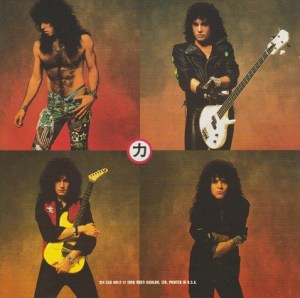
ML:
HAHAHAHAHA Bang Bang You…
You have to finish it now.

UM:
I hate this.

ML:
You can tell this is the period when Gene wasn’t around anymore.

UM:
My bum is embarrassed for my ears right now.

ML:
You think this is bad, I invite you to play Hot in the Shade.

UM:
OK…fuck man…it’s only song 4 of this one…hold it now.

ML:
I’ll shoot you down with my love gun baby.

UM:
I’m not guaranteeing I’m getting through this one.

ML:
You can’t walk away now.

UM:
And…I might just review the first 4 songs…and say… ok…I’m done…don’t care about the rest…goodbye.
Goodbye.
That would make a point.

ML
Nope you HAVE to play MY WAY.
I need you to hear track 6.

UM:
Who is singing No No No?
Kulick?

ML:
Gene.

UM:
Doesn’t sound like him.

ML:
He doesn’t sound like him on any of the album.

UM:
Oh…ok…he sounds different.

ML:
Nevison forced him to drop his normal voice.

UM:
Passable.

ML:
Barely.

UM:
Kinda reminds me of Skyscraper by David Lee Roth.
ML:
Same era.
Very plastic and keyboardy and samply on the drums.

UM:
Better than the first 3.
Eric carr’s only writing credit.
Does Kulick or Carr sing any tunes?

ML:
Nope just Gene or Paul.
Eric was promised a song and didn’t get one which made him very bitter.
Apparently he stopped speaking to Paul around the next album.

UM:
I mean on any album.

ML
Eric sings two.
He sings Beth on Smashes and Thrashes.
And Little Caesar on Hot in the Shade.
Bruce sings one.
I Walk Alone on Carnival of Souls.

UM:
Ok…that’s weird.

ML:
Funny thing there:
Both guys sang their first original Kiss songs on their LAST Kiss albums.
In Fact Bruce’s song is the last song on his last Kiss album.

UM:
Neat.

ML:
In the current band Eric Singer and Tommy Thayer both have two lead vocals each.

UM:
Hell or High Water is…boring…not offensive like earlier.
Sounds like Tesla.

ML:
But you can hear his voice is smooth not rough.

UM:
I just wrote down one line now in the first minute of My Way.
“Bon Jovi can fuck right the fuck off already”.
Oh man this smells.
It’s like actual runny sharts are oozing throught this speaker.
OK… Reason to Live is on a new shelf of shit. Holy Fuck. Of course…Desmond Fucking Child. What a shit hat.
It sounds like St. Elmos Fire meets Michael Bolton working out in a shit gym.
OK…I’m done it’s off…I can’t do anymore…no fucking way.
Done.
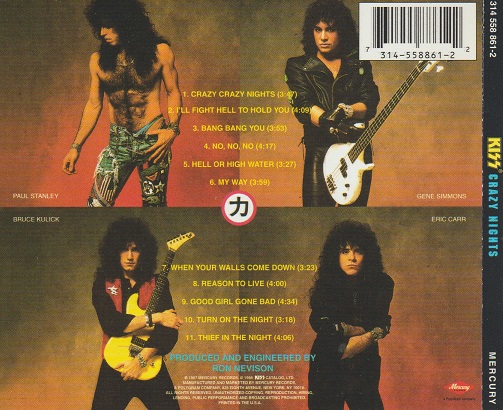


Crazy Nights is the last album reissued in the Mercury CD remasters series.  No album more recent than this has been remastered and reissued.

Original mikeladano.com review:  2012/08/04

RE-REVIEW: KISS – Asylum (1985)

The KISS RE-REVIEW SERIES Part 28 

 – Asylum (1985 Polygram, 1997 Mercury remaster)

When we last met our heroes, they were a fractured bunch with differing priorities.  Gene Simmons cut his hair and went to Hollywood.  Paul Stanley was steering the Kiss ship singlehandedly.  They were down a guitar player (Mark St. John) but were fortunate to find his replacement in Bruce Kulick.  Not only was Bruce an old acquaintance (his brother Bob played on a number of Kiss tracks) but he was also just what the band needed.  He added a shot of stability and wrote good material.  He has three writing credits on his first album Asylum, and that was just the beginning.

Paul and Gene produced Asylum, in a similar way to how Animalize was recorded.  As had become routine, Gene wasn’t around to record some of the bass parts in Paul’s songs.  Jean Beauvoir returned to fill in, while Paul also played some bass.  Without Gene fully committed, Asylum was the second Kiss album in a row hobbled by his reduced participation.  Animalize was a huge selling album for Kiss having gone platinum.  Asylum sounds like Paul wanted to duplicate that record.

Eric Carr opens the album with a thunderously memorable drum intro.  Carr didn’t have to try to impress anybody; his drumming brought Kiss to a higher level musically.  His double bass work on “King of the Mountain” would make Lars poo his pants.  For Carr fans, “King of the Mountain” surely must be considered one of his brightest moments.  Fortunately the song also kicks ass.  As one of the Kulick co-writes, the new guitarist impresses immediately.  His soloing style was so much smoother than his predecessor Mark St. John.  He had similar speed and ability but better composition when it comes to solos.  Meanwhile, Paul takes this high octane speed rocker and turns it into a rallying call of encouragement.

I’m gonna climb the mountain,
I’m gonna hit the top,
I wanna go where nobody’s ever been,
I’m never gonna stop.

Who needs Shakespeare when you just need a good shake?  “King of the Mountain” is fuel injection for the bloodstream.

Over to Gene.  “Any Way You Slice It” kicks ass.  He had a habit of barking out his lyrics in the 80s, and “Any Way You Slice It” is very bark-y.  The riff really catches air and takes off.  Back to Paul, and a big single.  “Who Wants to Be Lonely” has a chug and a plaintive chorus.  Paul’s vocal abilities were at a peak, but it sounds like Gene was nowhere near the studio when it was recorded.

There are a lot of contributions from outside songwriters on Asylum, from people such as Desmond Child and Jean Beauvoir.  One of the few songs without them is “Trial By Fire” by Gene and Bruce.  Once again the rhythm is a chug, but this simple little rocker is appealing.  There’s nothing wrong with the chorus, but it has never been played live.  Nor has Paul’s “I’m Alive” which just takes the speed thing to an absurd level for this band.  Kiss isn’t a speed metal band and “I’m Alive” isn’t a memorable song.  “I’m hot enough to give you chills.”  I’ll take your word for it, Paul!

Flip the album and you’ll hear “Love’s a Deadly Weapon”, which both Gene and Paul have a credit on.  This is noteworthy, because the pair hadn’t written anything together on Animalize and only one track on Lick it Up and The Elder each.  That’s all the co-writing credits they had together after the infamous Kiss solo albums.  However, “Love’s a Deadly Weapon” isn’t really a co-write.  It’s one of Gene’s songs, with a title and some words taken from a Paul Stanley demo called “Deadly Weapons”.  Again, Kiss takes the speed level to the absurd.  This ironically renders the song powerless.

Fortunately Paul’s big single “Tears are Falling” brings back the quality.  It was one of the few songs from this era to continue to be played live.  It was kept in the set on the Revenge tour, and had been brought back periodically by the current lineup of the band, even appearing on their last album Kiss Rocks Vegas.  That’s because it has a chorus that goes on for days and days.  Bruce’s guitar solo is one his most memorable, which doesn’t hurt either.

Gene’s “Secretly Cruel” shows off his sleazy side, on a likeable but forgettable album track.  He wrote this one solo, just as Paul did for “Tears are Falling”.  And it’s sleazy from there in.  “Radar for Love” is a Paul/Desmond composition with a groove and a chorus that nails it.

And then it’s “Uh! All Night”.  Yes, “Uh! All Night” is the name of a song.

I’ll confess that when I first heard “Uh! All Night” in 1985, I didn’t know what “Uh!” meant.  I figured it meant “partying” or something.  And there was a period when I really liked this song, but that was over 30 years ago and it sure has worn out its welcome.

Kiss went on tour again, never leaving home territory except for one date in Toronto.  This was a step backwards for the so-called “Hottest Band in the World”.  Asylum wasn’t the hit album that Animalize was.  Money was becoming a problem.  These are problems they aimed to solve next time.

The irony is, although Asylum wasn’t as big as Animalize, song for song it’s probably a better album.

Today’s rating:

3.5/5 stars

To be continued…

Original mikeladano.com review:  2012/08/02

REVIEW: KISS – Demos 1981-1983

The KISS RE-REVIEW SERIES Part 24 New bonus review!

Demos 1981-1983  (Bootleg)

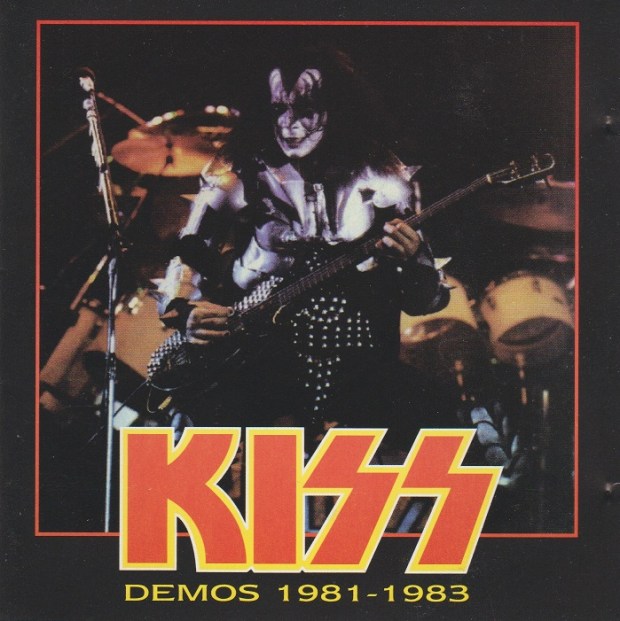
For the first time in my life, I bought a CD that sounded so shitty, I couldn’t even stand to listen to it. I knew that the bootleg CD, Kiss Demos 1981-1983 wasn’t going to sound terrific, because my neighbor George had a version of this on LP way back in the day. I didn’t know it was going to sound this horrid.

Demos 1981-1983 collects some Kiss and assorted tracks, from some very dubious sources.  It sounds like 12th generation cassettes, complete with music bleeding through.  You can actually hear “Tokyo Road” by Bon Jovi bleeding through on track 7.  Enjoy the tape drop-out and inaudible drums too.  There are some interesting bits here, and some useless ones.

You can divide this CD into three sections.  The first six tracks seem to be Vinnie Vincent demos.  They include “Boyz Are Gonna Rock”, which evolved into two separate songs.  The verses became “And on the 8th Day” by Kiss, from the 1983 album Lick It Up.  The choruses became “Boyz Are Gonna Rock” from Vinnie Vincent Invasion’s debut LP.  These demos reportedly feature Vinnie himself on lead vocals, and he does a fine job of it in fact.  Why did he even need a lead singer?  Another curious track is “Back on the Streets” which Ace Frehley was known to play live before his first Frehley’s Comet album.  In fact the Comet band covered it on the tribute album Return of the Comet, and Vinnie put it on the first Invasion album. Finally there is the track listed on the back as “Your Baby”.  This is actually “Baby O” also from Invasion’s debut.

Moving on from the Vincent tracks, there are a few Kiss demos supposedly from The Elder sessions.  These include titles that are probably made up:  “Heaven”, “The Unknown Force” and “Council of the Elder”.  They are accompanied by an instrumental demo of “A World Without Heroes” and the original Frehley version of “Dark Light”, called “Don’t Run”.  These are actually really cool skeletons of tracks.  The one titled “Unknown Force” is a bass-led instrumental, and it has a funky little guitar part that is insanely nifty, but it’s just one idea that needs to be fleshed out.  Then there is “Heaven” which fans today know better as “Carr Jam” (on Kiss’s Revenge) or “Breakout” (on Frehley’s Comet).  Eric Carr wrote this riff for The Elder sessions and though Kiss didn’t use it, Ace did.  “A World Without Heroes” is an instrumental on which you can barely hear guitars.  Finally there is the track called “Council of the Elder” which could be the best of the lot.  It has a Zeppelin-y beginning reminiscent of things like “Thank You”, before it blasts into a cool riff that I don’t recognize from anywhere else.  Only a small part of the song seems to have been used, in “Only You”.

The third chunk of songs focuses on Lick It Up demos, a boring bunch of inaudible crap, all but one snippet called “You”.  It’s just a few chords and a vocal melody idea that Paul and Vinnie came up with, but it’s cool to hear them harmonize.  It’s possible this track evolved into “A Million to One” as the chords are similar.

The most inexcusable inclusion on this CD is “Young & Wreckless” which claims to be a Lick It Up demo with vocals by Vinnie Vincent.  This inclusion is an error that goes all the way back to the vinyl versions of this bootleg that circulated in the 80s.  The immediately obvious issue is that it’s not Vinnie Vincent singing, it’s Brian Vollmer.  That’s because “Young & Wreckless” is a Helix song, and this track is lifted right from their 1984 album Walkin’ the Razor’s Edge!  Like the rest of the CD, it sounds like an 18th generation cassette copy.

This disc is for die-hards only.  What I’d like to see is an official release of the demo tracks from The Elder period, which are great.  Next box set, boys?

1/5 stars

To be continued…


RE-REVIEW: KISS – Lick It Up (1983)

The KISS RE-REVIEW SERIES Part 23:

  Lick It Up (1983 Polygram, 1997 Mercury remaster)

On September 18 1983, Kiss publicly unmasked on MTV.  They each appeared with a name tag at a desk and answered questions from the press.  Their first album with their bare faces on the cover was just released on that day:  Lick It Up.  With two non-original members now in the band, and their fortunes fading, it seemed like the best move commercially and artistically.  According to writer Robert V. Conte, the Kiss press conference was overshadowed by an MTV special on Van Halen, broadcast the same evening.

It would be easy for skeptics to dismiss Kiss’ unmasking as a mere stunt, and in many ways they would be right, but it was not a decision made lightly.  Kiss had legitimate fears about how they could carry on without the makeup and costumes.  They came to realize that they could just continue doing what they do – playing their songs live as they always have.

The new album, Lick It Up, was brilliant. It is “exhibit A” in the case of “Did Vinnie Vincent save Kiss?”  With eight out of ten writing credits, all of them great, it certainly appears that Vinnie gave Lick It Up a swift kick in the afterburner.

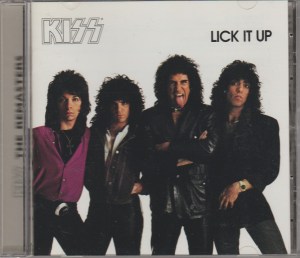
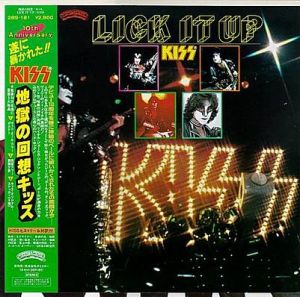
The stark white cover featured Kiss in their street clothes.  It was a minimalist cover with the only clue to their identities being Gene’s tongue.  In Japan, a full cover obi retained the band in makeup (including Vinnie) until you opened the package and saw the white cover inside.  This led to an urban legend that Japan actually had a rare makeup cover on their edition of Lick It Up.

Strangely enough, even though Lick It Up was Vinnie’s official debut as a Kiss member, He didn’t play the solo on opening salvo “Exciter”.  This was unknown to fans at the time, but “Exciter” was performed by Rick Derringer after Vinnie couldn’t nail the right vibe in the studio.  It was an ominous warning of things to come.

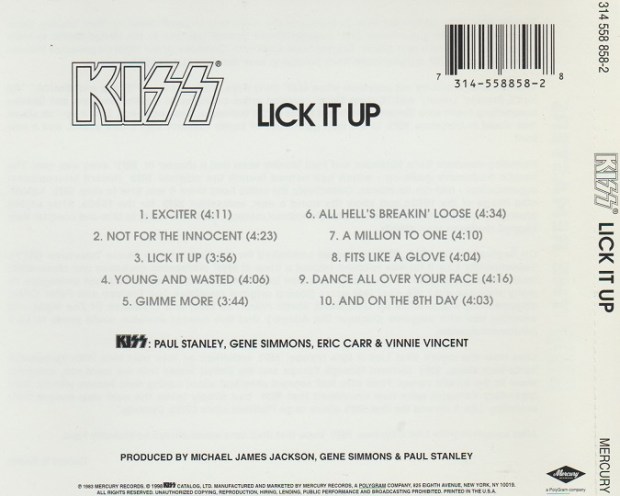
Otherwise, “Exciter” ushered Kiss into the 1980s with a sound that fit.  It had a chunky guitar chug, and killer melodic chorus, and left the sound of the 70s far behind.  Perhaps most importantly, it had no outside writers.  Nothing on Lick It Up required outside writers now that they had Vinnie in the band.

After the blowout opening of “Exciter”, Gene Simmons grinds it down slow with one of his heaviest tracks to date: “Not For the Innocent”.  Gene adapted his singing style to include a Demon scream, and “Not For the Innocent” features lots of it on the outro.  “Not For the Innocent” built on the heavy Kiss of Creatures of the Night and pushed it heavier.

The first single was the successful and surprisingly simple “Lick It Up”.  It’s basically a textbook guitar chug with verses and a chorus – no solo.  It was enough to go top 40 in the UK and Canada and has since become a concert staple.  In fact it’s the only Lick It Up song to remain in the set beyond the 80s, and it’s a pretty good song for what it is.

Simmons returned to the fore on the frenetic “Young and Wasted”, an example of speedy 80s Kiss keeping up with their metal compatriots.  Fortunately, Vincent provided a kicking riff.  Live, “Young and Wasted” was often given to Eric Carr to sing.  The studio version is the one to beat.  Then it was Paul Stanley’s turn in the driver’s seat with “Gimme More”, keeping things rolling in a non-descript top gear.

One of the most interesting tunes on Lick It Up is the side two opener and second single “All Hell’s Breakin’ Loose.”  It was begun as a Zeppelin-y riff by Eric Carr, and finished by all four members – only the second Kiss song ever credited to all four members.  It became, in Eric’s words, a “rock and roll rap song!”  That’s not quite so, though Paul’s talk-singing in the verses evokes the basics of rap.  No worries though; this is one brilliant Kiss song that really deserved more exposure.  One worth buying the album for.

The Simmons-dominated second side of Lick It Up is where most of the treasures are found, but Paul had one more kick at the can.  Paul’s “A Million to One” is an unsung classic.  A defiant Stanley tells an ex that her chances of finding a better lover are “a million to one”.  With such an awesome song backing him, Paul makes a convincing argument.  He hits a homerun with melody and angst.

A trio of Simmons tunes ends Lick It Up as one of Kiss’ heaviest album.  “Fits Like a Glove” is speedy-Kiss again, hyper-caffeinated and playing as fast as they can.  Gene’s barking out the words, chewing them up, spitting them out and taking no prisoners.  Then, he brings it back to a groove on “Dance All Over Your Face”.  It’s a song you might not know, but you should.  Kiss’ deep cuts from the 80s have some rare diamonds, and this is one of them.

The closer was an apocalyptic rocker called “And on the 8th Day” which was based on a Vinnie Vincent demo.  The verses of that demo became “And on the 8th Day”.  The choruses became a later Vinnie Vincent Invasion track called “Boyz Are Gonna Rock”, which we will look at later on.  The two songs share DNA but have little else in common.  The Vincent demo is the kind of speed rocker that dominated Lick It Up.  Meanwhile the Kiss song “And on the 8th Day” has the slow monster plod, a killer riff, and a chorus that goes on for days.  Although it’s never seen the light of a concert stage, it really should have.

Though Vinnie Vincent co-wrote the songs that may or may not have saved Kiss, he was a real problem.  His personality didn’t mesh, and his ego got the better of him.  He couldn’t come to an agreement with Kiss over his contract, and in fact never signed one to become an official Kiss member.  This caused him to be let go at the end of the European Lick It Up tour.

Finding a replacement for Vincent wasn’t easy, and he was re-hired for the American tour, though he still delayed signing a contract.  Issues with Vinnie grew on this tour, as he grabbed more of the spotlight from his bandmates.  Like Ace Frehley before him, Vinnie was given a five minute solo spot, but sometimes Vinnie dragged them out well into overtime.  This caused plenty of tension, especially when he once broke into an impromptu solo leaving the band on stage not sure what to do.  The issue of Vinnie’s contract became a non-issue when he was let go permanently.  The band have had very little good to say about Vinnie Vincent since then, especially when the lawsuits began.  Despite this, Lick It Up was not to be Vinnie’s final collaboration with his former band.

Did Vinnie Vincent save Kiss?  This argument will go on as long as there are Kiss fans to discuss it.  Vinnie certainly did provide Kiss with some grade-A songs, both here and on Creatures of the Night.  However he wasn’t the kind of guitar player they needed, who could play the old stuff authentically and also shred with the new kids.  If Vinnie hadn’t come along, another talented writer would have, and Kiss would have continued.  This doesn’t do anything to discredit Lick It Up, a damn fine “comeback” indeed.

Today’s rating:

5/5 stars


Uncle Meat’s rating:

3.5/5 steaks 

Meat’s slice:  After my scathing review of Creatures of the Night, I wasn’t sure how to approach this Lick It Up Meat’s Slice. I guess I’ll start with March 15, 1984. My buddy Scott Hunter and I went to Maple Leaf Gardens to see Kiss on the Lick it Up tour, with supporting act Accept! This was to be my second Kiss concert, as we were also at Maple Leaf Gardens for the Creatures tour on January 14, 1983. A concert in which we didn’t know until well after that it wasn’t Ace Frehley on guitar…but none other than Vinnie Vincent. Of course Vinnie was on guitar for the Lick it Up tour as well. Great show with openers The Headpins. Before my 15th birthday, I had now seen Kiss twice. I am 47 now and haven’t seen them live since.

Kiss had taken the makeup off between these albums. Years before I remember seeing a People magazine in my grandmother’s bathroom, while taking a shit, that showed Gene Simmons with a bandana over his face just over his nose. Up until now I had not seen any Kiss member without makeup. So there they are on the Lick It Up cover and all I can think is…”Damn…wish they still had makeup at least for that really ugly dude,” (Vinnie).  The title track of the album has become a bit of a Kiss classic and is still a great song. Not a lot of this album is exceptionally great in my opinion, but there are some good gems in there. The best of which I think is “All Hell’s Breakin’ Loose”, which I have always loved and still do. Other than those two songs? The album lies somewhere between Meh and Good for me.

Funny Vinnie story for me though. Many years ago our makeshift band at the time were playing a Christmas assembly at St. David’s High School in Waterloo here. I was standing behind the soundboard as my guitar player was on stage doing a sound check. The sound guy asked my buddy Dave to play a bit to get a starting level. As per usual, Dave went ripping into some heavy metal bullshit soloing. After a few seconds of that I could see the sound guy waving his hands in the air in front of me, and after getting Dave’s attention, says into the microphone at the board, “Okay Vinnie Vincent…Settle down there.”  Always found that kinda defined the Vinnie Vincent Invasion.

Favorite Tracks: “All Hell’s Breakin’ Loose”, “Lick It Up”

Forgettable Tracks: I don’t know about forgettable, but the rest isn’t that memorable.


To be continued…

Original mikeladano.com review:  2012/07/20


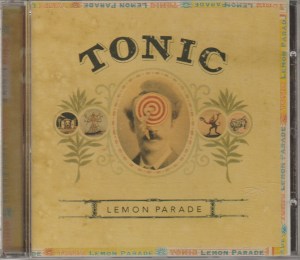
REVIEW: Tonic – Lemon Parade (1996)

TONIC – Lemon Parade (1996 Polygram)

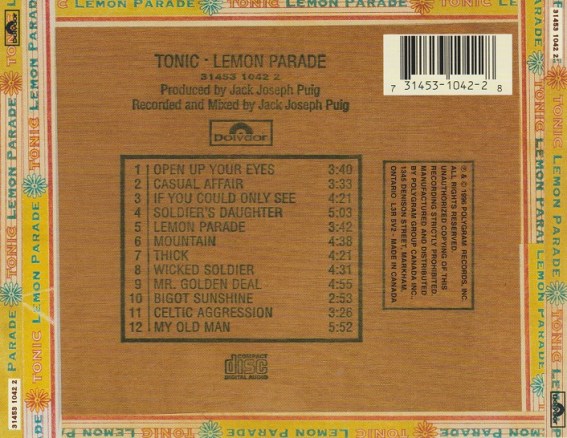
“If You Could Only See” was both the song the put Tonic on the map, and the one that put the bullet in their career.  If you’re over a certain age, you remember the powerful and tasteful ballad from when it hit the charts in 1997.  I had the album already.  I bought it when it first came out, after reading a glowing review in the local paper and seeing a used copy pop in at the Record Store.  Finding Jack Joseph Puig’s name in the producer credits got my attention too.

Tonic’s debut Lemon Parade is a great sounding CD, thanks to Puig and the richly arranged guitars of Emerson Hart and Jeff Russo.  When the guitars are center stage, all is well.  The opening duo of “Open Up Your Eyes” and “Casual Affair” have the punch that people don’t always associate with Tonic.  These guys could play.  “Casual Affair” in particular has angst and emotion ripping out of those six-strings.  When they get heavy, like on “Wicked Soldier”, there is always something bright and chiming going on with backing guitars.  Check out “Celtic Aggression” for a fine example of their guitar expertise.  Emerson Hart has an emotive voice, whether rocking out or serenading the ballads.

It’s the ballads the people remember, and you have to admit that when you break it down, “If You Could Only See” is a fantastic song.  Layers of chiming, chugging and sliding guitars are right there beneath the core melodies.  On the mandolin-infused “Mountain”, plus “Soldier’s Daughter” and “Lemon Parade”, you can absolutely hear old-tyme southern influences creeping through.  Tonic have traits that sound as if from another era, in many ways.  These are actually quite great songs, largely forgotten because of that one hit.

There are only a few songs that don’t score top marks:  “Thick” (no hooks), “Mr. Golden Deal” & “My Old Man” (both too sleepy).  The rest is pretty solid.

3.5/5 stars

#423: The Tyranny of Cassette in the ’80s

RECORD STORE TALES MkII: Getting More Tale
#423: The Tyranny of Cassette in the ’80s

Anyone who grew up in the mid to late 1980s probably enjoyed their music on the most popular format at the time:  cassette.  Vinyl LPs were still around, and still popular, but not nearly as much as cassettes.  CDs were new and only a few of us had CD players yet.  Cassette tapes had the portability factor going for them.  Everybody had a Walkman, and those who didn’t probably had one on their Christmas list in 1985.

Vinyl was a dying breed in our highschool halls.  There were still some older kids who boasted of the superior sound quality, but none of my friends had equipment good enough to enjoy that sound quality.  I certainly didn’t.  All I had was a turntable hooked directly into a Sanyo cassette deck for amplification.  The sound was harsh and tinny.  The scratches inherent with the format were also more distracting than the tape hiss of cassette.

So, it was all about cassette!  Buy ‘em, trade ‘em, swap ‘em and re-record over them when you decide you don’t like the music anymore.  I have a cassette copy of Michael Jackson’s Thriller that had long ago been erased and taped over with other stuff.  When you couldn’t find a fresh blank tape to record on, you could just erase something else.  Everybody did it.  My friend Bob had a cassette of In Through the Out Door that he recorded over with us talking and goofing around!

For teenage highschool kids, cassettes were enough for our musical fixes.  A decent quality name brand tape could hold up to 110 minutes without stretching.   We used them to tape anything and everything.  (I have a tape with the sound of a friend’s dad taking a massive shit — no, I did not record it, they did!)  Since cassettes were re-recordable, that meant that every kid could even record their own music and become a rock star in his or her own basement.  You couldn’t do that with your fancy schmancy LPs, we all thought!  Don’t like your song?  Just rewind and record it again!  Those who didn’t play music could have their own fun, DJ’ing and and writing skits.  And let’s not forget about taping your friends’ albums.  Recording tape to tape would always result in excessive tape hiss, but kids didn’t seem to mind in the 1980’s.  We ignored the hiss.  It was something we considered part of the music, because we really never heard any music without hiss!

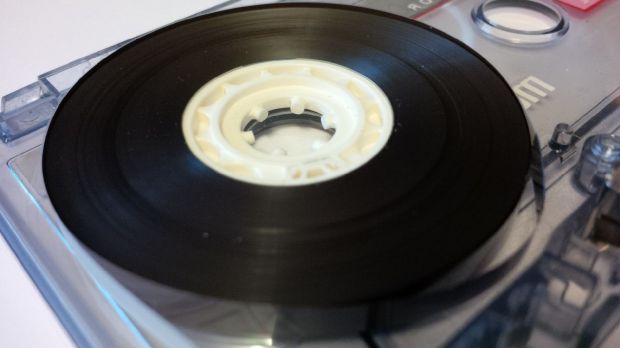
Although the flaws of cassettes are patently obvious today, in the 80’s we were just discovering these troubling issues for ourselves.  We overlooked the tape hiss, but it was harder to ignore speed issues.  The biggest problem that I had with cassettes was inconsistent speed.  Some tapes, especially those made by Polygram and EMI in Canada, seemed to have a lot of internal friction.   Grab a small screwdriver and open up an old cassette tape some time.  Inside you will find rollers, spindles, and bits and pieces all designed for the cassette tape to roll smoothly.  Whether they worked right always seemed to be a matter of random luck.  When friction inside caused the tape to run slow, it was immediately obvious.  The pitch would be noticeably lower, and often the tape would warble as your player tried to play it at normal speed, but fought against the friction.

On the other hand, sometimes the problems came down to your player.  Your tape deck had even more spindles and doo-dads to turn that tape around and around.  Those got dirty and worn out, too.  Sure, you could buy tape head cleaners and demagnetizers, but did they ever really have a noticeable effect on your listening experience?  Probably not.  I used to diligently clean the insides of my tape decks with lint-free cloths and isopropyl alcohol.  Although I could see black filth coming off the rollers when I cleaned them, the sound and speed never really improved.  It was always very frustrating when a tape would play fine on a friend’s deck, but went slow as molasses on your own.  My Sanyo went in for service and professional cleaning more than once, but that didn’t help either.

Although cassettes sounded like shit, and only got worse the longer you kept them, they did have a big advantage over CD for me, and that was portability.  I preferred cassettes in the car, up until fairly recently.  The reason for this was, working in the used CD store, I saw so many CDs that were just utterly destroyed by car CD players.  You don’t get that problem so much anymore, but in the 90’s and 2000’s, there were a lot of discs just annihilated by a lot of car decks. It didn’t seem to matter if the car player was a high-end stereo or a piece of crap.  People would bring their used CDs in to me, and ask me how they looked.  I’d usually ask, “Did you play this in a car deck?”  I could always tell.  Customers would ask me, “How did you know?”  Because the CD would be completely scratched, but always in perfect circles.  Some dirt clearly got into the car deck, and scratched up the discs as they were spinning.  Or, the disc was just scraping up against the internal workings of the car player as it spun.  Either way, the result was usually a CD that looks like a kid’s Spirograph drawing.

At least when playing a cassette in the car, those things could take a beating.  I only ever had one or two that were “eaten” by the player.  Compare that to the thousands of CDs that I saw destroyed by car decks over the years.

If life is a musical journey, then cassettes were my travelling companions for over a decade.  We had a necessary parting of ways, and now I am happy to stick to CD and flash drives when on the road!

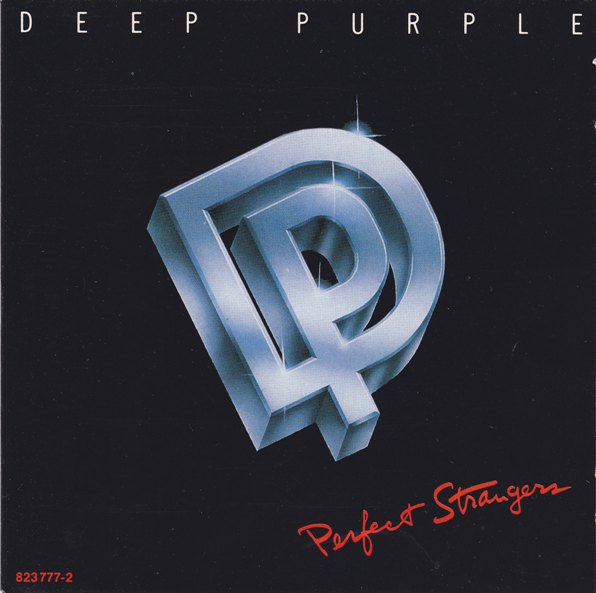
REVIEW: Deep Purple – Perfect Strangers (1984)

It’s Purple Week at mikeladano.com!  It’s all Deep Purple and Deep Purple alumni, all week.  This is Part 3…and this time we’re going Epic Review Time.  

Part 1:  Shades of Deep Purple
Part 2:  The Book of Taliesyn

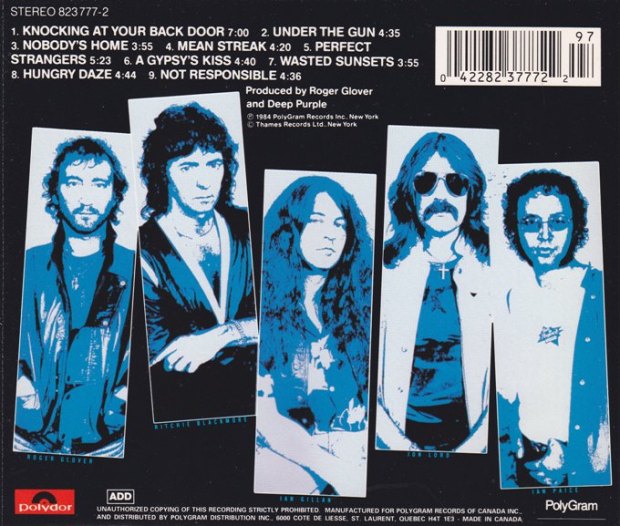
PERFECT STRANGERS_0001

DEEP PURPLE – Perfect Strangers (1984 Polygram)

Deep Purple were the proverbial candle that was burned at both ends.  Their first four studio albums (plus a friggin’ concerto!) were cranked out in a mere two years.  Management and record labels pushed the band to stay on the road, only taking precious breaks to write and record new music.  Sometimes the pressure worked (Machine Head) and sometimes it didn’t (Who Do We Think We Are).  Ian Gillan’s resignation signaled the end of the celebrated Deep Purple Mk II lineup.  Though the band successfully carried on with David Coverdale & Glenn Hughes, even those lineups imploded and by 1976, Deep Purple officially ceased to exist.

The absence of Purple created a void that was filled by greatest hits records, live albums, and well-known side projects such as Ritchie Blackmore’s Rainbow, Gillan, and Whitesnake.  Still, there was such a demand for Deep Purple itself that original singer Rod Evans put together his own bogus “Deep Purple” and played several shows in 1980!  In his band were a couple guys from Iron Butterfly, but no other former Purple alumni.  Just Rod.  The guy who didn’t sing “Highway Star”, “Smoke on the Water”, or “Lazy”.  Needless to say, Rod Evans’ bogus “Deep Purple” did not last as soon as word got out.  The lawyers for the other former Deep Purple members ensured that by running ads in the local papers. “The following members will not be appearing with the band called Deep Purple at [such and such a date and venue] : Ritchie Blackmore, Ian Gillan, Ian Paice, Jon Lord, Roger Glover, Glenn Hughes, David Coverdale.”  A show in Montreal was particularly horrid, and reportedly the band’s stage act involved one of the members bringing out a chain saw to cut stuff up. They were hit with lawsuits galore and quickly packed it in, but not before recording two new songs for a projected new “Deep Purple” studio album. The two songs, “Blood Blister” and “Brum Doogie”, are thankfully lost.  A video of “Smoke on the Water” live in Mexico remains, to remind us why this was not a good idea.  [For more on the bogus “Deep Purple”, click here.]

Clearly, lots of profits were to made if the real Deep Purple were ever to reunite.  They tried earlier on, but were hung up when Ian Gillan joined Black Sabbath.  When Ian’s Sabbath commitments were finished a year later, it finally happened.  Jon Lord had freed himself of Whitesnake, and Ritchie, Roger Glover and Ian Paice were all ready willing and able.  The reunion was on, for real this time.

The band quickly agreed on creating new music (otherwise, what’s the point of it?), and decided that there had to be a level of quality that served the name Deep Purple.  They retreated to the gorgeous Stowe, Vermont and found themselves to be in great spirits and full of ideas.  Another wise decision was the use of bassist Glover to produce.  After his first stint in Purple, he became quite successful as a producer.  He recorded some of the best Nazareth albums, a Judas Priest record (Sin After Sin) , Rainbow, David Coverdale, and countless more.  It only made sense to keep production of the new album within the band when you have a guy like Roger in the band!

The album that resulted, Perfect Strangers, was more modern but unmistakably Deep Purple.  Taking advantage of modern recording studios resulted in an album with rich instrumental tones.  As great as classic Deep Purple albums were sonically, Perfect Strangers has a new richness and clarity.  Jon’s organ is deep and gorgeous, but Ian Paice’s drum sound is monstrous.

The opening track “Knocking at Your Back Door” (hah hah hah) commences with ominous keys from Jon, sounding at first like the pipes of doom.  Then Roger begins a quick pulse, and Paice crashes that cymbal, and my God, Deep Purple is back!  Ritchie and Ian join them for the first Deep Purple epic of the album — and on the first track, no less!  “Knocking at Your Back Door” may be a joke lyrically, but it’s dead serious musically.  It’s Deep Purple, but streamlined.  Extraneous things have been discarded; others are sleeker.  The only disappointment about the song is actually the guitar solo, which just slightly does not fit.  Glover once said about this album that Ritchie struggles with solos in the studio more so than live.  Something about when the red light goes on, he gets cold feet.  There’s some incredible playing in this guitar solo, but parts of it feel out of place and overdone.

PERFECT STRANGERS_0003

That one minor complaint is probably the only quibble you’ll read here about Perfect Strangers.  The album continues to impress as it plays.  “Under the Gun” is a song that would sound so great live today; shame that it hasn’t been played live in 30 years.  I can’t imagine why.  “Under the Gun” demonstrates the streamlined groove that Purple were going for in the 80’s.  Listen to Paicey’s drums.  They are relentless and powerful, but he’s also playing it simpler than he used to.  This is intentional.  When I say “streamlined”, that doesn’t mean there aren’t long solos, because Ritchie’s here is over a minute long (in a 4:34 song)!

“Nobody’s Home” gives Jon Lord a change to stretch out a bit on the synths, but it’s just a feint.  This track re-writes “Black Night” for 1984, and ties it all up with a little bow in under four minutes.  “Your lights are burnin’ bright, but nobody’s home!” sings Ian, for once not speaking of Blackmore!  Jon takes the spotlight with a nice quick solo on the Hammond, a sound not often heard in ’84.

Side one was closed by the nasty little “Mean Streak”.  It has one of those quirky Gillan lyrics that I like so much. “She came home last night, rockin’ rollin’ drunk. She talk no sense but she sound good so she thunk.”  It’s a cool rock track with a chugging riff; always a deadly combination when wielded by Deep Purple.  It boasts one of Ritchie’s coolest solos on the album.

I will never forget seeing this video on MuchMusic, introduced by Bruce Dickinson.  Of Deep Purple he said, “Well, they’re very good. But not as good at football as they appear. No. They’re not.” The VJ (Erica Ehm) asked, “Why not?”  Dickinson simply responded, “Because they’re not! What a silly question.”

Of all the songs on Perfect Strangers, only one has been consistently played live every tour:  the title track.  This epic, like its  side one counterpart “Knocking at Your Back Door”, opens with Jon’s ominous keys.  This time it’s the old trusty Hammond, and then the band crash in with the riff to kill all riffs.  I think in some respects, this song has become Deep Purple’s “Kashmir”, especially when played in concert.  It has evolved to become more exotic since it was first recorded, though it does contain those flavors here.  The lyrics are ambiguously beautiful.  Back in the Record Store days, I talked to a guy once who thought the lyrics were about God.  I’ll leave it up to you.  Blackmore called it his favourite Deep Purple song.  It’s a tough call, but Top Five for sure.  I cannot survive without this song in my life, period.

Then WHAM! “A Gypsy’s Kiss,” right in the kisser.  If any doubters had thoughts that Purple had lost anything in the past decade, this song proved them dead wrong.  Blazing pace, blazing Paice, the whole place is ablaze!  Again, Ian’s lyrics are awesome, and I love the self-referencing.  “Space truckers free and high, Teamsters get ya by and by.”  I also really like this verse, because, hey. John Wayne, man.

John Wayne, the Alamo,
Crazy Horse, Geronimo,
I’ll smoke a piece with you.
Mind, Body, Heart and Soul,
We got Rock and Roll,
And there’s nothing they can do.

A good Deep Purple album rarely has a slow blues buried deep within.  “Wasted Sunsets” is the album’s heavy blues track, like “When a Blind Man Cries” was to Machine Head (though it was relegated to a mere B-side).  Jon’s organ sets the mood stunningly, and Ritchie absolutely nails it.  I get the feeling that Ian is baring his soul in the lyrics, although he doesn’t seem too regretful of all those one night stands.

For self referencing, no lyric on the album beats out “Hungry Daze”:

The mountain’s getting cold and lonely,
The trees are bare,
We all came out to Montreux,
But that’s another song, you’ve heard it all before!

Regrets?  Hell no.  “Different girls, laughing girls, forever girls and it was loud!”  Gillan has a talent for making cheeky lyrics like this work with serious music.  “Hungry Daze” has that modern Purple groove with the same kind of chugging exotic riff that powers “Perfect Strangers” — but faster!  There’s even backwards tapes (Jon’s organ), a sound unheard on a Deep Purple album since 1969, but back in style in 1984.

Lucky cassette and compact disc buyers got a bonus track: “Not Responsible”.  When I first got the album (on cassette) I wondered, “Why is this song a bonus track? It’s one of the best songs!”  Good question!  (Perhaps because it’s the only song on which Gillan dropped an f-bomb.)  I think it closes the album even better than “Hungry Daze” does.  Lyrically it’s more drinking and debauchery.  “So I’ll raise a glass to you, the foot is on the other shoe.”  I consider “Not Responsible” to be of equal value to any of the better tracks on the album proper, so if you only own this on LP, consider getting this song (legally) to complete the picture.

PERFECT STRANGERS 12 INCHWant more?  There’s one more, but you’ll have to do a little research to get it in full.  “Son of Aleric” is a killer slow groove 10 minute instrumental, with all the flavor of the album.  It was released on the B-side of “Perfect Strangers”.  If you bought the 7″ single, you got the 5:28 edit version.  If you bought the 12″ single, you got the full Monty at 10:03.  The full version was rarely issued on CD.  I have it on a compilation CD with the cumbersome title of Knocking at Your Back Door: The Best of Deep Purple in the 80’s.  But “Son of Aleric” is only on the UK version!  (Other territories just got a live version of “Child in Time” from the live album Nobody’s Perfect.  Bummer.)  This is the kind of open Deep Purple jam that you just want to melt into.  It’s magic.

If you like Deep Purple, but do not own Perfect Strangers, then I advise that you remedy that situation at your earliest convenience.  I am no stranger to this album; I have played it hundreds of times, often more than once in the same day.  I have never grown tired of it.  For that reason, and many more, Perfect Strangers earns the coveted:

5/5 stars

PERFECT STRANGERS_0002

REVIEW: Def Leppard – High ‘n’ Dry (1981)

Part one of a Def Leppard two-parter!

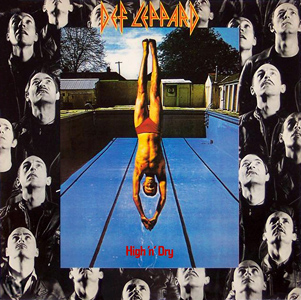
Def_Leppard_-_High_'n'_DryDEF LEPPARD – High ‘n’ Dry (1981 Polygram)

Now that Pyromania, Hysteria, Slang and Adrenalize have been remastered and reissued with bonus tracks, it is High ‘N’ Dry that needs to be given the deluxe treatment next.  The fact that Adrenalize has been given an elaborate deluxe edition, but High ‘n’ Dry hasn’t even been remastered yet, is injustice.  Any time I listen to High ‘n’ Dry, I leave with one conclusion:  This is Def Leppard’s best album.  And not only that, it’s just one of the best by any hard rock band, period.

For High ‘n’ Dry, my g-to version is my vinyl US pressing.   The CD is still in my collection, because it includes two songs not on the original LP: 1984 Remixes of “Bringin’ On The Heartbreak” and “Me and My Wine” (the versions that were used for the music videos).  So that’s cool, good enough reason to own the CD, but the LP has one more gimmick that you can’t get on CD.  The final track on side two, “No No No”, ends in an infinite loop of Joe screaming “NO!”  I love vinyl gimmicks.  I also love that the vinyl has inner sleeve photos that you don’t get on CD (even if one appears to be Rick Allen’s genitals covered in whipped cream).

This is one solid LP.  Def Leppard teamed up with Mutt Lange for the first time and his influence is palpable.  Def Leppard had been heavy before, but now they were channeling a serious AC/DC vibe.  Mutt had just produced a little album called Back In Black.  Surely it was no coincidence that High ‘n’ Dry has similar riffy and sonic qualities?  Def Leppard’s edge had yet to be blunted in their search for hits.  Instead, it had been sharpened.  On Through the Night could have been better, more tightly focused.  High ‘n’ Dry is as focused as a laser beam.  Aside from one guitar-driven power ballad (“Bringin’ On the Heartbreak”) every song seeks only to scorch.

Although there is not one single throw-away or filler track on High ‘n’ Dry, everybody has their favourites,   Mine:  The melancholy vibe of “Lady Strange” and “Mirror, Mirror (Look Into My Eyes)”.  The pedal-to-the-metal hard rock of “High ‘N’ Dry (Saturday Night)”, “Another Hit And Run”, and the instrumental “Switch 625”.  And my personal favourite song, “You Got Me Runnin'”.  I don’t know why that is so, but that’s the one right there that puts fuel in my tank.

Unlike the band that Def Leppard has become today, this album was all about the hot riffs and the Joe Elliott screams! Hard to believe it’s the same band. But, of course, today they have two different guitar players, so the meat of this band is also not the same.  Having said that, the band acquitted themselves nicely on the recent live album Viva! Hysteria.

Every Leppard fan should own High ‘n’ Dry.   Everybody who’s ever liked a Def Leppard song needs to check out High ‘n’ Dry.  Actually, anyone who breathes should check this album out at least once.  It’s on my desert island list for sure.

5/5 stars, but come on, we need a reissue!

REVIEW: Aldo Nova – Blood on the Bricks (1991)

ALDO NOVA – Blood on the Bricks (1991 Polygram)

After Aldo’s career had been declared clinically dead and Aldo himself a “one hit wonder” (“Fantasy”), it took the mighty Jon Bon Jovi to resurrect him. JBJ, who co-produces and co-writes pretty much every song here, has a heavy stamp on this album. Considering that Aldo played on several Jon Bon Jovi releases, this album will appeal mostly to fans of the Well-Coifed One.

The problem with Blood On The Bricks is not lack of decent material, or lack of chops. Indeed, Aldo proves on several tracks that he is a burnin’ axeman, and he even takes a brief keyboard solo on “Bright Lights”. The problem here is that this album is choked to death in overproduction, and I have to blame JBJ for that. Every song collapses under its own weight of gang “whoa whoa” backing vocals, shrill instruments, and thudding shapeless drums with all the characteristic telltale signs of samples.

A song like “Medicine Man”, for example, is a decent if generic song on its own. However it stumbles under the weight of layers of backing vocals and overdubs. The production has spoiled this batch of pleasant if ordinary rock toons. This type of production value was way too common in 1991. Play Prisoners in Paradise by Europe, or Hey Stoopid by Alice Cooper for an idea of this sonic quality. Aldo’s album is recorded and mixed even worse than the afforementioned. And the lyrics are pretty juvenile. “His boom-box blastin’ some Metallica track”? Did Aldo really sing that?

Song highlights for me incluced the burning title track, “Bright Lights”, and nostalgic moments like “Touch Of Madness”, “Young Love” or “Medicine Man”. However aside from the guitar playing everything here is terribly generic; there’s nothing here that you haven’t heard before.  For example, “Veronica’s Song” boils down to a rewrite of Bon Jovi’s “Silent Night”, and that makes me sad.

Two more Bon Jovi connections to mention:  the great Kenny Aranoff, whom Jon likes to use on his solo projects such as Blaze of Glory, plays drums.   Phil X is pictured in the CD booklet as he was in Aldo’s touring band, but he does not play on Blood on the Bricks.  Phil X, known to his friends as Phil Xenedis, is currently on the road with Bon Jovi, filling in for Richie Sambora.

I do like the original cover, it was cool if a bit bland. This edition has an annoying “FEATURING JON BON JOVI” scrawled all over it, as large as the album title.  That also makes me sad.

3/5 stars