My thoughts are with those in Boston tonight. Yesterday, T-Rev, Wes and I attended the The Toronto Musical Collectibles Record & CD Sale. T-Rev went specifically hoping to find Ogden’s Nut Gone Flake by the Small Faces, on vinyl, with the original round cover in displayable condition. He came home with that record for the price of $30.
I hit paydirt. I came with $200 and I left with $0 (there was a $5 entrance fee). I also left with seven (7!!!) Japanese import rock albums all with bonus tracks, five 12″ records, a 7″ single, and a rare book. Today I’ll show you the CDs, which I am most excited about! You can see the rest another day.
You can’t find Japanese imports anymore around here. And many of these are long out of print. I’ve been looking for the Pistols’ Filthy Lucre Live since 1996. Blackmore’s Rainbow is one that I’d seen before. The HMV store at Fairview Mall in Kitchener had one…in 1995. Rob Vuckovich used to try to goad me into buying it, but I couldn’t pay the $50 price tag for just one bonus track. $15 though? With obi strip intact? Hell yeah!
So here’s the list of Japanese imports and what I paid. I believe most of these have to be half of retail.
HAREM SCAREM – Live at the Gods. This is a Japanese exclusive live album. I paid $20, sealed.
SEX PISTOLS – Filthy Lucre Live. I’ve been waiting a long time. I love this album. Two bonus tracks: “Buddies” (“Bodies”) and “No Fun”.
SCORPIONS – Face the Heat. I paid $15, for 2 wimpy bonus tracks called “Kami O Shin Jiru” and “Daddy’s Girl”. Both are ballads, but for $15, no bother!
IAN GILLAN – Gillan’s Inn. This one was a bit more expensive: $30, because it had the DVD (that won’t play in this region). But it also has the bonus track “Eternity” that isn’t even on the Tour Edition.
CORROSION OF CONFORMITY – Wiseblood. I paid $20, has the bonus track “The Land of Free Disease”.
RAINBOW – Stranger In Us All. Bonus track: “Emotional Crime”. Paid $15.
WHITESNAKE – Good To Be Bad. Paid $20, sealed. Two bonus tracks: “All For Love (Alt mix/Doug solo)” and “Summer Rain (Unzipped)”.
OZZY OZBOURNE – iTunes Festival 2010 (iTunes exclusive EP)
Jesus Murphy! How much live product does Ozzy need? Remember back in the 80’s when he used to moan and moan about record companies who wanted to release live stuff with his hits and Sabbath tunes? Well, for a guy who complained about it, he sure didn’t break the cycle.
This is Ozzy’s third live EP (after Live E.P. and Just Say Ozzy). For those keeping score, Ozzy also has four full length or double live albums, a live bonus disc to the Diary of a Madman album, and several live bonus tracks. But who’s keeping track? I guess it’s kind of cool that this EP was released three days after it was recorded on July 3, 2010…if you were there…or even knew it was happening…I guess.
Anyway this live EP was cool at least because it was the first live product available with Ozzy’s new guitar wizard Gus G. The band was rounded out by Blasko (bass), Tommy Clufetos (drums) and Adam Wakeman (keys). Hmm, didn’t two of those guys also play on the last Black Sabbath tour?
It’s entertaining enough, but any Ozzy live product in the last 20 years has felt like “just another live album” to me. Even with the new lineup on this one, I can’t feel too excited. At least I got one song that I didn’t have any live versions of: the new “Let Me Hear You Scream”. Oh, wait, hold on — another live version was on the Scream tour edition that was released a few months later! Jesus! This iTunes version sound like it has loads of taped backing vocals. Too bad.
“Mr. Crowley” is next, a fine version, nothing wrong with it, after all these years nothing can compete with the version on Randy Rhoads Tribute. Gus G plays the solo pretty much perfectly, but something’s missing. Maybe it’s that the song is tuned down for Ozzy’s voice. Ozzy reminds us that he wants to see “some fuckin’ hands”. Another Blizzard of Ozz track follows, “I Don’t Know”. Gus G gets to do some more original shredding here, as he puts his own spin on an Ozzy classic. This guy will be a guitarist to watch, as he grows.
“Suicide Solution” is the third of three tracks from Blizzard. I think it’s a shame that Ozzy keeps playing the oldies while leaving more recent songs behind him. On this EP, only “Let Me Hear You Scream” is newer than 1991. I for one would probably poop if I got to hear something like “Perry Mason” or “Trap Door”. At least Gus G breaks the world landspeed record with his solo.
One song I never liked, ever, is “I Don’t Want to Change the World” from No More Tears. This is the fifth version I own now. It’s just…I dunno…I hate the chorus. It’s too pop for Ozzy. It’s like Bon Ozzy, or something. Ozz Jovi.
My favourite track is last: “War Pigs”. Even though “War Pigs” is on pretty much every Ozzy live album ever made, this version is one of the most fun! I just love when Ozzy tells the audience this:
“Clap your fuckin’ hands, come on you fuckin’ assholes!”
That is just hilarious! I always laugh. When I put this song on mix discs, I always label it “War Pigs (‘You fuckin’ assholes’ version)”.
OZZY OZBOURNE – “How?” (2010 iTunes single)
The last thing I want to talk about is Ozzy’s studio version of John Lennon’s “How?”. This is also an iTunes exclusive, released in October 2010, shortly after the EP. It was released on what would have been Lennon’s 70th birthday, with the proceeds going to Amnesty International.
Causes and good intentions aside, I think this version is just as crappy as anything on Ozzy’s dreadful Under Cover CD. This is just…dull, boring, and not good. I don’t know who played on it or produced it because there are no credits. (Physical product! This is why I care!)
BON JOVI – “Because We Can” (2013 Island Records Japanese single)
There was a time I used to look forward to new releases by Bon Jovi. It’s been a long time since I felt that way. I thought the band bounced back (pun intended) with 2002’s Bounce, then they lost me immediately again with This Left Feels Right. I don’t like to give up on bands that I used to feel strongly about, so I decided to check out Bon Jovi’s newest single, “Because We Can”.
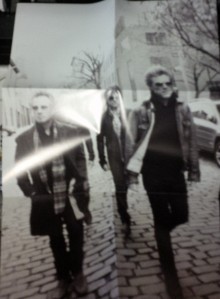
I chose the Japanese single as it had one more track than the European. I had not even heard the song yet. It is written by Jon, Richie and songsmith Billy Falcon, produced by Jon and John Shanks. (In other words, more of the same…) The single came with a small 6-panel fold out poster and lyric booklet in English and Japanese.
The light glare completely erased Dave Bryan from this photo!
Like many fans who have been hanging on long past Bon Jovi’s best before date, I found the song disappointing. Rather than growing, it sounds like Bon Jovi are returning to the mainstream modern pop sounds of Have A Nice Day or even Lost Highway. Bon Jovi’s never been the hardest rocking band, but they have written some great passionate rock songs in the past. “Because We Can”, by title alone, should be in your face and proud of it. Instead, it’s another faceless Pop Jovi song. I’m going to write my own Pop Jovi song called “Who Says We Ain’t Strangers Tonight Because We Got It Goin’ On”.
I hate the chorus, it would be embarrassing to be caught singing this one. There are some nice guitar licks flitting here and there, almost Brian May-like in sound, but barely audible. Everything is buried under a thick blanket of backing vocals, plastic drums and electronic sounds. You can barely make out Richie’s voice, and what passes for a guitar solo is really just a layered guitar melody. At least the Japanese single comes with an instrumental version, which will allow you to hear Richie’s simple and sparing guitar.
The third and final track is a 7 minute live version of “Keep the Faith”, from 2010 in New Jersey. Even this is slightly more laid back than the original 1992 version. But at least it shows that Bon Jovi can write and play challenging material while keeping it accessible. From the manic drum patterns to Richie’s smokin’ solo, this live version is everything that “Because We Can” should be. Richie really shines on this track; I hope he comes back. Bon Jovi without Richie ain’t Bon Jovi.
Based on this single, I won’t be buying the new album What About Now unless I find it cheap.
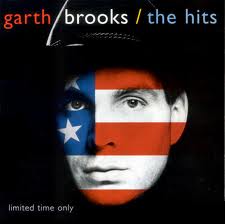
In 1994, Garth Brooks issued his 10 million copy selling compilation album, The Hits. On the front cover was an interesting notation: “limited time only”.
Now, I’ve bought discs that were limited edition before and were numbered to prove it. For example I recently picked up #5945 of the “Credo” single by Fish. Even so…that’s a lot of copies out there for a single by Fish. How many copies of a Fish single would be made anyway? And aren’t all singles limited edition? After all, they aren’t going to make more once they’ve run their course, no matter who the artist is. Onto the next thing.
And then of course you have some seriously limited edition items, like that recent Thin Lizzy Live at the BBC box set! I’m not sure how many copies were made, but everybody’s sold out, and now you have to buy it from people asking way too much. Over $250 USD on Amazon right now. Forget it! That is limited edition.
When Garth plastered “limited time only” all over The Hits, it quickly became a joke. We ordered 50 copies of them, and sold most during the first week. We ordered another 50 copies, as Christmas was coming soon. Those sold. We ordered 20 more after Christmas had passed, and continued to order them every week into the new year whenever we sold out. Some limited edition!
10,000,000 people bought it, and I’m sure 99.9% would have bought it without that “limited time” tag. With great pomp and circumstance, Garth then had the master tapes destroyed.
The master tapes to a freakin’ greatest hits album! Who cares?
It was really hard to take the phrase “limited edition” seriously after that. The next release that came out that truly was a limited edition was the Smashing Pumpkins box set The Aeroplane Flies High, but even that enjoyed a second run when the first printing sold out.
So: the lesson here folks is, when it says limited edition, be skeptical! Very few things are, and the ones that really are limited aren’t always advertized as such. Record labels want to make money, right?
Unfortunately, Garth didn’t put this one on his box set!
One day in the early 2000’s, I was at work, and had this album playing. This guy was in the store, that actually worked at the HMV. As soon as “Truth?” came on, he approached me.
“I can’t believe you’re playing this album. This is great. I don’t know anybody else who really knows this album at all.”
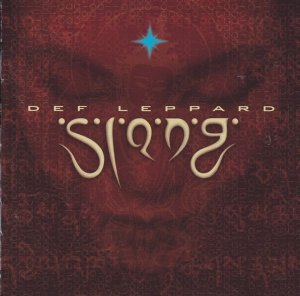
That’s the way Slang went for Def Leppard. It came out to disappointment from the types who want to hear the same album over and over again. (They were obliged on Euphoria). I really dug Slang, then and now. If anything, today I think it might be a tad ballad-heavy. I still love it, and I am excited that Def Leppard plan on releasing a deluxe edition with bonus tracks soon. In the meantime, I have my original limited edition 2 CD set that came with a bonus disc called Acoustic in Singapore.
“Truth?” is a thunderous opener, laden with modern sounding samples and rhythms. Even better is the hypnotic “Turn to Dust”. Although it moves slow, it has loads of exotic atmosphere and instrumentation. Neither of these songs sound like old Def Leppard. There are major changes, including acoustic drums, darker tones and a noticeable lack of shout-along gang vocals.
It’s still the same spirit though. There’s an obsessive attention to detail, layers of backing vocals, and tasty choruses. It’s just 1996’s version of those things. Listen to the title track, “Slang”, for example. It doesn’t sound like anything Leppard have done before, but you can see it as “Sugar” a decade later if you like.
“All I Want Is Everything” is another personal favourite, a great ballad but again unlike what Def Leppard has done before. It has a certain power to it, without being loud and obnoxious. It has a plaintive quality and a fantastic chorus.
Next is “Work It Out” , a contribution from “new kid” Vivian Campbell. It is absolutely loaded with cool guitar squeeks and squonks, no wankery, but a new kind of guitar heroism. These little adornments are there in the mix waiting to be discovered, under suitably thick drones of rhythm guitars. I love this song, which really proved to me that Leppard had successfully adapted their sound to the mid-90’s. A shame it didn’t sell.
Phil’s “Breathe A Sigh” is one that threw a lot of people for a loop. Either Spin or Rolling Stone (I forget which) compared it to TLC. Indeed, loops make up a large part of the percussion parts, and the band seem to be trying R&B on for size. What keeps it Def Leppard are the layers of droney guitars in the back of the mix, and the immaculate vocal choirs.
Interestingly, Slang was stacked with four singles in a row, “Breathe A Sigh” being the final single. This does not mean the album is out of ammunition. “Deliver Me” brings back the heavy. Leppard In Chains? Def Temple Pilots? Not one of the best songs, “Deliver Me” at least balances some of the softer material. Better is “Gift of Flesh”, a driving riff rocker with some slammin’ drums from Rick Allen. Phil wrote this one. I bet it would have been smokin’ live if they ever played it.
This fades directly into a lush but quiet ballad called “Blood Runs Cold”. I could imagine some old-timey fans running away in fear that their nuts would shrivel, at the sound of this one. I love this song, but I’m not sure it needed to be followed by yet another ballad, “Where Does Love Go When It Dies”. Although not a single, “Where Does Love Go When It Dies” was recently dusted off by the band as part of their recent acoustic medley. It is more upbeat than the previous song, and has a folky campfire quality. It also gives the album a sense of flow: an upturn before the dramatic closer.
“Pearl of Euphoria” is that dramatic closer, which returns the listener to the dark, powerful tones that we began with. Leppard don’t often reflect a strong Led Zeppelin influence, but you can definitely hear some “Kashmir” here. Not only is Rick Allen laying down a Bonham-esque groove, but some of the guitar bits flying in and out of the speakers remind me of the sound collage section in “Whole Lotta Love”. It’s a great closing song.
The Acoustic in Singapore disc was a limited edition run, but since the album didn’t sell well you can find them quite easily. This six song disc was recorded in late ’95. Both discs were co-produced by Pete Woodroffe. Some songs work really well acoustically. “Armageddon It” works surprisingly well, a fresh summery version. Some were acoustic originally, like “Two Steps Behind”. It’s cool to have but certainly not essential to your enjoyment of Slang.
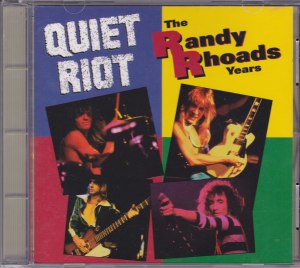
Growing up in the 1980’s, Quiet Riot was the first “metal” band I liked. Back then, we were aware that Quiet Riot had two albums prior to Metal Health. These albums seemed unobtainable forever at best, mythical at worst! The first two, Quiet Riot and Quiet Riot II, were released in Japan only. Later on, I did manage to get both albums, so I have a unique perspective on this CD: The Randy RhoadsYears, by Quiet Riot.
See, here’s a nutshell version of the story: QR lead howler and co-founder Kevin DuBrow had wanted to re-release the Randy material for years. Randy himself was never happy with those albums, nor his guitar sound on those albums. In light of this, the late guitarist’s mother Delores was very guarded of Randy’s legacy. She knew that Randy felt the albums consisted of sub-par songs with horrible production. DuBrow eventually won her blessing to re-release some of the old Quiet Riot material, but on one condition only: Get the quality of the songs up to snuff so it doesn’t tarnish Randy’s legacy.
So that’s what he did, using all the means available, and the result is a highly modified collection of Quiet Riot songs with Randy Rhoads.
I can tell people out there who haven’t heard the first two albums that they do sound awful. That’s not a myth. Randy’s guitar is but a shadow of what it would become, and the songs are mostly pretty bad, especially on the first album. The second is much better (particularly in the songwriting category) but it is still hampered by poor production. So what could DuBrow do to get permission to do a re-release?
He started by picking out six of the better songs from the first two records: “Mama’s Little Angels”, “It’s Not So Funny”, and “Look in Any Window” from Quiet Riot, and “Trouble”, “Killer Girls”, and “Afterglow (Of Your Love)” from Quiet Riot II. All of these songs were heavily remixed, with completely re-recorded vocals, from scratch. DuBrow felt, probably correctly, that his original singing voice on those albums was too “boy-ish”.
DuBrow re-sampled all the drums, and re-recorded all of Randy’s guitar tracks through a Marshall stack. Randy had confided with Kevin that he was happiest with the way his guitar sounded live with Ozzy, so Kevin recorded the original, sterile guitar tracks through Carlos Cavazo’s amps. They used the Randy Rhoads Tribute CD as a guide.
On one guitar solo, Kevin knew that Randy wished he had used a wah-wah, but couldn’t afford the pedal at the time. Kevin played the wah-wah pedal himself, using Randy’s guitar tracks, a unique form of collaboration between two friends.
With the Small Faces cover, “Afterglow”, Kevin came up with a cool idea. “Unplugged” albums were on trend, so Kevin stripped all the drums and electric instruments off the track, leaving just Randy’s bare acoustic guitar. It is like stripping a layer of paint off old beautiful old wood: the bare guitar track reveals previously unheard warmth. Kevin re-sang the vocal, kept the electric guitar solo intact, and used a triangle sample to cover up places where the original drums had leaked into Randy’s mike. This painstaking work created from the ground up an incredible alternate version that Randy would hopefully have been very proud of.
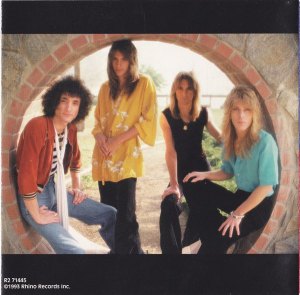
None of these people are Frankie Banali.
One of Quiet Riot II‘s best songs is “Trouble”. Kevin felt that it plodded too much, so he slightly sped it up which also raised its pitch. He then re-sang it, and the result is a much better song. Suddenly “Trouble” is a rich sounding hit-worthy rock track.
“Killer Girls” had some minor tampering, a blast of guitar where previously there was nothing. It is “Last Call For Rock ‘n’ Roll” that is most changed. Previously titled “Mama’s Little Angels” on Quiet Riot, Kevin re-wrote what he thought was a juvenile lyric. (It was about trashing the house playing a game of “indoor baseball”.) Bobby Rondinelli, who was working with Kevin on a Quiet Riot album called Terrified at the time, helped him re-write the tune. Unfortunately, regardless of all this work, the song is still just a stock sounding track, nothing special, aside from Randy’s always classy if underplayed guitar work.
The rest of the album consists of unreleased songs. One of the most exciting is a live take of “Laughing Gas” which Quiet Riot never cut in the studio. It comprised an evolving, extended Randy Rhoads guitar solo. Within it, you can hear the kernels of ideas that later became Ozzy Osbourne classics such as “Dee” and “Crazy Train”. Even this “live” track is tampered with: Kevin re-recorded his lead vocals (even the “Ladies and gentlemen, Mr. Randy Rhoads!” part) and actually spliced two different guitar solos together into one. You can hear the splice point between the two quite clearly. Of course this makes the solo no less jaw-dropping.
“Picking Up the Pieces” and “Breaking Up is a Heartbreak” are two of a kind. Kevin says these come from their “pop” period after the second album, just before Randy was off to work with Ozzy. They were getting more desperate for hits, and wrote these two melodic, radio-ready tunes. Both are excellent. Much like “Trouble”, these two songs are world-class. Kevin re-recorded the vocals and so on just as he did with the other tracks. At this time, bassist Kelly Garni had left the band and Randy played bass himself.
Lastly, “Force of Habit” is the only bare, untampered song. In the liner notes, Kevin says they lost the original master tapes, so he was unable to remix or re-record any of it. I think it’s an excellent heavy song on its own. In fact, Ozzy Osbourne must have thought so as well, since parts of this song later became “Suicide Solution”!
This work, and “Laughing Gas” in particular were enough to convince the Rhoads family to go forward with this album. If Kevin hadn’t done this, undoubtedly we would never have seen this release. On the other hand, this isn’t the way Randy recorded it, and Randy obviously had no input to how the tracks were mixed. This has polarized fans, some of whom thought Kevin was the great Satan, others just enjoying the album for what it is.
I enjoy the album for what it is. I like it a lot, actually. I do have misgivings about the tampering, but since I own the first two albums, that feeling has subsided. I can back up the claims that the first two albums are pretty poor.
Kevin had planned on a second volume, including such treasures as Quiet Riot’s metallic cover of “The Mighty Quinn”. He had also mentioned a home video, including the extended “Laughing Gas” guitar solo. Sadly DuBrow, will never get to complete these Rhoads reissues.
BON JOVI – These Days (Special Edition, 2010, Universal Music)
Just as a general comment on the series of Bon Jovi “Special Edition” remasters from 2010: They’re crap. Sorry but they are. A couple unreleased live tracks? That’s it? Come on. They remastered these things 10 years ago and I bought them all then. I’ve bought almost every Bon Jovi album, in some cases multiple times. These Days? Three times now, just to get all the bonus tracks scattered hither and yon. For that reason these Bon Jovi remasters are in my $10 or less purchase range.
As for the album, These Days, I think it’s the best Bon Jovi album. It’s definitely more laid back than any previous Jovi platter, but it has a genuine quality to it that I like. You may like the cheesey 80’s keyboard sounds yourself, but in 1995 Bon Jovi couldn’t release an album like that. Keep the Faith was a great success, but These Days took the band to a new, darker, more soulful place. The production, once overly glossy, has been reduced to a purer, more live sonic clarity. This is a very organic album and many tracks sound live off the floor, such as “Diamond Ring”. Tico’s got a great drum sound on this album too, the snare has a great tonal quality.
Lyrically, Jon has never sounded more real and heartfelt. A song like “These Days” gets me right where it hurts every time. Unfortunately, the biggest hit from this album was the single “This Ain’t A Love Song”. Well, it may not be a love song, but it sure sounds a lot like others I’ve heard, like “Always”. Contrasting the generic ballad were some heavier rockers. “Hey God” is positively angry. “Damned” has swagger. Bon Jovi are always melodic, but the chorus in the infectious “Something For The Pain” is just awesome. “If That’s What It Takes” and “Hearts Breaking Even” are memorable and as strong as any previous Bon Jovi hit, but sadly remained overlooked. The quiet “(It’s Hard) Letting You Go” is one of Bon Jovi’s best ballads ever, because it’s so understated, with the actual vocal delivering the song.
The best song is the brilliant “Something To Believe In”. If I was going to pick one song as the absolute peak of Bon Jovi’s entire career, it could be this one (tied with “Dry County”). Driven by some sparse dark bass and piano, it soon picks up the pace. Richie’s backing vocals punctuate Jon’s powerful chorus beautifully, and you won’t be able to get that “Hey! hey! hey!” out of your head.
Yeah, I’m a sap. I love this album!
I like Eddie Vedder best.
What really sets These Days apart are the sweet harmonies of Jon and Richie. They’ve always done great work together vocally but These Days is a whole level beyond that. If you are a fan of Richie Sambora, I think you will enjoy These Days. In a very real sense I think this represents Sambora’s greatest contributions to Bon Jovi.
This new remastered edition has two live bonus tracks, which unfortunately are both ballads. “This Ain’t A Love Song” is one, I guess because it was the hit single. Shame they didn’t use “Hey God”. “Diamond Ring” is the other live ballad. This one was a bit of a cult song I guess. They wrote it back in the days of New Jersey and almost released it, a few times. It got bootlegged and became an underground favourite. This live version is recorded in Italy. It’s great to hear Jon and Richie singing together like this, but again, I wish they put on a rocker instead of a ballad. Richie’s guitar solo is awesome though.
My preferred edition, which I will cover in a separate future review, is the European 2 disc edition. In a beautiful magnetic digipack, it contained lots of bonus tracks: “All I Want Is Everything”, “Bitter Wine”, “Fields Of Fire” (Demo), “I Thank You”, “Mrs. Robinson”, “Let’s Make It Baby” (Demo), “I Don’t Like Mondays”, “Crazy” (live, lead vocals by Tico Torres), “Tumblin’ Dice” (live, lead vocals by David Bryan), “Heaven Help Us All” (live, lead vocals by Richie Sambora).
There are other editions with bonus tracks, including an Australian edition with a live CD (this is on my “want” list). There were plenty of singles, and I’ll cover each of those in future reviews as well, because they each contained notable bonus tracks. One was a track called “Lonely At The Top”, which to me sounds like it’s about Frances Bean Cobain. It has the lyric, “Tell Frannie I’m sorry she didn’t get to know her dad.” There was even a (great) cover of “Rockin’ In The Free World”, as well as a cover of “634-5789”, which featured Jon cracking up and laughing right in the middle of a verse!
So there you go. Get this album, but buy wisely. Choose an edition that suits your bonus track needs (or lack thereof).
5/5 stars for the album, -1 for this ripoff edition!
Below, pictures and tracklists for all the singles that I have from this album, as well as the Special Edition 2 CD set from 1996. It was a digipack with a neat magnetic clasp to keep it closed.
Part 2 in my series of Def Leppard Slang reviews! If you missed the first part, click here for “Slang”.
DEF LEPPARD – “Work It Out” (1996 2 part CD single, Mercury Records)
The second single from Def Leppard’s ill-fated but cult-favourite album, Slang, was the modern, powerful “Work It Out”. This immediate winner had drony 90’s qualities and organic, acoustic drums in addition to Rick’s electronics. It sounded like a breath of fresh air for this band, a clever reinvention that kept them fresh, melodic, guitar-oriented and layered, without resorting to stigmatized 80’s sounds such as squealing solos and shout-along choruses.
The cool thing is that the song was originally very different! This was Vivian’s first serious contribution to the band, and he brought it in completely demo’ed with him singing. It’s a much brighter, poppier version, some have compared it to Crowded House! It’s very 90’s pop-rock. That version is included on the CD 2 of this set!
“Move With Me Slowly” is a non-album track, maybe you’d call it a ballad, I dunno. It’s soulful, and there’s some really elegant guitar work going on here. I don’t know what’s Viv and what’s Phil, but all the playing here is soulful, bluesy and perfect. It’s songs like this — a B-side! — that prove what awesome songs this band can write. If this song had come out in, say 1990 instead of 1996, it would have been hallowed Def Leppard, another hit for the record books. According to the liner notes, this would have been the Japanese bonus track on their edition of Slang.
“Two Steps Behind” is the typical acoustic arrangement, live at the BBC Radio One Studios, in 1995 while the band were out promoting Vault. “Truth?” is a very different version from the album. Initially it starts the same, but goes into a completely different, much heavier set of verses. It’s bass heavy, less exotic, and more thunderous than the album version. All told, the album version is superior, but it’s basically a different (but related) song. It has some riffs and melodies in common but otherwise it may as well have a different name. This is a good example of how Def Leppard’s work ethic can turn a good song into a great one. This early version was not quite there.
The second CD came with a really cool set of post cards, of the first four album covers. The next four covers came with the next single, which was “All I Want Is Everything”. Coincidentally, that will be the next review in this series. Stay tuned.
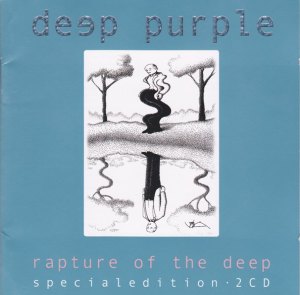
DEEP PURPLE – Rapture of the Deep (2 CD special edition, 2006 Eagle Rock)
Deep Purple, that hard rock institution that formed back in ’68, has been at it nearly non-stop with critically acclaimed albums and tours since reforming back in ’84. Lineup changes ensued, but by and large the band has retained its integrity even if only one member of the original ’68 lineup remains (drummer Ian Paice). However, this lineup of Purple is still 3/5 of the classic “Mark II” lineup that recorded Machine Head and Perfect Strangers, and is chock full of rock royalty.
Vocalist Ian Gillan is intact, his voice no longer screaming, but still unique and recognizable as a one-of-a-kind. His partner in crime, bassist Roger Glover is here, joining drummer Paice to complete the legendary rhythm section. On guitar is Steve Morse (Dixie Dregs), first joining Purple in ’95 and this being his fourth studio album. “New kid” in the band is keyboardist Don Airey, celebrating his second Purple album here, but no stranger to these guys from his work with Rainbow, Whitesnake, Ozzy and many more.
Airey’s first album with Purple, 2003’s Bananas, was a reboot of sorts. Gone was original member (and legend on the Hammond) the late Jon Lord, for the first time ever in Purple’s history. Also new on board was producer Michael Bradford, who was very much a collaborator. Bananas was a great album, but perhaps a little too commercial for Purple in the long run? Rapture Of The Deep is an attempt to steer Purple back to the sounds of ’71 while still retaining the modern edge that they gained with Bradford. It is raw and uncompromising, not slick at all, definitely and defiantly Deep Purple.
Purple and Bradford have produced here an album that is not an easy first listen, but a very rewarding 6th or 7th listen. If you give it a chance it will become a favourite. Keep in mind, these guys are musicians of the 60’s and 70’s. Back when people still had attention spans, you were supposed to listen to an album 6 or 7 times, usually in one night!
“Money Talks” kicks off the album with the growl of a Hammond B3, that’s how you know this truly is Deep Purple. Morse’s guitar, very different from Ritchie Blackmore’s, leaves a lot of space between the chords. It’s a different kind of riffing, staggered and jagged, fast and genius. Gillan’s lyrics are, as always, witty and full of humour. Only Gillan can chuckle in the middle of a lyric and make it sound like it’s suppose to be there, and he does.
“Girls Like That”, the second song, is more melodic and commercial A little bit more “Bananas”, and exactly what the album needed after the vicious “Money Talks”. Track 3, “Wrong Man”, has one of the most powerful Morse riffs on the album, and it sounds great live (more on that later). Fantastic song, great chorus.
The centerpiece of the album is the title track, “Rapture Of The Deep”. The guitar part sounds like a Morse trademark, slightly Arabic, rhythmically odd; just an entrancing song and worthy of the Deep Purple canon. As if this wasn’t enough, the next song “Clearly Quite Absurb” is simply one of the best ballads Purple have ever done. This is thanks to another trademark Morse guitar melody, and some wonderful singing by Gillan. The lyrics are emotive and optimistic. It sounds a lot like material from the wonderful Purpendicular CD, and keep in mind this is a band that doesn’t do a lot of ballads. There’s only this one ballad on Rapture Of The Deep.
Other standout tracks on the album includes “MTV”, a wry look at the life of a band of the “classic rock” format. Gillan and Glover must be used to certain interviewers getting their names wrong, and only knowing one song, judging by the lyrics:
“Mr. Grover n’ Mr. Gillian, you must have made a million, the night Frank Zappa caught on fire.”
“Kiss Tomorrow Goodbye” is one of the heaviest tracks, Gillan attempting a scream here and there, sounding like the furious side of Deep Purple is alive n’ well. “Junkyard Blues” is anchored by a solid Glover bassline, simple but metronomic, and then that takes us into the final track, the atmospheric “Before Time Began”. At 6:30, “Before Time Began” is not for people with ADD!
A great album, demanding of your attention. Worthy of your attention. Deep Purple have always had some kind of standards when it comes to studio albums. Even their weakest have some sort of integrity to them. Rapture of the Deep is not an immediate album, nor will it unseat Machine Head as the fan favourite. But it does serve to remind the world that Deep Purple are still a great band, within the confines that age brings with it. Deep Purple are in fact one of the best bands of this age, because they just refuse to sell out.
The bonus disc here is a treasure, and I am so glad I re-bought this album (third time now) to get these songs!
The “new version” of “Clearly Quite Absurd” sounds like a re-recording to me, with more orchestration. I’m not sure why this was done, the two songs have a similar feel even though they are instrumentally quite different. Both versions are equally great in my opinion. Yet even with a great song like this, Purple can’t get their new material on the radio! What a crime! “Things I Never Said” is a great song, a bonus track, with another busy Morse riff. This is originally from the Japanese release of the CD. Next up, finally released in its studio version (but recorded during the Bananas sessions) is “The Well-Dressed Guitar”. You may remember this instrumental workout from Deep Purple tours and live albums circa 2002 (check out the Live at the Royal Albert Hall CD). Then, five live tracks, the first ever official live tracks with Airey on keyboards! Two are from this new album (“Rapture” and “Wrong Man”), and there are three classics including — yes — “Smoke On The Water”. These tracks prove that no matter who is in the band these days, they still sound like Deep Purple. The other two live tracks are “Highway Star” and “Perfect Strangers”.
4/5 stars. Now What?!
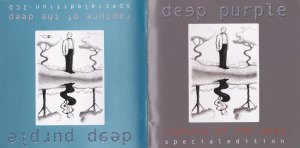
I also have a single disc 2005 tin version from Edel Records. This one boasts an enhanced CD with studio footage and an EPK (electronic press kit video) which I’ve never watched.
My initial thinking regarding this single was that I didn’t need it; both songs are available on On Through the Night. Then I found out that these single versions of “Wasted” and “Hello America” are earlier, non-album recordings. Rick Allen was in the band by this time but On Through the Night had yet to be recorded. This immediately put the single on my radar as a must-have.
On Through the Night was produced by Tom Allom (Judas Priest) but before settling on him, Leppard tried out Nick Tauber due to his history with Thin Lizzy. (He also produced Sheer Greed by Girl, the band that featured future Leppard alumnus Phil Collen.) Tauber worked on the earlier, folksier Lizzy, not the later version of the band that rocked out such classics as “Jailbreak” and “Bad Reputation”.
The story goes that the record label was unhappy with Nick Tauber’s results and put a halt to his work on the album. He had finished four songs: These two, plus “Rock Brigade”, and “Glad I’m Alive” which both remain unreleased. The label released “Wasted” as a single while recruiting Tom Allom to start over on the album.
“Wasted” boasts one of Leppard’s all time greatest riffs, if not the greatest. You can see how this song has remained a cult favourite all these decades later. This earlier version isn’t as adrenalized (pardon the pun) as the later album version, but there’s otherwise nothing wrong with it. I think Allom’s album version is safely still the definitive one. The two tracks are not that dissimilar, just Allom’s more in tune with the current heavy metal sounds.
The B-side, “Hello America”, would become a single in its own right the following year, in its guise as an Allom track. This might be one that I prefer in its Tauber version. Allom added a synthesizer riff to the chorus of “Hello America” that I always felt dated the tune. While this version is not as manic or electrified, it does have the bare unadorned chorus. There are bonuses to both versions.
It’s kind of funny to hear how shaky Joe Elliott’s voice was back then. He grew into a powerful screamer by the High ‘n’ Dry album, which is my favourite period of Def Leppard. They were all young back then, but Joe was clearly not as confident nor in his control of his voice in 1979.
Still, as a purchase, as a single, as a collectible, I am very happy with this. My only regret is that I didn’t find one with a picture sleeve.












 mikeladano.com