rhino

REVIEW: Gene Simmons – The Vault – Disk 2 (2018)

Previous Reading: 

Record Store Tales #600:  The Vault
Disk 1 Review


Another disc, another 15 songs!


GENE SIMMONS – The Vault – Disk 2 (2018 Rhino)

One of the fastest and heaviest songs from Gene’s solo album Asshole was “Weapons of Mass Destruction”.  It was originally written for Psycho-Circus, but deemed insufficient.  The demo version just called “Weapons” features Gene calling out what instruments go where, and a much rougher recording.  The final album version was not a remarkable song and neither is this demo.  The song was pretty much in place at this stage.  2.5/5

“Weapons (Power to Raise the Dead)” is another demo version, this one with Ace Frehley on lead vocals.  Gene hoped for him to sing it on the Kiss album, and let Ace write new lyrics.  It also features Bruce Kulick and Eric Singer.  It sounds like Gene wrote the entire song around a bass lick.  This is why it’s better than Gene’s original idea:  Ace’s presence also brings much needed variety to this box set after 16 songs with Gene singing lead.  Ace was in good voice back then, and it would have been awesome to hear a final version.  Psycho-Circus could have and should have been a longer album to accommodate more band contributions.  3.5/5

“Hate” made it onto Carnival of Souls.  Gene openly admits he was inspired by Seattle and that angry style of music.  Written with Bruce Kulick and Scott Van Zen, “Hate” would be improved upon immensely when it was recorded for good.  What’s missing is Bruce’s wah-wah drenched lead guitar acrobatics and drones that normally run through the track.  Otherwise, this is the same arrangement, complete with lyrics and only minor differences.  There’s a neat tape edit trick at the end; see if you can spot it.  4/5

“Hate” goes immediately without break into “Carnival of Souls #2”.  This a four-track demo of the same song included on disc one.  This is performed with Scott Van Zen, and the lyrics are not fully written yet.  As stated earlier, this was never one of Gene’s better songs.  It does feature some cool guitar stuff in the middle breakdown, but otherwise this is a forgettable demo of a song that was never really up to snuff.  2/5

“Master of Flesh” is an interesting song because it’s a cover of a New York band called Street Punk.  Gene bought the publishing rights for cash from writer Jon Montgomery.  Regardless of the name “Street Punk”, that’s not what this is.  An acoustic ballad with spoken word verses, Gene compares it to David Bowie and Lou Reed.  There’s also a bit of John Lennon in the falsetto of the chorus.  Gene recorded the undated demo on a Tascam and plays the lead guitar solo himself.  Really not bad and had potential.  It wasn’t where Kiss was headed over their next few albums, but could have perhaps fit in somewhere.  3.5/5

“Heavy Rain” is a demo with Bruce Kulick of a recurring song called “Rain Keeps Fallin'”, previously released on a Gene Simmons Family Jewels Season One bonus CD.  This heavy-as-hell riff really pops.  Very much akin to Carnival of Souls kind of heavy, with rolling bass, this is the kind of material that is worth coming back to.  There’s some tape dropout issues but that is not unexpected on a collection of demos, often originally recorded on cassettes.  Eric Singer can easily be identified on drums by style and sound.  3.5/5

“Within” from Psycho-Circus was one of Gene’s more ambitious stompers.  Featuring backwards guitars and Lennon-inspired lyrics, there was some psychedelia involved.  Taking that further, the overall song was inspired by Doctor Strange from Marvel comics.  Gene envisioned Strange facing off against a character like Nightmare, and somehow, that led to “Within” featuring Bruce and Eric once again.  The backwards guitar on this demo was used in the final album version later on.  This lengthy demo is far more dramatic and heavy, and really allows certain riffs and bass parts to come out more.  If only the lyrics were complete!  If this were properly recorded, it could surpass the overproduced album version.  4/5

The first version of “In Your Face” included on this box set is a Gene demo before bringing it into Kiss for Ace Frehley to sing.  You may recall this track was a B-side or bonus track for Psycho-Circus, with Frehley singing.  The early version is a bit different with a lot of different lyrics.  It sort of hangs together but is a fairly loose idea that sounds thrown against the wall.  2.5/5

“In Your Face with Ace” is much closer to album version, partly re-written by Ace and much better recorded.  It’s barely different from the final version, except the lead guitar may sound more naturally Ace.  Another Frehley vocal is also very welcome.  This is a fantastic demo that again shows that Psycho-Circus could have rocked a lot more like Kiss.  The producer may have been an issue.  5/5

“Rain #2” is the second (but not last) version of “Rain Keeps Fallin'” that we will hear on this disc.  This version features Simmons proteges Silent Rage on instruments, with a drum machine.  It’s a bit different from the first version we heard called “Heavy Rain” and doesn’t seem to punch as hard.  Only now do a realize there is a line about “keep sippin’ my Diet Coke.”  Why not?  Dare I say why not?  3/5

It’s almost a cheat to call “Carnival Intro” a full track among the 15 here.  This 32 second track is the intro that was later used on Psycho-Circus, though it was originally intended for “Carnival of Souls”.  A cool little intro, but more like a bonus.  Historically valuable for the eventual use by Kiss.  2/5 

It was only a matter of time before Vinnie Vincent (née Cusano) appeared in this set.  Kiss began writing with the future Ankh Warrior in 1982 for what became Creatures of the Night.   Gene says “I Wanna Live” is among the songs they wrote, and has never been recorded or heard before.  It has a cool synth part that goes through the song and sounds like an idea with potential.  This demo sounds pretty decent and the chorus is good enough for rock and roll.  Catchy hard rock with a tough vibe.  4/5

“If It’s Too Hot, You’re Too Cold” later became “Hot and Cold” on Sonic Boom.  This demo with Silent Rage is based on an old song called “Rotten to the Core” from 1977.  Gene says it’s also related to “Eat Your Heart Out”, but the liner notes are a little confused here.  Either way, this is pretty good stuff and does have a 70s Kiss vibe, which is why it worked swimmingly on the Sonic Boom album.  4/5

Finally, “Rain Keeps Fallin'” appears in its third version!  This is still not the same one as the Family Jewels set, which is 3:53 in length.  This version sounds the most 80s, of the songs, circa Crazy Nights if Gene’s smooth vocal delivery is to go by.  It is very hard rock, with focus on the chorus.  You can really hear the evolution of a song by listening to this disc.  An interesting trip.  4/5

“Bells of Freedom” closes this disc, with a Who-inspired song.  Tommy Thayer is on guitar, but from a time before he was in Kiss.  You can hear the Pete Townsend influence in those big chords.  It’s a pretty good song idea and and it sounds like it could really have become something.  There is a great solo included.  It is hard to judge demos like this because often the concept is to get the idea down quickly.  We’ll err on the high side, because there are some serious possibilities with these hooks!  This could have been an 80s rock anthem!  4/5

Averaging out the score for the 15 songs, disc two rates:  3.16/5 stars


Disk 2 Track length and songwriters (from Wikipedia)

1. Weapons (4:16) Simmons
2. Weapons (Power to Raise the Dead) (4:13) Simmons / Frehley
3. Hate (Demo) (4:02) Simmons / Van Zen / Kulick
4. Carnival of Souls #2 (Demo) (3:15) Simmons / Van Zen
5. Master Of Flash (Street Punk) [1980?] (3:38) Montgomery
6. Heavy Rain (3:22) Simmons / Kulick
7. Within (Demo) (5:58) Simmons
8. In Your Face (Gene Demo) (1:51) Simmons
9. In Your Face (Ace Re-write Demo) (3:20) Simmons / Frehley
10. Rain #2 (3:35) Simmons
11. Carnival Intro (0:32) Simmons
12. I Wanna Live (Demo) (4:33) Simmons / Cusano
13. If It’s Too Hot, You’re Too Cold (3:42) Simmons
14. Rain Keeps Fallin’ (3:22) Simmons
15. Bells of Freedom (4:37) Simmons

REVIEW: Gene Simmons – The Vault – Disk 1 (2018)

Previous Reading:  Record Store Tales #600:  The Vault


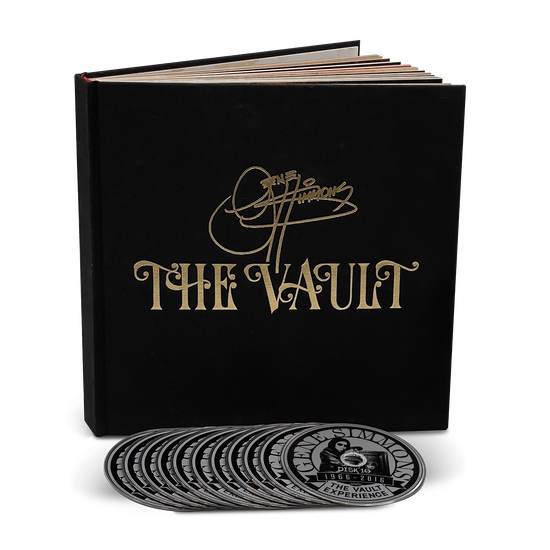
I knew — I knew!! — that if I held out long enough, there was a chance this could happen.  When a bare-bones versions of the Gene Simmons Vault finally went on sale for a reasonable price, I had to have it.  All 11 CDs, plus the coin and the statue, for $100 was too great a deal to pass up.  All you don’t get is the actual vault and gift from Gene.  In this 12 part series, we will take a good look at my new Vault.

This box set was first announced about two decades ago, originally titled Gene Simmons 100.  Then it was going to be called Monster, though that title was re-used on something else instead (Gene blames Paul for “borrowing” that name).  As implied from 100 title, it was supposed to be a set of 100 unreleased songs from Gene vaults.  Kiss demos, solo demos, pre-Kiss music, everything.  Obviously things grew and grew, and so did the price tag!  In the end, there were 165 songs and a much more reasonable valuation.  This will only become more collectible.

In the liner notes, Gene says he tried to split up the songs by “mood”.  Please enjoy this series as we go through each and every song, disc by disc, in this massive collection.


GENE SIMMONS – The Vault – Disk 1 (2018 Rhino)

Rather than start with his earliest material, Simmons chose to sequence this box set starting with a 2011 recording called “Are You Ready”.  It is, for all intents and purposes, a Kiss song without Paul Stanley.  It features Tommy Thayer and Eric Singer on guitar and drums (and backing vocals).  This song was written after Kiss had essentially given up on recording albums, though one lyric was used previously on Monster:  “Give me [a] kiss,  bite your lips”.  This is a Kiss rocker, pure and simple, and had they ever recorded it, it could have been one of their best latter day songs.  The chorus is right out of 1977, and the boys do a great job on it for a demo.  A simple riff, and a fist-pumping beat, and you’re hooked.  Great song.  5/5

“I Turn To Stone” is a hotel demo by Gene and Tommy Thayer.  The title was inspired by the Biblical “pillar of salt” story, but there’s nothing holy about these lyrics.  It’s all about Gene’s inability to resist the fairer sex.  It’s a pretty good song that sounds very early 80s, somewhere around the Killers-Creatures era.  Gene talk-sings some of the lyrics but the song is otherwise pretty melodic.  There are some of “ah-ah-ah” bits in the outro that sound very Hot In the Shade.  Pretty cool, and doubtless would have been polished up for an album.  Great potential.  3.5/5

“Juliet” starts immediately with a riff like “Custard Pie”.  Co-written by Ken Tamplin for the Revenge album, it did not make the cut.  It’s a little herky-jerky sounding, and the clunky primitive drum machine used doesn’t translate it well.  Again, there’s a lyric here that was used later on “Russian Roulette” from Sonic Boom.  This song was probably rejected for being too close to Led Zeppelin.  2.5/5 

“Hey You” is the second Tamplin co-write.  It has a really cool dark vibe, but doesn’t hold together as a song.  It’s more just some components stuck together that don’t necessarily fit.  One guitar bit sounds like it made it onto Revenge in another song.  It’s upbeat, and sounds like something that was hoped to would be a fist pumper in concert.  Close but no cigar.  2/5 

The Carnival of Souls album contained a lot of stuff that was written for Revenge“I Confess” is one such song.  It’s one of Gene’s more serious lyrics, regarding religion and hypocrisy.  If you confess to the priest, who does the priest confess to?  This demo is not very different from the final version; just as dark and with the same vocal delivery.  The main differences are in the guitar parts, which Bruce Kulick later put his own stamp on.  4/5

Continuing on with things that ended up on Carnival, “Legends Never Die” was inspired by events that also inspired “Childhood’s End” later on.  Co-written by Micki Free and Adam Mitchell in 1982, this power ballad could have been on an album had Paul Stanley not been the ballad guy in Kiss.  When Gene went on to produce Wendy O. Williams, she recorded this song almost identically to the demo.  Her vocals are more extreme, going from soft to growl, but a Kiss version sung by Gene certainly would have been interesting.  This is as close as we get.  Gene considers it a very personal song.  4/5 

“Something Wicked This Way Comes” is a familiar song title that we have heard about for years.  Gene says he recorded several versions including some with Bruce Kulick on guitar.  It sounds very much like Carnival of Souls material, but not up to standards.  The outro guitar stuff is great.  There is potential to some of the individual parts, but as a whole there’s not much of a song here.   The title was inspired by Ray Bradbury, but is otherwise unrelated.  1/5

“Hand of Fate” with Tommy Thayer and Eric Singer was considered for Sonic Boom.  It’s a song Gene likes, and is a prime example of the “monster plod” groove that he is known for.  There are some nice layers of backing vocals on the bridge (all overdubbed by Gene), but the song would have been one of the weakest on Sonic Boom.  We already have a lot of Gene songs with this kind of groove and theme.  Next!  2/5

“Hunger” is a sex song, written in the late 80s and recorded on New Year’s Eve with Bruce Kulick and Eric Carr.  It’s nice to hear Carr; he has such an identifiable song.  This is an unremarkable song.  It’s a simple riff without a lot of melody to back it.  It sounds like a Whitesnake outtake more than Kiss, but Gene wasn’t beyond being “inspired” by other bands who were having hits.  2/5  

Gene prefers this demo of “In My Head” from Carnival of Souls.  His idea was to do “Beatles-y” things like recording backwards cymbals, but layering them over a heavy thumping groove.  The song idea is inspired by people to hear voices in their heads, and the result is a very chilling song and lyric.  It’s angry, heavy and slightly psychedelic.  The main differences are that Bruce hadn’t added all his layers of genius to the guitars yet.  4/5

Speaking of Carnival, one of the songs that didn’t make that album was “Carnival of Souls”.  It later came out on Gene solo album called (ahem) Asshole.  It was never a good enough song.  Demo #1 is pretty intact.  The issue is mostly the chorus, which just isn’t very good, nor fitting for the fast, almost thrashy verses.  Written with Scott Van Zen, Gene says he was going to a psychedelic vibe similar to the band Love.  A miss.  2/5

“Are You A Boy, or Are You A Girl” is a phrase Gene heard a lot growing up in New York, growing his hair long.  People would stop him on the street and ask that question.  “Are you a long haired creature from another world?”  This song has Eric Carr and Tommy Thayer, which would date it back to the Hot in the Shade era.  There are some musical ideas that later turned up in a Kiss song called “Hot and Cold”.  What is most interesting about this song is that Gene takes a brief bass solo at 1:25 into the song.  Gene’s an underrated bass player; just listen to those walking basslines on the first three albums.  Too bad Kiss never did anything like that on an album.  3/5

“Say You Don’t Want It” dates back to 1979, with a problematic song Gene had called “Mongoloid Man”.  This a is a re-write from 2001 with Tommy Thayer and without the troublesome lyrics.  Some of these words would resurface on “Spit” from the Revenge album.  “Spit” is a far better song.  Just not good enough, and monotonous to boot.  2/5

If that wasn’t enough, the original version of “Mongoloid Man” with Joe Perry on guitar follows.  Musically, this demo actually sounds better.  It has a cool vintage vibe not unlike Gene’s first solo album (which Joe also played on).   It was never going to be an amazing song, but this vintage version is definitely marginally better, despite the lyrics.  Perry smokes!  2.5/5 

Written by Darren Leader of Steel Panther with Gene, “I Wait” ends this disc on a powerful note.  You could call it a ballad, in sort of a late 90s altera-rock way.  It’s actually a great song and though not suitable for Kiss, would have made an excellent solo track.  It definitely sounds a lot more like a 90s alternative band than a classic rock band, but a good song is a good song.  “I Wait” is a good song with potential to be great.  Re-record this one, Gene, and release it as a single.  4/5

When we tally up the 15 individual song scores, this is how Disk 1 averages out:  2.63/5 stars.

We’ll be keeping track of these scores so we can get an accurate average for the box set.  This score is not surprising.  Gene is known for a quantity-over-quality style of creation.  At least his batting average here is over 50 (barely).


Disk 1 track length and songwriters (from Wikipedia)

1. Are You Ready [2011] (3:13) Simmons
2. I Turn to Stone (3:58) Simmons
3. Juliet (2:52) Simmons / Tamplin
4. Hey You (3:44) Simmons / Tamplin
5. I Confess (3:40) Simmons / Tamplin
6. Legends Never Die [1982] (4:24) Simmons / Mitchell / Free
7. Something Wicked This Way Comes [1988] (3:44) Simmons
8. Hand of Fate (3:15) Simmons
9. Hunger (4:14) Simmons
10. In My Head [1994] (3:30) Simmons / Van Zen / St. James
11. Carnival of Souls #1 [1994] (3:44) Simmons / Van Zen
12. Are You a Boy, or Are You a Girl (2:49) Simmons
13. Say You Don’t Want It (3:29) Simmons
14. Mongoloid Man [1976] (4:06) Simmons (with Joe Perry of Aerosmith)
15. I Wait (4:04) Leader / Simmons)

Unboxing The Vault! A Massive Mailing from Gene Simmons and Rhino Records (VIDEO)

Two weeks ago, Rhino Records released a stripped-down version of Gene Simmons’ The Vault box set.  For only $80, you could get all 11 CDs including such hits as “My Uncle is a Raft” and “Eskimo Summer”!  That’s all I ever wanted.  As a collector of physical media, I would love to have, but cannot afford, the full $1500 Vault with all the bells and whistles.  For that, head on over to 2loud2oldmusic and have a gander at John Snow’s copy!

This box also includes the famous Van Halen demos for the Love Gun album.  To finally have them is unbelievable!

The book is huge and packed with liner notes.  But don’t take it from me…watch the video!


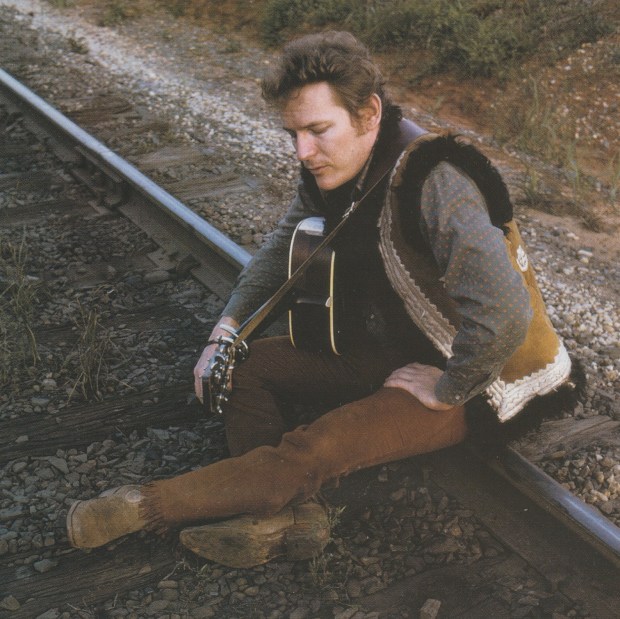
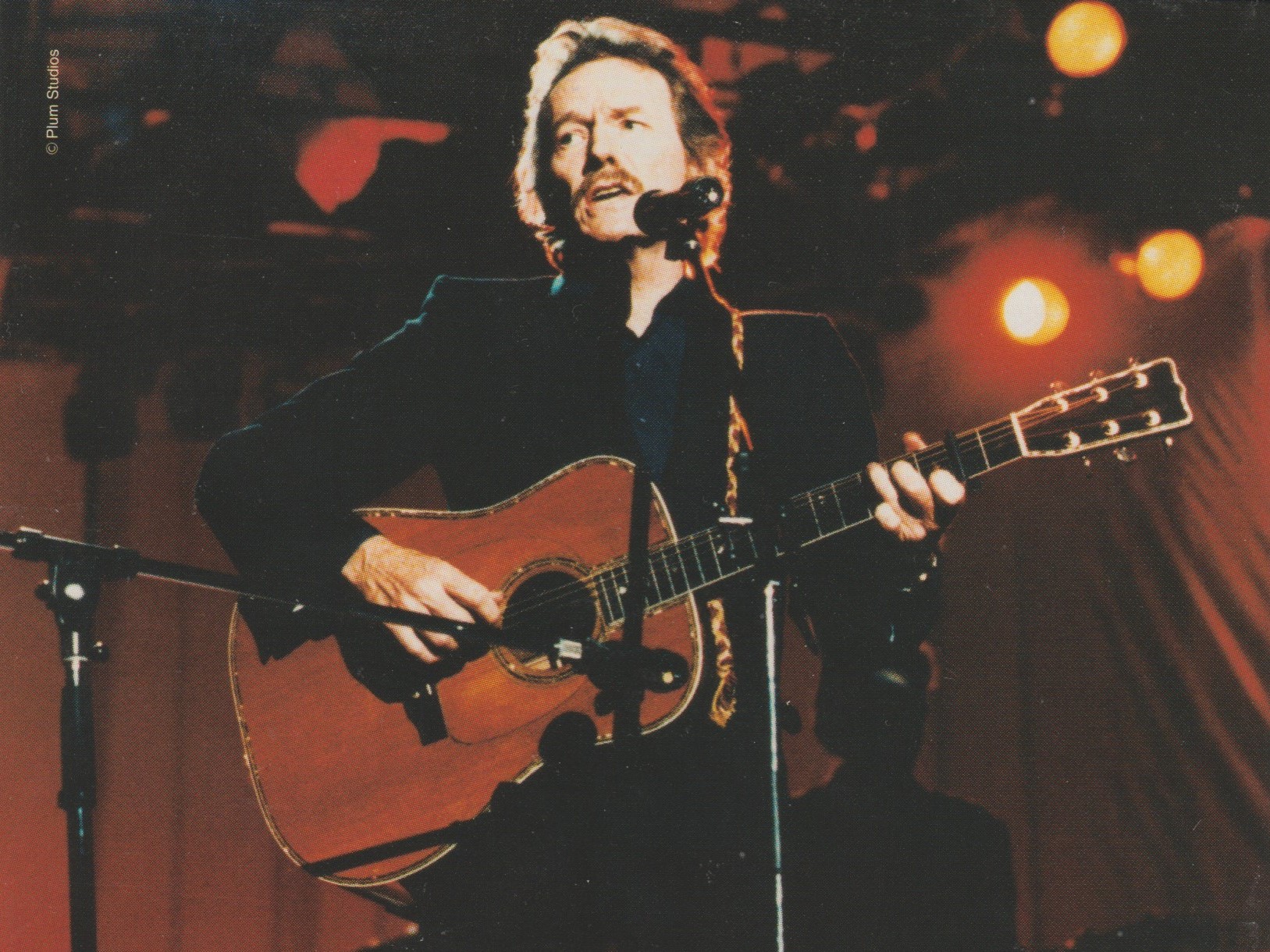
REVIEW: Gordon Lightfoot – Complete Greatest Hits (2002)

GORDON LIGHTFOOT – Complete Greatest Hits (2002 Rhino)

You just have to laugh when you see something called “CompleteGreatest Hits.  Complete?  Says who?

I don’t see “Ribbon of Darkness” on Complete Greatest Hits, and where is “Bobby McGee”?  I do see 20 terrific songs that you shouldn’t live your life without.  Gord’s Gold is the benchmark, but because it’s missing Gordon Lightfoot’s best known song — “The Wreck of the Edmund Fitzgerald” — it isn’t enough.  (Gord’s Gold also featured two sides of re-recordings because Lightfoot supposedly couldn’t listen to his early work.)  The best way to get “Edmund Fitzgerald” and Lightfoot’s other best known songs in one purchase is to go for Rhino’s Complete CD.

The experience starts with “Early Morning Rain” from Gord’s first LP Lightfoot! (1966).  Gord’s calling cards are two:  his baritone voice, and his songwriting.  “Early Morning Rain” shows of the perfection of both.  You’ll get chills.  “In the early morning raaaaaaain…”  Undoubtedly, Gordon Lightfoot is one of Canada’s greatest songwriters of all time, and “Early Morning Rain” is all the evidence you need.  If that’s not enough, there are fortunately 19 more incredible tracks.

“For Loving Me” from the same LP boasts some intricate acoustic picking and more of that voice.  The vibrato, the control, the expression…nobody could touch Gordon Lightfoot.  In recent years his voice has been reduced to a powerful whisper, but nothing on this CD dates past 1986.  His voice is double-tracked on “Go Go Girl”, another unforgettable song from 1967’s The Way I Feel.  His storytelling lyrics always make you wonder who and what inspired the songs.  “Only a go-go girl, in love with someone who didn’t care.  Only 21, she was a young girl, just in from somewhere.”  There’s so much there between the lines, while the acoustics pluck away in dense patterns.

After three succinct beauties, here comes Gordon’s epic:  “Canadian Railroad Trilogy”.  The Canadian Pacific Railway was built on hardship and dreams, and Gord captures that and more in a multi-textured composition.   “An iron road runnin’ from the sea to the sea.”  Not only is this song his greatest lyric, but the diverse vocal parts could be his strongest work.  Hard to imagine that that he was only on his second album.

1968 brought the brooding ballad “Pussywillows, Cat-tails”.  Backed by strings, the dream-like song paints a picture rather than spelling out a story.  “Naked limbs and wheat bins, hazy afternoons.”  Then “Bitter Green” is brighter, though with similar countryside imagery and a story about lost love with a twist ending.  Moving on to 1970, “If You Could Read My Mind” is one of Lightfoot’s most renowned songs.  It went to #1 in Canada, and in 1997 it hit the dance charts in a cover version by Stars On 54.  Gord’s version is one of the most passionate laid to tape.  Written about a divorce, the feelings were raw.

1971 brought the bright “Cotton Jenny” and the uplifting “Summer Side of Life” from the album of the same name.  The latter features subtle organ and rich backing vocals, broadening the palette.  “Beautiful”, a soft and romantic ballad, came from 1972’s Don Quixote, and hit the Billboard Hot 100.  This CD then skips past the #1 album Old Dan’s Records (Complete Greatest Hits, huh?) and goes straight to “Sundown” from the album of the same name.  I always loved the front cover of Sundown, with Gord in sandals smoking a cigarette in a barn.  For the first time, there’s an electric guitar solo, but the song is most notable for the strong chorus.  “Carefree Highway”, also from Sundown, has lush strings and another chorus that is impossible to forget.  I highly recommend playing this one while driving down country roads on a Sunday afternoon.  “Rainy Day People” from 1975 (the same year he did the Gord’s Gold re-recordings) features more backing instrumentation than earlier material.  The lush, countrified music didn’t do him any harm when the track went Top 10 in Canada (and #1 on the adult contemporary charts).

All this leads to “The Wreck of the Edmund Fitzgerald”, probably the greatest songs about a sea tragedy ever written.  With a big electric guitar as the main hook, the song is completely unlike all the Lightfoot hits that came before.  There is even a soft synthesizer part.  It went to #1 on every applicable chart in Canada, and #2 in the US.  Though simpler in structure, “Edmund Fitzgerald” is the only song to rival “Canadian Railroad Trilogy” as his greatest epic.  It’s also one of Gordon’s most chill-inducing lyrics, with a vocal part to match.

Everything after this can only seem anticlimactic.  “Race Among the Ruins” is the strongest track post-“Edmund”, as Gordon included country slide guitars and other accoutrements.  The final five (“Daylight Katy”, “The Circle is Small”, “Baby Step Back”, “Stay Loose” and “Restless”) are not slouches, but simply not as striking as the earlier songs.  Though the recordings are more sophisticated, it’s hard to top your earliest hits.

The liner notes to this CD point out that your first exposure to Gordon Lightfoot was probably via a cover.  Perhaps Bob Dylan, Janis Joplin, Elvis Presley, Johnny Cash, or the Tragically Hip.  I suggest making “Edmund Fitzgerald” your first Gordon Lightfoot if you haven’t heard one of his classics already.  This CD is the best way to get it.

5/5 stars


* Deke, have you ever listened to the Wreck of the Edmund Fitzgerald while sitting on the shore of lake gichi-gami?  That’s on my bucket list.  

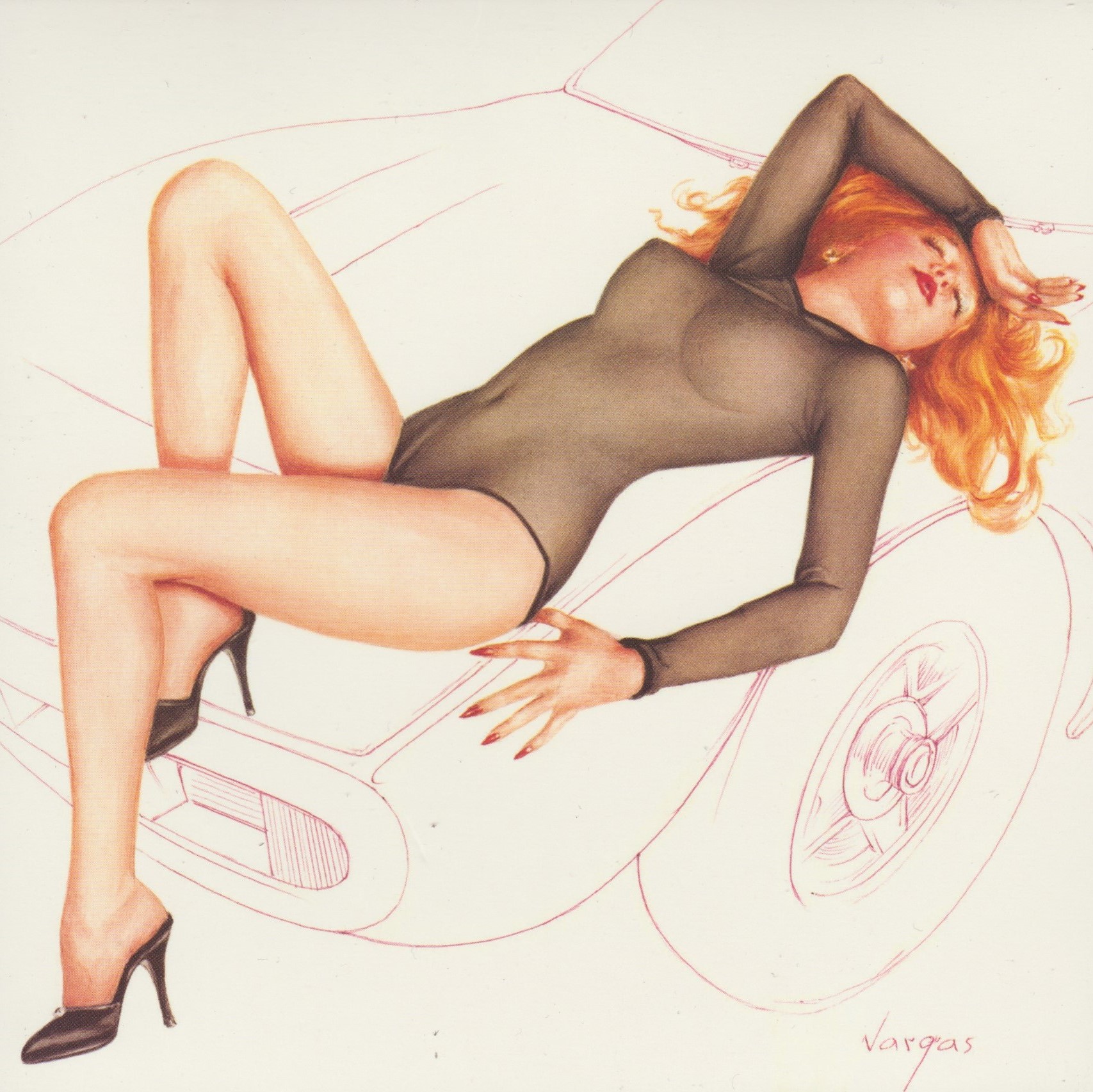
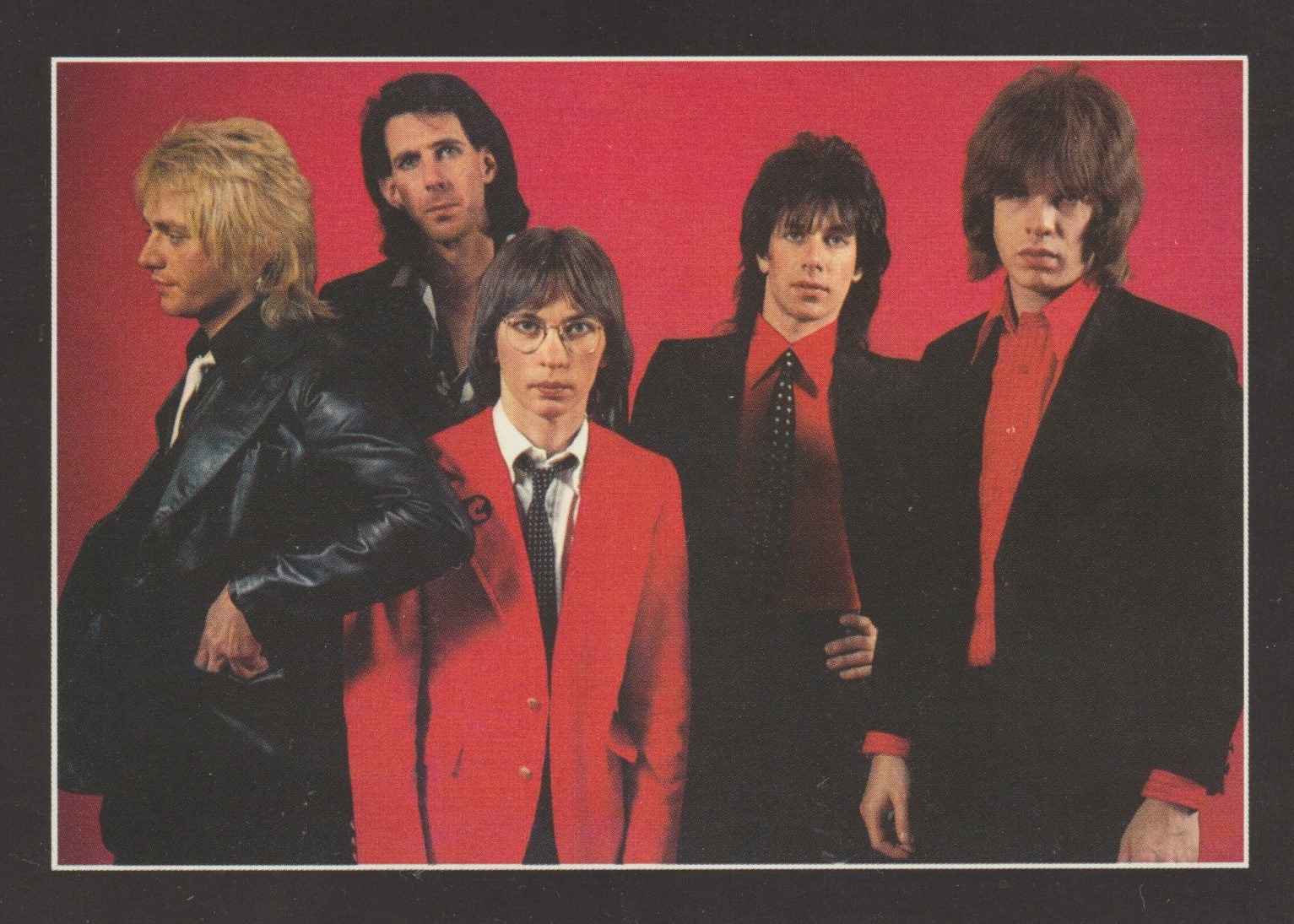
REVIEW: The Cars – Candy-O (1979, 2017 expanded edition)

THE CARS – Candy-O (1979 Elektra, 2017 expanded edition)

How many perfect albums are there in the world? Albums with no filler, only songs vital to the whole and valuable to the listening experience? Hopefully you have included The Cars’ Candy-O in your count.  The often “difficult” second album was apparently no problem for The Cars.  Ric Ocasek came in with a huge batch of new minimalist songs, plus a couple outtakes.

“I like the night life, baby!”  Ben Orr takes the first lead vocal on “Let’s Go”, the Max Webster-like lead single.  Already off to a great start, this tight little number is subtle and loaded to the gills with hooks.

“Somethin’ in the night just don’t sit right.”  Ric Ocasek enters the fray with a quirky “Since I Held You”.  The Cars’ unique way with a melody is apparent on this track, one of those deeper cuts you don’t want to miss.  David Robinson’s drums — loud and effective at punctuation.  Give credit to producer Roy Thomas Baker for wringing every last hook out of these songs.

“And once in a night, I dreamed you were there.”  A restrained ballad, it unleashes the melodic power of the Cars at the chorus, given a bump by Greg Hawkes’ mini moog.  One of their more accomplished compositions, every part serving its purpose.

“It takes a fast car, lady, to lead a double life.”  The possible centrepiece of the album, Ocasek’s “Double Life” smoulders and builds into a dark masterpiece.  At one point this track was to be dropped from the album; let’s be glad the Cars came to their sense.  Though the song is built on a punchy, sharp beat, Elliot Easton’s guitar melody floats detached above.

“You ride around in your cadium car, keep wishin’ upon a star.”  A robotic pulse and frantic vocal make up “Shoo Be Doo”, a transitional piece that serves to bridge the two songs it falls between.  Candy-O is beginning to sound like a concept album to the ears.

“Edge of night, distract yourself.”  The fierce title track “Candy-O”, fronted by Ben Orr, is another possible centerpoint of the album.  The song is layered thick with Elliot Easton’s guitar hooks and Greg Hawkes’ keyboard blips.  Though not a single, “Candy-O” has become a favourite and a great example of the Cars’ musical abilities as players.

“Ooh, how you shake me up and down, when we hit the night spots on the town.”  Jittery and caffeinated, the noturnal “Night Spots” again verges on Max Webster territory.  Ocasek stutters his way through the lyrics while the hyper band get bouncing in behind.  It feels like you’ve been staying awake for three days and three nights with nothing but coffee in your blood.

“I can’t put out your fire, I know it’s too late.”  The album then takes a sudden left turn back to smoother ground, playing looser on the ballad “You Can’t Hold On Too Long”.  The lyrics take a darker turn, with the shadow of addictions.

“He’s got his plastic sneakers, she’s got her Robuck purse.”  Ocasek sings an anthem to the mismatched on “Lust for Kicks”, another punchy Cars song though with a laid back tempo.  Hawkes’ simple keyboard hook is the main structure, with Easton providing guitar noise far in the background.  Ocasek’s expressive vocal is the focus.

“Send me a letter on a midnight scroll.”  There’s a frantic energy to “Got a Lot on My Head”, a sense of panic and urgency.  This time it’s the guitar in front and some of the Cars proto-punk roots break through.  A lot is packed into a short song.

“Can I bring you out in the light?  My curiosity’s got me tonight.”  A third contender for centerpiece of the album is the closer “Dangerous Type”, and its closing position might be its only disqualifier.  Though it has a “Bang-a-Gong” knockoff riff for the verses, the chorus dips into much darker territory.  Then another Max Webster moment creeps in when Hawkes adds his moog.  This brilliant track is an apt closer for such a quirky yet dark album.

Indeed, Candy-O seems semi-obsessed with the night, with shadows, and with secrets.  So it’s quite unexpected how uplifted you feel after listening to it — lighter and brighter.  As if the shadows have been exorcised, at least for a little while.

Candy-O itself is only 36 minutes, so if you need a deeper immersion, the expanded edition is perfect.  It contains seven bonus tracks:  five alternate versions, one B-side and one unreleased song.  (There is an additional piece of rare music available separately, a very different early version of “Night Spots” on Just What I Needed: The Cars Anthology).  Remarkably, though rougher, most of these are probably good enough for an album already.  If you already love Candy-O, you will dig the slightly different and more raw versions offered as bonus tracks.  “Dangerous Type” is far less dark, and “Let’s Go” is busier.

“They Won’t See You”, like early 80s Alice Cooper, has a dark campy quality but also a biting guitar hook.  It’s actually better than a lot of Cooper from that period, even though it was never released.  Apparently it was a popular Cars encore.  Finally (and appropriately) its “That’s It”, ending the CD at an hour in length (easy enough to digest in a single sitting).  If not for the technical limits of vinyl at the time, it might have made an excellent coda for the original album.  It’s a song about endings, so it works naturally at the end of this edition.

Candy-O, with or without the extras, is a perfectly brilliant listen and an album that deserves a place of honour in a collection.  But why get 36 minutes when you can have an hour, plus an expanded booklet with lyrics, photos and Easton essay?  “Let’s Go”!

5/5 stars

REVIEW: Whitesnake – Slip of the Tongue (6 CD/1 DVD 30th Anniversary box set)

WHITESNAKE – Slip of the Tongue (originally 1989, 2019 (6 CD/1 DVD 30th Anniversary Rhino box set)

There’s a theme you may have noticed every time we review a Whitesnake box set:  David does it right.

Here’s another one:  Coverdale cares.

Slip of the Tongue gets the super-deluxe treatment this time, the third of the “big three” to go that way.  This is the album that divided fans the most.  Replacing Vivian Campbell was none other than ex-David Lee Roth stringbender Steve Vai.

“What the hell would that sound like?” we all wondered.

Longtime Whitesnake fans felt it was a step too far into the world nebulously defined as “hair metal”.  Others loved the guitar mania inside, with Vai stretching out in ways different from his prior bands.  Not the “definitive” Vai record that they still wanted (and would get a year later), but certainly a platter they could sink their teeth into.  And it was a weird reason that Steve was playing on Slip of the Tongue at all.

As you’ll see from a feature on the included DVD (“A Look Back: Whitesnake Chronicles with DC and Adrian Vandenberg”), the album was written and thoroughly demoed with Adrian.  They wouldn’t need a guitarist until it was time to tour.  At this point, Adrian injured his wrist and was unable to finish.  Steve Vai and David Coverdale found that they got along famously and the seven-string wizard brought his unique and advanced stylings to the blues-based Whitesnake.

What the hell would it sound like?

It sounds absolutely mental.

With the benefit of now hearing all the demos that Adrian laid down, it’s obvious Steve Vai didn’t just pick up his guitar and play the parts.  It’s clear right from opener “Slip of the Tongue”.  Compare the album to Adrian’s demos on the other discs.  Vai changes one of the chord progressions to high-pitched harmonics, and, let’s face it, improves the song.  Elsewhere there are unique trick-filled runs and fills that add another dimension to the music.  If Whitesnake was always 3D rock, Vai upped it to 4.  The guitar work is blazingly busy, never cliche, and always to the advancement of the song.  With all respect to Adrian Vandenberg who wrote these great songs, Steve Vai was more than just icing on a cake.  Slip of the Tongue arguably sounds more a Vai album than Whitesnake, even though he didn’t write any of it.

The beauty of this set is that if you’re more into ‘Snake than alien love secrets, you can finally hear the purity of Adrian’s vision in the multitude of early demos included.

Unfortunately, if you’re familiar with the album you’ll hear something’s up by track 2.  “Kitten’s Got Claws”?  That song used to close side one.  What’s up?  The album running order has been tampered with, and so has “Kitten’s Got Claws”.  It’s now missing the Steve Vai “cat guitar symphony” that used to open it.  It could be a different remix altogether.  My advice is to hang on to your original Slip of the Tongue CD.  You’re probably going to still want to hear the album and song as they were.

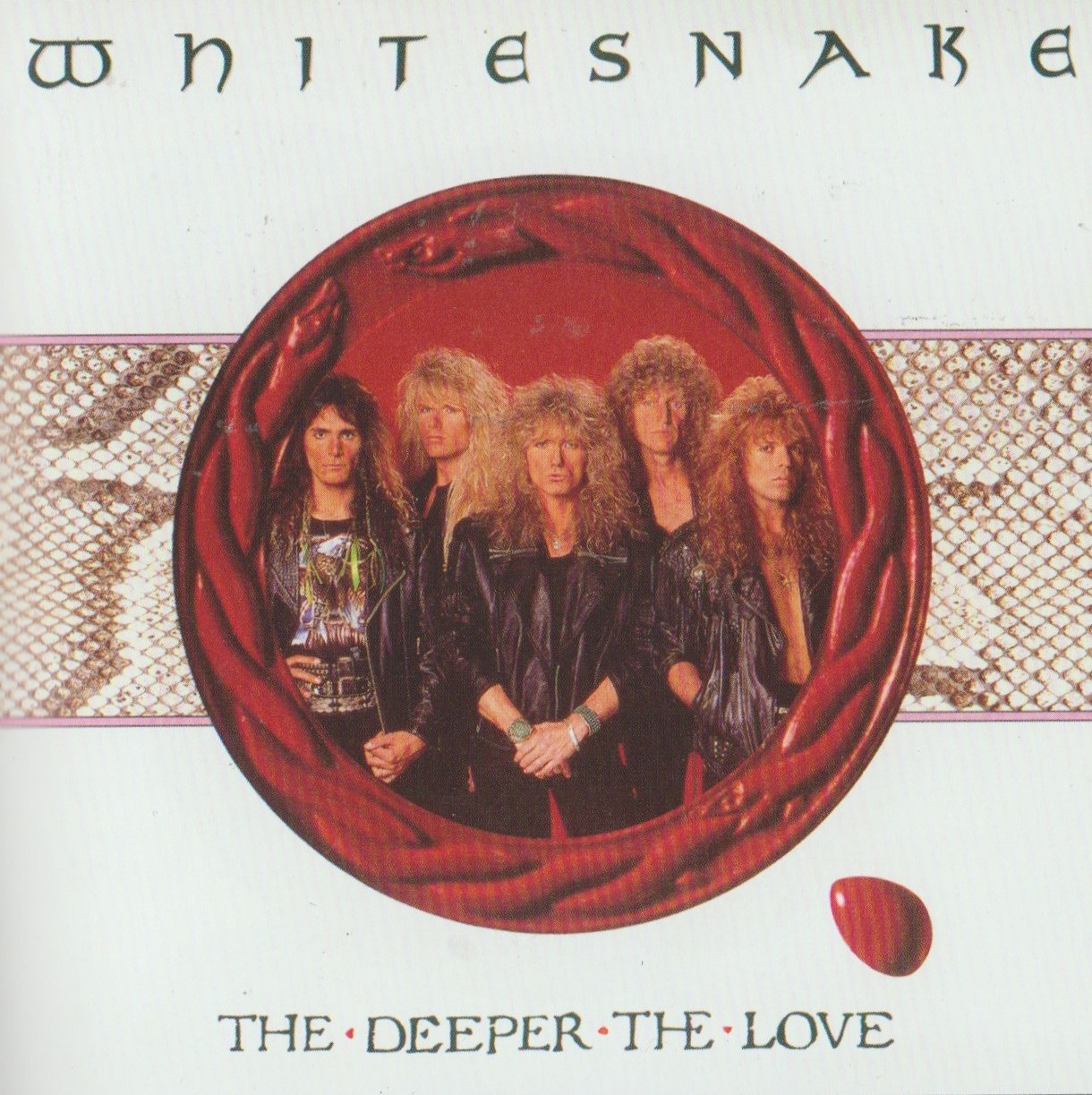
This running order puts “Cheap An’ Nasty” third, a song that structurally resembles the ol’ Slide It In Whitesnake vibe.  Of course Vai’s space age squeals and solos modernized it.  Listen to that whammy bar insanity at the 2:00 mark!  Up next is “Now You’re Gone”, a classy rocker/ballad hybrid that has always been an album highlight.  The demos on the other discs allow us to hear how much this song was improved in the final touches.  That cool answering vocal in the chorus, and the hooks that Vai added, came much later.  Strangely, this box set puts the other ballad, “The Deeper the Love”, up next.  Keyboard overdubs made it a little too smooth around the edges, but a good song it remains.

The Zeppelinesque “Judgement Day” is a track that used to piss off some fans, who felt it was an abject rip off from “Kashmir”.  The Vai touch of sitar (replacing guitar in the early demos) probably aided and abetted this.  Regardless it succeeds in being the big rock epic of the album, and a favourite today.  Another strange choice in running order follows:  “Sailing Ships”, formerly the album closer.  It’s quite shocking to hear it in this slot.  Again, Vai replaced guitar with sitar, and David goes contemplative.  Then suddenly, it gets heavy and Steve takes it to the stratosphere.

“Wings of the Storm” used to open side two; now it’s after “Sailing Ships”.  Some tasty Tommy Aldridge double bass drums kick off this tornado of a tune.  Vai’s multitracks of madness and pick-scrapes of doom are something to behold.  Then it’s “Slow Poke Music”, a sleazy rocker like old ‘Snake.

The new version of Slip of the Tongue closes on “Fool for Your Loving”, a re-recording of an old classic from Ready An’ Willing.  The new version is an accelerated Vai vehicle, lightyears away from its origins.  Coverdale initially wrote it to give to B.B. King.  Vai is as far removed from B.B. King as you can imagine.  The original has the right vibe, laid back and urgent.  This one is just caffeinated.

The only album B-side “Sweet Lady Luck” is the first bonus track on Disc 1.  By now it is the least-rare B-side in the universe, having been reissued on a multitude of Whitesnake and Vai collections.  Valuable to have to complete the album, but easy to acquire.  It’s basically a second-tiered speed rocker with the guitar as the focus.  Other B-sides from this era were remixes, and they are included here as well.  The Chris Lord-Alge mix of “Now Your Gone” is the kind that most people won’t know the difference. Vai said that Lord-Alge could make the cymbals sound “like they have air in them.”  Then there’s the “Vai Voltage Mix” of “Fool for Your Loving”, which has completely different guitar tracks building an arrangement with way, way, way more emphasis on the instrument.  The rest of the disc is packed with four more alternate remixes:  “Slip of the Tongue”, “Cheap An’ Nasty”, “Judgement Day” and “Fool for Your Loving”.  These mixes have some bits and pieces different from the album cuts.  Vai fans will want the alternate solo to “Cheap An’ Nasty”, though it’s less whammy mad.

Of course, “Sweet Lady Luck” wasn’t the only song that didn’t make the album.  In old vintage interviews, Coverdale teased the names of additional tracks we didn’t get to hear:  “Parking Ticket”, “Kill for the Cut”, and “Burning Heart”.  They’ve been safely buried in Coverdale’s vault, until now.  Additionally, it turns out that Whitesnake also re-recorded a couple more of their old songs:  “Ain’t Gonna Cry No More” and “We Wish You Well”.  They’re all here in different forms on the demo discs.

Perhaps “Kill for the Cut” would have been one dirty song too many for the album.  It ain’t half bad, and has a unique little bumpin’ riff.  “Parking Ticket” had potential too.  Rudy Sarzo gave it a pulse that might have taken it on the radio.  The 1989 monitor mix would have been perfect for B-side release.  Why did Cov have to hold out on us all these years?  “Burning Heart” was a special song, a re-recording of an old Vandenberg track that David really loved.  Unfortunately the monitor mix is is only a skeleton of what could have been a sensational Whitesnake ballad.  “Ain’t Gonna Cry No More” is heavily modernized, with keyboards sounding like they were trying to recapture “Here I Go Again” (which they were).  “We Wish You Well” is more contemplative, with piano as the focus.

All of this previously unheard material is scattered over several discs.  “Evolutions” (Disc 3) is a familiar concept to fans of these box sets.  Demos from various stages of completion are spliced together into one cohesive track.   You will be able to hear the songs “evolve” as the band worked on them.  Every track from the album plus “Sweet Lady Luck”, “Parking Ticket” and “Kill for the Cut” can be heard this way.  Disc 4 is a collection of monitor mixes with all the album songs and all the unreleased ones too.  These discs are the ones that allow us to really hear the album the way it would have been if Adrian didn’t hurt his wrist.  We would have got an album that sounded a lot more like Whitesnake.  It was audibly different even if familiar.

Perhaps the best disc in the entire set is “A Trip to Granny’s House:  Session Tapes, Wheezy Interludes & Jams”.  It’s just as loose as it sounds.  Enjoy the funk of “Death Disco”, the funkiest David’s been since Come Taste the Band.  If you’ve always wanted to hear David sing “Tie a Yellow Ribbon ‘Round the Old Oak Tree”, now you finally can!  There’s a lot of goofing off in some of these tracks, but also a lot of rock.  It’s live off the floor as they rehearse the songs, as a four piece band with Adrian.  Not all the final lyrics or solos are set, but the songs are so raw and fresh.  Some of the jams show a side of Whitesnake we rarely got to see.  Kind of Purple-y in the way they just could take off and rip some blues.


Given all the rich audio extras, it’s OK if one of the CDs is a little impoverished.  That would be disc 2, “The Wagging Tongue Edition”.  This is a reproduction of an old promo CD, featuring the album Slip of the Tongue with a Dirty David interview interspersed.  This was meant for radio premieres.  It has the entire album in the correct order, but because it’s faded in and out of interviews, it’s really not a substitute for a proper copy of the original album.  At least the vintage 1989 interviews are interesting.  It saves collectors from buying a copy on Discogs.  (Coverdale claims “Judgement Day” was originally titled “Up Yours Robert”.  Ooft.)

There’s another disappointment here and it’s difficult to forgive.  In 2011, Whitesnake released the long awaited Live at Donington as a 2 CD/1 DVD package.  This brilliant performance finally gave us a permanent record of Whitesnake live with Vai.  In our previous dedicated review, we had this to say:

Musically, it’s a wild ride. It’s not the Steve Vai show. Adrian gets just as many solos, and his are still spine-tingling if more conventional. It is loaded with ‘Snake hits, leaning heavily on the three Geffen albums. In fact there is only one pre-Slide It In song included: The Bobby “Blue” Bland cover “Ain’t No Love in the Heart of the City”.  And, since it is also the pre-grunge era, there are plenty of solos, which today seems excessive.  Aldridge does his drum solo at the end of “Still Of The Night”. Vandenberg gets his “Adagio for Strato”/”Flying Dutchman Boogie”. Most excitingly, Steve Vai performs two songs from his then-brand new (and top 40!) album Passion And Warfare: “For The Love Of God” and “The Audience Is Listening”, with Aldridge on drums. Coverdale even introduces him as “Mr. Passion and Warfare!” so I imagine there was no sour grapes that Vai’s album was doing so well. And lemme tell ya folks — the audience WAS listening, and going nuts too!

Unfortunately, to save a little bit of plastic, this set was reduced to a single CD for its inclusion here.  The Vai and Adrian solos were cut, though Tommy’s drum solo in “Still of the Night” is retained.  To cut the guitar solos in such a guitar focused boxed set is not only unwise but unforgivable.  Fans who don’t have Live at Donington are going to want to shell out again just to get the solos.  Fortunately, the whole show is uncut on the included DVD.

The DVD has plenty of added value; it’s not just a reissue of Live at Donington.  You’ll get the three music videos from the album (“Now You’re Gone”, “The Deeper the Love” and “Fool for Your Loving”).  There’s even a brand new clip for “Sweet Lady Luck” cobbled together from existing video. Then, you can go deeper into the album. The aforementioned sitdown with David and Adrian is really enlightening.  Another behind the scenes feature narrated by David is fantastic for those who love to watch a band create in the studio.  Coverdale’s not a bad guitarist himself.

These Whitesnake box sets also include ample extras on paper.  There’s quite a nice miniature reformatted tour program with the majority of cool photos.  A large Slip of the Tongue poster can adorn your wall, or remain safely folded up in this box.  Finally, there is a 60 page hardcover booklet.  This is a treasure trove of press clippings, magazine covers, single artwork, and more.  Lyrics and credits wrap it all up in a nice little package.

Because we know that David puts so much into these box sets, it’s that much more heartbreaking that this one is so slightly imperfect.  The shuffled running order and lack of guitar kittens on “Kitten’s Got Claws” is a problem.  The truncated live album is another.  It means I have to hang onto old CDs that I was hoping to phase out of my collection in favour of this sleek set.  Alas, I’ll keep them as they are my preferred listening experience.

Otherwise, in every other way, this box set delivers.  It makes a lovely display next to its brethren and it justifies its cost.

4.5/5 stars

MORE Slip of the Tongue?

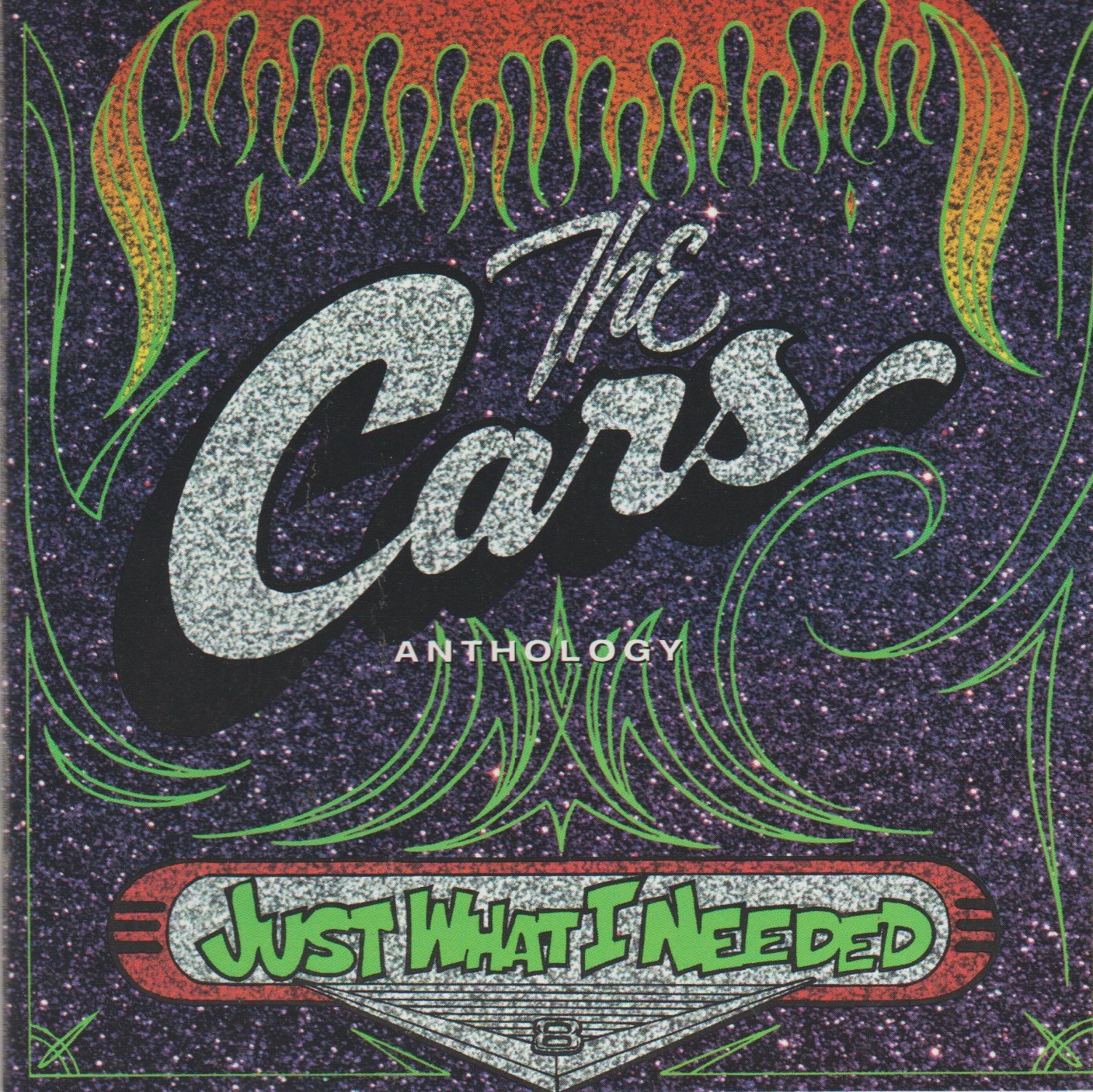
REVIEW: The Cars – Anthology: Just What I Needed (1995)

THE CARS – Anthology: Just What I Needed (1995 Rhino)

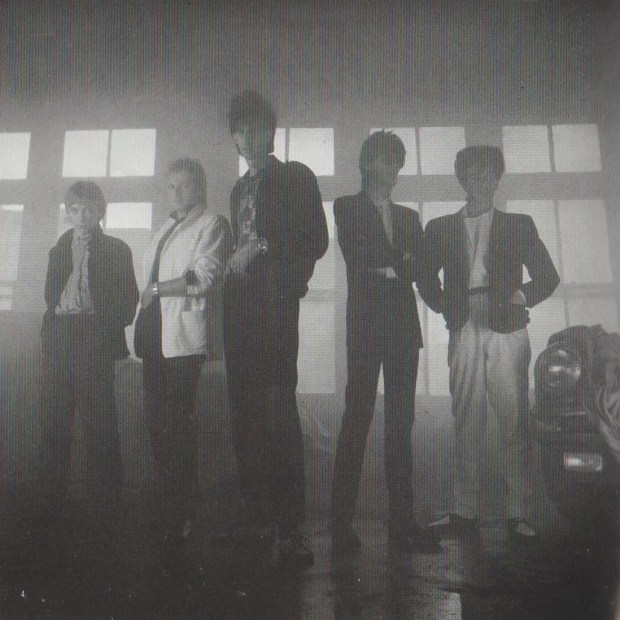
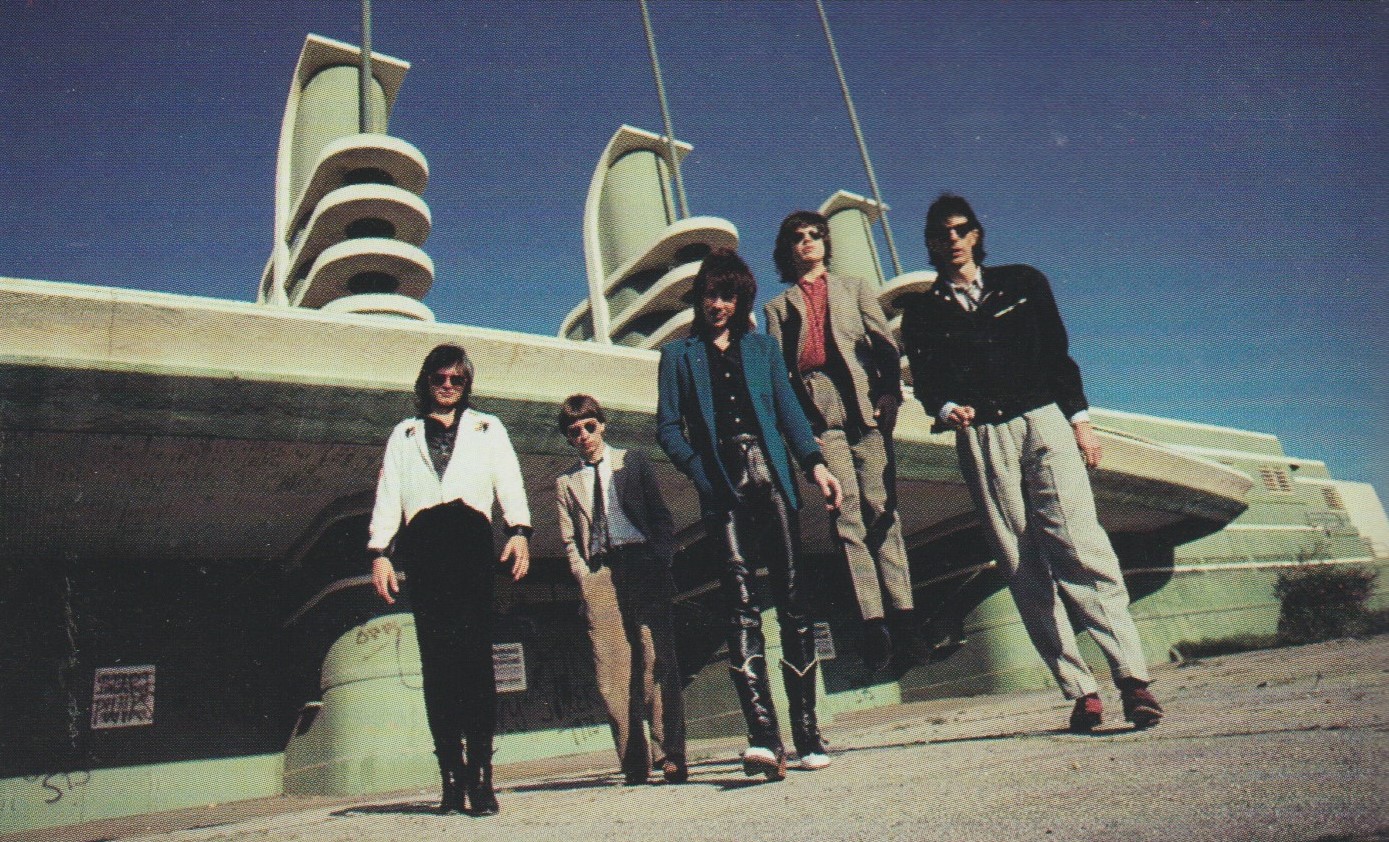
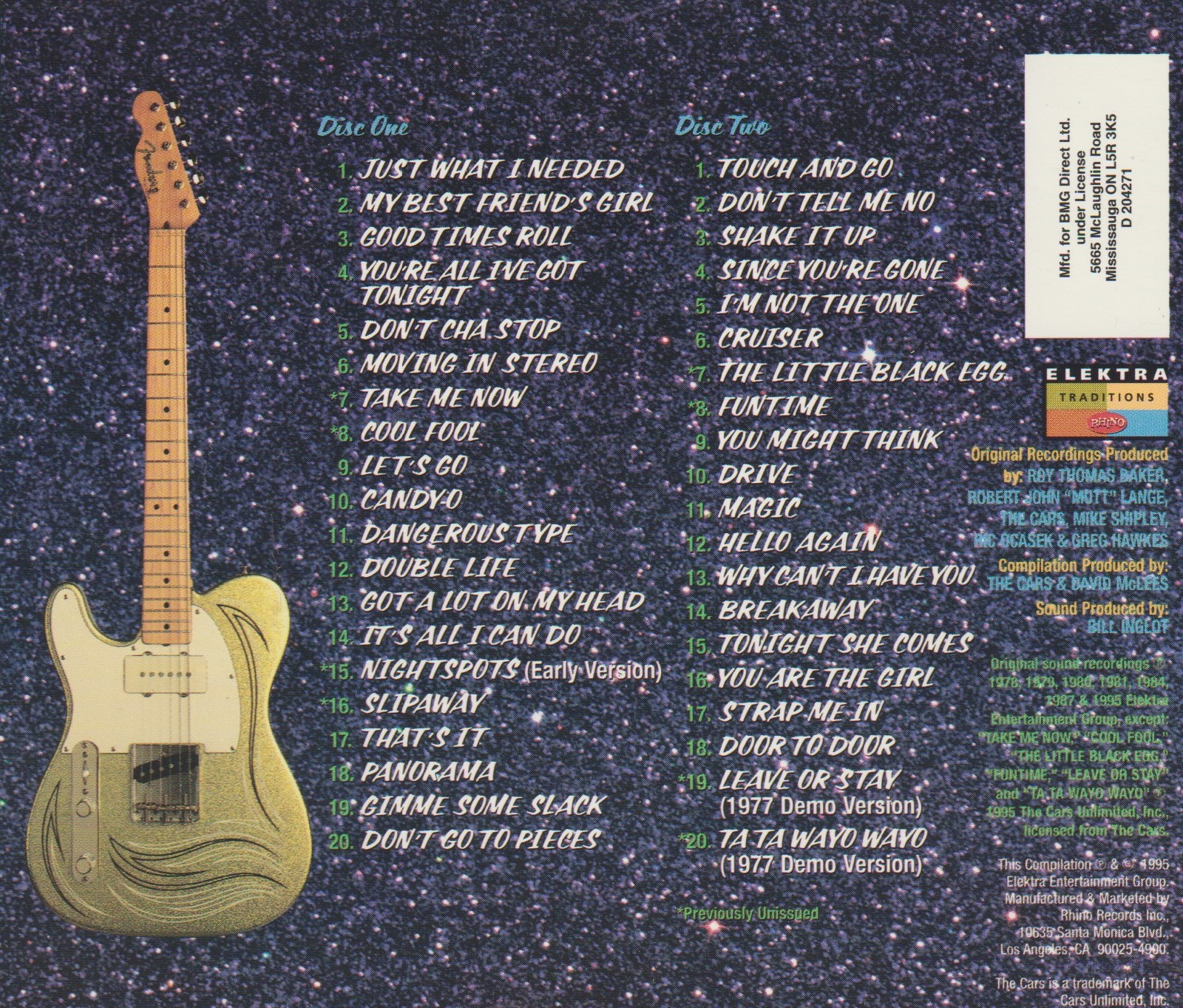
Ric Ocasek was cool.  Whether it was the sunglasses, or the black hair and leather jacket combo, he was just cool.  The Cars were birth attendants to MTV.  “You Might Think” was arguably the greatest music video on this side of Michael Jackson.  And The Cars were far, far more than just a one hit band.  This Cars Anthology proves just how much gas they had in the tank.  With 40 songs including a number of rarities, this anthology is just what YOU needed.

The first four songs in a row, all from the Cars’ self-title debut, are radio staples.  “Just What I Needed”, “My Best Friend’s Girl”, “Let the Good Times Roll” and “You’re All I’ve Got Tonight” still rock the airwaves, proving their timelessness.  The Cars could write a song, and whether it was Ric Ocasek or Benjamin Orr on vocals, the hits kept rolling in.  It’s a combination of choppy guitar hooks, keyboard candy, and plain ol’ songwriting ability.

The Cars were also consistent.  There is no dry spell for hits, not until we get to 1987’s Door to Door.  When you listen to a cross section of material in chronological order like this, it’s quite noticeable when Robert John “Mutt” Lange takes over production duties.  Heartbeat City and its synthetic drums are the prototype for Def Leppard’s Hysteria album.  The backing vocals, the bass tones, and impeccable production all foreshadow the sound of things to come in Mutt-ville.  Roy Thomas Baker didn’t put so much of his own fingerprints on the Cars (although you can definitely hear a Cars influence via Baker on Alice Cooper’s Flush the Fashion).  Mutt sounds like Mutt, for better or for worse.  The album sold four million copies.  Whatever Ric learned from Mutt and Baker, he put to good use as a producer himself.

There are some songs that are just special.  Even though their fellow tunes are unique, important and classic, some rise even higher.  One is the legendary ballad “Drive”, written by Ric and sung by Benjamin.  Soft and gentle, “Drive” has been our companion for decades now, through lonely nights and happy days alike.  Another immortal song is the aforementioned “Just What I Needed”, for all it’s pop-punk perfection, before that was even a term.  I believe they just used to call it “New Wave”.  Finally “You Might Think” must be remembered as not only an important video, but also an ageless pop song that still grabs you today.

Rarities in this set include single B-sides, demos and previously unreleased songs.  Some have since found homes on the Cars’ deluxe reissue CDs, but some seem to still be exclusive to Just What I Needed.  One interesting outtake is a bang-on cover of Iggy Pop’s “Funtime”.  The liner notes are also exemplary, as Rhino usually do.  You could consider this to be a miniature box set for all the care put into it.  While buying The Cars by the album will not lead you astray, there is much to be said for a really good anthology.  You’re looking at one right now.

5/5 stars

Rest in peace Ric, rest in peace Benjamin.


REVIEW: Whitesnake – 1987 (30th Anniversary Edition box set)

WHITESNAKE – 1987 (30th Anniversary Edition Rhino box set)

Back when I reviewed the original “Deluxe” edition of Whitesnake’s 1987, I said, “Great album, but this reissue could have been so much better.”  And so here we are.

Let’s get right down to it.  You already know the story of Whitesnake 1987 or you wouldn’t be here.

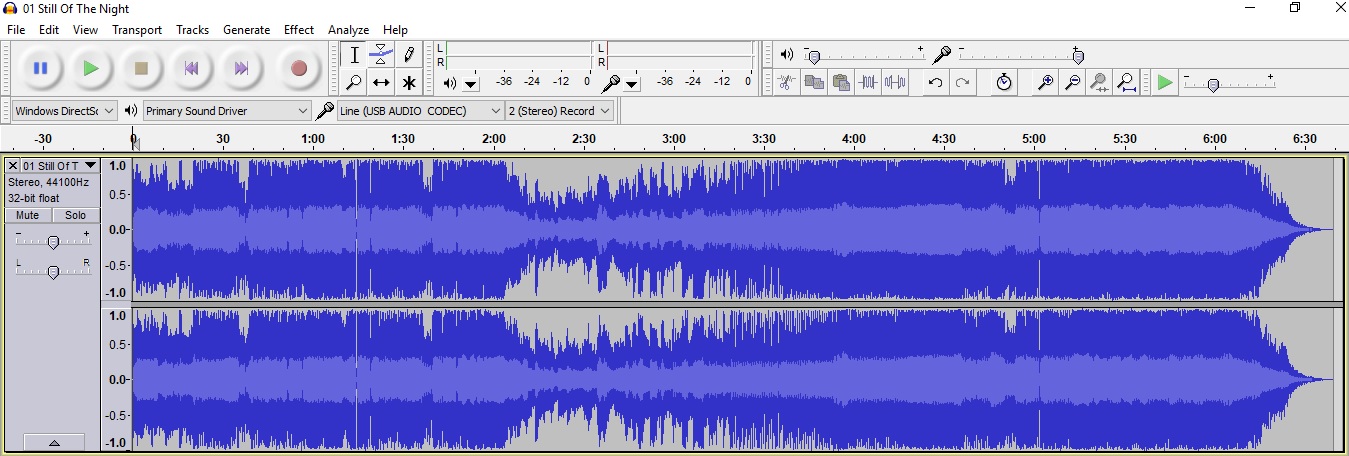
The main feature is the 2017 remaster of 1987, which actually sounds pretty great.  In this day and age, if you’re seeking the warmth of a vintage vinyl experience, you can go and have that experience for far less money than this box set costs.  For a compact disc, this might be as good as we’ve gotten so far.  If you look at the Audacity waveforms below, you can see the 2017 remaster (top) has roughly the same levels as a previous one from Whitesnake Gold.

I’m still hanging on to my original UK version of 1987, but for compact disc, this is probably it.


David Coverdale wanted to adapt Whitesnake to the 1980s with this album, and this lineup with John Sykes, Neil Murray, and new drummer Aynsley Dunbar was certainly able to deliver.  The album was always loud, especially compared to their 70s output.  Sykes provided the squeals that the kids wanted.  David was back in top voice.  The album they delivered is legendary for how it changed Whitesnake’s fortunes.

The running order on this box set is not the original UK or US, but the combined running order as used on the previous 20th anniversary edition.

“Still of the Night” blows the doors in, a tornado in the night, mighty and sexy too.  Whitesnake had never been this aggressive before, but “Give Me All Your Love” lulls the listener back to something easier to digest on first listen.  “Give Me All Your Love” was a successful single because it’s melodic pop rock with guitars.  But then the band scorch again with “Bad Boys”, top speed right into your daughter’s headphones!  Whether it was Aynsley Dunbar or just the songs that they wrote, the pace is high gear.

“Is This Love”, a song that David was writing with Tina Turner in mind, was another massive hit.   John Kolodner (John Kolodner) insisted that they keep it for themselves, and he was right as he often was.  For a big 80s ballad, “Is This Love” really was perfect.  It tends to work better in a stripped back arrangement, since the original is so specifically tailored to that era.  Still, Sykes’ solo on it has to be one of his best.

Speaking of hits, “Here I Go Again” is the one that Sykes didn’t want to do, and look what happened.  That humble pie probably tasted no good to Sykes when he found himself fired by Coverdale after the album was completed.  His replacement, Adrian Vandenberg (Vandenberg) actually played the guitar solo, so dissatisfied was Coverdale with the one Sykes produced.  “Here I Go Again” was of course a minor hit from Saints & Sinners, but deserving of a second shot in America with production more suited to their tastes.  Don Airey on keyboards; though Whitesnake did without an official keyboardist this time.

“Straight For the Heart” is a great also-ran that perhaps could have been another single if they kept trottin’ them out instead of stopping at four.  High speed but with incredible hooks, it’s impossible not to like.  “Looking For Love” is the second ballad, but actually originally unreleased in the US.  It’s toned down from the style of “Is This Love”, and Neil Murray’s bass is pronounced.  He was a huge part of the groove on this album, if you really settle in and listen to the rhythm section.  His bass has a certain “bop” to it.  “Children of the Night” returns the tempo to allegro and the lyrics to dirty.  I can’t imagine too many fathers of the 80s wanted their daughters to go to the Whitesnake concert if they heard David cooing, “Don’t run for cover, I’m gonna show you what I’ve learned, just come a little closer, come on an’ get your fingers burned.” Another UK exclusive, “You’re Gonna Break My Heart Again” cools it down slightly, but that Sykes riff is hot like a torch!

“Crying in the Rain” is held back to second-last in this running order, even though it opened the US album.  Another re-recording, “Crying in the Rain” was suggested by Kolodner because he knew Sykes could give it that massive blues rock sound that it had in the live setting.  Again, he was right.  “Crying in the Rain” is massive — perhaps the most sheerly heavy piece of rock that Whitesnake ever dug up.  Finally the CD closes with the last ballad, “Don’t Turn Away”, which closed the US version.  It’s a fine song indeed, and a really good vibe on which to end Whitesnake 1987.


The second CD in this set is called Snakeskin Boots:  Live on Tour 1987-1988.  Presumably, these are recordings from throughout the tour, assembled into a CD-length running order.  The “boots” in the title implies bootleg quality, but it certainly sounds better than that.  Soundboards maybe?

The studio lineup of Whitesnake dissolved and David got Vandenberg in, followed by Vivian Campbell (Dio) and the rhythm section of Rudy Sarzo and Tommy Aldridge (Ozzy Osbourne).  This new lineup was not based in the whiskey blues of the old band(s), but in the flashy stylings of the 1980s.  Vivian and Vandenberg were both capable of shredding your brain.  That’s generally how they do it on these recordings.  Opening with “Bad Boys”, the manic tempo is maintained while the guitars reach for the stratosphere.

Sounds like it was a hell of a show, rolling into the groove of “Slide it In” and “Slow An’ Easy”, and the good news is the 1987 band can play the 1984 songs too.  David Coverdale is the ringmaster, the veteran, confident and in prime voice.  All the songs are from either 1987 or Slide it In, with only one exception:  the slow blues “Ain’t No Love in the Heart of the City” from the original 1978 Snakebite EP.  Sounds like Vivian Campbell accompanying David on this slow, classy blues.  No Deep Purple in the set; but my old pal Rob Vuckovich once said he went to the Toronto show on this tour bearing a flag that said “PLAY PURPLE”.  He also claimed David acknowledged it by saying, “We’re not playing any of that!”

“Here I Go Again” comes early on the CD, fourth in line, and it’s excellent.  “Guilty of Love” is a nice surprise, and “Love Ain’t No Stranger” is more than welcome at the party.  “Is This Love” is well received, and works well in the live setting without too much extra production.  Adrian can’t top the Sykes solo, though he gets within very close range.  Vivian and Adrian get a feature solo with a keyboard backdrop, and it’s quite good — more like an instrumental than just a solo.  It leads into a brutally heavy “Crying in the Rain”; Tommy Aldridge literally beats the shit out of it!  The CD closes on “Give Me All Your Love” with David substituting the word “baby” in the opening line with “Tawny”!

There’s little question.  For most fans, the major draw of this box set will be this live CD.  If that is you, you will not be disappointed by Snakeskin Boots.


Disc three in this monolith of a box set is the 87 Evolutions.  This is an interesting concept but not one that you will be craving to have a listen regularly.  This disc is intended for deeper study.  These tracks are the album’s songs in various stage of demoing.  “Still of the Night” for example starts as a living room demo, with David slapping his knees for drums, and only the most basic of lyrics.  Then this demo fades seamlessly into a more advanced full band arrangement, with the lyrics still unfinished.  There’s a funky middle solo section here that is more jam than song, but a blast to hear.

That is the kind of thing you can expect to hear on 87 Evolutions.  No need to spoil what you should enjoy discovering yourself.  This is for the hardcore of hardcore fans, those that want every squeal that ever came from Sykes’ axe.  You are gonna get it.  Incidentally, I think I prefer David’s original, rough slow bluesy version of “Give Me All Your Love” to the glossy pop song it became.

This disc ends with a “Ruff Mix” of the completed “Crying in the Rain” from Little Mountain studios.  All the parts are in place, the mix just needed that modern bombast that David was aiming for.


The fourth and final CD, 87 Versions, is a collection of alternate remixes released on various singles, and brand new remixes as well.  These are really cool bonuses.  The 2017 mix of “Still of the Night” has a really dry sound, allowing you to really hear the spaces between the instruments.  A lot of these remixes have a different balance of instruments, so you will hear different things yourself.  There are two remixes of “Give Me All Your Love” on this CD:  the 2017 with the original Sykes solo, and the highly coveted alternate with “new” solo by Vivian Campbell.  There are also two remixes of “Here I Go Again”, including the old “Radio Mix” with a completely different group of musicians and a much more pop arrangement.

Among these remixes is something called the 1987 Versions:  Japan Mini-Album, proving that Japan always get the best stuff.  This apparent EP contains the B-sides and bonus tracks that you couldn’t get on the album.  “Standing in the Shadows” was another song re-recorded for 1987, though left as a B-side.  “Looking For Love” and “You’re Gonna Break My Heart Again” are also included, since back then you could only get them in the UK.  “Need Your Love So Bad” was a previous Whitesnake B-side, remixed in 1987 for a new B-side!  It’s an absolutely stunning ballad, quiet with only keyboard accompaniment.

With all these tracks included, pretty much every track associated with the 1987 album and singles is covered.


Whitesnake: The Videos is the fifth disc, a DVD.  It’s really just an add-on, nothing substantial (like a 5.1 mix).  First on the menu:  “More Fourplay”, the classic MTV videos that set the world on fire in 1987.  Some behind the scenes footage too.  MTV was a huge part of this band’s success (hopefully Tawny gets paid a royalty from this reissue?).  These glossy videos are…well, they didn’t age as well as the album did.  Why does Rudy always lick his bass?  You just gotta laugh at “Here I Go Again”; the pretentious image of the three guys (Viv, Adrian, Rudy) playing keyboards passionately side by side…utterly silly.  But yet iconic.  “Is This Love” has the band playing on evening rooftops, Rudy wielding a double-neck bass.  Why?  Doesn’t matter; in 1987 we thought it was awesome.  “Give Me All Your Love” is a notable video, being a “live on stage” type, but also with the brand new guitar solo cut by Vivian.  For his solo, Viv chose to play on the wang bar a bit too much, but at least David let him do one.  It remains Vivian’s only studio appearance with Whitesnake, ever.  Unannounced but cool just the same, “Love Ain’t No Stranger” (from Slide It In) is used in whole as the end credit song for the “More Fourplay” segment.

Next up is a 28 minute documentary about the making of the album.  David has clear recollections and is always a delight to listen to. (Some vintage Coverdale interview footage is actually from a MuchMusic piece with Denise Donlon.) Interestingly, he claims that the “Still of the Night” riff is one that he found in his mother’s attic, that he wrote back in the tail of Deep Purple.  “Still of the Night” could have been a Purple song, but it took John Sykes to make it what it became.  We then move on to the assembly of the touring lineup, dubbed the “United Nations of Rock”.  Tommy and Rudy are also interviewed in vintage clips, with Tommy proudly proclaiming that they want to bring musicality back to rock and roll.

The “Purplesnake Video Jam” (whut?) video of “Here I Go Again” is basically a brand new music video using alternate footage from the time.  The mix is similar to the old single mix, but spruced up.  Finally there is the “’87 Tour Bootleg”, and woah!  It’s pro-shot multi-camera footage.  You only get half of “Crying in the Rain”, and all of “Still of the Night”.  Why not more?  Is this a tease for some kind of upcoming DVD?  The footage reveals a band of their time, but a good band.  Not the best Whitesnake lineup ever (Sykes gets that), but a good lineup with something special together.  They were tight, they could all play their nuts off, and present a high energy 80s stageshow, especially Rudy.  By the end of “Still of the Night”, David is actually dodging panties being thrown at his head.  I kid you not.


As per usual, any box set worth its own respect is packed with added stuff usually made of paper.  In this case, a nice hard cover booklet, a smaller softcover lyric book, and a poster.  Posters have to be the biggest waste of money in a set like this.  Who’s going to hang it?  I’m probably never even to unfold mine once.

Now that you have all the details, you should be able to decide if this box set needs to be in your collection.  It needed to be in mine.  And guess what — Slide it In is next!

5/5 stars

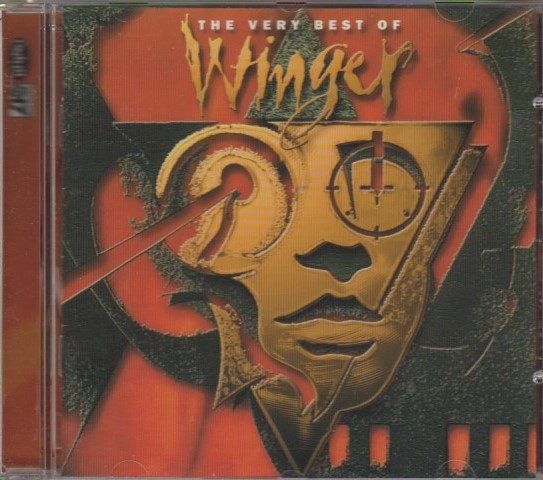
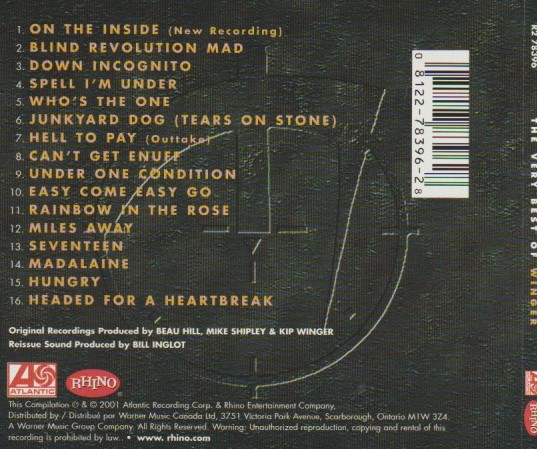
REVIEW: Winger – The Very Best Of (2001)

WINGER – The Very Best Of (2001 Atlantic/Rhino)

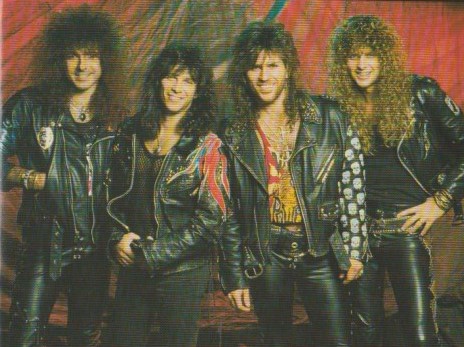
Winger broke up in ’94, but reunited in 2001.  Part of the reunion entailed new music.  Before they finally released a new album (Winger IV), they tested the waters with one new song on The Very Best of Winger.  Yes indeed, you had to buy a “greatest hits” to get the new song.  At least Winger also gave you a Japanese bonus track for your money too.

New tune “On the Inside” was written for Pull (their third album and last before breakup) but recorded for Very Best Of.  It’s a chunky, heavy tune with splashes of anthemic keyboard in the chorus.  It really underlines that Winger could write and play with integrity when they wanted to.  Reb Beach’s solo is unorthodox and outside the box.  “Hell to Pay” is listed as an outtake, but it was actually released as a Japanese bonus track to Pull.  Stuff like this saves collectors for shelling out mucho dinero for a Japanese import.  Good sassy tune, and listen for that scorching outro.

Pull was a record that never got a shot, so it’s OK that the first chunk of tunes are from that album.  It deserved a second chance.  These are standout songs:  “Blind Revolution Mad” smokes white hot, and with depth.  “Down Incognito” has a bright, memorable chorus contrasted with groovy verses.  90s-style riffing worked perfectly on the track “Junkyard Dog”, a seven-minute thrill ride through different textures.  Winger were not playing it simple.  Even their ballads from that era have more heft.  “Spell I’m Under” has edge under those layered melodies.  Few songs are as starkly lovely as “Who’s the One”.

The Very Best of Winger takes a dive after the Pull material.  The CD is in reverse chronological order, which almost never works.  Yes, it highlights the most current sounding music, but at the cost of consistency.  Winger II: In the Heart of the Young was, let’s be honest, not good.  The ballads were sappier and the rockers too cheesy.  Only “Rainbow in the Rose” really fits on this set.  Past the dreck, the four singles from album #1 are included.  This means the CD at least ends on an up, though the ballad “Headed for a Heartbreak” is a bit anti-climatic.

Go for The Very Best of Winger if:

a) you want to check this band out, or

b) you want the rarities.

Your needs might be met by just buying Pull.

3.5/5 stars

REVIEW: Alice Cooper – The Life and Crimes of (1999 box set)

ALICE COOPER – The Life and Crimes of Alice Cooper (1999 Rhino 4 CD set)

With the benefit of hindsight, 1999 was way too early for Alice Cooper to be looking back with a comprehensive box set.  His new album Paranormal will be out this month.  He’s been consistently touring and recording.  The picture was different in 1999 though, since Alice had been quietly under the radar for much of the decade and there was no sign of new music coming.

This Rhino box set is pretty comprehensive.  Though there are plenty more rarities out there to get on singles and elsewhere, Rhino served up a very generous selection of them.  Starting in 1966 with singles by The Spiders and The Nazz, Alice’s sound begins to evolve.  Those early bands were 4/5 of the original Alice Cooper group:  only drummer Neal Smith had yet to join.  The early singles are unfocused compared to what Alice was going to do in a couple years.  “Don’t Blow Your Mind” and “Lay Down and Die, Goodbye” (sometimes known as “I’ve Written Home to Mother”) are sloppy psychedelia.  “Hitch Hike” is like rockabilly.  “Why Don’t You Love Me” is late 60s style rock and roll with a nice harmonica part.  It sounds influenced by the Beatles.

A demo version of “Nobody Likes Me” is the first “official” Alice Cooper Group track and it sees the sound veer closer to where they were headed.  It has a sing-song melody that recalls “School’s Out” later on.  A few tracks from Alice’s first two albums (Pretties For You and Easy Action) demonstrate a work in progress.  “Reflected” is an early version of something that would be re-written as “Elected”.  The band was still very psychedelic and not as tight as they would become.

There is a sudden shift, and Alice Cooper emerges as the classic artist we know and love when he hooked up with producer extraordinaire Bob Ezrin.  “Caught in a Dream” (a single edit) and a number of essential tracks from Love It to Death kick the box set right in the ass and it suddenly becomes a very engaging listen, when before it was just…interesting.  A quintet of songs from the next album Killer are just as special, though including “Halo of Flies” would have been appropriate too.

Before heading into the School’s Out material there is a rare demo entitled “Call it Evil”.  A small portion of the music would make it into the the classic West Side Story tribute “Gutter Cat vs. the Jets” (also included), but this is its own song and otherwise unreleased.  The single version of “School’s Out”  is an obvious inclusion, but these two are the only tracks from School’s Out, a baffling set of omissions.  Granted, “School’s Out” plays like a concept album and is tricky to split up for a box set, but it is under-represented here, period.

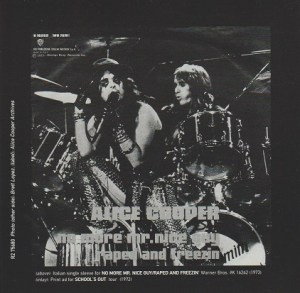
Billion Dollar Babies is considered a peak of this period, and gets five tracks of its own, all brilliant.  “Elected” is the single version.  “No More Mr. Nice Guy” is a highlight of Alice’s entire career and it still sounds fresh.  Another rarity ensues which is “Slick Black Limousine”, a UK exclusive flexi-disc release.  It sounds more like early Alice Cooper group material, with Alice doing his best Elvis.  The end of the original group was nigh, unfortunately, and Alice’s next album Muscle of Love was noticeably lacking something.  Maybe it’s because Bob Ezrin didn’t produce it, but the band was also on the verge of splitting.  Addictions were hurting them.  They were still making great rock and roll, just not…as great.  “Respect for the Sleepers” is a demo version of “Muscle of Love”, an unreleased track with lyrics inspired by Alice’s “dead drunk friends” (Jimi, Janis, Jim).  There are more songs from Muscle of Love included than there were for School’s Out, which is odd but alright.

At this point, Alice split from the original band.  Then there are a pair of rarities featuring Alice from an obscure rock opera called Flash Fearless Vs. the Zorg Women, Pts. 5 & 6.  Before Queen, there was this Flash Gordon album and Alice’s tracks feature players like John Entwistle, Kenney Jones, Nicky Hopkins, Bill Bruford and Keith Moon as “Long John Silver”.  “I’m Flash” and “Space Pirates” are mere curiosities, but it’s stuff like this that makes buying a box set so much more worth it.  Where else would you hear these tracks?  Both feature Alice’s delicious trademark sneer.

Alice’s solo career really began with 1975’s Welcome to My Nightmare.  He and Bob Ezrin went all-in with an elaborate horror rock concept album featuring a number of classics.  “Welcome to My Nightmare” and “Only Women Bleed” are single versions, and it’s fantastic that the blazing “Escape” was included.  Another concept album, Alice Cooper Goes to Hell, was not as strong.  Only two tracks are included, but both were singles.  “Go to Hell” is a must-have.

The third CD in this box set commences a murky period.  Alice was making albums frequently, but they weren’t as well received and many dwell in obscurity.  Lace and Whiskey was pretty good, and “It’s Hot Tonight” is a great track to start the disc.  Meanwhile, original band members Michael Bruce, Neal Smith and Dennis Dunaway formed the Billion Dollar Babies.  They made one album called Battle Axe, and their cool rock track “I Miss You” is included.  That’s a nice touch, because for the first seven albums those guys were as important as Vincent Furnier (aka Alice Cooper).  Michael Bruce sings, but lead guitarist Glen Buxton was more or less incapacitated by addiction and wasn’t invited.  “Battle Axe” sounds like a natural continuation of the Muscle of Love sound.  A bunch more rarities are incoming:  a torch ballad called “No Time for Tears” (unreleased) and “Because”, the Beatles cover featuring the Bee Gees.  This was from that pretty mediocre Sgt. Peppers tribute album from 1978, so it’s great to be able to get it in a box set.  Alice’s interpretation is creepy, and the Bee Gees are immaculate.

Moving on to his next solo album, Alice changed direction on From the Inside.  He had just gotten out of rehab (an actual mental hospital) and made a concept album with David Foster and Bernie Taupin about the experience.  The title track is included as a single version, and you also get the beautifully campy ballad “How You Gonna See Me Now”.  It was a single too, and its B-side “No Tricks” is also included.  It is a duet with soul singer Betty Wright.  Disc three is generous in rarities.  Another one called “Road Rats” (produced by Todd Rundgren) is a decent rocker from a movie called Roadies.

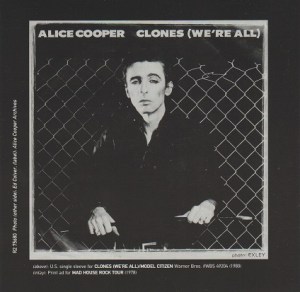
Alice moved into the 1980s on Flush the Fashion which employed some new wave and punk influences.  Its two best songs, “Clones (We’re All)” and “Pain” are included.  1981 brought Special Forces and more rarities.  “Who Do You Think We Are” is a single version, and “Look at You Over There, Ripping the Sawdust from My Teddy Bear” is a synthy unreleased song pulled last minute from the album.  Then there is “For Britain Only”, the stripped-back rocker from the EP of the same name.  “I Am the Future” is a single version originally from 1982’s Zipper Catches Skin.  Completing this era (sometimes called Alice’s “blackout period”) are a pair of tracks from DaDa (1983).  Alice had moved as far as he would go into the high-tech synthesizer direction, and he soon cleaned up for good.  A couple odds and ends tidy up the tracks from this era.  “Identity Crisises” and “See Me in the Mirror” are previously unreleased songs from the Monster Dog movie (1984) which starred Alice.  These are very low-fi tracks, but “Identity Crisises” is actually pretty cool.

The final track on the third disc is the first one from Alice’s big comeback period.  “Hard Rock Summer” is a fun heavy metal rocker from the Jason Lives soundtrack.  It’s cheesy but also previously unavailable.  The fourth and final CD picks up there, with two more rarities from the same movie.  “He’s Back (The Man Behind the Mask)” is included in demo and movie mix versions.  Onto 1986’s Constrictor LP, you get the enjoyable “Teenage Frankenstein”.  By 1987 Alice was telling us to Raise Your Fist and Yell on “Freedom”.  The excellent “Prince of Darkness” is also from that album, but then there are two more rarities.  Alice cut a re-recording of “Under My Wheels” with Axl Rose, Slash and Izzy Stradlin for the movie The Decline of Western Civilization Part 2: The Metal Years. Unlike many re-recordings, this one is well worth it because hey, it’s Guns N’ fuckin’ Roses.

Alice’s sound got slicker moving into the late 80s. “I Got a Line on You” is a Spirit cover from the movie Iron Eagle II. There is a notable shift towards mainstream hard rock, and this spilled over onto the next album Trash (1989).  This box set has three songs from Trash, but one is the irritatingly bad title track featuring Jon Bon Jovi.  His sound got a little tougher on Hey Stoopid (1991) from which you get a single version of the title track, and “Feed My Frankenstein” (also from Wayne’s World).  The Hendrix cover “Fire” is the last song from this period, which was a B-side.  Unfortunately another B-side called “It Rained All Night” is a superior song, but not included.

Alice took another short break between albums before emerging in 1994 with another critically acclaimed concept album, The Last Temptation.  Alice shed the trappings of the 80s and the album is held in high esteem today as a diverse combination of the 70s and 90s.  Three tracks represent it, but it’s hard not to wish “Side Show” was also included.

The Last Temptation was Alice’s last studio album when this box was released in 1999.  In the meantime, Alice made friends with Rob Zombie who was obviously influenced by the Coop.  They collaborated on a song called “Hands of Death (Burn Baby Burn)” for an X-Files CD.  This box set has the unreleased “Spookshow 2000 Mix”.  The track points in the direction of Alice’s next album Brutal Planet.

This box set is quite an epic journey, with many facets and side roads.  A trip like this needs an appropriate closing, and Rhino did something interesting to do that.  They broke the chronological format they used for the majority of the set, and slid in the acoustic rocker “Is Anyone Home?”.  This was a studio track included on Alice’s 1997 live album A Fistful of Alice.  This serves as the climax, and “Stolen Prayer” from The Last Temptation is the finale.  “Stolen Prayer” is a powerful duet with the late Chris Cornell.  It was always a perfect closer, but now it’s…also sad.

It should be obvious now that The Life and Crimes of Alice Cooper is a worthwhile box set even for fans who own every album.  The wealth of rarities are just a taste, but they certainly scratch a lot of track off of collector’s lists.  Many remain exclusive to this box set.  On top of that, it is simply a good listen, bumpy start aside.

4.5/5 stars