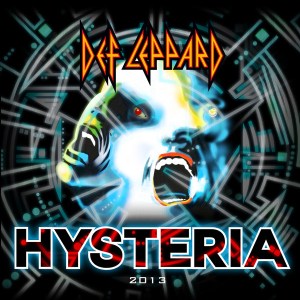
Just in time for their Viva! Hysteria & More tenure in Vegas, comes another re-recorded “forgery” (Joe’s words). This one is really good. It takes a bit to figure out which version it is, in fact. Musically, you can barely hear any differences, although the production sounds slightly less shimmery and saturated. A few guitar parts (probably Vivian) sound mildly different. Vocally, you can slightly tell it’s not the same version, but what’s incredible is how much Joe Elliott 2013 sounds like Joe Elliott 1987. I read that Joe spent a lot of time getting his voice into that shape again.
“Hysteria” has long been one of my favourite Def Leppard songs, probably since I first heard it. I think it’s an incredible song, one of the best from this commercial phase of Def Leppard’s career. Time stands still when I hear it. An original version is always going to mean more to the real fan. That’s just the way it is, that’s psychology. These forgeries were designed so Leppard could sell their music on iTunes on their own terms (ie; make more money than the label was offering them). It’s business — I have no problem with it. For $1.29, I have an alternate version of this track. I didn’t have to, I wasn’t tricked into it, and the song is clearly labelled as a 2013 re-recording.
Necessary for those who “have to own it all”, or those who want a quick easy cheap way of getting a studio version of the song online (like, say people downloading it for a wedding). This will be of little value to anyone else.
My initial thinking regarding this single was that I didn’t need it; both songs are available on On Through the Night. Then I found out that these single versions of “Wasted” and “Hello America” are earlier, non-album recordings. Rick Allen was in the band by this time but On Through the Night had yet to be recorded. This immediately put the single on my radar as a must-have.
On Through the Night was produced by Tom Allom (Judas Priest) but before settling on him, Leppard tried out Nick Tauber due to his history with Thin Lizzy. (He also produced Sheer Greed by Girl, the band that featured future Leppard alumnus Phil Collen.) Tauber worked on the earlier, folksier Lizzy, not the later version of the band that rocked out such classics as “Jailbreak” and “Bad Reputation”.
The story goes that the record label was unhappy with Nick Tauber’s results and put a halt to his work on the album. He had finished four songs: These two, plus “Rock Brigade”, and “Glad I’m Alive” which both remain unreleased. The label released “Wasted” as a single while recruiting Tom Allom to start over on the album.
“Wasted” boasts one of Leppard’s all time greatest riffs, if not the greatest. You can see how this song has remained a cult favourite all these decades later. This earlier version isn’t as adrenalized (pardon the pun) as the later album version, but there’s otherwise nothing wrong with it. I think Allom’s album version is safely still the definitive one. The two tracks are not that dissimilar, just Allom’s more in tune with the current heavy metal sounds.
The B-side, “Hello America”, would become a single in its own right the following year, in its guise as an Allom track. This might be one that I prefer in its Tauber version. Allom added a synthesizer riff to the chorus of “Hello America” that I always felt dated the tune. While this version is not as manic or electrified, it does have the bare unadorned chorus. There are bonuses to both versions.
It’s kind of funny to hear how shaky Joe Elliott’s voice was back then. He grew into a powerful screamer by the High ‘n’ Dry album, which is my favourite period of Def Leppard. They were all young back then, but Joe was clearly not as confident nor in his control of his voice in 1979.
Still, as a purchase, as a single, as a collectible, I am very happy with this. My only regret is that I didn’t find one with a picture sleeve.
Part 3 of a 4-part series on early Def Leppard singles!
DEF LEPPARD – “Bringin’ On the Heartbreak” (1981 Phonogram/Vertigo single)
High ‘n’ Dry is my favourite Def Leppard album, and I can’t wait to review it (particularly the vinyl version). “Bringin’ On the Heartbreak” was probably the biggest single from the album…I mean, freakin’ Mariah Carey even covered it! This is a cover version I have never heard and am not even curious to hear, but good on Def Lep for the success anyway.
The original 1981 version is the best known version of the song, although the 1984 remix (keyboards added) was the most pervasive in the late 80’s. The 1984 remix was done to capitalize on the success of Pyromania, and it was re-released as a single, and as a bonus track on the High ‘n’ Dry album itself. Also remixed and re-released was the B-side to “Bringin’ On the Heartbreak” called “Me And My Wine”. They even made new videos for both remixes!
For many years, I had never heard the original “Me And My Wine”, as only the 1984 remix was made available on the new High ‘n’ Dry. I finally hunted down a copy of an original “Bringin’ On the Heartbreak” single with picture sleeve, completing this phase of my Def Leppard collection!
“Bringin’ On the Heartbreak” of course is Def Leppard’s first ballad, and one they still play in concert, a rarity for these early years. It’s always been a favourite of mine. Back then, you had to have a power ballad, but it had to remain tough. For example, “Still Loving You” by Scorpions was very soft, you could try to use it to woo a ladyfriend, but it had that awesome guitar solo. As if to say, “I’m sensitive, but tough.” This single is Def Leppard’s crack at the format. I think it’s very successful, the song has proven to have longevity. It has all the right elements: a killer chorus, dark and plaintive verses, a dramatic lead solo break, and the word “heartbreak” in the title!
“Me And My Wine” was the main reason I have been hunting this single. It’s one of Def Leppard’s fastest tunes, while they were still a metal band, and a bit of a cult favourite. The 1984 remix version is great, and many Def Leppard fans agree that it’s also the best music video they ever made. Hearing the original 1981 version for the first time, the differences are subtle.
The intro on the remix version is longer, with a count-in, the original mix does not have this. The drums on the original are a lot more raw. The remix sounds like the drum tracks are completely replaced by new electronic drums. The original features more prominent bass guitar as well. I have to say that after only a couple listens, I already believe the original version is superior to the remix. It’s groovier with the amplified bass, and I think the remixed drums really take the edge off. The original version just has more balls!
The characters: Me, a guy who looked like Jim Carrey, and his buddy
Taken straight from my journal, here’s the story:
What, is today Stupid Person Day?
This last guy that was just in, I can’t tell if he was for real, or if he was Jim Carrey. Is Jim Carrey tall? Could have been him. This guy was Jim Carrey in The Cable Guy: Same hair, same voice, same mannerisms.
He tried to sell me a Rush CD that had obviously been used as an air hockey puck. And he didn’t understand why I wasn’t going to buy his ruined CD. “You didn’t advertise that you wouldn’t take it scratched!” Well, no, because that much should be obvious.
Jim Carrey left with his buddy, remarking that it was so cold his “balls were frozen”. Yeah! You go, Jim!
I really hope it was just Jim Carrey playing a character for fun, because nobody should be this lame!
This classic underappreciated masterpiece of rock goodness has finally been expanded with bonus tracks. Underappreciated? Sure, while everyone knows at least two songs from this album, how many friends of yours actually own a copy?
Jailbreak‘s been given some cool bonus tracks. An entire disc’s worth in fact! The remastering sounds good enough to me. Until I got this deluxe, I hadn’t played Jailbreak in a while, and I had completely forgotten about great album cuts like “Running Back”. It’s a sweet little love ditty as only Phil can do it, romantic but classy all the way.
I think the second track, “Angel From the Coast”, is one of Lizzy’s greatest album cuts. It rides on top a rhythmic, rolling guitar riff, but it’s also one of Phil’s more memorable compositions. “Romeo and the Lonely Girl” is another one of Phil’s romantic classic rockers. The lyrics are kinda cheesey: “Whoah-oh, poor Romeo, sittin’ all on his own-e-o”. But it works, because it’s Phil, and everything he did sounded sincere and cool.
“Warriors” brings the metal. It’s a classic heavy rocker that I am sure people like Steve Harris studied meticulously to learn the mysterious art of songwriting. Multiple sections collide, thundering drums roll, and solos rage.
“Fight Or Fall” is a great ballad, acoustic and soulful. This is the kind of thing that Phil had done so well on albums like Nightlife. “Emerald” is another Phil historical epic. Once again, I feel that Steve Harris probably studied this song intensely. This really anticipates where Iron Maiden were going to go later on.
One of the true classics on Jailbreak was “Cowboy Song”, a song that melded live with Lizzy’s cover of Bob Seger’s “Rosalie”. In my mind, the two songs are one in the same now. They go together like peanut butter and jam. And that, friends, is a tasty sandwich.
I don’t really need to talk “Jailbreak” and “The Boys Are Back In Town”, do I?
Alright, I will. “Boys Are Back” is one I discovered initially through Bon Jovi. They covered it back in 1989 on a charity CD that I’ll cover another time. It was perfect for them. Didn’t Jon always sing about the boys being back in town back then? It had a tasty guitar harmony part for Richie Sambora to sink his teeth into, and it was melodic and radio-worthy. In a way, this is Lizzy’s Bon Jovi song, but it is no less classic for it.
And “Jailbreak”? Everything about it is perfect. The riff, the melody, but it really came alive in a live setting. As good as the album version is, it was live that “Jailbreak” burned.
The bonus disc kicks off with four remixes helmed by Joe Elliott, one of the biggest Lizzy fans out there. His strategy was simple: some subtle fixes to out-of-tune guitars and drums that were mixed too low. Then he and Scott Gorham added previously unheard lyrics, solos and fills. The result is some fine alternate versions that won’t replace the originals but serve as interesting companion pieces. I especially enjoyed the previously unheard lyrics from Phil.
The remixes are followed by some live takes. BBC recordings of the title track, “Emerald”, and others are nice and clean. Just as you would expect from the BBC. Then there is an extended cut of “Fight Or Fall” with some very tasty slide guitar brought up to the forefront. It’s a nice touch. “Blues Boy” is a completely unreleased track, a blues as you might have guessed. It is complete with some skeletal vocals from Phil, but this is essentially a blues jam. As an unreleased song, this is a valuable inclusion, albeit not a standout song. The album ends with a live take called “Derby Blues”, which is an embrionic version of “Cowboy Song”. “This is a new number, this one!” says Phil. “As yet untitled. We’ll call it ‘Derby Blues'”. It still has all the energy and fire that it would later embody. (“Derby Blues” is also on a more recent release called UK Tour 75.)
The liner notes to this edition are quite excellent, among the best I have ever run into in a deluxe edition. As an added bonus, there is a page of notes from Joe Elliott, explaining the included remixes.
If you don’t want to bother with the deluxe, at least make sure you own Jailbreak. 5/5 stars
I was just 11 years old when I first heard of Kilroy.
Allan Runstedtler at school had it first. He was always talking about it…this cool song called “Mr. Roboto”. This album where the songs all told a story. It had robots in it, it was an album with pictures and a story…not unlike those Star Wars story soundtracks we used to listen to. In hindsight it seems obvious that Kilroy Was Here was my gateway drug to rock music.
I went over to Allan’s house, with my little Fisher-Price mono tape deck, as he put Kilroy Was Here on the hi-fi. I hit “record” and we all quietly left the living room…so as to not disturb the open air recording. Only once did we step downstairs, but this was only to flip sides on the LP and cassette.
You can see why it was so appealing. The robots didn’t look that dissimilar from the childhood classic film The Black Hole, plus there were robot vocals on the song, but it wasn’t guitar heavy or threatening. It was catchy though, “Mr. Roboto” being the song that hooked us in. We had the lyrics completely memorized (the handy lyric sheet was a revelation to us) and could sing any part of the song by heart.
With the benefit of hindsight, “Mr. Roboto” todays sounds quaint, a harmless boppy synth radio hit nothing like the Styx that emerged onto the scene over a decade earlier. Dennis DeYoung’s vocals are all spellbinding as ever, the man as identifiable on this as he was on “Lady”. Where’s the guitars from Tommy Shaw and James “JY” Young? I’m really not sure. There are a few things here and there, fuzzy buzzy melodies that might well be guitars. Only once in a while in the course of a 5-minute-plus song can you really hear any sort of instrument that wasn’t programmed or played with keys!
Tommy’s “Cold War” was another upbeat one we liked as kids, and yes you can hear some guitar in the intro and chorus. There’s even a solo! Otherwise, it’s just a dreadful synth pop piece, with loads of those annoying synth-claps and other assorted sounds that are supposed to sound like percussion. Tommy plays a character named Jonathan Chance on this album, and “Cold War” reads like a manifesto from that character.
The album came with a story, so it was quite easy to break it down and figure out what was happening. It’s a dystopian tale, and the setting is…”the future”. Dr. Righteous (James Young) has risen to power, using a clever manipulation of media and government. Rock N’ Roll music…is banned! Robert Kilroy (DeYoung), a legendary rock musician, is jailed for a murder he did not commit. But Jonathan Chance (Shaw), a young rebel hoping to bring back Rock N’ Roll, is using Kilroy’s image and music as a rallying cry for his cause. One night Kilroy escapes prison, and disguises himself as a “Roboto”, the labor robots pervasive in this future world.
Got all that?
Drummer John Panozzo is credited as a character named “Col. Hyde”, and bassist Chuck Panozzo as “Lt. Vanish”. I have no idea who those people are supposed to be. There was a minifilm that went with the album and tour, and opened the live shows. It’s incredibly funny and campy, the Styx version of the Star Wars Holiday Special.
“Don’t Let It End”, a DeYoung ballad is a song we always skipped as kids. I played the ballads maybe once the whole time I owned the album! But it’s actually a pretty good tune, and you can see why it was a hit. This is followed by “High Time” with DeYoung, introducing the character of Dr. Righteous:
“I flip the switch on my laser video, And there’s the man staring back at me, He starts to speak in a voice so righteous, About the sins of society”
It’s a fun song, upbeat, very showtune-y, with DeYoung having a chance to cut loose a bit. It’s alright, and it sounds like the horn section are real horns, not some synth.
JY gets to be the one to bring the rock on “Heavy Metal Poisoning”. In this song, Dr. Righteous takes to the airwaves with the ironically hardest rocking song on the album.
What the Devil’s going on? Why don’t you turn that music down, You’re going deaf and that’s for sure, But all you do is scream for more!
We were always amused by Dr. Righteous using heavy metal music as his musical vehicle to attack heavy metal music, and wondered if there was a hidden message there? Something about hypocrisy. Righteous complains that rock and roll will lead to sex and drugs, while punishing his guitar with some seriously heavy riffing and a smoking solo. Unfortunately, some goofy keyboard bits detract from the song and keep it from being a pure heavy rocker.
“Just Get Through This Night” is a ballad we skipped as kids, but in retrospect this is a great dramatic ballad. Tommy wrote this one, a long, atmospheric meandering 6 minute piece that would have been too long to hold our kiddie attention span anyway. Even though it didn’t do anything for us as kids, it stands as one of the bright spots on an album that so often just gets too goofy. Tommy’s guitar solo, recorded backwards, is a highlight on this song.
Our second-favourite song was next: “Double Life” written and sung by JY. It’s certainly one of the highlights on the album, a menacing, dark stomp with the synths this time supporting rather than fighting the song. No idea how this fits into the story, but who cares!
Tommy’s final ballad, “Haven’t We Been Here Before” is kinda skip-worthy, although it’s nice when Dennis accompanies him on the chorus. There’s also a nice harmony guitar solo, but loaded down with effects, blunting its edge. Fortunately, the album ends with “Don’t Let It End (reprise)” which is actually a reprise of “Mr. Roboto”, but with Tommy singing and more guitars. The album ends on a bright note, as Jonathan Chance seemingly takes the mantel of rock leadership from Kilroy, vowing to keep Rock N’ Roll alive! Then Dennis comes in, doing his old rocker schtick, sending up Elvis, Little Richard and many more, and that’s the album. Great finish.
I think if we were to discuss this album in 1983, I would have raved and rated it 4/5 stars. I also probably would have overused the words “awesome” and “cool-a-mundo”. That was 30 years ago…man. That’s a long, long time. Listening to it now…
Way back in 2004 we were selling this album in our stores on consignment. One of my co-workers said, “You have to buy this. These guys are incredible. They’re like a local Rush.” Intrigued, I played the album and put it aside for myself to buy later.
For reasons unknown (probably too much music to buy and not enough money to buy it with) I didn’t buy the first and only release by Hibakusha. It is only now, in 2013 that I have finally acquired this album. Uncle Meat had come over to do our recent video, and he reminded me how great this album is.
This truly is a great, world-class album. You can hear the Rush influences in the lead vocals, the complex rhythms and drum patterns, and the impeccable musicianship. You can tell Hibakusha had listened to their fair share of the Holy Trinity in their formative years, particularly the later groove-oriented Rush circa Counterparts. This exists simultaneously with a modern edge; a drony cloud of simple melodic elements that grounds the whole thing. It shines like a new car, one you can’t wait to drive over and over….
Uncle Meat pointed out that there aren’t any real guitar solos until the final track! And it’s a explosive solo at that. The role of the lead guitar here seems not to solo, but to shower down melodic hooks. “The Moped Song” is a great example of this. It is a mid-tempo melodic tune with a repeating guitar hook where the solo would go.
Elsewhere, “Is It Concern?” quiets things down, until the chorus explodes with impassioned vocals. “Televangeline” is a massive, rhythmic machine barreling forward unstoppable. The album is loaded with great songs, great playing, terrific vocals, and memorable melodic lines. Drums crash, fleeting fingers ride the groove from fret to fret…there isn’t a dull moment on this album.
“Masquerade” might be the best summation of the Hibakusha sound in one song. It begins deceptively gently, before turning into in a light bass-driven groove. Then out of nowhere comes a colossal stuttering riff straight from the Burke Shelley of Budgie school of thought. The wailing Geddy vocals seal the deal.
My only beef about Hibakusha is the dreadful cover art. It just screamed “indy” and failed to stand out. There is absolutely no way I would have picked this album up off the shelves just by seeing its cover. The cover does nothing to indicate what’s inside.
Hibakusha were Paul MacLeod (formerly of Skydiggers) on vocals and guitar, Cory Barnes (guitar and vocals), Mark McIntyre (bass) and Gord Stevenson (drums). Even though I was almost a decade late, I’m glad I finally picked up this disc. It had been a long time since I last heard it, and I am treating it as a happy reunion.
Great album. Don’t hesitate to look for it online, it is easy to find.
Part 2 of a 4-part series on early Def Leppard singles!
DEF LEPPARD – The Def Leppard E.P. (1979 Bludgeon Riffola)
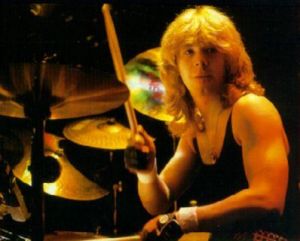
I’ve been slowly, slowly working towards a complete Def Leppard collection. This is one of the last items from the early years that I still needed — The Def Leppard E.P. This is a 7″ single, 33 1/3 RPM however, and never have these recordings been released on a Def Leppard CD. This first EP had Frank Noon on drums. He was just a fill-in, and a month later Def Lep replaced him with a 15 year old Rick Allen.
I have been wanting this one since I was a young fella. Def Leppard was a band I was obsessed with back in highschool. They are in fact the band that really kicked off my collecting, as I described in one of the first Record Store Tales. “Ride Into the Sun” was the B-side to the “Hysteria” single, and it has long been a personal favourite of mine. What I found out later was that this B-side was actually a re-recording of one of the very earliest Def Leppard songs, pre-On Through the Night!
The self-produced 1979 version of “Ride Into the Sun” is a bit different, not as fast or heavy, and containing a different pre-chorus. It’s still a great, fun Def Leppard song from their brief “NWOBHM” period. “Getcha Rocks Off” is a Van Halen-style shuffle, a cool tune that really cooks, with hot solos and a couple smoking riffs. This recording was briefly available on Lars Ulrich’s NWOBHM compilation album. A heavier live (?) version of this song is available on the On Through the Night album.
Side B was taken up by a 7:50 epic track called “The Overture”. This song too was re-recorded by Tom Allom for the debut album (that version is just called “Overture”). Perhaps this song is as close as Def Leppard has ever been to a metal band. It riffs solidly along with some primitive dual guitar hooks. There are ample solos, pounding drums, and different sections and tempos. It’s like Def Judas Maiden. Or something.
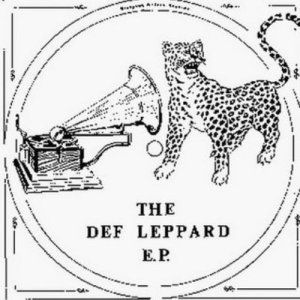
The edition I bought is MSB001 of which 15,000 copies were made. This edition unfortunately did not come with the picture sleeve. The original cover was spoof of the His Master’s Voice logo, with a leopard instead of a dog.
I’m glad to finally have this Def Lep collectible. It’s been a long time waiting.
One year ago today, I launched LeBrain’s Record Store Tales & Reviews. It’s been a blast. Keep on keepin’ on!
ALICE COOPER – Alice Does Alice (2010 iTunes EP)
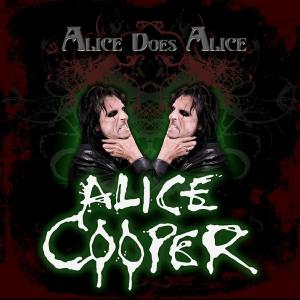
It seems the latest thing to do these days is re-record your old classic hits and sell them again. Alice’s reason for doing so was that they needed new multi-track recordings for use in the Guitar Hero video game. I think only one was ever used, which is “No More Mr. Nice Guy” (Guitar Hero: Warriors of Rock). The Alice Cooper 6 Pack download for Rock Band is mostly live tracks, not the versions that Alice released on Alice Does Alice.
According to the official Cooper site, these re-recordings were produced by Bob Ezrin. Ezrin, of course, helmed the originals. That must be why these new versions sound so authentic. Yes, part for part, note for note, they’re pretty much the same. Just with Alice’s voice older and wiser, and today’s sound quality. But of course you can’t duplicate a classic, no matter how hard you try nor who you work with. It’s impossible. It’s catching lightning in a bottle. So, these versions will always remain inferior to the classic, magical originals. They’re just too nice, clean and neat.
I will say though, it’s pretty amazing how close these are to the originals. The drums don’t sound the same, they’re thuddier and more modern, but the guitar tones are remarkably similar. All the strings and horns are there too, and they do benefit from the sonic clarity of today’s technology. Kudos to Ezrin and the players for capturing this. (Because this is an electronic release with no physical version, there’s no credits.)
Tracklist:
“School’s Out”
“No More Mr. Nice Guy”
“Elected”
“I’m Eighteen”
“Welcome To My Nightmare”
According to sickthingsUK, six tracks were actually recorded. The sixth was “Poison”, which of course was originally produced not by Bob Ezrin, but by Desmond Child. The track remains unreleased in 2013.









 mikeladano.com