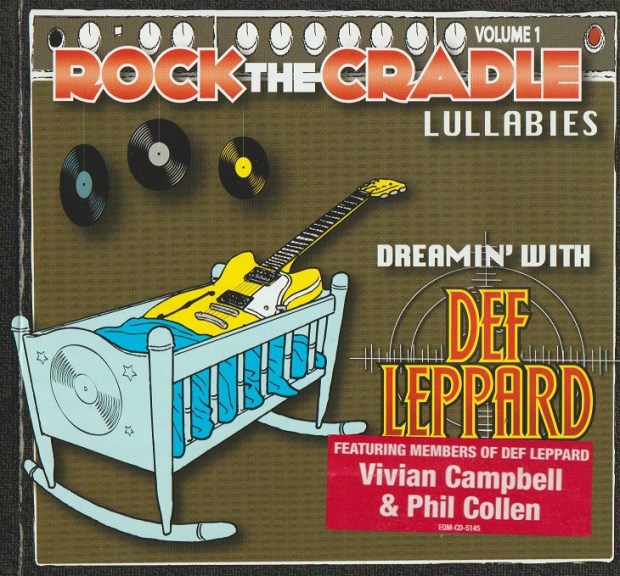
ROCK THE CRADLE LULLABIES volume 1 – Dreamin’ with Def Leppard (2011 Happiness Records)
They call these lullabies, but I’m not so sure about that word. Bon Jovi did an actual album like this, and titled it This Left Feels Right, I believe.
Slowed down, acoustic bluesy and laid back instrumental versions of Def Leppard songs will be found on this CD, easily digestible by anyone. Their effectiveness as lullabies has not been tested under lab conditions but for casual listening in any age group, it should be well received. As stated on a sticker on the front, Vivian Campbell and Phil Collen from Def Leppard make guest appearances (three songs each).
The liner notes state that the technique for “lullification” of these hits involved distilling them down to their core melodies. That makes the songs both easily identifiable and readily enjoyable. A mellow slide guitar often fills in for a lead singer. Phil and Vivian’s work should be identifiable for fans to pick out. Ballads tend to work better than rock songs like “Photograph” or “Pour Some Sugar”, and there are even a few surprising selections from outside the usual Pyromania and Hysteria suspects. “Stand Up (Kick Love Into Motion)” is a particularly good mellow treat.
You like reading music reviews. You read them for information and entertainment. You can’t get enough music reviews!
But what formats do you like? Perhaps you enjoy a meaty, detailed review with all the nitty gritty details. Some get bored with length, and just want a quick n’ dirty summary. This is why we tried the #200wordchallenge, and why Aaron at KeepsMeAlive enjoys the old-fashioned 80 word “hit and run” style from time to time. And others, such as our friends at 1001AlbumsIn10Years, are skilled at metaphors, and have added innovative graphics and charts to album reviews.
All of these techniques are valid, and the more unique and individual reviews certainly deserve praise for breathing fresh life into an ages-old format. But what about a numeric ratings system?
Some kind of rating is pretty standard for music reviews. Rolling Stone magazine uses a five-star system. So does Allmusic and NME, but Spin magazine uses a 10 point system. These allow a reader to very quickly see if a writer thought an album was any good, without having to actually read anything!
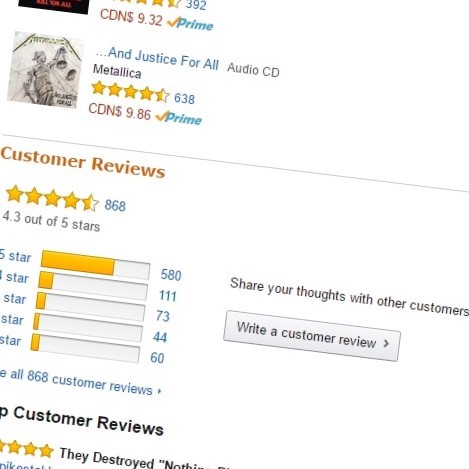
Here at mikeladano.com, we use a loose 5 star system. This originated at Amazon, where products must always be rated from 1-5 stars. Most of our earliest reviews here began life at Amazon, before they were expanded and modified for your edification. Because of this, we imported and have continued with an Amazon-like 5 star system.
Even this is limiting, so we have allowed fractions – you will see many 3.5/5 star reviews here. This essentially makes it a 10 point system like Spin’s.
But it’s not an exact science and that’s where we get into trouble.
It’s fairly easy to listen to an album a few times and decide on a number rating that feels right. A 5/5 feels like a near-perfect listening experience. A 4.5/5 might have some perceived flaws. But when you get into seriously comparing and stacking albums up against each other, the differences can be felt. It’s also worth noting that a 5/5 star jazz album and a 5/5 star Kiss album are going to be wildly different from each other. It’s all in the ear of the beholder.
Taken individually, ratings usually hold up. When compared amongst a band’s entire discography, things get dicey. Our series of Iron Maiden reviews was one such example. They have so many great albums – amazing albums, in fact – that it is quite easy to lay down 5/5 stars to much of their discography. But this ignores minor different degrees of rock excellence. Iron Maiden’s Rock In Rio is excellent. It is a rollicking heavy metal journey exploring Maiden’s history up to 2001. But is it as good as Live After Death? No. Very few things are. Both could easily have received a 5/5 rating, but we chose to lower Rock In Rio to 4.5/5 stars to keep everything in perspective.
If you review 1000 albums on a scale out of 5, you could quickly build up enough fractional ratings to necessitate three decimal places. But that complicates things needlessly. Wasn’t the numerical rating system supposed to be a quick and easy way to say if it’s good or not? We have done 6/5 star reviews, reviews in negative numbers; we’ve done everything imaginable to try to keep ratings in scale. Ultimately it is simply not possible. Like finding an electron in a cloud, you just cannot pinpoint album ratings to that degree of precision.
A numerical rating can also paint you into a corner. There was some Facebook controversy recently over our assertion that Motley Crue’s self titled 1994 was one of the best albums of the 90’s, killing much of the competition. This led to challenges and comparisons with other albums of the period, all great records. How do you rate something “the best” over a bunch of other 5/5 star albums? And how do you know that you will still feel that something is “the best” when you think about it again next month? Putting a numerical rating on an album is like putting it into stone, and that can be limiting, especially when comparing.
We’ve been utilizing the 5 star system (with fractions) for close to five years now. We could stop, but at this point I don’t think it would help. For better or for worse, our bed is now made. And it’s 5/5 stars.
DEEP PURPLE – This Time Around – Live in Tokyo ’75(2001 EMI)
This shouldn’t have been the “last concert in Japan”!
Many of the old, post-breakup-issued Deep Purple live albums are virtually impossible to find today on CD. One of those is Last Concert In Japan, which was originally released only in that country. It featured the Mk IV lineup of Deep Purple: David Coverdale, Glenn Hughes, Ian Paice, Jon Lord, and the late Tommy Bolin on lead guitar. As a matter of historical releases for my collection, I also own the original Last Concert in Japan on both LP and CD.
The tragic story goes that while some members of Purple were rejuvinated with the fresh blood that Bolin donated, others were dead tired of it all. Reviews were spotty and word was spreading that Deep Purple were over. Both Bolin and Hughes were in the throes of serious drug habits. On the night of the recording of Last Concert in Japan, Bolin was shooting up and caused his arm to go numb. Frantic attempts to get him stageworthy worked and he managed to barely play the show. Guitar parts are sloppy and that’s what people remember because it went on LP. The original one-record set from the show has now been expanded to two lengthy CDs, 17 tracks. It’s been remixed and remastered. Production was supervised by Purple expert Simon Robinson, so you know that the quality level is about as good as it could be. Because of the fully expanded tracklist, some of the finer live Deep Purple moments have been restored to this album, such as a 16 minute “Gettin’ Tighter” which was too long to include on a single record.
Some flaws do remain of course. Tommy’s guitar is now barely audible in the “Burn” riff as opposed to non-existent. However the overall experience is very listenable. It’s a darkly interesting album to own, because within months Purple disbanded, and a year later Tommy Bolin would be dead.
If you already own Last Concert In Japan, this purchase gives you over an hour more of unreleased music. Even so, all of it has been remixed, so you are still in for a fresh listen with open ears. If you already own dozens of Deep Purple live albums (believe me, it’s possible), this one has five songs that you can’t get elsewhere in live versions. It’s even a better listen than In Concert/King Biscuit Flower Hour (aka, On The Wings Of A Russian Foxbat) with stronger vocals. Plus you get Tommy singing on “Wild Dogs”. Worth the double-dip.
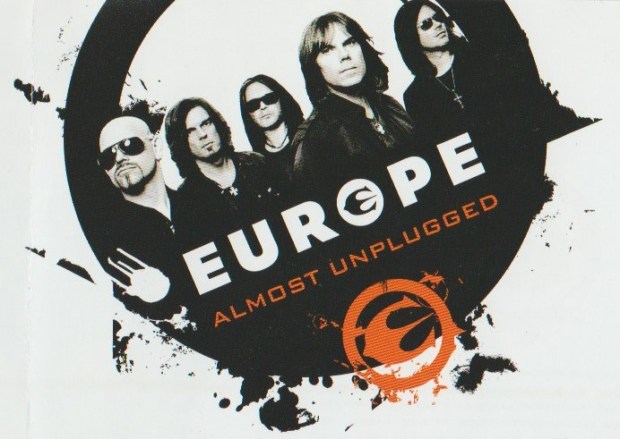
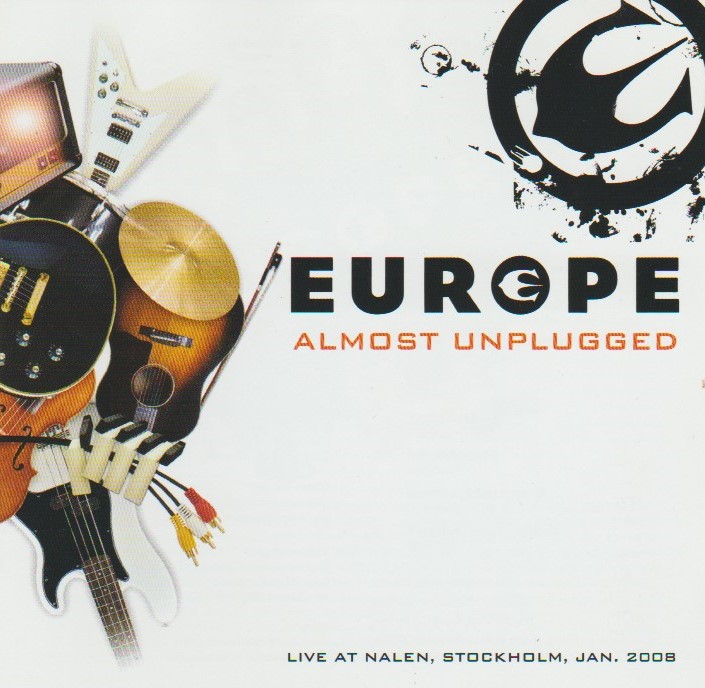
This was a special show in Sweden, with Europe playing some of their best material (with a few covers) in a largely acoustic setting. There are strings, but there are also keyboards and electric guitar. The best of both worlds!
The band were riding a high wave then, which has really not dissipated since. They had done a couple well received reunion albums (Start From the Dark and Secret Society) and were working on music that many fans consider a peak (Last Look at Eden). Europe have long been an under appreciated band, but Almost Unplugged should win over even the staunchest critic.
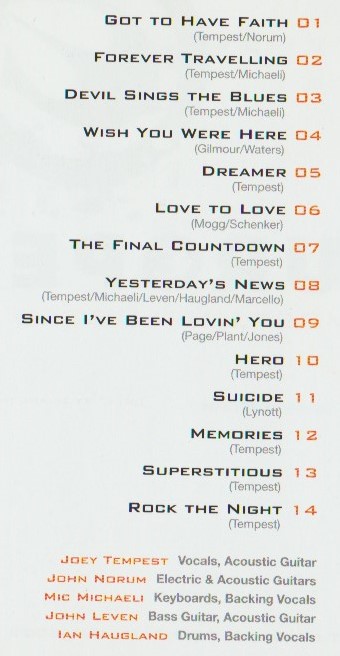
“Got to Have Faith” opened Europe’s reunion album Start From the Dark, so it works triumphantly as a concert opener. Here, it is laid back, bluesy with slippery guitars. “Forever Travelling” from Secret Society follows hot on its heels. The string quartet adds drama to this song, which works naturally in the acoustic setting. From the same album is the killer track “Devil Sings the Blues”, highlighted by some splendid John Norum electric guitar noodling.
Every time Europe does a cover, it becomes an album highlight. The acoustic “Wish You Were Here” is beautiful and not at all overdone. Thin Lizzy’s “Suicide” is full on electric, and pretty spot-on, especially considering that Lizzy were a two-guitar band while Europe has a guitar and a keyboard. Covering Led Zeppelin is always risky but “Since I’ve Been Loving You” is surprisingly great. Joey doesn’t try to copy Robert Plant, but he certainly can sing the blues just fine. (Hey! Maybe the devil really does sing the blues! Oh, you devil you!) Just as importantly, Norum plays some electrifying guitar blues over this monster of a cover. The most brilliant cover however is a UFO song: “Love to Love”. More than any other, this one sounds like Europe owned it. It’s very well suited to their dramatic rock stylings, and they absolutely kill it. If there was one track worth buying the CD for, you just found it.
The Europe originals that make up the bulk of the album span the entire history of the band. From the first LP is “Memories”, which in its original version was a brutally heavy stampede. Here, it is an acoustic gallop, just as aggressive, but with subtlety. The piano ballad “Dreamer” comes from the second album, an unsung classic that was a few years shy of fame. The fame and fortune finally came on 1986’s The Final Countdown, and of course the title track is played. In its acoustic version there is no synth hook; it instead played by the string quartet. It’s trippy to hear it done like this; a little strangeness for fun. “Superstitious” (from 1988’s Out of This World) sounds more natural in this format. It’s also refreshing to hear Joey’s voice crack in a couple places. That means this is really truly live.
One should always familiarize with the originals first, but even if you don’t have them, Almost Unplugged should be well enjoyed by any discerning rock fan who doesn’t mind when the acoustics come out.
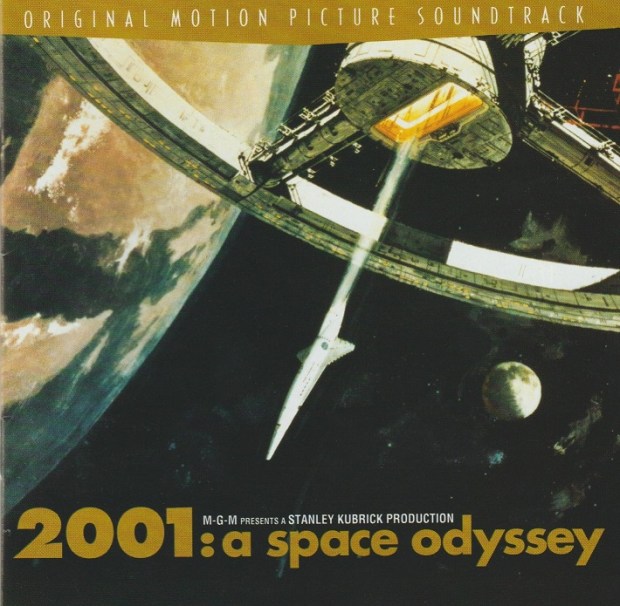
2001: A Space Odyssey – Original motion picture soundtrack (originally 1968, 1996 Rhino remaster)
Stanley Kubrick changed the sci-fi playing field with 2001: A Space Odyssey. When he and Arthur C. Clarke sat down to write the “proverbial good science fiction movie”, they strove for a depth and realism that had yet to be attempted. No sounds in space. No thruster sounds, no pinging space radar. Music (or even lack thereof) would be required to tell the audio story. Kubrick initially contacted Spartacus composer Alex North. The plan changed, however. Stanley had been editing the film to a temporary score of classical music. Nothing North could come up with satisfied the fussy director as much as the classical pieces, so that is what was used on the final film.
The film was fiercely different, free of cliches and intensely determined not to dumb things down. The same could be said of the soundtrack, reissued on CD by Rhino with four supplementary bonus tracks. This fine release enables the listener to delve deeper and unlock even more of the secrets of the universe. Ligeti’s dissonant “Atmospheres” delivers an uneasy feeling; after all we humans know nothing of what is really out there. The conflicting (and conspiring) tones of “Atmospheres” is supplanted by the main title, “Also Sprach Zarathustra”. The music implies great revelation, standing on the cusp of universal breakthrough.
Unease returns with the bee-like swarms of “Requiem” also by Ligeti. Voices sing, each one in their own world, but joining together to join a coherent piece. In the film, this unsettling music appears when we encounter the enigmatic Monolith. The Monolith is a tool of our growth as a race and a stark warning that there are things beyond that our science is not equipped to explain. Arthur C. Clarke’s “third law” states “Any sufficiently advanced technology is indistinguishable from magic,” and that describes one aspect of the Monolith in 2001. (The other two laws: 1. “When a distinguished but elderly scientist states that something is possible, he is almost certainly right. When he states that something is impossible, he is very probably wrong.” 2. “The only way of discovering the limits of the possible is to venture a little way past them into the impossible.”)
After the chaos of “Requiem” and “Atmospheres”, Strauss’ “Blue Danube” offers a warm respite. The brilliance of the “Blue Danube” in the film is how Kubrick managed to capture the dance-like coordinated movements of objects in space. A shuttle docks with a spinning space station; spinning of course to create artificial gravity that humans need to survive long-term in space. This complex docking maneuver requires no dialogue, just Strauss. But space is a cold deadly place, hostile to almost all known life. Ligeti returns, as he must, with “Lux Aeterna”. This music was used to back Dr. Floyd’s trip across the lunar surface to meet the Monolith. It is mildly disconcerting, as is what Floyd’s team finds.
Khachaturian’s “Gayane Ballet Suite” is a somber piece, depicting the boredom and routine of interplanetary space flight. Astronauts David Bowman and Frank Poole seem disconnected from their humanity; the music has more feelings than they do. The coldness of space is easy to feel from inside their stark white starship, and Khachaturian painting the tone.
Mankind meets its future on “Jupiter and Beyond”, a combination of three Ligeti pieces. Once again, we must face the Monolith and what it means. Dr. David Bowman experienced great terror as he plunged inside it, and this is the music that accompanied his long trip into the beyond. The film at this point became its most experimental: impressionist images and obscure dissonant music put many viewers off balance as they struggled to comprehend just what the hell was going on. It is over only when Zarathustra speaks again, and humanity has taken its next giant leap.
These are challenging pieces of music, but not difficult to enjoy. They have all become intertwined with the film forever. Even The Simpsons used “The Blue Danube” for a space docking scene (Homer and a potato chip) in an homage to 2001. Whatever the original composers intentions were, in the 20th and 21st centuries, the pieces used in this movie are now associated with it forever. You simply cannot hear these Ligeti pieces without seeing Bowman’s journey in your mind. You cannot hear “Thus Spake Zarathustra” without feeling the awe of 2001‘s revelations.
The Rhino edition adds some bonus material. Ligeti’s “Adventures” was altered for the film to add an impression of laughter. Ligeti himself was not amused. The original complete “Adventures” is on this CD. From the archives is a different recording of “Thus Spake Zarathustra”. The version used in the film and on the CD was conducted by Von Karajan, but the original LP had a version by Ernest Bour. The latter version has been added to the Rhino CD release. “Lux Aeterna” was longer on the original LP than the film, and the long version is also restored to CD. Perhaps most valuable of all is a track of Douglas Rain’s dialogue as HAL 9000.
The excellent liner notes state that this CD release is the definitive one. It contains all the music from the original soundtrack LP, and all the music from the film. It’s a one-stop shop to get your musical mind blown.
What a band Strange Fruit would be…if only they were real!
The film Still Crazy chronicled the tale of the fictional band, Strange Fruit. The Fruit were led by brothers Brian and Keith Lovell (guitar and lead vocals respectively). When Keith died, they carried on with new singer Ray Simms (Bill Nighy). The inevitable internal tensions led to the band’s demise. However in 1998 there was enough interest to get the band back together — minus Brian, who is assumed to have also died. The surprisingly emotional film boasted fine performances from Nighy, Jimmy Nail, Billy Connolly, Timothy Spall and more. The key however to any movie about a fictional band is to come up with a soundtrack of original material that sounds like it could be classic. Still Crazy accomplished this. You wish for Strange Fruit to be a real band, so good are the songs.
The ballad “The Flame Still Burns”, which in the fictional movie was written by bassist Les Wickes for the fallen Keith, is sung by Jimmy Nail in real life. (The song was written by the team of Mick Jones, Marti Frederikson, and Chris Difford.) This fine song is a perfect example of something that sounds like it must have charted somewhere many years ago. In the film, this song is the cause of much tension between Les and Ray, who did not want other band members to sing lead vocals. The beautiful thing about Still Crazy is that there is a tremendous amount of history to the band, most of which is not seen on screen, only felt through the actors portraying the memories. Jimmy Nail sings another sorrowful ballad, “What Might Have Been”, and does a fine job of it. It’s a lovely acoustic song with a little mandolin and another standout performance by Nail. He gets a chance to sing an upbeat number with “Bird on a Wire” (not that “Bird on a Wire”). This is a darn fine Wilburys-like rock tune.
To be clear, Strange Fruit are not a ballad band even though “The Flame Still Burns” is clearly that. Strange Fruit are a rock band, and “All Over the World” is a prototypical set opener. Bill Nighy would make a damn fine rock frontman, if he wasn’t too busy being a fine film actor. It’s not about the notes he sings but the style in which is he sings them. Nighy sounds like a veteran rock singer (and in the film, you believe it 100%). The track “Dirty Town” has a nifty little riff reminiscent of “Layla”, but this track sounds more like 80’s Deep Purple, right down to a blazing guitar solo. “Black Moon” verges on heavy metal. If you’re wondering why it rocks so hard, it probably because of Michael Lee on drums. It’s Purple, Sabbath and Cream all in one. Nighy gets to be a heavy metal demigod on “Scream Freedom”, which was one of the funnier scenes in the movie. The best Fruit tune might be “Dangerous Things” which plays in the movie like it’s one of their biggest hits. This too has Michael Lee on drums, along with bassist Guy Pratt. That’s some heavyweight talent, folks.
A movie with Billy Connolly in it is twice as good as a movie without (studies have shown). A movie with Connolly singing in it is four times as good. The traditional “Stealin'” is a fine fit for the Big Yin and his banjo. There is even a great vintage-sounding rock track by Bernie Marsden (ex-Whitesnake) that is plenty of fun (“A Woman Like That”). This is incidental to the main feature, which is the host of Strange Fruit tracks, but a nice inclusion. Unfortunately the techno track “Ibiza Theme” doesn’t fit the disc at all and can be safely skipped by most listeners.
Admittedly, the Still Crazy soundtrack is more enjoyable if you have seen the film. When I hear “Dangerous Things” I picture things that Nighy as Ray does on stage. “The Flame Still Burns” is more powerful when you remember the friction it caused because of petty jealousies. Regardless, these songs were all written and performed by professional musicians, and they do stand up as individual tunes. Memorably so.
In 1989, two things happened to me that changed everything.
Upon entering the 12th grade, I realized I was having trouble seeing distance. I was taking an OAC level Geography class, but I couldn’t see the text on the overheads. A checkup at the eye doctor revealed that I needed glasses. At roughly the same time, I got my first real job at a grocery store, and had to cut my long hair. Within a matter of months, I had transformed from a long haired rocker to a short haired geek with huge glasses that I dubbed my “welding goggles”.
None of my favourite rock stars looked like me!
There is however a huge precedent for rock and rollers with glasses. Most people immediately think of John Lennon, but think back to Rubber Soul. Lennon wasn’t wearing his glasses in 1965. He could be seen wearing prescription sunglasses, but not until 1967 was he wearing his normal glasses on a regular basis in public. The first album cover with a bespectacled Lennon was Sgt. Peppers.
Lennon was inspired to wear his glasses by the original icon, Buddy Holly. Buddy’s black rimmed glasses began a trend in America, and that style of frames became known as “Buddy Holly glasses”. A young Elton John, who didn’t even need glasses yet, began wearing them just to look like Holly.
Today, there are countless more stars who wear glasses on stage, although many use custom shades. Elvis Costello, Lisa Loeb, Robert Fripp, Ozzy Osbourne, Rivers Cuomo, Peelander Yellow, Weird Al Yankovic, and so on…the list is endless.* But who wore them best? Certainly not Bono, who could make even the simplest pair of glasses look pompous. It’s tempting to say Jerry Garcia, since the glasses just make him look even more like a big teddy bear.
But there can only be one winner, and this is actually an easy choice.
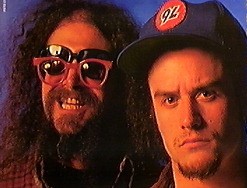
The one artist that wears glasses best is Sir James Martin, ex-of Faith No More. For the simple reason that he is the only one who wears two pairs of glasses simultaneously. Take that, Bono!
*Keith Richards does not wear glasses. Science has shown his eyesight lives forever.
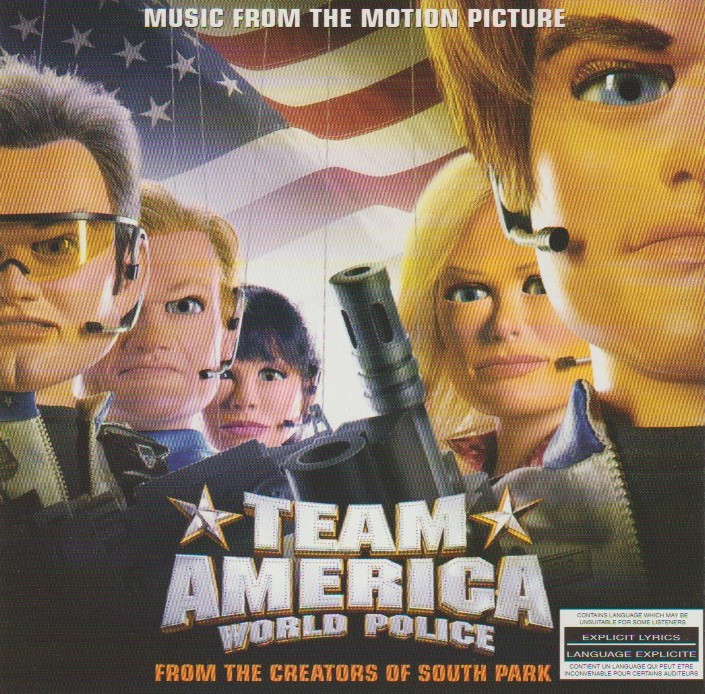
TEAM AMERICA: WORLD POLICE – Music from the Motion Picture (2004 Atlantic)
It’s incredible to think that the world is even more screwed up today than it was in 2004. Matt Stone and Trey Parker are talented at both satire and musicals, not to mention the most vulgar of humour. Their movie Team America: World Police combined the satire and vulgarity with music, and the kind of vintage puppetry that made Thunderbirds so memorable. The sets are intricately detailed miniatures. Look at the cobblestones in Paris — they are shaped like little croissants! It’s a triumph, which is all the more amazing considering that there is a scene of puppets shitting on each other.
The soundtrack had to be equally amazing. How else could Parker and Stone top the hit song “Now You’re A Man” from the Orgazmo soundtrack?
The answer is simple: With a “Fuck Yeah”!
One warning though. This soundtrack will make little sense to you unless you’ve at least seen the movie. So see the movie – it’s unforgettable, at the very least.
From the fictional musical Lease (a parody of Rent) comes “Everyone Has AIDS”, an uppity singalong number that proves nothing is sacred to Stone and Parker. “Everyone has AIDS!” they sing with glee! “The Pope has got it, and so do you!” The easily offended have already gotten off the bus, but the song isn’t saying anything more than AIDS doesn’t discriminate. It doesn’t matter if you’re gay, straight or otherwise. Stone and Parker are known for burying messages such as this in their juvenile jokes.
“Freedom Isn’t Free” is the best patriotic country anthem you’ll ever hear. “Freedom isn’t free! No there’s a hefty fuckin’ fee!” The music is a completely serious country ballad, which could have been a Tim McGraw hit. The contrast is delightful. But that’s just a build up to the main event: “America, Fuck Yeah”, the movie’s theme song.
America! Fuck yeah! Comin’ again to save the motherfuckin’ day, yeah! America! Fuck yeah! Freedom is the only way, yeah! Terrorists, your game is through, ‘Cause you now you have to answer to… America! Fuck yeah!
You get the idea.
It’s actually a brilliantly cheesy rock theme song, something along the lines of “Dare” by Stan Bush, from the 1986 Transformers movie soundtrack. The only real difference is the use of F-bombs instead of inspirational uplifting cliches.
The terrorist theme music called “Derka Derka” is an interesting accomplishment since it is written to replicate the Star Wars “Cantina Theme”, but fitting a Middle Eastern style. It’s unmistakable, and really helped make the scene in the movie. The next artist to be lampooned is Aerosmith; rather latter-day BalladSmith. “Only A Woman” is clearly intended to be the “I Don’t Want to Miss a Thing” for this album. If anything the song highlights how paint-by-numbers those Aerosmith ballads are. Granted, Diane Warren wrote “I Don’t Want to Miss a Thing”, but all those Aeroballads are interchangeable.
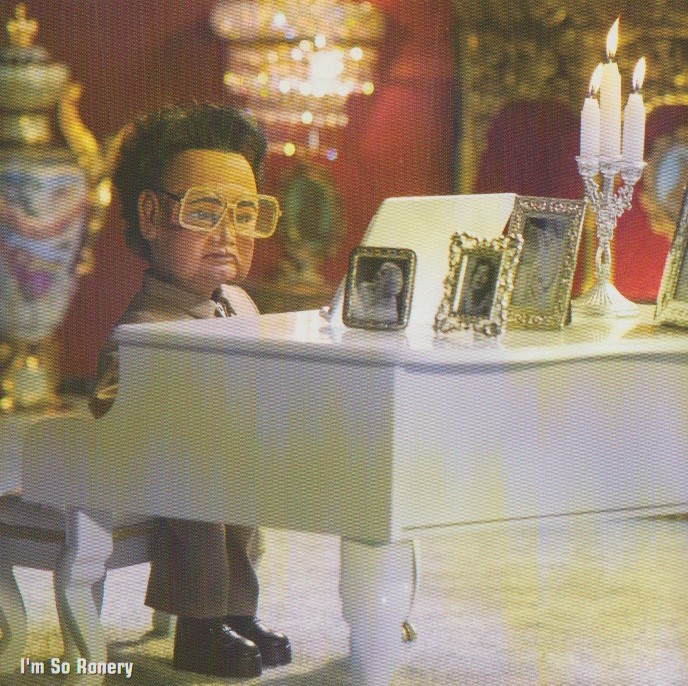
Fans of the movie know that the greatest character was Kim Jong Il. “I’m So Ronery” reveals the true reasons behind Kim’s evil deeds, provoking the world to the edge of war. He’s just lonely. “When I change the world maybe they’ll notice me? Until then, I’ll just be ronery…” (But is this really Kim’s soul motivation? See the movie to find out the true answer….)
From there we go to the “Bummer Remix” of “America, Fuck Yeah”. It is a somber retelling of the song, indicating that we at at the lowest point in the story. The “all hope is gone” moment. Can our puppet heroes survive? (See the movie!) The somber music continues with the ballad “The End of an Act”, which does nothing but trash Michael Bay. It is his style of film, after all, that Team America is a parody of. “All I’m trying to say is Pearl Harbor sucked…and I miss you.” Parker and Stone go as far as to question why Bay is allowed to keep making movies. (The answer, guys, is that his movies make a butt load of money. Why they make this kind of cash is because “BOOM”, “FOOSH”, “EXPLODE”!)
Any good action movie needs a montage! That’s what the song “Montage” is all about! Trey Parker sings, “Every shot shows a little improvement; to show it all would take too long!” And now you know what a montage is. “Even Rocky had a montage!” continues the song, assuring us of the artistic validity of the technique. The montage leads us to “North Korean Melody”, a silly nonsense song that pokes fun at certain cliches about Korean accents.
The CD has two distinct sections: songs, and the score. The songs are all relatively brief and comedic, while the score is a full-fledged action movie soundtrack with full orchestra. Whether it be chases, romance or villainy, there is a taste of each in the score. The final track “Mount, Rush, More” is a great example of tension-filled soundtrack excellence. Chances are that 90% of buyers picked up the CD for the songs, not the score. The songs themselves are just shy of 19 minutes of music. The score is over 28. It is perhaps a little devious that this is not indicated on the back (not even track lengths). Music fans of broad tastes won’t mind, but they are probably in a small minority. The score will especially be of interest to fans of composer Harry Gregson-Williams, who has done the soundtracks to award winning films such as The Martian and all the Shrek movies. They will be pleased to know that Gregson-Williams wrote some excellent material for Team America.
As a listening experience, you may as well consider this like listening to two albums. Or perhaps an EP and an album. One minute you’re pissing your pants at “Montage”, the next you’re knee-deep in a serious action movie score. It’s a little uneven, so perhaps you’d enjoy it better if you put the tracks in a different order, with the score interspersed. Give it a try!
TRAILER PARK BOYS – Out of the Park: Europe (2016 Netflix)
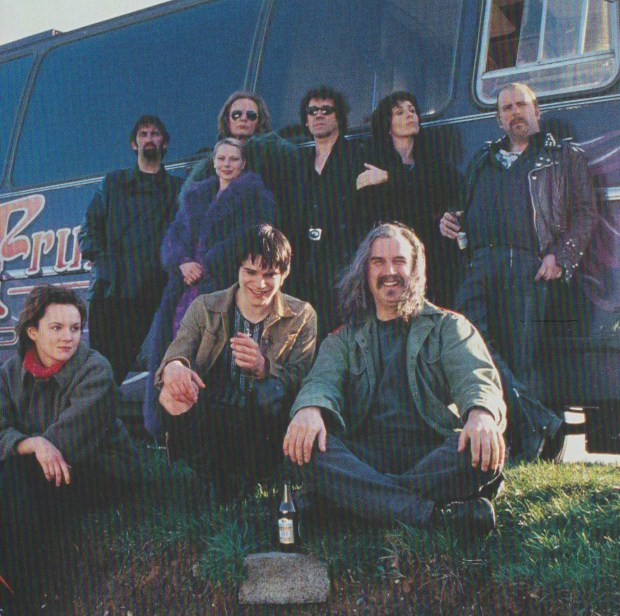
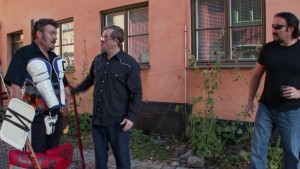
It’s a whole new series, and it’s not what you expect. When Ricky, Julian and Bubbles head off to Europe for what they think is a paid vacation, they are in for many unpleasant surprises. Randy and Lahey may be far behind them in Canada, but in London England they are met by a different kind of adversary. Mayhue is their guide, a Swearnet representative, and taskmaster (played by Guns N’ Roses stage manager Tom Mayhue). The boys are going to be driving around Europe in a rock-star class tour bus, but given nothing to eat, drink, smoke, or spend. The only way to make money is to complete special tasks or missions assigned by Swearnet. (If you do the math, in real life Swearnet are writer/actors Robb Wells, J.P. Tremblay, and Mike Smith: the guys who play Ricky, Julian and Bubbles. They are essentially being given missions by their real-life alter-egos.)
Previous Trailer Park Boys offerings have come in the form of stand-up comedy shows, and of course the classic TV series that started it all. The original series was designed as a “mockumentary” reality show, as a film crew followed around repeat offender Julian and his gang of criminals. This new spinoff series takes inspiration from another reality TV program, the Amazing Race.
In each city (of which they visit seven), they are given specific tasks to earn specific amounts of money. They soon learn it’s all about the fine print. The devil is in the details in London with these deceptively simple pit stops: Get comedian Noel Fielding’s autograph ($25), drink six complementary draught at the Swan pub and hold your piss for six hours ($25), reshoot the cover of the Beatles’ Abbey Road ($25, or $1000 if you can get a living Beatle in the picture), and steal the Queen’s undies from Buckingham Palace ($1000). It quickly becomes apparent that Ricky has never even heard of the Beatles.
Though the show is scripted, setting it on the streets of Europe does give it a “reality TV” feel similar to the Amazing Race. Bystanders stop to take pictures of the three weird looking Canadians, often up to no good. After London, it’s off to Berlin. Communication becomes a problem in Germany. Bubbles orders what he thinks is going to be a hamburger, but turns out to be an octopus burger (still delicious, according to Bubbles). Next stop: Copenhagen, Denmark. Bubbles is horrified to find that one of that day’s tasks ($1000) is to step in the ring as his wresting character Green Bastard, with former heavyweight boxing champion Brian Neilson. Only two ways to win: Give him two shots in the nuts, or last three rounds. Good fuckin’ luck.
The boys get arrested in Oslo, Norway. All they had to do was give a troll a three second atomic hover wedgie ($25), “acquire” a boat and take it around the fjords ($25), and convince actor Fridtjov Såheim (from the Netflix series Lilyhammer in a cross promotion) to join them for drinks ($1000). Stockholm has its own offerings, two of which are food based: Finish the “Belly Buster Meatball Meal” at a local eatery without losing their lunch, and follow it up with a can of surströmming for dessert. According to wikipedia: “When a can of surströmming is opened, the contents release a strong and sometimes overwhelming odour. The dish is ordinarily eaten outdoors. According to a Japanese study, a newly opened can of surströmming has one of the most putrid food smells in the world, even more so than similarly fermented fish dishes such as the Korean Hongeohoe or Japanese Kusaya.” I don’t think anything in this scene was staged.
Being in Europe allowed the boys to meet some NHL heroes from the past. Ricky is tasked to stop one shot by Peter Forsberg (two NHL Stanley Cups) in a five shot shootout ($500). In Helsinki Finland, they are given a relatively simple task: Sing in a karaoke cab, and not talk about hockey ($25). It gets complicated when five-time Cup winner Esa Tikkanen steps into their cab.
The Trailer Park Boys had to end their tour in Amsterdam for obvious reasons. It was a lifelong dream of Ricky’s to go there, and that warrants a two-part episode to finish the season. Humiliation after humiliation, it was a long hard road to get to Amsterdam. It is a delight to see Ricky happy as a kid in a candy store when they finally arrive. Everything seems to be going well; they even run into an old friend from Canada. The final challenge enables Bubbles to play one of his own songs with 2/3rds of Crosby Stills & Nash. Steven Stills wins Best Line of the Series with the simple, “They’re Canadians. They don’t know any better.”
A second Trailer Park Boys series could have been a misstep, especially considering the ill-executed Drunk and On Drugs Happy Funtime Hour. Instead, this year fans received both the quality-driven Season 10 of the original series, and now Out of the Park: Europe. With double the amount of Trailer Park Boys hilarity, Netflix hit an inside-the-park home run in 2016. It is made clear by the end that this is not the last time Ricky, Julian and Bubbles will be Out of the Park. Where they go next, only Swearnet knows.
GETTING MORE TALE #526: Location, Location, Location
I worked at many Record Store locations over the years, often temporarily for training and managing. Some of them I spent a few days at, others were several weeks or months in total. Each one had its own flavour and clientele. While experiences and mileage may vary, here are some memories of some favourite locations (all in Ontario, Canada).
1. Cambridge
The store in Cambridge was our first to carry movies, initially in VHS format. It was a lot of fun working there from time to time, buying and selling used movies. There was always something I wanted for my collection, and it broke up the monotony of seeing nothing but CDs every day.
Cambridge was also interesting because we used to get a number of people coming in just to ask where the strip club was. “It used to be around here!” I don’t know why the dudes looking for the strip club kept stopping in the Record Store (as opposed to the Tim Hortons or a gas station or anywhere else), but they did indeed used to ask.
Some of the customers in Cambridge were…well, let’s just say they were not all our best and brightest. T-Rev managed that store, and I took over temporarily when he was on road trips elsewhere setting up new stores. The customers there wore me down more than anywhere else. Especially when they came in to sell, which was frequently. Cambridge bought a lot of stock. If the customer wasn’t happy with my offer, they’d ask when the “regular guy” would be back. Maddening since I was more generous than a lot of other folks.
There was one customer in Cambridge who hated selling to me, he always asked where “the regular guy” was. He asked my name and I told him it was Sanchez. When T-Rev came back, we had a laugh over the employee named “Sanchez” who was apparently low-balling this customer for his dance CDs.
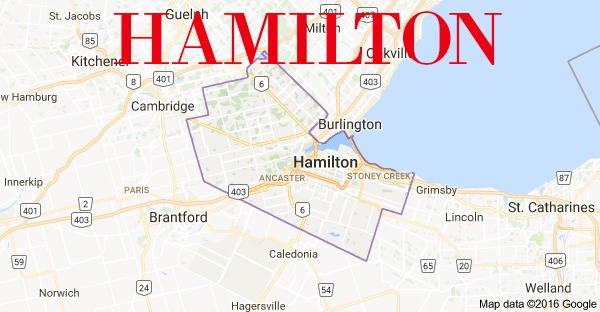
2. Hamilton
The store I worked at in Hamilton was pretty quiet most of the time. There was a lunch time rush when kids from the nearby highschool would come in to listen to and occasionally buy CDs. Given Steeltown’s reputation, I was pleasantly surprised to find the kids I dealt with to be polite and friendly, more than I was used to seeing. The adults weren’t always so friendly, but no more or less than any of the other stores I worked in. Hamilton was a shitty place to drive (confusing one-way streets), but I didn’t mind working there at all.
3. Kitchener
I worked in three different stores in the Kitchener area. One of the other guys there used to refer to Kitchener as a “ham & egger” town, a phrase I never heard before. A lot of blue collar customers. It was still a step up from Cambridge, depending on which Kitchener location I was working in.
I’ve said many times that my favourite store was the original one, in a small mall in Kitchener. It was our only mall store ever. It was a special place to work. It was tiny and compact. It could get really busy on the weekends. There were a lot of regular customers, more than I remember elsewhere, probably due to the fact we were in a mall. There was a familiarity – I knew them, and they knew me. When I was eventually given a larger store elsewhere to manager, I missed the faces I would see on a regular basis at the mall.
I also missed the “unique” individuals you’d meet at the mall store. Malls have a whole ecosystem of life forms, unlike others in the outside world. There was Johnny Walker, so named because every day he would walk the circuit around the mall, talking to himself, all day. One day, something peculiar happened. He came in, stopped talking to himself, and bought a tape. He paid for his cassette and then resumed walking and talking to himself again. I only saw that happen once. There was Butts, the guy who would dig through ashtrays looking for cigarette butts. Let’s not forget Trevor the Security Guard, and the drunks at the restaurant next door. It was a blast! I didn’t care for the mallrats, but they were a minor annoyance.
4. Oakville
I did not like working on Oakville, as was discussed in Record Store Tales Part 16: Travelling Man. Many of those customers were snooty; just too good for you. They felt entitled to park in the fire lane, because they were more important than you. Read the Oakville tale for the misery that was working there.
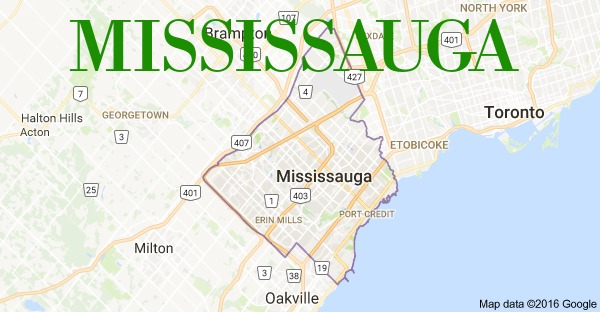
5. Mississauga
More than any other location, I may have resented Mississauga the most. It was a shit location. There was nothing of any value around. There was a health products store, but nowhere to buy a snack or a lunch. There was no foot traffic. Across the street was an empty field. It was a dead store from the day it opened. I invested myself deeply in my work. There are many things in life that can crush your soul. One of them is working hard at something (training employees, helping set up a store) and seeing it come up to nothing. That was Mississauga. In the used CD business, you depend on customers bringing in good stuff for you to re-sell. Mississauga provided very little good stuff.
There were more, all with tales of their own. These however were five of the most memorable, each for its own reasons. While a change of scenery is nice once in a while, there is nothing better than working in a location you love.






 2001: A Space Odyssey – Original motion picture soundtrack (originally 1968, 1996 Rhino remaster)
 After the chaos of “Requiem” and “Atmospheres”, Strauss’ “Blue Danube” offers a warm respite. The brilliance of the “Blue Danube” in the film is how Kubrick managed to capture the dance-like coordinated movements of objects in space. A shuttle docks with a spinning space station; spinning of course to create artificial gravity that humans need to survive long-term in space. This complex docking maneuver requires no dialogue, just Strauss. But space is a cold deadly place, hostile to almost all known life. Ligeti returns, as he must, with “Lux Aeterna”. This music was used to back Dr. Floyd’s trip across the lunar surface to meet the Monolith. It is mildly disconcerting, as is what Floyd’s team finds.








 TRAILER PARK BOYS – Out of the Park: Europe (2016 Netflix)






 mikeladano.com