There have been a few times in Cult history when it seemed unlikely they would be making any more albums. Thankfully, these fears were unfounded. Thankfully, because The Cult are so damn great at making albums.
Their latest is Hidden City, and it continues their upwards trajectory. Teamed up once again with Bob Rock, the band created a powerful recording, very Cult-like and loud. It is a cohesive and impressive collection of songs that tend to defy individual description. It is easy to pick our favourites such as “No Love Lost”, “Birds of Paradise” or “Hinterland” (my personal fave), but Hidden City is more than the sum of its parts. Its components are strong compositions that highlight the strengths of the band: Ian Astbury’s powerful and unique voice, and Billy Duffy’s unmistakable riff stylings. Hidden City collects the light and shade and presents them as a multi-coloured hue.
Its grooves are huge but textured. The songs reveal more hooks the more you listen. The Cult’s performances are top notch. The album is electrifying. Hidden City must be considered a latter-day high water mark, an album that builds on the last few records and continues pushing forward. The Cult rule again.
How many of you were members of the Columbia House music club? Tapes or CDs?
The concept was simple. Get 12 tapes or records for one penny. Then agree to buy “X” more at “regular club prices” within a year. They would usually offer all sorts of incentives, such as getting your first regularly priced item for half price. Their “regular club prices” were fairly high, but if you played your cards right you could make joining the club worthwhile.
Every few weeks after signing up, Columbia House would send you a catalogue and an order form. The order system was controversial, because it required a negative response if you didn’t want to buy something. When you signed up, you could pick your favourite genre of music (I chose “metal”). Each time a catalogue came out, your selected genre would have a “selection of the month”, usually a new release but not always. If you did not respond with an order form expressing that you didn’t want it, they would automatically mail you the “selection of the month” and bill you for it too. (The Columbia Record Club system was worked into a sub-plot of the movie A Serious Man by the Coen Brothers.)
For many people this wasn’t a problem. Our parents let my sister and I sign up when I was in grade 11. We split the membership and free tapes 50/50. We paid for everything ourselves and diligently sent in our order forms each time. We were both already massive music fans, so we poured over every single page. Most times, one of us ended up buying something, if not the selection of the month itself.
I can still remember every album I received in that first shipment. Seven tapes. These tapes went into immediate and constant rotation, which is why I remember them all so well today.
Our musical world opened up in a massive way, and not just because of the new music we were listening to. The catalogues introduced us to names and album covers that we’d not experienced yet. What is this Bitches Brew thing? Why did Deep Purple albums have so few songs? Did Iron Maiden copy their Maiden Japan from Purple’s Made In Japan? Holy crap, Hank Williams Jr. has three greatest hits albums?
Everything was absorbed. Five years later, when I started at the Record Store, my boss was surprised that I knew who most of the artists were, what sections they should go in, and even what record labels they were on.
“I read the Columbia House catalogue cover to cover every month,” was my answer!
The catalogue provided knowledge, and pictures to cut out for locker or wall. We made the most of that catalogue every time. It was rare when pictures were not cut out!
I was even able to acquire things that might have been considered rarities back then. I had never seen Leatherwolf stocked in a store, but Columbia House had it. When vinyl was being discontinued, I was still able to get Skid Row’s Slave to the Grind (1991) on LP. They had most of the Savatage albums.
It all sounds wonderful, but Columbia House had flaws too. The biggest one was horrendous quality control. They licensed and manufactured the tapes themselves, which were simply not as good quality wise as the ones you could find in a store. They would be warbling within weeks (if not right out of the case) and the J-cards were sometimes shoddy, with printing not lining up with fold lines, or just they’d just start falling apart along perforations. They also didn’t carry certain record labels. While they had everything Warner Bros and Columbia Records, they had nothing from EMI. Finally, bands made next to nothing on albums that were sold through Columbia House. Some bands such as the Tragically Hip refused to sell their music via Columbia House. We didn’t know all of this as kids, of course. I started to pick up on the quality issues when they seemed to take a serious dive around 1991.
The key to not getting ripped off by Columbia House was to order smart. The 12 free tapes sounds like a great deal, but when you balance in buying the rest of your selections at full price, most people ended up on the losing side. Get in and get out, buying the bare minimum. That was the way to do it. Of course, we didn’t. We just enjoyed the convenience and stayed members for years! No regrets since this led directly to a 12 year career in the Record Store!
A mighty Union was formed from the ashes of two classic bands’ lesser-known lineups. First up is Bruce Kulick, formerly of Kiss and now in Grand Funk. Kulick had been taking an increasingly important role within Kiss, leading to the Carnival of Souls LP which Bruce was instrumental in writing and recording. With him was John Corabi who had just been booted from Motley Crue after making (arguably) their best album (or one of). Corabi was in a bit of a state. His confidence in himself was shaken after the Motley experience, who seemed impossible to please when their album tanked. John told Bruce that he didn’t want to sing anymore, he just wanted to play guitar. Bruce’s response was “Dude, you’re fuckin’ high!”
And so it was that Bruce and John teamed up (with Brent Fitz and Jamie Hunting) in the aptly named Union.
You wouldn’t call Union a supergroup, but they did create a fine album. It is in the mold of the last albums these guys made separately (Motley ’94 and Carnival). Union turned out as an angry, dark rock record, very much a child of the 1990’s. With Kulick on guitar, Union was more than a 90’s alt-grunge retread. The 90’s are omnipresent in the droning riffs and staggered rhythms, but then Bruce dumped out his tackle box of guitar tricks. Bruce evolved over the years from a guy who played really fast on 80’s Kiss albums to a serious player interested in pushing his own limits. Where he used to be content to play flurries of notes, on Union he goes for maximum gut impact. It’s less about playing the notes than bending them to his will.
It’s also quite clear how much writing Bruce and John did in their respective bands, judging by the sound of this. “Around Again” bears groovy similarities to tracks like “Jungle” by Kiss and “Uncle Jack” by Motley. There’s a pissed-off attitude, and musicianship that would make Nikki Sixx crap his pants. Thankfully Union have a good batch of songs backing them. Much like the previous Kiss and Crue records, Union is not instant love. It takes about three good listens to penetrate its metal-grunge (with a touch of Beatles) hybrid sound. Union usually seem to go for the guts rather than singalong melodies.
One of the exceptions to this rule is the pure fun “Love (I Don’t Need it Anymore)”. This is the one that hooks you on the first round. With a funky little riff and a chorus that sinks right in, it slays. The ballad “October Morning Wind” is another catchy track, an acoustic number a-la Zeppelin. Think of a track like “Loveshine” from the Motley album for the right ballpark. Stealing a Zeppelin title, Union’s song “Tangerine” is a groove rock tune like a heavier Aerosmith.
On the other side of the spectrum: psychedelic rock. “Let It Flow” is a trippy song broken up into sections called “The Invitation”, “The Journey” and “The Celebration”. I think John was smoking something green when he wrote the lyrics, but Bruce’s sitar-like guitar is the perfect complement. “Empty Soul” has similar scope, being a pretty huge song with musical goodness coming out the wazoo.
Adding the Beatles cover “Oh Darlin'” to a reissued version of the album is a little greedy, but fortunately worth it. As it turned out this band only made two studio albums, so more Union is good Union. If you recall the original song, Paul McCartney gave it his best rasp screams. Up to bat is John Corabi who can sing that way in his sleep. It’s a perfect match and “Oh Darlin'” is a nice little extra on which to end an exceptional album. The only issue I have with “Oh Darlin” is actually its placement as the last song. Previously, the solo-written Corabi acoustic ballad “Robin’s Song” was the closer, much like “Driftaway” was on the Motley album. You become accustomed to “Robin’s Song” as a closer, because it has that quality to it. “Oh Darlin'” is not a closer. It would have worked better earlier in the track list, so feel free to shuffle as you choose.
Whatever version you acquire, any fan of Kulick and/or Corabi would be foolhardy to live without this CD. It ranks as one of the best albums by either.
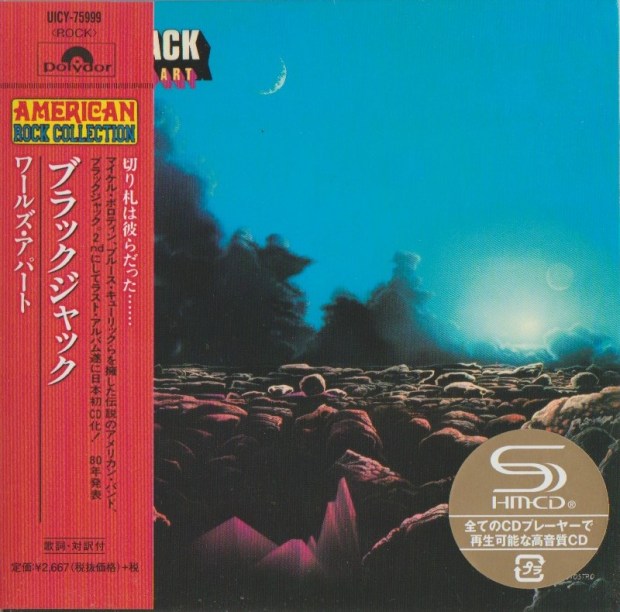
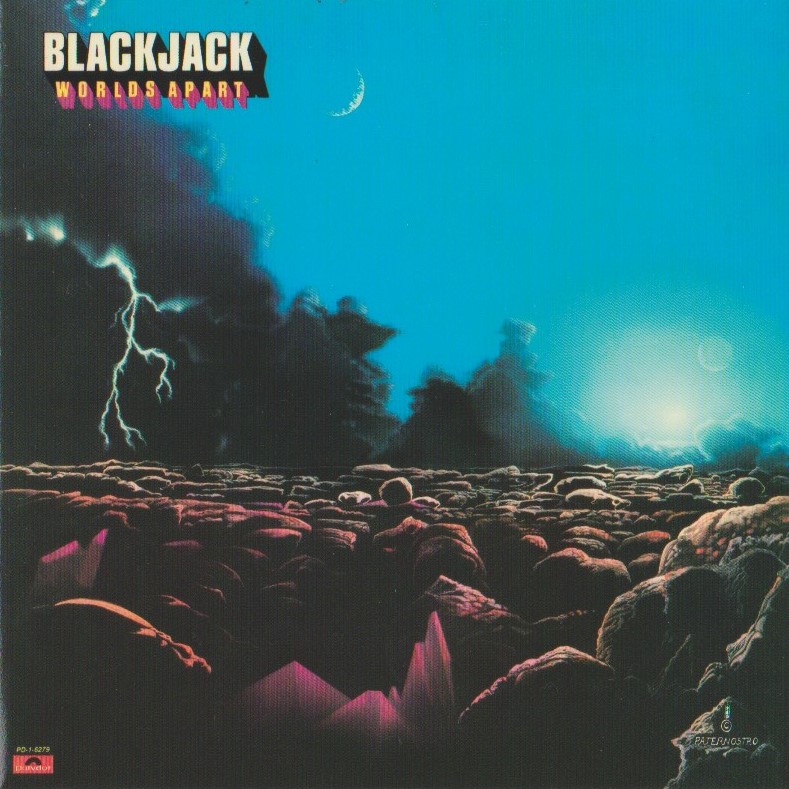
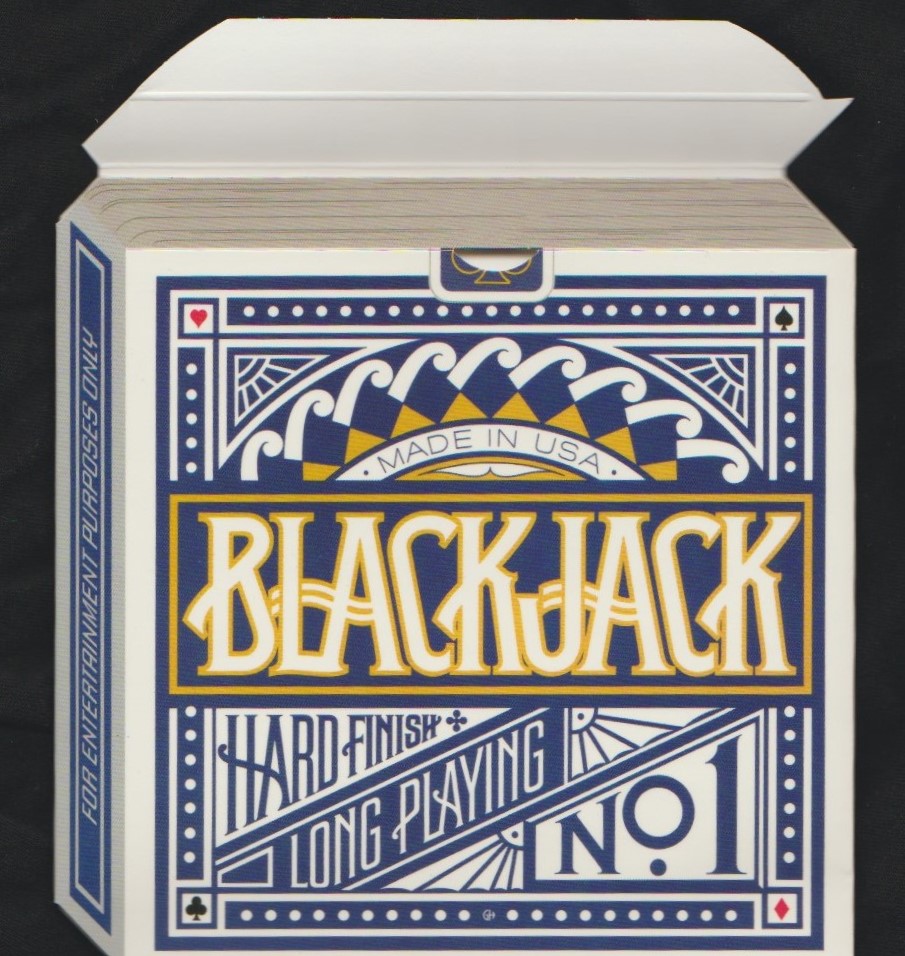
BLACKJACK – Worlds Apart(1980 Polydor, Universal Japan reissue)
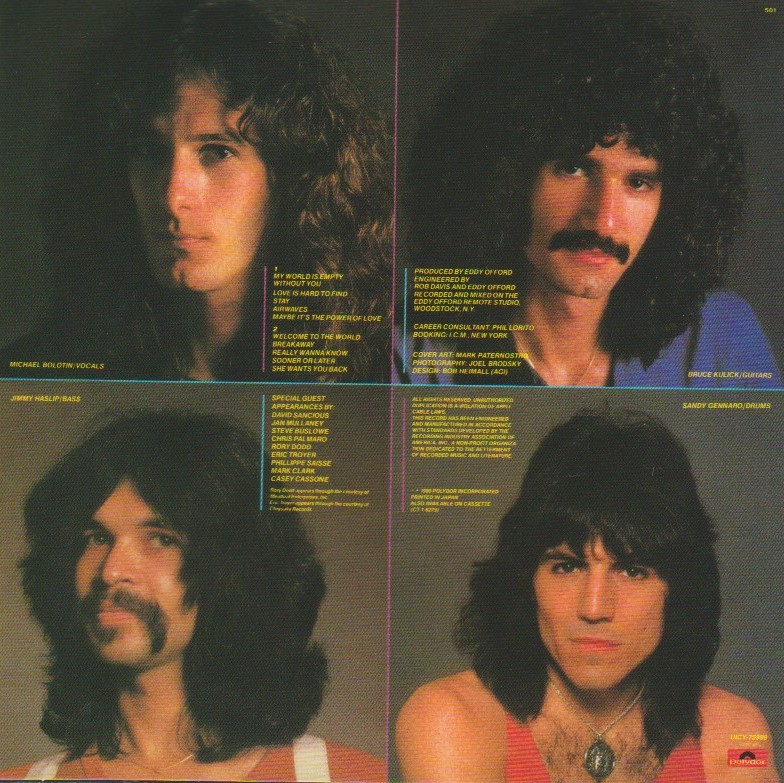
Blackjack (Bruce Kulick, Jimmy Haslip, Sandy Gennero and some unknown guy named Michael Bolton) made a grand total of two albums before splitting. Michael went on to a fairly successful solo career (two Grammy awards), and a few years later Bruce joined Kiss. Neither guy is really sweating the fact that Blackjack had no impact. The albums are long out of print, except in Japan.
Their second album, unfortunately, lacks the memorable hooks of the first one. Starting off with a cover is rarely a good sign. The Supremes’ “My World is Empty Without You” is as ham-fisted as you can imagine, with heavy handed bass forced into what is usually a fine soul song. Bolton oversings. It’s a misstep from the get-go, and it’s not a good sign that this is one of the better tracks on the album which is otherwise mostly written by Bolton and Kulick.
“Love is Hard to Find” works well as an early-80’s Bon Jovi blueprint. The ballad “Stay” certainly sounds like Michael Bolton, or more accurately, it sounds like Michael covering an over-dramatic Rod Stewart ballad. “Airwaves” passes as a rock song, but it certainly is a weak one even compared to similar bands from the era such as Journey. Ironically what it needs is Michael to let loose with those pipes, the way he does on the ballads. Even a title like “Maybe It’s the Power of Love” lacks the kind of vocal power you want (though Bruce does get a tasty little solo with a dual harmony part).
The hardest rocker of the album is the side two opener, “Welcome to the World”, which bizarrely opens with an actual recorded baby birth. That aside, it’s a pretty solid rocker with more of those Kulick harmony licks. Strangely, Kulick had nothing to do with its writing. This works into the very 80’s sounding “Breakaway” with its programmed keyboards and soft-rockisms, and among the worst tracks on the album. “Really Wanna Know” is almost as bad, so cheesy you can smell it coming by the opening synths. “Sooner or Later” works better, again perhaps a precursor to early Bon Jovi. Good track, and Michael lets the voice rip like you want to hear it. And then the album craps its own pants with the closer, “She Wants You Back”, lighter than light rock. There’s a lick that borrows from Steve Miller’s “Swingtown”, but the Miller song is better.
The second Blackjack album has no surprises, no progression and little impact Even though the second LP is a soundalike to the first, it’s weak. And so they split. Bruce Kulick’s brief foray into “moustache rock” ended and he was on to other things. Blackjack and Worlds Apart are interesting mostly to Kiss fans and collectors. As for Bolton fans, I know he still has many, but I think only these two fellas would buy Worlds Apart (they celebrate the guy’s entire catalogue).
It’s Bruce Kulick week here at mikeladano.com! Check in for some cool releases featuring the extremely talented former KISS guitarist.
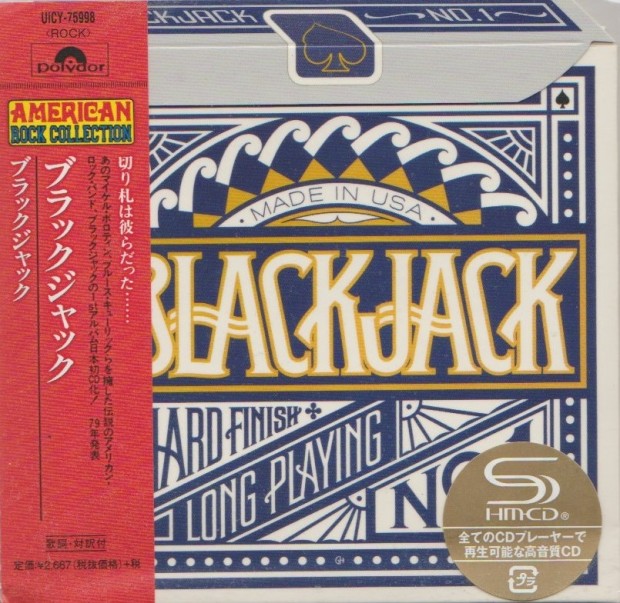
BLACKJACK – Blackjack (1979 Polydor, Universal Japan reissue)
The Kiss family tree is a fascinating tangle of disparate roots and branches. One of the most intriguing branches is that of Bruce Kulick (Kiss guitarist 1984-1996) who has played with a number of fantastic artists over the years. After completing a tour with Meat Loaf, Bruce was invited to form a new band with a hot young rock singer out of New Haven, Connecticut. This singer was a powerhouse with a Seger-like rasp, mixing soul and rock in equal measure, and able to write songs too. In fact today, this singer has sold 75 million albums with his name on them. Or at least the shortened version of his name. Back in 1979, his last name was spelled “Bolotin”. Today, he’s known as Michael Bolton.
Today, Bolton is probably best known for covers (“When a Man Loves a Woman”), but in 1979 he co-wrote every song on Blackjack’s debut. Both Kulick brothers (Bruce and Bob) have credits on a number of songs. And shockingly, they are generally pretty good! Fair warning though, this isn’t hard rock or heavy metal. Look at Bruce’s moustache. This is 1979 moustache music. It actually sounds bang-on in tune with the 1978 Kiss solo albums.
Bolton’s blue-eyed soul had a remarkable youthful energy. Check out the powerhouse chorus on the lead track “Love Me Tonight”. It’s hard to recognize the chops of Kulick, who was just beginning his evolution. The focus is undoubtedly on the singer, who impresses on every song. Second in line is “Heart of Stone”, a dusky soul-funk-rock number with some unbelievable singing. Unfortunately the ballads are less interesting then the rockers. “The Night has Me Calling for You” lacks the focus of the prior two songs. Following it with “Southern Ballad” makes it seem like we’re listening to a Peter Criss solo album at times. The side resumes to rocking with “Fallin'”, a great little tune that again sounds like it could have fit on one of the Kiss solo albums.
They even made a music video!
Although this is a remastered Japanese HM-CD, the second side of the original LP would have commenced on “Without Your Love”, a catchy and hit-worthy rock song a-la Journey (the members of whom helped out Bolton on his hit 1987 album The Hunger). Although “Countin’ On You” counts as a ballad, it’s better than the two on side one. It bears a strong chorus with urgency, and some cool finger picking by Bruce. The chorus of “I’m Aware of Your Love” is awkward but also catchy. I mean, who says “I’m aware of your love”? Is that a thing people say? If it works for you, sing along with Michael!
For soul ballads, “For You” is quite good, and Kulick complements it well. Finally the album ends with energy courtesy of “Heart of Mine” another strong soul-rocker with some powerful Bolton pipes. This is good stuff, horribly dated but if you like the cheesier side of late 70’s rock, then dig in. Who knew that Michael Bolton could rock? Kiss fans, that’s who. Because of Kulick, fans have been aware for years that Michael Bolton did rock at one time. Now with both Blackjack albums re-released in Japan on super high quality CDs with LP style packaging, you can get in on the fun too.
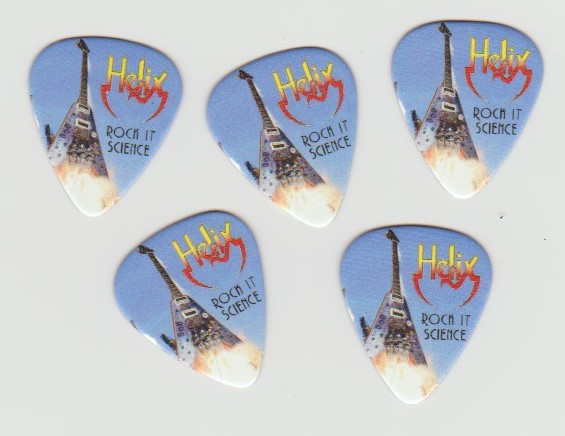
To promote their new album Rock It Science, Helix released this set of five custom guitar picks. It is available at their site for only $10, and they feature the excellent album art (by Brent Doerner) on the front. On the back, each pick has a photo of a band member: Brian Vollmer, Daryl Gray, Greg “Fritz” Hinz, Kaleb “Duckman” Duck and Chris Julke.
Guitar picks are great to collect and here at LeBrain HQ, we can always appreciate a cool set of custom plectrums. They’re fun, they don’t take up a lot of space (I’ll be storing mine inside the CD case) and they just look cool. Feast your eyes upon these beauties and if you decide to go for a set, don’t forget to order the Rock It Science CD to go with ’em!
“When you create something, it doesn’t matter if it’s art or music…there is always suffering attached to the creative process.” — Peelander Purple (Akiteru Ito)
MAD TIGER (2015 Film Movement)
Directed by Jonathan Yi and Michael Haertlein
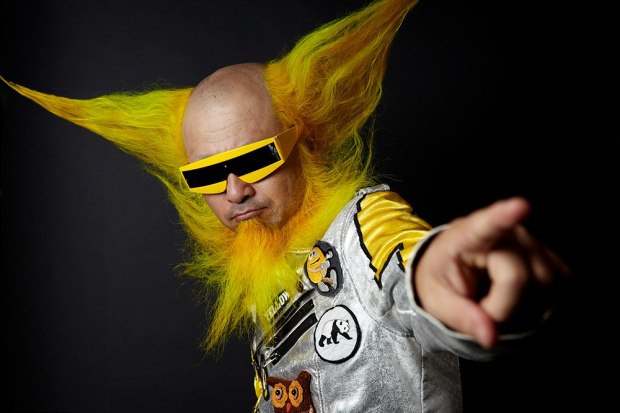
Peelander-Z is a Japanese-born punk band, via New York City, sort of a cross between Gwar and Japanese science fiction. In their own words, they are a “Japanese Action Comic Punk band hailing from the Z area of Planet Peelander”. They have been releasing music to a cult following since 1999. Their hits include “Mad Tiger” and “Ninja High School”. Music is only 10% of what they do, with elaborate stage shows, stories, monsters and characters to go with it. Like many Japanese super-teams, they are all completely colour coordinated. Their founding leader is Kengo Hioki, or Peelander Yellow. His partly-shaved head is always dyed yellow, and his costumes match. According to his wife Peelander Pink (keyboards), Kengo first had to learn how to play guitar standing up in order to form a real punk band.
Their music is meant to be fun, to bring happiness. The music itself is not serious, but Yellow takes his band very seriously. When original drummer Peelander Blue left the band in 2008, he was replaced by Peelander Green who helped bring the music to a more professional level. Bassist Peelander Red (Kotaro Tsukada) was the lynchpin, being the member who was the most physical on stage and able to do the stunts that Yellow could not. A new stunt involved him riding a unicycle in a squid suit and crashing into the stage. He’d often be the member who was climbing on top of things, and hanging from the ceiling by his legs. Other gags include human bowling a-la Jackass, and chair fights like WWE wrestling. Red’s physicality was essential to this.
The atmosphere around Peelander-Z is bubbly and celebratory, but inside, there is tension. Red has decided to leave the band and open a bar in New York. A final show for Red is a big deal, an emotional event for the members — each one changed colours to red for this special show. For Yellow, it means not only losing a close friend, but having to create a new character for a new member to play. Another friend, Akiteru “Eatman” Ito, is flown in from Japan to play bass. His musical style is different from Red’s, and different from what Yellow is used to. He becomes Peelander Purple, a rhino-headed bass behemoth, and they prepare for their first show together.
While this movie is ostensibly about a unique punk band with a 15 year history, it is more so a look at Kengo Hioki, a born entertainer who was facing a crossroads in his life with the departure of Red. We get to visit his family in Japan, his devoutly Christian father and his siblings. We get a sense of what friendship and commitment means to Kengo, especially in regards to the tensions between his partners in Peelander Z. Watching the band seemingly fall apart while he was working hard to build it back up is poignant. Filmmakers Jonathan Yi and Michael Haertlein chose to leave in raw, emotional footage that Kengo wanted to sum up in animated form.
The songs are silly and fun, but the passion is genuine. Check out Mad Tiger.
Music fans can buy just about anything with their favourite band’s name on it. While Elvis merchandise and the onslaught of Beatlemania stuff makes for fun collectibles, Kiss really blasted things into overdrive, for better or for worse. Growing up in the late 70s and early 80s, we were inundated with Kiss. Neighbors on our street had Kiss cards, the Kiss remote control van, Kiss comics, Kiss posters, books about Kiss and more. You could buy Kiss dolls. Kiss Your Face makeup. Everything! At the time Kiss were heavily criticized for their merchandising. Paul and Gene defended it by saying, ‘if our fans want to buy a Kiss hat, then why shouldn’t they be able to buy one?’ Turns out their fans wanted to buy a lot more including cars and coffins!
Now the merchandise door is wide open. Everybody has dolls; my sister had some wretched New Kids on the Block dolls. I have a friend who owns the Spice Girls. I myself own Johnny Cash, Alice Cooper and Ozzy Osbourne. Today, music celebrities have their own alcohol, such as Motley Brue or The Trooper beer. Rock stars even have their own hot sauces. I was a proud owner of Joe Perry’s Boneyard Brew. (I’ve never been able to find Michael Anthony’s Mad Anthony sauce.) I often like to picture Joe Perry hard at work over a boiling pot, mixing specially selected peppers and spices until he finally came up with his own Boneyard Brew. It’s not impossible, although it is unlikely.
What is very highly unlikely is that Justin Bieber studied perfume chemistry to come up with his own scent, “Girlfriend”.
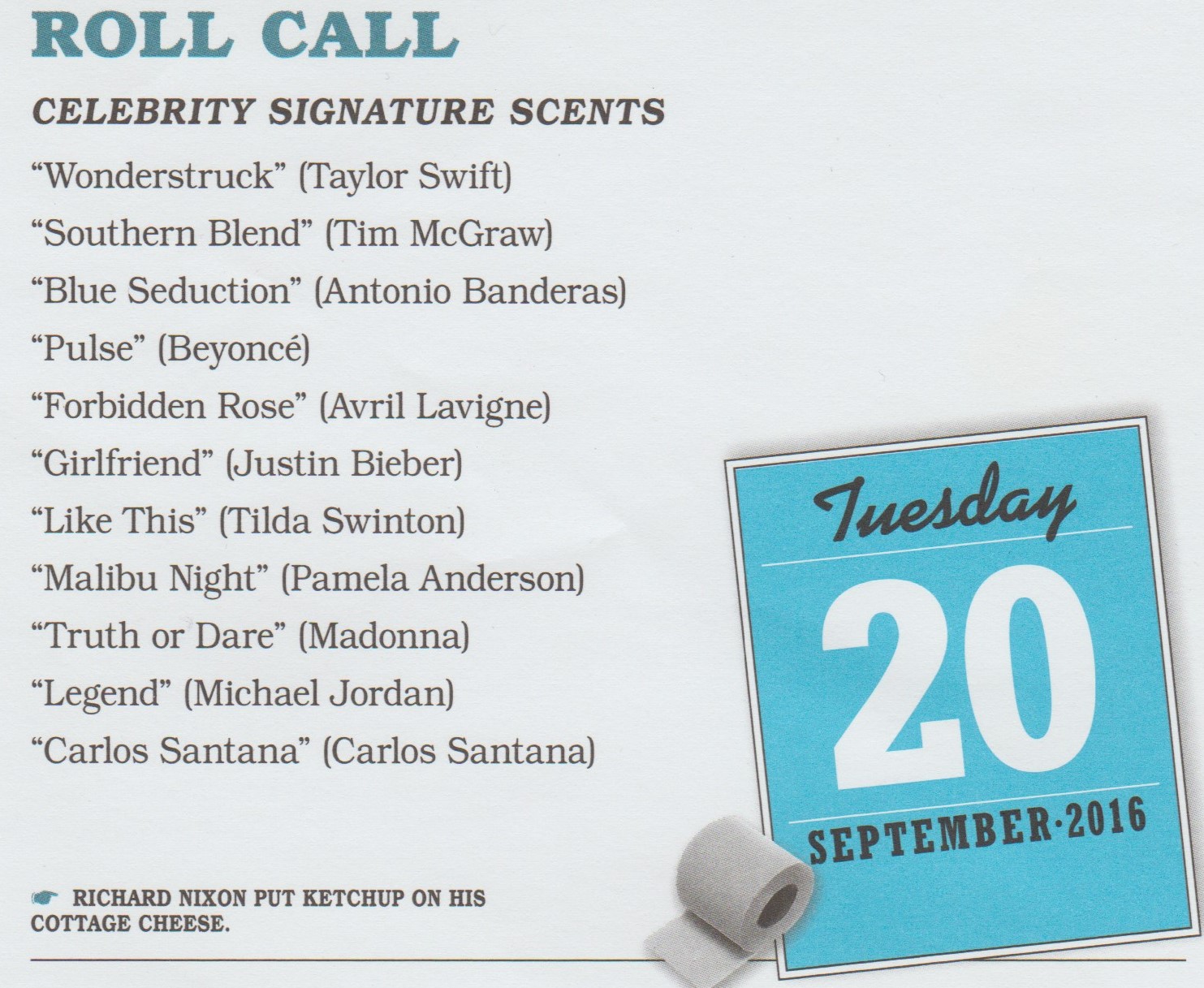
It seems perfumes and colognes are the latest hot trend in celebrity endorsements. We are not so naive to think that the stars have anything to all to do with their own perfumes, but look at the list below. (Courtesy once again of Uncle John’s calendar.) Taylor Swift and Beyoncé don’t surprise me, but I didn’t know Tim McGraw had his own scent (“Southern Blend”). Check out some of the interesting names below.
Who knew Carlos Santana had a scent called “Carlos Santana”? I wonder who came up with that clever name? (Whoever they are, they probably make more money than us.) Even Kiss have a cologne, called “KISS Him for Men”. Kiss sell aftershaves and deodorants too. But we can’t blame Kiss for this trend, can we? This one is on the shoulders of Hollywood.
The first celebrity scent was “Sophia” by Sophia Lauren, in 1981. The Italian film icon’s perfume was released by Coty who work with just about every major celebrity today. That’s not the interesting part. What is interesting is that we might be able to blame Gene Simmons just a little bit for the first music celebrity scent. After all, it was his ex-girlfriend Cher who was the first music star to enter the perfume world. Her scent “Uninhibited” was the first for a music performer. Did her ex-boyfriend’s merchandising ways have anything to do with this? The truth is, probably not — but it’s fun to blame Gene anyway.
With the reigning queens of pop like Katy (“Killer Queen” and “Purr”) and Gaga (“Fame for Women”), not to mention the boy-throbs like One Direction (“Our Moment for Women”), it is likely that music perfumes and colognes will remain big business for years to come.
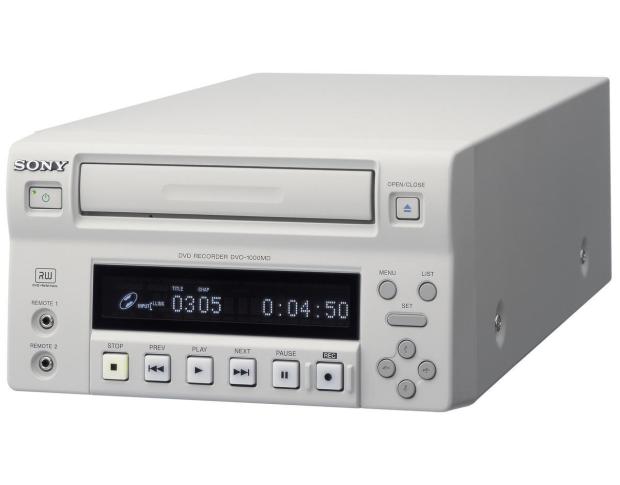
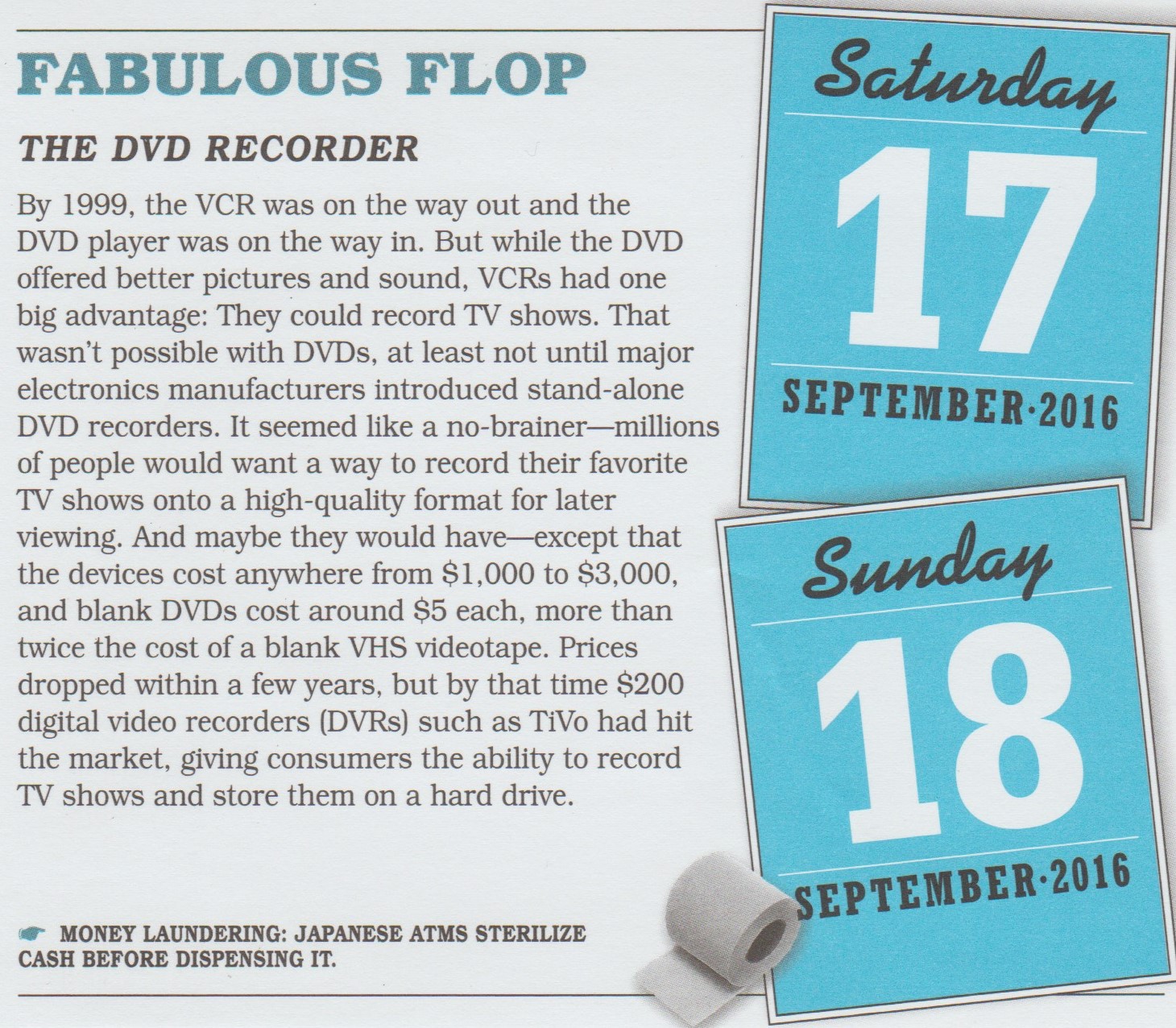
Obsolete and outdated technology can be fascinating to look at. For a long while, it looked like everything was going to go DVD. Even music. There was talk of box sets by bands such as Led Zeppelin or the Beatles that could fit the entire catalogue on one disc. The Digital Versatile Disc all but completely took over from the VHS tape for viewing, so why not for simple household TV recording too? Enter the DVD recorder. This was not the same as a DVD burner for your computer. It was a standalone unit for your home entertainment system, connected to your cable box and ready to go. As you can guess, it failed gloriously. Why? Uncle John’s daily calendar tells us it came down to cost:
While it is considered obsolete now, the DVD recorder had one slight advantage over the typical PVR that you can rent today from Rogers Cable. That is keeping a recording permanently. I’ll give you a great example.
In 1994, my future father-in-law won tickets to go see the Toronto Maple Leafs during the playoffs facing off against the Sharks in San Jose. My future wife came with him, bearing a sign that said “DOUGIE G. FOR PRIME MINISTER”. This is of course a reference to legendary Toronto Maple Leaf center Doug Gilmour. Then my wife saw the unmistakable Canadian hockey broadcaster Don “Grapes” Cherry in the lobby, with his colourful suit and camera crew. She shouted out “GRAPES!” Nobody else in California would have known him as “Grapes” so he knew it was a fellow Canuck. He saw the Dougie G. sign — his favourite player from Kingston, Ontario. He asked her to come on down. That’s how my wife got on Hockey Night in Canada back in 1994. We have a copy of this on video tape, but when the game was re-run a couple years ago, we recorded it including the part with my wife on our Rogers PVR.
It was nice to have it digitally but we always knew we’d lose it if the PVR busted. There’s no way to retrieve a recording from it, according to Rogers. So when it finally kicked the bucket, we lost the hockey recording. No matter; we’ll just wait for the next re-run.
If we only had an old-fashioned DVD recorder, however, we’d have a hard copy that we could have kept safe and sound forever!
What are your “musical firsts”? Here are mine! Let’s start with concerts.
First concert: Johnny Cash (1983)
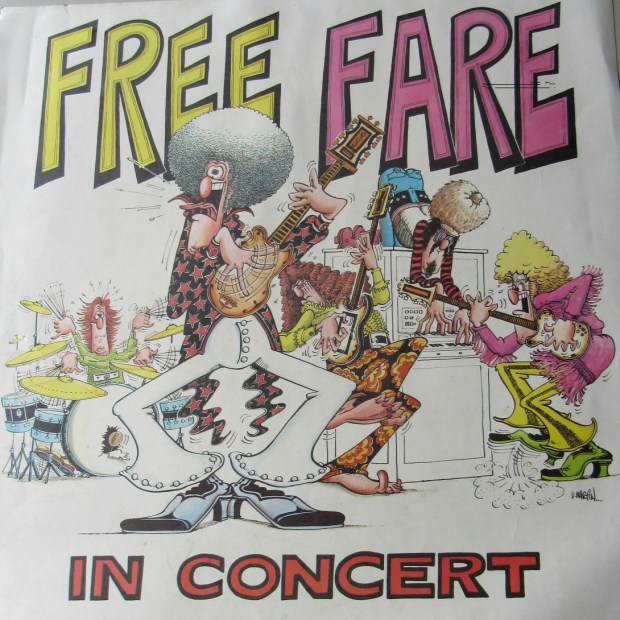
First highschool concert: Free Fare (1986)
First rock concert: Helix (1987)
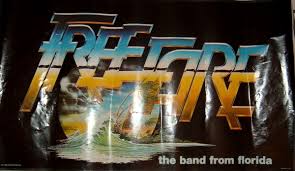
Who remembers Free Fare? They billed themselves as “the band from Florida” (there was only one?) and toured highschools all over the US and Canada. They played Grand River Collegiate in my grade nine year, performing popular covers and giving away Free Fare bandanas.
How about your first musical instruments?
First instrument played – bass guitar
First instrument bought – electric guitar
First instrument smashed – the same electric guitar, smashed by my sister
Finally I’m sure you all remember your first albums. Here are mine:
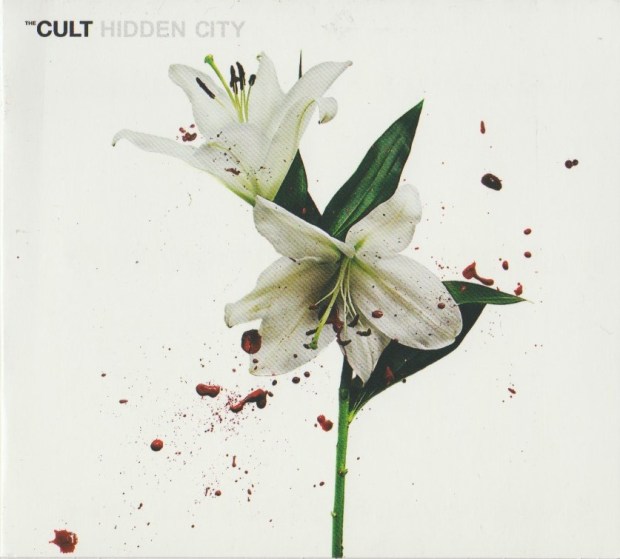
 THE CULT – Hidden City (2016 Dine Alone)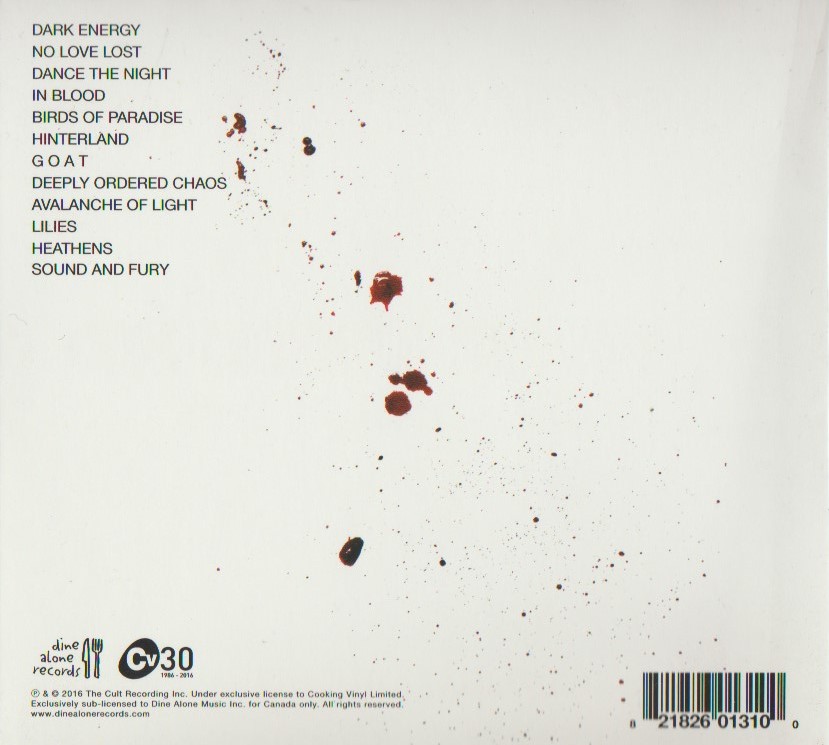















 mikeladano.com