#486: Dream Music

Welcome to another theme week at mikeladano.com. This week: Getting MORE Getting More Tale. Instead of reviews, we have lined up five days of music stories in the Getting More Tale series. Hope you enjoy.


dream music

Have you ever heard music in your dreams?

Steve Vai has.  When he was a young musician, he experimented with lucid dreaming.  When you’re in a lucid dream, you can control your own actions.  Vai’s lucid dreams were very sexual, and musical.  Eventually his album Passion & Warfare emerged from these experiences.  The opening track “Liberty” is directly inspired by one of his dreams where he was standing saluting a flag (“a different kind of flag,” said Steve).  His song “Liberty” was meant to approximate what he heard in the dream, but what he was able to write versus what he actually heard in his head were very different.  He was unable to capture the fullness and grandeur of his dream.

Terence Trent D’Arby too has heard music in his dreams.  In his case, Marvin Gaye approached him in a dream, and asked if he’d be interested in a song Gaye had written.  Perhaps as an expression of his own ego, D’Arby answered, “If I like it.”  He must have, because D’Arby recorded the song as “To Know Someone Deeply is to Know Someone Softly” on 1989’s Neither Fish Nor Flesh.  Much like Vai, D’Arby found it impossible to translate the beauty of his dream music accurately into the real world.

As for me?  I’m no musician; I wish I was.  Maybe if I was, I could do something with the music constantly cruising around in my unconscious LeBrain!*

I don’t know why it is, but music does exist in dreams, and vividly so.  Bringing that music into the auditory realm is so damn hard no matter how hard you try to remember.  I like to write songs – little riffs and melodies that fit together into ditties that I can hum, but not really perform on an instrument.  Some of the music I have heard in my dreams would have been the best songs in the world, had they been real!

It’s impossible to describe anything specifically, except to say the music I heard in my dreams was heavy, symphonic, grand and complex.  If I wanted to, I could focus in on any specific part.  I could dive into the strings and hear the individual parts.   I could even manipulate the music once immersed.  As if I was playing the guitar myself, I could make the guitar solo go any way I wanted it to.  I could control the music like I was a conductor.   The only thing I couldn’t do was remember it when I woke up.

I’d wake up, and even though I could remember dreaming of an amazing piece of music, I couldn’t get it out of my head and onto tape or paper.  I could hum a melody or two, but nothing more.  The grandness and power was all gone.  Who knows if the melody I was humming was even anything like what I heard.  Either way, the melodies I would hum after would be tiny snippets, special in no way at all.

It’s a rare, bizarre, beautiful, frustrating experience.  Has this ever happened to you?


*Thanks to Mr. Books for perfecting that sentence for me.

#485: Cry for the Indians

GETTING MORE TALE #485: Cry for the Indians

We rarely get political here at LeBrain’s Record Store Tales and Reviews.  We try to keep the discussions light.  The topics are mostly focused on music, tech, retail and work place stories.  With that in mind, here’s a good work place tale from 2006.

Without getting into the nitty gritty details, back in 2006, a group of Six Nations on a reserve near Caledonia held an armed standoff over Aboriginal land claims.  In question was a 40 hectare parcel of land that was being prepared for development into subdivisions.  They occupied a large patch of land and wouldn’t budge, stating that historically they never gave up this land.  There is a very complex history as to the ownership of land in Caledonia, going back to 1784.  The police arrested occupiers, and in return the Six Nations set up roadblocks.  This went on for weeks, highlighted by violence and anger on both sides.  Local radio covered all the news, which made national headlines.   It was an ugly scene all around, but also a very serious issue that remains unresolved today (the last blockade happened in 2014).

During the months this was going down in 2006, I was working in a small data entry office with two ladies a little older than myself.  The radio was tuned to the local news.  During an update on the situation, one of the two ladies blurted out, quite offensively, “Why don’t those Indians just pack up and go home and stop causing trouble?  I’m sick of them!  I don’t even understand what they want!”  She ranted for a bit and then things went quiet.  The other lady didn’t answer, so I chimed in.

“They’re arguing for their rights to use their traditional lands,” I explained.

“What land?!” she answered incredulously.

“In Caledonia, but really this was all their land,” I informed her.  “When the Europeans like us came to this country, we pushed them off their land and took it for ourselves.  Now all they have left are these little crummy reservations.  But they were here first.”

Her response was something I’ll never forget:

“What?!  I never heard of that!”


Come again?  Did you somehow miss grades 1 through 12?  Canada often prides itself in our great education system.  There’s proof right there that it certainly has its flaws.  Highschool is free, people!  I had to explain this to a lady who was old enough to know where all the white people in North America came from.  I had to convince her this was real history and not a “theory”.  She didn’t have to like these facts, but how can you go through life without even knowing them?

And that is the story of one of the most ignorant comments I’ve ever heard inside or outside the work place.  In the words of Anthrax:

We all see black and white,
When it comes to someone else’s fight,
No one ever gets involved,
Apathy can never solve.

Forced out – brave and mighty,
Stolen land – they can’t fight it,
Hold on – to pride and tradition,
Even though they know how much their lives are really missin’,
We’re dissin’ them.
On reservations,
A hopeless situation.

Cry for the Indians,
Die for the Indians,
Cry for the Indians,
Cry, cry, cry for the Indians.

Respect is something that you earn,
Our Indian brothers’ getting burned,
Original American,
Turned into second class citizen.

Love the land and fellow man,
Peace is what we strive to have,
Some folks have none of this,
Hatred and prejudice.

Territory –  It’s just the body of the nation,
The people that inhabit it make its configuration.
Prejudice – Something we all can do without,
Cause a flag of many colors is what this land’s all about.

REVIEW: Brian Byrne – Tuesdays, Thursdays, and if it Rains… (2006)

Scan_20160505 (2)BRIAN BYRNE – Tuesdays, Thursdays, and if it Rains… (2006 Kindling Music)

Strangely, I first heard Brian Byrne’s solo single debut, “Far From Good”, on a local lite-rock radio station that I usually try to avoid.  The song caught my ear for its upbeat, country-rock sound, with bouncy violin and piano on top.  A neat mix.  When they said it was by Brian Byrne, I stopped myself.  Couldn’t be the I Mother Earth singer getting played on a lite-rock station, could it?  But it was.  I promptly ordered the CD from the Record Store at which I formerly worked.  The disc arrived in a few days, great condition, except for the promo-cut jewel case.  They normally should have replaced the case before the CD shipped, but somebody missed it.  I didn’t want to ask for a new case, because I just left the place six months before and I didn’t want to become “that” customer!

But enough about me, what about Byrne?  Here he worked with near-legendary Canadian producer Tim Thorney, as well as former Killer Dwarfs guitarist Gerry Finn.  (Byrne and Finn both hail from Newfoundland.)  I Mother Earth were deactivated, and Byrne honed Tuesdays, Thursdays and if it Rains… into a pleasing acoustic rock album, very “singer-songwriter” in sound.

“Far From Good” is the highlight, being the most immediate and lively.  The album is diverse.  The opening track “Days Go On” has elements of country, funk, classic rock and soul.  The juicy organ parts really suck you in.  “Jen’s Song” is one of many ballads, this one reminding me of 80’s Phil Collins for some reason.  Byrne gets to let his voice speak more than he does in the louder I Mother Earth.  Then there’s a big chorus on “Sweet Love”, a better light country rock tune than Bon Jovi’s ever written.  This is like country-Jovi, but with integrity and feelings, and not a lot of flash.  “Nova Dashboard” is a lovely, bluesy country ballad along the lines of Blue Rodeo’s dusky favourites.  The guitars (by Thorney) get right under your skin.

I could go on and on, but all the songs have a quiet, smouldering power to them.  The light and shade of the album sounds quintessentially Canadian to me, and the calibre of the musicianship is above reproach.  Expect an album of diverse music crossing several genres, but do not expect I Mother Earth.  Byrne almost went as far in another direction as you could imagine.  And that is really cool, because he does it so well.

3.5/5 stars

Scan_20160505 (3)

REVIEW: Brant Bjork – Punk Rock Guilt (2008)

Purchased for $7.99 at Vertigo Records in Ottawa.

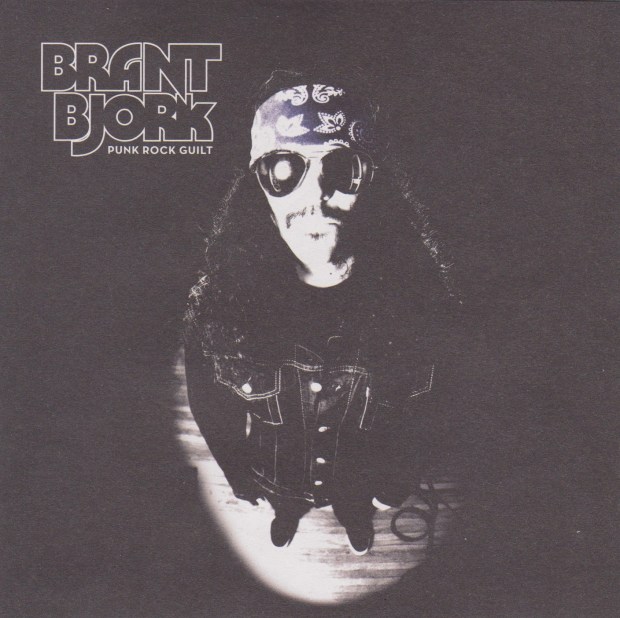
Scan_20160415BRANT BJORK – Punk Rock Guilt (2008 Dine Alone Records)

Brant Bjork is one prolific mo-fo.  Whether it’s solo or with bands such as the Bros, the Operators, or Ché, Bjork always maintains a high level of quality. Punk Rock Guilt is undoubtedly a solo album. All music was written and performed entirely by Bjork. He’s a talented multi-instrumentalist with a wide variety of influences from all over the music spectrum. When they collide in the grooves of the wax, it’s audio ecstasy.

What’s surprising is that an album called Punk Rock Guilt is loaded with both short songs and long bombers.  Maybe that’s the guilt part?  Sitar commences the album on an Indian note with “Lion One”, the first of the lengthy tracks.  At over 10 minutes, the challenge is to keep things interesting, and Bjork does.  When the song settles into a slow bass-heavy groove, I’m immediately reminded of his first excellent solo album Jalamanta.  The vocals don’t even kick in until the 3:00 mark, and then with a semi-spoken Lou Reed direction.  As a long song of this nature should, it picks up speed come solo time.  “Lion One” is outstanding rock as it rises and falls in waves.

The next is the shortest song, “Dr. Special”, and already much rock ground has been covered.  “Dr. Special” has a funky 70’s porn soundtrack vibe but heavy and sparse.  (This sounds like it’s a lot of fun to play.)  Over to “Punk Rock Guilt”, which is surprisingly classic rock.  The melodic riffs and catchy vocals give it something in common with Boston, but without leaving the Bjork sound behind.
“This Place (Just Ain’t Our Place)” returns to the Bjork groove, laid back, heavy and probably stoned.  There is no lyric sheet included but I’m pretty sure Bjork has returned to one of my favourite lyrical subjects:  UFOs!  The guitar solo has a spacey sound.  On vinyl (a double record set for its total 46 minute length), this closes LP 1.  The second record commences with a riff and “Shocked by the Static”.  Even though the copy here is a CD, you can hear this is a natural spot for a side break.  Lacking any major hooks, the way to enjoy “Shocked by the Static” is to focus on the groove and just air drum along.

The surprise of the album is “Born to Rock”, starting light and airy like some U2 outtake.  Clean guitars and Lynott-like vocals do the trick:  this is a killer.  Contrasting this is “Plant Your Seed” which has Sabbathy guitar tones and a singular groove.  Finally it’s another 10 minute tune, “Locked and Loaded”, to finish the album.  “It’s a hijack groove, electric boogaloo, and bloodshot eyes are watching you.”  Not sure what that means, but the groove is ZZ Top’s from “I Thank You”.  Cool vibe on which to end a cool album.

4/5 stars

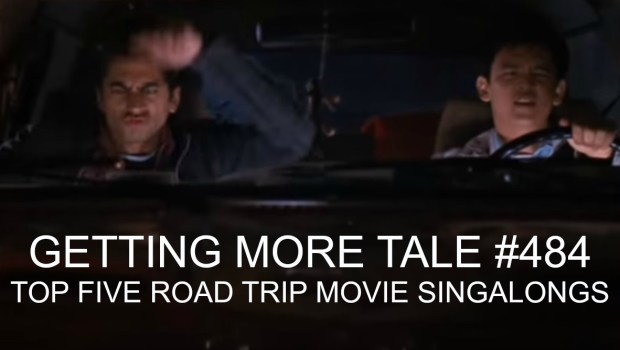
#484: Top Five Road Trip Movie Singalongs

HAROLD AND KUMAR

Sometimes-contributor Thussy and I came up with a list of our Top Five Favourite Road Trip Movie Singalongs!  The five songs below are forever associated with these films in my mind.  Like any other list, I’m sure you’ll have plenty that we forgot.  These are some of our favourites.  What are yours?


#5: Harold and Kumar Go to White Castle – “Hold On”

Once our heroes Harold and Kumar finally best the Extreme Sports Assholes, they not only steal their ride but also their “Extreme Mix Vol. 5” tape! Kumar and Roldie then enjoy a hearty singalong to Wilson Phillips’ “Hold On”.  So extreme!


#4: Dumb & Dumber – “Mockingbird”

“Radio?  Haha!  Who needs a radio!  Ready Harry?”


#3: Planes, Trains and Automobiles – “Three Coins in the Fountain”, “Meet the Flintstones”

Double whammy with this classic movie!  Steve Martin attempts to get a bus full of people to sing the 1954 theme song from the romance film Three Coins in the Fountain, with no success.  Much to his chagrin, John Candy’s irritating (though lovable) character Del Griffith got plenty of response to his “Meet the Flintstones”.


#2:
 The Hangover – “Three Best Friends Song”

The Hangover featured two great original songs:  “Doug” performed on piano by Ed Helms, and “Three Best Friends” sung by Zach Galifianakis. “Three Best Friends” gets the nod, because the other took place in a hotel room.  Come on, sing along folks…


#1:  Wayne’s World – “Bohemian Rhapsody”

Technically not a road movie, but they did make a trip from Aurora to Milwaukee in the film.  This iconic scene had to be #1.  There really were no other competitors.  We’re not worthy!


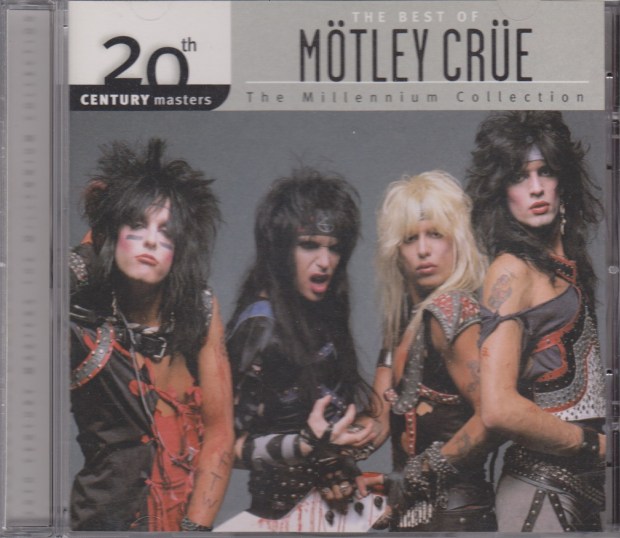
REVIEW: Motley Crue – 20th Century Masters – The Millennium Collection

MOTLEY CRUE – 20th Century Masters – The Millennium Collection (2003 Universal)

As a change of pace, this review focuses not on what is on the album, but what was left off.  This 20th Century Masters is more than a little shoddy, as this series can often be.  So let’s talk about what it is not.

  • Too Fast For Love

“Piece of Your Action” is a great little ditty from the debut record Too Fast For Love. What you’re missing though: the speedy single “Live Wire”!  It makes little sense to have this one without “Live Wire”.

“Shout at the Devil” and “Too Young to Fall in Love”: Great choices. Both are classic 80’s metal. What you’re missing is hit single “Looks that Kill”.  But as Meat Loaf says, two out of three ain’t bad.

“Home Sweet Home” is Motley’s biggest hit ballad ever, but where is the Brownsville Station cover “Smokin’ in the Boys Room”?  Can you believe it’s not on here?  And it’s not because it’s a cover, because, well, we’ll get there.

  • Girls, Girls, Girls

The title track makes good sense to include, but why is “All in the Name Of…” on here instead of “Wild Side”? Also missing, but understandably so, is the ballad “You’re All I Need” which never made much impact.  “Wild Side” though remained a concert staple to the end, so that’s one you’ll need to find elsewhere.

  • Dr. Feelgood

There were five singles on this album, and of course you can’t include them all on a 20th Century Masters CD. What you do need are the title track and lead single “Dr. Feelgood”, and obviously “Kickstart My Heart”.  “Kickstart” was an explosive statement by the band, proving they were as mighty as ever without the drugs.  Those two songs embodied the album, but there’s no “Feelgood” here. Inexplicable!  Certainly one of the biggest oversights on this disc.


Great song!  Not on this CD!

  • Decade of Decadence

For reasons that are unexplained and perhaps best left that way, instead of including any of the above better known songs, 20th Century Masters has the far less famed “Rock ‘N’ Roll Junkie”, and Sex Pistols cover “Anarchy in the UK”. “Junkie” is a Feelgood outtake, original released on The Adventures of Ford Fairlane soundtrack in 1990. “Anarchy” was recorded for Motley’s first greatest hits, Decade of Decadence. Neither song is essential, and both are on Decade. Why are they here? “Primal Scream”, which was a powerful single, is a must have. But it’s not here.  Yet another song you’d still have to get elsewhere, because it’s awesome and important.

No complaints here.  “Hooligan’s Holiday” is included from 1994’s self-titled album with John Corabi on vocals. Nice to see this single represented instead of ignored.

At this point, for a compilation like 20th Century Masters, I don’t think you need to explore the 90’s. But, from 1997’s dreadful Generation Swine comes the title track. Not the minor hit single “Afraid” mind you, but the title track which did nothing and went nowhere.  Baffling!

Ending the album with “Hell on High Heels” brought the compilation up to date for its 2003 release date. Unfortunately, there was nothing on New Tattoo worth bringing to the table. Tommy Lee had left and there was a serious dip in quality, even after Generation Swine.  Although it was the only Motley album featuring late drummer Randy Castillo, New Tattoo is simply a turd with no songs that are up to snuff. Crappy way to close a pretty crap compilation, though.  Motley Crue’s instalment of 20th Century Masters sounds as if it’s a single disc from a double CD compilation, and the other CD’s been lost.  Sorry Motley, this CD gets the dreaded Flaming Turd.

1/5 stars

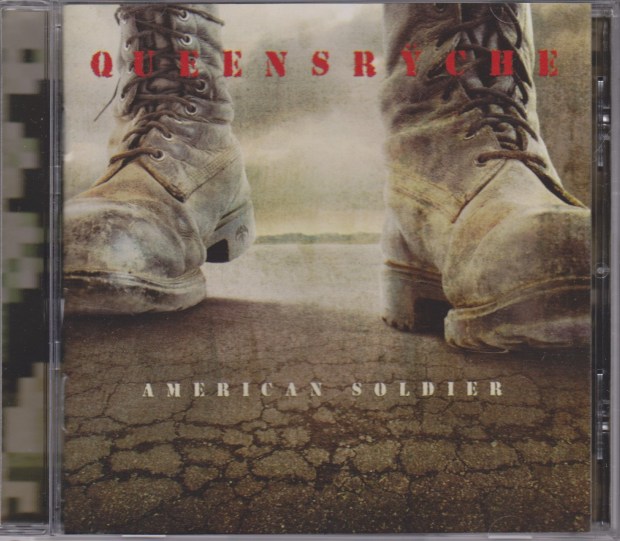
REVIEW: Queensryche – American Soldier (2009)

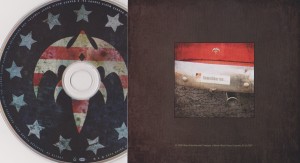
Scan_20160511QUEENSRYCHE – American Soldier (2009 Rhino)

There is no doubt that a decade and a half of war has dramatically changed the United States.  In 2009, Queensryche decided to deal with their feelings by writing a concept album on the subject.  It’s something that they do very well, and American Soldier, the finished product, was another ambitious piece of work.  Although the album was mostly written by Geoff Tate and his friends Jason Slater and Kelly Gray, in reality it’s the last good album the band made with Tate.

The band interviewed soldiers for this album, and their words are a huge part of the record.  The track “Unafraid” opens like this, creating a hauntingly serious atmosphere.  At times, the music is toned down, allowing the dialogue to speak.  It’s an interesting effect and certainly it works in creating the mood that the band were going for.  I think it is also a token of appreciation to the soldiers who defended the country.  They had a chance to speak their minds, and be immortalized in music.  That’s pretty cool.

The end result is a good album that is not necessarily easy to listen to.   There is no “fun” in this music, it is dead serious the whole way through.  The intensity burns and you can hear that Tate was focused like a laser on this project.   The songs are fine; not Mindcrime quality but I don’t think that anthemic progressive rock would have fit American Soldier.  The single misstep is the vocal by Tate’s daughter Emily on “Home Again”.  What was meant to be a dramatic, emotional focal point is instead distracting.

Scan_20160511 (2)

Among the best tracks are “Sliver”, a cool opener featuring an actual soldier (A.J. Fratto, a 14 year vet) barking orders with the music.  Fratto ended up touring with the band in support of this album.  Well done, sir!  “Hundred Mile Stare” is slow and intense.  The hundred mile stare in the song is a variation of the thousand yard stare — a distant look in the eyes a soldier gets after they’ve been in the field too long.  “A Dead Man’s Words” is another complex highlight, middle-eastern in style and clearly about conflict in that region.  This one is perhaps the most “Queensryche” of the songs, in the sense that you can hear their classic sound at play.  This includes a Tate sax solo, something I wished he did more of with the band.  Then, for choruses, I have to go with “The Killer”.  For sheer intensity, it’s the soldier’s story on “If I Were King”.  If you want heavy ‘Ryche, then “Man Down!” is the track for you.

One disappointing factor in American Soldier only hits you when you open the booklet.  Great artwork aside, it’s really too bad that Tate relied so heavily on his buddies to make this album rather than his band.  Drummer Scott Rockenfield has two co-writes, and that’s it.  Damon Johnson from Brother Cane has just as many co-writes.  The rest of the credits are variations of Tate, and producers Jason Slater and Kelly Gray.  Queensryche were down to four members at this point, so Johnson and Gray subbed on guitars.

Although Promised Land was probably the most deeply personal Queensryche album, American Soldier is likely the runner up.  At least for Tate and his collaborators, there is obviously a lot of their hearts and souls invested in this.  Unsurprisingly, it is not an immediate album.  It requires time, but it also requires space between listens.  There’s no glory here, just stark reality, so take your time.

3.5/5 stars

Scan_20160511 (3)

REVIEW: Queensryche – Operation: Mindcrime II (2006)

QUEENSRYCHE – Operation: Mindcrime II (2006 Rhino)

10 years ago, when this project finally saw the light of day, a lot of fans were expecting it to be 1988 all over again. However, there were many reasons why they shouldn’t have.

1. Longtime guitarist/songwriter Chris DeGarmo, such an integral part of the original Mindcrime, had been out of the band for quite some time.
2. Geoff Tate’s voice didn’t have that high-note power it once had.
3. The band never intended to pretend it was still 1988. This album is a continuation, 18 years later, and as such the music has changed somewhat as well.  The albums are meant to complement each other, not duplicate each other.

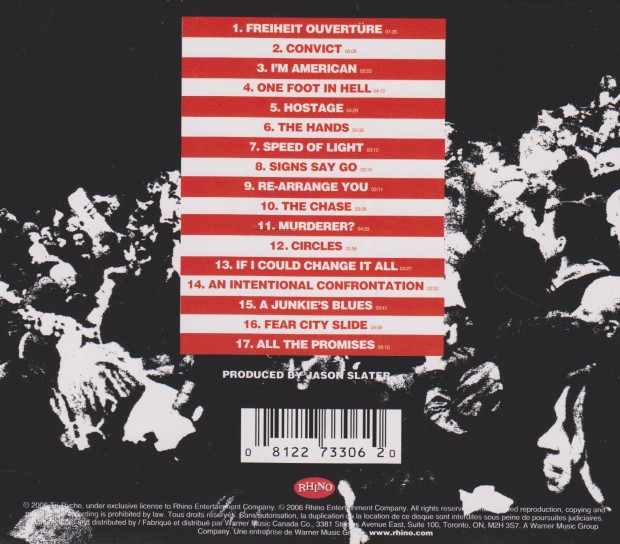
Scan_20160510 (2)The story picks up with Nikki, the anti-hero from the original Mindcrime, finally being released from prison, 18 years after the events of the first album. He begins to piece together his memories of what happened. He decides to pay Dr. X a visit (“X marks the spot”, goes the lyric), who is deliciously played by the late Ronnie James Dio.  For die-hard Dio followers, this was a real treat. Dio sings as if in a stage production, which I’ve never heard him do before. Pamela Moore reprises her role of Sister Mary, playing a larger role and appearing on more songs. She’s a great complement to Geoff Tate, who clearly revels in the chance to do something dramatic like this.

New second guitar player Mike Stone (ex-Criss) gels very nicely with Michael Wilton, playing dual guitar leads that Queensryche of old would have been proud of. At the same time, modern technology has creeped into the production in the form of sequencers and samples, to remind us that this was 2006.  Still, Eddie Jackson’s bass had never been recorded this well before; he should be very proud of his rumble. Scott Rockenfield’s back to playing some serious metallic drumming as well, leaving behind some of his tribal influences for the moment.

So, the actual sound of Mindcrime II is amazing. The songs however are not up to the very high standards that Mindcrime I set. There is no “I Don’t Believe In Love” or “Eyes Of A Stranger”, although some songs like “The Hands” come pretty close, with an amazing metallic riff and great chorus. (Did anyone else notice a few bars of music from “I Don’t Believe In Love” within “The Hands”? Listen again.) “I’m American” is lyrically fantastic, and angrier than anything Queensryche has done since Q2K. “Chase” is the one featuring Dio, and the one I keep coming back to.

The thing about Queensryche albums is, they do tend to get better with time.  Maybe they were always slightly ahead of the curve, or more likely they just take a few listens to absorb.  It’s been a decade now, and few of the Mindcrime II songs remain lodged in the my brain.  Meanwhile, I could hum any song from the first one.  In particular, the second side of Mindcrime II really takes a drop.  Tracks like “Fear City Slide” do not have the impact of “I Don’t Believe in Love”, and the closer “All the Promises” fails to deliver.  It’s a concept album after all, and the last song is like the last scene in a movie.  It should be memorable.

Will Mindcrime II ever become classic like the original? Doubtful. As soon as you name something with a “II” behind it, you’re painting yourself into a corner, but Queensryche have done about as good a job as the fans could have expected.  It seems many fans have warmed up to it over the years, though it certainly cannot be considered equal with the original.

3/5 stars

Scan_20160510 (4)

#483: The Wreck of the Edmund Fitzgerald

GETTING MORE TALE #483: The Wreck of the Edmund Fitzgerald

The legend lives on from the Chippewa on down,
Of the big lake they call gichi-gumi.
The lake, it is said, never gives up her dead,
When the skies of November turn gloomy.
With a load of iron ore twenty-six thousand tons more,
Than the Edmund Fitzgerald weighed empty,
That good ship and crew was a bone to be chewed.
When the gales of November came early.

Living in Southern Ontario, we have easy access to three of the five Great Lakes. Many children spent time holidaying on Huron, Erie or Ontario. In school we learned to memorize the names of the Great Lakes with the acronym “HOMES”: Huron, Ontario, Michigan, Erie and Superior. The Ojibwe called Superior “gichi-gami” meaning “big sea”. When I was a kid we spent our summers at the cottage in Kincardine. Kincardine is located on the eastern shore of Lake Huron, or as my dad used to call it when I was a toddler, “big water”. Some things are universal.

We are surrounded by nautical activity, from the great locks at Welland canal, to the legendary shipwrecks on the Great Lakes.   Just a few kilometers south of Kincardine is Boiler Beach, so named because a few meters from the shore sits the boiler from an old steamer that exploded in 1883.  The Erie Belle was a tug boat sent to rescue another ship that had blown aground after missing Kincardine harbour and attempting to turn around.  It could not budge the freighter, and the Erie Belle’s boiler exploded when the engine overheated and seized.   The piece of history is still sitting there partly due to the cold fresh waters of Huron.  You can see it clearly even from the road.  If that kind of sight doesn’t instil in a kid an interest in nautical Great Lakes history, nothing will.  And then there are glass-bottom boats that do tours, and in clear waters to view shipwrecks.

We also weathered quite a few storms that rolled in off the lake, taking down hydro poles and trees.  All you can do is sit tight and wait it out.  We always kept several oil lamps at the cottage, ready to go, and we had to use them annually.  It was easy to see how a even a huge ship could come to harm in such a storm.

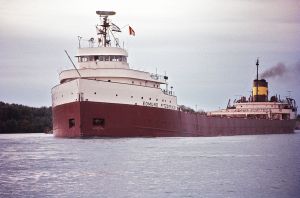
Today, thanks to Gordon Lightfoot’s musical immortalization, the wreck of the freighter SS Edmund Fitzgerald is the most famous Great Lakes shipwreck of all time.

EDMUND

The huge freighter was hauling iron from Duluth, Minnesota to steel mills in Detroit, Michigan.  Its final destination of the season was the port of Cleveland. It was late in the year 1975, and the big ship had to traverse the entire length of Superior, the deepest and most northerly lake.  From there, to the locks at Sault Ste. Marie, and then south down the entire length of Huron.  The Edmund Fitzgerald was a sturdy ship, launched in 1958 as the largest on the lakes.  She broke speed records, and then broke her own records.  She was a favourite to crowds because of the charismatic “DJ Captain”, Captain Peter Pulcer.  He enjoyed piping music in the loudspeakers, and entertaining crowds on the St. Clair and Detroit rivers with tales of the big ship.  But it was Captain Ernest M. McSorley who was command that fateful night in November.

There was a storm on the radar, but the weather service predicted it would proceed harmlessly south of Lake Superior.  The Edmund Fitzgerald departed on November 9, but by 7 pm that night, the weather reports suddenly changed.  The storm was crossing the lake, and they sounded the warning for gale-force winds.  Pounded by 60 mph winds and 10 foot waves, the Edmund Fitzgerald headed north for shelter.

When suppertime came, the old cook came on deck,
Saying, “Fellas, it’s too rough to feed ya.”
At seven PM it grew dark, it was then,
He said, “Fellas, it’s been good to know ya.”
The captain wired in he had water comin’ in,
And the good ship and crew was in peril.
And later that night when her lights went out of sight,
Came the wreck of the Edmund Fitzgerald.

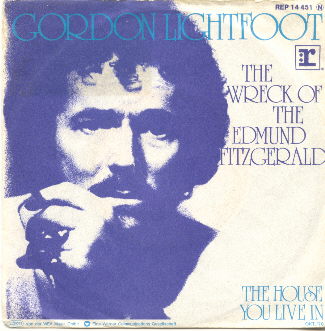
Gordon Lightfoot was fascinated by the story and wrote the famous song around the disaster. His storytelling ability made it legendary, never to be forgotten.  It went to #1 on every relevant chart in Canada, and has been covered by artists as diverse as the Dandy Warhols and the Rhoestatics.  And in honour of the 29 men who died on that ship, he has revised his old lyrics. Formerly the words went, “At seven PM a main hatchway caved in.” However this implies the hatchway was not secured properly, and investigations showed that there was no crew error in the disaster. With respect to history, Lightfoot changed the line to “At seven PM it grew dark, it was then…”

Lake Huron rolls, Superior sings,
In the rooms of her ice-water mansion.
Old Michigan steams like a young man’s dreams,
The islands and bays are for sportsmen.
And farther below, Lake Ontario,
Takes in what Lake Erie can send her.
And the iron boats go as the mariners all know,
With the gales of November remembered.

The Edmund Fitzgerald lies at the bottom today, 15 miles from the aptly named  Deadman’s Cove, Ontario.  It is now a protected site, but there are no conclusive answers to what happened in her final moments.  The way Lightfoot worded it was appropriately vague: “And later that night when her lights went out of sight, Came the wreck of the Edmund Fitzgerald.”  What is more important today, rather than the cause of the wreck, is the fact that the 29 people lost at sea are now immortal.  Gordon Lightfoot ensured that.

In a rustic old hall in Detroit they prayed,
In the Maritime Sailors’ Cathedral,
The church bell chimed ’til it rang twenty-nine times,
For each man on the Edmund Fitzgerald.

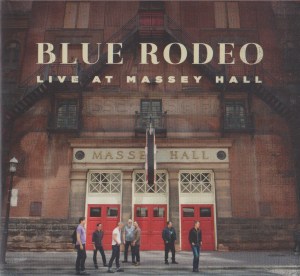
REVIEW: Blue Rodeo – Live at Massey Hall (2015)

Scan_20160426BLUE RODEO – Live at Massey Hall (2015 Warner)

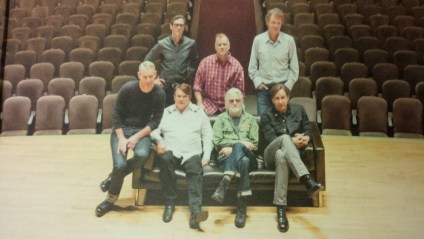
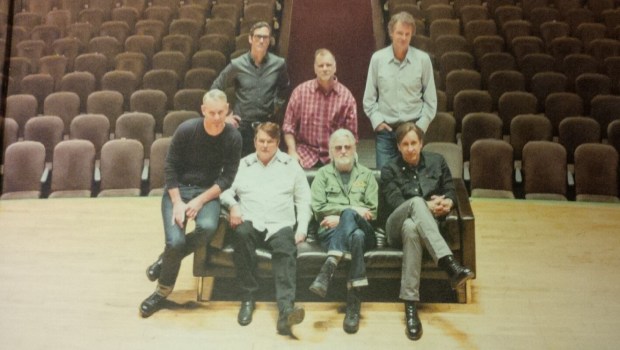
Things have changed a lot since the last time I saw Blue Rodeo in the mid-2000’s. They have added a few more albums to the oeuvre, and a few more members to the band. The expansion of Blue Rodeo to a seven-piece band has made their live sound smoother, the rough edges sanded off. Due to Greg Keelor’s hearing loss, the singer and author of some of the most gonzo country-rock guitar solos north of the 47th was forced to unplug, and focus on the acoustic guitar instead. Colin Cripps (Crash Vegas), who had filled in before, was drafted full time to fill the guitar sound. With Kitchener resident Bob Egan on slide and various other stringed instruments, there are now four guitar players in Blue Rodeo. The newest member is Michael Boguski on various keyed instruments.

According to the band, one of the solutions to Greg’s hearing issues was changing over to in-ear monitors. There was a rough shake down period to get used to this setup, timid performances during which the band says they failed to take chances live. For Blue Rodeo to issue a new live album, one must assume these issues have been ironed out. Live at Massey Hall is the band’s first live album since 2008’s Blue Road.  It is also their shortest live album with only one disc inside (Blue Road was more of a video album, with unique CD and DVD content).

Supporting the studio album In Our Nature, the Massey Hall album has a little bit of newer material, but is dominated by past hits.  Most of the new songs are clumped together in the middle of the CD:  “New Morning Sun”, “Tara’s Blues”, “Tell Me Again” and “When the Truth Comes Out”.  There is no drop of quality during this four-song clump, in fact “New Morning Sun” almost sounds as if lifted from Blue Rodeo’s late-80’s heyday.  The last of the new songs, “Paradise”, is left closer to the end, before the rousing finale of “5 Days in May” and “Lost Together”.

Plenty of hits abound, with only “Try” obviously absent.  There are also a couple of surprise tracks: the rarely played “Girl of Mine” from Diamond Mine, and “Disappear” from Tremolo.  The 8:04 “Disappear” is the album highlight, recalling the mighty feats of Blue Rodeo onstage in the 1990’s.  It rivals “Diamond Mine” for drama and instrumental gold, but has a beautiful melancholy power.

IMG_20160426_090808

Old man time may have taken his toll on Greg’s hearing.  Jim’s voice might be a little lower and huskier than it used to be.  This band, surely one of the best live acts Canada has produced, survives on.  The studio albums may no longer hit the charts like they used to, but Blue Rodeo have always seemed truly at home on the stage.  With the addition of Cripps (helping out on backing vocals as well as guitar), the band are still able to do the big bold rock songs like “Lost Together” and “Diamond Mine” at full strength.

There was once a time when the music press questioned if Blue Rodeo could remain a vital force without original member Bobby Wiseman on keyboards.  That was 1992.  Not only have they remained just as challenging as ever, but they have continued to evolve and grow.  Now it feels as if things have come full circle, back to that point in the mid-90’s when we realized the sky was the only limit for this band.  We look forward to whatever Blue Rodeo produce next.

4/5 stars


Scan_20160426 (2)