Alan Moore

RE-REVIEW: Judas Priest – Sad Wings of Destiny (1976)

I was listening to Sad Wings of Destiny recently and wrote up a brand new review before realizing I already reviewed it.  Fortunately, I had lots more to say.  For my original 2015 review, click here.
JUDAS PRIEST – Sad Wings of Destiny (1976 Gull, 1998 Snapper Music)

1974’s Rocka Rolla didn’t set the world on fire, so back to the drawing board for album #2.  Having rid themselves of most of their early bluesy material, Judas Priest went heavier, and more diverse simultaneously.  The resulting album, 1976’s Sad Wings of Destiny, is considered an early classic by the band.  Some feel they rarely reached these heights again as they took their metal more mainstream in the 80s.

“Victim of Changes”, which opens the album, introduced the world to the high notes that Rob Halford was able to hit.  “Whiskey woman don’t you know that you are driving me insaaaaaaaaaaaaaane!”  Yet that note is nothing compared with Rob’s final shrieks.  This track combines an earlier unreleased Priest song titled “Whiskey Woman” written by original singer Al Atkins with a track called “Red Light Lady” brought in by Halford from his old band Hiroshima.  You can hear the moment the two songs are welded together at around the 4:45 mark.  Together at almost eight minutes they form a complex, classic Priest track that represents a high water mark.  Twisting from a metal groove into ballady territor-y and back again, this is drama the way Priest do it.  And they never do it better.

“The Ripper” boasts similar high notes but it’s almost a parody.  This riff-based shorty (2:51) is from the perspective of Jack the Ripper (or if you like, Jack the Knife).  With a galloping beat from new drummer Alan Moore (who was eventually replaced by the far superior Les Binks), “The Ripper” is as metal as things got in 1976.  Its placement as second track is perfect because the next two, “Dreamer Deceiver” and “Deceiver” form a single 8:34 epic.  “Dreamer Deceiver”, which forms the majority of the song, is an epic ballad about a supernatural being who tempts those below.

“Saw a figure floating, ‘neath the willow trees.
Asked us if we were happy, we said we didn’t know.
Took us by the hand and up we go.”

They follow the dreamer through the purple hazy clouds into the cosmos.  The intricate acoustic guitars let Rob Halford dominate with his story.  Though the track is haunting, it seems the people in the song find “complete contentment” and live without worries.  But as the song builds, adding piano, Rob’s vocals become more urgent (and high).  Though it seems like a heavenly paradise, the second part “Deceiver” changes the mood considerably.

“Solar winds are blowing, neutron star controlling.
All is lost, doomed and tossed, at what cost forever?”

There is always a price when temptations seem too good to be true.  This song brings another heavy gallop, the kind which Iron Maiden would later perfect.  Solos blast, as Halford warns us all of the “Deceiver”!  This is the kind of metal that people associate with Judas Priest, though its’ far more impressive if you consider it part of a larger composition.
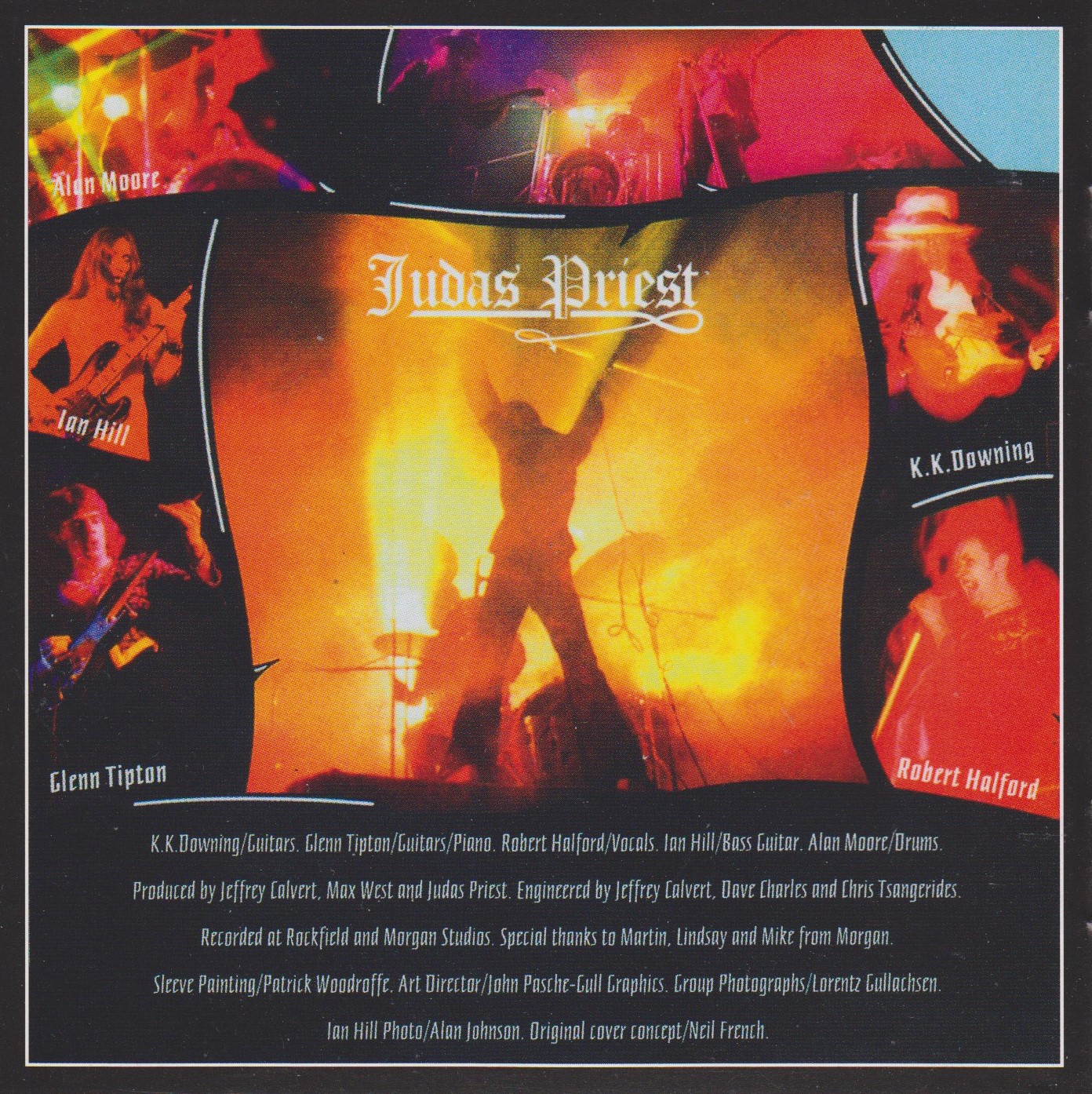
Side one can be viewed as just three songs:  two epics and a hard rocker.  Side two has more to offer, though it opens in epic enough quality.  Glenn Tipton’s piano piece “Prelude” is foreboding.  As a Sabbath-like instrumental, it serves to set the scene for “Tyrant” (though “Tyrant” is always performed live without “Prelude”).  Overdubbed vocals make for a cool chorus, but this one is just a molten metal burner.  It wastes no time in laying waste, with guitar solos galore, in both single and dual formations.

“Genocide” is a slower, cooler groove that doesn’t seem to match its violent title.  But this is from the perspective of a survivor.  “Save me, my people have died, total genocide.”  This is the song that gave us the next album title, Sin After Sin:  “Sin after sin, I have endured, but the wounds I bear are the wounds of love.”  Cool track and a necessary one to give the album balance.  Songs of this tempo and style would make up the bulk for Priest albums in the future, yet it’s not simple or blockheaded like some 80s Priest tended to be.  It retains some complexity and traverses multiple musical landscapes through its length.

Next:  a complete left turn.  “Epitaph” (written by Tipton) is a piano-based funeral dirge that sounds a heck of a lot like Queen.  It’s beautiful though.  With Halford’s vocals layered as a choir, it’s a daring change of pace even though Queen were pretty much the biggest band in the world in 1976.

“Epitaph” fades directly into the final track “Island of Domination”, another metal chug but with an apocalyptic bent.  Rob’s lyrics are unusually styled with archaic sounding lines like “‘Twas as if all hell had broke loose on this night.”  This could be Rob’s first BDSM-themed song with lines like “Lashings of strappings with beatings competing to win.”  If not, then it’s just a brutal battle set to the tune of speedy Priest metal.

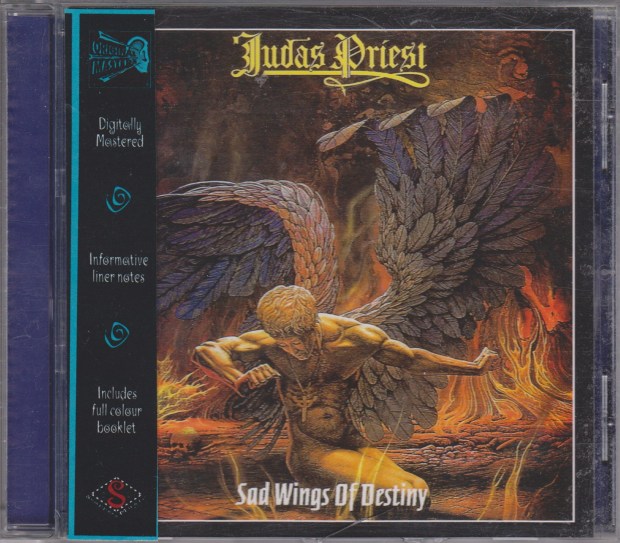
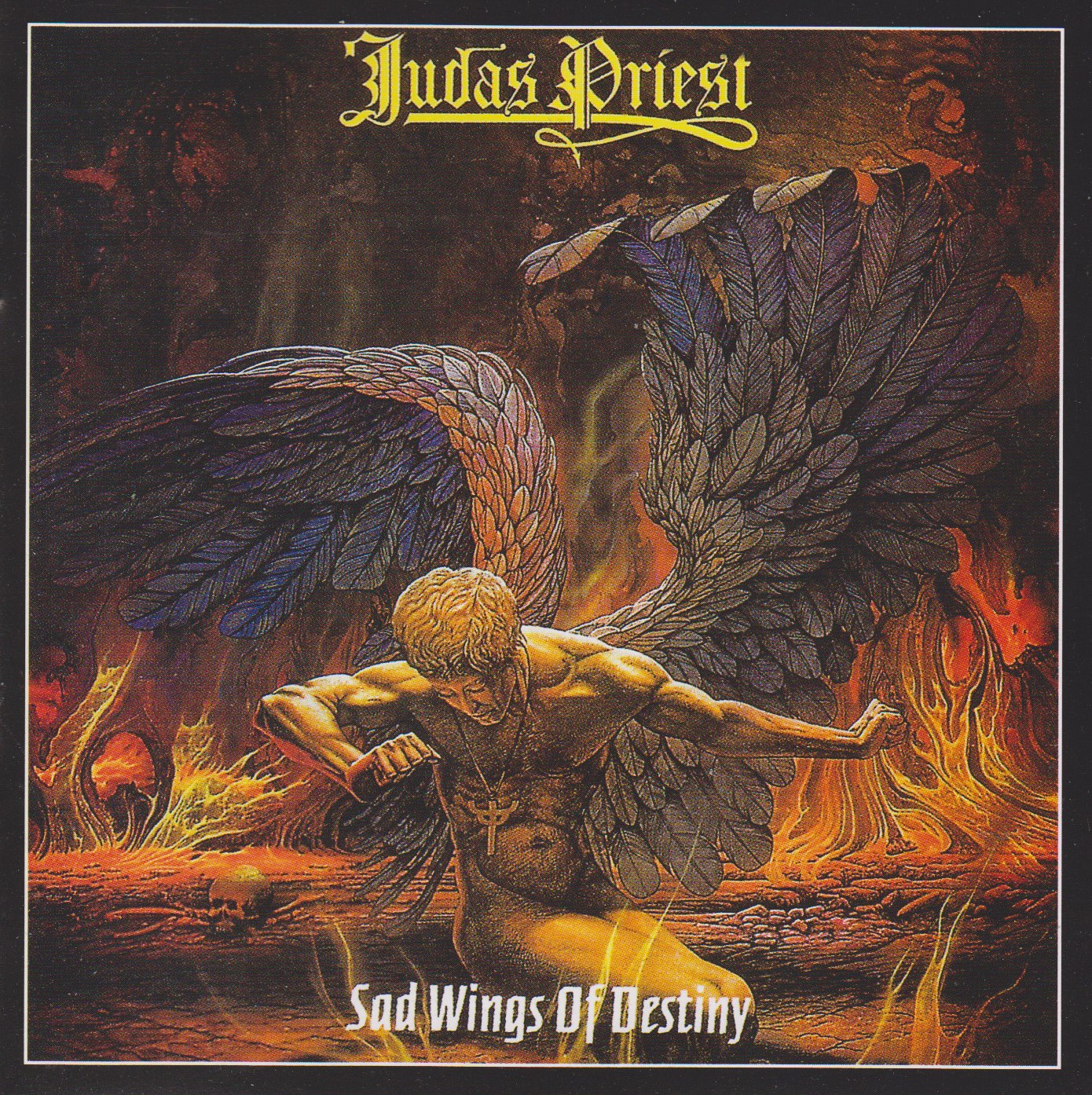
It must be said that Sad Wings has a striking album cover, with the angel depicted burning in hell.  School teachers worldwide would have loved this cover back in 1976.  The angel character would return 14 years later as the Painkilller.  The “devil’s tuning fork” necklace that the angel is wearing would become Priest’s symbol on later albums as well.

Though Sad Wings is an essential album for a serious metal collection, and stuffed full with riff after riff of majesty, it is frustrating hard to find good versions on CD.  Priest’s albums on Gull records have never been officially reissued by the band.  The 1998 CD release by Snapper music is usually rated fairly well.  If you’re unsure then get an original Gull vinyl copy.  But do get Sad Wings of Destiny and prepare to hear a young, vital and daring Judas Priest just beginning to learn what they can do.

5/5 stars

REVIEW: Judas Priest – Hero, Hero (1981)

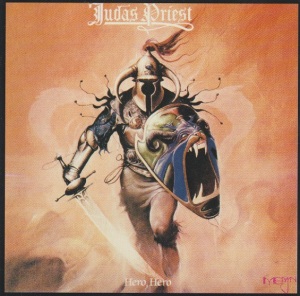
JUDAS PRIEST – Hero, Hero (1981 Gull)

It’s true:  By all measurements, Hero, Hero is an exploitive compilation of Judas Priest material.  Their first record label, Gull, was prone to do this.  However this is no typical “hits” set; this one is of interest to collectors and die hard fans.

Hero, Hero (named for a lyric from the song “Dying to Meet You”) was originally released in 1981 to take advantage of Priest’s rising star. The original two releases on Gull records, Rocka Rolla and Sad Wings Of Destiny, had been exploited previously in a compilation called The Best Of Judas Priest, which was a single record. Hero, Hero was a double record which included all of Rocka Rolla and most of Sad Wings, as well as the crucial Joan Baez cover, “Diamonds and Rust”, in an alternate take (previously heard on Best Of).

So, if you have all that material already, why is this album required at all?  Cover art aside, of course.  That cover (a pre-existing painting) is brilliant.  There is also a Kiss bootleg called Barbarize with the same cover.

The reason is revealed in the liner notes. All of Rocka Rolla had been remixed for this release. Why is unknown, as that record sounded just fine for what it is. The remixes are, in general, not even all that different. The major changes are made during “Cheater”, the “Winter” suite, and “Rocka Rolla” itself, during which major portions of the songs are noticeably shifted around. “Rocka Rolla” has its verses rearranged, and there’s a burst of harmonica in “Cheater” where there never was before.

The remix done to Rocka Rolla doesn’t really add or subtract anything from the album, which makes it that much harder to understand why it was done.  Why Gull records spent the money to remix these tracks is unknown, and the names of the engineers involved are a mystery.  But there it is:  Rocka Rolla remixed in its entirety but not in order, here on the Hero, Hero album.  Because they’re less familiar to the ear, they sound fresh, but in many cases you’d struggle to point out differences.  A little reverb here, a little echo there.

Highlights including a bluesy “Cheater” and the flanged chug of “Diamonds and Rust”.  The six tracks from Sad Wings of Destiny are brilliant.  “Dreamer Deceiver” and “Deceiver” are used to open this CD, but that is not the original running order.  Normally the album begins with “Prelude” and “Tyrant”, also from Sad Wings.  The original Canadian cassette version on Attic maintained the original running order with “Prelude” at the start.  Essentially, the Connoisseur Collection CD has side one and side two flipped.

Fair warning to CD buyers:  There are some shoddy reissues of this album that don’t have the remixed tracks.  Transluxe is one such version.  To make your life easier you might just want to look for an original 1981 LP.  The pictured CD from Connoisseur Collection (1995) does have the remixes, so you’re good to go if you spot one.

3/5 stars


REVIEW: Judas Priest – Sad Wings of Destiny (1976)

Welcome to PRIEST WEEKEND! It’s a long Thanksgiving weekend in Canada, and…

Well, here’s the truth of it. I had three Judas Priest reviews lined up and needed a spot to schedule them. A three day weekend worked. That’s how much thought went into the scheduling of this Thanksgiving theme.

Enjoy PRIEST WEEKEND starting with their immortal second album…

Scan_20150930JUDAS PRIEST – Sad Wings of Destiny (1976 Gull)

It’s quite a shame that Judas Priest haven’t regained the rights to their first and second albums.  Too many fly-by-night labels have done shoddy or half-arsed reissues of the albums and Sad Wings is no exception.  This one, on Snapper, isn’t too objectionable.  It’s funny to see “digitally mastered” on the front sticker, as if this is some kind of selling feature.  All CDs are digitally mastered!  Remember that old AAD, ADD, DDD logo that used to appear on CDs?  The A and D refers to analog or digital processes: recording, mixing, and mastering.  Every CD is at least AAD.  The “informative liner notes” (by somebody called “Krusher”) is just a blubbering general history essay on the band.

Fortunately, no matter how it’s packaged, the music is exceptional.

“Victim of Changes” defines “epic”, and probably remains Judas Priest’s definitive word on the epic song.  This is actually a mashup of two earlier songs called “Red Light Lady”, written by Rob Halford, and “Whiskey Woman” by original singer and founder, Al Atkins.  That’s how it came to be that Halford shares a writing credit with his predecessor, an unusual circumstance indeed!   The finished song “Victim of Changes” has everything: the concrete heavy riffs, the drama, the melody and the unearthly screams!  It takes its time, but it simply lays waste to the landscape.  By the time Rob nails his final scream, you may find yourself hard of hearing.  As if that wasn’t enough, “The Ripper” (a shorty) contains even more screams-per-minute than “Victim”.  Priest seemed to take a turn away from blues, towards metal on Sad Wings of Destiny.  The first two songs are as sharp and devastating as anything else in the Priest canon.

Although they are often separated on compilations and whatnot, “Dreamer Deceiver” and “Deceiver” are more or less one song.  One sounds incomplete without the other.  “Dreamer Deceiver” is an airy, acoustic number about some sort of ethereal being.  It is as entrancing as its title character:

“We followed the Dreamer through the purple hazy clouds,
He could control our sense of time.
We thought were lost but, no matter how we tried,
Everyone was in peace of mind.”

Rob’s vocal performance on this one ranges from the deep and dramatic, to the wails that Priest fans crave.  It is the blueprint for similar early Iron Maiden tracks such as “Remember Tomorrow”.  Even the guitar solo is a well-composed piece of music, but this is just the beginning.  Morphing into “Deceiver”, the acoustic plucking has changed to an electric chug.  This time the guitar solo blazes rather than cries.  “Deceiver” burns out quick, ending the first side.

Scan_20150930 (3)

Side two begins, as it obviously should, with a piano instrumental!  Glenn Tipton wrote and performed “Prelude” which is really just another track meant for you to let your guard down…before being ploughed over by the evil “Tyrant”!  He is the destructor, and every man shall fall!  The way Rob screams it, you believe it.  This is straight up the alley of prior tunes, like “Ripper” and “Deceiver”:  fast, lean, and heavy as balls!

“Genocide” is a change of pace, a leaning towards the mid-tempo ground that Priest would find great success with later.  There is a Priest stamp to it: a simple 4/4 beat, a couple of cool riffs, verses, chorus and solo…but I like the slow middle section best.  “Sin after sin…I have endured, but the wounds I bear, are the wounds of love.”  Sin After Sin was used as the next Priest album title.  Then, another surprise.  “Epitaph” is a piano ballad with Rob singing with a Queen-like backdrop of vocals.  Only piano and vocals, that is it.  Once again this is a Glenn Tipton song, and even though Priest let on that they had quiet tendencies, this is still a bit of a shocker.  “Pretty” is an appropriate word.  It is a tour de force for Rob, who performed some very intricate singing.

Chugging off to into the horizon, “Island of Domination” is the final track on a purely excellent heavy metal album.  Multi-layered Halford screams usher in the final assault.  Rocking both heavily and intelligently, the mighty Priest finished the album with a blitzkrieg, taking no prisoners.  From gallop to groove, “Island of Domination” has a bit of everything Priest did well.

What an album.  Do you like heavy metal music?  Then you need Sad Wings.  Period.  Exclamation point!

5/5 stars

REVIEW: Judas Priest – The Best of Judas Priest (Insight Series reissue)

Welcome back to GREATEST HITS WEEK! This week we are looking at different, interesting hits albums from various bands. Today we visit the Mighty Priest!

Monday:  Extreme – The Best of Extreme: An Accidental Collication of Atoms? (1997)


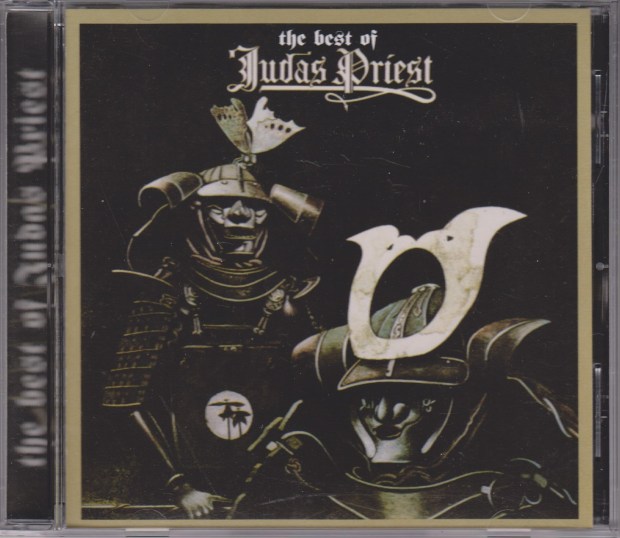
Scan_20150808JUDAS PRIEST – The Best of Judas Priest (1978 Gull, 2000 Koch Insight Series reissue)

The abbreviated story:  Judas Priests’s first two albums, Rocka Rolla and Sad Wings of Destiny, were released on Gull records.  Priest’s first album for Columbia was Sin After Sin in 1977.  When they made the move to the bigger label, they lost all rights for their first albums to Gull.  The label proceeded to issue and reissue unauthorized compilations of those songs.  They even had Rocka Rolla remixed in its entirety by Rodger Bain and reissued in 1981 as part of the double album Hero, Hero.

The Best of Judas Priest was the first exploitive release by Gull, in 1978.  It would have been frustrating for the band to be out there promoting the new album, Stained Class (1978) when the unauthorized Best of hit the shelves.  Whenever asked about it, Priest have discouraged fans from spending their money on these Gull releases.  That was especially true when Best of Judas Priest was reissued again in 2000 by Koch records as part of the “Insight Series”.  They even placed a disclaimer on the official Judas Priest site advising fans to stay away from this CD in particular.  What really seemed to chap their collective ass was that the “Insight Series” contained a lengthy interview with former drummer John Hinch, who was really in the band for only a short time and was fired due to “lack of ability” (their words).

We at LeBrain HQ have acquired a copy for research purposes!

The Best of opens with 10 minutes of slow sludge from Rocka Rolla in the form of “Dying to Meet You” and “Never Satisfied”.  Poor sequencing aside, it is surprising that the up-tempo “One for the Road” is nowhere to be found.  Some heat is finally in the kitchen on Joan Baez’ “Diamonds and Rust”, an early unreleased version.  This too must have peeved the Priest.  This was recorded during the Sad Wings of Destiny sessions, but ultimately left off the album.  Not wanting to let the arrangement go to waste, it was re-recorded for Sin After Sin with Roger Glover producing. This earlier version, out the following year, probably confused a few fans who bought both albums.  The Sad Wings version is of high quality.  It lacks the crispness of the Glover recording, but should be absolutely essential to collectors today.  It can be found on a number of releases including Hero, Hero.

“Victim of Changes” was and is a high water mark.  It’s actually an amalgam of part of a song Rob Halford wrote (“Red Light Lady”) with a song by original Priest singer and founder, Al Atkins (“Whiskey Woman”).  To this day, has Halford ever used his scream more effectively?  “Victim of Changes” is nothing less than a desert island classic.  “Victim”, and the rest of the songs, all come of Priest’s immortal second album Sad Wings of Destiny.

“Island of Domination” is not a place you want to visit:  “We gotta get, we gotta get, we gotta get out of this place.  There’s a man with a needle who’s pleading to get to my face.”  The speedy metal delight keeps you there anyway.  “The Ripper” is a brief but undeniable classic, another highpoint from the Gull years.  Finally, “Deceiver” is separated from its first chapter, “Dreamer Deceiver”.  It does sound odd without its companion, but for a brief and explosive rock song to end a side of vinyl, it is certainly more than up to the task.

Finally there is the infamous 18 minute John Hinch interview that so upset the Priest camp upon its release.  Hinch discusses his history with the band, going back to forming a band with Rob Halford called Hiroshima.  Perhaps the guys in Priest were peeved when Hinch recalls playing on the same bill as Judas Priest, who he says were “horrible”.  His description of KK Downing as a “strutting lead guitarist [with] long blonde hair,” isn’t complimentary.  Ian Hill invited Rob and Hinch to join the band to replace Al Atkins, and their drummer Chris “Congo” Campbell.  According to Hinch, they did so reluctantly and with a desire to change the name.  This critique turns to praise, especially after Glenn Tipton joined the band to fill out the sound.  Perhaps his recollections don’t match those of the band, but it is otherwise impossible to find any other interviews with the drummer from Priest’s first album.  If you want a perspective from the drum stool in 1974, here it is.  What’s missing is any comment on why he was let go.

Ultimately it is up to the fan to decide where to draw the line on what to buy, and what not to buy.  Since the early “Diamonds and Rust” is also on Hero, Hero, one could choose to only buy that release, if they decide they don’t need the Hinch interview.  One could even buy both, or neither.  Personally speaking, I would have bought this anyway if only for the unique cover art.  It is your decision, but The Best of Judas Priest is a decent listen.

3/5 stars

MOVIE REVIEW: The Ultimate Cut: Watchmen – The Complete Story (blu-ray)

Hot on the heels of my Man of Steel review, here’s…the Watchmen.

WATCHMEN : The Ultimate Cut – The Complete Story (2009 Warner 4 disc blu-ray set)

Directed by Zack Snyder, 216 minutes 

What’s the greatest comic book movie of all time?  I’ve seen a lot of them. There’s quite a few I haven’t seen as well, but it’s a great topic for discussion.  I always have to put Watchmen on the table when discussing great comic book adaptations.

Watchmen is a complex tale.  Its original comic was ambitious, containing page after page of dense backstory information in the form of documents and faux-magazine articles, all very relevant.  There’s even a parallel story taking place, a comic within a comic, which directly reflects one (or arguably more) of the characters in the main story.  Characters and their psychology are key.  In addition, neither the comic nor the movie are linear.  The story unfolds within different time periods, flashing back and forth, as we learn more about the characters, their motivations, and the world they inhabit.

It is the world they inhabit that was the hook for me.  I’m a sucker for alternate universe stories.  Here’s one that sets us on Earth, 1985, but things have unfolded very differently.  The influence of various superheroes/vigilantes has caused history to unfold very differently.  Specifically, it is the presence of Dr. Manhattan, who puts a swift and decisive end to the Vietnam war, who influences history the most.  In this 1985, Richard Nixon is still president, and masked vigilantes are now outlawed.

The Watchmen are a group of such vigilantes, originally known as the Minutemen.  Some, such as Dr. Manhattan truly are superhuman.  Others, such as Nite Owl and his successor Nite Owl II, are mere mortals with high-tech gadgetry and skill as their allies.  All have retired, some in fame and some in anonymity…all but one.  Rorschach.  He remains active, alone and wanted.

The movie begins as a murder mystery.  Someone has managed to identify and kill Edward Blake — The Comedian, once one of the most dangerous heroes alive.  To overpower and murder Blake would require an individual of tremendous resources.  Who?  And are other former vigilantes also at risk?  Rorschach seems to be the only one who wants to know.

Being a fan of the graphic novel, I was very happy with the way that Zack Snyder captured Watchmen. It was done with love and care. The things that are discarded, I didn’t miss so much. The things that he changed, I understand why it was done.  There’s one layer to the story/mystery that has been discarded, probably to keep this thing under 4 hours!  The things that are reverently exactly the same as the comic made my jaw drop in awe.  The acting performances are what they are, but I have to give special mention to Jackie Earl Haley as Rorschach.

WATCHMEN_0006The soundtrack is one of the best in recent memory. Outside of Wes Anderson, I haven’t loved a soundtrack this much in a long time.  It’s awesome from the stunning Bob Dylan classic “The Times They Are A’Changing”, to Nat King Cole, to Simon and Garfunkel, Hendrix and Philip Glass, and probably the weirdest use of Leonard Cohen’s “Hallelujah” in movie history.  The soundtrack is where it’s at.  The movie even contains a Village People sighting!  I’ll skip My Chemical Romance.

This Ultimate Cut weaves the comic-within-a-comic, Tales Of The Black Freighter, previously only available on its own, into the main body of Watchmen. These segments are narrated by Gerard Butler.  New live action linking sequences connect the movie to Black Freighter, much like it worked in the graphic novel. People who haven’t read the graphic novel might not understand what “Black Freighter” is doing there, but they should probably start with the less daunting theatrical cut to start with anyway.

WATCHMEN_0003The box set includes four discs, beautifully packaged. Hardly a complaint to be registered. The box is heavy and sturdy. Included is Watchmen: The Motion Comic, packed in its own case, 5 hours long on its own. One disc is the expired digital copy of the theatrical cut (whoop de do) and another disc is loaded with special features. Best of these is Under The Hood, which is based on the graphic novel segments covering Holis Mason.  Mason, the original Nite Owl I, wrote an autobiography called Under the Hood; this film is a faux-documentary on his story. It is presented as a television program from 1975 re-run in 1985, including commercials and scratchy footage. At 35 minutes, this is an absolute must. Other special features include brand new audio commentaries, for those who dare to keep going deeper. This set is just loaded.  Unfortunately I found the sound level inconsistent, I had to turn it up and down frequently.

Having said that, I’m not going to discard my Director’s Cut of Watchmen. Clocking in at almost four hours, watching this version is a commitment. I know that occasionally, I will want to watch the “shorter” version of the film. Since a digital copy of the theatrical (shortest) cut is included here, maybe you won’t feel the need to double-up on Watchmen editions.  For an enriched viewing experience, set aside the four hours one afternoon and enjoy.

4/5 stars

Malin Akerman … Laurie Jupiter / Silk Spectre II

Billy Crudup … Dr. Manhattan / Jon Osterman

Matthew Goode … Adrian Veidt / Ozymandias

Jackie Earle Haley … Rorschach

Jeffrey Dean Morgan … Edward Blake / Comedian

Patrick Wilson … Dan Dreiberg / Nite Owl

Carla Gugino … Sally Jupiter / Silk Spectre

Matt Frewer … Moloch