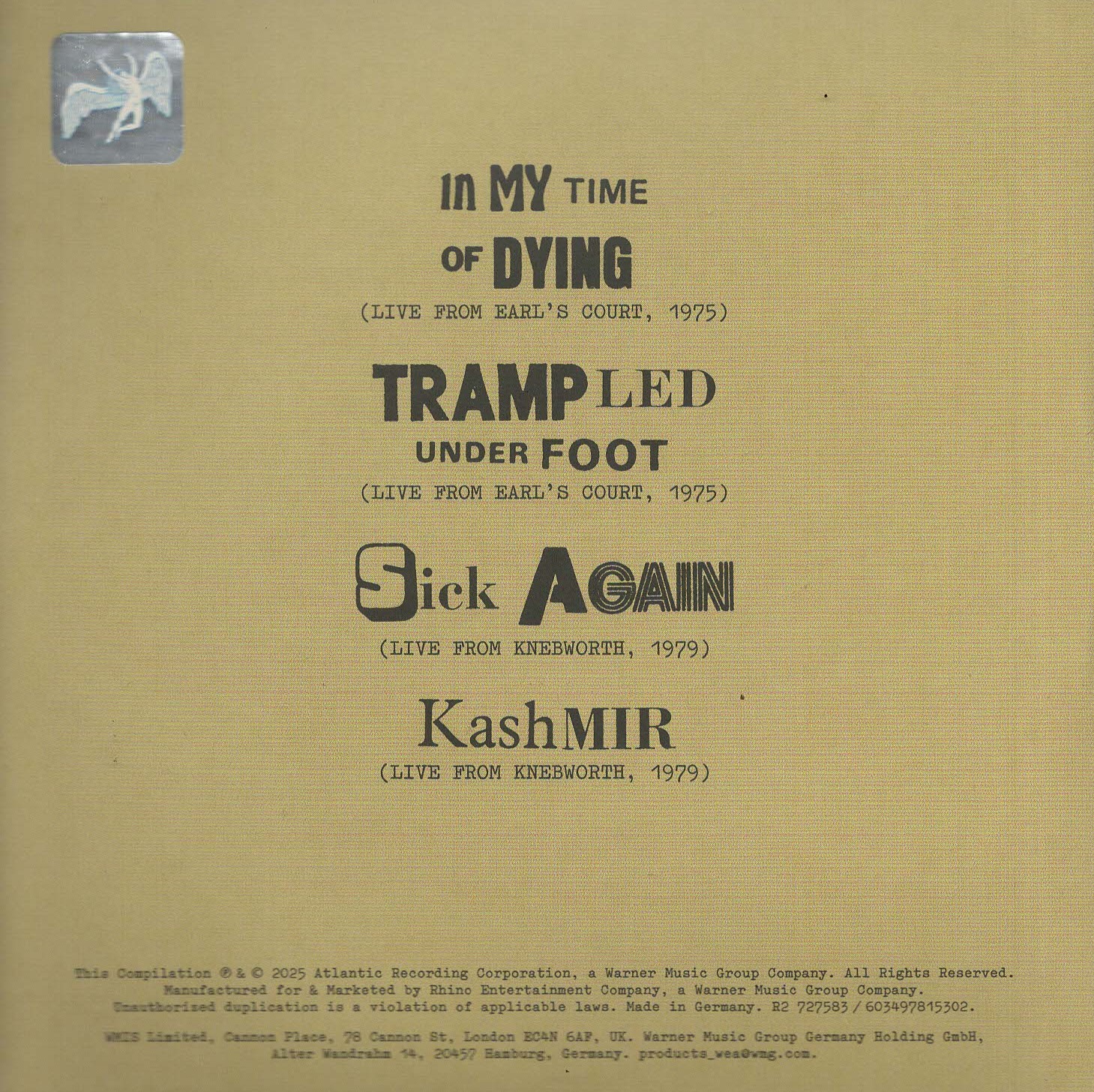
Feast or famine: Led Zeppelin have always been weird with their archival releases. There are numerous valid complaints about the release of this live EP, sourced from their 1975 Earls Court and 1979 Knebworth concerts. Why not just release the whole shows, as they were on the DVD set? Why not indeed? We have no good answers to that, so instead we’ll focus on what we did get: a smoking hot live EP by Led Zeppelin, including a magnificent “Kashmir”. It also tickles the nostalgic funnybone that they simply called it Live EP. From the band that brought you a DVD called DVD, and a box set called Box Set 2. The cover art recalls Physical Graffiti in such a way that you know without guessing that it’s a Led Zeppelin release.
Of course, calling it an EP is a matter of perspective. At over 34 minutes, it’s a live album.
“In My Time of Dying” was played fourth at Earl’s Court, but here it opens the affair with a slower, more brooding tempo. Then things pick up. You know how the song goes: “Oh Gabriel, let me blow your horn!” as things get faster and funkier. Plant drives this beast with orgasmic shouts and declarations, while Pagey plies the neck of his guitar with a slide. In the back, John Paul Jones and John Bonham are so locked in, it’s boggling. With Jones playing countermelodies, Bonham accentuates the groove. You could listen to the song multiple times, focusing on different musicians, and not get tired despite the 11 minute running time. Plant’s vocal outro is the kind of bombastic exercise you expect in any decent Zep parody – but done with sincerity. This is is peak Led Zeppelin.
13th in the Earl’s Court set was “Trampled Underfoot”, but here it appears without a gap. You want funky? You got funky. Talk about love! Plant brings the love. This accelerated version is locked into the groove, with Bonham adding flair when necessary, and John Paul holding it down. Pagey is free to possess that riff like a six string demon, all before John Paul goes into a keyboard solo. At about seven minutes, they just bring the whole thing to a boiling jam. Not just a jam, but a memorable part of the performance. A definitive version of a classic.
There is a fade before we get to the Knebworth 1979 tracks. Something about late Led Zeppelin. You know they were not at their peak, health-wise, and there are tales of mixed reviews live. Knebworth was one such concert, considered a show with incredible moments of Led Zeppelin’s chemistry, and others a display of a tentative, nervous band. “Sick Again” shows absolutely none of the weakness. It was played 15th in the set. Perhaps by that time, Zeppelin had felt warmed up and comfortable?
“Knebworth was useless. It was no good at all. It was no good because we weren’t ready to do it, the whole thing was a management decision. It felt like I was cheating myself because I wasn’t as relaxed as I could have been. There was so much expectation there, and the least we could have done was to have been confident enough to kill. We maimed the beast for life, but we didn’t kill it. It was good, but only because everybody made it good.” – Robert Plant
None of that is evident to the untrained ear on “Kashmir”, which was 13th in the set. “Kashmir” is somewhat a rarity as far as official Led Zeppelin live audio versions go. The only other officially released live version in audio format was on Celebration Day, a 2007 reunion concert with Jason Bonham on drums. This sounds brilliant. There might be more energetic performances out there, but as the only live one by the vintage band on CD goes, it’ll probably get repeat plays in your deck.
As a Live EP (or album if you will), this is a brilliant way to spend 34 minutes with Led Zeppelin.
My old friend and collaborator Tommy Morais passed away in 2024, but miraculously, I found this 2015 email from him. It contained a complete review of Twisted Sister’s Love Is For Suckers album that we never published, and a memorial for Twisted Sister drummer A.J. Pero, who had recently died. I am please to finally publish this final review that Tommy sent me to post. Rest in peace Tommy.
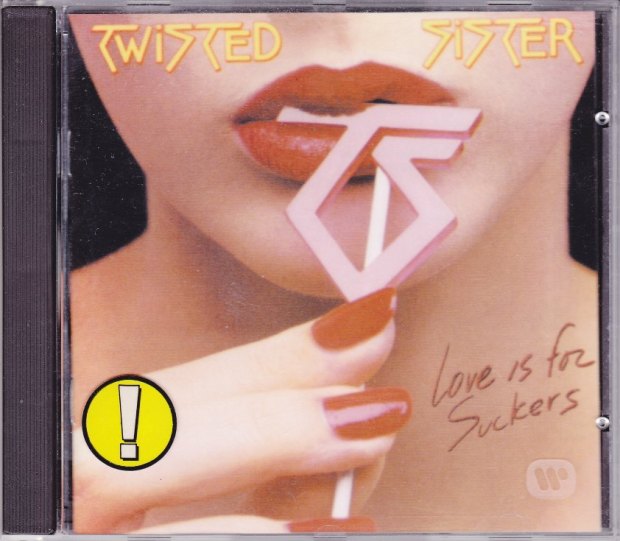
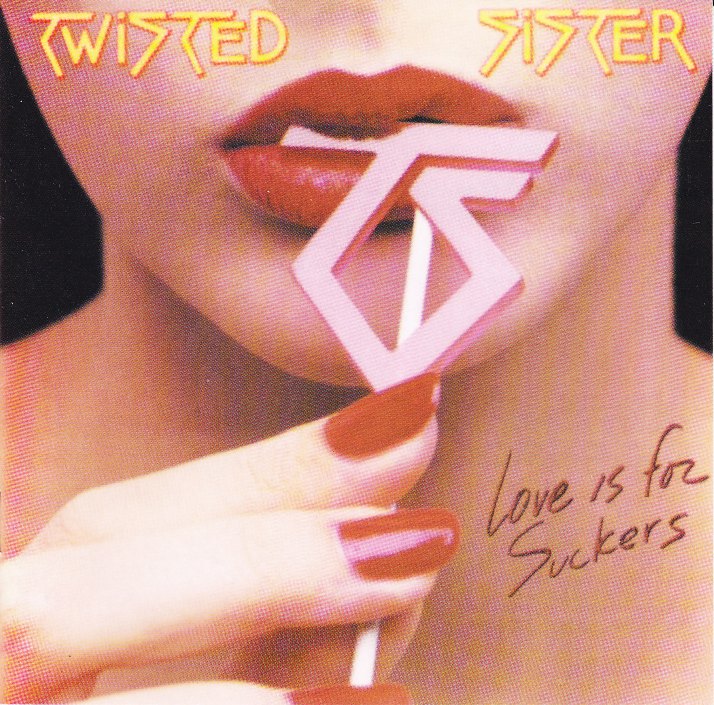
TWISTED SISTER – Love Is For Suckers (1987 Atlantic)
by Tommy Morais – written March 28, 2015
“The ‘Soft & Filler’ album…” Bought in 2012 in France for something like 17 euros!
Twisted Sister’s fifth and final studio album Love Is For Suckers (unless you count the band’s 2004 Still Hungry, a collection of re-recordings of Stay Hungry) is one that tends to divide people. Some hardcore fans dismiss it as too pop and lacking much substance, while others have a soft spot for it and thought it was an enjoyable release at the time. There’s some claims to be made about both opinions. The main problem with with Love Is For Suckers is that it really isn’t a Twisted Sister album. “Wake Up The Sleeping Giant” is deceiving in that it almost sounds like classic TS. Yet only Dee Snider as an original member remains, and then there’s Joey “Seven” Franco who was in the current lineup on drums. It really should have been a Dee Snider solo album which is what it was intended as and truly was, but instead the record company pressured this to be released as a Twisted Sister album.
Then it is plagued by a few big issues, besides the absence of the classic lineup. Did you ever see Reb Beach and Kip Winger receiving credits on a Twisted Sister album? Well, they played on this. Probably not a happy thought for most Twisted Sister fans, as it ended up taking an ultimately softer and a more pop direction. Then you have to consider that it may have been competitive and cutting edge in 1987, but Love ls For Suckers has not held up well with time. Also for an album title that claims love “sucks”, it’s ironic that most of these songs are well… love songs.
What’s with the drum sound?! The songs are wimpy but with a thunderous, big drum sound which leads to question that maybe Joey was a good drummer who ended up playing on the wrong album. The production by Beau Hill is about what you’d expect, very “1987” and time has not been too kind to its sound.
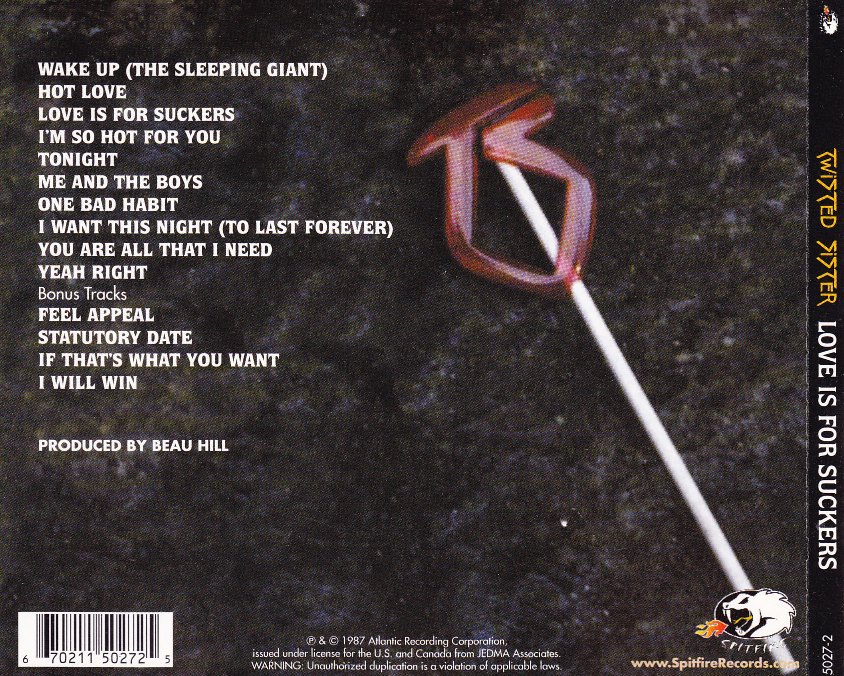
Opener “Wake Up The Sleeping Giant” is misleading. 1) It sounds like Twisted Sister and 2) It’s the best song on the album, and it leads you to think (and hope) the rest may be up to this standard. “Hot Love” was and is a great candy rock piece tailored for 1987; cheesy but fun and a good overall choice of single. It’s one of the most memorable songs (remember the video that went along?). The title track is actually not a bad rocker at all, it’s consistent as Snider does a good vocal performance and it’s somewhat catchy. This is where the album takes a slide in the quality department with “l’m So Hot For You” and “Me And The Boys” (this one especially is embarrassing) being generic filler tracks that halt any momentum the album had going for it. Sandwiched in between those songs is the slightly better rocker “Tonight” which showcases some aggression; not a bad tune at all. “One Bad Habit” is more filler material. “I Want This Night To Last Forever” has a Van Hagar feel to it, especially during the chorus but is nothing to write home about either. “You’re All That l Need” tried to be a big power ballad but it failed during the chorus, even though it had a nice build up. The keyboards prevent it from being a strong ballad like “The Price”, and as a result it sounds a little too soft and thin. The closing “Yeah Right” ends thing on a more positive note. It’s a solid upbeat rocker and one of the heaviest songs on an album that could’ve used more songs of this calibre.
I own the remastered version with four extra songs. “Statuary Date” is the worst of the bunch. “Feel Appeal” is better than some of the songs that made it onto the actual album, it’s more straight up rock and a little catchier. “I Will Win” is rocking but the chorus doesn’t get it right; close but no cigar. “If That’s What You Want” became “Me And The Boys” although it’s earlier incarnation was stronger and had better lyrics. If you ask me this version should’ve made the album instead!
There you have it. Any way you slice it, Love Is For Suckers is definitely, without a doubt, the worst Twisted Sister album. It suffers from the production, is full of fillers and it doesn’t feature Jay Jay French, Eddie Ojeda, Mark Mendoza, A.J Pero (who left before this was released), even though the liner notes say they were a part of it (minus Pero, replaced by Joey Franco). The first two songs, and the album cover, are the only things that are truly memorable about LIFS. The rest is really unfocused and sub-par. Twisted Sister’s decline had already begun with their previous effort, 1985’s Come Out And Play which would show cracks of the band’s implosion, but this one was a commercial disappointment failing to reach gold status or chart successfully. Simply put, Twisted Sister was no longer a band at this point and the album did nothing to stop them from breaking up and was quite frankly just not very good.
It was grade six. I was 11 years old, and it was the Friday before a holiday, which meant the whole class got to do nothing but chill and watch a movie. For the rest of the day our teachers let us hang out and do nothing. We each brought pop, chips or both to share. One of my friends Maxime brought one of his dad’s CDs. That CD? Twisted Sister’s greatest hits. He asked the teacher if he could play it for us, and the rest is history. I was introduced to my first taste of Hard Rock and Metal. I distinctively remember telling one of my friends “this is not bad huh?”, to which he agreed. I glanced at the album cover. It said “Twisted Sister Big Hits & Nasty Cuts“. Then l proceeded to tell Maxime that this (ugly) “girl band” was pretty good. I wasn’t familiar with Glam/Hair/80’s metal at that point and even less so with the look. Truth is l had been exposed to some AC/DC, Loverboy and Metallica prior to that but this was the first time it really clicked. Maybe it was just just the right age, the right time. There you have it, Twisted Sister was the first band I recall really taking a liking to. From then on l discovered my dad and his brother’s LPs and played them on the turntable (I remember digging the first Van Halen a lot). I definitely have a soft spot for Twisted Sister.
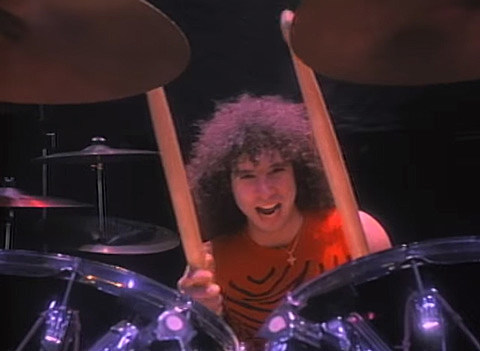
It is with sadness that I learned of longtime drummer and classic lineup member A.J. Pero’s unfortunate passing. Pero was a crucial part of the band and its sound, and a great drummer too. I approached Mike about maybe doing something Twisted Sister related on his blog to which he was very enthusiastic. I wanted to review something AJ played on, like Come Out And Play as l plan to review all of TS’s material in the upcoming days, but with time restraints l had to settle for my (still brand new) Love ls For Suckers. The band has said that were to make some big announcement next week. One can only assume that it is regarding Twisted Sister’s future as a band. Jay Jay said on social media that they were already thinking about hanging it up prior to Pero’s passing. Then Dee Snider said it would be profitable to the Pero family if the band kept playing and that they were thinking about winding down in 2016 for the band’s 40th anniversary. I’m not against them continuing performing live and going out on a final tour to honour AJ and the anniversary of the band just as l am not opposed to the band calling it quits. I have a feeling they’ll at least play a few more shows and maybe do one last concert CD/DVD (that would be cool). Rest in peace A.J., the rock world lost a great drummer.
I love admitting to my past musical sins. Perhaps others will learn from my mistakes.
I was in grade 11, a mere 16 years old, when the music video for “Youth Gone Wild” hit the airwaves. Skid Row were the latest thing, a band promoted by Jon Bon Jovi himself, from his home state of New Jersey. We didn’t know yet that the lead singer, Sebastian Bach, identified as a Canadian. He grew up in Peterborough Ontario, just on the other side of Toronto. In fact, I didn’t know that I already had something of Bach in my music video collection. I had a brief clip of him, with teased up hair, in a prior band called Madame X. This band was led by Maxine Petrucci, sister of Roxy Petrucci from Vixen. They featured a young Sebastian Bach and Mark “Bam Bam” McConnell whom Bach would play with in VO5. I wasn’t into any of those bands. I was pretty hard-headed about what I liked and disliked.
In Spring 1989, I first encountered “Youth Gone Wild” on the Pepsi Power Hour. It could have been Michael Williams hosting, but whoever it was, they hyped up this new band called Skid Row. I liked getting in on new bands from the ground floor. Made them easier to collect when you started at the start. At that point, I wasn’t even sure how many albums Judas Priest actually had. I was intrigued enough to hit “record” on my VCR as the music video began. I caught the opening “Ba-boom!” of drums, and sat back to watch.
While I wasn’t blown away, I kept recording. The key was the singer. If the singer sucked, I’d usually hit “stop” and rewind back to where I was. The singer passed the test: he didn’t suck. I kept recording.
After about a minute, I pressed the “stop” button, and lamented that this new band wasn’t for me. What happened? What did Skid Row do to turn me off so quickly?
I can admit this. I’ve always been open about the fact that I was very image-driven as a teenager. We all were! With the exception of maybe George Balazs, all the neighborhood kids were into image to some degree or another. I was probably driven by image more than the average kid, consuming magazines and music videos by the metric tonne. So, what exactly was wrong with Skid Row?
I’ll tell ya, folks. It was serious.
The bass player had a chain going from his nose to his ear.
I just could not. I couldn’t put a poster on my wall with some band that had a bass player with a chain that went from his nose to his ear! No way, no f’n way.
I pressed rewind, and prepared to record the next video over Skid Row.
That summer, the glorious, legendary summer of ’89, I went with Warrant. I bought their debut album sight-unseen, based on a blurb in the Columbia House catalogue. Warrant were the selection of the month. “What the hell,” I thought, and checked the box to order it immediately.
Meanwhile, Bob Schipper and the girl I liked, named Tammy, were really into Skid Row. They knew all about my issues with the nose chain. They got under my skin about it a bit, but I wouldn’t bend on Skid Row.
“18 and Life” was the next single, a dark power ballad that was easy for me to ignore. “I Remember You” was harder to pass on. It was the perfect acoustic ballad for 1989. You had the nostalgic lyrics, which Bob and I both connected with. Somehow, we knew that 1989 was the absolute pinnacle. We knew this would be the summer to beat! Bon Jovi and Def Leppard were still on the charts. Aerosmith and Motley Crue had new singles out with albums incoming. We walked around singing “Summer of ’69” by Bryan Adams, except we changed the words to “Summer of ’89”. We just knew. “Got my first real six string…” we sang. And we both had our own fairly new guitars that we could barely play.
“I Remember You” was a massive hit, and still I resisted.
“Because of the nose chain?” Bob Schipper questioned me.
Absolutely because of the nose chain!
I stood firm for two years. Bob Schipper went to college, and Tammy was long distance and not meant to last. I felt a bit like an island by the time 1991 rolled around. I felt alone. My best friend was gone, I had no girlfriend, and most of my school friends went their own ways. I was a loner like I’d never been in my life before. Music was my companion, and my beloved rock magazines were my library.
That’s how Skid Row eventually got me. Sebastian Bach had a good friend in Drew Masters, who published the excellent M.E.A.T Magazine out of Toronto. Drew’s praise for the forthcoming second Skid Row album, Slave to the Grind, was unrelenting. He caught my ear. I was looking for heavier music in my life, not satisfied with Priest’s Painkiller as one of the heaviest albums I owned. I wanted more rock, and I wanted it heavy.
The other thing that got me was the collector’s itch. When I found out that Slave to the Grind was released in two versions with different exclusive songs, I was triggered. I had to have both.
“I’ll make a tape, and put both songs on my version!” It was a pretty cool idea.
Costco had Slave to the Grind in stock. They had the full-on version with “Get the Fuck Out”, the song that was excluded from the more store-friendly version. Columbia House stocked the tame version, which had a completely different song called “Beggars Day”. I bought the CD from Costco, the vinyl from Columbia House, and suddenly I was the only guy in town who had the full set. I made my cassette with joy, recreating the Skid Row logo on the spine, and writing the song titles in with red ink.
“Get the Fuck Out” was track 6, side one. “Beggars Day” was track 7, side one. I still have them in that order in my mp3 files today.
Sure, there was an audible change in sound when the tape source went from CD to vinyl, but I couldn’t afford two CD copies. Little did I know how cool it would be later on to have an original vinyl copy of Slave to the Grind.
I loved the album. I loved all three of the ballads. The production was sharp. There were excellent deep cuts: “The Threat”, “Livin’ on a Chain Gang”, and “Riot Act” were all as great as any of the singles. Furthermore, the singer had taken it to new heights of intensity and excellence.
I let Skid Row into my heart that day. It was a good decision. Skid Row accompanied me through times good and bad, lonely and angry. They were my companion through it all, and they’re still pretty good. It was meant to be!
TWISTED SISTER – The Best of the Atlantic Years (2016 Atlantic)
Nobody likes buying the same thing twice, so Twisted Sister have ensured this “greatest hits” album is vastly different from their other stand-by, 1992’s Big Cuts & Nasty Cuts. That album boasted a side of live B-sides, now collected as Live at the Marquee. As such, it only had 10 studio tracks, whereas this new compilation has 17 plus a previously unreleased bonus.
The repeated songs are the obvious ones:
“I’ll Never Grow Up, Now!”
“You Can’t Stop Rock ‘N’ Roll”
“I Am (I’m Me)”
“The Kids Are Back”
“I Wanna Rock”
“We’re Not Gonna Take It”
“The Price”
That leaves a whole lotta songs, including a few singles, that you’ll find here but not on Big Hits. Notably though, that means this compilation doesn’t have “Shoot ‘Em Down”, “Under the Blade”, or “Bad Boys of Rock ‘N’ Roll”.
What makes this compilation a little more special is that the tracks go almost chronologically, and don’t skimp out on songs from Come Out and Play, or Love Is for Suckers. Founding guitarist Jay Jay French mentioned in the liner notes that Suckers was supposed to be a Snider solo album, but we do get two songs.
Opening with Twisted’s first Atlantic album Under the Blade, we are treated to the 1985 remixes of “What You Don’t Know (Sure Can Hurt You)”, “I’ll Never Grow Up, Now!” and “Sin After Sin”. It’s a nice one-two-three punch, with “I’ll Never Grow Up, Now!” being a bubble gum punk sandwich, stuck between two heavy metal hard hitters. It’s actually a nice change of pace, getting the echo-laden remixes this time.
The heavy metal assault continues with what might be my favourite Twisted song of all time: “You Can’t Stop Rock ‘N’ Roll”.
“Like a charging bull, it’s a juggernaut, With steam at full, never to be caught, Incarnate power, roaring from the sky, While others cower, rock ain’t gonna die.”
The slow intro, the chugging riff, the pounding drums of the late great A.J. Pero (my favourite member as a kid) and the roar of Dee Snider made this the perfect heavy metal song to entice a young teenager back in the 80s. “You Can’t Stop Rock ‘N’ Roll” is part of a trio included from the same-titled album, joined by melodic metal masterpieces “I Am (I’m Me)” and “The Kids Are Back”. When Twisted went all melodic, they drew upon classic influences, but combined with the heavy guitars, they almost sound like precursors to pop-punk. In many regards, Twisted Sister were ahead of their time. It’s a simple recipe: Guitars chug, bass joins them, drums throw in some catchy fills, and Dee Snider delivers the hooks with the band on backing vocals. Simple, but difficult to master.
The largest clutch of songs obviously comes from Stay Hungry, with six. The three big singles are the obvious ones, but also thrown in are the classic deep cuts “Burn In Hell”, “The Beast” and “S.M.F.” In these songs, you get the heavier side of “Stay Hungry”, minus the title track itself. People who don’t actually know Twisted Sister might be surprised how heavy Stay Hungry could get once you ventured outside the safe singles. “Burn in Hell” is an exersize in intensity that deserves every listen you can give it. Perhaps the oft-forgotten “The Beast” is the most welcome here, as a true red-blooded slow burner metal monster.
Despite the quality of the lesser-heard Stay Hungry songs, one remains the pinnacle of Twisted Sister’s finest moments: “The Price”. Twisted probably took guff from the press and the doubters for attempting a ballad, but “The Price” puts the “power” in power ballad. Notably, A.J.’s drums are far busier and heavier that you expect from the average paltry power ballad. Dee Snider demonstrates his expert-level versatility here on the high notes, rendering this song very hard to sing note for note today.
This album wastes no opportunity. Come Out and Play is finally given a fair shake. The dark ugly duckling of the Twisted discography is represented by the title track, “Leader of the Pack”, “The Fire Still Burns” and the forgotten sing-along “You Want What We Got”. They didn’t skimp out here, and you get the full length version of “Come Out and Play”, including the Warriors homage of “Twisted Sister, come out and play!” Pero’s final album, and his drumming on this track is as blazing fast as it got for Twisted Sister. “Leader of the Pack” is campy fun, but it really had to be included, being an integral part of Twisted’s early history and eventual failure (at least according to Jay Jay in the liner notes). “The Fire Still Burns” has an intense flame indeed, though did Dieter Dierks’ production do it any favours? Of note: “You Want What We Got” is not the album version. It is longer at 4:21, and contains an outro with Dee Snider talking, and dropping a deleted expletive! This version is not credited as being unique, and it’s currently unknown where it originated.
Love Is For Suckers is often neglected. The Beau Hill-produced album was written to be Dee’s solo debut, and included members of other bands from the Hill camp, such as Fiona, Winger and Kix. Reb Beach played lead guitar, which led to a sudden change in sound, away from the heavy metal of Twisted Sister’s roots, and more towards what was popular at the time: the subgenre they call “hair metal” today. Joey “Seven” Franco replaced A.J., and was so nicknamed as he was the band’s seventh drummer. Franco also followed Dee into his solo band the following year. “Hot Love” was the single, which should have been a hit, while “Love Is For Suckers” was the only cover the band ever recorded without playing live first.
The final song is the bonus track, “Born to be Wild”, the Steppenwolf cover that they have indeed played live (going back to 1976, but more recently on Live At Wacken: The Reunion). This new studio version was recorded in 2005 and produced by Mark “The Animal” Mendoza. It was used prior to this release in a reality TV series called Knievel’s Wild Ride. It’s tremendous fun, with Twisted Sister ripping into it with their usual reckless abandon. Mendoza’s bass is delightfully bass, but Dee Snider really lets loose at the end.
This set, being limited to the Atlantic years, gratefully doesn’t include anything from Still Hungry or Twisted Christmas. That’s fine and dandy; they would unbalance this release. The Best of the Atlantic Years is the best single Twisted Sister compilation on the market.
SAVATAGE! This Florida metal band reigned from 1979 to 2002, and is now back ready to unleash a new album called Curtain Call! They never received the recognition they deserved over the course of 12 mostly excellent albums. Let’s fix that here and now!
We begin our story with tragedy, but also triumph. Lead guitarist Criss Oliva was killed by a drunk driver, almost ending the band permanently, and shattering the soul of his brother Jon. Jon Oliva was not even a member of the band anymore, having abdicated the mountain king throne to new singer Zack Stevens a year prior. Undaunted, Oliva wrote and recorded almost all the instruments on the next Savatage album Handful of Rain. Even though bassist Johnny Lee Middleton and drummer Steve “Doc” Wacholz are pictured inside, they did not play. Jon did. Joining him on lead guitar was former Testament master-shredder Alex Skolnick. An immensely powerful team up. They produced a somber album, but not without power and thrills. The title track, available as a 5:25 extended edition or the standard 5:02 version, boasts acoustic verses and a powerful chorus that will stay with you for days.
The final Savatage epic from the final Savatage album. Jon Oliva was back on lead vocals. Zack Stevens departed to form his own band, Circle II Circle. This song utilizes a powerful, relentless riff and a host of backing singers taking care of a complicated vocal counterpoint. Different lyrics and melodies all overlap to form a cohesive and weighty segment of an already powerful song. With piano and guitars intertwined with equal emphasis, Savatage may have taken their new operatic metal style to its peak here. Though a comeback is planned, the band has remaining largely inactive ever since. Regardless, at least they finished their first life in style, and with masterful progressive metal music.
Though this song commences with a corny keyboard bit and a ballady melody, it is far from that! The battle grunts of the “warriors” soon join in with a sharp metal riff. An alloy of iron and titanium, “Warriors” boasts a relentless chorus. The verses are fun too. “Armed to attack! The soldiers react!” Not poetry, but it matters not when Oliva screams. This is simply heavy metal, down to the basics, and executed with youth and naivete. The thing is: it’s really good and catchy!
A shorty, at under four minutes. The tempered steel of Criss Oliva’s riff is the main hook. Much would improve later on, such as Jon’s lyrics and the band’s writing skills, but they had everything they needed from the get-go. There’s a slower breakdown in the middle that only serves to re-ignite the powerful riff later on. Oliva’s shrieking was already in place, fully formed and under his complete control. Because the song is so short, you just have to go back and play it one more time.
Producer/manager Paul O’Neill was working with a little band called Badlands in 1989, featuring former Black Sabbath singer Ray Gillen on lead vocals. He made a hell of an impression before Badlands as a backing vocalist on “Strange Wings” by Savatage! This song, which boasts a powerfully simple riff, contains one of Savatage’s mightiest choruses! A melancholy metal song with oodles of power, “Strange Wings” is one of Savatage’s top deep cuts. There are many to choose from, but Ray’s singing on this one sets it apart. His voice, mixed with Jon Oliva’s, offers a rare metal duet of stainless steel.
A classic Criss Oliva riff, backed by the haunting screams of brother Jon! This song introduced Savatage to the metal masses. Few songs can top the power of its mighty riff, or the unholy notes that Oliva hits on the chorus. Not overly complex, but neither is it simple. After Criss’ solo, Jon simply lets loose with the howls of a banshee gone mad! Many would rank this song much higher than #5. Perhaps the Metal Man is one. It is extremely difficult, since Savatage have so many songs of different flavours. Of their era of pure metal majesty, this song is tops.
4.“The Wake of Magellan” from The Wake of Magellan (1999)
Savatage have utilized counterpoint vocals numerous times on their albums from Handful of Rain to Poets and Madmen. It is arguable that “The Wake of Magellan” is their most effective use of the technique. Multiple vocal parts and lyrics overlap over each other, with uncountable Zacks singing complementary parts over each other. Fortunately, the melodies are strong enough to stand out in the storm! While the band and orchestra cooks behind, Zack Stevens sings all the parts, overdubbed for simultaneous power. The first layer: “Don’t see the storms are forming, don’t see or heed the warning, don’t hear the sound of tyrants, surrounded by the silence.” Then a second Zack joins, singing the same. A third Zack emerges overtop, singing the extremely fast and challenging lines: “Columbus and Magellan and De Gama sailed upon the ocean in a world of ignorance with thoughts so primitive. That men were killed with no more will than that they simply had the notion, but in this world of heartless men this thing they never did.” Imagine singing that live, which the band had to do, at machine gun speed! Another Zack doubles those lines. Then a fifth Zack joins: “Don’t hear it, don’t hear it…” Then another Zack: “Got to keep it underground, pretend you never heard a sound.” More Zacks join with the lines “If they find it, kill it, blind it,” and “Lord tell me what is to be,” until all the voices coalesce together in the line “They whisper, and I…” Has there ever been a more epic song in any genre?
New singer. New lease on life. Zack Stevens was sometimes compared to Geoff Tate when he first debuted in 1993 on Edge of Thorns. The first single from the first album of a new era, combining the metal of Savatage’s early years and the piano epics of the previous two records. The brilliant title track from Stevens’ debut still raises goosebumps on the arms. An apex of this style of metal, “Edge of Thorns” has no dull surfaces. Every edge cuts deep, the scarlet blood stains lingering in your heart forever. “I have seen you on the edge of dawn, felt you here before you were born. Balance your dreams upon the edge of thorns…but I don’t think about you anymore.” Yet he clearly does. This theme recurs through the album on songs like “Conversation Piece”. Another genius Criss Oliva guitar solo is the cherry on top. Few bands can meld their different styles from separate eras together like Savatage did on “Edge of Thorns”. A masterpiece of a song.
I’ll never forget hearing that opening piano figure. Loosely, Jon Oliva plays: “ding, ding, ding…” Then as he plays the notes become stronger and the tempo more steady. Suddenly the band crashes forth and “Gutter Ballet” careens through your stereo, into your soul. Savatage had never incorporated piano like this before, and by breaking new ground they broke down walls. No longer were they a simple heavy metal band. The doors to a whole new world of concept and drama had opened. Welcome to the Gutter Ballet. This track combines an epic piano melody with incendiary guitar riffs, an orchestra, and street-smart Oliva/O’Neill lyrics about the nasty gutters of New York City. “Balanced on their knives, little parts of lives, such a strange reality. Kill the unicorn, just to have its horn, soon he’s just a fantasy…” And the Criss Oliva guitar solo! A composition unto itself, backed by strings. Power, emotion, skill and fire combined together into one incredible song. An epic song that few bands could top. Few…except Savatage.
Within the context of the Streets story, the main character D.T. Jesus witnesses a luminous spirit emerge from a dying homeless man, that he follows up several flights of stairs to a roof of a building. D.T. opens his heart, and hears the voice of God. “Believe” is the perfect ending to an epic emotional journey. With all the power that Savatage can muster — overblown, dramatic, and pompous — “Believe” ends the rock opera (and this list) properly. Interestingly, it retains an epic section that was lifted directly from “When the Crowds are Gone”, as the two albums share a genesis. So epic is this segment, that Savatage had to re-use it. Then later, on the Savatage album Handful of Rain, part of it was re-used again, along with other parts of “Believe”. “Believe” ends this album on the bright up-note that you want a story to end with, your soul awash with light and musically uplifted. “I’ll be right there, I’ll never leave, and all I ask is believe”
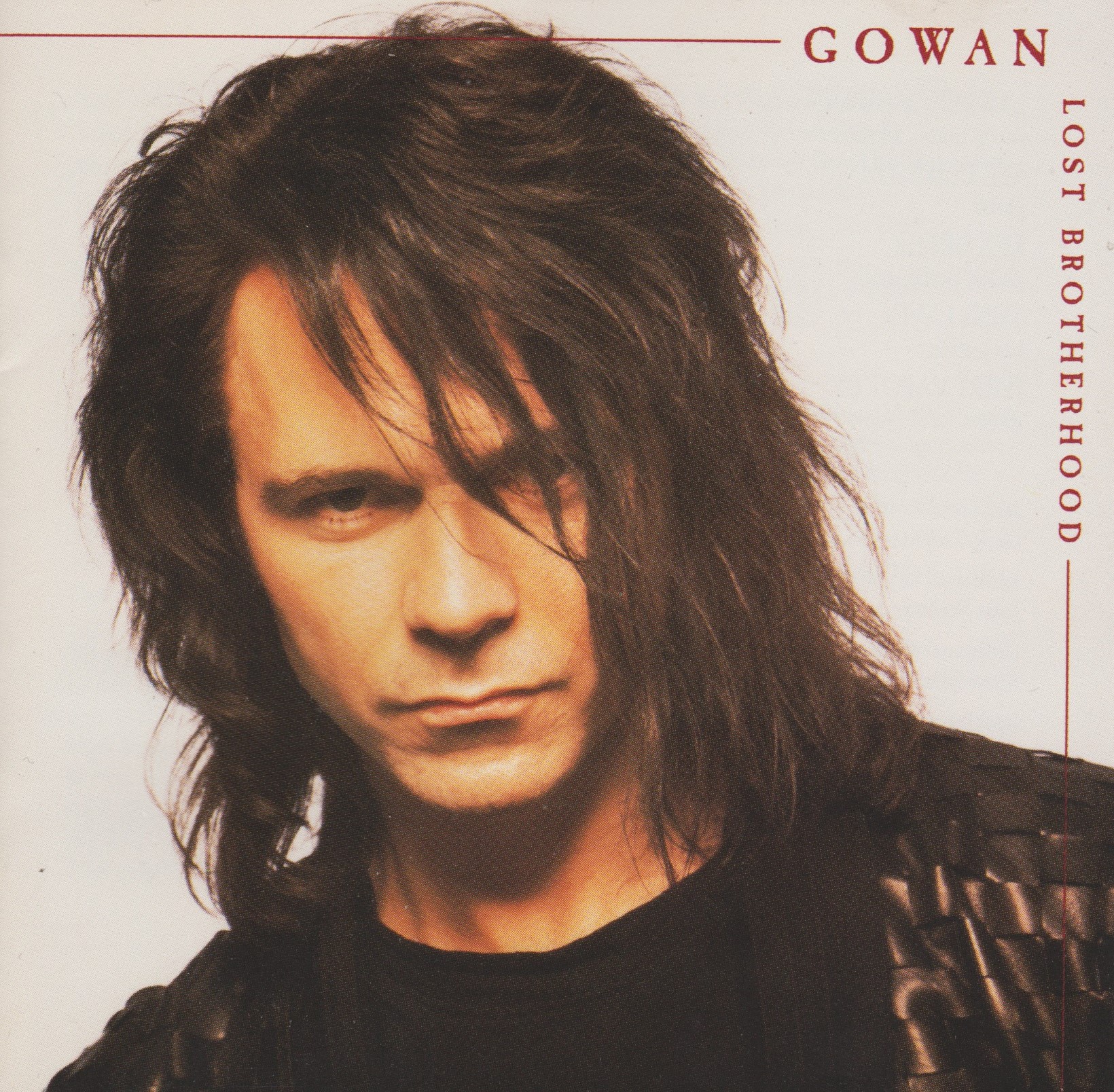
I like to think of this Gowan album (a gift from Aaron at the KMA) as “the one with Alex Lifeson”. Gowan has worked with some incredible musicians besides Styx, including Tony Levin (several times, including this album), Robert Fripp and Jon Anderson. Gowan’s fourth album Lost Brotherhood has a distinct Rush tone on several tracks and so it easily became a favourite. It’s important to note though that it’s not just Lifeson on this disc, but also Ken Greer from Red Rider providing the guitars. Though Lawrence Gowan is primarily a keyboardist, this might be his most guitar-heavy album. (Of note, future Triumph contributor Mladen Zarron also plays additional guitar on this album.)
“All the Lovers in the World” was the single, a hit as I recall, and still excellent today. You can’t forget that chorus. It sounds so very 1990, like Presto-era Rush, especially when Alex rips one of those patented Lifeson solos that’s more about the guitar tone than banging out a million notes. In the back, you got Tony Levin dancing gleefully all over the neck of his bass. One word: breathtaking.
A Levin groove commences a nocturnal “Lost Brotherhood”, a serious prowler that you could easily mistake for latter-day Styx. Lawrence has a way with writing piano hooks and “Lost Brotherhood” boasts a tasty one. “Call It A Mission” could be Rush for all you could tell, if not for Gowan’s huskier voice. The pulse of this song is like a “superconductor”, if you catch my drift, and the solo is slick and different. Then it’s “The Dragon”, dramatic and weighty. Levin is hitting some deep notes which just makes “Dragon” rumble like the titular beast.
Gowan goes for acoustic ballad territory on “Love Makes You Believe”, another big chorus. Ken Greer accents the song with very slight touches and Tony adds so much texture. They really crank it on “Fire It Up”, a rocker that would have led off side two of the original vinyl. This boogie just stomps!
“Out of a Deeper Hunger” is another ballad, at least until a nice crunchy guitar kicks in on the excellent chorus. Rock territory is reclaimed on “Tender Young Hero”, another Rush-like monolith with memorable chorus. Gowan’s got a knack for a chorus, and the snare sound on drummer Jerry Marotta is a dead ringer for Peart.
Tinkling keys are the main feature on the delicate “Message From Heaven”. Light, but still heavy. Dramatic as hell. But closer “Holding This Rage” is a masterwork, combining the piano and drama in a way that just reaches out and grabs you by your humanity. Sounds like Marillion.
“Holding this rage isn’t your answer boy, Holding this rage won’t lead you on. Holding this rage will tear you to pieces boy, Look what it’s done.”
By the fade out you’re…one again…breathless.
Though my Canadian bias is showing, it is a good thing that today, million of people get to hear Gowan’s special talents with Styx. Though with Styx, Lawrence is part of a band led by Shaw/Young, as a solo artist he is the captain and always had the goods all along. Lost Brotherhood is an excellent “first Gowan” album to check out due to the emphasis on guitar and of course the presence of one Alex Živojinović.
“Twisted Sister…come out and play!” Happy anniversary to Come Out and Play released on this day 34 years ago.
TWISTED SISTER – Come Out and Play (1985 Atlantic LP & Spitfire CD remaster)
What was a band at the proverbial crossroads to do? Continue along the commercial path of the 3 million copy selling Stay Hungry? Or revert to the tried and true heavy-as-an-SMF sound of yore?
There was only one dissenting vote. Bassist Mark “The Animal” Mendoza felt that putting “Leader of the Pack” on the new album was a mistake. The other four voted “yes” but some grew to regret it. Both Dee Snider and J.J. French have since realized the error of their ways. Today, Come Out and Play is acknowledged as the beginning of the end, though it has its fans and some sturdy tracks to support it.
Twisted Sister recruited Scorpions producer Dieter Dierks and enlisted high profile guest stars like Alice Cooper, Billy Joel, Brian Setzer and Clarence Clemons. They were top-loaded onto a old-time rock and roller called “Be Chrool to Your Scuel”, and the gamble backfired immediately when MTV banned the music video for its zombies and ghouls. It’s an interesting track at least. You don’t hear a sax solo on a Twisted Sister song every day, nor the kind of plucking that Brian Setzer deals in.
“Leader of the Pack” was a failure as well, actually a re-recording of a track that debuted on the Ruff Cuts EP. The video (starring the then-hot Bobcat Goldthwaite) further painted Twisted Sister as a novelty band.
Tensions, especially between Mendoza and Snider, were amplified. The songs that sound like they were meant to be “hits” fall far short. The impression you get from “You Want What We Got” is that it was intended to be a specific kind of hit. Unfortunately it’s just a repetitive anthem. “Lookin’ Out for #1” is similarly filler, a song that never quite clicks.
Some tracks maintained a heavy rock presence. They include the anthem “I Believe In Rock and Roll”. It’s a manifesto for the PMRC generation; a decent attempt that just misses the mark. “Come Out and Play” features A.J. Pero nailing down a speedy beat, but the production of Dierks neutered the powerful drummer. Dierks introduced keyboards to some of the tracks, watering them down needlessly. “The Fire Still Burns” works better than some of the other songs, and despite the production you can hear A.J. is just crushing the kit. If the backing vocals sound unusually lush, that’s Don Dokken and Gary Holland. “Out on the Streets” trades the speed in for plaintive melodies, and is the better for it. Finally “Kill or Be Killed” does what it promises. Unbelievable that A.J. could play at such a relentless velocity, but he was an absolute beast.
Strangely, some of the best tracks are the ballads. Dark ballads. Ballads of depression, of loneliness, of alienation. “I Believe in You” is the first of two, bolstered by strong melodies and Dee Snider’s enviable pipes. The one that impresses the most is the CD and cassette bonus track “King of the Fools”. Although “Kill or Be Killed” ends the album just fine, this coda adds some substance. Sounding like a man destroyed, Dee sings the melancholy lyrics.
What kind of kingdom has no throne? No crown or castle do I own, I don’t have silver gold or jewels, Yet I’m the king, king of the fools.
It’s surprisingly thoughtful songwriting, complimenting the mournful melodies. Yet there is a defiant, powerful streak in the choruses.
King of the fools, Who are these people to cast stones? King of the fools, Better a fool than just a clone.
Dee Snider has always resonated with the underdogs, the bullied, the downtrodden. “King of the Fools” might be the most honest of all those songs. Some regal guitar melodies by J.J. French and Eddie “Fingers” Ojeda show that they were picking up what Dee was laying down.
Here’s the catch though. If you’re buying this album, you need “King of the Fools”. To get it, you’ll want the CD. But Come Out and Play might be most notable for the album cover you can only get on vinyl. Open up that manhole cover and out pops Dee Snider in all his…all his…rags.
Heeere’s Dee!
Do what I did. Get CD and LP, just for the cover. Everybody needs a pop-up Dee Snider.
TWISTED SISTER – Big Hits and Nasty Cuts (1992 Atlantic – Canadian CD)
When Twisted Sister split at the end of 1987, they went rather quietly into that goodnight. No big magazine articles, no solo projects incoming, not until 1992 when Dee Snider finally re-emerged with his new band Widowmaker. It was a quiet five years, broken only by the low key release of Twisted Sister’s first “greatest hits” compilation in March of that year.
Big Hits and Nasty Cuts was a compilation that both fans and band deserved. No careless cash grabs here. In 1992 it’s doubtful that Atlantic thought they’d be making much money off “I Wanna Rock”, one of the biggest cheerleaders of the obsolete generation. While Kurt Cobain cashed his biggest royalty cheque yet, J.J. French was writing the liner notes for this CD. (Mark “The Animal” Mendoza did the remastering with Ted Jensen.)
For the era, Big Hits and Nasty Cuts was one of the most fan-friendly, value-intensive CDs on the market. Even better for American fans, this time they got the bonus track! The album was split into two sides — the hits and the “nasty cuts”, all rare B-sides recorded at the Marquee club in England. Fortunately the entire show has since been issued by Rhino, but in 1992, very few fans had the original 12″ singles these songs were sourced from. Another rarity included was Twisted’s first single, “I’ll Never Grow Up, Now!” These were first releases for the CD format! Good thing too, because “I’ll Never Grow Up, Now!” is indelible as any of the hits.
The hits portion of the album isn’t quite predictable. Would you have expected the heavy metal uppercut “Under the Blade”? Or the raw “Shoot ‘Em Down”? Here they are, and thanks to the liner notes, you can find out why. (Oh fine, we’ll spoil one. “Under the Blade” was included because it’s been played at every Twisted show since it was written.) The three biggest hits are present and accounted for. “I Wanna Rock” and “We’re Not Gonna Take It” would be the two hits that everyone knows, and “The Price” is runner-up.
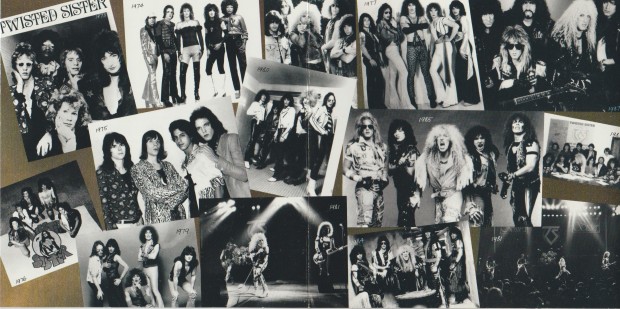
Also present: “I Am, I’m Me” and “The Kids Are Back” demonstrate Dee’s early knack for melodic songwriting, very punk-like in its simplicity especially when coupled with Twisted’s 4/4 rock. “You Can’t Stop Rock and Roll” also had to be here. Perhaps it’s Twisted’s best metal anthem. Finally “Be Chrool to Your Scuel” featuring Alice Cooper ends the hits side with the last one chronologically. (“Bad Boys of Rock and Roll” on the US version.) There’s no “Leader of the Pack” and no “Hot Love”. All hail the classic lineup: Dee Snider – lead vocals. J.J. French – guitar. Eddie “Fingers” Ojeda – guitar. Mark “The Animal” Mendoza – bass. The late, underappreciated A.J. Pero – drums. The lineup that set MTV on fire relied on catchy videos, yes, but the songs have survived equally well.
The nasty cuts may just be too heavy for the average listener. Recorded to 2-track tape, there’s no fixing the mixes here. The lengthy start to “What You Don’t Know (Sure Can Hurt You)” includes Lemmy’s intro and plenty of noise. There is no overlap with any other songs on the CD. “Destroyer” grinds so hard it’s almost a parody of itself. “Tear It Loose” is out-of-control fast, blowing away the album version. The US got “Run For Your Life” right after “Tear It Loose”, another fast rendition once it kicks in. (In Canada, “Run For Your Life” was only on cassette.) The cover tunes “It’s Only Rock ‘N’ Roll” and “Let the Good Times Roll/Feel So Fine” include plenty of crowd interplay. Just the thing to turn off Joe Average Listener, but amazing to hear the energy of the band and audience that night.
The live cuts really highlight, with 20/20 hindsight anyway, the power of A.J. Pero. The guy could really kill a drum kit, and his timekeeping is the cornerstone of what made Twisted Sister heavy.
Don’t buy this CD if you’re looking for a party CD. Buy it because you’re intrigued and want to learn more about a band who doesn’t get enough credit for being one of the world’s most dangerous. Buy it to check out the rarities and get a taste of what those in the know had in their collections back in 1983. Buy it because you’re going to get liner notes and photos of band members you never even heard of before. Buy it because this is a great compilation, done with loving care and value.
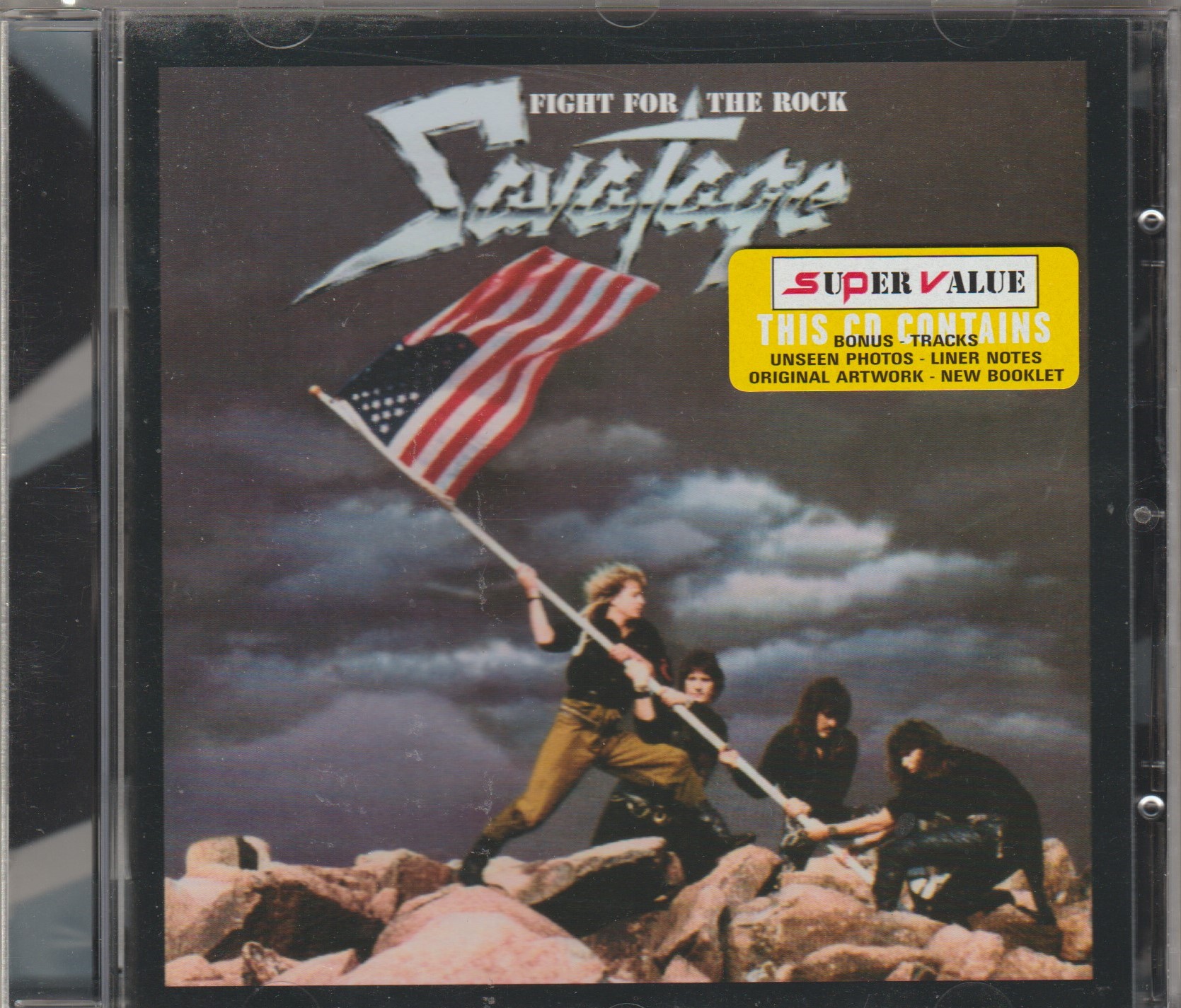
SAVATAGE – Fight For the Rock (Originally 1986, 2002 Steamhammer remaster)
Like many bands then and now, Savatage were led astray by bad management and poor direction by record company executives. At least they tried. Hoping to make some headway, Savatage leader Jon Oliva agreed with the record company’s plan for a change in style. Steering towards hard rock and hoping to become the next Journey, Oliva and company said “what the hell”. Meanwhile, Jon Oliva had submitted some songs to management to see if any other artists might be interested in recording them: “Lady in Disguise”, “She’s Only Rock ‘n Roll”, and “Crying For Love”. They turned around and said “No, we want Savatage to record these songs.”
New bassist Johnny Lee Middleton was lined up to replace Keith Collins. They flew to England on a tourist visa to record the album, only to find Steve “Doc” Wacholz detained at the airport for five hours. “I’m a golf instructor,” he claimed at customs, but most golf instructors don’t carry drum sticks and sheet music in their carry-on bags. This is a perfect metaphor for the album Fight For the Rock: a band masquerading as something they were not.
A big echoey 80s sound blunts the sharp edge that Savatage gained on Power of the Night (produced by Max Norman). “Fight For the Rock” is a good song, but obviously toned down in comparison to title tracks past. Most obtrusive are keyboard overdubs by a studio cat, very different from the keys that Jon Oliva would eventually bring into Savatage himself. These sound like added afterthoughts, not structurally part of the song. Still, as stated, a good song in that Dokken-Crue mold. Only the Jon Oliva screams really connect it with early Savatage.
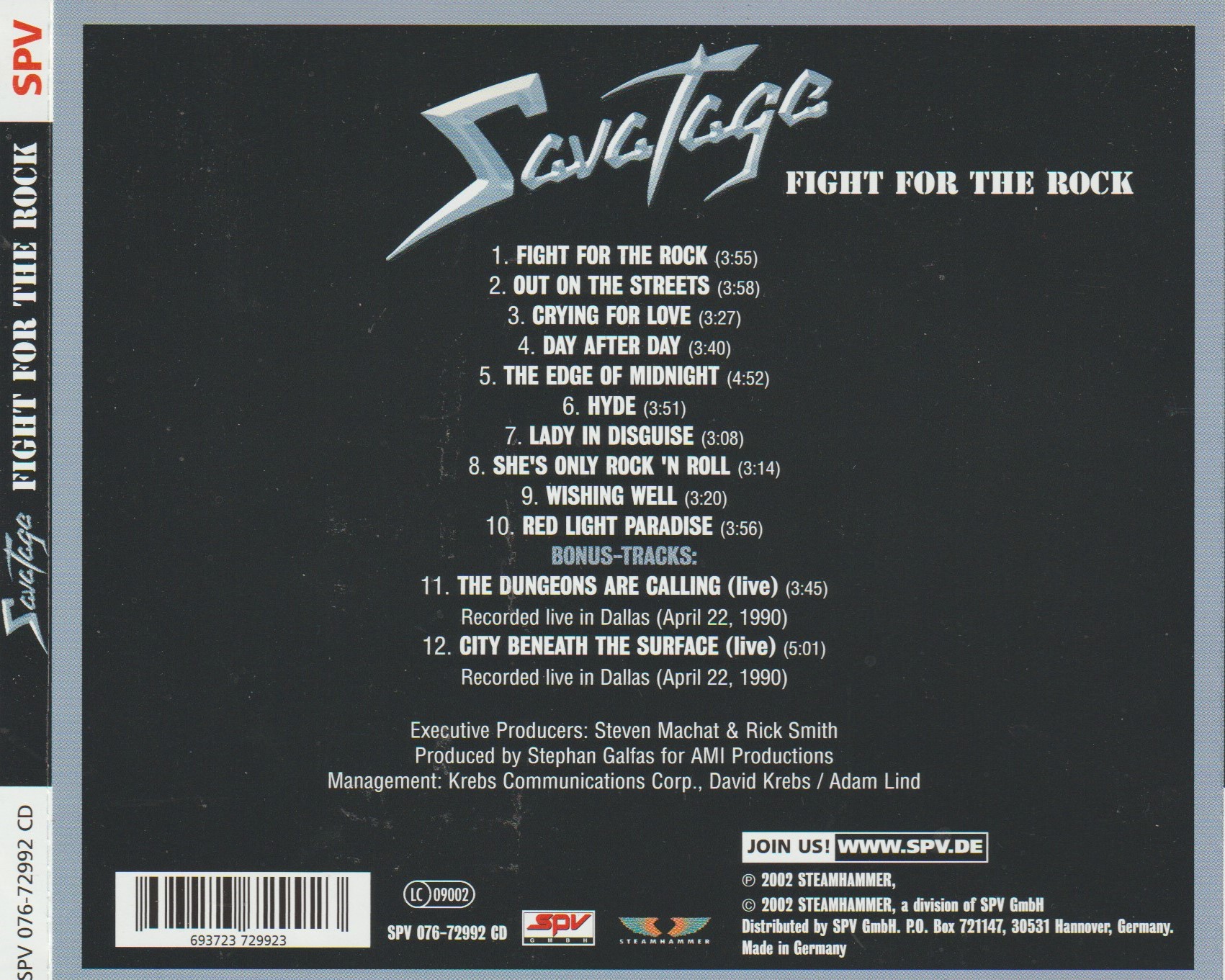
Keyboards return on “Out on the Streets”, a song from Sirens re-recorded. As a ballad, you can see why the suits thought it would be worth another shot. A great tune is a great tune, but the pipe-like keyboards don’t do it favours. “Crying for Love” is a re-recording of “Fighting for Your Love” and one of the songs Oliva wanted another artist to record, perhaps John Waite. It’s a heavier ballad, not as good as the Sava-demo, but retains some balls.
Hard left turn ahead: “Day After Day” by Badfinger. Oliva decided to do this track since he’d be playing the very piano from the original, so why not. He’d already gone this far. May as well go all-in. “Day After Day” is perhaps the least “Savatage” song in their entire catalogue. A very different Savatage would have evolved had this been a hit for them. A Savatage more akin to Night Ranger or even Stryper!
There are only two songs that Jon Oliva considers “real” Savatage songs today: “The Edge of Midnight” and “Hyde”. They occupy the dead center of the album, closing side one and opening side two. Although they too are infected by the awkward keyboard overdubs, they are both metallic Savatage lurkers, dark and shadowy. “Hyde” hits all the right notes, with perfect OIiva lyrics:
“A good man to evil, From the potion on the table, Taken by mistake, but now it’s far too late.”
“Lady in Disguise”, which exists in superior demo form, was largely rewritten to be submitted to other artists. It exists on Fight For the Rock as the third ballad, watered down and rearranged to accommodate a big keyboard hook. “She’s Only Rock ‘n Roll” is a little more Savatage even though it too was not intended for their use. It’s a hard rock Savatage, a little Dio-ish and one of the few songs with a recognizable Criss Oliva guitar riff.
Not particularly Sava-like but very good just the same is the Free cover “Wishing Well”. It and “Day After Day” remain the only true covers that Savatage have ever recorded. It’s a pummelling arrangement, well performed and strangely appropriate for the Sava-treatment. It’s like their “Green Manalishi”. Concluding the album, “Red Light Paradise” has a touch of that occasional Sava-sleaze. Good track with a nice chug to it, and plenty of screamin’ vocals.
As before, Steamhammer added bonus tracks to the 2002 reissue. From the Gutter Ballet tour and featuring an expanded lineup with second guitarist Christopher Caffery, it’s two live classics: “The Dungeons are Calling” and “City Beneath the Surface”. Could that year, 1990, have been peak Savatage? That powerful lineup was short lived, as Caffery temporarily left the band at its conclusion. When he returned, Criss Oliva was gone, killed by a drunk driver. To the point: these are killer versions, (and not the same as the live album Ghost in the Ruins).
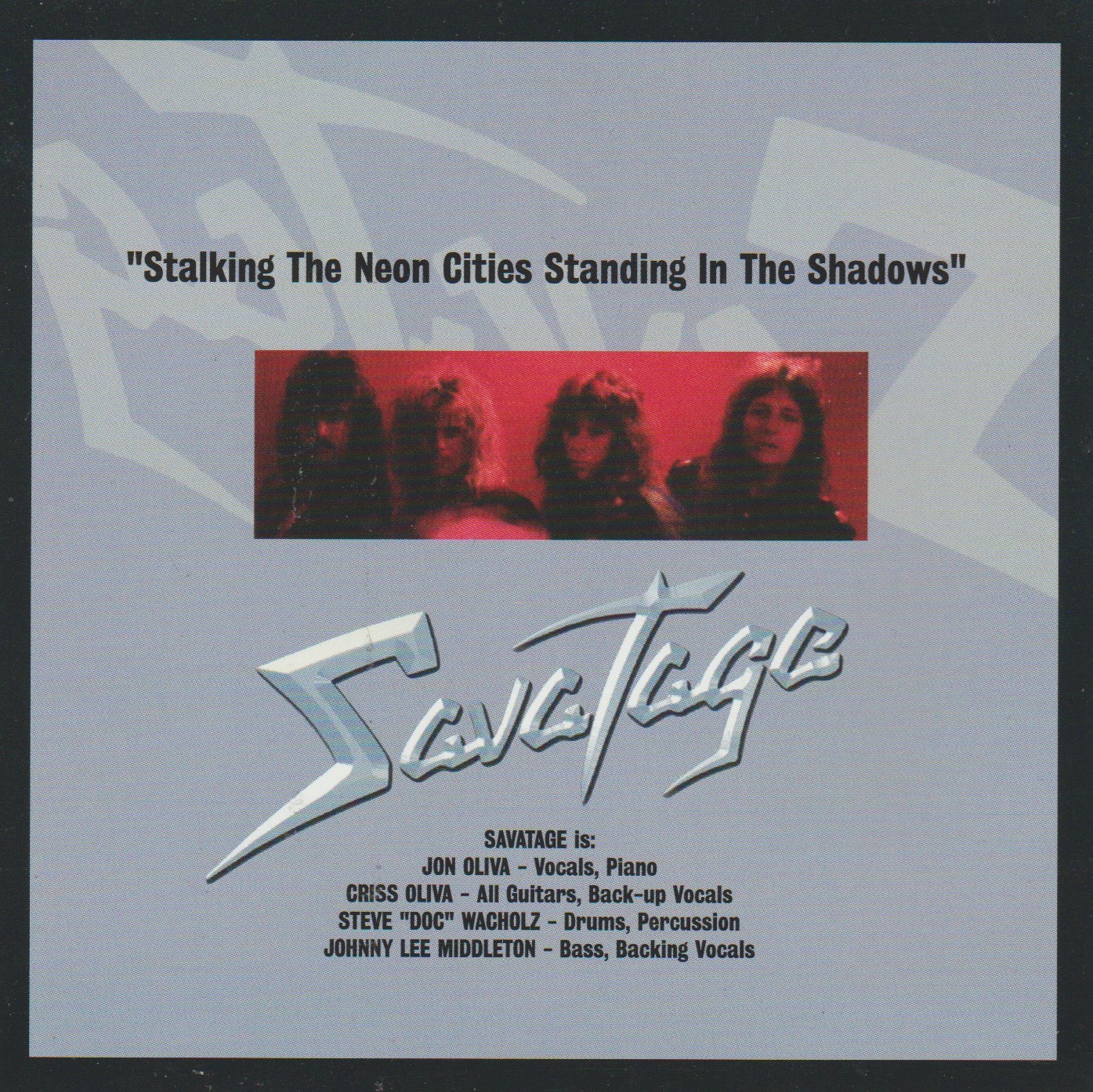
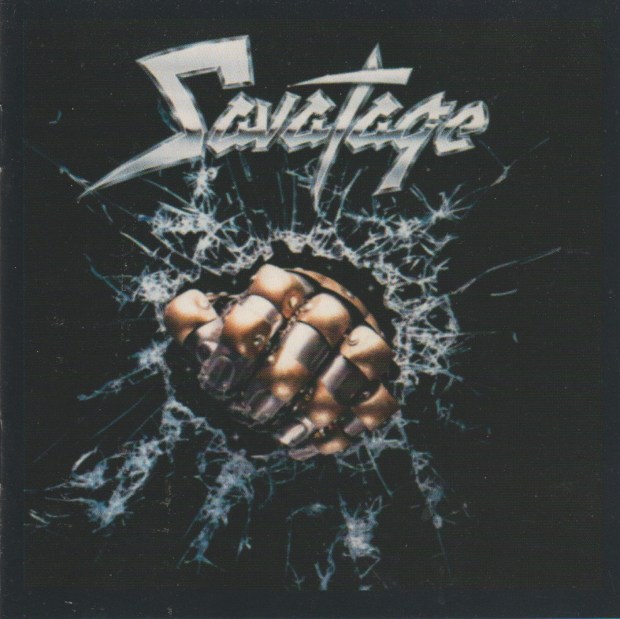
Steamhammer also provided in-depth liner notes, housed inside a blurry reproduction of the cover art. That is an unfortunately win/lose. One is tempted to have two copies of the album, just to have clear original cover art. Collectors need more that one copy anyway, just to deal with the maze-like bonus track situation through the entire Savatage collection.
As Jon Oliva says in the notes, Fight For the Rock is not a bad album, if you like hard rock. It’s not really a good Savatage album. Hey, they tried, right? They swung for the fences. And when they failed to hit the grand slam home run, they lost credibility with fans and the rock press. Still, for those willing to check it out, there are a few rewarding tracks amidst the muck.
3/5 stars
The story continues with these previously posted reviews:
SAVATAGE – Power of the Night (Originally 1985, 2002 Steamhammer remaster)
Raise the first of the metal child!
If any fans were worried that Savatage would “sell out” after signing to Atlantic in 1984, those fears were swiftly cast aside. Power of the Night, their first on a major label, was produced by metal-meister-to-be, Max Norman. The band had plenty of material demoed (in a session with Rick Derringer) and were ready for the studio.
Nothing was toned down; if anything, Savatage turned it up. Melting the speakers with the title track, a fancy keyboard opening might have fooled some. When the patented Criss Oliva riff commences, you better hold on tight.
“Children of the metal movement, The legions growing stronger, Stronger than they believe.”
With Norman at the helm, Savatage achieved a sharp, biting sound. Relentless beats courtesy of Steve “Dr. Killdrums” Wacholz helped them cement themselves as true metal competitors. The foursome from Florida were not to be ignored.
Savatage were improving as songwriters. “Unusual” puts atmosphere over headbangin’ riffs, and effectively so. Singer Jon Oliva became increasingly interested in keyboards album by album until it eventually became the focus of the band. Here it works to cloak you in a dark weave of ominous metal. Then, if you were hungering for more riffs, bow down to the fuckin’ rad* “Warriors”. Another Criss Oliva riff as only he could write them, “Warriors” rivals Judas Priest for absurd fantasy metal thrills. It gets a little silly on “Necrophilia”, but the headbangin’ does not wane. You might break your neck on “Washed Out”, a little speed metal ditty to cure what ails you.
Side two switches the gears a bit with a Scorpions-Dokken hybrid called “Hard for Love”, which generated some faux-controversy in the 80s. It’s the most commercial Savatage song yet, but it works remarkably well due to the sharp edges; not blunted by improved production values. Still riding high with quality metal, “Fountain of Youth” takes things to a wizardly world inhabited by Dio and his cohorts. (Of note: it’s one of the few Savatage songs with a Doc Wacholz writing credit.)
Savatage’s speed metal adventures can be hit or miss. “Skull Session” is a miss, though you may enjoy the lyrics about an “X-rated lesson”. There’s no real melody and the riff isn’t one of Criss’ most notable. Plenty of screams though. A mid-tempo “Stuck On Your” doesn’t get the car out of the mud. It’s just a little dull compared to the scorchers on side one.
Ending Power of the Night on a ballad was a ballsy move, but “In the Dream” is one of the best from the early years. Indeed, Jon Oliva re-recorded it acoustically for one of the many reissues of Sirens/Dungeons are Calling. Dr. Killdrums does a fine job of punctuating the song’s drama with short bursts of swinging limbs.
Steamhammer included two live bonus tracks.** From Cleveland in 1987, a spot-on “Power of the Night” is a furious rendition of a song already smoking hot. “Sirens” live in Dallas three years later is just as furious, though Jon’s voice is more worn. They also included excellent liner notes, lengthy and detailed. Unfortunately the cover art on these Steamhammer reissues is atrociously blurry.
Power of the Night was the last Savatage album with original bassist Keith Collins. Originally a guitarist, Collins’ bass wasn’t up to snuff at all times so Criss Oliva had to play on several tracks to fix portions they weren’t happy with. Now that it’s encoded on a little silver disc forever, the final album is tight and punchy.
4/5 stars
Unfortunately, it didn’t sell well enough for Atlantic. Bumpy road ahead!
* “Warriors” is “fuckin’ rad” according to Holen MaGroin
** Like all Savatage albums, different issues have different sets of bonus tracks. These will have to be covered at a later time as a “complete” Savatage collection can be an expensive proposition.












 mikeladano.com