Canadian rock

REVIEW: Triumph – Edge of Excess (1992)

Bought in Taranna at Kops for $2.50!


Scan_20160102TRIUMPH – Edge of Excess (1992 Virgin)

When Triumph split in ’87, Rik Emmett went off in a pop direction leaving his two bandmates with no singer/guitar player, and without their most recognizable member.  As bassist Mike Levine said in M.E.A.T Magazine, “We couldn’t just be Duo-umph”.  Since Triumph always had two lead singers in Rik Emmett and drummer Gil Moore, this time Gil simply stepped up and sang everything.  Then they needed a guitar player.  Gil and Mike Levine wrote and recorded most of Edge of Excess with Mladen Zarron in Toronto, before hiring ex-Frozen Ghost (current Bon Jovi) shredder Phil X.  Five years after the split, the new Triumph emerged with a heavier and darker album, Edge of Excess.

Triumph boldly opened the album with a whole minute of nothing but bluesy guitar noise.  If there was a stronger way to say “We don’t need Rik,” I don’t know what that would be.  This guitar noise serves as an intro to the first Triumph song without Emmett, “Child of the City”, a harder edged Triumph song with the same kind of hooks.  It’s hard to determine who is playing lead guitar, Mladen or Phil X, but rest assured that whoever it is has laid waste to the land.  Rik Emmett wasn’t just a shredder, but a talented player who composed his solos with class and ability.  Mladen and Phil have done the same, but without emulating Rik.  (Phil’s going to have his work cut out for him in Bon Jovi, though.)

The rip-roaring “Troublemaker”, easily the fastest and heaviest Triumph track to date, was featured on the soundtrack to Hellraiser III, and it’s easy to see why.  It’s as close to speed metal as Triumph have been, and I shouldn’t need to tell you that again the solos shred.  Who’s playing?  Fucked if I know, there are three guys credited on the song.  The song is actually very close to high-octane Whitesnake and it would be easy to imagine Coverdale’s crew doing it.

Lest you think that ballads were a thing of Triumph’s past, “It’s Over” has a country & western feel. Unfortunately of the two singers, Moore had the less commercial voice.  This is where Gil’s voice reveals its limitations.  On backing vocals, some big names are on hand such as Fred Coury of Cinderella and Steve DeMarchi of Sheriff, to help beef up the big chorus.  It’s not enough to make a memorable song.  They cook up some groove on the title track, tapping the vein of Van Hagar.  But without Rik Emmett, Triumph lost part of what made their unique sound.  On Edge of Excess it’s too easy to compare them to contemporaries.  “Turn My Back on Love” is better, occupying a dirty mid-tempo groove, and with Phil X handling all the guitars himself.  The big chorus is the closest thing to old Triumph on the album.

That’s the side; the second one opens with “Ridin’ High Again”, a sleezy rocker that sounds like Don Dokken emigrating to Canada.  Phil X really can shred though, and anyone who’s curious what he can do should check it out.  I don’t think Phil will be able to play to his strengths in his new band, so give this a listen and hear the guy blaze like Vai meets Van Halen.  “Black Sheep” starts as a total surprise; a blues right in the middle of the album.  No drums, just claps.  Sadly instead of sticking with this, it transforms into a stock hard rocker.  “Boy’s Nite Out” has a grammatically incorrect title:  The lyrics are clear that it is not a boy’s night out, but “the boys”, plural.  It should therefore be called “Boys’ Nite Out”.  Here I am bitching about the grammar and not the word “Nite”…anyway, back to the song.  Standard rocker.  Plenty of great shreds, but this album is far too burdened by generic rockers.  Rik Emmett used to bring a variety of influences to the table, and their albums with him may have had their weaknesses, but they were more diverse than Edge of Excess.  Without enough identity, Triumph forged a batch of largely forgettable bluesy hard rock songs.  Lots of crunch, not enough stick-to-your-brain hooks.

Fortunately the classy power ballad “Somewhere Tonight” helps wind things up properly.  Identity is still a problem, but at least this is a break in the rut the album had been in.  Right back into the rut for “Love in a Minute”, the last in a batch of heavily generic rock songs that sound like about a dozen bands…none of them Triumph.

Like any fan, I was pleased that Triumph kept going despite such a huge setback as losing your main guy.  Unfortunately the album they produced in ’92 was not up to par, and I guess that’s why it took me 23 years to finally buy it!  A couple good songs early in the album, but not much more.

2.5/5 stars

REVIEW: Feel – This (1994)

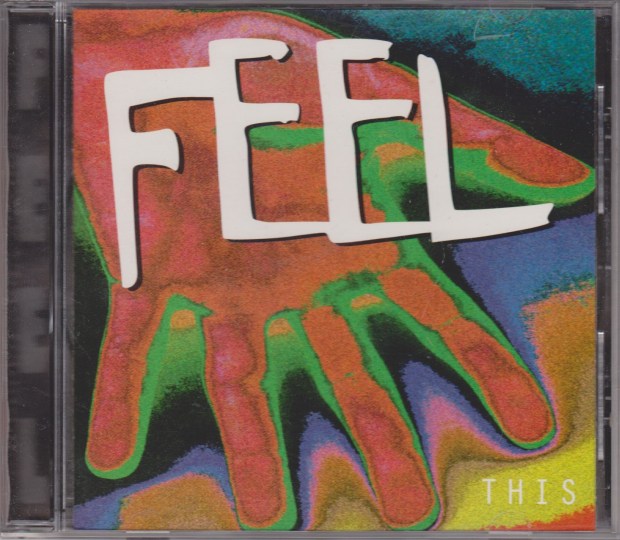
FEEL – This (1994 Feel)

Russian Blue followed their critically acclaimed demo tapes with a full length CD, but perhaps it was the long wait that killed their chances.  Between 1991 and 1994, the entire musical landscape had turned itself upside down.  A name change was in order to suit the new climate, and after using the name Deadmoon for a little while, they settled on Feel.  Simple: one word, one syllable, and trendy.  Would they be able to maintain a level of quality over a full-length CD?

Almost.  There is very little dead weight on Feel This.

“I Become You” is brutalizing, menacing, grooving detuned grunge.  The presence of the bass is felt on this heavy recording.  What Feel had that was different from other bands was the Axl-like screech of frontman Jo E. Donner.  Indeed, when Donner multi-tracks his high voice with his lower register, the overall feeling is very Axl.  Donner bellows forcefully, blowing out the speakers but not without help.  Guitarist Richard Gauci and drummer Mike Willerding were capable of playing challenging rock.  The drum patterns are busy and and Gauci is able to both shred like a hero, and also create the kind of noise that you needed to do in the 90’s.  The band were between bassists.  Robo was no longer in the band, so there are a couple session players on the CD.

Several smouldering tracks in a row occupy the first half of the album.  “What You Made of Me”, “Wild Eye” and the lengthy “Brotherhood” all boast heavy guitar and vocal hooks.  Wimps need not apply; Feel go for the throat even with a slower tempo.  The songs sound well thought out, with attention given to every shriek and guitar noise manipulation.  The bass grooves are absolutely key to all of this.  Rumbling and shaking like a good Soundgarden line, they deliver the bass chills that fans of such sounds love.  But was it all too similar to the chilly winds that had blown in from Seattle?  Feel had been growing heavier and groovier on the demo tapes already, so I believe this to be a natural evolution that happened independently from the Seattle scene.  Witness other Canadian bands such as I Mother Earth, who also evolved on their own into something that fit into that 90’s box.

Scan_20151014 (6)

The centerpiece of the album has to be “I Am Your Mind”.  Long with a droning, irresistible chorus and cool lyrics — what’s not to like?  This tune takes only one listen to bore its way deep into your medial temporal lobe. Building dramatically, every guitar hook will sink in hard, only for Donner to hit everything home with his powerful larynx. Everything is perfect — a song of this quality could easily have been on Badmotorfinger or Superunknown. Hyperbole? I don’t think so.

The second half of the CD has fewer highlights. After being slammed in the face with so much heaviness, Feel were wise to put on an acoustic number next. “Ain’t Nothin’ Wrong” is good, and shows off the band’s Zeppelin influences especially in the vocals. It’s just that Feel unplugged doesn’t have the kick that Feel does fully electrified. On the other hand, another listener might say it’s the best track. The first skipper is “Under My Wing”, too slow and boring. Not enough Sabbathy slow, just stuck in the wrong gear. Back to the groove is the killer “Drip Sweet Blood”. Making use of trendy 90’s vocal distortion, Donner blows the speakers especially around the 3:15 mark with another hair-raising bellow — just awesome. “Stand on Walls” sounds something like a Skid Row outtake. It’s nothing outstanding, but it’s only 3:38. Closing the disc is “All”, which was formerly known as “Black” on the second Russian Blue demo. The psychedelic intro from the demo was axed, tightening up the song and amplifying its power. Alternating from soft to loud, “All” kind of does have it all, at least for 1994.

Feel could have got themselves off to a great career with This as a debut album. Unfortunately I think by 1994 it was already too late.

3.5/5 stars

REVIEW: Glueleg – Heroic Doses (1994)


GLUELEG – Heroic Doses
(1994 Page Publications)

Any band that can handle an instrument as beastly as the Chapman Stick is worth listening to at least once. Glueleg, from Toronto Ontario, were once such band. They boasted not only the Stick but also a horn section with sax and trumpet. If that wasn’t enough to garner them some local praise, a few people turned their heads when they hooked up with James Stewart (cousin of The Cult’s Jamie Stewart) to produce their first CD, Heroic Doses. Prior Glueleg releases were cassettes…CD was the big time.

The title track was the first single/video, and entered rotation on MuchMusic and several rave reviews. Guitar player Ruben Huizenga sings this immediately infectious track. The hypnotic vocals, the punchy horns, the Stick, that low-as-fuck rib-busting riff…this track is perfect in every way. “Heroic Doses” nails it completely and there is no wonder that it garnered some serious attention. The end result of this was a record deal with EMI, but nobody can accuse Glueleg of being commercial on “Heroic Doses” even so.

“Pollo” (“Chicken”) is rapped and sung by Stick player Carlos Alonzo. He has an interesting voice, able to do a rap in a Beastie-like style but with his own spin. He can also sing quite well. He also sings “Mister Pink”, another manic groove. The horns deliver consistent punctuation, and that Stick just thumps. “Lilies” has a droney riff/groove combo that stoner rock bands today love to utilize. “Spiderman” is an original, an instrumental, but it certainly recalls the classic cartoon theme. Glueleg songs don’t tend to adhere to convention song structures. They have more in common with Mr. Bungle than the Chili Peppers, but much more accessible. Their songs have the complexity and chops of Bungle, but are direct. There are also grunge elements, a-la Alice in Chains.

The sonics of this album are really quite good even today. The Stick has a snap to it, and the horns have depth. Having two singers enabled them to play different styles of songs even within the confines of what Glueleg were doing. “Dust” is a dirge, for example. Then the next track “Pampa De Chooch” is completely different, at times almost sounding like Kyuss with horns. “Park Alien” might be Zappa-esque progressive jazz. “I Saw You Joja” is then something else again. Perhaps there’s a lack of focus, or maybe it’s just that Glueleg were so bursting full of ideas, but some songs come off as scattershot.

Biggest surprise of the album: the closing track “Red”, the King Crimson instrumental. What a drum tour de force performance this is, by Christian Simpson. Simpson is no slouch; he later went on to play with Saga for several years, as well as David Usher and Edwin.

I like all of it. Heroic Doses is one of those discs that are indicative of their times, and has nostalgia value, but also plenty of musical chops to keep you busy. If the songs had been tightened up a bit more I think you’d have a serious classic here. Unfortunately there are some songs that are just not quite there.

3.25/5 stars

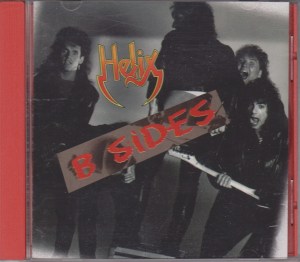
REVIEW: Helix – B-Sides (1999)

Scan_20150918 (5)HELIX – B-Sides (1999 Beak Records)

The occasion:  It was Helix’s 25th anniversary.  How about an album, and some classic returning band members, for a good time?

The title B-Sides here is misleading; a B-side is a track that appears on the flipside of a single, and is often not on the album. No tracks on this album appeared on the flipside of any singles, at least not these versions. However, the misleading title does not mar the excellent music contained within.

B-Sides contains songs written and/or demo’d for various Helix albums from 1990 onwards. Some of these have been re-recorded, such as “Love Is A Crazy Game”, which appeared as an acoustic version on the Business Doing Pleasure CD. This version is electric and is much heavier. I could imagine this version fitting right in on an Aerosmith album. “S.E.X. Rated” has also been re-recorded. It’s the only song that actually appeared as a B-side, but it’s not the same version as on that single.

Various versions of the Helix band appear on this album, but most interesting is the lineup on the bonus tracks. “Like Taking Candy From A Baby” and “Thinking It Over” are both from the sessions from Helix’s excellent first album (Breaking Loose), left unreleased until now. “Thinking It Over”, a terrific pop rock song, is a Del Shannon cover.  Helix worked as Shannon’s backing band during an early 70’s Canadian tour. There are also three songs by a reunited “80’s Helix”, and it’s great to hear that version of the band again.

In a way, it’s a shame that this album was given the title and terrible album cover that it has. Brian Vollmer and Co. could have simply put this out as the next Helix album, which may have given it the respect it deserves. From the ballads to the heavy stuff, this Helix CD has a bit of everything you already liked about the band, with a modern edge. Every song kicks, there’s not a weak track in the bunch. By the time you get to the bonus tracks, Helix have already pummelled your eardrums.

Helix fans absolutely need to hear this music; not B-sides but in fact some of Helix’s best stuff. Along the way, there are appearances from pretty much every major Helix member from the indi days to the mid-90’s. You will even hear songs written and performed by Paul Hackman, the late Helix guitarist who was tragically killed in a 1992 auto accident.  The major selling point of the disc was that three songs featured a reunion of the surviving members of the classic 80’s Helix.  With Hackman gone, that consisted of leader singer Brian Vollmer, guitarist Brent “the Doctor” Doerner, bassist Daryl Gray, and drummer Greg “Fritz” Hinz.

Personal faves:

  • “Thinking It Over” which my wife thinks sounds like Sloan.
  • “Devil’s Gate”, hard and hammering.
  • “You Got Me Chained”, with killer horn section.
  • “Take It Or Leave It”, moody and dark but catchy as hell.

Final bonus:  a booklet absolutely chock full of never before seen photos.  A real treat!

5/5 stars

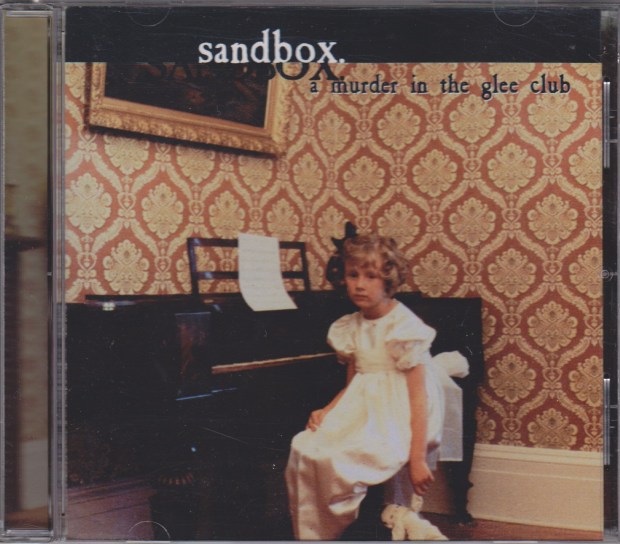
REVIEW: sandbox. – a murder in the glee club (1997)

sandbox. – a murder in the glee club (1997 EMI)

This is a fascinating album.  Sandbox (parsed as “sandbox.” on the album) had come out with a successful enough debut, but what we didn’t know then was how much ambition they had.  For their second CD, they did what most bands usually wait to do, much later on: the dreaded concept album! It is such a gamble to go for a concept album at all, let alone on your second record.

Setting the scene is the title track, “A Murder in the Glee Club”; but is all what it appears to be?  The liner notes state:

“Recorded as in introduction to a play in 1932 by Freddie Corn and the Ohioans, the song has sat dormant on a shelf for the past 65 years.  Shortly after it was recorded, the production was cancelled and the song was never released or published.  The version you hear on this record is the original recording, sonically enhanced and embellished using mordern technology.”

Hmmm.

An online search for “Freddie Corn and the Ohioans” reveals only one hit: an old interview with Mike Smith from the University of Western Ontario, which is only quoting the liner notes.

I always wondered if Sandbox were trying to pull the wool over our eyes a little bit with those liner notes.  You can draw your own conclusions but “A Murder in the Glee Club” does lull you in to the concept of the album:  Altered states of consciousness and mental illness eventually lead to murder.  Then, the murderer becomes haunted by the crimes he has committed.  That “1932 recording” really sets the mood right.

“…to red” is the first proper song on the album, and this is lyrically connected to the final track on Sandbox’s first album, Bionic.  It’s immediately obvious that the production, this time by Don Fleming, is far superior.  “…to red” is a vast improvement sound-wise over anything on the first album.  Performance-wise too; the band no longer sound stiff.  Singer Paul Murray seems less shy, and willing to stretch out his voice.  “…to red” is a fantastic up-beat start, with enough twangy-crunchy guitars to compensate for the pure pop that is the melody.  “I woke up with a different life, I was wondering where I’d been,” and the disoriented lead character is introduced.  This track was written by the uber-talented Mike Smith.  “Spin”, by Jason Archibald continues the story.  “I can’t believe you ran, I can’t believe you wanted out.”  When the character sings, “The Devil was my name,” then I get a bad feeling.  The music is darker, but driving.   The excellent guitar chops of Sandbox really make it enticing.  They leave a lot of space between the instruments so you can really hear what is going on.

“Spin” fades softly into “The Garden Song”, and it is clear that something bad has happened.  “They found you in the garden, arranged smile stained your face.”  While the lyrics are poetic it’s difficult to pay attention to them, because of the imagery they evoke.  The music is absolutely lovely, almost uplifting at times, but this has to be the darkest moment in the story.  “The Spectre”, faster and loaded with tasty backwards guitar, begins to deal with the haunted thoughts of the killer.  This is a duet with Mike Smith on second vocals.  You can picture this guy wandering through some a cold field somewhere, arguing with himself.  It’s an electrifying song, leading into the blitzkrieg of “Melt”.  This is the heaviest song Sandbox have ever done, blasting with a heavy chunk-tastic riff.  “Better stories, a better plan, this guy thinks he’s Superman, I think I’d like to smash his face with Kryptonite.”  I love that line.  There’s an intense feeling of anger.

Forwarding the story, “If I Tell” reveals regret, and delusions.  The killer now wishes he could bring his victim back, but he certainly isn’t willing to confess.  He justifies this by saying that he’s just protecting those whose lives would be impacted by his confession, perhaps family or friends.  Jason Archibald plays what sounds like electric sitar recorded backwards.  Then, “Self-Contained”, the best track on the album steps forth with a powerful, catchy riff.  This was the first song to really jump out on first listen.  “I hate the way I’m self-contained,” sings Paul Murray, wishing he could escape the insanity.  But the really crazy thing is, even though we know what’s gone on before, taken individually anybody can relate to the lyrics.  “I wanna feel the rush, of an electric song, I wanna be in love, it turns me on.”  On first listen, you’re not going to follow the concept of the album completely.  This song jumped out at me, and I always loved the lyrics, even though I hadn’t pieced it together with the rest of the album yet.

“Carry” was a the lead single/video, and an upbeat pop rocker it is.  Guitar jangle and steady beats provide what you need for a hit, only it wasn’t.  (For shame.)  Perhaps it just wasn’t edgy enough for rock fans in 1997, I don’t know and I don’t understand why Sandbox were not absolutely huge.  Jason Archibald’s “Missed the Day” is a beautiful, softer ballad.  The guitar and vocal melodies are ace, but I also like listening to the drums of Troy Shanks.  Brilliant song with its own hit potential, untapped and wasted.

I remember visiting the Calgary Zoo when I was younger.  The most haunting image in my mind was a polar bear named Snowball who paced back and forth, back and forth, back and forth…endlessly.  (Read more here.)  When Snowball finally died, I am sure I was not the only Canadian who believed that he was probably better off.  Watching that bear, having long ago gone insane in that tiny enclosure, pacing back and forth was one of the most difficult lessons Young Me had to learn about our relationship with nature.  “Bear Bear” was not inspired by Snowball, but by a similar bear at the Metro Toronto Zoo.  It fits into the concept of the album only metaphorically.  Musically, it’s quite jagged and drony, in a strangely catchy way.  This is a powerful song!

According to the liner notes, “How I Feel” was written by Mike Smith, and was lyrically inspired by seeing the Spice Girls on Saturday Night Live one night.  He pulls no punches:  “I’ve been watching all the sheeple of the world, Masses flocking to the mindless shit they’ve heard.”  Musically, it’s brilliant and very 1960’s in vibe.  The electric piano brings me back a few decades.  On this song, the lead character simply cannot connect with people — he is baffled by their behaviour, their words and beliefs.  And he resents them.  “Will you even notice when I go?  I’ll be leaving here when I say so.”

The final track for this dark concept album is “A Question of Faith”, with sparse echoey guitars and a plaintive melody.  What you hear and what someone else hears may be two different endings altogether.  You decide what it all means.  The song is brilliant, and emotionally heavy.  Yet it also feels like release.  A great weight lifting.  “A Question of Faith” is as well crafted as everything else on A Murder in the Glee Club.

I have said in the past, that if I had only bought this album in the year 1997, it would have made my top albums list (published in our store newsletter) that year.  Alas, I did not get it until early in the new year.  If I had got the CD in time, it definitely would have been on that list.  It’s truly a shame, but this second CD proved to be Sandbox’s last album.  Mike Smith had no problem finding fame elsewhere, as his career as Bubbles from Trailer Park Boys has certainly skyrocketed!

5/5 stars


REVIEW: sandbox. – Bionic (1995)

Part one of a Sandbox two-fer!

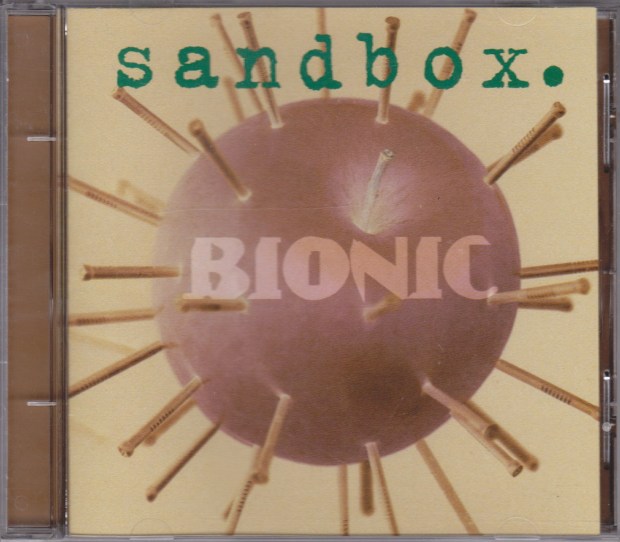
sandbox. – Bionic (1995 EMI)

Because it was the 1990’s, and you had to do stuff like this, Sandbox referred to themselves as “sandbox.” with the period at the end.  This being 2015, in this review we’re just going to call them Sandbox.  Sandbox were very, very 1990’s with some melancholy music and an abstract album cover of an apple with nails in it.  There is no reason for this that I can tell.  It may well have just been, “Hey, let’s make this apple look like the guy from Hellraiser.”

Sandbox were from Nova Scotia, and have two really interesting connections.  One, the lead singer Paul Murray is the nephew of Anne Murray, who made “Snowbird” a national treasure back in the 70’s.  Two, the lead guitar player was a talented fellow named Mike Smith.  Unless you’ve been living under a rock for the last 10 years, then you know Mike Smith as his Trailer Park Boys alter-ego, Bubbles.  I saw these guys opening for the Barenaked Ladies back in 1996 and was impressed by the six tunes they played.

The big hit was “Curious” and it’s still fantastic once you get past the trendy 90’s-isms.  (By that I’m referring to the watery, distorted vocals, lack of a solo, and simple construction.)  But damn, what a song.  All the right parts are there.  The guitar riff works its way into your brain effortlessly, and the band provide all the necessary backing.  Paul Murray is not a singer of remarkable range or power, but his voice works with the music to create a a wave that washes over you.  Mike Smith and the band are more than capable of providing melodic backing vocals.

The problem with the Bionic album was that it had a couple really strong, powerful songs and a lot that didn’t have the same impact.  “Collide” is a good song, but it plods along without enough excitement.  It doesn’t get you moving.   I think a few of these tunes worked better live.  The studio can be a stifling environment, and it took Sandbox an album to really grow in the studio.  “For You” boasts a strong chorus hook, but again not enough spark.

“Decisions”, dark quiet and slow, boasts a great chorus and impassioned lead vocals.  It is augmented by a nice cello part, which works so well for dark tracks such as this.  “Decisions” is a standout on the album, with a big part of that being due to the cello.  More songs on Bionic would have done well with some augmentation like that.  “Grief” is similarly dark, but edgy.  I dig the backwards guitar solo, a touch I have always loved in rock music.  “Three Balloons and a Trapdoor” is the kind of song title I find annoying, but the cello is back.  It’s a sparse little acoustic song without much else going on with it besides the cello.  It sounds like a side closer, and that’s the exact position it occupies on the CD running order.  Coincidence?  I don’t think so.

“Here and There” is the first song that rocks in a while, and it’s very welcome.  It could have used more hooks, but it gets the job done well enough.  It takes advantage of the jangling guitar chords of Mike Smith and Jason Archibald.  Then, “Live” is a fantastic song.  Where sometimes, Sandbox’s songs seem to lack sufficient passion and memorable melody, “Live” completely delivers.  I feel the sadness, and I can swim in the melodic vocals like a river.  “Flux” and “Weatherman” are both OK. “Flux” has a nice hard beat and a chorus I can get into.  “Weatherman” is sparse, acoustic and intimate.

The last amazing tune, on a par with “Curious”, is the incredible “Lustre”.  A simple guitar lick coupled with another killer chorus is all it takes.  A classy acoustic guitar solo just makes it all so perfect.  It’s hard to describe just what makes the song click, but it has clicked with me for almost 20 years, so there must be something good going on here.

The final track is the slow and dull “And the Mood Changes…”, followed by silence and then a strange distorted spoken word bit that always struck me as another 90’s gimmick.  I was wrong, it is actually the first part of the second Sandbox album, which was a concept album called a murder in the glee club.  This spoken word bit is meant to lead directly into the beginning of that album, a story of a killer who is tormented by what he has done.  And speaking of that second album, what an album it was!  Sandbox obviously benefited from the studio experience on Bionic, because what they achieved on a murder in the glee club was something quite special and fantastic.  But that’s another review.

3/5 stars

REVIEW: Max Webster – High Class in Borrowed Shoes (1977)

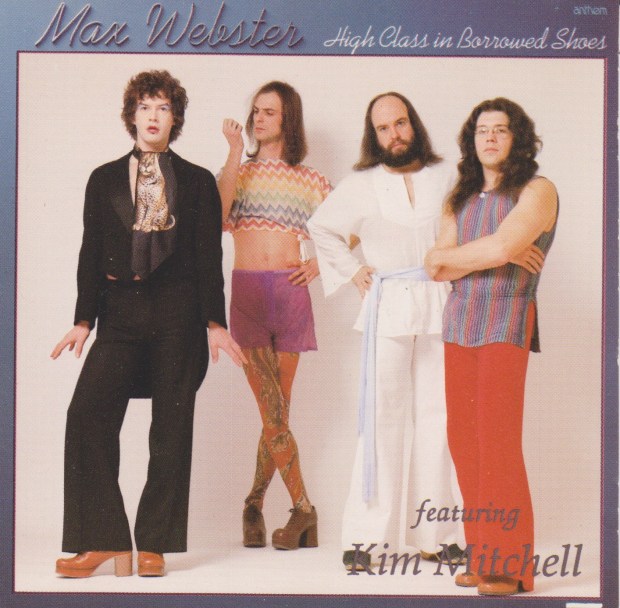
Scan_20150730MAX WEBSTER – High Class in Borrowed Shoes (1977 Anthem)

It’s only the second Max Webster album, but the band were so tight and perfect that they got three radio classics off it.  “Diamonds Diamonds”, “Gravity” and the title track are all three radio staples, and “On the Road” a live classic that Kim Mitchell occasionally plays unplugged.  Every fan has a favourite Max album, and I think I probably know a couple who would put High Class in Borrowed Shoes as numero uno.

The album opens with the impressive “High Class in Borrowed Shoes”, a blaster that sounds to me like a Canadian Van Halen!  Max had tamed some of their wackier tendencies (“Toronto Tontos”, anyone?) and focussed their chops.  Not that the new Max (now featuring legendary drummer Gary McCracken) was normal by any definition.  Just listen to the lullaby-like “Diamonds Diamonds”.  Great song, but very different for a rock band.  Its dreamlike mood is heightened by the surreal lyrics by Pye Dubois.  Not to mention there are only six lines to the words!

“Gravity” would make my top five Max tracks in a heartbeat.  “What do I know?  I sat under a cloud.  I looked up, afraid to look down.”  Kim sounds like a little boy speaking the words, to great effect.  The chorus is a big one, backed by a Kim’s riffing.  I have no idea what this song is about, but to me the line “Forget that fear of gravity, get a little savagery in your life,” says everything.  Don’t be afraid to take chances.  As Pye’s friend Neil Peart once said, just roll the bones.  That’s what it means to me, anyway.

Proving he has always been capable of tender ballads, “Words to Words” is one of Kim Mitchell’s first.  The keyboards of Terry Watkinson keep it just a little left of center, but Kim’s acoustic work is impeccable and excellent.   Pye Dubois’ lyrics are magical and stirring.  It’s hard to overstate just how quality this song is.  However ballads are usually best followed by scorchers, and that’s “America’s Veins”.  Killer solos, smoking drums, and a chorus built for the concert stage: it’s here in one complete package.

“Oh War!” is an incredible monument of rock.  AC/DC did a song with a similar vibe called “Little Lover”, but “Oh War!” is a completely different animal.  The gonzo solos are more in the “Z” section of the rock aisle, as in “Zappa”.   And check out the words!  “‘Cause I say fuck you instead of thank you, your choice under your breath.”  Yes, that’s what Uncle Kim, Canada’s favourite king of the summertime, just said!  OK, so it wasn’t going to get on the radio with those words…but damn, it should have been.  This song could have been almost as big as “Battle Scar” had it been.

I have a tape here of Kim Mitchell doing “On the Road” live in the MuchMusic studios, acoustically, on their Intimate and Interactive show.  This is what you might call “campfire rock”, but that sells it far too short.  “On the Road” is more than a song that would sound good played live around a fire, it has genuine soul that you can feel.  It’s an incredible song, and once again, I wonder why Max Webster wasn’t friggin’ huge.  “Rain Child” is next in line, which I would describe as a slow burner.  Terry Watkinson’s keys take center stage, never intruding.  “Rain Child” is a classic album track, and perfect for winding down the album.

IMG_20150730_182836

Max Webster went mad on the last track, “In Context of the Moon”.  This is the second of four “Moon” songs on the first four records:  “Coming Off the Moon”, “Beyond the Moon”, and “Moon Voices” are the others.  “In Context” can’t be described easily, because it spans many styles and tempos in just five measly minutes!  How?!  You have to play this one a few times just to get everything that is happening.  It’s certainly one of the most challenging pieces of music Max have recorded.  The four musicians must have rehearsed the shit out of this one.  Anyway, at all times, it smokes.  Whether it’s the bright intro guitars, or the metal riffs that follow them, or the sheer madness (including bass solo) that ensues, “In Context of the Moon” is always riveting.  It’s just non-stop even though by the time you get to the end of it, you’ll wonder how you got there!

Final note:  My good buddy T-Rev, who has guest written here a couple times before, met Gary McCracken after he moved to Sarnia.  He was working at Fastenal when in came a guy to pick up an “order for Gary McCracken.”  T-Rev pondered a bit before enquiring, “I hope you don’t mind me asking, but were in a band called Max Webster?”  Yes, he had.  It was that Gary McCracken, and he was cool.  I love little stories like that.  Gary McCracken was Trevor’s biggest influence as a young drummer!

Popoff's awesome book

Popoff’s awesome book

There is nothing more to be said in just a single review.   For the whole enchilada, get the book from martinpopoff.com!  And be sure to get High Class in Borrowed Shoes for your collection.

5/5 stars

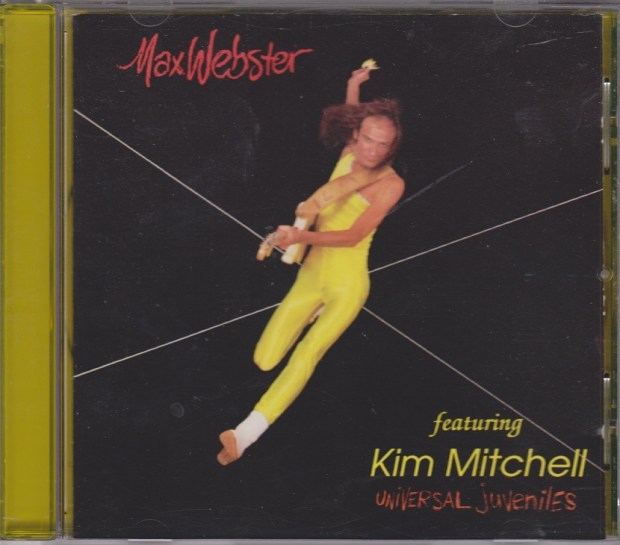
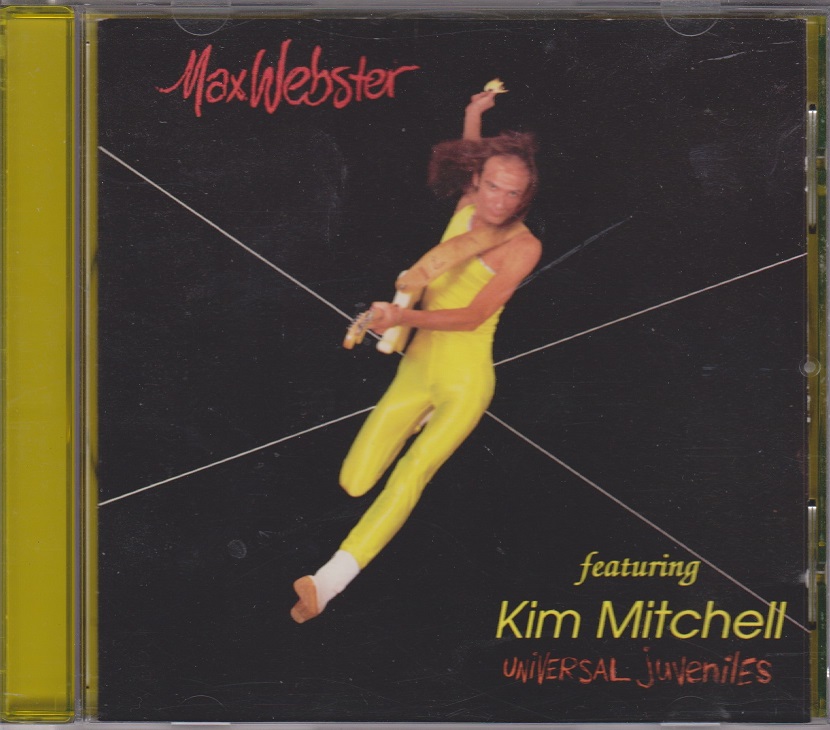
REVIEW: Max Webster – Universal Juveniles (1980)

Scan_20150717 (3)MAX WEBSTER – Universal Juveniles (1980 Alert)

“1980 will be a year long remembered.  It has seen the end of Max Webster, and will soon see the end of Led Zeppelin.” — Darth Vader

All good things must indeed come to an end.  If there was one band — just one band! — out of the Great White North that truly deserved better things, it was Max Webster.  Much like their soul mate, Frank Zappa, Max Webster had successfully inserted humour into complex progressive rock songs.  The big difference was that Max tended to keep it to guitar-bass-keyboards-drums.  Their musicianship was unimpeachable.  Much like Bubbles shouted out “Geddy Lee! Neil Peart! Alex Lifeson!” to emphasize the awesomeness of Rush, I shout “Kim Mitchell! Terry Watkinson! Gary McCracken!”

Maybe it was the skinny balding front man in the tights, the weird but deep lyrics, or the goofy keyboards.  One way or another, Max Webster never saw the success that their friends Rush did, and Universal Juveniles would be the last Max record.  Genius keyboardist Terry Watkinson was out of the band, although he did play on the album.  Kim Mitchell folded the band mid-tour after the record, unable to hack it any longer.

Kim’s smoking chops open “In The World of Giants”, perhaps the world that Rush occupied and Max failed to enter.  Max sound stripped back, with minimal piano and keyboards.  What a song though.  Surely “In the World of Giants” is one of Max Webster’s most breakneck rock songs, albeit with the complexity of riff and licks that you would expect.  At the same time, do I sense a certain amount of fatigue, between the grooves?

There’s no detectable tiredness on “Check”, which will wake you right the fuck up!  There’s nothing like a good, joyous, loaded-with-all-the-guitar-fixin’s Max Webster romp.  Want some shredding?  “Check this out!”  At only 2 1/2 minutes, “Check” is all it needs to be — in and out, the mission of kicking ass all complete.  Yet Max Webster was not about simply rocking, so “April in Toledo” brings some funk.  The classic refrain of “I wanna run to Niagara, I’ll cry and cry in the dark” is joined by gleeful guitars, to create the picture perfect mixture of Max confection perfection.  I’m still sitting here scratching my head wondering how Kim got that weird guitar sound in the solo so perfect, but I’m soon distracted by another awesome chorus.

“Juveniles Don’t Stop” is a Max party anthem; not as memorable as “The Party” itself, but still good to crank with some cold ones.  Don’t get too loaded though — you don’t want to miss the double barrelled blast that is “Battle Scar”.  What could be more epic than a duet with Rush vocalist Geddy Lee?  Oh, how about doing the whole song with Rush — a double trio!  That’s two bass guitars opening the song.  That’s Neil Peart and Gary McCracken providing the dual beats.  (You sure can tell when it’s Neil doing a drum roll, that’s for sure!)  That’s Alex Lifeson accompanying Kim Mitchell in a legendary guitar team-up.  Geddy Lee, in peak voice, provides the vocal chills necessary to top off such an epic alignment.  Truly, “Battle Scar” is not just an important song for Canadian rock, but a track that any serious rock fan should seek out and own.  You simply owe it to yourself to do so.

There’s some sneaky understated goodness in “Chalkers” but I find it to be one of the less memorable tracks.  It’s notable for containing the phrase “universal juveniles” in the lyrics, lending it for the album title.  “Drive and Desire” is a bigger song, a sizeable rocker with a nice bluesy vibe.  McCracken’s drums on this one are purely delicious.  Even better is the slow mournful “Blue River Liquor Shine”.  It foreshadows some of the songs on Kim’s excellent solo EP, Kim Mitchell.  A proud achievement, “Blue River Liquor” does indeed shine with Max classics of the past.

“What Do You Do With the Urge” is a wreckless Max party rocker, just in time to set us up for the final Max Webster song — the last one ever, sadly.  “Cry Out for Your Life” lurches like a wounded soldier crawling to the warmth of safety.  Loads of Max class abound, but there does seem to be less glee, less shimmer.  Perhaps the end was inevitable.  Although Kim and the gang turned in another jaw dropping Max Webster record, something was wrong and it sounds somewhat forced at times.

Kim Mitchell had tremendous success with his solo career in Canada.  Anthems such as “Go For Soda” have been immortalized in our memories, and on our TV sets.  Who can forget the moment in Season 7 of Trailer Park Boys, when Bubbles goes to “rock a piss”, and Ricky responds, “You go rock a piss, I’m gonna get ‘er going with the Mitchell!”  Then: Bubbles peeing to the tune of “Go For Soda”, bopping his head in time with the music!  Just classic.  On the more sentimental side, Kim appealed to the adults in the crowd with “Patio Lanterns” and “Easy To Tame”.  He really aimed to please everybody….

…Except the fans of old, goofy Max progressive rock.  Universal Juveniles is its capstone.

4.5/5 stars

REVIEW: Helix – Back For Another Taste (1990)

Epic review time!!


BACK FOR ANOTHER TASTE_0001

HELIX – Back For Another Taste (1990 Capitol)

Helix’s Back For Another Taste was easily their best album since No Rest for the Wicked. It was also their last for Capitol. As such it received a neat, very limited vinyl release with a special cover commemorating the last (planned) printing of Capitol vinyl. I wish I had bought it when I had the chance. I recall seeing it at Sam the Record Man (owned by Gil Zurbrigg, brother of original Helix bassist Keith Zurbrigg) in downtown Kitchener. I didn’t have a good way of playing records back then, so it didn’t seem worth it.

BACK FOR ANOTHER

Special release aside, Back For Another Taste will always be associated with some hard times in Helix. Brent “the Doctor” Doerner, with the band since LP #1, decided to move on from rock and roll. Although lead howler Brian Vollmer saw the departure coming, it still hit hard. Doerner stuck around long enough to record some rhythm guitars and solos for the new album. His brother Brian Doerner played drums on three tracks, as he often has on past Helix albums. (Helix mainstay Fritz Hinz played on the rest). The songs were written by Vollmer and guitarist Paul Hackman, with the exception of two. Vollmer took a trip down to the US to work with Marc Ribler who helped him hone his songwriting chops.

Helix presented themselves as a four-piece in promo photos and music videos, for the first time. Doerner would prove hard to replace over the years, with American Denny Balicki taking over for the tour. He was Helix’s first American member. He made notable appearances in a one-hour MuchMusic special called “Waltzing With Helix”, a documentary on Helix’s European tour with Sacred Reich, and opening for Ian Gillan. (Also in that documentary: a kid I grew up with in the neighborhood called Brian Knight. He was a Helix roadie at the time. Brian Vollmer misspelled his name in his book as “Brian McKnight“. Whoops!)

Back For Another Taste was produced by Tony Bongiovi, who gave the band a raw, more kicking sound in the studio.  It was clear from track one “The Storm” that Helix meant business again.  A mean sounding gritty groove-rocker, “The Storm” was unlike anything they’d done before.  It was a completely un-wimpy lead single and a surprising one at that, since it’s not a very commercial.  The new four-piece Helix sound great here, with Hackman able to really dig in and play, while bassist Daryl Gray gets more room to groove.

The really impressive track on the album was “Running Wild in the 21st Century”. When every other band seemed to be softening it up, Helix seemed to go full-on metal. An edgy music video featuring London’s “Snake the Tattooed Man” won Helix some acclaim and recognition. Snake was a friend of the band, and when the idea came up for a music video, Vollmer said “I know the perfect guy for this.” (I myself encountered Snake at the Record Store, in Part 118 of Record Store Tales.)

“Running Wild” is a killer track, pure Helix adrenaline with their trademark smooth backing vocals.  In the lyrics, Brian seems confident of rock and roll’s future survival. Once again Paul Hackman confidently handles the guitars, allowing his personality to really shine.

Right up the alley of old Helix rockers is “That’s Life”, a classic sounding tune that’s great for drinking to.  Just you try not having fun while hoisting a frosty to “That’s Life”!  But Helix are more than just a party band, always have been.  “Breakdown” is the long dramatic slow one.  Vollmer had been going through some rough times: divorce, having to work at a convenience store to pay the rent, getting mugged, and then heave-ho and re-locating to London Ontario.  “Breakdown” must come from those times, because you can hear the desperation and the determination.  This track is the closest Helix ever got to re-capturing the golden sound of their first album, Breaking Loose.  But you gotta end side one on a party rocker, doncha?  So “Heavy Metal Cowboys” is that track and it sounds exactly how you expect.   Hackman throws down some slide guitar for good measure.

The title track is quintessential Helix.  “Back For Another Taste” indeed, this track could have been right at home on Wild in the Streets.  It’s dirty and rocking, just like you like it.  The stretching out a bit, the pop side of Helix emerges on “Rockin’ Rollercoaster”.  I immediately noticed a higher rating on the 10-point Catchiness Factor scale (c), than other songs on this album.  But then it’s even higher on “Midnight Express”, a real singalong!   I really like these two songs, and even the ballad “Good to the Last Drop” really impressed.

Marc Ribler wanted to write a song called “Can’t Eat Just One”, but Vollmer found the title cumbersome, so he suggested “Good to the Last Drop” instead.  What came from this was a hit ballad with heaps of class and all the right ingredients – a solid 9 on the Catchiness Factor scale.  The music video received a swanky remix with extra keyboard overdubs, and that’s the version I go for.  (It’s on many Helix best-of’s, but not this CD.)


BACK FOR ANOTHER GRAPH


“Give It to You” wasn’t exactly a new song. An earlier version (more raw) surfaced on 1989’s Over 20 Minutes With…Helix compilation. I prefer the raw version, but it’s still a great dirty lil’ Helix number. “Pull the trigger of my honey gun.” Oh, Brian. “Special delivery, just for you!”

So Helix stretched out on this album a bit, and went back to their roots while exercising their melodic songwriting muscles. They went heavier, they went softer, they went dramatic, and they revisited some of their pop roots. What’s left? Faster, faster, faster!

“Wheels of Thunder” is probably the fastest, heaviest Helix track of all time and it closes Back For Another Taste on a killer note. Dr. Doerner handles the solo on this one, and Fritz is absolutely thrash metal mad. The only Helix track that might be faster is “Jaws of a Tiger” (also from Over 20 Minutes With…Helix), but we’re splitting hairs. What a ballsy way to end the album.

There were some cool singles available, but most interesting was the cassette single for “Good to the Last Drop”. That had an unreleased B-side, a song called “S.E.X. Rated”. This is a completely different version from the one that later appeared on the album B-Sides. This one has Paul Hackman, and that’s significant.

In July of 1992, Fritz Hinz was injured (slipped disc) and unable to tour, so Brian Doerner returned for a few western Canadian dates.  As a bonus, so did his brother Brent.  After a final date in Vancouver the band headed home.  Paul Hackman elected to travel home in the tour van with bassist Daryl Gray, while the rest of the band booked flights.  Hackman, not wearing a seat belt, went to sleep.  Then, according to reports, the van veered off the road and down an embankment when the driver fell asleep at the wheel.  Three men were thrown from the vehicle, and Hackman was killed.  Daryl Gray suffered minor injuries and flagged down help.  20 cars passed the frantic, bleeding bassist before someone stopped.

Back For Another Taste was Paul’s final recording.

5/5 stars

BACK FOR ANOTHER TASTE_0004

REVIEW: Helix – White Lace & Black Leather (1981 H&S)

Part two of a Helix three-fer!

HELIX – White Lace & Black Leather (1981 H&S)

Having already done it once themselves, why not do it again?  Once again Helix with manager Bill Seip raised the funds to record an independent album.  Drummer Brian Doerner was gone, replaced by Leo Niebudek.  On bass, Keith “Bert” Zurbrigg hung around long enough to record one new song (“It’s Too Late”).  He was replaced by the young, talented and troubled Mike Uzelac.  He was only 17 when he first joined Helix.  He told them he was 19.

Sticking to the same formula as Breaking Loose, there is really no deviation in sound.  Some members have changed but little else.  The band still managed to come up with enough good material to fill an album to follow the first.  I don’t know if the track “Breaking Loose” was a leftover from the first album or not, but quality-wise there is nothing “leftover” about it.  I would call it a typical Helix party rocker: a fast one, often used back in the day to open their sets.  The lyrics are the kind of thing that Helix were about:  the weekend!

“4 O’clock Friday afternoon,
Punch that time clock, now you’ll be home soon,
Your week’s all done, now it’s time to roll,
You’re like a time bomb about to explode.”

Vollmer reminds us “You only got two days, so make it last,” a philosophy I heartily agree with.  Brent Doerner and Paul Hackman lay down a pair of ripping guitar solos for the icing on the cake.  Then “It’s Too Late” is the kind of melodic mid-tempo rocker that their first album was loaded with.  Surely something like “It’s Too Late” could have worked on the radio, and I think that was the intent.  That takes away nothing from the song, which is classy with quality.

“Long Distance Heartbreak” at almost seven minutes is Helix’s longest song ever.  In the early days they tended to experiment with their songwriting, coming up with the odd mini-epic.  Like many Helix classics, this one reads as a road song.  Thin Lizzy they were not, but Vollmer captures the heartbreak in their lyrics while Doerner and Hackman take care of the guitar drama.

Helix get even more serious for a moment with “Time For a Change”, and “Hangman’s Tree” also brings a few issues to the table.  “Time For a Change” is sadly even more valid today.

“Everyday there’s a new headline,
Another war and another lie,
When will we learn to stop this killing while we can?”

It’s interesting that Helix didn’t seem to know their direction yet, but still infused every song with their bare honesty.  They were riding a line between a party band and a more serious, more experimental rock band.  In the end they chose the route that they were intended for, but that takes nothing away from these early songs.  “Time For a Change” and “Hangman’s Tree” are unexpectedly ambitious for a young bar band from Canada.  In each case, it is the guitar work that elevates the songs.

WHITE LACE

“It’s What I Wanted” lightens the mood, a mid-tempo rocker with a great melody. I don’t know why it is, but these melodic rock songs really sound like home to me. They conjure images of a more innocent time, when the world seemed smaller to me. They capture and bring back hazy, happy pictures of Kitchener in the late 70’s.

Brent Doener comes back with his only lead vocal on the track “Mainline”. Sounds like Brent was having no trouble getting satisfaction back then. “She keeps me happy, what can I say?” he sings, lamenting that his lady keeps him up all night and late for work in the morning! “Pick up my cheque at the end of the day, I find I’m down a couple hours’ pay.” So in essence, “Mainline” is about choices. You can either have tons and tons of sex at all hours of the day, or get to work on time. It’s your choice, people!

“Women, Whiskey & Sin” is pretty simple in its message. This smoking track is more like Helix would evolve on later albums like No Rest For the Wicked. “Ain’t no laws to hold us back on a Saturday night,” sings Brian Vollmer. (Hate to tell ya Brian, there actually are laws about some of the things you boys were doing back in the day!) Then “Thoughts That Bleed” is a proggy, slow closer with lots of dynamics, similar to how Helix ended the first album with “Wish I Could Be There”.

Ultimately there is no question that Helix made the right move to drop some of these softer, more progressive moments and focus on the heavy metal side of their sound. It got them signed to Capitol Records and secured their biggest hits. That leaves these first two albums as evidence of an earlier, more naive Helix willing to stretch out a bit more.

4/5 stars