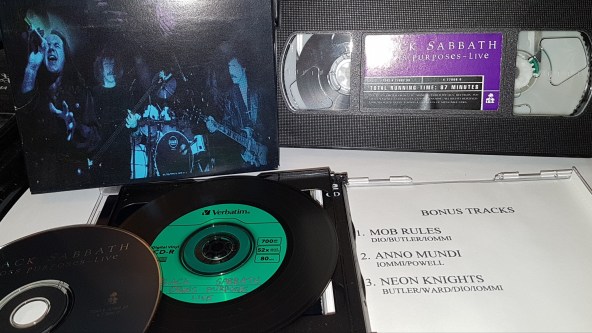
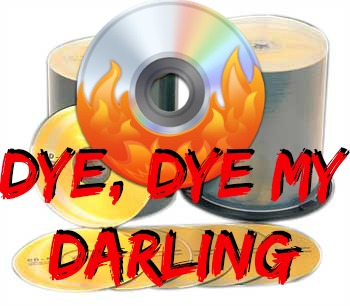
It’s quite complicated actually, but the basic idea is that data is encoded in binary “pits” and “land”. If you recall your grade 10 math, binary allows you to record any data in ones and zeros. In the CD world, this translates to “pits” and “land”. Think of the pits as zeros, and the land as ones. When you burn a CD at home, musical data is encoded with a laser. The laser doesn’t actually etch the plastic or metal layers of a disc. Instead, it burns the data into a layer of dye. It is this dye that gives a blank CD its typical colours. Once this information is properly encoded onto the blank CD, you can then play it on most household disc players. But they don’t last forever. The colour of the disc can be a clue how much life it has. It can help indicate what dye was used in manufacturing.
Cyanine dye (green)
These are the earliest blanks made, with a layer of dye that was also UV sensitive. Unfortunately this meant that your CD could be destroyed by exposing it to direct sunlight. The dyes were improved to make them more stable, but many people had their data destroyed simply by leaving the disc out, playing side up, where sunlight could get to it.
Phthalocyanine (gold, silver, light green)
A more stable form of dye. You’d have to leave your CD out in sunlight for two weeks to destroy it. Unfortunately phthalocyanine dyes are more sensitive to the writing laser, and these discs required some technical advances to make for a good recording.
Azo (dark blue)
Rated for a storage lifetime of decades. More stable than the other two dyes. It would take a month of sunlight to destroy an azo-based disc. Also capable of faster writing speeds than other dyes.
Because it would have been easy to look at a green CD and say, “Nope, I’m not buying this one,” disc manufacturers tricked you by adding other colours to the dyes. But the type of dye is only one factor in how good your CD sounds and how long it lasts. A CD is like a sandwich made of plastic with layers in between where the data is stored. Poorly manufactured CD-Rs allow moisture to seep in between the layers and destroy the disc. And of course the quality of the burner is also critical to a good sounding CD-R. And be careful if you’re labelling your disc with a marker. Sometimes solvents from markers can react with the dyes.
In very rare cases, CDs and even DVDs have been known to explode during burning, according to a New York Times article from 2004. It happened when a disc was spun too quickly, probably as a result of heat from the burning laser combined with centrifugal force. This is why the upper limit for burning a CD is 56x. Go faster than that and your music could go BOOM (and not in a good way).
A re-writable CD is different still from a dye-based CD-R. A CD-RW (which can be re-written thousands of times) uses a metal alloy layer that is physically liquefied by the laser. It’s crystalline before burning, but less reflective after burning. Therefore a CD-RW has pits and lands made of more and less reflective spots on the disc. And if you don’t like it, you can start all over again. The laser re-heats the alloy, restoring it to its crystalline reflective state.
It’s all very technical and interesting, but how often do you record a CD today? Though burning a CD will always be a pastime for many music fans, the majority have happily moved on to easier and quicker flash storage. Is that as fascinating as a laser etching your music onto a disc? No, but however you handle your music collection is up to you.
Note: This tale is from 1996 and does not reflect current tech.
GETTING MORE TALE #504: Waiting
The store that I managed for the longest period of time was opened in April of 1996. The format was 95% used stock, about 5% new. It was fun being a part of the cutting edge in retail.
When we opened that store, we were inundated by customers who had never heard of us before. Every day for months, somebody would wander in who had never been in one of our stores before. It was cool. We were different, and we wanted people to know it. We were eager to promote our special features and strengths, such as our listening stations and reservation lists.
The reservation list caused a lot of confusion among new customers.
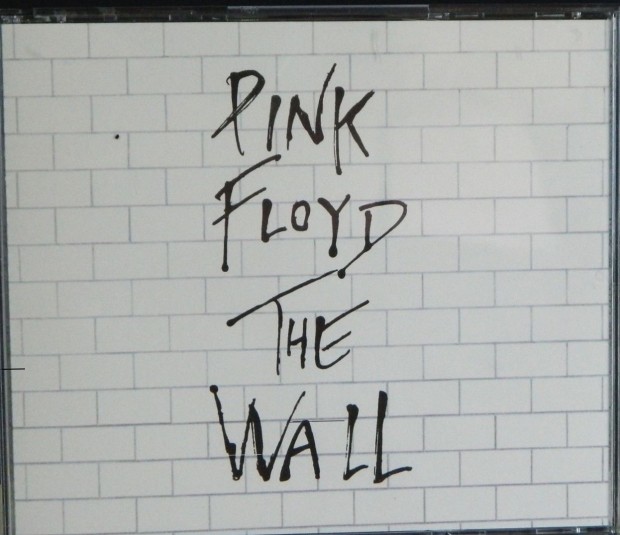
Here’s how it worked. Let’s say you’re looking for a CD that is hard to find used – Pink Floyd’s The Wall. That one was expensive brand new. Usually it ran for about $33.99. Customers would much rather pay less, so they put themselves on our waiting list. At the time we opened, the waiting lists were for that store only. We didn’t have the ability to share our waiting lists with other branches yet. This was still a massive improvement over the old system: a notebook with phone numbers and titles written in it. (There were lots of names and numbers with the title “any Beatles”.)
The list operated on a first-come, first-served basis. If you were the very first customer to put their name in for The Wall back in April ’96, then you would get dibs on the very first used copy that came in. If you were second, you’d get the next shot at it, and so on and so forth. What seemed to confuse my early customers the most was “Where do these used CDs actually come from?”
There was no magical land of used CDs. There was no massive warehouse from which to pick and choose copies of The Wall in various conditions. There was no place from which to order used CD stock like you could with new. If there was a Used CD Magic Wonderland, then it was in your basement, because the only way we received our stock in those days was via the customer. If a customer came in and traded a great condition copy of The Wall, then congratulations – the first person on the waiting list received the first call.
On down the list we went. If the first person no longer wanted The Wall (a frequent occurrence) then we’d go down the list to the second person. We would phone each customer and give them a week to pick up their CD. Unfortunately most customers who no longer wanted the CD never bothered to tell us, so it would sit there for a whole week before we could put it back in the hopper. We wiped out our entire waiting list for Last of the Mohicans (Soundtrack) with just one copy, because none of the reserved customers wanted it anymore. There were five names on that list, and then suddenly none!
So: reserve a CD, and we would let you know when one was traded in. This doesn’t seem like it should be hard to understand, but apparently for some it was.
One upset customer came in about two weeks after reserving a rare CD. “Is it in yet?”
I checked. “No, it’s not in stock, but since you have a reserve for it, we’ll call you when it does show up.”
“When’s that going to be?” he asked.
“Hard to say,” I responded, trying to answer his question. “Whenever someone trades one in, which could be tomorrow or it could be next year.”
Then he bellowed, “What do I have to do to get this thing to come in?!”
Sometimes, I just didn’t know what else to say.
“You don’t have to do anything,” I said, not sure how to explain this further. “Somebody will get tired of their copy, or just need the money. If they sell it to me, you’ll get a phone call right away.” Then, feeling a little snarky, I added, “Unless you know somebody with a copy that you can talk into trading it in to us.”
There was actually one nearly-surefire way to guarantee a used CD would come into stock. T-Rev discovered this, inadvertently. Somehow, any time either of us bought a new CD that we’d been hunting for, suddenly a used copy would show up in store. Sometimes on the same day. This happened more than once! I was there when it happened with a Primus CD he was looking for. (Wish I could remember which one.) It was eerie.
Everything has changed today, obviously, and now you have access to the world’s inventory from your PC. It’s hard to imagine there was once a time when you (gasp!) had to actually wait to find a used copy of The Wall!
GETTING MORE TALE #476: Won’t Get Fooled Again (the long-awaited sequel to Record Store Tales Part 225: Bait & Switch)
“I knew immediately there was a problem. In his hands was a used copy ofPuff Daddy’s brand new smash hit album, No Way Out. It had one of ourBargain Binstickers on it, priced at $5.99. However the album was a fairly new release, and any used copies we had were always priced at $11.99. I’d never put one of them in my Bargain Bin, ever at this point. You just didn’t throw a new release into a sale bin. As Puffy said, ‘It’s all about the Benjamins.'” — from Record Store Tales Part 225: Bait & Switch
We had a deceptively simple inventory system at the Record Store. Each used CD case was empty. Every one of them was tagged with the price, and a number that would tell me the location of the actual compact disc behind the counter. This system benefited both our point of sale computer, which updated our inventory live in real time, and it was also a security bonus. With compact discs safely stored behind the counter, thieves knew they would get nothing by stealing a case. We made it obvious, by posting large ALL CASES ARE EMPTY signs. The bastards had to get creative when ripping us off.
In the Record Store Tale above, a scam artist got away with it. I wasn’t going to let him, but the owner didn’t stand up to the guy, called it a misunderstanding and let the guy have a discount. The scammer switched price tags, without realizing that the number code on the tags lead to a specific disc. When boss gave the guy a discount, it made me feel about two feet tall. I never let that happen again.
My new strategy was quite simple and it worked every time. When the first guy ripped us off, my big mistake was explaining to him that somebody switched price tags. That got him on the defensive and he had already prepared his argument regarding bait and switch laws. I got smart after that, by playing dumb.
The most memorable occasion involved a douchebag in his mid-20’s, and a rap title. I cannot remember today what the rap title was, but the CD itself was very brightly coloured and easy to spot. Buddy came up to the counter with a CD case, and the price tag looked tampered with. They never quite looked the same once peeled off and re-applied, and years behind the counter taught me that. Sure enough, the number on the price tag led to me the wrong compact disc. I checked out the locations of the discs in the computer and confirmed the guy had switched a tag. He wanted an $11.99 CD for $7.99, but it wasn’t going to happen on my watch. I pretended to look for the disc, but I had actually already grabbed it and put it aside. The price tag that he swapped it with, the $7.99 CD, was alphabetically right next to the other one. It was obvious he just grabbed two nearby and switched prices. I was taking time figuring this out though, so I had to tell him why.
“I’m sorry man but I’m having a really hard time finding this CD,” I explained. “Each price tag has a number on it that tells me where the disc should be, but it’s not in this spot. I’ll keep looking.”
As earlier explained, the compact disc I was supposedly looking for was a bright one, easy to spot. What I didn’t count on was this dude has already seen it behind the counter in its location. But what he didn’t count on was that I had since yanked it and hidden it out of sight! From the right vantage point, you could have spotted it, but it was gone now.
“Are you sure?” the scammer asked. “I think it’s right over there,” and he pointed me in the general direction. I put on a good act of looking, flipping through every disc but his. “I’m sure I saw it right there.”
“Can you show me?” I asked, knowing it wasn’t there. I don’t know if he figured out my game or not. He probably had. But there was nothing he could do about it. “Is this it?” I pulled out a disc with random artwork on it. “No, but I saw it right there, in that spot that is empty now.” Yeah, he caught me.
“I’m really sorry but it’s not there. I’ll keep looking. Why don’t you give me your name and phone number? I’ll call when I find it. I’m sure it’ll turn up.”
If loyal readers know one thing about LeBrain, it is that he owns a lot of CDs.
A LOT.
I haven’t done a count in ages and I’m giving up on keeping track of these things. I estimate over 3000 CDs are in inventory currently. Add to that a few hundred tapes, LPs, DVDs and other miscellaneous musical formats.
For Christmas this year, I received a number of Deep Purple releases. Some of these releases would presumably replace older Deep Purple discs in my collection. For example, I expected the 5 CD box set Hard Road 1968-1969 to replace thefirstthree Purple albums in my collection, and I could retire those discs permanently. This was not the case. I began checking, track by track, and it turns out the individual CD versions have tracks that are not on the Hard Road box set. “Hush” live from US TV is one such track. There are also BBC Top Gear sessions on the remastered CDs that are not on Hard Road, but I believe all of these are duplicated on yet another Deep Purple CD, BBC Sessions 1968-1970. On top of all that, there is another CD called The Early Years that covers the same ground, but it too has one exclusive track on it. That is an alternate take of “Kentucky Woman” that I don’t have elsewhere. This is crazy! How can anyone keep track of it all?
I’ve been ripping all the CDs in my collection to the computer in bits and pieces for a couple years. It didn’t have much rhyme or reason. If I wanted to listen to something, I ripped it at that time. If it was a new arrival, I’d rip it to PC on first listen. This Deep Purple situation got me to go over my entire Purple collection, looking for duplicates and redundant releases. (I didn’t find any.) This in turn prompted me to get the rest of my Purple albums ripped and digitized for good. This has turned out to be a monumental task.
My Deep Purple folder had 74 sub-folders in it, each one an album or a disc from one. That’s a lot of Purple. So how many did I have still to rip?
At first count, it was 64 more discs. That includes 12 discs from a box set called The Soundboard Series (the second of two 12 disc live Purple box sets I have!). It includes all the multi-disc sets I got for Christmas. With the exception of the Hard Road box set, these are all live discs, and all official releases! Then, I had to adjust my count. I found two more box sets tucked away (as box sets sometimes are, due to their odd shapes): On Tour MCMXCIII (4 discs), and Live Encounters (2 CDs, plus 2 DVDs too). Last week, a double live from Japan arrived at LeBrain HQ, called Live in Verona. Up that count to 72 more discs. So far, I’ve ripped 25 of them.
This isn’t even all the Deep Purple I have left un-ripped. I have some things that I don’t particularly need to listen to. The 3 CD Live in Japan was a great package for its time. It contained a remixed and expanded version of Made in Japan. While I always want a unique official remix in my collection, just to have it, I don’t need to listen to it since it has been usurped by the remixed (again) 4 CD deluxe Made in Japan. Who cares about a remix they did in ’93? Obviously I only care enough to keep it (for “completion”), not to play it. There are more like that, such as an earlier mix of California Jam that has since been replaced by a better, more complete version.
Now that you have a glimpse at what Obsessive Compulsive Disorder looks like up close, I’m sure you have one specific question.
“How many versions of ‘Smoke on the Water’ are there?” Well, it appears that I have 63 versions on CD. 63. Different. Versions. Of. “Smoke on the Water”. By Deep Purple. None of these are covers by other bands.
This, folks, is a shat-ton of Deep Purple! Won’t you join me each day this week for some live Purple action?
GETTING MORE TALE #457: Making the Best Buy (Or, making lemonade from lemons)
In Getting More Tale #326, we lamented that the once-mighty retail chain Best Buy isn’t what it used to be. This time, we’ll take a look back at the store’s history.
Who doesn’t love those fact-filled Uncle John’s books and calendars? Here’s the entry for December 2 2015. Before reading this I had no idea, nor did I really care how Best Buy started. Uncle John changed my tune:
Scan from the Uncle John’s 2015 desk calendar.
Back at the Record Store days in the early 2000’s, the Boss was bracing for a new Best Buy store to open nearby. He figured that we’d probably feel some short term pain, but in the long term the store should draw more customers to the area and we’d benefit from their presence. He also strongly encouraged us not to shop there, a big US chain edging into our turf.
I tried to avoid shopping there at first, but the convenience was too much to resist. When I needed printer ink, computer supplies, or a new movie release, they were right there, and they usually had everything I came in for. That made it hard to avoid. I still tried to shop locally — I remember making special trips to Steve’s TV in Frederick Mall to buy the Star Wars trilogy on DVD. Between big items like TV sets, and small ones like candy, I know I have easily spent thousands of dollars at our local Best Buy stores. They also had hard to find items, such as the rare ZZ Top box set that came in a little box shaped like a barbecue shack (Chrome, Smoke & BBQ). The guilt felt for shopping a big US conglomerate was tempered by the savings and convenience.
That was then. As mentioned in chapter #326, Best Buy took a serious dump a few years ago. Still, a few weeks back, I had the chance to stop by one with my friend and sometimes contributor, Thussy. We had an hour to kill before a work dinner, so we popped into Best Buy, prepared to spend money if they had something we wanted. We spent an hour in the store, but no dollars.
The one thing I would have bought would have been the new Adele CD, 25, for my mom. (Yes, it’s for my mom.) I know Best Buy pretty much cut audio CDs from their stores completely, but hey, it’s Adele. Worth a try, right? Even my grocery store has the new Adele. Best Buy did not have the new Adele. I wasn’t really surprised.
We were tempted by some of their blu-ray deals. We saw a reissue of Monty Python and the Holy Grail, which I have already bought thrice, no more no less, over the years: VHS, DVD, and special edition DVD. This new version was a blu-ray, with the same features as the DVD, but a neat little castle set and plastic animals to catapult over it. Very tempting indeed. But both of us said no. We survived their $7.99 cheapie blu-ray bin without spending a penny. The only thing that was almost a serious temptation was that new remote controlled Star Wars Sphero BB-8 toy. It was $180, and it is definitely a neat little toy. But what the hell was I going to do with it? With a big record shopping excursion in Toronto on my horizon, the $180 would be better saved.
It was a pleasant trip to Best Buy, and we marvelled at all the new televisions and gadgets. We were asked by one pleasant employee if we needed any help, and only once, which is exactly how you want it.
Best Buy, what happened to you? Obviously, their story didn’t end with opening 1000 superstores. They continued to grow, by acquiring other electronics and music retail chains, such as Sam Goody. Their presence in Canada was felt in 2001, when they bought out our own, similar chain: Future Shop. That’s when they began horning in on our territory, and freaking out the Boss. They continued to expand and acquire, and their services such as the Geek Squad became household names. It seems this is where Best Buy and I parted ways, as they focused more and more on electronics, and less on the media that I often came in for. They bought mobile phone stores and services, and became the first non-Apple distributor of the iPhone in 2008. Phones, game consoles and tech support took over the spaces once designated for music. Meanwhile online, Best Buy’s on-demand movies, improved web sales services, and quick delivery began to dominate. I bought my laptop online, and it was at my door to me a few days later in the post. Around 2010 however their sales began to dip, but Best Buy shed some weight in order to continue to survive.
It just hasn’t happened with much of my help.
This year, Best Buy’s Canadian acquisition Future Shop bit the dust. I hadn’t done much shopping there lately either, for the same reasons as above. The two stores were all but identical, and sometimes existed side by side! It was no wonder they shut their doors. Others re-opened under the Best Buy banner, but it was a major hit for the company.
I think Best Buy will continue to exist, but as online ordering and home delivery becomes the norm, I think the stores will be able to shrink in size and survive. Large items like televisions might remain in-store for customers to try out, or to pick up after ordering online. Small items like movies might be phased out altogether, since Amazon’s own home delivery is the king of convenience.
I will continue to watch Best Buy, and sure, I’ll be cheering from the sidelines. I would very much like to buy something cool at a great price from them again, some day.
RECORD STORE TALES MkII: Getting More Tale #415: B-Cards
One of the least practical formats that I saw during the Record Store Days was the B-Card CD. A B-Card is the same as a CD-ROM, and works on any standard CD-ROM player, but was the size and shape of a business card. The idea was that business people could order B-Cards instead of regular business cards. This would be a striking alternative, in tune with the tech-savvy 90’s. It was a way to appear on the cutting edge.
A B-Card could hold up to 100 MB of data. The disc was rectangular, about 90mm x 55mm, but with a circular silver CD portion in the center of the disc. The readable part of the card was smaller than even a 3” CD single. You could still encode anything you wanted on the disc, from audio to video to slideshows and text. Instead of handing someone a business card with your phone number on it, you could give them a card with that and a visual presentation of whatever you were selling. From that point of view, it was a pretty inventive idea.
Where the B-Card failed was physical storage. As any music fan knows, CDs scratch up very easily, especially when in physical contact with another material. Plastic sleeves were the worst. Nothing scratched plastic discs worse than plastic sleeves. And guess what B-Cards often came packaged in? Plastic sleeves. There were larger plastic cases available, hinged to open and protect your precious B-Card, but nobody carried them because they were too thick for a wallet.
Lord of the Rings “Gollum” B-Card CD-ROM
I had one business man come into the Record Store with a scuffed up B-Card that no longer worked. He asked me to fix it for him, but I could see easily with just a quick glance that it wouldn’t be possible. The plastic sleeve had worn off the protective top layer of the CD in spots, creating massive top-scratches and pinholes. When that happens, there’s nothing for the laser to read and it comes up with errors or skips. He was very unhappy that his B-Card was toast.
I explained to him that it was the plastic sleeve itself that had ruined the card. This did not make him happy. I showed him how a CD should be properly stored (in a protective jewel case) and his response was “I’m not going to carry that around in my pocket!” That was the first major flaw with the format. It was small and portable, but not easy to keep safe without bulking up with a proper case.
The other problem with B-Cards was the rectangular shape. This unusual shape meant that it might encounter problems being played. The weight of the disc wasn’t evenly distributed. You could not play them in many tray or slot-based readers. They were the same idea as a shaped CD, which were popular novelty items at the time. These came with warnings that they could not be played in all players due to the shape, and the ominous message that the manufacturer would not be responsible for any damaged equipment.
I’m glad that B-Cards have gone the way of the Dodo. My mikeladano.com cards are printed on regular paper – and that’s fine by me!
RECORD STORE TALES MkII: Getting More Tale #393: Format of Choice
What is your audio format of choice? Which is the one that makes up the majority of your collection?
In addition to occasionally speaking in the third person, LeBrain has specific wants and needs in his music collection. I have a fast and loose set of rules when it comes to choosing the format on which I buy new music. Some prefer the ease and speed of downloading from iTunes. Others prefer the so-called “warmth” of vinyl. How do you decide what formats to buy your music on?
Here are my collection priorities:
#1. Compact Disc
99% of my collection is on CD. I have many reasons for this. One is the superior sound quality: a CD just sounds better than an mp3. A CD won’t crash like a hard drive. The oldest CDs in my collection are over 25 years old, and still look and play perfect. They have always been stored in their CD cases after use, in a cool dry place. They do not suffer from CD rot, which is a deterioration of the aluminum layer inside a CD due to oxidation. The discs may not last 100 years, but I am confident that most if not all will be enjoyed through my lifetime. CD rot can be minimized or prevented just by handling your CDs correctly.
I have chosen CD as my #1 format for other reasons other than longevity. They are easily transferred to mp3 for better portability (they are already easily portable). Playing mp3 files in a mobile environment like my car can only extend the life of the source CD. Also, compact discs are easy to store and just look cool when all lined up in my collection!
I buy almost all my CDs online now, and they ship fast and easy. Most of the time the packages will even fit in my mailbox, saving me a trip to the post office! For these simple reasons, CDs are the lion’s share of the LeBrain Library.
#2. Vinyl
Today’s vinyl LP has been around since 1948, and even then the technology wasn’t new. It merely updated and standardized something that had been playing on gramophones for a couple decades. They used to be made out of substances such as hard rubber and shellac, but vinyl proved to be versatile and enduring.
Since vinyl has been around so long, and couldn’t even be killed off by the cassette or compact disc, it is safe to say you should always be able to buy something to play an LP. However, an LP doesn’t have the longevity of a CD in terms of a long playing life. Your CD laser never makes contact with the plastic, but your stylus does contact the surface of the vinyl. The force of friction means that every play will wear down your LP, even if it’s only microscopically. The key is to use good clean equipment and records. If you do, a record will outlast a temporary format such as VHS or cassette tape. Minimizing friction-causing dust particles extends the life of both LP and needle.
For all these reasons, vinyl is my second priority in format collecting. They are bigger and take up more room, but when I want the warmth of an LP or just bigger cover art, there is only one way to go. 180 gram vinyl is especially nice to hold and listen to. For buying old albums affordably, vinyl is a great alternative to CD. Some old metal albums have had limited CD releases in other territories, making them expensive and hard to get once they go out of print. Vinyl can be a cheaper alternative for your collection.
Vinyl bonus tracks are a slam-dunk reason to buy an LP. Alice Cooper’s Welcome 2 My Nightmare is a great example of an LP that has a track unavailable on any other format (“Flatline”). And of course Jack White took the idea of LP bonuses to the ultimate level with his “Ultra LP” version of Lazaretto.
#3. Digital download (mp3)
I hate paying money for something that does not physically exist. If I have to, I will, but I only “have to” when there are bonus tracks unavailable on any physical format. Given the choice and the money, I will always buy the physical version, not just 1’s and 0’s floating around on a magnetic hard drive. I hate that you (usually) don’t get any info or liner notes with an mp3. I hate that your hard drive just needs to have a nice crash for you to lose this music that you paid for. I understand the convenience, but digital downloads do not service my needs.
I know there are high quality download formats such as FLAC, but that still doesn’t solve the problem of not being on a physical format that won’t crash, and my issue of paying for a non-physical entity. I also know that a lot of people don’t care about these things, and I wanted to understand why. I asked one reader why he prefers his iTunes:
“Here’s my deal: At the time when iTunes first came out, I had three young daughters. Getting to the record store (when there were record stores) was tuff to say the least, let alone the cost as well! I just couldn’t drop $20 all the time. Sure, I made exceptions and I bought actual product like Maiden and Rush, but iTunes became my way of music buying. Especially re-buying albums I had owned on cassette or vinyl. I just re-buy them on iTunes and download straight to my iPod! Now that my daughters are teens, I have just stayed the course with iTunes. I pre-order product from them, like the latest Priest, and the Van Halen live album. Convenience is just the way of life for me now! Don’t get me wrong though, I would still enjoy buying the actual product, but man it does boil down to affordability! iTunes delivers that and I can stay current with adding to my dinosaur rock collection! Ha!”
#4. Cassette
Once the mighty majority of my collection, cassettes have been reduced to a mere novelty. I treasured them for portability and convenience, but now I loathe them. I debated putting mp3 last on my formats of choice, but the truth is, cassette is far worse.
Cassettes have several things going against them. The first is moving parts. A CD or LP requires no moving parts, but a cassette has spindles and rollers that rub against and wear the magnetic tape. Sometimes a cassette’s parts can be too tight inside, causing it to warble when you play it. But it’s the analog tape itself that is the real problem. Even brand new, a cassette will not sound as rich as an LP because it’s not capable of reproducing the same range of frequencies. A cassette has a built-in high level of static noise. Then once you start playing it, magnetic particles begin to wear off. In fact over time, tapes will degrade to be unlistenable, no matter how well you take care of them. Even worse, record companies used the worst quality tape for their releases. If you bought a cheap blank Sony tape, you would have better quality than a store-bought record label’s cassette.
The poor sound and lack of longevity are the two main reasons I’m still replacing all of my old tapes with CDs and LPs. Anybody got a copy of Bonham’s Mat Hatter on CD for me to upgrade to? How about Wolfsbane’s first? Still looking for those!
#5. Miscellaneous
Not really ranked last, I just wanted to mention other formats that I own music on.
5.1 surround sound can’t be encoded on a standard CD, so DVD and Blu-ray have to step up to the plate. I have several Rush, Queen, Black Sabbath and Deep Purple albums (among many others) that have been given official Quadrophonic or 5.1 surround mixes. Often, these mixes include bits of music that are not in the stereo versions, such as guitar solos and fills.
The problem with DVD and Blu-ray is that I only have one home theater system. I only have one place, one room in the house, where I can listen to these special albums. I can’t play them in the car, on a walk, or at the cottage. As such, a Quad or 5.1 release gets limited listens at Chez LeBrain.
How many people are there like me? Let me know your favourite formats in the comments section!
RECORD STORE TALES MkII: Getting More Tale #378: “Kick it Kevin, do something Kevin!”*
If you’re like me, then you absolutely hate it when a piece of your valued technology goes on the fritz. It happens frequently enough. Something stops working, and you try to get it functioning again. For men at least, our first reaction is usually to give the malfunctioning piece of tech a good whack. You might give it a swift kick, cross fingers, and sometimes that’s all it takes! Kick it, and it’s suddenly back to life. A loose connection, perhaps. Or maybe there’s something mystical about the art of kicking something to make it work again. Whatever the case may be, fixing one of our modern tech items by ourselves is becoming increasingly more difficult today. Certainly, a kick rarely works anymore. All of us will have to replace at least one tech item in our households this year. Be it your audio device, stereo component, TV, gaming system, computer, or even just your microwave, everything we buy today has a built-in short-term lifespan.
When I was working at the Record Store, it seemed that at least two of our seven CD players were always broken at all times. When the main store player broke, we’d swap it out with one of the customer listening station players. Disc players don’t seem durable anymore. Yet somehow I still own my mom’s original 5 disc CD changer from 1991 (a Sony about the size of a battleship), and it’s the most reliable player in my home. It’s probably also the oldest piece of tech in the house. That old Sony keeps on ticking, no kicking required. Every once in a while it needs a good cleaning, but then it’s good to go once more.
Here’s another interesting fact about my Sony. It’ll play anything. Be it a DualDisc or an old cheap Canadian independent CD from the early 90’s, it can play it. Neither my PC nor laptop will play those things without an annoying amount of artificial digital noise. My 24 year old Sony will.
That one CD player aside, everything else here seems to constantly be on the verge of collapse! I had to buy a new blu-ray player last spring. The old one refused to boot up anymore. The original wasn’t a cheap player: I paid almost $500 for it, in 2010! I was beyond upset when I had to replace it (with a $120 Samsung from Walmart) but the new player has all sorts of bells and whistles built in that the old one didn’t! The ability to play Netflix, Youtube, or video files off a flash drive were all new to me when I bought it; the old player couldn’t do those things. (I almost feel like I should have waited before making the switch to Blu.)
More than just the Blu-ray player, everything else here busts eventually. Both Jen and I have owned Hipstreet brand mp3 players that broke within mere weeks. I had to replace my car stereo two years ago (I drive a 2010). Speaking of car stereos, two weekss ago my left door side speaker started cutting in and out! The following week, it died altogether. I gave it several good solid boot kicks, but it did not help and I had to have it fixed to the tune of $200. A similar problem happened in my old Plymouth Sundance. The left door speaker blew but the car was on its last legs and it wasn’t worth spending money on. T-Rev came over one night to help me pry the door panel off; we were hoping it was just a wire that came loose. We never figured it out, but we did damage the door panel in the process. I never want to pry off another door panel.
Let’s not even talk about computers! I’ve had to replace more power supplies, fans, cards, routers, monitors…hell, just last week, one of the ethernet ports on my router died. No idea why, it’s just one of those things that happens, isn’t it? The nice thing though, about being forced to replace something like that, is that you are almost certain to be upgrading every time. Since the technology becomes fancier over the years, if you blow a hard drive you’ll most likely be replacing it with a bigger and faster one.
Faster, sleeker, tricked out…technology keeps getting more exciting, but more disposable. When I was a kid, it didn’t seem that way. Each family had a VCR…that was their VCR. They didn’t go and buy a new and better one every two years. Each kid had a ghetto blaster. That was their ghetto blaster…it was expected to last many years. If it broke, you fixed it or got it fixed. That’s how it went. Today, we go buy a new one, and pay a recyling fee to throw out the old. Seems to me like it’s not the technology that’s broken, it’s this disposable culture we live in.
* The title refers to an on-stage meltdown by the band Extreme last year. Their own technology went sour and they were having sound issues all night. Nuno walked off stage…Pat walked off stage…leaving singer Gary Cherone and drummer Kevin Figueiredo up there trying to play “Get the Funk Out” by themselves. After Cherone begging “Kick it Kevin, do something Kevin!” the drummer too left the stage, leaving everyone in puzzlement.
In Getting More Tale #347.5: Days of Christmas Past, you may recall our good buddy Aaron sent me another Mystery Aaron Mail (M.A.M.) parcel. It finally arrived, several days behind schedule, but safe and sound which is the main thing. With Aaron’s encouraging “Give’r!” I tore into the packaging, to discover the treasure seen below.
Raise the Dead – Live From Wacken is Alice Cooper’s latest offering, one I had been excited to get! One thing you have to credit Alice Cooper with is changing up his setlist tour after tour. No two tours offer the same highlights, hits and surprises. At a glance, I can see this 2 CD/1 Blu-ray set contains the following interesting choices: “House of Fire” from 1989’s Trash, “Caffeine” from the recent Welcome 2 My Nightmare, the favourite “Department of Youth” from the original 1975 Nightmare, and oldies-but-goodies “Killer”, “Dwight Fry” and “Go To Hell”. This is rounded out by numerous covers, perhaps from Alice’s soon-to-be-unleashed covers album? “Break On Through” outta be good.
Finally this is Alice’s last release with Orianthi on guitar, who has since split to play with Richie Sambora. I’m glad she has been captured live in concert in hi-def on Blu-ray. Thank you, Aaron, for this gift! The 2 CD format means that I can listen to it in the car, and the Blu-ray gives me Orianthi in 1080i hi-def, according to the specs! There’s also a 20 minute interview and 5.1 surround mix. Gonna be a rockin’ Christmas if this is any indication!
This slideshow requires JavaScript.
This last set of pictures is a Christmas gift to myself, from myself! I ordered this guy back on November 11, and he only just arrived today. His name is Ratbat, and he is the Decepticon fuel auditor. In the Marvel comics series, Ratbat emerged as a bureaucrat on Cybertron who eventually came to Earth and took leadership of the Decepticons, a title he held for 11 issues of the series. For this reason, and for the reason that he transforms into a cassette, he is always high on my collecting priority list. I have a Masterpiece edition Soundwave figure, and I had five of his cassettes. All but Ratbat. Ratbat was only available with a special black Masterpiece Soundwave figure called Soundblaster. Although I would love to, I can’t afford to buy the same toy over again in a different colour just to get Ratbat. So I figured I’d never get one.
My buddy Jason then suggested I check out some the sellers on eBay, selling KO (knock-off) Ratbat figures. Knock-off figures are exactly what the sound like. Somebody copied the mold and made their own figures. Some are shit quality. Some are much better. Ratbat is one of the figures. There are two flaws in the paint of the cassette, but I’ve bought official Hasbro and Takara items new out of the package with similar flaws, so I can’t that’s particularly troublesome. There was also a teeny tiny extra bit of plastic in the jetpack assembly that I had to lightly shave down in order to transform nice and straight. Again, this can happen with a KO toy, but it can also happen with official Hasbro toys too. Ratbat (KO) came with no box, but did come with a microcassette case, and only cost me $20 plus shipping from China. MP13B Masterpiece Soundblaster, the official Takara release including Ratbat, is “on sale” right now at Big Bad Toy Store for $129.99, plus shipping. I think I made a good choice. Here’s Ratbat with Soundwave and all his cassette buddies!
It’s finally done! Enjoy this video souvenir from our (Mike and Aaron) 2014 Record Store Excursion in Toronto .
Of the albums I bought in Toronto, one stood out as an immediate killer. Just an awesome disc, that I’ll be reviewing tomorrow. See if you can guess which one blew me away.