classic rock

REVIEW: The Black Crowes – Shake Your Money Maker (2021 deluxe edition)

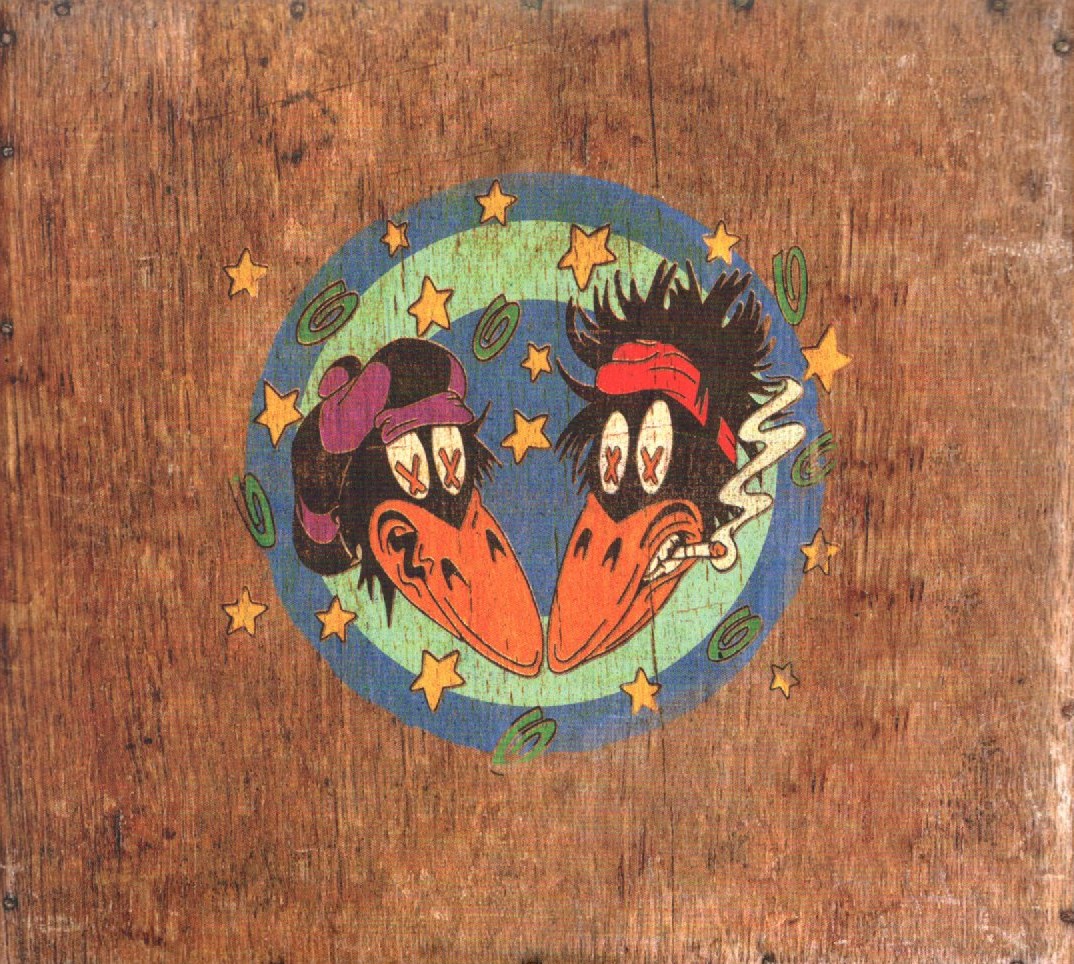
THE BLACK CROWES – Shake Your Money Maker (Originally 1990, 2021 Universal deluxe edition)

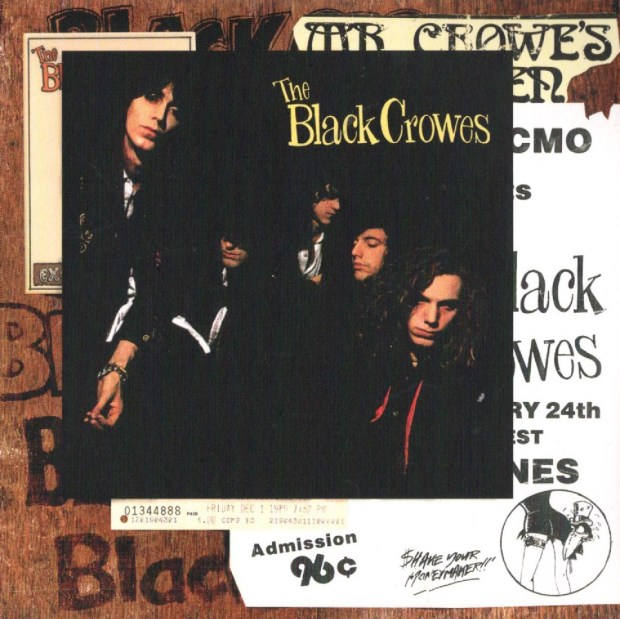
How many times have you bought Shake Your Money Maker (31 years old but not a day over 20)?  This time the Crowes did it (mostly) right.  The last time they reissued this album in 1998, they added only two bonus tracks.  Now there are 25.  These include a whole disc of rarities called More Money Maker, and a homecoming live set from December 1990 with the original lineup and a sneak peak at new, work-in-progress songs.  All of this is worth your money to buy one more time.  Especially for the songs they were already road-testing.
Disc 1:  Shake Your Money Maker

Freshly remastered and sounding good.  Opening up with a rip of slide guitar, the Crowes made their southern bluesy roots known from the get go.  It was nothing like Bon Jovi, Def Leppard, or anybody else on the radio at the time, except maybe the London Quireboys.  They drew influence from the 70s:  Bands like the Stones and Skynyrd, as well as the old Mississippi Delta bluesmen.  Listen to Rich Robinson’s slide and dig in.  Chris Robinson’s bluesy drawl delivers a hell of a chorus.  “Twice As Hard” is perfect in every measure, and producer George Drakoulias captured it without messing with it.

Second in line is the debut single “Jealous Again”.  It sounds like the offspring of the Stones at their boogie-woogie best.  The noticable difference is the big drum sound wielded by Steve Gorman, the Crowes’ secret weapon.

Shake Your Money Maker is a well rounded album with a few piano based slow tracks.  The first ballad is “Sister Luck”, sort of prototype for the kind of things the Crowes would do in the future.  You want authenticity?  That’s Chuck Leavell on keys.

Back to the rock, “Could I’ve Been So Blind” kicks it with a shot in the arm and a great chorus.  Thing go slow again on the organ-based blues “Seeing Things”.  The wild thing is, the Crowes were just kids, but it sounds like they have years and years of pain to pour into these songs.

One of the most well known singles from Shake Your Money Maker was the old Otis Redding cover “Hard to Handle”.  A bit of a surprise to hear an Otis song on the radio, but we gladly took it.  The Robinson swagger on this one is enormous.  Back to rock, “Thick N’ Thin” begins with a car crash. Fast paced rock and roll with boogie woogie piano gets the feet moving, like the Faces on adrenaline.

One of the fastest songs gives way to the slowest one.  “She Talks to Angels” is the only one that technially deserves the tag “ballad”.  Acoustics guitars, organ, and Chris’ plaintive voice took it to #1 on the US “album rock” charts.  It’s still just as stunning today, with the feel still coming through.

Moving in for the close, “Struttin’ Blues” is relatively nondescript compared to some of the prior ass-kickers.  They save the most kick-ass for last:  “Stare It Cold”.  It starts as a standard Stones-y rocker, but then it picks up speed right to the end, brilliantly ending the debut album on a hell of a good impression.
Disc 2:  More Money Maker:  Unreleased Songs & B-Sides

This isn’t all the B-sides of course; the Crowes issued plenty of live tracks that you will have to track down the singles for.  This does collect the studio music that made it onto B-sides and bonus tracks, as well as far more serious rarities.  One of those is “Charming Mess”, a slamming unreleased track that easily could have been a hit.  Slippery guitars, bouncing piano, and a wicked chorus.  Early Crowes tended to keep things simple, and this a great example of their early charm, cranked up to 10.
The Humble Pie cover “30 Days in the Hole” is tight and clean.  Johnny Colt was an underrated bass player and you can hear it on this decent but underwhelming cover.  The original “Don’t Wake Me” is an also-ran, in the fast-paced category.  Great guitar work as always though, so always something to listen for.  The Lennon cover “Jealous Guy” always lacked something that the original had, but by turning it into a lamenting blues, the Crowes made it their own more than the other covers.  The original “Waitin’ Guilty” is a real treat.  Happier with twang, it was rarely played live, perhaps because it’s a bit of a departure.  A sweet, tasty, twangy departure.

The “Horn Mix” of “Hard To Handle” has been difficult to track down for years.  Here it finally is!  One thing not apparent when listening to it on a shitty radio — the bass really thumps on this remix.  With this version now finally widely available, it is the definitive mix.  Two acoustic versions of big hits are next:  “Jealous Again” and “She Talks to Angels”.  Stripped down to the very basics with no drums.  “She Talks to Angels” benefits very much from the bare arrangement, becoming something truly special.

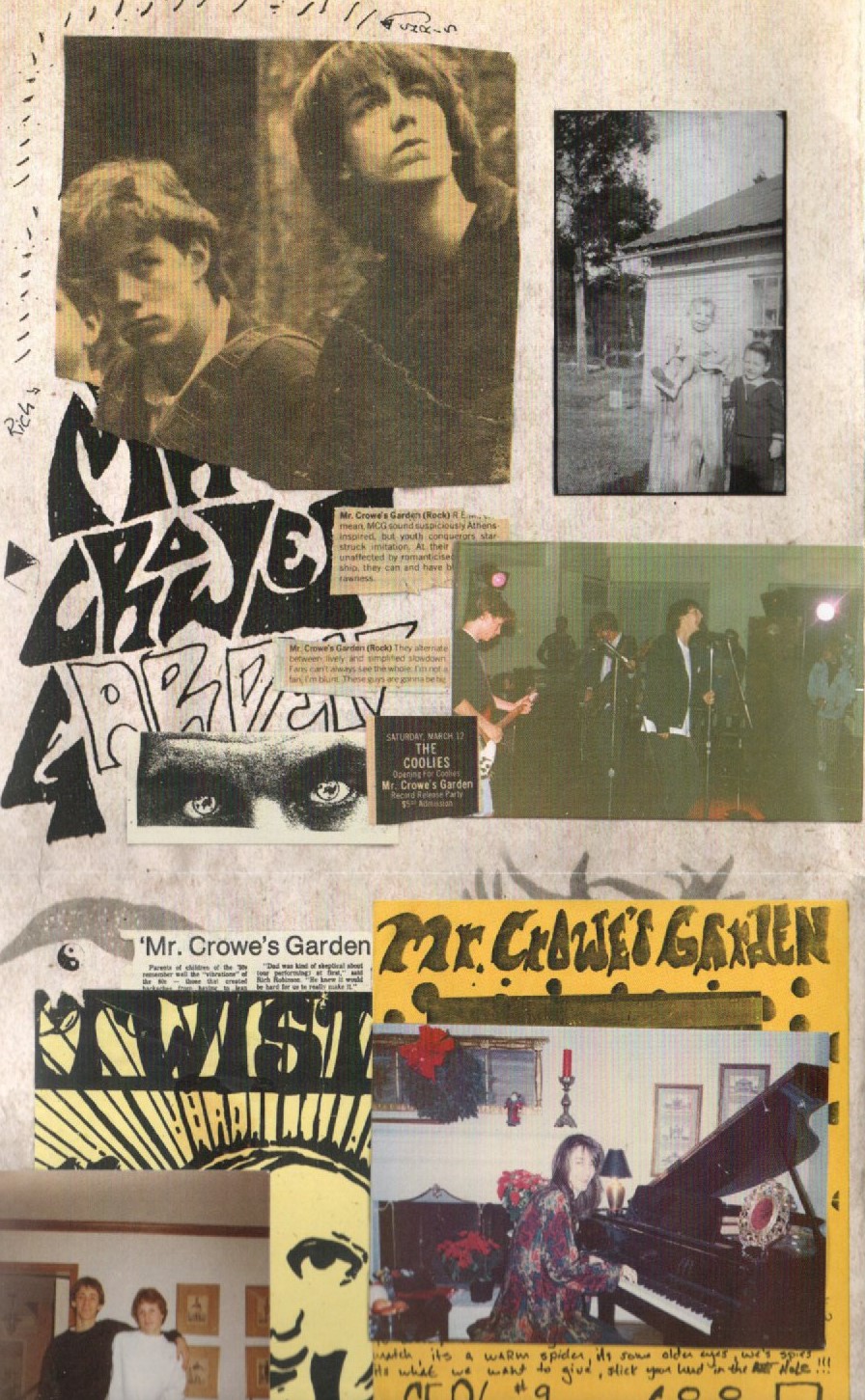
This disc ends on a double treat:  Two early demos by Mr. Crowe’s Garden, the incarnation that preceded the Black Crowes.  “She Talks to Angels” is fully written but with a higher lead vocal melody.  “Front Porch Sermon” is more folksy than what we usually expect from the Crowes, at least until the later years.  Banjo is the dominant instrument.   The chorus is a dead ringer for Blue Rodeo.  Great stuff; let’s hope we get more Mr. Crowe’s Garden demos in the future.
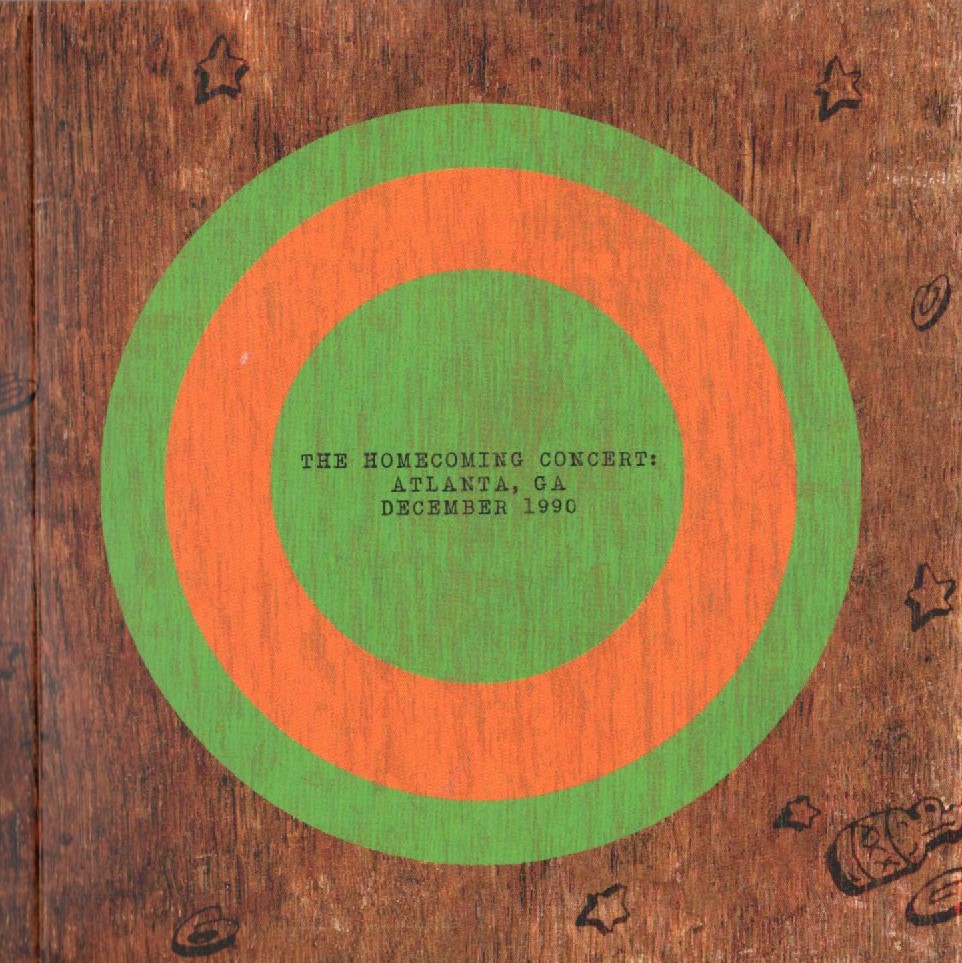
Disc 3:  The Homecoming Concert:  Atlanta, GA December 1990

For many, this is the main feature of the set, and for good reason.  This era of the Crowes only lasted a short time and change is already evident.  The new material they were working on, and were already playing live, was different.  The band was also changing and soon guitarist Jeff Cease would be out of the lineup, replaced by Marc Ford.  This concert CD is one of our few chances to hear what Jeff Cease brought to the band.  They couldn’t have grown where they did with Cease, but as the lead guitarist on these rock and roll tracks, he’s perfect.

Chris Robinson is on fire, as evident on the stormin’ first song, “Thick N’ Thin”.  It’s an energetic version and that energy carries over into a new song called “You’re Wrong”.  It would later evolve into “Sting Me”.  The sound of Southern Harmony was starting to creep in and you get a lot more a  bit later into the set.  Although nobody sounds bored, the Crowes roll out the hit “Twice as Hard” next.  It could be one of the best versions out there, for Chris’ impassioned overblown vocal.

Favourites from the album are played one after the other:  “Could I’ve Been So Blind”, “Seeing Things”, “She Talks to Angels”, “Sister Luck”, and “Hard to Handle”.  Particularly powerful is “Seeing Things” though highlights are plenty through these tunes.  The Crowes also peppered their sets with non-album covers.  “Shake ‘Em On Down” (Bukka White) is unexpectedly followed by “Get Back” (The Beatles).  But really it’s just one extended jam on some familiar themes.

The real treat is a full 13 minute version of “Words You Throw Away”, the long jam that would one day evolve into a little hit called “Remedy”.  You can hear certain chords and rhythmic ideas that ended up in “Remedy”, and maybe also “Thorn in My Pride”.  It is however its own song, with some unbelievable hooks of its own that never made it into anything else.  Just lay back and enjoy all 13 minutes of musical nirvana.

Closing the set with “Stare It Cold” and “Jealous Again” can only be anticlimax after that workout.  What else could they do?

It’s very fortunate this live set was so well recorded, mixed and mastered for release.

In Conclusion

Though affordable, the 3 CD edition has skimpy packaging.  There is a small foldout with rare photos (and some really cool ones of Mr. Crowe’s Garden) but no real liner notes or other details.  It would just be nice to know more about where the rare tracks originated, or even the original studio album itself.  The album used to come with lyrics, but this comes with nothing.

Still the music more than makes up for up for the lack of packaging.  The top-notch live set is a revelation, and the bonus rarities are valuable and high quality.  You can’t say no to the music.

4/5 stars


REVIEW: The London Quireboys – “Hey You” (1990 cassette single)

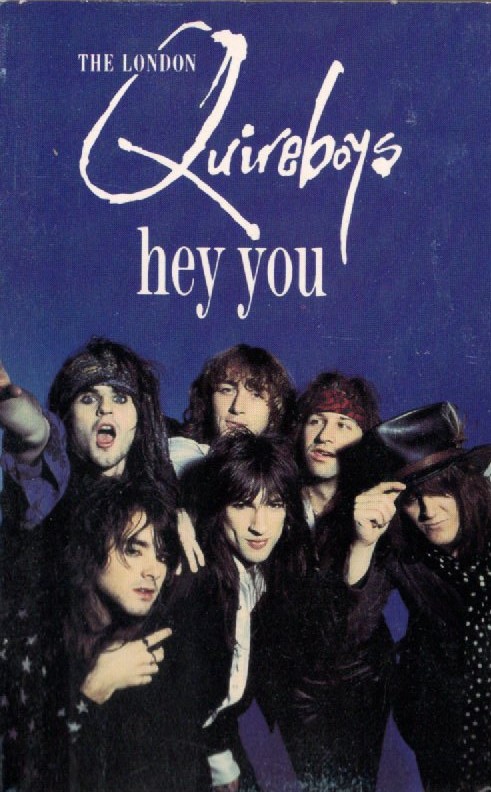
THE LONDON QUIREBOYS – “Hey You” (1990 Capitol cassette single)

A curiosity unique to cassette.  The UK 12″ single for “Hey You” included a live “Hoochie Coochie Man” on the B-side.  It and the 7″ single also contained the album track “Sex Party”.  You could get these same tracks on the CD single, but the cassette went with a different route.

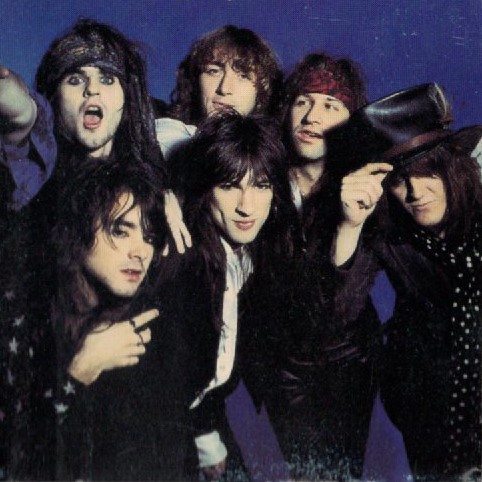
The A-side common to all is of course “Hey You” from the hit debut album A Bit Of What You Fancy. It sounds classic from first crash of guitar. The Stones-y Faces vibe is immediately apparent, and fondly recalls the summer of 1990 when the need for such a sound heralded in the Quireboys and Black Crowes.  It was completely unlike everything out by Motley Crue, Bon Jovi, and Warrant.  Its refreshing reliance on slide guitar still sounds great in the speakers, but the rasp of singer Spike is its most defining trait.

The first B-side is the roudy “Sex Party” from the album.  The boogie piano keeps it kickin’ hard.  But then the cassette goes its own way with two additional tracks.  They are severely edited versions of hit singles “I Don’t Love You Anymore” and “7 O’Clock”.  Both fade out prematurely just as the songs are getting awesome!

The whole thing repeats on both sides.  The idea is to give the kids incentive to go out and buy the album next time.  Save your allowances and buy the album to get the full songs.  Such teases!  Just as Spike is telling us what time it is, adding that it’s also “time for the party”, the song fades and the side ends!

Can’t realistically rate something like this very high.  While the two full tracks are both awesome, it’s hard to justify buying this tape today as anything other than a curiosity.  The cassette still sounds good after 31 years though!

2/5 stars

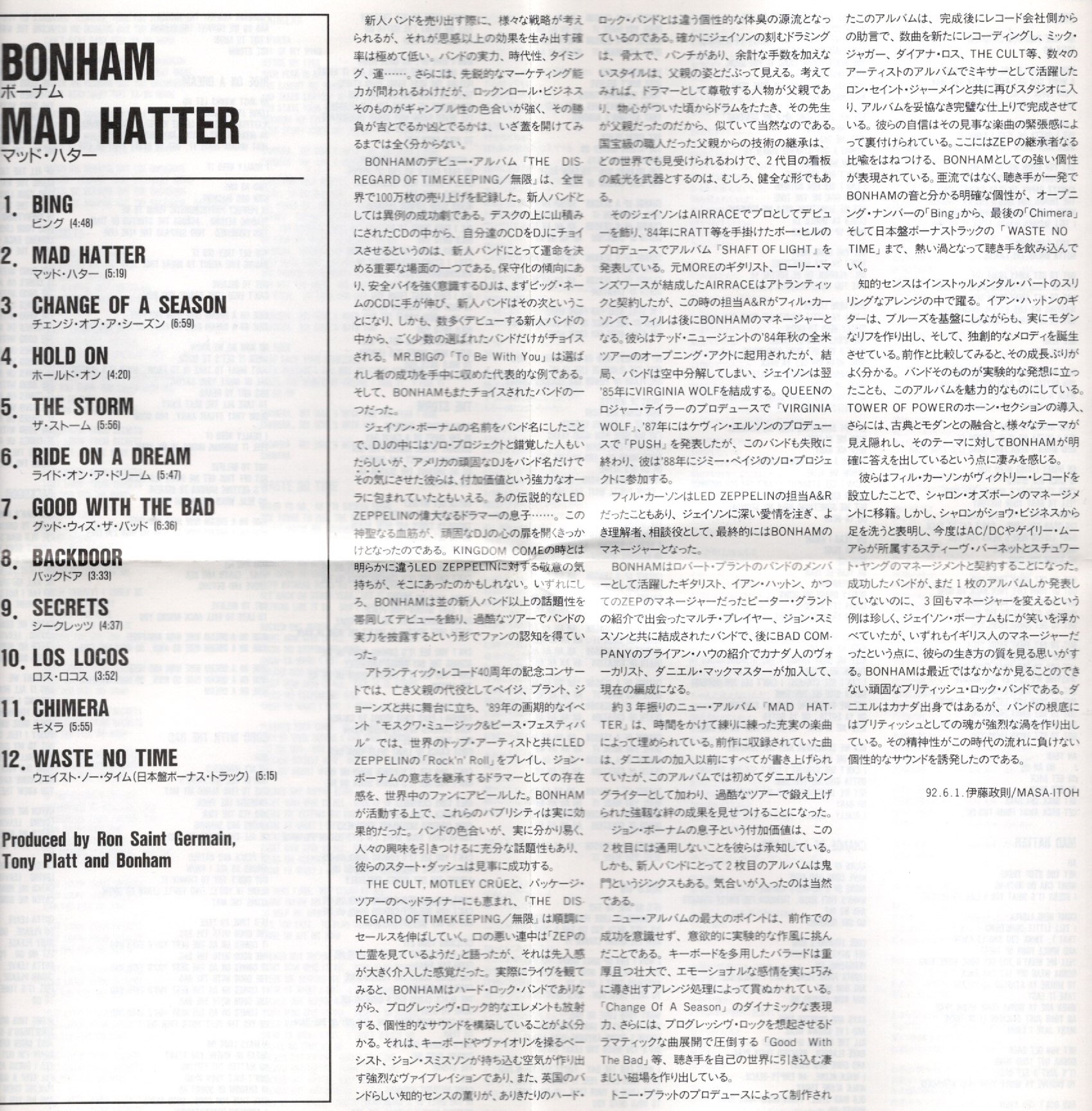
REVIEW: Bonham – Mad Hatter (1992 Japanese import)

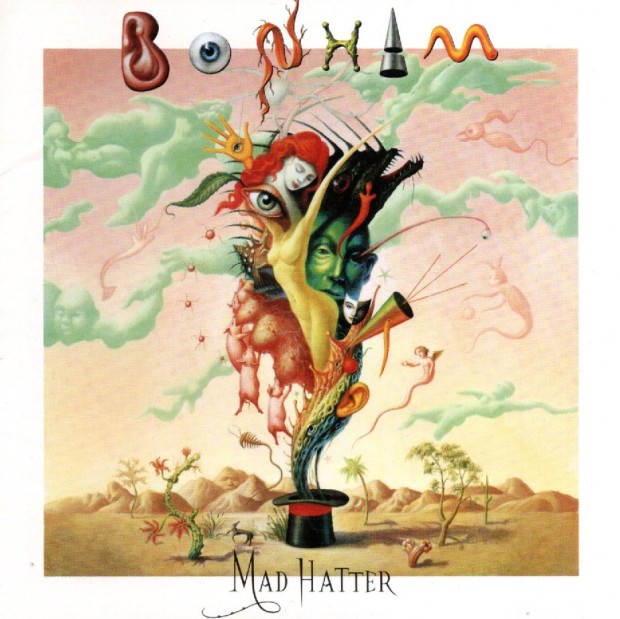
BONHAM – Mad Hatter (1992 Sony Japan)

The first Bonham album in 1989 was a critic’s darling.  Produced by Bob Ezrin, it sold well enough and made plenty of year-end lists.  For the year 1989, it was a breath of fresh air compared to the Motley Crue, Bon Jovi and Def Leppard tracks dominating the airwaves.  Those who thirsted for the rarified air of Led Zeppelin got some of that with Jason on drums and the incredible Canadian Daniel MacMaster on lead vocals.  It was easy to imagine that “Wait For You” was a new Zeppelin single built for that year.  But every band has to grow, and where would Bonham take it?  Further down the Zeppelin road, or try and find their own identity?

Bob Ezrin did not return, and most of the followup album Mad Hatter was produced by Tony Platt, with the rest produced by Ron Saint Germain.  The band grew from the debut, establishing more of their own groove.  It was a more diverse and challenging platter.  Unfortunately, the album arrived in 1992, amidst the Pearl Jams, Soundgardens, Nirvanas and the rising tide of grunge.  Despite the strong single “Change of a Season”, the album tanked.

What an opener “Bing” is, a word that doesn’t seem to be in any of the lyrics.  At first, it has a very old school Zeppelin groove, akin to “Candy Store Rock” meets “Black Dog”.  But then it goes to a completely different place on the chorus.  The sonics are clearer and sharper than the debut.  Jason’s drums are huge as the should be.

Yet it’s the title track that really shocks the system.  Opening with a blast of horns, “Mad Hatter” goes one of the few places Zeppelin never went:  full-on funk with horns.  This would be the Tower of Power horn section.  It would be lazy to compare “Mad Hatter” to “Get the Funk Out” from a couple years past, as it has its own vibe.  Ian Hatton on guitar proves himself to be diverse talent with licks-o-plenty.

Another direction is explored on “Change of a Season”, the shoulda-woulda-coulda single that would have been huge a year or two prior.  The melancholy ballad was simply the wrong temperature for 1992. The gothic tone of the video was cool, but the video got zip for airplay.  It’s the backing strings (synth) and epic chorus that make this song.  It sounds less like Zeppelin and perhaps more like something from David Coverdale’s Reptile Emporium.

Another cool direction is explored on “Hold On”, a unique song with elements from multiple genres.  Funk, soul, progressive, blues, and even bluegrass.  This is followed by another song with epic overtones, “The Storm”, a six minute track that takes the Zeppelin influences to the craggy progressive peaks of another land.

Although there’s no side break on a CD, there are a natural place for it as you can pause for a breath before plunging into “Ride on a Dream”.  A breaknace pace and metallic riff make it unlike anything else on the album.  Perhaps a band like the Scorpions could do “Ride on a Dream”, but even Klaus would be challenged by the outstanding MacMaster lead vocal.  This plutonium-fuelled track would give anyone a run for their money.

But after all that drama, you need something a little more laid back.  That would be “Good With the Bad”, a jazzy piano ballad and the longest song on the album.   It doesn’t remain in ballad territory forever, going to the swamps of Florida where Savatage reside halfway through.  The comparisons are easy to hear.  Next, we go to a bluesy, funky blast of Zeppelin-flavoured ale on “Backdoor”.  Another cool tune with a different vibe from the others.  Things drag a bit on “Secrets”, which tries to marry the funky side with a “Kashmir”-scale chorus but doesn’t really follow through.

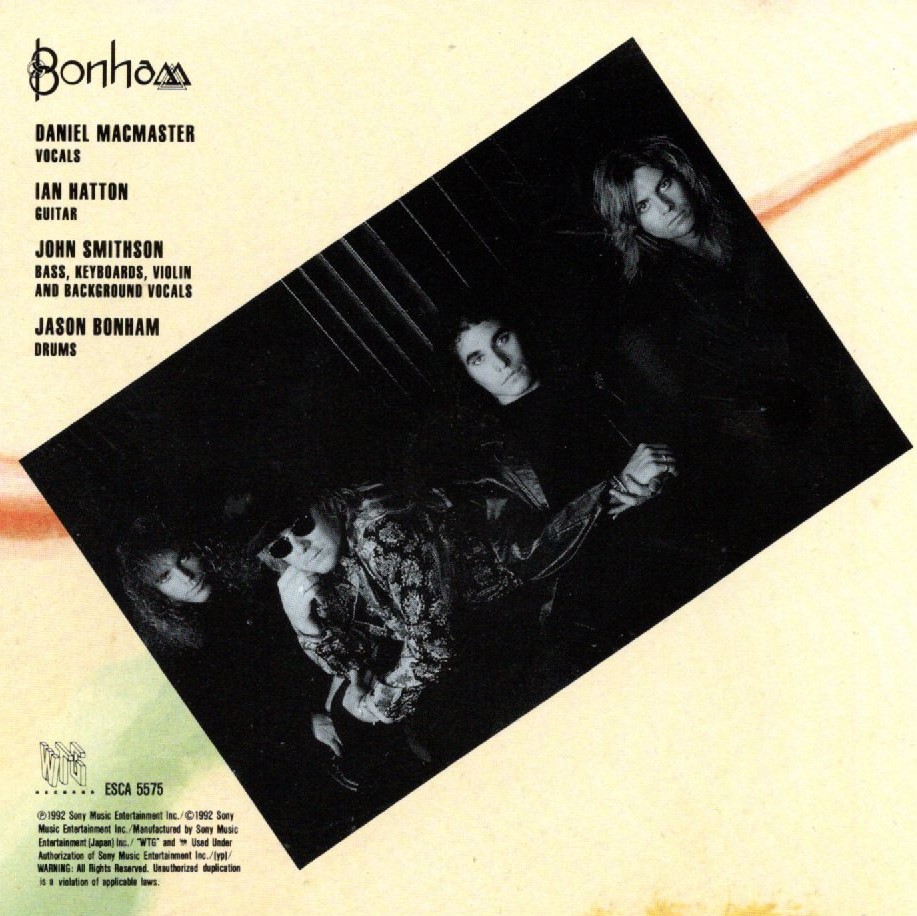
Moving on to the end, it’s “Los Locos” in second to last position.  This is a tender blues guitar/violin instrumental with dark piano accents.  That would be bassist John Smithson handling those wicked violin licks and a lot of the keyboards.  Perfect track for this spot, setting up for the closer.  It’s up to “Chimera” to take you out, and it does with a shiny upbeat vibe.  Although it’s probably sheer coincidence, it sounds a bit like Marillion circa the same period.

Lo and behold, that is not all!  The Japanese fans got a little bonus on their CDs called “Waste No Time”.  It’s definitely not an also-ran.  It has a heavy bass groove that isn’t like the other tracks on the album.  MacMaster really lets it blast on the chorus too.  Definitely Zeppelin vibes come solo time.

This album was available with two covers.  The majority of copies have the surreal Dali-esque landscape that you see here.  The alternate cover was plain white with just the new Bonham logo.  Which looks rather silly without the proper cover art for context.  That’s the cover that retailers such as Columbia House sold in the 1990s.

In 1994, Jason Bonham reconvened with Ian Hatton and John Smithson, but not Daniel MacMaster.  The new singer was Marti Frederiksen — yes, that Marti Frederiksen, the one that writes massive hits for everyone today.  The band took on a new modern grunge sound, and renamed themselves Motherland.  ☮︎ For Me was the pretentious name of that album.  As a sad final coda, Daniel MacMaster died too young at age 39 from a strep infection that he thought was a cold.

At least we can say that Bonham with MacMaster really did outgrow the Zeppelin tag by the second album.  Still a part of the DNA, but expressing itself more rarely.  It’s a shame about the timing of the album, because had it sold like the first one did, maybe we wouldn’t have had the Motherland debocle.  Mad Hatter is a pretty fine second album that does all the things that second albums should do.  Shame it was the last.

3.75/5 stars

REVIEW: ZZ Top – The ZZ Top Six Pack (1987)

ZZ Top – The ZZ Top Six Pack (1987 Warner)

What a strange time the dawn of the compact disc was.  Even at the end of the 1980s, vast catalogues of music had yet to be released on CD.  It was a hit and miss affair, with some early discs sounding wonderful and others sounding like a thin, tinny facsimile of the original vinyl.  The longer running time of CD was a bonus that many bands took advantage of, while other heritage groups were considering the ways they could re-release their music on this new format.

Before Jimmy Page took his first crack at remastering the Led Zeppelin catalogue for CD, ZZ Top took a different route.

Now, granted, ZZ Top’s music spans a longer time period than that of many of their rivals.  They’re also notable for starting the 1970s as a dirty raw blues and ending the 80s as clean space-age rock.  While this took them from one success to an even more massive one, it unfortunately meant that the ZZ Top camp felt it necessary to “update” their music for the CD age.  Make the catalogue sound more on an even keel with Eliminator and Afterburner.

And so the six ZZ Top albums that were so-far unreleased on CD were remixed:  First Album, Rio Grande Mud, Tres Hombres, Fandango!, Tejas, and El Loco.  Only Degüello was spared, having been released on CD earlier.

Apparently, updating the ZZ Top catalogue for CD was of “overriding concern” for all parties involved.  ZZ Top were aware that there were complaints about early CD transfers for classic albums.  The goal was “return to the original analog tapes and consider what steps were needed to render the music appropriate to  contemporary digital playback equipment without compromising integrity.”

The answer was none.  No steps were necessary.  The remixes were not what the old fans wanted to hear on their brand new CD players.  Rhythm tracks were updated with sequencers, drums treated digitally, and the whole thing came out sterile and flat.  Adding echo didn’t add depth.  Doing an A/B test with a remix vs. an original track makes you wonder why you even own the ZZ Top Six Pack.*  It just…doesn’t sound right.  Like a disorienting time displacement.

As of 2013, you can get all the original ZZ Top albums on remastered CD as they should have always sounded.

While it is nice to have six ZZ Top albums on just three CDs, and there is no denying the booklet is hot, you do not need the ZZ Top Six Pack anymore.  The charm of the originals is that they are a document of those hot Memphis studios where ZZ Top laid down the original tracks fast and dirty.  The remixes sound like a digital mixing board trying to tame a wild animal.  Wrong, and unnecessary.  “Francine” is actually awful.

The booklet is truly valuable (nonsense justifying the remix aside) and worth a point on its own.  The ZZ Top songs in and of themselves are always incredible, so they too are worth a point.

2/5 stars

* It was a gift from Kevin.  He also rates it 2/5 stars.  I asked him for a quote for this review.  All he had to say about the ZZ Top Six Pack was:  “I’m glad Mike took this crap off my hands.”  

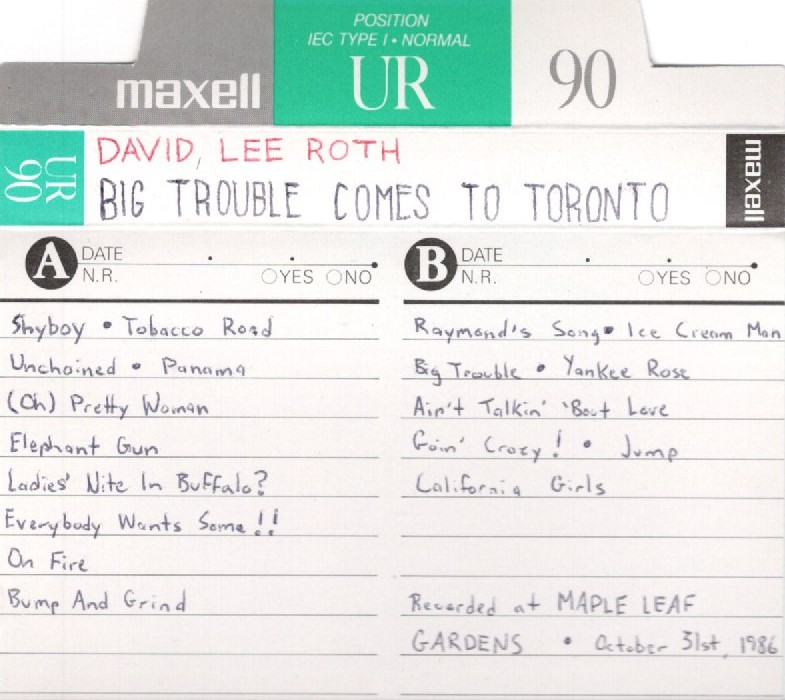
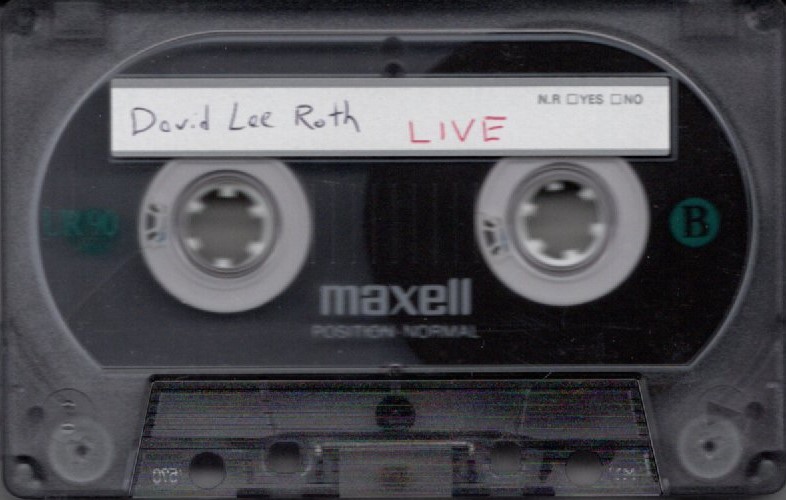
REVIEW: David Lee Roth – Big Trouble Comes to Toronto – Maple Leaf Gardens 10/31/86 (bootleg cassette)

DAVID LEE ROTH – Big Trouble Comes to Toronto – Maple Leaf Gardens 10/31/86 (bootleg cassette)

This cassette is a second generation, recorded from a buddy (with good equipment at least) in 1992.  My first bootleg.  It opens with a Van Halen-era interview with David Lee Roth about “precision rock”.  The crackle of original vinyl is audible.

A nice fade-in brings Steve Vai’s guitar to the fore, and then it’s wide open into “Shyboy”.  High octane, even though it’s just an audience recorded cassette with not enough volume on the guitar.  Without pause they rock into “Tobacco Road”. Gregg Bissonette’s toms a-thunderin’.  Vai certainly needs no help in hitting all the guitar hooks that he baked into the vinyl, just with more flair and energy.

Dave has never shied away from Van Halen hits or deep cuts.  “Unchained”, “Panama” and “Pretty Woman” are the first three.  The bass rumblings are unlike anything Michael Anthony played on the original.  The backing vocals are far more elaborate.  Like in Van Halen, “Unchained” is interrupted part way, but this time it’s so Dave can ask what you think of his new band!  Pretty hot.  After “Unchained” he stops to talk to a “pretty Canadian girl”.  “Panama” sounds a little odd with Brett Tuggle’s keyboards so prominent in the mix.  And it’s also way way way too long, with Dave trying to figure out who is reaching down between whose legs, but that’s Dave.  You don’t go to the show just to hear the music.  You go to see the whole schtick.  You put in the quarter, you gotta let the jukebox play the whole thing out.

“Pretty Woman” is zipped through fairly quickly (with one audience participation stop), going into Dave’s rabid “Elephant Gun” and the slick “Ladies’ Night in Buffalo?”  “Elephant Gun” features solos galore that would have been pretty awesome to see up close.  It sounds like there’s a vinyl side break before heading into “Buffalo”.  Vai’s guitar is the star here, in an extended solo backed only by Tuggle.  This turns into a dual bass/guitar call-and-answer.

When Bissonette starts on those tribal beats, you know it’s Van Halen’s “Everybody Wants Some!!”  This great version includes a drum solo.  Next it’s “On Fire” from the Van Halen debut.  Dave asks for the guitars to be turned up – we agree.  “On Fire” with keyboards and Vai noodling is a different animal.  After Dave’s original “Bump and Grind”, it’s time to flip the tape.

Side two opens with some of Dave’s acoustic strummin’, and a story called “Raymond’s Song”.  It’s just an excuse for him to say “Toronto” a whole lotsa times before introducing “Ice Cream Man”.  Which completely smokes.  Vai puts his own space-age spin on it, and Tuggle adds boogie piano, but this is one wicked version!

Dave’s solo track “Big Trouble” has plenty of atmosphere and fireworks for the Toronto crowd, but “Yankee Rose” is just nuts.  Nothing but the hits from here on in:  “Ain’t Talkin’ ‘Bout Love”, “Goin’ Crazy!”, “Jump” and “California Girls”.  The heavy riff of “Ain’t Talkin’ ‘Bout Love” sounds great in Steve’s hands, who doesn’t go too crazy with it.  Of course there has to be another long break in the middle (too many breaks at this point now).  This time it’s so Dave can get Stevie to make his guitar say “Toronto kicks ass, because the chicks are so fine”.  The rest of the songs are somewhat fluffy, the pop stuff, and rendered a little sweet with the added shimmer of Brett Tuggle.  “Jump” misses the deeper tone of Eddie’s Oberheim OBXA.

It’s worth noting that Roth closes with “California Girls”, not “Jump”.  His solo career is the point, not Van Halen, he seems to be saying.  This is the cherry on top.  Roth hands it to his new band several times in the show — he knew they had to deliver, and they did.  And he wants people to know that he has a band that can compete with his old group.

The show is complete,  and apparently Dave didn’t play “Just a Gigolo” on this tour.  The opening act in Toronto was Cinderella, supporting Night Songs.

Sometimes you wish Dave would get on with it and play the next song, but that’s only because this is a cassette bootleg being played on a Technics RS-TR272.  If you were there in Toronto on the Eat ‘Em and Smile tour, you’d be eating up every word Dave laid down.  He is the master of the stage.  Sure, it doesn’t always translate to tape but that’s the nature of Dave’s live show, isn’t it?  It’s precision rock — visually and audibly combined.

4.5/5 stars (for what the show must have been in person)


REVIEW: Tesla – The Great Radio Controversy (1989)

TESLA – The Great Radio Controversy (1989 Geffen)

Tesla came right out of the box with two great studio albums in a row.  Their debut Mechanical Resonance is close to perfect.  Two years later they came into their own even more with The Great Radio Controversy which saw them stretch it out further.  The dropped some of the more overt heavy metal influences that were heard on “Modern Day Cowboy” and went for the roots.  The Great Radio Controversy provided Tesla with their biggest hit, “Love Song”, the track that got me into the band for good.

1989-90 was peak power ballad time and I loved ’em as much as any lonely highschool boy would.  Bob Schipper was the Tesla fan first, but once I decided to take the plunge, I went all the way and got both albums on CD instead of cassette.  Though the big hit was the ballad, The Great Radio Controversy is a tougher album overall than the debut.  Once hooked by “Love Song”, other tunes made themselves immediately prominent.  Unfortunately the ballad probably didn’t convey an accurate image of Tesla to the general public.

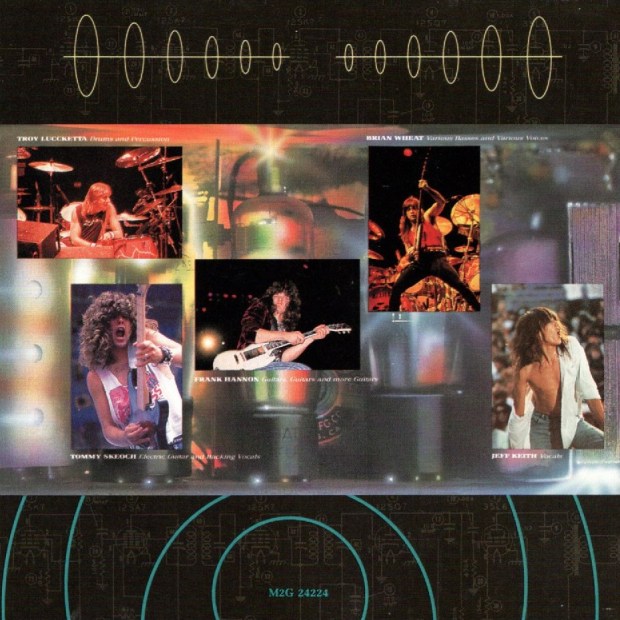
Tesla were great at writing hooks, and opener “Hang Tough” hits right away with a killer little bass intro by Brian Wheat.  This hard-hitter is a killer song with dual guitars, and Jeff Keith just givin’ ‘er at the microphone.  It’s a defiant tune with the kind of shouted chorus that a concert crowd could get behind.  Guitars galore courtesy of Mssrs. Hannon and Skeoch.  Continuing the lyrical theme of “hangin’ in there”, it’s “Lady Luck”.  The punchy chorus, “Lady Luck took a walk,” has a Def Leppard vibe circa Pyromania.  Jeff Keith’s convincing rasp is like a blunt instrument for delivering hooks.

The first track that really showed Tesla were a cut above the Hollywood trash was “Heaven’s Trail (No Way Out)”, a track ahead of its time.  With a grungy, chunky groove and acoustics layered with electrics, wah-wahs and slides, it’s Tesla doing their own thing.  It has one foot in southern rock and another in molten lead.  At this point, Frank Hannon and Tommy Skeoch were on their way to “serious guitar duo” status.

Tesla lighten up a bit on “Be a Man”, catchy and simple enough for the radio.  Nicely composed for easy consumption, complete with a considerably canorous guitar solo.  The skies grow dark again quickly on “Lazy Days, Crazy Nights” which sounds like it should be a party rocker, but is not.  “I’m doing fine right here on borrowed time,” sings Jeff on this memorable dirge.  Things get hot again on “Did it For the Money”, a slammin’ track with another riff reminiscent of a certain British band from Sheffield.  They don’t slow down on “Yesterdaze Gone”, the side closer, which is only faster and more intense.

A solid side-opening “Makin’ Magic” brings the tempo back to centre.  Chugging along with guitarmonies aloft, this is a nice rocker to reset the tone.  This leads into another single, “The Way It Is”, which is a light rocker but not quite a ballad.  Tesla’s southern side shines through.  It sounds like a celebration with a little bit of Skynyrd on the side.

I have one memory regarding “Flight to Nowhere”.  It was September of my last year of highschool, and for the yearbook, they wanted to take a big aerial photo.  I believe we stood in the football field spelling the letters “GRCI” while a plane flew overhead taking the pictures.  I remember standing near my friend Danesh, who also owned a CD of The Great Radio Controversy.  This song came to our minds as we jokingly imagined doomy scenarios of plane crashes and our imminent deaths.  “Goin’ down!  I’m on a flight to nowhere!”  Anecdote aside, this killer track is a deep cut tragically ignored over the years.  As it blasts through the skies powered by the chug of electric guitars, it only gets more intense.  My favourite line to repeat:  “Now the headlines read all across the lands, ’bout the motherfuckers gettin’ way outta hand.”  It seemed to genuinely apply to the world we lived in, as Iraq invaded Kuwait and created a powderkeg in the middle east.  More importantly it captured my youthful anger at the situation the world found itself it.  Motherfuckers.

The one weakness that The Great Radio Controversy has is its length.  We’re on track 11 and only now getting to “Love Song”.  Like “Little Suzi” on the previous LP, this one opens with a unique acoustic instrumental passage.  It is a mini composition of its own, unrelated to “Love Song” with a vaguely neoclassical vibe.   Yet it’s still a part of it, as one seems incomplete without the other.  Either way, “Love Song” is a powerhouse, a definitive power ballad, and one of the best from a period that suffered from a glut of them.  Midway it goes to a whole new level with a gut-busting Frankie Hannon lead.

Everything after this unfortunately feels like anti-climax because of the massive presence “Love Song” has on the second side.  “Paradise” is a good tune, which actually sounded better when it was redone acoustically on the next album Five Man Acoustic Jam.  The original is a tad overwrought, like heavy-handed Aerosmith.  The final song is, appropriately enough “Party’s Over”.  The riff bounces from the left speaker to the right in a cool effect, and once again I’m reminded of another five-member band from across the pond with the same management (Q-Prime).

Though song for song, The Great Radio Controversy seems the equal of Mechanical Resonance, it’s just a hint more uneven due to its longer running time.  Minor quibble.  Tesla had made two outstanding rock albums in a row by now and were still growing.   Some say The Great Radio Controversy is the best Tesla album.  I say, you be the judge.

4.25/5 stars


THREE-VIEW: KISS – Best of Solo Albums (Japanese CD)

 – Best of Solo Albums (Originally 1979, 2020 Universal Japan CD)

Third review for this Kiss compilation here, but why?  A couple reasons.  For one, it’s the first-ever official CD release of this album!  It took 41 years for them to finally put out a CD, and yet only in Japan.  More remarkably, there is one track here that I’ve never heard before in this particular version.

That song is the incredible Paul Stanley epic “Take Me Away (Together As One)”.  On Paul’s solo disc, it fades away at the end of side one at 5:35 in length.  Here, it goes to 5:48, no fade, right to the end of the track.  It’s an ending I’ve never heard before.  This song isn’t even on the more common European version of Best of Solo Albums, just the Japanese.  And apparently the CD has an unreleased version without the fade.

“Oh boy!” you exclaim.  “I have to buy this import just to get 13 seconds of music I never heard before?”

No.  You don’t have to buy it.  I did, because I wanted a copy of this album on CD.  When I discovered the longer version of the track, I was ecstatic to unexpectedly get something extra for my money.

There’s no need to review this album track by track again.  I’ve done it twice, and I’ve also reviewed all four solos albums twice each.  There’s really no need to run through all the songs again, although this tracklist is quite different.  Unlike the European version, these songs are not arranged in three-track blocks for each member.  Additionally, seven of the European tracks were substituted with others.  That’s more than half the album!

Gene Simmons:  Instead of “Mr. Make Believe” and “See You In Your Dreams”, Japan used “See You Tonite” and “Living In Sin”

Paul Stanley:  “Move On” was replaced by the unreleased version of “Take Me Away (Together As One)”.

Ace Frehley:  “Speedin’ Back to my Baby” was removed in favour of the instrumental “Fractured Mirror”

Peter Criss:  All three of the Cat’s songs – “You Matter To Me”, “Tossin’ and Turnin’”, and “Hooked on Rock and Roll” were replaced!  I guess Japan didn’t care for those as much as they did “Don’t You Let Me Down”, “Rock Me Baby” and “I Can’t Stop the Rain”.

For me, I prefer the running order that Europe used, with each member of the band getting three songs in a chunk.  However, there are plenty of songs that I prefer on the Japanese version, such as “See You Tonite”, “Take Me Away (Together As One), “I Can’t Stop the Rain” and “Don’t You Let Me Down”.

It’s interesting that the solo albums are by and large panned by the masses, but nobody can agree on the “Best Of“.  Maybe those albums weren’t so bad after all, at least when you distil them down to the essential tracks.  The Japanese CD will become my preferred listening experience for two main reasons:  it sounds better than the vinyl, and I like more of the songs.  It would sound even better if I had an MQA decoder, a new-ish hi-resolution CD format from Japan, which will unlock an even better sounding version of the album, if you have a few grand to spend on upgrading your system.  If not, enjoy the disc and stellar packaging, with not one but two different covers to display.

4/5 stars


Best of 2020 Part 6: Iron Tom Delivers the Lists

Iron Tom returns with his 2020 list of awesome, a little bit of commentary, and plenty of Youtube videos for you to check out!


  • Elder Omens


  • King Buffalo Dead Star


  • Drive-By Truckers The New OK


  • The Atomic Bitchwax Scorpio


  • King Gorm King Gorm


  • Five Alarm Funk Big Smoke

Let the ‘Wheels on the Bus’ take you on a tight funky ride…


  • Jerry Joseph The Beautiful Madness


  • Drive-By Truckers The Unraveling

Great album for the shit-storm that was the last four years. However, I’m not sure I’ll be partying to some of it four years from now….


  • Brant Bjork Brant Bjork

The coolest dude on the planet being a one-cool-man-band….


  • Steve Earle Ghosts of West Virginia

Emphasizing the humanity over politics plays well….


  • Deep Purple Whoosh!

After the quality of the last few albums, I don’t know why I was surprised by how much I liked this one… Keep going boys….


  • Testament Titans of Creation

This band has been pretty consistent over the decade and have produced another great thrash album that is as catchy as it is heavy….


  • Neil Young Homegrown

1974-recorded and 2020-released and enjoyed…I read that Young thinks that the album is ‘the unheard bridge between Harvest and Comes A Time’ and he’s right….


  • Armored Saint Punch the Sky

A pleasant surprise…no gimmicks just solid consistent heavy metal.


  • Blue Öyster Cult The Symbol Remains

A little uneven but the highs more than outweigh the lows… The videos may be unintentionally hilarious but the rock fire remains….


  • Wishbone Ash Coat of Arms

Fans of well crafted rock with tasty twin guitar will enjoy….


  • Annihilator Ballistic, Sadistic

A heavy riffy old-school thrashfest that does not let up….


  • Jason Isbell, Reunions

It doesn’t quite match the strength of his last two, but that’s only because Isbell has set the bar so damn high for himself… This is an excellent album in its own right….


  • Mr. Bungle The Raging Wrath of the Easter Bunny Demo

Ian’s and Lombardo’s presence help Mr. Bungle deliver little on the experimentation, but some great straight-up thrash….


  • Brimstone Coven The Woes Of A Mortal Earth

Riffy modern occult rock with excellent vocal harmonies….


  • Lowrider Refractions

Who knew there were deserts in Sweden? These Kyuss-wannabies make a good case that there are….


  • Wytch Hazel III: Pentecost

Wishbone Ash fans will have lots here to enjoy….


  • King Weed – Riffs Of The Dead
  • King Weed The Seven Sins Of Doomsday

Instrumental Stoner from France… Groovy cool shit… And there are two more 2020 releases I haven’t checked out yet….


  • Diamond Head Lightning to the Nations 2020

A fresh coat of paint on some metal masterpieces and some pretty cool covers….


  • Wobbler Dwellers of the Deep

Yes, Crimson and Gentle Giant fans will find much to like here….


  • Freeways True Bearings

Vintage 70’s guitar rock for 2020 and they are from Brampton….


  • Bonehawk Iron Mountain


  • Shuffle Demons Crazy Time


REVIEW: Kim Mitchell – Greatest Hits (1995)

KIM MITCHELL – Greatest Hits (1995 Alert)

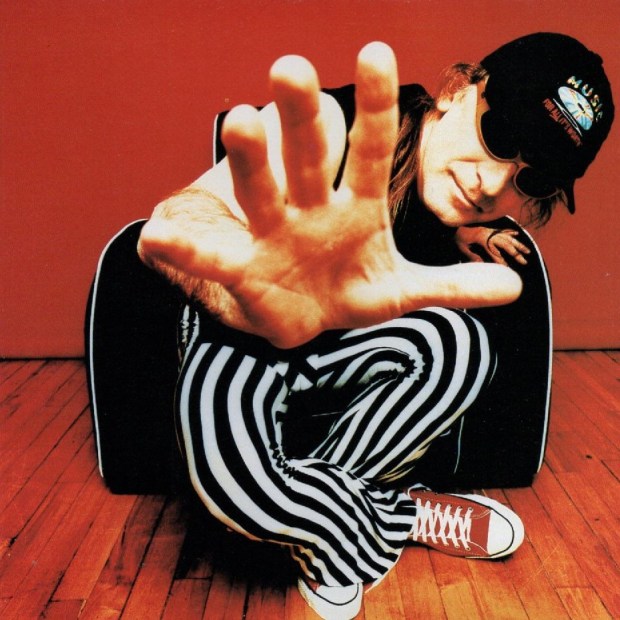
Five studio albums, one live and an EP to boot:  Definitely enough music to justify your first solo Greatest Hits.  For added value, Kim included a bunch of new and unreleased music.  With 15 songs and over an hour of music, Kim Mitchell’s Greatest Hits is an easy buy for fans and collectors.  For new fans it’s not quite ideal, for reasons we’ll get in to.

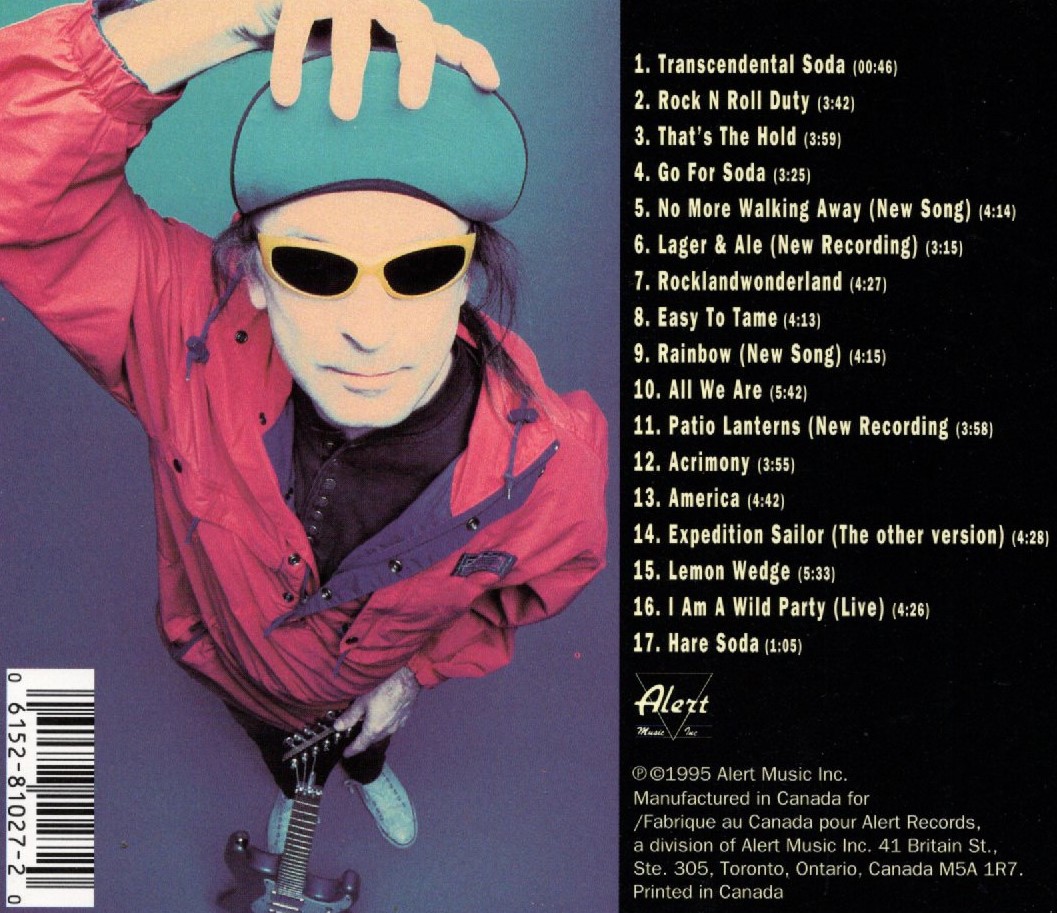
Long time fans will remember that Kim’s prior band Max Webster issued a greatest hits called Diamonds Diamonds with two new songs.  This album follows suit with two brand new tracks recorded for this set.  “No More Walking Away”, co-written by Pye Dubois, is an electric ballad with stunning guitar tones.  This is in the same lane as some of Kim’s previous ballads from Rockland or Aural Fixations; very much a “later Kim” sound.  Long time fans will love hearing Peter Fredette on backing vocals.  The other new song, “Rainbow”, is a straight-on hard rocker.  With Andy Curran on lyrical duties, “Rainbow” is just good time Kim rock as you have grown to expect it.  It goes without saying that his guitar playing is tremendous.  The chorus goes all the way to the clouds.  “I’m bringin’ you back your rainbow,” sings Kim and you better believe it.

In addition to the new songs, this time Kim also included two re-recordings.  This is unfortunately where first-time buyers are going to be let down.  One of Kim’s biggest career hits was undoubtedly 1986’s “Patio Lanterns” from Shakin’ Like a Human Being.  This compilation includes a new arrangement, which is actually quite cool.  It’s twangy and has lots of guitar play.  But that’s not the version that old folks remember from highschool — not even close.  The tempo they used to dance to is gone.  This version, excellent as it is, unfortunately is only for people who already own the original.  The other re-recording is the less sacred “Lager & Ale”, originally from Akimbo Alogo.  The vocal line is slightly modified, but this one shouldn’t upset too many people.  The Akimbo original remains the best version.

What else is to be found on this disc?  We have the opening and closing bits called “Transcendental Soda” and “Hare Soda”, which are simply snippets from the live intro to “Go For Soda”.  Nothing too special, but elsewhere you’ll find some cool stuff.  “Expedition Sailor” is credited as “The Other Version” which is a remix from the music video, long unavailable to regular folks like us.  This fine ballad was a decent hit back in 1989-90 so it’s nice to own that elusive video mix.

That’s it for the special stuff listed on the back, but there are two hidden surprises within.  Between “Rainbow” and “All We Are” (the live version from I Am A Wild Party) you will find 30 seconds of a demo.  This is a demo for “All We Are”, and the tape could even date back to the Max Webster days since that’s when he wrote the tune.  That’s gold.  What a cool way to introduce “All We Are”.  The other surprise is evident by the track times.  Hit single “Rocklandwonderland” is missing the fade out, and runs out to its actual end.  It just ends — the guys just stop playing.  Really cool unlisted bonuses here.

As for the rest, it’s the hits!  All singles (though some only for radio), except for “Lemon Wedge” which was a hit with the fans.  Though it doesn’t suit everybody’s needs, Greatest Hits still plays well and scratches some of those big Kim itches.

4/5 stars

REVIEW: Iron Maiden – Nights of the Dead – Legacy of the Beast – Live in Mexico City (2020)

IRON MAIDEN – Nights of the Dead – Legacy of the Beast – Live in Mexico City (2020 Parlophone)

I feel a bit like a jackass reviewing this, because so many people I know caught this tour, or at least one of the recent tours, and I’ve never seen Maiden live.  I only have these live albums to go by.  But what I like about Iron Maiden is that they take the time to document almost every single tour since the Bruce reunion era began.  (Only three tours did not receive a live album.)  The Legacy of the Beast tour was in support of a video game, and featured a sort of “legacy” setlist, heavy on the old classics with a small smattering of more recent material.  This prevents too much crossover with the prior live album, The Book of Souls – Live Chapter.

Without going track by track, I can tell you that Nights of the Dead was pieced together from three shows in Mexico City, much like Live After Death in Long Beach and Hammersmith.  Even so, Bruce’s voice only tends to get stronger as they go further down the setlist.  By “Hallowed” and “Run to the Hills”, it sounds like the man is just warming up!

The setlist is a delightful mix of hits, deeper cuts and the odd recent classic.  “Where Eagles Dare” from Piece of Mind whips the throng into immediate hysteria.  “Revelations” from the same LP has a certain contemplative gravity that it brings to any live album, and hearing it here is sheer nostalgic delight.  Two Blaze-era songs return to the set in “Sign of the Cross” and “Clansman”, both lengthy epics.  Enhanced by the three-guitar lineup and the Air Raid Siren, can we say these versions challenge the originals for supremacy?  Though it wasn’t written for Bruce, “Sign of the Cross” has more dynamics with him at the microphone — he adds a few high notes for embellishment.  Not to mention the depth that the third guitar adds to a song that was always a bit thin sounding.

Reunion era Maiden is cut back, leaving only “Wicker Man” and the always welcome “For the Greater Good of God”.  Both deserving songs.  Stuff like “Wicker Man” (and the earlier “Flight of Icarus”) really pump up the adrenaline levels by keeping it short, sharp and unshackled.

Then you have the stuff that you have to call “the hits”:  songs like “Aces High”, “2 Minutes to Midnight”, “Trooper”, “Beast”, “The Evil that Men Do”, “Iron Maiden”, “Fear of the Dark” and “Run to the Hills”.  These are the Maiden standards; a serving of essentials that everybody has connected with at some point in their life.  Some of them float in and out of setlists, and some always remain.

A word should always be said about the packaging and artwork of any Iron Maiden album.  The Mexican-themed Eddie can be found in a couple pieces of art inside and out.  Manager Rod Smallwood wrote the included liner notes, explaining that the live album came to be when the world came to a halt due to Covid-19.  Yay Covid?  Joking aside, Smallwood’s notes are always informative to read while rocking along to the CD.  There is even a mini 2021 tour poster (let’s hope!) included, with the Trooper version of Eddie surrounded by iconic imagery from prior Maiden artwork.  Icarus, the mushroom cloud from “2 Minutes to Midnight”, a crashed Spitfire…have a look.  Finally, a sticker sheet is an added bonus though most of us will be keeping the stickers intact, I reckon.

Perhaps it’s just giddy glee that there’s a new Maiden live album to cap off this year, but Nights of the Dead is so good that I wouldn’t change a thing.

5/5 stars