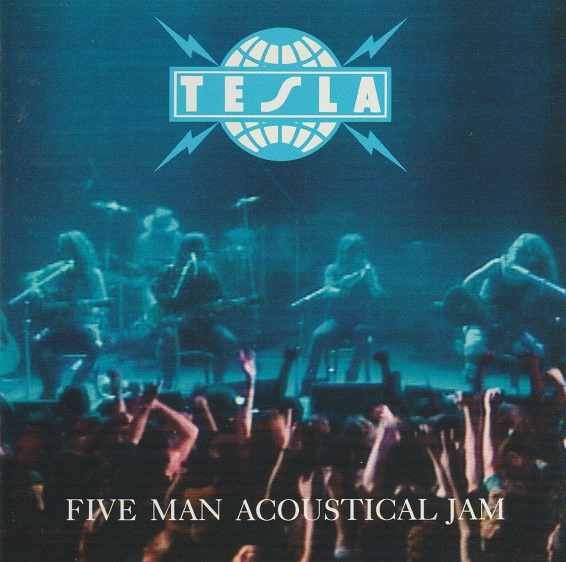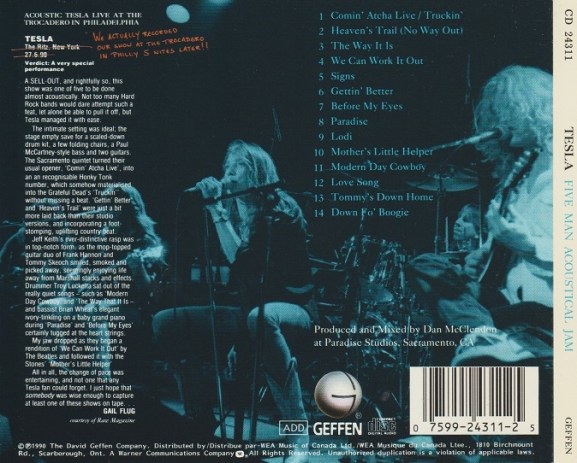
One of the great Unplugged albums of all time…isn’t even an “official” Unplugged album. That would be Tesla’s spontaneously released Five Man Acoustical Jam from 1990. Its hit single “Signs” absolutely helped set up the MTV Unplugged revolution.
With no intention of creating a live album, Tesla played a few acoustic gigs on off days and then recorded the Philly show for the archives. However a radio station in Boston started playing an acoustic rendition of “Signs” and plans were put in motion to capitalize. Thus Five Man Acoustical Jam came to be, a highlight of the Tesla catalogue that was almost completely unplanned.
“We’re just fuckin’ around tonight!” says singer Jeff Keith before “Heaven’s Trail”. Well then Tesla should spend more time fucking around. The looseness of the songs was so fresh for 1990. Tesla rolled the hits: “Modern Day Cowboy”, “Gettin’ Better”, “The Way it Is”, and of course “Love Song”, the only one with an electric solo. But because they were “just fuckin’ around”, there are also some very interesting covers: Beatles, Stones, the Dead, CCR and of course the Five Man Electrical Band. Tesla’s version of “We Can Work it Out” is awesome and incredibly fun. Less so with the Stones’ “Mother’s Little Helper” which is an unusually structured song to start with. “Lodi” by CCR was custom made for Tesla. “Signs”, of course what the smartest cover song decision the band ever made.
Five Man Acoustical Jam is a live album held in high esteem, for many good reasons.
1. A great selection of original material (old and brand new) that worked well in the acoustic format.
2. Choice covers.
3. Terrific recording, and 100% live with no fixes or overdubs.
4. Expert musicianship.
5. Humour.
Frank Zappa asked “Does humour belong in music?” The answer is “Sometimes”! One of those times is a loose, fun acoustic show. They could get away with playing a joke track like “Tommy’s Down Home”, written and sung by guitarist Tommy Skeoch. “I’d like to cut the balls off a long-haired hippie, and tie them up to a tree,” he sings gleefully.
The one single was the smash hit “Signs”, and it had a non-album B-side. “Little Suzi” (also a cover, but an earlier one) might be from the same gig. Jeff’s voice is shredded on this one, but it’s hella cool.
It’s probably fair to say that Tesla are underrated. They get stuck on tours with bands like Poison, who have nothing to do with the rootsy rock that Tesla has on offer. Tesla are better than that, and Five Man Acoustical Jam is actually a bit of an essential classic to own. The irony is that Tesla’s most definitive live album is the one that was basically a fluke!
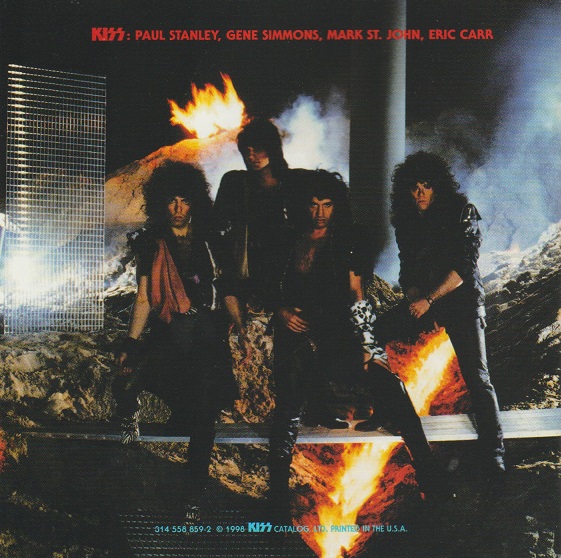
Animalize: a huge hit not proportional to the quality of the songs inside. It went platinum on the strength of lead single “Heaven’s On Fire”, but going deeper into the record, Kiss did not have the goods this time.
New guitarist Mark St. John (formerly Mark Norton) replaced the fired Vinnie Vincent, and in doing so, continued Kiss’ quest for shreddery dominance. In the 80s you had to have an Eddie Van Halen or Yngwie Malmsteen to get noticed, or so it seemed, and that was what Kiss went for. In the meantime, Gene Simmons was off in Hollywood leaving Paul Stanley to do handle Kiss, something Paul eventually came to resent.
Paul Stanley re-teamed with his songwriting buddy Desmond Child. Their last collaboration was 1979’s disco hit “I Was Made For Lovin’ You” from Dynasty. The partnership struck gold a second time with “Heaven’s On Fire”, a simple song perfectly suited for the Kiss of the 80s and beyond. Paul Stanley’s “Woo-ooo-ooo-ooo-OOOOO-ooo” intro is legendary and truthfully a song like “Heaven’s On Fire” isn’t too far removed from classic Kiss. Paul’s sassy delivery is enviable.
Desmond Child also co-wrote the opening number “I’ve Had Enough (Into the Fire)”. As the 80s began, Kiss seemed determined to write fast songs for their albums. Very fast songs. “I’ve Had Enough” is one of those, and it’s a good one too, though it was rarely played in concert. You’d never guess Desmond was involved without reading the credits, but you’d also not imagine it was Kiss if it wasn’t Paul singing.
Another fine Paul song called “Get All You Can Take” is a co-write with Mitch Weissman whose name has repeatedly popped up on Kiss credits over the years. This slow paced sleazy rocker has one of the few Kiss f-bombs in the chorus: “What fucking difference does it make?” Mark St. John’s solo is a blazing showcase of different tricks and techniques, but it suits the song rather awkwardly like an ill fitting tux. Such was the problem with a jazz-influenced shredder in Kiss.
Another fast number is “Under the Gun” written by Paul, Desmond and drummer Eric Carr. This one was played frequently on the Animalize tour though there are better songs. Fluttery guitars sound like laser beams zipping back and forth. Carr kicks ass, but it’s not a great track. Paul gets in a cute double entendre though: “There’s no speed limit where I’m coming from…let’s hit the highway doing 69!”
The final Paul song is probably the best one, although he has since criticized it as not good enough. “Thrills in the Night”, co-written with Jean Beauvoir, deserves praise. Sometimes the artist is their own worst critic, but “Thrills in the Night” is awesome, dramatic Kiss rock. The chorus goes on for weeks and the soloing fits.
If Animalize was a Paul Stanley solo EP, there would be enough good songs to give it a passing grade. However…we have the Gene Simmons songs.
Animalize shall forever be cursed as the album with the lyric, “I wanna put my log in your fireplace.” Yes, the man who once wrote a song with Bob Dylan also wrote a ditty called “Burn Bitch Burn”. The riff is awesome. It has its moments. It’s also undeniably one of Gene’s worst lyrics, and that is saying something. The song also sounds unfinished, as if he said, “OK good enough, onto the next song.” Fortunately Mark St. John’s solo playing is awesome, though not especially accessible. And that’s Gene’s best song on the album.
Gene’s other songs are “Lonely is the Hunter”, “While the City Sleeps” and “Murder in High Heels”. Of these, “Lonely is the Hunter” is by far the best. A slow sleazy groove is more up Kiss’ alley than these fast speed rockers. All three of these songs have one quality in common with “Burn Bitch Burn”, and that is that they sound like rough ideas gone unfinished. Animalize was produced by Paul (with a co-producer credit for Gene). A Kiss producer like Bob Ezrin likely would have told Gene to go back and come up with better material. The most interesting thing about “Lonely is the Hunter” and “Murder in High Heels” is the solo work. It’s stellar. It’s not overdone. It’s melodic and memorable. And it’s…familiar. Future Kiss guitarist Bruce Kulick stepped in to play ghost guitar on these songs.
The trend of Kiss using uncredited outside musicians was growing. Allan Schwartzberg (who also played on The Elder) did drum overdubs. Jean Beauvoir played bass on “Under the Gun”. Gene played the rhythm guitars on his own songs. That’s why the credits on Kiss albums always simply state: KISS – and the names of the members.
Gene cut his hair short for a movie called Runaway. He starred as the villain (of course) Dr. Luther, opposite Tom Selleck. Kirstie Alley was in it, and it was written and directed by Michael Crichton. Considering the year and the names involved, this was a fairly high profile role. Gene went for it, and has since admitted his brain wasn’t in Kiss at the time. The wig he wore on stage with the band made him look silly, and new fans considered Paul the singer and Gene a secondary guy. Gene’s songs weren’t singles anymore. They weren’t being played live. “Burn Bitch Burn” was only ever played once! These were all clues as to what was going on behind the scenes. Paul was sailing the ship now. He had no choice. Animalize suffers for it. Gene is to blame for his own downfall during the period and has since gracefully accepted that.
The Animalize tour was the biggest Kiss had done since the glory years, but troubles began early. Mark St. John couldn’t play. He was diagnosed with an arthritic condition called Reiter’s Syndrome. His hands swelled up and he simply could not do the gig. Mark passed away in 2007, but suggested that the arthritis may have been triggered by stress. The aforementioned Bruce Kulick stepped in to take his place, and did so with professionalism and respect. He got along with everyone. He was willing to learn. He was a great fit. The first great fit in many years.
The Animalize period put Kiss on MTV and on back the radio again, but its success was vastly disproportional to its quality.
Today’s rating:
2/5 stars
Uncle Meat’s rating:
2/5 steaks
Meat’s slice:There really isn’t much to say here. “Heaven’s on Fire” is a good song that I still enjoy hearing. Everything else is OK at best and non-essential. “Burn Bitch Burn” might have some of the worst lyrics of all time.
During my first few weeks at the Record Store, one of the new releases I got to deal with was the new Tesla, Bust a Nut. My boss cracked open a copy to play in store, but he wasn’t impressed.
“It sounds the same…” he remarked. “It’s just the same.”
Gosh, Tesla didn’t go grunge or rap in 1994? What a crime. No, instead Tesla stubbornly continued, as they always have, without bowing to trends. Bust a Nut wasn’t a successful album, but it was a damn good one. To call Bust a Nut “the same” sells it short. It sounded like Tesla, but a tad heavier and more diverse. Of course, this being Tesla, there must be ballads too.
“The Gate” invites you in via chugging guitars and squealing six-strings. It merges into “Invited”, a hell of a fine introduction. “Invited” reflects the light and shade of Tesla in one song: the mournful acoustic verses, the heavy and catchy choruses, all grounded in a solid classic rock vibe. Tommy Skeoch and Frank Hannon made one fine guitar duo, and the layers of instrumental goodness will keep you interested and digging for more. Heavier still is “The Solution”, which is about as metal as Tesla have ever been. Songs about environmental conservation are more relevant than ever: “Mother nature’s on her knees, and we’re the reason for her disease.” Very true, Jeff Keith. “If we’re gonna make it through tomorrow, the solution is to make a change today.” Tesla have never used such a grinding, detuned riff like this before. What’s this about it being “just the same”? Tesla didn’t go grunge, but they were able to go harder within their own style.
A brilliant track called “Shine Away” uses the soft/loud dynamic popularized by grunge, but that chorus is brighter than the sun. Enjoy some patented Tesla guitar harmonies which always sound as if inspired by Thin Lizzy, though this time verging on Iron Maiden! Time to cool things down with a ballad, and “Try So Hard” is a lovely one in the acoustic mold. A good variety of tunes occupy the rest of side one, but the next obvious standout is “Action Talks”. This is as angry as Tesla get, even dropping a “fuck you!” in the lyrics. It’s difficult to imagine that the same band can do “Action Talks” and “Try So Hard”!
Bluegrass and heavy bluesy rock collide on “Mama’s Fool”, as Tesla have never been afraid to mix genres. Sharp fans will recognize the opening and closing acoustic patterns as the same as “Government Personnel” from Psychotic Supper (1991). A slamming beat drives the tense “Cry”, a killer track based on a simple riff. Dig that theremin! “Rubberband” returns to the soft/loud format, and the loud part is fucking killer. The chorus goes on for days and sticks like glue. Another heavy groove called “Earthmover” earns its title, but some of the best tracks on side two are the ballads. “A Lot to Lose” is likeable, and “Wonderful World” begins with a southern acoustic flavour. Best of all is the fun closer, the old Joe South hit “Games People Play”. It’s Tesla-fied, and the sitar is ditched in favour of more traditional rock instrumentation. It’s transformed into a soul-gospel-rock and roll good time.
Tesla fired Tommy Skeoch (too many drug problems) and went down to a quartet before splitting up. Thankfully they have enjoyed a long and quality-driven reunion since 2001. Bust a Nut is an unsung highlight of their catalogue, and an album you’d be well advised to pick up.
The 80s were bumpy for AC/DC. Back In Black was massive. For Those About to Rock was almost as big. Flick of the Switch was a solid ball of rock, but things were uneven and some songs were filler. Fly on the Wall has its detractors for its muddy sound, and Blow Up Your Video was mostly a snooze. For their 1990 comeback, AC/DC got Canadian mega-producer Bruce Fairbairn involved.* He had a huge run of hit albums most notably by Bon Jovi and Aerosmith. Could he work his magic with AC/DC?
Bruce was one of the biggest names around, but having a hitmaker like him working with AC/DC was bound to affect their sound. Not too much of course; this was AC/DC after all. But Bruce did offer a cleaner sound, and there is no question it worked. To the tune of five million copies! Another change was bringing in ex-The Firm drummer Chris Slade after the departure of Simon Wright, who joined Dio. The bald-headed beat keeper became a fan favourite very quickly. (Slade is once again the drummer of AC/DC today after replacing Phil Rudd.)
Debut single “Thunderstruck” has deservedly become a classic in the pantheon of AC/DC classics. It was immediately obvious that AC/DC toned down the bluesy leanings of Blow Up Your Video in favour of rock and even arguably metal. “Thunderstruck” is heavy metal, especially with that fluttery Angus Young lick that dominates the song.
Chris Slade’s hyper-caffeinated drum stylings really impact “Fire Your Guns”, one of the fastest and most fun AC/DC tracks in recorded history. Any AC/DC song that involves them yelling “fire!” is guaranteed to thrill. Not to be ignored is bassist Cliff Williams who is effortlessly locked in with Slade. And sonically this is the best sounding AC/DC stuff since Back in Black. Singer Brian Johnson said at the time that Bruce Fairbairn encouraged him to scream more like the old days.
Another huge single was the plucky “Moneytalks”, bringing the groove down to a perfect mid-tempo. The main thing is the hook of the chorus. Though all songs were written solely by the Brothers Young, you can hear Bruce Fairbairn’s impact. It’s tight and focused more than AC/DC had been last time out. No doubt Bruce acted as a brutal editor in the studio when necessary, and must have had a role in shaping the songs to their final form. Listen to the layers of vocals on the chorus and tell me that’s not Bruce’s doing.
Some of the best AC/DC tracks in history have been deeper album cuts. The title track is one such song, an ominous almost-epic. “The Razors Edge” refers to a storm front on the horizon, and the song has that kind of foreboding feel. Unfortunately this friggin’ incredible construction of guitars and screams is followed by a novelty track. A seasonal novelty track. “Jingle bells, jingle bells, jingle all day the day. I can’t wait til’ Christmas time when I roll you in the hay.” This song should have been axed and saved for a compilation or single, where it actually could have had some impact. Not that it’s not fun; it is! But who wants to listen to jingle bells on track five of an AC/DC album? “Rock Your Heart Out” closed the side with the dubious distinction of being the first obvious filler song.
The third single “Are You Ready” was the opening track for side two. Good tune, nothing particularly special, but good enough for an AC/DC album. “Got You By the Balls” is an amusing title, but not a memorable song. It has a menacing bite, but not enough hooks. There’s a definite “side two slump” as none of these songs are as good as the first batch on side one. “Shot of Love” is OK. Things get back on track with “Let’s Make It” which might have made a great single itself. It has an old-timey rock and roll feel, and a slow groove. That classic rock and roll sound isn’t heard frequently on The Razors Edge. “Goodbye and Good Riddance to Bad Luck” isn’t shabby but veers close to that filler territory. Finally The Razors Edge comes to a campy end with the unusual “If You Dare”. Fortunately it’s a great, hooky little closer.
As it turns out, The Razors Edge was a one-off of sorts. It spun off a successful live album, also produced by Bruce Fairbairn, but that was the end of their partnership. A 1993 single called “Big Gun” sported a ballsier sound provided by Rick Rubin who went on to do their next album as well. The Razors Edge is also the only studio album with Chris Slade. Phil Rudd returned, reuniting the classic Back In Black lineup. No one will question that Rudd is the best fitting drummer that AC/DC have ever had, but that doesn’t negate Chris Slade’s contribution. Slade and Rudd do not sound alike, and therefore AC/DC acquires a different flavour with him in the band. His cymbal work is enviable and nobody can play “Thunderstruck” like Chris Slade, period.
3.5/5 stars
*Much to the upset of the Scorpions who had tapped Bruce to do their next album Crazy World. That didn’t happen because of the AC/DC job.
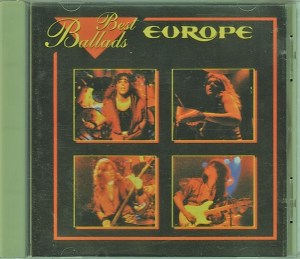
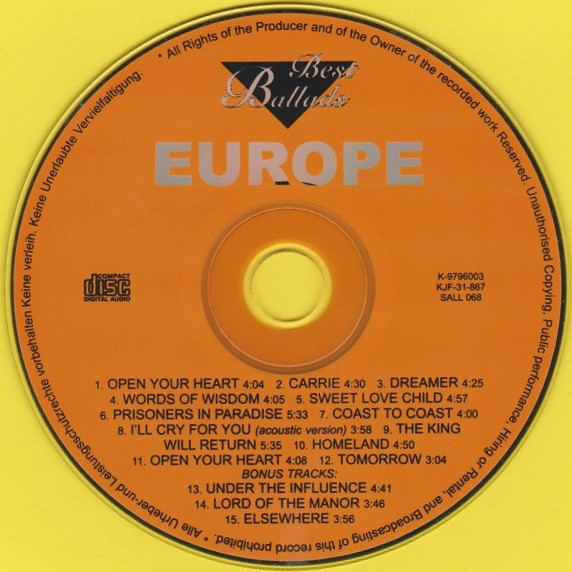
EUROPE – Best Ballads (1999 unofficial Russian compilation)
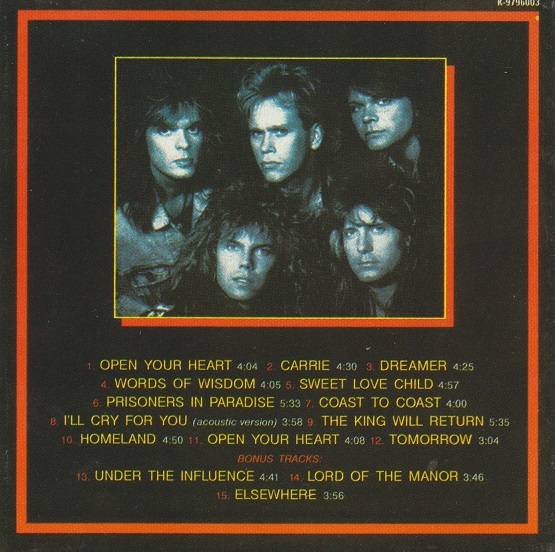
Ah Russian imports! Those funky and cheaply printed covers, the lack of liner notes or label information…how quaint. It is clear the Tempest Administration had no collusion with anyone in Russia. Yet the Russians did hack their database and release Best Ballads anyway, a weird collection of 12 Europe songs and three solo tracks by Joey Tempest. This CD originated during the period right before Europe’s triumphant reunion album Start From the Dark, so Best Ballads only contains music from the first five Europe discs.
Because it’s unauthorized and the Russians can do whatever they want, why not have both versions of “Open Your Heart” on one CD? The sweeping 1988 version from Out of this World inaugurates the album, a brilliant version often forgotten in favour of the 1984 original. What’s the difference? John Norum played on the 1984 version from Wings of Tomorrow, and the re-recording has his replacement Kee Marcello. The 1988 version also has more modern keyboards added. Since both are included, you don’t have to pick a favourite. We can all agree it truly is one of Europe’s Best Ballads.
What else is present? The “big one” of course, which would be “Carrie”. It’s the only track from The Final Countdown, because it was the only hit ballad from that album. Other crucial Europe ballads: “Dreamer” (Wings of Tomorrow), “Coast to Coast” and “Tomorrow” (both from Out of this World). All timeless and flawless ballads. From their first album (1983’s Europe) are a couple songs I wouldn’t have considered ballads. In my review, I stated that “Words of Wisdom” has “an acoustic verse [but] that doesn’t make it a ballad!” The other track, “Return of the King”, is “still pretty epic and wouldn’t be considered wimpy by anyone”. Do they belong on a CD called Best Ballads? Who gives a fuck; it’s just a Russian import!
You’ll even find a couple rarities included. “Sweet Love Child” and “I’ll Cry For You (Acoustic version)” are both B-sides from the Prisoners in Paradise (1991) period. The title track “Prisoners in Paradise” is also present but again, not really a ballad. Either way…all the Europe tunes included are fantastic no matter how you classify them. Each one has at least a foot in ballad territory so it all works out.
But what about those Joey Tempest “bonus tracks”? Surprisingly good and un-Europe. “Under the Influence” flies close to adult contemporary levels. “Lord of the Manner” could have been a hit for Rod Stewart, but that’s not a bad thing! This is more like soft rock than balladeering. “Elsewhere” sounds more like a ballad, enhanced with strings and all the accoutrements. All good songs and worth checking out.
Europe’s Best Ballads is not a bad little CD, but being an unofficial release, it’s difficult to reason out a rating out of 5. I did the best I could.
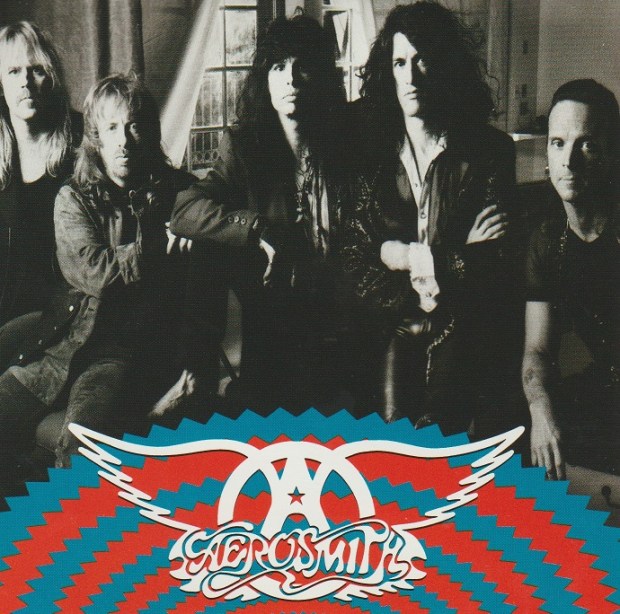
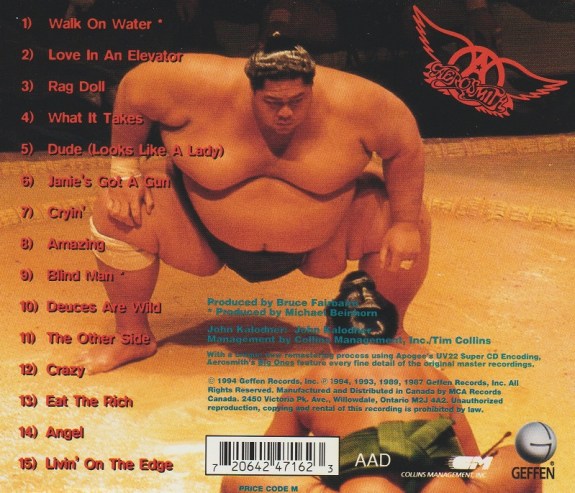
There is an informal rule that a band should have at least three albums out before they entertain the idea of a live or “greatest hits” release. Aerosmith obviously had lots of albums out in 1994, but on two different labels: Columbia, and Geffen. Their 1994 best of, not-so-cleverly titled Big Ones, drew from only three Geffen albums. Therein lies its weakness, though Aerosmith have often had issues trying to balance their classic and pop hit eras on compilations. Big Ones is easily made redundant by later compilations, but how is it for a straight listen?
A long one: 73 minutes with lots of hits and perhaps a few too many ballads, although there is no denying their chart power.
Three songs were new to the majority of buyers. “Deuces Are Wild” was a fine ballad, one of their best from this era. It wasn’t entirely new; it was written for Pump and considered for Get A Grip before being released in 1993 on the Beavis and Butt-head Experience CD. The other two were brand new recordings: “Walk on Water” and “Blind Man”. Fans who dug the heavy Aerosmith on tunes like “Eat the Rich” will enjoy “Walk on Water” as one of their harder rockers. OK song, but long forgotten now. Unfortunately “Blind Man” is just another ballad, this one similar to “What It Takes” from Pump. It’s the better of the two new songs, but sadly another ballad is not what Big Ones needed.
Making this CD even less valuable to buyers, every single track is on the later album Young List: The Aerosmith Anthology (2001). Even the three new songs!
Otherwise Big Ones plays much like a run-though of Aerosmith’s radio staples that you can hear on the FM dial just about everywhere. Each and every big hit from the three massive Geffen albums is here. How often do you need to hear “Crazy”, “Cryin'”, “Amazing”, “Janie”, “Rag Doll”, “Angel”, “Dude”, “Elevator” and the rest? That is up to you.
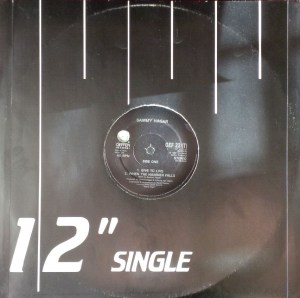
SAMMY HAGAR – “Give to Live” (1987 Geffen 12″ single)
Sammy Hagar released his solo album I Never Said Goodbye in 1987, right when he was still in Van Halen. It was co-produced by Sammy and Eddier himself. It was a mixed bag, with some killer tunes and a few things that were far too wimpy. A couple singles were released, and “Give to Live” was the best. As a power ballad, it probably could have suited any of the Van Hagar albums except For Unlawful Carnal Knowledge. That’s Eddie on bass, by the way, and listen to how great he is. No surprise, right? When you’re as great at music as Eddie Van Halen is, it must be hard for other musicians to cut it in his eyes. (Cough cough Michael Anthony cough.)
Also on the A-side is album opener “When the Hammer Falls”, an OK rock track. As discussed in the album review for I Never Said Goodbye, “When the Hammer Falls” has a good riff but not much of a chorus. That’s too bad since it was one of the hardest rockers on the LP. (And just listen to Eddie’s bass…again!) you can’t hit a homerun every time, though there’s nothing here to be embarrassed of.
If you buy the single, there’s no point unless you get the 12″ with the non-album bonus track. On the B-side you will find the full-length version of “Standin’ at the Same Old Crossroads”, which was only 1:46 on album. It served as an introduction to the song “Privacy”, but on this single it’s unedited. This is a real treat for fans of Sammy’s underappreciated guitar playing. The song is just Sammy and an electric slide guitar, bluesing it up. The intro is longer and there’s a lot more playing than the album version. Stuff like this is the reason to have B-sides and buy singles in the first place.
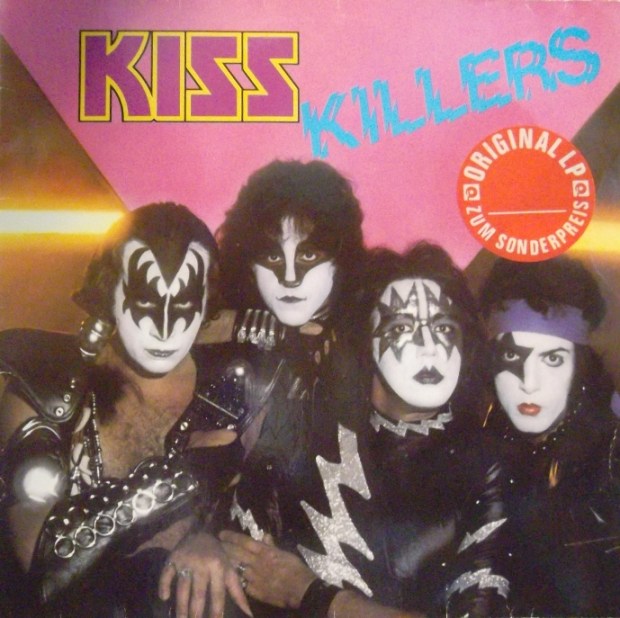
– Killers (1982 Casablanca, German and Japanese versions)
No matter how you feel about Kiss’s concept album Music From the Elder, it was a commercial dud. It was Kiss’ first serious flop as a band since hitting the big time in 1975 with Kiss Alive!More significantly, it was part of a trend: Kiss chaos. Since the solo albums, Kiss were fragmented. The band weren’t playing on all the songs anymore, and members were leaving. They had strayed from their music roots and become a comic book novelty act. The Elder was not so much an album that people didn’t “get”, but one they didn’t care to “get”. Fans were moving on.
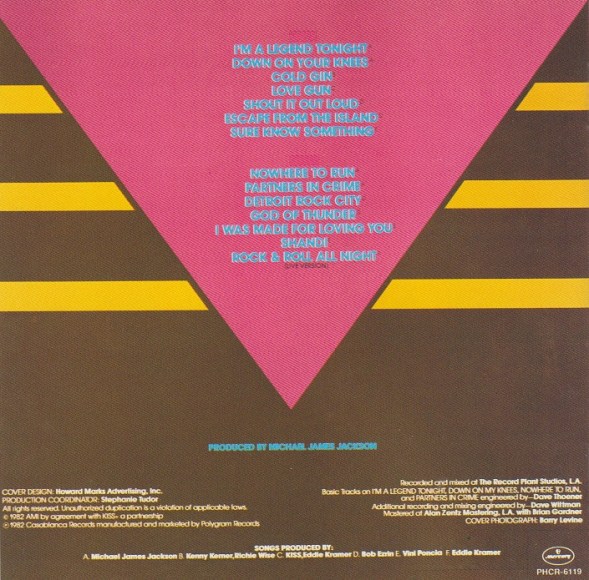
The European record label, Phonogram, was in damage control mode. They drew up plans to issue an album consisting of new and old songs; a compilation to put some money back in the coffers. They weren’t mucking around. They wanted a batch of new rock songs, but Kiss had effectively become a trio. Ace Frehley hadn’t left the band officially, but he was no longer involved creatively. Filling the guitar slot again was Bob Kulick. As he did on Kiss Alive II, Bob played lead guitar on the new songs. A 1988 book called Kiss: Still on Fire also named Ratt’s Robbin Crosby as a guitar player on the new songs, though this is a claim not backed up in any other source. Paul provided the new songs, written with old and new friends: Mikel Japp, Adam Mitchell, and some Canadian guy named Bryan something. Bryan Adams? Cuts like a knife indeed! Adams co-wrote the lethal “Down On Your Knees”, and it wouldn’t be his last songwriting credit with Kiss either.
The best new tune in the batch was called “Nowhere to Run”, and it was one of the rockers that Kiss were working on before they decided to do The Elder instead. The sheer quality of this Stanley-penned underdog really supports the theory that doing The Elder was a mistake. “Nowhere to Run” was classic Stanley, as good as anything on his solo album and exactly the kind of song that Kiss should have been doing. In an alternate universe where The Elder never came out, what could have happened to Kiss? Unfortunately the new compilation called Kiss Killers was never released in North America. “Nowhere to Run” could do very little to change Kiss’ fortunes without being released in their native country.
The second-finest of the new songs is a little ditty called “I’m a Legend Tonight”. Paul has somewhat disowned these songs since, but it is really hard to understand why. This is a hard hitting Paul rocker, as only Paul can do. It’s all innuendo and hot guitar licks. The riff is simple and hooky, while Kulick plays for all he’s worth. No longer was Bob being told to “play like Ace”. His signature scorch really makes these new songs sound like a continuation of the Paul Stanley solo album. Then there is “Down on Your Knees”, the one with Bryan Adams’ fingerprints on it. It’s hard to tell, although it’s not outside the Adams ballpark. It’s a sleazy rocker, spare and sounding great. The new tracks were produced by Michael James Jackson, who finally captured Eric Carr’s drums properly. Bob Ezrin buried them under mud on The Elder. Kiss Killers sounds more like the real Eric Carr debut album. The last of the new songs, “Partners in Crime”, is the weakest of the four. Paul takes it down to a slow sexy grind, but “Partners in Crime” lacks the charisma of the other three.
As far as the new songs could be considered a “comeback”, it’s close but no cigar. There’s no discernable Demon. Where is Gene Simmons? The lack of any audible Simmons vocals makes you question whether he even played bass on the new songs. Regardless, Kiss is about a balance between Gene and Paul, and Killers represents the first heavy skew towards Paul.
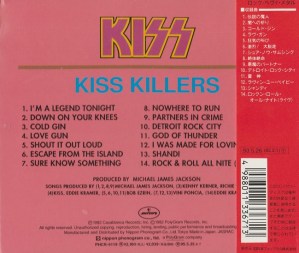
The hits on the record make for great listening. Most of the key bases are covered: “Detroit Rock City”, “Shout it Out Loud”, “Love Gun”, “God of Thunder” and even “I Was Made for Lovin’ You”. There are no Peter Criss songs, and the only Frehley is “Cold Gin”, which Gene sings. The only ballad is “Sure Know Something”, a minor hit in Germany where this album was issued. In a cool touch, the record closes with the “live” (quotation marks!) version of “Rock and Roll all Nite” that made them superstars. It is the more well known, and arguably superior version. (Some of the other tracks are edits or single versions.*)
Kiss’ very first Japanese bonus tracks were on Killers. The Japanese version is an even better listen. They put a bonus track in the second-to-last position on each side: “Shandi” (massive hit in Australia) and “Escape From the Island” (previously unreleased in Japan — it wasn’t included on their version of The Elder). “Shandi” is just a great fucking song, and “Escape From the Island” is a cool inclusion because of a) its obscurity, and b) its total Ace Frehley shreddery. It is interesting to note, that only Japan had tracks from the two most recent Kiss albums, Unmasked and Music From the Elder. The rest of the world did not. Were Kiss already trying to bury those records?
Periodically, the new songs on Kiss Killers have reappeared on single B-sides, compilations and box sets. The best way to get them is just to pick up a copy of Killers. Choose your format, sit back and rock!
Today’s rating:
4/5 stars
* “Shout it Out Loud” is a single version with a different mix on the lead vocals and an early fade. “Detroit Rock City” and “I Was Made for Lovin’ You” are edited versions.
– Music From the Elder (1981 Casablanca, 1997 Mercury remaster, 2014 Universal vinyl)
Kiss had gone as far as they could go in the pop direction that they travelled on Unmasked. The band’s stature was in jeopardy. The image was outweighing the music and they suffered their first member defection. As discussed in chapter 18, Peter Criss was out, but he was replaced by an energetic young drummer henceforth known as Eric Carr. His abilities put sounds in reach that the band weren’t able to do with Peter Criss. The smartest move, albeit the safest, would be a return to the band’s hard rocking roots. Songs were written and demoed, including “Don’t Run” (Frehley/Anton Fig), “Every Little Bit of My Heart” (Stanley), “Deadly Weapons” (Stanley/Simmons), “Nowhere to Run” (Stanley), “Feel Like Heaven” (Simmons) and an instrumental called “Kix Are For Kids”.
Based on what we know of these songs today, Kiss easily could have turned them into a classic sounding album. Whether it be ego, fear, ambition or sheer hubris, Kiss scrapped the demos and aimed instead to shoot in another direction. That is, Paul Stanley, Gene Simmons and manager Bill Aucoin changed direction at the protest of Ace Frehley. Eric Carr had no say, being an employee. Playing on the strengths of Kiss’ larger than life comic book image, Gene concocted a fantasy story that they wanted to turn into a concept album. If that was successful, they could spin the album off into sequels, a tour and a movie. And who else would be better to produce a concept album than Bob Ezrin?
The addition of Ezrin was another grievance for Ace Frehley. It was Bob Ezrin who replaced him on 1976’s Destroyer album with Dick Wagner on “Sweet Pain”.
So a fractured Kiss went into separate studios to record the concept album. Ace stayed in his new home studio in Connecticut and recorded his guitar parts there, painstakingly taking his time to get just the right crunch. Much to his chagrin, Bob Ezrin used only bits and pieces of what he was sent. Bob was dealing with a severe drug problem, and had isolated himself so that the only lines of communication regarding the album were Kiss and Bill Aucoin. Nobody outside of the circle heard a note until they were done. There was talk of a double album, but it made sense to do it one at a time…just in case it didn’t sell. Hence the title, Music From the Elder. Like Star Wars, this was meant to be only a part of the whole story.
A word about the running order. When Music From the Elder was first released in North America, the story didn’t make much sense. It was supposed to begin with the instrumental “fanfare” and then the acoustic strumming of “Just a Boy”. Instead the record company shuffled the song order to start with something heavier: “The Oath”. But the concept never made any sense. In 1997, Mercury released the Kiss remastered series, and restored the original intended track order. They even restored a snippet of “lost” music, a Gregorian chant bit between the first two tracks. The original Japanese pressing came with the tracks in the right order, but was missing one overall (“Escape From the Island”). The Japanese version also came with a neat full cover obi with pictures of the band — something fans missed out on with the normal release. (When fans did finally see pictures of the 1981 Kiss, they were taken aback by the modern hair and image.) The current 2014 LP edition on 180 gram vinyl also has the restored track order.
The album begins quietly (and pretentiously) with strings and woodwinds of “fanfare“, credited to Ezrin and Stanley, and based on the melody of second track “Just a Boy”. “Who steers the ship through the stormy seas? If hope is lost then so are we. While some eyes search for one to guide us, some are staring at me.” The Elder is the tale of a reluctant hero known only as “the boy”. He is the archetypal “chosen one” selected by the mysterious and powerful Council of the Elder. “When the Earth was young, they were already old,” reads the liner notes. He must face the evil Blackwell, but he can’t believe there is anything special about him.
Although “Just a Boy” is a deep cut loved only by those with Kiss infecting their blood, you can hear its charm. It sounds nothing at all like Kiss, and its soft acoustics don’t even sound like a rock band. Paul sings the chorus in an insane falsetto, which he also utilizes elsewhere on the album. The powerful guitar solo is all his, and one struggles to hear Ace Frehley on the track at all. “Just a Boy” is a good song, with structure and dynamics and thoughtful composition. It isn’t something that could be performed well on stage, and the production leaves a muddy haze over the lead vocals. It’s hard to hear 50% of Paul’s lyrics. Fortunately, the 2014 vinyl reissue comes with something the 1997 CD did not: a lyric sheet. With that in hand, you can follow the story.
In fact, it must be recommended to listen to The Elder on vinyl at least once to fully appreciate the album. Something about sitting there with a gatefold jacket open and following a story on a record sleeve works as a sort of time machine. It’s truly an experience that you cannot feel with CD alone, and the only way to do that with the songs in the proper order is with the 2014 vinyl reissue.
Kiss have thrown obscure covers on their albums before, but it’s strange to see such a thing on a concept album. “Odyssey” by Tony Powers fit the story at this moment, although nothing could sound less like Kiss. It is a fully orchestrated song and it doesn’t even have Eric Carr on it. Ezrin didn’t think he was getting the right vibe so he brought in Allan Schwartzberg who also played on Gene’s solo album. “Odyssey” is as overblown and pretentious as a song can get, as if Kiss suddenly became the Beatles and this was their “Hey Jude” moment. This many soft, un-Kiss like songs right off the bat is a good way to throw listeners, so the record label ended up moving it to side two. Paul Stanley has disowned the song, but what Paul failed to appreciate is that though campy, “Odyssey” is also incredibly fun. It has no place in the Kiss canon, but there it is, and it’s hard to forget that delightfully pompous orchestra.
The first appearance of the mighty demon Gene Simmons is “Only You”, a choppy and spare guitar number that is the first rock moment on the album. It’s an attempt to be progressive and rock, and it more or less works. It’s simple and blocky, but it shifts into a few different sections including a reprise of the “Just a Boy” theme. Paul also guests on a verse as the boy character, questioning his destiny: “I can’t believe this is true, why do I listen to you? And if I am all that you say, why am I still so afraid?” The Elder respond, “In every age, in every time, a hero is born as if by a grand design.” In an interesting twist, Doro Pesche later covered this song with completely different lyrics.
According to their self-written Kisstory (volume 1) tome, Eric Carr expressed some doubt as to the band’s current direction. In response Gene challenged him to come up with something of his own, so Eric provided the beginnings of “Under the Rose”, on which he also plays acoustic guitar. “Under the Rose” became his first writing credit on a Kiss album, with Gene Simmons. “Under the Rose” is soft/heavy, soft/heavy, and features an ominous choir on the chorus. But through this, Ace Frehley’s presence cannot be felt. Such an important part of the Kiss sound before, now relegated to the sidelines. Ace had only one lead vocal on The Elder, a song based on a riff written by Anton Fig. Their “Don’t Run” demo was re-written by Gene Simmons and Lou Reed, yes Lou Reed, to become “Dark Light”. In context of the story, “Dark Light” warns of coming evil. Ace’s presence is welcome, providing some much needed rock foundation and a brilliant guitar solo. Unfortunately “Dark Light” is probably his weakest in his Kiss career, a disappointing followup to prior classics like “Talk to Me”, “Save Your Love” and “Shock Me”.
Lou Reed co-wrote the lyrics to the single “A World Without Heroes”, which originated as a Paul Stanley ballad called “Every Little Bit of My Heart”. Reed came up with phrases like “a world without heroes is like a world without sun.” These clicked with Gene and Bob Ezrin who completed the song. Paul plays lead guitar on a somber single that, again, sounds little like Kiss. Kiss had done ballads before and even had hits with them, but nothing like “A World Without Heroes”, one of their darkest songs. Strangely, it ended up being covered by Cher.
At this point of the story, the boy agrees to fulfill his destiny and become the hero. This happens on the most heavy metal song on the album, “The Oath”. This is the track that opened the original released running order of the album, completely destroying any comprehensible plot. You can still understand why they did this. Its metal riff and impressive drums are the intro that the album really needed. Paul sings in falsetto again: “Now inside the fire of the ancient burns, a boy goes in and suddenly a man returns.” The song was performed live once in 1982 on a TV show called Fridays. Although the performance seemed sloppy and awkward, Ace burned up a couple wild guitar solos. If this is the kind of material that Bob Ezrin cut from the album, it was a big mistake.
So the boy has taken the oath, and it’s time to meet the evil one. Gene and Lou Reed wrote “Mr. Blackwell” about the character, who doesn’t seem to be too worried about the discovery of the chosen one. “Here’s to the kid, a real man among men,” mocks Blackwell in the lyrics. (The song also contains the phrase “rotten to the core”, which was a song title Gene had been batting around since the mid-70s.) Musically, “Blackwell” is spare and revolves around the words. A bumping and thumping bass is the main feature of a song that is more words than music.
At the exact moment that you need Ace Frehley to come back and save the album, he does with the instrumental “Escape from the Island”. Co-written with Eric Carr and Bob Ezrin, “Island” delivers the thrills and action-packed guitar action. Because it’s an instrumental it’s hard to determine exactly how it fits the story, except it sounds like an action scene. Perhaps Blackwell launched a preemptive strike on the boy, who escaped. Ace’s guitar attacks the surroundings, chopping them down with fatally loud riffs.
The final song (on all versions of the album) is the single “I”. Gene and Paul split lead vocals on this Simmons/Ezrin song, but once again Eric Carr was secretly replaced on the recording by Allan Schwartzberg. The story is wrapped up with the boy now proclaiming he believes in himself and is ready to take on the evil. The end of the album, yes, but clearly intended as only the first chapter of something bigger. Gene spoke of a heavier sequel album called War of the Gods which would depict the conflict. Instead, “I” serves as the ending, and at least it’s a kicker. Like vintage Kiss, the riff and chorus meld into one fist of rock. The lyrics are suitably uplifting. “I believe in something more than you can understand, yes I believe in me!” That’s pure Kiss in a nutshell right there.
A short hidden track following “I” provides the only dialogue on the album (over a reprise of “fanfare“), although more was recorded. The hidden coda reaffirms that the Elder have found the right kid. “He’s got the light in his eyes, and the look of a champion. A real champion!”
There are two ways to listen to The Elder. If you want the whole enchilada and would like to hear the story in its correct order, pick up a remastered edition of the album either on CD or vinyl. If you’d like a more even listening experience that is the same as that of fans who dropped the needle on the album in 1981, then go for the original CD or vinyl release. But if you’re a Kiss maniac, you simply must do it both ways.
Music From the Elder is a flawed album, mostly marred by sonic muddiness. It has an uncharacteristic quantity of ballads and un-Kiss-like songs, so fans stayed away in droves. What they missed was a decent concept album for Kiss, a band that never should have attempted a concept album in the first place. Because the album failed to sell, Kiss’ ambitious tour plans were scrapped and the band stayed home. Aside from the three songs played on the Fridays TV show (“The Oath”, “A World Without Heroes” and “I”), Kiss never played any songs from The Elder live until their 1995 acoustic Konvention tour. The lack of a tour meant Kiss’ momentum was all but halted. The new drummer that fans barely knew only ever played one show in North America!
A bigger problem was brewing, and that was a bitter and disenfranchised Ace Frehley. Once again, fans were not aware of the problems brewing in Kiss, but The Elder was the last album Kiss Ace played on until 1998. It was a repeat of the Peter Criss situation only two years prior.
If Kiss had stuck to their plan of recording a hard rock album again, perhaps things would have played out completely differently. We’ll have a chance to check out some of the songs they were working on in upcoming chapters for they would not stay buried long.
Today’s rating:
3.5/5 stars
Uncle Meat’s rating:
2/5 steaks
Meat’s slice: Some of my favorite records ever have been “concept” records. Operation: Mindcrime, Misplaced Childhood, 2112, Metropolis Pt 2: Scenes From a Memory, El Corazon; to name just a few of many. When it comes to The Elder, my one sentence review of this album would simply be: Some bands should not make concept albums. Bob Ezrin came straight from The Wall to record this mess. I read somewhere recently, and it may even have been in the comments here perhaps, but Ace Frehley hates this album. Which completely makes sense considering he had been on such a roll until it halted with this record. It’s kind of a hard album to break down individually, but some quick notes:
“The Oath” – Very chuggy heavy song. I think the [domestic] album starts off with the best song. Song begins as if it’s Manowar meets Kiss. More reminiscent of Creatures of the Night than this record. Perhaps some bombastic Tenacious D-like moments.
“Just A Boy” – Starts off like early ELP and first reaction is that Paul Stanley could never come close to singing this song again. Solid song. Overall I get a Wishbone Ash feel.
“Dark Light” – As mentioned earlier, Ace’s roll slows down with a dull track. I do like the guitar solo over the bongos though.
“Only You” – An even duller track that starts with Gene singing, and morphs into Stanley singing with some stupid effect on his voice. Right producer, wrong band. (That could be another one sentence review of The Elder)
“Under the Rose” – This clunker doesn’t flow for me. Gregorian Monks? Bah….
“A World Without Heroes” – I thought it was lame then and it’s only slightly less lame to me now. Could have used more Lou Reed.
“Mr. Blackwell” – Funky novel track. Dancy and quirky but one of the strongest songs on The Elder for me. One of the only songs for me that has a great hook to it. Unmasked this album is not.
“Escape From the Island” – Good solid rocker. Great drumming. This would have been a great live jammer, but I’m doubting they have ever played this live. LeBrain? [Nope]
“Odyssey” – WTF? Was this Paul’s tryout demo for Phantom of the Opera? This song alone is an unforgivable sin, and just another reason why this album should have been aborted in the womb.
Favorite Tracks” “The Oath”, “Mr. Blackwell”, “Escape From the Island”
Brief explanation: After the #200wordchallenge, I was inspired to come up with an even more daunting task. Could I do a review in 0 words — without using any words at all? I invite you to the #0wordchallenge! Mine is below, but use your imagination and come up with something uniquely you! This review is a part of…