I’ve never hid my disappointment that Skid Row have been unable to hang into a lead singer for long since Sebastian Bach’s 1996 ouster. Johnny Solinger was their best shot at a permanent lead singer, since replaced by a dizzying array of vocalists. Erik Grönwall, from Swedish Idol and H.E.A.T., was probably the biggest hope. Sadly, as a cancer survivor, Erik was forced to resign and focus on his health. The one album he made with Skid Row, The Gang’s All Here, received critical acclaim in 2022 and was called Album of the Year by several outlets.
Erik Grönwall brings the necessary range and power, more so than Solinger. Unfortunately, both Solinger and Bach had a lot of character in their voices. Grönwall has a more generic sound, and this robs Skid Row of some of what made them special. He almost sounds too good, too professional.
A lot of people will disagree and that’s fine. We’re all entitled to our opinions.
Only two songs here, “Time Bomb” (sort of a punky rewrite of “Piece of Me”) and “The Gang’s All Here”, made it onto the tour setlist. 80% of the album was not played live. There are shout-along choruses, Kiss-like guitar licks, and Bolan’s bass bounce…but do the songs stick to the brain like albums of yore? Some do. The best moments are the ones that recall the past, such as “Resurrected” which has a “Monkey Business” familiarity. Unfortunately, the trite lyrics are another one of those “we’re back where we belong” kind of songs.
The strongest song is the ballad “October’s Song”, which comes closest to nailing the timeless Skid Row level of quality. Grönwall’s schooled approach to singing is opposed to Bach’s desperate passion to blow down the biggest of buildings, but that was a long time ago, and Bach is never coming back. “October’s Song” has some great riffage and should have been made a permanent part of the setlist. You’ll not find a better song among the new ones. We’ll say it right here: this song stands up against the back catalogue, even the intense Slave to the Grind ballads.
Credit due: Skid Row almost go activist on the environmental message song “World On Fire”.
Much of the album was written with previous singer Z.P. Theart, of Dragonforce. Core Skid Row members “Snake” Sabo, Scotty Hill, and Rachel Bolan handle the majority of songwriting, retaining Rob Hammersmith on drums.
If you want a new Skid Row album that you can pump your fist to, stomp your feet, or bang your head, then The Gang’s All Here is a must-buy. If you were hoping for a Skid Row album that you’ll remember for years like Slave to the Grind, Subhuman Race, or even Thickskin, then the jury is still out. Thickskin had way better songs – there, I said it!
I love admitting to my past musical sins. Perhaps others will learn from my mistakes.
I was in grade 11, a mere 16 years old, when the music video for “Youth Gone Wild” hit the airwaves. Skid Row were the latest thing, a band promoted by Jon Bon Jovi himself, from his home state of New Jersey. We didn’t know yet that the lead singer, Sebastian Bach, identified as a Canadian. He grew up in Peterborough Ontario, just on the other side of Toronto. In fact, I didn’t know that I already had something of Bach in my music video collection. I had a brief clip of him, with teased up hair, in a prior band called Madame X. This band was led by Maxine Petrucci, sister of Roxy Petrucci from Vixen. They featured a young Sebastian Bach and Mark “Bam Bam” McConnell whom Bach would play with in VO5. I wasn’t into any of those bands. I was pretty hard-headed about what I liked and disliked.
In Spring 1989, I first encountered “Youth Gone Wild” on the Pepsi Power Hour. It could have been Michael Williams hosting, but whoever it was, they hyped up this new band called Skid Row. I liked getting in on new bands from the ground floor. Made them easier to collect when you started at the start. At that point, I wasn’t even sure how many albums Judas Priest actually had. I was intrigued enough to hit “record” on my VCR as the music video began. I caught the opening “Ba-boom!” of drums, and sat back to watch.
While I wasn’t blown away, I kept recording. The key was the singer. If the singer sucked, I’d usually hit “stop” and rewind back to where I was. The singer passed the test: he didn’t suck. I kept recording.
After about a minute, I pressed the “stop” button, and lamented that this new band wasn’t for me. What happened? What did Skid Row do to turn me off so quickly?
I can admit this. I’ve always been open about the fact that I was very image-driven as a teenager. We all were! With the exception of maybe George Balazs, all the neighborhood kids were into image to some degree or another. I was probably driven by image more than the average kid, consuming magazines and music videos by the metric tonne. So, what exactly was wrong with Skid Row?
I’ll tell ya, folks. It was serious.
The bass player had a chain going from his nose to his ear.
I just could not. I couldn’t put a poster on my wall with some band that had a bass player with a chain that went from his nose to his ear! No way, no f’n way.
I pressed rewind, and prepared to record the next video over Skid Row.
That summer, the glorious, legendary summer of ’89, I went with Warrant. I bought their debut album sight-unseen, based on a blurb in the Columbia House catalogue. Warrant were the selection of the month. “What the hell,” I thought, and checked the box to order it immediately.
Meanwhile, Bob Schipper and the girl I liked, named Tammy, were really into Skid Row. They knew all about my issues with the nose chain. They got under my skin about it a bit, but I wouldn’t bend on Skid Row.
“18 and Life” was the next single, a dark power ballad that was easy for me to ignore. “I Remember You” was harder to pass on. It was the perfect acoustic ballad for 1989. You had the nostalgic lyrics, which Bob and I both connected with. Somehow, we knew that 1989 was the absolute pinnacle. We knew this would be the summer to beat! Bon Jovi and Def Leppard were still on the charts. Aerosmith and Motley Crue had new singles out with albums incoming. We walked around singing “Summer of ’69” by Bryan Adams, except we changed the words to “Summer of ’89”. We just knew. “Got my first real six string…” we sang. And we both had our own fairly new guitars that we could barely play.
“I Remember You” was a massive hit, and still I resisted.
“Because of the nose chain?” Bob Schipper questioned me.
Absolutely because of the nose chain!
I stood firm for two years. Bob Schipper went to college, and Tammy was long distance and not meant to last. I felt a bit like an island by the time 1991 rolled around. I felt alone. My best friend was gone, I had no girlfriend, and most of my school friends went their own ways. I was a loner like I’d never been in my life before. Music was my companion, and my beloved rock magazines were my library.
That’s how Skid Row eventually got me. Sebastian Bach had a good friend in Drew Masters, who published the excellent M.E.A.T Magazine out of Toronto. Drew’s praise for the forthcoming second Skid Row album, Slave to the Grind, was unrelenting. He caught my ear. I was looking for heavier music in my life, not satisfied with Priest’s Painkiller as one of the heaviest albums I owned. I wanted more rock, and I wanted it heavy.
The other thing that got me was the collector’s itch. When I found out that Slave to the Grind was released in two versions with different exclusive songs, I was triggered. I had to have both.
“I’ll make a tape, and put both songs on my version!” It was a pretty cool idea.
Costco had Slave to the Grind in stock. They had the full-on version with “Get the Fuck Out”, the song that was excluded from the more store-friendly version. Columbia House stocked the tame version, which had a completely different song called “Beggars Day”. I bought the CD from Costco, the vinyl from Columbia House, and suddenly I was the only guy in town who had the full set. I made my cassette with joy, recreating the Skid Row logo on the spine, and writing the song titles in with red ink.
“Get the Fuck Out” was track 6, side one. “Beggars Day” was track 7, side one. I still have them in that order in my mp3 files today.
Sure, there was an audible change in sound when the tape source went from CD to vinyl, but I couldn’t afford two CD copies. Little did I know how cool it would be later on to have an original vinyl copy of Slave to the Grind.
I loved the album. I loved all three of the ballads. The production was sharp. There were excellent deep cuts: “The Threat”, “Livin’ on a Chain Gang”, and “Riot Act” were all as great as any of the singles. Furthermore, the singer had taken it to new heights of intensity and excellence.
I let Skid Row into my heart that day. It was a good decision. Skid Row accompanied me through times good and bad, lonely and angry. They were my companion through it all, and they’re still pretty good. It was meant to be!
Park Avenue leads to…SKID ROW! But Skid Row leads to Grant’s Rock Warehaus!
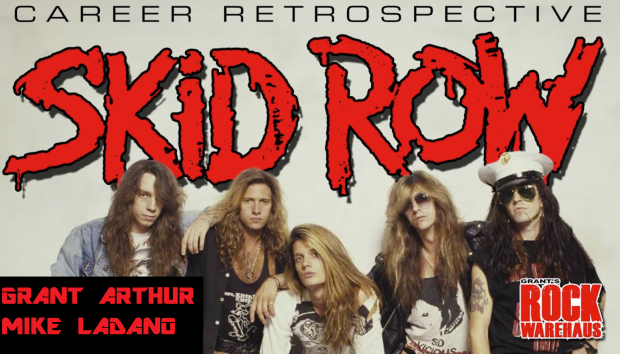
This week on Grant’s Rock Warehaus, we talk about a band that Grant has been digging seriously for the last several weeks, ever since seeing former singer Sebastian Bach on an 80’s cruise. We don’t talk just Bach. We tackle the Johnny Solinger years, the unfortunate tale of Erik Grönwall’s short stint, and of course, current lead singer Lzzy Hale. Take a look at my Skid Row collection, including The Atlantic Years box set (unboxing!), my original 1991 vinyl of Slave to the Grind, my Japanese Best of Skid Row, and a rare promo single from 1995.
Grant and I tried to cover as much ground as possible. Album artwork is discussed, and a few underdog records are praised. I tried to highlight what I think are some incredible and underrated ballads that might be forgotten in the shadow of “I Remember You”. We shone a light on the talent of all the members, and questioned what they could have done differently through their career. Leading to the present day, we have some suggestions for Skid Row about their future and reissues we want to see happen.
It’s all here, on Grant’s Rock Warehaus with your host, Grant Arthur!
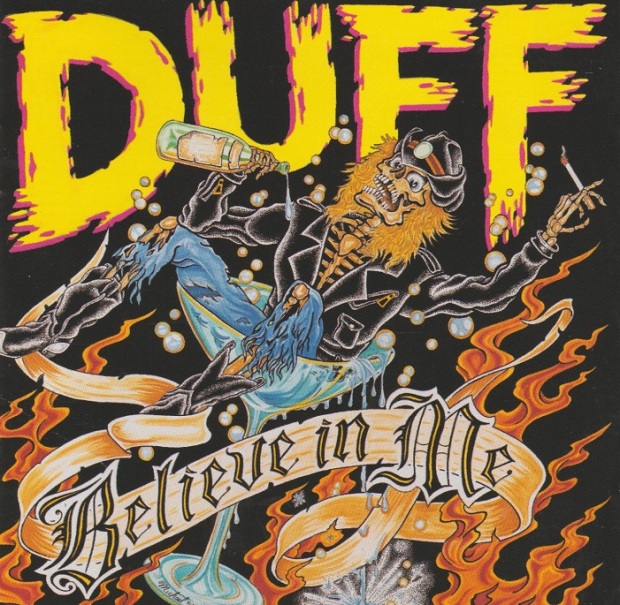
In 1993 Duff McKagan was not clean yet, at least not for good. It would take a critical medical emergency for him to get close enough to death and stop drinking. The cover of Believe in Me, a skeletal Duff bathing in a martini glass, reflects the last of the old Duff. It was his solo debut, following Izzy but before Slash. Guns’ own Spaghetti Incident? hit the shelves two months later, as the end of the original band creeped on the horizon.
Fans were probably experiencing a bit of Guns overload. Two albums, two live concert video tapes, loads of touring and music videos…Guns were everywhere from 1991-1993 and then it was the dawn of Guns solo albums.
Duff’s solo debut was a grab bag of different styles: punk, rock, funk, jazz and ballads. It was also loaded with rock star guest shots: Lenny Kravitz and Sebastian Bach sang one song a piece. Dave Sabo and Rob Affuso from Skid Row joined Baz on the album while Slash laid down a couple trademark dirty guitar solos. Jeff Beck dropped by, and just about every Guns member except Axl himself contributed.
Despite Duff’s ambition, the best tracks tend to be the rockers. Opener “Believe in Me” was a very Guns-like single: short, sweet, catchy and with a Slash guitar solo to hit it home. “I Love You” isn’t a ballad despite the title, in fact it’s a rocker and perhaps the best tune on the album. “Just Not There” also rides the GN’R train, normally bound for hitsville. Sebastian Bach’s “Trouble” is plenty of fun, and Lenny Kravitz gets angry on “The Majority”. These songs would have made a fine basis for a Guns album, but Axl wasn’t looking for songs that sounded like Guns N’ Roses.
An angry “(Fucked Up) Beyond Belief” (a song birthed from GN’R rehearsals) is noisy punk-rap, while “Fuck You” itself is basically a rock rap song featuring a guy named Doc. “Punk Rock Song” is exactly what it claims to be, but isn’t particularly memorable. The biggest mis-step is the muted trumpet jazz number, “Lonely Tonight”. At least Duff was trying something different, but his vocals and lyrics leave a lot to be desired.
During the period that Guns N’ Roses were inactive or just working behind closed doors, a lot of these solo albums really represented an alternate universe. “What if the original members didn’t leave and instead recorded a new album?” It’s possible these songs or songs like them could have been on that hypothetical album. Instead, Believe in Me was a launch pad for plenty of Duff projects and albums: Neurotic Outsides, 10 Minute Warning, Loaded, Velvet Revolver and many more. Duff has proven that clean and sober, he can be one hell of a prolific songwriter. Believe in Me is a good introduction to the many stylings of Duff McKagan.
Skid Row had the songs, but most importantly, they had the frontman. Only once in a blue moon does a congenital entertainer like Sebastian Back happen upon the scene. Born in the U.S. but raised in Canada, Bach had it all: the looks, the youth, the charisma, and most importantly the voice. He was a bull-headed bastard in those days too, but that is often a part of the frontman package. Bach was a dynamo, always “on”, and with that voice on his side, people paid attention.
Without Bach, would Skid Row ever have made the impact they did? Not to that degree, no. Sure they had Jon Bon Jovi in their corner (and to take them out on tour) but without Bach, Skid Row would have been just another hard rock band in 1989, the peak year for the genre. It can’t be understated how important the voice was. Bach had the power, range and unique style required, but he had it right out of the gate! The band was good too: Dave “Snake” Sabo, Rachel Bolan and Scotti Hill wrote some great, bone-shaking cock rocking tunes. Rob Affuso (today in Four by Fate with members of Frehley’s Comet) has long been an underrated drummer capable of some serious steppin’. With Michael Wagener in the producer’s chair, everything aligned and came up platinum.
Three major hit singles made the album a must-have. They were, of course, “Youth Gone Wild”, “18 and Life” and “I Remember You”. These have become their career-defining songs, particularly the ballad. “I Remember You” may have misled more than a few listeners when it first came out. This is not a ballad album, but a very hard rockin’ record. This wasn’t Bon Jovi. It was heavier than everybody else on the radio that summer: Motley, Warrant, Aerosmith, Van Halen, Def Leppard. Though it rocks hard, it’s still memorable.
With the benefit of hindsight, we know Skid Row were capable of so much more, and they delivered on the next album Slave to the Grind. Once they let the thrash metal and punk influences come out, the real Skid Row sound was conceived. Their debut is good, but the next two were even better.
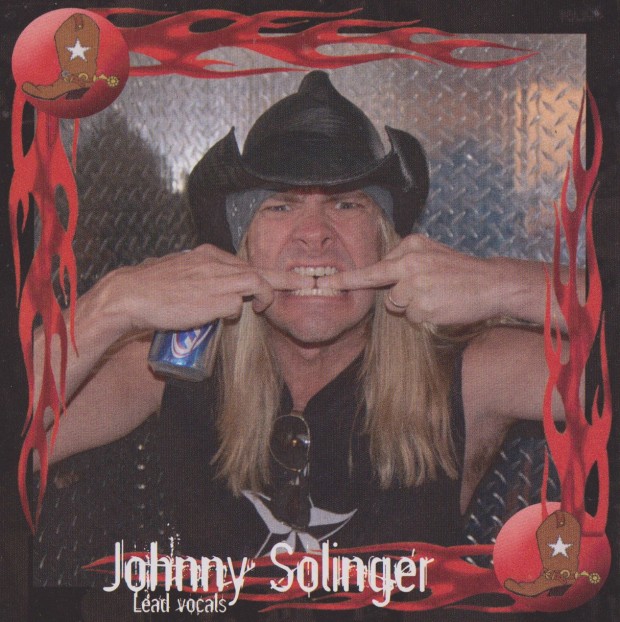
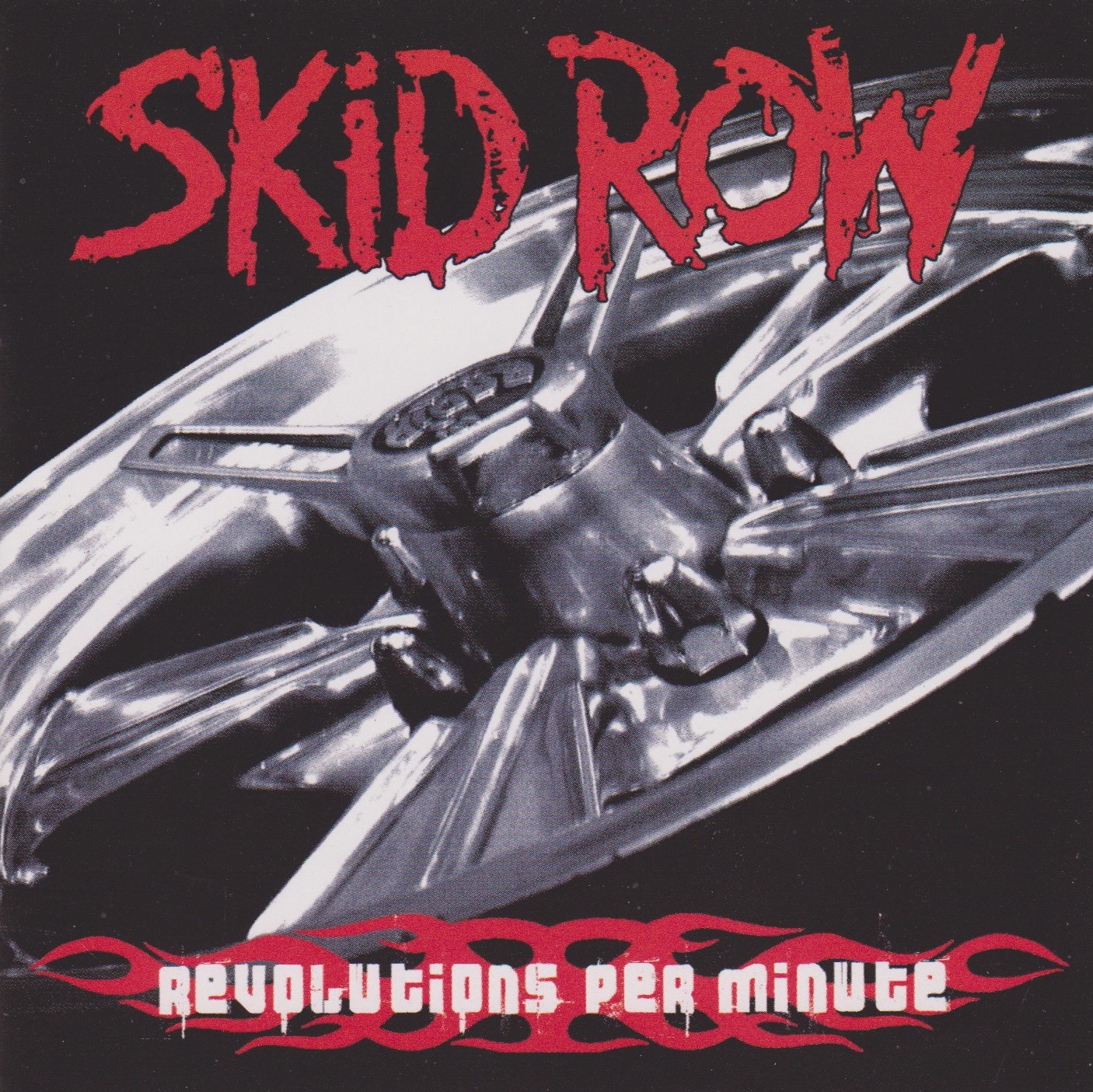
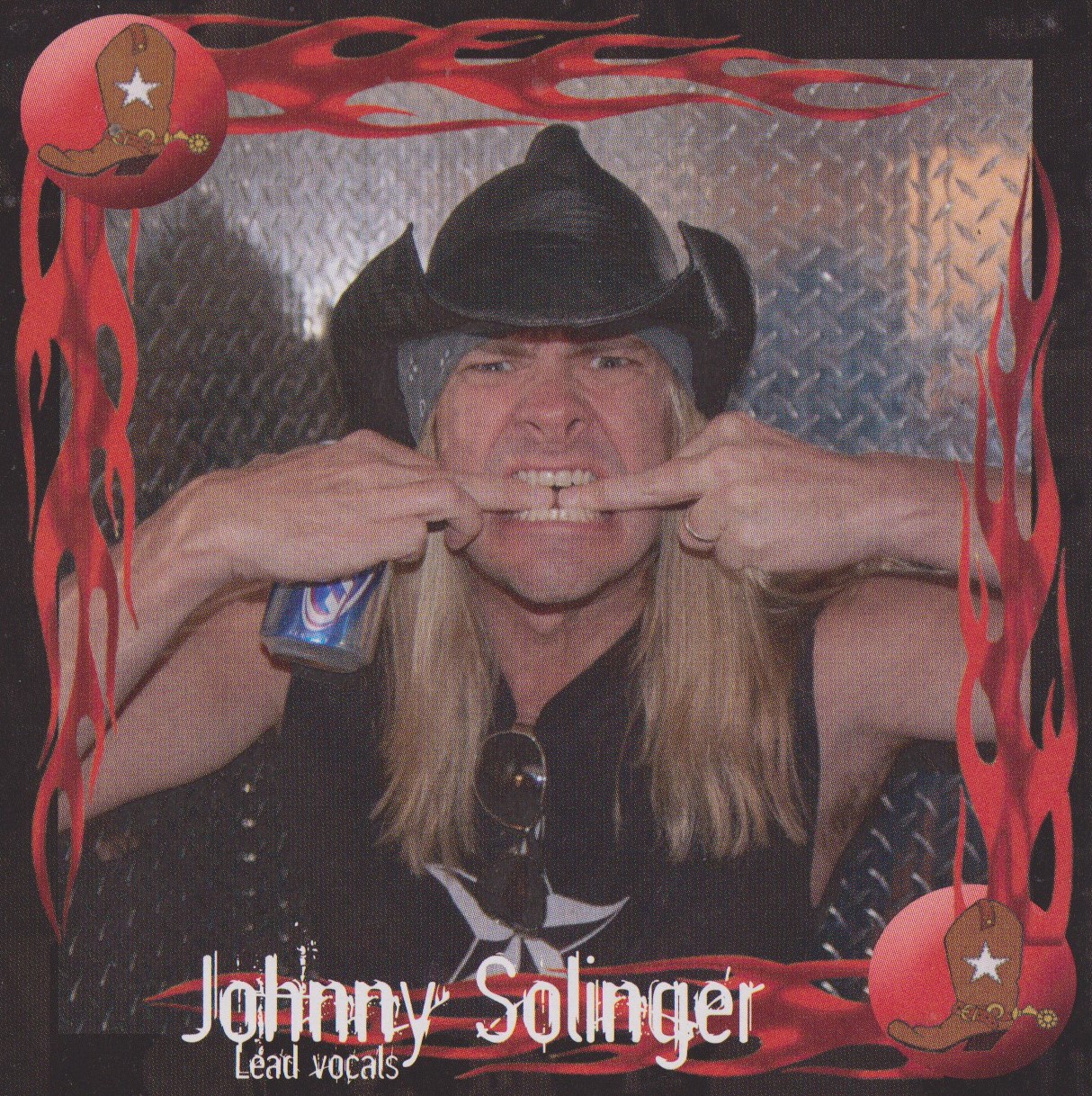
Skid Row did a pretty good job of replacing the irreplaceable Sebastian Bach on their fourth LP, Thick Skin. It earned a more than healthy 4.25/5 stars, in part due to the charismatic vocals of Johnny Solinger. For their second album with Johnny, they re-teamed with producer Michael Wagener, but had mixed results in repeating the magic.
Revolutions Per Minute is heavy enough; there was no issue of the band going soft. There was a dip in quality from the songwriting department, strongly dominated by bassist/leader Rachel Bolan. Strangely, they chose to pad out the album with a cover (The Alarm’s “Strength”) and a remix. It’s worrisome when the best song is a cover. There’s a distinct pop-punk vibe on many songs, which one has to trace back to Bolan. Dave “Snake” Sabo has two co-writes, and Scotti Hill a mere one.
“Disease” is very Skid Row, nothing outstanding, but a strong enough way to open the album. The punk-like “Another Dick in the System” is better. With Solinger scraping the ceiling with his screamy high notes, it’s reminiscent of old Skid Row circa Slave to the Grind. “Pulling My Heart Out from Under Me” follows with an 80’s Elvis Costello vibe to the guitars. This one is quite a departure from Bach-era Skid Row, and a decade later I’m still not sure if I like it. You can’t fault a band for experimenting, but if the results aren’t good enough, that’s a tough call. I’m not sure if “Pulling My Heart Out from Under Me” is good enough. The worst of the punk influenced songs is “White Trash”, which is so indescribably bad that I won’t even try. It’s not funny and not good. Back to something that sounds like Skid Row, “Nothing” is one of those tunes that you could imagine was written in 1988 for the debut album.
Influences collide on “When God Can’t Wait”. Johnny Solinger is a country guy, and Rachel Bolan is a punk guy. It seems 1+1 does indeed =2, and the sum total of punk and country is rockabilly. I have to admit to liking this one, even though I’m still not sure if it’s any good. I definitely prefer it to the next tune, “Shut Up Baby, I Love You” which doesn’t have much going for it aside from the full-metal tempo.
Strangely, the best original song is “You Lie” which begins as nothing but pure country. Only after the twangy guitar solo does it accelerate into rock territory, but it’s the country part that rules. The final track is a “Corn Fed” remix, which adds slides, harmonica and accoutrements. At least that ends the album on a good notes. The CD does start to drag a bit with two lacklustre songs, “Love is Dead” and “Let it Ride”, so the remix of “You Lie” is a smart way to end it.
You get the feeling that Skid Row had potential for a great album, but only came up with enough good songs for an EP.
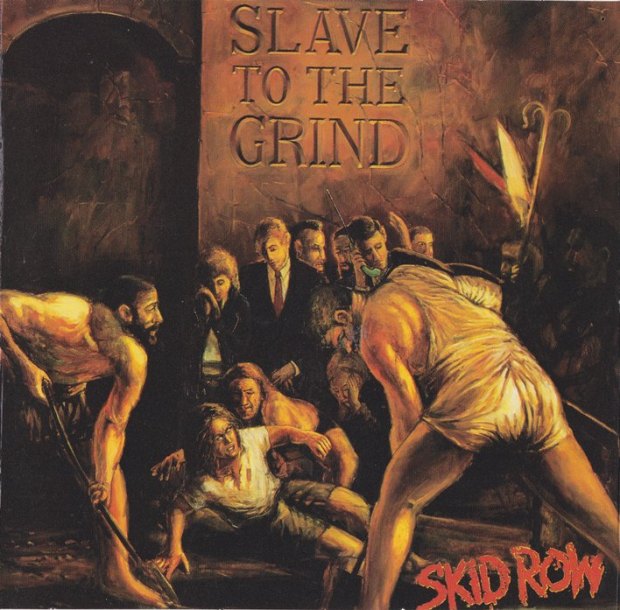
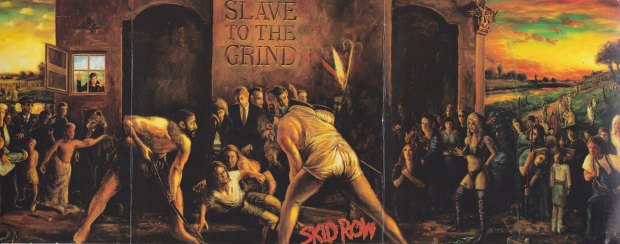
SKID ROW – Slave to the Grind (1991 Atlantic “clean” and “dirty” versions)
The Skids knew the second album had to kill. The band, always heavier live than the first album implied, also knew the second album had to sound more like they did in concert. And following up a huge hit debut, they also demanded the album be all killer, no filler. Raising the bar and ignoring the record company, the band re-convened and kicked every ass in the room. The result is Slave to the Grind, one of the best hard rock albums of ’91 period.
The first single “Monkey Business”, which is essentially just dirty grooves n’ screams, was about as commercial as the album got. With this as first single, it was clear that Skid Row didn’t care whether they got played on MTV or not. There was nothing glossy or slick about it. It’s still obvious that there’s something special here, and I credit that to two factors: the songwriting talents of Snake Sabo & Rachel Bolan, and the frontman chops of Sebastian Bach. Bach commands this song. It’s not just his vocals. It’s his confidence, his swagger, and his ego shining through.
If “Monkey Business” didn’t scare your little sister, then the second single “Slave to the Grind” definitely did. For the first time, Skid Row jumped straight into the thrash metal deep end. Drummer Rob Affuso had the chops to do it, and it really was a natural step to take. Other bands were getting heavier in 1991 too, but none of them took a turn like this. Skid Row raised the bar for everyone in their field in ’91.
The other singles from the album were technically “ballads”, although the band were eager to point out that none of them were anything like “I Remember You”. They were dark and edgy. The record company execs no doubt shit their pants when they heard the magnificent “Wasted Time”, which I can only describe as epic. It’s an incredible song, and it’s one of the few that Bach had a hand in writing. Baz wrenches all the emotions from his soul and that’s what I hear coming from the speakers. “Quicksand Jesus” and “In A Darkened Room” are only a little less impressive. They share the same kind of mood and sonic landscape. There is really nothing commercial about any of them. They all have headbanging moments and integrity.
Rounding out the album were several very strong deep cuts. “The Threat”, track 3 on the disc, easily could have been a single. In fact Terry David Mulligan of MuchMusic asked Sebastian if it was going to be selected as a future video, so I’m not alone in thinking that. “Psycho Love” is a bangin’ bass groove, laid to waste by Bach’s scorching vocal. “Livin’ on a Chain Gang” is another standout, an angry one about injustice. Then you have slow, landmine-infested blasters like “Mudkicker”, and fast smokers like “Riot Act”. All strong songs. The only one I’m not keen on is “Creepshow”, a jokey tune about the kind of people you’d see on daytime talk shows.
Skid Row knew well ahead of time that some markets would not release an album with a song called “Get the Fuck Out” on it. This fun punk rocker sounds like a Rachel song, but Bach’s attitude nails it. It’s probably a bit of a novelty, but it’s fun. “Fuck you if you can’t take a joke!” says Bach in one line. But it’s OK: if you can’t take the joke, you can buy the version of the album without “Get the Fuck Out”. Earlier pioneers in the clean/dirty dual releases, Skid Row saved the song “Beggars Day” for the Walmart version of the album. (Also sold by Columbia House in Canada.) I think it’s cool that they gave both markets added value with exclusive songs. This song is more traditional metal (perhaps Priest-like) than the rest of the record, but it’s equally strong.
Michael Wagener produced this album with a raw, unpolished finish. But there are backing vocals where you need ’em, and the instruments are clear and in your face. It still sounds heavy today, unlike a lot of other music from the same year. It just seems like everything clicked, and all the factors were in place. Slave to the Grind kicks ass with the best of them.
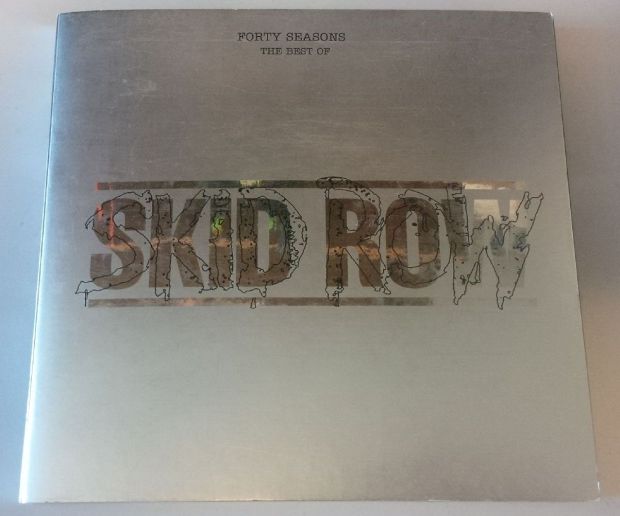
SKID ROW – Forty Seasons: The Best of Skid Row (1998 Atlantic Japan)
US cover
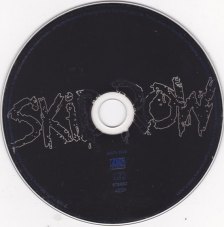
The Japanese fans always seem to get the coolest stuff. Look at this package: shiny silver, instead of the boring grey of the American release. Digipack with foil stickers! Bonus track! So much cooler than the standard release here. Hell, the Japanese title is even spelled F-o-r-t-y, where the American version has the briefer 40. Why? Not sure. Either way I’m glad to have this version, which fell in my hands thanks to customer Conrad in the late 90’s. He sold it to me with stickers intact and still sealed; all that is missing is the obi strip.
Whether you own Forty Seasons or 40 Seasons, the party starts with “Youth Gone Wild”. Any commemoration of the Sebastian Bach years should open with that track. Although “Youth Gone Wild” is Bach’s signature track today (along with “I Remember You”), he actually wrote neither. Some fans would be surprised how little Bach has written in Skid Row, and indeed he only has two writing credits on this greatest hits disc. What Bach brings to the party is his spirit, attitude, and incredible voice. When Skid Row came out in ’89, Bach was almost instantaneously a 21 year old superstar. He had the ego to deliver the rock star vibe in concert and in print, and he certainly had the vocal chops. This is why Bach has remained a thorn in Skid Row’s side today, 15 years since hiring Johnny Solinger to replace him.
Track two is a little too soon for a mellow song in my opinion, but “18 and Life” works in this slot due to its dark vibe and powerful choruses. The singles “Piece of Me” and “I Remember You” are the other representations from album #1, although I definitely could have done without “Piece of Me”. Skid Row have written much better heavy rockers since. “I Remember You” is a song I still haven’t really tired of, thanks to Bach’s timeless performance. Every time Baz sang this tune in Toronto, the place went insane, as Bach always sang it for his old stomping grounds. Rachel Bolan and Snake Sabo may have written the song, but when I think of “I Remember You”, I think of Toronto.
Skid Row’s second album Slave to the Grind blew away the first. I’m glad “The Threat” was included. It may not have been a single, but it was one of the outstanding album cuts. Equally solid was the bass groove of “Psycho Love”, which is relentless. Skid Row really turned up the octane on that second album. I think both tracks outshine the single “Monkey Business”, but nothing can overpowerful the thrash metal of “Slave to the Grind” itself. When it was released, I couldn’t believe how full-on Skid Row had become. This is a high water mark of heaviosity.
“Quicksand Jesus” represents one of the three slow tunes on Slave; I would have selected “Wasted Time”. “Quicksand Jesus” is an outstanding song, and so is the other slow tune not included here, “In A Darkened Room”. “Wasted Time” is so clearly above and beyond either of those two, that I can’t understand why it’s not on this CD. It has something special to it, like “I Remember You” did.
So the first half of the CD covers the first two Skid Row records with all the big hits. The second half covers the rest, plus rare and unreleased stuff. I love the third Skid Row record, Subhuman Race. I consider it a great metal record in the context of the mid 1990’s. For some reason, none of the Subhuman songs included here are the album versions. I know the band fought with Bob Rock over the production on that album, and maybe that is why. “Into Another”, which might be considered a slower song, is remixed making a little lusher. The single “My Enemy” is also remixed, perhaps to tame down the St. Anger-esque drums. My favourite Skid Row ballad, “Breakin’ Down” is remixed as well, but you have to know the song really well like I do to notice by ear alone. (Listen to the guitar accents.) Overall it’s more polished and finished, which is fine, because the album version was actually more or less just the demo version. Lyrically the song is a message from Sabo to Bach, about their failing relationship. Bach reportedly received the demo, sang to it, and that’s what was put on the record.
The excellent banger “Frozen” is presented in demo form, which is interesting but inferior to the excellent, slamming album version. Finally, “Beat Yourself Blind” (Bach’s favourite song from Subhuman Race) is live. What an awesome tune live. This is from the Japanese Subhuman Beings on Tour EP. As great as the stuttery album version is, the live one is more fluid. I’ve heard Rachel Bolan say the Subhuman album “sucked”. I don’t understand how he can say that, and I think the five songs here prove my point.
The album closes with a pair of treats: unreleased songs! “Forever” from the first album’s sessions is better than many of the songs on that record! Who chooses these songs? Perhaps it was a bit too derivative of other popular 80’s bands, but Sebastian makes it sound like nobody else but Skid Row. This not only should have been on the album, but could have been a hit single. Then there’s “Fire in the Hole”, a great little slammer that didn’t make the second album. This time I agree. That second album is incredible and “Fire in the Hole” isn’t up to those high standards. It’s definitely better than many bands’ album tracks, but not Skid Row.
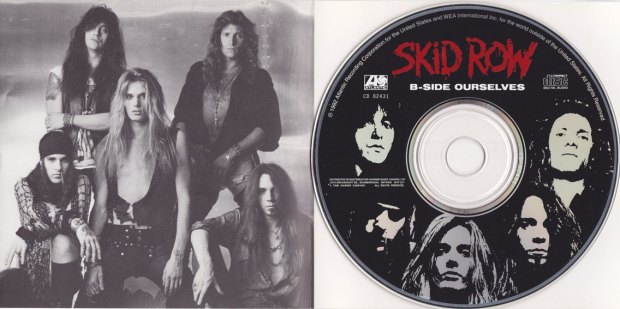
Last of all, the lucky Japanese got the Ramones cover “Psycho Therapy” from the B-Sides Ourselves EP (1992). This is the only inclusion from that EP, and it’s a gooder. Rachel sang lead (with Taime Downe of Faster Pussycat backing him). We all know Rachel’s a punk guy, and I think that’s the side of Skid Row that clashed with Bach’s metal tendencies. Just my theory.
This was a great EP, ranking among some of the better examples of such a format in metal. I love the MAD-Magazine-esque cover artwork. I also loved the concept of this EP as a bit of a treat to tide the fans over during the excruciatingly long four year wait between albums. The five selections are all fun, performed competently, and sound like Skid Row. They also sound like a band who truly loves these songs and knows them backwards and forwards. It’s not quite as satisfying as you want it to be, as it’s only about 18 1/2 minutes long. (I mean hey, there’s a Ramones cover on here so there you go.) This is meant to be nothing more than a fun snack, and as such pay no more for this than you’d be willing to pay for any 18 minute CD.
Tracklist time!
1. “Psycho Therapy”
Bassist Rachel Bolan sings this Ramones-approved cover (backed by Faster Pussycat’s Taime Downe). It was chosen as the first single/video. Excellent cover, very authentic. So well received, it was even included on their Forty Seasons: The Best Of CD.
2. “C’Mon And Love Me”
Classic Kiss cover from Dressed To Kill! A great riffy Kiss song. Skid Row do it justice. It’s one of those solid, meat & potatoes rock songs that requires no frills, just some solid guitars. I think this is definitely one of my favourite Kiss covers ever.
3. “Delivering the Goods” (Live)
Featuring the Metal God himself, Rob Halford, in a duet with his buddy Baz! One thing that is immediately obvious is that Baz is absolutely pumped. But then again, he does state that he’s been waiting his whole life to share a stage with Halford. Great cover, very live sounding, mistakes and all. Still, “Delivering the Goods” is the weakest of these covers…yet it still blows away most bands.
4. “What You’re Doing”
Perhaps the best cover on the album. This is a first-album Rush cover. Back when Geddy was writing the lyrics, and before Rush were singing about how trees are talking to each other and how different sides of your brain works, or outerspace bullshit. It’s an absolutely ferocious, angry Skid Row cover with Baz paying tribute to his countrymen. Excellent, obscure choice and the only cover on the album that I hadn’t heard somebody else do before (or since).
5. “Little Wing”
A surprisingly great turn on the Hendrix classic. Very different from Jimi’s version (obviously), this sounds nonetheless authentic and classy. Of note, the Skids also did a live-in-the-studio version for the music video. I wish that version was released on a CD as well. Unlikely we’ll see that happen.
Covers records can be so very hit-or-miss, but this one is five hits. Battleship sunk. Just wish it wasn’t all over in 18 minutes.
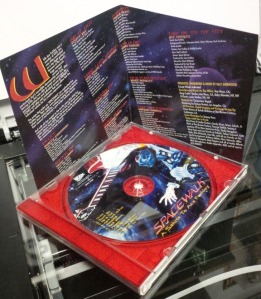
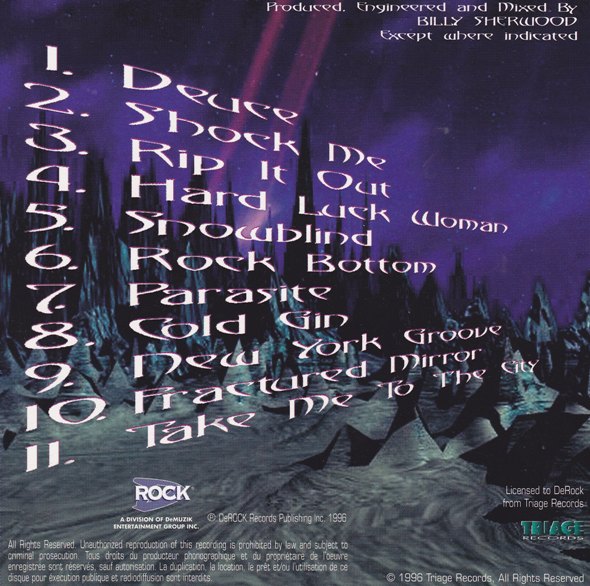
Spacewalk – A Salute to Ace Frehley (1996 DeRock/Triage)
Just in time for the massive Kiss reunion tour came this tribute CD. There were several versions of this. I have the second-coolest of the three:
Least cool: Regular domestic 10 track CD.
Second coolest: Import CD (Europe?) with brand new bonus track by Ace Frehley himself, called “Take Me To the City”
Most cool: Japanese import CD with that and Sebastian Bach’s “Save Your Love”
This is one of those tributes made up of a mish-mash of metal musicians, no real “bands” so to speak, although all are great musicians. Scott Travis plays drums on most of it (lending an awkward Priest-like vibe to the drums), Charlie Benate plays with Scott Ian on “Rip It Out”, and Vinnie Paul of course plays with Dimebag Darrel on “Fractured Mirror”. (This site has all the information and credits for the CD. Enjoy! You’ll notice the backing band is basically Racer X on most tracks.)
I’m good with every track on here except one: Bruce Bouillet’s version of “New York Groove”. I’m not into drum loops in general, and although the track has a funky groove to it, it’s just not my bag. On the other hand, Scott Ian’s cover of “Rip It Out” is Anthrax-worthy. Frankie Bello’s on bass, and somebody named Zach Throne sings it with Scott. Zach nails an authentic Ace-like vocal, while Charlie’s relentless on the drums. The Anton Fig drum solo is almost exact note-for-note. As is the signature guitar solo.
Gilby Clarke’s “Shock Me” is one of the better tracks. I don’t usually think of Gilby as a soloist, since in GN’R he didn’t solo. His soloing style is unlike Ace’s, but he performs an original solo of his own that is appropriate to song. On the other hand I wouldn’t count “Deuce” by Marty Friedman (ex-Megadeth) as a favourite. The vocal (by somebody called Tom Gattis) is a tad overwrought. Another “blah” tune is “Snowblind”, performed in a too-modern metally sound by Jason McMaster (Dangerous Toys) and Snake Sabo from Skid Row.
Ron Young (Little Caesar, the Four Horsemen) has a soulful but southern sound on “Hard Luck Woman”, an odd choice for a Frehley tribute. Written by Paul and sung by Peter, the original was created for Rod Stewart to sing! But it’s as good a cover as any, and I don’t have a lot of other stuff of Ron’s, so I’m cool with this. Jeff Watson (Night Ranger) is on guitar.
We all knew Sebastian Bach would knock it out of the park on “Rock Bottom”, and he does. “Rock Bottom” wasn’t written by Ace, but he did write the intro, performed here by Russ Parish of Fight/Steel Panther. Baz is obviously a huge Kiss fan and the song is in great hands, although the solo’s way too modern. Still, I wish I had “Save Your Love” too.
Tracii Guns is passable on “Parasite”, but again I think the song is done in a style too contemporary. Up next is John Norum of Europe, with “Cold Gin”! (Hey, two songs in a row written by Ace!) McMaster is back on lead vocals, not my fave singer in the world. John is a great guitarist, and this version of “Cold Gin” is heavy with fills. Some go with the song, some miss the mark.
Dime’s “Fractured Mirror” is perfect, even the production and sound of the acoustic guitar is eerily similar to Ace’s original. Dime may well have been the biggest Ace Frehley fan in the world. Darrell does throw some of his own personality into the song, but I think foremost on his mind was probably playing the song the way he remembered it. And he does.
Lastly, “Take Me To the City” is performed by Ace himself, with his crack band: Steve Werner on drums, Karl Cochran on bass, Richie Scarlet on guitar and backing vocals, and…Sebastian Bach is there too at the end! This Ace rarity is the best of all reasons to track down this CD. This is Ace back to a hard rocking Frehley’s Comet sound, with an anthemic chorus. When Baz shows up at the end, it’s icing on the cake (although you need to turn it ^UP^ to catch him in the fade).
I don’t really buy tribute albums anymore, because I find these mish-mashes of somewhat related artists to be a bit tedious. Still, it’s pretty solid, and definitely worthwhile to fans of bands like Pantera, Skid Row, or Anthrax. The Ace bonus track is pretty much a compulsory purchase.
3/5 stars
Soon, we’ll also be talking about another quality tribute album with some surprising guests and alumni. Stay tuned.

 SKID ROW – The Gang’s All Here (2022 Edel)


















 mikeladano.com