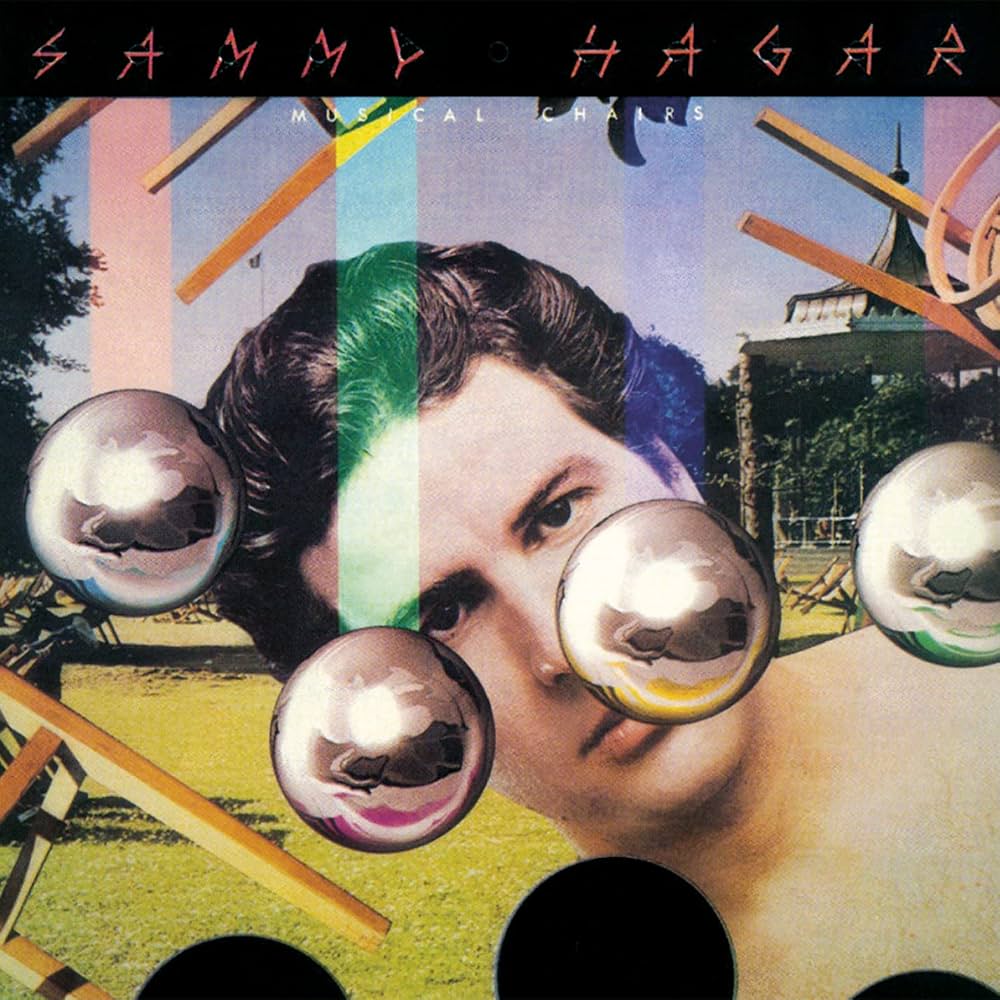
A second album in 1977 for Sammy Hagar! Swiftly following his self-titled record, Sammy was back with another collection of originals and covers featuring Bill Church and Alan Fitzgerald. New to the band this time out were drummer Denny Carmassi, and Gary Pihl on guitar. With Denny on board, it’s Montrose without Ronnie.
This review is based on my notes for an excellent episode of Tim’s Vinyl Confessions, and so does not follow my usual review format. By all means, check out his Sammy Hagar book Red On Black for more details. Let’s take ’em all track by track.
1. “Turn Up the Music” (John Carter, Sammy Hagar 3:35)
One of the Sammy songs I have known for ages, being on a 1989 “special markets” compilation called Turn Up the Music! Very cool intro guitar lick, one of Sammy’s catchiest solo tracks. Cool lyrics referencing the working day, and shouting out to past rockers like “Johnny B Goode”. An ode to music making you feel better, helping you get through the day. “Heavy metal music, oh that feels alright.”
2. “It’s Gonna Be All Right” (Hagar 4:11)
Laid back with cool synth riff by Fitz, and great punchy horn section. Catchy and fun. Youthful. “We may be young, but we are strong, we can’t be wrong. We’ve only just begun to be right!” I remember feeling that way! The horn section really gives the song a unique flavour for hard rock, and it just blasts!
3. “You Make Me Crazy” (Hagar 2:47)
Lovely little ballad with great keyboards and female backing vocals. Very mellow in a 70s sense. I picture a wintry chalet with a fire roaring. Tommy Bolin vibes, circa “Sweet Burgundy”. While it doesn’t really fit the Hagar oeuvre (especially on an album featuring the lyric “heavy metal music”), I do like this song. Maybe it would be called adult contemporary in some circles…but not mine.
4. “Reckless” (Hagar 3:32)
One of Sammy’s heaviest! Smokes from start to finish. Guitar/organ riff is killer. Heavy metal music indeed! A true head banger. Primitive Hagar music, with all the punches intact.
5. “Try (Try to Fall in Love)” (Norman Des Rosiers 3:11)
A cover of a sappy piano ballad. Full of strings and adornments, flutes, and woodwinds, but a bit too mushy. No rock. Very lush, and Sammy attempts a nice falsetto, but it’s not a favourite. And that song title? It reminds me of “Tonight I’m Gonna Rock You (Tonight)” by Spinal Tap. Why “Try (Try)”? Why? Oh that’s too much now.
6. “Don’t Stop Me Now” (Carter, Hagar 3:12)
Back to form, thankfully! Nice crunchy simple riff here, and catchy guitar licks. Punchy, simple and crunchy. Nice chorus. Listen for “red” reference – “I’m turnin’ red.” This one strikes me as Kiss outtake quality. Think Simmons’ Vault.
7. “Straight from the Hip Kid” (Liar cover – Norman Tager, Paul Travis 3:09)
Funky clavinet is a nice touch; thanks Fitz! This is a cover tune by Liar, a contemporary 70s band who put out their own version of the track two years earlier. Hard rocking, but with a slight touch of funk.
8. “Hey Boys” (Hagar 2:50)
OK song. Light but not particularly memorable. Chorus feels like it doesn’t fit. Good keyboard solo work, very atmospheric. “We’re all playin’ musical chairs, of but a change is gonna come,” lyric comes from this song. Nice light rock. Yacht rock?
9. “Someone Out There” (Hagar 3:01)
Enjoy the upbeat rock stylings of this song. Light background organ is very nice.
10. “Crack in the World” (Hagar 5:11)
Slow rocker. Goes epic in a soft kind of way, but the chorus doesn’t quite fit, which is a problem plaguing this record. Good keyboard and guitar solos for what it is. Kind of ends prematurely.
Not a spectacular album, with only two real serious rockers. There are a few good light rockers too, but fans expecting the “Heavy Metal” Hagar will be sorely left with something they won’t understand.
Following the demise of Whitesnake and the failure of Zeppelin to mount a 1991 tour in support of their first box set, it was almost inevitable what happened next. It was something that many Zeppelin fans feared. Lead Snake David Coverdale, who was once derided as “David Coverversion” by Robert Plant, joined Plant’s erstwhile bandmate Jimmy Page in a new supergroup. Geffen’s John Kalodner (John Kalodner) helped facilitate this move which should have generated sales over 10 million units. Unfortunately another thing also happened in 1991: grunge.
The shame of it is that Coverdale-Page is a stunning rock album. For years it haunted my bargain bins, simply because of the hard rock stigma that permeated the 1990’s. Many fans refused to listen to it, others simply chose to mock superficial elements of it, such as Coverdale’s man-shrieks. The fact that Page was looking and sounding great should be enough to warrant multiple listens by any serious rock fan. He hadn’t released any new material since 1988’s Outrider. As for Coverdale, it was a chance to get back to his bluesy rock roots, something he expressed a desire to do shortly after Whitesnake’s dissolution.
The studio band weren’t hacks either. Ricky Phillips had played bass with Neal Schon and Jonathan Cain in Bad English, and he’s been in Styx for ages now. Drummer Denny Carmassi was in Montrose (that’s him on the cover of the classic 1973 self-titled record) among many stellar bands, and he later did a stint in Whitesnake itself. Coverdale and Page co-produced the album with veteran Mike Fraser.
Finally, the most important elements were also in place: the songs. 11 songs, most in the 5-6 minute range, make up Coverdale-Page. Those expecting or even hoping for a Zeppelin album were bound to be disappointed. Despite the “Coverversion” nickname, Cov the Gov is his own person and persona. Singing over Pagey’s classic Zeppish riffs does not a Zeppelin make. Rather, Page and Coverdale comingle over their common ground, and naturally there are elements that have a Whitesnake aura. To expect otherwise would be folly.
“Shake My Tree” was the perfect opener. Pagey’s tricky little licks have that familiar sound, immediately. Then the great lothario Cov the Gov starts howlin’…the stage was set within the first minute of the album. The closest comparison I can think of would be “Slow An’ Easy” in terms of overall vibe. Just replace Moody’ slide guitar with Jimmy’s intricate chicken pickin’. David’s lyrics were as naughty as ever. It must have burned Robert Plant’s ass to have to sing it when he reunited with Jimmy later on himself. He seemed to be freestyling it quite a bit with David’s lyrics, barely sticking to the words at all!
“Waiting On You” would have been a radio-ready single. It has that kind of smoking hard rock riff, a killer of a chorus, and great vocals. Coverdale’s no poet, but I dig his words. “Ever since I started drinkin’, my ship’s been slowly sinkin’, so tell me what a man’s supposed to do.” Well, let me tell you David. 1) Drinking and boating is against the law, just like drinking and driving. 2) Put on your goddamn life vest!
I hesitate to call “Take Me A Little While” a ballad. I mean, it is a ballad, but it’s also a pretty good bluesy workout for David. It’s a little classier than the average “power ballad”, because hey…it’s Jimmy Page. It doesn’t sound like other ballads by other bands, because not too many bands have Jimmy Page. His playing and writing are unlike anyone else’s, he is one of the most recognizable musicians in rock and roll.
“Pride And Joy” was the first single, and what a single it was. It starts off swampy and acoustic, before Jimmy’s big Les Paul announces its presence with some big chords. Then David’s back in lothario-land, seducing “daddy’s little princess, Momma’s pride and joy.” Despite the lyrics, the song’s still a stunner. “Over Now” is also cool; a thinly veiled attack on Tawny Kitaen.
You told me of your innocence, An’ I believed it all, But your best friend is your vanity, And the mirror on the wall.
It doesn’t get any nicer from there, but musically this is one of the most Zeppelin-ish songs. While you can’t compare it to any specific song in the Zeppelin oeuvre, but it’s there in that slow relentless drum beat, the orchestration, and Pagey’s unorthodox guitar.
The closest thing to filler on Coverdale-Page is “Feeling Hot”. It’s not outstanding, but it does show off the faster side of Jimmy’s playing. It’s akin to “Wearing and Tearing” but with naughtier lyrics. Once again it is Jimmy’s playing that I’m tuned in to. That continues with “Easy Does It” which begins acoustically. Like most acoustic moments on the album (and like Zeppelin), Jimmy’s guitar is recorded in layers, giving it real heft. This all changes halfway through the song, when Jimmy’s Les Paul once again takes center stage. Then it transforms into a bluesy prowl.
Possibly the most commercial song is “Take A Look At Yourself”. Not a bad song, but definitely the most “pop rock”. It’s probably closest to a Whitesnake song such as “The Deeper The Love”. Had the year been 1990 or even 1991, “Take A Look At Yourself” would have been a top charting single everywhere. David seems to have cheered up with new found love here. However the heartbreak is not over. “Don’t Leave Me This Way” is about as earnest as it gets. At 8 minutes, it’s also the most ambitious song. It’s the centerpiece of the album. It sounds at once like it’s the most sincere song, showcasing some of Jimmy Page’s best post-Zeppelin guitar work. As for David, he’s never sung better.
“Absolution Blues” begins similarly to “In The Evening”. Fading in are layers of atmospheric guitars as only Jimmy plays them. These give way to the fastest, heaviest song on the album. It’s also one of my favourites. You you can hear the elements of Jimmy and David separately, but working together. The song goes through numerous changes before returning to that riff. If you thought Jimmy Page had already written every great riff in Led Zeppelin, think again. It’s “Black Dog” sped up to ludicrous speed.
Album closer “Whisper A Prayer For the Dying” is as cheerful and uplifting as the title alludes. It’s has an epic quality and length like “Don’t Leave Me This Way”, but this time the lyrics are less personal and more topical. David laments the innocent casualties of modern warfare, and refers to politicians as “bodyguards of lies”. While certainly not profound, it’s refreshing to hear Coverdale change the bloody subject away from the female of the species every now and again. Profound or not, I’m certain that it was heartfelt, and musically it kicks ass. It’s also a perfect album closer for a dark and brooding record like this. So there.
Hugh Syme (Rush) did the artwork. Say what you will about the bland cover itself, but I like the way he used the “merge” sign much like the “object” was in the artwork for Presence. And like many Zeppelin albums, there are no pictures of the artists anywhere.
The year 1993 was not a kind one to singers of Coverdale’s ilk. Most of his competition had been replaced by Chris Cornell, Eddie Vedder, and Kurt Cobain. One way or the other, the Coverdale-Page tour was not doing enough business and the plug was pulled. David has since mentioned that he and Page had more songs, enough to get started on a second album. He’s also expressed a desire to release those songs on some kind of deluxe edition reissue. I hope that happens. I’d buy Coverdale-Page again. It would only be the third time.
CINDERELLA – Long Cold Winter (1988 Polygram Records)
I remember how excited I was upon hearing the first single, “Gypsy Road”, in the summer of ’88. Cinderella had managed a bluesier, more “authentic” hard rock sound for their critical second LP. Night Songs was OK, but Long Cold Winter was better in every way. The cheese factor had been replaced by pedal steel guitars, pianos, and Hammond B3 organs.
Drummer Fred Coury was touring with Guns N’ Roses (Steven Adler had broken his hand punching a wall) during much of the making of Long Cold Winter. It’s not clear how much of Long Cold Winter he played on, as the band pulled in two incredible session drummers for the project: Denny Carmassi (of Heart and later Coverdale – Page), and the late great Cozy Powell!
From the bluesy opening of “Bad Seamstress Blues”, it was clear that the AC/DC clone Cinderella that featured Bon Jovi cameos in its videos had evolved. Two incredible, throat wrenching rockers follow this: “Fallin’ Apart at the Seams” and “Gypsy Road”. Both songs easily stand up today as forgotten classics of the “hair metal” era. But truthfully, Cinderella only made one “hair metal” album. Long Cold Winter doesn’t really fit in with that scene, and their next album Heartbreak Station would leave it behind completely.
“Don’t Know What You Got (Till It’s Gone)”, the epic power ballad, is more Aerosmith than Poison, and still features a great guitar solo straight out of the Iommi blues notebook. I’m not too keen on “The Last Mile”, a straightforward rocker, but it was still chosen as a single from this album. Much better is the side-closing “Second Wind”, amped up and stuttering.
Side two opened with Cinderella’s “serious” blues, the title track. It’s a bit too contrived for me, it has a vibe of, “Hey, let’s write our ‘Since I’ve Been Loving You’!”. Lots of repeated “baby baby baby” Plant-isms. At the time it was released, this song was seen as a serious departure for the band, but in hindsight it’s really just a first step into a larger world. It’s somewhat reminiscent of the rare occasions that Black Sabbath has attempted a slow blues (I’m thinking “Feels Good To Me”, also featuring Cozy Powell) mixed with Zeppelin.
“If You Don’t Like It” is another standard rocker, nothing special, but this is followed by no less than three great songs in a row. First is the single “Coming Home”, not really a ballad, but a hybrid. This was one of the most immediate songs that I fell for when I picked up the album. You can tell that Cinderella wrote a lot of this album on the road, by the lyrics. “Coming Home” is one such road song.
“Fire and Ice” is heavy, sort of a revisited “Second Wind”, another standout! Then the album closes with the slide-laden “Take Me Back”, which strikes me as another road song. Just as good as “Coming Home”, but heavier, it was a great album closer. Personally if this album had spawned a fifth single, “Take Me Back” would have been my pick, hands down. And I think this album could have justified five singles.
The band evolved further with album #3 (which featured strings by John Paul Jones!), but I think Long Cold Winter strikes the perfect balance between screeching rock and bitter blues. From the classy album cover on down to the perfect production, I don’t think they’ve ever made a better album.

 SAMMY HAGAR – Musical Chairs (1977 Capitol)



 mikeladano.com