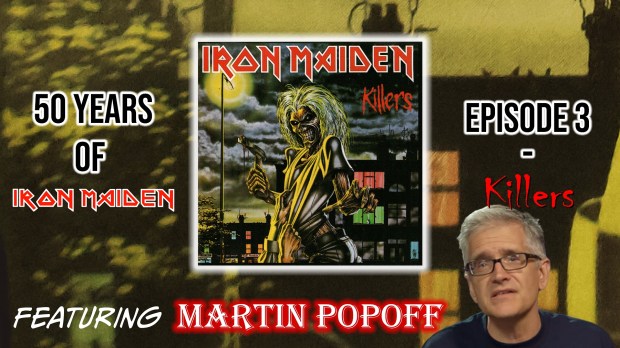
Here is the episode we’ve all been waiting for: Author Martin Popoff (Iron Maiden: Album By Album) joins us to talk about record #2, Killers.
With Adrian Smith now in the fold, Maiden settled into the studio with legendary producer Martin Birch to lay down another series of tracks that the band had been working up for years. “Wrathchild”, “Killers”, “The Ides of March” and more will be broken down, track by track.
We will also discuss the singles, the B-sides, and the tour. Once again Harrison goes through the Killers tour and tells us the facts, figures and songs.
Don’t miss this awesome episode of 50 Years of Iron Maiden, tonight on Youtube.
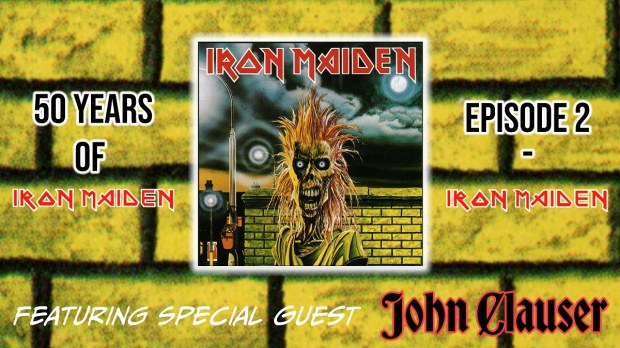
50 Years of IRON MAIDEN episode 2: Iron Maiden (1980) and “Women In Uniform”
With John Clauser (My Music Corner)
GRAB A STACK OF ROCK #86
Welcome to the big leagues, as Iron Maiden are signed to EMI and release their first singles and album! New members Clive Burr and Dennis Stratton are now on board with Steve Harris, Dave Murray, and Paul Di’Anno. We cover it all on this second episode of 50 Years of Iron Maiden.
Joining Harrison and I is John Clauser from My Music Corner! We bid you welcome to this special pre-recorded look at Iron Maiden’s self titled debut album. Because we always aim to go in depth as possible, we’ll discuss the entire album track by track, the artwork, and all the singles and B-sides. As an added bonus, we’ll also take a look at the standalone single “Women In Uniform”, a Skyhooks cover that the band have somewhat disowned.
A new feature to the series debuts tonight as well: Harrison Kopp will take the spotlight every time we talk about a studio album, to go over the tour in detail. Harrison will provide the facts, the figures, and the dates, while also analysing the setlists. This segment is a highlight of the show.
This episode premieres at 7 o’clock PM exclusively on YouTube. (Sorry Facebook – we are trying some new things with this Maiden series. The live episodes will still be streamed to Facebook, but not these recorded ones.)
One of us will try to be in the comments tonight, so if you want to take part in a discussion, please don’t miss the premiere!
Review dedicated to the donor of this CD, Mr. Harrison Kopp. I hope I like it. I am writing this review “live” so to speak, on first listen.
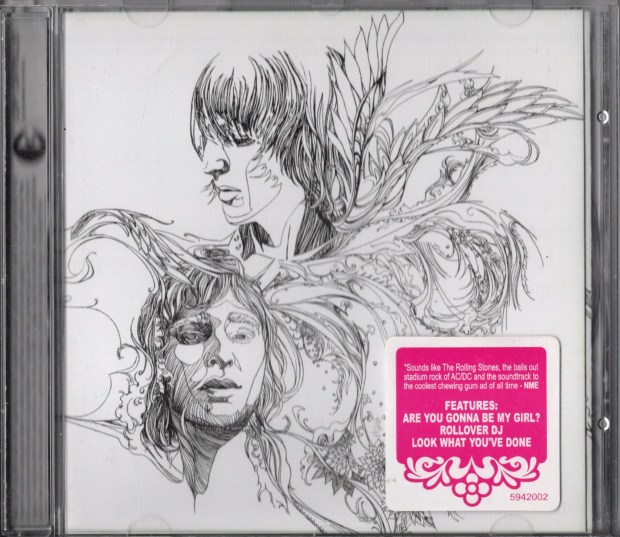
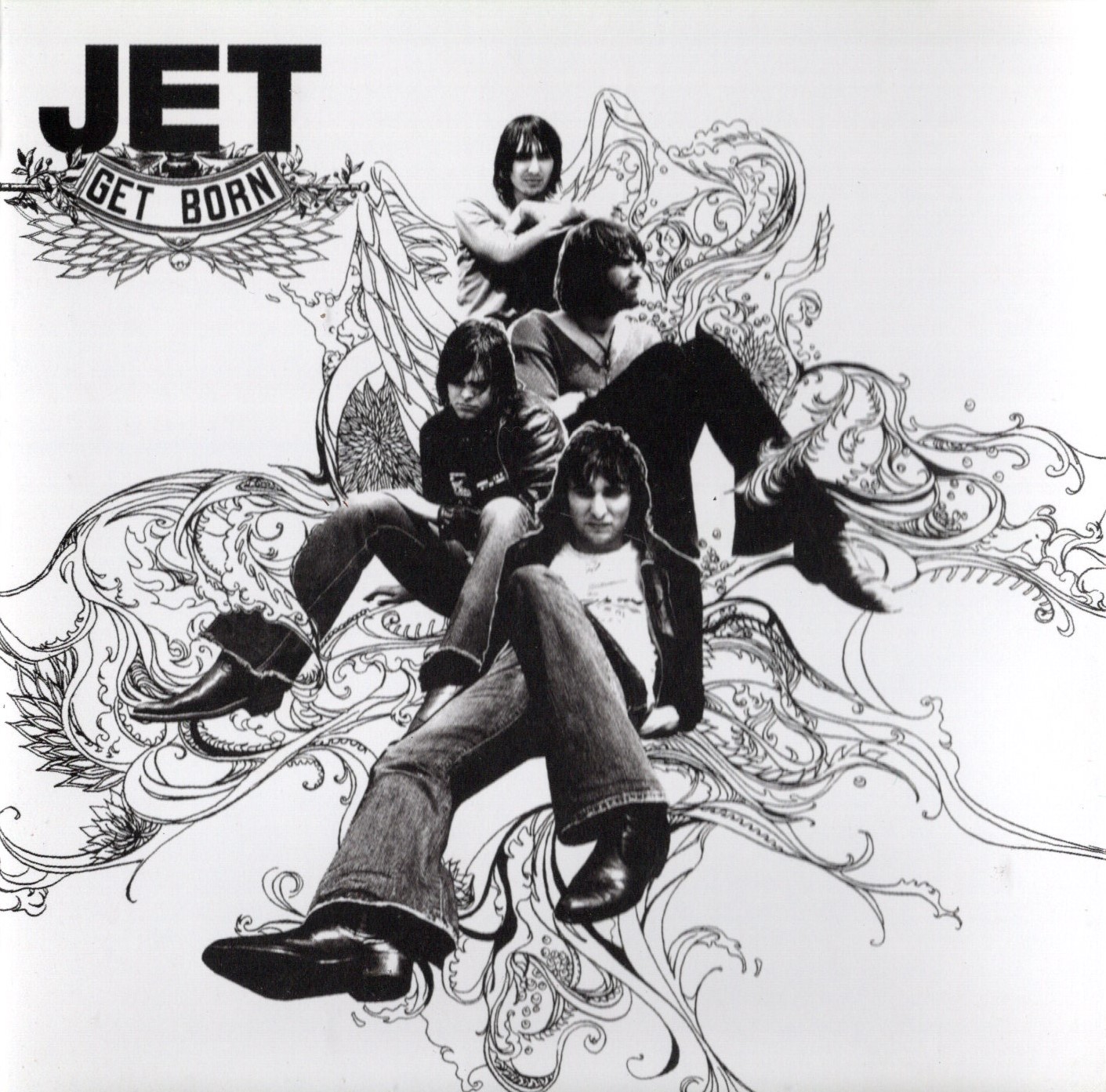
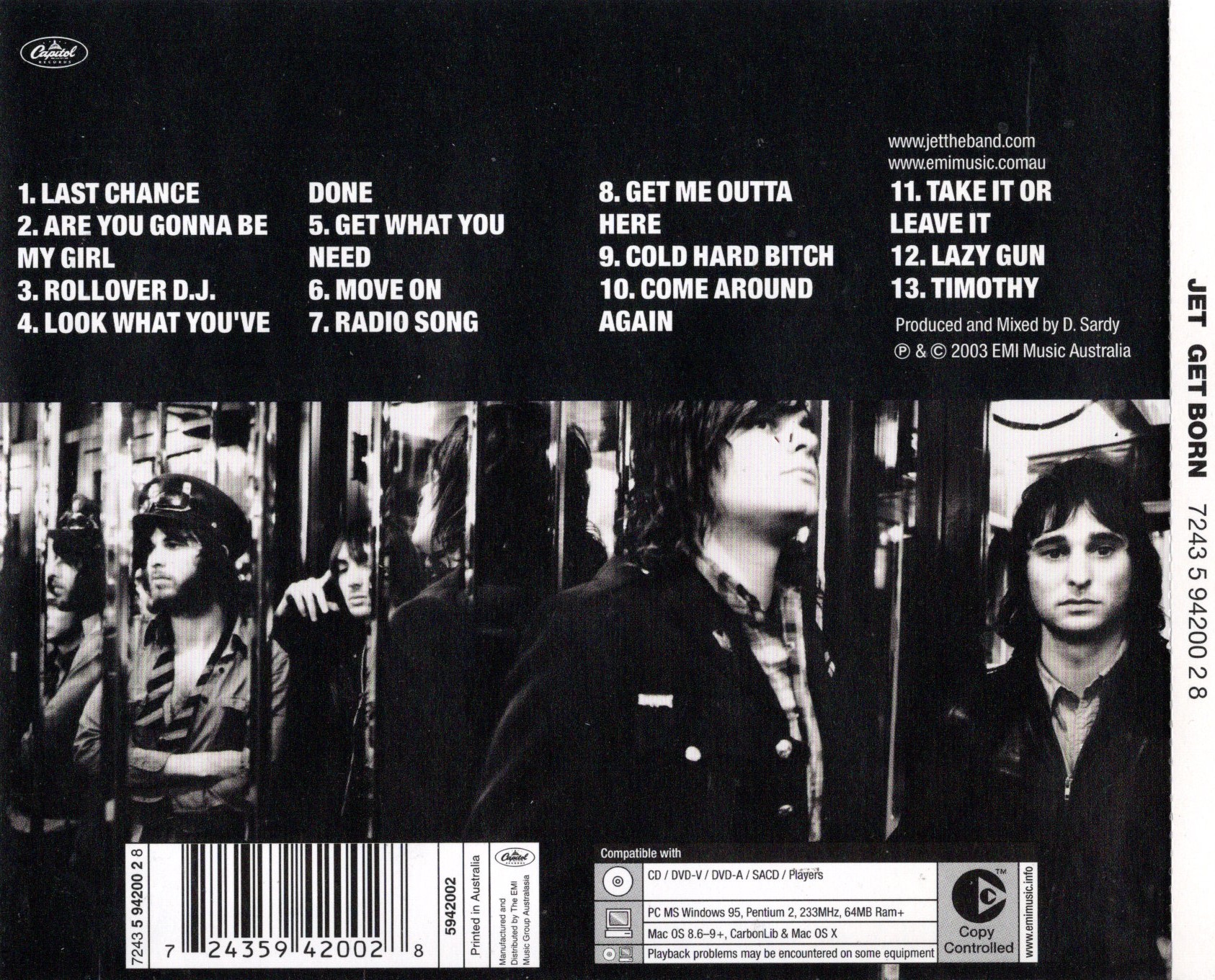
JET – Get Born (2003 EMI)
Get Born is Jet’s first LP, only two years after forming, and after one 4-track EP. Let’s listen and find out how adept this band got at writing songs after only two years. You already know track 2, “Are You Gonna Be My Girl”, the one that everyone says is “Lust For Life” re-written. Both songs utilize Motown beats, though the Jet song has more frantic energy. Plagiarism is excusable in some cases. In this case, I’m still undecided. Is the rest of the album more original?
Many of these songs are fast and short. Opener “Last Chance” doesn’t even break two minutes. It possesses a strong riff, reminiscent of AC/DC in their Bon Scott heyday. Lead singer Nic Cester is quite adept at “Yeahs!” and “Woos!” which will suffice. This leads directly into the signature bassline on “Are You Gonna”, which we don’t need to review. You already have your opinion, and mine is that you can’t tell me those guys never heard “Lust For Life”. That kind of thing always has a subliminal influence, intentional or not. The only question I have is how much was intentional, but I really stopped caring 20 years ago. It is, admittedly a good song if overplayed on radio (still).
“Rollover D.J.” hits right off the bat with bass and guitar, and sounds great in that second it smashes you in the face. Then it lays back a bit, in a Def Leppard-y way, when they used to rock. The chorus is punkier, but feels somehow incomplete. “Look What You’ve Done” switches up to a piano ballad, an unexpected twist. This tender song has an Oasis quality without the snot-nosed BS. This means, yes, you can hear a Beatles influence. Nic Cester demonstrates a smoother side to his singing. I didn’t want to like it, but the truth is, if this was on one of the first three Oasis albums, I would have liked it anyway. A keeper.
A nice rock n’ roll riff brings in “Get What You Need”, and one must admire the nice thick bass tone on this album. This song is all about the guitars. The melodies are inconsequential. It’s all the guitars, and the bass.
In another surprise, “Move On” opens with the distant sound of a steel guitar, before an acoustic intro. This western tinted ballad might be too soon after the previous ballad, but it’s a good song! Very much like the way the Stones would throw those acoustic numbers on their albums. It’s now clear that Jet are not interested in breaking new musical ground. They are focused on writing and recording classic sounding songs that fall within a certain boundary. That’s allowed.
Another surprise: acoustics and piano return on “Radio Song”, a moody trip that has me questioning everything I just wrote. Lead vocals by guitarist Cameron Muncey. I can hear some Radiohead, but the irony is the chorus: “This won’t be played on your radio, tonight.” It’s as if they knew “this is the song where we’re going to experiment a bit.” It’s different, and it has an audible heart to it. It goes epic by the ending, but not too much. Not into Guns N’ Roses bombast. Still sticking to the core instruments. An album highlight.
Back to rocking. A stock riff occupies the necessary space on “Get Me Outta Here”, which fortunately compensates for it with verse and chorus power! Really great work here, with all the singing parts hitting the spot, satisfying a certain craving for a song that’ll be in your head long afterwards.
AC/DC’s fingerprints are all over “Cold Hearted Bitch”, though with drums more out of the Who school of crashes and smashes. Unfortunately, momentum is lost on “Come Around Again”, another Stones-y ballad with piano and twang. It takes time to build, but the reward is brief. The mellotron and organ are the most interesting parts.
Energy returns on the punk-surf-rock-blast of “Take It Or Leave It”, like a shot of pure adrenaline to the album. By this stretch of the album, the “Yeah’s!” are getting a bit tiring and the schtick is wearing thin. “Lazy Gun” has a completely different vibe, with a Gary Glitter sound, and an unexpected secondary section that may or may not fit the first part. We’re over 40 minutes into the album now, and this, the longest song, shouldn’t be track 12. Ear fatigue is setting in.
Finally, “Timothy” is an acoustic ballad to close the album. It sounds extraneous, though with a psychedelic rock twist. I like the chorus, “It’s not what it seems, but it is…” but it seems the song never builds to anything bigger.
Two takeaways: 1) Jet is more diverse than I expected. 2) I don’t think they have a lot of character on this album. Nothing strikes me as unique. Further listens are warranted, but…
DEEP PURPLE – “Woman From Tokyo” (Originally 1973, 1998 Warner Japan CD reissue)
The 2:56 single edit of Deep Purple’s “Woman From Tokyo” is somewhat of a rarity on CD. It’s not on the Singles A’s and B’s. You could get it on a Japanese box set called Purple Chronicle.
The original song was almost six minutes, so half of the tune was chopped out for single release. The intro is mangled. The middle section is missing, and cut in such an amateurish way. The guitar solo is missing. Rule of thumb: never cut the friggin’ guitar solo from a Deep Purple song, of all bands! This is a butcher job of a single edit. Probably why it never made the cut to Singles A’s and B’s.
The B-side “Super Trouper” is also 2:56, but unedited. That’s just how the song goes, one of Purple’s shortest. No, it’s not an Abba cover, but both songs were named after Super Trouper stage lights. Some of Ian Gillan’s lyrics can be interpreted to be about his impending departure from Deep Purple. “I wanna be like I was before, but this time I’m gonna know the score.” A lot of looking in the rear view mirror in this song. A lot of past-tense.
Because of the butcher job on the “Woman From Tokyo” edit, the B-side here outshines the A-side. The single at least has lyrics. For collectors and analysts only!
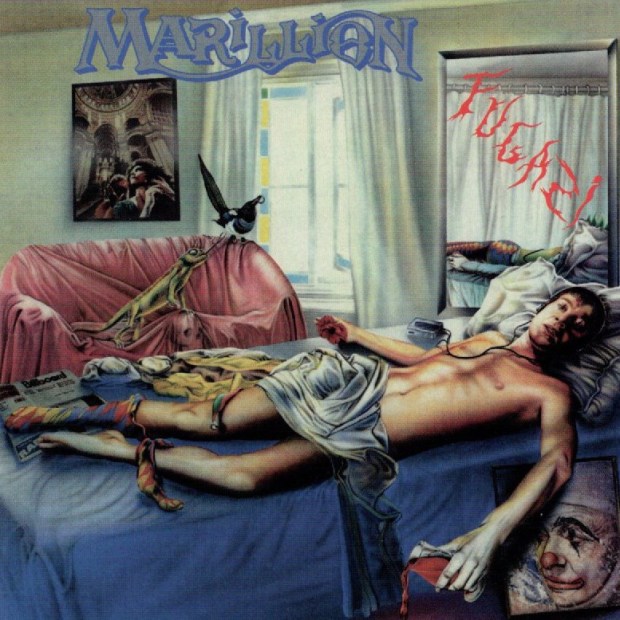
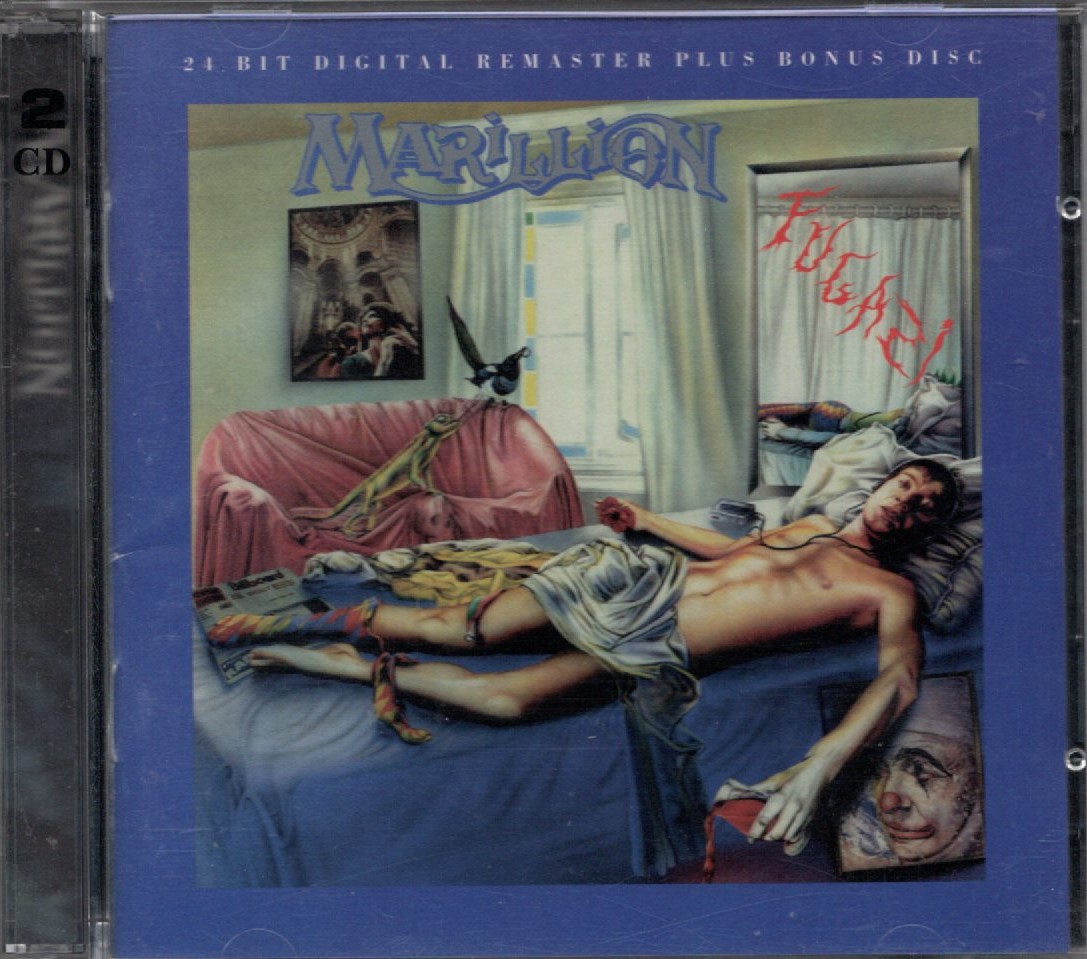
MARILLION – Fugazi(1998 EMI 2 CD edition, album originally released 1984)
Fugazi: Military slang meaning “fucked up situation”, coined during the Vietnam war.
Or: The making of Marillion’s second album.
After rolling through a couple drummers including Jonathan Mover, Marillion finally settled on Ian Mosely, the British veteran who is still in the band today. They settled in to record the “difficult” second album, which was dubbed Fugazi. It is a challenging listen, probably the most challenging of the original four. As such it tends to fall by the wayside today, despite the inclusion of the excellent single “Assassing”.
“I am the assassin, with tongue forged in eloquence. I am the assassin, providing your nemesis.”
It was a pointed statement at the ex-drummer Mick Pointer, from his former friend, lead vocalist Fish.
Lyrically, Fugazi represents the very best of Marillion of any era. Both “Jigsaw” and the included B-side track “Cinderella Search” contain lyrics of great depth, beauty, emotion, and layers upon layers of interpretation. I like Fish’s use of homonyms, such as “Swam through the nicotine seize”.
Musically, this is a dense album that takes multiple listens to appreciate. Side one of the original album was catchier, with the two singles (“Punch & Judy” being the second) and the lullaby-like “Jigsaw”. Side two was more challenging, with longer heavier songs: “She Chameleon” and “Incubus” are good examples. Incidentally, Fish considered “Incubus” to be his greatest lyrical achievement, once again using homonyms. “I, the mote in your eye.”
The bonus disc contains the stellar B-side “Cinderella Search”, a song that goes through multiple sections before culminating with its powerful ending. “I always use the cue sheets but never the nets, never the nets, nevertheless.” Other B-sides include a remix of “Assassing” and the re-recorded version of “Three Boats Down From The Candy”. (I prefer the original.) This disc is rounded out by four demos of some of the more challenging songs.
The cover art is loaded with brilliance courtesy of Mark Wilkinson. He put just as much thought into the art as Fish did into the lyrics. Wilkinson and the band provide enlightening liner notes. You’ll want to make sure you read them. Did Mark Kelly really see a ghost? Find out inside.
5/5 stars
Fugazi is expected to be upgraded to a multidisc deluxe edition including 5.1 mix this summer- 2021.
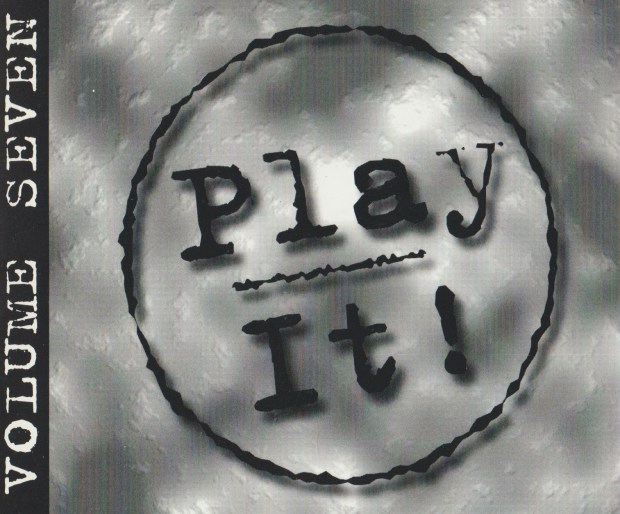
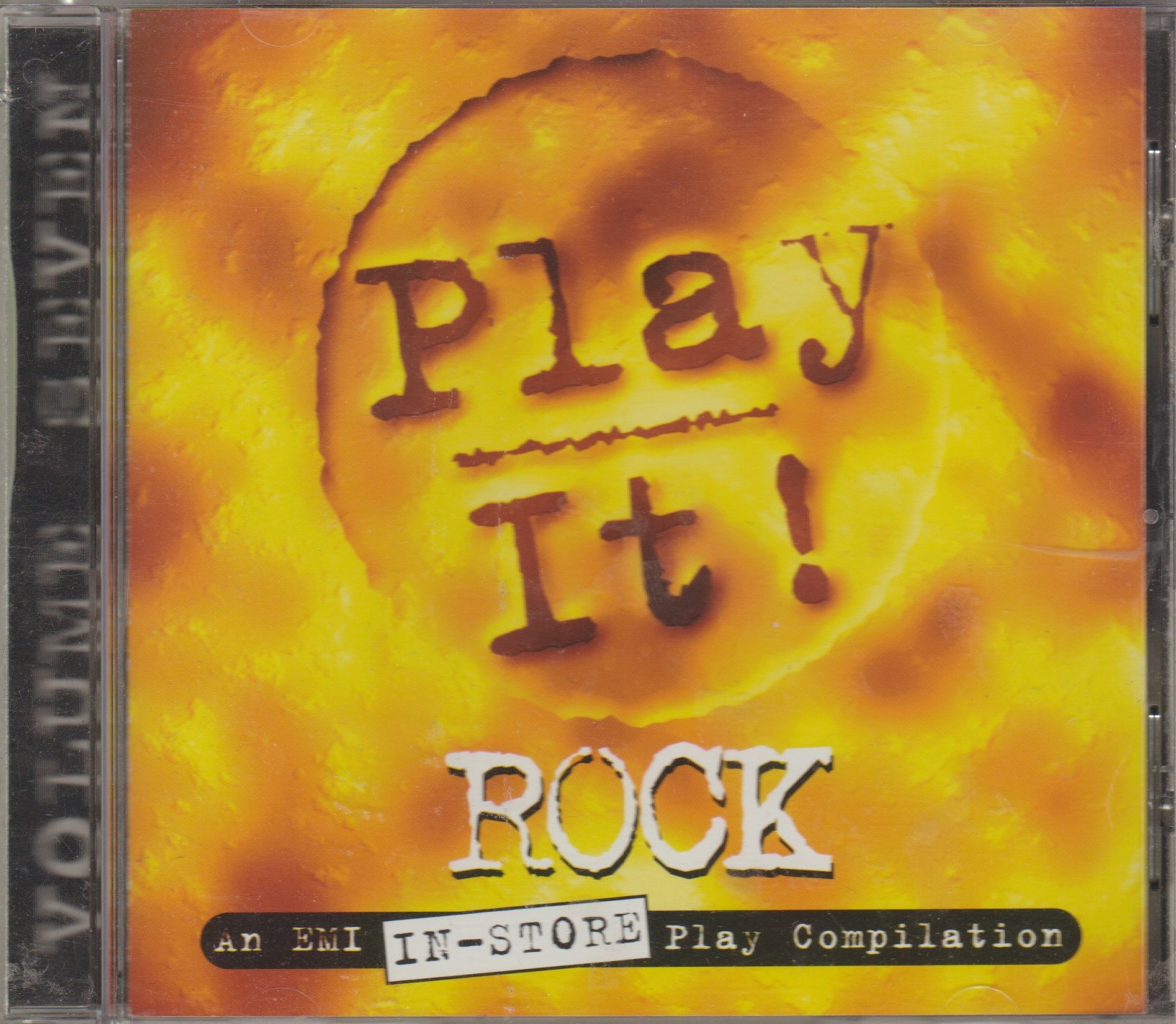
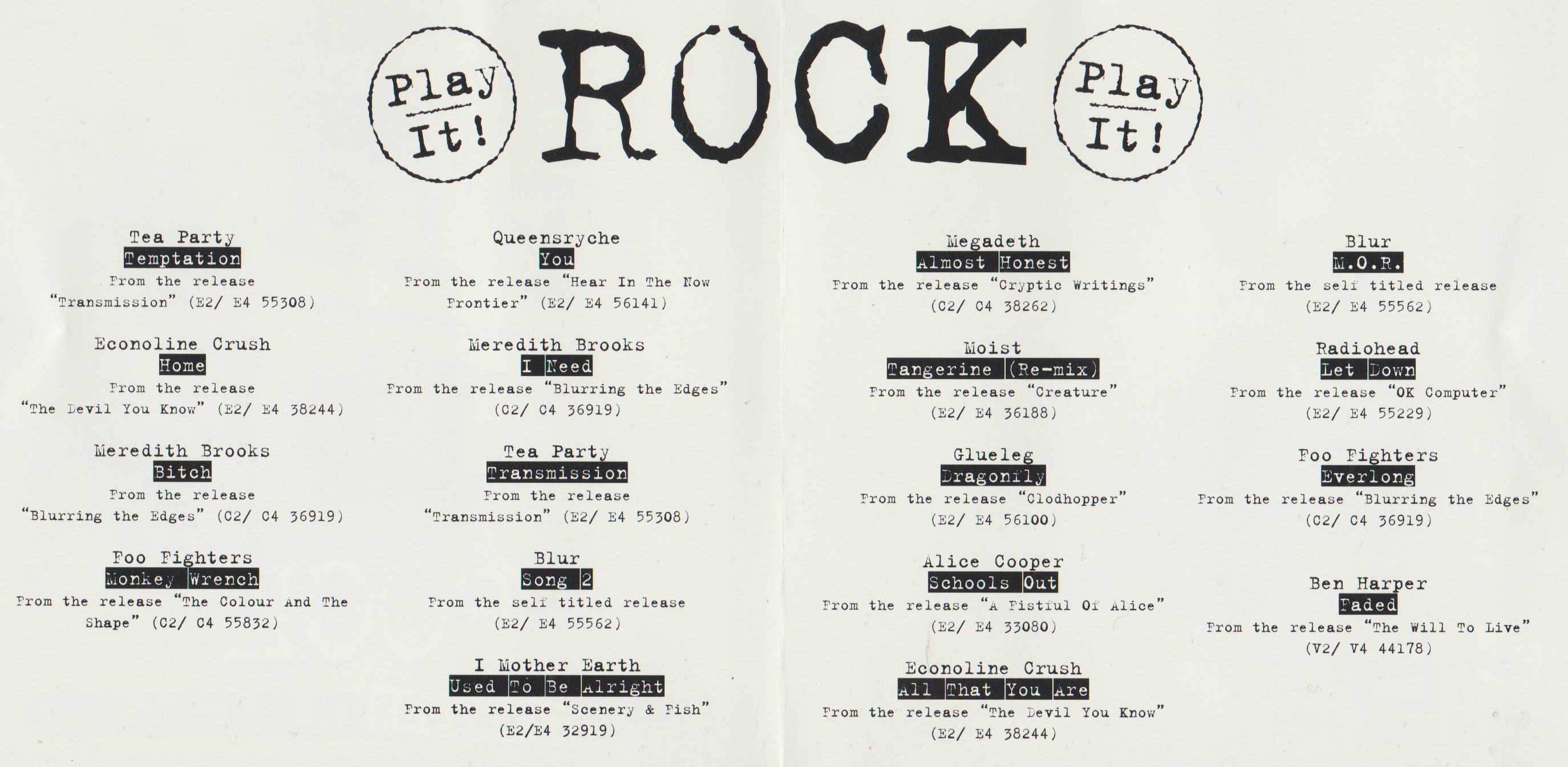
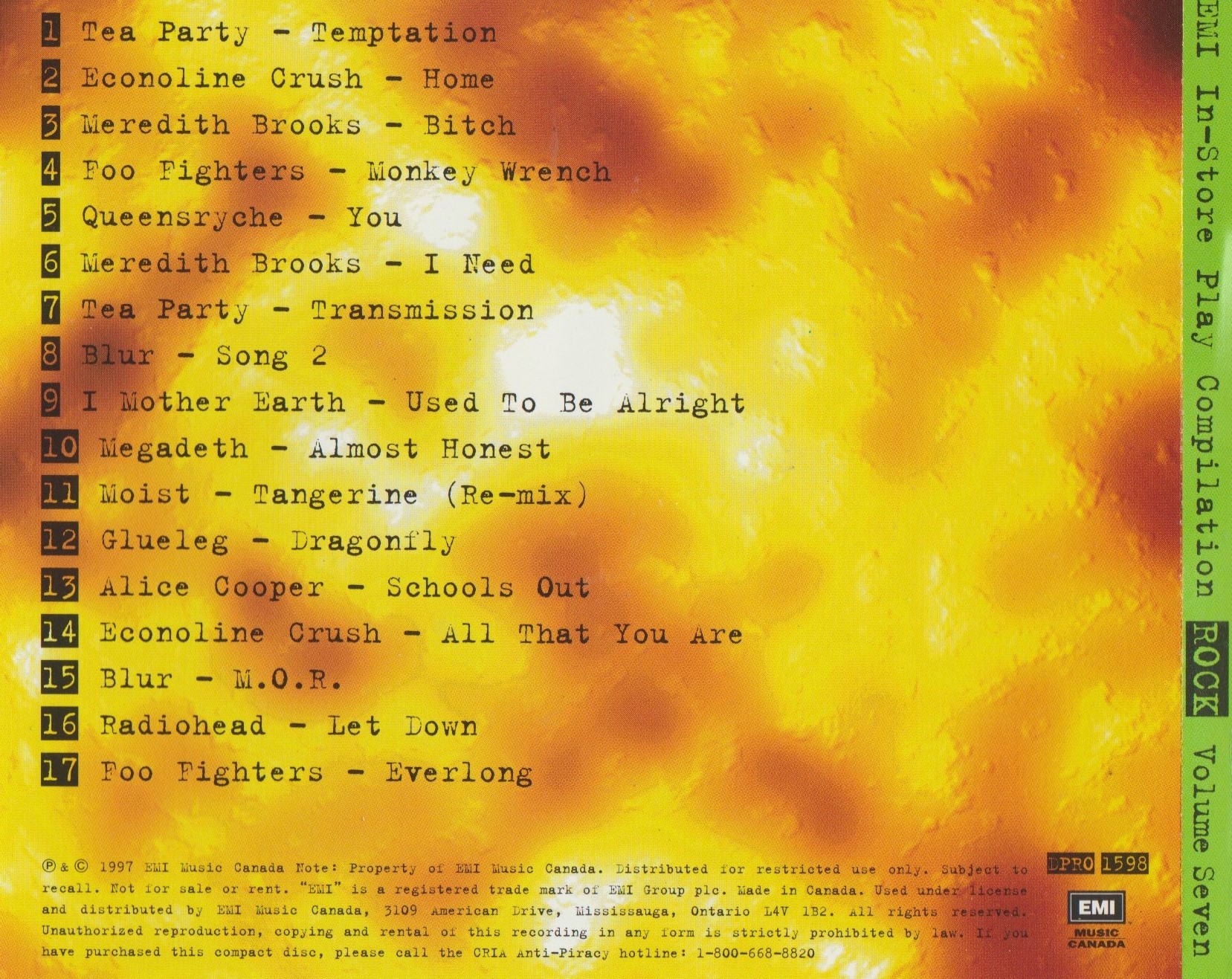
Play It! Volume Seven – ROCK – An EMI In-Store Play Compilation (1997 EMI promo)
“Woah! I own ‘Song 2’. How about that.”
That was my first reaction upon revisiting this old promo CD from the Record Store days. I really didn’t know that I had that song, and I’m sort of glad that I do. This was a freebie, and not a bad one as it had some rarities on it. In fact there’s only one artist on this disc I’d flat-out skip. Let’s dive on in.
The first track is a rarity: an unadvertized single edit of “Temptation” by the Tea Party. “Temptation”, crossing the new sample-driven sounds of the late 90s with classic exotic Zeppelin, was huge. The single edit snips off the extended intro. Industrial rock band Econoline Crush is up second, who also had a big album (The Devil You Know) at the time. “Home” was a memorable fast-paced single, but their big single “All That You Are” is also included as track #14. Far more mainstream, “All That You Are” was omnipresent in 1997. It’s still a little too over-familiar to be enjoyable.
Skip Meredith Brooks. I’ll be happy if I never hear the novelty song “Bitch” ever again. Brooks has a second track on this CD, “I Need”, which suffers due to the spoken word verses. No thanks. Skip ’em both. “I Need” reminds me of what I hated about 90s music.
Foo Fighters’ “Monkey Wrench” and “Everlong” were two of the greatest singles of 1997. Fast paced, drums-a-blazing, and perfectly rifftastic. In ’97 Grohl could do no wrong. He released one of the few perfect albums of the year. ’97 was Peak Foo — prove me wrong. Flawless songs, still not taxing on the ears. Probably never will be.
Queensryche had a new album in 1997, the ill-fated Hear in the Now Frontier. “You” wasn’t one of the most notable songs, and here on this mainstream compilation, doesn’t fare well. I don’t think EMI knew what to do with Queensryche, so hey let’s pick a song with 90’s intonations and throw it on this store play disc. A second Tea Party song, “Transmission”, is its full unedited length, combining the same ingredients as “Temptation” but at lower velocity. “Song 2” follows that, I song I’m admittedly not bored with at all. A second Blur track later down the line, “M.O.B.” boats a cool riff and pop sensibilities.
I Mother Earth were riding a wave with their second album Scenery and Fish. I’m not a fan of that disc and I can usually do without “Used to Be Alright”. Fortunately Megadeth bring some metal to the proceedings. From the underrated Cryptic Writings comes “Almost Honest”, a hard rocking single with nary a glimmer of thrash. Great song from a period when Megadeth were quite adept at writing mainstream metal.
Rarities ahoy! Moist’s “Tangerine” is remixed here, a mix that is far more industrial than the album, but that’s why remixes go on weird compilations I suppose. Always fascinating, Glueleg are up next with “Dragonfly”, one of their catchiest numbers, still maintaining their weird genre-bending tendencies.
Alice Cooper steps in with a live version of “School’s Out”. This being 1997, that automatically means it’s the one from A Fistful of Alice. It’s a little strange hearing “School’s Out” on a compilation of all-new material, but I suppose EMI didn’t have confidence that a new Alice song (“Is Anyone Home?”) would attract new buyers. But they were more likely to hear Radiohead’s “Let Down” and buy OK Computer instead. It’s a stunning ballad that might have been unfamiliar to those who hadn’t bought the album yet — the exact people this CD was aimed at! The CD closes on the slide-inflected “Faded” by Ben Harper. It’s choked by unnecessarily grungy production.
Record companies rarely sent us free CDs, because we were a used CD store and they assumed we’d sell ’em. What they didn’t realize was that it was usually guys like the asshole at CD Plus that would be selling their free CDs. We’d try to be educated about what we bought, and avoid the promos like this one. If a customer left it behind for us to take for free, it was up for grabs. As a store-play disc, this would have been pretty good, assuming we had all those albums in stock to sell.
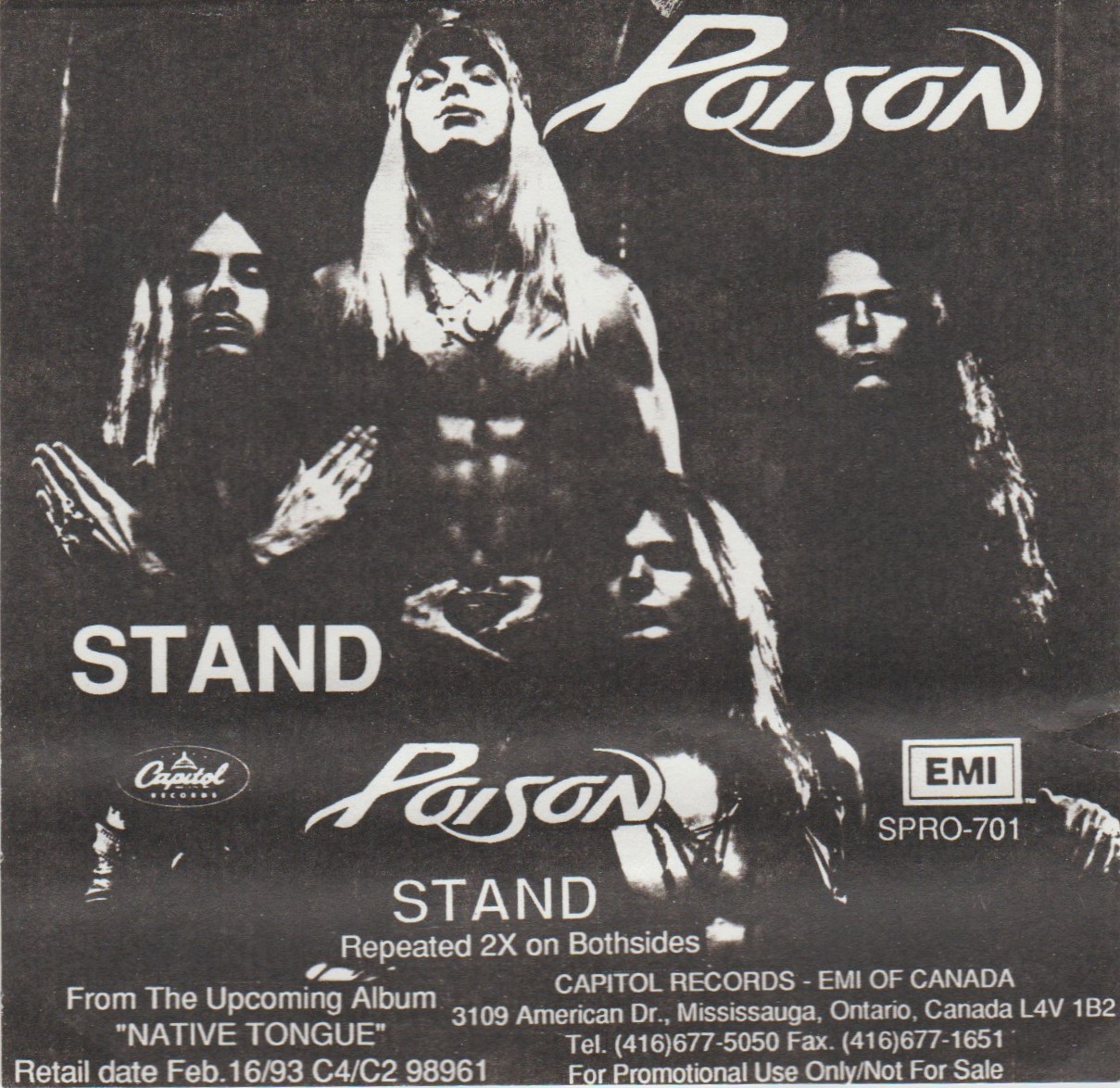
What is a “CHR edit”? It’s a special single edit of a song specifically intended for “contemporary hit radio”. In other words, Top 40. So, when “Stand” by Poison was selected to be the first single from 1993’s brand new Native Tongue album, it had to be trimmed for length. Getting Poison on the radio was going to prove to be an impossible task, so why make it harder by giving them a 5:16 long track that they definitely wouldn’t touch? “Stand” was shortened to 4:21, with much of Richie Kotzen’s delightfully idiosyncratic guitar licks getting the axe, along with some of the choir.
The cassette you see here contains two edited versions of “Stand”: the 4:21 “CHR edit” and another at 4:30 simply called “edit”. The differences are in the guitar solo which starts to deviate at the 2:28 mark. It’s in interesting curiosity, a peak inside the minutia of thinking that goes into marketing a song. “Hey, this format needs another nine seconds of song, leave in some guitar solo.” Is that how it worked?
The tape has both edit versions on both sides…twice. 2x2x2=8 times total, that you will hear “Stand” by Poison, if you play it all the way through. Call the CIA and let ’em know I have this cassette; they can use it with their enhanced interrogation techniques. I’ll sell.
On that note I can all but guarantee this cassette has never been played through, ever. It was sent to the Record Store about a year and a half before I started working there. The owner hated Poison. Hated — with a passion. There is no way he played this tape in store, ever. I rescued it from a giant, forgotten stack of promos that were stuffed into a bin. All garbage. “Don’t take any of those,” said the owner. Eventually all that junk was slated to be thrown out when the only location that sold tapes changed formats at the end of 1996.
This tape is valuable for one thing: it reveals the true North American release date for Native Tongue. Currently (August 2019), Wikipedia claims Native Tongue was released on February 8, 1993. That’s impossible because the 8th was a Monday. New releases came out on Tuesdays. This promo cassette clearly states on the back that the forthcoming album Native Tongue was retailing on February 16 — a Tuesday. You’re welcome, internet.
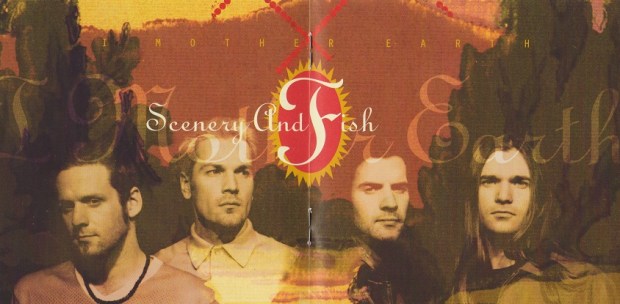
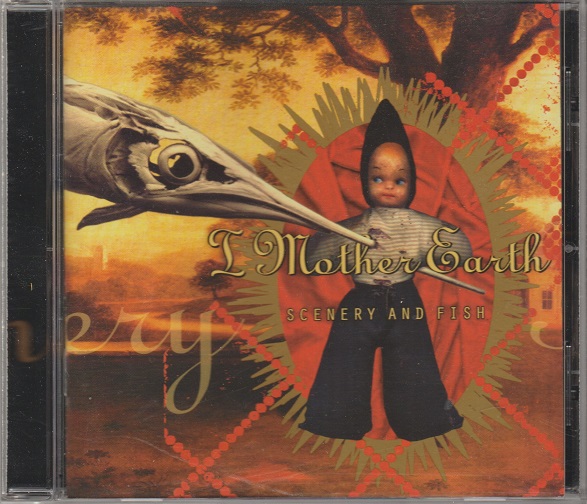
Some albums that mean everything to some, can mean nothing to others. Take a look at Scenery and Fish.
I Mother Earth’s second album gets a slew of 4 and 5 star ratings on the Canadian Amazon. Yet I don’t get it and never have. I was on the I Mother Earth train very early, before their first album came out. I loved the modern heaviness of the band. With the tribal and funk influences seeping through, I Mother Earth put out a seriously impressive debut album: a Canadian classic. As any band should, they mixed it up a bit on the second album.
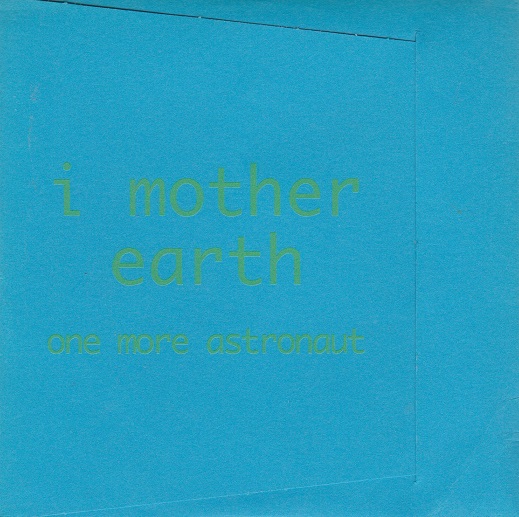
In early 1996 I received a promo CD for the first single from the second album, “One More Astronaut”, with the album version and a 4:35 edit. It didn’t seem too different, maybe just a bit more concise than some of the first album’s longer jams. This isn’t indicative of the album in general, which is a wild ride of different styles.
The exotic percussion (by Luis Conte and Daniel Mansilla) is still intact, melded with the funk bass, but the overall sound is very different. Paul Northfield’s production is cleaner and slicker than Mike Clink’s on the first LP. He still enables to band to exercise their instruments unfettered, but perhaps with a more radio friendly backing.
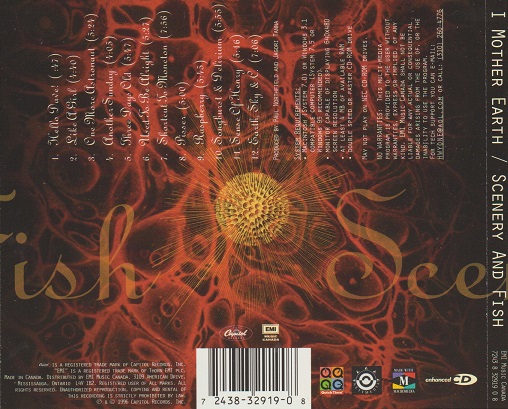
Although I’ve tried over and over again through the past two decades to let Scenery and Fish “click”, it just won’t. Other fans certainly have their favourite tracks: “Like a Girl”, “Raspberry”, “Used to be Alright”, “Another Sunday”. These are indeed some of the best tracks on the album, yet I struggled to remember how they go. “Another Sunday”, for example has an incredible blast of hooks for a chorus, but no memorable verses. Maybe this album is too thick with musical ideas and passages for the average mortal.
But that’s just me. You might think I’m nuts. There are those who think I Mother Earth can do no wrong, but fans in general love Scenery and Fish, while I simply don’t get it. I’ll always enjoy “One More Astronaut” and “Like a Girl”, which by the way features a friend of theirs named Alex from some band called Rush.
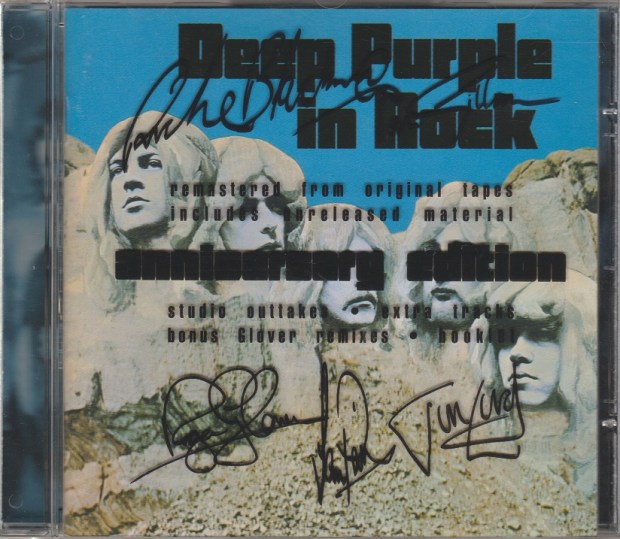
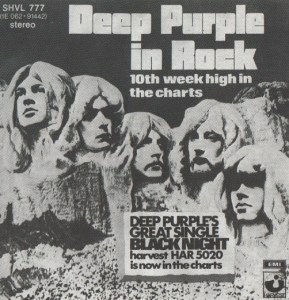
DEEP PURPLE – In Rock (1970, 1995 EMI anniversary edition)
Deep Purple In Rock: The title speaks mountains about the music. They didn’t want there to be any question regarding what kind of band Deep Purple were. The first version of the band, Deep Purple Mk I, made three psychedelic but still clearly rock and roll albums. Wanting to rock harder, they ditched singer Rod Evans and bassist Nick Simper, and brought aboard Ian Gillan and Roger Glover. However the first album released by Deep Purple Mk II was…Concerto for Group and Orchestra? There was also a wishy-washy gospel rock single called “Hallelujah” that went nowhere. Indeed, there was some confusion in terms of public perception. In Rock was designed from the start to reaffirm.
With In Rock, producer Martin Birch commenced a long and fruitful relationship with Deep Purple. The single was a track called “Black Night” which, oddly enough, wasn’t on the album. It was a response to a record label request for a single, so the band nicked the bassline from Gershwin and wrote a simple rock track with nonsensical lyrics. It was an immediate hit. Appropriately, the original single version of “Black Night” is included on this 25th anniversary edition of In Rock.
The B-side to “Black Night” was an edited version of opening album track, “Speed King”. The full length version was even edited down for some releases of the In Rock album, except in the UK. Almost a minute of noisy instrumental freakout explosively starts the full enchilada. This leads to a calming, light Jon Lord organ, misleading you into thinking the onslaught is over. Think again.
“Speed King” is a quintessential Deep Purple track, cementing their instrumental prowess and lyrical credentials. The sheer velocity of the track alone packs a whallop, but the sonics are just as powerful. “Speed King” has a deep, gut-punching heaviness. There is also a long instrumental section, custom built for the jam-loving audiences of the era. The words are cut and pasted from classic rock and roll hits in one stream of consciousness. The best word for “Speed King” is “exhausting”. Listening through feels like you just finished a sprint. The band were trying to capture the same vibe as Jimi Hendrix’s “Fire”, but overdid it just a smidge!
And what of that new singer? Ian Gillan didn’t get to do much screaming in his previous band (with Glover), Episode Six. In Deep Purple, his unmistakable wail sets world records for pitch and volume. Without Ian Gillan, there would be no Bruce Dickinson, and therefore Iron Maiden could never have existed as we know it today. In Rock features Ian at his peak powers. Nobody can touch In Rock, not even Bruce in his prime.
“Bloodsucker” is a vintage, grinding organ-based groove. In Rock has a very bass-heavy mix, but clear and defined. This helps the low growling Hammond combine with Roger Glover’s pulsing bass to form a wave of sound. Ride that wave on “Bloodsucker”, with a cool double-tracked Gillan vocal that keeps the thing slightly off-balance. Drummer Ian Paice can never be underappreciated, and in 1970 he was one of the hardest hitters on the field. “Bloodsucker” leaves massive Yeti footprints because of that beat.
One of the most important songs in the Deep Purple canon is “Child in Time”, a 10 minute composition of light and shade that transforms as you listen. As it begins gently, Ian Gillan gets to utilize the soothing side of his voice. “Child in Time” is almost a lullaby…until it is not. Wait for the ricochet. This album is called Deep Purple In Rock after all. Not Deep Purple In Bed or Deep Purple At Church.
In 1970, this would have been the moment you get up and flip the record. To do that, you would have to peel yourself from the floor.
The second side of In Rock features lesser played tracks, but no less impressive. “Flight of the Rat” takes off amidst a Blackmore guitar rocket riff. Though fast, it is a step off the pedal from “Speed King” and with enough vocal melody to keep one hanging on. Lord and Blackmore both solo, fighting to be champion but with no clear winner. All the while, Glover and Paice keep the pulse going through the time changes. Then it is “Into the Fire”, a rarely played unsung classic that the band resurrected on tour in 2000 and 2014. Bopping heavily along, “Into the Fire” will burn if you let it. Then the drums of “Living Wreck” fade in, with a incredibly deep natural echo that you feel in the bones. The snare sound rings sharp. “Living Wreck” was actually one of the first tracks taped, and just listen to Ritchie Blackmore’s tone on the lead solo! This is truly a triumph of studio recordings.
Finally “Hard Loving Man” closes In Rock with one of the heaviest Purple riffs in their history. Deep Purple invented the heavy metal chug on “Hard Loving Man”. Meanwhile Jon Lord contributes to the sludge by hitting as many keys simultaneously as he seemingly can! What a track, and much like “Speed King” at the start, it leaves you beaten and out of breath.
No Deep Purple album has come close to In Rock for brute strength. The band and Martin Birch truly captured something special in the studio, back when that meant finding the right amp for the right instrument in the right room. It’s much like alchemy, only real. In Rock is an artifact of the way they used to do it, and evidence of why it can’t seem to be repeated. The monument on the album cover was an apt indicator of what the new Deep Purple sounded like.
The 25th anniversary edition contains a wealth of bonus material, interspersed with amusing studio chat, such as:
Jon Lord (singing): “I smashed the microphooooone.”
Martin Birch: “Are you going to hit it again?”
Jon Lord: “I don’t think so.”
In addition to the original single “Black Night”, there is a fascinating alternate take of “Speed King”. The band were toying with a version featuring piano instead of organ, which completely changed its character. This version was recorded and accidentally released on a single instead of the proper one. Here it is as a bonus track, showing you a work in progress and what could have been.
Then we have a Roger Glover remix of “Cry Free”, one of the earliest songs recorded (30 takes total) but ultimately rejected. It was first released on the 1977 posthumous Deep Purple album Power House, one of many releases that EMI put out during the period the band were broken up. Glover oversaw remixes of many of Deep Purple’s reissues beginning here. The differences are subtle but not unnoticeable. Glover also remixed “Black Night” (more on that later), “Flight of the Rat” and “Speed King” (including intro) for these bonus tracks. They might be described as “fuller sounding”. “Black Night” was expanded to include a previously unheard outro. Then there is “Jam Stew”, an instrumental with a chicken-pickin’ lick that has been all but forgotten. It was played for the BBC once with improvised vocals; that version can be found on BBC Sessions 1968-1970. Ritchie used the riff later in 1970 for a side project album called Green Bullfrog.
With these bonus tracks, the In Rock anniversary edition is expanded from 43 to 78 minutes. For fans that needed every last morsel, there was still one more release to be found. To coincide with the anniversary edition in 1995, EMI released a limited and numbered CD single of “Black Night”. (How many made? I don’t know, but I have #2908.) This three track single has two versions not on the In Rock CD: a single edit of the “Black Night” Glover remix, and a “matching mix” by Glover of “Speed King”. This “matching mix” seems to be an edited remix without the noisy intro. They’re not essential except to the collector.
To date, this 1995 anniversary edition is still the only expanded edition of In Rock. With the rare photos and expansive Simon Robinson essay inside, it is the obvious definitive edition, 22 years reigning strong. They even tried to get Ritchie Blackmore involved with the reissue. He offered one quote for the booklet: “This is my favourite LP along with Machine Head.” Be very careful if seeking out a mint condition copy of this CD. The jewel case itself is very special. The autographs and notes on the front cover are not on the front cover. They are etched into the plastic of the jewel case. Mine is safely enclosed in a scratch proof plastic sleeve, but finding an original jewel case intact will not be an easy task on the second hand market.
DEEP PURPLE – This Time Around – Live in Tokyo ’75(2001 EMI)
This shouldn’t have been the “last concert in Japan”!
Many of the old, post-breakup-issued Deep Purple live albums are virtually impossible to find today on CD. One of those is Last Concert In Japan, which was originally released only in that country. It featured the Mk IV lineup of Deep Purple: David Coverdale, Glenn Hughes, Ian Paice, Jon Lord, and the late Tommy Bolin on lead guitar. As a matter of historical releases for my collection, I also own the original Last Concert in Japan on both LP and CD.
The tragic story goes that while some members of Purple were rejuvinated with the fresh blood that Bolin donated, others were dead tired of it all. Reviews were spotty and word was spreading that Deep Purple were over. Both Bolin and Hughes were in the throes of serious drug habits. On the night of the recording of Last Concert in Japan, Bolin was shooting up and caused his arm to go numb. Frantic attempts to get him stageworthy worked and he managed to barely play the show. Guitar parts are sloppy and that’s what people remember because it went on LP. The original one-record set from the show has now been expanded to two lengthy CDs, 17 tracks. It’s been remixed and remastered. Production was supervised by Purple expert Simon Robinson, so you know that the quality level is about as good as it could be. Because of the fully expanded tracklist, some of the finer live Deep Purple moments have been restored to this album, such as a 16 minute “Gettin’ Tighter” which was too long to include on a single record.
Some flaws do remain of course. Tommy’s guitar is now barely audible in the “Burn” riff as opposed to non-existent. However the overall experience is very listenable. It’s a darkly interesting album to own, because within months Purple disbanded, and a year later Tommy Bolin would be dead.
If you already own Last Concert In Japan, this purchase gives you over an hour more of unreleased music. Even so, all of it has been remixed, so you are still in for a fresh listen with open ears. If you already own dozens of Deep Purple live albums (believe me, it’s possible), this one has five songs that you can’t get elsewhere in live versions. It’s even a better listen than In Concert/King Biscuit Flower Hour (aka, On The Wings Of A Russian Foxbat) with stronger vocals. Plus you get Tommy singing on “Wild Dogs”. Worth the double-dip.














 mikeladano.com