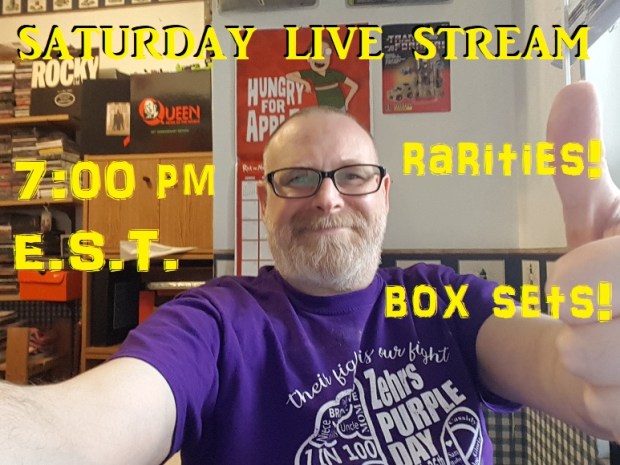
I hope you’ve been enjoying these Facebook live streams! I sure have been. This week’s stream will be Saturday April 18 at 7:00 PM Eastern Standard Time. The idea behind changing days and times is to give different people an opportunity to watch. (If you missed last week’s live stream, The Judas Priest Discography, you can watch it here.)
The subject matter this week is: Rare Box Sets! I have an armful dusted off to show off to you. Some you may have seen on my site before, and some you might not even know existed. I’ll throw in a rare album or two as time permits. I plan on going for roughly an hour. Rob Daniels from Visions in Sound will be going live after I’m done so I’ll be jumping over to catch his show!
No crazy stunts this time, but I will be trying out a new feature. Whether it’s a bomb or not, we’ll see. It’s called What the Hell is Mike’s Dad Watching on TV.
Join me tomorrow at 7 PM E.S.T. for some rock and roll shenanigans! Facebook: Michael Ladano
Disclaimer: There will be NO half-moons this time. I swear.
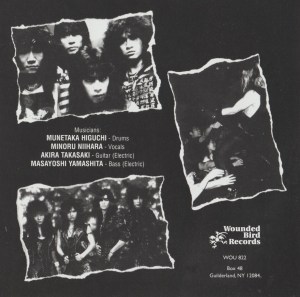
It’s safe to say that, while the Mike Vescera era of Loudness has its merits, the band was not the same after Minoru Niihara was let go. Loudness were not the first Japanese metal band to utilize an American singer in an attempt at greater success. When that didn’t pan out, Vescera left to join Yngwie Malmsteen. Unfortunately, this lineup shift happened at the worst possible time in music history: the 1990s. The beginning of the grunge movement.
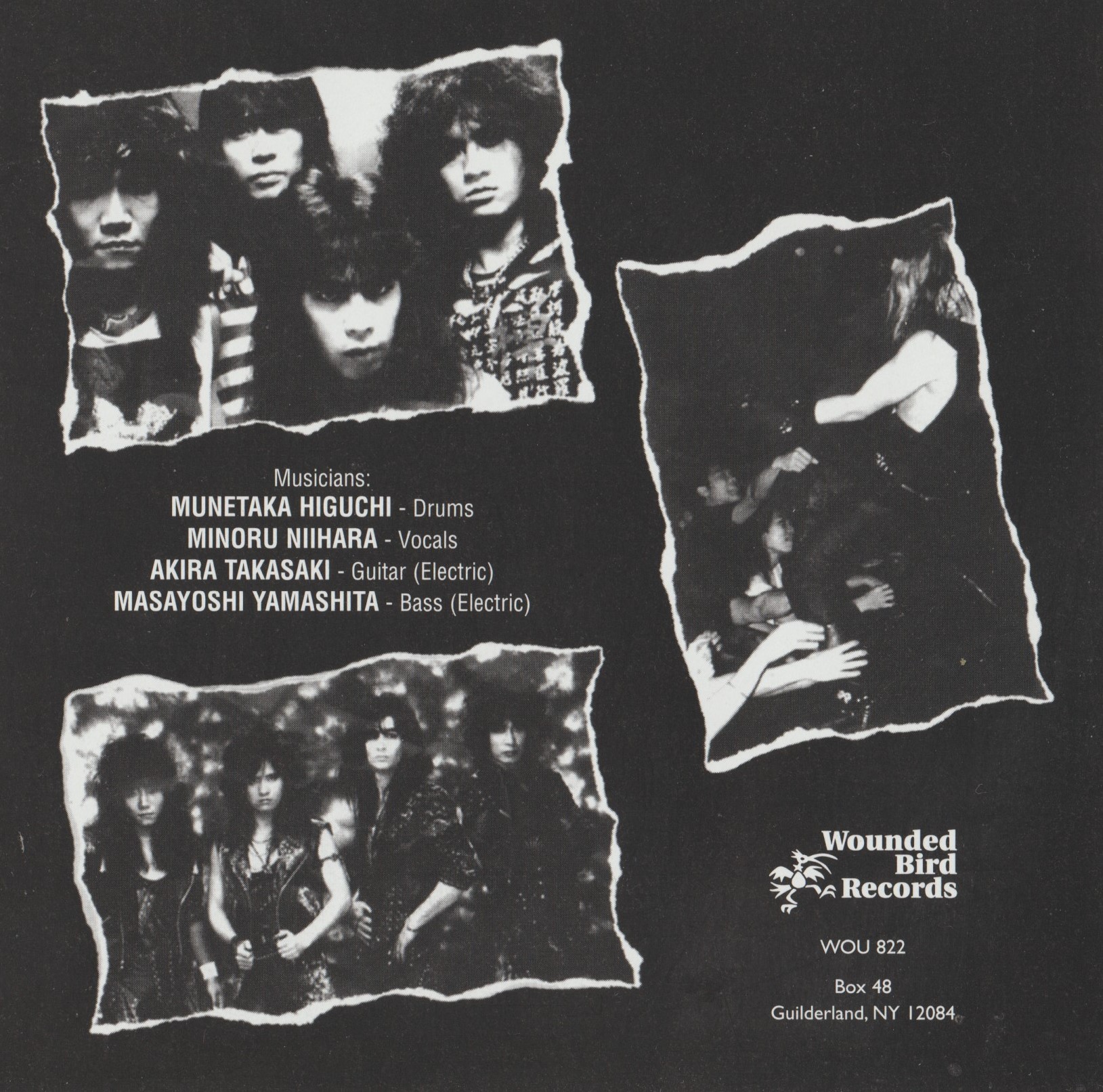
Also gone was bassist Masayoshi Yamashita, leaving only founders Munetaka Higuchi (drums), and Akira Takasaki (guitar). Returning their focus back to Japan, Loudness sought new members already well known at home. Taiji Sawada from X (called “X Japan” over here) joined on bass. In a surprising move, they chose E-Z-O singer Masaki Yamada to front Loudness through the 90s. Masaki’s style was a vocal shift, drastically different from Niihara and Vescera. He was also known as a theatrical frontman, using exaggerated makeup and hair. The name recognition wouldn’t hurt though. E-Z-O put out two critically acclaimed albums in the US, one of which was produced by Gene Simmons of Kiss.
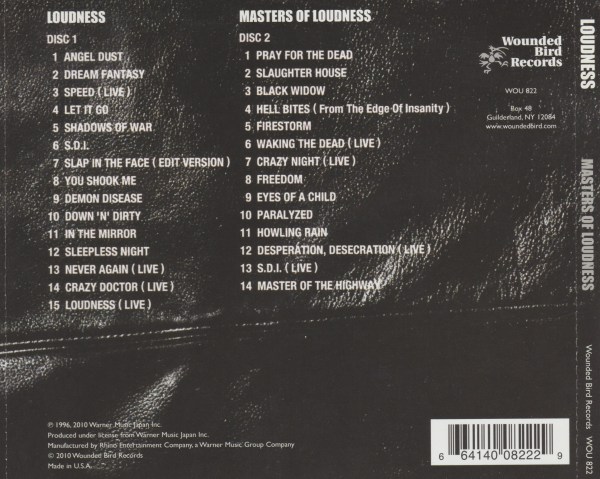
Having felt pressure to commercialize his music, Takasaki decided to go heavy. What better way to proclaim that they’ve returned to center than by calling the new album simply Loudness?
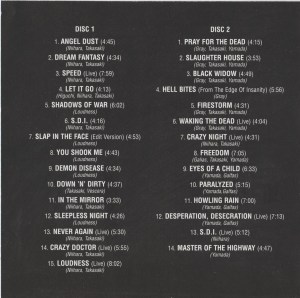
“Pray for the Dead” opens with heavy, heavy 90s riffing like a cross between Pantera and Megadeth. Takasaki was not fooling around. His trademark divebombs soon give way to a slow grind. Masaki’s growling presence is swiftly felt. He might not sound like Minoru but he’s completely right for the new Loudness. This is not the heavy, technical speed metal of the early albums. “Pray for the Dead” is the new heavy; slowed down and emphasis on groove. The difference between Loudness and all the rest of the slow, heavy alternametal bands of the 90s is Akira. He continued to shred solos that would make most players scratch their heads trying to keep up.
Higuchi pounds his way into “Slaughter House” which wastes no time getting up to speed. The first fast tempo track of the album gets into thrash territory, leaving Metallica in the dust. Once again Akira blows minds on the solos, this one going neoclassical before duelling with Taiji on bass. Not letting up, “Waking the Dead” is a vicious song due to Masaki’s vocal bite.
Loudness is relentless. The best tune is the groover “Black Widow”, track #4. It is here that Loudness and Masaki gel most perfectly. It’s better than a lot of the heavy music coming out of Seattle at the same time. The production is crisp but weighty. The performances really jam, even though they’re quite technical. “Black Widow” is a killer!
A “Kickstart My Heart”-like drum pattern opens a song appropriately called “Racing the Wind”. This is in the neighborhood of Painkiller-era Judas Priest, but with a bass player who can really shred. On “Love Kills”, the wah-wah pedal is broken out for some play, but the song otherwise chugs along slowly. At the time, this was the kind of song that was in the right ballpark to be a hit. “Hell Bites” then annihilates the senses: a blistering track with incredible musicianship from all around. There’s that wah-wah again! It’s the closest thing to an album epic when it goes through different tempos and riffs. Outstanding track.
An interesting song is “Everyone Lies”, since the music was written by former bassist Yamashita. At first, it’s not an outstanding track. After a few listens, the heavy groove becomes unshakeable. “Everyone Lies” is a serious banger, and it gives Masaki room to really bellow. “So sick of bullshit, better get wise, everyone lies!” Masaki was assisted in lyrics by Jody Gray, but this sure does sound like Takasaki’s statement towards old managers and record labels.
There’s a funky groove on “Twisted”, a song that could only have been written in the 90s. The crazy thing is Taiji’s funk bass skills are phenomenal! When Takasaki starts Vai-shredding all over it, I forget what band I’m listening to. Especially when Gray raps. But that is mercifully brief. It just goes to show how all-encompassing that altera-rock phase was in the 90s. It touched virtually every band in some way. Loudness more than expected.
An absolutely insane thrash metal surgical strike ends the album on “Firestorm”, with lyrics split 50/50 between Japanese and English. Metal doesn’t come much faster than this. Hopefully the old fans were shitting themselves in happiness with new music of this velocity.
Although Loudness had returned to their roots in terms of playing fast, heavy music once more, there is no question that they also moved into another direction simultaneously. Loudness is not The Law of Devil’s Land. Solos aside, there is nothing as traditionally “metal” as early Loudness. Masaki isn’t a melodic singer like Minoru. Instead Masaki goes full blast. Masaki is an acquired taste with a different style. You’ll either like it or you won’t.
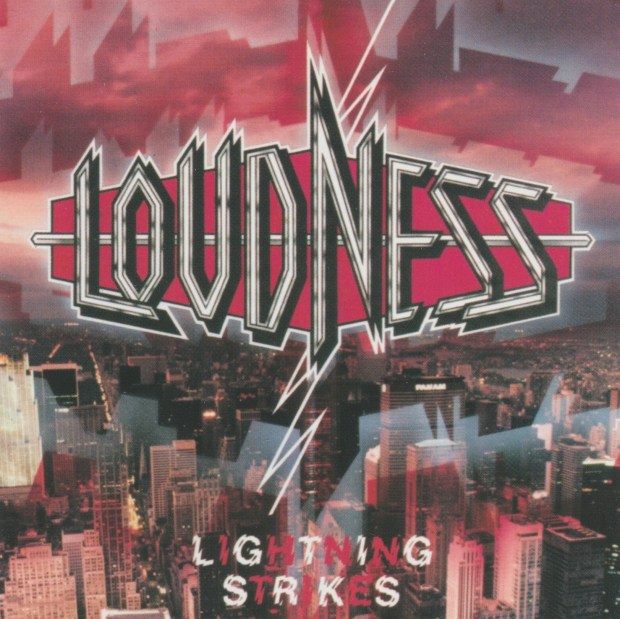
LOUDNESS – Lightning Strikes (1986 Warner – US version)
Eager to repeat the success of 1985’s Thunder in the East, Loudness regrouped with the same production team (Max Norman and Paul Cooper) on the followup Lightning Strikes. Taking their sound to even wider commercial limits, Loudness wrote a single for the new album, and hoped for American stardom.
When metal bands try their hands at commercial music, the results can be mixed. Fortunately for Loudness, they had the ability. Guitarist Akira Takasaki was in a pop rock band called Lazy when he was 17 years old and could write melody.
Lightning Strikes commences with the lead single “Let It Go“, a triumphant upbeat rock song that any band would have loved to write. The song cannot be praised heavily enough for its sharp catchy riff or singalong melodies. Singer Minoru Niihara delivers with a knack for a good yell. Like icing, Takasaki lays down a melodic and technical solo for the sweet tooth.
Seconds up to bat is “Dark Desire”, a terrific track that encourages you to “start a fire with rock”. This fire goes at a slow burn, but with another notable Takasaki solo as accelerant. “1000 Eyes” is a bit more metal with its themes of storms and destruction, and screaming chorus to boot. Check out some bass slaps from Masayoshi Yamashita too. Then, like a high speed chase, it’s “Face to Face”, pure metal with no commercial considerations whatsoever. It’s not particularly memorable but the chorus scorches. The first side concludes with a textbook Takasaki riff on “Who Knows”, a different but decent melodic metal track. It reminds me of some of the more interesting songs on side B of Iron Maiden’s Piece of Mind, but not as accomplished.
Some tricky stuff via the school of Yngwie Van Lynch is piled onto the front end of “Ashes in the Sky”, a phenomenal power ballad that would have been great on a Dokken album. (This song was titled “Shadows of War” and served as the opening title track for the slightly different Japanese release.) “Black Star Oblivion” picks things up with a speed metal track propelled by drummer Munetaka Higuchi. The jagged chorus makes up for the ordinary verses. Another memorable riff makes up the structure of “Street Life Dream”, which grinds along at a deliberate pace. Closing with some dense and blurringly fast riffing, “Complication” sounds like its title. It’s a bit too busy but certainly ends the album dramatically.
Lightning Strikes is not a bad album. It has some great tunes, but it has a few that miss the mark. It houses possibly their greatest song ever, “Let It Go”. It’s a good album to have, but you just wish it was more consistent.
Join me for Friday April 10 at 5:00 PM E.S.T. for the third Friday Live Stream! This week we will be tackling the complete discography of a beloved metal band, looking at some special musical rarities (CD and vinyl)…and something craaazy.
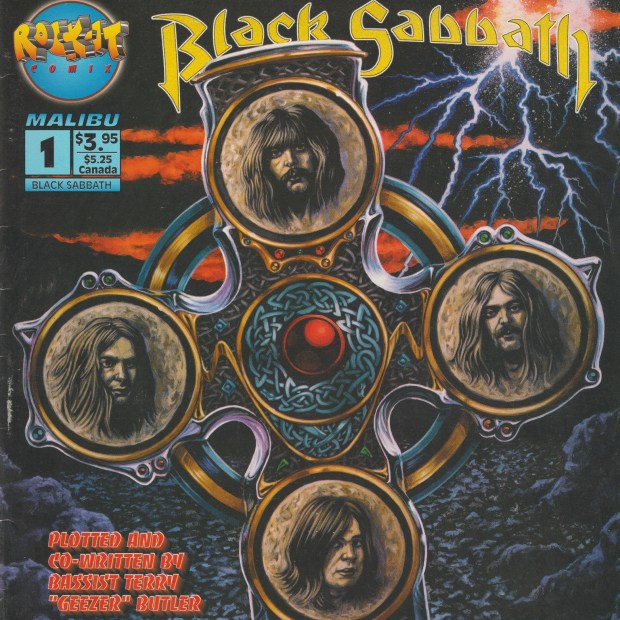
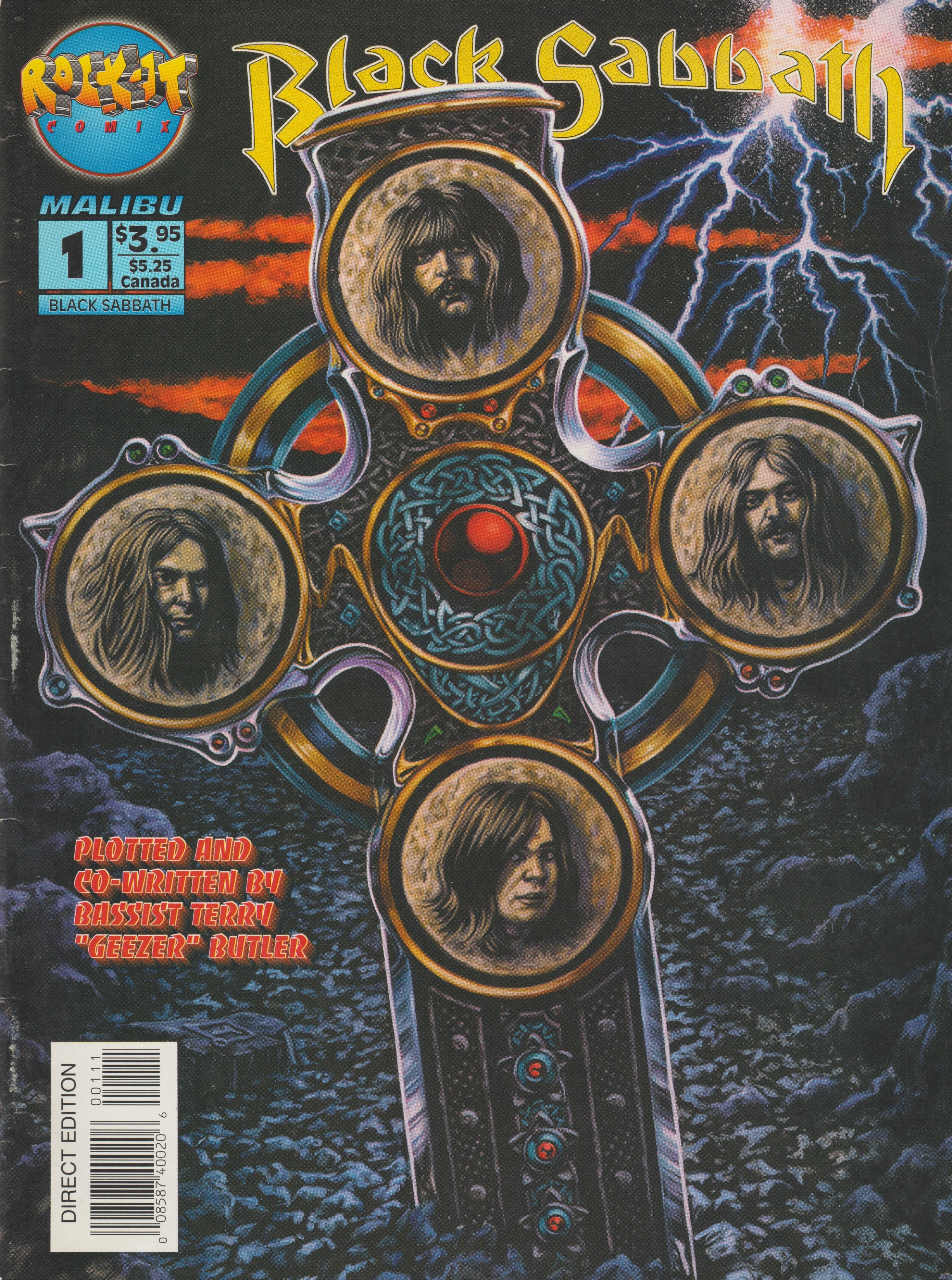
BLACK SABBATH – The Best of MusikLaden – Live at the Beat Club (1970 television performance)
When Black Sabbath released their Black Box in 2004 featuring all the original lineup’s studio albums in remastered form, they also included a bonus four-song DVD. This disc was the oft-released television broadcast of a German show called Beat Club (later MusikLaden). Sabbath made two appearances in 1970, and the Black Box was the most official release of them. Before upgrading to the Black Box, I owned an earlier, unofficial DVD release. I taped that DVD to cassette, and that’s what I’m listening to right now.
“Black Sabbath” is torrential, as intense as the young band was able. Ozzy sounds as if possessed, truly terrified and warning us that something foreboding and terrible is coming. “Paranoid” is strangely echoey and distant, but still as incendiary as 1970 Black Sabbath should be. Interestingly, in this version it really does sound as if Ozzy is singing “end your life” instead of “enjoy life”. A sparse “Iron Man” announces its arrival with evil Gibson guitar sonic bends. This version of “Iron Man” is a little stiffer than others, but not for long. Towards the end, Geezer Butler unleashes the hordes and the song stampedes to a close.
Finally and most notoriously is “Blue Suede Shoes”, a performance pretty much everybody has since disowned. It’s not terrible, although it’s certainly uncharacteristic. It’s as if Black Sabbath were suddenly encroaching upon ZZ Top’s territory. Tony’s speedy solo is interesting if not typical, and the band really stepped it up. I get why some would mock it; it’s kind of goofy and definitely not as impressive as the Sabbath originals. But it’s…fun? Is Sabbath allowed to be…fun?
OZZY OSBOURNE – Ordinary Man (2020 Epic Japanese import)
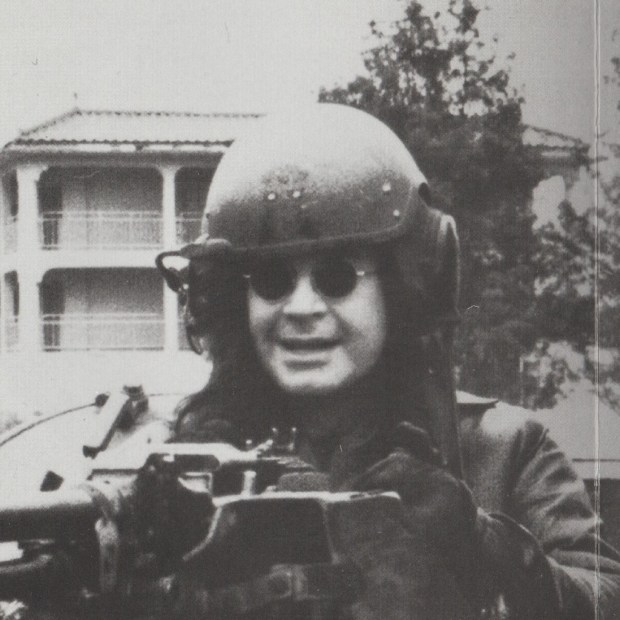
Expectations were low at LeBrain HQ for a new album by Ozzy Osbourne. In that regard, Ozzy delivered. Ordinary Man is an ordinary album. It is Hard Rock 2020 distilled down to 50 minutes. Nothing on this album comes close to challenging anything from the first six Ozzy albums. It’s most comparable to 2001’s Down to Earth, an overly-modern affair put together by suits.
This time out, the suits assembled a band consisting of Duff McKagan (GN’R) on bass, Chad Smith (RHCP) on drums, and Andrew Watt (California Breed) on guitar. These guys, plus a smattering of strangers, are responsible for the songwriting. The melodies are very deliberate and calculated rather than natural sounding. While things with Zakk Wylde were getting stale, at least Zakk tried to keep Ozzy on track. I’m not sure Ozzy is on track here. “I’ll make you scream, I’ll make you defecate.” Who wrote that?
The glossy production covers up some pretty stellar playing. Watt is fantastic when soloing, but sounds a bit like he’s trying to ape the Zakk vibe. In the vocals department, you can hear some telltale signs of autotune, which I guess is OK now in 2020. If Paul Stanley can lipsynch live and get away with it, then Ozzy can autotune his albums. I suppose.
Some of the better tracks include the ballads, and the surprising “Scary Little Green Men”. This one features some awesome lickity-licks from Tom Morello. Slash appears elsewhere, not sounding at all like Slash. The single “Under the Graveyard” is not bad. The worst track has to be “It’s a Raid”, possibly an outtake from Blink 182’s Neighborhoods CD.
Elton John sings on one track, and it’s not bad at all, sounding like a classic Ozzy ballad from the 1990s. I didn’t recognise Reginald Dwight’s voice at first. It’s deeper these days. Regarding Post Malone, he’s fine, has a decent voice albeit also autotuned. I don’t know what the guy sounds like without enhancement, but he sounds like he’s probably a better singer than Ozzy recently. I could do without his song “Take What You Want”, but at least the Japanese edition of the album ends on a better note. A blues track called “Darkside Blues” is brief, but actually sounds like something more real, more genuine.
Think about your favourite Ozzy albums. How often to do you spin Blizzard, Diary, or Tears? Now think about how often you play Down to Earth, Black Rain, and Scream. In two years’ time, you’ll be spinning Ordinary Man about as often as Black Rain, but you won’t be getting Wylde.
LOUDNESS – Thunder in the East (1985 Atco, 2003 Wounded Bird reissue)
1984’s Disillusion album turned some heads, especially when Loudness re-recorded the vocals in English. Now they were signed to an American label and worked with an American producer (Max freakin’ Norman), ready to break into that lucrative market. Thunder in the East was their debut to many fans outside Japan. For the occasion, the band shed some of its more challenging heavy metal arrangements in favour of mainstream rock and metal.
Out of gates first, “Crazy Nights” is a virtual sledgehammer. The riff is trademarked “heavy metal” and the chorus has the galvanised sheen expected from a song like this. The lyrics were designed for the concert stage, with lines like “Let me hear you all go wild,” and “Come on get on your feet”. But the line that confused fans worldwide was the chant “M! Z! A!” after every chorus. It turns out that “M-Z-A” stands for nothing. It’s just some filler lyrics that were meant to be replaced in the final version, but left in because it sounded cool. Fortuitous for Loudness, as it became a bit of a catchphrase.
Regardless, “Crazy Nights” is the one Loudness song you need to get if you only want one Loudness song. The riff just bites, like a mean old dog. It’s the “big hit” and deservedly so. Lots of chances to sing, shout and headbang. You are the heroes tonight.
A blistering “Like Hell” turns up the temperature in short order, with a fast blitz including melodic verses. The chorus however is a simple shout: “Like hell!” Loudness founder Akira Takasaki is not only a master of the six string (usually compared to Eddie Van Halen) but also a hell of a songwriter (pardon the pun). His knack for riff and melody resulted in a collection of songs running the gamut from vintage Priest to Dokken. “Like Hell” could have been on Defenders of the Faith. More on the old-school Scorpions side of things is “Heavy Chains”, a metal dirge with a foothold in early Maiden territory to boot. This brilliant track showcases singer Minoru Niihara’s impressive range and power. A frantic “Get Away” takes its speed and melody from Van Halen, but cranked up to 11. Takasaki’s multitracked guitar solo is neoclassical nirvana right up Malmsteen Avenue. Sheer melodic thrills embody “We Could Be Together”, a song Don Dokken could have felt at home singing, and with some licks that sound positively Lynchian.
The second side commenced with “Run For Your Life”, a complex track that sounds at times like a ballad and others like a heavy metal hurdle through a minefield. It’s the first track that doesn’t have the same structural integrity as the others, though it challenges in other ways. “Clockwork Toy” is more straightforward, solid riff and chorus, but not as memorable.
Things take a cool, funky turn on “No Way Out”, a very different track but also very addictive. The guitar playing on tracks like this proved Takasaki could do a lot more than people assumed. Impressive too is the chugging “The Lines Are Down”, which is located right in Dokken Town. Except heavier, because make no mistake, Loudness are heavier.
The final track “Never Change Your Mind” is harder to categorize. Ballady, with light and shade, it’s unique. It sounds like an anthem at the halfway point…an anthem with guitar divebombs. It’s a dramatic way to end an impressive metal feast.
Since Thunder in the East contains Loudness’ best known hit, it comes highly recommended. It’s a solid piece of metal history. It might not be their pinnacle but it’s a damn fine album indeed.
DEF LEPPARD – Los Angeles 1992 (Red Line bootleg CD)
It’s the Seven Day Weekend tour! Def Leppard brought back the “in the round” stage concept from their previous tour and played a set of hits with a few deeper cuts. This audience recorded bootleg captured the Los Angeles date permanently.
Wasting no time, it’s straight into the first single “Let’s Get Rocked”. I have never particularly felt this song was as strong as past efforts, but Def Leppard had overcome such tragedy. I was willing to forgive them for painting by numbers a bit with the new songs. One thing apparent on a bootleg with no post-production sweetening: Def Leppard’s vocals are 100% live.
Right into something better, it’s “Tear It Down”, better because it’s originally a B-side from the inspired Hysteria sessions. Speaking of Hysteria, onto “Women”! You can hear that new guitarist Vivian Campbell fit right in, seamlessly. A couple seriously great tunes follow — “Too Late for Love” from Pyromania and Hysteria‘s title track. Two of Leppard’s most accomplished singles. Slower, ballady, and not at all weak. “Hysteria” live begins just a little differently, but quickly becomes familiar and authentic.
I never cared for “Make Love Like a Man”, but it’s a temporary speedbump before a deeper track. “White Lightning”, the tribute to the late Steve “Steamin'” Clark is very hard to find live. This is the first version I’ve owned. It’s every bit as epic as it deserves to be. The stone cold classic “Foolin'” follows, and the Los Angeles crowd goes nuts when the track explodes. They are just as excited for “Animal”, sounding brilliant in live form, although hampered on audio by a loud talker in the crowd. New guy Vivian Campbell gets a big showcase solo next. I’m sure this show is edited down to fit on CD, since Phil usually gets a big solo too.* Viv’s is impressive and he gets to show off his shred a little bit, though his solo is more of an instrumental composition that sounds delightfully Vai-ish.
Another big epic, “Gods of War” from Hysteria is a serious thrill and chill. Say what you will about Leppard’s more pedestrian material. When they wanted to do something a little more challenging, they nailed it. A big long version of “Rocket” including the “Whole Lotta Love” segue closes the CD prematurely, which is a shame, and one can hope that the second half of the set was issued elsewhere.
4/5 stars
*Here is the full setlist that night according tosetlist.fm:
Let’s Get Rocked
Tear It Down
Women
Too Late for Love
Hysteria
Make Love Like a Man
Guitar Solo (Phil Collen)
White Lightning
Foolin’
Animal
Guitar Solo (Vivian Campbell)
Gods of War
Rocket (
Acoustic Medley Section
Enter Sandman (Metallica cover) (Vivian)
Back in Black (AC/DC cover) (Phil)
Tonight (acoustic)
You Can’t Always Get What You Want (The Rolling Stones cover) (acoustic)
Bringin’ on the Heartbreak (acoustic/electric)
GETTING MORE TALE #818: Alive and Wandering through the memorabilia bin with Gypsy Jayne
I wouldn’t have heard of Gypsy Jayne if not for Raw M.E.A.T. Volume 1, specifically. That compilation of underground bands from Ontario included one called “Wildside” with a killer, pro-level track called “Ready, Willing & Able”. They had a guitarist, Johannes Linstead, that could really wail. Their sleazy rock vibe had more in common with Roth-era Van Halen than current bands.
The year after, M.E.A.T magazine informed us that Wildside were now Gypsy Jayne and had a demo tape called Alive and Wandering for sale. This demo tape, good enough to be a major release EP, showed Gypsy Jayne had world class songs: Seven tracks including one classical guitar instrumental as good as anything coming out of California in the summer of ’92. I’m fortunate enough to know that, since I ordered the tape upon the magazine’s recommendation.
On August 10 of 1992, guitarist Johannes Linstead wrote me a thank-you note, packed up my tape and mailed it from Oakville, Ontario. A few days later it arrived here in Kitchener, and I was seriously impressed upon first listen. I played it a couple times in quick succession. Gypsy Jayne were exactly what I wanted to hear out of a new band in 1992. No grunge, no dark depressions, just grooves and riffs and hooks and incredibly solid performances. Even in the present, I still ranked their demo at 4/5 stars when it came up for review.
I kept just about everything I ever got in the mail from a rock band. While searching for memorabilia, I found the letter from Linstead still inside the original mailer for the Gypsy Jayne cassette.
“Dear Mike, glad to see you support original metal.” If you get a chance, we’d appreciate comments you might have on our music or musicianship.” Signed, Johanne Linstead. Not only could the guy play guitar, but his penmanship was impeccable. Of course I wrote him back immediately. I believe the words I used regarding the musicianship were “blown away”. Johannes never wrote back again but I was obviously happy to have received his note in the first place.
Just recently, I received two separate inquiries about Gypsy Jayne in one week. Johannes Linstead is now an established world class flamenco guitarist. But I hope he hasn’t forgotten his metal roots. Perhaps Gypsy Jayne is primitive compared to music he performs today, but it is certainly an accomplished recording for its genre. Nothing to be ashamed of, surely. There is a demand for a Gypsy Jayne CD reissue. My old cassette is barely listenable and the only reason to listen is the incredible music.
It’s very pleasing to hear from fellow Gypsy Jayne fans, so if you have heard this band and also wish for a CD reissue, leave a comment below! Songs like these should be available for anyone who likes classic rock to buy and enjoy. They deserve to be recorded in rock history as one of the great “shoulda-woulda-coulda” stories of the Canadian 1990s.
I don’t know how this is supposed to work. Do you have to watch an animated series in order to “get” Post-Apocalypto? I’m not doing that. I’m listening to an album; I’m reviewing an album.
21 tracks, half an hour. Most of the tracks run a minute and a half. So what’s the concept? Humanity has destroyed the Earth in a nuclear holocaust. Tenacious D survived, though their songwriting abilities did not. Richard Branson, Elon Musk and Yo-Yo Ma have been saved, and now live on a space station. Kyle Gass wasn’t good enough to make the cut and now has a two-headed dog named Hope to keep him company. Unfortunately the KKK seems to have taken over security on what’s left of Earth.
Post-Apocalypto is part uninspired sketches, part uninspired songs. Some are decent, or half-decent, like “Take Us Into Space” and “Woman Time”. Most are too soft, light and forgettable, and the sketches are tired. Jack Black’s “Arnold” accent isn’t bad, but the joke wears out.
Bottom line: as stated by Uncle Meat, “18 minutes of music isn’t an album.” Iron Tom adds, “Although I’ll listen to some tunes individually, I don’t see myself listening to it again as an entire album.”