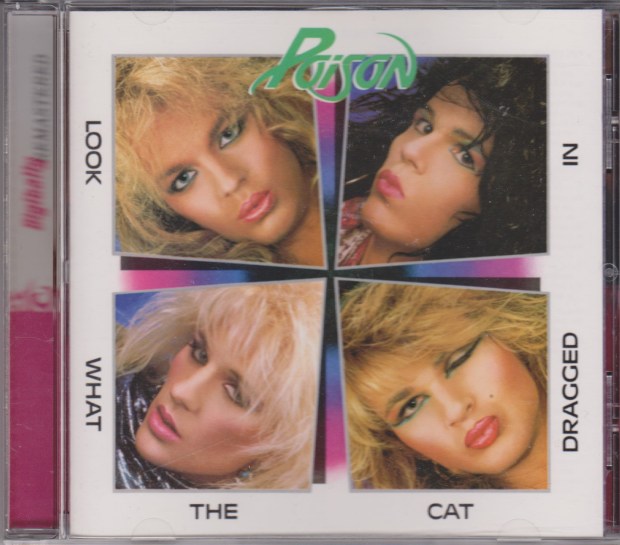
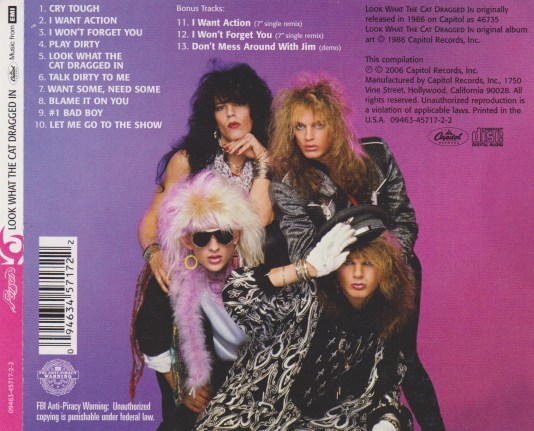
POISON – Look What the Cat Dragged In (1986, 2006 Capitol remaster)
I remember seeing this album in the racks of our local Zellers store. I didn’t know the band. I thought CC Deville was pretty cute.
Taking the gender-bending makeup of the mid-80’s to its logical end point, Poison stormed out of Hollywood and onto the charts. They did this with a handful of great singles, including “Talk Dirty to Me”, “Cry Tough”, and “I Won’t Forget You”. Also huge, but barely tolerable as a song, was the singalong “I Want Action”.
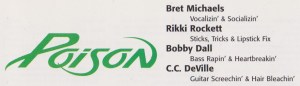
Bass “rapin’?” Good god!
Armed with just $23,000, Poison recorded Look What the Cat Dragged In with producer Ric Browde (Ted Nugent, W.A.S.P.) in less than two weeks. What they emerged with was a fun, raunchy and terrible sounding album with some big hits and plenty of filler.
“Cry Tough” was a tight little opener, a hot and bright rocker about going out and givin’ er. “You gotta cry tough, out on the streets, to make your dreams happen!” sings Bret Michaels in full-on cheerleader mode. Unfortunately the sonics of the album leave much to be desired. The guitar, drum and vocal sounds are demo quality at best, but that’s what you get for $23,000 and Ric Browde.
The other singles were all huge. “Talk Dirty to Me” is now minor staple, and “I Want Action” (annoying as it is) is another. The ballad “I Won’t Forget You” is an album highlight, well before Bret & co. had mastered the art of writing hit ballads. Low key, basic and electric, “I Won’t Forget You” is very different from “Every Rose” and some of the later broken-hearted Poison love songs. Paul Stanley has a cameo in the road-ready music video, which didn’t hurt.
That leaves a hell of a lot of room for filler, and Look What the Cat Dragged In has plenty. Of the album tracks, the decent ones include the saucy glam-slam rawking title track, and another song called “Want Some, Need Some”. Both tunes could have used some last-minute tightening up, but neither are as bad as the dreck on the tail end of the album: “#1 Bad Boy”, “Blame it on You” and the horrid “Mama Let Me Go to the Show” all suck absolutely. “Play Dirty” on side one is also pretty awful.
Even with the quality issues in sound and songwriting, Look What the Cat Dragged In sold over 3,000,000 copies. 20 years later, it was given a fresh remastering and three bonus tracks. The remastering could not fix the audio issues, but the bonus tracks are pretty good. Single remixes of “I Want Action” and “I Won’t Forget You” are marginally better than the original album tracks. Somebody realized that they were sonically deficient, and the remixes help a teeny tiny bit. Then Jim Croce’s “You Don’t Mess Around With Jim” is added to the end, a song that got more exposure on the covers album Poison’d! The bonus tracks go a long way towards making the album a little more listenable from start to end.
2/5 stars
KISS – Greatest Live Hits (2015 Concert Live limited edition)
“What’s this?”, you ask with scorn. “Just another Kiss hits/live thing, is it?”
Yes and no.
Concert Live is a great company that records and releases “instant live” albums from major artists like Kiss and Alice Cooper among many. You can buy them immediately after the concert, or online as I have. Kiss have a lot of Concert Live releases. I have three, all from the Sonic Boom tour: Montreal, Saskatoon, and Atlanta. They are live, not overdubbed, raw and real. And expensive! So when Concert Live announced they were releasing a Greatest Live Hits CD from these concerts, I clicked the “add to cart” button immediately. The original order claimed there were only 200 copies available, but you can now get it from Concert Live as a part of a multi-album box set.
This 2 disc collection has all the classic hits (nothing more recent than ’83) from a variety shows from different nations. There are three tracks of Kiss from the Download Festival, in 2008. Paul’s voice is surprisingly strong, and the reason why is because they are from seven years ago. There is no booklet with details, so only the location of the recordings is obvious from the packaging. It is true that Eric Singer covers for Paul when his voice cracks or he cannot hit the note anymore. Concert Live seemed to focus on the best versions they could find of these particular tracks, so you get a high ratio of good-to-bad Paul performances.
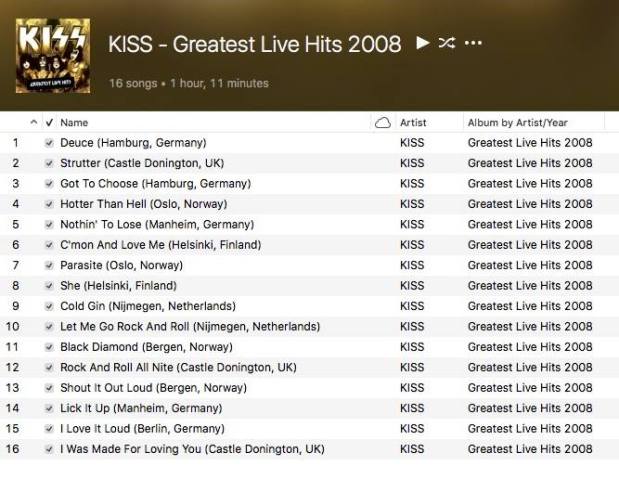
Below are the recording details, courtesy of rock journalist Mitch Lafon. He suggests re-ordering the tunes to create an actual Kiss setlist.
At this stage, with so many Kiss live packages on the market, there’s no point in discussing specifics. The recordings sound as you have come to expect from Concert Live. Warts and all, but with sonic care and clarity, these are true live albums. When Gene has to suddenly sing in a lower key in “Rock and Roll all Night”, that’s in there. This is the kind of thing that drives casual music fans up the wall. I actually know people who can’t stand live music because of such realities. I find it hard to understand because that is a real moment captured in time, and it’s just a moment. The song does not derail and Gene soon returns to the original key.
Random observations:
1. When “Strutter” begins, the first second sounds uncannily like “Hide Your Heart” and it always takes me by surprise!
2. It’s nice to get “Rock and Roll all Night” out of the way early, but “I Love It Loud” as a closer? That’s a weird way to end an album: on a sluggish, way overplayed note!
3. On “Let Me Go Rock and Roll”, Eric Singer tries to do his version of Peter Criss’s shtick, talking to the crowd in the cool-cat voice. Unfortunately I find this to sound contrived and awkward for the new Cat Man, Eric.
4. Tommy Thayer haters can suck it. He’s playing the style Paul and Gene want him to play, and he does his job perfectly. This is the Kiss sound they have gone for, a classic Frehley guitar sound, and Tommy Thayer’s the man for that job so long as the Ace Man isn’t.
I was pleasantly surprised by the overall quality of this disc. A few more concert details would have been nice, and some of the edits between tracks aren’t so great, but this is a worthwhile buy for any fan of the present day Kiss!
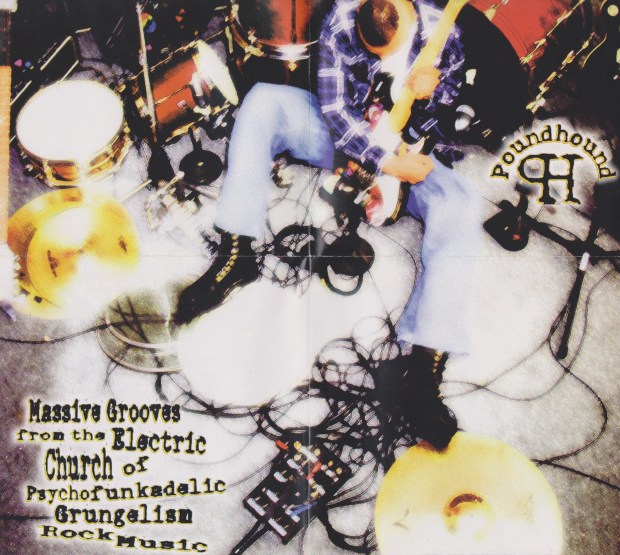
POUNDHOUND –Massive Grooves from the Electric Church of Psychofunkadelic Grungelism Rock Music(1998 Metal Blade)
You have to give Doug Pinnick credit for many things, and one of them is his prolific musical output. The same year as King’s X Tape Head album, Doug released this solo project under the band name PoundHound. Massive Grooves (the shortened title) featured Doug playing all instruments except drums. His King’s X bandmate Jerry Gaskill, and Shannon Larkin of Ugly Kid Joe helped out in the percussion department. The result isn’t that dissimilar from Tape Head itself. As the title suggests, these are indeed massive grooves.
The Reverend Hershall Happiness is your host for this heavy celebration. “Jangle”, the opening song, isn’t that much different from the groovy side of King’s X at all, and just listen to that bass! Doug lets it ring low, and boy oh boy does it sound good. “Jangle” is as catchy as it is groovy. “Shake” puts the emphasis strictly on groove. “Everybody, shake your thing,” sings the Reverend. It probably surprises nobody that Doug is a good enough guitar player to nail some cool solos too. Is there anything he can’t do? (Just the drums, apparently!)
The songs are mostly short and to the point. Don’t expect the progressive metal of King’s X. Do not think you’re getting simply good time party groovers either. A great song called “Friends” for example is pretty blunt. “Kevin is a razorhead, he says the cutting numbs the pain.” Just like King’s X, Doug is not afraid to paint a stark picture of some parts of real life that we often want to bury. “My world just got darker,” he sings on “Darker”. If you were expecting an entire album of good times, this is not it. But good rock and roll? Absolutely. The direction is more or less the same from track to track. It’s heavy groove based rock with the best soul singer in metal. The variety that you get from King’s X (and their multiple singers) is not present here, but if you like Doug then you will love PoundHound.
Doug’s bass and guitar sound amazing (you will rarely hear such a full bass sound), but the drums are fairly dry and a little thin (compared to the last few King’s X discs). This does not hamper enjoyment of the disc. The songs and sound are consistent enough.
Best tracks: “Jangle”, “Shake”, “PsychoLove”, “Friends”, “Hey”. Only semi-stinker in the bunch: “Supersalad” (too much grungy grunting vocalizing).
Doug released a second album as PoundHound, before shortening his name to Dug and putting out proper solo albums under his own name. For all intents and purposes though, Massive Grooves is the first Doug Pinnick solo album and a damn good one it is.
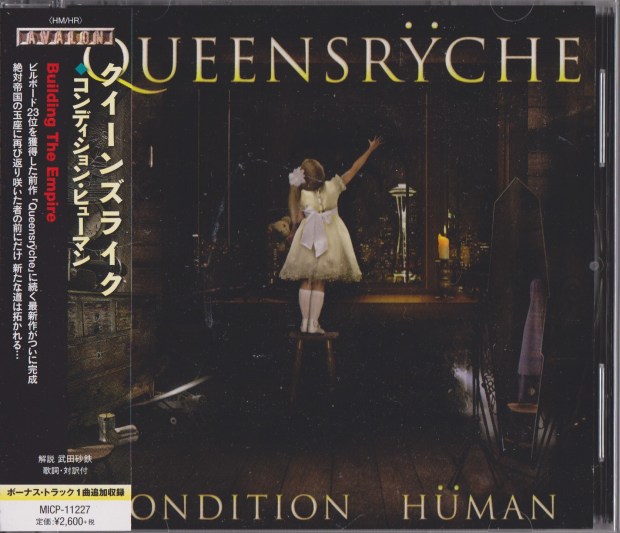
QUEENSRŸCHE – Condition Hüman (2015 Century Media Japanese edition)
As if it was not abundantly clear on their last album (2013’s self-titled), Queensryche seem to have no intentions of abandoning their heavy metal roots again. Furthermore when you have a significant lineup change, such as a new lead singer, you can’t just stand still. You have to keep progressing forward. The ‘Ryche used their last album to re-ground their sound, but for a followup you need more than that. Condition Hüman pushes the boundaries out once more, but not without keeping the metal intact.
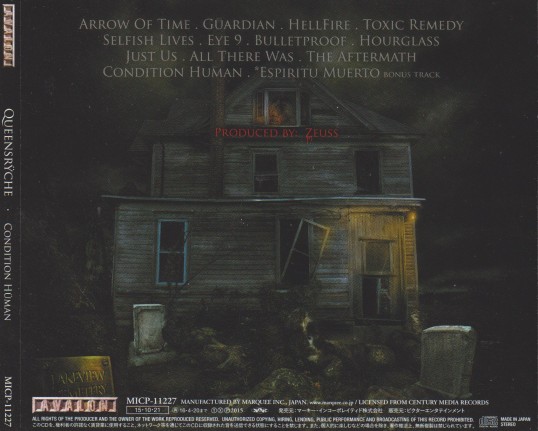
Indeed, “Arrow of Time” sounds as if the quintet had been ingesting nothing but classic Iron Maiden for breakfast. Swift and viscous, “Arrow of Time” gets the job done in the requisite four minutes but not without exploring the exotic side of metal riffing. Imagine an alternate reality where Queensryche did not go in the highly technological direction of 1986’s Rage for Order album. Envision instead a timeline in which they followed The Warning (1984) with an album that continued to progress, but also go heavier at the same time. That album would have been Condition Hüman. “Hellfire” demonstrates this as well; the song would have fit on a heavier version of Rage.
“Guardian” demonstrates this even more clearly. With the vintage-style screams and vocalizations (Todd La Torre for MVP), metal riffing, but also Mindcrime-like progressive rock, Queensryche have hit upon a satisfying balance. Songwriting credits are various combinations of all five band members; all but “Eye 9”, written solely by bassist Eddie Jackson (a first, I think). The album has a cohesive sound, like five guys all pulling in the same direction. The production, by Zeuss, is punchy. Queensryche have always employed elements such as sound effects and programming, and Condition Hüman has these fixtures as well.
Moving on, “Toxic Remedy” is Mindcrime-like, but denser and massive sounding. Pay attention to the way Todd La Torre layers his vocals on “Toxic Remedy”. He has arranged the vocals in his own way; this is not a carbon copy of something else. “Selfish Lives” is the same. Yes, there are hooks and melodies that sound very Queensryche, but Todd is showing off his own personality more than before. And he’s not taking the easy way out on any of it! Sounds like he is really pushing his own limits, especially on “Selfish Lives”. It’s quite remarkable how lucky Queensryche were to find a compatible guy like Todd, who is also able to stretch it out.
Another album highlight is the rhythmic “Eye 9”, the aforementioned Jackson composition. This Queensryche-meets-Queens of the Stone Age track blows the doors wide open in terms of direction by putting the rhythm first. It sounds like Queensryche, yet nothing like any prior Queensryche, simultaneously. “Bulletproof” puts a new slant on the Queensryche power ballad, keeping the emphasis on the power. La Torre makes it his own — listen to the last note he sings. Sends chills up the spine. Speaking of chills, crossing the acoustics with the heavy chunky riffing on “The Hourglass” did exactly that. There are Pink Floyd influences coming up to breathe from time to time on Condition Hüman. This is most obvious on “Just Us”, which is also very much like the slightly psychedelic acoustic side of Led Zeppelin. Queensryche have never done anything like “Just Us” before. “Silent Lucidity” this is not. The soulful singing at the close of the song is also unlike anything on a prior Queensryche song.
For fans of the technical, fast side of Queensryche, “All There Was” will scratch that itch. With that pulsing technological rhythm and “Needle Lies” tempo, you are in for a ride. Don’t forget the blazing guitar histrionics. The final album track is “Condition Hüman” itself, 7:48 of dramatic progressive metallic rock. Check out the “Astronomy Domine” section after the fifth minute, just before it goes into that deliberate Mindcrime riff. If I had to pigeonhole the sound of this album, it would be “progressive metallic rock”, but pigeonholes are lazy. Still, as Commander Pavel Chekov once said, “If shoe fits…”
Holding out for the Japanese edition of the album, the bonus track “Espiritu Muerto” is the bonus track worth waiting for. Going sludgy for 3:40, but topped with a soaring chorus, the bonus track is in the mold of the album but different just the same. It’s a long album though, and adding more material (even if good) can sometimes push a CD just a bit too far in terms of attention span. “Espiritu Muerto” is close to this line, but because it has enough personality of its own, it’s worth staying around for.
If any of these songs sound intriguing to you, check out Condition Hüman. Fans who wonder where Queensryche could have gone had they adhered to heavier roads will find much to enjoy. They have never taken the easy way with any of their albums, but it is hard to imagine a fan of early ‘Ryche who won’t find something here to love.
Happy Halloween, folks! And what better way to celebrate this day than with the king of horror rock, Alice Cooper?
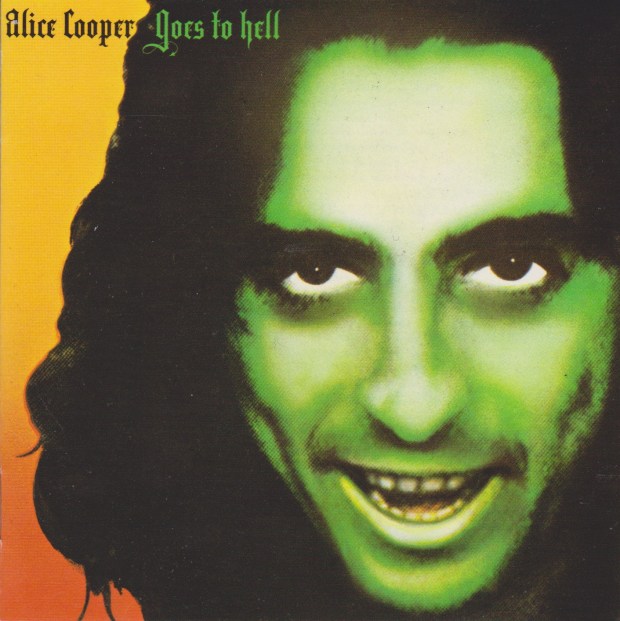
ALICE COOPER – Alice Cooper Goes to Hell(1976 Warner)
Last time, he welcomed you to his nightmare. Now, journey with Alice as he takes you straight to hell! Subtitled (in the inner booklet) as “A Bedtime Story”, Alice Cooper Goes to Hell is another concept album, to follow a concept album. Steven is back. It’s a pretty mad concept, and one that ties into not only Nightmare, but also Nightmare 2, decades later. Steven will fall asleep, and follow Alice down a dark endless staircase, “the pit where he doesn’t want to go, but has to.”
Written and produced by Alice, Bob Ezrin, and Dick Wagner, Goes to Hell features a backing band with a name you might recognize: The Hollywood Vampires. It’s not the same band, obviously (Johnny Depp was 12 years old), but it does demonstrate just how long Alice has been using that name for a band. Among the many musicians herein, you will recognize many: Steven Hunter, Dick Wagner, Tony Levin, and Allan Schwartzberg are probably in your record collection many times (credited or otherwise).
Goes to Hell doesn’t have the fire, or the reputation, of Welcome to My Nightmare. It is the beginning of a long slide that did not fully right itself until after Alice had kicked the booze for good. It is, however, an under-appreciated album with fun and nuance in the dark shadows. The title track is one song that still graces the live stage. Here, Alice seems to be paying for his crimes committed. “For criminal acts and violence on the stage, For being a brat refusing to act your age, For all of the decent citizens you’ve enraged, You can go to hell!” You’ll never have so much fun on the road to H-E-double-hockeysticks, this side of an AC/DC album. Quintessential Alice, this is, and indispensable too. Anyone who has ever liked the biting humour and celebrated riffs of Alice Cooper will love “Go to Hell”. Bob Ezrin adds the usual accompaniment to the mix: horns, keys, and gang vocals condemning Alice to hell!
A full three years before Kiss, Alice Cooper went disco. If you like disco rock metal music, then “You Gotta Dance” to this one. This is a track that some Alice fans would probably love to bury, but it has its moments. Steve Hunter plays a wicked funky guitar solo. There is always instrumental integrity. “I’m the Coolest” slows the pace to a jazzy drawl. At this point I imagine the character of Alice is meeting various people down in hell, perhaps the man in charge himself. “Didn’t We Meet” suggests this. “To look at you, deja vu, chills me to the core.” Then, “They say you’re the king of this whole damn thing.” These three tunes are all quite a departure from hard rock, but Alice has always been so diverse. The hit ballad “I Never Cry” (#5 in Canada) is very pretty, unusually so for Alice. It is, according him, an “alcoholic confession”, and not the only moment on the album that touches on his drinking.
The first side of the album has some great tracks, but only the first (“Go to Hell”) really rocks. Side two is similarly diverse and dark. “Give the Kid a Break” is a campy musical number, with Alice pleading his case before the judge. “I don’t know why I’m down here, I don’t deserve to roast or bake.” Predictably, things don’t go well, since the next song is called “Guilty”! “Guilty” is the hardest rocker on the album, and one of the only songs to be played live occasionally through the decades. Not that all the other songs on the album suck; Alice just sounds right when he’s rocking like he always has. And the lyrics rule:
Just tried to have fun, raised hell and then some, I’m a dirt-talkin’, beer drinkin’, woman chasin’ minister’s son, Slap on the make-up and blast out the music, Wake up the neighbors with a roar, Like a teenage heavy metal elephant gun.
If you call that guilty, then that’s what I am. I’m guilty, I’m guilty!
This is right up the alley of a tune like “Escape” from the last album. It’s a shot in the arm and just when you need it.
With “Wake Me Gently”, we are back in ballad land, and it is unfortunately the longest song on the album. It sounds like an Ezrin creation, but in comparison to his other works, it is among his lesser creations. The string section is the highlight. Then he turns up the funk again for “Wish You Were Here”, with the help of Wagner on funky gee-tar. “Havin’ a hell of a time my dear, wish you were here.” Sounds like Alice has more than enough of hell by now. Steve Hunter plays the blazing Lizzy leads at the end of the song.
In a surprising-but-not turn, Alice pulls “I’m Always Chasing Rainbows” out of the hat, an old Vaudeville song (1917) once performed by Judy Garland in 1941. It actually works within the concept of the album, and predictably, Alice perfectly camps it up. It blends splendidly into “Going Home”, with Steven finally escaping his nightmare. Was it a nightmare? “I wonder what happened to Alice,” he ponders. This is pompous, overdone Ezrin, just the way you like it. Orchestration and thunderous percussion lend themselves well to this dramatic close.
It’s pretty clear that the reason Alice Cooper Goes to Hell is not as fondly remembered as Welcome to My Nightmare is the sudden change in direction to balladeer. There are only three rocking songs on an album of eleven tracks, and Alice was always primarily a rock artist, albeit an experimental one. You still found his records in the “rock” section of your friendly neighbourhood record store. Three rockers aside, the rest is a diverse assortment of music, well put together and played. Clearly, that has to be the key. But there is more to it than that. Nightmare seemed a more celebratory affair. It felt lively; it felt alive. Goes to Hell sounds less so. Alice’s lungs seemed weakened, just a smidge, from how they used to bellow.
Alice Cooper Goes to Hell is worthy of praise, not derision. Just remember — it’s not a rock album. At best it’s rock opera. Proposed analogy: Goes to Hell is Alice’s Music From the Elder. They even have the same producer!
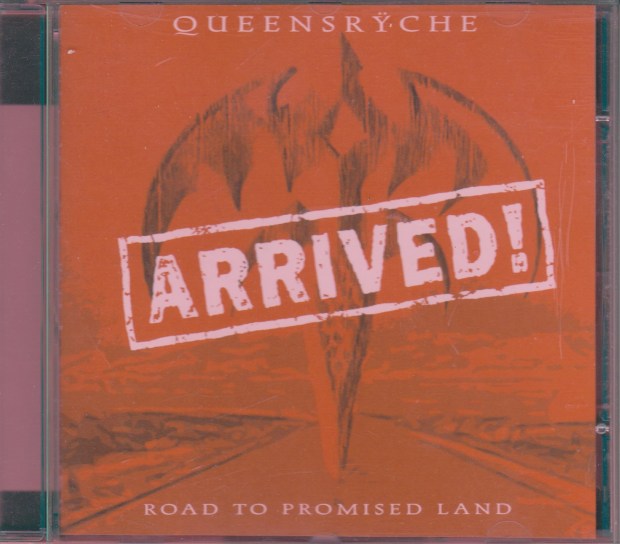
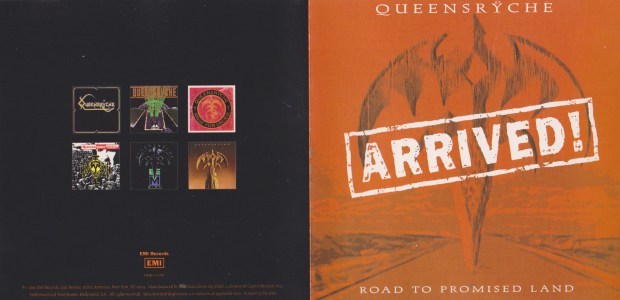
QUEENSRŸCHE – Road to Promised Land (1995 EMI promotional “best of” CD)
20 years ago, good buddy T-Rev let me know this little treasure had arrived in his store (first discussed in Record Store Tales part 120). Released to promote the 1995 Promised Land tour, Queensryche’s Road to Promised Land AKA Arrived! was a neat little greatest hits package released well before their actual Greatest Hits several years later. This is a promo CD released by EMI in the United States, and it covers every Queensryche release to date.
From the original EP is not “Queen of the Reich”, but “The Lady Wore Black”. The ballad starting the set is an odd but explainable choice. Queensryche were playing “The Lady Wore Black” on tour, but Geoff Tate didn’t enjoy singing “Queen of the Reich” and tried to avoid doing so. Being so full of powerful metal drama, even as a ballad, “The Lady Wore Black” can work as an opener. Then “Take Hold of the Flame” follows, one of the best Queensryche songs of all time (from the first LP The Warning). Unfortunately that is the only inclusion from The Warning, although it is certainly a must. Geoff Tate used screams as a art form on this song like no other. You want metal drama? They opening tracks are Metal Drama 101.
Two tracks are selected from Rage For Order, and they are fairly obvious choices: “Walk in the Shadows” [“WALK WITH MEAT!“] and “I Will Remember”. It is a given that both are high quality songs, from an album that can be difficult to pick individual hits. The opening part of the CD feels rushed, with the critical first EP and two albums giving up only four songs. Keep in mind that these albums now make up a large bulk of Queenryche 2015’s set, although that wasn’t the case in 1995 with their original singer.
From the brilliant landmark concept album Operation: Mindcrime are three selections: “I Don’t Believe in Love”, “Eyes of a Stranger” and “Revolution Calling”. Once again these are fairly obvious choices, being the three singles from the album. Strangely, “Eyes of a Stranger” was not edited down and is the full 6:39 cut, complete with album outro. Their most successful LP yet, Empire, was also give three inclusions. “Best I Can”, “Jet City Woman” and “Silent Lucidity” were three great singles. I wonder why the title track “Empire” wasn’t used? I think it’s more identifiable than “Best I Can”.
Rolling into Promised Land for the final three tracks, it is plain sailing to hear the evolution of the band over their first decade. Although the metal got tuned down in favour of more drama and radio-friendly elements, one thing that never changed was their urge to experiment. Indeed, the first Promised Land single “I Am I” features plenty of daring sounds. (This version of “I Am I” fades out rather than skipping directly into “Damaged”.) From cello (by Chris DeGarmo) to tribal percussion to innovative vocal effects, “I Am I” proved that Queensryche could rock progressively in the increasingly alternative 1990’s. Lyrically, they were as serious as ever but more personal. The ballad “Bridge” was about DeGarmo’s relationship with his father. Finally, the heavy-as-plutonium “Damaged” closes the CD abruptly. That’s the problem with these record company assembled promo CDs. They are not designed to play as an album. They are designed for radio use and store play. In other words the only real consideration is including all the individual tracks you want to plug. Like “I Am I”, “Damaged” too was edited for radio. They shaved three seconds off in fades, because normally these songs flow together on album.
Rating a CD like this is kind of pointless, because it was never meant to be sold. But let’s say you don’t own any Queensryche, and you saw this used while wandering the shops. Would it be a good Queensryche purchase for somebody looking for a good overview of the classic years?
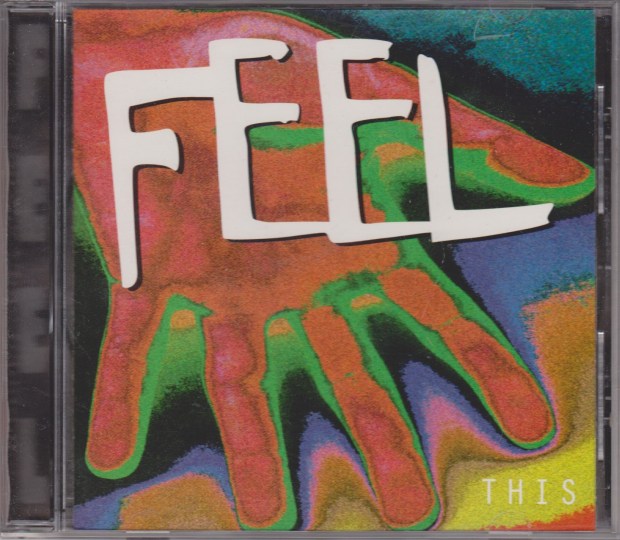
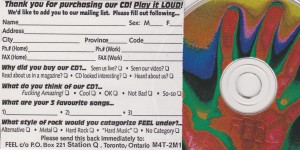
Russian Blue followed their critically acclaimed demo tapes with a full length CD, but perhaps it was the long wait that killed their chances. Between 1991 and 1994, the entire musical landscape had turned itself upside down. A name change was in order to suit the new climate, and after using the name Deadmoon for a little while, they settled on Feel. Simple: one word, one syllable, and trendy. Would they be able to maintain a level of quality over a full-length CD?
Almost. There is very little dead weight on Feel This.
“I Become You” is brutalizing, menacing, grooving detuned grunge. The presence of the bass is felt on this heavy recording. What Feel had that was different from other bands was the Axl-like screech of frontman Jo E. Donner. Indeed, when Donner multi-tracks his high voice with his lower register, the overall feeling is very Axl. Donner bellows forcefully, blowing out the speakers but not without help. Guitarist Richard Gauci and drummer Mike Willerding were capable of playing challenging rock. The drum patterns are busy and and Gauci is able to both shred like a hero, and also create the kind of noise that you needed to do in the 90’s. The band were between bassists. Robo was no longer in the band, so there are a couple session players on the CD.
Several smouldering tracks in a row occupy the first half of the album. “What You Made of Me”, “Wild Eye” and the lengthy “Brotherhood” all boast heavy guitar and vocal hooks. Wimps need not apply; Feel go for the throat even with a slower tempo. The songs sound well thought out, with attention given to every shriek and guitar noise manipulation. The bass grooves are absolutely key to all of this. Rumbling and shaking like a good Soundgarden line, they deliver the bass chills that fans of such sounds love. But was it all too similar to the chilly winds that had blown in from Seattle? Feel had been growing heavier and groovier on the demo tapes already, so I believe this to be a natural evolution that happened independently from the Seattle scene. Witness other Canadian bands such as I Mother Earth, who also evolved on their own into something that fit into that 90’s box.
The centerpiece of the album has to be “I Am Your Mind”. Long with a droning, irresistible chorus and cool lyrics — what’s not to like? This tune takes only one listen to bore its way deep into your medial temporal lobe. Building dramatically, every guitar hook will sink in hard, only for Donner to hit everything home with his powerful larynx. Everything is perfect — a song of this quality could easily have been on Badmotorfinger or Superunknown. Hyperbole? I don’t think so.
The second half of the CD has fewer highlights. After being slammed in the face with so much heaviness, Feel were wise to put on an acoustic number next. “Ain’t Nothin’ Wrong” is good, and shows off the band’s Zeppelin influences especially in the vocals. It’s just that Feel unplugged doesn’t have the kick that Feel does fully electrified. On the other hand, another listener might say it’s the best track. The first skipper is “Under My Wing”, too slow and boring. Not enough Sabbathy slow, just stuck in the wrong gear. Back to the groove is the killer “Drip Sweet Blood”. Making use of trendy 90’s vocal distortion, Donner blows the speakers especially around the 3:15 mark with another hair-raising bellow — just awesome. “Stand on Walls” sounds something like a Skid Row outtake. It’s nothing outstanding, but it’s only 3:38. Closing the disc is “All”, which was formerly known as “Black” on the second Russian Blue demo. The psychedelic intro from the demo was axed, tightening up the song and amplifying its power. Alternating from soft to loud, “All” kind of does have it all, at least for 1994.
Feel could have got themselves off to a great career with This as a debut album. Unfortunately I think by 1994 it was already too late.
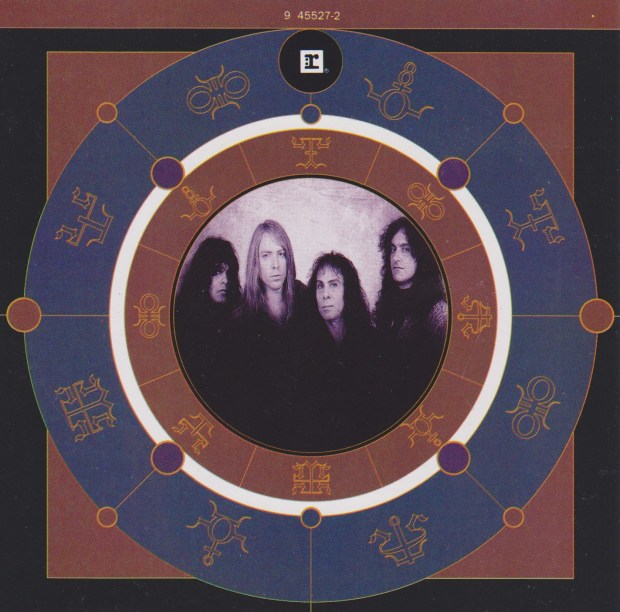
Black Sabbath had a very acrimonious split with Ronnie James Dio in 1993. Sabbath were asked to open for Ozzy Osbourne at his “farewell” concerts in Costa Mesa. At the end there was to be an original Sabbath mini-reunion. Ronnie James Dio outright refused to perform and left the band immediately afterwards. Sabbath were forced to get Rob Halford, not so far away in Pheonix, to fill in (the first of two times he would have to do so in Black Sabbath, the second time due to an Ozzy illness). Halford did so admirably under the circumstances. After the show, drummer Vinnie Appice joined Ronnie in a new version of Dio.
The new Dio lineup was a four-piece for the first time since album #1. On bass, Jeff Pilson (ex-Dokken), also helping out with keyboards and backing vocals. Pilson was always capable of singing the high parts in Dokken songs, and with Dio he adds a little bit of melodic accent by harmonizing with Ronnie. On guitar, controversially so, was Tracy G (Griljalva) from the band WWIII, which had also included Appice at one point. Dio described his mood as “pissed off” during this period and it certainly came out in the heaviest Dio album yet.
The thing with Tracy G was that he had an abrasive, atonal drony guitar sound, although certainly fitting to the new angry Dio sound. It was very different from the slick neo-classical bent that guys such as Vivian Campbell added to their solos. It was a brutally heavy and edgy change that should have earned Ronnie some credit rather than criticism. “Jesus, Mary & the Holy Ghost” opens the album on a speed metal approach, showing off the new guitar player. Tracy G was like the mad man’s scientist heavy metal guitar player crossed with Steve Stevens from Billy Idol’s band. If you want to check out what Tracy G did within Dio, just crank up “Jesus, Mary & the Holy Ghost”.
Admittedly, a whole album of Tracy G’s razor blade guitars can make one weary, but fortunately Dio albums are usually varied in song tempo and style. “Firehead”, the second track is a slow metal groove that suits Dio well. Arguably, the Dio lineup with Pilson on bass is more adept at this Sabbathy path than any other. Pilson has always been one for the low end, and his bass has an elastic thud that is similar, but different from ex-Dio bassist Jimmy Bain. Slower and heavier still is the title track “Strange Highways”. Ronnie has always stated that he liked to hear the space between the instruments, and that’s “Strange Highways”. This really was a great lineup for the band.
“Hollywood Black” is based on a lyric that Ronnie wrote for the sessions of Black Sabbath’sDehumanizer album. Maybe it’s even the same melody; the original has never been leaked. This is a strong mid-tempo slog; the most mainstream Dio song yet in this collection. Side closer “Evilution” (love that title) is even better; nastier and snippy.
I have a funny story about this song. I bought the cassette while out on a road trip with my buddy Peter, who was always a much bigger Ozzy fan than Dio. We put the tape in the car deck. The words at the end of the song baffled us both, but it was a case of mis-heard lyrics! On Peter’s overdriven, bass-heavy car system, we heard the closing words as:
“Hello, good night, it’s me, I’m open again, Come back, come in, goodbye, Wear clothes!”
The actual final line is “We’re closed.” If you play the song and pay attention…you can hear it too, can’t you? “WEAR CLOTHES!” Misheard lyrics…or hidden message?
As if there was any question from the first side of the album that Ronnie was in a bad mood lately, then “Pain” should settle. “Take the water and wash your face with pain!” Or, “Take the hammer and pound yourself with pain!” My favourite, “Bury my bones on the moon, if they ever should find me it would be too soon.” It was hard to find Ronnie’s usual positivity in some of these words. But listen to that one floor tom hit at 2:00 in! Holy drums, Batman! I love that one hit, it’s my favourite part of the song, which is actually pretty good.
“One Foot in the Grave” is a lot more upbeat than you’d expect by the title and it too is pretty decent. Notice these songs are not “great” — they are just shy of whatever quality makes a song great. Then “Give Her the Gun” is the Dio power ballad, but thematically it too stark and real for some tastes. Child abuse, gun rights? In a Dio song? All power to the man for speaking his mind, but even the most ardent supporter must concede that this is an unusually blunt song for him.
Onto “Blood From a Stone”, back to metaphors once again, and back to blazing hot Tracy G shreddery. Back to insuppressible Pilson bass. There are some 80’s-isms in some of the guitar licks, but blink and you’ll miss ’em. Then, rock out to “Here’s to You”, which sounds like a blazing hot celebration of the rock, or the “masters of the universe”, or something. But according to Ronnie, “The wheel goes ’round, so here’s to you!” Sounds like by this point in the record, Ronnie has worked out whatever bitterness he had left seething in his system. Finally “Bring Down the Rain” ends the album on a very Dio note, with all the majesty and power he can inject into a closing song. It’s just heavier than before. “Put out the flame”, sings Ronnie, his leathery lungs never more impassioned nor powered.
Perhaps Dio still had much anger left in him after all, since the next album was the aptly-titled Angry Machines. But that’s another review.
Strange Highways in a good album bordering on great — but not quite.
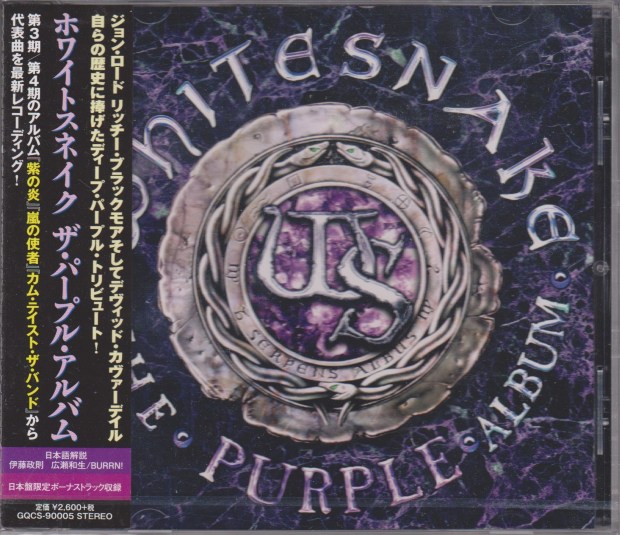
WHITESNAKE – The Purple Album (2015 Frontiers, Japanese & deluxe editions)
One old school buddy of mine, Rob Vuckovich, was a huge David Coverdale fan back in the 1980’s, but mostly a Deep Purple fan. He took great pride in telling me that he went to see Whitesnake on the 1987 tour. He held aloft a sign that said “PLAY PURPLE”. David reportedly acknowledged his sign by saying, “We’re not doing any of that!” What changed?
Jon Lord’s dying wish to his friend David Coverdale was to somehow reform Deep Purple MkIII. “Life’s too short and too precious to hold any animosities,” learned David after Lord’s passing. He reached out to Candace Night, wife of Ritchie Blackmore, and eventually spoke to the Man in Black about a Lord-less reunion. Blackmore was intrigued and David started working on updated arrangements for the tunes. He didn’t want to sing them in the same way that he did in his 20’s. The situation with Ritchie didn’t work out, but David did not want the work he had gone to on the new arrangements to go to waste. He approached his band and asked them what they thought about a Deep Purple covers album. The response was instant. Joel Hoekstra (guitar) in particular was pumped.
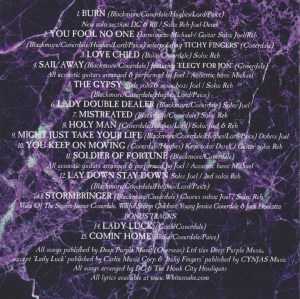
The result is The Purple Album. Sourced from Coverdale’s three albums with Deep Purple (Burn, Stormbringer, and Comes Taste the Band), 15 songs were selected. It’s hard to argue with the selection, either. There are chances taken. “Holy Man” is a damn hard song to sing, and it was originally performed by Glenn Hughes, not David. And four, count ’em, four songs (on the deluxe) from Come Taste the Band, perhaps the most underrated album in the Purple canon.
The sound is “Snaked up” as David says, which means modern guitars and technical shredding. To his credit, David really let his band play instead of copying Deep Purple. Joel Hoekstra is a hell of a guitarist, able to shred. He has brought some soul back to Whitesnake that I felt was missing from their two studio albums with Doug Aldrich. Other songs are stripped down, such as the now-acoustic “Sail Away”. This song is dedicated to Jon Lord and it’s certainly among the best songs on The Purple Album. It’s very “live” in the studio.
Is it necessary? Hell no, but David’s entitled to do what he wants. Nobody else is keeping these songs alive except for Glenn Hughes now and then. Jon Lord would be delighted with the quality of it, but he would surely be saddened that Deep Purple MkIII has never reunited. Since that was indeed the case, David and Whitesnake worked very hard on plenty of new parts and licks for their own arrangements. Reb Beach sings many of the Glenn Hughes lead vocal parts (quite well), and finally Whitesnake feels like a real band again. It’s odd that it happened on a Deep Purple cover album, but the band sound like a real band, on album for the first time in ages. Hopefully the injection of passionate young blood in Hoekstra and new bassist Michael Devin will result in new music some day.
The deluxe edition of The Purple Album comes with two bonus tracks and a loaded DVD. “Lady Luck” and “Comin’ Home” from Come Taste the Band are actually two of the best selections. It’s rare that bonus tracks are album highlights, but just because these songs are not as world-renowned as “Burn” does not mean they are not as good. They’re awesome. “Comin’ Home” is very different from the original, having a new and very Whitesnake (circa Slide It In) riff installed.
Japan usually get exclusive bonus tracks and this time it’s a different mix of “Soldier of Fortune”. The reason for the alternate mix (according to the documentary DVD, which we’ll get to) is that David was somewhat torn on which version he liked best. The original concept was a straight acoustic version, with just David’s voice and an acoustic guitar — one guitar, like in Deep Purple. That version didn’t make the album. In a last minute decision, David chose to record bass and other embellishments, and that is what you hear on the standard album. The lucky fans in Japan (or those who wish to shell out for an import!) get the original concept as a bonus track. Delightful.
The bonus DVD is a nice treat, for the 30-minute “Behind the Scenes” feature. It’s great to see the band get so much face time, talking about their love of Deep Purple. Things like this aid in your appreciation of the final album. Observations: Reb Beach does a hilarious Coverdale impression. Tommy Aldridge is still an unstoppable beast of a drummer, even today. Indeed, the new Whitesnake lineup comes across as an inspired band. It is a brand new era for Whitesnake, according to David. He is happier with their sound than he has been in years.
Then there’s the fluff, the Whitesnake EPK (electronic press kit) which is just a condensed version of the main feature. Added to this are four music videos. It’s almost amusing that Whitesnake made music videos today, but again the band get a lot of face time and that’s cool. In the music videos, it really seems like Whitesnake are a band regardless of the lineup changes. The videos are glossy, a little cheesy, but a nice little add-on.
The original rating for this album was going to be 3/5 stars. Cover albums just can’t be judged by the same yardstick as an album of original material. Having seen and heard how much passion and work Whitesnake put into The Purple Album, I’ve grown to appreciate it more. Therefore:
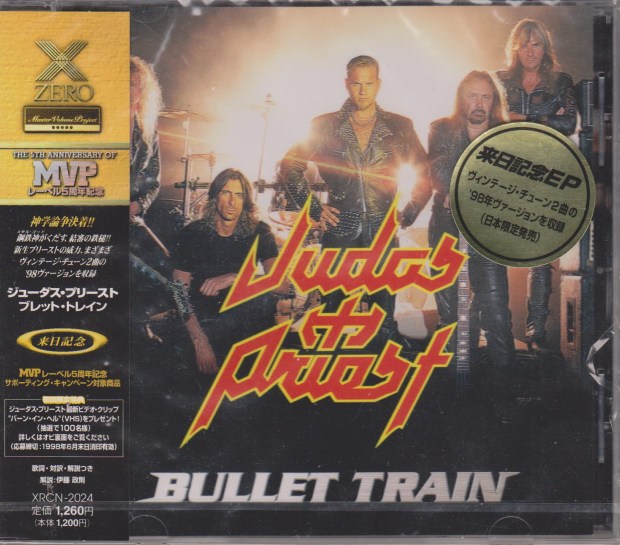
JUDAS PRIEST – “Bullet Train” (1998 Zero, from Japan)
I know not why it took Priest until 1998 to release a single from 1997’s Jugulator. In hindsight, the choice of “Bullet Train” as a single seems a calculated move. Nu-metal was all the rage with the disaffected youth of the late 90’s. The new singer (Ripper Owens) was capable of doing any kind of vocal, so why the hell not, I guess?
Whatever kind of metal it is, it seems Priest can play it. With Scott Travis nailing the double bass like a metronome, “Bullet Train” is an example of razor-sharp precision. Travis is always a pleasure to listen to just blasting away. It’s just a shame they didn’t choose a better song for a single. “Bullet Train” is only about the fourth-best song on Jugulator, an album so atrocious that it’s more accurate to say that “Bullet Train” is only the seventh-worst.
Of course, nobody would order this all the way from Japan unless there were B-sides worth having, and there are. Much like Iron Maiden did with Bruce Dickinson, Priest decided to re-record some old Priest classics with the new singer. They picked two incredible songs; timeless metal favourites updated for the period. From British Steel, it’s “Rapid Fire”! Neither Owens nor Travis played on the original, so the song is naturally more fierce and aggressive. Both of them kill it. Some may object to Ripper’s insertion of addition lyrics:
“Rapid fire, between the eyes, Rapid fire, terrifies, Rapid fire, before you die Rapid fire.”
Doesn’t bother me.
“Green Manalishi” is updated in an interesting way. Unexpectedly it is slowed down. Live, they always tended to play it just a hair faster than the mid-tempo original. On this studio re-take, they’ve gone the opposite direction, closer to the original 1970 Fleetwood Mac tempo. This is just a one-off, they did not perform it live in this slow guise. Live, it was faster than ever. Given that this is ultimately just an alternate slant on an obscure single, it lives on as an interesting side road. The tempo naturally extends the song, giving you even more Priestly goodness! The star of the show is the singer. Ripper takes one final scream at the end there that seals the deal: he was definitely good enough for Judas Priest.
Not a bad little single here. The two B-sides were later re-released on a limited edition digipack version of their next album, Demolition.







 POUNDHOUND – Massive Grooves from the Electric Church of Psychofunkadelic Grungelism Rock Music (1998 Metal Blade)




















 mikeladano.com