neil murray

REVIEW: Brian May – “Too Much Love Will Kill You” (1992 CD single)

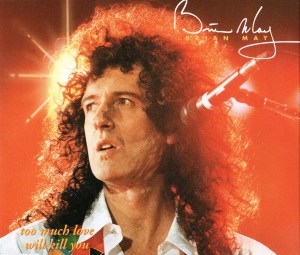
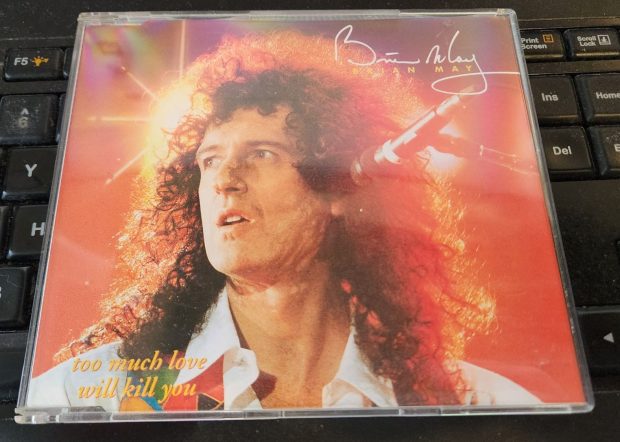
BRIAN MAY – “Too Much Love Will Kill You” (1992 EMI/Parlophone CD single)

The first time that most of us heard “Too Much Love Will Kill You” was in 1992, at the Freddie Mercury tribute concert.  Surely one of the biggest and most spectacular such events ever hosted, Queen played a scorching set with guests that night.  One of the highlights was a song that Brian May humbly said was the best he had to offer.  That song was the ballad “Too Much Love Will Kill You”, which Queen recorded but did not release on The Miracle (until 2022).  For that album, the band chose to only include songs written solely by the four core members.  “Too Much Love Will Kill You” was co-written by Brian with Elizabeth Lamers and Frank Musker.   A few months after the concert, May would release his solo version of  the song on his album, Back to the Light, and also as a single.  (There is now a deluxe edition of Back to the Light, containing all the songs from this single.)

“I’m just the pieces of the man I used to be,” croons May after a a delicate intro.  A song about being torn between two lovers, you somehow actually feel sorry for the guy who’s trying to choose between two women.  “Too much love will kill you, just as sure as none at all.”  May’s version is different from Queen’s, with lush orchestration taking up much of the space.  It’s absolutely gorgeous!  Queen’s version was as well, and it may be difficult to choose between versions.  Brian takes a lovely acoustic guitar solo, which is so rarely heard from the master of electric layers of bliss.  His vocals are impassioned, perhaps even more than Freddie’s were.  Though loaded to the gills with strings and accoutrements, it’s a spellbinding version.

Second on the single is a rocker named “I’m Scared”.  If it were a Queen song, it would be one of the harder-edged.  It’s a speedy ride through an amusement part of guitar and drums (by Cozy Powell, with bass by his Black Sabbath and Whitesnake compatriot Neil Murray).  Brian talk-sings for most of it, which works well, especially when he mockingly has trouble getting his words out towards the end.  It’s a performance, and the chorus ain’t bad regardless of the vocal storytelling.  It’s too weird for radio, but could be one of those cool deep cuts.

Track three is the “guitar version” of “Too Much Love With Kill You” which, believe it or not, is an instrumental.  Brian’s electric guitar takes the place of the singer.  It’s a cool and unexpected version.  It’s an incredible, lyrical version.  Brian takes liberties and doesn’t play the vocal melody note for note, but you can make it out just the same.  This could be one of May’s greatest guitar performances, simply because he uses his instrument to speak in a way that very few guitarists can do for four minutes straight.  He changes voices, he adds luscious trills, and it’s an absolute knockout.

The last track is a re-do of lead single “Driven By You”, with Cozy and Neil.  Brian played bass on the album version.  This version is hard and punchy.  The song is a melodic rock classic.  If it had come out a couple years earlier, it could have been a summer hit.  Cozy and Neil were in Brian’s live band, so having them re-do the track for a B-side probably made sense.  It’s really strong, and the bass and drums are both in your face.  Diehard fans will absolutely be able to recognize the legendary rhythm section.  Cozy in particular has a signature sound, and Neil does as well to a lesser degree.

What a great single, combining rarities with hits and a deep cut.  A total score.

5/5 stars


REVIEW: Whitesnake – Here I Go Again: The Whitesnake Collection (2002)

WHITESNAKE – Here I Go Again: The Whitesnake Collection (2002 Universal)

Back in the days before David Coverdale began lovingly curating his 80s catalogue with expansive box sets and assorted compilations, the record labels were doing it for him.  And, all things considered, they were milking it pretty hard with very little in terms of added value to the fans who already had a decent collection.  2002’s Here I Go Again: The Whitesnake Collection might have been the first one really worth buying.

At its moment of conception, it was probable and perhaps likely that a large number of Whitesnake fans didn’t already own all three of the Geffen albums on CD.  Perhaps they just owned Greatest Hits, or 1987.  Rather than force fans to buy (or re-buy) a three disc set for all that material, Universal gathered 24-bit remasters of the three albums with some associated bonus tracks and released it all as more affordable two disc set.  It offered good value for fans looking to get those albums digitally, or those just trying to acquire the bonus tracks.

Starting off with the rare “Radio Remix” of “Here I Go Again”, a familiar song leads the charge.  This unusual version has Dan Huff on guitar, Denny Carmassi on drums, and Bill Cuomo on keyboards.  It’s shorter without that long “keyboard heaven” opening.  As a radio remix, it has choppier guitars, more keyboards, and prominent female backing vocals.  Huff’s solo is refreshing after being used to Adrian Vandenberg’s for so long.

From there, the compilation delves into the albums, in their US mixes and running orders.  Therefore, Slide It In kicks off with “Slide It In” just as I remember it.  It will always be debated which version of Slide It In was superior, the original UK or the partially re-recorded US mix.  I have long maintained that the US had more punch, and I still prefer it.  John Sykes was a powerful force, and his modern guitar squeals helped push Whitesnake into the 80s (for better or for worse).  From there the album runs through the big singles “Slow An’ Easy” and anthemic “Love Ain’t No Stranger”.  These two songs alone are worth buying the album for, but the deep cuts are strong.  “All or Nothing” and “Gambler” are darker, while “Guilty of Love has an upbeat rock singalong power.  “Hungry For Love”, “Give Me More Time” and the cheeky “Spit It Out” are all memorable, but the dramatic “Standing In the Shadow Of Love” remains one of the most impressive Whitesnake closers to date.

There are no Slide It In-era bonus tracks included, but the next album 1987 is augmented with plenty.  We already had the radio remix, so the disc dives in with opener “Crying In the Rain”, actually a re-recording of a track from Saints & Sinners, just like “Here I Go Again” itself.  The CD runs through all of Side One of 1987 and partly into Side Two, with “Children of the Night” being the last song on the disc.  This is the one and major flaw with The Whitesnake Collection:  the oddly timed split between Discs One and Two.  “Here I Go Again” (the album version) was meant to close Side One of 1987, but these things can’t be helped.

After you blast through that remarkable album and all the John Sykes guitar fireworks it contains, you are treated to a number of extras.  UK-only songs “You’re Gonna Break My Heart Again” and “Looking For Love” should have been on the US album.  One rocker and one ballad, they aren’t really like any of the other songs and could easily have strengthened an already mighty album.  Then, for the fans that have always wanted to hear the one and only solo that Vivian Campbell recorded with Whitesnake, you are given the single mix of “Give Me All Your Love” (1988).  An odd choice for a single originally when better songs were available, but significant due to Vivian’s tenure with the band.  His solo is more whammy-inflected and shreddy, but it is still memorable and fitting.  Weirdly, Campbell is not credited in the booklet though Sykes and Vandenberg are.  The final bonus track of this era is the lovely keyboard ballad B-side “Need Your Love So Bad”, a re-recording of a Slide It In-era B-side.  A song that could have even been a single!  This showcase for David’s vocals features only keyboards and the man himself; no other instruments.

Some fans would stop the disc here and hit eject, for the controversial Steve Vai era is next with Slip of the Tongue.  An acquired taste, or perhaps not acquirable at all, Slip of the Tongue was a left turn.  Going even slicker and more modern, Coverdale eschewed the blues for the most part and took his band of pirates space truckin’.    For Steve Vai fans, this album features his most commercial playing, for he didn’t write any of the songs.  Adrian did, but was sidelined by injury.  Now with Rudy Sarzo and Tommy Aldridge on bass and drums, the band was completely different from the 1987 version!  David was pushing his voice into a higher register and it never quite sounded the same ever since.  Though Slip of the Tongue was a powerful statement in the world of inventive guitar fireworks, it ultimately proved unpopular with those who preferred when David was singing the blues.  Results may vary, but the perennial Vai-era bonus track “Sweet Lady Luck” closes the disc as it should.  It does not have the Chris Lord-Alge remix of “Now You’re Gone”, but hey.

There are minimal liner notes and photos, and it’s amusing to read the notes from the perspective of a time when Whitesnake was no longer a band.  (They reunited in 2003.)  However the value here is getting all this music and relevant bonuses all in one place for a good price.  It just made sense.

4/5 stars


REVIEW: Black Sabbath/Motorhead – 07/22/1995 – Lulu’s Roadhouse, Kitchener Ontario

I thought this review had been lost.  I wrote it in 1995, saved it to floppy disc, later uploaded it to a site called sabbathlive…and when that site disappeared I assumed my review was lost too.  I was wrong!

Guest contributor Holen MaGroin somehow, and with great effort, retrieved the text.  You can compare this with the version I wrote from memory back in 2012.  I’m very grateful to have this back, one of the earliest reviews I ever wrote.  For the record the friends I was with included Iron Tom Sharpe but I can’t remember who else might have gone that night.  It was the night that made me into a Motorhead fan.

This is my first time reading it in decades, so this is almost as new to me as it is to you!  I will leave everything as-is. I can tell that the review is mostly original with a couple sentences added later on when I uploaded it to sabbathlive.  I will put that text in a lighter colour.

The biggest difference between the 1995 review and the rewrite I posted in 2012 seems to be my impression of Tony Martin.  Here I call him “wonderful” and in the version I rewrote from memory, I called him “so-so”.


BLACK SABBATH/MOTORHEAD – 07/22/1995 – Lulu’s Roadhouse, Kitchener Ontario

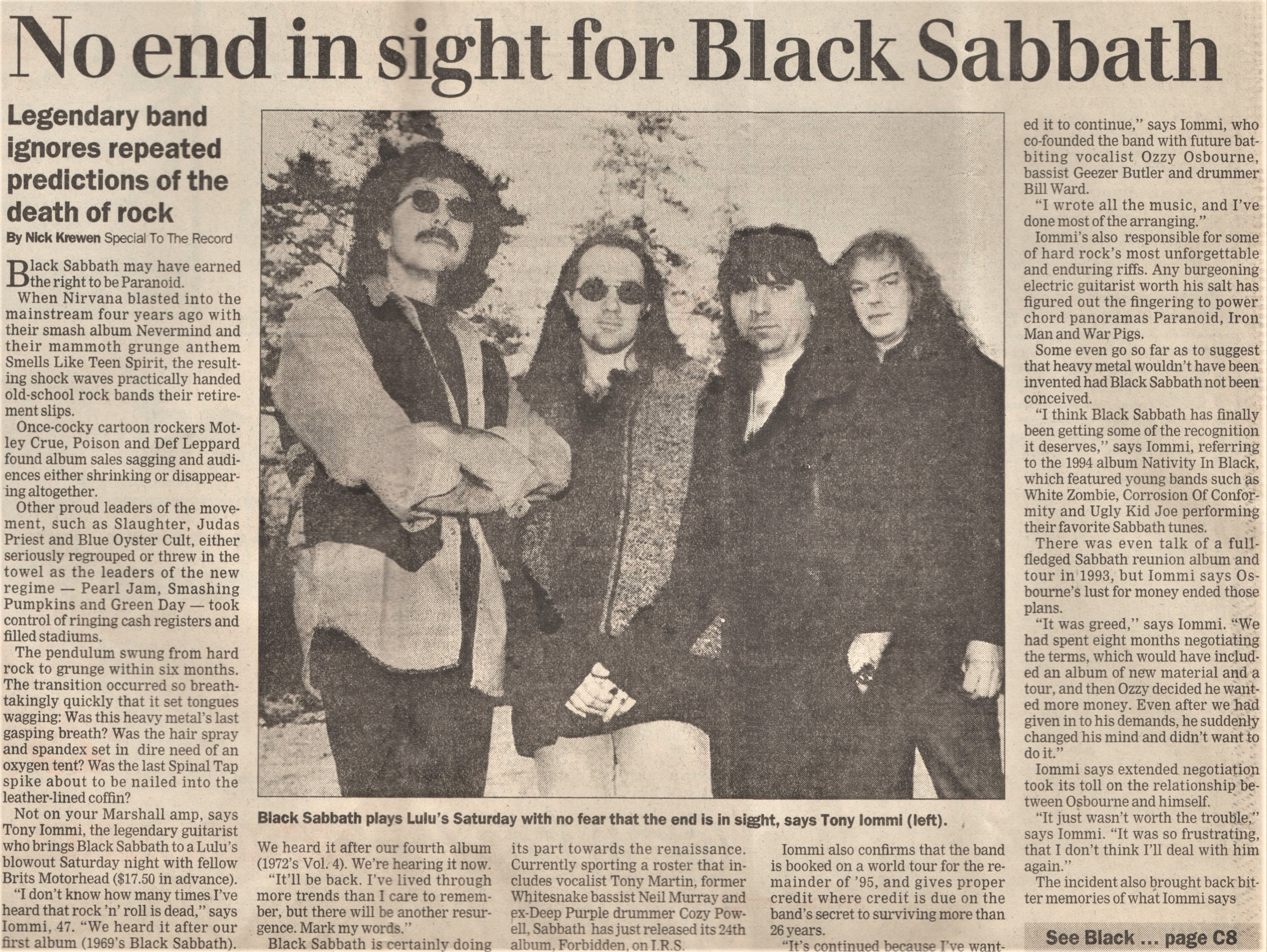
I arrived at Lulu’s with my friends at 9pm sharp, to find a nicely filled hall. Not too cramped yet at this early hour. Upon our arrival, we were informed that we had missed opening act Tiamat. None of us cared too much. While my friends were there to see Motorhead, I was there to see Black Sabbath.

Motorhead hit the stage on full octane with “Ace Of Spades”. From there on, it was no remorse (pun fully intended). Lemmy looks old, Phil Campbell looks old, but they played like teenagers, and it was refreshing to see. Lem and Phil’s onstage banter was funny as hell, and drummer Mikkey Dee (easily one of the fasted double-bass drummers in the world) was unreal. The highlights of Motorhead’s set were easily “Killed By Death”, “Iron Fist”, “I’m So Bad Baby I Don’t Care”, and the brand new “Sacrifice”. (Lem: “This song is so fucking fast, don’t try to dance
to it or you’ll break both your fucking legs!”) Every single song they played sounded terrific. Exciting riffs, awesome double bass, and cool vocals – if you can call them that. I’m now converted to the gospel of Motorhead: These guys are simply awesome.

The crowd received them very well. I think Lemmy, Phil and Mikkey looked pleased by both the turnout and the response to their set. Lem said he’d come back to play here “any fucking time”, but don’t they all say that?
This time it seemed they meant it. [NOTE: Motorhead did indeed come back to Lulu’s the next year.]

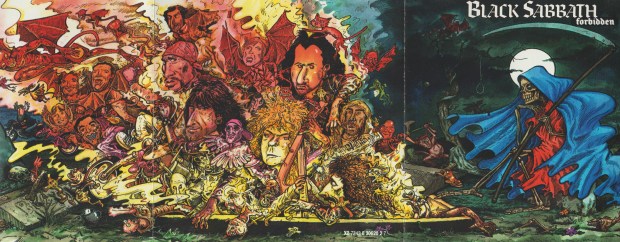
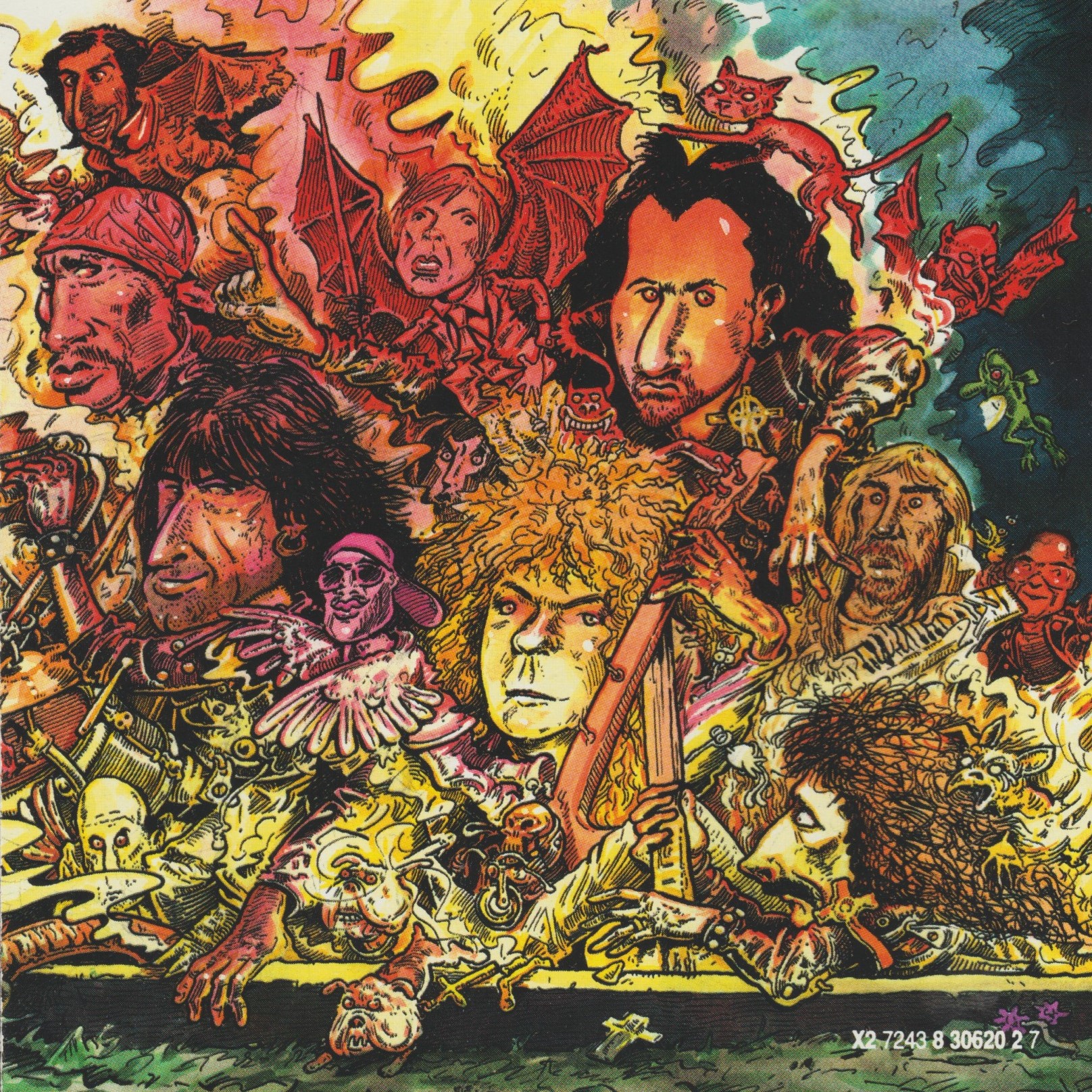
We went back to check out the T-shirts and hats. I really liked the new Black Sabbath FORBIDDEN T-shirts, which had the cartoon cover art. Even a hat would have been nice to own, but I was short on cash. I didn’t even have the $25 to cover a Sabbath hat. D’oh!

We decided at this point to try to stand at the front of the stage for Black Sabbath’s set. We had kind of figured that most people in Kitchener were there to see Motorhead, not Sabbath, and the crowd would thin out a little bit. We were totally wrong. It didn’t take long for the crowd to grow, and thicken in front of the stage.

We grabbed an awesome spot right up front, in between where the two Tony’s – Martin and Iommi – would be. However, this would not be the night to be standing close to Black Sabbath. I’m from small-town Ontario, and rough mosh pits were not what we were used to. During Motorhead’s set the crowd stood there politely, cheered madly after each song, and were generally well behaved, which is the way we liked it. We came to see the band, and hear the music, after all.

The first sign of trouble was when a fight broke out right behind us. A small Cobain-ish kid began pushing around a very large (we’re talking pro-wrestler large) man, who didn’t take it all that well. One headbutt later, the small kid was on the ground bleeding, and the large guy was out the door before security even noticed what had happened. They collected what was left of Cobain.

At 11:30 this was all forgotten. Black Sabbath hit the stage with a powerful version of “Children Of The Grave”. Tony Martin gave the song a fierce energy.

The first thing I noticed was that Tony Martin looked a lot older than I expected. I hadn’t seen any decent pictures of Black Sabbath for a couple years. Martin has small but friendly looking eyes, and receding hair. He sported an evil looking goatee, a long black shirt, black jeans and boots. By contrast, for some reason Tony Iommi looked a lot younger than I expected. He smiled a lot, and even moved around a bit on stage. This is Tony Iommi, the man known for staying riveted in one spot on stage!

Cozy Powell looked the same as he always has, same hair and all, although he did look a little chubbier in the face. Neil Murray looked identical to the way he looked in the “Feels Good To Me” video, five years previous. Keyboardist Geoff Nicholls was partly hidden on side stage. Why Black Sabbath don’t put him up front on the main stage is a mystery to me, he’s been in the band for 15 years now! However, the first thing that hit me about the rarely-seem Nicholls was that he was trying to look hip with his dyed blonde hair.

The set list included all the following songs, although I may have the order somewhat jumbled:

“Children Of The Grave”, “Neon Knights”, “The Shining”, “Get A Grip”, “The Wizard”, “Headless Cross”, “Rusty Angels”, “Can’t Get Close Enough”, “When Death Calls”, War Pigs”, “Sabbath, Bloody Sabbath”, “Black Sabbath”, “Heaven And Hell”, “Mob Rules”.

Encore: “Iron Man”, “Paranoid”, “Heaven And Hell” [reprise]

I felt that Tony Martin was a wonderful frontman. He has his own style. During the instrumental sections of songs, he would back up a few steps, spread his arms like he was awaiting the coming of Christ, and shake his hair about. While singing, he makes eyes contact with you. He smiles a lot. He enjoys what he does. I genuinely felt like the smiles that Iommi and Martin gave off were real, and that’s the real reason that Black Sabbath are still around 25 years later. These guys just love playing music. Cozy Powell and Neil Murray were more reserved, but Iommi and Martin, the core of Sabbath, were happy just being up there.

All the Ozzy-era classics were received with tremendous cheers by the crowd. Tony Martin allowed the crowd to sing most of the lyrics to “War Pigs”. The Dio-era songs were met with equal excitement. Most people in our area on the floor sang along to every word. All the later material was drawn from Tony Martin’s albums, though nothing from the excellent TYR or CROSS PURPOSES, which I found disappointing. However, as Martin said during the set, Black Sabbath have over 200 songs in the catalogue,and you can’t play them all.

They played three of the best songs from the new FORBIDDEN album: “Get A Grip”, “Rusty Angels” and “Can’t Get Close Enough”. They were played well, I felt they sounded better than the album versions. For the “Can’t Get Close Enough” sections of dark fingerpicked guitar, Iommi switched from his Gibson to an unusual make of guitar that I’d never seen before and couldn’t identify.

The highlight of the set for myself was “The Shining”. It had always been my favourite Tony Martin-era song, and I was not disappointed. The surprise was that a lot of people in the audience also seemed to know that song. “Headless Cross” was played equally well, and I was amazed with how rich Tony Iommi’s guitar sounds live. However, this song demonstrated how much vocal range Tony Martin has lost in recent years. He could not hit the high notes. (Play the original and see how high he gets!) Instead, he sang an octave lower. Again, most people seemed to
know this song.

“When Death Calls” came as a surprise, since it was never released as a video like the other Martin-era songs. On the way to the show I said I wanted to hear some obscure 80’s Sabbath, and I got it!

The crowd just ate it up, everything Sabbath served, they ate up and asked for seconds. When the moshing began, I was a bit surprised, and made way further back so as to not avoid injury. A lot of people came out of that show limping, and I didn’t really feel like being one of them.

If I was the only person there surprised by the moshing, it looked like the stage-diving took even the band by surprise! When the first gentleman made his way onto the stage, Tony Martin appeared shocked and backed up a few steps. After this, a security guy parked himself on stage and pushed off every guy who made it up there. It was kind of strange seeing a security guy crouching on stage in front of Martin.

Sabbath ruled. They simply ruled. For sheer intensity they couldn’t match Motorhead, but they held their own. The set list was about as perfect as you could make it, since it’s impossible to squeeze in too many more. After all, the band couldn’t avoid the classics in order to play more material from the 90’s. It was also nice to finally hear Tony Martin’s live renditions of those classics. He really did an excellent job and I hope one day they’ll commit his voice to a live album.*

This was my first time seeing Black Sabbath live. Seeing them so close to home in such a small venue really was an amazing experience. I hope it’s not the last.**


* Cross Purposes Live was released in 1995 in Europe only.

** It was.


REVIEW: Whitesnake – 1987 (30th Anniversary Edition box set)

WHITESNAKE – 1987 (30th Anniversary Edition Rhino box set)

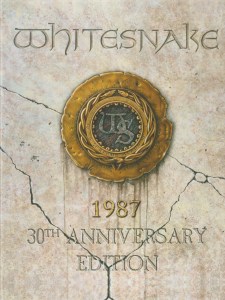
Back when I reviewed the original “Deluxe” edition of Whitesnake’s 1987, I said, “Great album, but this reissue could have been so much better.”  And so here we are.

Let’s get right down to it.  You already know the story of Whitesnake 1987 or you wouldn’t be here.

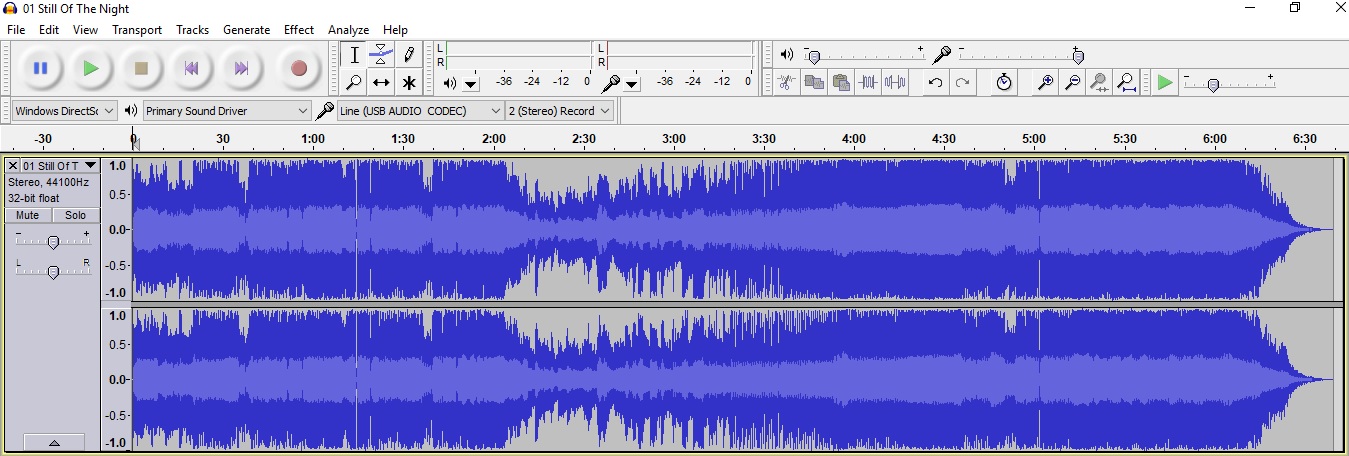
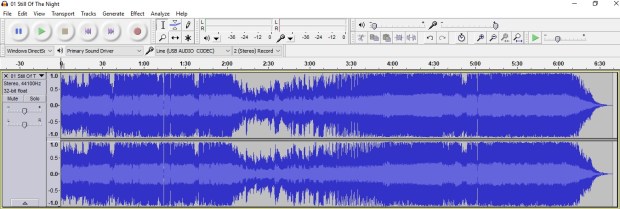
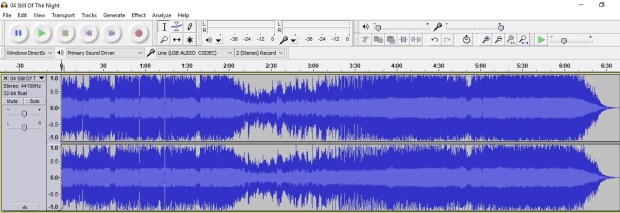
The main feature is the 2017 remaster of 1987, which actually sounds pretty great.  In this day and age, if you’re seeking the warmth of a vintage vinyl experience, you can go and have that experience for far less money than this box set costs.  For a compact disc, this might be as good as we’ve gotten so far.  If you look at the Audacity waveforms below, you can see the 2017 remaster (top) has roughly the same levels as a previous one from Whitesnake Gold.
I’m still hanging on to my original UK version of 1987, but for compact disc, this is probably it.


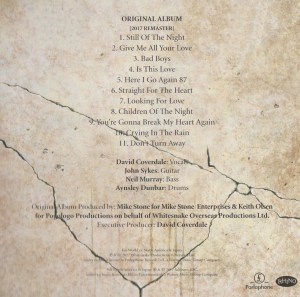
David Coverdale wanted to adapt Whitesnake to the 1980s with this album, and this lineup with John Sykes, Neil Murray, and new drummer Aynsley Dunbar was certainly able to deliver.  The album was always loud, especially compared to their 70s output.  Sykes provided the squeals that the kids wanted.  David was back in top voice.  The album they delivered is legendary for how it changed Whitesnake’s fortunes.

The running order on this box set is not the original UK or US, but the combined running order as used on the previous 20th anniversary edition.

“Still of the Night” blows the doors in, a tornado in the night, mighty and sexy too.  Whitesnake had never been this aggressive before, but “Give Me All Your Love” lulls the listener back to something easier to digest on first listen.  “Give Me All Your Love” was a successful single because it’s melodic pop rock with guitars.  But then the band scorch again with “Bad Boys”, top speed right into your daughter’s headphones!  Whether it was Aynsley Dunbar or just the songs that they wrote, the pace is high gear.

“Is This Love”, a song that David was writing with Tina Turner in mind, was another massive hit.   John Kolodner (John Kolodner) insisted that they keep it for themselves, and he was right as he often was.  For a big 80s ballad, “Is This Love” really was perfect.  It tends to work better in a stripped back arrangement, since the original is so specifically tailored to that era.  Still, Sykes’ solo on it has to be one of his best.

Speaking of hits, “Here I Go Again” is the one that Sykes didn’t want to do, and look what happened.  That humble pie probably tasted no good to Sykes when he found himself fired by Coverdale after the album was completed.  His replacement, Adrian Vandenberg (Vandenberg) actually played the guitar solo, so dissatisfied was Coverdale with the one Sykes produced.  “Here I Go Again” was of course a minor hit from Saints & Sinners, but deserving of a second shot in America with production more suited to their tastes.  Don Airey on keyboards; though Whitesnake did without an official keyboardist this time.

“Straight For the Heart” is a great also-ran that perhaps could have been another single if they kept trottin’ them out instead of stopping at four.  High speed but with incredible hooks, it’s impossible not to like.  “Looking For Love” is the second ballad, but actually originally unreleased in the US.  It’s toned down from the style of “Is This Love”, and Neil Murray’s bass is pronounced.  He was a huge part of the groove on this album, if you really settle in and listen to the rhythm section.  His bass has a certain “bop” to it.  “Children of the Night” returns the tempo to allegro and the lyrics to dirty.  I can’t imagine too many fathers of the 80s wanted their daughters to go to the Whitesnake concert if they heard David cooing, “Don’t run for cover, I’m gonna show you what I’ve learned, just come a little closer, come on an’ get your fingers burned.” Another UK exclusive, “You’re Gonna Break My Heart Again” cools it down slightly, but that Sykes riff is hot like a torch!

“Crying in the Rain” is held back to second-last in this running order, even though it opened the US album.  Another re-recording, “Crying in the Rain” was suggested by Kolodner because he knew Sykes could give it that massive blues rock sound that it had in the live setting.  Again, he was right.  “Crying in the Rain” is massive — perhaps the most sheerly heavy piece of rock that Whitesnake ever dug up.  Finally the CD closes with the last ballad, “Don’t Turn Away”, which closed the US version.  It’s a fine song indeed, and a really good vibe on which to end Whitesnake 1987.

The second CD in this set is called Snakeskin Boots:  Live on Tour 1987-1988.  Presumably, these are recordings from throughout the tour, assembled into a CD-length running order.  The “boots” in the title implies bootleg quality, but it certainly sounds better than that.  Soundboards maybe?

The studio lineup of Whitesnake dissolved and David got Vandenberg in, followed by Vivian Campbell (Dio) and the rhythm section of Rudy Sarzo and Tommy Aldridge (Ozzy Osbourne).  This new lineup was not based in the whiskey blues of the old band(s), but in the flashy stylings of the 1980s.  Vivian and Vandenberg were both capable of shredding your brain.  That’s generally how they do it on these recordings.  Opening with “Bad Boys”, the manic tempo is maintained while the guitars reach for the stratosphere.

Sounds like it was a hell of a show, rolling into the groove of “Slide it In” and “Slow An’ Easy”, and the good news is the 1987 band can play the 1984 songs too.  David Coverdale is the ringmaster, the veteran, confident and in prime voice.  All the songs are from either 1987 or Slide it In, with only one exception:  the slow blues “Ain’t No Love in the Heart of the City” from the original 1978 Snakebite EP.  Sounds like Vivian Campbell accompanying David on this slow, classy blues.  No Deep Purple in the set; but my old pal Rob Vuckovich once said he went to the Toronto show on this tour bearing a flag that said “PLAY PURPLE”.  He also claimed David acknowledged it by saying, “We’re not playing any of that!”

“Here I Go Again” comes early on the CD, fourth in line, and it’s excellent.  “Guilty of Love” is a nice surprise, and “Love Ain’t No Stranger” is more than welcome at the party.  “Is This Love” is well received, and works well in the live setting without too much extra production.  Adrian can’t top the Sykes solo, though he gets within very close range.  Vivian and Adrian get a feature solo with a keyboard backdrop, and it’s quite good — more like an instrumental than just a solo.  It leads into a brutally heavy “Crying in the Rain”; Tommy Aldridge literally beats the shit out of it!  The CD closes on “Give Me All Your Love” with David substituting the word “baby” in the opening line with “Tawny”!

There’s little question.  For most fans, the major draw of this box set will be this live CD.  If that is you, you will not be disappointed by Snakeskin Boots.


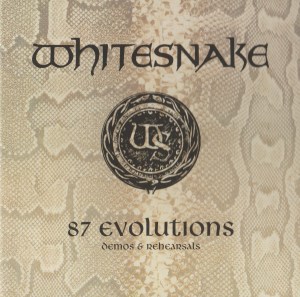
Disc three in this monolith of a box set is the 87 Evolutions.  This is an interesting concept but not one that you will be craving to have a listen regularly.  This disc is intended for deeper study.  These tracks are the album’s songs in various stage of demoing.  “Still of the Night” for example starts as a living room demo, with David slapping his knees for drums, and only the most basic of lyrics.  Then this demo fades seamlessly into a more advanced full band arrangement, with the lyrics still unfinished.  There’s a funky middle solo section here that is more jam than song, but a blast to hear.

That is the kind of thing you can expect to hear on 87 Evolutions.  No need to spoil what you should enjoy discovering yourself.  This is for the hardcore of hardcore fans, those that want every squeal that ever came from Sykes’ axe.  You are gonna get it.  Incidentally, I think I prefer David’s original, rough slow bluesy version of “Give Me All Your Love” to the glossy pop song it became.

This disc ends with a “Ruff Mix” of the completed “Crying in the Rain” from Little Mountain studios.  All the parts are in place, the mix just needed that modern bombast that David was aiming for.


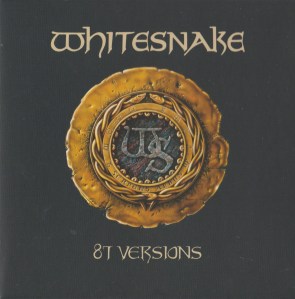
The fourth and final CD, 87 Versions, is a collection of alternate remixes released on various singles, and brand new remixes as well.  These are really cool bonuses.  The 2017 mix of “Still of the Night” has a really dry sound, allowing you to really hear the spaces between the instruments.  A lot of these remixes have a different balance of instruments, so you will hear different things yourself.  There are two remixes of “Give Me All Your Love” on this CD:  the 2017 with the original Sykes solo, and the highly coveted alternate with “new” solo by Vivian Campbell.  There are also two remixes of “Here I Go Again”, including the old “Radio Mix” with a completely different group of musicians and a much more pop arrangement.

Among these remixes is something called the 1987 Versions:  Japan Mini-Album, proving that Japan always get the best stuff.  This apparent EP contains the B-sides and bonus tracks that you couldn’t get on the album.  “Standing in the Shadows” was another song re-recorded for 1987, though left as a B-side.  “Looking For Love” and “You’re Gonna Break My Heart Again” are also included, since back then you could only get them in the UK.  “Need Your Love So Bad” was a previous Whitesnake B-side, remixed in 1987 for a new B-side!  It’s an absolutely stunning ballad, quiet with only keyboard accompaniment.

With all these tracks included, pretty much every track associated with the 1987 album and singles is covered.

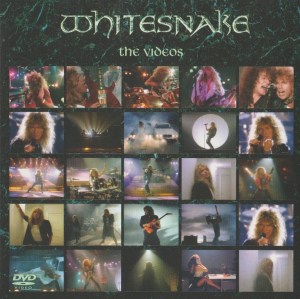
Whitesnake: The Videos is the fifth disc, a DVD.  It’s really just an add-on, nothing substantial (like a 5.1 mix).  First on the menu:  “More Fourplay”, the classic MTV videos that set the world on fire in 1987.  Some behind the scenes footage too.  MTV was a huge part of this band’s success (hopefully Tawny gets paid a royalty from this reissue?).  These glossy videos are…well, they didn’t age as well as the album did.  Why does Rudy always lick his bass?  You just gotta laugh at “Here I Go Again”; the pretentious image of the three guys (Viv, Adrian, Rudy) playing keyboards passionately side by side…utterly silly.  But yet iconic.  “Is This Love” has the band playing on evening rooftops, Rudy wielding a double-neck bass.  Why?  Doesn’t matter; in 1987 we thought it was awesome.  “Give Me All Your Love” is a notable video, being a “live on stage” type, but also with the brand new guitar solo cut by Vivian.  For his solo, Viv chose to play on the wang bar a bit too much, but at least David let him do one.  It remains Vivian’s only studio appearance with Whitesnake, ever.  Unannounced but cool just the same, “Love Ain’t No Stranger” (from Slide It In) is used in whole as the end credit song for the “More Fourplay” segment.

Next up is a 28 minute documentary about the making of the album.  David has clear recollections and is always a delight to listen to. (Some vintage Coverdale interview footage is actually from a MuchMusic piece with Denise Donlon.) Interestingly, he claims that the “Still of the Night” riff is one that he found in his mother’s attic, that he wrote back in the tail of Deep Purple.  “Still of the Night” could have been a Purple song, but it took John Sykes to make it what it became.  We then move on to the assembly of the touring lineup, dubbed the “United Nations of Rock”.  Tommy and Rudy are also interviewed in vintage clips, with Tommy proudly proclaiming that they want to bring musicality back to rock and roll.

The “Purplesnake Video Jam” (whut?) video of “Here I Go Again” is basically a brand new music video using alternate footage from the time.  The mix is similar to the old single mix, but spruced up.  Finally there is the “’87 Tour Bootleg”, and woah!  It’s pro-shot multi-camera footage.  You only get half of “Crying in the Rain”, and all of “Still of the Night”.  Why not more?  Is this a tease for some kind of upcoming DVD?  The footage reveals a band of their time, but a good band.  Not the best Whitesnake lineup ever (Sykes gets that), but a good lineup with something special together.  They were tight, they could all play their nuts off, and present a high energy 80s stageshow, especially Rudy.  By the end of “Still of the Night”, David is actually dodging panties being thrown at his head.  I kid you not.


As per usual, any box set worth its own respect is packed with added stuff usually made of paper.  In this case, a nice hard cover booklet, a smaller softcover lyric book, and a poster.  Posters have to be the biggest waste of money in a set like this.  Who’s going to hang it?  I’m probably never even to unfold mine once.

Now that you have all the details, you should be able to decide if this box set needs to be in your collection.  It needed to be in mine.  And guess what — Slide it In is next!

5/5 stars
REVIEW: Whitesnake – Greatest Hits (1994)

WSWHITESNAKE – Greatest Hits (1994 Geffen)

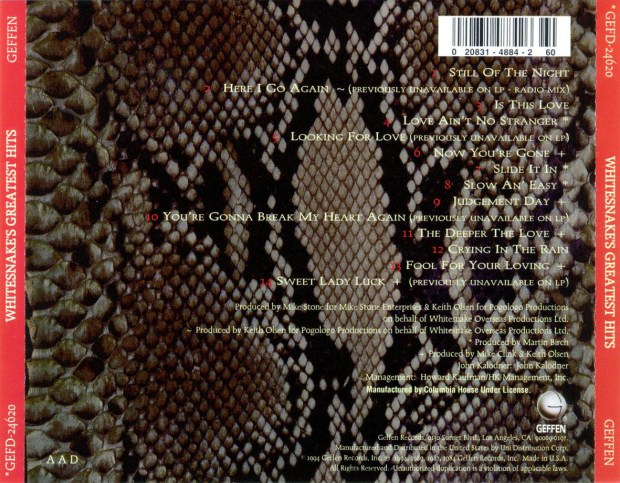
I don’t own this CD.  Never have, actually.  I gave it enough in-store play (only while working alone!) that I have no problem reviewing it. This Greatest Hits CD dates back to 1994, the year I first started working at the Record Store. As such, it was the first ever official Whitesnake Greatest Hits CD, the first of many. The band had been broken up for about four years at that point. Even by 1994 standards, it was only an OK release. It did contain some rare tracks, but was limited to Whitesnake’s 1984-1989 Geffen output only. For budget-priced collections, I would recommend the cheaper 20th Century Masters – The Millennium Collection because it still has all the hit singles from that period at a lower price. For fans who need more, the much better Whitesnake Gold or Silver Anniversary Collection make a more complete picture with more rarities and deep album cuts. These of course weren’t available in 1994.  Today music buyers have a lot more to choose from.

One inclusion that some listeners may not enjoy about Greatest Hits is the version of “Here I Go Again” chosen. This is not the well-known album version that most people have heard. This is the “single remix” with different guitar solos (by guest Dan Huff) and more keyboards. Some radio stations do play it from time to time, but I think most casual buyers would listen to this and say, “I don’t like it as much”.  And nor do I, but it is a rarity.

Otherwise, this album (like 20th Century Masters) contains every hit single from the period, and nothing from the blues-based records before. It does feature some other cool rarities: the B-side “Sweet Lady Luck” featuring Steve Vai, “Looking For Love”, and “You’re Gonna Break My Heart Again”. However, with the many compilations and remasters released since 1994, these songs are no longer hard to find. “Sweet Lady Luck” was even released on a Steve Vai boxed set!

Rounding out this selection of hits and rare tracks are deeper album cuts.  These are include the glossy Kashmir-esque “Judgement Day”, “Crying in the Rain ’87”, “Slow Poke Music” and the wicked “Slide It In”.  They help balance out the ballad-y hits that Whitesnake were adept at writing.

Interestingly, when this album was released, David Coverdale assembled a new, shortlived Whitesnake and toured for it. That version of Whitesnake included former members Rudy Sarzo and Adrian Vandenberg, both of the 1987-1990 version of the band. It also included drummer Denny Carmassi (Coverdale-Page) and guitarist Warren DeMartini (Ratt). Shame that no live recordings from this version of the band have never been released. The band disolved for several year again after this, only to reform in 1997 with a new lineup including Carmassi and Vandenberg.

This album is only mildly better than 20th Century Masters, but is inferior to the more recent, more comprehensive compilations I have mentioned. Buy at a sensible price point.

2/5 stars
WSBACK

REVIEW: Whitesnake – Live in ’84 – Back to the Bone (DVD/CD)

It’s Purple Week at mikeladano.com!  It’s all Deep Purple and Deep Purple alumni, all week.  This is Part 4…and once again we’re going Epic Review Time.  It’s Deep Purple Mk III’s lead throat, David Coverdale & Whitesnake!  This is almost a new release; it’s about four months old.

Part 1:  Shades of Deep Purple
Part 2:  The Book of Taliesyn
Part 3:  Perfect Strangers

WHITESNAKE – Live in ’84 – Back to the Bone (2014 Frontiers Deluxe edition DVD/CD)

David Coverdale has been pretty good to the fans, in terms of giving them live archival releases from the periods they care about.  In addition to cranking out studio and live releases with the current Whitesnake lineup, David has issued deluxe editions of certain albums along with the long awaited 3 disc set Live at Donnington 1990. Now it’s the 30th anniversary of the Slide It In album, so David has issued a live retrospective set from that period too.  A CD and DVD set documenting the John Sykes years is almost a guaranteed slam dunk in itself, but how does it stack up when we break it down?  Let us take a look at the DVD and CD portions in detail.

Super-Rock Japan ’84

The main program of the release is on the DVD, and the main focus of the DVD is Super-Rock Japan ’84.  It is an 11 song set taken from Japanese television.  This is the legendary four-piece lineup: David Coverdale, John Sykes, Cozy Powell, and Neil Murray.  There is no doubt that even though the band had been trimmed down, they sounded powerful.  I just really hate when an interview is inserted right between the first and second song.  There’s no reason to ever interrupt a song on a live video, but editors do it all the time!  It’s interesting seeing Whitesnake in a single-guitar lineup, but there is obviously a backstage keyboard player (Richard Bailey).  The chops of John Sykes are such a welcome addition to the Whitesnake sound.  He has a “chug” that few other guitar players have.  Cozy Powell is as on-point as ever, but David Coverdale’s young lungs are remarkable.  At peak power, David prowls the stage and humps the microphone in complete control.

The highlight of this portion of the set is “Crying in the Rain”, almost but not quite like it would be performed on Whitesnake 1987.  I also enjoyed Sykes’ guitar solo.  Sykes makes some of the best guitar faces in rock, and he resembles a young David St. Hubbins with his shaggy mane.  “Soldier of Fortune” (an abridged version) was a pleasant surprise.  On the other hand, Cozy’s looong overblown drum solo would be more appropriate to his time in E.L.P. (Emerson Lake & Powell).  David must have been taking care of business backstage.

The video quality here is very good for an 80’s television broadcast.  Sound quality, also good.  David states in the liner notes that they weren’t able to find the master audio tapes, so this hasn’t been touched up too much.  I’m satisfied; in 1984 we didn’t have 1080p TVs in widescreen.

Only three songs from this were included on the CD: “Love Ain’t No Stranger”, “Ready An’ Willing”, and “Slow An’ Easy”.  That’s too bad.  I would have paid a little more to get a 3 disc version with a full CD of this show.  Just sayin’.

BACK TO THE BONE_0003

Jon Lord’s Final Whitesnake Performance

The passing of Jon Lord has been the biggest loss in rock, in recent memory.  This truly is a treasure.  From Swedish television and shot with multiple cameras, this looks even better than the Japan footage.  Shame it’s only four songs.  To have Jon there raises the bar several notches.  It’s a five-piece lineup, although the cameras spend so little time on Jon that you’d wonder if the keyboardist is offstage again!  (Jon’s wearing a white shirt in a black-topped band; he should be easy to spot but he’s not.)  “Gambler” goes directly into “Guilty of Love”, and it’s so strange to hear it with only one guitar.  With guys like Sykes and Powell in the band, they are very active on stage and the energy is plentiful.  “Love Ain’t No Stranger” is so much better with Jon than without.  You cannot understate how much difference that big bad Hammon organ makes.  Then David tells the audience that they are “Ready An’ Willing” for some sweet satisfaction!  From this brief four song set, I can at least conclude that Swedish television in the 80’s was better than Canadian television.  Strangely, on the CD, it is included as one solid 16 minute track with no breaks.

Slide It In Slide Show

This is actually a cooler feature than you might think.  These contain some snippets of writing demos for Slide It In.  In some, David’s talking to someone, and there’s a single guitar.  In others there is a full band, but the lyrics are not there yet.  You can hear some of the classic riffs taking shape.  The rest of the audio has vintage interviews with David and live music.  Unfortunately at times the “slideshow” portion of this turns into little more than a lyric video, defeating the purpose of having a photo slideshow.  The real treasure here is a live version of the B-side, “Need Your Love So Bad”, with just David and Jon.  I am disappointed that it is not on the CD.  Something that rare really should be.

BACK TO THE BONE_0002

Snakeskin Boots: The Best of the Bootlegs 

The main feature on the CD consists of bootleg and soundboard tapes.  I love bootleg recordings, and who can fault a band for beating the bootleggers and releasing the tapes officially?  Tapes were cleaned up as much as possible to make them listenable (David suggests the car as a good setting).  These songs were sort of arranged in the order of a live concert, so it still begins with “Gambler” and “Guilty of Love” like all the other sections.  “Gambler” sounds pretty good, only slightly muffled but with a hard pulse.  Sykes’ solo on “Guilty of Love” sends electric chills up the spine.  It’s great to hear the band so young and ferocious!

Cheeky David tells the crowd that the Slide It In album title does not refer to a banana!  “Love Ain’t No Stranger” is always a pleasure to hear, especially sung by a young David, and Sykes is shreddin’.  Then another cheeky intro: “I’d like to give you a toast.  If it’s in deep, and if it’s in long, and if it’s in hard…it’s indecent!”  That has to mean “Slow An’ Easy” is up next.  I will never tire of this excellent song.  “Walking in the Shadow of the Blues” is a nice surprise, but “Ready An’ Willing” is overplayed.

Sykes is given a couple minutes on his own to introduce “Crying in the Rain” with some bluesy soloing.  As great as this song is, this long version makes it clear why Whitesnake is a two guitar band.  They sound very bare when John again takes a long solo in the middle, and Neil Murray is left to fill the space.  David always wanted two guitar players, while John would have preferred not to share the spotlight.  “Soldier of Fortune” closes this portion of the CD, a nice version of the old Deep Purple classic.

The rest of the CD is dedicated to the three tunes from Super-Rock Japan that they chose to include, and the four songs from Jon Lord’s final Whitesnake show.  If you have a look at the tracklist you’ll notice that this means there’s a lot of repeat.

In closing

None of Coverdale’s archival releases or deluxe editions have been perfect.  Live in ’84 – Back to the Bone is probably the best of them yet.

4/5 stars

BACK TO THE BONE_0006

REVIEW: Black Sabbath – The Sabbath Stones (1996)

Bought at HMV, Stone Road Mall, Guelph ON, on import for $29.99 in 1996.

BLACK SABBATH – The Sabbath Stones (1996 IRS)

The Sabbath Stones, a record-company cash-grab, is a greatest hits compilation of Sabbath’s Tony Martin years (mostly) plus a smattering of bonus tracks. While it is not perfect, and so many great songs were omitted, it is still a really great listen from start to finish. Tony Martin is probably the most derided of all Sabbath vocalists. Having seen Sabbath live on their final tour with Martin (also including Cozy Powell and Neil Murray) I can say that I quite enjoyed that incarnation of Sabbath. Also, in 1996 when this was released, albums such as Headless Cross and The Eternal Idol were very hard to find on CD.  With that in mind, read my track-by-track breakdown.

1. “Headless Cross” — This compilation is the IRS years (that’s the record label, not the government agency) and thus starts with their first IRS album, Headless Cross. The title track is one of those underground classics. The groove here is monstrous (thanks, Cozy)  and the notes Martin hits in the chorus are superhuman. This track, back in 1989, was Sabbath getting back to a truly heavy evil sound. Shame that the keyboards (on all tracks by Geoff Nicholls) are mixed so high!

2. “When Death Calls” — One of my favourites from Headless. Beginning with fretless bass (by temp bassist Lawrence Cottle) and haunting vocals, you’d almost think this was a ballad. By the end, it’s breakneck, with Tony Martin singing these evil lyrics about how “your tongue will blister” when Satan says you’re to die! The guest guitar solo by Brian May will sear your soul.

3. “Devil and Daughter” — A third great track from Headless, an album loaded with great tracks. This is an uptempo one all the way through!

4. “The Sabbath Stones” — From 1990’s underrated Tyr album. I quite liked Tyr. “The Sabbath Stones” is a fast one, wicked, but muddy in sound as was all of Tyr. Once again, Martin hits inhuman high notes by the end.

5-7. “The Battle Of Tyr/Odin’s Court/Valhalla” — These three tracks are actually all bits of one long piece, on Viking mythology. Sabbath at the time were trying to get away from the “Satanic thing”, and Vikings were still evil enough to sing about. Some fans didn’t like that turn of events but I think Sabbath were well ahead of their time. “The Battle Of Tyr” is a keyboard-y bit, just an intro to get you in the mood. “Odin’s Court” is acoustic, with Iommi picking a simple melody while Martin sings about “leading us on, to the land of eternity, riding the cold cold winds of Valhalla”. That takes us into the main meat of the trilogy, the “Valhalla” portion. One of the most powerful of all Martin-era tracks, with great keyboard accents and a memorable Iommi riff, this was my favourite track off Tyr.  (It’s either this one, or “Jerusalem”.)

8. “TV Crimes” — A brief departure from the Tony Martin years. In 1992, he was out and Ronnie James Dio, Geezer Butler, and Vinny Appice were back in. The album was called Dehumanizer and even though it did not sell well, a hardcore following now consider it among the very best Sabbath albums of all time, and possibly one of the best things Dio’s ever done. Why it was underrepresented here with just one song is beyond me. There should have been at least three Dehumanizer tracks on this CD (I would have nixed “Devil and Daughter” and “The Sabbath Stones” in favour of two more with Dio singing.) Anyway, “TV Crimes” (the single) is here, and while not one of the best songs from Dehumanizer, it and “Time Machine” were the two most well-known.

9. “Virtual Death” — Tony Martin is back, with Rainbow’s Bobby Rondinelli and Geezer Butler too!  That would not last long, as Geezer soon fled back to Ozzy’s solo band to record the Ozzmosis CD. “Virtual Death” is hardly one of the better songs from the Cross Purposes album, a decent record if a bit soft. Having said that, the soft tracks were really quite good and “Virtual Death” was just a grunge song.  Black Sabbath influenced that whole scene, but they ended up copying Alice In Chains’ trademark vocal style on “Virtual Death”.  That double tracked vocal melody could have come right off Dirt.

10. “Evil Eye” — Another puzzling Cross Purposes selection.  I can’t think of a reason to include it.  There was once a legend that “Evil Eye” was co-written by Eddie Van Halen, who went uncredited.  The same rumour suggested that Van Halen either performed the guitar solo or wrote the solo for Iommi to play.  Joe Seigler of black-sabbth.com has busted this rumour as false.   My two tracks from this album would have been “I Witness” (fast one) and “Cross Of Thorns” (slow one).

11. “Kiss Of Death” — Finally we arrive at the end of the Martin years with the dreadful Forbidden album. It’s sad because it wasn’t the end that Tony Martin deserved. The album just got out of hand and next thing you know, Ozzy was back. This track was at least one of the strongest ones. A killer, slow closer with some unbelievable Cozy Powell drum fills, if it had been recorded right it would have just slammed you in the face.

12. “Guilty As Hell” — Another Forbidden track, and one of the weakest. “Can’t Get Close Enough” should have been subbed in. Just filler.

13. “Loser Gets It All”TREASURE!  The Japanese Forbidden bonus track, finally available domestically! (Please note, the Cross Purposes Japanese bonus track “What’s The Use” is still unreleased outside Japan, dangit.) This song, a shorty just over 2 minutes, is actually stronger than all the other Forbidden stuff. Good riff, good keyboards, not bad sounding. Shame it was buried on a Japanese release.  Why?  Who knows.  Maybe Tony Martin does.  Tony, drop me a line.  I’d love to talk.
And that finishes the final IRS album, and the final one for Martin. He’d been replaced once before by Dio, and now finally by the once and future Ozzy, and it’s all over for him.  Since then he’s taken a back seat to his more famous predecessors, although he released the strongly reviewed (by me) Scream solo album in 2005.  He also did a number of albums with guitarist Dario Mollo, two of which I own but have to revisit.

There are three “bonus tracks”, songs that were included under license, from the period before the IRS years.  The inclusion of these songs really make the album a fun listen.

14. “Disturbing The Priest” — My favourite incarnation of Sabbath was 1983’s Gillan/Iommi/Butler/Ward and this is my favourite song from Born Again. It’s so evil you’ll feel like you need to confess your sins after listening! I have no idea how Gillan managed such demonic screams. Brilliant selection!

>

15. “Heart Like A Wheel” — I’m actually quite fond of the Glenn Hughes fronted album, Seventh Star, but this song has no place on this album. Granted Sabbath played it live on the ’86 tour with Ray Gillen subbing in for Hughes, but it’s too slow and bluesy. The title track or “In For The Kill” should have been subbed in.

16. “The Shining” — Tony Martin triumphantly ends the album with his first single with Black Sabbath.  “The Shining” has a vintage Iommi riff, and more ungodly high notes. There are early demos of this song from before Tony joined the band, with other singers, as Iommi had this riff a long time before.  A 1984 demo entitled “No Way Out” was recorded with Ian Gillan’s short-lived replacement singer, David “Donut” Donato.  Then it was re-written and re-sung by Ray Gilllen, and this version was recently released on the Eternal Idol deluxe edition. Tony Martin’s version then is the third incarnation of the song that I have, and it’s a triumphant one.  I love the way this album was bookended with Tony Martin songs.

That’s the CD: 80 MINUTES LONG! You just can’t argue with cramming that much music onto one disc. And yes, you can get 80 minutes onto a CD, and this album is the proof.

While I have argued against the inclusion of some songs, by and large this is a well-made compilation, for a record company cash-grab. Considering the Martin years have been buried, I think it is well worth owning. I listened to it all the time.

4/5 stars

REVIEW: Whitesnake – 1987 (Deluxe edition)

Whitesnake reviews at mikeladano.com:

Snakebite – Come An’ Get It – Slide It In – Live at Donnington – Good to be Bad – Forevermore

1987WHITESNAKE – 1987 (2007 20th Anniversary Deluxe edition)

I remember sitting at home watching MuchMusic in July of ’87. The Power Hour was on and they played “Here I Go Again”. It was my first time hearing Whitesnake and I hit “record” on the VCR.

This was and still is a great album, although it was a lot heavier than I expected back then. Also, if you’re from the 80’s you’ll remember this, the cassette was so tight that it always played slow in my tape deck. So it always sounded frickin’ awful for me and it wasn’t until I picked it up on CD sometime in the 90’s that I really gave this album a chance.

It’s overproduced all to hell, even excessive by the standards of the time. But my God it does some crunch to it. John Sykes on guitar saw to that. Neil Murray remains on bass, but buried inaudibly beneath a very dense mix. Aynsley Dunbar subbed in on drums, a very busy drummer, but it actually works. There are a few moments, particularly during “Crying In The Rain”, where he overdoes it, but in general he was exactly the kind of drummer needed to elevate the album to this caliber.

If you’re looking for the radio hits, they are pretty much all on this album, so just click “buy” on whatever site you choose.  Or visit your local brick-and-mortar and see if they carry it.  In any case this album goes beyond just the four hit singles. The aforementioned “Crying In The Rain” (a re-recording from Saints An’ Sinners, same as “Here I Go Again”) is a crucially important album track, as is “Don’t Turn Away”, a rocker/ballad closer that has some of Coverdale’s best singing. But wait, there’s more. The album has included the addition of the two songs that are usually only available on the UK version: “You’re Gonna Break My Heart Again” (awesome fast rocker, totally album worthy) and “Looking For Love” (ballad). I like what they did here — they maintained the track order of the US version (my preferred version) and put in the two UK tracks within the tracklist (tracks 7 & 9). It just works better in my opinion to have “Don’t Turn Away” at the end of the album.

Then I hate what they did next. Instead of giving you era B-sides or live songs, they stick on four live versions by a later version of Whitesnake, readily available on a common live album. (Live versions of the four big singles.) What could have been included instead: the “single version” of “Here I Go Again” which is a completely different mix! The single version of “Give Me All Your Love”, the only recording to feature guitar playing from Vivian Campbell (the solo)!  Or hell, even live recordings from the era?  Anything but these live duplicates from a much later time.

There is a bonus DVD included. The four music videos and then, again…the same four damn live songs!  Also by a later Whitesnake, from a common live DVD. Jesus Murphy!  Booklet and liner notes are decent at least, but not enough to justify me owning this any longer.  My recommended edition: Here I Go Again: The Whitesnake Collection (2CD). This contains the US versions of all three Geffen-era Whitesnake albums, all the pertinent B-sides except one*, the two UK bonus tracks from this album, and the aforementioned single mixes.

4/5 stars. Great album, but this reiusse could have been so much better.

CD track list				DVD video list
1. Still of the Night			1. Still of the Night
2. Give Me All Your Love		2. Here I Go Again 87
3. Bad Boys		                3. Is This Love
4. Is This Love				4. Give Me All Your Love
5. Here I Go Again 87			5. Give Me All Your Love (live)
6. Straight for the Heart		6. Is This Love (live)
7. Looking for Love		        7. Here I Go Again (live)
8. Children of the Night		8. Still of the Night (live)
9. You're Gonna Break My Heart Again
10. Crying in the Rain
11. Don't Turn Away
12. Give Me All Your Love (live)
13. Is This Love (live)
14. Here I Go Again (live)
15. Still of the Night (live)

* Still missing on any CD is the 1987 remix of “Standing in the Shadow” from the “Is This Love” single.

REVIEW: Black Sabbath – Forbidden Rough Mix (bootleg)

BLACK SABBATH – Forbidden Rough Mix (bootleg CD)

Black Sabbath’s Forbidden album has a unique place in the Sabbath canon.  It is almost universally condemned by casual and hard core Sabbath fans alike.  I am one of the many who did not like Forbidden, and you can read about why right here.  It was also the final studio album released under the Black Sabbath name, until now.

Forbidden should have been great.  It had the uber-talented Tyr lineup of Tony Iommi, Tony Martin, Cozy Powell, and Neil Murray.  Even with all that muscle, it came out as the weakest Sabbath album ever, probably hindered by Ernie C’s limp production.  I was eager to get my hands on the “rough mix” of Forbidden, which supposedly sounded a lot better.

This CD, simply titled Forbidden Rough Mix is dubbed from a cassette.  That said, it sounds a lot better than any cassette I’ve ever dubbed.  It’s bootleg quality, and I’m fine with that.  The only unfortunate thing is that it is all instrumental versions.  You can hear some of Tony Martin’s vocal bleeding through from somewhere, but it’s not mixed in.  Maybe he was singing scratch vocals in the studio for the band to play along with.  I know that Forbidden was a time of upheaval in the band, with Martin not knowing if he was in or out at any given time.  Ice T was coming in to lay down his own vocal tracks, and nobody would tell Tony if this was for the whole album, one song, part of one song, or what the deal was.

Anyway, if you were hoping for better sounding versions of the Forbidden songs, then this might be as close as you get.  Even though it’s the same album, this version sounds somehow faster and heavier.  It’s some kind of audio illusion, because the drums are unfettered, and you can hear the cool bass runs.  Neil Murray’s bass is much more interesting than it comes across on the original album.   Everything sounds more Sabbathy.   There’s some stunning guitar work buried in there.  This could have been a great album.

Even though it’s just instrumental, the title track “Forbidden” is so much better than the album version.  I can listen to Cozy’s drums!  There’s a lot more keyboards, as performed by Geoff Nicholls in this mix.  Even “The Illusion of Power”, one of the worst songs on the original album, is a cool, traditional sounding Black Sabbath death march on this CD.  Throw an eerie sounding Ozzy lead vocal on top of this instrumental track, and you could have had something appropriate for the Volume 4 album.

‘Tis a shame.  A bloody shame.  There’s been a rumour floating around for years that Tony Iommi is trying to get this album re-released in deluxe edition format.  If that’s the case, great but I’m not counting on it.

4/5 stars

REVIEW: Whitesnake – Snakebite (album)

SNAKEBITE FRONT

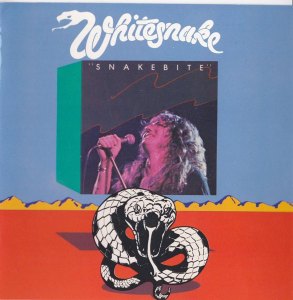
WHITESNAKE – Snakebite (1978, released as both album and EP)

You gotta give David Coverdale some kind of credit for name-dropping two of his old Deep Purple Stormbringer classics right there in the first song on this album/EP, “Come On”.

“I’m just a SOLDIER OF FORTUNE,
Must be the GYPSY in me…”

Maybe David just wanted to remind people who he was, that this was not just some “new” band.  Either way, it’s a very solid outing, considerably more enjoyable than David’s first two albums as a solo artist.

SNAKEBITE FRONT BACK

Snakebite was originally a 4 song EP, under the name Whitesnake.  Over here in Canada, I knew it as a full album .  North America stuck on four of the better tunes from David’s solo album, Northwinds, and released it as an LP.

The EP, or side one of the album, was helmed by Purple producer Martin Birch.  He ensured a solid sound, and Coverdale & Whitesnake provided four solid tunes.

The aforementioned “Come On” sounds like a smoove Paul Rodgers prowl, and features three players who would stay through most of Whitesnake’s history: Neil Murray (bass), Bernie Marsden (guitar) and Mickey Moody (guitar). Track two, “Bloody Mary” is driven by a boogie piano, one of the best songs on the album.  My personal favourite of the album, anyway.  It’s just impossible not to move to this one.  David’s as naughty as ever in the lyrics:

“You know that Madam Palm and her five sweet daughters”
Couldn’t give her man what the doctor ordered”

Then Coverdale gets bluesy. “Ain’t No Love In The Heart Of The City”, previously a hit for Bobby “Blue” Bland, ended up becoming Whitesnake’s live centerpiece.  On the original EP, it is the last track, its position swapped with “Steal Away”.  “Steal Away” is a another highlight.  Moody’s slide guitar is just pure awesome sauce.  The only thing I dislike is some really cheesy sounding electronic toms.

NORTHWINDSSide two of the LP had the earlier Northwinds material, produced by ex-Purple bassist Roger Glover. Although Mickey Moody plays on these songs, he’s the only future Whitesnake member present. The tunes are decent enough.  “Keep On Giving Me Love” was funky, like the kind of stuff Glenn Hughes was always trying to push on Deep Purple.  It’s not really outstanding until you get to the chorus.  “Only My Soul” however is a stand out. Coverdale has often done these incredible soul-searching pieces, such as Purple’s “Soldier Of Fortune”, and Whitesnake’s later “Sailing Ships”. This time out we’re treated to some very appropriate violin, and Glover on synth.  The side is rounded out by “Queen of Hearts” and “Breakdown”, the raucious rocker written about the final demise of Deep Purple.

Although David Coverdale seemed to still be searching for direction after leaving Purple, the Snakebite album (or EP, whatever you happen to own) is an enjoyable listen from front to back. Some material really showed what David was capable of, and he certainly would deliver in full in the future. Whitesnake diehards should not do without Snakebite, as it provides an interesting set of snapshots as to what Coverdale was up to, between his bouts of fame and glory.

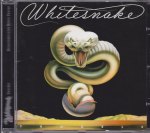
TROUBLEThere are numerous options today to get this music.  Not only is the Snakebite album still in print on CD in North America, but you can now also find the tunes remastered.  The Snakebite EP has been added as bonus tracks to Whitesnake’s debut album, Trouble.  You can also get David’s solo album, Northwinds, remastered with bonus tracks.  Or you could just get ’em on original vinyl!  The choice is yours, but I think any Whitesnake fan would enjoy this Snakebite.

4/5 stars