Welcome to PRIEST WEEK! It’s all Judas Priest, all week. Let’s go!
JUDAS PRIEST – Rocka Rolla (1974 Gull Records)
Years before the glory of Sad Wings of Destiny, Judas Priest was just another Birmingham bar band playing their version of the blues. Original lead singer and founder Al Atkins wrote a lot of the early material, with a variety of lineups. Atkins quit the band in the early 1970’s and “Bob” Halford was brought in, along with second guitarist Glen Tipton. Judas Priest as we know it was born.
I remember the next door neighbor George played me the song “Rocka Rolla” and I immediately loved it. It had a cool riff and a hypnotic chorus. Years later (1989) I walked into Sam the Record Man and bought my LP copy off the near-legendary Al King. Finding a copy on cassette was nigh on impossible so I bought an LP. Little did I realize that was a good move. I can still play the LP and it sounds great, whereas a cassette would be in a Thunder Bay landfill by now.
Unfortunately Rocka Rolla disappointed me. I didn’t like it when I got it in ’89 and I still find it kinda dull. The band wrote a lot of songs with Al Atkins, largely blues-based rock, and that’s what Rocka Rolla is: Leftovers from the Atkins era, slow blues jammers meandering along at a leisurely pace. There is precious little heavy metal here. “Run of the Mill” and the “Winter” suite, for example, run the gamut from hippy-dippy flower power love to amateur British bar blues. Yet, Jethro Tull these guys were not, and Rocka Rolla is strictly second rate. The drummer on Rocka Rolla was John Hinch, a musician that Tipton described as “inadequate” to play Priest’s more challenging material. Maybe that is one reason that Rocka Rolla lacks power.
There are a couple decent moments that keep this album from being a 1-star stinker. The title track is a fun proto-metal number, with a neat classic sounding riff. There is also the outro to “Dying to Meet You”, known as the “Hero, Hero” section which actually has some spark. “Never Satisfied” has some powerful moments. “One For the Road” is a good song. The rest is basically a band trying to find its direction, not sure whether it’s a jam band, a blues band, or a rock band, and excelling at none of those sounds.
There’s a bonus track on some CD versions, tacked-on but unrelated. This is the version of “Diamonds & Rust” from the Best Of album. Great song and great version, sounding totally out of place here. Also of note, there are two album covers. I prefer the soda bottle cap much more than that weird football player bomber guy.
Two years later, Judas Priest laid down one of my all-time favourite metal classics Sad Wings of Destiny. How they turned the ship around so drastically is beyond me. New songs, new chemistry? Let’s be grateful they did turn it around, for if this band failed to do so you never would have heard of them.
JUDAS PRIEST – Nostradamus (2008 Sony deluxe edition)
I was really worried about this album. I started reading some of the early bad reviews and was a little shocked as to how much some people hated Nostradamus. Even more worrisome were the mixed reviews, often coming from long-time Priest fans. Many liked it, but they were far from blown away.
I’m strongly in the “like” category with this CD. I get completely why some fans don’t like it. Most of the terrible bad reviews I read came from dyed-in-the-wool metal fans, and yeah, you’re not going to love it if all you eat, breathe, and sleep is metal. I’m not meaning to be condescending here. People who don’t love just metal, but also progressive rock, classical, and even opera, are more likely to love Nostradamus.
The production is OK (self produced this one is), but the drums are oddly buried in the mix. Maybe Scott Travis isn’t even the right drummer to be playing these kind of grooves (plods?), I don’t know. He sure does wail on “Persecution” though, among others. Still, it’s like a weird 80’s drum sound from a Leatherwolf album or something.
KK Downing and Glenn Tipton — awesome as ever. At least KK went out of Priest on a high note. He got to stretch his wings out a bit on this, as did Glenn. There is everything a guitar lover could want on Nostradamus. Lots of natural guitar tones, distortion, crazy riffs and spastic solos, even a bloody flamenco! Mental solos – unbelievable.
Halford — awesome. On some songs he’s really reaching back to his love of opera, no doubt of that. Buddy sings in Italian on one song! Kind of jarring, but it suits the whole epic nature of the music. Yes, there are screams. He’s learned to make the screams more effective by using them sparingly, more strategically. At the same time a lot of fans want to hear him scream at the top of his lungs again, like he did on Painkiller, and I can understand that. Fact is, maybe the guy can’t do it like that anymore. Is that his fault? Of course not. His singing is very much like it was on Angel Of Retribution. Mature’s a good word. I miss the screaming too, but if he can’t do it like he used to, it can’t be helped. It is what it is.
Regarding bassist Ian Hill, I can’t hear the bass guitar, most of the time. I guess that’s kind of expected in Priest, right? They’re not really known for bass. Don Airey of Deep Purple played keyboards, and he’s great. As always. Lots of dramatic piano, circa vintage Sad Wings era Priest. Very different from what he does currently in Deep Purple.
There are also real strings, so don’t fret. Lots of guitar synths as well, but not on a “Turbo Lover” sort of scale. I didn’t find the synth too intrusive for the most part. In a lot of cases the string and synths combined make it sound like a massive Michael Kamen score. You’ll know what I mean when you hear it. It’s very big and bombastic and some don’t find that kind of string arrangement to their tastes. Some find it very one-dimensional. Personally I think it had to be this way on Nostradamus, since the strings need to be heard among the guitars.
This “Deluxe Edition” comes in a nice hardcover book. It’s roughly DVD sized. Very nice package even if you have to slide the CD out of a cardboard sleeve (again!). Worth the extra cash to you? Well, that’s up to you. I’m not sure it’s worth it to me or not, but I bought it, so there you go.
I wonder if Nostradamus will go down as the most controverial Priest album ever? Even more so than Turbo, Point Of Entry, or Jugulator? Certainly some of the initial reaction on the usual sites was pretty harsh. Priest have always been a diverse metal band, and if you love Priest’s entire history including all the nooks and crannies, you’ll love Nostradamus. If you only like British Steel, you are probably going to hate Nostradamus!
I had to treat you guys right on a Monday. This edition needs no commentary. These are all real search terms from real people who ended up (somehow) at my site. Enjoy (I guess). If you missed the last one, Mythbusters edition, click here!
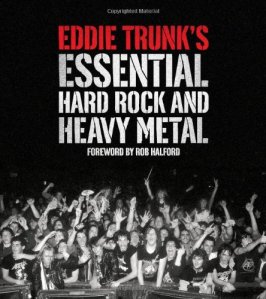
Here is a book that I heartily endorse — for beginners. I bought my best bud Peter a copy of this for his birthday a couple years ago. For a guy like Peter, a general survey book like this is perfect. It’s boiled down to the essentials, by a guy that many trust: Eddie Trunk.
I normally don’t go for this kind of book, because what can Eddie Trunk tell me about Judas Priest in three pages that Martin Popoff didn’t in his excellent book, Heavy Metal Painkillers? So this book is for the people that just want the facts, ma’am. Anybody who’s listened to Eddie Trunk’s show on Sirius XM knows that this guy is the real deal — he knows his stuff, he knows the bands personally, and he doesn’t pander. He has a genuine love for the music, all of it. His personal touch helps make his radio show that much more enjoyable. Same with this book.
After Rob Halford’s forward, Eddie presents his essential hard rock and heavy metal bands, in alphabetical order. AC/DC, Aerosmith, and all the way down the line. You may take exception to some of the bands that he skips over (I read on a message board that Quiet Riot were ticked that they’re not in here) but I think by and large he hit the nail on the head. The bands that he does include…well, it’s hard to argue against them, and you only get so much page space, right? And this is a gorgeous book. Full colour photos, every page. Beautiful. Lots from Eddie’s personal collection, you’ll see a very young Eddie Trunk meeting the bands as a kid!
In addition, Eddie gives you a discography for each band (not perfect, there are a couple errors here, as in inevitable in a book like this). He also lists the members of the bands, and the most important ex-members and sidemen. So when you get to Queen (and yeah, you may argue that Queen is not a hard rock band) you’ll see the four original members, and Paul Rodgers listed beneath them. Finally, Eddie gives you his list of his ideal mix CD for each band. Go ahead and make your own, and see if you agree!
As a gift to Peter who likes the music but doesn’t know the details, he gleaned plenty from this book. Before reading it, he only knew of one Billy Squier song. Eddie Trunk got him up to speed. Thanks Eddie!
5/5 stars
For a guy like me, and quite possibly you as well:
2.5/5 stars
Added note: I know there is a Part II as well, but I have not checked it out.
“Part 6 in a miniseries of reviews on Rob Halford’s solo career! If you missed the last part, click here!” That was a rhyme, that ain’t no crime…Breaking the Law! Breaking the Law!
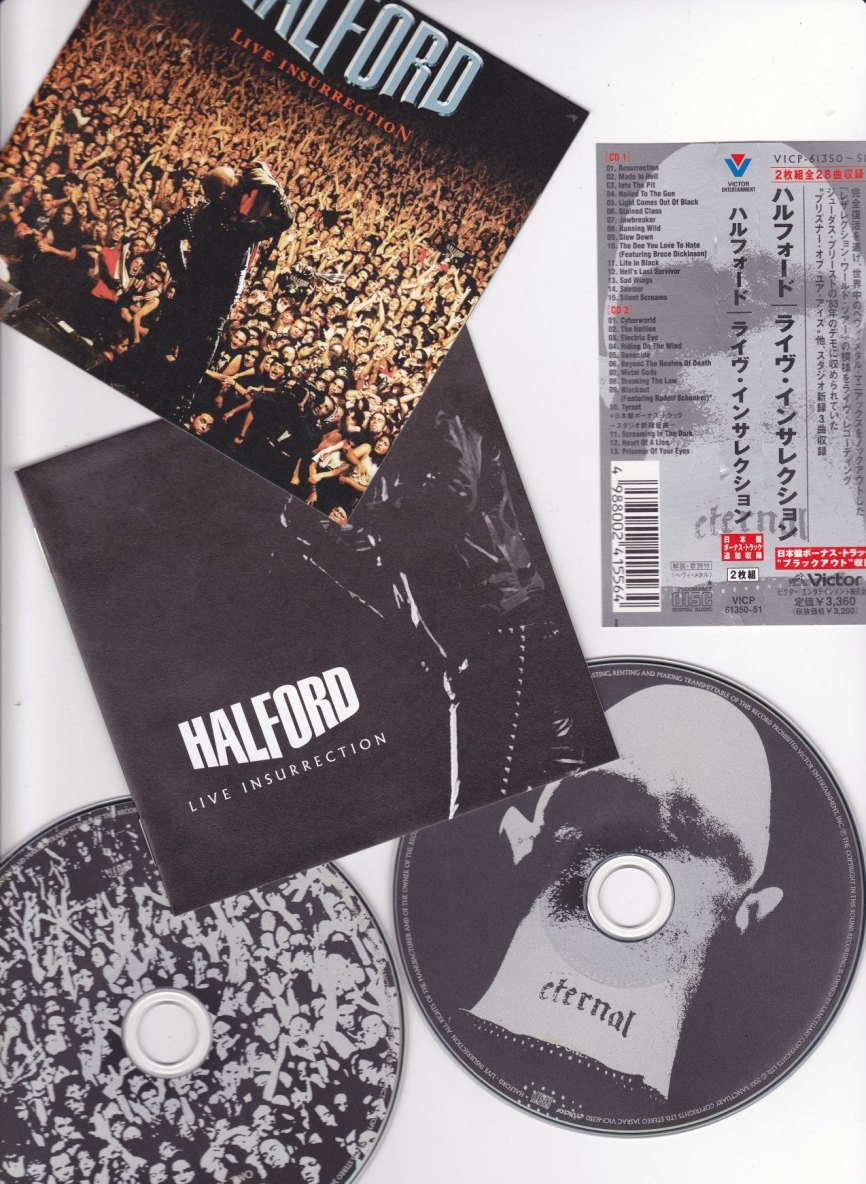
HALFORD – Live Insurrection (2002 Japanese Import)
Having a wealth of solo and Priest material to draw from, this seems like a good place for a double live album to drop. And so it was; Live Insurrection, Rob’s first full-fledged live solo outing. For me personally, this is the peak. This Rob’s home run of solo projects.
Admittedly, there is a certain sense of Rob trying to bury parts of his recent past. There are no songs from Two, and the set is Priest-heavier than prior tours. I found the Halford band to be kind of faceless, a little devoid of personality. They’re absolute pros and there is no question of them cutting it. That’s not the issue, it’s just one of…I can’t hear the different personalities of the players, compared to Fight.
On the other hand, the setlist is so much richer than Fight used to do. The songs are culled from the Halford album Resurrection, the Judas Priest back catologue, and the first Fight album, with a lot of added surprises.
These surprises include three studio tracks, two of which are tracks written by Judas Priest, but never released at the time! You also get Rob’s duet with Bruce Dickinson of Iron Maiden, “live” (recorded during rehearsal I believe), and the two bonus tracks from the Japanese version of the Halford album, once again performed live. Rob even sings his first-ever solo track, “Light Comes Out Of Black” which was originally on the Buffy The Vampire Slayer soundtrack back in 1992. The Priest material is a great mix: old obscure stuff from Sad Wings and Stained Class, as well as more obvious stuff from Hell Bent and Screaming. Rob’s voice is in fine form, doing justice to the Priest and Fight material.
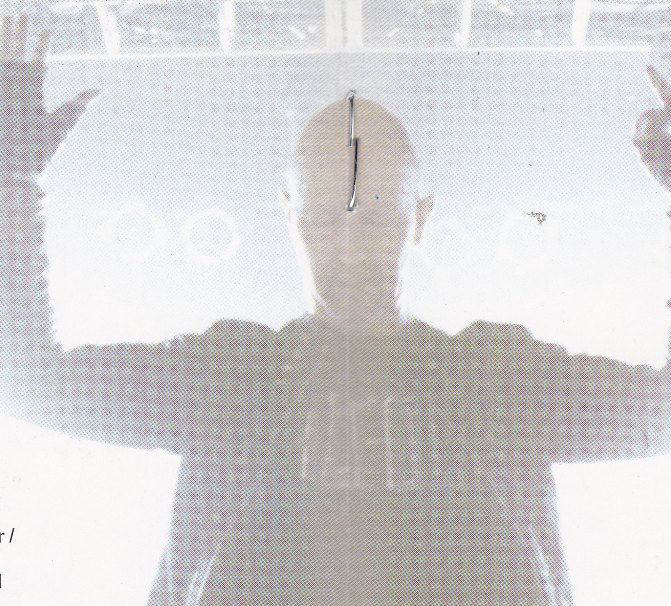
Rob’s so hardcore, he stapled his fuckin’ forehead!
The Japanese bonus track is “Blackout”. Yes, the old Scorpions tune, and recorded here with a Scorpion: Rudolph Schenker! Halford easily handles Klaus Meine’s vocal part. It’s a great bonus track, easily worth the extra cash that I spent on this import version. I got this from Amazon.com in 2002.
They give you lots of great packaging with this live album. Decent liner notes, lots of pictures, plenty to look at while you spend a couple hours listening to this platter of metal perfection. Enjoy the feast.
5/5 stars
I’ll be taking a summer break from this series. I’m a bit burned out on Halford albums now, and there are so many new arrivals to listen to! But fear not. I’ll be following this review with Crucible, another Japanese release, a box set, and more.
HALFORD – Resurrection (2000 Japanese edition, 2008 remastered edition)
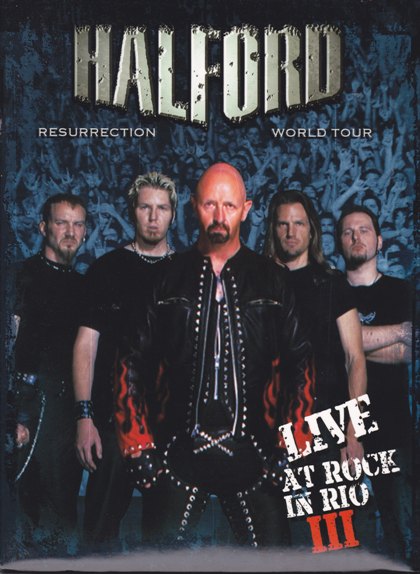
Note: There have been several versions of this CD. The original CD and Japanese import versions had a certain tracklisting, but the track order was changed up a bit for the Remastered edition (see tracklists at bottom). Since that’s the version that’s out right now, that’s what I’ve decided to review. I got mine in a combo pack with the DVD, Resurrection World Tour Live at Rock in Rio III. Rob has also retroactively started to number his solo albums; as such the remastered version is technically Halford 1: Resurrection.
Voyeurs by Two was not a mega seller regardless of the association with Trent Reznor and Nothing Records. Rob needed to return to heavy metal or risk alienating his fanbase.
I think pretty much everyone was enthused by the title track and lead off single, “Resurrection”. This wasn’t techno wizardry with whispery vocals. This was heavy metal, with screams! Although Rob was already headed in that direction at the end of Two, while working with Bob Marlette, it is Roy Z that drives this one single home. Yes, Roy Z, the Roy Z that Bruce Dickinson utilized to collaborate on manya greatsoloalbum. With Halford now drinking at the well of riffage that is Roy Z, “Resurrection” was bound to smoke. And it does. Take the sound of classic Judas Priest circa Painkiller, adjust for 10 years of sonic trends, stir in Roy Z, and you have “Resurrection”. Rob makes sure you know he’s serious from the very opening, screaming as only he can.
What I dislike are the lyrics. “I walked alone into a Fight”? Rob, you weren’t alone, you had Scott Travis with you! “I tried to look too far ahead, and saw the road lead to my past instead.” In other words, sorry about the Two album, this is what I really want to be doing.
The first three tracks totally smoke, all falling somewhere in a Defenders/Painkiller vibe of Priestly goodness. At first I didn’t like “Night Fall”, the fourth track, too much. Its redeeming value is a great chorus, totally in the Defenders mold.
“Silent Screams” is one of the songs that Rob was working on with Marlette at the end of Two. Rob was especially proud of this lengthy number, and he released a demo version of it for free on his official website. The demo version is an evolution from Two. It has screams (appropriately enough) and heavy guitar riffs. The album version has a more emotional lead vocal and tones down the keyboards. The song is a bit slow and ploddy to start with but it is epic in quality and it sure does rock by the halfway point!
The big gimmick on the album was the duet with Bruce Dickinson, “The One You Love to Hate”. The connection is Roy Z, but obviously a matchup like this would generate much hype. Arguably the two best singers in metal, together at last. Bruce sounds great, holding his own against the Metal God, who sounds vintage 80’s. I have to say I enjoyed this one a lot. Shortly thereafter, there were rumours of a coming supergroup called the Three Tremors – Rob, Bruce, and Geoff Tate of Queensryche. All three artists were touring together at the time, but this idea was never meant to be taken seriously.
“Cyber World” is fast and heavy but unfortunately also boring and skip-worthy. Likewise, the groovier “Slow Down”. Dull title, dull song. I tend to think of Resurrection as losing steam on side 2. I guess that’s why the remastered edition inserts the Japanese bonus track “Hell’s Last Survivor” right here. Sounding something of a Screaming for Vengeance outtake, I think this was placed here to compensate for some of the weaker tracks.
“Temptation” is a little on the boring side, so two new tracks are inserted at this point for the remastered edition: “God Bringer of Death” and “Fetish”. In my opinion it doesn’t sound like they belong here. Rob’s voice had changed a lot in the 8 years since, and the sound is more like later Halford albums. Neither song is particularly notable.
On the other hand, “Sad Wings”, which was previously only on the Japanese version, is awesome. It has a sharp riff and a chorus that is designed to remind you what band he was the singer of. This is followed by “Twist” which sounds like maybe it had its origins in Two, but I like it a lot. “Drive” is also pretty decent, and the album ends with “Saviour” which has an anthemic chorus.
Bottom line: Pretty decent if a bit safe comeback. Rob wasn’t treading any new ground here musically, but Roy Z never fails to class up any album he’s on. His tasteful and blistering solo work is just marvelous.
Fight was kaput. Rob had a new band, a photo of whom appeared in Metal Edge magazine. The band was called Halford, and although that would change, Rob used his surname for another band later on. I remember a weird looking blonde dude wearing a silver skin tight suit of some kind (more on him later), and I thought, “Well, OK then. This is going to be different.” Soon after the Metal Edge photo, the name had changed from Halford, to Two.
I had a buddy, Nathan, who was really into Nine Inch Nails. This Halford project was on his radar as well, due to Rob’s collaboration with Trent Reznor. At the time, Rob Halford insisted that the resulting album, an industrial/rock hybrid, was the sound he was going for all along when he quit Priest in ’92 and formed Fight.
I don’t believe that, but they did come close on the Mutations EP. I think Fight was exactly what he wanted to do at that time. When the second Fight album fizzled I think Rob questioned his musical direction, hooked up with Trent, and did this experimental record.
Two (stylized as 2wo) were experimental by Halford’s standards, but not by industrial music standards in general. Voyeurs has all the expected bells and whistles, including but not limited to: distorted vocals, the word “pig” in a song title, thumpy bass, ticky-ticky sounds, bloops, bleeps, and other stuff that sounds like broken machinery.
What does make this album special is that the band was “Two”, not “One”…meaning there is a second guy involved here, and what a talent he was. That guy was guitar player John 5. This was his breakthrough release. After this he hooked up with David Lee Roth, Marilyn Manson, Rob Zombie, et al. John 5’s involvement means there is some wicked guitar work here, including “I Am A Pig” which features a solo that sounds like a mashup of Morello and Satriani.
Highlight songs include “I Am A Pig” (Reznor sure loves his pig imagery), “Stutter Kiss”, “Hey Sha La La”, “Water’s Leaking”, and the epic closer “Bed of Rust”. “Bed of Rust” could have made a pretty cool Fight track. I would say in fact that there are no throwaway songs here. All of them have something worthwhile to offer. Just don’t think too much about the lyrics. Halford’s delivery is understated and, at times, whispery. No screams. At Reznor’s suggestion, instead Rob explored other aspects of his voice.
Other notable names: Bob Marlette plays bass and produces. Dave “Rave” Ogilvie does some production work. Trent Reznor “executive produced”. I always wondered what that means. I picture it meaning that Trent gives the project either a “thumbs up” or a “thumbs down” when the real work is done.
Of course many Priest fans didn’t get it, although a chunk of the Reznor fans (who at the time would buy anything on Nothing records) accepted and enjoyed the album for what it is. I think if this was a release by a more popular band, like say Nine Inch Nails or KMFDM, it could have spawned two or three singles.
Japan had a bonus track called “In My Head” which is absolutely impossible to find, so good luck. I’ve never heard it.
3.5/5 stars
Postscript:
It was during this period, promoting the Two album, that Rob Halford came out. People joked for a good number of years that Rob’s sexuality was the worst kept secret in rock. That can’t negate the courage that it took for Rob to come out in a musical genre that isn’t always kind to anyone who’s “different” (hello, Blabbermouth!).
“I think it’s difficult for everybody, you know, in making the decision to come forward and be who you are, based on peer pressure, especially if you’re a teenager,” Halford said. “That’s where a lot of the anxiety begins, and so maybe people like myself and others that do step in front of a camera and let the world know, maybe it’s of some help, where there’s an individual that’s been successful, that’s been able to achieve dreams and visions and goals in life and not let the issue of sexuality be something to hold them back, so I think it’s an important thing.”
Russ Parrish was out, and in came youngster Mark Chaussee. This change negated one thing I loved about Fight, which was the interplay between two different guitar players. Chausee and Tilse are too similar in tone, and so the followup album A Small Deadly Space renders me deaf if I try to listen to it in one sitting. The mix on this album bothers me, it has so much bottom end, but then not enough on top to balance it. I don’t like the vocal effects that reduce the power of Rob’s voice. Halford doesn’t scream much on A Small Deadly Space.
The songs are powerful enough, and this time Rob is writing with his bandmates. The opener “I Am Alive” is slow and massive, unlike anything on War of Words. “Mouthpiece” is different yet again, with a slippery riff and an accelerated pace. “Blowout in the Radio Room” is actually psychedelic metal. Halford sings about how music gets him high, and goes for a tripping druggy sonic assault. The guitar solos are straight out of the Hendrixian Book of Knowledge, it’s just great. “Never Again” is one of the few moments of Halford screams, and it’s like an injection of adrenaline! This is a Priest-quality album track.
I still think of CDs in terms of being albums, of having a “side one” and a “side two”, and to me this sounds like a natural break between two album sides. I like side one, but side two wears on me. The title track has a wicked wicked cool sounding guitar solo, but it’s just one lick that repeats four times. Typical 90’s simplicity. Then there’s “Gretna Greene”. The lyrical matter is that of abuse, but unfortunately this very important subject is relegated to the back seat by the title of the song. Yes, it’s an O.J. Simpson trial reference. That wouldn’t matter so much if the music stood up, but this song is pretty boring. They stay that way until “Human Crate”, which is slower but a really cool song with powerful vocals. The album ends with a ballad, “In A World of My Own Making”. For the first two minutes it’s just a piano, and Rob. It’s a side of Halford rarely heard. Then the band comes in, and it becomes a slant on “Beyond the Realms of Death”. Except…with flat sounding drums and brittle guitars.
But that’s not all, there’s also the super hard to find secret bonus track, “Psycho Suicide”. It’s noisy and tuneless, but it sure is heavy, and I kinda like it.
So, I think I’ve been clear that I’m not a fan of the mix of this CD. A Small Deadly Space was remixed as part of the 2008 Into the Pit box set. As I get along in this series of reviews, I’ll revisit that box set and see if this album makes a new impression on me.
FIGHT – Mutations (1994 Epic collector’s edition, 2008 Metal God Entertainment reissue)
Released in late 1994, Mutations (subtitled “collector’s edition“, which really means nothing) was a live/remix CD to follow War of Words. I seem to remember this being marketed as some sort of “extended EP” or some kind of not-album, which again is kind of meaningless. The original release was 45 minutes, a full length album by most measures.
Live Fight! Shame it was only four songs, as they absolutely kick ass. Rob Halford was still in peak voice in 1994, and every high scream is present on opener “Into the Pit”. Fight as a live band were less stiff than on the first album. They were no less precise, and each song is just as ferocious as its album counterpart. On “Nailed to the Gun”, bassist Jay Jay does the low death metal growls while Rob howls like a mad dog.
I was surprised that Rob put “Freewheel Burning” on the album, as he seemed to be trying to distance himself from his past at this time. Its the only Priest song and I don’t think they played many Priest songs on the tour at all (but I know they did cover Sabbath’s “Sweet Leaf”). Surprisingly it’s here that Rob’s voice falters, struggling with the demanding song. He redeems himself on the bluesy single “Little Crazy”.
I enjoy hearing live recordings from bands with two distinct lead guitar players trading off. Russ Parrish and Brian Tilse were both very different stylistically, and the contrast is awesome. The pace is aggressive, and these guys keep chugging on. (Note: Russ Parrish is not credited on this album. He had left the band by the time of release, but there is no question that he did play on all these tracks. Why he was not credited is a mystery, but he does appear on the remastered version cover art.)
I believe I am well on record as not being a fan of remixes in general. There are exceptions but so many remixes add techno-crapola that often serves to reduce the songs to repetitive mockeries of themselves. On a track like “War of Words” , they remove Scott Travis’ drums from sections, and replace him electronic beats. At the time I thought, “Why would you want to replace Scott Travis with a drum machine?” Today, it still bugs me. But hey, those who doubted the sincerity of Rob’s industrial work with Trent Reznor in Two should remember these remixes!
I’ll be honest, I struggle getting through the remix side in one sitting. There are some cool moments, such as the chance to hear isolated instruments and solos. “Vicious” is an example of a remix that works for me. It’s weird, it has an opera singer and dance beats added, but it’s pretty heavy and cool. But in general, the Fight songs were simple and repetitive to begin with. Making them simpler and more repetitive didn’t work for me. Sure, I own some Nine Inch Nails albums, but this sound isn’t where my heart lies.
Goodie-goodie-gosh, Mutations was reissued as part of the Into the Pit box set, with two bonus tracks. And these bonus tracks are (you guessed it) remixes. More versions of “Kill It” and “War of Words”. At least the “Culture of Corruption Mix” of “War of Words” is about half as long as the regular “Bloody Tongue Mix”.
Incidentally, why do remixes always have cliche sounding names? “Bloody Tongue Mix”! Raahhrr! Why not…”Toothpaste Mix”. Something original. I think remixers should strive to be more original in the naming of their work. Something nobody’s used yet. “I’m Rob Halford and I Endorsed This Mix Mix”.
Part 1 of a miniseries on Rob Halford’s solo career!
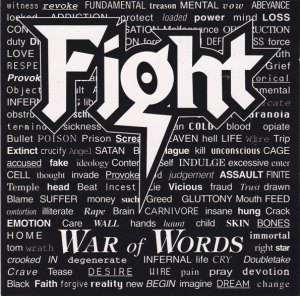
FIGHT – War of Words (1993 Sony)
I was devastated when Rob Halford left Priest. I was so heavily invested emotionally in the excellent Painkiller album, I couldn’t believe it was over! Last I had heard, the band were going to be working on two new songs for a greatest hits album (Metal Works) and then Rob would take a break to do a solo album. Instead, the band split completely! Halford and drummer extraordinaire Scott Travis formed Fight with guitarists Russ Parish and Brian Tilse, and the bass player from hell, Jay Jay. (Today, Parish goes by the name “Satchel” when he plays with Steel Panther!) Regarding Jay Jay, Halford says that he did a number of Rob’s own tattoos. Rob figured if he could play bass as well he he tattooed, he was in. Jay Jay also does the grunt-metal backing vocals.
The resulting album, War of Words, is a Pantera-esque thrash-fest, one of the heaviest things Rob had ever done (until Halford’s Crucible album), undeniable brutal, scream-laden, and punishing from start to finish. Halford had cleverly assembled two shredding guitar players with differing styles too: Tilse specialized in the noisy speedy solos, while Parrish played the more melodic and traditional speedy solos! War of Words is solo nirvana for fans of Rob and Priest. And Rob wrote every single song by himself.
The twin openers, “Into the Pit” and “Nailed to the Gun”, are two of a kind: they are rip-yer-head-off thrashers with Rob’s patented glass-breaking screams. The song structures on War of Words are simpler than what we heard with Priest, no doubt since Rob composed the songs by himself. This simplicity serves to make the album feel even heavier and more relentless.
The lyrics, just as simple and aggressive. “Into the Pit” doesn’t feature much in the way of poetry:
Conspiring, for sation Malfeasance, on high Obstruction, of duty Disorder, will rise
Rob takes the pace back a bit on the third track, “Life in Black” which I don’t think you can fairly call a ballad, to me it’s more Dio-era Sabbath with a very vintage-Dio sounding solo. (Rob had just helped out Sabbath live after Dio left, singing lead for two shows while opening for Ozzy Osbourne.) Meanwhile “Immortal Sin” bears a slow groove with a melodic chorus, downtuned but a bright spot in the proceedings.
The title track opens with the American First Amendment (Rob was living in Phoenix). It’s another aural assault with Rob keeping his vocals in the upper register. Travis’ incredible drumming punctuates every venomous word. Considering that less than three years prior, Rob (with Priest) was in court defending his band during the infamous “suicide trial”, the words are apt.
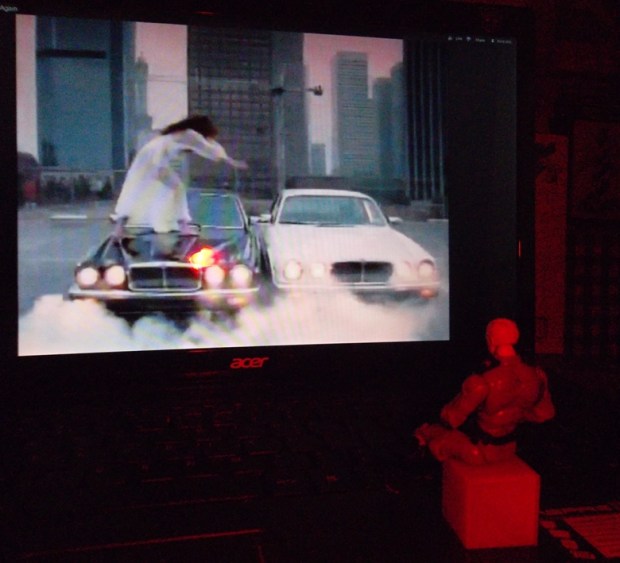
Dream Deceivers, directed by David Van Taylor, the excellent documentary on the Judas Priest trial
It’s back to dark haunting territory next: “Laid to Rest” ended the first side of the album. I find this one to contain one of Rob’s best vocal performances of the album. It’s reminiscent of “A Touch of Evil” by Priest, but downtuned and slightly exotic.
Side Two’s opener, “For All Eternity” is really the final reprieve. It is most definitely a power ballad in vintage Priest vibe, but again with the modern downtuned guitars. A song like this really proved Rob’s songwriting chops. He’s capable of writing emotive, catchy powerful music completely on his own, and the song is an achievement. The bridge around 2:25 is just awesomeness, but Tilse’s guitar solo completes the picture. As if that wasn’t enough, Rob returns to full on scream mode for the end.
“Little Crazy” was a critically acclaimed heavy metal blues, and the second single/video. I’m struggling to describe it beyond “heavy metal blues”, but this song is definitely a highlight. Rob puts everything he has into the slinky lead vocal, while band fuse the blues feel with heavy metal’s precision. I recall reviews of the time saying, “If Rob wanted to drop metal and go full-on blues, he could.” Now that would be interesting.
The rest of the album is no-holds-barred. The triple threat of “Contortion”, “Kill It”, and “Vicious” is almost too much. Each song strips everything down to the basics: simple riffs, violent words, relentless drums, without much in terms of melody. This is the most difficult part of the album to penetrate. In time the three songs grow. “Contortion” protests what we are doing to the Earth with angry frustration. “Kill It” is about TV preachers (whom I’m sure had their opinions on Priest during the trial). “Vicious” was always my favourite of the trio:
You cheating, lying, mother-fucking son of a bitch..
Vicious, vicious, Fucker, fucker!
I was going through an angry phase at the time!
Rob saved the best track for last. “Reality: A New Beginning” is a weighty epic, a perfect closer, slightly exotic and successfully combining Fight’s heavy side with Rob’s ability to write great melodies. This is simply an incredible song, a jewel in Halford’s crown, and a song which definitely deserves another look. The lyrics seem to be autobiographical:
This time, when I’m leaving, Who cares where I’ll go?
There was a hidden CD bonus track (not on cassette) after a five minute silence, a jokey song called “Jesus Saves”. Rob’s voice is electronically manipulated to sound…well, not sure what he’s supposed to sound like. An angry elf, I guess.
4.75/5 stars
There are some supplementary releases available:
1. This one is on my wishlist, I don’t own a physical copy: In 1994 Fight released a Christmas CD single called “Christmas Ride” with a message from Rob! They later reissued this as a free download from Rob’s site, but that is no longer around.
2. The live/remix EP, Mutations (next up in this series of reviews).
3. In 2007, a demo album called K5: The War of Words Demos was released. This featured demo versions of most of the album, plus five more. These include four new songs, and “Psycho Suicide” which was later remade for the second Fight album, A Small Deadly Space. The demos reveal that a much more conventional-sounding metal album was initially planned. (“The Beast Denies” is a very different version of “Reality: A New Beginning”.)
4. The 2008 Fight box set Into the Pit contains remixed versions of War of Words (again without “Jesus Saves”) and A Small Deadly Space. But the cool thing it contains is a DVD, Fight Live In Phoenix. The band rips through the entire album, in sequence (no “Jesus Saves”!) and then Rob’s solo track, “Light Comes Out of Black” (from the Buffy the Vampire Slayer movie soundtrack).
5. Buffy the Vampire Slayer original motion picture soundtrack. This is the only place you can get the studio version of “Light Comes Out of Black”, featuring his backing band…Pantera. All of Pantera.
I like “Light Comes Out of Black”, but it’s a lot easier to swallow than Fight is on first listen. I remember a M.E.A.T Magazine interview with Glenn Tipton and KK Downing, where they trashed it. “If it were on Painkiller, it would be one of the weaker songs, if not the weakest,” said KK.
KK might have been right about that to a certain extent, but only because Painkiller consists of 10 awesome songs!







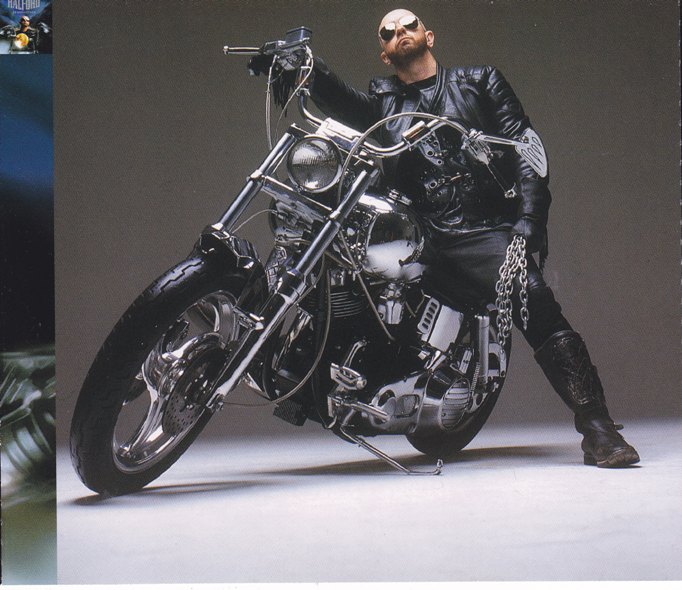


 I still think of CDs in terms of being albums, of having a “side one” and a “side two”, and to me this sounds like a natural break between two album sides. I like side one, but side two wears on me. The title track has a wicked wicked cool sounding guitar solo, but it’s just one lick that repeats four times. Typical 90’s simplicity. Then there’s “Gretna Greene”. The lyrical matter is that of abuse, but unfortunately this very important subject is relegated to the back seat by the title of the song. Yes, it’s an O.J. Simpson trial reference. That wouldn’t matter so much if the music stood up, but this song is pretty boring. They stay that way until “Human Crate”, which is slower but a really cool song with powerful vocals. The album ends with a ballad, “In A World of My Own Making”. For the first two minutes it’s just a piano, and Rob. It’s a side of Halford rarely heard. Then the band comes in, and it becomes a slant on “Beyond the Realms of Death”. Except…with flat sounding drums and brittle guitars.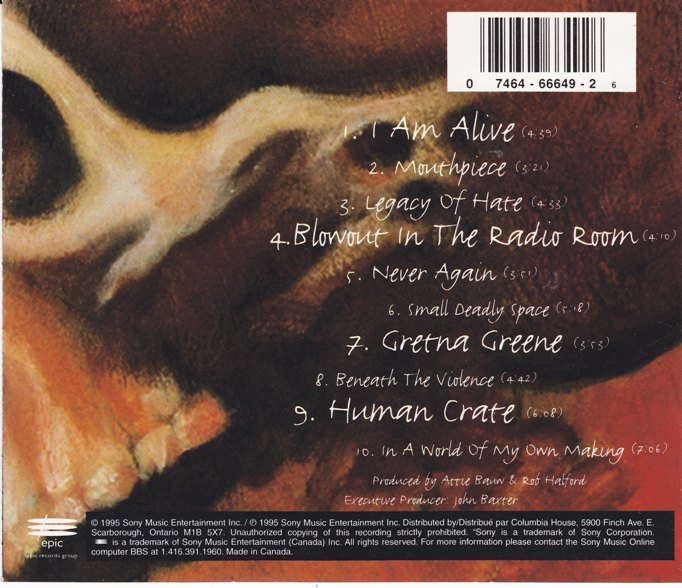


 I believe I am well on record as not being a fan of remixes in general. There
  I’ll be honest, I struggle getting through the remix side in one sitting. There are some cool moments, such as the chance to hear isolated instruments and solos. “Vicious” is an example of a remix that works for me. It’s weird, it has an opera singer and dance beats added, but it’s pretty heavy and cool. But in general, the Fight songs were simple and repetitive to begin with. Making them simpler and more repetitive didn’t work for me. Sure, I own some Nine Inch Nails albums, but this sound isn’t where my heart lies.




 mikeladano.com