Sony

REVIEW: Pretty Maids – Red, Hot and Heavy (1984)

Thank you to Thor Blackmore for this CD!

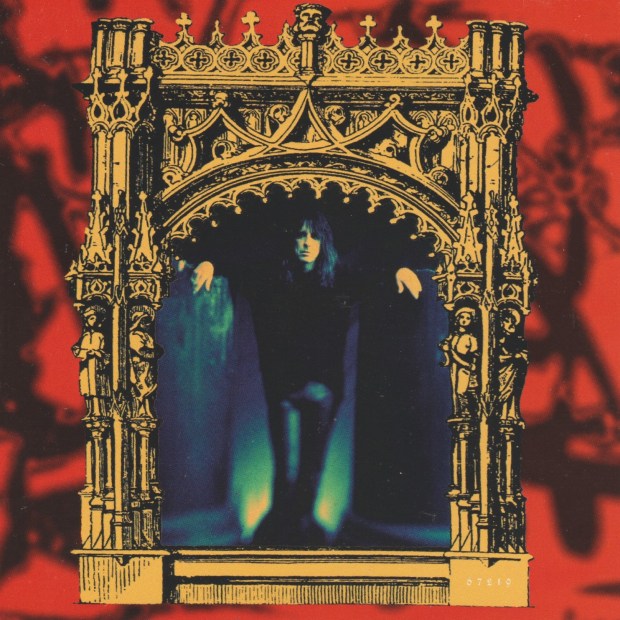
PRETTY MAIDS – Red, Hot and Heavy (1984 Sony)

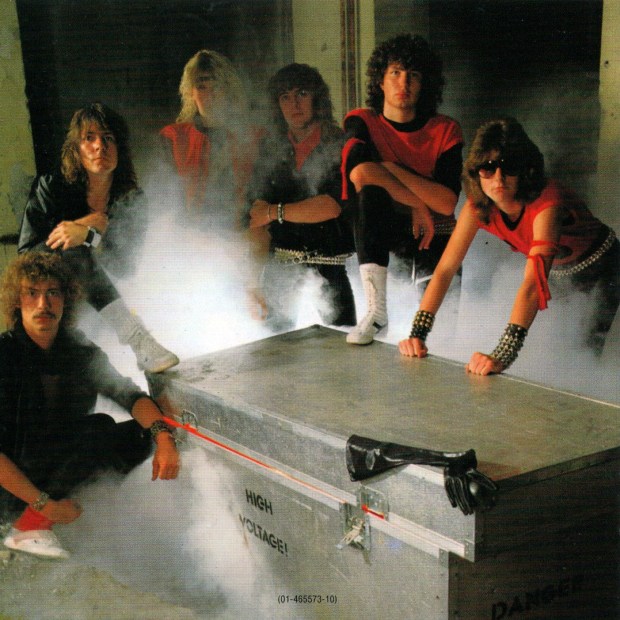
I ignored Pretty Maids when I first heard of the band.  “Pretty Maids?  What kind of name is that?”  Shallow kid stuff, but impactful, because now in 2024 this is my first real listen to Pretty Maids with intent.  Red, Hot and Heavy was the debut album for the Danish hard rock band, after a self-titled EP in ’83.  The six-piece band had some moderate success with the album, so let’s have a listen.

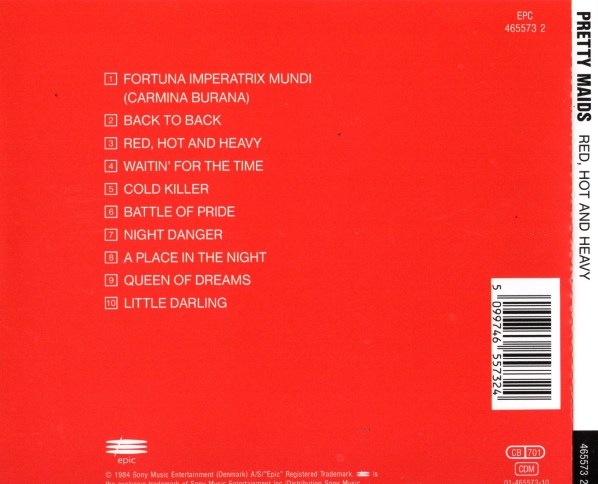
Opener “Fortuna Imperatrix Mundi” is actually an excerpt from Carl Orf’s “Carmina Burana”, and is credited as such on the back.  It’s just a few seconds.  The real opener is “Back to Black”, a scorching metal number with tempo and riffs sharpened and at the ready.  The raspy vocals of Ronnie Atkins differentiate the song from the works of other metal groups such as Iron Maiden and Judas Priest.  The keyboards give a highbrow neo-classical vibe.  It’s heavier and fuller than Dio, but with all the drama and guitar solo shenanigans.

The title track is slower and nastier.  A rallying cry for metal heads, “Red, Hot and Heavy” doesn’t pretend at being anything more than it is.  A slow metal banger, perfect for fist-pounding and shouting along with at the concert hall.  The shout chorus is custom made for the stage.  The duel guitar solo is pretty cool.  A stock metal chugger, but there is a need for a drum-bashing, stompy riff-rocking concoction such as this.

The highbrow keyboards return on “Waitin’ for the Time”, a very European sounding song which builds from a ballady opening to an upbeat pounder.  Sounds a bit like the Swedish band Europe during their Wings of Tomorrow era, with a hint of Def Leppard in the riff.  It’s an excellent song with light and shade, and a complete musical journey without exceeding five minutes.

“Cold Killer” begins with news broadcast dialogue, and then goes in a fast and ominous music unlike the other songs.  The rather clunky lyrics are about the weaponization of space, a hot topic in 1984 with Reagan’s “Star Wars” program in the nightly news.  But…clunky.  “There should have been a paradise, instead there’s a killer out in space.”  We’ll give them credit for trying at least, which is more than could be said for many bands of the 80s.  Musically it’s a terrifically fun ride through sweet guitar riff and solo action.  The keyboards add a progressive vibe, though some might say pretentious.

The anti-war theme flips over onto side two, with “Battle of Pride”.  Again, it’s not poetry, but the lyrical theme was very popular in metal at the time.  Musically it’s a fast Dio-like rocker with the keyboard accents giving it a different flavour.  Ronnie Atkins’ rasp continues to separate Pretty Maids from other bands, but by the time we hit side two, the ear is craving more variety in the voice.

“Night Danger” is a pure blitzkrieg, now more in the wheelhouse of a band like Accept.  These guys are not slouches when it comes to riffs over 80 mph in speed.  The irony is that, even at that speed, the song doesn’t really go anywhere.  It’s speed for its own sake, and that’s actually fine, because it’s plenty fun and doesn’t need to be anything else.

Acoustics join the electric guitars on “A Place in the Night”, one of the most impressive songs on the album.  Mid-tempo melodic rock, and dialing down on the vocal growls, is exactly what the album needed at this point.  The chorus explodes with passion and power at the right moment.  The keyboards add to the mixture by thickening up the melodic accents.  Brilliant deep cut late in the album.

“Queen of Dreams” has an Yngwie vibe again, though Malmsteen wouldn’t put as much emphasis on the other instruments.  The keyboards add a regal synth-trumpet sound over the guitars, but when the drums kick in, there’s no nonsense.  It’s that kind of metal that is obviously influenced by Deep Purple and Blackmore’s Rainbow, but amped up for the 80s.

The surprise is the closer:  a cover of Thin Lizzy’s single “Little Darling”.  Formerly a horn-laden rock classic, Pretty Maids heavy it up a bit and increase the tempo.  Though “Little Darling” will always be a personal favourite, I don’t think Pretty Maids did it any favours.  Their backing vocals are too shrill for the chorus, and without the horns, it loses that something special.  A swing and a miss for Pretty Maids, which is terribly unfortunate.

Red, Hot and Heavy is a strong debut.  Obviously the band grew and expanded their sound, and still continue today.  This is the foundation.

3.5/5 stars
#1117: I Admit It: I Miss My Cassettes

RECORD STORE TALES #1117: I Admit It: I Miss My Cassettes

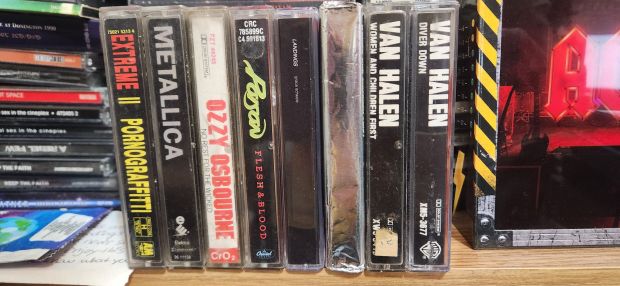
Hey, it’s me, the guy who has talked about how much he hates cassettes, again and again ad nauseum.  I don’t know why, but I’m feeling a lot of nostalgia for tapes these days.  While CD remains my go-to format, with vinyl in second, I am now on the lookout for old 80s metal cassettes that still play well.  What the hell happened to me?

It’s true that I have a lot of bad memories about cassettes, to go with the good.  I have my own system and language when it comes to my collection, but I abandoned cassette back in 1995 because the sound quality wasn’t there and got noticeably worse the more you played the tape.  I considered cassette to be a “soft copy”, with the longer-lasting CD and vinyl being “hard copies”.  You simply have more control in keeping those two formats in good shape.  Cassettes are another story.  It’s just magnetic particles stuck to a ribbon, and every time you play it, those particles wear off bit by bit.  In effect, you wreck your favourite tapes fastest because you simply love listening to them!  There were other complications.  Different decks played at different speeds, with my “ghetto blaster” playing the slowest and most warbly.  I had two Sanyos and then a Sony, and the Sanyos were by far the worst.  Only my Sony Walkman was able to play almost every tape in my collection at something close to the right speed.  Once I learned to drive, I found that the car deck could play pretty much anything, but it did eat a few tapes too.  It was like every time you wanted to listen to music, you had to pick the right equipment and cross your fingers.  I remember wrecking a copy of Black Sabbath Tyr by accidentally pushing two buttons at once on my Sanyo.  This created a loud squeal right during the start of “Anno Mundi” that was impossible to ignore.  Playing tapes was like walking a minefield sometimes!  I always prayed that nothing would go wrong.

CD solved most of the problems I had with cassettes.  Heck, even the artwork was back to being a square!  Cassette cover art was either cropped or “pan-and-scanned” (to coin a phrase) to make a square fit into a rectangle.  Everything about CD was better.  Bonus tracks, better sound, longer life, larger (and square!) artwork…even the ability to skip through songs in an instant.  What wasn’t there to prefer?  And why the hell do I miss cassettes right now?

It’s all nostalgia.  There was something about buying a new album on cassette, and being basically forced to listen to the whole thing.  There was a certain appreciation for the album, with an actual side break, that connected us to the vinyl age in a way that CD did not.  Or, maybe it was just the glory time of our youths that made it feel that way.  The act of closing the door, pressing “play” on a new tape, and laying on your bed to listen with intent.  How often is music just background noise in our modern lives now?  How frequently do we sit and spend time just listening to the music while staring at the packaging today?  Are we listening, or are we multitasking?  I’m multitasking right now, listening to Trilogy by Yngwie J. Malmsteen on my speakers.

I picked that recording for a reason.  I got on cassette from my grandma in 1987.  It was on Capitol Records and it played for shit out of the box.  Many Capitol tapes did around 1986-87.  my W.A.S.P. and Iron Maiden all had similar problems, which them priorities to upgrade on CD when the time came.  I know not everybody likes Yngwie.  Some find him grating.  He does take some adjustment, but imagine listening to your first Yngwie on a slow, warbly cassette.

I do miss some things though.

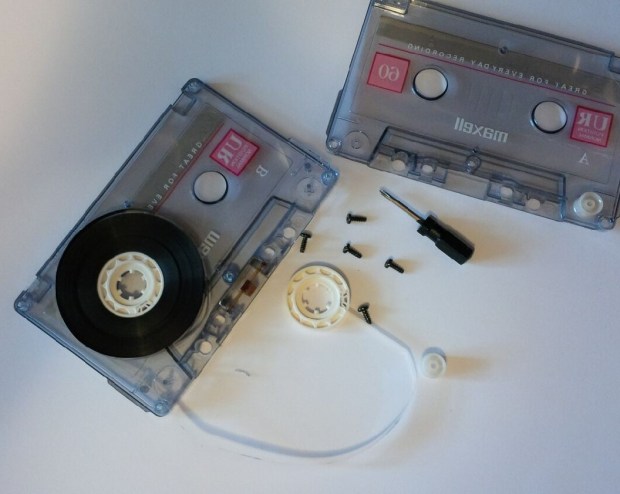
I miss opening up a new tape and seeing what colour or design the shell was.  Usually they were black, but as the 90s progressed they were frequently clear.  Some were white, and my Helix was glow-in-the dark!  With CD there was the occasional thrill when we got a picture disc, but soon that became the standard.  The clunky cassette, with its little wheels and windows, was physically just cooler than a CD and you didn’t have to be as careful.

The lyric sheets were easier to read.  All you had to do was unfold the J-card and lay it out.  CDs often had pages stapled into a little booklet that you had to hold open.  Cassettes may have had smaller print, but the paradox was that the format made it physically easier to read!

Cassettes were perfect for the pocket.  You could easily slide a couple (maybe even three) into a jacket pocket.  CDs never fit right and if you got one in your pocket, it was a tight fit.  And jewel cases were easy to crack and break.

That’s another thing!  Cassette cases had their weaknesses too.  They could crack like a CD case, and the little arms could snap off.  However this is far more common on the CD case, which also have those annoyingly fragile teeth that hold the disc in place.  Cassette cases were just slightly more sturdy than their CD counterparts.

Finally, cassette spines were wider and easier to read.  Period!

I do miss cassettes.  I have better equipment today, and though not an audiophile setup, I get by.  There are some releases I’d like to have on cassette again, or for the first time.  I guess I’m a changed man.  I’m not the format snob I used to be.  However, if they start jacking up the prices of cassettes the way vinyl is today, we’ll have to talk again.


REVIEW: Joe Satriani – Surfing With the Alien (1987, 1999 remaster, 2017 RSD 2 LP reissue)

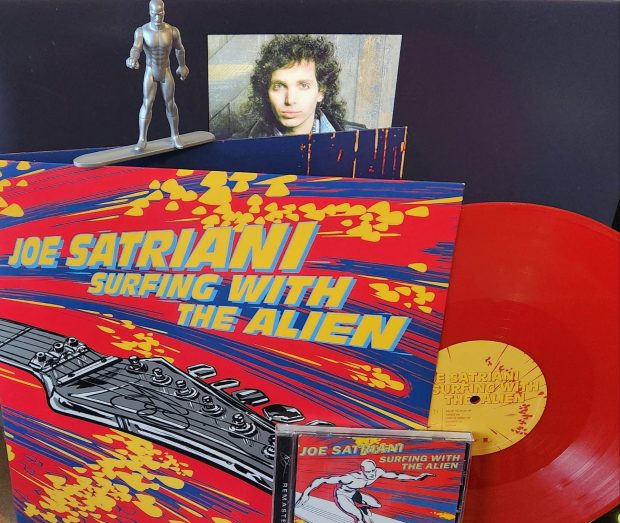
JOE SATRIANI  – Surfing With the Alien (1987, 1999 Sony remaster, 2017 RSD Epic 2 LP reissue)

On October 15 1987, the face of rock music was  shaken when a little instrumental album called Surfing With the Alien started making waves.  The record eventually went platinum, and its songs found itself used on radio and TV for decades to come.  Why?  Possibly because of Joe’s impeccable attention to songwriting.  Though his guitar playing put him on the map, it was his knack for writing catchy rock songs that made this album so special.  Satriani’s songs are written as if the lead guitar is the lead singer.  There are verses and choruses, and attention to structure and melody.  That must be why Surfing With the Alien was nominated for two Grammys in 1988.

Opening with the title track, a striking little chugging riff starts the show.  But then Joe’s melodic lead guitar kicks in, and you realize it’s exactly like if a singer was leading the show!  You can literally sing along to Joe’s guitar and a little wah-wah effect doesn’t hurt.  And then the shred begins, and you feel like, “OK, I get it now.  This guy is an actual genius.”

Yet it’s all accessible.  He may throw in licks as fast as greased lightning, but you can still follow.  Your brain still picks out notes and melodies that satisfy those musical needs.

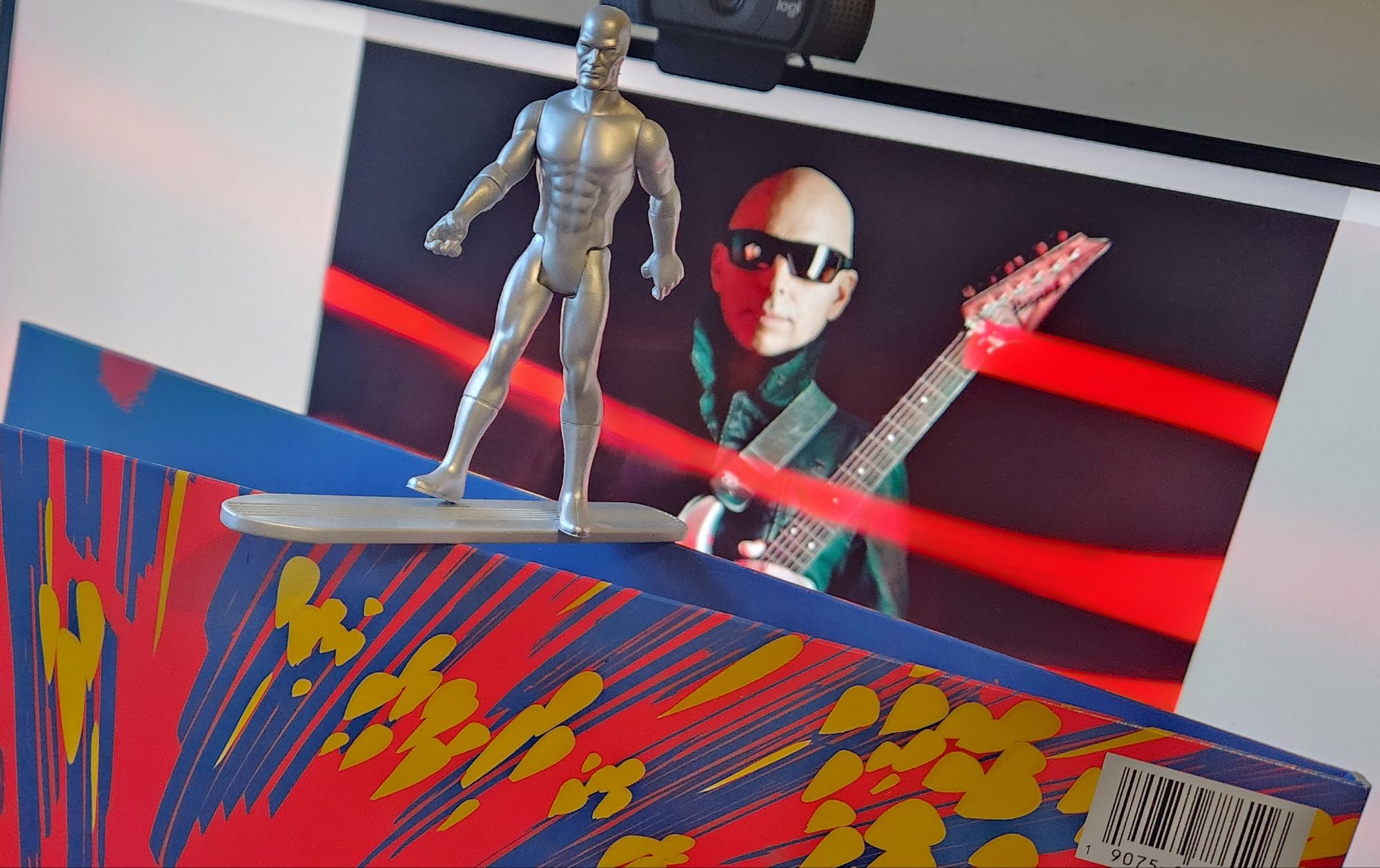
The cool “Ice 9” is a funky groove (Joe on bass) with a slick melody on top.  Joe can work with mid-tempo grooves just as well as high-speed blazes.  Solos with different sounds and guitar tones add diversity.  A fun tune, but the third song “Crushing Day” has more tension and urgency as the tempo is turned up once again.  The variety of solos, melodies and riffs in one short song is quite remarkable.  Joe’s guitar tone is bright and shimmery, like the Silver Surfer himself.

Incidentally, regarding the striking album cover featuring the titular Marvel character from Silver Surfer #1 (1982), Joe lost the licensing for him at some point in the 2000’s.  This is why the 2017 RSD reissue has different artwork, without him.  (Look carefully at the new art, and you will see that they replaced the yellow streaks with yellow guitar picks!)  Hopefully Joe doesn’t feel too badly about losing the Surfer art.  Marvel comics repaid him for the popularisation of the character outside the comic world by naming a planet after him.

The beautiful ballad “Always With Me, Always With You” might be considered the most famous song.  It received three Grammy nominations in three separate years (live versions, you see) and was prominently featured in an American Dad episode.  It is hard to describe exactly what makes it so special, without you listening for yourself.  The guitar is lyrical and memorable, and it worked so much better than it would have with a lead vocal.  This is an instrumental ballad, made magical.

“Satch Boogie” is arguably just as popular.  Deep Purple played it during the brief period when Joe Satriani was in the band post-Blackmore and pre-Morse.  It has been used on TV, radio and video games.  It is indeed a boogie!  It taps into the Van Halen vibe a-la “Hot For Teacher”, but burns straight through without stopping to talk.  Mid-song, there’s a jaw-dropping solo that is pure tapping nirvana.

An ominous and brief interlude (“Hill of the Skull”) paints an apocalyptic picture.  The programmed drums don’t detract, as it is all about the tale that the guitar is telling, with layered wails.  This serves to set up “Circles”, one of the most interesting tracks.  Echo is employed to great effect on this mellow but dark ballad.  Without pause, the striking chimes of “Lords of Karma” enter the picture, a pounding guitar rocker with drums by Jeff Campitelli.  (Drums on this album are a mix of live and programmed.)  Much like “Crushing Day”, “Lords of Karma” is a bit faster and more intense.

A lovely classical sounding interlude called “Midnight” sets up the final track.  “Midnight” features techniques that an expert will have to identify, except to say it sounds remarkable and innovative.  The spotlight is never really on Joe’s fingers though – just on the notes and sounds he magically produces with them (and an array of effects).  Then the thud of bass opens “Echo”, the last song on this important album.  It’s unlike the previous ones, with the bass so prominent.  The song sounds as if it’s always just bubbling under.  Perhaps it would come as a surprise that the final song on this album of guitar showcases is so much about feel and restraint.

That’s one thing about Surfing that does make it special.  Like any good album, it is sequenced as a full listen, not as a collection of shreds.  Even without the shreds, it’s still not bad.

That’s what the 2017 Record Store Day deluxe vinyl edition is all about.  A bonus LP is included, with all the lead guitar stripped off.  This allows you, the ambitious home player, to try to solo over the bed tracks.  For the rest of us, it just allows us to listen a little bit differently to an album that is very familiar.

The drums seem more prominent on the title track, allowing us to better hear Jeff Campitelli’s fills.  Mostly though, you can still bang your head, and maybe sing along to an imaginary vocal melody.  “Ice 9” is particularly fun in this guise, sounding a bit like an “80s dance remix” even though it’s not.  “Always With Me, Always With You” is still delicate and beautiful.  You get the picture.  These tracks, though needing the lead guitar to be whole, are perfectly listenable without.  Only “Circles” and “Midnight” seem completely barren.  You don’t have to be a guitar player to enjoy this bonus record.  You just have to be interested in music, and how it is constructed in the mix.  You can hear melodies and accents, even on “Always With Me”, that you might have missed on the album version all these years!

There are many ways to acquire copies of this impactful album, that opened the charts to Steve Vai and others a few years later.  There is a 1999 Sony remaster with liner notes and nice packaging.  There is a deluxe edition with a live DVD from the 1988 Montreux Jazz Festival.  The version with the most actual audio tracks, however, is the limited 2017 Record Store Day reissue.  You don’t get the lovely Silver Surfer artwork, but you do get the bonus record of stripped tracks, and red & yellow coloured vinyl.

No matter what choice you make, Surfing With the Alien in any form is an essential addition to a serious rock fan’s collection.  Some may argue it’s the best rock instrumental guitar album ever made.

5/5 stars


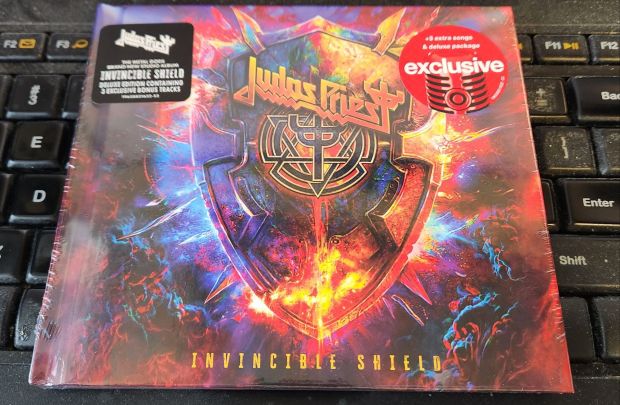
REVIEW: Judas Priest – Invincible Shield (2024 Deluxe with bonus tracks)

JUDAS PRIEST – Invincible Shield (2024 Epic Deluxe with bonus tracks)

I don’t usually write “first impressions” reviews, because I like the albums to have time to sink in, and to consider my opinions.

I’ll break some rules this time.

Invincible Shield tops Firepower and could be the best Priest album since Defenders.  Or maybe even before that…

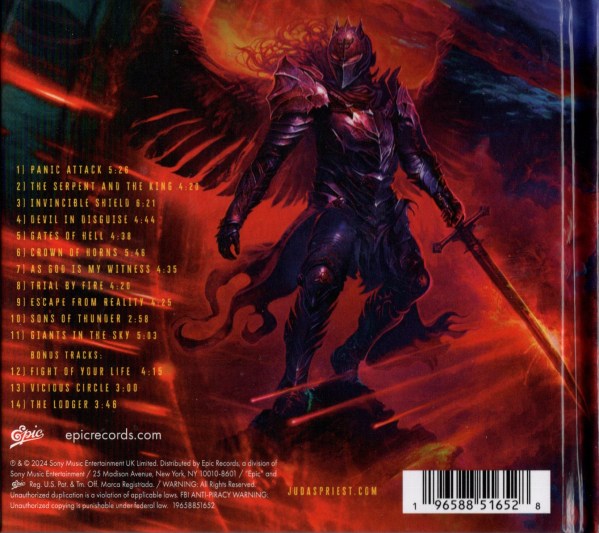
The highlights are many and the riffs are strong.  Rob’s voice has not changed in 20 years and he is still of the same power and range as Angel as Retribution.  As one goes deeper in, the songs continue to gain strength.  “Invincible Shield” didn’t really jump out at first, but does now with a very Maiden-y outro.  “Devil In Disguise” is another early highlight.  “Crown of Horns”, “Escape From Reality”, “As God is My Witness” are instantly likeable, with hooks aplenty and the odd adventurous lick or detour.  Richie Faulkner has been a godsend to this band, injecting them with new songwriting life, metallic riffs and speedy leads.  Meanwhile, you can hear Glenn Tipton too, illness be damned!  He trades off with Faulkner just as is Priest’s trademark.  The classical guitar solo on “Giants In the Sky” is something completely new for this band and a surprising delight.

Invincible Shield has most of the longer material stacked to the top of the album, with the short songs going on side two.  Even with 14 songs, the album is only just over an hour with bonus tracks, not overstaying its welcome, and inviting to repeated listens.  There’s no point in getting a version of this album without the bonus tracks.  You’d be missing out.  You can get them at Target, Sunrise, or Amazon in Canada.  They are “Fight Of Your Life”, “Vicious Circle” and “The Lodger”.  “Fight Of Your Life” might be the most necessary song of the album, as it really hearkens back to the early 70s albums like Sin After Sin.  It could be the deep cut of the record.

Lyrics have always been a shaky point in Priest history, and there are some cringey ones on Invincible Shield, but I doubt they will impede anyone’s enjoyment of this album.  It has summer written all over it, as we await the coming of the sun and the highway months.

Production by Andy Sneap sounds great to these ears, with Ian Hill’s bass rich and deep, and Scott Travis’ drums livelier than ever.  There are flashes back to the 70s and 80s, and some of Priest’s highest peaks of the past.

Martin Popoff may be right, but I’m not going as far as he did.  Still…

Album of the year.

5/5 stars

REVIEW: Def Leppard – Def Leppard (2015 Japanese + Classic Rock fan pack edition)

Part Forty-Seven of the Def Leppard Review Series

DEF LEPPARD – Def Leppard (2015 Sony Japan + Classic Rock fan pack edition)

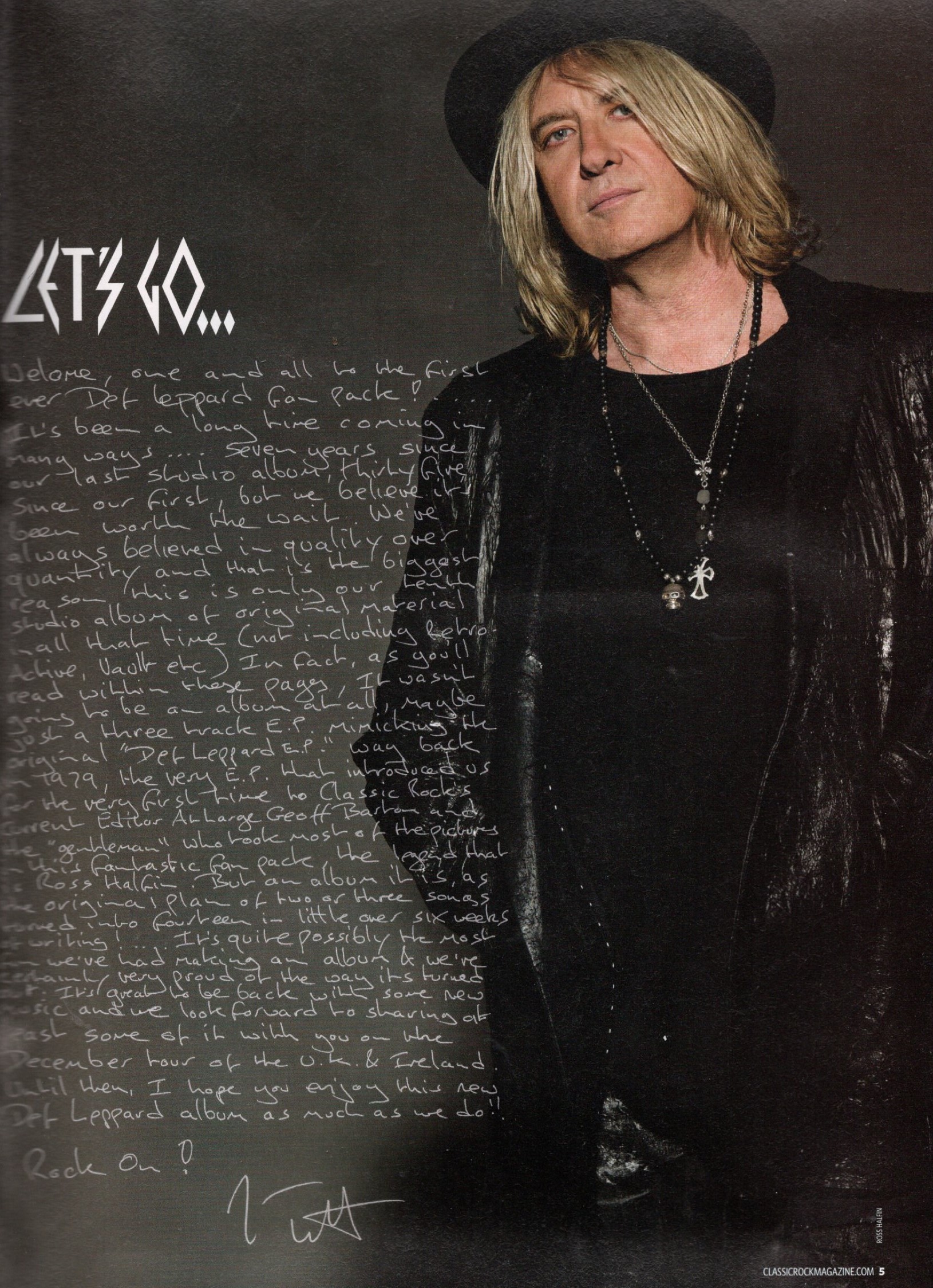
As with anything these days, you often have to buy multiple copies to get “all the songs” (only for them to be reissued in a box set later on).  The Classic Rock “fan pack” edition of 2015’s Def Leppard has plenty of bonuses (which we’ll get into) including two exclusive versions of songs.  The Japanese CD has an exclusive demo.  Gotta catch ’em all.

Def Leppard are in a comfortable niche now and their self-titled 2015 album easily could have been another “ia” titled construction, next to Pyromania, Hysteria and Euphoria.  Hell even 1992’s Adrenalize was originally to be titled DementiaDef Leppard is another “ia” album, but it’s notably closer to matching the quality of Hysteria better than most of their records since.  Upon dropping the laser after a long period of neglected, the album comes to life.  The hooks are remembered, and stand the test of time.

“Let’s Go” pretends to be another re-write of “Sugar” before going into an unexpected lush pop chorus.  Not a “Sugar clone at all, but something new for Leppard combining their trademark sound with bubblegum.  The Classic Rock fan pack comes with a bonus single edit, shorter by a minute.  “Dangerous” is straight-up Leppard, like “Photograph” or “Promises” all over again.  This song smokes, just like the previous hits in the same mold.

Funky Queen-like bass isn’t far out of Def Leppard’s range.  “Man Enough” is kind of goofy and might have worked better with just about any other lyrics.  When the song gets going, it starts to bang.  This is the kind of song that will divide people:  some will think it’s a highlight, others will say it stinks.

An album highlight is the first ballad “We Belong”.  It’s a gentle song recalling the softer moments on Slang, but what makes it unique is that all five Def Leppard guys sing lead vocals for the first time.  Truly an outstanding track, made more special by the vocals.  Even a non-fan can appreciate the different textures the voices add.  Phil is gritty, Sav is smooth, and they all bring extra dimensions.  Classic rock’s bonus tracks include an alternate version with just Joe Elliot singing.  It’s interesting because his solo take is different from the other singers.

“Invincible” is a rare Rick Allen co-write, a blazer like Pyromania-era Leppard, without the screaming.  That’s the only difference.  “Invincible” is otherwise vintage-style, including a quintessential Phil Collen guitar solo.  Moving on to “Sea of Love”, this one stretches out melodically.  The guitar riff keeps it rooted in Def Leppard, but the intro and chorus are something else.

The first mis-step is the ballad “Energize” which sounds like a Euphoria reject, something that came out of a computer.  Thankfully “All Time High” does the real energizing.  Back to a Pyromania style of rock, and the solos is right out of the 80s.

“Battle of My Own” is more like acoustic Led Zeppelin.  Quite unlike Leppard’s early acoustic experiments in 1992.  The psychedelic vocals and Zeppish riffs really set it apart.  This is definitely something that could have followed Hysteria, and probably right up the charts.

A fun rocker steals the “Don’t Shoot Shotgun” riff and turns it into “Broke ‘N’ Brokenhearted”.  There might be a touch of Leppard’s recent country influence coming through on the chorus.  This seamlessly goes into “Forever Young” which, in the past, might have been left as a single B-side.  A good B-side admittedly.  “Last Dance” goes back to acoustic, this time for a ballad like “Two Steps Behind”.  Don’t forget “Two Steps Behind” was a B-side as well, and “Last Dance” would probably work well in that format.  Interesting, the Japanese CD’s bonus track is a demo version of “Last Dance” with Rick Savage, its writer, singing lead.  This is probably the best of the two versions because on a long album like this, additional lead singers help keep things interesting.

Two songs remain, both unusual.  “Wings of an Angel” uses the penultimate slot to deliver a dark, understated rock song.  Then “Blind Faith” goes Beatles, with strings, bluesy guitars, and the kitchen sink.  Totally a “Walrus” kind of song.  A good closer, albeit very different for this band.

Sometimes I like to think of Def Leppard albums in terms of pre and post-Hysteria.  To me, Adrenalize was not the followup that Hysteria deserved and I think Def Leppard knew that.  Adrenalize was more like a bonus disc, or a Reload to the original Load.  Because of the sad passing of Steve Clark, the band had to deliver and so they kept things safe.  But Leppard are an experimental band, and if they weren’t dealing with another series of hardships, I think they would have progressed beyond Hysteria.  They did on Slang, but by that time grunge had washed the slate clean and Def Leppard made their sound more alternative and more organic to adapt.  Slang was not the sequel that Hysteria would have got either.  Maybe Def Leppard is the closest we have to a proper followup.

4/5 stars


Previous:  

  1. The Early Years Disc One – On Through the Night 
  2. The Early Years Disc Two – High N’ Dry
  3. The Early Years Disc Three – When The Walls Came Tumbling Down: Live at the New Theater Oxford – 1980
  4. The Early Years Disc Four – Too Many Jitterbugs – EP, singles & unreleased
  5. The Early Years Disc 5 – Raw – Early BBC Recordings 
  6. The Early Years 79-81 (Summary)
  7. Pyromania
  8. Pyromania Live – L.A. Forum, 11 September 1983
  9. Hysteria
  10. Soundtrack From the Video Historia – Record Store Tales
  11. In The Round In Your Face DVD
  12. “Let’s Get Rocked” – The Wait for Adrenalize – Record Store Tales
  13. Adrenalize
  14. Live at the Freddie Mercury Tribute Concert
  15. Retro-Active
  16. Visualize
  17. Vault: Def Leppard’s Greatest Hits / Limited Edition Live CD
  18. Video Archive
  19. “Slang” CD single
  20. Slang
  21. I Got A Bad Feeling About This: Euphoria – Record Store Tales
  22. Euphoria
  23. Rarities 2
  24. Rarities 3
  25. Rarities 4
  26. Cybernauts – Live
  27. Cybernauts – The Further Adventures of the Cybernauts (bonus disc)
  28. X
  29. Best Of (UK)
  30. Rock Of Ages: The Definitive Collection
  31. Yeah!
  32. Yeah! Bonus CD With Backstage Interviews
  33. Yeah…Nah!  (Record Store Tales)
  34. Songs From the Sparkle Lounge
  35. “C’Mon C’Mon” (picture disc)
  36. Taylor Swift & Def Leppard – CMT Crossroads (DVD)
  37. B.Sides
  38. Yeah! II
  39. Yeah! Live
  40. Mirror Ball: Live & More (Japan bonus track)
  41. iTunes Re-recordings
  42. Viva! Hysteria (DVD and CD 1)
  43. Viva! Hysteria (CD 2 and Bonus features)
  44. Viva! Hysteria (Japanese import)
  45. Slang (2014 Deluxe bonus tracks)
  46. “Helen Wheels” (from The Art of McCartney)

Next:  Thanks for reading!


#937: Bop Was Right: The Best Cassette I Ever Heard

“I agree that most cassettes and decks were crap, but the high end ones such as Nakamichi, Tandberg, Revox, Luxman etc. sound awesome and make great recordings.  The other thing is you can get decent audiophile quality cassette players for a good price, and the cassettes are cheap.” Boppin, August 13 2015


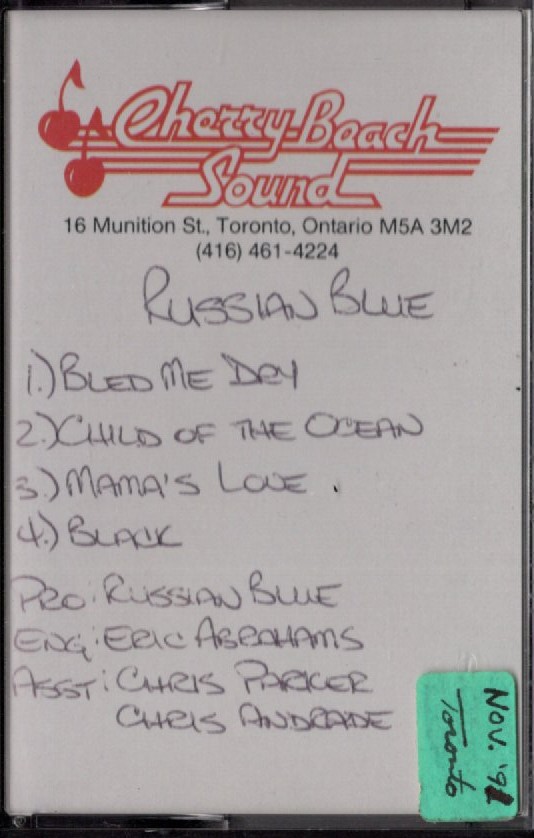
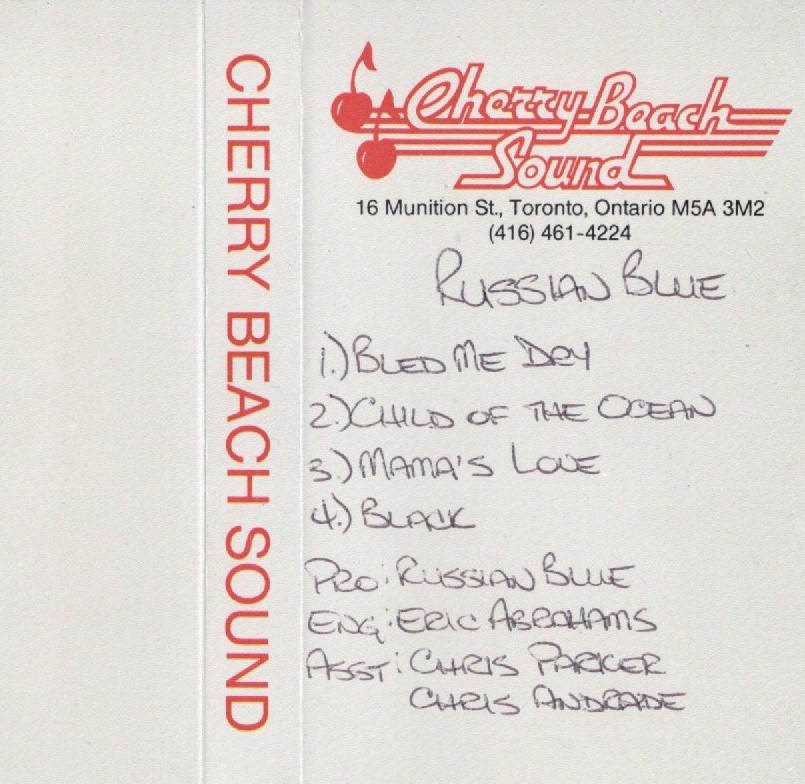
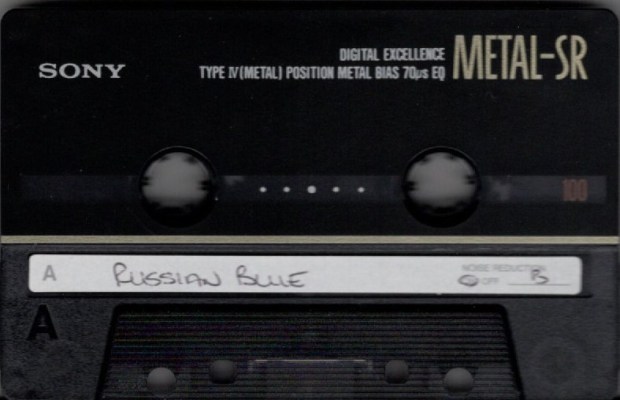
I recently purchased a couple cassettes from Drew Masters of M.E.A.T Magazine, from a band he was involved with at the time.  A band I like a lot called Russian Blue.  It’s a demo they recorded at Cherry Beach Sound studio in Toronto in November of 1991.

Even on my Technics RS-TR272 tape deck that badly needs a servicing, I can hear that it’s the best cassette I’ve ever played.

It’s loud.  Much louder than any other cassettes.  And it’s clear.  Barely any hiss even on this machine.  The dead spots between songs are quiet.  I’ve never heard a tape like it.

The reasons for this are two-fold.  One is that the cassette is a Sony Metal-SR 100, Type IV.  Not top of the line but not a bad tape at all.

Second is that this tape comes direct from the desk of Cherry Beach Sound, a professional recording studio.  Noise reduction set to “B”.  Their recorders are far better than anything I’ve had access to in my life, and certainly superior to the stuff they make mass-produced commercial tapes with.

What can I say?  Bop was right all along.  Cassettes don’t have to sound like shit.  I’ve been schooled.

REVIEW: Journey – Greatest Hits (1988, 2008)

JOURNEY – Greatest Hits (Originally 1988, 2008 expanded reissue)

It’s OK if your first album by anybody was a “greatest hits” of some sort.  Over 15 million people bought Journey’s Greatest Hits in the US alone, and you can be guaranteed that several of those millions were buying Journey for the first time.  Hundreds of thousands more copies still sell annually.  This has to be considered one of the most successful hits compilations by a rock band.

Even if you were a Journey diehard back in 1988, you still wanted Greatest Hits.  It had two huge Journey hits from movie soundtracks:  “Only the Young” (Vision Quest) and “Ask the Lonely” (Two of a Kind).  These songs were not meant to be obscurities; both were slated for the Frontiers album.  These are two awesome songs with insanely catchy choruses, one a rocker and one a soft burner.  Two gigantic peaks of the Jonathan Cain era of Journey, who co-wrote both songs.

“Don’t Stop Believin'” doesn’t need any additional commentary, except this:  listen to the drums.  That’s Steve Smith, the wizard of tempo.  There is a reason that Smith can often be found filed in the Jazz section.  Listen to his creative hits, cymbal work, and timing.  Yet not a lot of snare.  Same with “Separate Ways (Worlds Apart)”.  This is not typical rock drumming, and this is something that his replacements have had to recreate as faithfully as they could.

Greatest Hits ignores the first three Journey albums (pre-Steve Perry), and justifiably so.  Those first three progressive rock albums, as fascinating as they are, bore no hits.  “To Play Some Music” peaked at #138.  The earliest tracks are the radio staples “Lights” and “Wheel in the Sky” from 1978’s Infinity.  Incidentally these are the only tracks without Steve Smith, featuring his predecessor Aynsley Dunbar.

In 2008, Sony a series of budget-priced reissues including Journey’s Greatest Hits.  This version has one additional bonus track from Journey’s reunion album Trial By Fire from 1996.  This is a fantastic album, but the ballad chosen (“When You Love a Woman”) tips the album too far on the scales to ballads.

Through all the hits you know, and maybe a couple you don’t (“Girl Can’t Help It”? “Send Her My Love”?) you will get a clear picture of some of Journey’s facets.  But only some.  Little of their instrumental wizardry, which continued into the Steve Perry era with songs like “Dixie Highway”.  You also will not hear many hard edged moments, like “Stone in Love”.  You will however get a taste of Steve Perry’s soul, and the excellent hooks that he concocted with Neal Schon and Jon Cain.  You will absorb some awesome Schon tone.  On the later tracks, like “I’ll Be Alright Without You” and “Be Good To Yourself”, you will hear the slickness and groove of Raised on Radio.  But there are so many more key Journey tracks, as good if not better than these.

4/5 stars

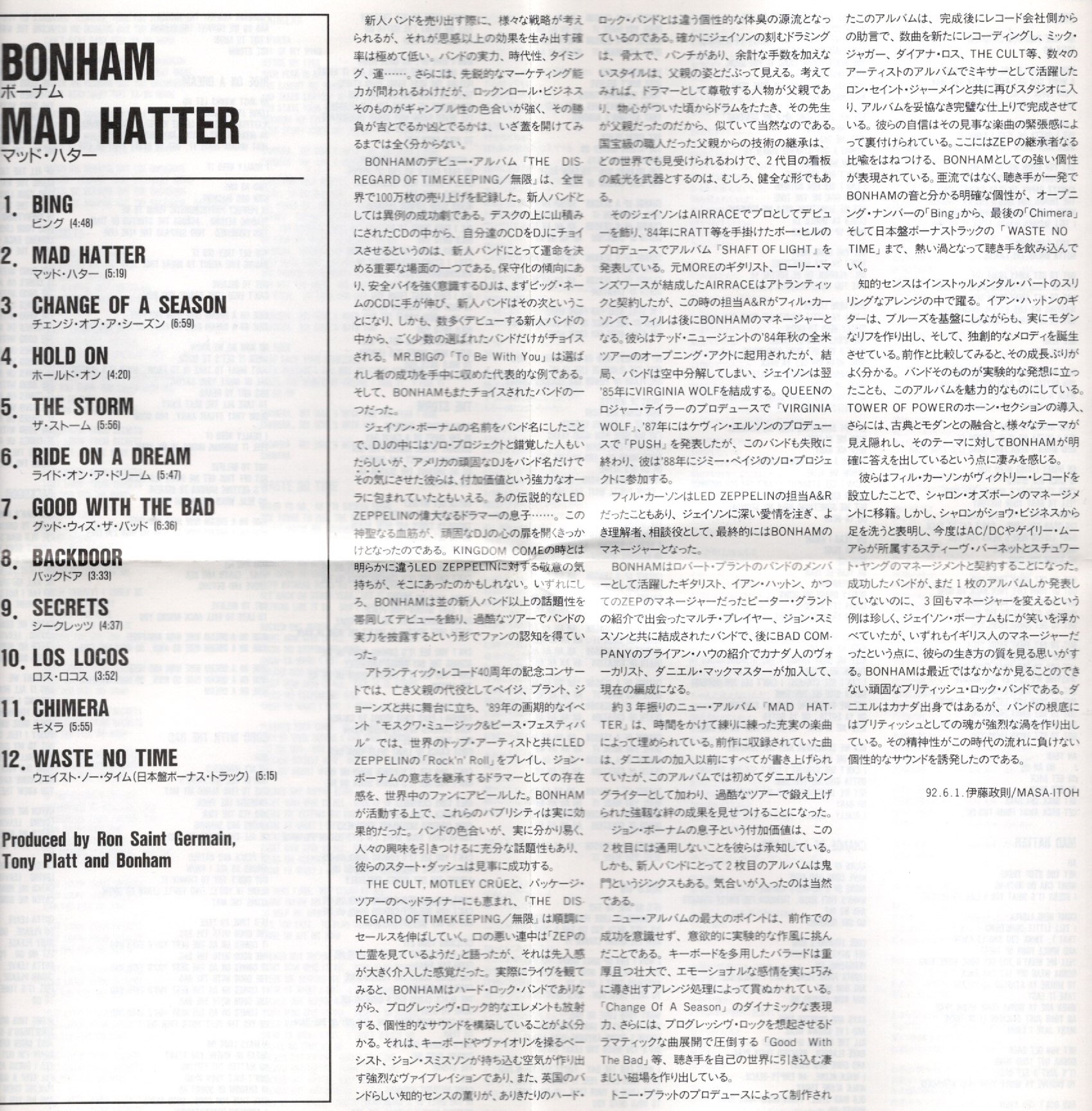
REVIEW: Bonham – Mad Hatter (1992 Japanese import)

BONHAM – Mad Hatter (1992 Sony Japan)

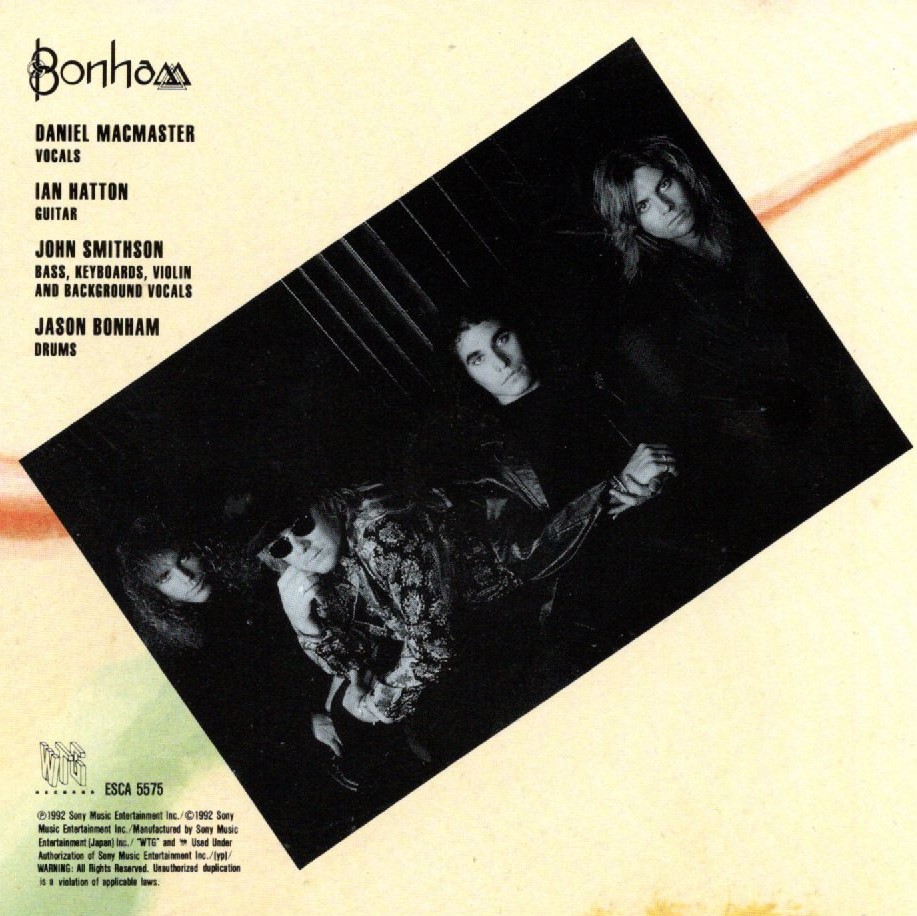
The first Bonham album in 1989 was a critic’s darling.  Produced by Bob Ezrin, it sold well enough and made plenty of year-end lists.  For the year 1989, it was a breath of fresh air compared to the Motley Crue, Bon Jovi and Def Leppard tracks dominating the airwaves.  Those who thirsted for the rarified air of Led Zeppelin got some of that with Jason on drums and the incredible Canadian Daniel MacMaster on lead vocals.  It was easy to imagine that “Wait For You” was a new Zeppelin single built for that year.  But every band has to grow, and where would Bonham take it?  Further down the Zeppelin road, or try and find their own identity?

Bob Ezrin did not return, and most of the followup album Mad Hatter was produced by Tony Platt, with the rest produced by Ron Saint Germain.  The band grew from the debut, establishing more of their own groove.  It was a more diverse and challenging platter.  Unfortunately, the album arrived in 1992, amidst the Pearl Jams, Soundgardens, Nirvanas and the rising tide of grunge.  Despite the strong single “Change of a Season”, the album tanked.

What an opener “Bing” is, a word that doesn’t seem to be in any of the lyrics.  At first, it has a very old school Zeppelin groove, akin to “Candy Store Rock” meets “Black Dog”.  But then it goes to a completely different place on the chorus.  The sonics are clearer and sharper than the debut.  Jason’s drums are huge as the should be.

Yet it’s the title track that really shocks the system.  Opening with a blast of horns, “Mad Hatter” goes one of the few places Zeppelin never went:  full-on funk with horns.  This would be the Tower of Power horn section.  It would be lazy to compare “Mad Hatter” to “Get the Funk Out” from a couple years past, as it has its own vibe.  Ian Hatton on guitar proves himself to be diverse talent with licks-o-plenty.

Another direction is explored on “Change of a Season”, the shoulda-woulda-coulda single that would have been huge a year or two prior.  The melancholy ballad was simply the wrong temperature for 1992. The gothic tone of the video was cool, but the video got zip for airplay.  It’s the backing strings (synth) and epic chorus that make this song.  It sounds less like Zeppelin and perhaps more like something from David Coverdale’s Reptile Emporium.

Another cool direction is explored on “Hold On”, a unique song with elements from multiple genres.  Funk, soul, progressive, blues, and even bluegrass.  This is followed by another song with epic overtones, “The Storm”, a six minute track that takes the Zeppelin influences to the craggy progressive peaks of another land.

Although there’s no side break on a CD, there are a natural place for it as you can pause for a breath before plunging into “Ride on a Dream”.  A breaknace pace and metallic riff make it unlike anything else on the album.  Perhaps a band like the Scorpions could do “Ride on a Dream”, but even Klaus would be challenged by the outstanding MacMaster lead vocal.  This plutonium-fuelled track would give anyone a run for their money.

But after all that drama, you need something a little more laid back.  That would be “Good With the Bad”, a jazzy piano ballad and the longest song on the album.   It doesn’t remain in ballad territory forever, going to the swamps of Florida where Savatage reside halfway through.  The comparisons are easy to hear.  Next, we go to a bluesy, funky blast of Zeppelin-flavoured ale on “Backdoor”.  Another cool tune with a different vibe from the others.  Things drag a bit on “Secrets”, which tries to marry the funky side with a “Kashmir”-scale chorus but doesn’t really follow through.

Moving on to the end, it’s “Los Locos” in second to last position.  This is a tender blues guitar/violin instrumental with dark piano accents.  That would be bassist John Smithson handling those wicked violin licks and a lot of the keyboards.  Perfect track for this spot, setting up for the closer.  It’s up to “Chimera” to take you out, and it does with a shiny upbeat vibe.  Although it’s probably sheer coincidence, it sounds a bit like Marillion circa the same period.

Lo and behold, that is not all!  The Japanese fans got a little bonus on their CDs called “Waste No Time”.  It’s definitely not an also-ran.  It has a heavy bass groove that isn’t like the other tracks on the album.  MacMaster really lets it blast on the chorus too.  Definitely Zeppelin vibes come solo time.

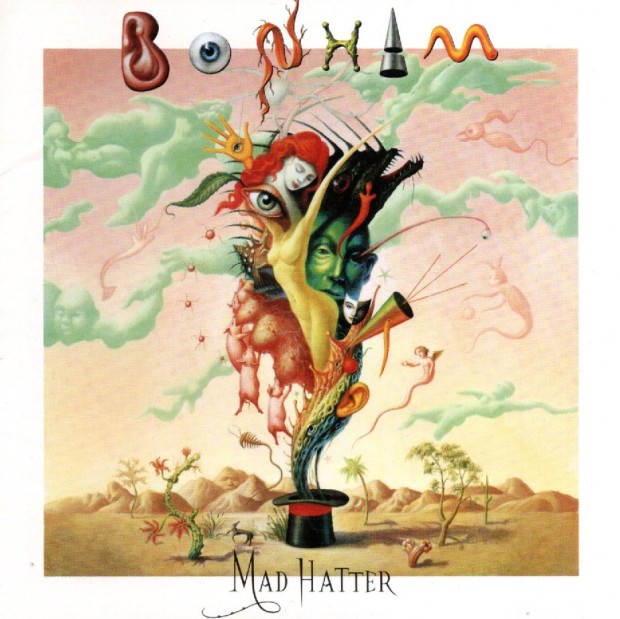
This album was available with two covers.  The majority of copies have the surreal Dali-esque landscape that you see here.  The alternate cover was plain white with just the new Bonham logo.  Which looks rather silly without the proper cover art for context.  That’s the cover that retailers such as Columbia House sold in the 1990s.

In 1994, Jason Bonham reconvened with Ian Hatton and John Smithson, but not Daniel MacMaster.  The new singer was Marti Frederiksen — yes, that Marti Frederiksen, the one that writes massive hits for everyone today.  The band took on a new modern grunge sound, and renamed themselves Motherland.  ☮︎ For Me was the pretentious name of that album.  As a sad final coda, Daniel MacMaster died too young at age 39 from a strep infection that he thought was a cold.

At least we can say that Bonham with MacMaster really did outgrow the Zeppelin tag by the second album.  Still a part of the DNA, but expressing itself more rarely.  It’s a shame about the timing of the album, because had it sold like the first one did, maybe we wouldn’t have had the Motherland debocle.  Mad Hatter is a pretty fine second album that does all the things that second albums should do.  Shame it was the last.

3.75/5 stars

#886: Hand Me Downs

RECORD STORE TALES #886: Hand Me Downs

It’s funny.  Though my music playback setup today is completely different from my first, even today there’s still one thing they have in common:  both setups featured hand-me-down audio components from my parents.  And I hope one of those components continues working forever.

In Getting More Tale #796: Improvisation, I explained that we kids of the 80s didn’t have the luxury to buy whatever stereo equipment we wanted.  We had to make due with what we had, and improvise.  And that’s exactly what we did.  When I first started collecting music, I owned it on two formats only:  LP and cassette.  The classic duo.  Compact discs existed only in Japan.  We hadn’t even heard of them.  All that existed in our world were the vinyl record and the compact cassette.  That’s all I needed to be able to play.

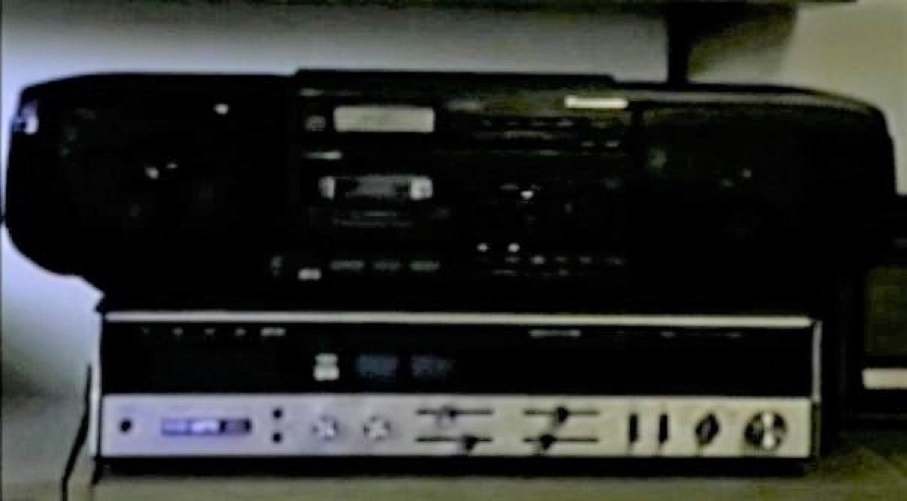
Around 1985, my parents realized they weren’t going to be listening to records or 8-track tapes anymore.  The living room needed to be renovated and there was no more room for that giant Lloyd’s stereo system.  The 8-track player didn’t work anymore, but it was a single unit combined with a radio receiver and amplifier, which still worked fine.  The Lloyd’s record player could still plug into it and play normally.  I snapped them up.  Only George Balasz and myself were lucky enough to have record players in our bedrooms.  Everybody else on the street had to use their parents’ systems.

Don’t get me wrong:  it didn’t sound great.  I took my parents’ hand-me-downs and plugged them into my Panasonic ghetto blaster, which essentially was both my tape deck and speakers.   Not ideal, but good enough for a 13 year old.  I recall the sound was rather tinny.  But it worked after a spell.  If my mom wanted me to tape her old Roy Orbison LPs, I could do that.  (Spoiler:  my mom really abused her LPs.)
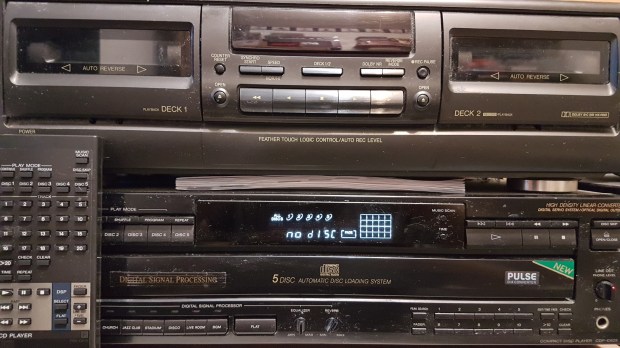
I used that setup for many years.  The Lloyd’s receiver lasted seven more.  It finally blew a circuit in early ’92.  A few weeks later, I replaced it with a small, affordable preamp.  It didn’t have a lot of power, but it enabled me to continue listening to records.  Of course, that old Lloyd’s turntable wasn’t in the best shape anymore.  The needle had never been changed, and I had really abused that thing, playing records backwards and trying to make funky sounds.  It was cool though, because it had four speeds:  16, 33, 45, and 78.  I didn’t own any 16’s or 78’s.  But I could play them.  And I kept it for well over a decade.  I only replaced it when I did a complete stereo system overhaul in the late 90s.  T-Rev and I went to Steve’s TV, and I picked out new everything.  Canadian made PSB speakers, a new Technics dual tape component, a Technics receiver to go with it, and a brand new Technics turntable.  Good enough for me, who had been living with a Frankenstein system his whole life.

The only thing I didn’t need to buy was a CD player.  And this is the last piece of hand-me-down tech incorporated into my still-current system.  (I actually have two systems today:  my 7.1 setup in the main room with blu-ray, and my stereo “man cave” with all my analog stuff.)

I call this CD player “the Tank”.  It is a 30 year old Sony five-disc changer and I more or less confiscated it from them when I moved out.  Once they had a DVD player, I didn’t think they needed a CD player anymore, so I made the executive decision to liberate it.  It wasn’t exactly a covert operation.  The Sony had been in my bedroom setup for a while.  I liked a numbers of its features.  It had a fader!  I could fade tracks in and fade out, which was perfect for recording live albums.  The timer was also a nice extra — you could use it to monitor the time remaining on a track, or even album.  This was great for tape-making.  It was also painlessly easy to program.  So I stole the Sony!  When I moved out, I just said “I’m taking this CD player.”  Mom grumbled a bit, but…here it is.  I successfully abducted my parents’ CD player with no casualties.

I’m glad I did.  Though the five-disc gimmick doesn’t work so smoothly anymore, the Tank can play any CD I throw at it.  That might not sound like a big deal, but it is.  You’d be surprised how many CDs you’ll have problems playing in your computer today.  Some players, and many computers, still won’t play weird stuff like DualDiscs.  I have an old DualDisc by The Cult that will not play properly in any computer ever invented by mankind.  Even regular CDs can be weird.  I have a Cinderella disc (multiple copies even) that no computer from PC to Apple will play correctly.

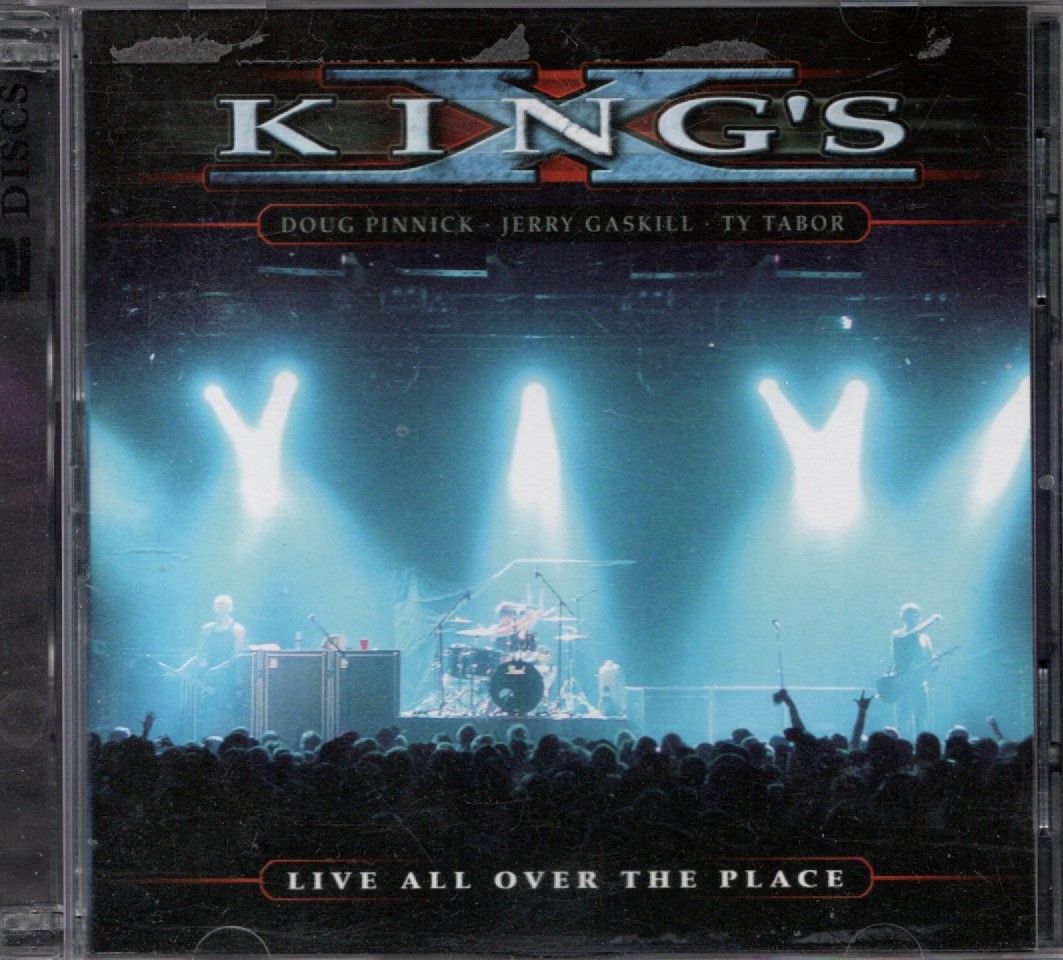
So I need the Tank.  Just recently, I was listening to a fantastic live album by King’s X given to me by Superdekes.  The last song (an acoustic version of “Over My Head”) refused to rip to my PC.  I booted up the laptop and ran into the same problem, same spot.  I didn’t need to try a third computer to know that this would be futile.  Only the Tank could play my King’s X.  I examined the CD up close for damage and saw nothing.  (Good thing too as copies today run just shy of $100!)  Deke sent me a good disc (and thank you once more for that!), but CDs can be fickle.

No issue with the Tank.  I powered up the Sony, inserted the King’s X and played the song through.  No issues!  I got a good recording of it in Audacity and exported the audio into the King’s X album folder.  Seamless!

Thanks mom and dad for giving me, and in some cases, allowing me to steal your stuff.  I kept it all working — I even still have the remote!

REVIEW: Alice Cooper – Classicks (1995)

ALICE COOPER – Classicks (1995 Sony)

Here’s a bargain basement perennial that you may have missed but might want to reconsider. If you like Alice Cooper — specifically the five year span of 1989-1994 — then this compilation is for you! If you collect Alice Cooper — specifically rare live tracks that have been released on VHS but mostly unavailable on CD — then this compilation is for you!

Classicks isn’t a particularly bad CD, but its limited focus means limited appeal.  Sony only had the rights to a smidgen of Cooper albums so they made due with what they had.  That meant the albums Trash, Hey Stoopid and The Last Temptation, and the home video Alice Cooper Trashes the World.  Of those releases, only The Last Temptation is really given any kind of critical acclaim today.

Classicks begins promisingly enough.  “Poison” is indeed a classic, thanks to that lush Desmond Child vocal production.  The hooks never stop, but “Poison” is the only bonafide classic on the Trash album.  Nothing else comes even remotely close, though “House of Fire” (written by Bon Jovi for New Jersey) has its moments.  Missing is the ballad “It’s Only My Heart Talkin'” with Steven Tyler cameo.

Hey Stoopid‘s guest-laden title track lead single was phenomenal, if not quite as awesome as “Poison” from TrashHey Stoopid was a bit tougher in stature than Trash, and a couple more singles can be found here:  “Love’s a Loaded Gun” and the absolutely massive “Feed My Frankenstein”.  You can thank Wayne and Garth for that one; there is no other way that song was going to be a hit in 1992.  But it was, and you can quote every word of that Wayne’s World scene.  I know you can.

The material from The Last Temptation has stronger bones but not as many candy-coated hooks.  Three tracks total:  smoking first single “Lost In America”, ballad “It’s Me”, and the epic Chris Cornell duet “Stolen Prayer”.  While all three are good ones, “Stolen Prayer” is truly special.  Chris (who wrote the track with Alice) was in peak voice and when he lets it rip at the end, hold on!  An acoustic-electric classic, worthy of far more attention than it gets.

The rest of the CD contains live versions from Trashes the World, all oldies that Sony didn’t have access to otherwise.  The lineup here features some of the guys you saw in Wayne’s World, such as Al Pitrelli & Canadian Pete Friesen (guitars) and keyboardist Derek Sherinian.  Tommy Caradonna and the inimitable Jonathan Mover are the rhythm section for these tracks.  All tracks have those telltale 80s guitar accoutrements.  “Under My Wheels” is rendered a bit faster than usual, but the guitar solos shred.  Likewise with “Billion Dollar Babies”.  “I’m Eighteen” is slower and brooding.  Alice’s opening rap to “No More Mr. Nice Guy” is a gas, although the song’s played a little heavy handedly.  “Only Women Bleed” is reliable, and “School’s Out” is “School’s Out” is “School’s Out”.  “You better know this one,” as Alice says.

Tacked on at the end is Alice’s cover of “Fire” by Jimi Hendrix, not to be confused with his cover of “Fire” by The Crazy World of Arthur Brown.  This B-side (to “Love’s a Loaded Gun”) wasn’t the best B-side available (that would be “It Rained All Night”) but at least it’s full of energy.  Whoever that is on guitar (Stef Burns?) rocks.

It’s obvious from the tracklist that this album was just Sony trying to cash in.  Cooper’s contract must have been up.  They tossed in the six live tracks to lure in any collectors who wanted them on CD rather than VHS.  Classicks can often by found brand new in the $5 range — pay no more than that.

2/5 stars