Guest Post

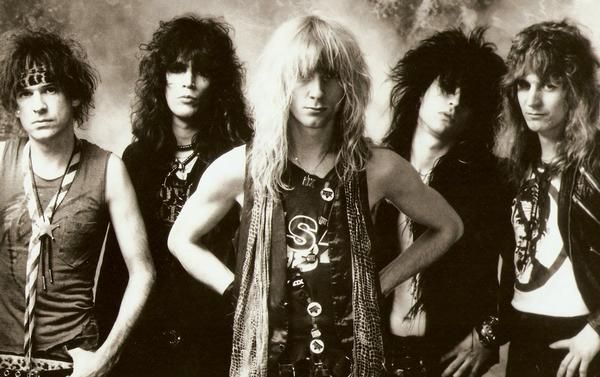
GUEST REVIEW: Kix – Blow My Fuse (1988)

Guest review by Holen MaGroin – part 4 in his KIX series

KIX – Blow My Fuse (1988 Atlantic)

When Kix released their fourth album on Atlantic, the band would finally receive the recognition and popularity that they deserved. Blow My Fuse is one of the most fun hard rocking albums of the late ‘80s without the guilty feeling that you get listening to the other “hair bands” that were dominating MTV. You could blast this record in a way that you couldn’t with say, Warrant, and not care who heard you, because Kix aren’t a hair band. They’re a hard rock band. These glorious Maryland hicks with a collective explosion fetish crafted a glorious hard rock album in the mold of AC/DC, with the pop hooks necessary to get proper attention on the radio, without ever watering down the rock. Produced by Tom Werman (with help from Duane Baron and John Purdell), Kix finally teamed up with a production team that knew how to turn their material into charting hits without diluting it.

Album opener “Red Lite, Green Lite, TNT” displays Jimmy “Chocolate” Chalfant reclaiming his territory after an Anton Fig substitution due to a broken arm on the end of the last album. Pounding away with a simple but effective beat, he sets the stage for the duo of Brian Forsythe and Ronnie “10/10” Younkins to blanket the track with midrange guitar goodness. The production on this album is really outstanding. The power of Kix clearly shines through, but with a new sheen to polish some of the rough edges. Steve Whiteman builds anticipation with restraint in his singing at the beginning of the song. Kix are masters of both tension and dynamics. They know just how long to string the listener along before delivering the heavy payoff. The twin guitar duo comes in with the song’s main riff, and Steve Whiteman pumps on the gas taking his vocals full throttle with rasp and power. Note the background vocals before the chanted chorus, which add some killer harmonic melody to the blistering hard rock. A call and response section between the harmonica and the guitar build off each other to end the song leaving the listener with his ass bruised and sore from being kixed for four euphoric minutes.

After taking a minute to ice the destroyed rectum, “Get It While It’s Hot” starts with a synthesizer run and some backwards vocals that recall their new wave roots. However, this is a clever ruse. Soon the guitars come in and betray the intro. This is another full on rock tune with the drums really in the driver’s seat during the verses. The guitarists play a few chords, rest, and then play a few chords, then rest; each phrase expanding upon the last to complete the picture at the end of five measures. It’s a tension building technique Kix would use again. The chorus drastically changes things up, but the energy level doesn’t dip at all. At this point we’re greeted by the song’s hook. With some era appropriate multi-tracked backing vocals, it drives the point across well.

Even with all the fantastic tunes, the reason that this album went platinum was because of the ballad “Don’t Close Your Eyes”. A number eleven hit in America, the song put the band on map, and on MTV. However, it wasn’t originally released as a single. When Kix were on tour with Great White, their manager Alan Niven asked the band why the song hadn’t been released as a single. Niven, despite being the manager for Great White, called up Doug Morris (president of Atlantic Records at the time) and told him they were sitting on a massive hit. They released it, and the rest is history. As for the song, it’s not a typical fluffy power ballad of the late ‘80s. It has more in common with “Dream On” than it does “Home Sweet Home”. The song is an anti-suicide PSA, a reassuring topic that proved Kix had more on their mind than just sex and explosions. It’s a great song, haunting and emotional. The lyrics and the conviction with which Whiteman sings them makes the hairs on your arm stand up. “Don’t Close Your Eyes” is a powerful song that has probably saved more than one or two lives as well, and is one of the most respectable power ballads of the 1980s.

But who cares when they’re singing about sex when the music backing it is of such high caliber? “Cold Blood” was the first single, and it sold much better after “Don’t Close Your Eyes” became huge. This song deserved to be a huge hit. It’s a stone cold classic. Starting out with a riff sounding like Electric-era The Cult, and progressing to total pop harmony payoff, this one is definitely one of the band’s best tunes. It also received moderate MTV airplay, and became the band’s second most popular song, a place only challenged by the album’s title track. A very fun and electrifying number about singer Steve Whiteman getting his fuse blown, his tower shook, his wires crossed, his hair lit up, his senses overloaded, and his juice felt. The lyrics speak for themselves; this one is another genre classic.

The album is rounded out with several other dynamic hard rock tunes, and a supernatural ability to insert pop melodies into them without diminishing the power one iota. There is no filler on this album, every song is a keeper. A 30th anniversary edition remixed by Beau Hill was announced earlier this year. Start off with the original that has been serving the public well for three decades now. If you were only to buy one Kix album, this is the one.

5/5 stars

GUEST REVIEW: Kix – Midnite Dynamite (1985)

Guest review by Holen MaGroin – part 3 in his KIX series

KIX – Midnite Dynamite (1985 Atlantic)

In 1985, Kix returned after two commercially unsuccessful albums, with what they consider to be their magnum opus, Midnight Dynamite. This is where the new wave styles of the first two records take a backseat to the hard rock influences. Later on, they’d completely shun their new wave influences by kicking them out of the car, and making new wave watch hard rock shag its girlfriend. For now, the blend was still somewhat apparent, but with the mix changed.

Produced by Lebrain’s favorite producer of all time (Beau Hill), Midnight Dynamite definitely sounds like its era, much more so than the debut or Cool Kids. For the first time we get some electronic percussion thrown into the mix and it is the first album by Kix to feature synthesizers in a prominent role. This could have been disastrous, but luckily Kix utilizes them to color the sound and they don’t diminish the hard edge of the guitars one iota. This is a hard rock record first and foremost, and with Ronnie “10/10” Younkins back in the mix, the guitar duo of the first album is reestablished. Pressured once again to work with outside writers, the primary guy for the job is Bob Halligan Jr. If the name sounds familiar, it could be because he wrote two songs for Judas Priest (“Take These Chains” & “Some Heads Are Gonna Roll”), and co-wrote with Icon on their second album Night of the Crime. Boasting some impressive credentials, the songwriting takes a step up this time around. Nearly all the songs are collaborations between bassist Donnie Purnell and Halligan.

The album is jump started by the title track. A slow and heavy number, it was a bold choice to open an album with.  Fortunately for Kix, it completely works. The intensity of the verses builds up tension for the ridiculously catchy harmonies in pre-chorus, where we finally get the big payoff during the chorus. This is melodic hard rock done right, without the frills that are usually associated with AOR or other bands of the time period. Kix made sure that the material had balls, something that many other bands of the time period eschewed for chart success. The intensity of the title track is followed by the erotic “Red Hot (Black & Blue)” with a sleazy stuttering riff. The production on this song is a little heavy handed with the reverse reverb in the verses, but it’s nothing that ruins the impact. Another song with dynamics, the verses stutter along with spunk, until the chorus where that Kix fire is unleashed. Some pretty cheesy lyrics, but if you weren’t prepared for that then why would you be reading a Kix review?

One of Beau’s buddies Kip Winger earns himself a writing credit on track number 3, “Bang Bang (Balls of Fire)”. As you can tell by the title, it’s one of the more generic rock songs on the album. It’s one of the least substantial, but it’s still an enjoyable tune. “Layin’ Rubber” is much better, as all the elements that make up the Kix sound are blended masterfully. Obviously more hard rock orientated than material of the past, the track features bubblegum pop chants before launching into a hard rock riff, while the intensity of the music elevates as the song goes on. Each section of the song’s structure is composed to perfectly transition into the next. One of the best tracks on the album, it manages to be damn brutal, and also catchy as shit.

The rest of the album proceeds in this manner, blistering hard rock tunes with undeniably catchy melodies that are never too sugary enough to make you sick to your stomach. There is only one ballad “Walkin’ Away”, which is built on synthesizers, but has enough of a kick to be enjoyable. “Cold Shower” was the other single, which features some rap like vocals in the verses and singer Steve Whiteman hitting some glass shattering notes before the chorus. It’s one of the most eccentric tunes on the album, and I’m surprised it was picked as a single.

Surprising songs or not, this album is one of the most underrated of the era. It’s a mystery as to why it didn’t sell better than it did. Label indifference? If you’re a fan of the rock music, you owe it to yourself to pick up this album and the even better follow up Blow My Fuse.

4.75/5 stars
A note for Kiss fans, Anton Fig plays drums on the last two tracks because Jimmy “Chocolate” Chalfant had broken his arm.

#693: GUEST SHOT! Rock and Religion by D

A follow up to #657: Operation: Van Halen and #533: Spirituality as a Heavy Metal Fan


GETTING MORE TALE #693: Rock and Religion
Guest post by musician and songwriter D

Rock N’ Roll and Religion. These things, the two capital R’s if you will, were a constant presence growing up. Sometimes I think back on my growing and think how I developed into the person I am now, certainly rock and religion played a part in that. Being raised Christian by a really awesome single mom who also loved classic rock was truly the best of both worlds. She encouraged me to seek out spiritual and musical power in equal measure. She was laid-back and let me just be who I am as I figured life out.

When I became too self-righteous in my religious fervor she’d pull me back and give me a reality check that being a person of faith means being kind and not a judgmental dickhead (which I certainly could be at times). Even as I now am a rather irreligious (i.e. not super orthodox) 27-year-old, I still think the philosophical and theological basis for my life was positive at least in respect to my mother’s teachings.

It also led to some…interesting, shall we say, experiences with two subcultures that tend to clash. While I grew up after the heyday of Tipper Gore and her merry band of fuckwits (the PMRC) persecuting metal musicians, I still felt the aftershocks in the 90s. Couple that with having more hardcore fundamentalist evangelical extended family and friends, and you can bet I have some stories to tell.

I first started to notice the conflict as a 10-year-old when I got into Black Sabbath and some family members suggested I burn the CDs promptly. I’m pretty sure had I agreed they would have built a bonfire in their backyard and eliminated the demonic disc in a flash of fire (as we all know, Satan lives in poorly made CD-Rs burned on a shitty Dell PC). Not sure if the pen fake tattoo of “OZZY” on my knuckles would have also been burned off in the process…but we can’t rule anything out.

Knowing so many religious folks as friends since I went to a Christian high school after leaving public school due to bullying led to some pretty hilarious confrontations. Being a huge Van Halen fan I would get confronted with different accusations. These would range from me being a practitioner of idolatry (must’ve thought I had a shrine to Eddie Van Halen where I burn sage and chant the lyrics to “I’m The One”), to full-blown accusations of Van Halen being satanic (HAIL DAVID LEE ROTH AND HIS MINIONS OF SATAN).

These sorts of conflicts arose with all of the bands I listened to, from AC/DC and Judas Priest, to Iron Maiden and Metallica. I was constantly having to justify my faith and my love of music that involved pounding drums and wailing guitars. The more I became a bit more liberal in my faith I was able to eventually stop caring, but it was an eye-opening experience for me.

Some suggested I listen to more Christian rock bands, which is an odd label; I mean being a musician is a job, do you make sure your plumber is a Christian plumber (on second thought, maybe you do…bless thy toilet and its holy water)? The problem was, while I found some great bands like Pillar and P.O.D. (also U2 writes constantly about God), they were basically shitty imitations of the real thing. I mean if you want Coke, are you really going to drink store-brand cola and think it tastes just as good?

I imagine that this experience is pretty common for kids in certain religious circles and I wonder if they are scared away from either belief or music because of a false dualism being presented. I ain’t a preacher, and I’m definitely no role model, but rock n’ roll in all its forms has been nothing but a positive in my life. Simultaneously, while I eventually walked away from the church and orthodoxy of my faith for personal reasons, at the time, I also benefited from the comfort I could find in the belief of a supernatural being.

I’m reminded of Malcolm Young’s response when asked if AC/DC were Satanists, he humorously stated “me mum would kill me if we were.” The less boundaries we draw for ourselves in these little subgroups the better. I’m not saying we all have to hold hands and sing “We Are The World” (that song is overrated as hell), but you’d be surprised how much you’d have in common with people that seem to run counter to your own worldview. Rock and religion shouldn’t be enemies, and maybe someday they won’t be.

For now, I’ll start on that Church of the Holy Lars Ulrich shrine for human sacrifices and hope for the best.

D


GUEST REVIEW: Kix – Cool Kids (1983)

Guest review by Holen MaGroin – part 2 in his KIX series

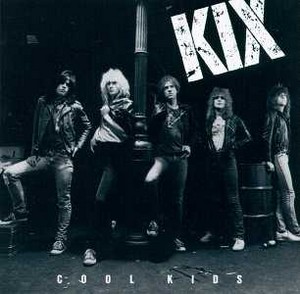
KIX – Cool Kids (1983 Atlantic)

Coming off the heels of their unsuccessful debut album, Kix returned to the studio with new producer Peter Solley to shell out what would be their most polarizing and least rocking album. Cool Kids is the most commercial album that Kix every recorded, pressured by Atlantic to deliver a hit after the failure of the debut to find an audience. This was 1983, just before Pyromania broke through the stratosphere to make melodic hard rock/heavy metal a viable commercial direction. Atlantic still had no idea how to market Kix, and also didn’t know what direction to push them in order to find an audience. For this album, they decided to push them towards the new wave aspects of their sound, forcing them to work with outside writers for the first time.

The production of Cool Kids is much more slick and pop-orientated than the rough and ready production of the debut. It’s obvious that the band was pressured into this direction, as a lot of the time they don’t sound comfortable in their own skin. Signer Steve Whiteman’s voice lacks its usual power and grit on this recording, likely being asked to hold back for the songs by producer Peter Solley. Another notable change to the band’s sound is the presence of new guitar player Brad Divens, temporarily replacing Ronnie “10/10” Younkins. This is the only Kix album to feature Divens, as Younkins rejoined them by their next album Midnight DynamiteCool Kids lacks the fiery and spontaneous edge of Younkins’ playing, and contributes even more to the album feeling sterile.

Despite these flaws, this is still a Kix album. There are still enjoyable moments throughout the record, quite a few actually. They are however, overwhelmed by the material that doesn’t work on this album. Opener “Burning Love” doesn’t introduce the set of tunes with a lot of power. Kix always has energy, but it seems to be counteracted with the sterile production and addition of keyboards. That being said, it’s a perfectly serviceable melodic rock tune, but there’s nothing genuinely exceptional about it. With it’s bouncy keyboards and lazy riff, it doesn’t sound much like Kix. This is one of the tunes that wasn’t written by the band. The title track follows it in a similarly sleek fashion, but is ultimately more enjoyable because it is more guitar-driven, and the band’s natural energy pushes through much more. It was also written by outside writers, but it is a very catchy tune. I’d say it’s a great melodic rock song for the early ‘80s. Unfortunately, it doesn’t sound much like Kix either.

After two tracks that fail to encompass the Kix sound, the first band-written track is up with “Love Pollution”. One of the only straight-up rockers on the disc, it’s also one of the best songs on the album. Written by Whiteman and Forsythe, the song burns along with a killer guitar riff and a lot of attitude, and accompanied by piano in the chorus that actually helps the song. A truly killer tune, one that I think represents the direction that this whole album should have gone in. It has a sound similar to that of the genre defying debut, but in a harder rocking vein. You can tell already that Kix wanted to toughen up their sound, though the shiny production doesn’t help that point across.

Next up is the outside penned “Body Talk” which used talk box three years before Bon Jovi, and also has one of the absolute worst music videos of all time. What the hell was the director thinking? Kix playing at what looks like a high school gym with only girls working out doing weird-ass synchronized exercise dances? Yeah, they really dropped the ball with this one. I find it strange that with this promotion Atlantic was confused about why the band weren’t doing well commercially. Luckily for them, Kix were still obscure enough that hardly anyone has ever seen that video. As for the song, it’s an uncharacteristic new wave workout, and a co-lead vocal between Steve Whiteman and drummer Jimmy “Chocolate” Chalfont. It’s a catchy pop tune, but it couldn’t be further from the Kix sound. Atlantic definitely missed the mark by making them record this one.

And if you didn’t think they could fall further into Flock of Seagulls territory, we get “Loco-Emotion”, penned by bass player Donnie Purnell. Steve Whiteman gets to play saxophone on this song, and for the verses it’s easily the weirdest Kix song ever. While the chorus contains a get up and go kick in the pants, the verses are just off-putting. Their first album used Devo primarily for what little new wave influence they had, but now they were courting the sound of several shittier new wave bands. Fortunately, from here on out everything was penned by the band, and there is nothing as jarring as this song.

However, a lot of these songs penned by Purnell are strange, and not up to his usual standards. “Mighty Mouth” is a powerful rock tune that gets bogged down by a very awkward and annoying chorus with Whiteman screaming the title. It seems a bit too cheeky for its own good, but is nothing compared to the campy “Nice on Ice” and the absolutely awful “Get Your Monkeys Out”. These songs lean hard on the bubblegum pop equation that was blended so successfully on albums before and after this with hard rock. Here, thanks to the shiny production, they sound cheesy and downright embarrassing. Thankfully, the album is redeemed with the two closing tunes.

Kix break the general rock standard of having the penultimate song be the worst on the album, by having the penultimate song be the best on the album. “For Shame” is an acoustic ballad years before “When the Children Cry”, or “Patience”, or “More than Words”. Beginning to see a trailblazing pattern? Yes, this is a heartfelt ballad that relies more on a nostalgic feeling than a sappy one. It uses the emotion of regret as the basis of the tune, which is an effective emotional connector. Whereas other love ballads seem derivative, this one seems genuine. The lyrics are very simple, but powerful. They detail summertime love that is lost with the passing of the seasons, with the two lovers unable to find each other afterwards Grease style. Thankfully, this song is stripped of the excess production that plagues most of the rest of the album, which keeps it sounding real, unlike other synthetic love tunes of the era. “For Shame” is a fantastic ballad, one that Kix would only surpass with a #11 hit on the Billboard charts (more on that when we get there).

They round the album out with the spiritual brother of “Love Pollution”. The other hard rocking song on the album, it features a writing credit from everyone in the band. It’s a speedy number the glides by ending the album on a high note. “Restless Blood” is an energetic kick in the pants to conclude the record with grace. Cool Kids is arguably the least essential Kixrecord, as it’s sound is the result of the label pressure. For the most part, it doesn’t represent the Kix sound, and a lot of the songs that do represent that sound, don’t get the equation as balanced as on the debut or any of their later albums. Thankfully, Kix would not let us down again. Atlantic finally realized that they had their hands on a hard rock band after this record tanked as bad as the first one. Our heroes would resurface again stronger than ever in 1985 with possibly the greatest album of their career. If this was the stepping stone that made Midnight Dynamite possible, so be it.

2.5/5 stars
 

GUEST REVIEW: Kix – Kix (1981)

Guest review by Holen MaGroin

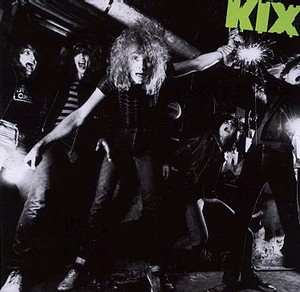
KIX – Kix (1981 Atlantic)

Kix: one of the most beloved and influential rock bands of the time that only made it big after years of great albums, legendary live performances, and a work ethic that never failed them. Unfortunately, they only seemed to stay there for the album/tour cycle of their classic Blow My Fuse. While over the years they’ve returned to being more of a cult act than a mainstream rock group, the effect the left on rock culture shouldn’t be dismissed. It’s common knowledge that Bret Michaels liked the group enough that he decided to “borrow” some moves from singer Steve Whiteman. Anthony Corder from Tora Tora called Kix a huge influence on the development of their second album Wild America. Despite all their influence, the band never seemed to secure a position as one of the most popular acts of the day. Bad management, label indifference, and being a little ahead of their time prevented them from becoming the multi-platinum success they deserved to be on every one of their albums.

As far as being ahead of their time, this eponymous debut was released on a major label in 1981, when even Mötley Crüe were still grinding it out on Leathür Records. Kix were one of the first hard rock acts signed from the decade, but were hardly acknowledged for it. This debut album sold very poorly, and original prints are tough finds out in the wild today. 1981 may have been just too early for a release like this to find widespread success. It’s also possible that Atlantic didn’t know how to market the band, as their debut album is an interesting and masterful blend of hard rock, new wave, and bubblegum melodies that sound like they could have come from the 1950s.

Produced by Tom Allom (Judas Priest, Black Sabbath, Def Leppard), the album is given a very punchy and dynamic sound. The drums sound big and chunky, and everyone is audible in the mix. Anyone familiar with the Kix of the later ‘80s may find this release a bit jarring at first. There’s a certain quirkiness to the songs that isn’t as prevalent later on in their career. This would be the new wave sensibilities. Not all the guitars are overdriven in a way that you’d expect from a hard rock record. There are a number of songs that glide by with clean guitars, and still manage to rock with a ton of energy thanks to the contributions of drummer Jimmy “Chocolate” Chalfont, and the contagious exuberance of singer Steve Whiteman. Of course, not all the record is this style, there are songs where the guitars have plenty of distortion, and they’re power loaded with midnight dynamite force.

The album opens with the scorcher and fan favorite “Atomic Bombs”. Starting with air raid sirens and some tasteful drum fills, the suspense of the song builds as a riff that Poison probably ripped off for “Look What the Cat Dragged In” tethers the song, and keeps it from completely going out of control. The first Kix song about blowing things up (a favorite topic of these Maryland hicks), it sets the tone for the album. It’s a relentless hard rock number with dynamics, and a nice solo that manages to create a feeling of the impending chaos of fallout. Opening with a rocker was a good choice; it gets people’s attention so that they’ll be more open-minded about what’s to come.

“Love at First Sight” is the first of the quirky Kix tunes. It’s a bouncy new wave influenced song, without any keyboards. If the thought of new wave scares you, it really shouldn’t because it’s so skillfully blended with these songs. It’s more Devo than it is Flock of Seagulls, and it shouldn’t turn off anyone even if they don’t enjoy new wave. The song gets a kick in the ass from guitarists Ronnie “10/10” Younkins and Brian Forsythe, as the distortion kicks in and the guitar solo gives the song the kick it needs to succeed. They were never the flashiest or greatest players of the ‘80s, but they were melodically wise, and knew what fit the song.

At this point in the record we get yet another change of pace, the ‘50s heart throb tune “Heartache”. With a bubblegum melody bound to get stuck in your head, that goddamn Kix band gives another change of pace. Rarely do audiences get this much diversity from a record of any genre. Kix would never release another album as eclectic as this one. Bass player Donnie Purnell locks in perfectly with the guitars and drums to give this tune an infectious energy that seems to fuel this entire album. The song builds with the addition of more guitars. The band has mastered dynamics, and knows just how to play them for the benefit of the song. The album is filled with tunes that blend each of these styles, some in which they are blended so seamlessly it’s impossible to pick what style is dominant. Take “The Itch”, the riff and song structure sounds similar to the underrated AC/DC tune “What’s Next to the Moon”. They’ve somehow taken that song structure and turned it on its head. Giving it breezy rock verses that build in intensity until the chorus which delivers another catchy melody complete with claps and gang backing vocals. The blend of styles shown on this album is seriously impressive for such a young group.

In case that wasn’t impressive enough, Kix closes the album with concert favorite “Yeah, Yeah, Yeah” (not an Alice Cooper cover). It’s a hard rock tune that lasts seven minutes, featuring the infamous rant from Steve Whiteman, complete with crowd noise. Steve is upset because the woman he’s been seducing has puked all over his floor. That’s a big mistake. Don’t puke on Steve Whiteman’s floor. Go outside and do that. The subject matter is juvenile, but this is rock and roll. It closes the album on a fast tempo upbeat note. Every song on here could be considered upbeat, no ballads, the energy never lets up.

As the album finishes a look at the liner notes reveals that this is the only Kix album in which they weren’t pressured to work with outside writers (at least of the ones on Atlantic). It can be concluded that this album is the purest distillation of the Kix sound. While I like some of their more hard rocking albums later down the line better, this album is interesting because of the fact that it and its much lesser follow up Cool Kids (the only Kix album I’m not overly fond of), contain a new wave style that the band would never return to. It’s interesting hearing the young Kix and what their original vision is. Some people consider this the best Kix album. Not me, but it’s still pretty damn good.

4/5 stars

Concert announcement! SASQUATCH: THE OPERA – composed by Faith No More’s RODDY BOTTUM coming to town

Guest post by Kathryn Ladano

Now that NUMUS‘ most recent season is finished, I just want to say that next season, I can’t friggin’ wait to present Sasquatch: The Opera – composed by Roddy Bottum of the band Faith No More. I saw this at the Edinburgh Fringe Festival last summer and knew that we had to find a way to bring it to Kitchener/Waterloo. It’s happening in February 2019! We’ll be doing four performances which will feature the original cast and the NUMUS orchestra led by Roddy himself!

February 14, 15, 16 and 17, 2019.  Registry Theatre, Waterloo.

Read more at the Guardian: Bigfoot and me: Roddy Bottum on his avant garde monster opera


GUEST REVIEW: Star Wars: The Last Jedi (2018) Blu-ray bonus features

We’ve already reviewed the movie ad-nauseum, so here is something fresh:  a review of the Blu-ray bonus features by guest writer Kovaflyer!

Guest review by Kovaflyer

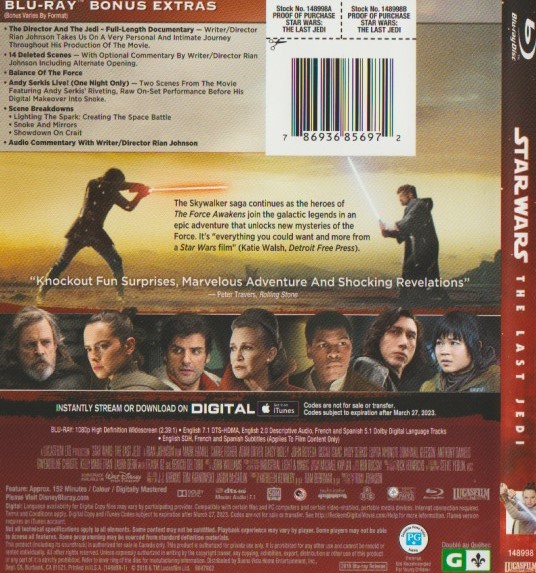
STAR WARS: The Last Jedi (2018 Lucasfilm blu-ray)

Directed by Rian Johnson

If you enjoyed The Last Jedi or if you have mixed feelings about the newest instalment of Star Wars and are trying to make sense of the film, the bonus features are a great in-depth look at where Rian Johnson took the galaxy that is so very far far away.


The Director and the Jedi – Full length documentary feature

The Director and the Jedi is your first behind the scenes look at The Last Jedi and the hard work that went into making this Star Wars movie. This part of the bonus features takes you behind the scenes of the building of up to 120 different sets, the creation of all the creatures that we have come to know and love, the eye-pleasing costumes, as well as the amount of detail involved in the makeup artistry; like the work done to create Kylo Ren’s scar.

The Director and the Jedi also features discussions with Mark Hamill about Luke Skywalker and the direction that Rian took with Luke in the film. Mark tells us that he was going to play the Skywalker that Rian envisioned regardless of how he felt about his own image of Luke. Early footage of Mark and Daisy going over lines and choreographing the Luke vs. Rey scene was fantastic.

The interviews and interactions with Carrie Fisher are both heart warming and fun and showcase Carrie at her best; the only way that Carrie knew how to be. Carrie was excited about the direction of Leia’s character in the movie, calling her strong and in charge.


Balance of The Force

Rian Johnson really wanted to hit the re-set button on “the Force” and what it means. He wanted to show new Star Wars fans that the Force is not a super power, but a balance between all things, the light and dark, in all living things.  It is a gift, and not all about moving rock or things across a room.

When he started writing The Last Jedi he had a look back at Star Wars and the main characters in the story and what challenges they would eventually come up against.

Rey is looking to find herself and where she comes from; who her mom and dad are and where they have been, and what her new powers mean and how to use them. With Rey there are no easy answers and if she wants them she is going to have to find them herself.

Finn has just woken up on a ship after being injured in a fight on Starkiller Base while trying to save Rey and the Resistance. He wakes up with the ship under attack and Rey missing, and therefore he has to think fast and take action to save Rey, himself and the ship.

Leia, facing more and more loss is taking charge and leading the Resistance in the biggest fight yet.

Luke is fighting his own internal battle that the Jedi must end. In his view, the Jedi have done nothing but added to the problems of the galaxy, and if he were to bring back the Jedi, the Sith would rise again. Luke believes if the Jedi die, that a new light could rise and win. Therefore, Luke Skywalker has exiled himself; he is being selfless. Rian knew that there was a reason why Luke went into hiding, that it was a selfless act and that he was not just cowering away.

Yoda, yes that Yoda (the puppet version brought to life by Frank Oz), comes to Luke when he needs him the most. Yoda reminds Luke of the same lessons he once taught him, to stop with all the big plans and to focus on the here and now, to be the Luke Skywalker that everyone needs; to be the myth, to be the legend of Luke Skywalker and to not let the light burn out. So, Luke must train Rey and keep her in the light. The most important message Yoda had for Luke, was that failure is the greatest teacher of all. Johnson insisted to have the original puppet version of Yoda and his puppeteer Frank Oz for the film. He wanted Mark Hamill to interact with Oz and not a CGI version of Yoda, and even procured the original Yoda puppet mold in order to fashion the latest version of the Jedi master.


Scene Breakdowns

The bonus features also offer the following scene breakdowns.

Lighting the Spark: Space battles are massive undertakings. You get the big explosions, the visual and auditory effects. However, Johnson explains that he felt that in this space battle, he wanted to show the humans behind the spaceships; to make you feel connected to what is happening based on the relevance of the battle to the characters. It is interesting and fun to learn where some of the sound effects that were used in the battle came from (e.g. a roll of duct tape), how some of the spacecrafts and battle sequences were modelled after WWII aircraft and aerial footage (e.g. a B-52 bomber), and how Kylo Ren’s spaceship was of course modelled after Vader’s own tie fighter. In this battle, that saw so many Resistance fighters lost, Johnson chose to highlight Leia’s struggle with loss and grief and her deep love for her people.

Snoke and Mirrors: Rian explains that in bringing Snoke to life, he wanted to ground him in reality; make him have a physical presence. He was worried, however, about the complexity of creating a believable character completely out of CGI technology. In utilizing a complete motion capture suit for Snoke’s character, however, they were able to use every nuance that Andy Serkis brought to the character’s physical being; every facial expression, every twitch, etc.

Showdown on Crait: Johnson explains that the scene of the showdown on Crait was one of the first visions he had when he started working on the movie. To create the visual effects for the shots fired on the salt planet, the film crew went to the salt plains of Bolivia and filmed shooting sequences. It is amazing to hear just how many different options they went through when creating the red under the salt (e.g. shredded dyed red paper), how they reinvented the Walker from Empire into the Gorilla Walker using various sounds bytes to create its own unique ‘voice’, or how they used sounds from old beaten down cars in order to obtain the sounds for the Resistance fighter ships.


Andy Serkis Live! (One Night Only)

This part of the bonus features offers a look at the first meeting between Rey and Snoke with Andy Serkis in the full motion capture suit. It is amazing to see Andy’s performance in the raw without the CGI effects. To say that Andy’s performance was intense is a serious understatement!


Deleted Scenes

The bonus features also provide a look at some of the scenes that did not make the final cut for the movie; fun to watch but one can understand why they were left out for the most part.


In closing

In closing friends, I give this bonus footage 4/5 stars and highly recommend that you pick up the Blu-ray edition of The Last Jedi as you will enjoy some fabulous bonus features that will enhance your enjoyment of this Star Wars film.


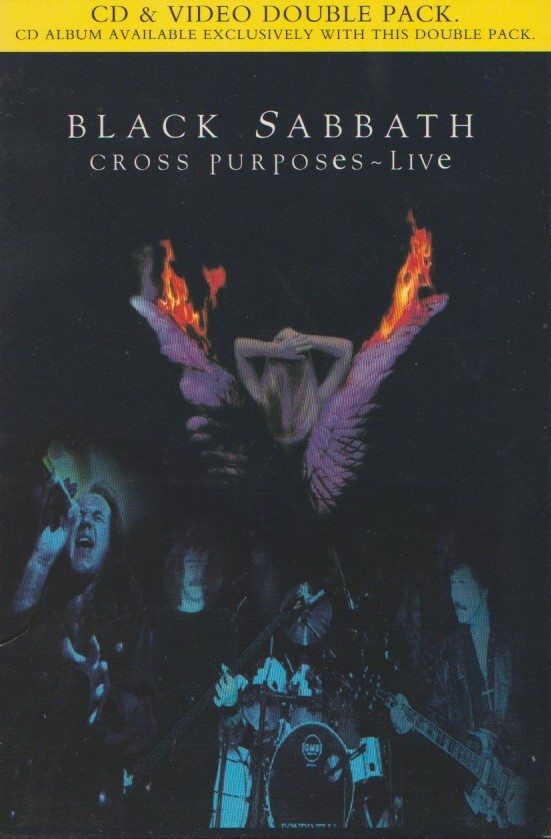
GUEST REVIEW: Black Sabbath – Cross Purposes ~ Live (1995) Part Two – the VHS

BLACK SABBATH – Cross Purposes ~ Live (1995 IRS CD/VHS set)
Part Two: the VHS video by Harrison Kopp

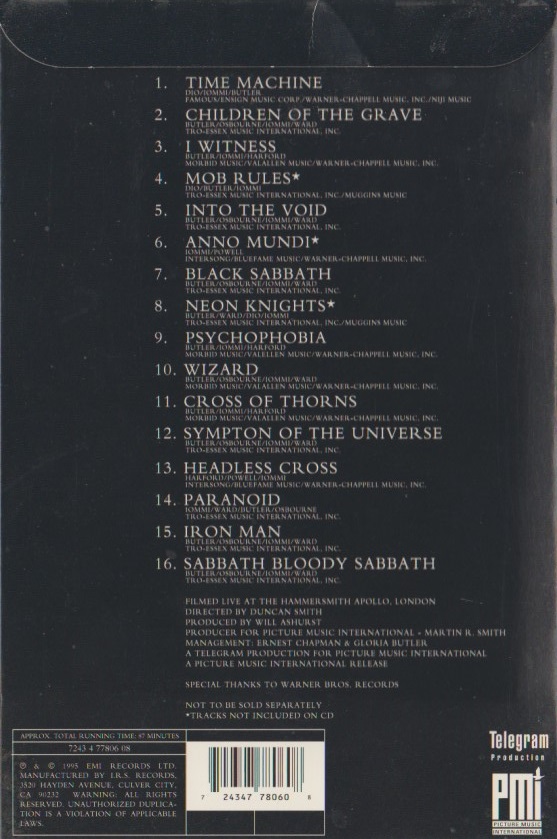
As Mike’s VCR is currently stored away, he will be joined by Harrison, who was naughty and downloaded a 720p copy of the show when someone had it up on YouTube, and therefore will be reviewing the video half of this box set.


The video version is a great snapshot of the band at this period. The quality is quite good for a VHS, only betraying its origins with any large expanses of black shown. It also features some innovative action shots to capture the band, which is much appreciated as, although Geezer is still head banging away as usual, Bobby generally fades into the background and, as Mike has pointed out in other reviews, Tony Martin’s frontman-ship involves either singing up front or shaking his thinning hair by the drum riser.  As for Tony Iommi? Well he’s still the epitome of theatrical guitar playing.

The lighting is done well also, although the red occasionally gives the skin an overly pink tone. And for the first time, Geoff Nicholls is visible in the background of some shots, doing keyboards and backing vocals.

Puzzlingly, there is also a black and white filter used on a couple shots here and there, that really isn’t necessary. Those preceding niggles however, were only small nit-picks of a thoroughly enjoyable show to watch.

There are also three songs included on the video that aren’t on the CD and will be therefore be reviewed here. The first is fairly early in the set and is “Mob Rules”. Tony powers through verse after verse without fail. Although it inevitably falls short of the Dio renditions, it still deserved a place on the disc.

“Anno Mundi” is next. This is easily the best of the three. Tony Martin sings his heart out in an amazing performance of the only song from Tyr. This easily should have been on the disc as well.  (They all should have.)  On a side note, it’s really nice to see audience members head-banging and singing along to these Martin-era songs.  Last of these is a decent rendition of “Neon Knights” that just can’t compete with Dio’s versions. A couple subtle melody changes here and there don’t help it either.

Still, despite a couple small missteps:

4.5/5 stars, and Tony martin’s finest hour with Sabbath.

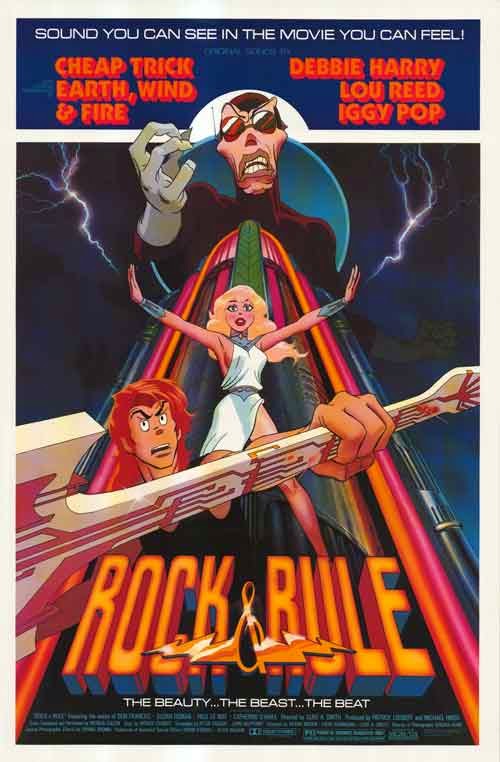
GUEST REVIEW: Rock and Rule (1983) by Robert Daniels

Please welcome guest writer Robert Daniels, from radio’s Visions In Sound 

ROCK AND RULE (1983 Nelvana)

“Oh what will the signal be for your eyes to see me…”

Back in about 1984 or 85 I remember watching TV one afternoon and stumbling on an animated movie. Interested, I stopped to watch. It had weird, trippy images and some scantily clad cartoon woman singing and a strange creature growling. My 14 year old mind was intrigued and then was completely blown when one of the animated characters said “Shit!” Cartoon characters were not supposed to swear!! Clearly this was a mistake. No, it was not a mistake, it was Rock and Rule. Although at the time I didn’t know the title and didn’t see the movie on TV again for a while.
Rock and Rule was set in a post apocalyptic future where the street animals evolved into a human like society. MOK is an aging rock star trying to find a specific voice in the guise of a worldwide talent search. MOK hopes to unleash a powerful demon from another dimension, his dwindling popularity driving him to destroy the world in vengeance and immortalize himself in the process. After returning to Ohmtown he finds the voice he’s looking for in Angel, a singer in a local band along with friends Omar, Dizzy and Stretch. MOK invites her to join him and when she refuses he kidnaps Angel and forces her to sing to raise the demon.

This was the era of the edgy “adult” cartoon, Heavy Metal, American Pop, Wizards, Starchaser: The Legend Of Orin and others. I do remember getting into an argument with my Mom back in 1981 about not being able to see Heavy Metal. “It’s a Cartoon…it HAS to be for kids!!!”.

It would be several years later when I was in high school that I described the ending scene to someone and they said “Oh yeah, that’s Rock and Rule…” Bingo, I had a title and looked high and low for a copy on VHS. Nothing. I was obsessed to find Rock and Rule. Of course, in the late 80s early 90s there was no internet so the only thing I could do was continue to bug the people at Steve’s TV to try and find a copy. Again, nothing. Then one day out of the blue I got a call from Steve’s. They said they found a copy and would order it for me. “Great” I said, “How much.” “$129.99”. My heart sank, that was far too expensive for my blood. So the film continued to sit in the back of my mind for years.

“My Name Is MOK, thanks a lot”

Then one day in (about) 2003, I heard of a showing at the former Hyland theatre. A local Anime expert and film buff rented the then-empty theatre to show the a cut of the film.

Also Don Francks, the voice of MOK, was going to be there. I jumped at the opportunity.

The film was nothing like I thought it was going to be. First, it was produced by Nelvana Studios that I only knew for Care Bears, Strawberry Shortcake, Droids and Ewoks, etc. All kids’ cartoons. It was also one of the first films I ever saw that listed “Songs by…” first above the main cast. This list included Cheap Trick, Debbie Harry, Lou Reed and Iggy Pop, with a special performance by Earth, Wind and Fire. After the movie there was a Q & A with Don Francks, who I later found out provided the voices for such characters as Dr. Claw from Inspector Gadget, Lackki from Captain Power and the un-credited voice of Boba Fett from the Star Wars: Holiday Special. I asked him if he based his performance of MOK on David Bowie. He said that he didn’t have any particular person in mind when he voiced MOK. I later found out that MOK’s full name was MOK SWAGGER a spin on Mick Jagger. However, the talent representation of The Rolling Stones’ lead singer objected and forced the producers to drop the character’s surname. It’s also interesting to note that David Bowie, Tim Curry, Michael Jackson, Mick Jagger and Sting were all considered for MOK but the budget of the film couldn’t afford them.

“I dunno about this, nobody seems to be buying these ‘I survived the MOK concert’ T-shirts.”

This year (2018) is the 35th anniversary of this masterpiece of Canadian animation. Rock and Rule is the first English speaking Canadian animated feature film entirely produced in Canada itself. Unfortunately the film sat in near obscurity for years after being shelved by distributor MGM and never got released in North America. The film did develop a cult following after being shown on CBC (who held the Canadian TV Rights), HBO and Showtime. Bootleg copies would show up at comic book conventions oddly enough with Ralph Bakshi being credited as director.

“She can sing, or she can scream!!!”

Much like Heavy Metal from 1981 music was a huge part of the film and also much like Heavy Metal the music got tied up in rights issues.

Back in about 2005 just before the release of the Rock and Rule DVD, I was actually in contact with someone from Nelvana Studios who told me that director Clive A. Smith, whose wife Patricia Cullen had also written the score, had the tape masters for the soundtrack in his garage and that he might be willing to let me have them for mastering. Unfortunately nothing came of this as I lost contact but it was the closest I came to producing a soundtrack release. In 2010 the film was released on Blu-ray and unfortunately has become quite expensive on the used market.
It was previously believed that no official soundtrack album had ever been issued for Rock and Rule. In fact, Deborah Harry mentions on a “Making Of…” documentary that she hopes the music gets a soundtrack release.  However, as it turns out, a handful of film critics received a cassette tape featuring nine songs (“Hot Dogs and Sushi” and “Send Love Through” were omitted). All songs are extended from how they appear in the film and in familiar copies. “Born to Raise Hell,” “I’m the Man,” “Dance Dance Dance,” and “Ohm Sweet Ohm” have been officially issued on CD, along with an alternate version of “Pain and Suffering,” and “Maybe For Sure” (an alternate version of “Angel’s Song”).

Though a deliberate Google search will turn up a couple of versions of the soundtrack, this is the most common track list:

[2:46] 01. Born To Raise Hell (Cheap Trick – Album Version)
[5:14] 02 Angel’s Song (Deborah Harry)
[4:22] 03 My Name Is Mok (Lou Reed)
[2:11] 04. I’m The Man (Cheap Trick – Album Version)
[3:12] 05. Earth Wind And Fire – Dance Dance Dance
[2:49] 06. Ohm Sweet Ohm (Cheap Trick – Album Version)
[3:15] 07. Triumph (Lou Reed)
[1:28] 08. Hot Dogs & Sushi (Melleny Brown)
[3:28] 09. Invocation Song (Deborah Harry)
[3:41] 10. Pain & Suffering (Iggy Pop)
[5:56] 11. Send Love Through (Deborah Harry and Robin Zander)
[4:30] 12. Maybe For Sure (Deborah Harry)
[5:22] 13. Angel’s Song (Cassette Mix)
[3:29] 14. Invocation Song (Mono Cassette Mix)
[4:35] 15. My Name is Mok (Cassette Mix)
[3:42] 16. Pain And Suffering (Iggy Pop)
[0:52] 17. Triumph (Movie Mix)
[2:35] 18. Angel’s Song (Movie Mix)
[1:38] 19. Invocation Song (Movie Mix)
[1:49] 20. Pain & Suffering (Movie Mix)
[2:06] 21. My Name is Mok (Movie Mix)
[3:36] 22. Triumph (Mono Cassette Mix)

Rock and Rule falls into the category of “…what could have been”. Had MGM had more faith in the project and released it in North America it may have been a hit rather than the cult classic it would eventually become. If you haven’t seen it or are interested in a look at a piece of Canadian animation history check it out, you will not be disappointed.

A solid 4/5 stars.  Dark, and yet at the same time fun.


Robert Daniels


REVIEW Round-up: Guns N’ Roses “Not In This Lifetime” Tour (Guest editorial)

GUNS N’ ROSES “Not In This Lifetime” Tour

By David Martin

A little while ago we reached back to the late-‘80s with a review of a Guns N’ Roses live session in New York. It wasn’t a perfect recording, but it’s a nice glance back to the early days of a band that’s become one of rock’s truly iconic groups. Another interesting thing about looking back at this time is that Guns N’ Roses has, against the odds, become something of a modern sensation.

Our first hints ought to have been when GNR started showing up anew in non-music pop culture. The band put out a vague teaser trailer before screenings of Star Wars: The Force Awakens for instance, and also partnered with an online developer to produce a video game in 2016. The latter was particularly random, though it makes sense when you look at the industry. An Australian gaming resource site states simply that presentation is a huge factor on betting and gaming sites, and part of that means introducing visually and sonically interesting games – like a slot reel based on an iconic rock band, in this case.

Neither a teaser trailer nor a video game tipped us off to what would actually start in the spring of 2016 – one of the most surprising tours, arguably in all of musical history. The band took the stage at Coachella – with Axl Rose and Slash sharing the stage for the first time in years – and kicked off an international slate of shows that ultimately extended into 2018. The tour, dubbed “Not In This Lifetime,” has become one of the most successful in modern history from a financial standpoint. And while reviewing it in its entirety isn’t easy (or necessarily possible) we can look at a roundup of reviews for particular shows along the way.

Coachella (April ’16) – “The magic was absent.” This was a take from Vice, building on a headline suggesting that Guns N’ Roses had shown its age at the Coachella show. The review noted hints of pleasure when the band played the hits, as well as Slash’s enduring skill, but ultimately pointed to a lack of chemistry and the simple ravages of time as reasons for an underwhelming reunion.

Detroit (June ’16) – “This was history being made.” This comment came from none other than Rolling Stone, in a piece that directly refuted some of the earlier reviews. Citing a straightened out lineup and an Axl Rose out of the foot cast he’d appeared in for Coachella, it painted the picture of a reunion tour that had found its groove.

London (June ’17) – “You can’t blow the roof off a stadium that doesn’t have one, but they damn well tried.” So said The Guardian after one of GNR’s European shows, painting a picture not only of an electric performance, but of the thrill for an original fan seeing the band back in action again.

Cleveland (October ’17) – “Guns N’ Roses have no intention of coasting to the finish line.” This was a take offered on one of the tour’s later dates. Not only was it yet another positive review, but it was one with the perspective to mention the almost universally positive response to the tour – as well as growing hopes of fresh material from the group.

All in all the impression left by the “Not In This Lifetime” tour is that while there are occasional frustrations stemming from the simple fact that the band’s members have aged, it’s been good to have them back. And on some occasions, they’ve absolutely wowed all their old fans.