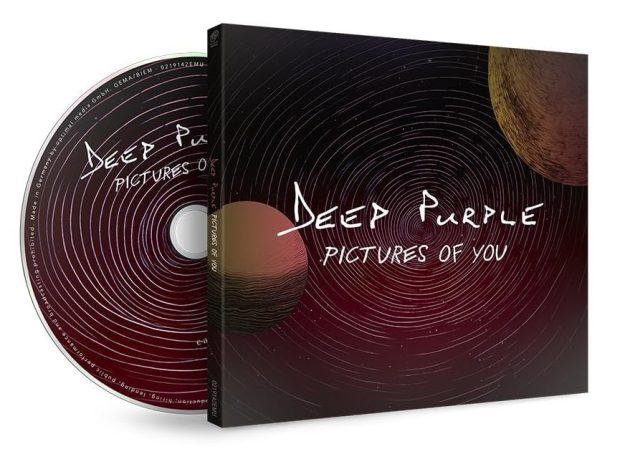
Deep Purple’s first new album with Simon McBride on guitar will be out July 19. Called =1 (“equals one”), the music seems to heading into a riffy direction. The band have just released a new CD single, something of a tradition for them during the Bob Ezrin era in this late part of their career. This single includes two tracks from the album, including the recently released “Portable Door”, and two live tracks with Simon recorded in 2022. Let’s have a listen and hear what the Purples have in store.
Track one, “Pictures of You” has a pretty cool and weighty riff. Backed by Don Airey’s organ, it’s one of Purple’s catchiest riffs in recent years. The chorus follows the riff melody. “These pictures of you are too good to be true,” sings Ian Gillan. Ian’s voice is pushed to its current limits, which is often the thing you hear people moaning about the most, but it’s really no issue. Simon comes in with a wicked catchy solo, before the whole song detours into a dainty Don Airey piano part with Simon doing volume swells overtop. Though only 3:50 long, “Pictures of You” packs a lot into a short time.
Without a gap, the band breaks into something completely different, ominous and heavy: “Portable Door”. Ian Paice is the backbone, always smooth, always identifiable, infallible. With Ian Paice on drums, Deep Purple will always sound like Deep Purple. Don Airey’s organ really dominates the solo section, as it should, and Simon’s guitar work is sublime. As for the tune itself? Top notch.
The live tracks were recorded October 17 2022 in Milan, Italy. These tracks will not be on the deluxe box set version of =1, and are exclusive to the single. First up is the classic blues “When A Blind Man Cries”, and we get to hear Simon do what Simon does. Perhaps more interesting though, the arrangement includes a new lounge-y into with piano. “Blind Man” feels slower than usual, but Ian Gillan is in fine voice. Simon takes center stage on the guitar solo, and it’s so phenomenal that you can hear the audience break into applause at its conclusion. It’s slow and passionate until he lets rip. Having Don Airey follow is almost anti-climax. Welcome to Deep Purple, Simon McBride!
The more recent “Uncommon Man” closes the disc, with a beautiful guitar solo backed by heavenly keyboards. As one of Purple’s more regal songs, it sounds great on stage. Roger Glover gets a little bit of the spotlight just before Simon’s solo, but this is a pretty faithful version. Most importantly, it is good to see that Deep Purple do not drop songs from the latter part of their career out of the setlist. (There are three other live versions of this song with Steve Morse available on other releases: Celebrating Jon Lord the Rock Legend, To the Rising Sun in Tokyo, and the Now What?! Live Tapes Vol. 2)
With only 5000 copies worldwide, this is sure to be a collector’s item.
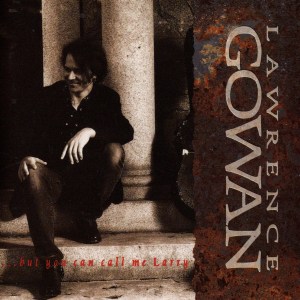
LAWRENCE GOWAN – …but you can call me Larry (1993 Anthem/Columbia)
Lawrence Gowan was clearly making changes for his first album since 1990’s Lost Brotherhood. He was now going by his full name, Lawrence Gowan, though long-timers had a hard time not just calling him Gowan. He assembled an ace crew of musicians including Robert Fripp and Tony Levin from King Crimson, Ken Greer from Red Rider, Jann Arden, and drummer/producer Jerry Marotta, who goes back with Levin. The result is a more organic album playfully called …but you can call me Larry. The sound is pure 1993, in the best possible way.
Tinkling acoustics open “Soul’s Road”, a far cry from from the synthesizers of a decade ago. This great song soon kicks into gear on the chorus with the crackling electric guitars and the cry of a pedal steel (by Greer). It reverts back to acoustics and piano on the verses. Gowan employs just a touch of rasp in his voice for an earthy vibe. It has just the right balance between hard and soft. Great opening track, and should have been a hit.
“When There’s Time (For Love)” features Colin Linden on guitar, and stays in the acoustic zone. This slow song is loaded with melody and passion, and once again really comes to life on the excellent chorus. This is a ballad for a quiet night in, but it isn’t lifeless at all. The drums keep it moving, and the musicianship on all instruments is absolutely stunning. Such a full, rich mix. You can really feel the bass. That’s Paul Northfield’s mixing work, done at Morin Heights in Quebec, where the album was recorded.
Co-written with Jim Vallance, “Innocence” goes for a different vibe, with a tense little piano line soon giving way to a powerful chorus. Tony Levin shares bass duties with Terry Gowan, who is currently touring with his brother in Styx. This rocker still maintains a touch of acoustic guitar in the background, but this is a rock song with just a hint of nocturnal menace.
Back to ballad territory, “Your Stone Walls” has a folksy sound, beginning with minimal instrumentation and letting the acoustic guitar carry the weight. It gradually builds, adding organ and drums, but the folksy sound remains. It’s an exceptionally beautiful song, especially as it continues to grow into something more epic, with soulful backing vocals and keyboards.
Things really pick up on the moving “Dancing On My Own Ground”. Levin’s bass has a lot to do with why this one moves with such an incredible pulse. Upbeat and bright, this acoustic rocker is probably the album highlight for those who like feel-good music. There’s a violin solo to boot. Gowan’s music always includes outstanding musicians, often from the progressive rock genre. It’s no wonder he ended up in Styx with that kind of experience.
By contrast, “Cry On My Shoulder” is the opposite; a somber piano ballad. (Was the idea of having two “On My…” song titles in a row a coincidence?) This one features ample cello parts, and a stunning slide guitar part by Ken Greer.
Things go suddenly retro on “Moonchild’s Psychedelic Holiday”. Using sitar became more common in the early 9os, and of course that combined with the word “psychedelic” means we’re going back to the era of free love. There are only slight Beatles-isms incorporated, but Jim, both Hendrix and Morrison, are cited in the lyrics. It feels a little corny and contrived, but others may think it’s the best thing on the album. Enjoy some purple haze and see what you think.
The somber acoustics of “You Never Let Go” feels like we’re back on track. Yet, it’s poweful. The lyrics tell a tale of a friend, a bad seed, that Gowan can see the other side of. Even though it is mostly a quieter song, there is an undercurrent. A drive. A power. A tension. It’s all released at the halfway point when the electric guitars kick in. One of the more impressive songs on the album.
Larry goes upbeat again on “(In The) Wild Summer Night”. It never goes too hard or heavy, but this rocker has some rhythmic piano, great drums, and a bouncing chorus to keep the party going. If you can criticise …but you can call me Larry for anything, it would be that the album gets burning too rarely. There is nothing here as bouncing as “Strange Animal” obviously, but “(In The) Wild Summer Night” gets the blood flowing. The soul singing comes back for the outro, as the drums just light it up. Get out of your chair!
“Last Laugh” features Jann Arden, slide guitar, dobro, and hand percussion. This laid back acoustic song really breathes when Jann joins Lawrence on the second verse. Most songs on this album seem to have a feature or two that makes them stand out from the others. In this case it’s Jann Arden. Though it is not a loud song, it’s very powerful. “We’ll have the last laugh, now…” they sing.
Album closer “Little Face” is the one with Robert Fripp. Even so, I would have held this song for last anyway. It is meant to be a closer, with a tension that builds and builds as the song goes on. Impressive drums here, and a dark powerful vibe with exceptional guitar work by the King Crimson mastermind. A burning closer with a great chorus. “Little Face” is the cherry on top of an impressive record.
One look at the covers, front and back, and you know immediately that the design is by Hugh Syme. Hugh did a number of albums in 1993 with similar fonts and marble designs: Rush, Coverdale-Page, and Def Leppard too. In fact this CD layout is virtually identical to Retro-Active by Def Leppard. Hey, if it works…
Disclaimer: This review is from the perspective of a drone rookie. I recently plunged into the hobby, and found it easy and inviting. Here’s what I have learned in my three weeks as a drone pilot.
Potensic ATOM SE GPS Drone With 4K Single-Axis Camera
When I was a young kid, I would come to the beach and watch this older kid fly his remote control airplane over the lake. He never landed it without crashing, with either major or minor damage. I thought it would be cool to fly an RC plane like that, but it looked difficult and expensive. Then, at some point decades later, my dad bought an indoor drone for me. Just a toy. Impossible to control, and it went flying off my wife’s head. Nope, flying things isn’t the hobby for me. Onto the next thing.
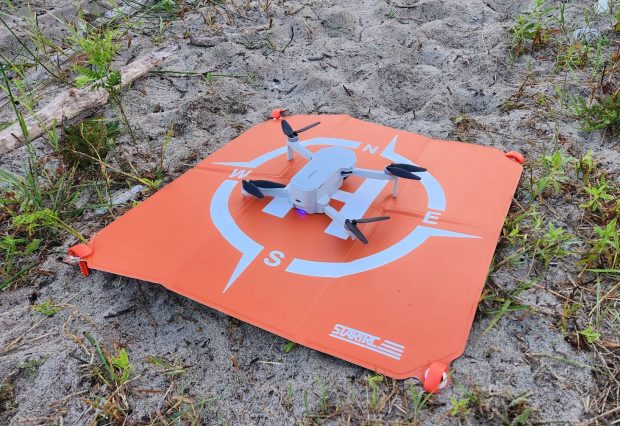
Then, one day after browsing Amazon, I decided to buy a real drone and see what difference it would make. You only live once. I chose the ATOM SE by Potensic, which came with two batteries, a remote, all the cables you need to charge and connect it, and a spare set of propellers (with the appropriate screwdriver). It all came in a nice, padded travel case that holds everything. It really is an all-in-one package. You can buy accessories too, including spare batteries and a charger that can do three of them at once (plus the remote). I also recommend picking up a landing pad, which helps keep your drone propellers out of the grass and/or sand. The only thing you will need to provide separately is a micro SD card so you can record all that lovely 1080p video you’re going to capture.
My only complaint: No paper manual. All you get is a pdf file. I gave it a read, but I learn by doing, so one Saturday morning when nobody was around, I took my drone over to the park. Within minutes I was in the air. (Of note: This drone is light enough that it does not require a license, so you are good to go.)
It is intuitive and easy to fly. You just plug your phone into the remote, to act as a screen. Everything fits perfectly. The camera is crisp and clear. For those with a higher budget, the next model up has a 3-axis camera, but this one just moves up and down. I found this plenty good enough. The controller has two (removeable) joysticks (with a clever storage solution). Everything is ergonomic. The left stick controls altitude, and rotates the drone. The right stick controls all movement forwards and backwards, and side to side. It moves equally well in all four directions.
This drone is steady as a rock. Even in a light breeze, it barely moves from where you want it. I took it up to its maximum ceiling of 190 feet, and then right down again to land, and it had only moved about a foot. There are automatic flying modes, such as one where it circles a waypoint (with camera always pointed at the center, a cool feature) and one where it follows you. You can set a home point for it to automatically return to. However, I am more comfortable being in control. That shows you how easy this thing is to use, that I prefer manual controls to automatic.
It’s a fast little drone, and zips right over your head going over 13 mph. It stops on a dime, and is extremely responsive. It is also capable of beautiful, slow movements. The resultant videos are always quality.
When I first bought this drone, a few people were asking me what the heck I would do with it? Check out the videos below and tell me I’m not having fun!
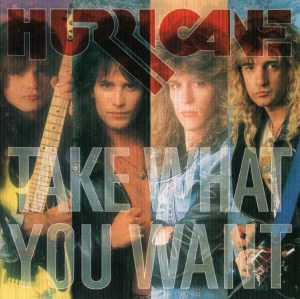
HURRICANE – Take What You Want (1985 Enigma EP, 1989 reissue with bonus tracks)
Hurricane attracted my attention initially because I was a Quiet Riot fan. I considered Hurricane to be a “brother” band to Quiet Riot. Bassist Tony Cavazo’s brother Carlos was in Quiet Riot. Guitarist Robert Sarzo also had a brother, in Rudy. I loved that Carlos played bass, and Robert played guitar. I just knew that they chose those instruments so they could have jammed with their brothers, on guitar and bass respectively.
Perhaps Hurricane are best known as a band that launched its members into higher orbits. Robert Sarzo has been a member of Geoff Tate’s Queensryche. Drummer Jay Schellen is in Yes. Singer Kelly Hansen is with Foreigner. Big names!
Their debut EP was not a bad start. It boasted one single/video that impressed me as a kid, but we’ll get there. The original EP opened with “Take Me In Your Arms”, a tough little rock crooner with a great chorus. Right from the get-go, it’s the singer that impresses. The production buried him a bit too far back in the mix. It may be a case of “too many cooks”, as Kevin Beamish, Mike Clink and Hurricane all get co-production credits, with Bob Ezrin in an executive role! The swampy backing vocals don’t really help, but fortunately Hansen was more than capable of driving a chorus home. It was also obvious that Jay Schellen was going to go places. His drumming here is far from simplistic, standard rock cliches.
The second track gives Tony and Jay a chance to jam a bit before Robert comes in with some squealing guitar. “The Girls Are Out Tonight” is not especially remarkable, but like the preceding song, it has a great little chorus to go with some pretty poor lyrics. “Laughin’ and talkin’ about the boys, with whom you want to be seen.” You don’t see the word “whom” in rock lyrics very often, I’ll concede. The MVPs on this track are Tony Cavazo with a rollicking bassline, and Robert Sarzo with some great 80s excess on guitar.
The title track “Take What You Want” goes third, with an ominous little riff to open it. There’s a vibe here somewhere between Journey and Kiss. Hansen impresses thoroughly with those pipes! The mood of the song isn’t consistent however, going for a more cliched rock vibe on the verses, while the chorus just smokes. Almost a great song, but not quite.
Hurricane’s eponymous track was the single/video back in the day, and immediately impressed with the riff. Traditional metal with a hint of exotic, “Hurricane” was my favourite song for two weeks straight. “You’re like a hurricane comin’, you don’t forgive!” Get pumped up and rock this tune on repeat. It’s great.
“It’s Only Heaven” features Robert Sarzo and Tony Cavazo making really cool, atmospheric sounds with their instruments. Then Schellen comes in with a classic drum beat, followed by Kelly Hansen. This ballad could have been a Scorpions song, perhaps. Vocally it’s very different from the Scorps, but Klaus can sing anything he wants. Though slow, this ballad could have gone down in history like similar songs by Dokken…except for a really bad key change almost six minutes into the song. Otherwise, it’s pretty epic and spectacular. Somebody should have chopped the last minute and a half of it though.
Back to the hard rockin’, “Hot and Heavy” was the closing song on the original EP. It gets the job done. It’s fast, rippin’ with shout along hooks, and ready to tear it down. Robert Sarzo illuminates the sky with guitar pyrotechnics. Good little tune. Nothing remarkable of course, but adequate for the task. The whole EP is above average, because of the skill of the players and some occasional production goodness. It’s just a nose above the rest of the bands that didn’t quite have the same level of musicianship.
Old CD copies came with a bonus track, “La Luna”, a beautiful classical guitar piece by Sarzo. There is some really clever backwards guitar mixed in with the forwards. It’s almost like next level Randy Rhoads. The entire band got credited for writing, which means the band had an agreement to split writing credits.
This CD reissue has three bonus tracks, all from the next album Over the Edge. The first is a single version of “Over the Edge” itself. This hard rocker opens and closes with cool acoustic guitars, which caught my ear back in the day. I loved this tune. The production is still a bit wanting, but you can hear the talent shine through. Schellen’s got a great groove going, and Kelly was so underappreciated as a singer back in the day.
“I’m On To You” was another great single from that album. This is just an edit version. This “super stormin’ hook edit” opens straight away with the chorus, which may or may not be to your taste. “Na na na na na na, I’m on to you!” croons Kelly Hansen. You’ll love it or hate it. Finally, the CD ends with “Baby Snakes” (not a Zappa cover)…and finally it’s an instrumental version, without the phone call stuff! That part of the song was amusing for a few minutes, but hindered re-plays. This instrumental version remedies that!
Hurricane could have gone further than they did. Unfortunately for them, Robert Sarzo departed after Over the Edge, replaced by a guy named Doug Aldridge that you might know from some other bands. They started using outside writers, and that’s rarely a good sign. They have since reunited, but never with this original lineup again. An album and an EP was all we got. At least they were both decent.
3/5 stars for the original EP 3.5/5 stars with bonus tracks
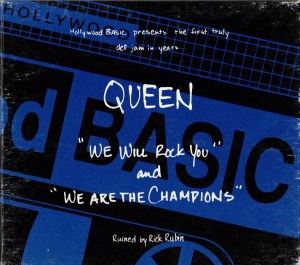
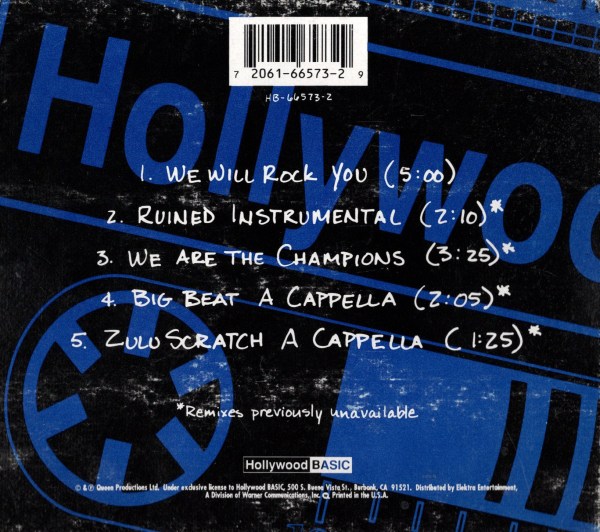
QUEEN – “We Will Rock You” and “We Are the Champions” Ruined By Rick Rubin EP (1991 Hollywood Basic)
Mercifully, it’s short. But did they know they were making a piece of shit? “Ruined by Rick Rubin”. “Mix Engineer Under Protest: Brendan O’Brien”. “Engineering and Additional Bad Ideas: Jason Corsano”. Those are the actual credits. They had to know these remixes were awful. Connecting the dots, this remix EP must have been the brainchild of Hollywood records.
Rubin claims that “We Will Rock You” was a perfect record already, so he thought “I can’t improve upon it, I may as well throw the whole kitchen sink at it,” more or less. This was a single that went along with the 1991 reissue of News of the World, which included the first remix here as a bonus track. Not much of a bonus, really!
“We Will Rock You” begins with the sound of a scratchy record, then the handclaps, before everything goes bonkers. A droning sound is accompanied by drum loops. This goes on for a while, with the original track playing underneath, guitar solo and all. Then it explodes with additional drums by the Chili Peppers’ Chad Smith (credited here for “bombastic skin attack”. Flea is on additional bass (credited as “supercharged bass from hell”). Records scratch, people shout “yeah” (or “blah” or something), until it is mercifully all over after an agonizing five minutes. One of the worst remixes in music history.
It gets worse. An instrumental remix follows. This is just the loops and scratches, and whatever samples thrown in. There are things that sound like horns, and more of that droning sound.
The next track ruined by remixes is “We Are the Champions”. This version is blasphemous. A rapper chants, “Aint it funky!” between Freddie’s lines. The pointless loops and additional bullshit are present and accounted for. The choruses are relatively intact, but forget about the verses. Did “We Are the Champions” need drum loops and reggae dubbed in? Unlistenable.
Back to “We Will Rock You” with the “Big Beat A Capella”. This means the vocal track from the song, without the handclaps, but stupid drums (and even steel drums) looped over. Steel drums on “We Will Rock You”.
Finally, there is the “Zulu Scratch A Capella” remix of “We Will Rock You” and I don’t even wanna bother. It’s mostly just the vocal track with minor manipulations and a few scratches. The only good thing about it is its brevity.
This remix EP is for collectors only. If you’re a Queen completist, or a Red Hot Chili Peppers diehard who has to have every note that Flea farted out, go for it. Everyone involved should be embarrassed about this flaming turd, and judging by the credits, I think they are.
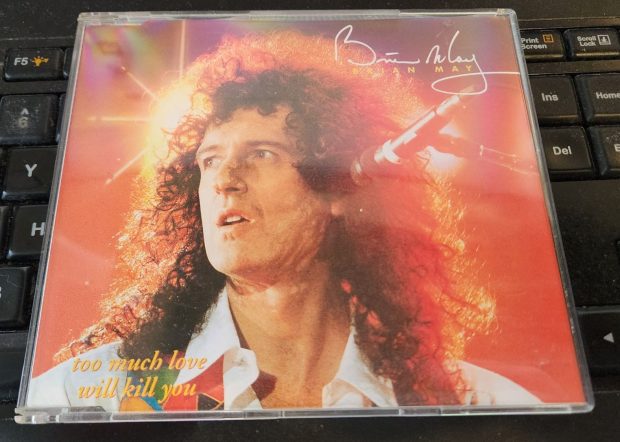
BRIAN MAY – “Too Much Love Will Kill You” (1992 EMI/Parlophone CD single)
The first time that most of us heard “Too Much Love Will Kill You” was in 1992, at the Freddie Mercury tribute concert. Surely one of the biggest and most spectacular such events ever hosted, Queen played a scorching set with guests that night. One of the highlights was a song that Brian May humbly said was the best he had to offer. That song was the ballad “Too Much Love Will Kill You”, which Queen recorded but did not release on The Miracle (until 2022). For that album, the band chose to only include songs written solely by the four core members. “Too Much Love Will Kill You” was co-written by Brian with Elizabeth Lamers and Frank Musker. A few months after the concert, May would release his solo version of the song on his album, Back to the Light, and also as a single. (There is now a deluxe edition of Back to the Light, containing all the songs from this single.)
“I’m just the pieces of the man I used to be,” croons May after a a delicate intro. A song about being torn between two lovers, you somehow actually feel sorry for the guy who’s trying to choose between two women. “Too much love will kill you, just as sure as none at all.” May’s version is different from Queen’s, with lush orchestration taking up much of the space. It’s absolutely gorgeous! Queen’s version was as well, and it may be difficult to choose between versions. Brian takes a lovely acoustic guitar solo, which is so rarely heard from the master of electric layers of bliss. His vocals are impassioned, perhaps even more than Freddie’s were. Though loaded to the gills with strings and accoutrements, it’s a spellbinding version.
Second on the single is a rocker named “I’m Scared”. If it were a Queen song, it would be one of the harder-edged. It’s a speedy ride through an amusement part of guitar and drums (by Cozy Powell, with bass by his Black Sabbath and Whitesnake compatriot Neil Murray). Brian talk-sings for most of it, which works well, especially when he mockingly has trouble getting his words out towards the end. It’s a performance, and the chorus ain’t bad regardless of the vocal storytelling. It’s too weird for radio, but could be one of those cool deep cuts.
Track three is the “guitar version” of “Too Much Love With Kill You” which, believe it or not, is an instrumental. Brian’s electric guitar takes the place of the singer. It’s a cool and unexpected version. It’s an incredible, lyrical version. Brian takes liberties and doesn’t play the vocal melody note for note, but you can make it out just the same. This could be one of May’s greatest guitar performances, simply because he uses his instrument to speak in a way that very few guitarists can do for four minutes straight. He changes voices, he adds luscious trills, and it’s an absolute knockout.
The last track is a re-do of lead single “Driven By You”, with Cozy and Neil. Brian played bass on the album version. This version is hard and punchy. The song is a melodic rock classic. If it had come out a couple years earlier, it could have been a summer hit. Cozy and Neil were in Brian’s live band, so having them re-do the track for a B-side probably made sense. It’s really strong, and the bass and drums are both in your face. Diehard fans will absolutely be able to recognize the legendary rhythm section. Cozy in particular has a signature sound, and Neil does as well to a lesser degree.
What a great single, combining rarities with hits and a deep cut. A total score.
I’ve never hid my disappointment that Skid Row have been unable to hang into a lead singer for long since Sebastian Bach’s 1996 ouster. Johnny Solinger was their best shot at a permanent lead singer, since replaced by a dizzying array of vocalists. Erik Grönwall, from Swedish Idol and H.E.A.T., was probably the biggest hope. Sadly, as a cancer survivor, Erik was forced to resign and focus on his health. The one album he made with Skid Row, The Gang’s All Here, received critical acclaim in 2022 and was called Album of the Year by several outlets.
Erik Grönwall brings the necessary range and power, more so than Solinger. Unfortunately, both Solinger and Bach had a lot of character in their voices. Grönwall has a more generic sound, and this robs Skid Row of some of what made them special. He almost sounds too good, too professional.
A lot of people will disagree and that’s fine. We’re all entitled to our opinions.
Only two songs here, “Time Bomb” (sort of a punky rewrite of “Piece of Me”) and “The Gang’s All Here”, made it onto the tour setlist. 80% of the album was not played live. There are shout-along choruses, Kiss-like guitar licks, and Bolan’s bass bounce…but do the songs stick to the brain like albums of yore? Some do. The best moments are the ones that recall the past, such as “Resurrected” which has a “Monkey Business” familiarity. Unfortunately, the trite lyrics are another one of those “we’re back where we belong” kind of songs.
The strongest song is the ballad “October’s Song”, which comes closest to nailing the timeless Skid Row level of quality. Grönwall’s schooled approach to singing is opposed to Bach’s desperate passion to blow down the biggest of buildings, but that was a long time ago, and Bach is never coming back. “October’s Song” has some great riffage and should have been made a permanent part of the setlist. You’ll not find a better song among the new ones. We’ll say it right here: this song stands up against the back catalogue, even the intense Slave to the Grind ballads.
Credit due: Skid Row almost go activist on the environmental message song “World On Fire”.
Much of the album was written with previous singer Z.P. Theart, of Dragonforce. Core Skid Row members “Snake” Sabo, Scotty Hill, and Rachel Bolan handle the majority of songwriting, retaining Rob Hammersmith on drums.
If you want a new Skid Row album that you can pump your fist to, stomp your feet, or bang your head, then The Gang’s All Here is a must-buy. If you were hoping for a Skid Row album that you’ll remember for years like Slave to the Grind, Subhuman Race, or even Thickskin, then the jury is still out. Thickskin had way better songs – there, I said it!
It was a marathon, but it was never dull! With Pete Jones on board, we completely dissected every track on these two 40 year old albums:
Judas Priest – Defenders of the Faith – 13 January 1984 – peaked at #18 in the US and went platinum. Produced by Tom Allom, his fifth with Priest.
Iron Maiden – Powerslave – 3 Sept 1984 – peaked at #21 in the US and went platinum. Produced by Martin Birch, his fourth with Maiden.
Harrison Kopp arrived at the end of the show and between he, Peter and myself, we chose a winner. It was a 2-1 vote.
Lyrically and musically we broke down each track to the individual parts. We shone light and appreciation on all the players, for what they contributed to each of these epic metal masterpieces. At the end of the day, it was clear that though both bands are often lumped together, these two albums are completely different. They have different moods, different directions, and different lyrical themes. Both are important albums to 80s metal, and to the respective band catalogues.
Subject matter broken down in detail:
The bass, drum, and guitar parts to each song.
Lyrical themes to each song and album.
The B-sides and bonus tracks.
The true and hilarious story behind Mission From ‘Arry.
Connections between Becket and Iron Maiden.
Personal stories and impact of these records.
Live performances and songs that have never been played live.
You will also be treated to a live performance of “Freewheel Burning” by Mike!
They call Peter the Professor and for good reason. He came prepared with tour information and intimate knowledge of the construction of these songs.
Though it pained me to have to pick a winner, we did!
We hope you enjoyed the show, and a big thank-you to Peter for contributing two hours of your Friday night! Of course, always nice to see Harrison.
This is likely the last evening show of the summer of 2024. Afternoon shows occur at 3:00 PM on Fridays, when I have an available co-host. Thanks for watching, and stay tuned…
The next show is an interview with author Angie Moon, regarding her debut music/true time book, Crime of the Century, June 21 on Grab A Stack of Rock!
This album, recorded during what I consider to be Blue Rodeo’s jammy psychedelic phase, is one of my favourites (it’s up there with the preceding Five Days and Tremolo, to which it is related). It isn’t an album to like instantly, but only through multiple listens. It suddenly clicked with me after seeing the band play these songs live.
This album began life during writing sessions in 1993, but the band was so inspired with some spontaneous new songs, they ended up writing and recording Five Days In July in, well…five days in July. That album was released first, and the band later returned to the other songs written during that period. Five Days was a huge hit, so when Blue Rodeo finally got back to making this album, the difference took fans by surprise. (Some of the leftovers became the similarly jammy but acoustic Tremolo, such as “Moon & Tree”, which was once more psychedelic and electric.)
When I saw the band live on this tour, they blew me away. I hadn’t seen them live since the 1991 Casino tour, so this was my first exposure to the new six-man lineup. Greg Keelor was on fire, playing gonzo Young-esque feedback-laden solos that lasted up to five minutes. It was incredible. This album distills that kind of sound down to 5 and 6 minute songs.
The first two tracks, “Save Myself” and “Girl In Green” were not about to become hit singles, as both are slow and melancholy. “Save Myself” is painstakingly slow, much like Greg’s first solo album, while “Girl In Green” is funky with a powerful, almost yelled chorus, backed by James Gray’s organ. Both songs are winners to this listener, because they are completely noncommercial, while retaining melody and tons of emotion.
Interestingly: There was both a 12″ and promo CD single of “Girl In Green”, a rare trance-y “Space Knowledge” remix. Very cool, very weird — I have both.
“What You Want” sounds a lot more like traditional Rodeo, Jim’s first upbeat rocker of the album. Greg’s hit single “Side of the Road” is track 4, a moody 6-minute tour-de-force with an incredible chorus and plenty of solos.
Like a one-two punch, Jim comes back with “Better Off As We Are”, possibly the best song on the album, if not the best rock song that Cuddy’s ever written. I love Jim’s lyrics; conversations with his brother and recollections of young adulthood. Such power in the performance!
My older brother he left the day he finished school, moved down to New York to Washington Square. he calls me up and says you should come and see me, watch the waves of people rolling everywhere.
“Sky” slows things down a bit, a Jim ballad with a slow tempo that sounds more like something from Greg territory. That ended side 1 of the original LP,
and side 2 began just as slowly with Greg’s “Brown-Eyed Dog”. Great chorus, with comatose verses that may put the unprepared to sleep. Then Jim’s “Blew It Again” is a sad
ballad, lyrically similar to “Bad Timing”, but musically based on a catchy little piano line.
“Get Through To You” follows, which features Greg waking up and letting rip again with an uptempo rocker. This song, one of Greg’s best, is kind of similar to Jim’s catchy tunes on side one. Jim’s “Armour” is another plaintive ballad as only Jim can do, and perhaps should have been a single, as it could have been a hit.
The album closes with two more slow ones, “Train” and the eight-minute-plus “Flaming Bed”. These songs drone off into the distance, meandering lazily, like the hot humid July that spawned them. This ends an album that is largely misunderstood as ignored by the general record buying public. And a shame that is.
As you can see, this isn’t the light-hearted countryfied Blue Rodeo of Casino or Outskirts. Greg’s health problems (diabetes) coincided with an interest in slowing things down, and that’s what this album is. It will either click with you, or it won’t, depending on the setting. Find the right place and time, however, and you will enjoy a surprising listening experience, full of depth and emotion, melody and lots of meandering jams.
I suggest listening during an evening, on the porch. In July.
5/5 stars
Of note, if there’s a third voice in the background that’s sounds familiar, it should: It’s Sarah McLachlan.
TWISTED SISTER – The Best of the Atlantic Years (2016 Atlantic)
Nobody likes buying the same thing twice, so Twisted Sister have ensured this “greatest hits” album is vastly different from their other stand-by, 1992’s Big Cuts & Nasty Cuts. That album boasted a side of live B-sides, now collected as Live at the Marquee. As such, it only had 10 studio tracks, whereas this new compilation has 17 plus a previously unreleased bonus.
The repeated songs are the obvious ones:
“I’ll Never Grow Up, Now!”
“You Can’t Stop Rock ‘N’ Roll”
“I Am (I’m Me)”
“The Kids Are Back”
“I Wanna Rock”
“We’re Not Gonna Take It”
“The Price”
That leaves a whole lotta songs, including a few singles, that you’ll find here but not on Big Hits. Notably though, that means this compilation doesn’t have “Shoot ‘Em Down”, “Under the Blade”, or “Bad Boys of Rock ‘N’ Roll”.
What makes this compilation a little more special is that the tracks go almost chronologically, and don’t skimp out on songs from Come Out and Play, or Love Is for Suckers. Founding guitarist Jay Jay French mentioned in the liner notes that Suckers was supposed to be a Snider solo album, but we do get two songs.
Opening with Twisted’s first Atlantic album Under the Blade, we are treated to the 1985 remixes of “What You Don’t Know (Sure Can Hurt You)”, “I’ll Never Grow Up, Now!” and “Sin After Sin”. It’s a nice one-two-three punch, with “I’ll Never Grow Up, Now!” being a bubble gum punk sandwich, stuck between two heavy metal hard hitters. It’s actually a nice change of pace, getting the echo-laden remixes this time.
The heavy metal assault continues with what might be my favourite Twisted song of all time: “You Can’t Stop Rock ‘N’ Roll”.
“Like a charging bull, it’s a juggernaut, With steam at full, never to be caught, Incarnate power, roaring from the sky, While others cower, rock ain’t gonna die.”
The slow intro, the chugging riff, the pounding drums of the late great A.J. Pero (my favourite member as a kid) and the roar of Dee Snider made this the perfect heavy metal song to entice a young teenager back in the 80s. “You Can’t Stop Rock ‘N’ Roll” is part of a trio included from the same-titled album, joined by melodic metal masterpieces “I Am (I’m Me)” and “The Kids Are Back”. When Twisted went all melodic, they drew upon classic influences, but combined with the heavy guitars, they almost sound like precursors to pop-punk. In many regards, Twisted Sister were ahead of their time. It’s a simple recipe: Guitars chug, bass joins them, drums throw in some catchy fills, and Dee Snider delivers the hooks with the band on backing vocals. Simple, but difficult to master.
The largest clutch of songs obviously comes from Stay Hungry, with six. The three big singles are the obvious ones, but also thrown in are the classic deep cuts “Burn In Hell”, “The Beast” and “S.M.F.” In these songs, you get the heavier side of “Stay Hungry”, minus the title track itself. People who don’t actually know Twisted Sister might be surprised how heavy Stay Hungry could get once you ventured outside the safe singles. “Burn in Hell” is an exersize in intensity that deserves every listen you can give it. Perhaps the oft-forgotten “The Beast” is the most welcome here, as a true red-blooded slow burner metal monster.
Despite the quality of the lesser-heard Stay Hungry songs, one remains the pinnacle of Twisted Sister’s finest moments: “The Price”. Twisted probably took guff from the press and the doubters for attempting a ballad, but “The Price” puts the “power” in power ballad. Notably, A.J.’s drums are far busier and heavier that you expect from the average paltry power ballad. Dee Snider demonstrates his expert-level versatility here on the high notes, rendering this song very hard to sing note for note today.
This album wastes no opportunity. Come Out and Play is finally given a fair shake. The dark ugly duckling of the Twisted discography is represented by the title track, “Leader of the Pack”, “The Fire Still Burns” and the forgotten sing-along “You Want What We Got”. They didn’t skimp out here, and you get the full length version of “Come Out and Play”, including the Warriors homage of “Twisted Sister, come out and play!” Pero’s final album, and his drumming on this track is as blazing fast as it got for Twisted Sister. “Leader of the Pack” is campy fun, but it really had to be included, being an integral part of Twisted’s early history and eventual failure (at least according to Jay Jay in the liner notes). “The Fire Still Burns” has an intense flame indeed, though did Dieter Dierks’ production do it any favours? Of note: “You Want What We Got” is not the album version. It is longer at 4:21, and contains an outro with Dee Snider talking, and dropping a deleted expletive! This version is not credited as being unique, and it’s currently unknown where it originated.
Love Is For Suckers is often neglected. The Beau Hill-produced album was written to be Dee’s solo debut, and included members of other bands from the Hill camp, such as Fiona, Winger and Kix. Reb Beach played lead guitar, which led to a sudden change in sound, away from the heavy metal of Twisted Sister’s roots, and more towards what was popular at the time: the subgenre they call “hair metal” today. Joey “Seven” Franco replaced A.J., and was so nicknamed as he was the band’s seventh drummer. Franco also followed Dee into his solo band the following year. “Hot Love” was the single, which should have been a hit, while “Love Is For Suckers” was the only cover the band ever recorded without playing live first.
The final song is the bonus track, “Born to be Wild”, the Steppenwolf cover that they have indeed played live (going back to 1976, but more recently on Live At Wacken: The Reunion). This new studio version was recorded in 2005 and produced by Mark “The Animal” Mendoza. It was used prior to this release in a reality TV series called Knievel’s Wild Ride. It’s tremendous fun, with Twisted Sister ripping into it with their usual reckless abandon. Mendoza’s bass is delightfully bass, but Dee Snider really lets loose at the end.
This set, being limited to the Atlantic years, gratefully doesn’t include anything from Still Hungry or Twisted Christmas. That’s fine and dandy; they would unbalance this release. The Best of the Atlantic Years is the best single Twisted Sister compilation on the market.










You must be logged in to post a comment.