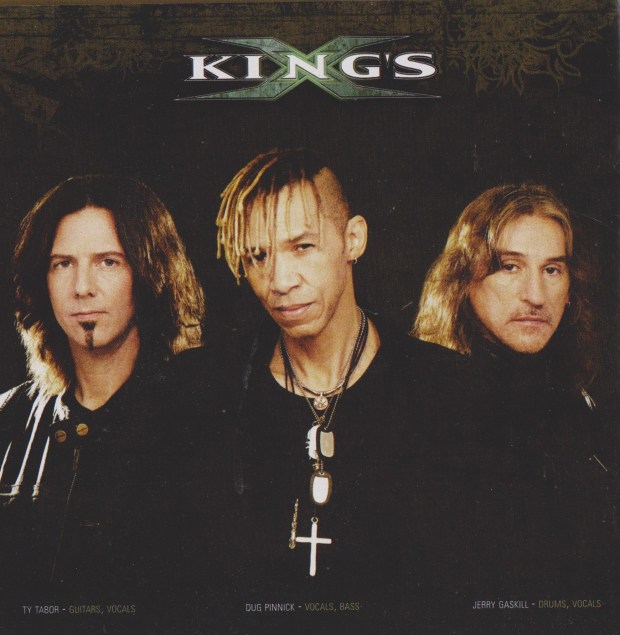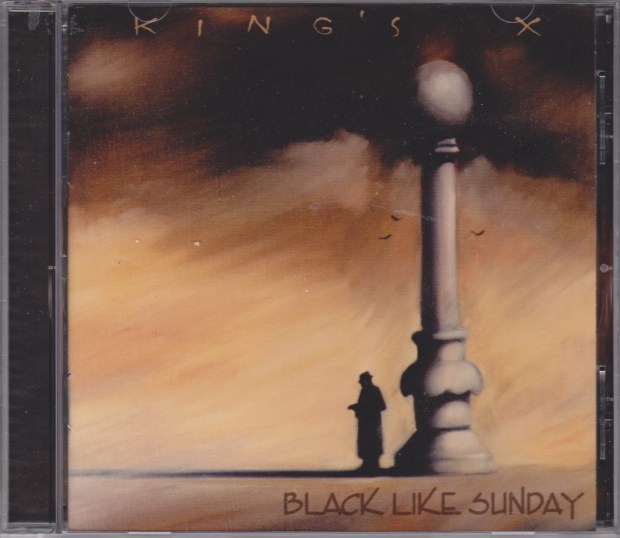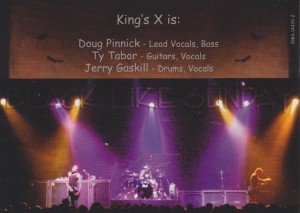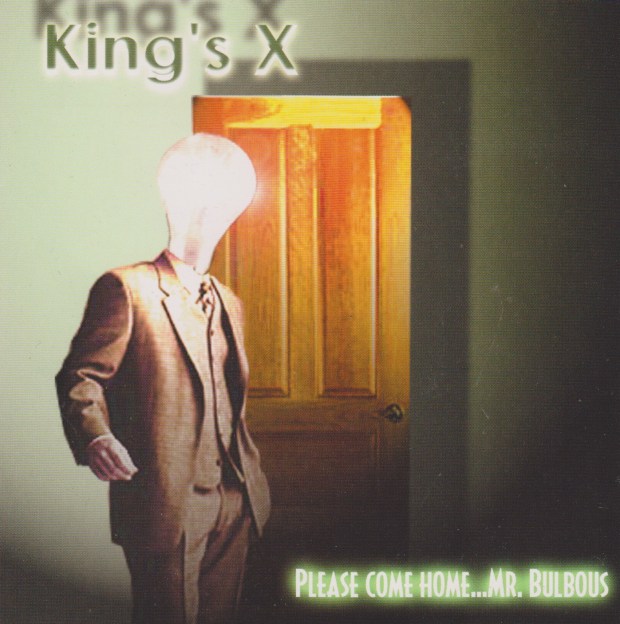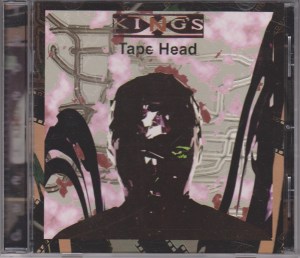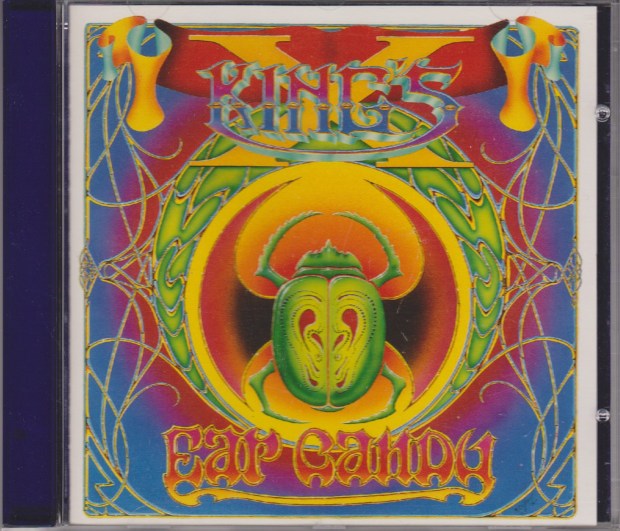
KING’S X – “Junior’s Gone Wild” (1991 Interscope, from the Bill & Ted’s Bogus Journey movie soundtrack)
With Faith Hope Love creating a little bit of a buzz, 1991 coulda been the year for King’s X to finally break. Meanwhile in Hollywood, a Canadian fellow named Keanu Reeves re-teamed up with his buddy Alex Winter to star in Bill & Ted’s Bogus Journey. Many rock fans worldwide had enjoyed the prior adventures of Bill & Ted. They liked cool bands and got to hang out with George Carlin. Not to mention, the movies had soundtracks. Extreme, for example, had some exposure thanks to an appearance on the first movie’s album. Then somehow, King’s X landed a song on the Bogus Journey soundtrack. Maybe because the movie soundtrack came out on Interscope, owned by Warner, also the parent company of King’s X’s label Atlantic.
The soundtrack CD is actually really good. Kiss, Faith No More, Megadeth, Primus, plus quality tracks from Winger, Slaughter and Richie Kotzen. Surprisingly, one of the weakest songs was the one by King’s X!
“Junior’s Gone Wild”, barely three minutes long, is one of the most unremarkable songs King’s X have done. You can’t pinpoint what exactly doesn’t work. On paper, it should. A stuttering riff, Doug Pinnick’s impassioned singing, and the trademark lush King’s X cloud of backing vocals: it’s all right there, wrapped up in a bow for 3:09. Yet it’s bland and forgettable. Was this the first crack in King’s X armour? Or did they just send a throw-away outtake out for the soundtrack? If so, perhaps doing so was a mistake. The movie made almost $40 million, doubling its budget.
In another weird twist, “Junior’s Gone Wild” also wound up on the B-side to a Kiss CD single, “God Gave Rock & Roll to You II“. With that kind of exposure, don’t you just wish King’s X had put an amazing song out instead? Meanwhile back on the soundtrack CD, I was being blown away by this new young kid, Richie Kotzen, with an incredibly soulful voice and hot space-blues licks. Kotzen succeeded in competing with the big boys on the CD, and so did Faith No More. King’s X fumbled the ball.
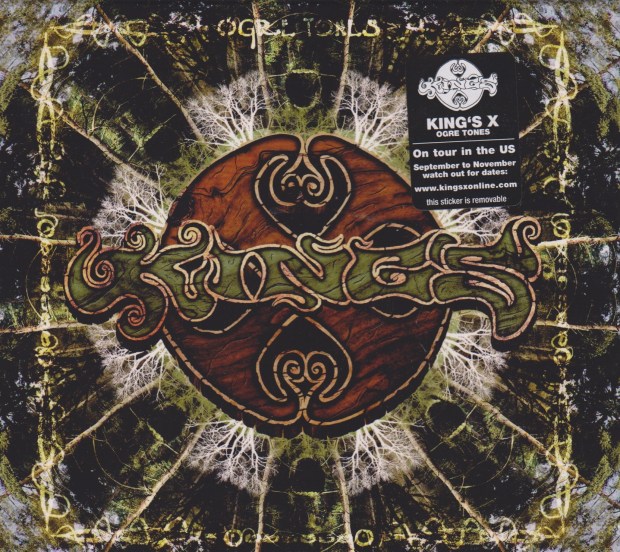
KING’S X – Faith Hope Love by King’s X (1990 Atlantic)
This is where I hopped on board the King’s X train. It was the quirky video for the irresistible pop rocker “It’s Love”. It wasn’t the first accessible King’s X single, but it was the first I ever had the chance to hear. And it was instant. It was an immediate, “Ah! So this is King’s X! I have to get this.” And I did. Before then, I had only read about them in magazines. Their cool cover art, striking album titles, and brilliant reviews had them on my radar.
“It’s Love”, written and vocalized by Ty Tabor, emphasizes the melodic aspects of the band. They always utilized Beatles-like harmonies over chunky guitars. This mixture was perfected for the charts on “It’s Love”, and it did make a minor dent.
Although “It’s Love” might be the most instantaneous song on the album Faith Hope Love (the band’s third), it’s not the most impressive. Not even close. And that’s saying something!
With Faith Hope Love, there was a downshift in intensity but not in quality. The album is overall a little less edged, but just as challenging. Indeed, the title track is almost 10 minutes of swirling rock, with dual lead vocalists and startling instrumental integrity. There is also a song called “We Were Born to Be Loved” with smoking playing, false endings, and enough technical chops to satisfy the most ardent fan.
King’s X have never taken the easy road, lyrically or musically. “Legal Kill” is abstract but can be interpreted to be about a few sensitive issues in today’s society. It’s not preachy: “I only know what I believe, the rest is so absurd to me.” It’s a beautiful song, a peaceful acoustic ballad. A song like this could have been a hit for anyone, except King’s X it seems.
Other accessible rock songs include the love song “I’ll Never Get Tired of You”, a beautiful sentiment. The “Fine Art of Friendship” combines the vocals of Doug Pinnick and Ty Tabor in that patented blend, always so tasty. Then there is the slow, dark ballad “Everywhere I Go” by Doug. There aren’t any weak songs on Faith Hope Love, although I find the softies “Mr. Wilson” and “Six Broken Soldiers” (vocal debut of drummer Jerry Gaskill) to be not quite as amazing as the rest of this stunning album.
The centerpiece is “Moanjam”. By the opening rumble of Doug’s bass and the intense tempo, you might think it’s a Motorhead song. Proving their diversity, “Moanjam” combines smoking metal riffing, lush harmonies, and Doug’s unmistakable soul singing. You could put “Moanjam” on an album 10 times and it would still be a hell of an album! With subtle Christian lyrics (“I sing this song because of You, You’re the glory”), you can headbang to it without thinking too much about the words. In fact, doing so is quite an enjoyable experience. It’s also a blast to air-drum to Jerry’s speedy parts; just be sure to catch your breath!
Although Faith Hope Love was their most accessible album yet, in many ways it really wasn’t. It was over an hour long, containing two long-bombers. The arrangements are still challenging, and still uniquely King’s X. There is nobody out there who plays guitar like Ty Tabor does, and nobody who can sing like Doug Pinnick. Faith Hope Love is a completely unafraid album. Unfortunately it might also have been their last chance to grab the brass ring. With grunge around the corner, bands like King’s X were hastily pushed aside. What a shame. This record could have been their Revolver.
KING’S X – Kings of the Absurd (split 1990 Metal Crash live bootleg with Faith No More)
Live bootlegs vary in quality, but usually have one thing in common: they are almost always interesting. Kings of the Absurd, a split live bootleg from Italy, raises a curious question.
Why put Faith No More and King’s X together on one CD?
No reason.
The King’s X set is from London at the Astoria; Faith No More’s from a festival set in Italy many months later. It’s an odd pairing, with no common musical denominator. If anything, both bands share critical acclaim, but that’s about it. Why are they together on one CD?
No reason!
Absolutely no reason.
The Faith No More portion of this CD will be reviewed at a later time, probably as part of a Faith No More review series. For now we’ll just examine the four songs presented by King’s X, which, believe me, are enough to melt your face off without the help of Mike Patton and co. I found this CD in the racks of the used CD store in which I started working, in early 1995. Loving both bands, and stickered at just $11.99, this was an easy winner once you figured in my staff discount. I was just lucky to have snagged it before Thomas, also a massive Faith No More and King’s X fan.
“What is This?” is the only song lifted from their debut album Out of the Silent Planet. The original set was 10 songs, and this was the second, but it works as an opener as well. The heavy groove and the slick backing vocals of Ty Tabor and Jerry Gaskill are intact. Doug is more impassioned live than on album, which is the way it is with any good soul singer. Doug’s take on “What is This?” is very different from the album; he just lets the vocal come out as it does. Even on this crappy sounding CD, you can hear that the bass is hella-heavy, and that Jerry Gaskill is one of the most underrated drummers you will ever lay ears on.
Doug addresses the crowd between songs. “We’re going to try to do almost everything that we know tonight for you,” he teases, with no idea that these words would end up on a live bootleg with only four songs! Next (and the next song played that night) is “Out of the Silent Planet” from their then-current Gretchen Goes to Nebraska album. The complexity of the backing vocals doesn’t seem to present them a problem. It’s clear that this is one hell of a trio, as if you were in any doubt. The CD doesn’t have “Sometimes”, the next song played, but instead goes to “Summerland”, also from Gretchen. The poor sound hampers the song slightly, since it’s lighter and doesn’t slam as hard as the others. Doug is again outstanding, not only one of the greatest singers in rock but also a top notch bassist. “Fall On Me” (Gretchen) ends this short set. It was a great song on album, but live it’s just as amazing. Doug’s lungs sound as if diesel-powered.
The fact that King’s X only got tacked onto the end of a Faith No More bootleg CD is sadly not unexpected. They got boned by the music business, so why not by bootleggers too? The whole set is out there, and it sounds like an amazing show. Just check out this article and the comments section, over at our friends Every Record Tells a Story. A few readers were there that night.
You gotta give King’s X a 5/5 stars for a set this hot, but Metal Crash get 0/5 stars for the CD
KING’S X – Gretchen Goes to Nebraska (1989 Atlantic)
Only a year — one measly year! — after debuting with one of the most dearly beloved first albums in memory, King’s X summoned the muse for a second time. They went back into the studio with Sam Taylor to repeat the magic. Repeat it they did, with their original blend of influences and talents, but without backing off one inch in compromise. They did make a couple corny but cool music videos, although the rarity of their airplay must have frustrated everyone involved.
“Over My Head” surely made the band look and sound cool. Their souls-meets-metal-meets whatever they want vibe is concisely summed up in under five minutes. “Grandma used to sing, grandma used to sing, every night when she was prayin'” says Doug, opening up old wounds that he would still be singing about for years. But it’s not dark; instead, the music is as uplifting as a church choir. But only if the church band featured Jimi Hendrix and the Isley Brothers.
Production is improved on Gretchen, and diversity has expanded once again. “Out of the Silent Planet” (the title track for the last album!) opens with sitar, but before too long a very Rush-like riff is enveloped by the lush psychedelic harmony vocals that Doug, Ty and Jerry create so naturally. Clearly the band did not take summer holidays that year because the growth is audible. Layers of guitars, sitars and unknown sounds create a swirl of purple haze. And listen to Doug’s chiming bass on the outro. What’s that you hear? Yeah, it sounds like the bass outro to “Jeremy” to me, too. Jeff Ament of Pearl Jam once said that “King’s X invented grunge”. I don’t think that’s true although it probably indicates that some smart guys in Seattle had good taste in music. I think Doug Pinnick invented the way that he and Ament play bass. If you hear Pearl Jam occasionally in King’s X, I think that’s the part that was tapped by Jeff Ament via Doug Pinnick.
Gretchen may be challenging like Silent Planet was, but King’s X try to make it easy for you to climb aboard the train. The light melodic picking in “Summerland” sound enticing so just come on in. Doug’s soulful wailing brings the clouds but Ty’s harmonies blow ’em back away. “Summerland” is a rock triumph, possessing drama with melody and integrity in a flawless mix. Back to church again on “Everybody Knows a Little Bit of Something” — but only briefly as we are now on funky ground. Accelerated for action, “Everybody Knows a Little Bit of Something” is a pulse-pounder not to be missed. King’s X can do no wrong, especially when combining disparate elements in new ways. Another side of King’s X is the acoustic one often visited by Ty Tabor, and that’s “The Difference”. The setting feels like a chilly fall day but King’s X paint pictures that allow you to see your own images. That’s the beauty of the music.
“I’ll Never be the Same” is more familiar King’s X territory. Never keeping it simple, never making it inaccessible must have been the motto. Their pool of influences seems to come out slightly different each time. Church organ (by Sam Taylor) makes its debut on “Mission”, an appropriate place for it, but that’s a bluff. “Mission” is actually a metallic assault on televangelists. “What is the mission of the preacher man?” asks Doug in an impassioned wail. “Some are true, Some do lie,” he warns. “Fall on Me” will then take your head off with some of the rockingest King’s X on the album. If a record label was looking for an accessible single, here it is. I guess this band really was just too smart for radio, like with the cosmic “Pleiades”.
Far off in the field I see a castle, Today the people gather at the pole, He tried to tell us all the world was spherical, They burned his body but not his soul.
Keep in mind this is a band that is often lumped in with Christian rock! But what about the riff? Imagine the love child of Ritchie Blackmore and Jimmy Page. They had a baby and named it “Pleiades”.
Pinnick brings the soul back on “Don’t Believe It (Easier Said than Done)”. “This is not the end of the road,” he sings and he’s right — even though it is track 10, it’s not the end. King’s X beefed up Gretchen with 12 tracks, a rare bounty in 1989. But this was not a normal band. These was an inspired trio with thoughts and feelings to get off their collective chests. “Send a Message” keeps the pace upbeat but not straight; there have to be some twists and turns. Ty then takes the final track with “The Burning Down” and a mellow ballad. Floyd meets Rush meets King’s X, and it’s over.
The first two King’s X albums boasted rich and impressive album art. Gretchen is the best of the pair. Now that’s an album cover; the LP at least anyway. On CD it’s much harder to appreciate. No matter since it’s the music that counts. It’s rare for a band to grow from an incredible album like Silent Planet to something even bigger like Gretchen. That’s exactly what King’s X did, even though they did it in obscurity.
Join us for a serious look at everyKing’s X studio album!…and more.
KING’X – Out of the Silent Planet(1988 Atlantic)
The Texas Trio, the soul-bringers of progressive rock…call ’em what you want (I just did, I made those two titles up), King’s X are too important for you to ignore any longer. If you have been aboard the King’s X train already, then you know what I am about to tell you. If not, then realize that this band has been tragically ignored for aeons. Since 1983 in fact, as Sneak Preview, a glammy rock band who released one record before changing direction and name to King’s X. Even though Sneak Preview were certainly not hinting that there was more beneath the surface than just some good sounding rock and roll, it was obvious that they had the ability to write and to play. They made a few music videos, and “Linda” depicts them delivering hooks more typical of Bon Jovi or Van Hagar.
Supposedly, the band were not happy with the way the Sneak Preview album turned out. Of 1000 copies made, half were reportedly destroyed on purpose. Today copies sell for over $200.
Newly christened as King’s X, the band and producer/manager Sam Taylor went into the studio for Megaforce, a division of Atlantic, the label that launched Led Zeppelin. They emerged with one of the most startling and important debut albums of the 1980’s, Out of the Silent Planet. Starkly original and different, King’s X took the critics by storm. If only the record buying masses followed their lead.
According to esteemed scholar and Sausagefester Scottie Geffros, “From Out of the Silent Planet right up to Tape Head (1998), there is so much good stuff that the world in general should be embarrassed that ‘music fans’ never caught on to the greatness that is King’s X.” Adds fellow ‘Fester Johnny Cheddar, “I remember the first time listening to Out of the Silent Planet with Dr. Dave…we had been on a music buying mission, and he found an elusive vinyl copy; going cheap if I recall. It was a hard album to come by in those days. I was amazed to hear such a heavy riffy metal sound, but without the sinister vibe that goes with it.”
Starting with a dramatic space rock intro, “In the New Age” soon introduces the core King’s X sound: The soul, the dual vocal talents of Doug Pinnick and Ty Tabor, and their unique cross of influences. Ty and Doug have voices on opposite sides of the rock spectrum. Ty sings high and clean with a hint of Lennon, and Doug goes deep to the howling limits of his soul. Their trio format, with Jerry Gaskill (another talented singer in his own right) on the drums still allowed them to create expansive rock. They were not writing anything simple or pandering anymore; “In the New Age” boasts daring changes and a progressive bent that major labels weren’t usually hawking.
The central song might be the ballad “Goldilox”. On this track, the band have married a knack for a good pop song without compromising their integrity. “Golidlox” is a spring-like, bright song of hope. Doug Pinnick has a voice to be envied by anyone, with power and the ability to evoke the classic soul singers of an era gone by. The other two back him to form a lush curtain of slightly psychedelic harmonies.
“Power of Love” has a pop rock chorus, but punched up by the hard hitting band. Vocally, this is a soul anthem. Musically, it’s anthemic rock and roll, good for head-banging or banana-dancing. It’s up to you — and that’s the “Power of Love”! Although hard rock songs not unlike this were getting played on the radio, King’s X were probably too smart for radio. “Power of Love” melds seamlessly into “Wonder”, a song about divisions between us. “There’s a wall between us, a partition of sorts.” Yup, too smart for radio. Chunky like good peanut butter, and still fresh today, “Wonder” is indeed still a wonder. “This is church, this is state, rock and roll, Amazing Grace.” Then, “Should I go to the front, should I go to the back? Should I just pray or should I attack?” Considering it’s Doug singing (Doug is black), I wonder if some folks of limited intelligence might have found those lyrics just a little scary? This is some powerful shit.
Doug sounds wracked with pain on “Sometimes”, again tormented by the world he sees around him. As King’s X progressed, so too would Doug’s subject matter and way of approaching it. In 1988 he was deeply religious. “I stand here waiting for new Jerusalem, I know it’s greater than the world outside.” The pain subsides on “King”, which is an incredible high water mark of songwriting…and it’s on a debut album. Consider that for just a moment. Again Doug is using Biblical imagery in his words, but King’s X did not seem to preach. Even if some were starting to suspect that the titular “King” was Jesus Christ himself, hey look an awesome guitar solo!
The rumblin’ bass of Pinnick shakes your teeth on “What is This?” Heavy and melancholy until the chorus kicks in, “What is This?” nails it again. “Far, Far Away” ceases the slamming temporarily, for some 60’s textures and dreamy Van Halen-esque chops. “Shot of Love” has a slight but noticeable jangle to its marching riffage. Out of the Silent Planet boasted numerous styles of rock on one album but also usually within a single song too. “Shot of Love” recalls gospel, marches, Queen, Judas Priest and Supertramp. Finally, “Visions” is heavy on riffage, combined with heavenly choirs of vocals. Sabbathy riff changes, Motorhead tempos, Eddie Van-shred, and Beach Boys harmonies. Put that in your pipe and smoke it.
1988 came and went, with King’s X winding up on many critics’ top 10 lists. As luck or perhaps just taste would have it, that did not translate into sales. But in 1988 that didn’t mean the end. That just meant you go back into the studio and make another album. A better album.
QUEENSRŸCHE – Condition Hüman (2015 Century Media Japanese edition)
As if it was not abundantly clear on their last album (2013’s self-titled), Queensryche seem to have no intentions of abandoning their heavy metal roots again. Furthermore when you have a significant lineup change, such as a new lead singer, you can’t just stand still. You have to keep progressing forward. The ‘Ryche used their last album to re-ground their sound, but for a followup you need more than that. Condition Hüman pushes the boundaries out once more, but not without keeping the metal intact.
Indeed, “Arrow of Time” sounds as if the quintet had been ingesting nothing but classic Iron Maiden for breakfast. Swift and viscous, “Arrow of Time” gets the job done in the requisite four minutes but not without exploring the exotic side of metal riffing. Imagine an alternate reality where Queensryche did not go in the highly technological direction of 1986’s Rage for Order album. Envision instead a timeline in which they followed The Warning (1984) with an album that continued to progress, but also go heavier at the same time. That album would have been Condition Hüman. “Hellfire” demonstrates this as well; the song would have fit on a heavier version of Rage.
“Guardian” demonstrates this even more clearly. With the vintage-style screams and vocalizations (Todd La Torre for MVP), metal riffing, but also Mindcrime-like progressive rock, Queensryche have hit upon a satisfying balance. Songwriting credits are various combinations of all five band members; all but “Eye 9”, written solely by bassist Eddie Jackson (a first, I think). The album has a cohesive sound, like five guys all pulling in the same direction. The production, by Zeuss, is punchy. Queensryche have always employed elements such as sound effects and programming, and Condition Hüman has these fixtures as well.
Moving on, “Toxic Remedy” is Mindcrime-like, but denser and massive sounding. Pay attention to the way Todd La Torre layers his vocals on “Toxic Remedy”. He has arranged the vocals in his own way; this is not a carbon copy of something else. “Selfish Lives” is the same. Yes, there are hooks and melodies that sound very Queensryche, but Todd is showing off his own personality more than before. And he’s not taking the easy way out on any of it! Sounds like he is really pushing his own limits, especially on “Selfish Lives”. It’s quite remarkable how lucky Queensryche were to find a compatible guy like Todd, who is also able to stretch it out.
Another album highlight is the rhythmic “Eye 9”, the aforementioned Jackson composition. This Queensryche-meets-Queens of the Stone Age track blows the doors wide open in terms of direction by putting the rhythm first. It sounds like Queensryche, yet nothing like any prior Queensryche, simultaneously. “Bulletproof” puts a new slant on the Queensryche power ballad, keeping the emphasis on the power. La Torre makes it his own — listen to the last note he sings. Sends chills up the spine. Speaking of chills, crossing the acoustics with the heavy chunky riffing on “The Hourglass” did exactly that. There are Pink Floyd influences coming up to breathe from time to time on Condition Hüman. This is most obvious on “Just Us”, which is also very much like the slightly psychedelic acoustic side of Led Zeppelin. Queensryche have never done anything like “Just Us” before. “Silent Lucidity” this is not. The soulful singing at the close of the song is also unlike anything on a prior Queensryche song.
For fans of the technical, fast side of Queensryche, “All There Was” will scratch that itch. With that pulsing technological rhythm and “Needle Lies” tempo, you are in for a ride. Don’t forget the blazing guitar histrionics. The final album track is “Condition Hüman” itself, 7:48 of dramatic progressive metallic rock. Check out the “Astronomy Domine” section after the fifth minute, just before it goes into that deliberate Mindcrime riff. If I had to pigeonhole the sound of this album, it would be “progressive metallic rock”, but pigeonholes are lazy. Still, as Commander Pavel Chekov once said, “If shoe fits…”
Holding out for the Japanese edition of the album, the bonus track “Espiritu Muerto” is the bonus track worth waiting for. Going sludgy for 3:40, but topped with a soaring chorus, the bonus track is in the mold of the album but different just the same. It’s a long album though, and adding more material (even if good) can sometimes push a CD just a bit too far in terms of attention span. “Espiritu Muerto” is close to this line, but because it has enough personality of its own, it’s worth staying around for.
If any of these songs sound intriguing to you, check out Condition Hüman. Fans who wonder where Queensryche could have gone had they adhered to heavier roads will find much to enjoy. They have never taken the easy way with any of their albums, but it is hard to imagine a fan of early ‘Ryche who won’t find something here to love.
Happy Halloween, folks! And what better way to celebrate this day than with the king of horror rock, Alice Cooper?
ALICE COOPER – Alice Cooper Goes to Hell(1976 Warner)
Last time, he welcomed you to his nightmare. Now, journey with Alice as he takes you straight to hell! Subtitled (in the inner booklet) as “A Bedtime Story”, Alice Cooper Goes to Hell is another concept album, to follow a concept album. Steven is back. It’s a pretty mad concept, and one that ties into not only Nightmare, but also Nightmare 2, decades later. Steven will fall asleep, and follow Alice down a dark endless staircase, “the pit where he doesn’t want to go, but has to.”
Written and produced by Alice, Bob Ezrin, and Dick Wagner, Goes to Hell features a backing band with a name you might recognize: The Hollywood Vampires. It’s not the same band, obviously (Johnny Depp was 12 years old), but it does demonstrate just how long Alice has been using that name for a band. Among the many musicians herein, you will recognize many: Steven Hunter, Dick Wagner, Tony Levin, and Allan Schwartzberg are probably in your record collection many times (credited or otherwise).
Goes to Hell doesn’t have the fire, or the reputation, of Welcome to My Nightmare. It is the beginning of a long slide that did not fully right itself until after Alice had kicked the booze for good. It is, however, an under-appreciated album with fun and nuance in the dark shadows. The title track is one song that still graces the live stage. Here, Alice seems to be paying for his crimes committed. “For criminal acts and violence on the stage, For being a brat refusing to act your age, For all of the decent citizens you’ve enraged, You can go to hell!” You’ll never have so much fun on the road to H-E-double-hockeysticks, this side of an AC/DC album. Quintessential Alice, this is, and indispensable too. Anyone who has ever liked the biting humour and celebrated riffs of Alice Cooper will love “Go to Hell”. Bob Ezrin adds the usual accompaniment to the mix: horns, keys, and gang vocals condemning Alice to hell!
A full three years before Kiss, Alice Cooper went disco. If you like disco rock metal music, then “You Gotta Dance” to this one. This is a track that some Alice fans would probably love to bury, but it has its moments. Steve Hunter plays a wicked funky guitar solo. There is always instrumental integrity. “I’m the Coolest” slows the pace to a jazzy drawl. At this point I imagine the character of Alice is meeting various people down in hell, perhaps the man in charge himself. “Didn’t We Meet” suggests this. “To look at you, deja vu, chills me to the core.” Then, “They say you’re the king of this whole damn thing.” These three tunes are all quite a departure from hard rock, but Alice has always been so diverse. The hit ballad “I Never Cry” (#5 in Canada) is very pretty, unusually so for Alice. It is, according him, an “alcoholic confession”, and not the only moment on the album that touches on his drinking.
The first side of the album has some great tracks, but only the first (“Go to Hell”) really rocks. Side two is similarly diverse and dark. “Give the Kid a Break” is a campy musical number, with Alice pleading his case before the judge. “I don’t know why I’m down here, I don’t deserve to roast or bake.” Predictably, things don’t go well, since the next song is called “Guilty”! “Guilty” is the hardest rocker on the album, and one of the only songs to be played live occasionally through the decades. Not that all the other songs on the album suck; Alice just sounds right when he’s rocking like he always has. And the lyrics rule:
Just tried to have fun, raised hell and then some, I’m a dirt-talkin’, beer drinkin’, woman chasin’ minister’s son, Slap on the make-up and blast out the music, Wake up the neighbors with a roar, Like a teenage heavy metal elephant gun.
If you call that guilty, then that’s what I am. I’m guilty, I’m guilty!
This is right up the alley of a tune like “Escape” from the last album. It’s a shot in the arm and just when you need it.
With “Wake Me Gently”, we are back in ballad land, and it is unfortunately the longest song on the album. It sounds like an Ezrin creation, but in comparison to his other works, it is among his lesser creations. The string section is the highlight. Then he turns up the funk again for “Wish You Were Here”, with the help of Wagner on funky gee-tar. “Havin’ a hell of a time my dear, wish you were here.” Sounds like Alice has more than enough of hell by now. Steve Hunter plays the blazing Lizzy leads at the end of the song.
In a surprising-but-not turn, Alice pulls “I’m Always Chasing Rainbows” out of the hat, an old Vaudeville song (1917) once performed by Judy Garland in 1941. It actually works within the concept of the album, and predictably, Alice perfectly camps it up. It blends splendidly into “Going Home”, with Steven finally escaping his nightmare. Was it a nightmare? “I wonder what happened to Alice,” he ponders. This is pompous, overdone Ezrin, just the way you like it. Orchestration and thunderous percussion lend themselves well to this dramatic close.
It’s pretty clear that the reason Alice Cooper Goes to Hell is not as fondly remembered as Welcome to My Nightmare is the sudden change in direction to balladeer. There are only three rocking songs on an album of eleven tracks, and Alice was always primarily a rock artist, albeit an experimental one. You still found his records in the “rock” section of your friendly neighbourhood record store. Three rockers aside, the rest is a diverse assortment of music, well put together and played. Clearly, that has to be the key. But there is more to it than that. Nightmare seemed a more celebratory affair. It felt lively; it felt alive. Goes to Hell sounds less so. Alice’s lungs seemed weakened, just a smidge, from how they used to bellow.
Alice Cooper Goes to Hell is worthy of praise, not derision. Just remember — it’s not a rock album. At best it’s rock opera. Proposed analogy: Goes to Hell is Alice’s Music From the Elder. They even have the same producer!
QUEENSRŸCHE – Road to Promised Land (1995 EMI promotional “best of” CD)
20 years ago, good buddy T-Rev let me know this little treasure had arrived in his store (first discussed in Record Store Tales part 120). Released to promote the 1995 Promised Land tour, Queensryche’s Road to Promised Land AKA Arrived! was a neat little greatest hits package released well before their actual Greatest Hits several years later. This is a promo CD released by EMI in the United States, and it covers every Queensryche release to date.
From the original EP is not “Queen of the Reich”, but “The Lady Wore Black”. The ballad starting the set is an odd but explainable choice. Queensryche were playing “The Lady Wore Black” on tour, but Geoff Tate didn’t enjoy singing “Queen of the Reich” and tried to avoid doing so. Being so full of powerful metal drama, even as a ballad, “The Lady Wore Black” can work as an opener. Then “Take Hold of the Flame” follows, one of the best Queensryche songs of all time (from the first LP The Warning). Unfortunately that is the only inclusion from The Warning, although it is certainly a must. Geoff Tate used screams as a art form on this song like no other. You want metal drama? They opening tracks are Metal Drama 101.
Two tracks are selected from Rage For Order, and they are fairly obvious choices: “Walk in the Shadows” [“WALK WITH MEAT!“] and “I Will Remember”. It is a given that both are high quality songs, from an album that can be difficult to pick individual hits. The opening part of the CD feels rushed, with the critical first EP and two albums giving up only four songs. Keep in mind that these albums now make up a large bulk of Queenryche 2015’s set, although that wasn’t the case in 1995 with their original singer.
From the brilliant landmark concept album Operation: Mindcrime are three selections: “I Don’t Believe in Love”, “Eyes of a Stranger” and “Revolution Calling”. Once again these are fairly obvious choices, being the three singles from the album. Strangely, “Eyes of a Stranger” was not edited down and is the full 6:39 cut, complete with album outro. Their most successful LP yet, Empire, was also give three inclusions. “Best I Can”, “Jet City Woman” and “Silent Lucidity” were three great singles. I wonder why the title track “Empire” wasn’t used? I think it’s more identifiable than “Best I Can”.
Rolling into Promised Land for the final three tracks, it is plain sailing to hear the evolution of the band over their first decade. Although the metal got tuned down in favour of more drama and radio-friendly elements, one thing that never changed was their urge to experiment. Indeed, the first Promised Land single “I Am I” features plenty of daring sounds. (This version of “I Am I” fades out rather than skipping directly into “Damaged”.) From cello (by Chris DeGarmo) to tribal percussion to innovative vocal effects, “I Am I” proved that Queensryche could rock progressively in the increasingly alternative 1990’s. Lyrically, they were as serious as ever but more personal. The ballad “Bridge” was about DeGarmo’s relationship with his father. Finally, the heavy-as-plutonium “Damaged” closes the CD abruptly. That’s the problem with these record company assembled promo CDs. They are not designed to play as an album. They are designed for radio use and store play. In other words the only real consideration is including all the individual tracks you want to plug. Like “I Am I”, “Damaged” too was edited for radio. They shaved three seconds off in fades, because normally these songs flow together on album.
Rating a CD like this is kind of pointless, because it was never meant to be sold. But let’s say you don’t own any Queensryche, and you saw this used while wandering the shops. Would it be a good Queensryche purchase for somebody looking for a good overview of the classic years?
Russian Blue followed their critically acclaimed demo tapes with a full length CD, but perhaps it was the long wait that killed their chances. Between 1991 and 1994, the entire musical landscape had turned itself upside down. A name change was in order to suit the new climate, and after using the name Deadmoon for a little while, they settled on Feel. Simple: one word, one syllable, and trendy. Would they be able to maintain a level of quality over a full-length CD?
Almost. There is very little dead weight on Feel This.
“I Become You” is brutalizing, menacing, grooving detuned grunge. The presence of the bass is felt on this heavy recording. What Feel had that was different from other bands was the Axl-like screech of frontman Jo E. Donner. Indeed, when Donner multi-tracks his high voice with his lower register, the overall feeling is very Axl. Donner bellows forcefully, blowing out the speakers but not without help. Guitarist Richard Gauci and drummer Mike Willerding were capable of playing challenging rock. The drum patterns are busy and and Gauci is able to both shred like a hero, and also create the kind of noise that you needed to do in the 90’s. The band were between bassists. Robo was no longer in the band, so there are a couple session players on the CD.
Several smouldering tracks in a row occupy the first half of the album. “What You Made of Me”, “Wild Eye” and the lengthy “Brotherhood” all boast heavy guitar and vocal hooks. Wimps need not apply; Feel go for the throat even with a slower tempo. The songs sound well thought out, with attention given to every shriek and guitar noise manipulation. The bass grooves are absolutely key to all of this. Rumbling and shaking like a good Soundgarden line, they deliver the bass chills that fans of such sounds love. But was it all too similar to the chilly winds that had blown in from Seattle? Feel had been growing heavier and groovier on the demo tapes already, so I believe this to be a natural evolution that happened independently from the Seattle scene. Witness other Canadian bands such as I Mother Earth, who also evolved on their own into something that fit into that 90’s box.
The centerpiece of the album has to be “I Am Your Mind”. Long with a droning, irresistible chorus and cool lyrics — what’s not to like? This tune takes only one listen to bore its way deep into your medial temporal lobe. Building dramatically, every guitar hook will sink in hard, only for Donner to hit everything home with his powerful larynx. Everything is perfect — a song of this quality could easily have been on Badmotorfinger or Superunknown. Hyperbole? I don’t think so.
The second half of the CD has fewer highlights. After being slammed in the face with so much heaviness, Feel were wise to put on an acoustic number next. “Ain’t Nothin’ Wrong” is good, and shows off the band’s Zeppelin influences especially in the vocals. It’s just that Feel unplugged doesn’t have the kick that Feel does fully electrified. On the other hand, another listener might say it’s the best track. The first skipper is “Under My Wing”, too slow and boring. Not enough Sabbathy slow, just stuck in the wrong gear. Back to the groove is the killer “Drip Sweet Blood”. Making use of trendy 90’s vocal distortion, Donner blows the speakers especially around the 3:15 mark with another hair-raising bellow — just awesome. “Stand on Walls” sounds something like a Skid Row outtake. It’s nothing outstanding, but it’s only 3:38. Closing the disc is “All”, which was formerly known as “Black” on the second Russian Blue demo. The psychedelic intro from the demo was axed, tightening up the song and amplifying its power. Alternating from soft to loud, “All” kind of does have it all, at least for 1994.
Feel could have got themselves off to a great career with This as a debut album. Unfortunately I think by 1994 it was already too late.