Dokken have never surpassed Back For The Attack, although they certainly have tried hard. This album is the pinnacle of Dokken. (No laughing!) No ballads! “Heaven Sent” is as close as we get. 13 songs, one being a George Lynch instrumental (pure smoke!), this album is packed full of great tunes and performances. Think about that — 13 songs, in 1987. That was overachieving, big time. Overkill!
One could argue that you only need one Dokken album proper, and I would argue that it’s Back For The Attack. Never had the band been so heavy or focused. Turns out they were falling apart at the seams, but at the time they were “Burning Like A Flame” up the charts indeed.
It’s a heavy regal hard rock sound, with oodles of smokin’ Furious George guitar as only he can play it. Not to be outdone are Jeff Pilson on bass and backing vocals (the vocals being a critical component of early Dokken) and “Wild” Mick Brown destroying his kit, cymbal by cymbal!
Highlights:
The heavy angry groove of “Kiss Of Death”, Don at his screaming (!) best
“Burning Like A Flame”, the melodic but not-wimpy single
“Mr. Scary”, George’s ferocious solo piece
and of course the hit single “Dream Warriors” which everybody knows.
Even the cover art is the classiest thing this band has done, and totally representative of the music inside.
5/5 stars! ( I only wish the track “Back For the Attack” was included! Get it on the “Dream Warriors” single instead.)
Disclaimer: I know nothing of the writings of William Blake. Curious because of this album, I decided to take a crack at them. I did not get far!
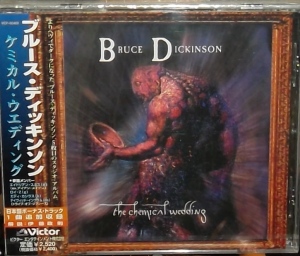
Suffice to say The Chemical Wedding is a swirling Blake-inspired non-concept album, a distinct up-ratchet from the excellent Accident of Birth. Upon hearing The Chemical Wedding, I said, “Well that’s it — Bruce has buried Iron Maiden, and his own back catalogue too!”
Seriously heavy, much heavier than anything Bruce has done before or since, The Chemical Wedding is an absolute triumph. The lineup remains the same: Bruce and Roy Z with Adrian Smith, Eddie Casillas, and David Ingraham. With a little bit ‘o narration from Bruce’s hero Arthur Brown (The Crazy World of Arthur Brown). The lyrics range from alchemy to the legend that Christ once went to England during his missing years, it’s a spellbinding listen, as long as you don’t hurt your neck from all the headbanging you’re going to do.
I had one customer who was a Christian. He asked me what was good in new metal, so I put The Chemical Wedding on for him. He ripped the headphones from his ears — couldn’t stand the lyrics! He told me they were “too demonic”, particularly the lead single “The Killing Floor”:
Satan has left his killing floor
Satan – hellfires burn no more
Although there is also a line about “Panzer divisions burning in the mud” so to me this is another commentary on the evil present in the world.
Going through the album track by track would get monotonous. So choose from the adjectives below: “fast”, “powerful”, “scorching”, “heavy”, “grinding”, “wailing”, “throbbing”, “headache-inducing” for the various songs.
There are numerous highlights, but my two favourites are:
“The Tower” – this one has a unstoppable pulse thanks to Eddie Casillas, and is one of the more melodic songs on the album while retaining its heaviness.
“Book of Thel” – with velocity comes the album epic, this one picks up where “Darkside of Aquarius” left off from the last album. I don’t know what a book of Thel is, but judging by the heavy evilness coming from my speakers, maybe I don’t wanna know!
Not to be outdone are the scorching opening “King in Crimson” (does not seem to be about a Stephen King character!) and the melodic Maiden-esque Japanese bonus track “Return of the King”.
The single for “The Killing Floor” had two unique B-sides, “Real World” and “Confeos”, neither of which are as strong as anything on the album. These songs plus “Return of the King” have been collected on the Bruce Dickinson deluxe editions.
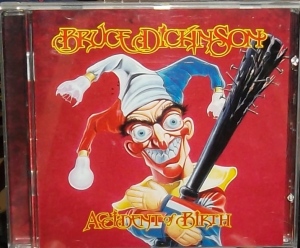
When Accident of Birth came out in 1997, I said, “This is incredible, Bruce is back and better than Maiden are. How the hell is he doing to top this one?” Unlike previous solo albums, Bruce didn’t do a complete 180 and change direction. Instead he simply added more fuel to the fire and created one of the best albums of his entire career, one he should be very proud of.
But again, I had to ask the same question, “How the hell does he top The Chemical Wedding“? I couldn’t see him turning up the gas any hotter without foraging into thrash metal territory, or losing what melody he still had. Luckily, fate intervened.
It turns out that Iron Maiden themselves were looking for another new singer. And Bruce was looking to finish his career off doing arenas, not clubs. A phone call was made….
5/5 stars
…And it is here that we shall pause again. Stay tuned for more Maiden in the days to come.
A lot of Rock-haters (people who hate Metallica’s output from 1991-2003) have no idea that the man is quite the musician himself. Canadians remember the Payola$ and Rock & Hyde, but then there was Rockhead. Bob Rock found a great Canadian punk rock vocalist named Steve Jack, who as it turns out, was also a great screamer. Some of the screams on this album are unreal — check out “Bed Of Roses”, “Heartland”, and “Chelsea Rose” for some awesome vocals. Face it, Canada has some great screamers (James LaBrie, Gerald McGhee, Sebastian Bach!) but Steve Jack was a contender.
This album was born during the the difficult Motley Crue sessions (not to mention a Bon Jovi album), while Bob was going through a divorce. This comes out in the song “Warchild”. In fact it ACTUALLY comes out during that song: Bob can be heard yelling and throwing stuff around the studio at one point, which he recorded after a painful phone call.
I don’t find there is a weak track on this album, and plenty of Bob’s buddies show up. Art Bergmann, Billy Duffy, Paul Hyde, Jon Bon Jovi & Richie Sambora all contribute songwriting skills. Duffy and Sambora also contribute solos. From the screamy Aerorock of “Bed of Roses” to the metal of “Heartland” to the acoustic Zeppelinesque “Angelfire”, every single track is worth a listen. It’s a diverse album actually, running the gamut from light to dark and embracing different sides of rock. Boozy, bluesy, epic, acoustic, you name it. Its roots are firmly planted in the 1970’s, but if this had come out in 1989, it could have spawned 5 singles.
Sonically if you like Bob Rock, you will like this. It’s right in the ballpark of that Motley Crue/Keep the Faith sound he had going on during that period. Big big drums, layers of guitars, a lil’ bit of keyboards here and there, but mostly, lots and lots and lots of guitars.
It is hard to believe that this monumental album, a piece of rock history, was only issued on CD in Japan! Finding a domestic LP or cassette isn’t hard (I’ve owned it on all three formats including CD) so hunt your record shops. I know Wendy Dio has a CD/DVD reissue lined up, hopefully including the full album, single edit, and the video and interviews. If you’re reading this Wendy…
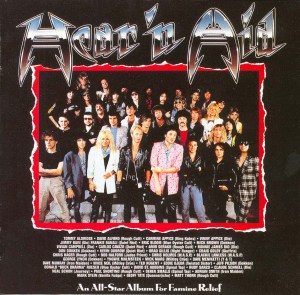
At the time, all funds went to starving people in Africa, hence the name Hear N’ Aid. The inspiration was something fairly obvious: No heavy metal people outside of Geddy Lee was involved in the numerous famine relief projects of the time! (Geddy sang a lead on the excellent “Tears Are Not Enough” (1985) by Northern Lights, but nobody metal could be seen in “Do They Know It’s Christmas” or “We Are the World”.)
“Oh, you knoooow that we’ll be there!”
Showing the world that heavy metal bands and fans aren’t a bunch of assholes, Jimmy Bain and Vivian Campbell of Dio came up with the concept for Hear N’ Aid.
The main track, “Stars”, by Hear N’ Aid is a tour-de-force. Written by Bain, Campbell and Dio, this is essentially an epic extended track with a soft intro and heavy verses, and tons of guests. They assembled virtually every major metal singer who was willing and available to take part. That means you will hear Quiet Riot singers Kevin DuBrow and Paul Shortino (still with Ruff Cutt at the time) singing together for the first and only time in history! Rob Halford, Don Dokken, Eric Bloom, Geoff Tate, Dave Meniketti, and Dio himself all take lead vocal slots too.
When the guitar solo kicks in, prepared to be blown away. With Iron Maiden guitarists Dave Murray and Adrian Smith playing backing harmonies, you will hear the monstrous talents of George Lynch, Yngwie Malmsteen, Vivian Campbell, Craig Goldy, Neal Schon, Buck Dharma, Carloz Cavazo, Brad Gillis and Eddie Ojeda all taking a few bars. No charity track had ever attempted to assemble not just singers, but guitar players, on one track before.
All this is backed by drummers, bassists and keyboard players from Dio and Quiet Riot. There are more backing singers than I can name, but most notably, Derek Smalls and David St. Hubbins from Spinal Tap. Of course.
The rest of the album is filled out by songs donated by bands who couldn’t take part in the song, but still wanted to help the starvation situation in Africa. Therefore you will get a live “Heaven’s On Fire” from Kiss, from their Animalize Live Uncensored home video. This is the only place that the audio track was released on. There is an unreleased live “Distant Early Warning” by Rush, and rare ones by Scorpions and Accept as well.
Tracklist:
1.Hear ‘n Aid – “Stars”
2.Accept – “Up to the Limit” (live)
3.Motörhead – “On the Road” (live)
4.Rush – “Distant Early Warning” (live)
5.Kiss – “Heaven’s on Fire” (live)
6.Jimi Hendrix – “Can You See Me”
7.Dio – “Hungry for Heaven” (live)
8.Y&T – “Go for the Throat”
9.Scorpions – “The Zoo” (live)
For the first time in a long time, there was this vibe of, “new Maiden? Meh.”
I recall seeing this listed in our distributor’s catalogue and ordering one for myself. We didn’t even order it in for the store. Think about that! The catalog had the title listed as Vartual Xi, which made me wonder what the hell I was buying.
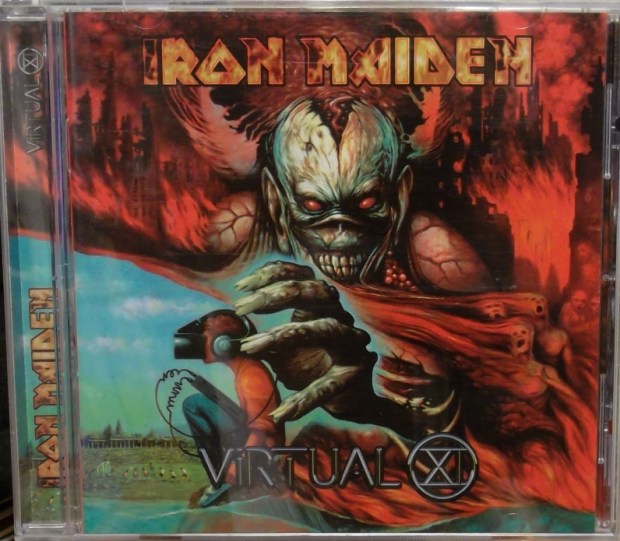
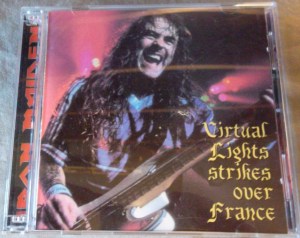
Virtual XI is the 11’th studio album by Iron Maiden. It is the second with Blaze Bayley on lead vocals and second to be co-produced by Nigel Green. It is also the second to feature cover art by Melvyn Grant, this time an improvement on his Fear of the Dark work (but only barely).
You’ll notice the Iron Maiden logo was changed — the jagged bits lopped off! It is this logo that Maiden used almost exclusively going forward. I prefer the original.
I was living with T-Rev when the album came out, early ’98, and both of us were heavily into the Nintendo 64 classic Goldeneye. One Saturday night when he was out working his second job at the Waterloo Inn, I stayed home with Virtual XI, Goldeneye, and enough junk food to last the weekend. I was set. And my feelings on Virtual XI largely go back to that night and the great fun it was to play the Statue Park level whilst rocking out to “When Two Worlds Collide”.
As highly as I rate the two Blaze albums, I will be the first to admit that he was the wrong singer for this band. His voice lacks the range. As I argued in my review for The X Factor, I think Blaze’s voice suited the mid-90’s and the darker tones that Maiden were taking. I remember cranking Best of the Beast in my store, Dickinson wailing away, and two kids laughing. Context is important! In the 90’s, tastes had drifted and so had Maiden. And don’t lie to me — you owned one of these five albums: Ten, Nevermind, Superunknown, Purple or Dirt. I know you did!
I personally enjoy the dreadfully-titled Virtual XI. I bet Steve Harris wishes he could take that title back. It is not as strong as the powerfully dark X Factor album. This is Iron Maiden trying to relax a little more, be more comfortable in their new sound, and trying to lighten up a bit after an entire album of dark thoughts and suicidal tendencies. Witness “The Angel And The Gambler” which is as close to a good-time rocker as Iron Maiden get. Its problem (and the problem with a few songs on the album) is length: At 10 minutes, it’s not an epic, it’s too repetitive. I could also do without Steve’s boppy keyboard line.
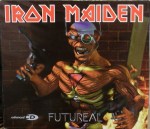
But I’m getting ahead of myself. The album kicks off with “Futureal”, a short fast rocker akin to “Man On The Edge” or “Be Quick Or Be Dead”, but with plenty of melody to spare. Harris wrote this one with Blaze.
Up next is “The Angel And the Gambler” which I guess Steve was hoping would sound like 70’s UFO or something like that. A classic Davey guitar solo keeps it in Maiden territory. It had a good video, very Star Wars cantina, funny with dated CG! The video however doesn’t do much to make Blaze Bayley’s case as a frontman.
Then, back to the darkness that marked the last album. “Lightning Strikes Twice” is a decent song with quiet verses and a powerful chorus. It takes a while to build unfortunately, since it’s only 5 minutes long.
Side one ended with “The Clansman”, continuing the Maiden tradition of basing songs on movies and historical events! This was the epic of the album, and one that they performed into the Dance of Death tour. You’ll be chanting, “Freedom! Freedom! Freedom!” by the end. This one sounds very traditional Iron Maiden, especially the fast parts.
Side two kicked off with a personal favourite, “When Two Worlds Collide”. Here’s Maiden’s take on the whole Deep Impact/Armageddon thing:
Now I can’t believe its true
and I don’t know what to do
For the hundredth time
I check the declination
Now the fear starts to grow
even my computer shows
There are no errors in the calculations
Kinda cheesy, kinda nerdy-cool at the same time. Have you ever seen the word “declination” in a heavy metal lyric before? This is the first and only collaboration between Steve, Blaze and Dave Murray.
Another dark and moody one is up next, “The Educated Fool”, another one I like quite a bit due to its delicate guitars. At this point Maiden were no longer trying to simply assault you aurally, now they were introduced in a smoother sounding guitar sound. But the song does kick in soon. There’s a line reflecting some of Steve’s personal inner pain, “I want to see my father beyond.”
This is followed by “Don’t Look To The Eyes Of A Stranger”. These songs are good tunes, but by this time we’ve already had several dark and moody ones with repeated choruses. The repetition was getting a bit much. Even the previous song, “The Educated Fool” suffers from repetitive chorus syndrome.
Last up is the closer “Como Estais Amigos”, translated as “How are you my friends”. It was written by Blaze and Janick. This one has an epic vibe to it as well, with its anthemic chorus of “No more tears, no more tears. If we live for a hundred years, amigo no more tears.” It is as if Maiden are saying, “We have been through some rough patches but better times are up ahead.” And yes, Maiden really did go through rough times, Steve Harris in particular.
And that is it, a mere 8 songs. Brevity this time unlike the previous two albums. No B-sides were recorded, either. The only B-sides were live. Let’s have a look at ’em!
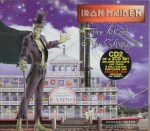
“The Angel And the Gambler” was released in two parts, one with cover art by Derek Riggs, one from the forthcoming new Maiden video game, Ed Hunter. They wisely included a single edit on the second one. The B-sides were live takes of “Blood On the World’s Hands” and “The Aftermath”, which if you recall are two of the songs I ranked poorly on The X Factor.
“Futureal” was the second single, with more Ed Hunter cover art. Inside, a poster featuring Derek Riggs’ far superior artwork. The live tracks were were “Man On the Edge” (another one I’m not fond of) and “The Evil That Men Do”, from Seventh Son of a Seventh Son! This is one of the few official versions available of Blaze doing a Bruce song. My take? His “Come on! Come on! Come on!” intro fails to inspire me, but the band is playing it fast and great. Vocally this one is well suited to Blaze’s voice. He does an excellent job. (He does screw up the lyrics in the same place that Bruce used to, too!) It was recorded in 1995, which makes sense. Everything I’ve heard from that tour sounds great. Everything I’ve heard from the Virtual XI tour, however…
I think after this album the vibe was generally one of “Who cares what Maiden do next?” I still would have loyally bought it. I had just given up on the idea of Maiden being a huge band that mattered again. I didn’t expect albums that would impact me the way that Piece of Mind or Powerslave or even The X Factor did. Maiden seemed to be coasting, at a time that Bruce Dickinson was forging forward with superior solo albums. In general though, it seemed metal was done, Maiden pretty much with it, and all that was left were unremarkable studio albums and tours.
As mentioned in the last chapter, Bruce Dickinson was eager to get back to metal, and he brought Roy Z with him. Together they forged a great modern steel beast of an album. But there was an additional surprise in store:
Bruce had also teamed up with his old Maiden alumnus Adrian Smith! The classic writing partnership was back, and Adrian was playing those trademark melodies again.
And then, just to stick it in Steve Harris’ nose, Bruce hired on Derek Riggs to do the cover art. He came up with a mascot: Edison! Get it?
The opening track, “Freak”, slams the listener right in the face with a modern metallic riff before the classic Bruce wail forces you to admit this is the kind of music he’s best at. And while it’s not the same as Maiden, you will be delighted to learn there are guitar harmony parts once again.
You have to give Roy Z credit where it’s due, the guy is great at writing metal riffs. He’s also a great soloist and a nice contrast to Adrian. Also not slouches are the badass rhythm section: Eddie Casillas (bass) and David Ingraham (drums), both back from the Balls To Picasso album.
“Starchildren” is an absolute stunner, a fucking brilliant song that combines programmed samples with traditional metal riffery. I also love that Bruce has continued on with the sci-fi lyrics, something he’s quite good at.
Although “Taking the Queen” is another great song, it is overshadowed by the epic track “Darkside of Aquarius”. At almost 7 minutes long, “Darkside” combines multiple parts together with guitar harmonies into one cohesive, stomping whole. This to me is the jewel on a fine album. I think this would have made one fine Maiden number (finer than what Maiden were releasing at the time).
Then, “Road To Hell”, a co-write between Bruce and Adrian. You can tell by the catchy guitar parts and singalong chorus. It is followed by the anthemic ballad “Man of Sorrows”. This one was chosen for release as its own EP later.
The single “Accident of Birth” is next, yet another great tune, but also a standout among great tunes. Once again the samples are back, blasting this piece of sheet metal into a pulp. The guitar melodies ground it in familiar territory as Bruce’s wail assaults the listener.
Why is Ingraham wearing that pilot hat?
“The Magician” comes somewhat awkwardly afterwards, as it is more upbeat than the previous material. But “Welcome to the Pit” (also co-written by Smith) sinks deep into a sludgey morass. “Welcome to the Pit” is filler, the first obvious such track on Accident of Birth.
The US edition of the album was elevated by another Smith co-write, the Maiden-esque “The Ghost of Cain” which restores the melody and guitar harmonies to the forefront. The UK edition skipped this track but made it available on a single (which we’ll get to). But it is a song like “The Ghost of Cain” that reminds the listener of the kind of magic that Iron Maiden lost when it lost Adrian Smith.
“Omega” and “Arc of Space” form a sci-fi duo. The sun is about to go all red-giant on Earth’s ass, and most people have left. But many remain behind.
Now it’s Omega-Zero day
The red star shines its last rays
The sun that gave us life yesterday
Is now the sun that takes our lives away
It’s this kind of lyric that gets my nerd-blood pumping. Arthur C. Clarke would have been proud. I’m sure Bruce has read The Songs of Distant Earth. But even musically it’s a winner. At first it sounds like a ballad before the band hits the gas and it turns into a blazing rocker with twin guitar harmonies.
And finally “Arc of Space”, an acoustic number (with cello!), and a perfect ending to a fine album. The choruses soar. Roy Z’s acoustic solo is perfect. The album ends as a triumph.
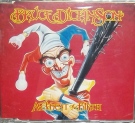
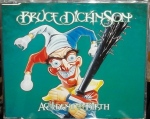
There were also singles to be had: “Accident of Birth” parts 1 and 2. Part one added “The Ghost of Cain” to the lineup for those who didn’t get it on the UK album. Both parts contained demo versions, basic stripped down recordings of “Accident of Birth”, “Taking the Queen”, and “Starchildren”. It sounds like these were most likely recorded using drum machines. In the case of “Accident of Birth” itself, in a lot of ways I prefer the more mechanical demo!
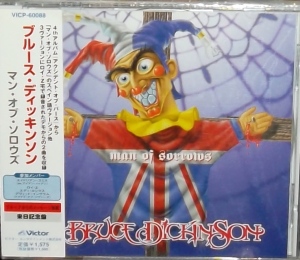
The Japanese even got their own exclusive EP from the albums called Man of Sorrows.
BRUCE DICKINSON – Man of Sorrows EP (1997)
Man of Sorrows is an awkward 5 song collection, essential only to the obsessed or the lucky ones able to find it at a good price. It has three versions of the title track: A radio edit, an orchestral mix, and a Spanish version (on a CD released only in Japan.) The orchestral version just mixes those instruments in higher. The Spanish version, “Hombre Triste”, is especially poor since the backing vocals in the chorus are still in English. You can also hear edits, as if the vocal recording was probably spliced together piecemeal line by line.
The saving grace to the EP (but not worth the $30 price tag to the average collector) are two more demos: “Darkside of Aquarius” and “Arc of Space”. Much like the other demos, these are fully fleshed out arrangements. “Darkside” features that drum machine again, but “Arc of Space” sounds like Bruce and Roy just doing the song live in a room. The liner notes reveal that Roy Z plays all the instruments on the demo versions.
Incidentally, all these songs plus the “Accident of Birth” single B-sides are now available on the deluxe edition of the album.
Bruce made a hell of a comeback on Accident of Birth, showing up Iron Maiden, and proving that he was built to sing heavy metal music. The cynical said that Bruce was just cashing in, but the next album would prove to be an even more powerful statement. Stay tuned.
Bruce’s studio band from the last album, Balls To Picasso, had a regular gig to get back to (Tribe of Gypies) and Bruce formed a new young band he called Skunkworks: Alex Dickson (guitar), Chris Dale (bass), and Alessandro Elena (drums). Dickson’s since turned up on Robbie Williams albums. (I know because I bought one.)
Why Skunkworks? Well, you know Bruce and his love of aviation. Skunk Works is the top secret project that brought to life the Lockheed Martin SR-71 Blackbird among other advanced aircraft.
Skunkworks, the album, was a new direction once again. Just as Balls To Picasso was very different from Maiden, Skunkworks was another hard left turn. It polarized fans: Some praised Bruce for doing something new and different again, others were puzzled and disappointed.
And some were just pissed that he’d cut his hair.
With most songs of the 13 clocking in between 3 and 4 minutes (none exceeding 5), Bruce and Alex had written a set of tight songs. Bruce was clearly in tune with what was happening with music in the 1990’s as most songs have that alterna-90’s vibe mixed with a heady prog-rock tendency. The sound of the album is dry and in your face.
The problem for me is most of the songs are just not memorable. The single “Back From the Edge” (which we’ll talk about later) is great, a rocket trip to the moon in a very sleek vehicle. Also great is the metallic and angry (but lyrically obtuse) “Solar Confinement”. These songs I like a lot. Most of the lyrics have a sci-fi bent that Bruce would revisit on later solo albums, which is also fine by me.
I don’t mind the epic closer “Strange Death In Paradise”, nor the chrome choruses of “Inside the Machine”. I like the velocity of “Innerspace”. But a day after listening to it, I couldn’t tell you how it went.
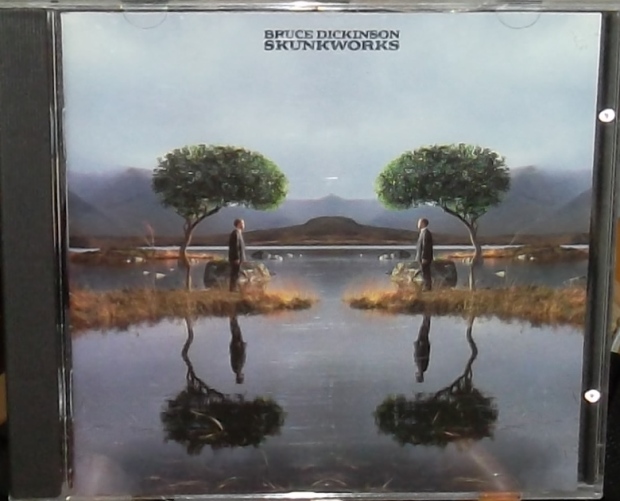
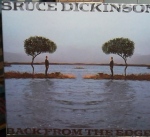
I love the Floydian artwork that unified the album with its singles. Compared to later Bruce albums, the artwork doesn’t stand out as much, but as a whole with all the singles it works great.
As I mentioned, fans are really polarized on this album. There has to be something here that I’m missing. I do like the B-sides, which were mostly fantastic! Some were heavy, some melodic, some acoustic. All worth having.
“Back From the Edge” CD1 contained:
“Rescue Day”
“God’s Not Coming Back”
“Armchair Hero”
“Back From the Edge” CD2 contained:
“R 101”
“Re-Entry”
“Americans Are Behind” (one of Bruce’s trademark joke songs)
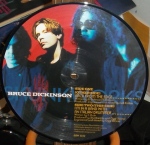
And the “Back From the Edge” 7″ picture disc contained:
“I’m In A Band With An Italian Drummer” (another joke song based on Alessandro Elena)
SKUNKWORKS – Live(1996 Japanese EP)
There would also be a cool live EP, billed under the name Skunkworks, and just titled Live. This was only made available in Japan, and I paid $30 for a copy at HMV 333 Yonge St. Now, this and all the B-sides are available on a deluxe edition of the album. Then, I spent a lot of money to get all the songs, but the end result is a bunch of cool looking discs with united artwork.
The Live EP had four tracks, three from Skunkworks: “Inertia”, “Faith”, and “Innerspace”. It was capped off by a Maiden cover, “The Prisoner”, something Bruce was only beginning to do as a solo artist. As a cover it highlights the differences in bands.
For the album Skunkworks:
2.75/5 stars
For the EP Skunkworks Live:
3/5 stars
Perhaps Bruce felt a tugging in his heart for heavy metal, or perhaps the fans were too vocal in their rejection of Skunkworks. Whatever the case may be, Bruce decided to abandon the band Skunkworks. He turned to his friend Roy Z, from Tribe of Gypsies and co-writer of Balls To Picasso.
“I want to make a heavy metal album,” said Bruce. “Do you have any metal riffs?”
As it turned out, Mr. Z had plenty. The Balls To Picasso lineup was back. And that wasn’t the only reunion in the works.
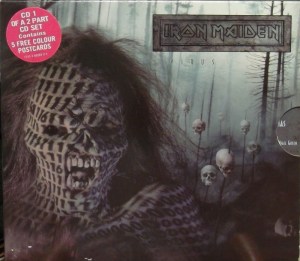
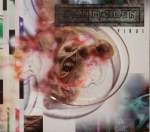
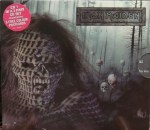
Much like other UK singles, “Virus” was released in two parts each with its own B-sides and cover art. If you bought the first, you also got a box with 5 postcards and space to store the second disc.
The first disc contained the (unadvertized) single edit version of “Virus”. I can happily live without the slow, boring, goes-nowhere first three minutes of that song. At least the single edit only has the up-tempo part of the song. I recall when the single came out, a few of us had grumbled that Maiden seemed to be losing it…
The B-sides on this first single were the previously released covers, “My Generation” and “Doctor Doctor”. You could get these tracks on the previous single, “Lord of the Flies” from The X Factor. Having said that, these are great versions, among the best covers Maiden have ever recorded in this writer’s opinion. “My Generation” is of course the Who classic. Maiden breathe their original punky sensibilities into this one, and it rocks like nothing that actually made it onto The X Factor! “Doctor Doctor” is a beefed up version of the classic UFO song, and my preferred version.
The second disc was the really, really special one. It had the album version of “Virus” (all bloody 6:15 of it, ugh) but it also has the ultra rare “Sanctuary” and “Wrathchild” from the 1979 compilation album, Metal For Muthas! When I had first picked up the single for “Virus”, I didn’t even know these recordings existed. Collectors rejoice! These tracks were previously unavailable anywhere else but Metal For Muthas, and this is the first CD release.
“Sanctuary” and “Wrathchild” both feature Paul Di’Anno on vocals, and are from the short-lived Maiden lineup of Di’Anno, Steve Harris, Dave Murray, Tony Parsons, and Doug Sampson. This represents one of Maiden’s earliest recordings. There are more from this lineup, but we’re not going to talk about those for a while yet…
Do I need to mention that these two tracks are just pure smoke of the early-Maiden variety?
A quick glance at Wikipedia reveals that there is a 12″ single release of “Virus” as well, this one with the two missing Soundhouse Tapes tracks that weren’t on the Best of the Beast CD. Adding to “want” list!
I found the cover art of the “Virus” single to be a little lacklustre, particularly the one in the petri dish. Like, really? It didn’t scream to be made into a cool poster for my wall. There were some cooler things on the postcards including one by Derek Riggs.
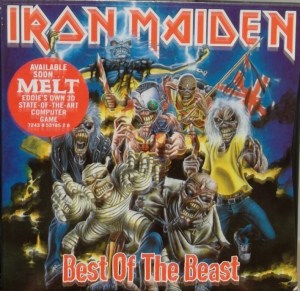
I’m not sure what prompted Iron Maiden to put out their first greatest hits disc in 1996, but at least they did it in style. Originally available as a limited edition 2 CD book set, it was pretty extravagant packaging for the time. My only beef is by the nature of such packaging, the paper sleeves will always scratch your discs, 100% of the time.
This album was also available in a standard edition single disc, with the songs in a different running order. I don’t have that one so I’m not going to talk aboot it.
The 2 disc version, perhaps to emphasize that Blaze Bayley is the current Maiden vocalist, starts at the present and then rewinds all the way back to the beginning, closing with The Soundhouse Tapes! An interesting approach indeed. As a listening experience I’m not sure that it works that well.
Since we’re starting at the present, the album kicks off with a new song. “Virus” is 6:30 of same-old same-old X Factor Maiden, but not as good as anything on that album. It drags and drags for three minutes before finally kicking into gear, but it is otherwise repetitive and boring until then. Lyrically, it is another attack on the sicknesses in society, much like “Be Quick Or Be Dead” and “Justice of the Peace” were.
Then back in time one year, to “Sign of the Cross”, the dramatic 11 minute epic from The X Factor, as well as “Man on the Edge”. (I would have preferred “Lord of the Flies” to “Man on the Edge”, but perhaps “Man” was the bigger single of the two.)
To bridge into the Fear of the Dark album, a new live version of “Afraid To Shoot Strangers” is featured, with Blaze Bayley singing. It’s a good live version, but it’s immediately obvious that Blaze is no Bruce.
Bruce takes over on the next track, “Be Quick Or Be Dead”, and we’re back in the saddle. Singles (including the popular live version of “Fear of the Dark”) and album tracks are counted down from 1993 to 1986’s Somewhere In Time album, ending disc 1 with “Wasted Years”, a great closer. My beef here: I would have preferred the single “Stranger In A Strange Land” to the album track “Heaven Can Wait” (but I know the Heavy Metal OverloRd doesn’t agree with me!)
Disc 2 is the glory years, if you will, everything from Live After Death to the beginning. It begins with the epic “Rime of the Ancient Mariner”, a ballsy move for a greatest hits album, and the live version at that. Chasing it is the live single version of “Running Free”. Then we count them down, all the singles from Powerslave to “Run To The Hills”, plus “Where Eagles Dare” and “Hallowed Be Thy Name” thrown in for good measure.
Then it’s the Di’Anno years, which are given an unfortunately brief expose. “Wrathchild”, from Killers is one of the best songs from that era, but the only included track from that album. Maiden’s first epic, “Phantom of the Opera” and the single “Sanctuary” represent the debut Iron Maiden. Finally, an unreleased track from The Soundhouse Tapes sessions (“Strange World”), and the rare Soundhouse version of “Iron Maiden” close the set. To read my review of The Soundhouse Tapes and these tracks, click here.
There was also a 4 LP vinyl edition available, with 7 extra tracks: “Seventh Son of a Seventh Son”, “The Prisoner”, “Killers”, “Remember Tomorrow”, an exclusive live version of “Revelations” from the Piece of Mind tour, plus the final two songs from The Soundhouse Tapes, “Prowler” and “Invasion”. You can read a story about the 4 LP edition by clicking here.
And there you have it, Maiden’s first greatest hits set, with lots of the hits and plenty of rarities thrown in for the collectors. I confess that I don’t listen to it often, and this time for this review was the first time in roughly two years.
The cover art was once again by Derek Riggs, doing a sort of mash-up of his (and nobody else’s) Eddie’s. It’s a suitably glorious piece of art for such a monument of metal. The inside of the book is loaded with concert dates, lyrics, liner notes, and chart positions, as well as more Eddie’s and photos!
I still want to talk about the single, “Virus”, but I think that it should get an article of its own. Check back soon for that!
Curiosity: the cover features an ad for the never-to-be Iron Maiden video game, Melt! Maiden did eventually release a video game, but we’re not going there yet….























You must be logged in to post a comment.