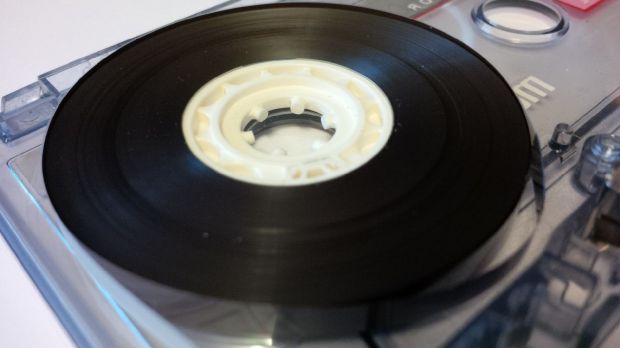
RECORD STORE TALES MkII: Getting More Tale
#423: The Tyranny of Cassette in the ’80s
Anyone who grew up in the mid to late 1980s probably enjoyed their music on the most popular format at the time: cassette. Vinyl LPs were still around, and still popular, but not nearly as much as cassettes. CDs were new and only a few of us had CD players yet. Cassette tapes had the portability factor going for them. Everybody had a Walkman, and those who didn’t probably had one on their Christmas list in 1985.
Vinyl was a dying breed in our highschool halls. There were still some older kids who boasted of the superior sound quality, but none of my friends had equipment good enough to enjoy that sound quality. I certainly didn’t. All I had was a turntable hooked directly into a Sanyo cassette deck for amplification. The sound was harsh and tinny. The scratches inherent with the format were also more distracting than the tape hiss of cassette.
So, it was all about cassette! Buy ‘em, trade ‘em, swap ‘em and re-record over them when you decide you don’t like the music anymore. I have a cassette copy of Michael Jackson’s Thriller that had long ago been erased and taped over with other stuff. When you couldn’t find a fresh blank tape to record on, you could just erase something else. Everybody did it. My friend Bob had a cassette of In Through the Out Door that he recorded over with us talking and goofing around!
For teenage highschool kids, cassettes were enough for our musical fixes. A decent quality name brand tape could hold up to 110 minutes without stretching. We used them to tape anything and everything. (I have a tape with the sound of a friend’s dad taking a massive shit — no, I did not record it, they did!) Since cassettes were re-recordable, that meant that every kid could even record their own music and become a rock star in his or her own basement. You couldn’t do that with your fancy schmancy LPs, we all thought! Don’t like your song? Just rewind and record it again! Those who didn’t play music could have their own fun, DJ’ing and and writing skits. And let’s not forget about taping your friends’ albums. Recording tape to tape would always result in excessive tape hiss, but kids didn’t seem to mind in the 1980’s. We ignored the hiss. It was something we considered part of the music, because we really never heard any music without hiss!
Although the flaws of cassettes are patently obvious today, in the 80’s we were just discovering these troubling issues for ourselves. We overlooked the tape hiss, but it was harder to ignore speed issues. The biggest problem that I had with cassettes was inconsistent speed. Some tapes, especially those made by Polygram and EMI in Canada, seemed to have a lot of internal friction. Grab a small screwdriver and open up an old cassette tape some time. Inside you will find rollers, spindles, and bits and pieces all designed for the cassette tape to roll smoothly. Whether they worked right always seemed to be a matter of random luck. When friction inside caused the tape to run slow, it was immediately obvious. The pitch would be noticeably lower, and often the tape would warble as your player tried to play it at normal speed, but fought against the friction.


On the other hand, sometimes the problems came down to your player. Your tape deck had even more spindles and doo-dads to turn that tape around and around. Those got dirty and worn out, too. Sure, you could buy tape head cleaners and demagnetizers, but did they ever really have a noticeable effect on your listening experience? Probably not. I used to diligently clean the insides of my tape decks with lint-free cloths and isopropyl alcohol. Although I could see black filth coming off the rollers when I cleaned them, the sound and speed never really improved. It was always very frustrating when a tape would play fine on a friend’s deck, but went slow as molasses on your own. My Sanyo went in for service and professional cleaning more than once, but that didn’t help either.
Although cassettes sounded like shit, and only got worse the longer you kept them, they did have a big advantage over CD for me, and that was portability. I preferred cassettes in the car, up until fairly recently. The reason for this was, working in the used CD store, I saw so many CDs that were just utterly destroyed by car CD players. You don’t get that problem so much anymore, but in the 90’s and 2000’s, there were a lot of discs just annihilated by a lot of car decks. It didn’t seem to matter if the car player was a high-end stereo or a piece of crap. People would bring their used CDs in to me, and ask me how they looked. I’d usually ask, “Did you play this in a car deck?” I could always tell. Customers would ask me, “How did you know?” Because the CD would be completely scratched, but always in perfect circles. Some dirt clearly got into the car deck, and scratched up the discs as they were spinning. Or, the disc was just scraping up against the internal workings of the car player as it spun. Either way, the result was usually a CD that looks like a kid’s Spirograph drawing.
At least when playing a cassette in the car, those things could take a beating. I only ever had one or two that were “eaten” by the player. Compare that to the thousands of CDs that I saw destroyed by car decks over the years.
If life is a musical journey, then cassettes were my travelling companions for over a decade. We had a necessary parting of ways, and now I am happy to stick to CD and flash drives when on the road!






















 mikeladano.com