Welcome to the semi-regular feature where I reveal stunningly weird search terms that led people to mikeladano.com For the last installment, Questions & Comments edition, click here. Alright, let’s dive in!
WTF SEARCH TERMS XXI: The Never-ending Search Terms
10. guess who am i (Give me a clue? Are you Leonard Nimoy?)
9. port elgin sucks (Harsh, dude. Harsh.)
8. timmy loved judas priest (That’s great!)
7. kunci gitar white lion till death do your fart (Fart to the death!)
T-Rev has always been talented at building things. He built for me my first two CD towers, not to mention my cassette storage shelves built into my closet doors. No design was too elaborate. I liked a simple CD tower myself, just some shelves and some stain. T-Rev was always pushing himself to build something cooler. One of the best towers he ever built had side doors for VHS compartments, and a big black light to illuminate the whole thing. Inside the doors were stickers from some of his favourite bands. The whole thing was painted gray, it was a masterpiece.
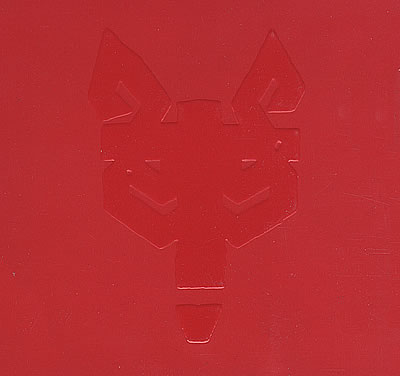
By coincidence, T-Rev also owned a semi-rare copy of Robert Plant’s 1990 solo album, Manic Nirvana. Both of us liked to collect “rare” versions of albums. T-Rev had a red digipack copy, with symbols embossed on the cover. It’s pretty hard to find, although we did see a couple copies float by in the Record Store. There’s weren’t any bonus tracks, but the rare packaging made it something desirable.
So what’s the connection between the CD tower and Manic Nirvana?
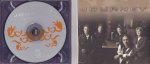
T-Rev was checking out the Plant CD one day, and happened to take a look at it under his black light. Lo and behold, suddenly symbols appeared on the cover, previously hidden! The front cover showed what appeared to be a big “H”. The back and inside covers had their own symbols that showed under black light.
It was a mystery! The symbols didn’t seem to have any meaning that we could discern. Maybe they were intentional, maybe not? Maybe they were just a byproduct of the manufacturing process. Other similar digipacks did not show anything special under a black light.
My questions regarding this CD are as follows: 1) Have you ever owned the red digipack version of Manic Nirvana?* 2) Have you ever looked at it under a black light? 3) WHAT DOES IT MEAN?
*Aaron discovered via the Discogs listing that this seems to be a promo release.
BILLY CONNOLLY – Journey to the Edge of the World – A voyage through Canada’s Northwest Passage (2009 ITV Blu-ray)
I’ve always found Billy Connolly to have an incredibly warm sense of humour, and that is on full display in this wonderful TV series. Because of recent decreases in Arctic sea ice, the Northwest Passage is now clear for several weeks during the summer. One can now travel along the northern coast of Canada, from the Atlantic to the Pacific. Connolly begins his journey in Halifax and travels north, and west. Along the way he sees sights that many of us will never have the chance to experience. It is all captured here on Blu-ray, in gorgeous 1080p. Towering icebergs are crisp blue and as detailed as you can imagine.
The isolation of these places is quite breathtaking. The real selling feature of this series is the hi-def glory of Earth’s nature in full 1080p. If you’ve ever romanticized about cold seas, towering icebergs, or glaciers without another human being in sight, then this disc will put you right there. It’s just awesome to behold. However there is a dark undertone here, as global warming is always just beneath the surface of the beauty. (For example, hearing the ice cracking with sounds like cannons.) By the time Billy finishes his journey in Vancouver, powerful images will be etched into your mind. This is not a disc to watch just once.
One of the charms of this series is that Billy genuinely seems to love people. Whether it’s the humble Newfoundland fisherman, or the smiling faces of Inuit throat singers, Billy loves them all. Billy has no problem getting wet, or trying dishes that are foreign to his palette. He’ll treat you to some folk music along the way, his banjo never far from his side. It is a joy to watch this film and learn about parts of my geography and culture that many of us are ignorant. A lot of activity is crammed into each episode, meaning you’ll likely take it off the shelf for another spin periodically, whenever you get romantic for the snow and ice of the north. With summer here, why not?
It’s funny to surf the reviews on Amazon for this CD. “Super and Awesome” says one. “Best Journey album since Escape” says another. (Really? Better than Frontiers?)
OK, cutting through the glowing fanboy reviews, let’s be dispassionate here. Journey hasn’t truly sounded like Journey since Steve Smith and Steve Perry left for good in the late 90’s. In my unassuming personal view, Trial By Fire from 1997 was the best Journey album since the glory days. They tried to replace Steve Perry with a clone singer named Steve Augeri on three releases (Arrival, Red 1, Generations) and the result was a generic band that sounded like (guess what) a Journey tribute band. The fact that the smooth-as-butter Steve Smith was gone didn’t help.
Journey did what I thought was a really smart move afterwards. They brought in the brilliant veteran Jeff Scott Soto to sing, and there are some pretty awesome bootlegs out there of Journey with Soto singing. Soto was no Steve Perry, but a unique singer in his own right, loved by his own legion of fans for his powerful voice. But he was no replicant; no duplicate. The band actually fired him to bring in someone more Perry-like.
That person is Arnel Pineda, who has an incredible set of pipes. I mean this guy can sing! Unfortunately, Pineda’s been singing Journey pretty much his whole life. He’s a Perry clone. He’s Perry-lite. He’s an imitator. And you can tell. He lacks the character, the grit, the personality, the soul, and the experience of Steve Perry.
Also, let’s not forget that Steve Perry was one of the major Journey songwriters, and without him Neil Schon and Jonathan Cain are left to their own devices. The soul is still gone, the heart of Journey is still ripped out. Revelation is no comeback album. It’s another Journey-lite album, it sounds like the best Journey tribute band in the world, but still…just a tribute band.
Having said that, it’s not bad. It’s not a comeback, it’s more of the same. There are good songs here – “Never Walk Away” being the strongest. “Like A Sunshower” is a nice, generic ballad. “The Journey (Revelation)” is the most adventurous tune here, an instrumental where Schon gets to show his stuff, shredding and classing up the place several notches. The rest of the tunes are just nice. Pleasant Journey-esque ditties where you can tell Cain and Schon were saying, “Let’s write a Journey rocker,” or “Let’s write a Journey ballad”.
The album is roughly half new songs, half old. The second disc is entirely re-records with Arnel singing classic Journey tunes. It’s nice but certainly no replacement for Greatest Hits. It’s great that they tackled “Stone In Love” and “Be Good To Yourself” on here. The rest are the hits, and you know ’em and love ’em already so I won’t talk about them too much. Except to say, this is where you notice first and foremost that Steve Perry is missing. The nuances are not here, rendering this disc nothing more than a novelty.
There are two other re-records, both (oddly enough) from the Augeri era. One is the Japan-only “The Place in Your Heart” which I don’t have so I can’t comment on it. The other, which is on all versions of the CD, is “Faith In The Heartland”, one of the better songs from Generations. I’m guessing they did these two re-records because nobody heard Generations. “Faith In The Heartland” is probably better on Generations, sung by the guy who actually wrote it, Steve Augeri.
There is also a great bonus track on the Mexican edition: great song, loaded with atmosphere, called “Let It Take You Back”. It’s about nostalgia, ironically, but I can relate and it’s a great tune backed by a strong riff. One of the best tunes on the album. Track it down, you won’t be sorry.
The Walmart exclusive edition has a really good DVD: live (in Vegas) performances with Arnel singing. “Mother, Father” shows that Arnel can sing. Man, can he sing! I think Journey at this point are a stronger band live than in the studio. Live, Arnel has more character and you’re just in awe of the man’s pipes. This is a good DVD. And for free, it’s worth the price of admission.
So there you have it. Ignore the fanboys and let’s be unbiased here. This isn’t the Journey comeback we hoped for. It’s just another medium-rare Journey album. Until Perry comes back (and let’s face it, he has to one day) and records an album as great and progressive as Trial By Fire, this is a tired band spinnin’ tires.
QUIET RIOT 1978
Randy Rhoads – lead guitar (founder)
Kevin DuBrow – lead vocals
Kelli Garni – bass
Drew Forsythe – drums
QUIET RIOT 1988
Carlos Cavazo – lead guitar
Paul Shortino – lead vocals
Sean McNabb – bass
Frankie Banali – drums
Quiet Riot are a rare bird in rock history; they actually released this album with no original members intact. Quiet Riot suffered numerous lineup changes until finally singer Kevin DuBrow was fired in ’87 after the disastrous QRIII. Bassist Chuck Wright also left the sinking ship (he joined House of Lords).
Banali and Cavazo made the questionable decision to carry on with a new singer, and that singer was Paul Shortino of Ruff Cutt. My only exposure to Shortino at that time was his excellent contribution to the song “Stars” by Hear N’ Aid. I loved his raspy voice and I was intrigued. Replacing Chuck Wright was bassist Sean McNabb…who, a few years later, again replaced Chuck Wright, this time in House of Lords. Since then he’s also been in Great White.
The album itself was a bit of a letdown at first, and only through many determined listens did it finally grow on me. The problem was that Quiet Riot are (or were) primarily a party band. I mean, this is the band who had songs called “Party All Night” and “Stomp Your Hands, Clap Your Feet”. Now, they had changed to a moodier blues-based glam rock band. The first single “Stay With Me Tonight” was darker, slower, bluesy and anchored by a howling Hammond B3 organ. Nothing like anything Quiet Riot had ever done before. Obviously, Banali and Cavazo had decided to trade party hooks in for integrity and possible critical acclaim. Unfortunately that never happened, but the result is that QR remains a hidden hard rock semi-gem. The lack of success led to Quiet Riot disbanding in 1989 after a short tour. Sounding very little like Quiet Riot, and playing unrecognizable renditions of the hits, the band clearly should have changed their name to something else. Clamorous Calm, perhaps?
The album did finally grow on me. Perhaps similarly to a band like House of Lords (who debuted at the same time), the tracks here were a bit darker. The ballads a bit more sad. The rockers a tad more threatening. The fact that this sounds absolutely nothing like Quiet Riot (except for the musicianship of Banali and Cavazo) doesn’t make it a bad album.
My favourite songs:
“Stay With Me Tonight”, the afformentioned first single.
“Run To You”, a guitar-based ballad with a touch of keyboards and great melodies from Shortino.
“I’m Fallin'”, one of the few party rock songs included.
“Don’t Wanna Be Your Fool”, another great darker ballad.
“Callin’ The Shots” which has a pretty solid, bluesy riff.
The sound, by long-time QR producer Spencer Proffer was not up to par. I didn’t expect Quiet Riot to go so bluesy either. These were sounds I was somewhat unfamiliar with at the time. Carlos did have a chance to shine on guitar more than ever before, and Frankie’s drums are loud and powerful as always. As a testament to the man’s talents, he ended up in W.A.S.P. after this on the brilliant Headless Children CD.
In 1993 DuBrow called Cavazo up, made amends, and formed a band called Heat. With the addition of Banali and bassist Kenny Hilary (R.I.P.), Heat morphed back into Quiet Riot. They released the pretty good Terrified CD which was a welcome return to vintage form.
This CD may not be a very good “Quiet Riot album”, but it is actually a pretty good album. If you give it time, you may find something to enjoy herein.
Date: 2004/08/10
On this Marillion live disc, Fish just dedicated the entire Misplaced Childhood record to Phil Lynott…he must have just passed away when it was recorded. That’s heavy, man. My two lyrical heroes, Fish and Lynott…
Date: 2004/08/24
Crazy to think that I’ve been in this business for 10 years, and only now am I starting to listen to Buddy Holly. Sad to think what I’ve been missing all these years! I can’t believe how great Buddy’s music was. It’s really clicking with me, I just love Buddy Holly!
Date 2005/01/30
Some dude was just in here throwing a pencil at us because he didn’t have a receipt. I AM TOO OLD FOR THIS SHIT. I need to get THE FUCK out of here.
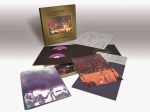
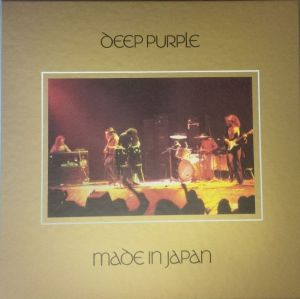
DEEP PURPLE – Made In Japan (2014 limited edition Super Deluxe box set)
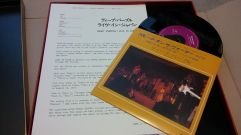
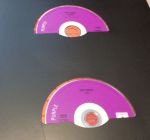
“Smoke on the Water” Japanese 7″ promo. This is a reproduction of a rare Japanese promo single from 1972, sleeve and all. It is pressed on heavy 70 gram vinyl, a treat indeed. It features the promotional single edit of the studio version, and an edit of the Made In Japan version on the other side. The studio edit is available on plenty of releases, such as Singles A’s and B’s. The live edit is one that I don’t think I owned prior to this. I actually enjoy something like this; it’s interesting to see where and how they did the edits, from a technical point of view.
Including a 7″ single in a box set of this size is something I wholeheartedly support. Not only do I love the vinyl format, but when you spend this much money ($115 Canadian) in one place, you deserve something extra. A lot of the stuff included in box sets these days, even in this box set, amounts to nothing more than paper. Music trumps packaging, so I’ll always take something like a bonus vinyl, especially when it has an exclusive track on it.
Interestingly, on this printing, the times for the two tracks are reversed. The live version is the longer, not the shorter as the label suggests.
DVD: Made In Japan: The Rise of Deep Purple MKII and more.
This hour-long documentary consists of new and archival footage and interviews, assembled into a narrative. Old footage of Deep Purple MKI begins our story. The shortcomings of this lineup led the core members of Ian Paice, Jon Lord, and Ritchie Blackmore to seek new bandmates. They had gone as far as they could musically with Nick Simper (bass) and Rod Evans (vocals). In stepped Roger Glover and rock’s greatest screamer, Ian Gillan. Then, the big albums: In Rock, Fireball, and Machine Head.
Strangely, it was a tax loophole that led to Machine Head. It was expected that the fortunes of the band would only rise, but British tax laws would keep them all paupers. If they became tax exiles, and wrote and recorded in mainland Europe, they would not be taxed. This led them to Montreux, Switzerland. According to Claude Nobs, they were planning on recording an album called Made In Switzerland. Nobs invited them to record at the local casino, and the circumstances of this have been well documented. A Frank Zappa concert that night was attended by Deep Purple and Nobs. Someone fired a flare gun into the bamboo ceiling, and the place went up in smoke. This DVD has the audio of Zappa asking the audience to leave!
The place did indeed burn to the ground. Luckily Deep Purple had not yet moved in their gear, or it too would be gone. Next they tried recording in a small theater, but noise complaints caused them to move again. It took almost a week to find the Grand Hotel, which was closed for the winter. Perfect. The results speak for themselves. Machine Head is the classic Deep Purple album. But according to Blackmore, it was Made In Japan that made them a phenomenon. It was a live album that they didn’t want to do, but could not have regretted doing.
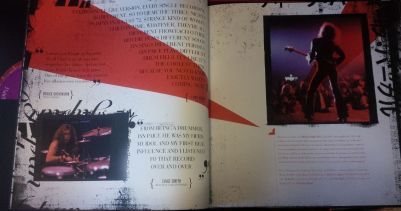
Bruce Dickinson, James Hetfield, Lars Ulrich, and more show up to discuss the impact of Made In Japan on themselves. Dickinson points out that the remarkable thing is that Made In Japan is 100% live. There are no overdubs. Martin Birch managed to capture it raw. There’s a lot of great footage here; live footage, showing the interplay of the band.
Next, the band headed to Rome to record the difficult Who Do We Think We Are.Made In Japan had not even been released in America yet, only Japan, until mass importing of the record forced the label to release it. Unfortunately at the height of their powers, Ian Gillan and Ritchie Blackmore had a massive falling out. Ian resigned. Blackmore and Paice almost formed a trio with Phil Lynott. Glover was fired, which was a condition Blackmore set to stay in Deep Purple. A final Japanese tour was the last commitment of the band. Glover describes a cold atmosphere, and the tension in the air.
Glenn Hughes appears next, remembering a Trapeze gig attended by members of Deep Purple. He sussed out the reason for their attendance. Still, he did not expect to be asked to join. It was an emotional time for Glover. He saw his Deep Purple albums on top of the charts, yet with magazines printing pictures of their new lineup featuring David Coverdale and Glenn Hughes. Hughes reveals he was mistakenly sent awards for albums like Who Do We Think We Are. Glover felt deeply hurt but strove to be a professional.
As a Deep Purple fan who owns a lot of Deep Purple on video, I enjoyed this documentary. Although it has some footage that I had before, it also had a lot that I didn’t, such as interviews that were new to me. Footage from Japan is a highlight. “Smoke on the Water” is presented almost in full (from the 17th), though it is very lo-fi.
Extras include a music video for “Smoke on the Water”, made up of footage from the documentary. “The Revolution” is a short film about rock music and counter-culture, focusing on Deep Purple while at Montreux in 1971. Much of this footage is in the main documentary. A bearded Gillan rips his way through “Speed King”, and the band are interviewed. There’s also a short German documentary from 1972, subtitled of course. I enjoyed the description of their stage attire: “intentionally scruffy hippie uniforms”. Finally, there is a 1973 performance of “Smoke”, but now I’ve really heard the song too many times. It’s the best footage though: full colour, pro-shot. Roger is wearing bright red platform shoes.
This DVD was adequate. The main documentary feature was re-watchable. “The Revolution” and the German doc, not so much. It’s too bad that the video content is only tangendentally related to Made In Japan. The DVD is really not much more than a supplement to the main feature.
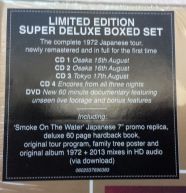
Final words: The box set is rounded out by an excellent booklet, a reproduction of the Japanese tour program, a family tree, and a reproduction press release. Ultimately these things are just pieces of paper. Nobody would go out of their way to buy a reproduction of a press release.
As a boxed set of music, Made In Japan is a home run. This is the way they should have released it back in ’93, instead of the incomplete Live In Japan. I’ll hang onto my old 2 CD anniversary edition of Made In Japan, because I believe in keeping the original mix of something. It’s an historic piece, not to be discarded. When I want a briefer Deep Purple live experience, I’ll play that version of Made In Japan. When I want the full Monty, I’m listening to this box set. Not only is it the best release sonically, but it is the only complete release of all three Japanese shows.
As a celebratory boxed edition of a classic, I’m less satisfied. The DVD and the papers inside are things I will get less enjoyment from. If the DVD had included a feature on the making and remixing of this edition, I would have been more interested.
DEEP PURPLE – Made In Japan (2014 limited edition Super Deluxe box set)
Disc 3: Tokyo, August 17 1972. Finally we arrive at the third night. The band were comfortable by the time they hit Tokyo, but the sound from the venue wasn’t as desirable as the two nights in Osaka. That’s the main reason that most of the Tokyo show was not used on Made in Japan originally. Yes, sonically this is not as crisp nor clear. It seems like a noisier mix, with Gillan’s voice more difficult to make out. However, we have heard plenty of Deep Purple recordings worse than this, and this is still Deep Purple MkII at the top of their game.
The band tune up and say hello before “Highway Star”, a quaint reminder of the way concerts used to be compared to today. Like the other two renditions of “Highway Star”, this is an electric performance. Jon’s organ solo was the highlight for me, Ritchie’s blistering frets notwithstanding. Gillan tells the crowd that the song is about somebody named “Fat Larry” and his automobile.
“Smoke on the Water” begins with Ritchie teasing a bit of “God Save the Queen”. Jon and Ritchie fall out of sync a bit in the beginning of the song, but they quickly lock back into place. Of the three, this is my favourite version of “Smoke on the Water”, just because it is different. The band are looser and willing to play around a bit more. Blackmore’s solo is a highlight as he travels all over the musical landscape.
Always epic, “Child in Time” is greeted by polite applause, a true show of Japanese appreciation. While the August 16 Osaka version may well be Uncle Meat’s favourite because of the guitar solo, I think this one is pretty special due to Jon’s keys. Either way, we’re splitting hairs here. It’s “Child in Time” performed live in Japan in 1972! To talk about favourites at this point is to be speaking in nanometers.
“The Mule” has an entertaining intro; Ian Gillan tells the monitor guy, “Can we have everything louder than everything else?” This is the version from the original Made In Japan. The intro was so legendary that Lemmy paid homage on the live Motorhead album, Everything Louder Than Everyone Else. The song goes absolutely mental at the 2:20 point, before Ian Paice breaks into his drum solo. Not a lot of drummers are interesting to listen to soloing for five minutes. Paicey is.
“Strange Kind of Woman” is another track that is never exactly the same twice. Gillan and Ritchie improvise together, a reminder of a day and age when they (mostly) got along. It’s hard not to smile. According to Ian, this song is about “Terrible Ted” and his “awful lady”.
Diving into newer material from Machine Head comes “Lazy”; always interesting since it too relies on a lot of improvisation. This is the version used on Made in Japan originally, and Jon’s solo (dipping into “Louie Louie”) is familiar and fun. That Hammond howls, and then Blackmore enters. This is one more Deep Purple long bomber. The vocal doesn’t even start until six minutes in!
Finally, “Space Truckin'”. One more amusing song intro: Ian says that this song is about what would happen if space travel and rock and roll ever met, which has not happened. Therefore, this song does not exist. But it sure does slam! The crowd clap along, obviously into it. I love every pick scrape, every drum roll, and every scream. Deep Purple can simply do no wrong at this point. The only flaw is distracting audience (or perhaps crew) noise. You can hear people speaking Japanese around the 13:00 mark.
Disc 4: Encores. This CD comprises all the encores from all three shows. “Black Night” was played first, at all three shows. “Speed King” was played twice, on the 1st and 3rd nights. On the 2nd night the band played Little Richard’s “Lucille” at absolutely breakneck pace. For many years, these encores were largely unavailable. “Black Night” from the 3rd night in Tokyo was released (edited) as a B-side, and then re-released on many compilations such as Power House (1977). The other encores didn’t receive release until the 90’s or later. Now, finally, all the tracks from Japan are collected in one set. I could barely keep track of where to find all the songs from the Japan shows, spread as they were over multiple releases. Now it’s all in one place, as it should be.
After tuning up, Blackmore noodles for a bit. Then “Black Night” crashes to a start. This song is almost a respite for the audience, after a track like “Space Truckin'”. If you remember from Part 1 of this review, Gillan had a case of bronchitis that he was recovering from. He couldn’t stand his performance on the 15th, but you’ll be hard pressed to tell on “Black Night”.
Ian says “good luck, good night,” but it’s just a clever ruse. Much applause results in a return and a noisy take of “Speed King”. There’s quite a bit of feedback, sour notes and noise coming from the guitar. Blackmore was either struggling with it, or abusing it. A knackered Ian Gillan is out of breath at times.
The second version of “Black Night”, from the 16th, is quite different. It’s quite ragged and feedback-laden, and this version reveals human errors that, to me, only add to the live experience. Deep Purple were taking things over the top at these concerts, and sometimes things fall apart. It’s rock and roll.
Once again, the applause of the audience brings Deep Purple back to the stage. Their insane cover of “Lucille” was a pleasant surprise. Deep Purple had been playing this for ages, since Gillan first joined the band. Another version (from London) can be heard on In Concert ’72. That is probably the superior version, though this is no slouch. Almost half of it is just intro! It is stretched over eight minutes. It keeps getting faster and faster, until they’re playing at Ludicrous Speed.
The final show in Tokyo is sonically different, as mentioned at the start of this review. That’s most obvious on this CD when you go straight from Osaka to Tokyo. This time, Deep Purple are introduced in Japanese, before Ian asks for the monitors to be turned down. This is the version used on B-sides and compilations numerous times before, and it is my favourite, probably due to familiarity. This mix allows Jon’s organ to shine a lot better. It is also unedited, which of course is a bonus.
And finally the journey ends with “Speed King”. The band tune up for the last time in Japan, and dive in. Once again, they’re off the rails. I don’t know where Gillan got the energy. Even though he’s tired, he’s still wailing. Jon Lord’s solo is especially enjoyable. I’m exhausted by the end of it. This has been a lot of Deep Purple to digest. But we’re not done yet.
DEEP PURPLE – Made In Japan (2014 limited edition Super Deluxe box set)
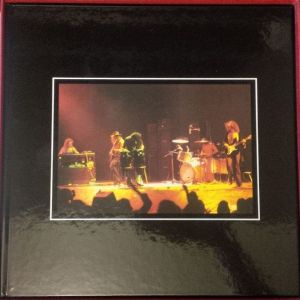
Giving you the kind of detailed review that you have come to expect from me is no mean feat when it comes to a massive set like this. This 5 disc (plus 7″ single) Made In Japan reissue was an epic undertaking to absorb. Just as much as reviewing Machine Head‘s 5 disc deluxe edition last year was a huge task, Made In Japan was its equal!
Because of this, I’ve decided to split the review into three: Today we’ll look at the first two CDs. Then the third and fourth CDs, the DVD, the 45, and everything else. Enjoy this first installment.
Disc 1: Osaka, August 15 1972. “Good morning!” jokes Ian Gillan as the band arrive on stage. A few moments of quiet as the band plug in and strum, and then…the opening drum beat to “Highway Star”. The first of three shows has begun!
Gillan says he was suffering from bronchitis on this first night, and you can indeed hear a bit of extra rasp in the man’s voice. Gillan says he hates these performances, but I think the extra rasp only adds to the furious “Highway Star”. Both Ritchie Blackmore and Jon Lord are on fire, ripping through their parts with great aggression. Blackmore makes a few mistakes during the solo, but who cares? Right from this opening salvo, you can hear the nuances and details of this new remix. Reading the liner notes, you realize that the biggest difficulty in remixing this album was that everything was bleeding through Gillan’s vocal mike. I’ll be damned if it tarnishes the listening experience though.
Before you can catch a breath, “Highway Star” has ended and they’re into “Smoke on the Water”, which had yet to become the classic concert favourite that it is today. Ritchie plays around a bit on the intro, as the crowd claps along. Clearly, they know the song. “Smoke” lacks the furious energy of “Highway Star”, but it is still an incredible performance. Once again, Ian Gillan’s raw voice only adds to the experience (but it’s not even that bad). “Smoke” is the only track from this show that was used on the final album Made In Japan.
Ian introduces “Child in Time” as a “sad story”, but nobody was mourning that night in Osaka. One thing I enjoy about “Child in Time” is that it is never played the same twice. Jon in particular changes up his opening melodies all the time, and this version is quite different from the one they debuted a mere three years prior at the Albert Hall. Somehow, bronchitis and all, Gillan still manages to scream his way through this monster. At times, Ritchie’s solo sounds like it’s drifting into “Lazy”.
According to Ian’s intro, “The Mule” is a song about Lucifer. This track from Fireball is essentially an excuse for Ian Paice to do a five minute drum solo. Nothing wrong with that; it’s Ian Paice after all. Gillan’s voice is a bit shaky at times, but I think that only adds to it. I enjoy that Allmusic refers to “The Mule” as an instrumental, proving once and for all that they don’t know what they’re talking about.
It’s all long-bombers from there. “Strange Kind of Woman” is extended with Ian and Ritchie’s usual interplay, and a gonzo guitar solo. “Lazy” is never short, nor is “Space Truckin'” which exceeds 20 minutes (complete with flubbed lyrics). They are all stellar. I found the intro to “Lazy” quite enjoyable, because after a brief noisy organ bit, Jon teases the crowd by stopping. It becomes dead silent for long enough that you’ll wonder if the CD stopped. That’s something you never hear on a live album these days; a silent crowd. Before “Strange Kind of Woman”, Ian begs the audience for a few moments to tune up. It pays off in the end, he says! All this talk is preserved on the box set version of Made In Japan.
I found the remix on this disc to be great. I love that I can hear every conga on “Space Truckin'”. I haven’t played my old 3 CD remixed Live In Japan (1993) set in a few years, so I haven’t compared the two mixes, but this is so good, I don’t really have a reason to play Live In Japan anymore.
Disc 2: Osaka, August 16 1972. Once again, “Highway Star” gets the proceedings off to a bang. Gillan’s voice is still raspy, but a new day has given it strength. The band sound more confident, as if they lacked any in the first place. It is, after all, the second Osaka show that made up the bulk of the original Made In Japan album. Once again, the remix is a joy. I believe in hanging on to an original mix of an album, that’s just the way I am. The original Made In Japan might not sound “better”, but it is an historical document of the circumstances of its making. It has its own sonic charm, and I think both can co-exist happily in my collection. (The ’93 mix, I’m afraid, will be retired in favour of this new 2014 mix. Interesting how they remix this album every 21 years.)
Not actually Made in Japan
Once again, “Highway Star” is followed by “Smoke on the Water”. Ritchie plays with the opening riff, but in a completely different way from the first concert. Later on, there’s a couple bum notes, and perhaps that’s the reason they used the version from the day before on the original album. The solo is a little loose too.
“Child in Time” is the adventure that it always is, and this version is familiar because it’s the one from the original Made in Japan. The song is truly a rollercoaster; that word applies here as well as any other. There are times it feels like it’s coming off the rails, but Glover and Paice keep it locked. Uncle Meat tells me that the original Made in Japan is his favourite live album “of all time.” (Perhaps it is also one of Dream Theater’s, since they did a song-for-song cover of the album.) Meat also says this is the “greatest guitar solo of all time,” right here on “Child in Time”.
“The Mule” was not used on the album; instead the version from the next night (in Tokyo) was selected. Same with “Lazy”. “Strange Kind of Woman” and “Space Truckin'” from this concert were used on Made in Japan. I couldn’t tell you why “The Mule” wasn’t used, it sounds great to me.
I very much enjoyed Ian’s “Strange Kind of Woman” intro. After explaining the song’s inspirations Ian says, “Why I’m talking such a lot is ’cause, like, we gotta tune up again…’Cause there’s a big time change from England you see, and the guitars are still not recovered from it.” After they are all tuned, Ian drops his famous line, “I have to announce that next week, we’re turning professional.” Through to his ungodly ending scream, “Strange Kind of Woman” is a corker.
Lord’s organ intro to “Lazy” is different from the first night, but just as interesting. “Space Truckin'” is the familiar version we know and love from the original Made In Japan, and it’s still astounding how this band could jam! Who cares that Gillan’s “Yeah, yeah yeah yeah!” is flat. That’s part of the action!
We’ll stop here for now, and pick up the rest tomorrow. Already, it’s apparent why a comprehensive set like this one was necessary. It’s because even if the setlist is the same, Deep Purple never play the exact same concert twice. Some of Ian’s song intros are by rote, but that’s where the similarities end. Deep Purple weren’t content to crank out the same jams and solos night after night, and that’s why a box set like Made In Japan is an important document of this band in their prime.












 mikeladano.com