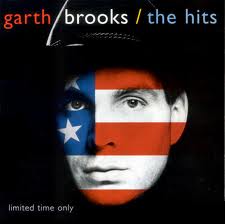
In 1994, Garth Brooks issued his 10 million copy selling compilation album, The Hits. On the front cover was an interesting notation: “limited time only”.
Now, I’ve bought discs that were limited edition before and were numbered to prove it. For example I recently picked up #5945 of the “Credo” single by Fish. Even so…that’s a lot of copies out there for a single by Fish. How many copies of a Fish single would be made anyway? And aren’t all singles limited edition? After all, they aren’t going to make more once they’ve run their course, no matter who the artist is. Onto the next thing.
And then of course you have some seriously limited edition items, like that recent Thin Lizzy Live at the BBC box set! I’m not sure how many copies were made, but everybody’s sold out, and now you have to buy it from people asking way too much. Over $250 USD on Amazon right now. Forget it! That is limited edition.
When Garth plastered “limited time only” all over The Hits, it quickly became a joke. We ordered 50 copies of them, and sold most during the first week. We ordered another 50 copies, as Christmas was coming soon. Those sold. We ordered 20 more after Christmas had passed, and continued to order them every week into the new year whenever we sold out. Some limited edition!
10,000,000 people bought it, and I’m sure 99.9% would have bought it without that “limited time” tag. With great pomp and circumstance, Garth then had the master tapes destroyed.
The master tapes to a freakin’ greatest hits album! Who cares?
It was really hard to take the phrase “limited edition” seriously after that. The next release that came out that truly was a limited edition was the Smashing Pumpkins box set The Aeroplane Flies High, but even that enjoyed a second run when the first printing sold out.
So: the lesson here folks is, when it says limited edition, be skeptical! Very few things are, and the ones that really are limited aren’t always advertized as such. Record labels want to make money, right?
Unfortunately, Garth didn’t put this one on his box set!
Mick Fleetwood and Dweezil Zappa appear in this cheesey 80’s classic!
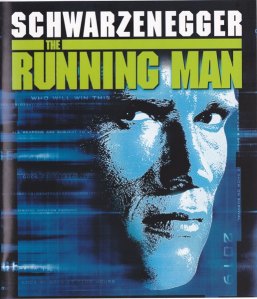
THE RUNNING MAN (1987, starring Arnold Schwarzenegger, directed by Paul Michael Glaser)
It’s hard to believe that, as goofy as The Running Man is, it came so close to predicting what aspects of our society would be like in the future. We still have a few years before we hit 2019, perhaps we are right on track for our 2019 to match this version!
The Running Man is loosely (and I mean, very very very loosely) based on the novella by Richard Bachman, otherwise known to his “dear readers” as Stephing King. Where the King book involved a desperate man who needs money to buy medicine, and a game where he can travel anywhere in the world, the movie scales things back. Ah-nold, at his one-liner best, is Ben Richards, a former pilot who disobeyed orders and refused to fire on an unarmed mob. He is imprisoned but escapes, and is now about to appear on “The Running Man”, a 24 hour a day, 7 day a week television show (hmmm, Big Brother?) and fight for his life. The prize is a full pardon for your crimes, a loss means death.
This story was recently ripped off in a lil’ smash hit movie called The Hunger Games. Perhaps you’ve seen it, or a 13 year old girl wearing a Peeta shirt?
Society is now a police state (hmmm?) and the people are distracted by endless game shows on television (hmmm?). News is heavily censored and “edited for television” (hmmm?). Ben Richards’ crime of disobeying orders has been spun by the networks — they show a fake video of him firing on the unarmed crowd, earning himself the nickname “The Butcher of Bakersfield”. Now he will have the chance to win his freedom on The Running Man, but the odds are well stacked against him. By his side, also fighting for their lives, are two captured freedom fighters. These guys are hoping to use their capture to find the source of network transmissions. Then they could jam it, and broadcast the truth of what the world has become….
The Running Man is not a great film. It’s an 80’s Arnold film. If you’ve seen one, you know what you’re getting. Lots of action. Arnold must battle “Stalkers” on The Running Man. Much like the gladiators on American Gladiators, these stalkers will do everything they can to stop Arnold from winning. They include:
* Sub-Zero, as played by Professor Toru Tanaka (weapons include hockey stick blade and exploding pucks)
* Fireball, played by Jim Brown (flamethrower, jet pack)
* the opera-loving Dynamo (who has a punk-rock-looking suit that can fire electricity; sings)
* Buzzsaw (so named for his use of chainsaw and motorcycle)
* the retired Captain Freedom (Arnold’s friend Jesse Ventura)
The show is run by Damien Killian (subtle!), played by former Family Feud host Richard Dawson. Nobody could have played this role better than Dawson. While playing a game show host was not a stretch for him, Dawson was absolutely flawless in the role. Other famous names include Yaphet Kotto (Alien) as another Running Man contestant, Mick Fleetwood as former-musician-turned-freedom-fighter named Mic (I like to think Mick is just playing the future version of himself) and a very young Dweezil Zappa.
The blu-ray disc has enough bonus features to keep you going after the film has ended, including audio commentaries and featurettes. The audio is really nice, mastered in sweet, sweet 7.1 surround. When Arnold is in that little pod heading down to The Running Man’s play area, the sound was awesome. If you have 7.1 at home you need to check this out. I really enjoyed the sound.
If you like other cheesey Arnold Schwarzenegger movies such as Total Recall or Commando, add The Running Man to your collection. If you like movies with a stirring plot and dramatic acting, avoid at all costs. Regardless of your feelings on this film, do try to read the book. I have always felt that a remake of this film, following King’s book, is well overdue.
One day in the early 2000’s, I was at work, and had this album playing. This guy was in the store, that actually worked at the HMV. As soon as “Truth?” came on, he approached me.
“I can’t believe you’re playing this album. This is great. I don’t know anybody else who really knows this album at all.”
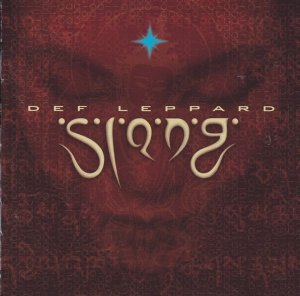
That’s the way Slang went for Def Leppard. It came out to disappointment from the types who want to hear the same album over and over again. (They were obliged on Euphoria). I really dug Slang, then and now. If anything, today I think it might be a tad ballad-heavy. I still love it, and I am excited that Def Leppard plan on releasing a deluxe edition with bonus tracks soon. In the meantime, I have my original limited edition 2 CD set that came with a bonus disc called Acoustic in Singapore.
“Truth?” is a thunderous opener, laden with modern sounding samples and rhythms. Even better is the hypnotic “Turn to Dust”. Although it moves slow, it has loads of exotic atmosphere and instrumentation. Neither of these songs sound like old Def Leppard. There are major changes, including acoustic drums, darker tones and a noticeable lack of shout-along gang vocals.
It’s still the same spirit though. There’s an obsessive attention to detail, layers of backing vocals, and tasty choruses. It’s just 1996’s version of those things. Listen to the title track, “Slang”, for example. It doesn’t sound like anything Leppard have done before, but you can see it as “Sugar” a decade later if you like.
“All I Want Is Everything” is another personal favourite, a great ballad but again unlike what Def Leppard has done before. It has a certain power to it, without being loud and obnoxious. It has a plaintive quality and a fantastic chorus.
Next is “Work It Out” , a contribution from “new kid” Vivian Campbell. It is absolutely loaded with cool guitar squeeks and squonks, no wankery, but a new kind of guitar heroism. These little adornments are there in the mix waiting to be discovered, under suitably thick drones of rhythm guitars. I love this song, which really proved to me that Leppard had successfully adapted their sound to the mid-90’s. A shame it didn’t sell.
Phil’s “Breathe A Sigh” is one that threw a lot of people for a loop. Either Spin or Rolling Stone (I forget which) compared it to TLC. Indeed, loops make up a large part of the percussion parts, and the band seem to be trying R&B on for size. What keeps it Def Leppard are the layers of droney guitars in the back of the mix, and the immaculate vocal choirs.
Interestingly, Slang was stacked with four singles in a row, “Breathe A Sigh” being the final single. This does not mean the album is out of ammunition. “Deliver Me” brings back the heavy. Leppard In Chains? Def Temple Pilots? Not one of the best songs, “Deliver Me” at least balances some of the softer material. Better is “Gift of Flesh”, a driving riff rocker with some slammin’ drums from Rick Allen. Phil wrote this one. I bet it would have been smokin’ live if they ever played it.
This fades directly into a lush but quiet ballad called “Blood Runs Cold”. I could imagine some old-timey fans running away in fear that their nuts would shrivel, at the sound of this one. I love this song, but I’m not sure it needed to be followed by yet another ballad, “Where Does Love Go When It Dies”. Although not a single, “Where Does Love Go When It Dies” was recently dusted off by the band as part of their recent acoustic medley. It is more upbeat than the previous song, and has a folky campfire quality. It also gives the album a sense of flow: an upturn before the dramatic closer.
“Pearl of Euphoria” is that dramatic closer, which returns the listener to the dark, powerful tones that we began with. Leppard don’t often reflect a strong Led Zeppelin influence, but you can definitely hear some “Kashmir” here. Not only is Rick Allen laying down a Bonham-esque groove, but some of the guitar bits flying in and out of the speakers remind me of the sound collage section in “Whole Lotta Love”. It’s a great closing song.
The Acoustic in Singapore disc was a limited edition run, but since the album didn’t sell well you can find them quite easily. This six song disc was recorded in late ’95. Both discs were co-produced by Pete Woodroffe. Some songs work really well acoustically. “Armageddon It” works surprisingly well, a fresh summery version. Some were acoustic originally, like “Two Steps Behind”. It’s cool to have but certainly not essential to your enjoyment of Slang.
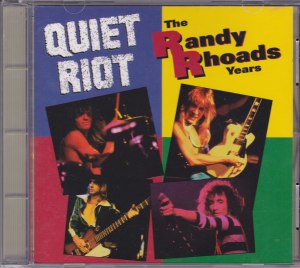
Growing up in the 1980’s, Quiet Riot was the first “metal” band I liked. Back then, we were aware that Quiet Riot had two albums prior to Metal Health. These albums seemed unobtainable forever at best, mythical at worst! The first two, Quiet Riot and Quiet Riot II, were released in Japan only. Later on, I did manage to get both albums, so I have a unique perspective on this CD: The Randy RhoadsYears, by Quiet Riot.
See, here’s a nutshell version of the story: QR lead howler and co-founder Kevin DuBrow had wanted to re-release the Randy material for years. Randy himself was never happy with those albums, nor his guitar sound on those albums. In light of this, the late guitarist’s mother Delores was very guarded of Randy’s legacy. She knew that Randy felt the albums consisted of sub-par songs with horrible production. DuBrow eventually won her blessing to re-release some of the old Quiet Riot material, but on one condition only: Get the quality of the songs up to snuff so it doesn’t tarnish Randy’s legacy.
So that’s what he did, using all the means available, and the result is a highly modified collection of Quiet Riot songs with Randy Rhoads.
I can tell people out there who haven’t heard the first two albums that they do sound awful. That’s not a myth. Randy’s guitar is but a shadow of what it would become, and the songs are mostly pretty bad, especially on the first album. The second is much better (particularly in the songwriting category) but it is still hampered by poor production. So what could DuBrow do to get permission to do a re-release?
He started by picking out six of the better songs from the first two records: “Mama’s Little Angels”, “It’s Not So Funny”, and “Look in Any Window” from Quiet Riot, and “Trouble”, “Killer Girls”, and “Afterglow (Of Your Love)” from Quiet Riot II. All of these songs were heavily remixed, with completely re-recorded vocals, from scratch. DuBrow felt, probably correctly, that his original singing voice on those albums was too “boy-ish”.
DuBrow re-sampled all the drums, and re-recorded all of Randy’s guitar tracks through a Marshall stack. Randy had confided with Kevin that he was happiest with the way his guitar sounded live with Ozzy, so Kevin recorded the original, sterile guitar tracks through Carlos Cavazo’s amps. They used the Randy Rhoads Tribute CD as a guide.
On one guitar solo, Kevin knew that Randy wished he had used a wah-wah, but couldn’t afford the pedal at the time. Kevin played the wah-wah pedal himself, using Randy’s guitar tracks, a unique form of collaboration between two friends.
With the Small Faces cover, “Afterglow”, Kevin came up with a cool idea. “Unplugged” albums were on trend, so Kevin stripped all the drums and electric instruments off the track, leaving just Randy’s bare acoustic guitar. It is like stripping a layer of paint off old beautiful old wood: the bare guitar track reveals previously unheard warmth. Kevin re-sang the vocal, kept the electric guitar solo intact, and used a triangle sample to cover up places where the original drums had leaked into Randy’s mike. This painstaking work created from the ground up an incredible alternate version that Randy would hopefully have been very proud of.
None of these people are Frankie Banali.
One of Quiet Riot II‘s best songs is “Trouble”. Kevin felt that it plodded too much, so he slightly sped it up which also raised its pitch. He then re-sang it, and the result is a much better song. Suddenly “Trouble” is a rich sounding hit-worthy rock track.
“Killer Girls” had some minor tampering, a blast of guitar where previously there was nothing. It is “Last Call For Rock ‘n’ Roll” that is most changed. Previously titled “Mama’s Little Angels” on Quiet Riot, Kevin re-wrote what he thought was a juvenile lyric. (It was about trashing the house playing a game of “indoor baseball”.) Bobby Rondinelli, who was working with Kevin on a Quiet Riot album called Terrified at the time, helped him re-write the tune. Unfortunately, regardless of all this work, the song is still just a stock sounding track, nothing special, aside from Randy’s always classy if underplayed guitar work.
The rest of the album consists of unreleased songs. One of the most exciting is a live take of “Laughing Gas” which Quiet Riot never cut in the studio. It comprised an evolving, extended Randy Rhoads guitar solo. Within it, you can hear the kernels of ideas that later became Ozzy Osbourne classics such as “Dee” and “Crazy Train”. Even this “live” track is tampered with: Kevin re-recorded his lead vocals (even the “Ladies and gentlemen, Mr. Randy Rhoads!” part) and actually spliced two different guitar solos together into one. You can hear the splice point between the two quite clearly. Of course this makes the solo no less jaw-dropping.
“Picking Up the Pieces” and “Breaking Up is a Heartbreak” are two of a kind. Kevin says these come from their “pop” period after the second album, just before Randy was off to work with Ozzy. They were getting more desperate for hits, and wrote these two melodic, radio-ready tunes. Both are excellent. Much like “Trouble”, these two songs are world-class. Kevin re-recorded the vocals and so on just as he did with the other tracks. At this time, bassist Kelly Garni had left the band and Randy played bass himself.
Lastly, “Force of Habit” is the only bare, untampered song. In the liner notes, Kevin says they lost the original master tapes, so he was unable to remix or re-record any of it. I think it’s an excellent heavy song on its own. In fact, Ozzy Osbourne must have thought so as well, since parts of this song later became “Suicide Solution”!
This work, and “Laughing Gas” in particular were enough to convince the Rhoads family to go forward with this album. If Kevin hadn’t done this, undoubtedly we would never have seen this release. On the other hand, this isn’t the way Randy recorded it, and Randy obviously had no input to how the tracks were mixed. This has polarized fans, some of whom thought Kevin was the great Satan, others just enjoying the album for what it is.
I enjoy the album for what it is. I like it a lot, actually. I do have misgivings about the tampering, but since I own the first two albums, that feeling has subsided. I can back up the claims that the first two albums are pretty poor.
Kevin had planned on a second volume, including such treasures as Quiet Riot’s metallic cover of “The Mighty Quinn”. He had also mentioned a home video, including the extended “Laughing Gas” guitar solo. Sadly DuBrow, will never get to complete these Rhoads reissues.
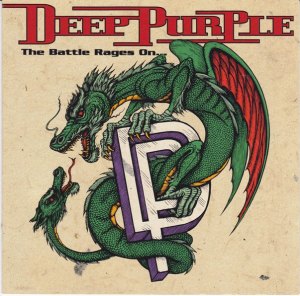
After the ill-fated (but personally enjoyed) Slaves and Masters, Deep Purple realized the only way forward was with Mk II screamer Ian Gillan back at the mike. With a full album’s worth of material already written with former singer Joe Lynn Turner, all Gillan had to do was turn up and re-write the melody and lyrics. Much to Blackmore’s chagrin! Blackmore had no qualms telling Gillan that he preferred the original lyric and melody to “Time To Kill”.
Much heavier than Slaves and Masters, The Battles Rages On is much more in line with albums such as Fireball, Perfect Strangers and Machine Head. Lord’s Hammond organ is much more in the forefront. However, a vintage sound does not a great album make. The Battle Rages On has 10 tracks, 5 of which are good and 5 of which are filler. This was disappointing for me personally, but some (M.E.A.T. Magazine and Martin Popoff included) have rated this album very high. Joe Lynn Turner derisively calls this album The Cattle Grazes On.
The five tunes I like: “The Battle Rages On”, “Anya”, “Time To Kill”, “Ramshackle Man”, “Solitaire”.
The title track is absolutely monstrous. I remember hearing it on the radio and thinking, “Bloody well right!” Big beefy riff, angry lyrics!
“Annihilation, kill ’em all. Capitulation, watch the mighty fall. The road to glory is lined in red, and though the reason now is gone…The Battle Rages On!” (Always wondered if this was about Gillan and Blackmore.)
The song is a Purple epic, along the lines of “Perfect Strangers” or “Knockin’ At Your Back Door”. Just an awesome track. I understand that in 2013 they have actually returned it to the set.
“Anya” is a keyboard driven rocker, Jon Lord style, lots of drama. “Time To Kill” is sort of a heavy pop rocker with Gillan trying to get philosophical with the lyrics, which Blackmore hated. “Ramshackle Man” is blues rock, pure and simple as Purple have specialized in. “Solitaire” is mournful, sad, kind of unlike anything Purple had really done before. Gillan’s droning melody seals the deal.
The rest of the songs just do nothing for me. Some, like “One Man’s Meat” have decent riffs and parts, but weak melodies and lyrics. As songs, they don’t add up to a satisfying listen. It is a shame, given the strength of the good songs on the album.
Blackmore left in the middle of the tour. Joe Satriani filled in, and there was talk that he wouldn’t mind joining Purple full time. His time proved to be temporary, and Steve Morse has been in the band almost 20 years now. When Joe Satriani was in the band, they did an awesome version of “Ramshackle Man”, which I have on a video bootleg from the European tour. There was an official live album with Blackmore from the tour, called Come Hell Or High Water. As well, you could buy official bootlegs with both Morse and Blackmore in a box set called Collector’s Edition: The Bootleg Series 1984-2000. And let’s not forget the Come Hell Or High Water video, with Blackmore throwing that water bottle in Gillan’s general direction…
Check out Satriani’s outro solo starting at about 7:07…smokin’!
To me, Purple’s true comeback was 1996’s Purpendicular. Having said that, the five good songs on The Battle Rages On are worth the purchase at a reasonable price. And hey, maybe Popoff was right, and I’m just not getting it. You decide.
3/5 stars
And check out these cool supplementary releases, all of which deserve their own individual reviews.
BON JOVI – These Days (Special Edition, 2010, Universal Music)
Just as a general comment on the series of Bon Jovi “Special Edition” remasters from 2010: They’re crap. Sorry but they are. A couple unreleased live tracks? That’s it? Come on. They remastered these things 10 years ago and I bought them all then. I’ve bought almost every Bon Jovi album, in some cases multiple times. These Days? Three times now, just to get all the bonus tracks scattered hither and yon. For that reason these Bon Jovi remasters are in my $10 or less purchase range.
As for the album, These Days, I think it’s the best Bon Jovi album. It’s definitely more laid back than any previous Jovi platter, but it has a genuine quality to it that I like. You may like the cheesey 80’s keyboard sounds yourself, but in 1995 Bon Jovi couldn’t release an album like that. Keep the Faith was a great success, but These Days took the band to a new, darker, more soulful place. The production, once overly glossy, has been reduced to a purer, more live sonic clarity. This is a very organic album and many tracks sound live off the floor, such as “Diamond Ring”. Tico’s got a great drum sound on this album too, the snare has a great tonal quality.
Lyrically, Jon has never sounded more real and heartfelt. A song like “These Days” gets me right where it hurts every time. Unfortunately, the biggest hit from this album was the single “This Ain’t A Love Song”. Well, it may not be a love song, but it sure sounds a lot like others I’ve heard, like “Always”. Contrasting the generic ballad were some heavier rockers. “Hey God” is positively angry. “Damned” has swagger. Bon Jovi are always melodic, but the chorus in the infectious “Something For The Pain” is just awesome. “If That’s What It Takes” and “Hearts Breaking Even” are memorable and as strong as any previous Bon Jovi hit, but sadly remained overlooked. The quiet “(It’s Hard) Letting You Go” is one of Bon Jovi’s best ballads ever, because it’s so understated, with the actual vocal delivering the song.
The best song is the brilliant “Something To Believe In”. If I was going to pick one song as the absolute peak of Bon Jovi’s entire career, it could be this one (tied with “Dry County”). Driven by some sparse dark bass and piano, it soon picks up the pace. Richie’s backing vocals punctuate Jon’s powerful chorus beautifully, and you won’t be able to get that “Hey! hey! hey!” out of your head.
Yeah, I’m a sap. I love this album!
I like Eddie Vedder best.
What really sets These Days apart are the sweet harmonies of Jon and Richie. They’ve always done great work together vocally but These Days is a whole level beyond that. If you are a fan of Richie Sambora, I think you will enjoy These Days. In a very real sense I think this represents Sambora’s greatest contributions to Bon Jovi.
This new remastered edition has two live bonus tracks, which unfortunately are both ballads. “This Ain’t A Love Song” is one, I guess because it was the hit single. Shame they didn’t use “Hey God”. “Diamond Ring” is the other live ballad. This one was a bit of a cult song I guess. They wrote it back in the days of New Jersey and almost released it, a few times. It got bootlegged and became an underground favourite. This live version is recorded in Italy. It’s great to hear Jon and Richie singing together like this, but again, I wish they put on a rocker instead of a ballad. Richie’s guitar solo is awesome though.
My preferred edition, which I will cover in a separate future review, is the European 2 disc edition. In a beautiful magnetic digipack, it contained lots of bonus tracks: “All I Want Is Everything”, “Bitter Wine”, “Fields Of Fire” (Demo), “I Thank You”, “Mrs. Robinson”, “Let’s Make It Baby” (Demo), “I Don’t Like Mondays”, “Crazy” (live, lead vocals by Tico Torres), “Tumblin’ Dice” (live, lead vocals by David Bryan), “Heaven Help Us All” (live, lead vocals by Richie Sambora).
There are other editions with bonus tracks, including an Australian edition with a live CD (this is on my “want” list). There were plenty of singles, and I’ll cover each of those in future reviews as well, because they each contained notable bonus tracks. One was a track called “Lonely At The Top”, which to me sounds like it’s about Frances Bean Cobain. It has the lyric, “Tell Frannie I’m sorry she didn’t get to know her dad.” There was even a (great) cover of “Rockin’ In The Free World”, as well as a cover of “634-5789”, which featured Jon cracking up and laughing right in the middle of a verse!
So there you go. Get this album, but buy wisely. Choose an edition that suits your bonus track needs (or lack thereof).
5/5 stars for the album, -1 for this ripoff edition!
Below, pictures and tracklists for all the singles that I have from this album, as well as the Special Edition 2 CD set from 1996. It was a digipack with a neat magnetic clasp to keep it closed.
I don’t hate it. It has a catchy riff, a good vocal from Geoff Tate, a shredding guitar solo, and it’s not about spitting on people or knives. It sounds modern while still featuring a guitar riff or two. I don’t hate it like I hated, say, Tribe. I’m disappointed that it’s a little faceless and generic sounding.
The problem is that it doesn’t sound like Queensryche. It sounds like a Geoff Tate solo track. Probably the best Geoff Tate solo track that there’s been so far. But just a Geoff Tate solo track.
The blockheaded drums do not sound like the textured complexity of Queensryche. (Sounds like Simon Wright though.)
The piano is distracting, I kept thinking a phone was ringing somewhere in my house. It sounds like, “Hey, we have a keyboard player in our band.”
I love the guitar solo. It’s so tasty and good. Who is this? Kelly? Robert? Neither? What will this sound like when performed live without guest stars?
I don’t know if the mix is worth the brew-ha-ha that’s being made of it. It’s not to my taste personally but it sounds like they had a vision of a heavier than fuck sound and just kind of overdid it.
This track confirms that Tate is still capable of writing good music. It does not confirm that Tate still is capable of writing good Queensryche music. This is his Chinese Democracy. It has a vibe of, “Let’s saturate the song with everything from the biggest sounding drums to the fastest solo to a guy playing piano.” Let’s try anything.
Where the real Queensryche’s song, “Redemption”, sounded unmistakably like Queensryche, Tate’s reeks of contrivances. In the Battle of the Ryches, Round One, the original band comes out on top. Tateryche will have their supporters, but it is clear now that Queensryche is a band sound, not merely a singer.
March 17, 1998. The wait was over – Van Halen 3 was out!
Van Halen’s 3 was kind of like The Phantom Menace for me: I was really excited about it, so much that it clouded my judgement of the music. I wanted new Van Halen so bad I would have taken just about anything I guess. Just like I would take Phantom Menace the following year. T-Rev, always the level-headed one, questioned whether I was enjoying the album more simply because of the absurd money that I had paid for it.
I paid $45 for the “collector’s tin”. I was hoping for bonus tracks, but there was nothing like that. A pick, a tin, some paper stuff, a sticker. It was still pretty cool to look at, and collectible.
I was living with T-Rev at the time. I was and still am very “OCD” about my CD collection. I don’t lend discs out anymore for example. Back then and today I am very fussy about the condition of the album.
A day or two after Van Halen came out, our buddy Neil came by to play N64 and have a beer. I was working the night shift that night, so I didn’t get in until after 9. When I came in, I played some N64 with Neil and headed off to bed.
The next day I woke up and wanted to play the new Van Halen. I grabbed it off my CD tower, and noticed something…not right. A fingerprint! On the tin! I could see it! But it wasn’t mine! Before I filed it, I distinctly remember wiping the tin. It had no fingerprints!
When T-Rev got up I asked him, “Hey, I know you wouldn’t have done it, you know me too well, but did Neil happen to look at my Van Halen 3 yesterday?”
T-Rev grinned and asked how I knew. I explained the fingerprint.
“The funny thing,” said T-Rev, “is that I told Neil you were going to notice if he touched it! He didn’t believe me!”
Trevor assured me that Neil was very careful with it, and didn’t touch the CD itself, etc. etc. We couldn’t help laughing at the fact that I did notice. That’s the OCD! I had a lot invested in that Van Halen disc, emotionally and monetarily.
Listening to it today with fresh ears, it’s not the disaster that some (cough cough Craig Fee cough) think it is. But it’s certainly not worthy of the praise that I gave it back in ’98. If it were an Extreme album, it wouldn’t be the best Extreme album. As a Van Halen album, well…
NEXT TIME ON RECORD STORE TALES…A Day In the Life (VIDEO BLOG!)
DEF LEPPARD – “All I Want Is Everything” (1996 two part Mercury CD single)
“All I Want Is Everything” was the first song from Slang that we got to hear. Def Leppard first revealed a live unplugged snippet on their Video Archive VHS. I was still surprised when I heard the whole studio version: It is a lot darker than I expected. I love it, don’t get me wrong. I love its sparse, organic sound. I think the chorus and verses are fantastic, but even better is the bridge.
A lot of my customers were turned off my Slang and songs like “All I Want Is Everything”. While I could argue that this song is every bit as good as “Hysteria” or “Stand Up (Kick Love Into Motion)”, it is obviously a lot darker. But it was also 1996. In 1996, bands like Def Leppard moved with the times. Bon Jovi made similar adjustments. This is no singalong hit, but it is quality songwriting and production.
Next up on disc 1 of this single is “When Saturday Comes” performed by Joe, Phil and Sav. This is apparently for a movie also called When Saturday Comes. This song would be more satisfying to those wishing for an older school vibe; indeed it is a dead ringer for Van Hagar. It is anthemic with some shredding from Phil. It wouldn’t make my own personal Def Leppard mix tape, but I thank them anyway for including the song so I wouldn’t have to hunt down an obscure soundtrack. “Jimmy’s Theme” performed by the same trio is an instrumental from the same soundtrack. Out of context from a film I’ve never seen, it doesn’t do much for me. It’s a nice slow blues with Phil playing some elegant melodies. But it’s just “nice”, I don’t regularly come back to this one. The CD ends with an edit version of “All I Want Is Everything” (whoop de do).
Disc 2, for whatever reason, also includes the same two versions of “All I Want Is Everything”. Why not just put the album version on disc 1, and the edit version on disc 2? Small gripe I guess but it got tedious when I had both discs in the changer and was too lazy to skip.
Also on disc 2 are a couple tracks from the Jeffology tribute record. Phil Collen does “‘Cause We’ve Ended As Lovers”. Personally I don’t think anybody can touch Jeff Beck on this one. In fact Beck is so awesome on this, especially live, that I don’t really see the point of listening to a cover version. Sorry Phil, that is nothing against your playing, which is really really great, especially when you start cookin’ around the 4 minute mark. I just think nobody’s even in Beck’s league on this one, and I think that’s a fair assessment.
Vivian Campbell does “Led Boots” from Wired. I love the original “Led Boots”. It’s just funky, chunky and fucked up. I think Vivian’s style is more suited to Beck than Phil’s is. This is an enjoyable listen, Vivian gets to shred a bit. It’s definitely less fucked up sounding than the original, but Vivian is just a pleasure to listen to, he is clearly enjoying himself.
The “Work It Out” single previous to this contained post cards of the first four Def Leppard albums. CD 2 of “All I Want Is Everything” has the final four: Adrenalize, Retro-Active, Vault, and Slang.









 mikeladano.com