RECORD STORE TALES Part 303: Marking Your Discs
In the 1990’s, stealing CDs and selling them to a pawn shop or a used CD store was a fairly common way for thieves to make some money. Today I doubt it happens at the levels I saw in the 1990’s. You just can’t get as much for a CD today, not even close.
I had seen too many people lose valuable music to theft, and never get the discs back. I received many visits and phone calls from upset customers, hoping that someone had sold their stolen discs to me. But a lot of thieves were too smart to sell them in town. They’d go somewhere else to sell them, assuming that they’d be harder to catch then. When somebody lost dozens of CDs in a break-in, they would call all the used stores in town. “If you see a guy bringing in a huge collection of Jazz box sets, including about a dozen Miles Davis remasters, call me.”
It was always best if you could somehow identify your collection. Jazz box sets and Miles remasters (for example) would be easy to spot. If somebody else called and said, “Somebody stole all my rock CDs…I had Stone Temple Pilots, Korn, Creed, Days of the New…” well, there wasn’t much hope. These are titles that we often saw, probably every single day. If you could somehow mark the discs as your property, however…
Different people used different methods. In 1995, I got a call from a guy who worked at the downtown Dr. Disc. His collection had been stolen. He marked his discs in a unique way. He placed a strip of tinfoil underneath the CD tray. If somebody came in to sell a hundred CDs and they all had tinfoil under the tray, there’s your guilty party.
Most people, who didn’t care about the packaging or condition of their discs so much, would just write their name inside. Either on the booklet, the inner tray, or the front cover. I could never deface my music like that, and neither could T-Rev. He came up with his own method. Rather than mark the CD packaging itself, he wrote his initials on a tiny red sticker, and placed that somewhere unobtrusively on the CD. If he ever wanted to remove it, he could do so without wrecking anything.
Tom didn’t share our “no permanent marks” philosophy. He embossed the front covers of his discs with a press that imprinted his initials on the front cover. Tom gave me a couple CDs once – his initials always bothered me. When I had the chance to swap covers with a copy that was in better condition, I did. Tom tells me he doesn’t emboss his CDs anymore. I’m glad he came to his senses.
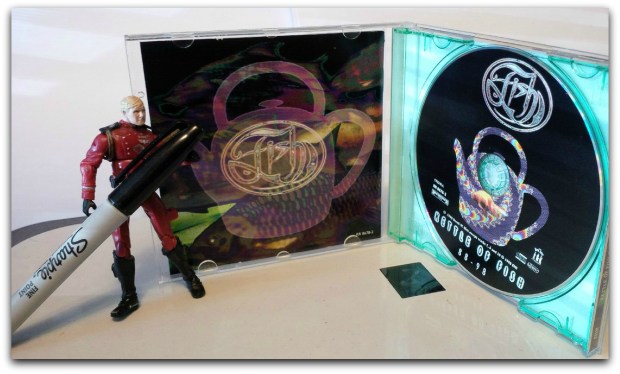
T-Rev and I both have had CDs stolen, unfortunately. Both of us had our vehicles broken into. T-Rev never recovered the handful of discs that were in his Jeep. (I remember that one was the excellent Barstool Prophets albums Last of the Big Game Hunters.) They never showed up, anywhere in town. As for me, I only lost one disc – Fish’s 1998 compilation Kettle of Fish, which was inside my Discman (also stolen). They didn’t take the CD case. I imagine they probably threw out the CD; chances are these thieves would not enjoy the subtle sounds of Derek William Dick. At that time, the album was not available in Canada, and I believe I had to order it directly from the official Fish site in the UK to replace it. That cost me about $30, to replace a CD that I originally paid $7.99 for. That was not a good day.



















 mikeladano.com