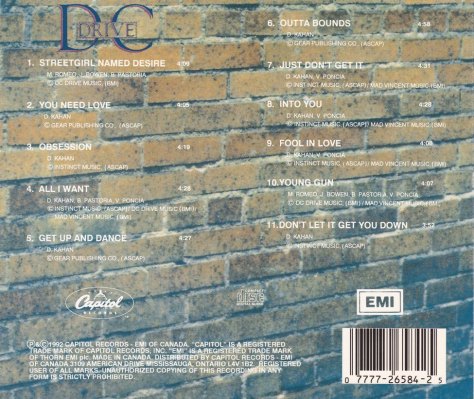
I saw DC Drive (from Detroit, get it?) open for Harem Scarem back in spring 1992. They were good live: the first single “You Need Love” rocked well enough, and lead singer Joey Bowen did “the worm” across the stage. He was a good frontman for a band like this. Their gimmick was that they mixed “rock and soul” and had a full time sax player. However, there is nothing overly special here, nothing that Little Caesar didn’t do, and perhaps better. I recall in a M.E.A.T Magazine interview that DC Drive boasted that they had more genuine soul than The Black Crowes; I would take issue with that.
Notably, DC Drive was produced by Vini Poncia, probably best known to rock fans as producer of the Kiss disco-era albums*. Poncia has several co-writing credits here as well. It’s a pleasant CD, fairly keyboard-heavy, with a couple good songs, but quite a bit of filler. It’s funky, but in that radio-friendly way that you remember from a couple decades ago.
The lead single “You Need Love” was good; “Streetgirl Named Desire” likewise. I also enjoyed the ballad “Fool In Love” sung by bassist Doug Kahan. I like the shameless pop of “All I Want”. If Bryan Adams recorded it, it would have been a hit. But the biggest problem with this album is how dated it sounds. A “rock and soul” band shouldn’t sound pigeonholed to eras past like this. It sounds like backing music to a 1991 buddy cop comedy. Joey Bowen has the goods when it comes to putting feeling into his singing, and guitarist Michael Romeo has a sweet tone. Unfortunately what the album really lacks is memorable songs.
DC Drive came out of the ashes of a previous Detroit band, Adrenalin. One odd thing about DC Drive: Even though they were from Michigan and were signed to a big label (Capitol), they were only signed to a Canadian record deal. The album wasn’t released in the US for another year, with a different track order, and minus one song (“Get Up and Dance”). The Canadian release enabled the band to at least get a footing in right next door to home, but it wouldn’t help in the long run.
Basically, the only reason I own this CD is because I saw the band live and it’s sort of a souvenir. Plus I found it for under 2 bucks. Otherwise this is pretty limp and bland, despite the sax (which isn’t always audible) and soulful Detroit roots.
For 90’s hard rock completists or anybody who remembers the song “You Need Love”. Otherwise don’t bother.
2/5 stars
* Poncia was brought into the Kiss family by drummer Peter Criss. Peter was probably inspired to work with Poncia due to his prior resume with Ringo Starr.
We’ve had a couple strong new releases in a row here of late: The newHelixandJudas Priest albums have been particularly great.
I guess two out of three ain’t bad.
NEW RELEASE
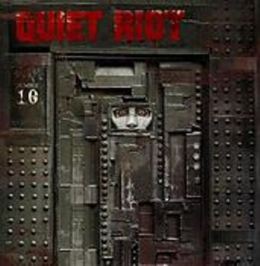
QUIET RIOT – 10 (2014 iTunes or Amazon mp3 download)
I’ve made no secret of my dislike for the happenings in Quiet Riot recently. I find their current reunion, with no original members, to be tenuous at best. Singer after singer, Quiet Riot stumbled onwards before finally hiring Jizzy Pearl of Love/Hate and Ratt fame. With Pearl they’ve managed to record an album. 10 is the name of that album, another thing I find a little disrespectful. The name 10 seems to me to imply it’s their 10th album. It’s not; all fans know Metal Health was their third, not first, album. This seems to play into an earlier attempt to re-write the Quiet Riot related Wikipedia pages to state that Metal Health was the band’s first record. Why? I can only speculate that this is done to promote the current Quiet Riot as having “original members”, when in fact they have none.
However, I’m going to listen with open ears, because that’s what I’m here to do.
First track, “Rock in Peace” is one I like quite a lot. What I don’t like is the muddy, muddy sound. The drums sound like they’re in another room. It’s too bad because I think the song has potential. As for Jizzy, it’s easy to adjust to him as lead singer of Quiet Riot. Although he doesn’t sound like the late Kevin DuBrow too much, he does have certain screamy qualities in common with DuBrow. This enables him to adapt to the Quiet Riot sound. The lyrics quote the band’s biggest original hit, “Metal Health”, which is alright. Halford’s quoted himself before too. OK, so production aside, not bad.
“Bang For Your Buck” has some tasty guitar by the talented Alex Grossi, making his first Quiet Riot album appearance here. Unfortunately the otherwise fine song is held back by Jizzy, overreaching and straining. Grossi really does redeem the song especially with the solo…but damn this album sounds muddy. Congested. Like I have a head cold while listening to it.
Third in line is the weird titled “Backside of Water”. I don’t know what that title means, and since this is a digital release, there are no lyrics. It smokes along nicely, with more fantastic Grossi guitars, but it’s an unremarkable song that doesn’t sound like Quiet Riot, except in the sense that Quiet Riot has a lot of unremarkable songs. The Ratt-like “Back on You” is outtake quality. I’m sensing that the guys think they can just throw a shout-AC/DC-style chorus on something and call it catchy, but it doesn’t work that way.
“Band Down” is what you’d call a “down n’ dirty” rocker. I’d call it dull, and poor sounding. I think they’re trying to recapture that “Stay With Me Tonight” vibe, but without a memorable chorus. But “Dog Bone Alley” is worse, absolutely sunk by horrendous backing vocals. It has a slinky, heavy groove, and some smokin’ guitars, but that’s not enough to build a song with.
Alex Grossi, Jizzy Pearl, Frankie Banali, Chuck Wright
Quiet Riot’s biggest stumbling block has always been songwriting. That’s why some of their biggest hits are covers. Quiet Riot 10 continues that frustrating tradition. Just like albums such as Alive and Well had some good songs and solid moments, so is Quiet Riot 10. And that’s only six songs!
What Quiet Riot did to make a full album is include four live songs, kinda taking a page out of the ZZ Top book, a-la Fandango! These tracks are all obscurities, songs not available in live versions before. They all feature Kevin DuBrow, but could Frankie have not found better sounding recordings? From Quiet Riot III is a horrid sounding version of “Put Up or Shut Up”. This is bootleg quality, and not even good bootleg quality. Too bad; sounds like it was a good version. Then, from the stinky Rehab CD comes an unnecessary “Free”. So it’s heavy, whoop-de-do. It’s a shitty song, and the vocals are so damn distorted at times that it sounds as if Kevin’s under water. “South of Heaven” too suffers from these sonic defects. It seems like they were going for a Zeppelin “Nobody’s Fault But Mine” kind of vibe, but as if the mothership crashed into “The Ocean”. (See what I did there?) Kevin even yelps, “Push, push!” It’s a shame because Frankie really is a smokin’ drummer.
The final track is a nine minute rock n’ roll medley. This is a great jam. Humble Pie’s “Red Light Mama, Red Hot!” is a great little obscure choice. Kevin sounds like he’s having a blast. Actually the whole band sound like they’re having more fun here than they were playing their own originals. This seques into other more familiar hits, still harkening back to that old British blues rock sound.
Live many albums of Quiet Riots past, 10 stumbles and fails at times, while producing pleasing hard rock surprises at others. The sonic issues are a surprise to me. I hope a physical CD release, if there is to be one, would improve the sound.
2/5 stars
1. “Rock in Peace” 4:00 2. “Bang For Your Buck” 3:52 3. “Backside of Water” 4:18 4. “Back on You” 3:24 5. “Band Down” 3:17 6. “Dogbone Alley” 4:29
Live 7. “Put Up or Shut Up” 4:18 8. “Free” 4:05 9. “South of Heaven” 5:25 10. “Rock ‘n’ Roll Medley” 9:22
For further reading, check out Jon Wilmenius’ review of Quiet Riot 10.
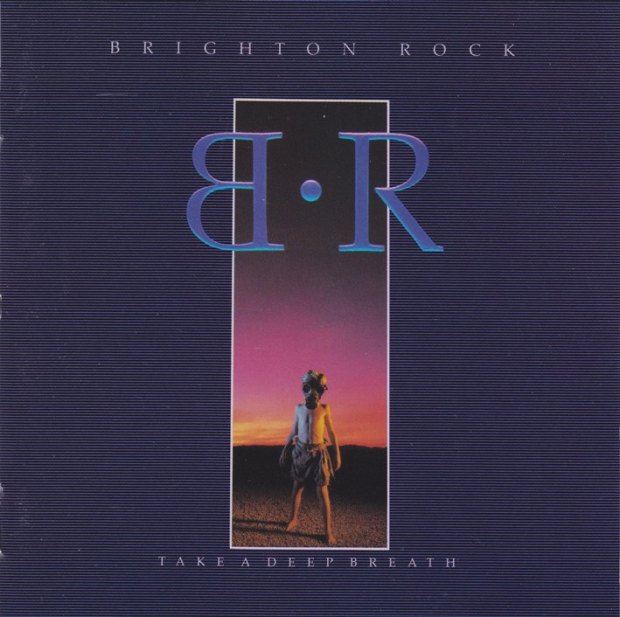
Legend has it that Brighton Rock hated this album. Singer Gerald McGhee was on record saying that record company pressure forced his band to soften up the songs and his singing style. Yet, Take A Deep Breath is actually an excellent 80’s rock album, with unusual quality. Everything you loved about 80’s rock is here.
Brighton Rock’s sound was different from the crop of hair bands at the time. They always had a classier feel in their commercial rock. Witness, from the first LP, “We Came to Rock”. The synth strings made it different, a little more refined. Johnny Roger’s tasteful keyboard parts have always provided an interesting background texture to their vocal and guitar melodies. Gerald McGhee’s vocals were emotional and he had a powerful range. On this album, he doesn’t scream (that record company pressure), but that’s OK. It works out fine with these songs. His voice is strong enough, he didn’t need to show off how high he could go.
Strong songs:
“Can’t Stop The Earth From Shaking” (poppy, catchy and upbeat rocker)
“Outlaw” (dark and moody, great keyboards providing background texture)
“Rebels With A Cause” (guitars upfront, a good groove)
“Power Overload” (another guitar rocker with a great shout-chorus)
“Who’s Foolin’ Who” (best song on the album, sounds like we have some fretless bass here, a moody dark rocker)
“Love Slips Away” (dark and moody ballad, second best track here)
“Unleash The Rage” (the dark, metallic song that sounds more like the rockers on the first album)
Drivel:
“One More Try” (the unfortunate first single, a ballad…look at those doe eyes!)
“Ride the Rainbow” (the pop song Gerald says he wished he never wrote)
As you can tell, dark moods dominate Take A Deep Breath. You could probably tell that by the cover. Hugh Syme (best known for his work with Rush, although he’s also done Iron Maiden, Megadeth, Queensryche, and dozens more) did the picture of the little boy with the gasmask in the post-nuclear landscape. Because of this dark feel, Take A Deep Breath is unlike most of the pop rock records out at the time. Its darkness allows it to stand up to scrutiny today. When Brighton Rock ditched keyboardist Johnny Rogers so they could “heavy it up” for their next album Love Machine, it didn’t work. They lost that special quality and became just another band trying to sound like it was from LA.
Don’t listen to Gerald McGhee: Take A Deep Breath was an album for him to be proud of, not embarrassed by. It was the high point of this band’s discography. Heck, Jack Richardson produced it — the same guy who recorded Universal Juveniles and the better Guess Who albums. There is a level of quality here underneath the keyboards that is audible, even today.
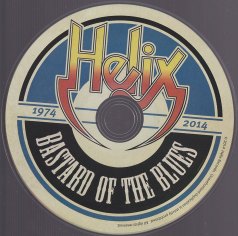
I’ve been a Helix fan a long time. They were one of the first bands I’ve ever liked. I’m pleased to report that their new album, Bastard of the Blues, is their strongest in years and possibly on a par with their best 80’s work. It is their first album with Chris Julke of Cambridge Ontario on guitar, replacing John Claus (who replaced the Doctor, Brent Doerner). This new lineup of the band (still featuring Kaleb Duck – guitar, Daryl Gray – bass, and Fritz Hinz – drums) is again working with Sean Kelly and Aaron Murray, producing one hell of a record. It consists of 8 brand new songs, and 3 slightly older songs that you may have missed the first time.
The title track “Bastard of the Blues” is a mean, fully loaded soul-metal rock song. Soul-metal? Sure, why not? Check out those backing vocals, and the smoking lead guitars. Soul-metal! Songwriting-wise, this is a top drawer. Production-wise, performance…there is absolutely nothing that sucks about “Bastard of the Blues”. Although this is a completely modern song, there are aspects of it that take me back to 1978’s Breaking Loose album, such as its experimental nature with different sections and so on.
It takes balls to name a song “Even Jesus (Wasn’t Loved in His Home Town)”. It’s heavier than the title track, and boasts a nasty little guitar riff to hook you. Once again, Helix raised the bar. Then they change gears: “Winning is the Best Revenge” is solid pop rock that in a just world would be on the radio. This one takes me right back to the mellower sounds on Helix’ 1993 classic It’s a Business Doing Pleasure. Vollmer’s voice is in top shape. Lyrically these two songs really seem pointed at those who may or may not have impeded Helix in the past!
“Screaming at the Moon” would be a cool song live, with it’s lyrics about fists pumping in the air. My favourite song however is the next one, “Metal at Midnight”. If it wasn’t for the modern production I’d swear this song was from 1984. What a great hard rock chorus. I’m absolutely nuts for this song. What is it about bands like Judas Priest and Helix recently, that they have managed to tap into that vintage vibe? I think part of the credit must go to co-writer Sean Kelly, who proved his metal credentials last year on his excellent Metal On Ice EP.
“Hellbound For a Heartbreak” is similar in direction to “Screaming at the Moon”, which is solid hard rock with hooky guitars. But then, I was taken by surprise: “When All the Love is Gone” is an epic 70’s-sounding ballad with a voice singing that I’m not familiar with. Turns out, it’s Daryl Gray! He absolutely nails it. This song could have been at home on Breaking Loose, alongside “You’re a Woman Now”. I tend to like albums with multiple lead singers, so I enjoyed the change of pace.
From the compilation CD Best Of 1983-2012 comes “Axe to Grind”, getting a second life here. Now here’s an interesting observation: On the Best Of CD it didn’t make a huge impression on me. Here, I’m enjoying it a lot more, particularly for the scathing lyrics. Anybody who has read Brian’s Facebook page knows he’s not shy about sharing opinions, and “Axe to Grind” reminds us of that. Then comes “Skin in the Game” from the EP of the same title. This being an older song, you can hear the presence of the Doctor! Also from that EP is “The Bitch is a Bullet”. It boasts one of those memorable Helix choruses.
Album closer “Sticks and Stones” is another favourite. It’s a fast-paced bluegrass-y metal shuffle! Hey, I don’t know how to describe it better. This is a great song, purely smoking, and showing off the musicianship of these five pros. Much like “Metal at Midnight”, I just can’t get enough of this song!
As an album, Bastard of the Blues is more cohesive and consistent than some of the recent Helix discs, including The Power of Rock and Roll and Vagabond Bones. As good as those albums were, Bastard is better. It feels like a complete album, more so than before. It holds its own against classics like Back For Another Taste, a high-water mark.
I don’t often get preachy in my reviews here, but I will say this: Go out and get Bastard of the Blues. Order it online. Do what you have to do to purchase this album. You’ll be supporting a hard working band that have really earned your dollars. If there was one pleasant surprise of 2014 so far, it is that Helix came out with such an incredibly strong album. They have raised the bar for themselves again.
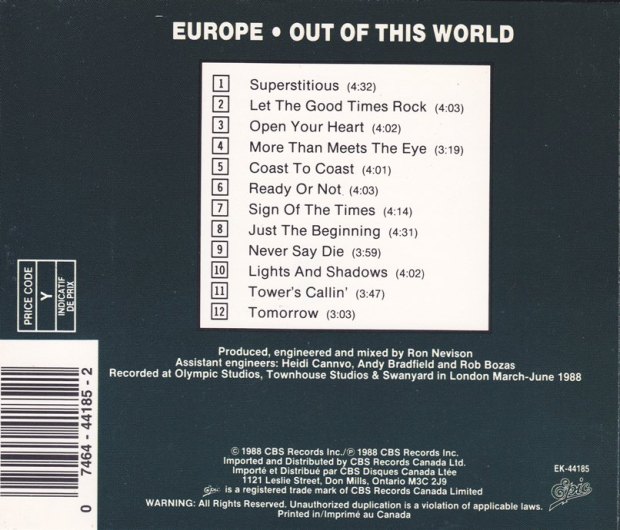
So here I am, in the same place that I was 26 years ago when I first heard Out of this World, by a band I just loved: Europe. It was late August of 1988. The location is a quaint wooden cottage north of Kincardine, Ontario. I bought this album at the local records & tapes store while on summer vacation. The problem with August in Kincardine is that it was a crummy time to be on vacation. It started to get cool in late August, dark and rainy. That August was a damp one, and I have lots of memories of being in this exact same location trying to wrap my head around Europe’s then-latest.
From the first single, it was obvious to my friends and I that Europe had mellowed somewhat. It seemed odd to me that a band of Europe’s stature would release something mid-tempo and softer as a first single. But there was no questioning the quality of “Superstitious”. It remains one of Joey Tempest’s greatest compositions. This song has it all: A soulful vibe, anthemic Europe keyboards, an absolutely blazing guitar solo by Kee Marcello, and plenty of organ to go with this darker mellow vibe.
I don’t think this video did them any favors.
That considered, I expected the next song “Let the Good Times Rock” to sound more like upbeat, “old” Europe (which to me was The Final Countdown). Although it has some cool guitar hooks and fun lyrics, it’s more of a laid back dark n’ dirty grind. This furthered the feeling that Europe were softening a bit.
None of us were then aware that “Open Your Heart” was a remake of a song from 1984’s Wings of Tomorrow. Kee didn’t play on the orginal, so it’s cool to hear his take on it. Even though this song was a ballad, it was undoubtedly hit single quality. When this song failed to get any airplay here, I began to worry that Europe’s fortunes in this country were over. I could not fathom how the song had not become a massive hit. Europe were being ignored by the mainstream. It was a shame. I still think the re-recorded version is great. As I said in my review for Wings of Tomorrow, “I prefer the re-recorded version, because it includes an additional guitar part, really cool and catchy, immediately after the acoustic intro.”
“More Than Meets the Eye” has nothing to do with the Transformers, but it does consist of more dark, keyboard-oriented radio rock. It’s a very good song, but again, I was craving something more upbeat. There was still hit single potential here. “Coast to Coast” is equally good, but very soft. This is a mournful organ-backed anthem. It’s peaceful, just like this cottage by the lake. Quality-wise, this is top-notch. However we are now five songs into the A-side, without a really truly upbeat sounding rock song. The young me found this all a bit too depressing, though today I don’t mind the laid back vibes.
Then, finally! “Ready or Not”! A smoking rock song. Everything the album needed. When Joey sings, “Then rock me just a little more,” that’s exactly how I felt! Coming from Canada, I often wonder how Europe’s Swedish fans, who had been on board much longer, felt about Europe’s new musical direction.
Side B commenced with the elegant keyboards of “Sign of the Times”. The song feels highbrow, and perhaps musically it was too sophisticated for the tastes at the time. It’s an excellent song, another keyboard-drenched anthem. The shame of it is, the production (by Ron Nevison) robs the song of so much power. Some things he captures quite well, such as Mic Michaeli’s organ. Other things are weak by comparison. Kee’s lead tone sounds cold…just like this cottage used to be in late August…and the rhythm guitars are not present enough. The song could have had much more dynamics, heavy and soft, if the instruments were just recorded a little differently.
“Just the Beginning” isn’t anything special to me, a chorus without a song. This one you can skip, there are better songs to be had. “Never Say Die” is pretty good. It too lacks that upbeat feel that I’m craving on a Europe album, but it’s good enough for me. It has some great parts even if the whole isn’t all it should be. The organ and guitar solos, for example, are a lot of fun. Unfortunately “Lights and Shadows”, which follows, is just filler.
“Tower’s Callin'”, the penultimate song, is back to quality songwriting. Even though the song has a cool groove (badly recorded once again) and a killer chorus, the lyrics are completely incongruous to the mood of the music! The songs seem to be about an air disaster:
All set ready to go but little does he know He ain’t comin’ back no more, no All set ready to fly into that deep blue sky Like so many times before Now the tower’s callin’, there’s no reply And there’s nothin’ they can do Now the night is fallin’ before their eyes Still no one’s comin’ through, callin’ F12
Or am I reading this with too much 2014 perspective? Perhaps the song is supposed to be more Twilight Zone in nature, a disappearing plane?
The final track is “Tomorrow”, a Joey Tempest piano piece that once again has to be one of his best compositions. It does close the album on a sad, rainy note…much like that August in ’88.
It’s obvious that I can’t separate my listening to Out of this World from feelings of nostalgia. For that reason, take my rating with a grain of salt. Although many may feel differently, I like this album. It has a weaker second side and way too many ballads, but Ron Nevison robbed the guitars of their thunder. The songwriting shines through on many tracks, as does the talent of the players. For those reasons:
When this album first came out, the local music geeks and I spent a lot of time discussing it. The foremost argument was, “What influence did grunge have on The Last Temptation?” While this is by no means a grunge album, I think there is a subtle grunge influence, and The Last Temptation is all the better for it.
The Last Temptation was heavier…more serious…more raw in production. These are all trends that grunge helped usher in. Alice had taken a bit of a slip, quality-wise, in the late 80’s and early 90’s. The Last Temptation was the album he needed to release in 1994. While it was not a commercial success, it excited the long time fans. It was the kind of thing we’d really missed from Alice, since the 1970’s.
The most obvious grunge influence is that Chris Cornell of Soundgarden wrote two songs and co-sings one. “Stolen Prayer”, the best song on the album, is Cornell’s, and his pipes have never sounded so good. Grunge forced a lot of hard rockers to drop the glossy production sheen of the 80’s, get serious a little bit on the lyrics, and write harder songs. This is evident in the world of Alice. This album spends a lot of time on the temptation of drugs, and while many rock fans might cringe at the idea of Alice delivering a “message” to us, this really is nothing new for our favourite masked rock star. He’s been serious before, on some of his finest moments in fact, but he always makes his messages fun to listen to and sing along with. West Side Story has always been a huge influence on Alice as fans know, and The Last Temptation is another album that shows this Broadway influence. “Bad Place Alone”, for example, has a chorus that sounds influenced by musicals.
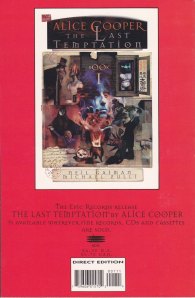
Alice is nothing if not ambitious. The Last Temptation was Alice’s first “true” concept album since DaDa in 1983. In fact there was a even three-part Neil Gaiman comic book available at the time to help flesh out the story. One edition of the CD came with issue #1. Here you can find images from all three issues.
Marvel went all out on these comics. The covers are hard stock, and the artwork inside by Michael Zulli is detailed and, at times, horrifying. The colour palette evokes autumn (the story is set in October). Even Alice himself appears as the Showman character, but the protagonist is (of course) Steven. These comics were later reissued in a trade paperback, but all are affordable today, running at about $4 each. The most desireable edition is probably the rare one that came backed with the CD: issue #1, with a white border.
Musically, Alice is at the very top of his game here. Gone is the gloss. In fact, the opening track “Sideshow” sounds so much like the 70’s that you could swear it’s from the original Welcome To My Nightmare record. Awesome horn sections, great riff, killer lyrics; you’ll be singing this one for days after hearing it. “Nothing’s Free” rips off “Billion Dollar Babies” somewhat with the opening drum hook, but you won’t be complaining when you hear it. Most likely you’ll be pumping your fists to it. The first single “Lost In America” is a fast, tight rock song with insanely catchy lyrics, very different from a lot of stuff Alice had done in the 80’s.
The rest of the album is strong, with “It’s Me” being the sole ballad. “Stolen Prayer” is an absolute diamond. Chris Cornell sings on the choruses with that classic, incredible 90’s Soundgarden voice. Although the song is largely acoustic and mellow, the best word I can use for it is “epic”. It’s a classic, and I believe that to be the reason that Alice used it to close his comprehensive box set, The Life and Crimes of Alice Cooper. (Cornell also wrote the track “Unholy War”, solely — even the lyrics, which Alice used without modification.)
Overall the direction of the album is dark and catchy, with great playing from the entire cast and Alice spitting out the words as only he can. The fact that most of these songs were played live on tour is a testament to the strength of the material and Alice’s confidence that he had made yet another classic album.
The Last Temptation is a record that is sadly unknown to many casual rock fans. However, anybody who loved Welcome To My Nightmare would be well advised to pick this up. They might find that Alice has built a musical time machine, an album that sounds timeless despite its 1994 release date. It may not be a grunge album, but I think we owe a thanks to the grunge movement for helping Alice make the strongest record he’d done since 1975.
What happens to Steven? You’ll just have to listen and find out.
QUIET RIOT 1978
Randy Rhoads – lead guitar (founder)
Kevin DuBrow – lead vocals
Kelli Garni – bass
Drew Forsythe – drums
QUIET RIOT 1988
Carlos Cavazo – lead guitar
Paul Shortino – lead vocals
Sean McNabb – bass
Frankie Banali – drums
Quiet Riot are a rare bird in rock history; they actually released this album with no original members intact. Quiet Riot suffered numerous lineup changes until finally singer Kevin DuBrow was fired in ’87 after the disastrous QRIII. Bassist Chuck Wright also left the sinking ship (he joined House of Lords).
Banali and Cavazo made the questionable decision to carry on with a new singer, and that singer was Paul Shortino of Ruff Cutt. My only exposure to Shortino at that time was his excellent contribution to the song “Stars” by Hear N’ Aid. I loved his raspy voice and I was intrigued. Replacing Chuck Wright was bassist Sean McNabb…who, a few years later, again replaced Chuck Wright, this time in House of Lords. Since then he’s also been in Great White.
The album itself was a bit of a letdown at first, and only through many determined listens did it finally grow on me. The problem was that Quiet Riot are (or were) primarily a party band. I mean, this is the band who had songs called “Party All Night” and “Stomp Your Hands, Clap Your Feet”. Now, they had changed to a moodier blues-based glam rock band. The first single “Stay With Me Tonight” was darker, slower, bluesy and anchored by a howling Hammond B3 organ. Nothing like anything Quiet Riot had ever done before. Obviously, Banali and Cavazo had decided to trade party hooks in for integrity and possible critical acclaim. Unfortunately that never happened, but the result is that QR remains a hidden hard rock semi-gem. The lack of success led to Quiet Riot disbanding in 1989 after a short tour. Sounding very little like Quiet Riot, and playing unrecognizable renditions of the hits, the band clearly should have changed their name to something else. Clamorous Calm, perhaps?
The album did finally grow on me. Perhaps similarly to a band like House of Lords (who debuted at the same time), the tracks here were a bit darker. The ballads a bit more sad. The rockers a tad more threatening. The fact that this sounds absolutely nothing like Quiet Riot (except for the musicianship of Banali and Cavazo) doesn’t make it a bad album.
My favourite songs:
“Stay With Me Tonight”, the afformentioned first single.
“Run To You”, a guitar-based ballad with a touch of keyboards and great melodies from Shortino.
“I’m Fallin'”, one of the few party rock songs included.
“Don’t Wanna Be Your Fool”, another great darker ballad.
“Callin’ The Shots” which has a pretty solid, bluesy riff.
The sound, by long-time QR producer Spencer Proffer was not up to par. I didn’t expect Quiet Riot to go so bluesy either. These were sounds I was somewhat unfamiliar with at the time. Carlos did have a chance to shine on guitar more than ever before, and Frankie’s drums are loud and powerful as always. As a testament to the man’s talents, he ended up in W.A.S.P. after this on the brilliant Headless Children CD.
In 1993 DuBrow called Cavazo up, made amends, and formed a band called Heat. With the addition of Banali and bassist Kenny Hilary (R.I.P.), Heat morphed back into Quiet Riot. They released the pretty good Terrified CD which was a welcome return to vintage form.
This CD may not be a very good “Quiet Riot album”, but it is actually a pretty good album. If you give it time, you may find something to enjoy herein.
VAN HALEN (Not Van Hagar!) Coda: Can’t Get This Stuff No More
Welcome to the final installment in my latest series of reviews at mikeladano.com: an in-depth look at all the classic VAN HALEN albums, with David Lee Roth. If you missed anything, don’t fret: the complete list is right below. Dig in!
VAN HALEN – “Can’t Get This Stuff No More” / “Me Wise Magic” (1996 Warner promo singles)
Van Halen had been doing just fine, thank-you-very-much, with Sammy Hagar for a decade. There had always been rumors that they were on the verge of a split with Hagar. I remember hearing those rumors on MuchMusic in 1987, around the time Sammy had released his self-titled solo album. The rumors returned when Sammy released his Unboxed compilation in 1994. When the split did finally occur in 1996, it was explosive. Especially when Van Halen announced that they had resumed work with David Lee Roth, and two brand new songs featuring his voice would be released on the forthcoming Best Of Volume I album.
A somewhat embarrassing MTV Awards appearance by the reunited Van Halen stoked the fire. They presented an award to a stunned looking Beck, who thanked them in his speech. Dave, always the ham, made the most of the opportunity to address the crowd. Edward looks uncomfortable, keeping his distance and trying keep the subject on the “Best Male Video” award.
As predicted, the reunion was strictly temporary. A tense studio situation (with new producer Glen Ballard) produced two cuts. The first, “Can’t This Stuff No More”, was considerably darker than most of the Van Hagar tunes the band has been putting out. You can hear some quiet organ overdubs, but it is otherwise void of keyboards. Roth uses his lower voice, as he had on his previous solo album Your Filthy Little Mouth. Eddie’s guitar sounds a bit like his work on 1984, but with a much fatter tone. As a single, “Can’t Get This Stuff No More” is a bit of a disappointment. If it had accompanied a whole album of new material, it would have made an excellent album cut.
“Me Wise Magic” is the one with the catchy chorus. It too has a dark tone to it, perhaps reflective of the mood in the Van Halen camp. Roth again uses his low voice, until the chorus when he lets those patented Dave shrieks loose. They’re older, more ragged and tamed, but it’s that same Diamond Dave “charasma!” that we had missed for so long. The chorus isn’t bad, but the song doesn’t boast one of those classic guitar riffs that albums such as Women and Children First were loaded with. There’s no mistaking the player as Edward, especially come solo time, but it is undeniable that these two “new” songs lack a certain magical aura. Both would have made excellent album songs, surrounded by others of different tempos and types. As “new” compositions on a greatest hits collection of questionable intent…
3.5/5 stars
Whether you are traveller or tourist, this is the end of the ride; the series stops here. We know what happened next: Van Halen 3, inactivity, followed by years of confounding turbulence. Finally, the album A Different Kind of Truth (2012), and redemption.
Edward Van Halen picked up the phone. On the other end was a man claiming to be “Quincy Jones”, asking Eddie if he was available to play on an album. Not knowing the name “Quincy Jones” and assuming it was a crank call, Eddie slammed down the phone yelling, “Fuck off, asshole!” Only a followup phone call from Michael Jackson clarified the situation. Quincy Jones, the legendary record producer, was working on the new Michael Jackson album. Could Eddie come by and play a guitar solo on an upbeat, driving song?
What Eddie laid down (in reportedly two takes) was selected by Guitar magazine as the greatest guitar solo of the 1980’s.
In one tension-filled solo, Eddie threw every trick from his bag: whammy dives, complex neo-classical trills, hammer-ons, pull-offs, tapping, harmonics, squeals, and finally a big fat pick slide.
If one wants to hear what Eddie Van Halen sounds like, all they need to do is play “Beat It”.
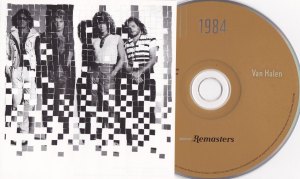
VAN HALEN – 1984 (MCMLXXXIV) (1984 Warner)
Having compromised his artistic instincts on 1982’s Diver Down, Edward Van Halen refused to do the same again. He and longtime engineer Donn Landee proceeded to build 5150, Eddie’s home recording studio. There he was free to experiment with the synthesizers that had begun to creep into Van Halen albums. When the studio was complete, Eddie felt that he had more control.
But there were other issues beginning to surface. The Michael Jackson cameo, for example. Roth had reportedly vetoed previous offers for Van Halen to do guest appearances on records. (Van Halen had also appeared on the semi-obscure Brian May and Friends EP Star Fleet Project.) When Quincy Jones and Michael Jackson extended the offer to appear on “Beat It”, Edward did it without telling the others in the band. Roth claims he never would have objected to Edward working with an artist of Quincy Jones’ stature, but the feelings of betrayal had set in.
Edward and Roth both recall that Van Halen had the main keyboard hook from “Jump” for years, and had submitted it for consideration twice. Roth and producer Ted Templeman rejected it both times, wishing Eddie to keep the focus on his guitar playing. The third time was the charm, and Roth finally agreed to write lyrics for the song, now titled “Jump”. Another synth piece of Eddie’s, now called “1984” was used on the album to precede “Jump”.
It’s impossible to underestimate the impact of “Jump”. Those big fat Oberheim keys were unlike any that Van Halen had used before. The song’s success made other bands pay attention, who were quick to begin adding keyboards themselves. The trends this song ushered included the successes of Bon Jovi, Europe and the like. Veteran bands like Kiss started adding keyboards to their live shows. “Jump” was a perfect storm. It captured Van Halen’s already likable and cool party-hearty spirit, with the cool new wave bands that had replaced punk. Eddie’s tasteful guitar solo ensured that his fans would still listen to every note in order to figure out just how the hell he did that. Meanwhile, who couldn’t love his sheepish grin in the music video?
If you listen carefully during the fade, you’ll hear a familiar guitar riff. Can you name it? That very riff was recycled in 1991 on Van Hagar’s song “Top of the World”!
“Panama” was also a single, no keyboards this time! David made the ladies faint every time during the middle break. The high-flying video showed their sense of humour and electric stage show. If any fan was left doubting after “Jump”, then “Panama” assured them that all was alright. Guitar pyrotechnics and cool lyrics are where’s it at.
What’s not to like about “Top Jimmy”? Perfectly fusing his experimental and hard rocking sides, Eddie created a hook using guitar harmonics for “Top Jimmy”. There’s the patented Van Halen backing vocals, a smokin’ song, and David Lee Roth running the show. This is one of those album cuts that’s every bit as good as the better known tracks. Same with “Drop Dead Legs”. Alex’s steady beat, Eddie’s smoldering riff, and Roth’s leathery moan are a trifecta of perfection. If you listen to the riff, you’ll notice Eddie’s innovative way of using a whammy bar in a musical fashion, as an actual part of the music. Towards the end, Eddie goes into a different riff, and solos his way to the side’s fade-out.
“Sit down, Waldo!”
Dave’s knack for video scored a home run with “Hot For Teacher”. You wouldn’t necessarily think a song like this, a hard shuffle with a lot of talking in it, would make for hit. Hell it opens with 30 seconds of nothing but drums! “Hot For Teacher” remains a pinnacle of hard rock music videos. There’s the humour, the girls, the cool car, and of course “Waldo” who got the last laugh, didn’t he?
“I’ll Wait” is the third and last synth track on the album (including “1984”). It too was chosen as a single, and like all the others, it has stood the test of time. “I’ll Wait” is a very transitional song. Roth keeps it cool, but musically, Van Hagar was already in sight. The echo of later songs like “Feels So Good” can be heard in that throbbing keyboard. “I’ll Wait” (credited to the band and Michael McDonald) went through a period in the 1990’s of sounding dated, but today it sounds timeless. Rather than commercial, today the keyboards sound classy. The guitar solo is simple and full of feel.
Ominous guitar tapping and shredding opens “Girl Gone Bad”, a devastating assault of Eddie’s most aggressive guitar. A song like this absolutely needed to be on 1984 in order to maintain the band’s metal credentials. Many teenagers injured their wrists trying to pick as fast as Edward. Meanwhile, Roth does his very best Robert Plant impression during the middle section. “Yeah, ahh, ahh, owww! Oooooooowhoah! Ma…ma…ma…oh!”
Finally, exhumed from the band’s distant past is “House of Pain”. This song was always one of Van Halen’s heaviest, featuring a chugging metallic riff. Eddie’s increasingly interesting solos have evolved, and they make the last couple minutes of “House of Pain” absolutely indispensable for anyone wanting to know anything about the electric guitar.
As “House of Pain” fades out and 1984 comes to close, a sadness overtakes me. The end sounds abrupt; unfinished. The album was so good, so great, that I want to hear more. But there is no more.
Another successful tour followed the 1984 album, and the band were burned out. David Lee Roth got the covers EP Crazy From the Heat out of his system. There was also some kind of companion movie to the EP in the works, something that bothered the Van Halen brothers greatly. After a while, the band settled in to begin writing the next album, their seventh. It was not to be. According to Alex Van Halen in a fall 1991 M.E.A.T Magazine interview, David Lee Roth fired the entire band.
Van Halen had to replace a frontman, a difficult thing to do in any circumstances, much less when that frontman was David Lee Roth. In the meantime, David Lee Roth had to replace an entire band. A difficult thing, especially when the lead guitar player of that band is oft-recognized as the best in the world.
Both bounced back. Van Halen pondered a number of singers including Patty Smyth of Scandal, before meeting Sammy Hagar. Hagar’s energy and musical chops helped fill Roth’s sizable shoes. Meanwhile, Roth chose to replace Van Halen with not one but two acclaimed virtuosos. On bass was ex-Talas maestro Billy Sheehan. On guitar, from Frank Zappa’s band, little Stevie Vai. Throw in the talented Gregg Bissonette on drums, and you had one hell of a band.
Both artists would find 1984 hard to top in the eyes of the most stubborn old fans. It’s hard to blame them. 1984 is a very special record, and quite arguably Van Halen’s very best.
5/5 stars
And that is all.
Or not…
They did try again, in 1996. We’ll be taking a look at that next time.
Of all the classic Van Halen discs in the canon, I find Diver Down hardest to review. After the pugnaciously perfect Fair Warning, the band really started battling over direction. Deciding to try for some hits rather than continue experimenting musically, Van Halen turned in the 31 minute Diver Down, a collection of covers, instrumentals and joke tunes with only a couple of serious rockers. Yet every time I listen to it, don’t I absolutely enjoy Diver Down?
To my ears, Diver Down sounds like an intentional return to the party rock sounds that launched Van Halen in the first place. It certainly does not sound like an album that should follow Fair Warning. Now, we’re back into covers: The Kinks’ “Where Have All the Good Times Gone!” opens the record. Eddie pointed out that the song and album are loaded with errors. He misses some harmonics in “Where Have All the Good Times Gone!”…and it’s fucking perfect. There’s nothing wrong with Van Halen showing up to play a drunken party again in the old neighborhood, is there? Even if they’re the big kids now?
“Hang ‘Em High” was an older song that the band exhumed for Diver Down. It immediately evokes the heavier material from some of the earlier records. Only now, Van Halen had learned to work in a recording studio and were taking advantage of some of the tricks they had picked up over the years. Eddie’s extended solo sounds spontaneous and live.
“Cathedral” is a trick of guitar volume swells. By physically manipulating the volume knob on his guitar, Eddie created a sound that reminded him of a church organ. Tonally it resembles where Van Halen would go on the next album. This is just an intro (a beautiful one at that) to “Secrets”, a laid-back original. “Secrets” has vibe, and this is as good a time as any to point out the ace rhythm section of Alex Van Halen and Michael Anthony. These guys were a big part of the overall Van Halen sound.
By 1982, David Lee Roth was starting to become interested in the new medium that was music video. He directed the concept video for “(Oh) Pretty Woman”, a Roy Orbison cover. Dave’s classic ingredients were all there: a cavalcade of characters, little people, and a joke-a-minute style of cool. The video however ran too long once edited together. The song was not even three minutes long, and Dave didn’t want to make further cuts. Instead he played synthesizer, while Eddie made guitar noises with a beer can on the neck, and they called that “Intruder”.
“Pretty Woman” features the biggest mistake on the entire album (which is just loaded with ’em, just listen). Where Roy Orbison sang this:
“‘Cause I need you, I’ll treat you right,” Come with me baby, be mine tonight.”
Roth unwittingly sang just this:
“‘Cause I need you, need you tonight…”
Side Two commenced with yet another cover. David Lee Roth really wanted to do “Dancing in the Street”, but Eddie wasn’t into it. Eddie already had a unique synthesizer part he was working on for his own song, and Roth suggested they use it for “Dancing in the Street”, which they did. If there was one song I’d skip on Diver Down, it would be this one. It does get a fair bit of radio play, though.
“Little Guitars” (and the intro that precedes it) is a bonafide Van Halen classic. Eddie was intrigued by flamenco guitar but couldn’t get the fingerpicking. Instead he used his own tricks (and a pick) to make it sound similar to what the flamenco players were doing. The song itself is a sassy mid-tempo rocker with a shiny melody. Once again the classic ‘Halen harmonies are to thank.
There are two schools of thought on “Big Bad Bill (Is Sweet William Now)”. One is that it’s a joke cover tune that shouldn’t have been on an album. Another is that while the song is humorous, it is also very special. This is a song from 1924 that Roth had discovered on the radio. Then, Dave suggested that they invite Jan Van Halen, the father of Eddie and Alex, into the studio to play clarinet. I get chills up my spine listening to Jan’s lyrical playing. Alex is playing with brushes, the others are on acoustics, and Dave is absolutely at home. This song is quintessential Dave Lee Roth, and conjures up that ol’ timey Al Jolson sound.
Dave plays the acoustic intro to “The Full Bug”, and then Eddie kicks in with that riff. Alex and Michael create that classic Van Halen shuffle as the band careens to the end of the record. Roth throws down a ballsy harmonica. This track could also be considered a bonafide Van Halen keeper.
Concluding with “Happy Trails” is only logical. The boys sound absolutely blitzed as they drunkenly sing acappella, before they all crack up at the end. Diver Down, undoubtedly a party rock album, is over.
While Diver Down is still fun to listen to, it seems like a blip in the overall Van Halen trajectory. It’s clear that it is not as innovative as some albums previous, nor does it rock as heavy. Yet, it’s likable. It still sounds great in the summertime. As Craig Fee pointed out, “I still think DLR’s version of ‘Where Have All The Good Times Gone?’ is way better than the original. For every shitty cover (‘(Oh) Pretty Woman’ comes to mind), you have original gems like ‘Little Guitars’ to make up for it.”















 My latest series of reviews at mikeladano.com is an in-depth look at all the classic VAN HALEN albums, with David Lee Roth. Jump in!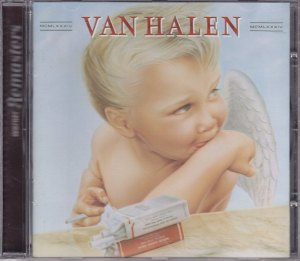


 mikeladano.com