heavy metal

REVIEW: The Cult – Ceremony (1991)

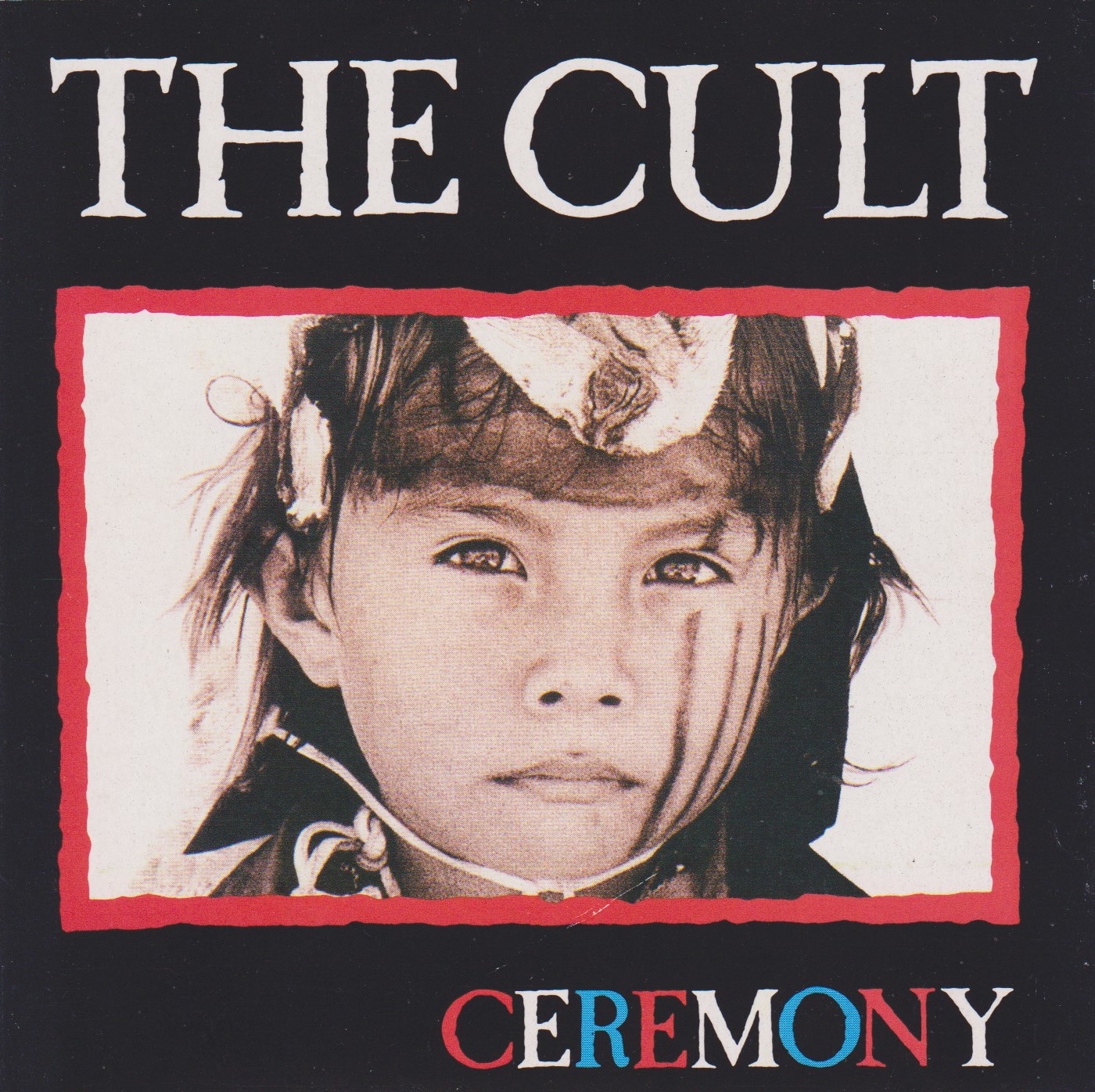
Scan_20160729THE CULT – Ceremony (1991 Beggars Banquet)

Only 25 years late, I have finally acquired the Cult’s Ceremony CD, thanks to my kind and generous reader Wardy.  I somehow missed this album all those years, even though I own all the singles.  There are some songs here that are completely new to me.  Ceremony received mixed reviews when it was released, as it represented the band’s furthest move away from their roots, into commercial radio rock.  Let’s see how accurate that is.

It starts sounding more like some lost Deep Purple album, with big organ and jammy sounds.  Richie Zito co-produced this disc, and the band got a sharper sound out of the studio than they did with Bob Rock last time.  Sonically, Ceremony has more impact, more heft, more oomph than the big and echoey Sonic Temple.  The “Ceremony” in question on the title track is the rock arena, as the Cult had definitely become arena rock.  They had also been reduced to a core duo.  Jamie Stewart and Matt Sorum were gone, and the Cult used session musicians during this period.  Charlie Drayton (bass) and Mickey Curry (drums) helped the band achieve what sounds like a very sincere crack at this kind of rock.  Accessible it is, but the Cult didn’t really sell out.  Check out the frantic “Wild Hearted Son”.  Like the sound of a stampede of horses across the plains, “Wild Hearted Son” does not let up.  I think I lot of fans were disappointed that the new Cult sound wasn’t more esoteric, but that doesn’t make it bad.

Just as relentless as “Wild Hearted Son” comes the “Earth Mofo”.  One thing I had never really paid attention to before was the bass.  Drayton’s get some great bass chops.  The production of Ceremony leaves a lot of space between the instruments, so you can hear them.  Those who find Sonic Temple overproduced may dig on this, so give “Earth Mofo” a spin.   That’s nothing though compared to the powerful “White”.  Epic in scope, “White” is a massive groove with layers of acoustic instruments a-la Zep.

I didn’t see the tender sound of “If” coming, just piano and Ian’s crooning.  Not after all that heavy hitting rock.  But then “If” also explodes into something bigger, anthemic and memorable.  I’m starting to think that if Ceremony got a bad rap back in ’91, it’s because people weren’t paying proper attention.

“Full Tilt” is a great name for a rock song.  Riffed out with generous helpings of rock sauce, “Full Tilt” was reported to have knocked a picture of at least one journalist’s wall.*  Just wait until the afterburners ignite in the last minute of the song.  Strangely, the very next track is the acoustic ballad “Heart of Soul”; a good song indeed but not as great as “Edie (Ciao Baby)” was.  Back to the rock, “Bankok Rain” lacks the charisma that the rest of the tunes seem to have in common, though there is certainly nothing wrong with it’s staggering riff.  By the end you won’t care, because the whole thing  burns like fire and gasoline until all the fuel is spent.

A fascinating Cult song is “Indian”, a basic acoustic song with cello accompaniment.  As Cult ballads go, this is definitely a peak moment.  Ian infuses more passion into one line than most singers can do in a whole song.  Unexpectedly, the album moves right on to another ballad, “Sweet Salvation”, which is actually less a ballad and more a soul song.  It’s powerful, as are all these songs in their own ways.  Ian Astbury breaks out the Morrison poetry jams to kick off the ending track, “Wonderland”, a riff driven slow broil.

That’s the album, and it’s hard to gauge where it sits among the whole Cult catalogue.  Certainly, this and Sonic Temple are brother records.  They are stylistically more similar than Cult albums tend to be.  Ceremony possesses track after track of scorching rock music.  Does it make as strong an impression as the bombastic Sonic Temple?  Not quite.  By stripping the production to a more sparse and live sound, perhaps the Cult sacrificed the nuances.  Ceremony gleams shiny with amped up guitars and drums aplenty.  It is hard to find fault.  It is still a fine album.

3.5/5 stars

* That’s a true story, but I can’t remember what magazine I read it in.  The reviewer said, quote “‘Full Tilt’ knocked a picture off my wall.”
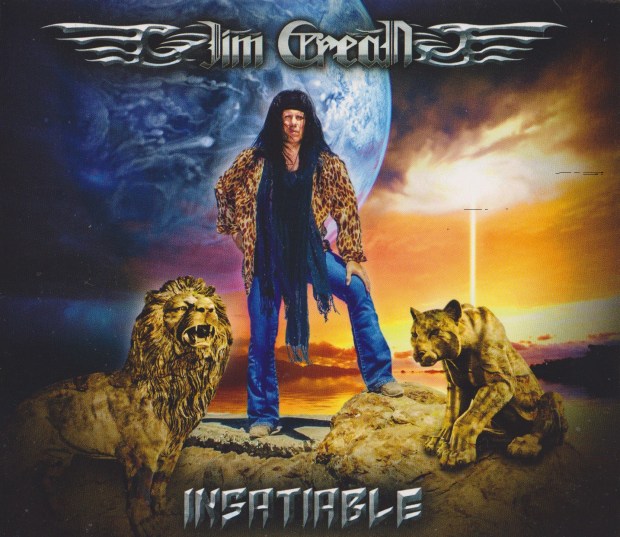
REVIEW: Jim Crean – Insatiable (2016)

NEW RELEASE

JIM CREAN – Insatiable (2016 Rocker Records)

If you’re not familiar with Jim Crean, that’s OK.  You probably know of his famous friends.  Crean sings lead with the Appice Brothers (Carmine and Vinny) for their Drum Wars live shows.   Both brothers appear on his solo CD, Insatiable, along with other stars such as Phil Lewis (LA Guns), Mike Tramp (White Lion), Tony Franklin (The Firm/Blue Murder), Phil Naro and more.  But it doesn’t matter how many guests you fill your album with if you don’t have the tunes.  Crean has not only the tunes, but also the voice.

In a way the weirdest track is the intro by Don Jamieson from That Metal Show.  He pronounces “Appice” differently for each brother.  Carmine is “Appeece” and Vinny is “Appicee”.  Very odd.  The title track “Insatiable” features Vinny, but the song does not address the pronunciation controversy!  If you’re a fan of 80’s sunset strip rock, then “Insatiable” is for you, like Faster Pussycat but fed a steady diet of heavy metal.  Crean has range and rasp, and the result is the kind of rock that people miss today.

Vinny might be best known for his stint in Dio and Black Sabbath with Ronnie James.  With the late Jimmy Bain on bass, Appice and Crean re-created Dio’s “Caught in the Middle”.  Having original players and writers on it lends it a credibility that most covers can’t match.  Best of all, Crean can pull it off!  Singing Dio is, to put it mildly, not easy.  Crean pulls it off with confidence and ability, just as he does with his own original tune “Touch”.  Not to exaggerate, but “Touch” has to be one of the best songs to come out in 2016:  killer mid-paced rock, besides the riffs and that voice!  Another fine cover, L.A. Guns’ “Over the Edge” is performed with assistance from Philip Lewis.  A more obscure choice from 1991’s Hollywood Vampires, it’s a powerful slow rock track with a Zeppelin-y groove.  Guitarist Steve Major also needs to be singled out for a fine performance on this one (and all the tracks).

The most star-studded song is the lead single, “Can’t Find My Way”, a Mike Tramp cover.  Mike sings on it, as does Phil Naro, with Tony Franklin on bass and Carmine on drums.  (Tony and Carmine make it 2/3rds of the original Blue Murder, minus only John Sykes.)  This ballad is a bit slow, a bit long, but kicks in for the chorus. I actually prefer Jim’s original material. “Follow Your Heart” is one such original, this one featuring ex-Dio guitarist Rowan Robertson. It has a distinct Dio-ish vibe, aided and abetted by Vinny’s incomparable drum sound. The final three originals (“Shut Your Mouth”, “Turn it Around”, and “Miss Me”) are all very strong hard rock songs. Crean wrote all his originals himself. What a talent. Such a voice, with sharp songwriting chops. This guy has more talent in his pinky than CC Deville has in his entire body.

Two bonus tracks close it out, both covers: Mr. Big’s rockin’ “The Whole World’s Gonna Know”, and “Magic Touch” by Kiss. Sharp fans will recall that Crean contributed “Magic Touch” to Mitch Lafon’s Kiss tribute CD, A World With Heroes.  If you missed that now sold-out CD, you can at least get Jim’s version of the song here.  “Magic Touch” is, of course, great.  It always was, but now here’s a chance to hear it without the disco (Kissco?) trappings.  As for “The Whole World’s Gonna Know”, Jim’s version may surpass the original.

Added Can-Con bonus:  Much of the album was recorded in Toronto, just a stone’s throw away from Jim’s base in Buffalo, New York.

Added extra bonus:  My copy included a DVD with the “Can’t Find My Way” music video.

If you like hard rock with integrity the way they used to make it, then this album is for you.  If you buy one new release this week, make it Jim Crean’s Insatiable.

5/5 stars


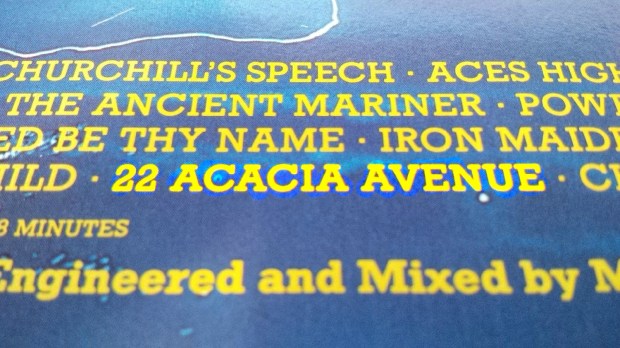
#503: 22 Acacia Avenue

GETTING MORE TALE #503: 22 Acacia Avenue

Everything started with Iron Maiden.  At least for me.  Way way waaaay back in Record Store Tales Part 1: Run to the Hills, we revealed that pivotal moment when everything changed.  The album was Masters of Metal Volume 2, and regarding hearing “Run to the Hills” for the first time I wrote, “Some people speak of moments of clarity: That was my moment.”  Everything I was focused on and passionate about now took a back seat to rock and roll.  The year was 1984.

I taped some Iron Maiden albums off friends, and bought the double Live After Death as my first Maiden LP.  I memorised the names of the members, and made sure to include Martin “Black Knight” Birch and Derek “Dr. Death” Riggs in my memory banks.  Maiden had the best album covers, the best videos, and the best lyrics.  They had songs about World War II and the Crimea.  It was more intelligent music than the other heavy metal bands I’d heard.  I stared for hours at my Live After Death LP, so loaded was it with photos and facts.  In grade 8, I was the only kid in my school who liked Iron Maiden, and that was fine by me.
Figuring out exactly what Maiden were saying, that was another story.  Live After Death had a lyric sheet, but before that we were just guessing.  In a case of mis-heard lyrics, I assumed that the lyrics to “Number of the Beast” went, “Hell and fire are born to be the least”.  Bruce was actually singing “Hell and fire are spawned to be released.”  “To be the least” went over better with teachers and parents, but when I got Live After Death, I kept the real lyrics for myself.  I did learn a new word from that song, “spawned”.

IMG_20160707_180758

Maybe it was Bruce’s accent, but I really struggled to hear what he was saying, even just when he was speaking on stage.  “Scream for me, Long Beach!”, he repeated throughout the album.  I could not figure out at all what he was saying, and neither could my best buddy Bob.  It sounded like “Scream for me, lambiens!”  So we assumed “lambiens” was British slang for “my friends”.  That made sense to us.  Bob had Live After Death on cassette and there were no liner notes.  Not until I got it on LP many months later did I see that the album was recorded at Long Beach Arena, and put two and two together.  Until then, it was “lambiens”!  “Speak to me, Hammersmith!” was another Bruce phrase that we couldn’t decipher.  Until I noticed that side four of the LP was recorded at Hammersmith Odeon did it click.  Until then, I thought Bruce was talking to his bandmates on stage.  “Speak to me, Harris Smith!”

Both of us played that live album plenty.  Thanks to “Powerslave”, I was way ahead on my Egyptology.  By the time we started taking Egyptian history in grade 11, I was already well familiar with the eye of Horus.  All knew all about Alexander the Great and the Gordian Knot.  Iron Maiden brought all that stuff right to our stereos, but I don’t think they got enough credit for it.

Maiden had other subject matter as well.  Though seldom, they would sometimes write songs regarding the “fairer sex” such as “Charlotte the Harlot”.  As a young kid first getting into the band, I had no idea what that was about.  Even foggier to me was “22 Acacia Avenue”.  It was a great tune, but the lyrics were a total mystery to me.  It’s not complicated:  Charlotte sells herself for money in both tunes.  In the second, someone is trying to talk her out of this lifestyle.  “You’re packing your bags, you’re coming with me.”  Right over my head.

In art class at school, we had to draw a scary scene for Halloween.  I chose a bunch of imagery I lifted from Maiden covers:  streetlamps, grave stones, fire, dark alleys, a grim reaper and…a house with the address “22 Acacia Avenue”.  I liked how Maiden’s artist Derek Riggs hid symbols and clues in his covers, so I was trying to do the same, but just randomly.  The teacher walked up and observed my artwork, and asked me a couple questions.  “22 Acacia Avenue, is that where you live?”  No, but how the hell do I explain this to the Catholic teacher at a very Catholic school?  Scrambling for an answer I said, “No, that’s the address of an actual real haunted house.”  The teacher “Oooh’ed” excitedly and went to the next student.  An actual haunted house?  Boy did I have that wrong.  Not that I could have given the real answer!

IMG_20160707_180740

Playing Live After Death again today as I’m writing this is very much a time capsule.  It’s 1985 again, and Bob and I are playing air guitars to “22 Acacia Avenue” in my basement.  How badly we so wanted to BE Iron Maiden.  Hell I made a birthday card for Bob one year that had his face in Iron Maiden over Dave Murray’s!  Of 22 Acacia Avenue, Bruce sang “That’s the place where we all go.”  Good enough for us, so we wanted to go too.  If we knew what Bruce was actually singing about, I think we would have (wait for it) run to the hills instead!

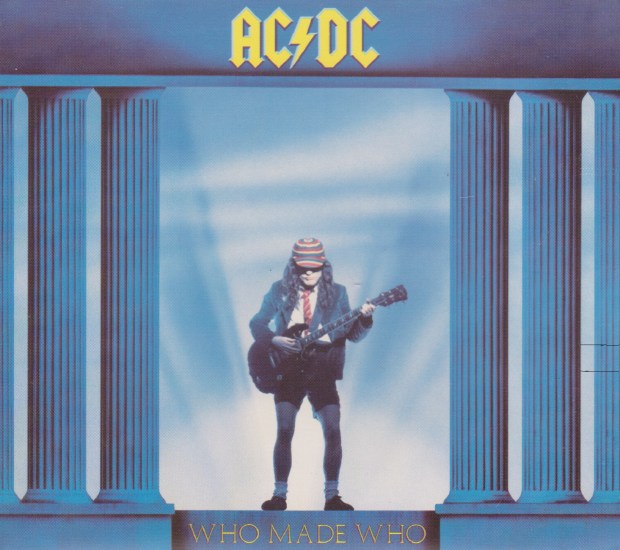
REVIEW: AC/DC – Who Made Who (1986 soundtrack to Maximum Overdrive)

movie-soundtrack-week

Today’s movie soundtrack comes by no coincidence.  Today’s my birthday!  And I got this album on this day in 1987 from my partner in crime for many years, Bob!


AC/DC – Who Made Who (1986 Epic soundtrack to Maximum Overdrive, 2003 remaster)

As a movie director, Stephen King is a great novelist.

30 years ago, Maximum Overdrive was King’s directorial debut.  The movies based on his books had been box office gold so far, but King always complained about the adaptations of his original material.  So why not hand the reins over to him?

King’s goal was to make “the loudest movie ever made”, and part of that was leaving the soundtrack to AC/DC.  King issued the film with instructions that “this film is to be played as loud as possible.”  The funny thing, according to him, was that most theaters did it.

AC/DC did the entire soundtrack, a mixture of old and new material.  It was an unorthodox move and it left AC/DC with what some consider to be their first real “greatest hits” album; this coming from a band who in 2016 has yet to issue an actual greatest hits album!

The robotic pulse of “Who Made Who” commences the affair, a massive hit still a radio staple today.  One of AC/DC’s most recognisable tunes, “Who Made Who” was a bigger smash than the movie that spawned it.  That’s Simon Wright on drums, emulating the perfect beats of Phil Rudd before him, creating a fine facsimile.  The keys to the song though are the simple and catchy guitars of Angus and Malcolm Young.  Having nailed down the art of writing catchy bases for songs, the brothers Young really perfected it here.

They also perfected it on 1980’s “You Shook Me All Night Long”.  Placing the biggest AC/DC hit of all time second in line is almost like nailing the coup de grâce prematurely, but there is plenty more firepower on the album.  It works in the second position, cleaning up anyone left standing and getting them shakin’ on the dance floor.

AC/DC added two brand new instrumentals to this soundtrack (“Johnson was sick that day”, joked Angus).  “D.T.” is the first of them, somewhat unremarkable and echoey on the drums.  But this is designed as background music for movie scenes, so it really shouldn’t be measured by the same yardstick as, say, a Rush instrumental.  The second on side two is the peppier “Chase the Ace”.  Punctuated with some cool Angus licks, “Chase the Ace” is simple and effective like “D.T.”.

There were a few tunes from the recent Fly on the Wall album, all killers.  “Sink the Pink” (oh, Brian!) is recorded so muddy that you can’t hear the words, but it does rock.  Angus’ guitar break is pure fun, and the song gets your ass moving.  That leads into the sole Bon Scott inclusion, “Ride On”, from a quieter moment in the film.  What’s really cool is that even though these songs are from all over the place, Who Made Who sounds like a fairly cohesive trip.

Side two commences ominously with “Hells Bells”, a fine way to distribute classic tunes evenly across the sides.  “Shake Your Foundations” is on its tail, hitting you with another blast of AC/DC right in the face.  One of the better tunes from Fly on the Wall, “Shake Your Foundations” does its advertised job.  Yet, I do believe there was only one way to properly end this album.  That would have to be the cannon-fire of “For Those About to Rock”.

Who Made Who was actually my first Johnson-era AC/DC album, given to me by my buddy Bob on this day in 1987.  If this review is slanted ever so slightly in the “pro” direction, so be it.

4.5/5 stars

REVIEW: Heavy Metal – Music From the Motion Picture (1981)

movie-soundtrack-weekHere we go with another week of movie soundtracks! It’s a case of the second one being even better than the first, so let’s start things off properly, shall we?


Scan_20160706HEAVY METAL – Music From the Motion Picture (1981 Elektra)

I’d never seen anything like Heavy Metal before.  It was a sci-fi cartoon with a bunch of guys from SCTV doing voices…but it wasn’t for kids!  I probably saw my first animated genitalia in Heavy Metal.  It was also the first time I heard Sammy Hagar.

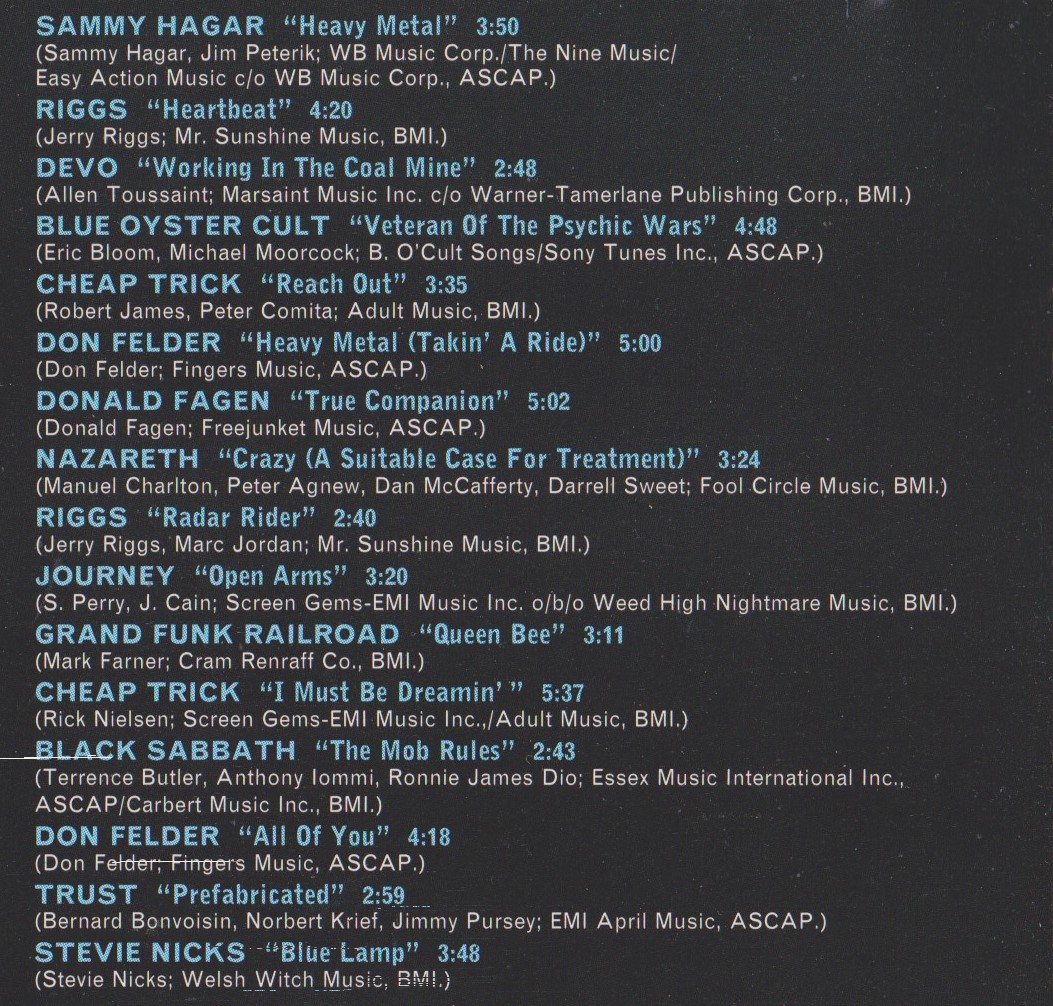
Sammy’s title track opens the now-legendary soundtrack, which like many others was deleted in the 1990s and commanded heavy prices on the second hand market.  When I worked at the Record Store during that period, there were always plenty of names on the wish list for this album.  There were tracks on here that were hard to find anywhere else.  This version of Hagar’s “Heavy Metal” is different from the one on Sammy’s Standing Hampton LP, and it was not the only such exclusive.  “Heavy Metal” is one of Hagar’s best tunes, simply legendary.  It’s a pummelling good time!

The rest of the album is equally awesome.  Riggs (Jerry Riggs, later of the Pat Travers Band) has a Hagar-esque rocker called “Heartbeat” that is definitely good enough for rock n’ roll.  You might not expect DEVO to be on an album called Heavy Metal, but what’s not to like about “Working in the Coal Mine”?  I’m sure more than a few metal fans would have skipped this one back in 1981, but when compared to the next song by Blue Öyster Cult…what’s the big deal?  B.Ö.C.’s “Veteran of the Psychic Wars” leans just as heavily on synthesizer, so purists be damned.  “Veteran of the Psychic Wars” is a classic, through and through, a dark apocalyptic ballad that can’t be touched.  Some would say it was the last gasp of B.Ö.C. before a long period of mediocrity.  Cheap Trick utilised synth too, but their “Reach Out” is a rocker.  Cheap Trick were another band in a period of decline, following the departure of original bassist Tom Petersson. “Reach Out” was a damn fine tune, and not on one of their albums at the time.  (It’s hard not to notice that Tod Howarth ripped off the verses of “Reach Out” for his own song “Calling to You” with Frehley’s Comet.  Howarth later played with Cheap Trick as a sideman.)

Don Felder from the Eagles isn’t the kind of guy you’d expect to hear do a song called “Heavy Metal (Takin’ a Ride)”.  It’s an Eagles-metal hybrid and it’s pretty cool, more metal than Eagles, but you can hear them in there.  He’s followed by Steely Dan’s Donald Fagen who presents the interesting “True Companion”.  It’s progressive jazz light rock nirvana.  The punks will hate it, but the same guys who dig Captain Beyond will appreciate it.  Quite daring to include tracks like this on a CD primarily made up of rock and metal, but this helped open the minds and tastes of many metal heads over the years.  Nazareth re-centers it back to rock and roll, with “Crazy (A Suitable Case for Treatment)”.  It’s not among Nazareth’s best but it’s always such a pleasure to hear Dan McCafferty gargling glass.

Scan_20160706 (2)

Riggs returns with “Radar Rider”.  Heavy riff in hand, it’s a slammin’ good track.  But it is overshadowed by the bombast of “Open Arms” by Journey, one of the biggest ballads in the history of balladry.  You know what’s funny?  Even though I have heard this song 106,941 times as of this morning, I still smile upon hearing it.  There must be something timeless to it that I can’t explain.

Grand Funk were in a decline (like a few of these bands), and “Queen Bee” from Grand Funk Lives was their contribution.  Good track, though it does not sound much like the Grand Funk I know from the 1970s.  And then it’s Cheap Trick again, with a noisy throwaway track called “I Must Be Dreaming”.  It’s a bizarre track from the high priests of rhythmic noise, but they do bizarre just as well as they do catchy.

There’s one band that I think blew the doors off the album.  One band that, to me, is always associated with this album.  One band that defines the phrase “heavy metal”, and that one band is Black Sabbath.  If you listen to fools, the mob rules!  This was brand new Black Sabbath at the time; Mob Rules wouldn’t be out yet for a couple months.  I have always preferred the soundtrack version of “Mob Rules” to the different recording that made it onto the album.  This could be because it was the first version I owned.  Regardless, to my ears it sounds faster and livelier…and more “Geezer-er”.  Not that it matters, because no matter how you slice it, “The Mob Rules” is a shot of adrenaline right to the heart.

Don Felder takes it back to a slow groove with “All of You”, a good rock ballad with some seriously cool funky bass.  All told, the Heavy Metal soundtrack has some damn fine playing on it from all of these bands — just incredible musicianship in these grooves.  Things wind down with Trust, and a very heavy track called “Prefabricated”.  Nicko McBrain was in Trust in 1981, but this does not sound like Nicko on drums.  The song would have been better without the vocals.  Especially when it’s followed by Stevie Nicks, one of the most iconic voices in rock.  “Blue Lamp” was recorded for her solo debut Bella Donna, but not used.  It’s certainly not outtake quality.  In fact it’s pretty damned classic.

That’s what the Heavy Metal soundtrack is:  a classic.  If you like heavy metal, but don’t like soundtracks, then you should still own this one.  Make it so.

4.5/5 stars

Scan_20160706 (3)

Like many movies with a rock soundtrack, there was also a score for Heavy Metal released.  I asked our friend Rob Daniels from Visions in Sound for a few words on this score in the interests of being complete:

“It’s a great score by the late Elmer Bernstein who is best known for a lot of 80’s comedic scores including Ghostbusters, Animal House and Airplane. His score fits perfectly within the metal music atmosphere, weaving its way through the various stories and songs to the Taarna story. The “Taarna” theme was actually first written for the Farrah Faucett character in the 1980’s film Saturn 3 but was not used. It includes an unusual instrument called a Ondes Martenot, similar to a Theremin but with a physical keyboard. Bernstein used the instrument quite a lot in his scores. While a lot of people know Heavy Metal for the songs in the film the score is of equal note and probably one of Bernstein’s best.”

HMSCORE


#502: Sausagefest XV: The Complete Countdown

Thanks for hanging out this week for six new instalments of the ongoing series Getting More Tale!  Today we bring the week back full circle.  


GETTING MORE TALE #502: Sausagefest XV: The Complete Countdown

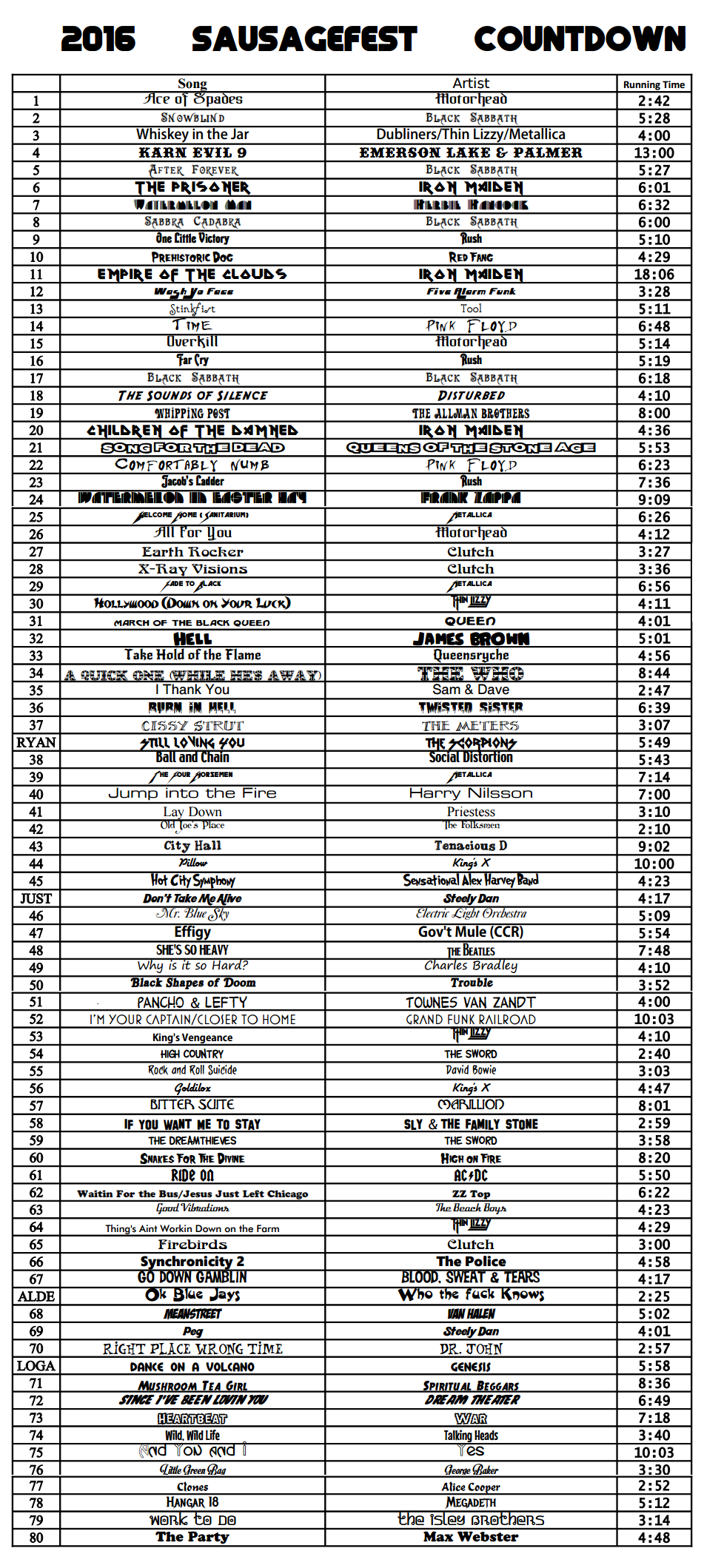
Clickity-click the glorious list below to enlarge.  This complete countdown was a blast to enjoy over two nights.  A few people said, “This was my favourite mix of tunes so far.”  As the 15th Sausagefest, that’s a mighty statement.

A couple notes:

Songs with names but no numbers are “tributes” to that particular Fester.

Only three songs that I voted for made the list this year:

  • “Take Hold of the Flame” – Queensryche
  • “Hollywood (Down On Your Luck)” – Thin Lizzy
  • “Empire of the Clouds” – Iron Maiden

You may be wondering what’s up with that version of “Whiskey in the Jar”.  What they did here was an interesting experiment.  Tom called it “ham-fisted”, and it was, but it was still a lot of fun.  We had three votes for “Whiskey in the Jar”, but by three different artists.  Technically, that would count as one vote each for three songs, rather than three votes for one song.  Instead, Tom creatively mixed together a medley of all three versions by the Dubliners, going into Thin Lizzy, then Metallica, back to Lizzy and ending with the Dubliners again.  Ham-fisted perhaps, but an interesting contrast that went over very well with the crowd.

If there are any tunes below that you haven’t heard before, I recommend giving them a spin!

Untitled (2)

#497: Sausagefest 2016 Official Report

Welcome to another week of Getting More Getting More Tale!  Join us each day this week for a new instalment of the Getting More Tale series, including the all-important, top-secret #500.


IMG_20160709_154153

GETTING MORE TALE: #497: Sausagefest 2016 Official Report

I have returned, bitten by many insects of all kinds, from Sausagefest.

Every year, Countdown has its own personality, or personalities.  This year, the fifteenth annual, the 81 songs were drawn in almost equal amounts from the fountains of heavy metal and soul/funk.  There was Metallica, and there was Five Alarm Funk.  There was Iron Maiden, and there was Charles Bradley.  It was a stunning mix, also including long bombers by Yes and ELP.   Because of this year’s countdown, I will soon be purchasing Close to the Edge by Yes, and a number of Clutch CDs.

The countdown began, appropriately, with a song by Hibakusha and a previously unheard Paul MacLeod comedic bit.  MacLeod had a comeback show scheduled for the same weekend as Sausagefest.  It is sad that it could not come to pass.

I was given 10 songs to do “LeBrain” intros for.  They were as follows:

78. “Hanger 18” – Megadeth (for this I did a 7-minute comedic steam-of-consciousness bit as my own intro)
67. “Go Down Gambling” – Blood Sweat and Tears
60. “Snakes for the Divine” – High on Fire
55. “Rock and Roll Suicide” – David Bowie
49. “Why is it So Hard” – Charles Bradley
42. “Old Joe’s Place” – The Folksmen
36. “Burn In Hell” – Twisted Sister
29. “Fade to Black” – Metallica
18. “The Sounds of Silence” – Disturbed
11. “Empire of the Clouds” – Iron Maiden

Now, I do not care for Disturbed, and I did not want to introduce that song. I wanted another tune because I had an intro planned already for it (“Hollywood”, by Thin Lizzy). Tom and Uncle Meat refused to give me Thin Lizzy. They did not want to hear Disturbed so they left it to me. I told Meat, “Fine, but I am going to record my intro in the bathroom while taking my morning shit.” And that’s exactly what I did. The intro was received…with grace, all thing considered, by the people who voted for Disturbed. I have no issue with David Draiman, he is an incredibly gifted and obviously trained singer. It’s just not my cup of tea. It’s not a song I wanted to hear done that way. So I did my intro the only way I knew how: with exaggerated disgust. Love it or hate it, nobody ignored it!

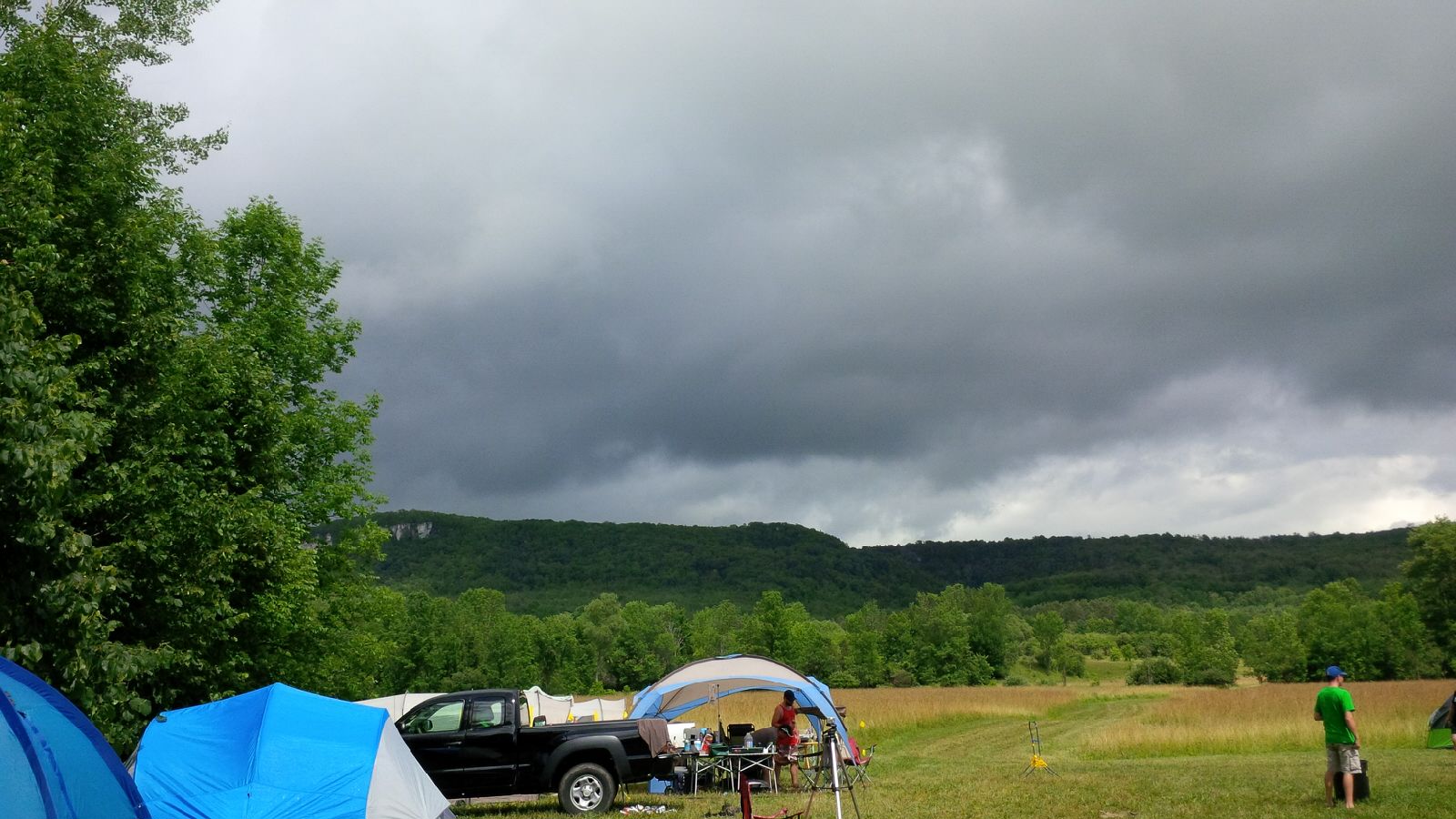
The weather was a challenge, but not unbeatable.  Friday afternoon and early evening, we were pelted with rain, hail and lightning.  Due to the weather forecasts, it was decided late last week that there would be no live jams this year.  The more capable among us assembled tarps and gazebos to protect the precious Wall of Sound, and us.  Standing in the refreshing rain on such a hot day, I felt like Andy Dufresne after having climbed through the mile-long shitpipe.  There were many personal highlights for me this year, but I will say this. I am glad that I slept in Saturday morning, and did not go into Flesherton to get breakfast at the Flying Spatula. A highlight of previous trips, the Spatula is now under new, surly ownership. Our guys were treated to disinterested and slow service. One group of eight guys was asked to share one booth. Disappointing. We’re disappointed in you, Flying Spatula.

The most important part of Sausagefest besides the countdown is the camaraderie. Every year it gets better, too. Many of these guys only see each other once a year. Some of us show up fatter, balder, or both. Some of us even showed up with a broken ankle. That’s dedication. It’s that important to us.

Or, as Uncle Meat sang during his interpretation of Pink Floyd’s “Hey You”:

“Hey Scott,
Where the fuck are you?
Did you have better things to do
Than rock and roll, man?”

Can’t wait to do it all again.

REVIEW: Skid Row – Revolutions Per Minute (2006)

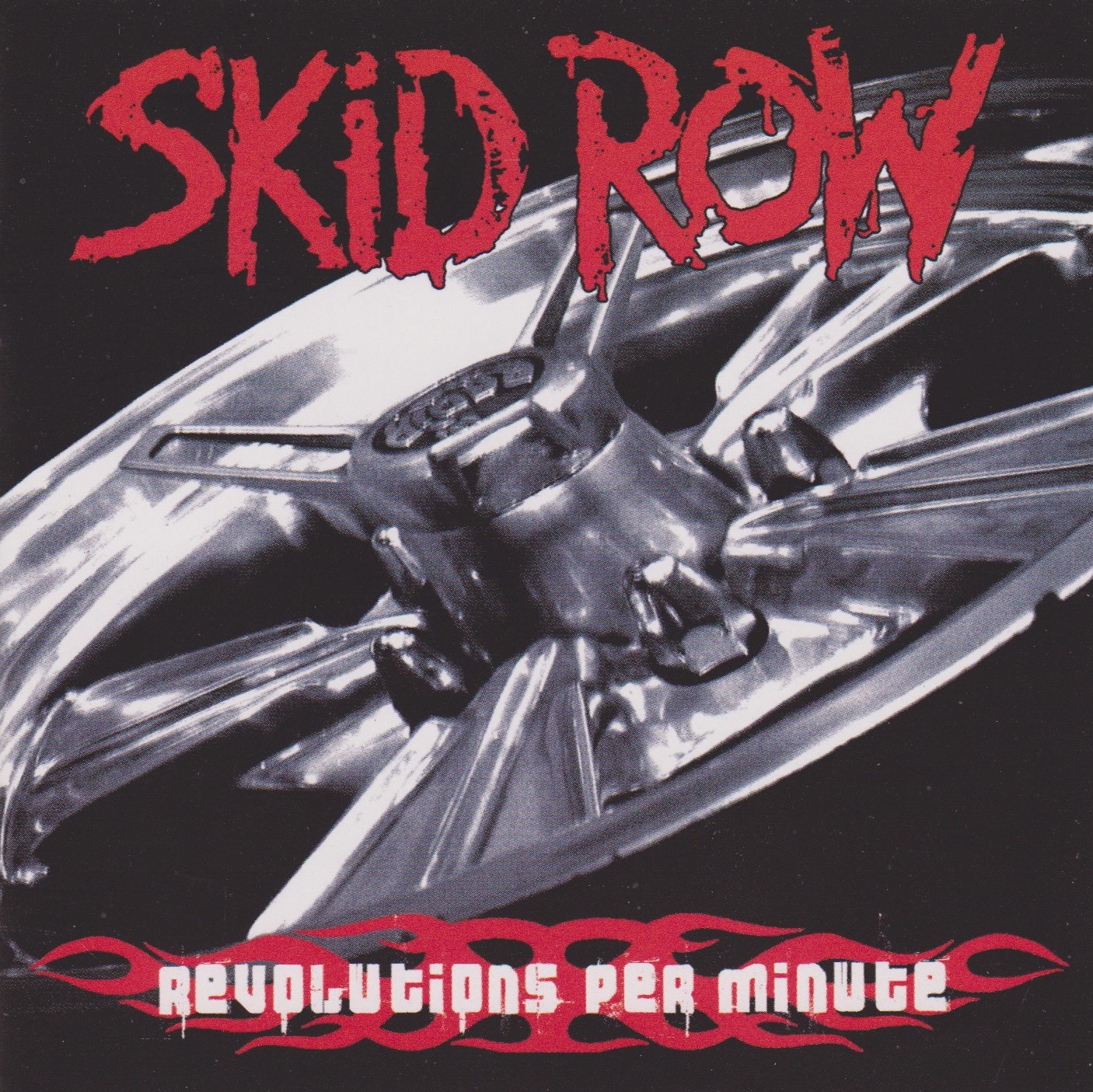
Scan_20160614SKID ROW – Revolutions Per Minute (2006)

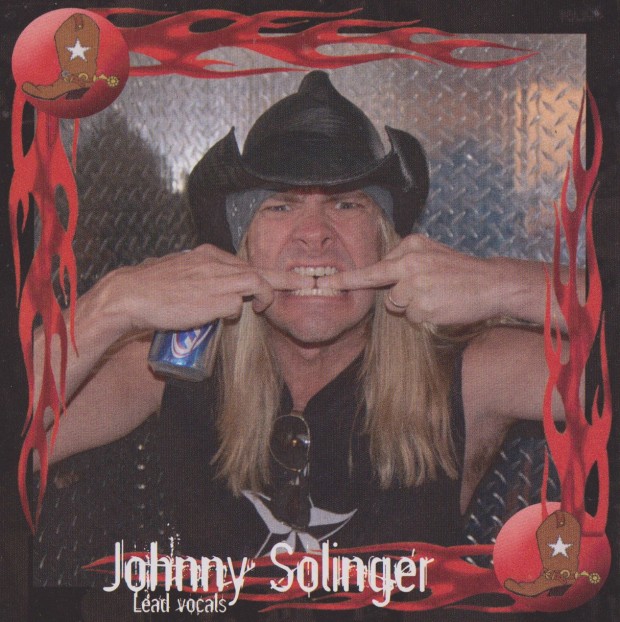
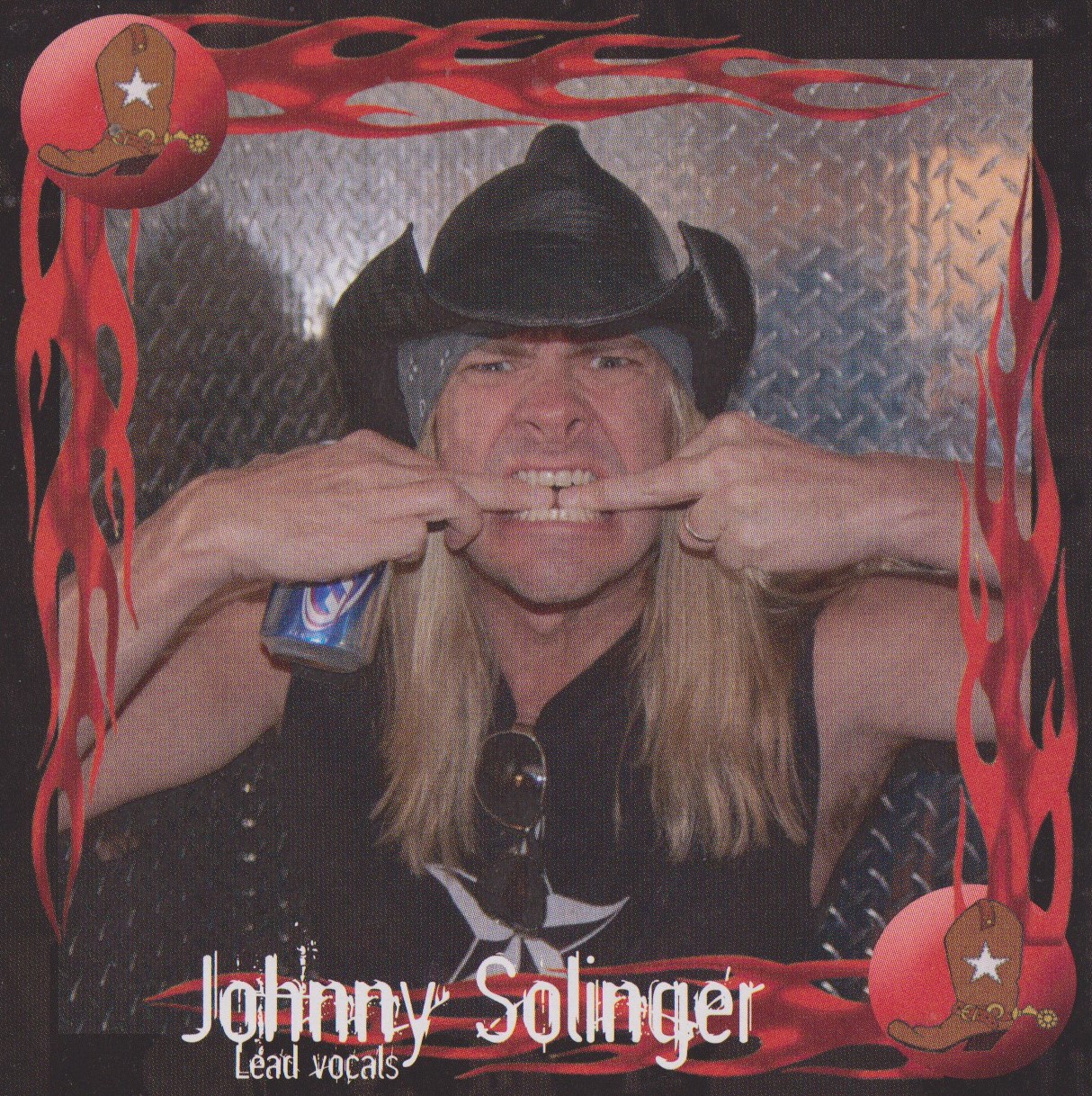
Skid Row did a pretty good job of replacing the irreplaceable Sebastian Bach on their fourth LP, Thick Skin.  It earned a more than healthy 4.25/5 stars, in part due to the charismatic vocals of Johnny Solinger.  For their second album with Johnny, they re-teamed with producer Michael Wagener, but had mixed results in repeating the magic.

Revolutions Per Minute is heavy enough; there was no issue of the band going soft.  There was a dip in quality from the songwriting department, strongly dominated by bassist/leader Rachel Bolan.  Strangely, they chose to pad out the album with a cover (The Alarm’s “Strength”) and a remix.  It’s worrisome when the best song is a cover.  There’s a distinct pop-punk vibe on many songs, which one has to trace back to Bolan.  Dave “Snake” Sabo has two co-writes, and Scotti Hill a mere one.

“Disease” is very Skid Row, nothing outstanding, but a strong enough way to open the album.  The punk-like “Another Dick in the System” is better.   With Solinger scraping the ceiling with his screamy high notes, it’s reminiscent of old Skid Row circa Slave to the Grind.  “Pulling My Heart Out from Under Me” follows with an 80’s Elvis Costello vibe to the guitars.  This one is quite a departure from Bach-era Skid Row, and a decade later I’m still not sure if I like it.  You can’t fault a band for experimenting, but if the results aren’t good enough, that’s a tough call.  I’m not sure if “Pulling My Heart Out from Under Me” is good enough.  The worst of the punk influenced songs is “White Trash”, which is so indescribably bad that I won’t even try.  It’s not funny and not good.  Back to something that sounds like Skid Row, “Nothing” is one of those tunes that you could imagine was written in 1988 for the debut album.

Scan_20160614 (2)Influences collide on “When God Can’t Wait”.  Johnny Solinger is a country guy, and Rachel Bolan is a punk guy.  It seems 1+1 does indeed =2, and the sum total of punk and country is rockabilly.  I have to admit to liking this one, even though I’m still not sure if it’s any good.  I definitely prefer it to the next tune, “Shut Up Baby, I Love You” which doesn’t have much going for it aside from the full-metal tempo.

Strangely, the best original song is “You Lie” which begins as nothing but pure country.  Only after the twangy guitar solo does it accelerate into rock territory, but it’s the country part that rules.  The final track is a “Corn Fed” remix, which adds slides, harmonica and accoutrements.  At least that ends the album on a good notes.  The CD does start to drag a bit with two lacklustre songs, “Love is Dead” and “Let it Ride”, so the remix of “You Lie” is a smart way to end it.

You get the feeling that Skid Row had potential for a great album, but only came up with enough good songs for an EP.

2/5 stars

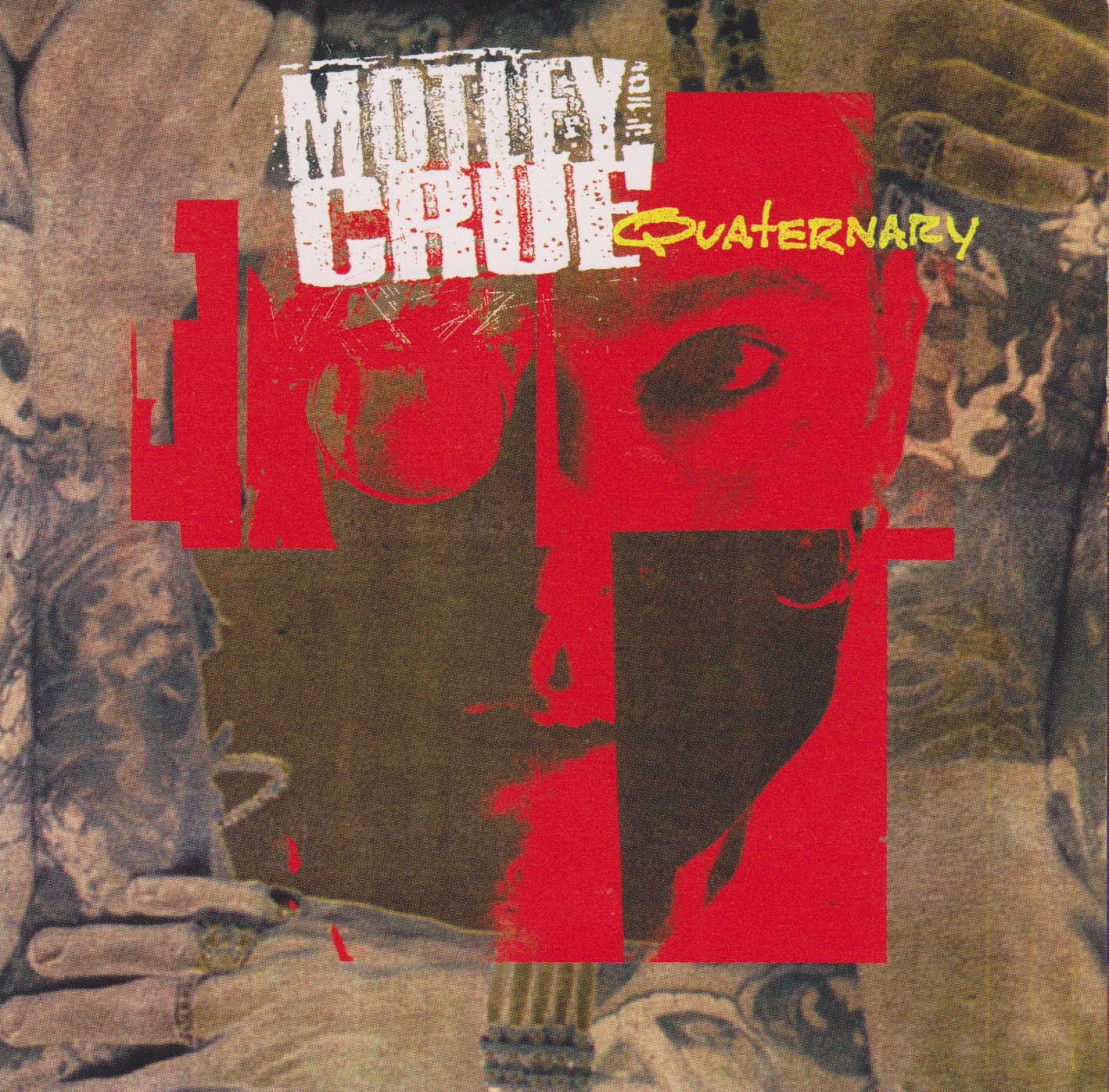
REVIEW: Motley Crue – Quaternary (1994 Japanese EP)

MOTLEY CRUE – Quaternary (1994 Elektra Japanese EP)

For me, undoubtedly the most heavily anticipated new album of 1994 was the new Motley Crue.  Originally titled ‘Til Death Do Us Part, the self-titled ’94 Crue disc was their first with new singer/guitarist John Corabi.  They holed up with producer Bob Rock and knuckled down, creating what could have been the most important album of their careers.  The long wait (five years between studio albums) and cryptic remarks from the studio indicated that this would be the heaviest Motley album ever, and their most ambitious.  The new, serious Motley for the 90’s had, as always, written plenty of extra material too.

In addition, producer Bob Rock had an idea for getting creative juices flowing.  He asked each of the four members of Motley Crue to write and record a solo track with no input from the other members.  This was slightly historic:  the first time Nikki Sixx, Mick Mars, Tommy Lee or John Corabi had done anything solo.  With all the numerous outtakes recorded for the Motley Crue LP, there was now plenty of extra material to put out as a bonus EP.

Scan_20160612A mail-away coupon inside the Motley Crue CD alerted fans that five more tracks were available by mail order only.  20,000 copies of the original EP were pressed.  They included all four solo tracks and a new Motley Crue song called “Babykills”, featuring fifth Beatle Billy Preston on clavinet!

Still, the lucky fans in Japan didn’t have to mail away for anything.  They were able to buy Quaternary right on their store shelves, and because it’s Japan, they also got bonus tracks.  The Japanese version of Quaternary was not a five song EP, but more like a nine-song mini-album.  I had no idea such a thing existed until finding one at Sam the Record Man in Toronto in the summer of 1996.   It still has the price tag:  I paid $49.99, for a total of three songs that I did not have before.

Today, every one of these songs can be found on the box set Music to Crash Your Car To: Volume II, along with even more bonus mixes.

Quaternary commences with industrial noises and studio dialogue:

Tommy Lee:  “I can’t play with fuckin’ clothes on man, this is bullshit.”
Bob Rock: “Play naked.”
Tommy Lee: “Fuckin’ jeans on, a fuckin’ shirt…what up with that?”
Bob Rock: “What, do you work in a bank?”

The industro-rap metal of Tommy Lee’s “Planet Boom” is a track he had been working on for years. An early version made its debut in the background on the 1992 home video release Decade of Decadence. Even though the words “industro-rap” and “Tommy Lee” don’t really sound good together, “Planet Boom” kicks ass. Tommy played all the instruments, utilising a simple, detuned Sabbathy riff and a relentless drum loop. The strength of his vocal came as a surprise, as did the song in general. A few years later it was remixed for Pamela Anderson’s movie Barb Wire. (Stick with this original.)

After a brief studio discussion with Mick Mars about hemorrhoids (?), his blues instrumental “Bittersuite” blows your ears off. Motley fans know that Mick Mars is the most musically talented member, considered an underrated and under appreciated rock god. The blues-rock of “Bittersuite” isn’t as satisfying as I imagine a pure blues offering to be, but there is no doubting Mick’s talent here. Both as a writer and a player, Mick hit it out of the park (Chris Taylor played drums). Mick’s goal was to pay tribute to rock-blues greats like Beck, Hendrix and Blackmore. Mission accomplished. His guitar tone is beautiful and so are his emotive licks.

Nikki Sixx goes third, with another industrial-metal cross. “Father” is one angry fucked up track. It’s heavy and direct, on-trend for 1994, and very abrasive. The riff and song are simple, but Nikki’s anger leaks through. “Father — where were you?” Backwards guitars, electronics and loops on top — you can tell Nikki and Tommy were listening to the same kinds of music at the time!

New kid John Corabi goes last, and in the liner notes he says that “Friends” is his first piano song. He meant to go acoustic, but “Friends” just came out of him. It’s a pretty Queen-like ballad with lovely harmonies in the middle. Although Mick Mars’ song is probably a greater technical achievement, “Friends” is my favourite of the solo tracks. When a guy like Corabi gets going on a ballad, it’s usually going to be amazing anyway. Throw in the Queen elements, and I’m just a sucker for it! It’s really a shame that Motley did not continue with John beyond this. The potential for greatness was always there.

After more studio chatter, we break into “Babykills”, the Billy Preston collaboration. “Babykills” is fun and funky hard rock, probably the heaviest thing Preston ever played on. Unfortunately his part is little more than an added topping. Great tune though; probably far too good to lie hidden away on an obscure mail-order EP.

An impromptu jam that seems to be called “I Just Wanna Fuck You (In the Ass)” ends the original EP on a jokey note.  “What the fuck do you want, for fuck all?”

Scan_20160612 (3)

As mentioned, the Japanese had bonus tracks.   These are tracks that did not make the finished Motley Crue album, since they had recorded so much extra material.  “10,000 Miles Away” is a cool blues ballad, showing off more of Mick’s fine fingerwork.  It was obviously too much of a standard sounding song to fit in with the experimental Motley Crue album.  Not that the album stood a chance in hell after grunge cleared the decks, but you do wonder if it would have been better received if some of these more digestible songs were included on it.

The one track on the Japanese release that is easy to skip is the Skinny Puppy remix of “Hooligan’s Holiday”.  This track was already available on the “Hooligan’s Holiday” single and it’s since been re-released in other places too.  It’s long — over 11 minutes.  Dave “Rave” Ogilvie remixed it with Dwayne Goettel and cEvin Key, so it is of possible interest to Skinny Puppy collectors.  The thing that bugs me about it is that it strikes me as lazy.  The song is pretty much the same as always for the first three minutes, and then the remixing begins.  The whacked out and frankly boring remixed part goes on for almost seven more minutes, before transitioning back to the standard song.  In other words, what Skinny Puppy did here was edit out the middle section and guitar solo of the song, drop in seven minutes of remixed barf, and then put the ending back on.

Two demos round out the CD:  “Hammered” (which did make the album) and “Livin’ in the No” (which did not).  The “Hammered” demo is structurally the same as the album version, no radical departures.  It sounds like much of it is live in the studio, and it’s clear that Motley were focusing on grooves.  It’s all about the four guys being locked in.  Finally “Livin’ in the No” is in the standard hard rock mold.  Again, a track like this fits in less well with the unorthodox LP, but might have made it more accessible for fans.  Even so, a guy like Vince Neil would never have been able to sing “Livin’ in the No” and make it sound good.

There is little question that the Motley Crue album deserves its 5/5 star rating.  This being a collection of outtakes, the same cannot be expected.  Still, it does deserve a very respectable:

4/5 stars

Get the complete EP including all Japanese bonus tracks on Music to Crash Your Car To: Volume II. That set also contains more remixes originally from single B-sides of the era: “Misunderstood” (Guitar Solo/Scream Version), “Hooligan’s Holiday” (Derelict Version), “Misunderstood” (Successful Format Version), “Hooligan’s Holiday” (Brown Nose Edit).

Scan_20160612 (5)

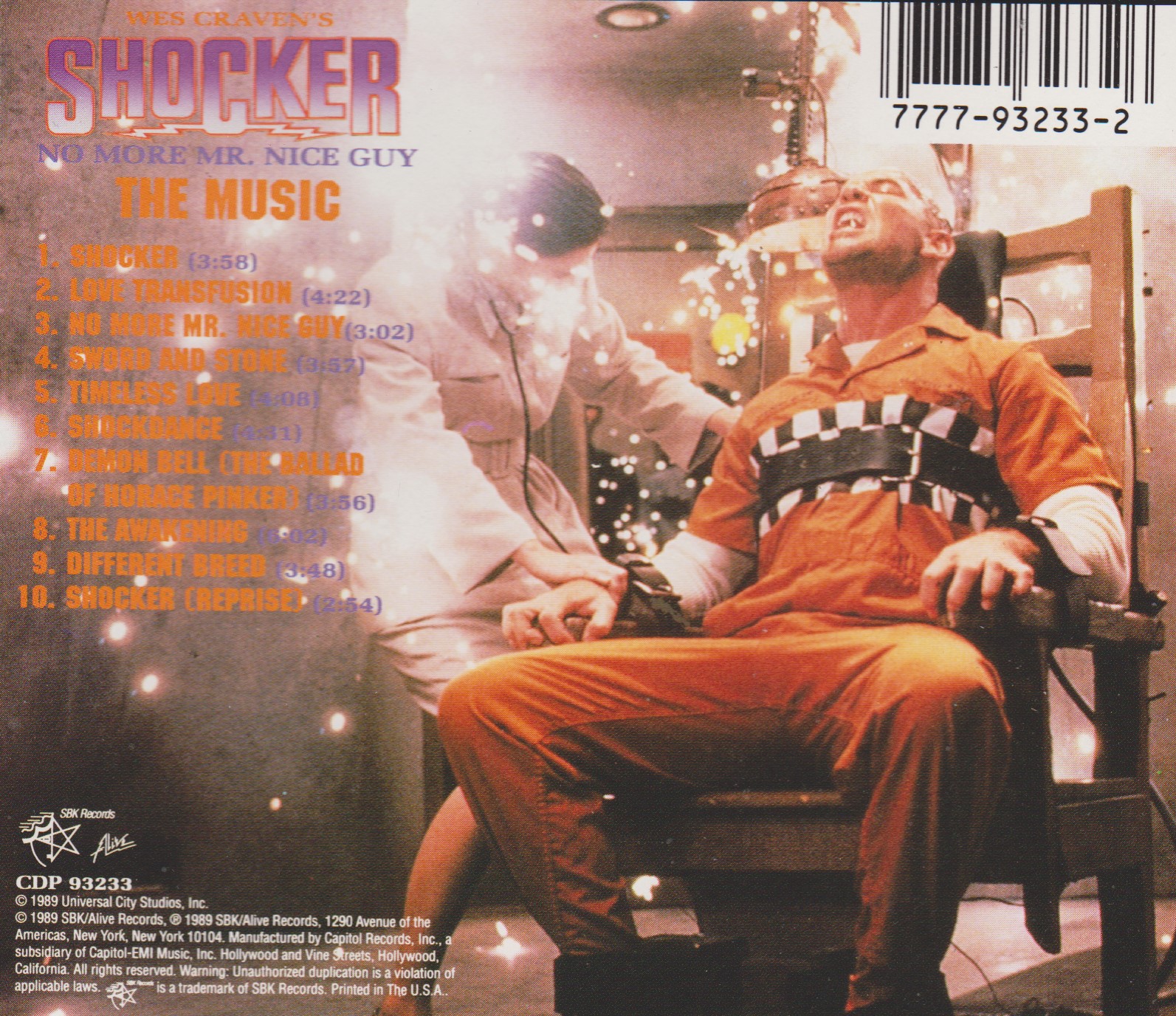
REVIEW: Wes Craven’s Shocker – The Music (1989)


MOVIE SOUNDTRACK WEEK

Scan_20160607Wes Craven’s SHOCKER – No More Mr. Nice Guy – The Music (1989 SBK)

1989’s slasher film Shocker was Wes Craven’s attempt to introduce a new character to the pantheon of horror.  Unfortunately, Horace Pinker and the movie he rode in on were quickly forgotten.  Also forgotten was the heavy metal soundtrack, so let’s have a gander and see what you may have missed.

Ever heard of The Dudes of Wrath?  This temporary “supergroup” consisted of various members from track to track, but the best song they did was “Shocker” itself.  With lead vocals by Paul Stanley and Desmond Child, it’s a must-have for Kiss maniacs.  If that’s not enough, Vivian Campbell, Tommy Lee and Rudy Sarzo also play on it.  It’s like a collision of some of those bands — Kiss, Dio, Motley.  The anthemic outro will slay you.

Desmond’s writing is all over this album, and he co-wrote a track with Alice Cooper that ended up being recorded by Iggy Pop called “Love Transfusion”.  Sub out the saxophone for guitars and you could easily imagine this being a Trash B-side.   In fact I wouldn’t be surprised at all if the backing track is from the Cooper sessions, because this sounds exactly like an Alice Cooper song with Iggy Pop overdubbed.  All the musicians are guys from the Trash album.  Do the math.

It’s hard to imagine a weirder team up than Desmond Child and Megadeth.  Dave Mustaine was deep into the powders at the time, and he recorded “No More Mr. Nice Guy” with a three piece Megadeth.  The late Nick Menza had joined the band already, but Marty Friedman was yet to be hired.   Most Megadeth fans are familiar with this track, since it was re-released on their Hidden Treasures EP.  Certainly not the band’s finest moment.

Paul Stanley reappears in a writing capacity on “Sword and Stone”, performed by Bonfire.   Paul wrote it for Kiss’ Crazy Nights LP with Desmond Child and Bruce Kulick.  If it had been on Crazy Nights, it might well have been the best tune on there.  Paul’s demo has yet to be released in an official capacity, but it’s been heavily bootlegged.  Bonfire’s version is fantastic, but it only makes me hungry for a fully recorded and mixed Kiss version.  One day….

Another version of The Dudes of Wrath appear on side two, this time with Alice Cooper on vocals.  “Shockdance” sounds like little more than a slowed down variation of the “Shocker” riff, with Alice and actor Mitch Pileggi rapping over it. Just terrible stuff, actually. Thankfully Desmond redeemed it a little bit with the song he wrong with Dangerous Toys, “Demon Bell”. Like Guns N’ Roses galvanized and electroplated, “Demon Bell” slays.

Voodoo X were the band of Jean Beauvoir, who Kiss fans know from his many co-writes and guest appearances on their records. He only made one record as Voodoo X, and his song “The Awakening” is damn fine indeed. At first you’re thinking, “Oh it’s just another crap ballad”. Then a riff kicks in, and it blasts right off. It’s a bit like 80’s Kiss meets Top Gun. The last band up is Dead On, pretty pedestrian thrash metal, and one of the few songs without any involvement of Desmond Child. The angry elf vocals are hilarious, but the song is almost a parody of bad metal. The album ends with a reprise of the title track “Shocker” from the first side. Basically what this means is that you get to hear Paul Stanley singing for another two or three minutes, when he was really able to hit some seriously high notes. Cool!

The worst track is probably the ballad “Timeless Love” by Sandi Saraya.  Guess who wrote this putrid sappy swath of heartbreak?  Desmond Fucking Child!

Shocker isn’t the greatest soundtrack, but it’s a hell of a lot better than the movie that spawned it!

2.5/5 stars

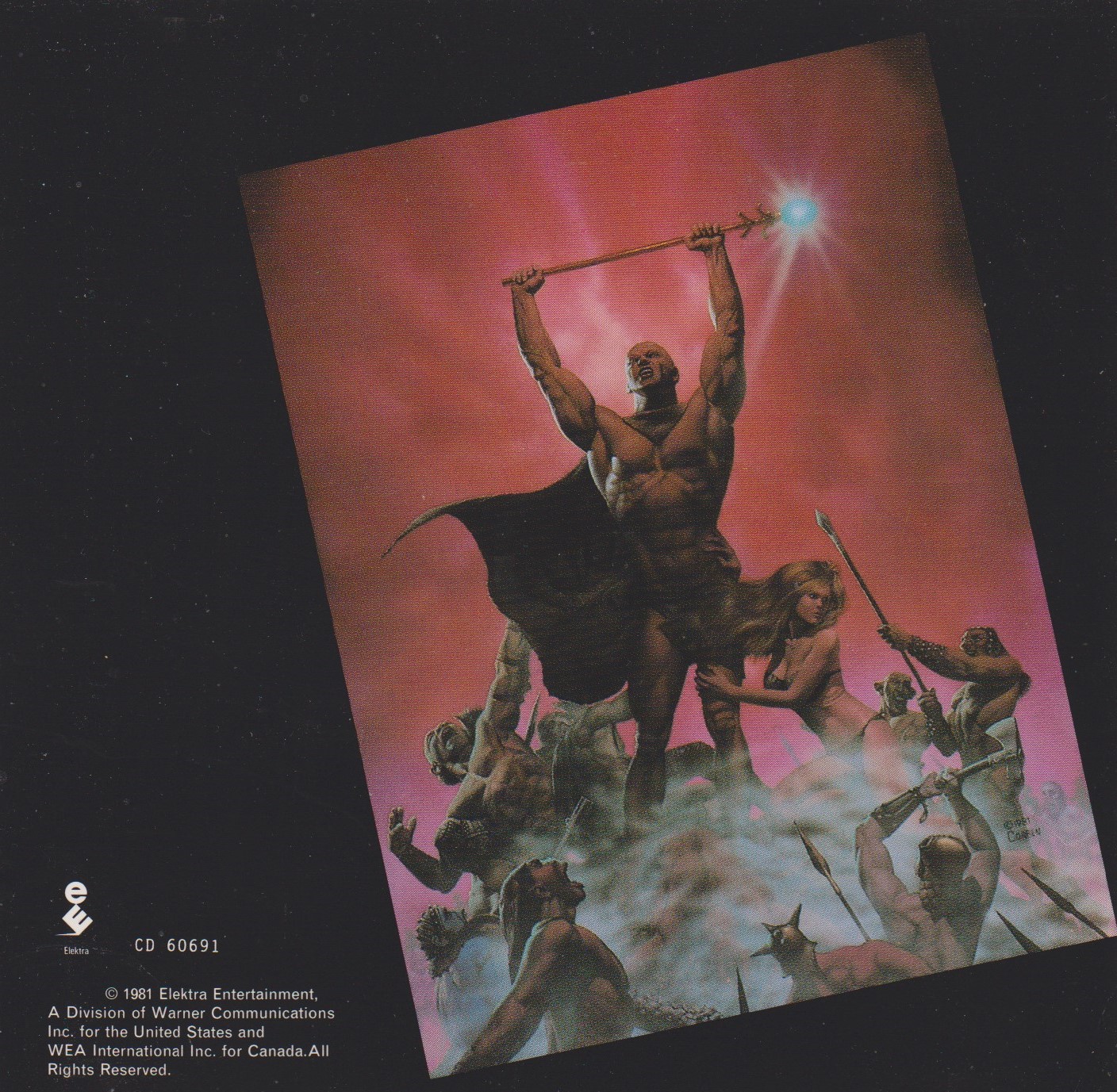
The helpful back cover doesn't even tell you who's on it.

The helpful back cover doesn’t even tell you who’s on it.