kevin shirley

REVIEW: Liquid Tension Experiment – Liquid Tension Experiment (1998)

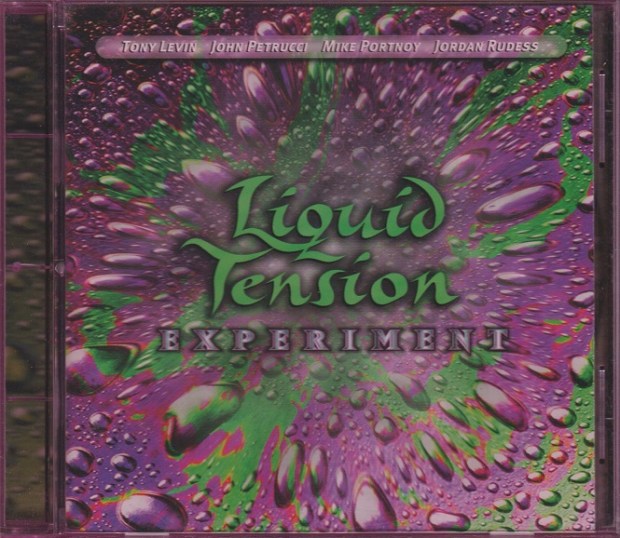
LIQUID TENSION EXPERIMENT – Liquid Tension Experiment (1998 Magna Carta)

Liquid Tension Experiment is a supergroup on Magna Carta, which should tell you much.

Featuring not one, not two, but three guys from Dream Theater, plus Tony Levin, Liquid Tension Experiment is the progressive fan’s dream band.  Granted, keyboardist Jordan Rudess wasn’t in Dream Theater yet when they did this CD, but that’s where people know him from today.  Drummer Mike Portnoy and guitarist John Petrucci are the other driving forces behind Liquid Tension Experiment.

To use phrases like “mind blowing”, “insane”, “incredible” or “the shredder’s wet dream” don’t even begin to touch what the album Liquid Tension Experiment is about.  The liner notes by Mike Portnoy reveal that this project was assembled based on a wish list of players and their availability.  Rudess and Levin were on the list but guitarists just weren’t available, so that’s how Petrucci stepped in.  Together they had six days to write and record this album.  That it turned out so incredibly well says volumes about these guys as musicians.

Liquid Tension Experiment is not just an instrumental album with wicked playing.  The compositions are strong enough to make the album rise well above similar projects.  Magna Carta is loaded with insane projects by the best players in the world, but how many of those albums are good for repeated listenings?  The melodic and tonal sensibilities of Petrucci in particular really keep the album grounded, in a way that even lay people can enjoy.  Levin adds the Chapman Stick and a new agey flavour to the lighter material.  Check out “Osmosis” for a fine example of this.

Most of the album is heavy jammin’. It’s Mike Portnoy, and he does that so well. Together, they create a challenging sound but one with enough hooks that anyone can get into it. You might not realize how many time changes, weird chords and tempos you’re being exposed to, but you are, and you’ll be far better for it.

Together the album consists of nine songs and one spontaneous jam that exceeds 28 minutes! In fact, the tape ran out while recording, so the tail end of the song is from a DAT tape that Portnoy always runs when rehearsing. According to the notes, this piece ironically called “Three Minute Warning” was 100% improvised. “Not a single beat or note was discussed beforehand.” And no fixes or overdubs were made after the fact. It’s over 28 minutes of pure improvisation, and it came out brilliant. Everybody needs some of that in their life, to experience what pure free-form musical genius sounds like.

Must-hear pieces include “Paradigm Shift”, “Osmosis”, “Freedom of Speech” and “Universal Mind”.  It goes without saying that the 28 minute jam is essential as well.

This self-produced album also just sounds incredible.  The sonics are huge, but when the layers are peeled back, you can hear everything so clearly.  The Chapman Stick also adds a huge palette, sometimes heavier than lead and others lighter than a feather.  I’m sure the excellent audio is partly due to the mixing skills of one Kevin “Caveman” Shirley.  Don’t hesitate to pick up Liquid Tension Experiment if you see it.  There was also a second album made called 2, but this is the one to get if it crosses your path.

5/5 stars

REVIEW: Iron Maiden – “Empire of the Clouds” (2016 Record Store Day picture disc single)

IRON MAIDEN -“Empire of the Clouds” (2016 Parlophone Record Store Day picture disc single)

The story of acquiring this single and RSD 2016 can be read right here, so without getting into the details again this is what you need to know:

  1. This was a Record Store Day exclusive (April 16 2016).
  2. There were only 5500 copies made.
  3. Everybody wanted one.

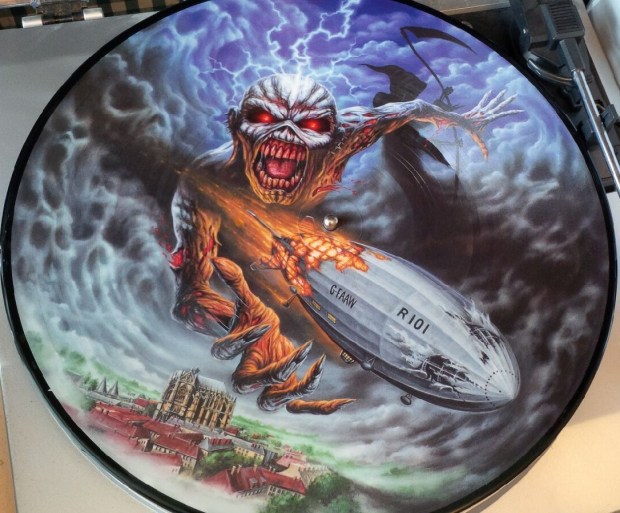
The picture disc and packaging are gorgeous.  The record is a depiction of the Eddie destroying the R-101 airship, but fear not, this is not how history actually unfolded!  This picture disc is ensconced in a die card cover with reprintings of the Daily Mirror newspaper article from the day following the disaster.  It’s a lovely keepsake for sure, but it also has an exclusive interview on the B-side.

Not that the A side is unimportant.  From my original review for The Book of Souls, I had much praise for “Empire of the Clouds”:

“Written solely by Bruce and coming in at almost 20 minutes, it is unprecedented in the Maiden canon.  Never before have the credits ‘Bruce Dickinson – vocals, piano’ been written inside one of their albums.  For the first time ever, the piano is a part of Iron Maiden’s makeup.  Maiden have used orchestras before, and the strings return as well.  ‘Empire of the Clouds’ is a peak accomplishment, something that they (and Bruce) can proudly proclaim, ‘we did that’.  The piano is a natural fit, in the way it is used to make an epic song even more dramatic.  Aviation has been one of Bruce’s favourite lyrical subjects for a long time, but ‘Empire of the Clouds’ might be his first song about airships.  You can trust him to instil it with all the drama and heaviness that you expect from Iron Maiden.”

Nicko McBrain and Bruce Dickinson discuss the making of the song, almost an album in itself, on the B-side “Maiden Voyage”.  The R101 was a massive airship (“the Titanic fits inside”) that was rushed into service and caught flame in 1930.  Bruce wrote the song on piano, which he had learned to play over the last three years.  He then researched the history of the airship and worked on the words.  The way he describes the incident on this interview track, it was a perfect storm of everything going wrong.  In its context, the airship was an expression of the ambition of the British Empire to stretch to all corners of the Earth and above as well.  Bruce says the crash was the end of this era.

Part of the story involves a storm, so Bruce came up with a piano part to depict that.  Before long he had enough components from his piano writings to build the different parts of the song.   One of the bits was written when Jon Lord (from Deep Purple) was ill with cancer.  After his death, Bruce used this piece for the part when the airship initially sets off.  It’s interesting that this era of British ambition inspired the most ambitious track that the singer had ever attempted.  This includes a musical “S.O.S.” in Morse code, something I picked up on upon first listen.

Bruce has particular praise for drummer Nicko McBrain in the building and recording of this song.  Nicko was not only a help in a technical respect, but also as a cheerleader keeping the band driven, so much was he into it.

Bruce Dickinson is a remarkable individual in heavy metal.  You don’t see many metal stars as well educated in history as Bruce, or as capable at communicating it to his audience.  Indeed, as a presenter on the BBC, Bruce has brought history to many diverse audiences.  You would think Iron Maiden fans would be one of the more challenging groups to reach, but Maiden followers are hungry for this kind of content.  We can only respect the band that much more when we realize the true depth of their work.  This coming from a licensed airline pilot, published fiction author, cancer survivor and amature fencer who also happens to be in Iron Maiden.  Extraordinary!

I’m not sure if this disc was worth the buying frenzy it spawned or the online prices you are about to see, but I’m sure glad I got my copy.

5/5 stars

REVIEW: Aerosmith – Nine Lives (European version)

Scan_20150829AEROSMITH – Nine Lives (1997 Columbia, European version)

By popular demand, here is a look at Aerosmith’s Nine Lives, an often overlooked and sometimes forgotten record overshadowed by bigger hits.

Aerosmith were in trouble.  In 1995, after completing a massive amount of work to support Get a Grip and Big Ones, drummer Joey Kramer suffered a nervous breakdown.  It was a traumatic experience for the musician, who had conquered his drug demons long ago and thought he was otherwise healthy.  Aerosmith went ahead with new producer Kevin Shirley, replacing longtime collaborator Bruce Fairbairn who was busy with Van Halen, The Cranberries, and INXS.  A session drummer (Steve Ferrone) filled in, with the intention that when Joey returned, they could finish the album with him.  Kramer did return, perhaps stronger than ever, and re-recorded all of Ferrone’s drums himself.  According to Joey, it made all the difference to him, to make the album sound like Aerosmith.

Although the first single, “Falling in Love (Is Hard on the Knees)” was pretty blasé, the album itself is very strong. I liked it all but immediately, bought it, and then bought it again when I found the European version with the bonus track “Falling Off”. The domestic version was “enhanced” for PC use, with some kind of game where you could play along to Aerosmith songs. I never even tried that, and I ditched the original when I found the European version. I found it in Calgary, Alberta, of all places.

A raucous opening is what you need to set the scene, and “Nine Lives” fits the bill.  That’s Joey on drums alright, as he has this steady, heavy beat that is quintessentially Joey Kramer.  There’s Tyler, vintage sassy and welcoming you to the party.  Over on guitar, Brad Whitford and Joe Perry are sounding brilliant thanks to some crunchy, crisp production from Kevin Shirley.  As always Tom Hamilton on the bass isn’t afraid to play all over the neck without getting in the way.  In other words, for all appearances, Aerosmith were as strong as ever.

Listening to the dreadfully titled “Falling in Love (Is Hard on the Knees)” again reminds me that I never disliked the song.  It was only the title (and the video directed by Michael Bay) I found silly.  Otherwise it’s a fine example of horn-enhanced mid-tempo 90’s Aero-rock.  It has a sleezy grind to it, but it’s not particularly distinguishable from any similar songs on past Aerosmith records.  It’s what they do, and although there are plenty better tunes, I suppose there is an Aero-niche that needs to be filled and here it is.  Another thing they had to do was the sappy ballad with strings and so here is “Hole in My Soul”, another single.  I think track 3 is a little early for ballad.

I remember walking into a record store with T-Rev one afternoon (I think Sunrise) and they were playing an early pre-release promo of “Taste of India”.  I intensely dug the heavy groove, and the exotic spices thrown in.  “Holy shit,” I said to Trevor, “this is really good.”  He wasn’t as enthusiastic, but I think the groove here is impossible to resist.  For latter-day Aerosmith, “Taste of India” represents one of those peaks, kind of like tunes such as “Kings and Queens” were for the early years.  It’s adventurous and I’m a sucker for those guitars that sound like sitars.  There is also sārangī on this track, performed by Ramesh Mishra who was a student of Ravi Shankar. I will return back to my original point though — the heavy groove here is the key. It’s all about that unstoppable steamroller of a rhythm. You don’t hear Aerosmith groove this heavy very often anymore. Back when I was at the Record Store, I did a brief paragraph review of this record for our store newsletter. I praised the song then too, and my enthusiasm has not diminished in the slightest.

“Full Circle” is an interesting track, a ballad that sounds a bit like something you’d sing in a big group on New Year’s Eve.  “Time, don’t let it slip away, raise your drinking glass, here’s to yesterday.”  It sounds a bit like an old Beatles ballad, interpreted by Aerosmith.  It’s just a stunning little track, different from a lot of the Aero-noise that filled later albums.  But “Something’s Gotta Give”, and we need an adrenaline-filled Aero-ass-kicker next.  “Something’s gotta give!  Does the noise in my head bother you?”  Tyler’s harmonica solo is scorching hot, I’m sure his lips were burning.  Then it’s a smokey, jazzy (with muted trumpet) intro to “Ain’t That a Bitch”.  I don’t think I’d wanna call this a ballad, but maybe a slow Aero-burner?  Using the word “ballad” sells the song short because it has more to it than that, even though there’s those strings again!  Then the horns return for the “The Farm”, an inessential but dramatic song.  This is about where the break between side 1 and side 2 would come, so I consider this song to be an apt side closer.

Aerosmith kick it into gear and “Crash” for a breakneck blaze of a song.  Perry’s solo is incandescent.  Kramer’s there in the back, locked into Tom Hamilton driving this big beast called Aerosmith forward as fast as it will go.  Tyler’s screaming “I’m losing my mind, losing my mind, losing my mind!” while the boys in the back are jamming hard.  The second half of this song is truly as good and wreckless as Aerosmith can get.  Just top drawer rawk n’ roll.

So of course they bring you down from that “Crash” with a ballad, called “Kiss Your Past Goodbye”.  This is by the books, and strictly just an off-the-shelf stock Aero-ballad.  There is a lull in the album right about here, as it stalls towards the end.  Another single, the pretty dreadful “Pink”, takes up a solid 4 minutes of your listening time.  I had a customer at the Record Store, the “Barefoot DJ”, a really annoying fucker who was persistently looking for this damned song.  But he refused to pay $11.99 for the Aerosmith album it was on, so he didn’t get it.  Sucked to be him, I guess.

Joe Perry redeems the album (on the European version only) with his song “Falling Off”, for which he handles lead vocals.  It’s nothing special, but it has an old-style rock integrity to it that centers us back to where we should be with this album.  Fortunately it’s followed by another strong song, “Attitude Adjustment” which has a hint of a twang to it.  It’s still nice an’ heavy, which you will have noticed by now is a continuing theme on this album.  Sure there are lots of ballads, but also lots of kinds of heavy.  “Attitude Adjustment” is rhythmically hard-edged, and Joe Perry’s slide guitar always hits you square right in the guts.

“Fallen Angels” brings the ballad count to four.  However, this ballad has integrity.  It is a long ballad, adorned with strings and all the fixings, but it also has the feeling and drama that preceding ballads lacked.  The exotic sounds of India return to close the song and the album, going “Full Circle” as Aerosmith said earlier.

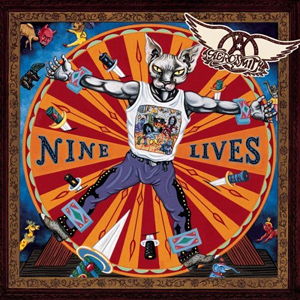
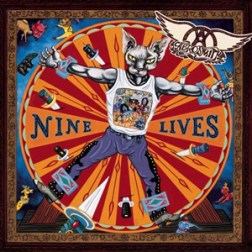
NINE LIVESLastly, I think Nine Lives has some of the best album artwork of any Aerosmith album in the CD age.  I know that the original cover art with the snakes and the dancing cat was offensive to some of the Hindu faith.  They then issued an alternative, revised version for retailers who wanted it, and it was just as cool anyway.  Each page of the booklet features artwork that “pulls back” further giving you a wider perspective of the actual scene.  This culminates with a zombie Aerosmith on the last page.  The best thing about the revised cover art is that it adds one more picture to this sequence of “pulling back”.  Now you can see the zombie Aerosmith are just a picture on a T-shirt on the same cat, who is strapped to a circus knife throwing wheel!  I wouldn’t mind getting that version of the CD (cheap) just to have the final picture in the sequence.

This version of Nine Lives has 14 songs.  If you think of an album in old-school terms, you realize that’s about four or five songs more than you used to get on a record.  If you trimmed a few of these songs off, as if you were releasing a vinyl album in the 1970’s, imagine how tight it could have been.  With the ballady filler, I’d give it:

4/5 stars

REVIEW: Iron Maiden – The Book of Souls (2015)

NEW RELEASE

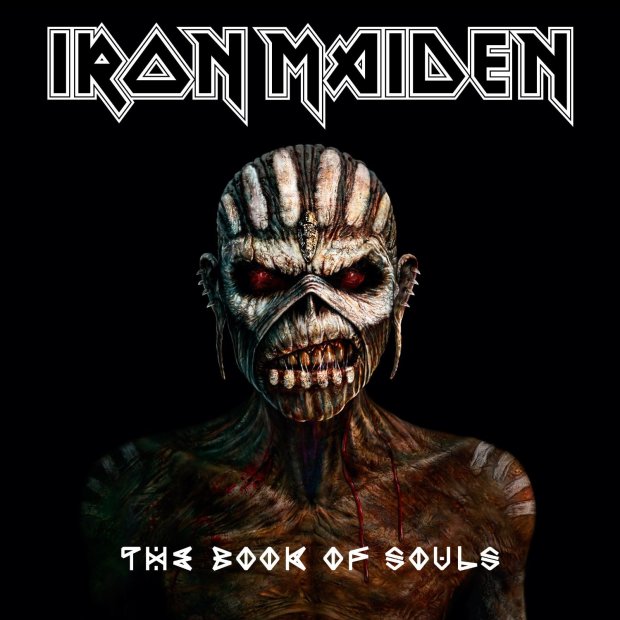
IRON MAIDEN – The Book of Souls (2015 Parlophone, collector’s book edition)

I have a new hero.  His name is Bruce Dickinson.

Bruce has not only beaten cancer back to that dark hole from which it came, but he takes command on Iron Maiden’s new opus The Book of Souls.

Even though he only has writing credits on four of the 11 tracks here, his impact is massive.  With lungs of iron, Bruce propels everything.  For the first time (possibly) ever, I feel that the most important band member is not leader Steve Harris, but the singer himself.

Right from the opener “If Eternity Should Fail”, Bruce is center stage.  He wrote this complex number himself.  It boasts one of Maiden’s most memorable choruses yet, and musical twists and turns that return us to Powerslave.  Meanwhile, there is a hook that reminds me of Bruce’s solo song “The Ghost of Cain”, from Accident of Birth.

We took a good look at the lead single, “Speed of Light” a couple weeks back.  Maiden often write a fast, heavy blazer to go with a new album, and that’s “Speed of Light”.  Even though it is the single, it is far from the strongest song.  Written by Bruce and Adrian Smith, it is certainly a good Iron Maiden track, but in comparison to the monuments of metal that surround it, “Speed of Light” feels like a brief diversion from the epic metal moments at hand.  Adrian’s solo, however, is delicious.

“The Great Unknown” (Smith/Harris) opens softly, but even so there is a menacing tone to Bruce’s voice and the underlying instruments.  With a slow, thrusting riff, “The Great Unknown” soon lurches forth, a killer metal march for the ages.  Bruce pushes his voice to the very limits, giving it all and then some.  As with many of the songs on The Books of Souls, I hear hints and echoes of past Maiden epics.  This is not a lack of originality, more like a signature — familiar but always different.  “The Great Unknown” ends on the soft note with which it began.

What is an Iron Maiden album without a Steve Harris bass intro?  He and producer Kevin Shirley captured a wonderful bass sound on this album.  “The Red and the Black”, another epic, is the only Harris solo writing credit.  It has a riff that takes me all the way back to Killers, but then it is gone, and it’s onto another riff…and another…and another.  At 13 minutes in length, this is one of those trademark Harris songs.  Time changes galore, loaded with hooks.  You can draw parallels to many epics from the past, but to do so takes away from this one.  “The Red and the Black” is a proud achievement, a passionate metal song as only Iron Maiden can really do.  Adrian Smith handles one of the guitar solos with a huge splash of wah-wah, and that is simply a thing of beauty.  In sum, if you took a little bit of everything that makes Iron Maiden great and unique, then all those ingredients are in “The Red and the Black”.  Bass outro, and that’s that.

A semi-shorty (5:52) is in the next slot, a fast riffer called “When the River Runs Deep” written by Steve and Adrian.  This one is hard to compare to any past Maiden tracks, as it occupies a space all its own.  Adrian Smith sometimes brings in riffs that sound like something other than Iron Maiden, and I think that’s “When the River Runs Deep”.  Adrian takes another wah-wah solo, but not to be outdone is Janick Gers who throws down an edgy solo of his own.  As far as Iron Maiden goes, this song is guitar solo nirvana.

A 10 minute epic always makes a good closer when you’re Iron Maiden, so the title track “The Book of Souls” (Gers/Harris) is last for disc one.  Gentle acoustic guitars and keyboards emulating pipes tell us that this is previously uncharted territory.  Then “The Book of Souls” trudges forth, with a beat not unlike “Mother Russia” from No Prayer for the Dying.  There’s far more to the song than that, however. Soaring lead vocals (Bruce only seems stronger!) just ice the cake.  All three Maiden guitarists shine on this, but Janick and Adrian have some solos that just play off each other so well. You want those trademark Maiden guitar melodies?  How about galloping riffs?  Nicko McBrain killing it on the drums?  Maiden deliver, in top notch style, everything and then some more.

IMG_20150907_114837

Bruce and Adrian co-wrote “Death or Glory”, opening side two with frenetic drums and riffing.  Going for the throat, The Book of Souls has more fast riffs per minute than any Maiden album in decades.  In five brief minutes, you are blasted against the wall, bounced off the floor, and nailed to the ceiling.  Don’t hurt your neck from all the headbanging.  This time, the guitar spotlight is on Dave Murray for an intense, dramatic solo.

“Shadows of the Valley” (Gers/Harris) sounds a lot like “Wasted Years” at first, but only briefly.  If anything, “Shadows of the Valley” recalls Dance of Death-era Iron Maiden.  Although this song is not as powerful or memorable as others on the album, it does contain some seriously incredible instrumental moments.

One of the most heartfelt and powerful songs on the album is the shortest.  “Tears of a Clown” is a thoughtful moment about Robin Williams.  The poignant lyrics are to the point:

All alone in a crowded room,
He tries to force a smile,
The smile it beamed or so it seemed,
But never reached the eyes, disguise,
Masquerading as the funny man do they despise.

I found this to be one of the compelling songs.  Of all the bands to commemorate Robin Williams, I did not expect it to be Iron Maiden.  But they did it in such a way that it completely fits.

Dave Murray and Steve Harris might not have known that Bruce already has a solo song called “Man of Sorrows”, but it doesn’t matter much since Maiden’s song is called “The Man of Sorrows”.  Musically this sounds much like X Factor-era Maiden.  Bruce takes it to a higher level than that.  Dave himself has a nice slow bluesy solo at the end that is just pure gravy.

The biggest surprise, the biggest song, and the biggest challenge has to be “Empire of the Clouds”.  Written solely by Bruce and coming in at almost 20 minutes, it is unprecedented in the Maiden canon.  Never before have the credits “Bruce Dickinson – vocals, piano” been written inside one of their albums.  For the first time ever, the piano is a part of Iron Maiden’s makeup.  Maiden have used orchestras before, and the strings return as well.  “Empire of the Clouds” is a peak accomplishment, something that they (and Bruce) can proudly proclaim, “we did that”.  The piano is a natural fit, in the way it is used to make an epic song even more dramatic.  Aviation has been one of Bruce’s favourite lyrical subjects for a long time, but “Empire of the Clouds” might be his first song about airships.  You can trust him to instill it with all the drama and heaviness that you expect from Iron Maiden.

Even though 92 minutes have elapsed, The Book of Souls does not particularly feel longer than A Matter of Life and Death or The Final Frontier.  Like those two previous records, The Book of Souls is going to have to be digested long-term, returned to again and again to fully absorb and appreciate.  This is an album in the true sense:  best appreciated in sequence, as a single work.  There’s an intermission in the middle for you to change CDs and take a break, but I recommend diving right back in once again.

With Bruce’s very serious health scare, and the increasing age of the band, there is always the chance that this could be the last Iron Maiden album.  Of course, some said that about The Final Frontier as well.  It seems that ever since Brave New World in 2000, Iron Maiden have set to top the previous album each time.  The cumulative effect of that is that they had a hell of a lot to live up to on The Book of Souls.

Mission accomplished.

5/5 stars

Disc 1
1. If Eternity Should Fail (Dickinson) 8:28
2. Speed Of Light (Smith/ Dickinson) 5:01
3. The Great Unknown (Smith/ Harris) 6:37
4. The Red And The Black (Harris) 13:33
5. When The River Runs Deep (Smith/ Harris) 5:52
6. The Book Of Souls (Gers/ Harris) 10:27

Disc 2
7. Death Or Glory (Smith/ Dickinson) 5:13
8. Shadows Of The Valley (Gers/ Harris) 7:32
9. Tears Of A Clown (Smith/ Harris) 4:59
10. The Man Of Sorrows (Murray/ Harris) 6:28
11. Empire Of The Clouds (Dickinson) 18:01

For the official KeepsMeAlive review by Aaron, click here!

REVIEW: Iron Maiden – “Speed of Light” (2015 single/T-shirt bundle)

NEW RELEASE

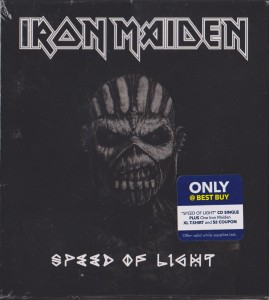
Scan_20150825IRON MAIDEN – “Speed of Light” (2015 BMG single/T-shirt bundle – Best Buy exclusive)

“Only at Best Buy — the words chill me to the bones.

I don’t know what the deal is with Best Buy exclusives in Canada.  When Tenacious D’s movie Pick of Destiny came out, I found the Best Buy edition no problem, just up the street.  Bonus disc and all, easy peasy.  Didn’t even know such a thing existed until I found it at Best Buy.

Only a few years later, it became impossible to find Best Buy exclusives at Best Buy.  Using Tenacious D as the example again, the Best Buy edition of Rize of the Fenix has two bonus tracks.  I had to buy it on eBay, so you know it was an inflated price.  Same thing with the last Black Sabbath album.  Best Buy had a bonus track called “Naïveté in Black” which happened to be one of the best songs.  Had to buy it on eBay.  Paid too much.

A few weeks ago, Best Buy announced they were getting an exclusive on the new Iron Maiden single “Speed of Light” from the forthcoming double album The Book of Souls.  It came with a T-shirt.  But I wanted the single just as much.  That’s where Stone from Metal Odyssey came in!

First of all, I’m gonna tell you to follow Stone in some way, shape, or form.  (WordPress/Twitter)  He read my plight regarding Best Buy items here and took pity.  I called my closest Best Buy — all CDs have been removed from their inventory.  So Stone bought two copies and sent me one, asking nothing in return.  (I will return the favour — just name it man!)  To say I appreciate this gesture is am understatement, which is why I’m being more long winded than usual for a one track CD single!

IMG_20150825_171143

“Speed of Light”, written by the duo of Dickinson/Smith, is true to Iron Maiden, and it sounds fucking brilliant.  We know all about the new double album, with plenty of long bombers.  “Speed of Light” is just a hair over five minutes, a very concise song for any Maiden album.  When Adrian and Bruce write together, you can count on a catchy riff and hooks.  “Speed of Light” delivers, and Bruce’s singing is just as powerful as ever, cancer be damned.  His voice is virtually unchanged since Brave New World, 15 years ago.  The air raid siren is intact.  And this album will be the fifth with this Maiden lineup, the longest lived in its history.  Impressive.

Most impressive.

A highlight of “Speed of Light” has to be Adrian’s solo.  The three Maiden guitarists (Janick Gers and Dave Murray being the other two) all have their own distinct styles, which is a major boon to a band like Maiden.  Adrian is the one who thoughtfully composes his solos, and then lets them rip.  This one is brief but has his stamp all over it.

Sometimes Maiden take on a 70’s vibe.  “The Angel and the Gambler” is one such moment, but I think “Speed of Light” also has one foot in the 70’s.  Just a hint, an insinuation, at the beginning.  Otherwise, “Speed of Light” is purely a modern Maiden metal moment.  It would have fit comfortably on The Final Frontier, although I would caution against inferring the sound of the new album from just one single.  It is probably one of the more straightforward moments on The Books of Souls, but we’ll find out for sure on September 4.

One last comment:  fuck you, cancer!  You just got beat by Bruce Dickinson!

4.5/5 stars

REVIEW: Journey – Revelation (2008 2CD/DVD edition, import with bonus track)

JOURNEY – Revelation (2008 Nomota)

It’s funny to surf the reviews on Amazon for this CD. “Super and Awesome” says one. “Best Journey album since Escape” says another. (Really? Better than Frontiers?)

OK, cutting through the glowing fanboy reviews, let’s be dispassionate here. Journey hasn’t truly sounded like Journey since Steve Smith and Steve Perry left for good in the late 90’s. In my unassuming personal view, Trial By Fire from 1997 was the best Journey album since the glory days. They tried to replace Steve Perry with a clone singer named Steve Augeri on three releases (Arrival, Red 1, Generations) and the result was a generic band that sounded like (guess what) a Journey tribute band. The fact that the smooth-as-butter Steve Smith was gone didn’t help.

REVELATION_0006

Journey did what I thought was a really smart move afterwards. They brought in the brilliant veteran Jeff Scott Soto to sing, and there are some pretty awesome bootlegs out there of Journey with Soto singing. Soto was no Steve Perry, but a unique singer in his own right, loved by his own legion of fans for his powerful voice. But he was no replicant; no duplicate.  The band actually fired him to bring in someone more Perry-like.

That person is Arnel Pineda, who has an incredible set of pipes. I mean this guy can sing! Unfortunately, Pineda’s been singing Journey pretty much his whole life. He’s a Perry clone. He’s Perry-lite. He’s an imitator. And you can tell. He lacks the character, the grit, the personality, the soul, and the experience of Steve Perry.

Also, let’s not forget that Steve Perry was one of the major Journey songwriters, and without him Neil Schon and Jonathan Cain are left to their own devices. The soul is still gone, the heart of Journey is still ripped out. Revelation is no comeback album. It’s another Journey-lite album, it sounds like the best Journey tribute band in the world, but still…just a tribute band.

Having said that, it’s not bad. It’s not a comeback, it’s more of the same. There are good songs here – “Never Walk Away” being the strongest. “Like A Sunshower” is a nice, generic ballad. “The Journey (Revelation)” is the most adventurous tune here, an instrumental where Schon gets to show his stuff, shredding and classing up the place several notches. The rest of the tunes are just nice. Pleasant Journey-esque ditties where you can tell Cain and Schon were saying, “Let’s write a Journey rocker,” or “Let’s write a Journey ballad”.

The album is roughly half new songs, half old. The second disc is entirely re-records with Arnel singing classic Journey tunes. It’s nice but certainly no replacement for Greatest Hits. It’s great that they tackled “Stone In Love” and “Be Good To Yourself” on here. The rest are the hits, and you know ’em and love ’em already so I won’t talk about them too much. Except to say, this is where you notice first and foremost that Steve Perry is missing. The nuances are not here, rendering this disc nothing more than a novelty.

There are two other re-records, both (oddly enough) from the Augeri era. One is the Japan-only “The Place in Your Heart” which I don’t have so I can’t comment on it. The other, which is on all versions of the CD, is “Faith In The Heartland”, one of the better songs from Generations. I’m guessing they did these two re-records because nobody heard Generations. “Faith In The Heartland” is probably better on Generations, sung by the guy who actually wrote it, Steve Augeri.

There is also a great bonus track on the Mexican edition: great song, loaded with atmosphere, called “Let It Take You Back”. It’s about nostalgia, ironically, but I can relate and it’s a great tune backed by a strong riff. One of the best tunes on the album. Track it down, you won’t be sorry.

REVELATION_0004

The Walmart exclusive edition has a really good DVD: live (in Vegas) performances with Arnel singing. “Mother, Father” shows that Arnel can sing. Man, can he sing! I think Journey at this point are a stronger band live than in the studio. Live, Arnel has more character and you’re just in awe of the man’s pipes. This is a good DVD. And for free, it’s worth the price of admission.

So there you have it. Ignore the fanboys and let’s be unbiased here. This isn’t the Journey comeback we hoped for. It’s just another medium-rare Journey album. Until Perry comes back (and let’s face it, he has to one day) and records an album as great and progressive as Trial By Fire, this is a tired band spinnin’ tires.

3/5 stars

DVD:

  1. “Sky Light”
  2. “Any Way You Want It”
  3. “Wheel in the Sky”
  4. “Lights”
  5. “After All These Years”
  6. “Never Walk Away”
  7. “Open Arms (Prelude)”
  8. “Open Arms”
  9. “Mother, Father”
  10. “Wildest Dream”
  11. “Separate Ways (Worlds Apart)”
  12. “Faithfully”
  13. “Don’t Stop Believin'”
  14. “Be Good to Yourself”

REVIEW: Deep Purple – Come Taste the Band (35th Anniversary edition)

DEEP PURPLE – Come Taste the Band (35th Anniversary edition, 2010 originally 1975, EMI)

For those keeping score, now every single album from the original run of Deep Purple 1968-1976 has been remastered with some sort of deluxe edition. Come Taste The Band is the final album of this series. Deep Purple imploded shortly after and the band was no more until Perfect Strangers in 1983.

Personally I have always liked Come Taste The Band right from first listen. However, I never heard the album until 1996 so the idea of a great Purple album without Richie Blackmore was not foreign to me. With open ears you can really appreciate what Deep Purple were up to on this powerfully rocking album. It has a solid groove, a much harder sound than Stormbringer and some greasy unconventional guitar playing from Tommy Bolin. Everybody is playing amazingly, even the coked-out Glenn Hughes who just rips it to shreds on “Gettin’ Tighter”, my favourite track. Paicey is awesome on said breakneck track.

Really though there are no losers on Come Taste The Band. Every song is incredible right from the opener of the ferocious “Comin’ Home” to the philosophical “You Keep On Movin'”. Another personal favourite is the sliding groover “Dealer”, a tale of warning from David Coverdale to Glenn Hughes about his habit. Bolin takes his first and only studio Deep Purple lead vocal on the bridge.

IMG_00000713As with all previous special editions, the liner notes are excellent, revealing, and loaded with pictures. One fact I didn’t know: The band were going to kick out Hughes if he didn’t kick the coke.

Bonus material is present. The single edit of “You Keep On Movin'” is tacked on to the end of disc one, but this is previously available on such albums as Singles A’s and B’s. The second disc contains the entire album remixed by Kevin Shirley. Shirley is truly a great mixer. It’s hard to discern what he did differently here, except the songs are a bit more punchy. Some now continue on past their original fade points, revealing never before heard playing from the band, right to the end of the song. This was done on previous remasters such as Machine Head and I like this touch a lot.

Two previously unreleased tracks are included. These tracks will be worth the price of purchase alone to Purple collectors. “Same In L.A.” is a nearly complete song with lead vocals and lyrics. If it had been included on the original album, it would easily have been the most pop, it sounds more suited to Stormbringer material. “Bolin Paice Jam” is also unreleased — not even heard before on Days May Come and Days May Go or the limited edition 1420 Beachwood Drive albums. This is a massive, fiery jam capturing the best of both players. Difficult to understand why this was not included on the aforementioned two compilations, but it’s just awesome and I’m glad it’s out.

Once again, Simon Robinson has outdone himself with the final Deep Purple remaster of this series. These albums, while expensive and difficult to obtain (mine took almost two months to ship) are well worth it to the faithful.

5/5 stars

REVIEW: Journey – Eclipse (2011 Japanese import)

JOURNEY – Eclipse (2011 Japanese import)

You gotta give ’em credit for trying. Three (!) singers since Steve Perry left, and Journey still refuse to patch it up or pack it in. Arnel Pineda is still the singer, back here for his second Journey album, and now contributing songwriting to the mix.

ECLIPSE_0003Otherwise, Eclipse (stylized as ECL1PS3 on the cover art) is heavily dominated by Neal Schon and Jonathan Cain, and you can tell that this is Neal’s album. Upon playing Eclipse, you will be inundated by colossal Schon riff after colossal Schon riff. This is backed by some dramatic synth by Cain. It’s a much heavier Journey album than any in recent memory. It’s a good mix, and producer Kevin Shirley captured it. I’ve been skeptical in the past when Journey puts out a new album and says, “This is us being heavier.” Stuff like the Red 5 EP…they were just underwhelming and were missing the soul of Journey.

I would argue that the soul of Journey belongs to Steve Perry, but Arnel Pineda turns in a stunning performance this time. Not that he didn’t last time, but this time it sounds less like he’s trying to be Steve Perry. This time it sounds like he’s more himself, and it’s better that way. Incredible set of pipes on this man by the way.

As long time fans know, Journey did three albums before Steve Perry joined the band. These albums had their roots in more instrumental, progressive rock.  One or two of the guitar passages on Eclipse sound a like stuff from those first three albums. It’s fleeting but it’s there.

Fave track: “Edge of the Moment”.

Most Journey-esque song: “City Of Hope”. (It even calls out an older Journey song title called “Message Of Love”.)

Meanwhile, the fine “She’s A Mystery” (co-written by Pineda) is a great little epic acoustic/electric song with some sweet Schon overtones that sound like gulls flying overhead. It captures the vibe of the more atmospheric material from Trial By Fire that I liked so much.

The extra thick case of the Japanese CD, can't replace it if you break it!

The extra thick case of the Japanese CD, can’t replace it if you break it!

The Japanese bonus track is a live cut of “Don’t Stop Believin'”, from the DVD Live In Manila.  No live album was ever made of that live concert, so this is a CD exclusive.   The Japanese CD also comes in an extra wide case, housing a lenticular cover insert.  Very similar to the recent “3D” Kiss Monster cover.

The thing about Journey albums of late is memorability. Your brain says “this is a good song, it has a melody I like,” but a day later you can’t remember how the song went. Eclipse is also like that.  All the songs are strong, melodic workman-like Journey songs.   They just seem to lack whatever it was about the classics that made them stick in the head.  Maybe I need to listen to it more, but I rarely have the craving to do so, when I can spend the time with Trial By Fire.

3/5 stars

REVIEW: Iron Maiden – Maiden England ’88 (2013 CD reissue)

“LIKE” the LeBrain Facebook page for sneak previews and additional content!
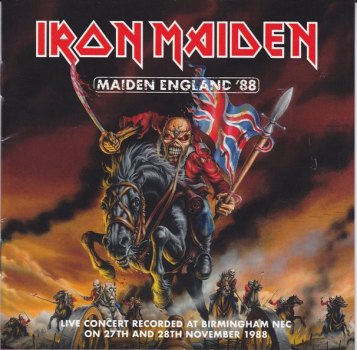
MAIDEN ENGLAND FRONT

IRON MAIDEN – Maiden England ’88 (2013 CD reissue)

It only took 25 years, but Iron Maiden have finally released a complete 2 CD edition of their legendary Maiden England recording.  A video was released in 1989, and a truncated CD version in 1994.  These were great, but less than 100% satisfying.

The first thing you notice is the striking cover art.  This is by somebody named Hervé Monjeaud.  It resembles Derek Riggs’ Eddies enough to fit in fairly seemlessly with the 1988 era.  I wish they used the original motorcycle cover art by Derek Riggs, but at least they credit him inside as the original artist.

Also checking the credits, I was pleased to find that the audio was not remixed.  This is the same mix that Martin Birch produced at the time.  The three unreleased songs are freshly mixed by Kevin Shirley, but there’s no tampering.  This is the authentic Maiden England.

Last year when I reviewed every Maiden release in a row, I discussed Maiden England.  Please check that review out if you’re looking for a more comprehensive review of the songs and content. Back then, I gave it 4/5 stars.  I found the sound a tad muddy, I complained about the brief running time, and I didn’t like that the CD did not include every song from the VHS version.  The missing songs were “Hallowed Be Thy Name” and “Can I Play With Madness”.  This edition restores them to the running order, and even adds three more songs that were cut completely from the original release!  So right there, two of my beefs have been addressed.

What about the sound?  Bloody great!  Whatever it was about the first CD release, the flatness of it, is gone.  It’s like when you take your car to the wash, how it shines.  Maiden England ’88 sounds so much better than the original CD.  And of course there’s a nice substantial booklet with photos and lyrics.  No notes from Steve or anybody else, disappointingly.  I always like those “producer’s notes” or what have you.  But that’s window dressing, this is really such a pleasure to listen to, I assure you.  As I wrote these words, Dave Murray was wheedly-wheedly-ing in my ears.  And I liked it.

With the added material and fresh sound, Maiden England ’88 takes its place alongside other Maiden classics such as Live at Donington or Rock In Rio.  Of course it cannot usurp Live After Death, nothing ever will.  Maiden England ’88 has some really awesome Maiden material that didn’t make Live After Death, such as “Still Life”, which remains dramatic and stunning.  “Killers” and “Sanctuary” are two other songs that were not on Live After Death.  Not to mention, by 1988 Maiden had two more albums to draw from.  That means you’ll also hear “Wasted Years” and “The Clairvoyant”, songs that stand strong among the old stalwarts.

The three unreleased songs are “Run To The Hills”, “Running Free” and “Sanctuary”.  These were the encores.  They are not mixed onto the end of the show, but follow a pause and have a noticeably different sound.  It’s hard to describe how the sound differs, but you can hear a change.  I’m not sure why these weren’t included on the original VHS.  Surely not for quality reasons.  The running time of the original video was 95 minutes.  Would another 15 have bumped them into a higher, tax, uhh, you know?  (120 minute tapes were common back then too.)

There’s a DVD too, but I don’t have that yet.  One thing at a time!  Send me a copy, EMI, and I’ll be happy to review it!

5/5 stars

REVIEW: Steve Harris – British Lion (2012)

STEVE HARRIS – British Lion (2012 EMI)

Add my voice to the chorus of people disappointed with British Lion, the debut solo offering from Iron Maiden’s visionary founder, Steve Harris.  It’s not just because it doesn’t sound like Iron Maiden, because I wouldn’t want it to sound like Iron Maiden.  It’s because Steve’s hired the most bland lead vocalist I’ve heard in many moons.  Mr. Bland’s name is Richard Taylor, and he lacks any sort of grit, power, or character.  I’m sure there was a method to Steve’s madness, and a reason he chose Mr. Bland to sing for him.  I’ll be damned if I can figure it out.

Steve self-produced this album, with Kevin Shirley mixing, and sonically it sounds good, especially the final track:  The lush “The Lesson” features strings and acoustics, and sounds great.  Unfortunately a good sounding production can’t inject life into these dull songs.

I hate to use such harsh language as “dull” and “bland” where Steve Harris is concerned, but I’ve played the album five or six times now, and I still can’t remember most of these songs distinctly.  There’s one standout:  the pop metal “Eyes of the Young”, which has a catchy chorus and is instantly memorable.  There are far more songs that are instantly forgettable:  the single “This Is My God”, for example, and the aforementioned “The Lesson” despite its production values.  “Us Against the World” isn’t bad, starting with keys and organ before some dual guitar harmonies kick in.  But then Mr. Bland opens his mouth.

Steve’s trademark bass is more groove oriented and less rinky-dink, which is fine.  He seems to gel well with the rest of the band, but unfortunately aside from some tasty guitar solos, the rest of the band is generic sounding and lack a distinct identity.  I lay most of that straight at the feet of Mr. Bland.  A really great singer could have injected some passion into these otherwise unremarkable songs.

A nice added touch:  The CD comes with mp3 copies, so you don’t have to rip to your portable device.  It comes in two forms:  mastered loud, and mastered very loud!

2/5 stars