remixes

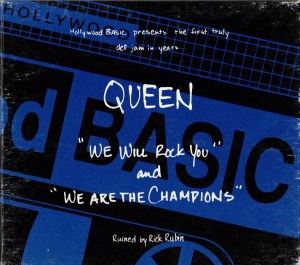
REVIEW: Queen – “We Will Rock You” and “We Are the Champions” Ruined By Rick Rubin EP (1991)

QUEEN – “We Will Rock You” and “We Are the Champions” Ruined By Rick Rubin EP (1991 Hollywood Basic)

Mercifully, it’s short.  But did they know they were making a piece of shit?  “Ruined by Rick Rubin”.  “Mix Engineer Under Protest: Brendan O’Brien”.  “Engineering and Additional Bad Ideas:  Jason Corsano”.  Those are the actual credits.  They had to know these remixes were awful.  Connecting the dots, this remix EP must have been the brainchild of Hollywood records.

Rubin claims that “We Will Rock You” was a perfect record already, so he thought “I can’t improve upon it, I may as well throw the whole kitchen sink at it,” more or less.  This was a single that went along with the 1991 reissue of News of the World, which included the first remix here as a bonus track.  Not much of a bonus, really!

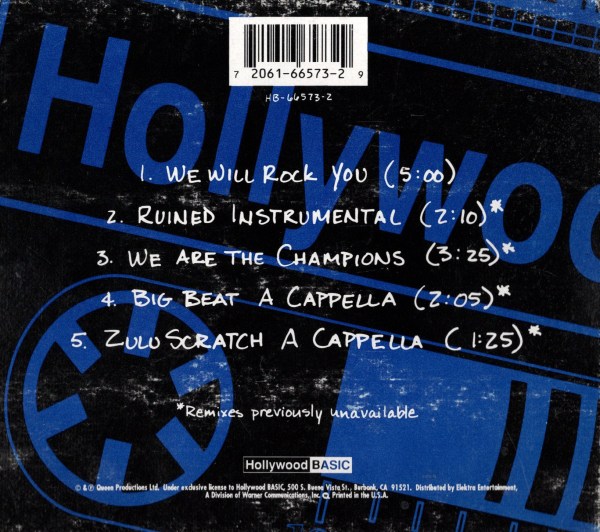
“We Will Rock You” begins with the sound of a scratchy record, then the handclaps, before everything goes bonkers.  A droning sound is accompanied by drum loops.  This goes on for a while, with the original track playing underneath, guitar solo and all.  Then it explodes with additional drums by the Chili Peppers’ Chad Smith (credited here for “bombastic skin attack”.  Flea is on additional bass (credited as “supercharged bass from hell”).  Records scratch, people shout “yeah” (or “blah” or something), until it is mercifully all over after an agonizing five minutes.  One of the worst remixes in music history.

It gets worse.  An instrumental remix follows.  This is just the loops and scratches, and whatever samples thrown in.  There are things that sound like horns, and more of that droning sound.

The next track ruined by remixes is “We Are the Champions”.  This version is blasphemous.  A rapper chants, “Aint it funky!” between Freddie’s lines.  The pointless loops and additional bullshit are present and accounted for.  The choruses are relatively intact, but forget about the verses.  Did “We Are the Champions” need drum loops and reggae dubbed in?  Unlistenable.

Back to “We Will Rock You” with the “Big Beat A Capella”.  This means the vocal track from the song, without the handclaps, but stupid drums (and even steel drums) looped over.  Steel drums on “We Will Rock You”.

Finally, there is the “Zulu Scratch A Capella” remix of “We Will Rock You” and I don’t even wanna bother.  It’s mostly just the vocal track with minor manipulations and a few scratches.  The only good thing about it is its brevity.

This remix EP is for collectors only.  If you’re a Queen completist, or a Red Hot Chili Peppers diehard who has to have every note that Flea farted out, go for it.  Everyone involved should be embarrassed about this flaming turd, and judging by the credits, I think they are.

0/5 stars

REVIEW: Extreme – Extragraffitti (1990 Japanese EP)

EXTREME – Extragraffitti (1990 A&M Japan EP)

This little EP, exclusive to Japan, is almost like a miniature “greatest hits” for Extreme.  Of the six songs, five were singles.  You might say “It’s not a greatest hits if it doesn’t have ‘More Than Words’ on it, and that would be a valid point, but that breakthrough ballad hadn’t been released as a single yet in November 1990.

Opening with the current single “Get the Funk Out”, we are off to a good start.  This track works most excellently as an opener.  That bass rolls in, before the guitar riff starts to rip.  Once the horns kick in, your face is thoroughly melted.  This EP focuses on fun.  There’s nothing here that’s a drag.

An edit version of “Decadence Dance” is unblunted.  It’s mostly just the intro stuff that’s missing anyway, and that belonged on the concept album from which it came.  The bonus here is you get Paul Geary’s cymbal count-in instead, which you can’t hear on the Pornograffitti album.  So dance to the beat of the decadent drummer, and get rocked.  This is one of Extreme’s best bangers, a full-on Van Halen romp with hooks and flash…as you like it.

Back to the self-titled 1988 debut album for the next three tracks.  A remix of “Mutha (Don’t Wanna Go to School Today)” may have more bass, edge and clarity.  It’s not a radical remix.  Nuno’s guitar fills jump out nicely.  The first Extreme album was a mixed bag of material, with none of it reaching the upper echelons like the second record.  That said, “Mutha” was probably the best track of the bunch, and the most like what came later.

“Little Girls” only loses about 20 seconds, so you’re fine with this version.  Again, it’s the opening missing.  This song is notable for some remarkable harmonica playing by Rapheal May.  Really impressive stuff here, just as superb as Nuno’s guitar work.  The lyrics, however, can’t be saved.  They were never good, even by 1988 standards.  “Incestual blood is thicker than water,” has to be the worst words that Gary Cherone has ever penned to paper.  Roll up your windows if you intend to sing along to this song.  Shame the band is so hot.

The album version of “Kid Ego” is here unaltered, it’s just not that interesting of a song.  The groove plods along in a lazy, 1980s way that every single band was doing.  It sounds like every band had their metronome set to the same time.

The B-side “Nice Place to Visit” has been released in a number of places, such as the “More Than Words” single in 1991, but first it was the B-side to “Little Girls”.  As an outtake from the so-so first album, this song is also so-so.

The final track, and the only one exclusive to this CD, is a message from Extreme!  These messages from band members were fairly common on Japanese EPs and singles by Western bands.  It is geared specifically for the Japanese fans, and it’s adorable hearing their deep Boston accents.  This message is fairly light.  Nuno talks about their goals as a band, and Gary assures the fans that they will see them real soon.  Apparently, the Japanese fans also sent the neatest, tidiest mail.

Good EP for its time.  There’s even a sticker inside.

3.5/5 stars


REVIEW: Whitesnake – Here I Go Again: The Whitesnake Collection (2002)

WHITESNAKE – Here I Go Again: The Whitesnake Collection (2002 Universal)

Back in the days before David Coverdale began lovingly curating his 80s catalogue with expansive box sets and assorted compilations, the record labels were doing it for him.  And, all things considered, they were milking it pretty hard with very little in terms of added value to the fans who already had a decent collection.  2002’s Here I Go Again: The Whitesnake Collection might have been the first one really worth buying.

At its moment of conception, it was probable and perhaps likely that a large number of Whitesnake fans didn’t already own all three of the Geffen albums on CD.  Perhaps they just owned Greatest Hits, or 1987.  Rather than force fans to buy (or re-buy) a three disc set for all that material, Universal gathered 24-bit remasters of the three albums with some associated bonus tracks and released it all as more affordable two disc set.  It offered good value for fans looking to get those albums digitally, or those just trying to acquire the bonus tracks.

Starting off with the rare “Radio Remix” of “Here I Go Again”, a familiar song leads the charge.  This unusual version has Dan Huff on guitar, Denny Carmassi on drums, and Bill Cuomo on keyboards.  It’s shorter without that long “keyboard heaven” opening.  As a radio remix, it has choppier guitars, more keyboards, and prominent female backing vocals.  Huff’s solo is refreshing after being used to Adrian Vandenberg’s for so long.

From there, the compilation delves into the albums, in their US mixes and running orders.  Therefore, Slide It In kicks off with “Slide It In” just as I remember it.  It will always be debated which version of Slide It In was superior, the original UK or the partially re-recorded US mix.  I have long maintained that the US had more punch, and I still prefer it.  John Sykes was a powerful force, and his modern guitar squeals helped push Whitesnake into the 80s (for better or for worse).  From there the album runs through the big singles “Slow An’ Easy” and anthemic “Love Ain’t No Stranger”.  These two songs alone are worth buying the album for, but the deep cuts are strong.  “All or Nothing” and “Gambler” are darker, while “Guilty of Love has an upbeat rock singalong power.  “Hungry For Love”, “Give Me More Time” and the cheeky “Spit It Out” are all memorable, but the dramatic “Standing In the Shadow Of Love” remains one of the most impressive Whitesnake closers to date.

There are no Slide It In-era bonus tracks included, but the next album 1987 is augmented with plenty.  We already had the radio remix, so the disc dives in with opener “Crying In the Rain”, actually a re-recording of a track from Saints & Sinners, just like “Here I Go Again” itself.  The CD runs through all of Side One of 1987 and partly into Side Two, with “Children of the Night” being the last song on the disc.  This is the one and major flaw with The Whitesnake Collection:  the oddly timed split between Discs One and Two.  “Here I Go Again” (the album version) was meant to close Side One of 1987, but these things can’t be helped.

After you blast through that remarkable album and all the John Sykes guitar fireworks it contains, you are treated to a number of extras.  UK-only songs “You’re Gonna Break My Heart Again” and “Looking For Love” should have been on the US album.  One rocker and one ballad, they aren’t really like any of the other songs and could easily have strengthened an already mighty album.  Then, for the fans that have always wanted to hear the one and only solo that Vivian Campbell recorded with Whitesnake, you are given the single mix of “Give Me All Your Love” (1988).  An odd choice for a single originally when better songs were available, but significant due to Vivian’s tenure with the band.  His solo is more whammy-inflected and shreddy, but it is still memorable and fitting.  Weirdly, Campbell is not credited in the booklet though Sykes and Vandenberg are.  The final bonus track of this era is the lovely keyboard ballad B-side “Need Your Love So Bad”, a re-recording of a Slide It In-era B-side.  A song that could have even been a single!  This showcase for David’s vocals features only keyboards and the man himself; no other instruments.

Some fans would stop the disc here and hit eject, for the controversial Steve Vai era is next with Slip of the Tongue.  An acquired taste, or perhaps not acquirable at all, Slip of the Tongue was a left turn.  Going even slicker and more modern, Coverdale eschewed the blues for the most part and took his band of pirates space truckin’.    For Steve Vai fans, this album features his most commercial playing, for he didn’t write any of the songs.  Adrian did, but was sidelined by injury.  Now with Rudy Sarzo and Tommy Aldridge on bass and drums, the band was completely different from the 1987 version!  David was pushing his voice into a higher register and it never quite sounded the same ever since.  Though Slip of the Tongue was a powerful statement in the world of inventive guitar fireworks, it ultimately proved unpopular with those who preferred when David was singing the blues.  Results may vary, but the perennial Vai-era bonus track “Sweet Lady Luck” closes the disc as it should.  It does not have the Chris Lord-Alge remix of “Now You’re Gone”, but hey.

There are minimal liner notes and photos, and it’s amusing to read the notes from the perspective of a time when Whitesnake was no longer a band.  (They reunited in 2003.)  However the value here is getting all this music and relevant bonuses all in one place for a good price.  It just made sense.

4/5 stars


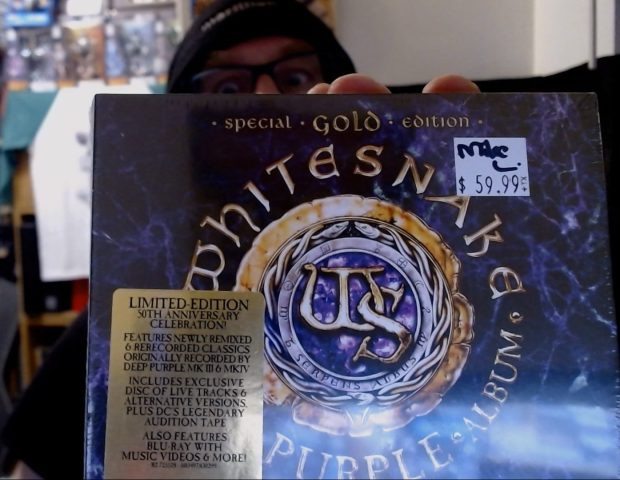
Whitesnake’s The Purple Album (Gold Edition) – Taking a look at all my Whitesnake “Colour” Albums – Red, White, Blues, Purple and more! [VIDEO]

For a good review (if I do say so myself) of the original 2015 releases of The Purple Album, click here!


David Coverdale has been remix-happy of late.  Nothing wrong with that, I just have a hard time overcoming my passion for original versions of songs that I spent time living and loving for many years.  Obviously I can’t have too much issue with it if I keep throwing money at him.  Thank you Encore Records for holding this pricey item for me.  $60 for 2 CDs and a Blu-ray disc.  Details in the scans below, along with images of my other related Whitesnake discs.

Enjoy the video below, taking a gander at all the different colours of Whitesnake!


REVIEW: Jethro Tull – Thick As A Brick (1972, 50th Anniversary remixed, cut 1/2 speed vinyl edition)

Thanks to Aaron of the KMA for sending this record for my 50th birthday!  50th anniversary edition for my 50th trip around the sun.


JETHRO TULL – Thick As A Brick (Originally 1972, 50th Anniversary Chrysalis Steven Wilson remix, cut 1/2 speed vinyl edition)

This review is focused on the remix and packaging of the 50th anniversary edition.  For a more music-focused analysis, read our 25th Anniversary CD review.  That CD came out in 1997.  How does that make you feel?  Here we are on the 50th anniversary of this great album already.

Even those who dislike remixes often approve of those done by Steven Wilson.  In 2012, for Thick As A Brick‘s 40th anniversary, Wilson created new stereo and 5.1 mixes for the album.  Such remixes work best when you play the album and can’t quite tell exactly what has changed.  Such is the case for Thick As A Brick.  The bass sounds deeper and the album sounds bigger.  You may notice musical elements you didn’t pick up on before, but the remix was clearly done with respect and never deviates too far from what you know.

The 5.1 remix is scheduled for a reissue in the fall, as even the 40th anniversary edition will get a reprint after nearly a decade out of print.

This vinyl LP was cut at 1/2 speed at AIR Studios.  According to the front sticker, this was performed on “a fully customized Neumann VMS80 lathe with fully recapped electronics”.  According to the same sticker, the 1/2 speed cutting allows better recreation of high frequencies.  I probably can’t hear them anyway, but in short:  the record sounds amazing!  The nuances of the flute, the organ, the acoustics…all here.  All thick as a brick!  Punchy.  More three-dimensional.  Because everything is so clear and in your face, this is my preferred way to listen to Thick As A Brick.  There is no struggling to hear any of the parts.  It’s all there, with good separation too.

For this reissue, the newspaper packaging has been reproduced full size.  The actual sleeve of the album is a 12 page newspaper.  This was, of course, discontinued for most reissues over the past decades.  Like a real newspaper, this packaging include crosswords and advertisements, all fake and meticulously assembled to entertain and baffle those who stumbled upon it.  The outer page, which becomes the front cover, is of harder paper stock than the inner pages.  There have been complaints of bent and damaged pages inside the shrink wrap, but this copy was perfect upon opening.

In case you need to be told, Thick As A Brick is one song, split over two sides of vinyl.  “Thick As A Brick” sides one and two; there’s your complete tracklisting!  It must be said that though side two tends to get less appreciation, the last 10 minutes are pure progressive rock delight.  The album just gallops on side two.

Get your newspaper and a coffee, and sit down to enjoy the Steven Wilson remix of Thick As A Brick.  It’s a lovely way to spend your day.

5/5 stars


REVIEW: Live – “Heaven” (2003 CD single)

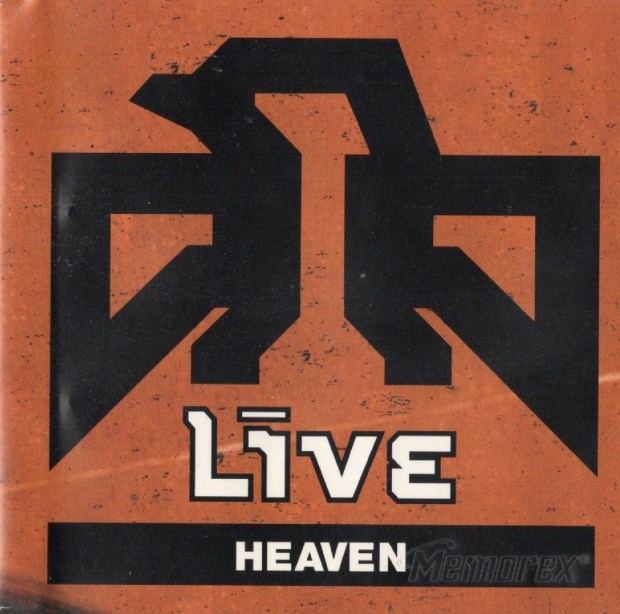
LIVE – “Heaven” (2003 Universal CD single)

If the goal is to review “everything” in the collection, then we must dig deep.  Sometimes you find things that you forgot you owned.  Things you have not listened to in 19 years.  Things you bought “for the collection” because they were cheap (staff discount).  This single would have cost me about two bucks.  Live were a good band once; Throwing Copper was a 90s staple.  I remember giving the Birds of Pray album some store play, and I think it might have been OK but obviously I didn’t feel it enough to buy it or I’d still have it today.

Let’s check out the two track “Heaven” CD single, without remembering a single thing about it.

The opening vocals on “Heaven” are an immediate turn off.  Nasal-y and annoying.  The chorus is pretty good, lots of crunchy guitars, but it almost sounds like a parody of this kind of 90s rock.  The production is excellent though; the drums really slam and the guitars cut through.  This song gets a passing grade though it’s nothing special and the lyrics are kinda irritating.

I don’t need no one, to tell me about Heaven
I look at my daughter, and I believe
I don’t need no proof
When it comes to God and truth
I can see the sunset and I perceive, yeah

I liked when Live used to sing about living in a “Shit Towne”, but this is little too much limburger.  Indeed, they did call the album Birds of Pray….

The B-side is a track called “Forever Might Not Be Long Enough”, and this is the “Egyptian Dreams Mix” of said song.  Hard pass.  The exotic loops that open are cool but then the dance beats kick in.  No idea what the original sounded like and I have to wonder if I have ever played this CD before or if this is the first time.

Back on the shelf!

2/5 stars


REVIEW: Kevin Kiner – Star Wars “Rebels Theme” (Limited edition picture single)

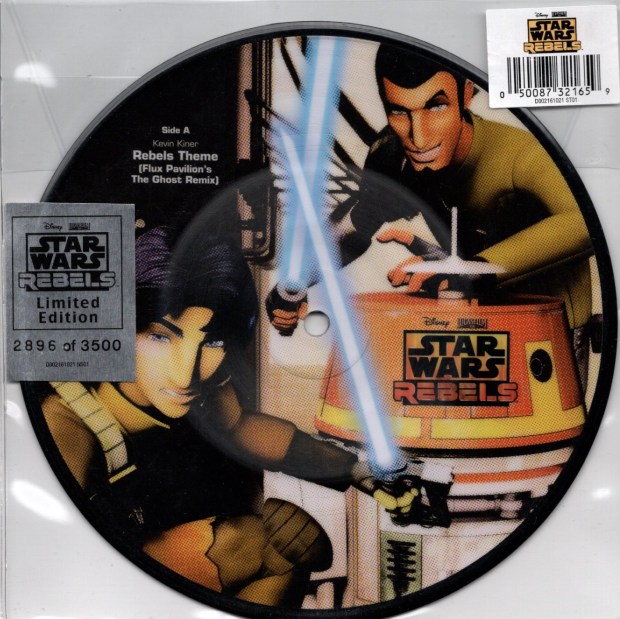
STAR WARS “Rebels Theme” (Limited edition Disney 2015 picture disc single)
Music by KEVIN KINER

You know where I stand on remixes, right?  Most of them are shite, especially when you try to dance-ify music that was not intended for dancing.  If that kind of remix is your thing, that’s cool.  You appreciate something that I do not.  I just recommend that you hit the “back” button on your browser right about now, that’s all.

I liked Star Wars Rebels.  Although it did come across more “kiddie” than Clone Wars, the era and characters it covered were more to my liking.  The Imperial era, not the Republic.  Of course, it later grew and merged with Clone Wars into a greater lore, but that is not for this review.  Just saying, check it out if you haven’t.  It’s on your Disney Plus.

Rebels’ composer, Kevin Kiner, was tasked with coming up with a new theme cue.  He did this by incorporating and adapting John Williams’ original cues.  It’s almost like a mega-mix of hero themes, in 55 seconds.  It’s just a cartoon after all, not a feature film.  Kiner’s rendition of these landmark themes is perfectly suitable to the show and honours the era in which it is set, and the spark of rebellion.

Though Star Wars Rebels has two volumes of music available on soundtracks, they were never issued on physical formats.  This single is the only place you can get a physical copy of Kiner’s “Rebels Theme”.

Unfortunately, the exclusive B-side of this single is the horrid “Flux Pavilion’s The Ghost Remix”.  It adds digital beats, noise and manipulations to the “Rebels Theme” and extends the thing by five times!  For the hell of it, there’s some laser blasts, some Wookiee howls, and some yelling.  This is utter garbage that young kids might enjoy, but makes me wanna hurl.  It deviates so far from the blueprint that it’s clear the ol’ hyperdrive needs some recalibrating.  The remix is at least memorable, for whatever that’s worth.

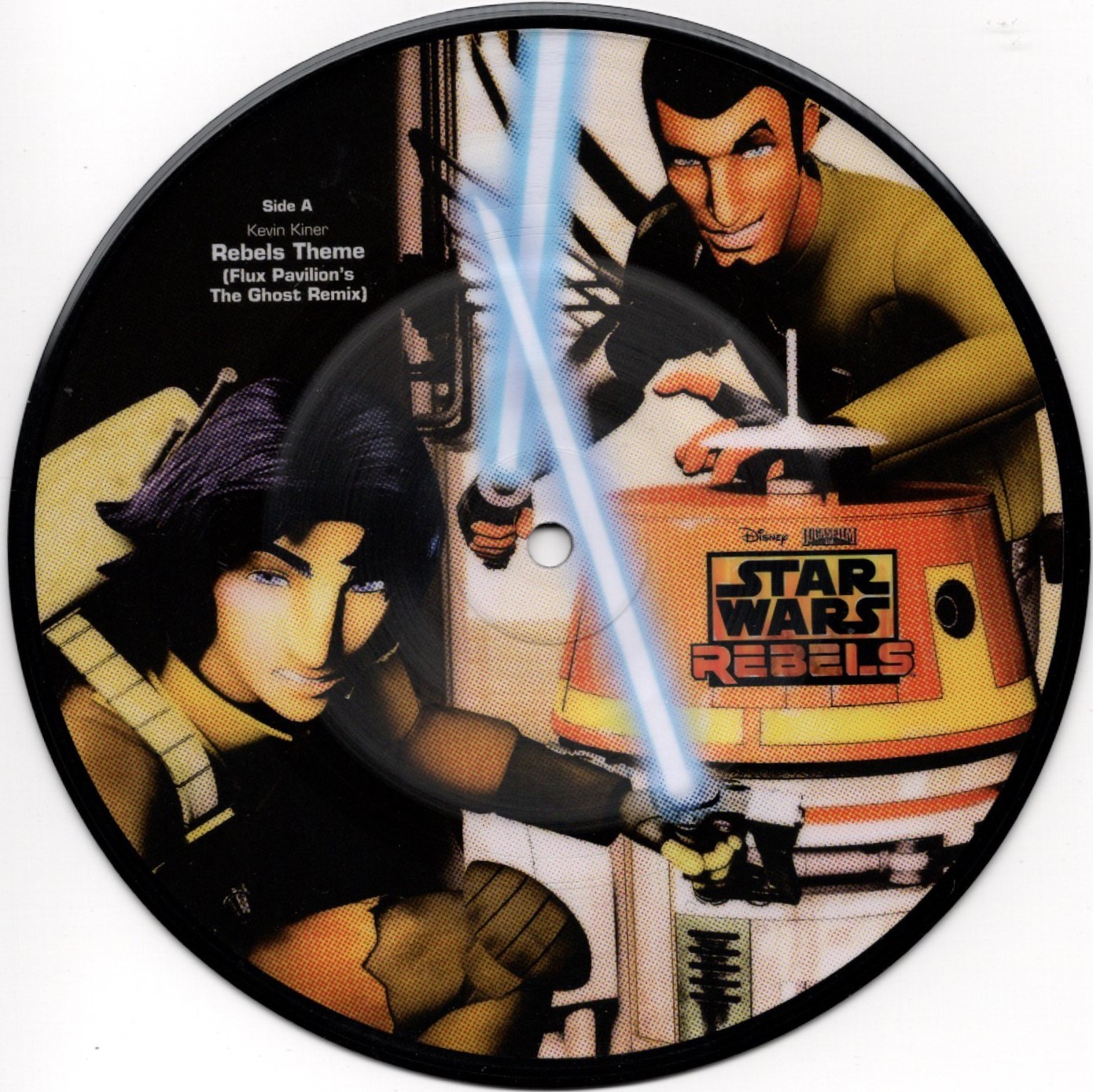
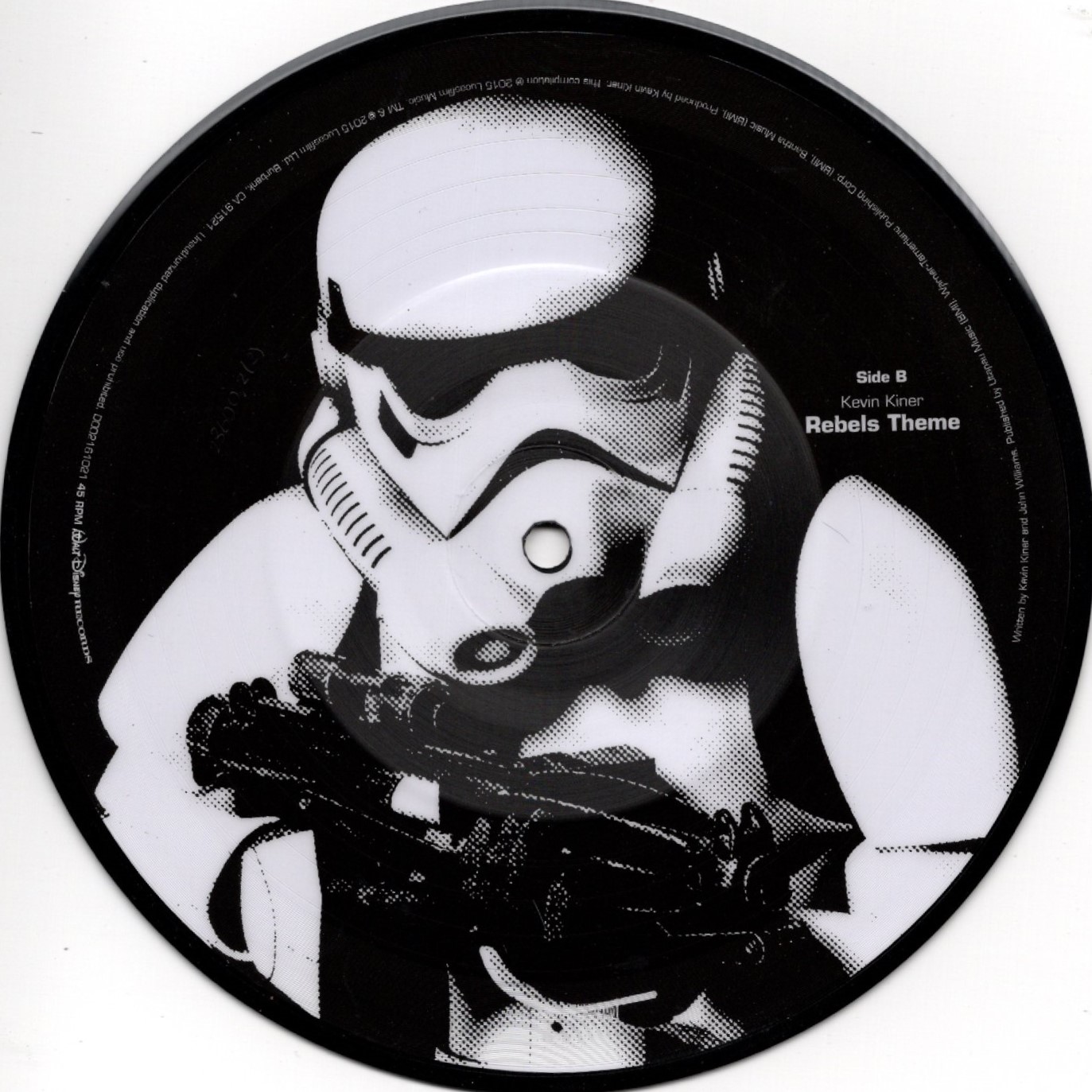
The picture disc is nice though.  On the A-side (which is unfortunately the remix side!) it’s hero Ezra Bridger with Jedi Kanan Jarrus and droid C1-10P, aka “Chopper”.  On the B-side, the original “Rebels Theme”, you get an Imperial Stormtrooper taking aim to fire (and miss)!  One of the coolest things about the Rebels show was that it used old Ralph McQuarrie designs from Star Wars pre-history.  Chopper is based on preliminary drawings of R2-D2.  Likewise the loveable character of Garazeb Orrelios is based on early designs for Chewbacca.

Being that the decent B-side is 55 seconds long while the remix is five times that length, the rating for this single cannot be high.

2/5 stars

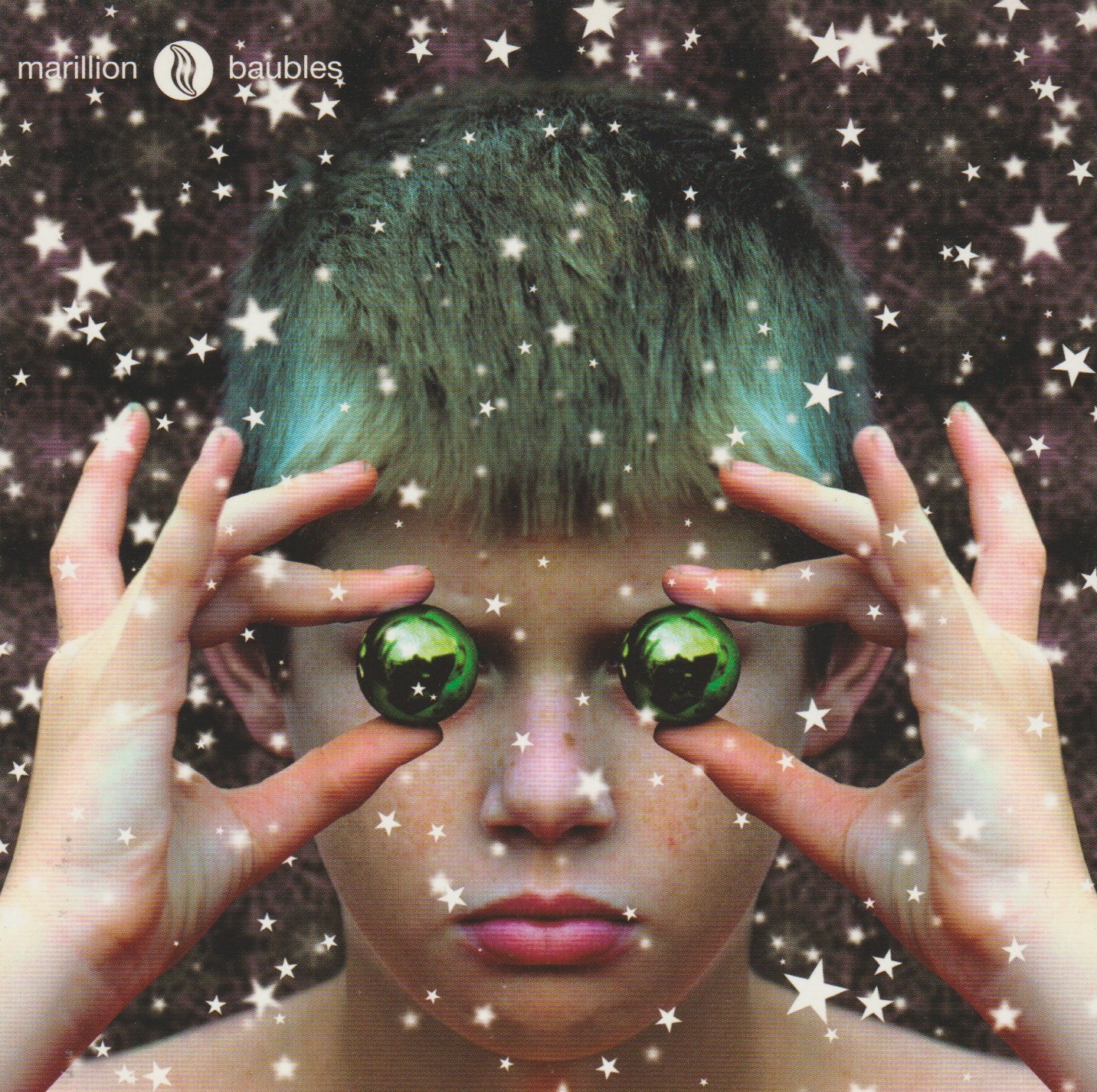
REVIEW: Marillion – Baubles – Christmas 2004

MARILLION – Baubles – Christmas 2004 (2004 Racket Records)

And now we have arrived at the worst Marillion “Christmas” album. There had to be one, didn’t there? Unusually for a Christmas CD, this one contains almost zero seasonal content. Which, you know, that’s no so bad in and of itself. Unfortunately, the 2004 Christmas CD is all remixes.

Marbles-era Marillion went a little remix-happy.  They had singles remixes.  They had a fanmade remix album (Remixomatosis) with a bonus CD of also-rans.  They had a 12″ promo single under the band name “Remixomatosis” with even more remixes.    And for the diehards who had a fanclub subscription, the annual holiday album was choked with nine more of these fanmade remixes.

The only Christmas content is the usual “Christmas Message”…which is, due to the unavailability of the band, just a remix of previously recorded Christmas messages.  Amusing?  Yes.  Disappointing?  Indeed.

The liner notes explain that Marillion received over 500 remixes from fans, and Remixomatosis represented the winners as voted for from the band.  Baubles, then, are the best of the rest.  It starts well enough, with the “Ordnance Survey Mix” of the excellent song “Map of the World”.  This one is decent because it doesn’t just mix in more drum loops, but oodles and oodles of string arrangements.  It’s “Map of the World” reimagined for strings, but unfortunately suffocating some of the regal vocal melodies in exchange.

Next is the “Demystified Mix” of “This is the 21st Century”, which begins by reducing everything to basic piano and percussion, and then adds the bass and accoutrements.  The chorus has a strange floaty quality.  Then the “2.5 Hearts in the Groove Mix” of “Fruit of the Wild Rose” is like coming down into the mud.  Very little of the original song remains, drowned by lofty beats and bass.  The funky chorus is good but the rest loses the plot too much.

“Number One” is a cool song for remixing, and this one is interesting.  Fast synth and beats turn it into something new, a pounding dark dance number.  They call it the “Whatever Mix” but it’s better than the name suggests.  It blends seamless into the “No Monsters Remix” of “If My Heart Were A Ball It Would Roll Uphill”, which doesn’t leave much of the original song intact.  I would have called it the “Boring Disco Remix”.  Moving on, “When I Meet God” is still recognizable in form of its “Ontological Mix”, with changes made to the guitar and drums.  It’s a good alternate mix to the original.

The “Latino Freak Mix” of “Separated Out” is surprising.  Taking the heaviest song on the album and making it into a mambo?  OK, I’ll give you points for that.  It’s not my cup ‘o hot chocolate, but to each their own.  The normally wonderful single “Between You and Me” is put into a laid back snooze on the “Martini Mix”, a failed (if jazz) experiment.  Finally the CD gratefully closes on the “Hard Time Mix” of “Quartz.  That aptly describes how it feels listening to this whole CD front to back.

1.5/5 stars

REVIEW: Europe – “The Final Countdown 2000” (Single)

“Oh God!  What did I just listen to?” – J from Resurrection Songs

EUROPE – “The Final Countdown 2000” (1999 Sony single)

As we edge closer to the start of a new decade, it’s the perfect time to look back at the turn of the millennium, 20 whole years ago.   Sony decided that Europe’s “The Final Countdown” would make the ideal anthem for the millennium, and so had it remixed by the guy (Brian Rawling) who did Cher’s “Believe” a year earlier.  Joey Tempest was not amused, and tried to find another mixer without success.  Drummer Ian Haughland called the finished remix a “disaster”.

The full 5:45 remix was released as a single, while a 3:47 edit version was issued on a new version of Europe’s “greatest hits”, with title updated from 1982-1992 to 1982-2000.  At least the millennium led to a performance by a reunited Europe on New Year’s Eve featuring both guitarists John Norum and Kee Marcello.

The full length remix is the antithesis to rock music.  Sped up, with bouncy synth bass and drums, it was obviously calculated for dancing.  There are keyboards, weird sounds, and samples that have nothing to do with the song.  Of the original recording, Joey’s vocals remain, but the rest sounds completely digital.  It goes on, and on.  The edit is tolerably shorter, but barely.  “The Final Countdown 2000” is an affront to rock music and everything its fans enjoy.  It is pure pandering to people who would never have bought a Europe album in the first place.  Is that what Sony felt they had to do in order to make it a hit a second time?  Imagine if Europe recorded a new version with both guitarists instead.  The song was already pop enough to be a hit again on the wave of 80s nostalgia.  It didn’t need to be mutilated to fit into a dance remix.  It surely would have done better than this (#6 in Sweden, #36 in the UK).

As a consolation prize, this CD single includes a single edit of the original song.  All it’s missing is the countdown opening.  After hearing the dance version twice, it sounds strangely sluggish (even though it’s not).  It’s like taking an offramp from the highway into normal traffic.

Possibly the worst single I’ve ever bought.  And I’ve bought Puff Daddy.

0.5/5 stars

REVIEW: Motley Crue – Quaternary (1994 Japanese EP)

MOTLEY CRUE – Quaternary (1994 Elektra Japanese EP)

For me, undoubtedly the most heavily anticipated new album of 1994 was the new Motley Crue.  Originally titled ‘Til Death Do Us Part, the self-titled ’94 Crue disc was their first with new singer/guitarist John Corabi.  They holed up with producer Bob Rock and knuckled down, creating what could have been the most important album of their careers.  The long wait (five years between studio albums) and cryptic remarks from the studio indicated that this would be the heaviest Motley album ever, and their most ambitious.  The new, serious Motley for the 90’s had, as always, written plenty of extra material too.

In addition, producer Bob Rock had an idea for getting creative juices flowing.  He asked each of the four members of Motley Crue to write and record a solo track with no input from the other members.  This was slightly historic:  the first time Nikki Sixx, Mick Mars, Tommy Lee or John Corabi had done anything solo.  With all the numerous outtakes recorded for the Motley Crue LP, there was now plenty of extra material to put out as a bonus EP.

Scan_20160612A mail-away coupon inside the Motley Crue CD alerted fans that five more tracks were available by mail order only.  20,000 copies of the original EP were pressed.  They included all four solo tracks and a new Motley Crue song called “Babykills”, featuring fifth Beatle Billy Preston on clavinet!

Still, the lucky fans in Japan didn’t have to mail away for anything.  They were able to buy Quaternary right on their store shelves, and because it’s Japan, they also got bonus tracks.  The Japanese version of Quaternary was not a five song EP, but more like a nine-song mini-album.  I had no idea such a thing existed until finding one at Sam the Record Man in Toronto in the summer of 1996.   It still has the price tag:  I paid $49.99, for a total of three songs that I did not have before.

Today, every one of these songs can be found on the box set Music to Crash Your Car To: Volume II, along with even more bonus mixes.

Quaternary commences with industrial noises and studio dialogue:

Tommy Lee:  “I can’t play with fuckin’ clothes on man, this is bullshit.”
Bob Rock: “Play naked.”
Tommy Lee: “Fuckin’ jeans on, a fuckin’ shirt…what up with that?”
Bob Rock: “What, do you work in a bank?”

The industro-rap metal of Tommy Lee’s “Planet Boom” is a track he had been working on for years. An early version made its debut in the background on the 1992 home video release Decade of Decadence. Even though the words “industro-rap” and “Tommy Lee” don’t really sound good together, “Planet Boom” kicks ass. Tommy played all the instruments, utilising a simple, detuned Sabbathy riff and a relentless drum loop. The strength of his vocal came as a surprise, as did the song in general. A few years later it was remixed for Pamela Anderson’s movie Barb Wire. (Stick with this original.)

After a brief studio discussion with Mick Mars about hemorrhoids (?), his blues instrumental “Bittersuite” blows your ears off. Motley fans know that Mick Mars is the most musically talented member, considered an underrated and under appreciated rock god. The blues-rock of “Bittersuite” isn’t as satisfying as I imagine a pure blues offering to be, but there is no doubting Mick’s talent here. Both as a writer and a player, Mick hit it out of the park (Chris Taylor played drums). Mick’s goal was to pay tribute to rock-blues greats like Beck, Hendrix and Blackmore. Mission accomplished. His guitar tone is beautiful and so are his emotive licks.

Nikki Sixx goes third, with another industrial-metal cross. “Father” is one angry fucked up track. It’s heavy and direct, on-trend for 1994, and very abrasive. The riff and song are simple, but Nikki’s anger leaks through. “Father — where were you?” Backwards guitars, electronics and loops on top — you can tell Nikki and Tommy were listening to the same kinds of music at the time!

New kid John Corabi goes last, and in the liner notes he says that “Friends” is his first piano song. He meant to go acoustic, but “Friends” just came out of him. It’s a pretty Queen-like ballad with lovely harmonies in the middle. Although Mick Mars’ song is probably a greater technical achievement, “Friends” is my favourite of the solo tracks. When a guy like Corabi gets going on a ballad, it’s usually going to be amazing anyway. Throw in the Queen elements, and I’m just a sucker for it! It’s really a shame that Motley did not continue with John beyond this. The potential for greatness was always there.

After more studio chatter, we break into “Babykills”, the Billy Preston collaboration. “Babykills” is fun and funky hard rock, probably the heaviest thing Preston ever played on. Unfortunately his part is little more than an added topping. Great tune though; probably far too good to lie hidden away on an obscure mail-order EP.

An impromptu jam that seems to be called “I Just Wanna Fuck You (In the Ass)” ends the original EP on a jokey note.  “What the fuck do you want, for fuck all?”

Scan_20160612 (3)

As mentioned, the Japanese had bonus tracks.   These are tracks that did not make the finished Motley Crue album, since they had recorded so much extra material.  “10,000 Miles Away” is a cool blues ballad, showing off more of Mick’s fine fingerwork.  It was obviously too much of a standard sounding song to fit in with the experimental Motley Crue album.  Not that the album stood a chance in hell after grunge cleared the decks, but you do wonder if it would have been better received if some of these more digestible songs were included on it.

The one track on the Japanese release that is easy to skip is the Skinny Puppy remix of “Hooligan’s Holiday”.  This track was already available on the “Hooligan’s Holiday” single and it’s since been re-released in other places too.  It’s long — over 11 minutes.  Dave “Rave” Ogilvie remixed it with Dwayne Goettel and cEvin Key, so it is of possible interest to Skinny Puppy collectors.  The thing that bugs me about it is that it strikes me as lazy.  The song is pretty much the same as always for the first three minutes, and then the remixing begins.  The whacked out and frankly boring remixed part goes on for almost seven more minutes, before transitioning back to the standard song.  In other words, what Skinny Puppy did here was edit out the middle section and guitar solo of the song, drop in seven minutes of remixed barf, and then put the ending back on.

Two demos round out the CD:  “Hammered” (which did make the album) and “Livin’ in the No” (which did not).  The “Hammered” demo is structurally the same as the album version, no radical departures.  It sounds like much of it is live in the studio, and it’s clear that Motley were focusing on grooves.  It’s all about the four guys being locked in.  Finally “Livin’ in the No” is in the standard hard rock mold.  Again, a track like this fits in less well with the unorthodox LP, but might have made it more accessible for fans.  Even so, a guy like Vince Neil would never have been able to sing “Livin’ in the No” and make it sound good.

There is little question that the Motley Crue album deserves its 5/5 star rating.  This being a collection of outtakes, the same cannot be expected.  Still, it does deserve a very respectable:

4/5 stars

Get the complete EP including all Japanese bonus tracks on Music to Crash Your Car To: Volume II. That set also contains more remixes originally from single B-sides of the era: “Misunderstood” (Guitar Solo/Scream Version), “Hooligan’s Holiday” (Derelict Version), “Misunderstood” (Successful Format Version), “Hooligan’s Holiday” (Brown Nose Edit).
Scan_20160612 (5)