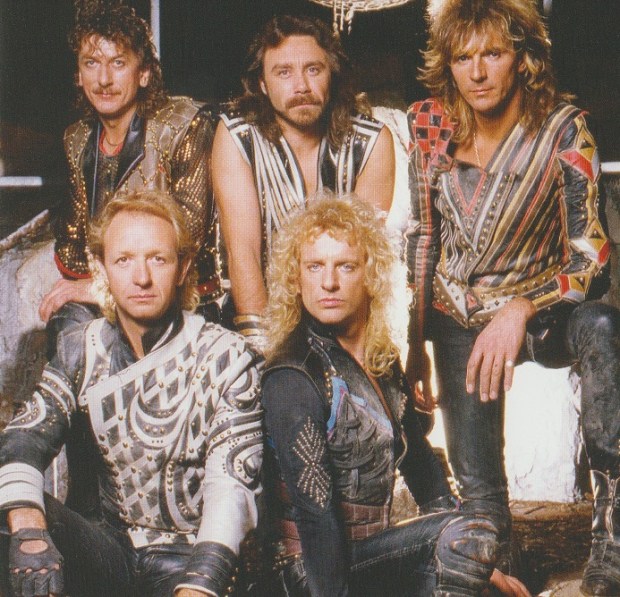
rob halford

VHS Archives #13: Two Rob Halford interviews (1990)

Two fantastic, historic clips for you today, featuring the “Metal God” himself, Rob Halford of Judas Priest!

First up, from MuchMusic’s news show called FAX, Steve Anthony talks to Rob about the Judas Priest suicide trial.  They also talk Priest’s new album Painkiller.  (The anchor of the FAX show is Monica Deol.)

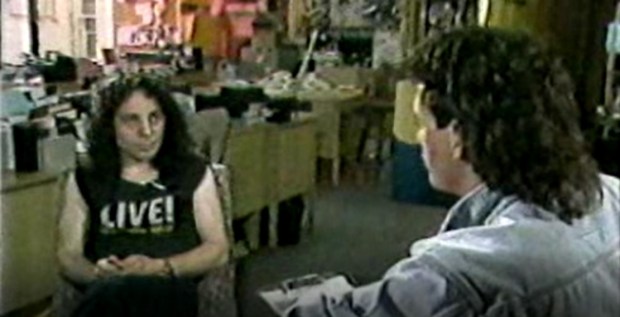
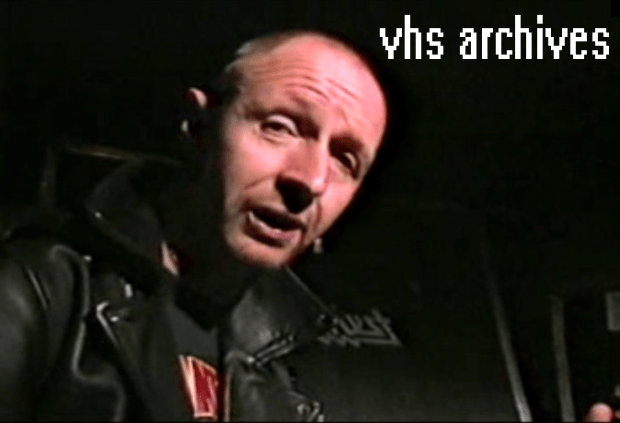
Second, and most important: Dan Gallagher visits the Scarborough rehearsal hall where Priest were gearing up for their Painkiller tour! Rob is friendly and engaged for this top-notch interview. Halford co-hosts the Pepsi Power Hour with Dan, and talks about his passion for new heavy bands like Pantera (he’s wearing the shirt), Love/Hate, and Suicidal Tendencies. They also discuss the trial, the drummer change, education, and reading. “I consume books,” says Rob. You’ll be impressed with Rob’s answers especially where the trial is concerned.

Rob picked all the music for the show, and while I didn’t include the music in the VHS Archive, you can at least find out what bands and songs Rob picked! (Hint: heavy bands!)

Also look for a Painkiller tour ad during one of the commercial breaks — I kept that in.

VHS Archives #5: Rob Halford interview (1986)

This brief but great clip has MuchMusic’s Terry David Mulligan getting Rob Halford to open up about drugs and Judas Priest’s image.  TDM hosted a show called MuchWest, but this was aired on the Power Hour.  Summer 1986, (presumably from Expo ’86) and Rob’s got a moustache and slick, long hair!  Definitely a look that didn’t stick.

VHS Archives #2: Hear N’ Aid Special – Pepsi Power Hour (1986)

The one VHS tape I’m working on currently spans a period of recordings from about July 1986 to September 1987. This Hear N’ Aid special features a MuchMusic interview conducted by J.D. (John) Roberts. There’s lots of exclusive information in this valuable video, including a tidbit on bands who refused to be in the same project as Spinal Tap!

REVIEW: Judas Priest – Firepower (2018)

JUDAS PRIEST – Firepower (2018 Sony)

It’s 2018 and the Priest is back.  The excitement for the mighty metal band’s return has been restrained by the knowledge that Glenn Tipton is too ill to tour.  Parkinson’s disease — what a bastard that is.  Co-producer Andy Sneap has stepped up to take over Glenn’s guitar parts on tour.

Meanwhile on album, Glenn’s contributions to Firepower can be heard.  Sneap and classic Priest producer Tom Allom recorded one of the most biting Priest albums to date.  More impressive than the sound they captured are the performances.  Rob Halford in particular is more expressive than he has been in years.

At 14 tracks and almost an hour, Firepower suffers only from too many tracks.  There are a couple that clearly could have been cut and left for B-sides or bonus tracks.  “Flame Thrower” (similar to “Hot For Love” from Turbo), though a cool title, would have been great on a B-side.  On album, I’d rather race ahead to some of the more exciting tracks.

Firepower throws it back to sounds of the past.  Sometimes it’s Painkiller, and sometimes Angel of Retribution.  Rock writer Heavy Metal Overload noticed sonic similarities to Halford’s Resurrection CD.   At other times it’s brand new, because guitarist Richie Faulkner brings new things to the table, such as slide.

There are many highlights among the 14 tracks.  “Evil Never Dies” and “Never the Heroes” both immediately jump out for their melodic mastery.  Rob is sounding better than he has on the last couple, with a few tasty screams to enjoy.  As time goes on, new favourites will replace old.  Perhaps it’ll be “Spectre”, “No Surrender”,  “Children of the Sun”, “Rising From the Ruins” or even “Flame Thrower”!  Another highlight:  mellow album closer “Sea of Red” which bears lyrical similarities to “Blood Red Skies” from 1988’s Ram It Down.  In general, Firepower is about fighting back.

The cover art by Claudio Bergamin is Priest’s new mascot, “Titanicus”.  Silly name aside, this one Priest’s best album cover in decades.  (Mark Wilkinson continues to contribute to the packaging art as well.)  Notice how Bergamin’s lines match up with the style of past Priest albums like Screaming for Vengeance.

It’s hard to imagine a better album this late in their career.  Priest have done it again.  Firepower lives up to its name.

4.5/5 stars


JUDAS PRIEST REVIEWS


REVIEW: Judas Priest – Hero, Hero (1981)

JUDAS PRIEST – Hero, Hero (1981 Gull)

It’s true:  By all measurements, Hero, Hero is an exploitive compilation of Judas Priest material.  Their first record label, Gull, was prone to do this.  However this is no typical “hits” set; this one is of interest to collectors and die hard fans.

Hero, Hero (named for a lyric from the song “Dying to Meet You”) was originally released in 1981 to take advantage of Priest’s rising star. The original two releases on Gull records, Rocka Rolla and Sad Wings Of Destiny, had been exploited previously in a compilation called The Best Of Judas Priest, which was a single record. Hero, Hero was a double record which included all of Rocka Rolla and most of Sad Wings, as well as the crucial Joan Baez cover, “Diamonds and Rust”, in an alternate take (previously heard on Best Of).

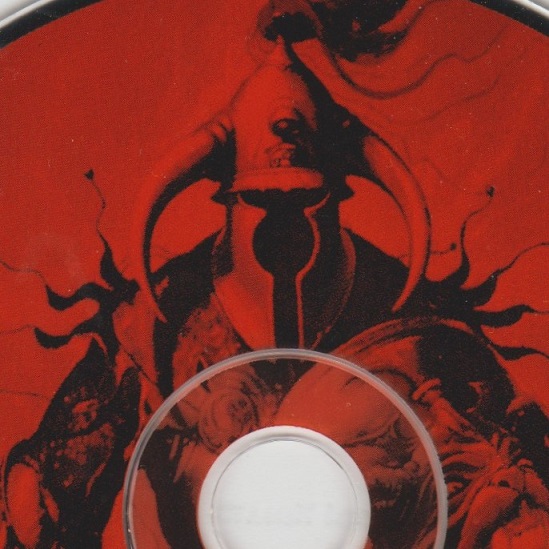
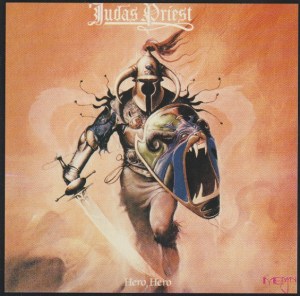
So, if you have all that material already, why is this album required at all?  Cover art aside, of course.  That cover (a pre-existing painting) is brilliant.  There is also a Kiss bootleg called Barbarize with the same cover.

The reason is revealed in the liner notes. All of Rocka Rolla had been remixed for this release. Why is unknown, as that record sounded just fine for what it is. The remixes are, in general, not even all that different. The major changes are made during “Cheater”, the “Winter” suite, and “Rocka Rolla” itself, during which major portions of the songs are noticeably shifted around. “Rocka Rolla” has its verses rearranged, and there’s a burst of harmonica in “Cheater” where there never was before.

The remix done to Rocka Rolla doesn’t really add or subtract anything from the album, which makes it that much harder to understand why it was done.  Why Gull records spent the money to remix these tracks is unknown, and the names of the engineers involved are a mystery.  But there it is:  Rocka Rolla remixed in its entirety but not in order, here on the Hero, Hero album.  Because they’re less familiar to the ear, they sound fresh, but in many cases you’d struggle to point out differences.  A little reverb here, a little echo there.

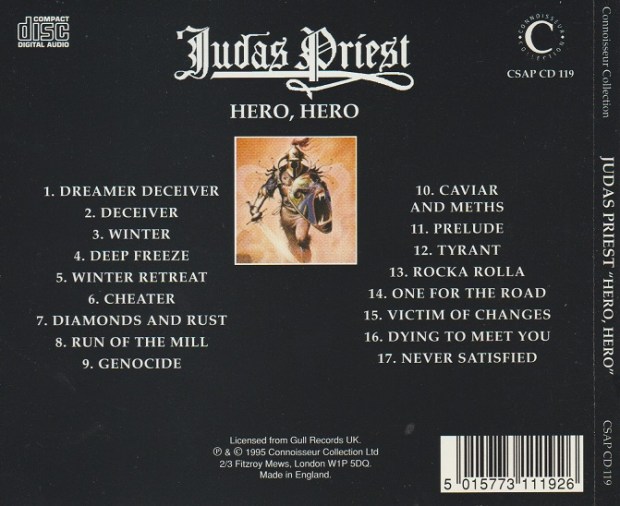
Highlights including a bluesy “Cheater” and the flanged chug of “Diamonds and Rust”.  The six tracks from Sad Wings of Destiny are brilliant.  “Dreamer Deceiver” and “Deceiver” are used to open this CD, but that is not the original running order.  Normally the album begins with “Prelude” and “Tyrant”, also from Sad Wings.  The original Canadian cassette version on Attic maintained the original running order with “Prelude” at the start.  Essentially, the Connoisseur Collection CD has side one and side two flipped.

Fair warning to CD buyers:  There are some shoddy reissues of this album that don’t have the remixed tracks.  Transluxe is one such version.  To make your life easier you might just want to look for an original 1981 LP.  The pictured CD from Connoisseur Collection (1995) does have the remixes, so you’re good to go if you spot one.

3/5 stars


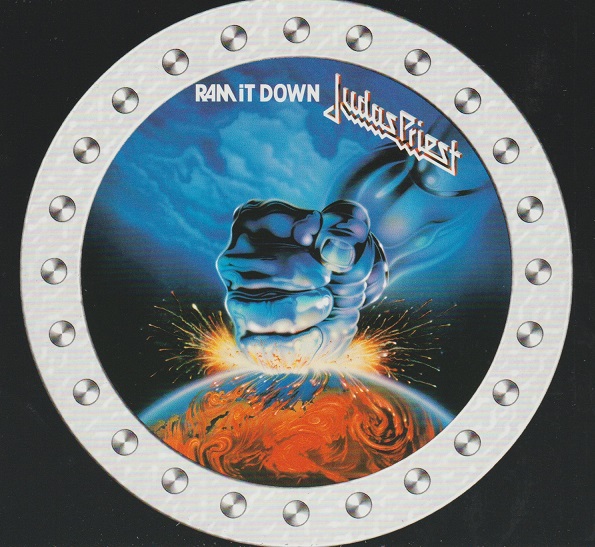
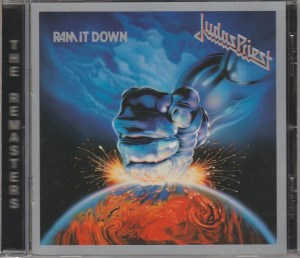
REVIEW: Judas Priest – Ram It Down (Remastered)

JUDAS PRIEST – Ram It Down (Originally 1988, 2001 Sony remaster)

Judas Priest seemed pretty lost in the late 80s.  They were bigger than ever, but they lost focus of their musical direction.  Producer Tom Allom had cursed them with a robotic plod, far removed from the lively firepower of yesteryear.  When they released Turbo in 1986, they had gone as far down those roads as possible.  It was am ambitious departure, but 100% a product of the 1980s.

For Turbo, Priest had written enough songs for a double album.  Twin Turbos, as it was to be called, was supposed to reflect all facets of metal, but the record comany got cold feet and a single disc was issued.  It contained the most techno-commercial tracks, while Priest held onto the rest for another day.  That day came in 1988 when Priest (again with producer Tom Allom) released Ram It Down, largely made up of Turbo outtakes.  The album was hyped as a return to the heavy Priest of yore, and this was at least partly true, but fans were unconvinced by it.  In comparison with Turbo, yes, Ram It Down was heavier.  But Priest had gone as far as they could with Allom.  Ram It Down was too sterile and bogged down with filler.

Certainly the title track opens Ram It Down on a thrash-like note.  As if to silence to critics, it was a proud metal statement with an opening Rob Halford scream that curdles the brain.  The weakness is drummer Dave Holland on his final Priest outing.  Only when Scott Travis joined Priest in 1990 did they acquire a drummer who could play the kind of beats at the speed they needed.  On Ram It Down, Priest were held back by the drummer and clunky production, two mistakes they fixed on 1990’s Painkiller.  The lyrics also seem dumbed-down for the 80s.  “Thousands of cars, and a million guitars, screaming with power in the air,” is cool but cliche.

“Heavy Metal” is more of the same lyrically, an ode to the power and glory of power chords.  Rob Halford’s performance is fantastic, and the man has rarely sounded as fantastic as he does on Ram It Down.  You can’t say the same for the words, the highschool equivalent of poetry.  On the music front, Priest were now following rather than leading.  They were on the same clunky metal trip as bands such as Scorpions at the same time.  There audible Kiss and Whitesnake influences on the album, with Rob sometimes sounding like he was trying to write a Gene Simmons tune.  “Love You to Death” on side two sounds right out of the Demon’s closet.  The embarrassingly terrible  “Love Zone” and “Come and Get It” both sound as if Coverdale co-wrote them on the sly.  Whether Priest were consciously copying other bands or just lost, who knows.  (“Love Zone” is one of the few songs that Halford almost seemed to write gender specific.  “With your razor nails and painted smile” are not specifically referring to a female, but certainly that was the general assumption.)

There are definitely a few cool tracks that deserve mention.  The first is “Hard as Iron” which had to be one of the fastest Priest songs to date.  It’s still held back by the production, but has some serious energy to it.  Like metal espresso injected right into the brain!  The other standout is “Blood Red Skies”, a forgotten highlight of this album and indeed of the Priest catalog in general.  (I actually used “Blood Red Skies” in a poetry project for school.  A girl liked it so much she asked for a copy of the lyrics.)  Using the synth effectively, “Blood Red Skies” paints a Terminator-like future with humans hunted by beings with “pneumatic fingers”, “laser eyes” and “computer sights”.  Halford  pours power and anguish into it, as a human freedom fighter.  “As I die, a legend will be born!”  Cheesey?  Absolutely.  Priest perfection?  Yes indeed!

There are also two mis-steps on Ram It Down that must be addressed.  The first and most obvious is “Johnny B. Goode”, from the 1988 movie Johnny Be Good starring Anthony Michael Hall and some guy named Robert Downey Something.  This track should have been kept off the album.  As a novelty single, sure, you can dig it.  It’s a stereotypical cliche-ridden metal cover, and that’s fun for a goof.  As a Priest album track, it only serves to completely destroy any momentum that Ram It Down managed to build.  Then there is “Monsters of Rock”.  This awful excuse for a song is only 5:31 long, but seems twice that.  It is the prototype for the even more awful “Loch Ness” from Angel of Retribution.  Most buyers probably didn’t finish listening to the album because of this bloated and aimless track.

The Priest Re-masters collection had two bonus tracks per studio album.  Ram It Down provides two completely unrelated but great tracks:  live versions of “Bloodstone” and “Night Comes Down”.  The liner notes don’t state when they were recorded, but live versions of either are always welcome in any Priest collection.  It’s interesting that bonus tracks from these actual sessions, such as “Red, White and Blue”, were used on other CDs but not Ram It Down.

Priest may have known Ram It Down wasn’t the metal album they hoped to make.  They cleared house afterwards.  Dave Holland and Tom Allom were done, and there is no question that Painkiller was superior to Ram It Down because of that.

2/5 stars


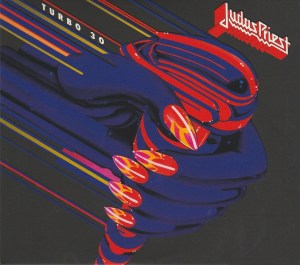
REVIEW: Judas Priest – Turbo 30 (2017 deluxe 3 CD set)

JUDAS PRIEST – Turbo 30 (2017 Sony Legacy 3 CD set)

It is sheer delight to see Judas Priest’s once maligned Turbo to finally see some vindication.  There was a time this album was shied away from completely.  They played no tracks from it on the 1990-91 Painkiller tour.  In 1990, Priest finally pulled themselves out of a slide into dangerously commercial territory.  For a long time, Turbo was considered a musical detour that did more harm than good.  However the frost thawed quickly and Priest began to put the title track back into the set around 2001 for their Demolition tour with Tim “Ripper” Owens.  Today there is no longer any shame in cranking Turbo while hoisting a tall cool one.

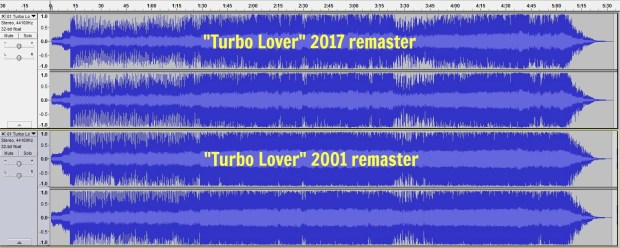
The 30th anniversary edition of Turbo contains a freshly remastered edition and two live discs.  The sound is greatly improved from the 2001 version from the Priest Re-masters series.  As you can see by the waveform below, the 2001 version at bottom was a victim of the “loudness wars”, and much of the dynamic range was lost by pushing it to overdrive.  The 2017 version at top has more peaks and valleys.  The new version wins for overall for having more warmth.
What the 2017 version does not have are the two bonus tracks included on the Priest Re-masters version.  They were a live version of “Locked In” (which would be somewhat redundant here) and an unreleased studio track called “All Fired Up” which sounds like a Ram It Down outtake.  For a complete review of Turbo and these bonus tracks, please refer to our review of the Turbo 2001 CD edition.  The rest of this review will focus on the two live CDs inside Turbo 30.

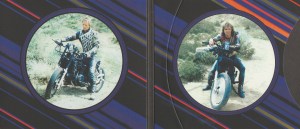
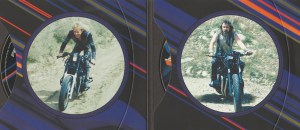
The Fuel For Life tour that followed Turbo was one of Priest’s biggest.  Their stage featured a riser that “transformed” from a race car to a robot that would lift Glenn Tipton and KK Downing in the air with its claws.  It was commemorated by an album (Priest…Live!) and a separate home video from a concert in Dallas, Texas.  This new double live comes from a show in Kansas on May 22 1986.  It is 100% superior to Priest…Live! by every measure and could supplant that 30 year old album in your collection.

The set list varies a little from Priest…Live! but hits the same key tracks.  The ballsy synth ballad “Out of the Cold” still opens the set, a brave move even in 1986.  It is certainly the most unexpected of all Priest’s openers, so bravo.  “Locked In” is restored to its spot in the set; it was not on Priest…Live!  A version from an unknown concert (the liner notes are vague) was on the prior edition of Turbo as a bonus track.  “Locked In” isn’t a major track but still important due to its place as part of the “Turbo Lover” music video duology.  This live version is the best yet, loaded heavy with plenty of guitar thrills not present on the studio original.  From there it’s on to “Heading Out to the Highway”, nicely in the pocket.  Rob Halford’s screams are ferocious.  Next is the march of the “Metal Gods”, another version far more lively than the one on Priest…Live!  Seems there is much less mucking around with the recordings this time.
“Breaking the what?  Breaking the what?  Breaking the what?”  It’s that silly yet tried and true song intro.  Post-British Steel, you just can’t have a Priest live concert without “Breaking the Law”.  But always remember, that in the dead of night, “Love Bites”.  From 1984’s Defenders of the Faith, “Love Bites” was very different for Priest but still a set highlight.  (Incidentally, British Steel and Defenders of the Faith are the other Priest albums that had recent triple disc deluxe editions with live albums.)  Then more from Defenders:  Two killers in a row, “Some Heads are Gonna Roll” and “The Sentinel”.  Two songs that fans never tire of, and some credit must be given to the mighty guitar duo of Tipton and Downing.  Their trade-offs are sublime, and Halford curdles the blood.

Back into new material, “Private Property” was one of Priest’s more obvious grasps for a hit.  It’s far from a must-have, but better at least than the version on Priest…Live!  A mere five minutes later you will be transported to the “Desert Plains”, a Point of Entry deep cut that was excluded from Priest…Live!  It is far faster live and stay tuned for a long voice-shredding breakdown by Halford.  (Rob was clean at this point in his life.  Rob Halford recommends vocal rest between shows, menthol eucalyptus gum, and herbal tea to maintain a strong voice.)  A frantic “Rock You All Around the World” from Turbo ends the first disc with a filler track that is again better here than on the prior live album.

Screaming for Vengeance brings the fury for disc two, “The Hellion” (taped intro) and “Electric Eye” bring the focus clearly back to heavy metal, just in time to go for a spin with “Turbo Lover”.  This song is now a beloved classic, finally appreciated for its sharp songwriting and adventurous production.  Downing and Tipton pushed synths into heavy metal in a big way, but with integrity and ingenuity.  Better run for cover indeed, and fast…for next is “Freewheel Burning”, a natural for keeping with the theme of turbos and the like.
As the disc roars to its close, we are treated to some serious historic Priest.  The oldest track is “Victim of Changes”, from the immortal Sad Wings of Destiny (1976).  This most dramatic of Priest compositions is always welcome in the set, yet was not on Priest…Live! probably to avoid overlap with 1979’s Unleashed in the East live album.  This one boasts a blazing hot guitar solo and some of Rob’s most impassioned wailing.  This stretches out for nearly nine minutes of pure metal brilliance at its most vintage.  But the vintage metal gift-giving is not over, because “The Green Manalishi” (1979’s Hell Bent for Leather, via Peter Green’s Fleetwood Mac) delivers the greatest of all riffs.

It’s nothing but the hits from there:  “Living After Midnight”, “You’ve Got Another Thing Coming”, and “Hell Bent for Leather”, the standards that everyone knows.  “Another Thing Coming” is stretched out with Rob’s annoying back-and-forth with the crowd, but it is what it is.  “Heavy metal communication”, he calls it.  Nobody is buying this CD for another version of that song anyway.

“You don’t know what it’s like!”  So get this package, the triple CD set, and you will!

5/5 stars
 

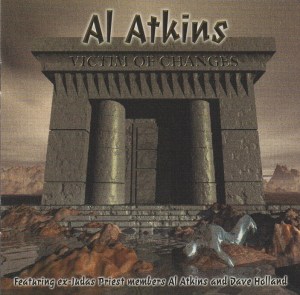
REVIEW: Al Atkins – Victim of Changes (1998)

scan_20161117AL ATKINS – Victim of Changes (1998 Pulse)

Al Atkins was the original lead singer in Judas Priest, before “Bob” Halford was invited to join. You’ll find a number of Atkins credits on the first two Priest albums, even though he was out of the band by that time. In fact, Atkins formed a band called Judas Priest in 1969. The band were named by bassist Bruno Stapenhill. They split in 1970, and Atkins went looking for a new band. He found them in Ken “KK” Downing and Ian “Skull” Hill, who were looking for a singer. With Atkins and drummer John Ellis, they eventually settled on the name Judas Priest, same as Atkins’ prior band. And yes, that means that Ian Hill is actually the only remaining original member of Judas Priest.

Atkins wrote and co-wrote much of Priest’s earliest material. Before he left, he wrote a song called “Whiskey Woman”. Rob Halford used that song and merged it with one of his called “Red Light Lady”. The result was “Victim of Changes”, the first and perhaps greatest of Judas Priest’s epics. Two other songs he wrote in Priest were “Mind Conception” and “Holy is the Man” which were demoed but never released.

Atkins worked a 9-5 job after Priest, but got back into music again in short order. His fourth solo album, Victim of Changes, was essentially a tribute to his Judas Priest years. It is a collection of new recordings of (mostly) a lot of numbers that Priest played live during the Atkins era.  As a gimmick, he had Priest’s drummer from the 1980s, Dave Holland, on this album.

Atkins and Halford couldn’t sound less alike.  Rob is known for his high-pitched operatics.  Atkins has a gutsier, grittier sound, somewhat like a Paul Di’anno meeting Blaze Bayley.  There is no question that Rob is the right singer for Judas Priest, so it is really only a matter of curiosity to hear these tunes with Atkins singing.  The tunes are at least good.

The unreleased “Mind Conception” commences the disc, re-recorded and very modern sounding especially in the guitars.  It is difficult to know exactly what the original “Mind Conception” sounded like, but it’s very safe to say it would not have sounded like this.  In the liner notes, Atkins states the original demos were recorded stoned and with a sore throat.  “Holy is the Man” has a slower groove to it, and would work very nicely as a modern Priest track.  As the only representation of these unreleased tracks available, die-hard Priest collectors will want to hear them.  Another track of interest is the cover of Quatermass’ “Black Sheep of the Family” which Priest played live at their earliest gigs (along with Hendrix’s “Spanish Castle Magic”).  Rainbow’s recording is still the one to beat.

scan_20161117-2

The familiar Priest tracks are actually anything but.  They are probably arranged more like the way Priest used to play them in the early days.  “Never Satisfied” is extended with a tough bluesy acoustic intro.  The heavy parts have a Zeppelin-y beat, due to Holland’s straightforward style.  Same with “Winter”.  Then there is “Caviar and Meths” which is a whopping 7:12 long.  According to Atkins, this song was their big finale live, but never recorded in full in the studio.  This version is the full-length arrangement that they used to close with live.  And it’s brilliant.  Finally there is “Victim of Changes” itself, and Atkins has some help from a backup singer for the high parts that Rob does.

There are a couple tracks that could be considered filler, since they have nothing to do with Judas Priest.  These are the instrumentals “The Melt Down” and “Metanoia”, written by guitarist Paul May.  They are excellent tracks, however, and should not be ignored.  (“Metanoia” serves as a postscript to “Winter” on the CD.) They are European sounding heavy metal tracks, loaded with guitar drama and ferocity.

Check out Victim of Changes for a glance at what Priest might have sounded like with Al Atkins singing lead.  One can hope for those unreleased demos to surface, but one can also wish for the moon.

3/5 stars

REVIEW: Two – Voyeurs (Japanese bonus track) #200wordchallenge

The #200wordchallenge continues!  The complete review for the original Two Voyeurs CD can be found by clicking here.

200 word


TWO – Voyeurs (1998 DML Music Japan)

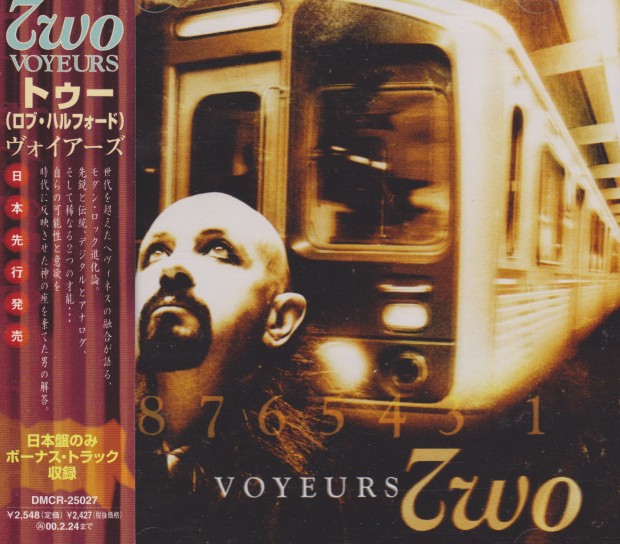
Rarity acquired!  After many years of searching, I snagged a mint condition Japanese copy of Rob Halford’s album as Two with John 5.  It was priced affordably and included the obi strip, always important to collectors.  The Japanese copy has a second booklet with pictures of the band, missing from the original CD.  Rob and John casually enjoying coffee in front of a wall of X-rays?  It’s in here!

The bonus track is called “In My Head” and it’s surprising how different it is from the album at large.  It still sounds like the industrial metal of Two, but criss-crossed with dirty blues.  It’s like Two meets the Black Keys, in a wormhole from before the Black Keys even existed.  Rob has occasionally shown a penchant for mixing the blues in with his heavy metal.  Witness “A Little Crazy” from the first Fight album.  John takes a really cool and inventive solo break on this track complete with plenty of slide.  Had this track been on the original album, it might have had more appeal with the rockers, though that’s admittedly a long shot.

It’s not easy to find, but worth finding for the industrial blues of “In My Head”.

4/5 stars

REVIEW: Judas Priest – Battle Cry (2016)

NEW RELEASE

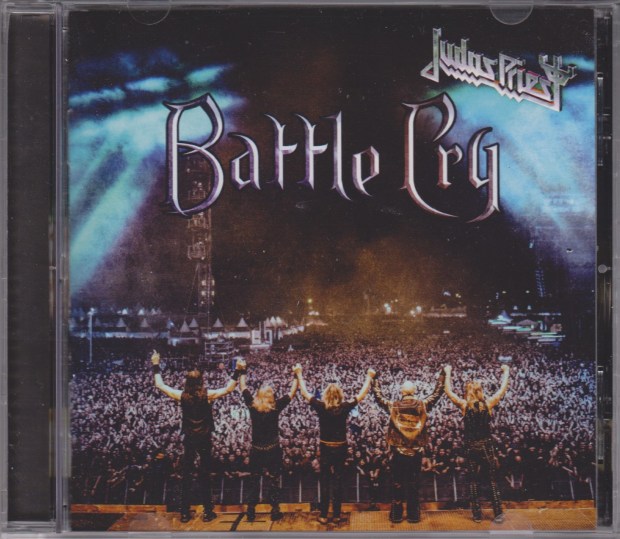
Scan_20160407JUDAS PRIEST – Battle Cry (2016 Sony)

Woah-ho!  Here comes the Priest with yet another live album!  How many does this make it?  Officially that’s six, not including live discs within deluxe editions, or live DVDs!  Battle Cry is the newest, recorded last year at Wacken (August 1 2015).

Some fans like to moan and complain every time an older band like Priest or Maiden release a live album.  You can see their point, but at the same time, how much longer will Priest be touring?  Don’t you want a live album with all their newest songs?  Priest’s last album, 2014’s Redeemer of Souls, was a triumphant return for the band, who had suffered a major lineup change.  KK Downing was out, and new kid Richie Faulkner was surprisingly able to take his place on the stage, and in the songwriting.  Rather than suffer from this blow, Priest simply kept going full speed ahead.  A live album is compulsory after this much activity.  Three of the new songs are included on the disc, in among a smattering of classics, but nothing from Nostradamus (2008) or Angel of Retribution (2005).  Fear not; you can get some of those songs on the live CD A Touch of Evil.

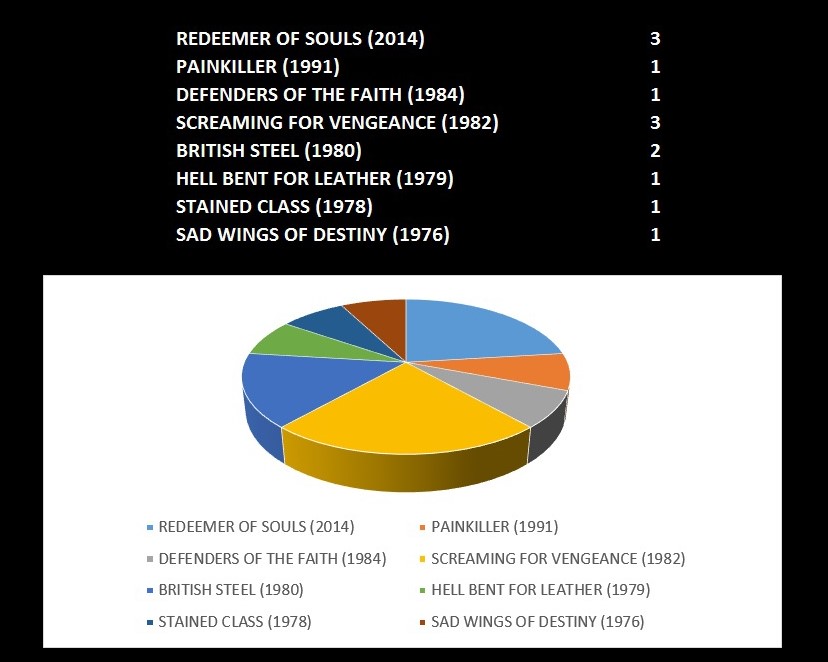
Here is a handy-dandy chart to show you where these songs originated, not counting intros “Battle Cry” and “The Hellion”.

priest chart

You’ll notice a huge 23 year gap in the music presented.  This isn’t uncommon for rock bands of Priest’s age.  There are so many classics, not to mention new songs to play, but not enough time.  As such, albums from later periods, or “cult” songs, are often overlooked.  The unfortunate effect of this is an unspoken implication that maybe the music between 1990 and 2014 wasn’t very good.  Now granted, Priest did have a lineup change during that period.  From 1997-2004, they were with singer Ripper Owens, and Priest have yet to revisit any of that material.

Proving that nothing has been lost with the departure of Downing, “Dragonaut” opens the show on a fast heavy note.  Faulkner is a perfect fit, acting in unison with Glenn Tipton to produce the same kind of Priest guitarmonies that you’re used to hearing.  “Halls of Valhalla”, another new track, rocks just as hard, but with the complexity of the Priest of yesteryear.  The musical chops of this band often go overlooked, but just listen to them play.  As for Halford?  He ain’t no spring chicken, but his singing style has changed to suit.  Within that framework, the man is a demon.  He can still do things with his voice that few can.  The final new song is “Redeemer of Souls”, a little stiff by comparison but certainly up to snuff.

A few lesser-played songs really spice up the set.   “Devil’s Child” from Screaming For Vengeance is a treat, and “Jawbreaker” from Defenders of the Faith is a nice switch up from “Freewheel Burning”.   Wacken probably would have rioted if songs like “Breaking the Law” and “Metal Gods” were not played, so of course you can count on the hits being represented.  A long guitar solo and instrumental section during “Another Thing Coming” is another surprise.  Halford used to do a long singalong at this point of the show, but that’s been shortened in favour of a pretty damn cool Richie Faulkner guitar solo.   Way to give the spotlight to the new kid — that is really classy.

Because there’s not enough time on a single disc, “Living After Midnight”, the final encore of the show, was axed.  Instead, “Painkiller” ends this CD, certainly an interesting choice for a closer.  This is the only song during which Rob’s voice can’t keep up.  The song is just insane; it always has been, and you can’t fault the guy for not quite getting there.

Battle Cry is yet another in a long string of great live Judas Priest albums.  Shoulda woulda coulda been a double CD.  The only two songs missing from this show are “Turbo Lover” and “Living After Midnight”, but wouldn’t you prefer having them?

3.75/5 stars