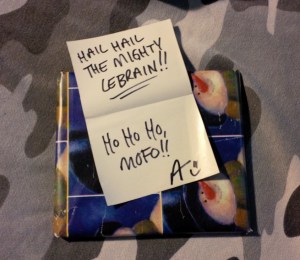
The “A” is for Aaron! Thanks man! This parcel wasn’t a total surprise but the contents inside sure were! I’m really excited about many of these items. (The Olivia Munn film looks great…) I’m so overwhelmed I don’t even know where to begin.
THE CULT – Live Cult (Marquee London MCMXCI) (Reissue)
This double live album was once the “Holy Grail” of Cult collectibles. It was originally a limited release involving a confusion of two separate discs, mail orders and bonus CDs in some versions of Pure Cult. Whatever, it’s been reissued (both CDs, the complete set) at retail…and now everybody can hear why The Cult went on hiatus at the beginning of the 90’s. It’s just not that good.
Like almost all live albums, this one has its pros and its cons. To me, the biggest con is that The Cult had dug themselves into this vaccuous, stiff, homogenic, generic rock/metal sound. For example, the cuts from Electic, in particular “Wild Flower”, are robbed of all their energy and groove. The rhythm section was new, but did consist of the late, great Michael Lee (later of Page & Plant). But these were not the same guys who recorded Love, or Electric, in fact they had never played on a Cult album. Perhaps that is why these songs don’t sound like The Cult that we know, but some early 90’s rock metal hybrid version of The Cult.
Another con is that Astbury was pretty hoarse that night. However in a sense that is also a pro — the liner notes proudly state that there are no overdubs or edits, that this is “as it was” on that night. And I will take a genuine live album with a hoarse singer over any overdubbed live album, every single time. In fact one entire track (“Amplification Breakdown”) is dedicated to the space between two songs while Duffy gets an amp fixed!
The track selection was adventurous, with lots of songs from Dreamtime and Love. “Brother Wolf, Sister Moon” is played live for the first time ever, according to Ian. They threw in a B-side (“Zap City”) and only a couple songs from their then-latest record Ceremony: They studiously avoided the too-mellow singles, and opted for lesser known rocking album tracks.
While this album was important as a document of a pre-hiatus Cult, before they reinvented themselves in 1994, it is a shame that the band was sounding so generically “rock” at the time, and little like the classic Cult. Perhaps that is why Ian and Billy felt like they had to reinvent themselves.
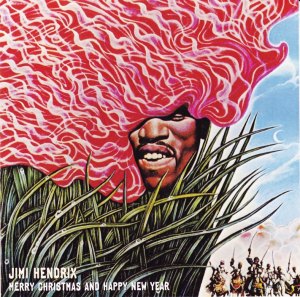
JIMI HENDRIX – Merry Christmas and Happy New Year (2010 Sony EP)
I couldn’t resist picking this single up on CD when I found it at my local Sunrise, although I wish I had also picked up vinyl. It wasn’t a huge expense, and if you’re an old-school music fan like me, you won’t mind paying to have an actual physical format with full colour cover art and liner notes. A quick browse on Discogs reveals average prices today for all formats: About $5 for CD, $7-10 for two-track 7″, and about $14 for the 10″ single.
The Band of Gypsys’ 1969 instrumental take of “Little Drummer Boy/Silent Night/Auld Lang Syne” sounds largely improvised and spontaneous. It is, in my humble opinion, a brilliant interpretation and serves to remind us that no matter what he did, nobody sounds like Jimi Hendrix. It’s incredible to me that today, 40 years after his death, there is still nobody that sounds like Jimi Hendrix.
“Three Little Bears” is the same version as on War Heroes so you may have this version already. Then the third track is an extended version of the first, which actually is pretty cool since it’s still over way too soon.
Inside the package are the aformentioned liner notes, as well as an alternate shot from a 1967 “Jimi dressed as Santa” photo shoot, holding copies of Axis: Bold as Love. Liner notes are detailed for a single, revealing the whens and wherefores of the recording sessions.
Recommended for all Hendrix fans, perfect for downing some ‘nog by the fire this winter.
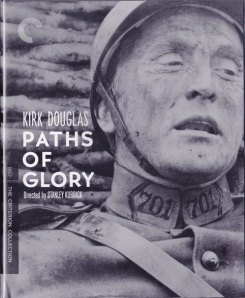
PATHS OF GLORY (2010 Criterion Blu-ray, originally 1957)
Directed by Stanley Kubrick
It is the First World War. The French have dug into trenches, 500 miles long, from the English Channel to the border of Switzerland. As the film’s intro eloquently states, victories are counted in hundreds of yards gained, at the cost of hundreds of thousands of men. This is the setting of Paths of Glory, certainly and easily one of the greatest war movies of all time.
Paths of Glory, one of several Stanley Kubrick masterpieces, contains some of the most realistic First World War battle scenes ever put to film. The landscape is a cratered no-man’s land of mud, wire and bodies. The desperation is captured beautifully. The references to “shell shock” are historically accurate (it was considered to be a mythical condition by the generals of the day).
Kirk Douglas is Col. Dax, once a lawyer in his old life, now ordered to take the “Anthill”. It’s a fortified position that German forces have held for a year. Now the French intend to take it and keep it. All they have to do this with is tired and worn out men. Dax doesn’t think it can be done, but cannot disobey an order. The only alternative for him would have been to be relieved of duty, and Dax won’t abandon his men when they need him.
General Mireaux, his ambition clouding his judgment, set up an impossible undertaking. As is inevitable, the man are slaughtered, not even able to clear their own barbed wire. The few survivors were forced back by more guns and shells. A humiliated and embarrassed General Mireaux then orders his artillery to fire on his own trenches (that should keep them from retreating to them, right?) When that order is refused, he decides to charge them for cowardice in the face of enemy. After all, someone must take the blame for this failure, and why should it be an officer? Col. Dax returns to his role of a lawyer and defends the three token men chosen at random to face the charges of cowardice. Then, the movie morphs into courtroom drama.
Paths of Glory paints a picture of the way it was, based loosely on the practice of executing men for cowardice before they “infect” the rest of the men with it. It’s not a pretty picture. The trenches in the film are perhaps drier than the real trenches but the landscapes look very real indeed. Kubrick’s style here was still that of an observer, which came from his years as a newspaper photographer. He places his lenses where an observer would sit, and you can watch the events unfold like a fly on the wall.
Kirk Douglas is joined by Kubrick regulars Timothy Carey (two Kubrick films to his name), Joe Turkel (three Kubrick films) as well as Adolphe Menjou and a very young Christiane Kubrick.
The story itself is a heart wrenching look at the realities of First World War Europe, and also the human spirit. It attacks our prejudices and practices while reminding us that we are all the same regardless of our station in life. Kubrick seems to have been both fascinated by war while being repulsed by its necessity.
This being such an historically important film, I am glad that it finally received the Criterion treatment. The restoration is very well done compared to the original DVD edition. The audio is in mono just as the original film was. I appreciate that nobody tried to tinker with the audio to make it multi-channel. This is the way Kubrick made it. Supplemental features are here including audio commentary, an essay, and a fun interview with Kirk Douglas from the 1970’s, among numerous others.
This is absolutely necessary for any fans of real war films and Stanley Kubrick. Hopefully this ushers in a set of brand new Kubrick Criterion editions. I bought two copies; the second was for my dad.
5/5 stars
Kirk Douglas … Col. Dax
Ralph Meeker … Cpl. Philippe Paris
Adolphe Menjou … Gen. George Broulard
George Macready … Gen. Paul Mireau
Wayne Morris … Lt. Roget
Richard Anderson … Maj. Saint-Auban
Joe Turkel … Pvt. Pierre Arnaud
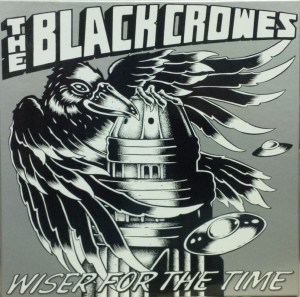
THE BLACK CROWES – Wiser For The Time(2013 4 LP box set, Silver Arrow/Megaforce Records)
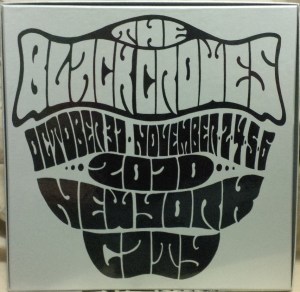
I enjoy when bands do releases that are exclusive to certain formats. In 2013 the Crowes put out this mammoth live album/box set, and let me tell you it’s gorgeous. All it lacks is a booklet with pictures or liner notes. I am otherwise completely thrilled with this release. I’ve been on a Crowes kick these last few weeks, being drawn to the feel and impeccable musicianship of the band. Wiser For The Time is largely acoustic, featuring mellow songs and arrangements spanning their entire career. It also has plenty of electric rock, funk and blues. It boasts 26 tracks and a running time of over 2 1/2 hours. There was also a bonus 27th song given away for free last year, “Under A Mountain” taken from the same series of five New York concerts that comprise the album.
The Black Crowes pulled out all the stops. From familiar hits such as “Jealous Again” to non-album obscurities like the scorching “Exit”, Wiser For The Time is treat after treat. “Exit” in particular was a delicacy for me. I had never heard the song before and was taken aback by its heavy groove. And this is a song that has never been released on an album!? Well, until now. Even familiar songs like “No Speak No Slave” have new exciting moments, making the album a fresh listening experience. Other songs like “Only Halfway to Everywhere” are extended to the 10 minute mark.
Covers? Of the Crowes always surprise with interesting covers choices. Here the biggest joy may be “Hot Burrito #1” and “Hot Burrito #2,” in sequence, by the Flying Burrito Brothers. That’s pretty hard core. There were plenty of unfamiliar songs to me on Wiser For The Time. Whether they are covers or Crowes obscurities I don’t know. Regardless, I enjoy a good live album with unfamiliar material on it. Who wants the same songs all the time?
Personal highlight: “The Garden Gate” is my favourite song from 2009’s sprawling 2-LP Before the Frost…Until the Freeze. I’m pleased that it made the album. It’s every bit as good here as it was on Before the Frost.
But whether it’s the funky “Make Glad” or the extended jamming that makes up the end of “Tied Up and Swallowed”, there is not a dull moment on Wiser For The Time. I solidly enjoyed the whole album. I hope I can find the time to do so frequently in the future, but let’s be honest. In our rat-race lives, few of us have the time to really spend time with an album anymore, particularly a 4 LP live box set. And this isn’t a cheap set. Sunrise had it for about $81, but Amazon were asking $73 with free shipping. For those who can’t justify paying that much, iTunes have it too. But these are beautiful 180 gram records, and iTunes can’t sell you the warmth that you will hear on a turntable. Think wisely before buying.
AC/DC – Stiff Upper Lip (Bonus CD edition, 2000 Warner)
So much music, so little time! I reviewed the AC/DC album Stiff Upper Lip months and months ago. Previously, I only owned the single disc version of Stiff Upper Lip. I knew of the 2 CD Australian version, but I didn’t own it. I thought and assumed all those bonus tracks were included on the massive AC/DC Backtracks box set. It has pretty much everything else. However I was wrong, and I promptly bought a copy of the 2 CD version from Discogs, with plans to review it shortly after I reviewed Stiff Upper Lip itself. That was in July. Like I said, so much music, so little time!
Backtracks is missing two songs from the bonus CD: “Back In Black”, live from Madrid, is exclusive to this set. So is the 11 minute “Let There Be Rock”. (Meanwhile, Backtracks had plenty more songs from the Madrid show that are not on this bonus CD. Those songs are “Dog Eat Dog”, “Hail Caesar”, and “You Shook Me All Night Long”.
Confusing, huh? That’s why I’m here. To help the fans and collectors out there.
The Stiff Upper Lip bonus CD has a mix of live tracks, videos, and one rare studio recording:
“Cyberspace” (Non LP Track)
“Back in Black (Live – Plaza De Toros, Madrid, 1996)”
“Hard as a Rock (Live – Plaza De Toros, Madrid, 1996)”
“Ballbreaker (Live – Plaza De Toros, Madrid, 1996)”
“Whole Lotta Rosie (Live – Plaza De Toros, Madrid, 1996)”
“Let There Be Rock (Live – Plaza De Toros, Madrid, 1996)”
“Stiff Upper Lip” (Music video)
“Safe in New York City” (Music video)
“Satellite Blues” (Music video)
I don’t care so much about music videos on a CD. Since the early 2000’s, bands tend to include a bonus DVD with their albums instead of videos on an enhanced CD. Plus we have Youtube now, most music videos are available online 24/7 on demand.
Skipping the videos, the most interesting track here is “Cyberspace” which was also a B-side to the “Safe in New York City” single. I hate songs about the internet (see: “Virtuality” by Rush) but thankfully “Cyberspace” kicks real ass. Sonically it’s the same as the rest of Stiff Upper Lip: hard, loud, stripped back. It’s also fast and memorable, making it one of the most interesting Stiff Upper Lip songs. Highly recommended to fans of this album.
Then you get the five live songs, originally from the 1996 concert in Madrid that was released on DVD as No Bull. I always prefer an audio format to a video one. I’ll tell you that the “new” songs from Ballbreaker were awesome live! In particular the title track, but “Hard as a Rock” is relentless and classic sounding. Meanwhile you can’t say anything bad about “Back in Black” or “Rosie”. You could argue that you didn’t need more live versions; I’d argue just to not buy this CD.
Finally “Let There Be Rock” is present in full-on extended live version. Angus wails away like a man possessed, a man in a trance, a man at one with the rock! With the rest of AC/DC behind him, you couldn’t ask for a more solid backing band, which makes the whole thing work.
As a companion piece to the whole Stiff Upper Lip album, I give the bonus CD:
FRANK ZAPPA – Shut Up ‘n Play Yer Guitar (1981, 2012 Universal/Zappa remaster)
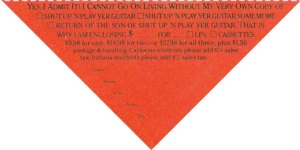
This is the first time I’ve ever seriously tried to write a Frank Zappa review; a daunting task indeed. I rely heavily on the excellent booklet inside the 2012 Universal/Zappa Record reissue of Shut Up ‘n Play Yer Guitar. For example, an advertisement for the album tells me that it was originally issued (in 1981) as three mail order records. You could buy them at once or separately, and they were individually titled Shut Up ‘n Play Yer Guitar, Shut Up ‘n Play Yer Guitar Some More, and Return of The Son of Shut Up ‘n Play Yer Guitar. Then they were later re-released as a 3 LP box set.
I also like how the spines of this series of remasters are all numbered, so you can easily file them in chronological order. That’s how I file my albums (alphabetically by artist, then chronologically by album). These three records were 31, 32, 33. For shits and giggles, I separated the tracks from this 2 CD release into the original 3 LP running order. My logic was, this gave the listener (me) a more “original” listening experience, as I took coffee breaks between “records” to collect my thoughts.
The whole Shut Up ‘n Play Yer Guitar set is a collection of instrumental guitar solos. Many of these are taken from live performances of other songs, but presented on their own, sometimes with humorous dialogue sprinkled in between. All solos are by Frank, although giants such as Steve Vai and Warren Cuccurullo are behind him on rhythm guitar. Frank’s playing is diverse (it better be if your album is an hour and three-quarters long) and interesting at all times. I’m not a guitar head, I can’t sit here and tell you, “Oh right now he’s playing the such-and-such mode in the key of whatever.” I can just tell you when my jaw hits the floor (frequently).
Rhythmically, “five-five-FIVE” (the opener) is one of my favourite tracks. The internets tell me that the time signature is a repeated sequence of 5/8 + 5/8 + 5/4. On top of that are some exotic and mindblowing Zappa tones. I was hooked on the first time. The next one, “Hog Heaven” is slower, a respite. Zappa remains the architect of electric guitar sounds you just don’t get to hear every day. I also love the aptly named “Variations on the Carlos Santana Secret Chord Progression” which does indeed have a vaguely Santana vibe.
Other highlights included “Ship Ahoy” which I’m not even sure how to describe so I won’t. “Pink Napkins” is a jazzy jam session with Eddie Jobson on keyboards that hits just the right notes. The 10 minute closer “Canard Du Jour” is remarkably by being sparse, without wasting precious playing time by being boring. It is aided and abetted by Jean-Luc Ponty on violin, a treat indeed.
I think I’ve said enough. I paid nine freakin’ bucks (Sunrise) for almost two hours of Frank Zappa playing guitar. How is that not one of the smartest decisions I’ve ever made?
Smash Hits…Unplugged!, the first ever acoustic release by Helix, was certainly a release that deserved more attention. While Helix have continued to make albums (and good ones, too), many of them have been ignored by the media in general. While an album such as The Power of Rock and Roll kicked as much ass as Walkin’ the Razor’s Edge, it went largely unheard. Smash Hits…Uplugged! was a more accessible version of Helix, but it still failed to garner the attention it deserved. I do hear “That Day Is Gonna Come” from this album on the radio from time to time, but this album is too good not to be heard by masses.
This, to me, was the real “classic Helix lineup” reunion album. Unlike Vagabond Bones, you can actually hear Brent and Daryl singing. Daryl Gray in particular contributes a lot to this album, including singing, bass, guitars, and more exotic instruments such as bodhran. All five Helix members participated, including Kaleb Duck with his first Helix album. Old friends such as Sean Kelly and Cheryl Lescom also dropped in.
Every song on this album was a hit somewhere or another, and every song on this album had the potential to be a hit once again. Vollmer sang his butt off as always. Some of these arrangements are startlingly original. Particularly “Gimme Gimme Good Lovin”, which shines with great harmony vocals and mandolin courtesy of former guitar slinger Brent Doerner. This excellent, energetic version is followed by a great single-worthy take of “The Kids Are All Shakin”. The ballads are also well done, in particular the shoulda-woulda-coulda-been hit “That Day Is Gonna Come” and their cover of “Dream On”.
It is a new cover version that really blew me away. Vollmer sings his very best on “Touch of Magic” originally by the late great James Leroy. This long forgotten song is a wonderful tribute to Leroy, an under-appreciated Canadian singer and songwriter from the 1970’s. His original version of “Touch of Magic” was a #6 charting single. While I can’t say that Helix have topped or equaled him, it is a nice tribute and let’s leave it at that.
Really in total honesty, every version here is great — I can’t say much more than that. I found some arrangements, such as “Rock You”, to be pretty standard, while others to be more adventurous especially in instrumentation. A sprinkle of fiddle here, some 12-string there, and you get a rich unplugged album much more interesting than most major bands’.
Pick up Smash Hits…Unplugged! by Helix. Not only do you know all these songs already, but you’re supporting a band that really deserves it.
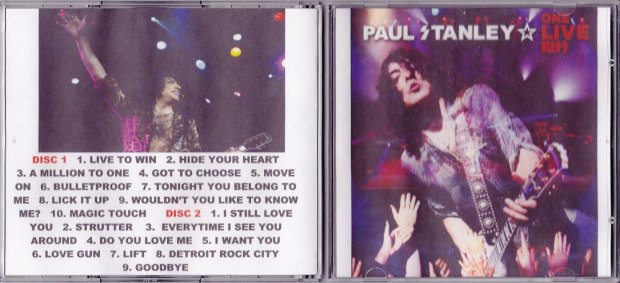
This album is significant to me for one reason only: It was the first CD bought for me by my lovely wife, Mrs. LeBrain. She knew I liked Kiss and she knew I didn’t have this album. It was a total surprise! It was also a total disappointment.
Paul’s 1978 solo album is a milestone for me, it’s one of those albums I can put on any time, any where, anyhow, and I always love it. When Paul wrote (quoted in the “Kiss: Behind The Mask” book) “Let’s just say it needs a sequel right about now,” I was so excited. Yet I forgot, the word “sequel” has many different connotations.
Unfortunately, Live To Win is a sequel in the sense that it’s inferior to the original in every way. The production is plastic, modern synthetic, and boring. The songwriting is good in parts, but there are three ballads here. Paul’s first solo album had nine songs and one ballad. Here, there are ten songs and three ballads. You can work out the math on your own. The playing is bland and generic. John5 plays guitar a bit, and he’s always great, and Bruce Kulick plays bass (why bass?) on a few songs. Everybody else is just a studio cat, guys who are paid big bucks to make people like Avril sound good. Good players, but there’s no personality on this album. Not like when Bob Kulick ripped Paul’s first solo album to shreds.
There are two good songs. They are “Wake Up Screaming” and “Where Angels Dare”. “Wake Up Screaming” starts off with some terrible drum machines. (Yes, not a misprint. There is far too much ProTools and programming on Live To Win.) It’s generic sounding, until Paul’s melody and vocal elevates the song to a whole different level. Still, it’s not aggressive enough for a song called “Wake Up Screaming”. Raw production would have turned this into a classic. The other good song is “Where Angels Dare”. It’s another great song with Paul’s riff, vocal, and melody taking it where it should be. A highlight.
“Live To Win” is also decent, it has a good chorus, but the riff and verses are boring. “Bulletproof” sounds like a Hot in the Shade outtake. “Lift” should have been on Carnival Of Souls, it has that grungy sound. The rest of the album is just plain boring, especially the ballads. Among the ballads there’s nothing here that can hold a candle to the dynamics of “Hold Me, Touch Me” even though they are every bit as schlocky.
Paul, I’m disappointed. For a guy who had the idea to go back to basics and record the Kiss album Sonic Boom on analog tape, this just doesn’t even sound like it came from the same person. Maybe if your first solo album wasn’t so good, so classic, then I wouldn’t have expected so much. Yet, Paul, you are a rock god. There’s no denying it even to non-fans. You are an icon, and you are responsible for a dozen or more of the best songs in rock history. There’s no denying it! For you to put this out, I can only conclude you were out of touch with your fans and rock in general. Or, worse, you were trying desperately for a hit.
Following the demise of Whitesnake and the failure of Zeppelin to mount a 1991 tour in support of their first box set, it was almost inevitable what happened next. It was something that many Zeppelin fans feared. Lead Snake David Coverdale, who was once derided as “David Coverversion” by Robert Plant, joined Plant’s erstwhile bandmate Jimmy Page in a new supergroup. Geffen’s John Kalodner (John Kalodner) helped facilitate this move which should have generated sales over 10 million units. Unfortunately another thing also happened in 1991: grunge.
The shame of it is that Coverdale-Page is a stunning rock album. For years it haunted my bargain bins, simply because of the hard rock stigma that permeated the 1990’s. Many fans refused to listen to it, others simply chose to mock superficial elements of it, such as Coverdale’s man-shrieks. The fact that Page was looking and sounding great should be enough to warrant multiple listens by any serious rock fan. He hadn’t released any new material since 1988’s Outrider. As for Coverdale, it was a chance to get back to his bluesy rock roots, something he expressed a desire to do shortly after Whitesnake’s dissolution.
The studio band weren’t hacks either. Ricky Phillips had played bass with Neal Schon and Jonathan Cain in Bad English, and he’s been in Styx for ages now. Drummer Denny Carmassi was in Montrose (that’s him on the cover of the classic 1973 self-titled record) among many stellar bands, and he later did a stint in Whitesnake itself. Coverdale and Page co-produced the album with veteran Mike Fraser.
Finally, the most important elements were also in place: the songs. 11 songs, most in the 5-6 minute range, make up Coverdale-Page. Those expecting or even hoping for a Zeppelin album were bound to be disappointed. Despite the “Coverversion” nickname, Cov the Gov is his own person and persona. Singing over Pagey’s classic Zeppish riffs does not a Zeppelin make. Rather, Page and Coverdale comingle over their common ground, and naturally there are elements that have a Whitesnake aura. To expect otherwise would be folly.
“Shake My Tree” was the perfect opener. Pagey’s tricky little licks have that familiar sound, immediately. Then the great lothario Cov the Gov starts howlin’…the stage was set within the first minute of the album. The closest comparison I can think of would be “Slow An’ Easy” in terms of overall vibe. Just replace Moody’ slide guitar with Jimmy’s intricate chicken pickin’. David’s lyrics were as naughty as ever. It must have burned Robert Plant’s ass to have to sing it when he reunited with Jimmy later on himself. He seemed to be freestyling it quite a bit with David’s lyrics, barely sticking to the words at all!
“Waiting On You” would have been a radio-ready single. It has that kind of smoking hard rock riff, a killer of a chorus, and great vocals. Coverdale’s no poet, but I dig his words. “Ever since I started drinkin’, my ship’s been slowly sinkin’, so tell me what a man’s supposed to do.” Well, let me tell you David. 1) Drinking and boating is against the law, just like drinking and driving. 2) Put on your goddamn life vest!
I hesitate to call “Take Me A Little While” a ballad. I mean, it is a ballad, but it’s also a pretty good bluesy workout for David. It’s a little classier than the average “power ballad”, because hey…it’s Jimmy Page. It doesn’t sound like other ballads by other bands, because not too many bands have Jimmy Page. His playing and writing are unlike anyone else’s, he is one of the most recognizable musicians in rock and roll.
“Pride And Joy” was the first single, and what a single it was. It starts off swampy and acoustic, before Jimmy’s big Les Paul announces its presence with some big chords. Then David’s back in lothario-land, seducing “daddy’s little princess, Momma’s pride and joy.” Despite the lyrics, the song’s still a stunner. “Over Now” is also cool; a thinly veiled attack on Tawny Kitaen.
You told me of your innocence, An’ I believed it all, But your best friend is your vanity, And the mirror on the wall.
It doesn’t get any nicer from there, but musically this is one of the most Zeppelin-ish songs. While you can’t compare it to any specific song in the Zeppelin oeuvre, but it’s there in that slow relentless drum beat, the orchestration, and Pagey’s unorthodox guitar.
The closest thing to filler on Coverdale-Page is “Feeling Hot”. It’s not outstanding, but it does show off the faster side of Jimmy’s playing. It’s akin to “Wearing and Tearing” but with naughtier lyrics. Once again it is Jimmy’s playing that I’m tuned in to. That continues with “Easy Does It” which begins acoustically. Like most acoustic moments on the album (and like Zeppelin), Jimmy’s guitar is recorded in layers, giving it real heft. This all changes halfway through the song, when Jimmy’s Les Paul once again takes center stage. Then it transforms into a bluesy prowl.
Possibly the most commercial song is “Take A Look At Yourself”. Not a bad song, but definitely the most “pop rock”. It’s probably closest to a Whitesnake song such as “The Deeper The Love”. Had the year been 1990 or even 1991, “Take A Look At Yourself” would have been a top charting single everywhere. David seems to have cheered up with new found love here. However the heartbreak is not over. “Don’t Leave Me This Way” is about as earnest as it gets. At 8 minutes, it’s also the most ambitious song. It’s the centerpiece of the album. It sounds at once like it’s the most sincere song, showcasing some of Jimmy Page’s best post-Zeppelin guitar work. As for David, he’s never sung better.
“Absolution Blues” begins similarly to “In The Evening”. Fading in are layers of atmospheric guitars as only Jimmy plays them. These give way to the fastest, heaviest song on the album. It’s also one of my favourites. You you can hear the elements of Jimmy and David separately, but working together. The song goes through numerous changes before returning to that riff. If you thought Jimmy Page had already written every great riff in Led Zeppelin, think again. It’s “Black Dog” sped up to ludicrous speed.
Album closer “Whisper A Prayer For the Dying” is as cheerful and uplifting as the title alludes. It’s has an epic quality and length like “Don’t Leave Me This Way”, but this time the lyrics are less personal and more topical. David laments the innocent casualties of modern warfare, and refers to politicians as “bodyguards of lies”. While certainly not profound, it’s refreshing to hear Coverdale change the bloody subject away from the female of the species every now and again. Profound or not, I’m certain that it was heartfelt, and musically it kicks ass. It’s also a perfect album closer for a dark and brooding record like this. So there.
Hugh Syme (Rush) did the artwork. Say what you will about the bland cover itself, but I like the way he used the “merge” sign much like the “object” was in the artwork for Presence. And like many Zeppelin albums, there are no pictures of the artists anywhere.
The year 1993 was not a kind one to singers of Coverdale’s ilk. Most of his competition had been replaced by Chris Cornell, Eddie Vedder, and Kurt Cobain. One way or the other, the Coverdale-Page tour was not doing enough business and the plug was pulled. David has since mentioned that he and Page had more songs, enough to get started on a second album. He’s also expressed a desire to release those songs on some kind of deluxe edition reissue. I hope that happens. I’d buy Coverdale-Page again. It would only be the third time.















 mikeladano.com