REVIEW: Judas Priest – Sin After Sin (1977)

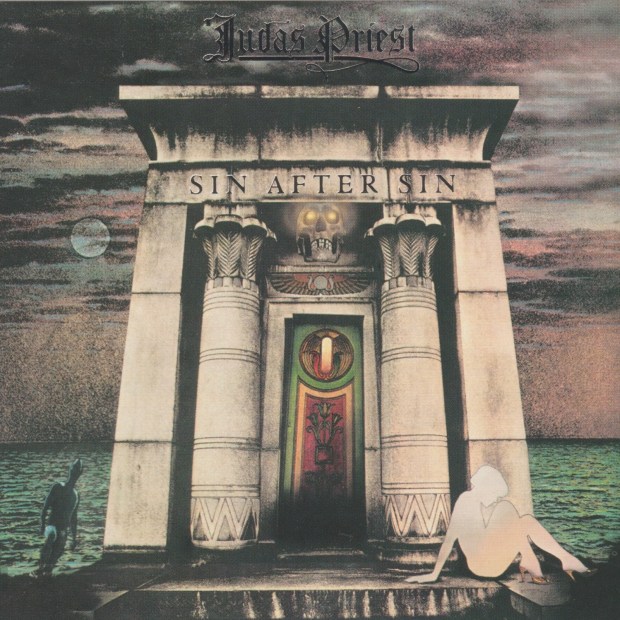
JUDAS PRIEST – Sin After Sin (Originally 1977, 2001 Sony reissue)

“SIN AFTER SIN, I have endured, but the wounds I bear are the wounds of love.”

This lyric from “Genocide” on 1976’s Sad Wings of Destiny would have been little more than a throwaway, if Priest didn’t recycle the words “sin after sin” for their next album title.  Though the song may have appeared to be the same, much had actually changed.  For the first time, they had a producer that understood that kind of aggressive rock that the young band were trying to create:  Roger Glover, ex-Deep Purple, who had already recorded several albums for Elf, Ian Gillan and Nazareth.  Perhaps even more significantly, for the first time they had a serious drummer creating the beats:  the not-yet-legendary Simon Phillips, who had still already played on a Jack Bruce album.  This was just a session for Phillips, but it enabled Priest to break the shackles of rhythm and really start exploring.

Opener “Sinner” might have been the same kind of tempos that Priest were working with before, but there is a new slickness to the drums; an effortless drive with increasingly interesting accents.  With a solid backing, Priest sound more vicious.  “Demonic vultures stalking, drawn by the smell of war and pain.”  The apocalypse has never sounded cooler.  As Phillips drops sonic bombs left and right, KK Downing goes to town on what would become his live showcase solo.  His growls and trills sound like a beast inflicting wounds on a struggling combatant.  At almost seven minutes, “Sinner” is the album epic, and it’s the opening track!

Priest previously recorded a cover of Joan Baez’ “Diamonds and Rust” for Gull records; that early version can be acquired on The Best of Judas Priest or Hero, Hero.  The Glover-produced track is the more famous and better of the two.  Radio play for “Diamonds and Rust” helped push the album to eventually sell 500,000 copies.  Rob Halford’s high pitched harmonies gleam like polished silver.

Ironic observation:  I hope by now we all know a light year is a measurement of distance, not time.  It is the amount of distance that light can travel in one year (9.46 trillion kilometres).  So, really really far.  Joan Baez playfully used it as a melodramatic measure of time in “Diamonds and Rust”.  (“A couple of light years ago”.)  On the next track “Starbreaker”, Halford refers to “light year miles away”, a crudely worded hyperbole for distance.  So with Sin After Sin, you get it both ways.  Regardless of scientific accuracy (or not) “Starbreaker” is a good track with a slightly flat riff.  Though Phillips is brilliant, it could just use a little more pep.

Like with Sad Wings of Destiny, you gotta have a ballad in there somewhere, and on side one that’s “Last Rose of Summer”.  This softie isn’t bad, though Priest have done and will do better.  Using a ballad to close a side isn’t always wise either, but on CD nobody really notices except us nerds.

“Let Us Prey/Call For the Priest” is a pretty epic side two opener, with harmony guitars playing an opening instrumental anthem.  Then a choir of Halfords joins in, and the band break in to what could be their fastest song yet.  From the wickedly fast dual guitar solos to the powerful rhythm, this song is a blitzkrieg of metal trademarks.  It’s relentless and all over the board, something that 80s Priest rarely was.

Side two keeps getting better with the groove of “Raw Deal”, which was Rob’s real “coming out” to fans in the know.  Today he calls it a “heavy metal gay rights song”.  It’s actually one of Halford’s best lyrics.  Instead of mashing together science fiction words and singing about battlefields, this time Halford paints a hazy picture of what is probably a gay club in Fire Island, New York.  It’s vivid but vague:  “The mirror on the wall was collecting and reflecting, all the heavy bodies ducking, stealing eager for some action.”  It’s also backed by some seriously cool Priest music, almost funky but always heavy.  “The true free expression I demand is human rights – right?”  It was all there in the lyrics all along.

A second ballad, the dirge “Here Comes the Tears” brings a cloudier mood.  An ode to loneliness, “Here Comes the Tears” is the one to play when you just can’t take it anymore.  When Halford starts givin’ ‘er at the end with the wildest screams in history, it sounds like an exorcism.  The guitars howl, a hint of piano can be heard, and there is an underlying choir of Robs singing sadly in unison.  Finally “Dissident Aggressor”, famously covered by Slayer, concludes the album on a violently fast note.  “Stab!  Fall!  Punch!  Crawl!”  This song is not for amateurs and might be the heaviest thing Priest have ever done.  There are plenty of contenders, but “Dissident Aggressor” must be in the Top Five Heaviest Priest Songs Ever.  But that being said, they still have the balls to end the song with another multi-layered harmony of Halfords.

The 2001 Sony remastered CD has two bonus tracks, and the first is the best in the entire series:  “Race With the Devil”, a cover of a track by The Gun.  This version, recorded for the next album Stained Class (Les Binks on drums) could easily have been a B-side all this time.  Why it went unreleased until 2001 is unknown.  Perhaps it was lost, but now that it has gotten a proper mastering job it is available on CD.  This is un-retouched, which cannot be said for other unreleased tracks in the Priest Remasters series.  “Run With the Devil” is raw, riffy, fast, and wicked.  All it really needed to make it album quality is a better guitar solo.  The second bonus track is a live “Jawbreaker” (Dave Holland on drums) from the Defenders of the Faith tour.  Out of place, but an excellent song regardless.

Incidentally, Sin After Sin is the last album before Priest adopted the first version of their current logo design.

4/5 stars

RE-REVIEW: Judas Priest – Sad Wings of Destiny (1976)

I was listening to Sad Wings of Destiny recently and wrote up a brand new review before realizing I already reviewed it.  Fortunately, I had lots more to say.  For my original 2015 review, click here.

JUDAS PRIEST – Sad Wings of Destiny (1976 Gull, 1998 Snapper Music)

1974’s Rocka Rolla didn’t set the world on fire, so back to the drawing board for album #2.  Having rid themselves of most of their early bluesy material, Judas Priest went heavier, and more diverse simultaneously.  The resulting album, 1976’s Sad Wings of Destiny, is considered an early classic by the band.  Some feel they rarely reached these heights again as they took their metal more mainstream in the 80s.

“Victim of Changes”, which opens the album, introduced the world to the high notes that Rob Halford was able to hit.  “Whiskey woman don’t you know that you are driving me insaaaaaaaaaaaaaane!”  Yet that note is nothing compared with Rob’s final shrieks.  This track combines an earlier unreleased Priest song titled “Whiskey Woman” written by original singer Al Atkins with a track called “Red Light Lady” brought in by Halford from his old band Hiroshima.  You can hear the moment the two songs are welded together at around the 4:45 mark.  Together at almost eight minutes they form a complex, classic Priest track that represents a high water mark.  Twisting from a metal groove into ballady territor-y and back again, this is drama the way Priest do it.  And they never do it better.

“The Ripper” boasts similar high notes but it’s almost a parody.  This riff-based shorty (2:51) is from the perspective of Jack the Ripper (or if you like, Jack the Knife).  With a galloping beat from new drummer Alan Moore (who was eventually replaced by the far superior Les Binks), “The Ripper” is as metal as things got in 1976.  Its placement as second track is perfect because the next two, “Dreamer Deceiver” and “Deceiver” form a single 8:34 epic.  “Dreamer Deceiver”, which forms the majority of the song, is an epic ballad about a supernatural being who tempts those below.

“Saw a figure floating, ‘neath the willow trees.
Asked us if we were happy, we said we didn’t know.
Took us by the hand and up we go.”

They follow the dreamer through the purple hazy clouds into the cosmos.  The intricate acoustic guitars let Rob Halford dominate with his story.  Though the track is haunting, it seems the people in the song find “complete contentment” and live without worries.  But as the song builds, adding piano, Rob’s vocals become more urgent (and high).  Though it seems like a heavenly paradise, the second part “Deceiver” changes the mood considerably.

“Solar winds are blowing, neutron star controlling.
All is lost, doomed and tossed, at what cost forever?”

There is always a price when temptations seem too good to be true.  This song brings another heavy gallop, the kind which Iron Maiden would later perfect.  Solos blast, as Halford warns us all of the “Deceiver”!  This is the kind of metal that people associate with Judas Priest, though its’ far more impressive if you consider it part of a larger composition.

Side one can be viewed as just three songs:  two epics and a hard rocker.  Side two has more to offer, though it opens in epic enough quality.  Glenn Tipton’s piano piece “Prelude” is foreboding.  As a Sabbath-like instrumental, it serves to set the scene for “Tyrant” (though “Tyrant” is always performed live without “Prelude”).  Overdubbed vocals make for a cool chorus, but this one is just a molten metal burner.  It wastes no time in laying waste, with guitar solos galore, in both single and dual formations.

“Genocide” is a slower, cooler groove that doesn’t seem to match its violent title.  But this is from the perspective of a survivor.  “Save me, my people have died, total genocide.”  This is the song that gave us the next album title, Sin After Sin:  “Sin after sin, I have endured, but the wounds I bear are the wounds of love.”  Cool track and a necessary one to give the album balance.  Songs of this tempo and style would make up the bulk for Priest albums in the future, yet it’s not simple or blockheaded like some 80s Priest tended to be.  It retains some complexity and traverses multiple musical landscapes through its length.

Next:  a complete left turn.  “Epitaph” (written by Tipton) is a piano-based funeral dirge that sounds a heck of a lot like Queen.  It’s beautiful though.  With Halford’s vocals layered as a choir, it’s a daring change of pace even though Queen were pretty much the biggest band in the world in 1976.

“Epitaph” fades directly into the final track “Island of Domination”, another metal chug but with an apocalyptic bent.  Rob’s lyrics are unusually styled with archaic sounding lines like “‘Twas as if all hell had broke loose on this night.”  This could be Rob’s first BDSM-themed song with lines like “Lashings of strappings with beatings competing to win.”  If not, then it’s just a brutal battle set to the tune of speedy Priest metal.

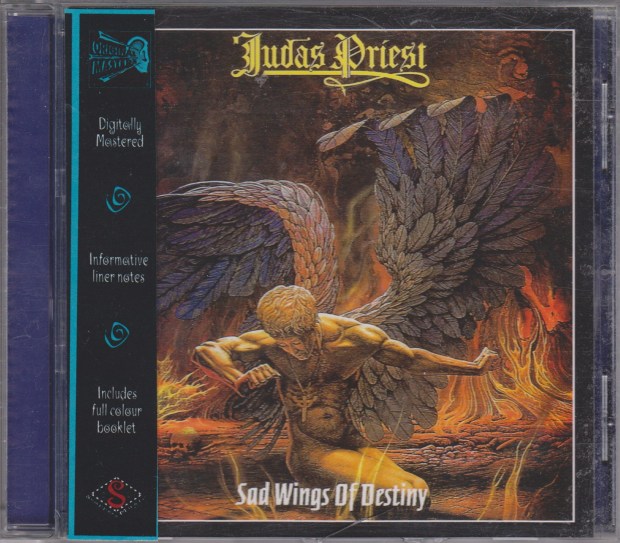
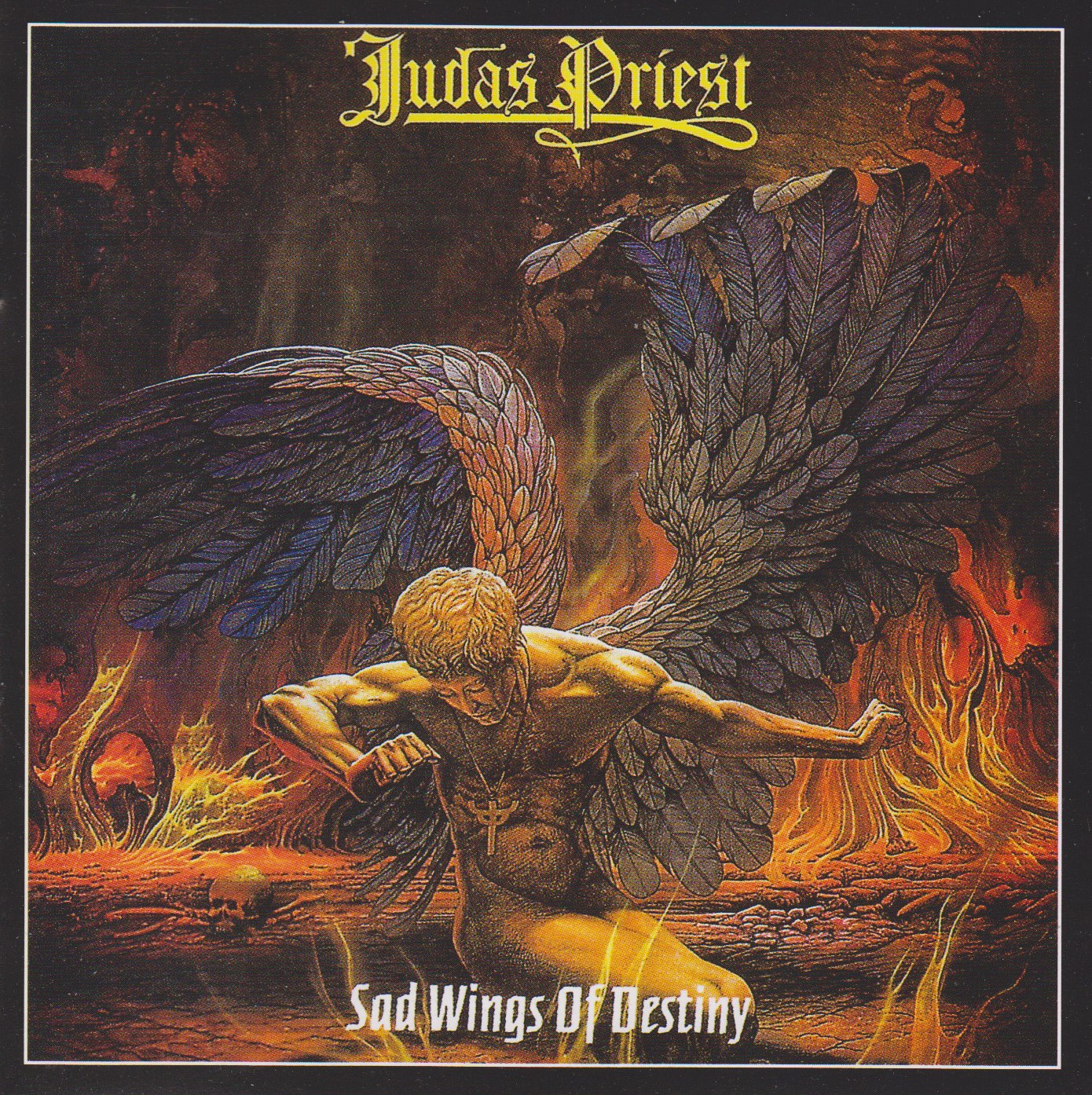
It must be said that Sad Wings has a striking album cover, with the angel depicted burning in hell.  School teachers worldwide would have loved this cover back in 1976.  The angel character would return 14 years later as the Painkilller.  The “devil’s tuning fork” necklace that the angel is wearing would become Priest’s symbol on later albums as well.

Though Sad Wings is an essential album for a serious metal collection, and stuffed full with riff after riff of majesty, it is frustrating hard to find good versions on CD.  Priest’s albums on Gull records have never been officially reissued by the band.  The 1998 CD release by Snapper music is usually rated fairly well.  If you’re unsure then get an original Gull vinyl copy.  But do get Sad Wings of Destiny and prepare to hear a young, vital and daring Judas Priest just beginning to learn what they can do.

5/5 stars

Epic All-Canadian Live Stream featuring Mr. Books

History was made Friday night!

Please welcome Mr. Books himself, Aaron from the KMA.  The subject this week:  Top 11 Canadian albums of all time.  An absolutely epic discussion unfolded with so many different genres being touched upon.  As remarkable as the lists were (five in total), it’s also quite astounding when we talked about all the albums we left out!

Lists submitted by:

  • Derek from Thunder Bay
  • Mr. Books
  • LeBrain
  • Darr
  • Dr. Kathryn Ladano

With Deke coming in from Lake Superior, Aaron from Georgian Bay, and myself on the shore of Lake Huron, we had three massive bodies of water covered.  What should we call ourselves?  The Great Lakes Consortium?

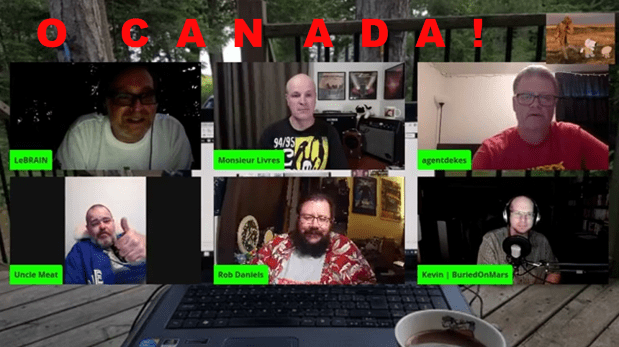
For a look at the shape of streams to come, check out the end of the video.  We brought in Uncle Meat, Rob Daniels from Visions in Sound, and Kevin/Buried On Mars.  While six at a time is a lot, it sure was fun to see everybody together for the first time!

I can’t help but take a little bit of pride in all this.  My very first live stream was March 20, the week lockdown began. Eager to make connections with others in isolation, I hit that “live” button on my Facebook app just to see what would happen. It ended up being a lot of fun and it so happened that others liked it too. A few weeks later, we figured out how to get Uncle Meat to co-host and he came up with the now infamous “Nigel Tufnel Top Ten” format.

But there were limitations, because we had to use a Facebook phone app if I wanted to have a co-host.  This reduced the scope of awesome people available to share the screen with me.  Finally Kevin directed me to Streamyard which solved numerous problems.  After months of trying to figure out how to stream to Facebook (where my audience is) without having to use Facebook, Streamyard worked.  For the first time after many months of trying, Aaron has finally co-hosted a show.  A milestone!  So yeah, I’m proud of myself and proud of the awesome friends who have co-hosted along the way.  We made something here that is catching on with people.  I owe Meat a huge debt for being the first co-host and coming up with the Nigel Tufnel Top Ten concept.

Look at the first stream below, and look where we are now.  We’ve come a long way.

O Canada! Friday Live Streamin’ returns with “Maple” flavoured lists!

The list format returns!  It’s another “Nigel Tufnel Top Ten”, and this time it’s a doozy.  How do you narrow down the top albums from an entire country, and arrange them on a list?  I dunno, but there are some of us that are going to try.  Wish us luck.

How you get in on the mayhem?  It’s easy.  Just go to Facebook: MikeLeBrain on Friday August 14 at 7:00 pm E.S.T.  There you can participate in the fun with your commentary, as we count down…

THE TOP 11 CANADIAN ALBUMS OF ALL TIME

No greatest hits; all genres permitted.  A monster of a task indeed.  Four lists have been submitted.  Cohosts have been booked.  If all goes according to plan (which it should due to an hour-long test stream last week) we will have two of the most knowledgeable Canadian music fans on board for what promises to be an epic discussion.

Join me tonight at 7:00 pm E.S.T., eh?

REVIEW: Gowan – Strange Animal (1984)

GOWAN – Strange Animal (1984 CBS)

Strange Animal was only Lawrence Gowan’s second solo album, and one of his best sellers.  It’s also one of his most dated sounding, with programming and production honed in on the 1980s.  Regardless, you can’t knock the musicians:  Tony Levin (bass/Chapman Stick), Jerry Marotta (drums), and Chris Jarrett & David Rhodes (guitars).  Gowan basically lifted his studio band from Peter Gabriel.

Opener “Cosmetics” was a single, though just shy of cracking the Top 40.  It’s terribly dated sounding, with that wretched brittle synthetic sound that even Queen resorted to at one point.  So you might love it!  The piano is delectable and Gowan is as smooth as pie.  “Desperate” is darker, but I sure do hate synth hand-claps!  Fortunately this is a great song, akin to 80s Phil Collins.  Another really smooth one is “City of the Angels”, like a waltz at midnight.  Progressive rock invades “Walking on Air”, which lightly tip-toes from gentle rock to more aggressive guitars.

A delicate but powerful “Burning Torches of Hope” sits right at the middle of the album, and it is so very 80s.  Levin makes some animalist noise on “Keep the Tension On”, which sounds much like its title.  Taut, powerful, and even heavy in a certain way.  It’s melds right into a march on “Guerilla Soldier”, a killer song with terrific verse hooks.  Massive song!  It feels like this album builds to a close.  Especially when you consider the last two songs.

Finally, at the end of the album comes the familiar hits.  First:  a huge Chapman Stick groove, on the poppy upbeat title track.  “Strange Animal” is an awesome song: strictly fun, and incredibly so!  The melody stays in your head for days, and you’re hooked.  Ominous spiritus, ahh!  And then it’s his most famous song, “A Criminal Mind”, otherwise known as “the one that Styx play live”.  Solo, in the studio, “A Criminal Mind” is just as haunting, just as powerful, and just as unforgettable.  It also had one of the most disturbing music videos we had seen as young kids, and our reaction was revulsion.  On album, it is a capstone of a pretty terrific record.  It really feels like it should have opened.

Though ultimately it is up to the listener, unless you grew up with Strange Animal in the Walkman nestled in your back pocket, the programming and 80s-isms are a bit distracting.  It’s also strange how Gowan left all the big firepower stacked at the end of the album.  In the CD age, it just makes the whole thing more rewarding at the end!

3.5/5 stars


REVIEW: Dedication – The Very Best of Thin Lizzy (1991 North American version)

REVIEW:  Thin Lizzy – Dedication – The Very Best of Thin Lizzy (1991 Polygram North American version)

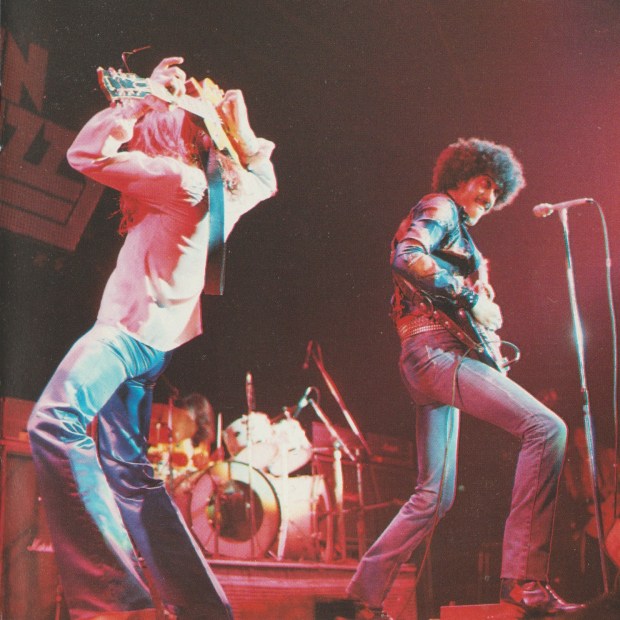
It might not be the best introduction to the most underrated classic rock band of all time, but it was my introduction. Dedication was a 1991 Thin Lizzy compilation that was buoyed by the unreleased song “Dedication” which was released as the radio single.  There’s nothing wrong with the “new” track, except it wasn’t supposed to be a Thin Lizzy song.  Phil Lynott recorded the song in 1985 for his new band Grand Slam.  Scott Gorham and Brian Downey replaced the original instrumentation leaving Phil intact.  And that’s fine.  “Dedication” sounds slightly unfinished but it also sounds like what Thin Lizzy might have been doing had they carried on.

These kind of extra songs usually get spotlighted at the front of the album, or left at the end to whet the appetite.  On Dedication, it goes last, leaving the compilation to ascend in chronological order.  Is that the best way to approach listening to Thin Lizzy?  While many sets go that route, it leads to a very uneven playing experience.  Early Thin Lizzy was much more folksy, and dare I say it, just not as good.  It certainly had some excellent tunes, and some of the better ones are showcased here.  “Whiskey in the Jar” is an actual folk traditional, rocked up and made unforgettable by that Eric Bell guitar hook.  That’s followed by the firecracker “The Rocker”, just shy of three minutes but every one of them shockingly great.

Original guitarist Eric Bell left the band after three albums due to exhaustion, and the band was beefed up to a four-piece with Brian Robertson and Scott Gorham taking his place.  It took a while for the albums to really catch up with the talent.  On CD it’s a lot of slow material before we get to the more rocking stylings of the Thin Lizzy that you know and love.  From 1974’s Nightlife we have “She Knows”, “Still in Love With You”, and “Showdown”.  A lot of ballads and blues and not a lot of fire.  The guitar work is sparkling but the songs are not yet as astounding as they would yet become.  Another ballad, “Wild One” from Fighting (1975) is one of the best of the batch.  It is bookended by two rockers, “Fighting My Way Back” and the Bob Seger cover of “Rosalie”.  Both are tracks you don’t want to live without.

Part of (but only part of) Phil Lynott’s genius was bringing Gorham and Robbo (and later others) together as a unified guitarmony duo.  The next batch of classics really hammer this home.  “Jailbreak”, “The Boys are Back in Town”, “Cowboy Song” and “Don’t Believe a Word” are the embodiment of what people think of when they picture Thin Lizzy.  The driving beats, the hooks, the dual solos, the poetic lyrics — it’s all there in what might be considered Lizzy’s peak era.

Brian Robertson left the band shortly after, and doesn’t appear on “Bad Reputation” or “Dancing in the Moonlight”, but Gorham picked up the slack in the studio and rendered these as two more stone-cold classics.  “Bad Reputation” covers the driving side of the band while “Dancing in the Moonlight” is funky, light romantic storytelling.  Truly excellent songs even without Robbo.

The Gary Moore era follows with “Do Anything You Want To” and “Waiting For An Alibi”, two more excellent Lizzy classics from the underappreciated album Black Rose.  Moore lasted only for one album, and his successor Snowy White for two more.  Snowy is only heard on one track here (“Chinatown”) and the man that replaced him (John Sykes) is heard on none!  So another failing of the Dedication album is a sudden drop-off at the end, leaving out important songs.  “Chinatown” is excellent at least, but so is “Hollywood” and “Renegade”, yet they are not here.

Yes, too many songs were left off Dedication because you couldn’t get ’em all on a single CD.  Johnny The Fox (possibly their best record) is an album that isn’t given enough time here, along with Black Rose.  And to have no Sykes?  Unjustifiable.

Fortunately the last song “Dedication” is better than expected, sounding like Thin Lizzy 1991, beefy and tough.  It doesn’t sound like Lizzy ’75 or Lizzy ’83.  But it does sound like Lizzy because Phil Lynott’s voice tends to do that.  Scott Gorham does a decent job of replicating all the guitar excitement himself (he’s had to do it before).  The track, written by Lynott and Grand Slam guitarist Laurence Archer, had one of those guitar hooks well suited to the Lizzy canon.  Gorham and Downey did it justice enough.

Dedication is not enough Thin Lizzy but it’s enough to get your feet wet.  Although it’s a slow starter it will eventually get you interested enough to try more.  It worked for me and it’ll work for you.

3.25/5 stars
#850: Truly A Marvel

GETTING MORE TALE #850: Truly A Marvel

You can blame my dad!  He doesn’t remember getting me into Marvel comics, but he started it.

My neighborhood friends did have something to do with it initially.  Marvel’s Secret Wars was turning into the comic event of the year.  Neighbors like Bob Schipper and George Balasz introduced me to some of the characters – The Vision, Scarlet Witch, Rogue, Storm, and Bob’s favourite Hawkeye.  Bob liked collecting “limited series” and 1984’s The Last Starfighter (based on the movie) was the first he completed.  Marvel also had the comic rights to Star Wars and Indiana Jones, so it was natural for me to gravitate to them rather than DC.   Even Kiss had a Marvel comic.

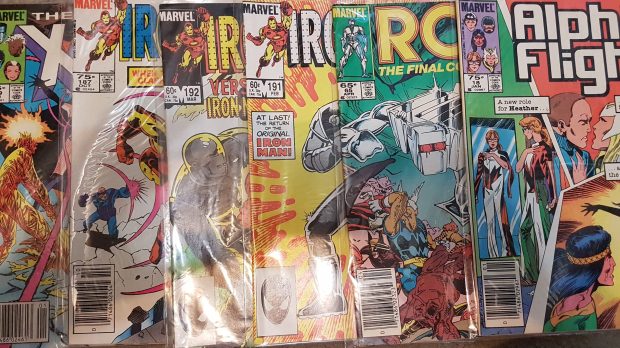
I remember Marvel four-packs at convenience stores.   You would get four Marvel comics from four different titles in one bag.  My dad would buy these for us on the way to the cottage to give us something to do.   Just one bag of four books would keep us occupied on those long drives.  Iceman, Iron Man, ROM the Spaceknight and the X-Men entered our lives this way.  I didn’t want DC comics; I wanted the characters that I knew.  We were not comic fiends the way some kids were, but Marvel was there for me with astounding tales of science fiction and fantasy.

My father has no memory of buying those old books.  He looks at these Marvel movies today completely dumbfounded.

“Who’s that guy?” he’ll ask.

“That’s Tony Stark!  Iron Man!  You bought my first Iron Man comics when I was a kid!”

Although he always responds with “I don’t remember that,” I sure do.

It’s all true.  He bought my first Iron Man.  When I started reading them, James Rhodes was actually Iron Man.  Tony was just about to reclaim the helmet for himself when I jumped in.

Of the heroes, ROM was my favourite.  His adventures crossed over with Ant Man, Alpha Flight and others, exposing me to more Marvel characters.  A ROM annual (#3) with the X-Men hooked me on the Spaceknight.  At this time, my grandfather was dying of cancer.  When we went to visit the hospital, I wasn’t allowed to see him anymore.  He was too sick and they didn’t want me to remember him that way.  I can remember sitting in the waiting room reading ROM #62.  The battle to save Earth from the Dire Wraiths was a good distraction from the hospital sounds and smells.

As a little kid, I couldn’t buy everything.  It was hard just getting to the stores to catch every issue.  So my mom got out her cheque book and bought me subscriptions to my three favourite books.  Now there was no way I would be missing the latest issues of ROM, GI Joe, and The Transformers.

DC Comics had the big movies – Superman, Batman – but Marvel didn’t seem to translate well to live action.  We had the TV show The Incredible Hulk starring Bill Bixby and Lou Ferigno, but it was only loosely based on the comic.  (The TV producers didn’t want the Hulk to be green but fortunately Stan Lee insisted upon it.)   Marvel finally came out with a great film in 2000’s X-Men, directed by Brian Singer.  Patrick Stewart and Ian McKellan were fantastic, but it was Hugh Jackman as Wolverine that was the real breakthrough.  Unfortunately the X-Men films declined in quality too quickly.  Sam Raimi’s Spider-Man debuted in 2002, but suffered the same fate by the third film.

Whether it was Blade, Fantastic 4 or Ghost Rider, Marvel rarely made me gasp in awe at the silver screen.  Not until Iron Man flew around the world in 2008.  That Jon Favreau film was a game changer.  Especially when Samuel L. Jackson showed up in a surprise cameo as Nick Fury to discuss the “Avenger Initiative”.  Suddenly the idea of Marvel heroes interacting with other Marvel heroes seemed possible.

None of us could have imagined the marvel-ous tapestry that they would weave over the next 22 movies.  Finally seeing my heroes like Captain America, Thor and Ant Man in movie form made me remember what I loved about my old comics.  They tried to stay reasonably close to the original stories.  The costumes might have been updated and less colourful, but there was no mistaking the Mighty Thor for anyone else.

And now all these decades later, I’m going back, buying graphic novels and catching up on my old friends in the Marvel Universe.  Reprints of The Infinity Gauntlet, Secret Wars, and the very first adventures of the Incredible Hulk, Iron Man, Spider-Man, and the X-Men are all in my library any time I need some nostalgia therapy.  Thank you Stan Lee, Jack Kirby, Steve Ditko and all the rest.  Jim Shooter, Larry Hama, Bob Budiansky and Simon Furman, I will always be grateful for bringing me childhood heroes month after month!


Sunday Chuckle: F’in bird!

Do you hate birds?  Dr. Sheldon Cooper isn’t a fan.  I saw this on the back of a delivery truck the other day, and couldn’t help but think that these icons for Facebook, Twitter and Instagram spell out “f’in bird”!