david coverdale

REVIEW: Deep Purple – Come Taste the Band (35th Anniversary edition)

DEEP PURPLE – Come Taste the Band (35th Anniversary edition, 2010 originally 1975, EMI)

For those keeping score, now every single album from the original run of Deep Purple 1968-1976 has been remastered with some sort of deluxe edition. Come Taste The Band is the final album of this series. Deep Purple imploded shortly after and the band was no more until Perfect Strangers in 1983.

Personally I have always liked Come Taste The Band right from first listen. However, I never heard the album until 1996 so the idea of a great Purple album without Richie Blackmore was not foreign to me. With open ears you can really appreciate what Deep Purple were up to on this powerfully rocking album. It has a solid groove, a much harder sound than Stormbringer and some greasy unconventional guitar playing from Tommy Bolin. Everybody is playing amazingly, even the coked-out Glenn Hughes who just rips it to shreds on “Gettin’ Tighter”, my favourite track. Paicey is awesome on said breakneck track.

Really though there are no losers on Come Taste The Band. Every song is incredible right from the opener of the ferocious “Comin’ Home” to the philosophical “You Keep On Movin'”. Another personal favourite is the sliding groover “Dealer”, a tale of warning from David Coverdale to Glenn Hughes about his habit. Bolin takes his first and only studio Deep Purple lead vocal on the bridge.

IMG_00000713As with all previous special editions, the liner notes are excellent, revealing, and loaded with pictures. One fact I didn’t know: The band were going to kick out Hughes if he didn’t kick the coke.

Bonus material is present. The single edit of “You Keep On Movin'” is tacked on to the end of disc one, but this is previously available on such albums as Singles A’s and B’s. The second disc contains the entire album remixed by Kevin Shirley. Shirley is truly a great mixer. It’s hard to discern what he did differently here, except the songs are a bit more punchy. Some now continue on past their original fade points, revealing never before heard playing from the band, right to the end of the song. This was done on previous remasters such as Machine Head and I like this touch a lot.

Two previously unreleased tracks are included. These tracks will be worth the price of purchase alone to Purple collectors. “Same In L.A.” is a nearly complete song with lead vocals and lyrics. If it had been included on the original album, it would easily have been the most pop, it sounds more suited to Stormbringer material. “Bolin Paice Jam” is also unreleased — not even heard before on Days May Come and Days May Go or the limited edition 1420 Beachwood Drive albums. This is a massive, fiery jam capturing the best of both players. Difficult to understand why this was not included on the aforementioned two compilations, but it’s just awesome and I’m glad it’s out.

Once again, Simon Robinson has outdone himself with the final Deep Purple remaster of this series. These albums, while expensive and difficult to obtain (mine took almost two months to ship) are well worth it to the faithful.

5/5 stars

REVIEW: Whitesnake – Forevermore (2011)

This has become a bit of a series I guess, unintentionally!  Here are my Whitesnake reviews thus far:

SnakebiteCome An’ Get ItSlide It InLive at DonningtonGood to be Bad

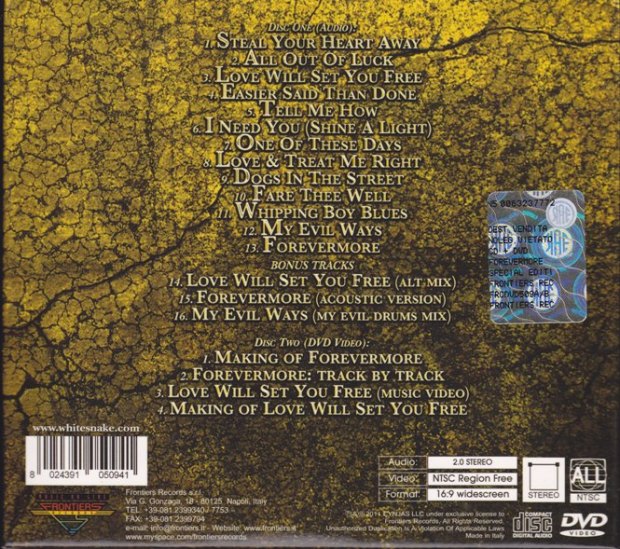
WHITESNAKE – Forevermore (2011 deluxe edition, Frontiers)

Considering that this band has housed such monster players as Steve Vai and John Sykes among many others, I take great risk with my opening statement, but here goes: I think Forevermore, the newest album by Whitesnake, is the most guitar-heavy of their entire career. Indeed, on first listen, one is blown away by the extremely well recorded antics of Reb Beach and Doug Aldrich. These guys can wail.

And wail they do, the opener “Steal Your Heart Away” (not to be confused with “Steal Away” from Snakebite) just roars with bluesy chords, fast fretwork, and slippery slides.  The guitars are greasy! And that’s just the opening track.

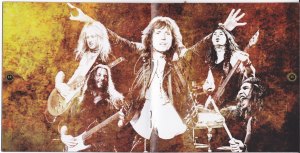
FOREVERMORE_0004You can definitely hear an urge from Coverdale and Co. to keep everything loosely based on the origins of Whitesnake. You get a lot of bluesy rock, a lot of soul singing from one of the best there is, and some serious groove. On the whole, this album sounds like a growth from the last album, the solid but safe Good To Be Bad. Good To Be Bad was a decent album, but very “safe”. It did not stray much if at all from the classic Whitesnake 1987 sound, complete with guitar solos from the John Sykes School of Axe Wizardry. Now Whitesnake are stretching out more, and dropping a lot of the Sykes-isms. If the last album was a debut album of sorts, this one definitely sounds like the more confident second album.
David is singing great. His voice is as marvelously rich as it was on the Coverdale-Page album back in 1993. And speaking of Coverdale-Page, some of these songs definitely bring that great album to mind.

The only thing that I really don’t like about Whitesnake today are the lyrics. David’s a capable lyricist, and songs like the oldie “Sailing Ships” are really well written. When David, at his current age, starts singing about girls that way that he sings about girls, I feel mildly queezy inside.  But then, on the album closer “Forevermore”, David returns to his philosophical lyrical side, a side I prefer.  (And it’s a great song.)

It is what it is, and musically this is just a freakin’ great album. My current fave track is “All Out Of Luck” which sports this nifty space age blues metal riff. You will find your own favourites too. Fans of both 70’s and 80’s ‘Snake should find something to enjoy here.

FOREVERMORE_0003

There’s a bonus DVD:  A music video, some making-ofs, and a track by track commentary by DC himself.

There are bonus tracks on my “deluxe edition”, all remixes and alternate versions. Just a nice bonus, not essential for the enjoyment of this album. The “Evil Drums” mix of “My Evil Ways” is a little crazy.  Of note, Japan also got an exclusive bonus of their own, a “Swamp Mix” of “Whipping Boy Blues”. Like our bonus tracks, it’s just a bonus, not essential to the flavour of the album. Track it down if you’re a collector. I’ve heard it, it’s cool.
4.5/5 stars

FOREVERMORE_0002

REVIEW: Whitesnake – Good to Be Bad (2 CD & Japanese versions)

Here’s my second review from the The Toronto Musical Collectibles Record & CD Sale! It was Japanese import Heaven!

For the last installment of this series, click here.

WHITESNAKE  – Good to Be Bad (2008 Warner/SPV)

Whitesnake disbanded in 1990.  Coverdale did his album with Jimmy Page, but that didn’t prove to last either.  Although they’d started writing for a second album, the affair ended and David Coverdale assembled a new Whitesnake for a Greatest Hits tour in 1994.  This reformation eventually led to an album in 1997 called Restless Heart (billed as “David Coverdale and Whitesnake”.  This R&B flavoured album, a personal favourite, did not resonate with some fans of 80’s ‘Snake.

After another hiatus, and a solo album (2000’s Into the Light), David once again formed a new group of ‘Snakes, a mixture of old and new members.  After several years of touring (and lineup changes), the long awaited new Whitesnake album, Good to Be Bad, hit the shelves in 2008.  Former Dio guitarist Doug Aldrich and Winger’s Reb Beach had been a formidable guitar duo since 2002.

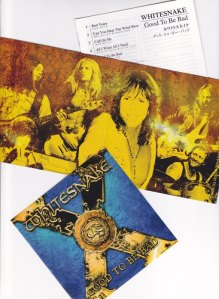
GOOD TO BE BAD_0003

Similarly to his partnership with Adrian Vandenberg, David has retained his writing style of co-writing with just one co-writer; in this case, Aldrich. It seems to be evident that the guys have gone for a John Sykes guitar sound and style.  You can certainly hear a lot of trademark sounds and tricks that Sykes used to do, that gave the 1987 album such a cool sound.  This isn’t to say that they don’t play plenty of their own style too, but the retro stuff is frequent.

So similar is the direction of this album to 1987, that you can play “name that tune” with all the new songs:
“Can You Hear The Wind Blow” for example directly references moments on 1987, right down to those flares that Sykes used to do.  “All I Want, All I Need” equals “Is This Love” Part Deux.  Basically, every song on Good To Be Bad is a mash-up of songs from Coverdale Page1987 and Slip Of The Tongue, and you can hear the references quite distinctly. “A Fool in Love” is “Crying in the Rain”.  “Lay Down Your Love” is “Shake My Tree”, without Jimmy Page.  Throw in a little “Kashmir” during “‘Til The End Of Time” (which seems to be based off “Till The Day I Die” from Come An’ Get It) too.

Having said that, despite the lack of originality, Good To Be Bad is still a very enjoyable listen, and a very welcome return. A world without David Coverdale’s voice is like a world without crème brûlée.  That voice is in fine form, perhaps even stronger than it was on 1997’s Restless Heart. The album has a lot more life to it than Restless Heart, although it does lack that album’s subtlety and R&B moments. The band play great, kicking it on every tune, even the ballads. The melodies are strong and memorable.  It’s just…too contrived.

The bonus live disc is the the Canadian special edition is highlights from Live: In The Shadow Of The Blues. No big deal.  It’s nice to hear Whitesnake playing “Burn/Stormbringer” from David’s Deep Purple days, and cool to hear the old 70’s classics.

The real cool version to have is the Japanese release with two bonus tracks.  And a sticker!  Can’t forget the sticker.  The bonus tracks are both remixes (a “Doug solo” version of “All For Love”, and a stripped down version of the lovely “Summer Rain”).  For $20, I wasn’t complaining.

3.5/5 stars

REVIEW: Deep Purple – Stormbringer (35th Anniversary Edition)

STORMBRINGER OUTER FRONT

DEEP PURPLE – Stormbringer (35th Anniversary Edition, 2009 EMI, originally 1974)

Stormbringer, now available in the gloriously remastered series of Deep Purple special editions, is one of my favourite Purple platters. Now augmented with bonus material, it has finally been given the treatment it deserved. It’s certainly not everybody’s cup of tea, but Stormbringer has earned some begrudging fans over the years.  I for one find it a more enjoyable listen cover to cover than 1974’s Burn.

A lot of fans did not like the funkier, softer direction of the band. You can understand this, of course. A fan who loved In Rock, one of the heaviest records of any decade, could easily be turned off by the radio-ready soul funk of “Hold On”.  Blackmore himself decried the funky direction of the band.

Here’s the good news: Whatever Deep Purple set their minds to, they could do. And they could do it well.

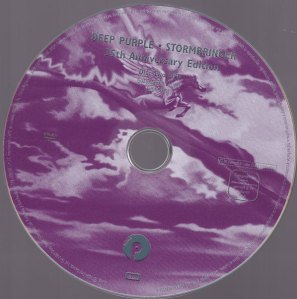
STORMBRINGER CDBlackmore may not have liked the album, and he did take a step back in the mix, (you can barely hear any guitar on “Hold On”).  He could stilll adapt to and play any style. His playing here, while sparse, is sublime. Ian Paice takes to the funky rhythms very comfortably, laying down some excellent grooves. Jon Lord steps up to the forefront, supplying some excellent, funky keys.

There are a few songs that harken back to the past: “Stormbringer”, the title track, sounds as solid as any epic the band had ever composed. It could have been on Burn as easily as this record. In fact, it stands out as being out of place: As the opening track, fans must have been shocked and surprised when the rest of the album was so different.

Another song that has shades of older Purple is “The Gypsy”.   It’s a slow mournful piece, perhaps akin to “Mistreated” from the previous album.  The lyrics are uncharacteristically bleak.

One track showed an interesting glimpse of the future. “Soldier Of Fortune” is an acoustic track which forshadowed much of the music Blackmore would do with Rainbow, and even now with Blackmore’s Night. David Coverdale has performed it live with Whitesnake.  I think it’s one of Richie Blackmore’s finest compositions.

Of the other tunes, “Love Don’t Mean A Thing” is one of the funkiest, and one of the most entertaining.  It’s just fun to listen to.  David and Glenn co-sing this one.  Ritchie’s solo is very understated, but appropriate.  Glenn takes his first solo lead vocal with Deep Purple on “Holy Man”, a soulful ballad.  “You Can’t Do It Right” features probably the funkiest guitar work of Blackmore’s career.  It’s fascinating to listen to, and the band really cooks on this one.  It’s one of the most extreme experiments of this funky Purple period.

As with all the Purple reissues, this has been lovingly remastered. Finally you can discard your original CD, mastered for digital ages ago, but never really letting the subtleties of the music shine. Stormbringer, of all the Deep Purple albums, perhaps has more subtleties to hear due to the quieter nature of the music.

STORMBRINGER DVDBonus material?  Oh yeah, there’s bonus material, in this case four remixes by Glenn Hughes. These remixes don’t replace the original songs, but they do act as a companion piece of sorts. Fresh light is shed on alternate takes incorporated into the mixes, and “Love Don’t Mean A Thing” is extended by over half a minute. “High Ball Shooter” is presented in an early instrumental form as well.

As an added bonus, a second disc has been included. The second disc, exclusive to this edition, is a DVD containing the original 1975 quadrophonic mix of Stormbringer! Nice. Apparently, this disc is to be a limited edition so get yours while you can. I liked quite a bit, myself. As with many quad mixes from the 70’s, the songs often bear noticeable differences from the originals.  Quad was a gimmicky fad, by today’s standards, but listening to it with the benefit of hindsight is quite enjoyable.

Lastly, I must acknowledge the great liner notes. The most entertaining story included is in regards to “Love Don’t Mean A Thing.”  While in Chicago, Ritchie ran across a street busker, who was snapping his fingers singing a song about money.  Blackmore invited him onto Purple’s plane, collected Coverdale and Hughes, and jammed for 20 minutes with this guy who taught them the song and the lyrics.  The band finished the song that became “Love Don’t Mean A Thing”, credited to the entire quintet, because nobody ever bothered to get the busker’s name.

Pick up Stormbringer in this 25th Anniversary Edition, and finally you can feel comfortable discarding your original.

5/5 stars for both the music, and the reissue!

REVIEW: Whitesnake – Snakebite (album)

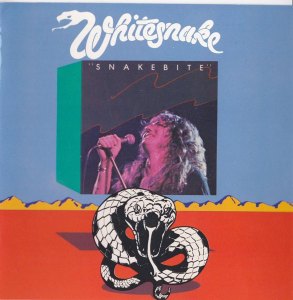
SNAKEBITE FRONT

WHITESNAKE – Snakebite (1978, released as both album and EP)

You gotta give David Coverdale some kind of credit for name-dropping two of his old Deep Purple Stormbringer classics right there in the first song on this album/EP, “Come On”.

“I’m just a SOLDIER OF FORTUNE,
Must be the GYPSY in me…”

Maybe David just wanted to remind people who he was, that this was not just some “new” band.  Either way, it’s a very solid outing, considerably more enjoyable than David’s first two albums as a solo artist.

SNAKEBITE FRONT BACK

Snakebite was originally a 4 song EP, under the name Whitesnake.  Over here in Canada, I knew it as a full album .  North America stuck on four of the better tunes from David’s solo album, Northwinds, and released it as an LP.

The EP, or side one of the album, was helmed by Purple producer Martin Birch.  He ensured a solid sound, and Coverdale & Whitesnake provided four solid tunes.

The aforementioned “Come On” sounds like a smoove Paul Rodgers prowl, and features three players who would stay through most of Whitesnake’s history: Neil Murray (bass), Bernie Marsden (guitar) and Mickey Moody (guitar). Track two, “Bloody Mary” is driven by a boogie piano, one of the best songs on the album.  My personal favourite of the album, anyway.  It’s just impossible not to move to this one.  David’s as naughty as ever in the lyrics:

“You know that Madam Palm and her five sweet daughters”
Couldn’t give her man what the doctor ordered”

Then Coverdale gets bluesy. “Ain’t No Love In The Heart Of The City”, previously a hit for Bobby “Blue” Bland, ended up becoming Whitesnake’s live centerpiece.  On the original EP, it is the last track, its position swapped with “Steal Away”.  “Steal Away” is a another highlight.  Moody’s slide guitar is just pure awesome sauce.  The only thing I dislike is some really cheesy sounding electronic toms.

NORTHWINDSSide two of the LP had the earlier Northwinds material, produced by ex-Purple bassist Roger Glover. Although Mickey Moody plays on these songs, he’s the only future Whitesnake member present. The tunes are decent enough.  “Keep On Giving Me Love” was funky, like the kind of stuff Glenn Hughes was always trying to push on Deep Purple.  It’s not really outstanding until you get to the chorus.  “Only My Soul” however is a stand out. Coverdale has often done these incredible soul-searching pieces, such as Purple’s “Soldier Of Fortune”, and Whitesnake’s later “Sailing Ships”. This time out we’re treated to some very appropriate violin, and Glover on synth.  The side is rounded out by “Queen of Hearts” and “Breakdown”, the raucious rocker written about the final demise of Deep Purple.

Although David Coverdale seemed to still be searching for direction after leaving Purple, the Snakebite album (or EP, whatever you happen to own) is an enjoyable listen from front to back. Some material really showed what David was capable of, and he certainly would deliver in full in the future. Whitesnake diehards should not do without Snakebite, as it provides an interesting set of snapshots as to what Coverdale was up to, between his bouts of fame and glory.

TROUBLEThere are numerous options today to get this music.  Not only is the Snakebite album still in print on CD in North America, but you can now also find the tunes remastered.  The Snakebite EP has been added as bonus tracks to Whitesnake’s debut album, Trouble.  You can also get David’s solo album, Northwinds, remastered with bonus tracks.  Or you could just get ’em on original vinyl!  The choice is yours, but I think any Whitesnake fan would enjoy this Snakebite.

4/5 stars

REVIEW: Whitesnake – Come An’ Get It (Remastered with bonus tracks)

“Like” the brand new LeBrain Facebook page!

WHITESNAKE FRONT

WHITESNAKE – Come An’ Get It (EMI 1981, 2007 remastered with bonus tracks)

Come An’ Get It is my favourite Whitesnake album.  Therefore it’s a bit of a surprise that I still haven’t reviewed it.  On the other hand it’s always nice to leave some goodies for later and cherish them, I suppose?

The first time I heard this album was in 1990.  I had ordered the cassette from Columbia House, and brought it with me on a trip to go visit my cousin and aunt in Calgary, Alberta.  I remember I brought two brand new (to me) albums with me from that Columbia House purchase; the other was School’s Out by Alice Cooper.  I ended up loving both, not a bad trip eh?  Driving through the mountains with “Lonely Days, Lonely Nights” by Whitesnake on the earphones was pretty fucking cool.

Come An’ Get It features this classic Whitesnake lineup, aside from David Coverdale himself:

  • Jon Lord – organ
  • Ian Paice – drums
  • Bernie Marsden – guitars
  • Mickey Moody – guitars
  • Neil Murray – bass

Basically, THE lineup of early ‘Snake.  In the liner notes, David says he finds this to be one of his most consistent efforts, and his favourite of the early band.

The incredible album kicks off with the flirtatious title track, Cov the Gov as cocky as ever, with this seasoned band behind him solidly grooving.  “If you want it, come an’ get it, I got something for you.”  And kids, I hate to break it to you, Coverdale’s “something” was not something innocent like candy or treats.

“Hot Stuff” is the second track, which changes up to a breakneck speed.  Lordy on the piano hammers away, keeping up with the furious pace of Paice and the 3 M’s – Moody, Marsden and Murray.  Another standout.

The single, “Don’t Break My Heart Again” is a bit more ominous, with Lord’s trademark Hammond organ carrying the song.  It’s a bit darker, a bit plaintive, David convincing us that he really is heartbroken, even though two songs ago he was begging some lovely lass to “Come An’ Get It”.  This is a standout song, with fantastically colourful solos and a memorable melody.  Shades of the Whitesnake to come.

The aforementioned blues, “Lonely Days, Lonely Nights” follows.  It’s this kind of song that David really sinks his teeth into.  Moody and Marsden throw in plenty of bluesy licks, Lord with his Hammond colouring the backdrop.  Once again, David will have you convinced that somehow, he really is lonely.  Lonely, even though the very next song talks about how much he loves “Wine, Women An’ Song”!

“Wine, Women An’ Song” is actually my favourite tune on the album.  Coverdale is as cheeky as ever:

“If I can make you smile, I will raise my glass,
But if you don’t like it, baby you can kiss my ass,
Yes indeed…
You can tell me it’s wrong, but I love wine women an’ song!”

This barroom piano bopper is irresistibly catchy.  I’ve always been a sucker for past piano tunes, that’s why I love Little Richard I guess!  David’s done a number of these over the years (“Bloody Mary”, “Bloody Luxury”) but this one is my favourite.  And that ended side 1.

WHITESNAKE INNER

Side 2 kicked off with one of David’s more philosophical songs, a style he also does well.  “Child of Babylon” starts slow and bluesy but soon becomes something a bit more menacing.  This is another triumph.  “Would I Lie To You” returns David to his cheekier side.  “Would I lie to you…just to get in your pants?  I think so,” winks Cov the Gov.  This is just a fun Whitesnake tune, catchy, danceable, tongues in cheeks (just not necessarily the cheeks of the tongue’s owner).

My least favourite song is the next one, the slightly funky “Girl”.  The liner notes compare it to Deep Purple; I don’t think so.  Yes, both bands forayed into funk.  I think Deep Purple did it better than this.  Much better is “Hit An’ Run”, which drives.  This song kicks.  David’s vocal is perfect, and there’s even a talk-box solo, and then a killer slide solo!  What more could you want?

The final song of the original album was “Till the Day I Die”, another one of David’s perfect philosophical album closers.  He seems to like to close his albums with tunes like this, or “Sailing Ships”, songs with some mood and thought to them.  “Till the Day I Die” is one of the best ever, a dramatic, sweeping number that goes from acoustic to epic in under five minutes.

Martin Birch produced Come An’ Get It, as he did many ‘Snake platters.  It has a workmanlike sound, powerful enough, sonically clear, with excellent performances.  Slide It In is more powerful in the long run, but this is a step on that road.

There are six bonus tracks to keep you satisfied after the main meal.  Think of this as dessert, as these are unfinished or rough mixes of album tracks.  There is nothing especially revelatory here, but as added value, it’s nice to have these bonus tracks.  There’s some unheard stuff here, such as Ian’s count-in to “Child of Babylon”, nothing mindblowing, just nice to have to fill out the CD.  Some alternate vocals, solos, and so on.

The liner notes by Geoff Barton are excellent, loads of photos, lots of text.  Coverdale shows up to offer his perspective, and illustrates a harmonious band firing on all cylinders.

Keep in mind that context is everything, especially when it comes to music.  I have powerful memories of this album.  For you, it might not be worth it, but for me:

5/5 stars

Part 141: When We Rock, We Rock, and When We Roll, We Roll

RECORD STORE TALES Part 141:  When We Rock, We Rock, and When We Roll, We Roll

I’d always liked Deep Purple, since I first heard the song “Knockin’ On Your Back Door”.  But I wasn’t a Deep Purple collector until 1996.  Until then I only owned three:  Deepest Purple, Perfect Strangers, and Knockin’ On Your Back Door.

In 1996 two critical events occurred:  Deep Purple released the incredible comeback record, Purpendicular, with Steve Morse.  I was also dumped by a girl who went and married the next guy, a few months later.  That kind of took the wind out of my sails.  And what’s better for putting the wind back in, than some new music?

I had T-Trev order Purpendicular for me.  I hadn’t even heard a note, or seen a review.  It was an import.  Wasn’t even released in this country yet. Yet, new music was what the doctor ordered.

The CD arrived open, as did almost all discs imported from England.  (Do you not seal your discs in England?)  T-Rev gave it a test spin before I arrived.  The track was called “Vavoom: Ted the Mechanic”.

“There’s some crazy stuff on here.  Hope you like it”.

In three listens, I loved it.

The quest was on to get more.  I taped some rare stuff off my buddy Vuckovich:  Anthology (the vinyl, not the CD version) , and Power House.  Both contained rare tracks that were not available on CD at the time.  We had copies of Shades Of and Book of Taliesyn, and I bought those as well.   Book Of was a cheap reproduction, unfortunately I paid $16 for it without realizing.  You could hear that it was taken from a vinyl copy.  We also had a used copy of When We Rock, We Rock, so I grabbed that too.  It had some live stuff from Made In Japan on it.

The local library had a copy of Deep Purple, the final Rod Evans album, which I recorded.  It quickly became a favourite.

At Sam the Record Man downtown, I found both Concerto For Group and Orchestra and King Biscuit Flower Hour.  I fell in love with the Concerto big time.  Unfortunately, it didn’t work well for store play.  The quiet parts were inaudible.

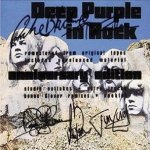
Later that summer, Tom directed me to a copy of The House of Blue Light, used with some water damage on the cover, at a Christian record store in Waterloo.  I took it because it was impossible to find on CD.   And finally, T-Rev and I hit HMV in Toronto, where I acquired a beautiful 25th Anniversary edition of In Rock, and the accompanying “Black Night” limited edition single.

Don’t break the case, the autographs are etched into the plastic!

That was just 1996, and I hadn’t even scratched the surface yet.  I didn’t even have Fireball, Machine Head, Made in Japan, or Who Do We Think We Are yet!  It would take time.  Back then you didn’t necessarily buy in order of preference, you bought in order of opportunity.

It was a lot of Deep Purple to absorb in a short period of time, but that’s how Purple became one of my top five favourite bands today.  Sometimes you just need to dive in…and sometimes you just need a little push to do so.  Thanks for dumping me, chickie!

Most Unrightfully Ignored Albums of the 1990s – LeBrain’s List Part 4

This is it!  The end!  In alphabetical order, here’s Part 4 of 4:  88 albums that meant the world to me in the 1990′s but never got the respect I felt they deserved.   Thanks for joining in!

Savatage – Streets:  A Rock Opera (sheer brilliance, their first and best rock opera)
Savatage – Edge of Thorns (an album to give Queensryche a run for their money)
Savatage – Handful of Rain (recovering from tragedy to create a triumph)
Savatage – The Wake of Magellan (how did this band just keep getting more brilliant?)
Scorpions – Face the Heat (had a couple good heavy rockers on there like “Alien Nation”)
Shaw/Blades – Hallucination (Tommy Shaw, Jack Blades, campfire goodness)
Skid Row – Subhuman Race (when you’re pissed off and you know it, bang thy head)

Sloan – 4 Nights at the Palais Royale (one of the best live albums of all time – ignored internationally)
Dee Snider’s SMF’s – Live / Forever Twisted (fuck, I missed Dee in the 90’s!)
Spinal Tap – Break Like the Wind 
Stryper – Can’t Stop the Rock (a compilation with two great new tunes)
Sultans of Ping F.C. – Casual Sex in the Cineplex (see here)
Talas – If We Only Knew Then What We Know Now… (Billy Sheehan and the boys reunited for one night, and has the wisdom to record it)
Tesla – Bust A Nut (in some ways it’s better than their prior records)
Testament – The Ritual (really heavily slagged at the time as a sellout)
Tonic – Sugar (much better than the first record, you know, the one that was a hit)
Devin Townsend / Ocean Machine – Biomech (one of his more accessible albums)
Union – Union (Bruce Kulick + John Corabi = better than what the Crue or Kiss was releasing)
Steve Vai – Sex and Religion (Devin Townsend — lead throat)
Veruca Salt – Eight Arms To Hold You (their best album, better than the big hit one)
White Lion – Mane Attraction (it was a little mushy, but brilliant guitars by Vito Bratta)
Whitesnake – Restless Heart (back to his blues rock roots, it wasn’t even released here)

We’re done!  88 albums that meant a lot to me in the 1990’s, but in some cases were criminally ignored.  Check them out.

Most Unrightfully Ignored Albums of the 1990s – LeBrain’s List Part 1

In alphabetical order, here’s Part 1:  88 albums that meant the world to me in the 1990’s but never got the respect I felt they deserved.  When appropriate, I’ll pop in with comments.  Part 1!  Enjoy!

  • Aerosmith – Nine Lives (better than Get A Grip)
  • Armored Saint – Symbol of Salvation (John Bush lead vocals, nuff said)
  • Barstool Prophets – Last of the Big Game Hunters (from Ottawa Ontario Canada, great album)
  • Big House – Big House (from Edmonton Alberta, long forgotten hard rock classic)
  • The Black Crowes – Amorica (my favourite)
  • Black Sabbath – Cross Purposes (bleak gooder from the Martin-era Sabs)
  • Blue Rodeo – Nowhere To Here (psychedelically delicious)
  • Blue Rodeo – Tremelo (acoustically psychedelically delicious)
  • Bon Jovi – These Days (their most mature albeit darkest work to date)

  • Gilby Clarke – Pawnshop Guitars (the all time best GN’R solo album)
  • Alice Cooper – The Last Temptation (fans love it in hindsight, but it sold poorly in 1994)
  • Corrosion of Conformity – Deliverance (I was hooked upon hearing “Clean My Wounds”)
  • Coverdale Page – Coverdale Page (unrightfully ignored? well, most just disrespected)
  • Cry of Love – Brother (guitarist Audley Freed plays his Fenders like bluesy butter)
  • Deep Purple – Slaves & Masters (I have a soft spot for this ballady Deep Rainbow disc)
  • Deep Purple – The Battle Rages On (there are some strong forgotten tracks here)
  • Deep Purple – Purpendicular (one of the best records of their career)
  • Def Leppard – Slang (ditto)
  • Bruce Dickinson – Balls To Picasso (I believe I’ve discussed these enough in my in-depth reviews)
  • Bruce Dickinson – Accident of Birth 
  • Bruce Dickinson – The Chemical Wedding
  • Dio – Strange Highways (it took a while to grow on me, but at the time it was criminally ignored)

Part 2 of 4 coming tomorrow…

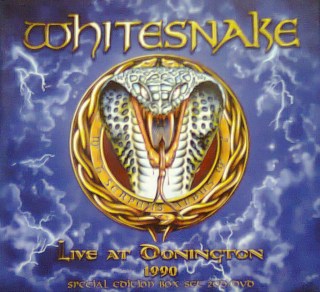
REVIEW: Whitesnake – Live At Donington 1990 (2CD/1DVD)


photo0479.jpg

Whitesnake – Live At Donington 1990 (2CD/1DVD)  (2011)

Back in 1989-1990 when Steve Vai was in Whitesnake, I was a huge fan of both. This was like a dream come true for me. Vai’s Passion & Warfare album, still one of the greatest guitar instrumental albums of all time, changed my entire musical landscape. Vai stretched the boundaries not just of guitar, but of mainstream music in general. Team him up with the very mainstream Whitesnake and you have a really fascinating combination. Did it work? Sometimes! But, I think in 1991 when Coverdale disbanded the ‘Snake for the first time, he wouldn’t have wanted this live album to be his band’s legacy. It’s far removed from the blues-rock at his heart.

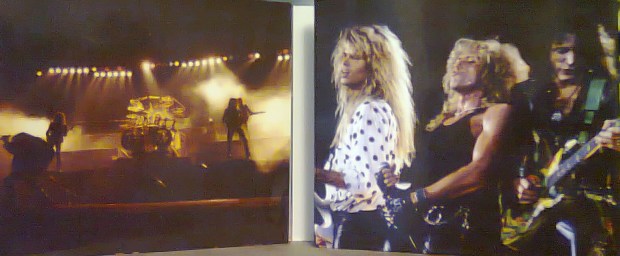
So now decades later, we finally get to hear the legendary 1989-1990 lineup of Coverdale, Vai, Adrian Vandenberg (guitar), Rudy Sarzo (bass), and Tommy Aldridge (drums). And we get to see it too, on the included DVD. This 3-pack is definitely the best economical choice for acquiring Donington 1990.

Musically, it’s a wild ride. It’s not the Steve Vai show. Adrian gets just as many solos, and his are still spine-tingling if more conventional. It is loaded with ‘Snake hits, leaning heavily on the three Geffen albums. In fact there is only one pre-Slide It In song included: The Bobby “Blue” Bland cover “Ain’t No Love in the Heart of the City”.  And, since it is also the pre-grunge era, there are plenty of solos, which today seems excessive.  Aldridge does his drum solo at the end of “Still Of The Night”. Vandenberg gets his “Adagio for Strato”/”Flying Dutchman Boogie”. Most excitingly, Steve Vai performs two songs from his then-brand new (and top 40!) album Passion And Warfare: “For The Love Of God” and “The Audience Is Listening”, with Aldridge on drums. Coverdale even introduces him as “Mr. Passion and Warfare!” so I imagine there was no sour grapes that Vai’s album was doing so well. And lemme tell ya folks — the audience WAS listening, and going nuts too!

As far as the ‘Snake tunes go, this lineup works best on the more space-aged music from the recent Vai-helmed Slip Of The Tongue. When they dip back to older John Sykes-era music…well, it’s weird hearing Vai replace those blazing Sykes solos with his own slippery concoctions. It’s amazing to listen to. Is it the “right” sound for this band? Clearly, no. But it was what it was.

Of note, Coverdale’s voice was in pretty rough shape at the start of the 90’s. It’s much stronger now, but here it is rough, leathery, and worn.

While this album won’t be considered Whitesnake’s live peak (that would be the Sykes era, although they are still very strong today too), it is definitely an essential part of the story. And it’s so long overdue, hard to believe that a live album with Vai was sitting in the cans for so long. And it doesn’t sound too bad. It sounds like it was recorded at a massive outdoor festival (which it was), flaws and all.

The DVD included would have been better released on VHS back in 1991, because at times it is very fuzzy, especially in long shots. What can you do? It was the technology of the time. Just be forewarned. It’s wonderful to see Vai teasing the audience, hiding behind his guitar, and playing acrobatics with it. It’s worth having, just don’t expect anything that will look as sharp as a modern live DVD.

4/5 stars. Long awaited, though imperfect.

photo0480.jpg