glam metal

REVIEW: Quiet Riot – Rehab (2006)

Part 2 of my 2-part review of the Quiet Riot Twin Pack set.  Twin Pack bundled the band’s final two releases:  a retro live album, and the final studio album, Rehab.

QUIET RIOT – Rehab (2006 Demolition)

I love Quiet Riot, even more than I have reason to. Metal Health was the first “metal” album I ever bought, on cassette, and I’ve re-bought it three more times since. I just love that album, and I admit it’s probably 60% music and 40% nostalgia. Since it came out, I’ve managed to collect a lot of Quiet Riot.  Prize possessions are my CD copies of Quiet Riot I and II.  This Twin Pack set was important to me because the version of Rehab contained herein has the European bonus track, “Wired To the Moon”.

It turns out, however, that Rehab kinda sucks. It has its supporters who enjoyed the heavier, bluesier sound.  Rehab unfortunately repeats the problem that Quiet Riot have had for many years:  they don’t write very many good songs!  Kevin DuBrow and Frankie Banali were reduced to a duo after the departures of Rudy Sarzo (who went on to Dio and is now in Tateryche) and Carlos Cavazo (now in Ratt).  Rehab had the right ingredients in place, with the awesome Tony Franklin on bass and Glenn Hughes providing backup vocals, but it was not to be. I give them an A for effort, as I am usually in favour of heavying up the sound and adding blues elements.  They get a D for execution.

The concept was to leave behind the glam rock, but the songwriting is so underpar.  Choruses and verses don’t mesh, melodies don’t stick in the head, and riffs don’t hit you where it hurts. The best song, “South of Heaven”, is a really good Zep-ish tune though.  “Strange Ways” features an incredible solo by Neil Citron, like a cross between jazz fusion and Eddie Van Halen.  Jazz Halen?  On the other hand, “Old Habits Die Hard” is one of the more colossal failures.  Aping Joe Cocker’s “With A Little Help From My Friends”, DuBrow sinks this one all by himself with his overwrought lead vocal.

There are some good moments.  Pretty much all the guitar solos and instrumental sections are incredible.  The drums are good.  A song called “Beggars and Thieves” is one of the better songs, because it is anthemic and memorable like old Quiet Riot.  Unfortunately, that cannot be said of most of this material.  Glenn Hughes classes up the place by several notches when he shows up at the end, but this also highlights Kevin DuBrow’s limitations.

I dislike the cover art and packaging.  DuBrow’s wig, oh my God.  Seriously? The old Quiet Riot logo is also gone, and the masked mascot dude is barely visible.  The album was self-produced by Kevin and Frankie, but they really should have spent some money on a producer with a decent set of ears.  These songs would not have passed muster with any serious producer.  The title of Quiet Riot’s final album is now a sad irony, considering DuBrow’s overdose at age 52.

2.5/5 stars

And sadly, almost unbelievably, the band’s legacy has been tarnished even further with Banali’s hack version of the band currently touring without any original members.  And Kevin rolls in his grave.

REVIEW: Quiet Riot – Live & Rare (2005)

Part 1 of my 2-part review of the Quiet Riot Twin Pack set.  Twin Pack bundled the band’s final two releases before DuBrow’s untimely death:  a retro live album, and the final studio album, Rehab.

QUIET RIOT – Live & Rare (2005 Demolition)

I will tell you right off the bat, the only reason to own Live & Rare by Quiet Riot is if you are like me (obsessive collector), and must own everything. That’s it. There are no other reasons. This is a terrible, terrible CD. Awful. It is so cheaply and carelessly put together that it truly is the definition of “cash grab”.

The original pressing of this CD had a major flaw, a 2 second gap between the songs.  This amateur mistake caused the audience noise to cut out and then start again in a way that was just jarring and unpleasant. They partially fixed the problem on my second printing…but only partially. The 2 second gap is gone, but it is replaced by a quick split-second pause — think about the way a live album sounds when you play it on an mp3 player. It’s not nearly as bad as the 2 second gaps, and it makes the album so much more listenable.   At the end, the live portion doesn’t even finish with a fade-out.  Just an amateur abrupt silence.  Lastly, the three demo tracks at the end aren’t even listed in the correct order on the CD sleeve.  I have a hard time imagining how these flaws made it past quality control — twice!!

I can remove the gaps using Audacity, and re-burn the thing using Nero, but really what’s the point?  If the album was decent, it might be worth the effort.  Unfortunately, Live & Rare is pretty poor.  You wouldn’t expect this to be the case upon reading the track list.  Live performances from the 1983 Metal Health and 1984 Condition Critical tours, the golden years with the classic lineup.  Throw on three bonus tracks from the 1981 DuBrow demo and it should be a pretty satisfying listen, gaps or no gaps.

Musically the songs are fine, but the recordings are terrible! Basically this sounds like a bootleg, and I have heard far better bootlegs.  I’ve heard audience bootlegs that were better quality than Live & Rare.  It’s nice that there are some rarely played tracks on here (“Gonna Have a Riot” and “Danger Zone”) plus a drum solo, but otherwise the CD is close to unlistenable. What’s the point of a drum solo if it sounds this terrible?  The only, and I mean only, saving grace on this CD are the three unreleased DuBrow demos. They date from a time when Quiet Riot was actually broken up, and Kevin was  recording under the name DuBrow. Banali was a part of the DuBrow lineup. They were eventually renamed Quiet Riot and they recorded Metal Health and made metal history. These demo tracks are historically significant to fans, and it’s nice to finally have them.

Buyer beware. I was not at all impressed with this CD, and I think Quiet Riot should have been embarrassed to release it. The liner notes state that it was “produced and mixed by Neil Citron and Frankie Banali”. I wonder exactly what they did to produce and mix it. I speculate that they adjusted some levels on a home PC and burned a copy to CD…without removing the 2 second gaps! Not very pro at all.

1/5 stars

REVIEW: Ratt – Ratt (EP)

Here’s the first review from the The Toronto Musical Collectibles Record & CD Sale! I promised I’d show you more of the stuff I scored. Here’s one!
RATT

RATT – Ratt (1984 remixed EP, Time Coast)

My understanding is that this EP, much like Twisted Sister’s Under the Blade, was remixed and re-released.  It is the remixed version that I got in Mississauga at the Toronto Musical Collectibles Record Show.  I’ve wanted this EP for a long time, but for some reason it’s only now that I finally picked it up.  I was pleased to find it an enjoyable listen, easily on a par with Out of the Cellar, possibly Ratt’s best album.

Europe got 7 tracks on their version of the original mix (wishlist!), but this remixed version only has six.  Missing is “You’re In Trouble” which in re-recorded version was also on Out of the Cellar.  6 songs is a good length, too much Ratt can sound like razorblades coming at your ears, some times!  This self-titled debut keeps things brief, each of its songs more or less delivering the goods.

RATT LABELThe opener “Sweet Cheater” and “U Got It” are the faster side of Ratt.  I love Bobby “Da Blotz” Blotzer’s simple but gleeful drum intro.  (Can’t believe this guy was in Tateryche.)  Both songs have decent riffs, once again keeping things simple.  Pearcy’s trademark vocal snark is in fine form.  Ratt are not a great rock n’ roll band, but they certainly satisfy my cravings when I need some spandex-wrapped non-wimpy LA hard rock.  No ballads.  They had their own sound, largely due to Pearcy’s one-of-a-kind voice.

The closest thing to a ballad would be “Back For More”, which is to say, it has some acoustic guitars before Pearcy yelps, “You turn him away, you tell him you’re mine, You make him believe you’re but one of a kind.”  Meaningless but cocky.  Which maybe sums up the whole Ratt experience.  This is an early version of the hit song from Out of the Cellar, a bit longer, needing some of the fat trimmed.

“Walkin’ the Dog” is a Rufus Thomas cover via Aerosmith.  Aerosmith were in no danger of being dethroned by Ratt’s version, but it’s fun.  It suits their sound, it’s heavy, they throw their own attitude into it, and I’m sure there were youngsters of the 1980’s who assumed it was their own original tune.  The guitar solo is great.

The best song is the single “You Think You’re Tough”.  If Ratt has two sides (fast, and mid-tempo) then this is the mid-tempo side.  The riff is one of their best, the chorus and bridges are great, and the video had both Ozzy and Motley Crue in it.  Cool.

That’s Tawny Kitaen on the cover.  Pre-Coverdale.  She was dating Robbin Crosby at the time!

4/5 stars
Side A:

  1. “Sweet Cheater”
  2. “You Think You’re Tough”
  3. “U Got It”

Side B:

  1. “Tell the World”
  2. “Back for More”
  3. “Walkin’ the Dog”

REVIEW: Quiet Riot – Quiet Riot I & II (1977, 1978)

QUIET RIOT – Quiet Riot (1977), Quiet Riot  II (1978 CBS)

A while ago I talked about the rarities/remix compilation album, The Randy Rhoads Years.  I recommended that album, but I am also lucky enough to own CD copies of the first two Quiet Riot albums.  Over 13 months ago (!) I promised you that we would take a closer look at Quiet Riot I and Quiet Riot II.  That day has come!  LeBrain never breaks a promise to his readers.

In a 1993 Guitar for the Practicing Musician interview, Kevin DuBrow complained that producers Derek Lawrence and Warren Entner “didn’t know from guitars”.  Quiet Riot I is ample evidence for that.  Randy’s guitar is but a shadow of what it would later become under the wing of Ozzy Osbourne.  Where later on, Randy would fill songs out with catchy, intricate licks, on QRI he tends to stick to riff-solo-riff song structures.

And this is one awful sounding album.  The vocals of Kevin DuBrow are shaky, and the recording is muddy.  There are very few standouts among its 12 tracks.  Even the Small Faces cover “Tin Soldier” is rendered lackluster.  You can hear Randy doing some neat tricks on the guitar, but it’s buried in the mix.

Lyrically, “Mama’s Little Angels” is beyond awful:

“As soon as mommy’s at work,
Out come the paint cans,
We start to spray it on the wall.
That’s getting boring, 
Go get the bats!
Gonna have us some indoor ball!
…Well Randy’s up to bat, gonna hit me a home run!
Sorry ’bout that, outside! Ball one!”

Whooboy.

“Look In Any Window” is better on the Randy Rhoads Years CD.  Here, DuBrow is singing a completely different, annoying vocal melody.  Shame, because this is QR’s slant on Alice Cooper, very much up the alley of “I’m Eighteen”.  I’ll stick with the remixed/re-recorded version, thanks.

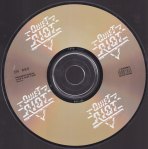
QRI CDThe best song on Quiet Riot I is easily the Dave Clark Five classic, “Glad All Over”.  I remember growing up, Bob had a Randy Rhoads guitar book.  It was loaded with transcriptions of his Ozzy classics, as well as “Glad All Over”.  We had never heard of “Glad All Over”.  To this day I don’t know why that seldom-heard song was included in a Randy Rhoads guitar book!  Kevin’s vocalizing here is hilariously screamy.  I love it.  Randy’s solo is Nuge-tastic, with a little intricate lick at the end.  Great stuff.

So that’s QRI.  Quiet Riot II is marginally better in the songwriting department.  The band wisely included only nine tracks on the second album.  A few of these are standouts:  “Slick Black Cadillac” would be re-recorded effectively by another lineup on the Metal Health album.  To hear that song played by Randy Rhoads, the guy who co-wrote it, is cool.  His take on the guitar is different from Carlos Cavaso’s, although Carlos obviously did copy some parts.  If only it were better recorded, this version could easily supplant the hit Metal Health version.

Another familiar song is “Afterglow (Of Your Love)”, also originally by Small Faces.  This song was rendered in an acoustic form on The Randy Rhoads Years.   On QRII, it is full-on electric.  I prefer the electric version, I just wish it sounded better.  There are other decent songs on QRII, such as the melodic “Eye For An Eye”, “Trouble”, and “We’ve Got the Magic”.   By the second album, Quiet Riot had gotten better at writing melodies.  They had work to do on stitching catchy melodies together into complete songs.  Most songs on Quiet Riot II have some really good parts, but are not necessarily great all the way through.  The dead production does not help the situation.

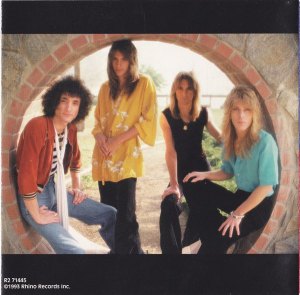
Even though Rudy Sarzo (Tateryche) is pictured on the sleeve and credited, he did not play bass on Quiet Riot II.  Kelly Garni played bass, as he did on the first LP.  To this day, I don’t know if the CD copies I have are promos or bootlegs.  While I don’t know of any promotional CD test pressings, these are definitely high quality for bootlegs.  They even have the hilarious mis-transcribed lyric sheets that usually accompany real Japanese CDs.  So, I really don’t know!

Quiet Riot I2/5 stars
Quiet Riot II3/5 stars

REVIEW: Def Leppard – “Breathe A Sigh” (2 part CD single)

Part 5 of 5 in my series of Def Leppard Slang reviews! I do listen to feedback and this series basically came from Heavy Metal Overload wanting to know more details about what these singles had.  Ultimately I choose to write about what I want to listen to at that moment, but if you have any requests don’t be shy and leave a comment! 

Part 1:  “Slang”

Part 2:  “Work It Out”

Part 3:  “All I Want Is Everything”

Part 4:  Slang (2 CD edition of the album)

DEF LEPPARD – “Breathe A Sigh” (2 part Mercury CD single)

Regardless of its perceived lack of success, Slang did spawn four singles.  The fourth and final single was 1996’s “Breathe A Sigh”.  I remember seeing this at HMV Toronto with T-Rev back in 1997.  I looked at the singles, which were not cheap (around $15 each).  I analyzed the track lists and said, “All the bonus tracks are live.  I’ll come back for this another time.”

It took me 15 years to finally get these!  What I failed to take into account was how cool the selection of live tracks is.  Pyromania‘s “Rock! Rock! (Till You Drop)” is up first on disc 1, less screechy than the beloved original but still on fire.  “Deliver Me” from the Slang album is next, which remains its only release as a live performance.  It’s a very 90’s sounding song, soft/heavy/soft/heavy.  The tremendously fun “Slang” itself is last, a song that has been revived for their Viva! Hysteria & More show in Las Vegas.

The second CD (available separately of course) had three more live tracks.  I believe I am well on record as holding the High N’ Dry album in very high esteem!  “Another Hit & Run” from that album is one of Leppard’s all time best heavy tracks, and it’s always welcome in the setlist as far as I’m concerned.  What’s amazing is that the Def Leppard that recorded High N’ Dry had two completely different guitar players and a drummer that had both arms.  They still own it when they play it, and it smokes.  Joe’s voice is noticeably lower.  Two Slang singles finish off the CD:  the ballad “All I Want Is Everything” and the rhythmic “Work It Out”.   Both songs are hit quality, although the energy level is noticeably lower here than the old classics.

I wonder if one of the big issues with Slang was that its darker sound didn’t translate well in concert.  With the exception of “Slang” itself, I wouldn’t describe these live versions as joyful affairs.

As for the song, “Breath A Sigh” itself?  At this point it was easily the softest song that Def Leppard had ever done.  They would later go even softer on the dreadful X album.  I enjoy its tasty R&B flavourings.  It was a cool choice as a single even if it didn’t go mega.

4/5 stars

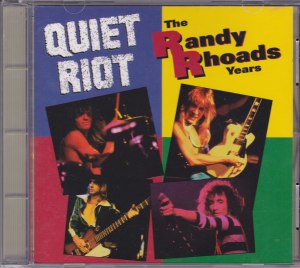
REVIEW: Quiet Riot – The Randy Rhoads Years (1993)

QR FRONT

QUIET RIOT – The Randy Rhoads Years (1993 Rhino)

Growing up in the 1980’s, Quiet Riot was the first “metal” band I liked.  Back then, we were aware that Quiet Riot had two albums prior to Metal Health.  These albums seemed unobtainable forever at best, mythical at worst!  The first two, Quiet Riot and Quiet Riot II, were released in Japan only.  Later on, I did manage to get both albums, so I have a unique perspective on this CD:  The Randy Rhoads Years, by Quiet Riot.

See, here’s a nutshell version of the story:  QR lead howler and co-founder Kevin DuBrow had wanted to re-release the Randy material for years.   Randy himself was never happy with those albums, nor his guitar sound on those albums.  In light of this, the late guitarist’s mother Delores was very guarded of Randy’s legacy.  She knew that Randy felt the albums consisted of sub-par songs with horrible production. DuBrow eventually won her blessing to re-release some of the old Quiet Riot material, but on one condition only: Get the quality of the songs up to snuff so it doesn’t tarnish Randy’s legacy.

So that’s what he did, using all the means available, and the result is a highly modified collection of Quiet Riot songs with Randy Rhoads.

I can tell people out there who haven’t heard the first two albums that they do sound awful. That’s not a myth. Randy’s guitar is but a shadow of what it would become, and the songs are mostly pretty bad, especially on the first album. The second is much better (particularly in the songwriting category) but it is still hampered by poor production. So what could DuBrow do to get permission to do a re-release?

He started by picking out six of the better songs from the first two records:  “Mama’s Little Angels”, “It’s Not So Funny”, and “Look in Any Window” from Quiet Riot, and  “Trouble”, “Killer Girls”, and “Afterglow (Of Your Love)” from Quiet Riot II.  All of these songs were heavily remixed, with completely re-recorded vocals, from scratch.  DuBrow felt, probably  correctly, that his original singing voice on those albums was too “boy-ish”.

DuBrow re-sampled all the drums, and re-recorded all of Randy’s guitar tracks through a Marshall stack.  Randy had confided with Kevin that he was happiest with the way his guitar sounded live with Ozzy, so Kevin recorded the original, sterile guitar tracks through Carlos Cavazo’s amps.  They used the Randy Rhoads Tribute CD as a guide.

On one guitar solo, Kevin knew that Randy wished he had used a wah-wah, but couldn’t afford the pedal at the time.  Kevin played the wah-wah pedal himself, using Randy’s guitar tracks, a unique form of collaboration between two friends.

With the Small Faces cover, “Afterglow”, Kevin came up with a cool idea.  “Unplugged” albums were on trend, so Kevin stripped all the drums and electric instruments off the track, leaving just Randy’s bare acoustic guitar.  It is like stripping a layer of paint off old beautiful old wood:  the bare guitar track reveals previously unheard warmth.  Kevin re-sang the vocal, kept the electric guitar solo intact, and used a triangle sample to cover up places where the original drums had leaked into Randy’s mike.  This painstaking work created from the ground up an incredible alternate version that Randy would hopefully have been very proud of.

None of these people are Frankie Banali.

None of these people are Frankie Banali.

One of Quiet Riot II‘s best songs is “Trouble”.  Kevin felt that it plodded too much, so he slightly sped it up which also raised its pitch.  He then re-sang it, and the result is a much better song.  Suddenly “Trouble” is a rich sounding hit-worthy rock track.

“Killer Girls” had some minor tampering, a blast of guitar where previously there was nothing.  It is “Last Call For Rock ‘n’ Roll” that is most changed.  Previously titled “Mama’s Little Angels” on Quiet Riot, Kevin re-wrote what he thought was a juvenile lyric.  (It was about trashing the house playing a game of “indoor baseball”.)  Bobby Rondinelli, who was working with Kevin on a Quiet Riot album called Terrified at the time, helped him re-write the tune.  Unfortunately, regardless of all this work, the song is still just a stock sounding track, nothing special, aside from Randy’s always classy if underplayed guitar work.

The rest of the album consists of unreleased songs.  One of the most exciting is a live take of “Laughing Gas” which Quiet Riot never cut in the studio.  It comprised an evolving, extended Randy Rhoads guitar solo.  Within it, you can hear the kernels of ideas that later became Ozzy Osbourne classics such as “Dee” and “Crazy Train”.  Even this “live” track is tampered with:  Kevin re-recorded his lead vocals (even the “Ladies and gentlemen, Mr. Randy Rhoads!” part) and actually spliced two different guitar solos together into one.  You can hear the splice point between the two quite clearly.  Of course this makes the solo no less jaw-dropping.

“Picking Up the Pieces” and “Breaking Up is a Heartbreak” are two of a kind.  Kevin says these come from their “pop” period after the second album, just before Randy was off to work with Ozzy.  They were getting more desperate for hits, and wrote these two melodic, radio-ready tunes.  Both are excellent.  Much like “Trouble”, these two songs are world-class.  Kevin re-recorded the vocals and so on just as he did with the other tracks.  At this time, bassist Kelly Garni had left the band and Randy played bass himself.

Lastly, “Force of Habit” is the only bare, untampered song.  In the liner notes, Kevin says they lost the original master tapes, so he was unable to remix or re-record any of it.  I think it’s an excellent heavy song on its own.  In fact, Ozzy Osbourne must have thought so as well, since parts of this song later became “Suicide Solution”!

This work,  and “Laughing Gas” in particular were enough to convince the Rhoads family to go forward with this album. If Kevin hadn’t done this, undoubtedly we would never have seen this release. On the other hand, this isn’t the way Randy recorded it, and Randy obviously had no input to how the tracks were mixed.  This has polarized fans, some of whom thought Kevin was the great Satan, others just enjoying the album for what it is.

I enjoy the album for what it is.  I like it a lot, actually.  I do have misgivings about the tampering, but since I own the first two albums, that feeling has subsided.  I can back up the claims that the first two albums are pretty poor.

Kevin had planned on a second volume, including such treasures as Quiet Riot’s metallic cover of “The Mighty Quinn”.  He had also mentioned a home video, including the extended “Laughing Gas” guitar solo.  Sadly DuBrow, will never get to complete these Rhoads reissues.

4/5 stars

REVIEW: Def Leppard – “Slang” single (Souvenir Pack)

SLANG SINGLE

DEF LEPPARD – “Slang” (1996 Souvenir Pack, Mercury)

I think Slang is a great album, and I think I’m going to talk about it soon , as I’m on a bit of a Def Lep kick these days.  Yesterday I ripped this CD single, a 1996 “souvenir pack” with two bonus tracks and four post cards commemorating the band’s “Three Continents in One Day” concerts.  Vancouver was the last stop — look how tired Rick Allen must be in the photo.

CARDS 2

Slang, in many respects, was as forward-looking from Hysteria as Hysteria was from Pyromania.  It was a reset, a brand new way of doing things, more organic and modern.  Yet at the same time, even though it sounds nothing like classic Leppard, it still retains the impeccable attention to detail.  Production-wise, it’s not the same beast, but it’s still a beast.

“Slang” itself was a brave choice for a single, and it did alienate many old-school fans, at least where I was working.  Others dug it and got it.  It’s a fun song verging on rap-rock, but really, isn’t that OK?  Didn’t Def Lep kinda-sorta probe those waters with some of the singles from Hysteria?  Bottom line, it’s catchy, fun, has the Def Leppard vibe without sounding like anything they’d done before.  It’s a good song.  The fact that they played it live during Viva! Hysteria in Vegas is proof!

The B-sides on the single include a “strings and piano only” version of “When Love & Hate Collide”, perhaps the most overrated Def Leppard song ever.  I have so many versions of it, I really am not certain if this version is on anything else.  It does have vocals, and even a guitar solo despite the description!  This is just a remix with most of the instrumentation stripped off.

The other B-side is a really cool non-album track called “Can’t Keep Away from the Flame”.  It’s acoustic but upbeat and cool.  Production-wise, this is very basic compared to Slang:  acoustic guitars, vocals, shakers.  But it’s also really good, with a cool guitar part, totally memorable.  Since then, Leppard’s recorded a lot more acoustic music but for 1996 this was definitely a standout.

According to the price tag, I bought this at Dr. Disc in Kitchener Ontario in May 1996, for the princely sum of $13.99.  Money well spent, I have enjoyed these songs a lot over the years.

4/5 stars

REVIEW: Def Leppard – “Hysteria 2013” (iTunes single)

HYSTERIA 2013

DEF LEPPARD – “Hysteria (2013 re-recorded version)” (iTunes single)

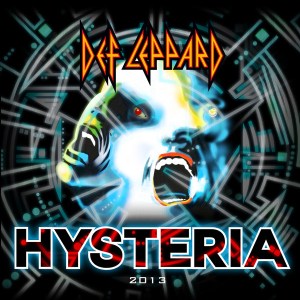
Just in time for their Viva! Hysteria & More tenure in Vegas, comes another re-recorded “forgery” (Joe’s words).  This one is really good.  It takes a bit to figure out which version it is, in fact.  Musically, you can barely hear any differences, although the production sounds slightly less shimmery and saturated.  A few guitar parts (probably Vivian) sound mildly different.  Vocally, you can slightly tell it’s not the same version, but what’s incredible is how much Joe Elliott 2013 sounds like Joe Elliott 1987.  I read that Joe spent a lot of time getting his voice into that shape again.

“Hysteria” has long been one of my favourite Def Leppard songs, probably since I first heard it.  I think it’s an incredible song, one of the best from this commercial phase of Def Leppard’s career.  Time stands still when I hear it.  An original version is always going to mean more to the real fan.  That’s just the way it is, that’s psychology.  These forgeries were designed so Leppard could sell their music on iTunes on their own terms (ie; make more money than the label was offering them).  It’s business — I have no problem with it.  For $1.29, I have an alternate version of this track.  I didn’t have to, I wasn’t tricked into it, and the song is clearly labelled as a 2013 re-recording.

Necessary for those who “have to own it all”, or those who want a quick easy cheap way of getting a studio version of the song online (like, say people downloading it for a wedding).  This will be of little value to anyone else.

4/5 stars

REVIEW: Def Leppard – “Wasted” / “Hello America” (1979 single)

Part 4 of my 4-part series on early Def Leppard singles!

DEF LEPPARD – “Wasted” / “Hello America” (1979 Vertigo/Phonogram single)

My initial thinking regarding this single was that I didn’t need it; both songs are available on On Through the Night.  Then I found out that these single versions of “Wasted” and “Hello America” are earlier, non-album recordings.  Rick Allen was in the band by this time but On Through the Night had yet to be recorded.  This immediately put the single on my radar as a must-have.

On Through the Night was produced by Tom Allom (Judas Priest) but before settling on him, Leppard tried out Nick Tauber due to his history with Thin Lizzy.  (He also produced Sheer Greed by Girl, the band that featured future Leppard alumnus Phil Collen.)  Tauber worked on the earlier, folksier Lizzy, not the later version of the band that rocked out such classics as “Jailbreak” and “Bad Reputation”.

The story goes that the record label was unhappy with Nick Tauber’s results and put a halt to his work on the album.  He had finished four songs:  These two, plus “Rock Brigade”, and “Glad I’m Alive” which both remain unreleased.  The label released “Wasted” as a single while recruiting Tom Allom to start over on the album.

“Wasted” boasts one of Leppard’s all time greatest riffs, if not the greatest.  You can see how this song has remained a cult favourite all these decades later.  This earlier version isn’t as adrenalized (pardon the pun) as the later album version, but there’s otherwise nothing wrong with it.  I think Allom’s album version is safely still the definitive one.  The two tracks are not that dissimilar, just Allom’s more in tune with the current heavy metal sounds.

The B-side, “Hello America”, would become a single in its own right the following year, in its guise as an Allom track.  This might be one that I prefer in its Tauber version.  Allom added a synthesizer riff to the chorus of “Hello America” that I always felt dated the tune.  While this version is not as manic or electrified, it does have the bare unadorned chorus.  There are bonuses to both versions.

It’s kind of funny to hear how shaky Joe Elliott’s voice was back then.  He grew into a powerful screamer by the High ‘n’ Dry album, which is my favourite period of Def Leppard.  They were all young back then, but Joe was clearly not as confident nor in his control of his voice in 1979.

Still, as a purchase, as a single, as a collectible, I am very happy with this.  My only regret is that I didn’t find one with a picture sleeve.

4.5/5 stars

REVIEW: Def Leppard – The Def Leppard E.P. (1979)

Part 2 of a 4-part series on early Def Leppard singles!

DL

DEF LEPPARD – The Def Leppard E.P. (1979 Bludgeon Riffola)

I’ve been slowly, slowly working towards a complete Def Leppard collection.  This is one of the last items from the early years that I still needed — The Def Leppard E.P.  This is a 7″ single,  33 1/3 RPM however, and never have these recordings been released on a Def Leppard CD.  This first EP had Frank Noon on drums.  He was just a fill-in, and a month later Def Lep replaced him with a 15 year old Rick Allen.

I have been wanting this one since I was a young fella.  Def Leppard was a band I was obsessed with back in highschool.  They are in fact the band that really kicked off my collecting, as I described in one of the first Record Store Tales.  “Ride Into the Sun” was the B-side to the “Hysteria” single, and it has long been a personal favourite of mine.  What I found out later was that this B-side was actually a re-recording of one of the very earliest Def Leppard songs, pre-On Through the Night!

The self-produced 1979 version of “Ride Into the Sun” is a bit different, not as fast or heavy, and containing a different pre-chorus.  It’s still a great, fun Def Leppard song from their brief “NWOBHM” period.  “Getcha Rocks Off” is a Van Halen-style shuffle, a cool tune that really cooks, with hot solos and a couple smoking riffs.   This recording was briefly available on Lars Ulrich’s NWOBHM compilation album.  A heavier live (?) version of this song is available on the On Through the Night album.

Side B was taken up by a 7:50 epic track called “The Overture”.  This song too was re-recorded by Tom Allom for the debut album (that version is just called “Overture”).  Perhaps this song is as close as Def Leppard has ever been to a metal band.  It riffs solidly along with some primitive dual guitar hooks.  There are ample solos, pounding drums, and different sections and tempos.  It’s like Def Judas Maiden.  Or something.

The edition I bought is MSB001 of which 15,000 copies were made.  This edition unfortunately did not come with the picture sleeve.  The original cover was spoof of the His Master’s Voice logo, with a leopard instead of a dog.

I’m glad to finally have this Def Lep collectible.  It’s been a long time waiting.

4/5 stars