glam rock

REVIEW: Ratt – Infestation (2010 Japanese and iTunes editions)

RATT – Infestation (2010 Roadrunner Japanese and iTunes editions)

Ratt needed a comeback. Lineup changes galore, deaths, poorly-received changes in sound — forget all that stuff.  The band has since stabilized.  Pearcy’s back on lead vocals, and Carlos Cavazo (ex-Quiet Riot) has taken over guitar duties from John Corabi. Corabi’s a rhythm player, not a soloist (and that’s not a knock on Corabi).  Cavazo rocks out quite a few solos on this album. The difference is noticeable, and it’s a welcome return to something like the Ratt sound of yore. Do you like twin leads? Cavazo and Warren DeMartini rip out a few, each with his own distinct sound, but meshing well like they’ve been doing this forever. Cavazo also contributes strong co-writes to about half the album. Surely, you can’t imagine a better match than this for Ratt.
INFESTATION_0003

[Note:  Since this release, original bassist Juan Crocier has also come back, replacing Robbie Crane.]

Pearcy’s in great voice, the passages of time disguise-able. But be forwarned, if you never liked Pearcy’s style before, this album is not going to change your mind. His vocals are augmented by some nice, but not overdone, backing vocals from the band. Longtime bassist Robbie Crane supplies backing vocals while holding down the bottom end.

INFESTATION_0005The sound of the album is pure Ratt, but modernly produced; surely the best sounding record they’ve done so far. Picture a heavier Out Of The Cellar. There are nods and winks to other eras of Ratt as well: I hear a little bit of “Way Cool” here and there, and damned if “Best Of Me” wouldn’t have fit right in on Detonator. Yet this is no retro-fest, as much as it does echo the 80’s. There are still sounds here that sound tougher and more modern, like the fast and heavy opener “Eat Me Up Alive” (my second favourite song).  There’s filler here, but even the filler is worth holding your finger off the skip button.  All except perhaps the dreadful “A Little Too Much”.

There Japanese bonus track is a cool slow groove rocker called “Scatter”, with a great memorable chorus. This is the best song to me.  Itunes got the track as well, but because I always prefer a physical edition, I bought the Japanese for my physical copy.  You will have to judge the value of that expenditure yourself, however I deemed it worthwhile.

There are also three live bonus tracks on the iTunes version, worth getting. These songs are “You Think You’re Tough”, “Tell The World”, and “Way Cool Jr.”, all previously unreleased and with Cavazo on guitar, “Live from the Rockline Studios”.  “You Think You’re Tough” is my favourite song from Ratt EP.

If you have ever liked Ratt, pick up Infestation if you’re curious what the band sounds like 25 years later. This is a solid Ratt album, not classic, but song for song among their better records.  They’ve retained their signature “Ratt N’ Roll” sound, but also what dignity and integrity a bunch of Ratts have. Well done.

3.333/5 stars

REVIEW: Electric Joy by Richie Kotzen (1991)

Classic Kotzen! For a look at the new album by his new supergroup The Winery Dogs, check out Jon Wilmenius’ excellent review.

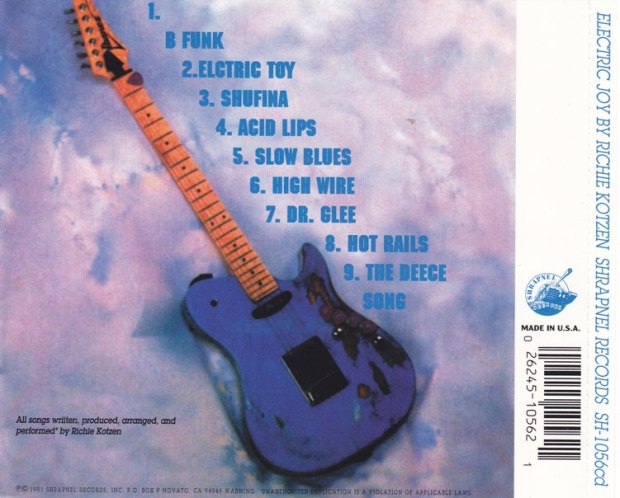
RICHIE KOTZEN – Electric Joy by Richie Kotzen (1991 Shrapnel)

Albums by Richie Kotzen were impossible to find in Canada.  My only exposure to his music was “Dream of a New Day”, from his second album Fever Dream.  Fever Dream was his first vocal album, but Kotzen returned to instrumentals on his third, Electric Joy.  I’d seen his picture in dozens of guitar magazines, but hadn’t heard his tunes until “Dream of a New Day” was included on the Bill & Ted’s Bogus Journey soundtrack.

His debut album was a hit with the shredders, but three albums in, Kotzen had already delivered three completely different pieces of work.  Electric Joy has some of the playfulness of the debut, but is mostly a jaw-dropping collection of intricately composed pieces that skirt multiple genres including funk, country, bluegrass, jazz, fusion, and blues.  If I had to pick out an influence, I would say that Electric Joy sounds like Richie had been listening to a lot of the “two Steves”:  Vai and Morse.  His technique is top-notch.

I first got this on a trip to Frankenmuth, Michigan.  My parents made a point of going there every spring and I started tagging along, and then later on my friend Peter joined us as well.  We’d stay at the Bavarian Inn and on the way back to Ontario, we’d stop at the stores in Port Huron, where I found this as well as old rare Savatage cassettes.

“B Funk” opens the album with some light-speed bluegrass-y licks, but it keeps changing, from a funked up rocker with shredding, to a melodic “chorus” section.  Then it’s back to the bluegrass from space.

At this point I’ll point out that Kotzen plays all the instruments except drums, himself.  That’s Richie’s standby Atma Anur on drums.  What this means is, that incredibly dexterous bassline you’re hearing on “B Funk” is also performed by Kotzen!  And it’s almost every bit as stunning as the guitar!

“Electric Toy” begins ballady, with some lyrical Vai-like moments.  Of course, Kotzen can’t help but do what he does, so there are different sections, some at lickity-split tempos.  This is followed by “Shufina”, which is essentially a blues jam.  Kotzen’s deep bends are appropriate, but before too long he’s harmonizing with himself on some unconventional melodies.

A smoking hot riff ignites “Acid Lips”, little lightning licks flicker in and out, but this one has a solid groove.  (It can’t be easy grooving with yourself on bass.)  “Slow Blues” contains some of Richie’s most lyrical lead work.  If you can imagine the lead guitar taking on the role of a singer, then “Slow Blues” is probably the most accessible song on the album.

The next song “High Wire” is uncatagorizable, suffice to say that like all of Electric Joy it combines quirky notes with shreddery, funk and groove.  My favourite song is “Dr. Glee”.  It sounds like it seems it should – gleeful.  I find this pleasant melody to be very summery.  Kotzen guitar has so many different sounds and shades, even just within this one song.

“Hot Rails” is another one that sounds like advertized…a train racing down the track.  Kotzen’s slide work is anything but simple.  This one’s so fast it’s hard to keep track of all the cool different guitar parts.  It almost sounds like Kotzen wrote a blues shuffle, and then decided to hit fast forward on his tape deck and learn it at that speed!

Electric Joy closes with “The Deece Song”, which thankfully is mid-tempo allowing us to catch our collective breath.  It’s another great performance, similar in style to “Dr. Glee”.  It has its sweeping Satriani moments as well.

The production on the album is very dry, which is different from what a lot of the other instrumentalists were doing at the time.  While this means it might take some more time to penetrate an album that is loaded to the brim with dense ideas already, it is a worthwhile endevour.

In a bizarre turn of events, Kotzen briefly put his solo career on hold.  He received a phone call from Bret Michaels.  The Poison frontman was looking for a replacement for the departed CC Deville.  The fact that Kotzen was from Pennsylvania, not already in a band, and wrote and sang original material caught Michaels’ eye in a magazine article.  Having a shredder, but one with some feel too, might garner Poison some respect in the tough 1990’s.

Kotzen did succeed in co-writing (and in some cases, writing entire songs himself) their most accomplished album, Native Tongue.  Of course, it did not sell.  The Poison relationship imploded because of another relationship: the one that Kotzen was secretly having with drummer Rikki Rockett’s fiance!  Kotzen eventually married her, and he was replaced in Poison by another shredder, Blues Saraceno (who was in the running with Kotzen in the first place).

As for Electric Joy?

4/5 stars

ELECTRIC JOY

REVIEW: David Lee Roth – Skyscraper (1988)


DAVID LEE ROTH – Skyscraper (1988 Warner Bros.)

Changes were afoot in the land of Roth after the success of Eat ‘Em and Smile.  Keyboardist Brett Tuggle was hired in as a full-time member.  Steve Vai was promoted to the rank of co-producer for the next album.  Billy Sheehan was put on a leash, his busy bass stylings reduced to typical pop rock lines on much of the new material.  One song even had a programmed bass instead of the real thing.

It seemed like a sudden about-face.  David Lee Roth had left behind the Van Halen-nouveau trappings of the last album in exchange for a much slicker and more commercial sound. What resulted was Skyscraper, a synth-heavy odd duck that nevertheless spawned a massive hit single still getting radio play today. Revisiting it, this almost (only almost!)  sounds more like a Vai album than a Dave album. That’s not a bad thing, depending on how you feel about the 6 (soon to be 7) string master. Certainly, his loopy noodling was reaching an early peak here, but his stylings are not for everyone.

My biggest complaint would be the sidelining of Billy Sheehan.  I mean, you’ve got possibly the best bass player in the universe in your band:  Exploit that!  Don’t keep him playing 1/4 notes.  In a 1988 Hit Parader interview, Sheehan said that he had to leave the band in order to express himself.  He referred to the “note police” (Roth) who ordered him to play it simpler.  After Skyscraper, he was replaced by drummer Gregg Bissonnette’s brother Matt (no slouch).

The opening rocker “Knucklebones” is a great song, but falls a little limp.  Skyscraper‘s production is cold, sterile, and digital; like in that 80’s way before the technology had really come along.  It does boast complex guitar riffing mixed in with idiosyncratic Dave lyrics. Dave has acknowledged that Vai was in the driver’s seat for this album, and its complexity is a testament to that.

Elsewhere there are some progressive moments (the title track, “Hina”), stage-ready rockers (“Perfect Timing”, “Hot Dog and a Shake”), good time ballads (“Damn Good”) and whatever-the-hell (“Three Fools A Minute”). All of this is surrounded by a fun, party-like atmosphere courtesy of Dave as the band’s hoots n’ hollers along.

I consider this album to be a brave experiment, and Dave’s highest artistic achievement. Not his best album, but his most artistic.  While not as instantly likable, rocking, or consistent as Eat ‘Em And Smile, it is endlessly ambitious, layered, and most importantly fun. Dave is the ringmaster of the greatest party in town. Skyscraper is the party where the smart dudes stop in for a beer.

Craig Fee at 107.5 Dave FM, the world’s biggest Van Halen (not Van Hagar!) fan has this to say:

I still have a soft spot for “Just Like Paradise,” “Stand Up” (the more you do it the less you fall down!) and “Hot Dog & A Shake.”  With Steve Vai on lead guitar, this album is a killer follow-up to EEAS.

I’m glad I asked Craig for his comment because our song likes and dislikes on this album are almost opposite!  My faves?  “Skyscraper”, “Hina”, “Just Like Paradise”, “Knucklebones”  My filler: “Stand Up”!  So there ya go.  Maybe this record has something for everyone?

4/5 stars

“Promo only!  Not for sale!”

REVIEW: Europe – Wings of Tomorrow (1984)

By request of the Heavy Metal OverloRd.

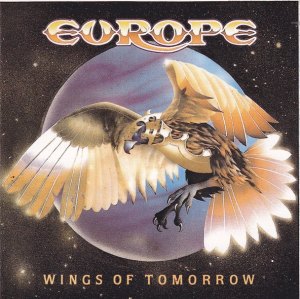
WOT_0001EUROPE – Wings of Tomorrow (1984 Epic)

In many ways, Wings of Tomorrow is the perfect Europe album.  It combines their early grand metallic leanings with the keyboards and anthemic sheen they would later become known for.   Like the first Europe album, it’s loaded with hard rockers, the odd ballad, and an instrumental guitar workout.  The same lineup from the last album was intact, with the major difference being Joey Tempest adding more keyboards to the mix.

The opener “Stormwind” is a great hard rock/metal tune, with a memorable chorus, riff, plus a tricky sounding solo from virtuoso John Norum.   Second up is the ferocious “Scream of Anger”, featuring Norum playing the heavily distorted riff through a talk box.  This is a solid burner, scorched-Earth policy firmly in place, taking no prisoners.  Tempest wrote this song with Yngwie Malmsteen bassist Marcel Jacob.

The best known song on the album is “Open Your Heart”, which a later lineup of the band re-recorded for the underrated Out of This World record.  I prefer the re-recorded version, because it includes an additional guitar part, really cool and catchy, immediately after the acoustic intro.  The original version is still a great song though, a power ballad, and probably the first great Europe power ballad.

The angry prowler, “Treated Bad Again”, takes us back into metal territory.  This predatory number would have fit in perfectly on something like a mid-period Judas Priest album.  Then, as on the debut album, John Norum ends Side 1 with an instrumental.  This one is called “Aphasia”, which refers to a medical condition that can render sufferers unable to speak.  Get it?

Side 2 opened with an assaulting metal riff, on the album’s title track.  It’s a jagged riff that juxtaposes nicely with Joey’s smooth voice.  “Wasted Time” sounds like the aforementioned Yngwie at first, just because of the riff, but then it begins to gallop into Diamond Head style chorus.  The guitar solo is shredder’s envy.   “Lyin’ Eyes” maintains the momentum.

All this sets the stage for the penultimate song, and possibly the best ballad Europe ever recorded:  “Dreamer”.  It’s a piano power ballad, without the saccharine overload of songs like “Carrie”.  This one’s just a classic ballad, much like you’d find on the first Europe album, but refined a bit.

Wings of Tomorrow closes with the reckless pace of “Dance the Night Away”, which sounds nothing like what its title implies.  It’s a simple metal song, fast burning riff, and plenty of solos.  It’s a shame the guitar wasn’t mixed in heavier.  You get the impression that this album would have sounded so much harder live.

I don’t know if anybody could have predicted the massive success of the next album, The Final Countdown, after labouring in obscurity for two records.  But success did come, and these early albums are a memento of a time before Joey Tempest wrote “hits”.

4.5/5 stars

REVIEW: Hot Leg – Red Light Fever (2009)

HOT LEG FRONT

HOT LEG – Red Light Fever (2009 Barbecue Rock Records)

It was a dark time for rock and roll.  The Darkness had split into two factions:  The Stone Gods, and Justin Hawkins’ Hot Leg.  The Gods were out of the gates with their album first in 2008, while Justin followed in 2009 with Red Light Fever.  Bizarrely, he credits himself as Justin “Dave” Hawkins in Hot Leg.

The Stone Gods made an excellent album, concentrating on rock and metal sounds.  Justin, on the other hand, has synthesized everything he does into one gestalt on Red Light Fever. There are still those cherished AC/DC-like moments that you may remember from Permission To Land (Hawkins even uses the lyric “permission to land” on one song) mixed with those operatic high vocals, taken to new levels of absurdity (“Chickens”). This is mixed with the polished Queen-like moments from the second Darkness album, One Way Ticket…, and the 80’s “keytar” sounds of his solo project British Whale. The result is, quite frankly, an album only Darkness fans will like.

I am a Darkness fan, and I do like it. The album kicks off with the aforementioned “Chickens”, which at first tricks you into thinking Hawkins has gone back to basics. Then the operatic chorus in full falsetto hits, and you realize that Hawkins is just as outrageous as ever.

“You Can’t Hurt Me Anymore”, the second track, reminds you that Hawkins is still one hell of a guitar player. Coming up right down the middle between Thin Lizzy and Brian May harmonies, it is Justin’s guitar work that keeps this band most anchored in rock.  The aptly titled “Trojan Guitar” is a cool workout, multi-faceted and complex.

By the time you get to the single, “Cocktails”, you will wonder just how Hawkins crammed so many notes into a word with just two syllables. Many will find this to be simply too much, like coffee with too much sweetener, or a cake with nothing but icing.  It’s a great song, with that Def Darkness vibe that I like so much, but the chorus is ridiculous!

“Gay in the 80s” is the most British Whale of the tracks, keytar up front and in your face, and Justin’s lyrics embracing the kitsch of that decade. Not a track for insecure rockers by any stretch.  Yet “Whichever Way You Wanna Give It” is the most reminiscent of early Darkness. It has that “I Believe In A Thing Called Love” vibe, with a chorus straight out of One Way Ticket…, and some solid guitar riffs with ample space between the power chords.

TAKE TAKE TAKEThe album ends a mere 35 minutes after it began, which some will find absolutely offensive after spending close to $30 (Canadian) on this import. However, if you wanted more, the band used to offer a vintage-Darkness sounding bonus track called “Take Take Take” on their website for free.  Unfortunately with the band now defunct, the song has been taken down.  Another free song, a bouncy upbeat number called “Heroes”, was available for a limited time only.

According to the inside notes, the album is to be filed under “Man-Rock”.

4/5 stars

REVIEW: The Darkness – “Get Your Hands Off My Woman…Again” (2004 mp3 single)

GYHOMWATHE DARKNESS – “Get Your Hands Off My Woman…Again” (2004 Atlantic mp3 single)

After the surprise hit Permission To Land (which was essentially just a released demo) The Darkness were determined to make a better sounding second album.  At first it was announced they were going to be working with one Mutt Lange; that didn’t pan out.  Up next was Roy Thomas Baker, of Queen fame.

Their first released collaboration was a re-recording of “Get Your Hands Off My Woman” re-titled “Get Your Hands Off My Woman…Again”.  It differs only slightly from the original.  Better sounding bass, better sounding drums, but almost identical otherwise.  There are only two moments were the song deviates from the original:  a 5 second piano break at 1:54, and a different, more abrupt ending.

This was released November 8 2004, for one month only, for 99p on the official Darkness site.   Since then I understand it’s been very difficult to find online.  I like when bands release stuff like this, even though for most people it’s fairly redundant.  A lot of bands test the waters by re-recording older material, Axl’s done that and so have others.  When they make it available for almost nothing for a limited time, sure, I’ll bite.  It’s a kind of immediate release that didn’t exist 20 years ago.

Not to mention that this is just one of the Darkness’ best songs, ever.  Gratuitous language, hot riffs, screeching high vocals, ripping solos, and hooks for miles.  I was sold on the original song on first listen.  As for this re-recorded update, I like the better quality sound, but I don’t like the piano break or the ending.  Great tune, great sonics thanks to RTB, but I’ll stick with the original!

3.5/5 stars

Since you can’t take a picture of a non-physical product, here’s the CD single that I burned!

REVIEW: Def Leppard – “All I Want Is Everything” (2 part CD single)

Part 3 in my series of Def Leppard Slang reviews!  

Part 1:  “Slang”

Part 2:  “Work It Out”

DEF LEPPARD – “All I Want Is Everything” (1996 two part Mercury CD single)

“All I Want Is Everything” was the first song from Slang that we got to hear.  Def Leppard first revealed a live unplugged snippet on their Video Archive VHS.  I was still surprised when I heard the whole studio version: It is a lot darker than I expected.  I love it, don’t get me wrong.  I love its sparse, organic sound.  I think the chorus and verses are fantastic, but even better is the bridge.

A lot of my customers were turned off my Slang and songs like “All I Want Is Everything”.  While I could argue that this song is every bit as good as “Hysteria” or “Stand Up (Kick Love Into Motion)”, it is obviously a lot darker.  But it was also 1996.  In 1996, bands like Def Leppard moved with the times.  Bon Jovi made similar adjustments.   This is no singalong hit, but it is quality songwriting and production.

Next up on disc 1 of this single is “When Saturday Comes” performed by Joe, Phil and Sav.  This is apparently for a movie also called When Saturday Comes.  This song would be more satisfying to those wishing for an older school vibe; indeed it is a dead ringer for Van Hagar.  It is anthemic with some shredding from Phil.  It wouldn’t make my own personal Def Leppard mix tape, but I thank them anyway for including the song so I wouldn’t have to hunt down an obscure soundtrack.  “Jimmy’s Theme” performed by the same trio is an instrumental from the same soundtrack.  Out of context from a film I’ve never seen, it doesn’t do much for me.  It’s a nice slow blues with Phil playing some elegant melodies.  But it’s just “nice”, I don’t regularly come back to this one.  The CD ends with an edit version of “All I Want Is Everything” (whoop de do).

Disc 2, for whatever reason, also includes the same two versions of “All I Want Is Everything”.  Why not just put the album version on disc 1, and the edit version on disc 2?  Small gripe I guess but it got tedious when I had both discs in the changer and was too lazy to skip.

Also on disc 2 are a couple tracks from the Jeffology tribute record.  Phil Collen does “‘Cause We’ve Ended As Lovers”.   Personally I don’t think anybody can touch Jeff Beck on this one.  In fact Beck is so awesome on this, especially live, that I don’t really see the point of listening to a cover version.  Sorry Phil, that is nothing against your playing, which is really really great, especially when you start cookin’ around the 4 minute mark.  I just think nobody’s even in Beck’s league on this one, and I think that’s a fair assessment.

Vivian Campbell does “Led Boots” from Wired.  I love the original “Led Boots”.  It’s just funky, chunky and fucked up.  I think Vivian’s style is more suited to Beck than Phil’s is.  This is an enjoyable listen, Vivian gets to shred a bit.  It’s definitely less fucked up sounding than the original, but Vivian is just a pleasure to listen to, he is clearly enjoying himself.

The “Work It Out” single previous to this contained post cards of the first four Def Leppard albums.  CD 2 of “All I Want Is Everything” has the final four:  Adrenalize, Retro-Active, Vault, and Slang.

3/5 stars

REVIEW: Def Leppard “Work It Out” (2 part CD single)

Part 2 in my series of Def Leppard Slang reviews!  If you missed the first part, click here for “Slang”.

DEF LEPPARD – “Work It Out” (1996 2 part CD single, Mercury Records)

The second single from Def Leppard’s ill-fated but cult-favourite album, Slang, was the modern, powerful “Work It Out”.  This immediate winner had drony 90’s qualities and organic, acoustic drums in addition to Rick’s electronics.  It sounded like a breath of fresh air for this band, a clever reinvention that kept them fresh, melodic, guitar-oriented and layered, without resorting to stigmatized 80’s sounds such as squealing solos and shout-along choruses.

The cool thing is that the song was originally very different!  This was Vivian’s first serious contribution to the band, and he brought it in completely demo’ed with him singing.  It’s a much brighter, poppier version, some have compared it to Crowded House!  It’s very 90’s pop-rock.  That version is included on the CD 2 of this set!

“Move With Me Slowly” is a non-album track, maybe you’d call it a ballad, I dunno.  It’s soulful, and there’s some really elegant guitar work going on here.  I don’t know what’s Viv and what’s Phil, but all the playing here is soulful, bluesy and perfect.  It’s songs like this — a B-side! — that prove what awesome songs this band can write.  If this song had come out in, say 1990 instead of 1996, it would have been hallowed Def Leppard, another hit for the record books.  According to the liner notes, this would have been the Japanese bonus track on their edition of Slang.

“Two Steps Behind” is the typical acoustic arrangement, live at the BBC Radio One Studios, in 1995 while the band were out promoting Vault. “Truth?” is a very different version from the album.  Initially it starts the same, but goes into a completely different, much heavier set of verses.  It’s bass heavy, less exotic, and more thunderous than the album version.  All told, the album version is superior, but it’s basically a different (but related) song.  It has some riffs and melodies in common but otherwise it may as well have a different name.  This is a good example of how Def Leppard’s work ethic can turn a good song into a great one.  This early version was not quite there.

The second CD came with a really cool set of post cards, of the first four album covers.  The next four covers came with the next single, which was “All I Want Is Everything”.  Coincidentally, that will be the next review in this series.  Stay tuned.

4/5 stars

REVIEW: Def Leppard – Pyromania (deluxe edition, 24kt gold Ultradisc II)

Another one that I wasn’t happy with my original review for.  I redid this one, with loads of new pics.  Here it is:  Pyromania redux!

DEF LEPPARD – Pyromania (1983, 24kt gold Ultradisc II, 2009 deluxe edition)

Pyromania is one of those landmark albums that every melodic rock fan should own: Over 10 million copies sold, four classic hit singles, and a sound that at the time was so new and fresh that everybody took notice. This is before Rick Allen’s accident, before Steve Clark’s death, and before Def Leppard had any serious hits. Three would prove to be their lucky number when they set down to record their third album.

Pyromania is also the only Leppard album to feature a three-guitar lineup, in a sense.  Pete Willis was fired mid-way through recording, ironically for alcohol abuse, the same illness that would take Steve Clark 8 years later.  Phil Collen (ex-Girl, with Phil Lewis of the future L.A. Guns) was hired to complete the unfinished guitar rhythms and solos.  Willis’ rhythm guitar appears on all 10 tracks, making this his final Def Leppard album.

Girl, featuring Phil Collen and Phil Lewis

Girl, featuring Phil Collen and Phil Lewis

At some point in the 1990’s, Pyromania was licensed out to Mobile Fidelity labs, who used the original master tapes to create a 24kt gold “Ultradisc II”.  The discs are “custom pressed” (don’t know what that really means) on gold, because it doesn’t oxidize (IE, it’ll last longer).  Although the back cover states that “all liner notes, photos and artwork from the original LP are faithfully recreated”, this is not so.  All the Ultradisc comes with are the lyrics, and nothing else.  Not even a producer credit.  And the weird thing is, Leppard didn’t even print lyrics in their albums at the time.

The ultradisc comes in its own unique case seen below, and does sound tremendous, I can vouch for that.  Does it sound better than the remaster?  Hell, I don’t know.  I’m no audiophile.  They both sound good to me!  The 24kt gold is obviously collectible, which is why I still have it, even though I upgraded to the deluxe since then.

SAM_2504

The Ultradisc II’s unique case

Now, onto the deluxe.  This was freshly remastered. It brings the glory of Mutt Lange’s groundbreaking production to daylight. The liner notes (by one of my favourite writers, Rolling Stone’s David Fricke) reveal Mutt’s obsession: At one point the band were laying down entire chords one note at a time in order to get the right alchemy. Their goal was to create an album that nobody had made before, and they succeeded. (Hard to believe that they would pull off the same stunt twice, and do it again on Hysteria, as different from Pyromania as Pyromania was from On Through the Night!)

This landmark album contains no weak songs:  All 10 of its tracks were valuable use of precious vinyl.  It even filled the vinyl, a full 45 minutes, pretty close to the maximum afforded by the format.  From the melancholy apocalyptic riffage of the power ballad “Too Late For Love”, to the manic gallop of “Rock! Rock! (‘Til You Drop)”, this album is nearly flawless.  Album cuts like “Comin’ Underfire” (tied for my favourite on the album) and “Stagefright” stick to the brain like peanut butter in the mouth.  (“Too Late” is my other favourite.)

And that’s not including the hits:  “Rock of Ages”, “Foolin'”, and “Photograph”, all classics in their own right, which I certainly hope you already know by heart.  The combo of Def and Mutt had, by this point, gotten quite good at writing riffs with hooks, and the songs to go with them.  “Rock of Ages” has a life of its own now, radio will never let this one die.  “Photograph” was a mid-tempo pop rock classic, pointing the way to Hysteria, four years later….

Unlike the Hysteria and Adrenalize deluxe editions on the market, Pyromania has no B-sides.  There were no extra tracks lying around unreleased, and no B-sides available. The liner notes reveal that an 11th song was written, but not much else is known about it.

Instead, the bonus second CD contains an awesome sounding show from the Pyromania tour. It’s important to remember that no live albums or videos were released by Def Leppard until post-Hysteria, so this is the only live release featuring Rick Allen before his accident. Def Leppard sound absolutely ferocious. Joe Elliot’s voice is at its vocal-cord-shredding best, gargling glass like Brian Johnson possessed. Steve Clark and Phil Collen (the new boy) rip and shred on their guitars, and weave them into a wall of thunder (listen to “Switch 625”). The two Ricks, Allen and Savage, keep it rolling on the rhythm, steady as she goes. And then Brian May of Queen even shows up at the end for a CCR cover tune (with a surprise foray into Led Zeppelin)! Some of these songs have never been heard live on a CD before. Indeed, Leppard rarely play anything pre-Pyromania anymore.

SAM_2505

I mean, it’s always a treat to hear “Wasted”, isn’t it?  Combine that with some great tunage from High N’ Dry, such as “Mirror Mirror” and “Another Hit and Run”.  These are some of my favourite Def Leppard tracks anyway, and to hear them live in ’83 by a young and hungry band is really, really entertaining.

Pyromania being their third release, it would have been totally appropriate (and in hindsight very wise, considering the gap between albums) to release this concert as a live album back in the 80’s as the band buckled in for the very hard Hysteria recording sessions. For whatever reason, that didn’t happen. At least we get to hear it now!

5/5 stars

Pictured below:  the three versions I currently own.  The original LP, the 24 kt gold Ultradisc II, and the deluxe. 

Part 173: Gene Simmons’ Asylum Demos

RECORD STORE TALES Part 173:  Gene Simmons’ Asylum Demos

Back in 1994-95, when I was working at our original store, I would always proudly fly the Kiss flag.  This was before the mega reunion, and on the heels of the Revenge album, which I was really into.

I had a small online presence back then, I had created our very first online ads in 1994.  I was talking about music on every single BBS (Bulletin Board System) in the area, and on one board, called Wanderer’s Rest, I had a forum for my reviews.  I was going by the online name “Geddy” (hah!) back then, and I was extremely prolific.  Very little has changed since!

One guy, name long forgotten, messaged me.  “Hey, I’m a customer at your store.  I have some rare Kiss demos.  Do you want to do a tape swap?”  Of course I did.  For him, I made a copy of the March 25 1974 show in Washington at the Bayou club.  It was a cool show because they played an unreleased song called “You’re Much Too Young”.

For me, he made a tape of Gene’s Asylum demos, on one of our Maxell UR60’s that we sold in our store.  Gene is a very prolific songwriter.  Not everything he comes up with is gold (clearly!) but he usually submitted a dozen tunes or more for consideration on each album.  Judging by this cassette, Asylum was no exception, even though he was very distracted by Hollywood at that time.

The tape, which unfortunately did not survive the years very well at all, contains 13 of Gene’s demos, 3 being instrumental ideas, and a bonus track.  A couple songs made the final album.  I tried to listen to the tape, to see if I recognized any ideas.  Unfortunately, this tape now sounds terrible and is unlistenable.  I ripped only one song, which was “Russian Roulette”, to see if it resembled the version that later ended up on 2009’s Sonic Boom album.  From what I can tell, only the title survived to Sonic Boom.

Musically however, the song was recycled on the Monster album, as “Eat Your Heart Out”!  It’s the same riff.  Although you can’t make out the lyrics on the demo version at all, you can tell they are completely different.

See the pictures below for the tape made for me by the Mystery Kiss Fan back in ’94-95.   If you know any of these Gene songs, please comment below!  We can hope that good quality versions will come out on Gene’s “Monster” box set, if it ever comes out!