Kiss took the unusual step of waiting six months before going out on tour to support Hot in the Shade. Bands were having trouble selling out arenas. In the meantime they released singles and videos. “Hide Your Heart” came first in October of 1989. It did alright; for fans the best part of “Hide Your Heart” was seeing Paul Stanley playing guitar again in the music video. The CD single was nothing special; just the Paul Stanley A-side, backed by two Gene Simmons B-sides, as had become the norm. “Betrayed” and “Boomerang” were among the better Simmons tracks to chose from Hot in the Shade.
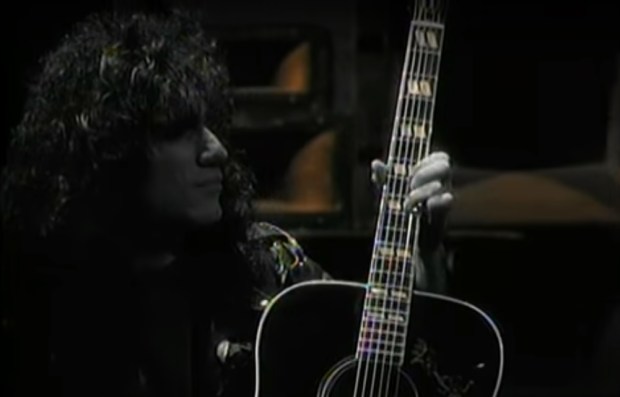
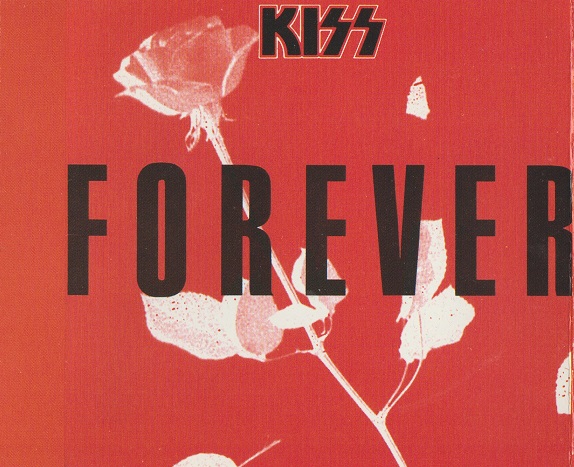
In January of the new year, they dropped what they hoped to be the big single, “Forever”. The excellent music video was an MTV hit, going to #1, while the single went to #8 on the U.S. Billboard Hot 100. One reason the video was so well received is that it was a rare back-to-basics look at the band. It was just four guys playing together in a room. No girls, no gimmicks, no dancing. Featuring exceptional performances by Eric Carr and Bruce Kulick, “Forever” was one of those rare ballads with integrity. Having Bruce’s old Blackjack buddy, Michael Bolton, in the writing credits didn’t hurt.
Ace Frehley wasn’t impressed though. In the July 1990 issue of Guitar for the Practising Musician, he dismissed it as pop. He wasn’t wrong, but that doesn’t make “Forever” bad.
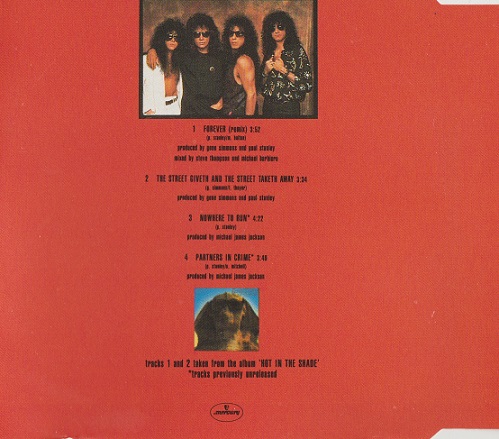
The single for “Forever” received a wider release on all three major formats (CD, vinyl and tape), and was expanded to EP length with four tracks. It also received something very rare for Kiss: a single exclusive remix, by Steve Thompson and Michael Barbiero. It has some difference in levels and echo. However, every CD copy of this single has a flaw, a skip at 1:40 that shouldn’t be there. It’s not even a damaged CD; if you look at the track times, the single version is encoded few seconds shorter. In other words a faulty master was used on every CD single. You won’t find one without the skip. Vinyl and cassette don’t have the flaw.
Fortunately this oversight was fixed when Kiss released their box set a decade later. The correct remixed single version without flaw was remastered and included in the set.
The included B-sides are an interesting mix. From the Hot in the Shade album, there’s the Gene Simmons throwaway “The Street Giveth and the Street Taketh Away”. The other two are, strangely, two of Paul’s “new” tracks from Kiss Killers. The logic here was the Kiss Killers was (and still is) unreleased in North America. At least this gave us an easy way to get the amazing “Nowhere to Run” on CD.
Too bad about that flaw on the CD version. Otherwise this isn’t a bad little single.
Step one: Get Gene Simmons’ demon head back into the game.
Step two: Record a rock album, not a Bon-keyboard-Jovi-Kiss hybrid.
Throw in the kitchen sink while you’re at it. It’s Kiss, so what’s wrong with excess? Why not a new album with 15 tracks? Why not work with Vini Poncia, Desmond Child, Holly Knight, and Michael Bolotin Bolton? How about bringing in Tommy Thayer from Black ‘n Blue to co-write some tunes?
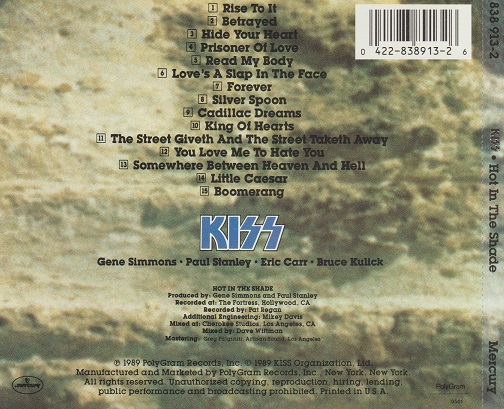
Why not indeed. The results yielded were interesting to say the least, and certainly more rock and roll than anything else Kiss did in the 1980s. It is also overall one of the hardest Kiss albums to listen to front to back. A for effort, D for songs. Its bloated and unfinished track list seemed like Kiss was trying really hard on one end, but gave up on the other.
Paul Stanley and Gene Simmons self-produced Hot in the Shade, after the negative experience with outsider Ron Nevison. This meant that there was no-one to push them to do better, as Bob Ezrin and Eddie Kramer would. No-one to say “no” to using demo tapes on the finished albums. No-one to say “no” to 15 tracks, to drum machines, and to sub-par songs.
Issues aside, Hot in the Shade is not all bad. At least you can say that Kiss went for it.
Opener “Rise to It” begins with something new: acoustic slide guitar (from Paul Stanley)! In a time when rock bands were re-discovering the blues, this old-timey touch was a welcome sound. The slide gives way to one of Paul’s most incendiary tracks of the decade. Written with expert songsmith Bob Halligan Jr., “Rise to It” hits all the right spots.
“Rise to It” was eventually chosen as a third single to promote Kiss’ upcoming 1990 tour. The music video opened a door that fans refused to allow them to close: Kiss in makeup again. Instead of the slide guitar intro, the video takes us to a theoretical 1975. Gene and Paul sit in the dressing room, applying their legendary whitepaint. The conversation was one that Gene and Paul may have had many times in the old days: musing on a life without makeup.
“I saw that review today. Some of those people don’t think this is gonna last. They think it’s a joke,” says Paul. Gene reassures them that it doesn’t matter as long as they believe in themselves.
“I bet you we could take the makeup off and it wouldn’t make any difference,” Paul retorts. Gene calls him nuts.
“Gene, there’s nothing we can’t do.”
“Still say you’re nuts.”
At the end of the video, there they were: Paul and Gene, Starchild and Demon, in makeup for the first time in seven years. What did it mean? Was it just hype? Of course it was. It would be seven more years before they’d do a tour in makeup again.
But it was cool, and it made many fans smile ear to ear.
Like all the previous Kiss albums from the non-makeup era, all three single/videos were Paul songs. Though “Rise to It” is the most noteworthy video, “Hide Your Heart” was first. This Stanley/Child/Knight outtake from Crazy Nights was actually first recorded by Bonnie Tyler in 1988. At the same time that Kiss were recording it for Hot in the Shade, Ace Frehley also did his own version for 1989’s Trouble Walkin’. Confusing? Kiss were the only band to have a semi-hit with it (#22 US).
As a nice change of pace from putting X’s in sex, the lyrics were a story about star-crossed lovers in gangland. “Tito looked for Johnny with a vengeance and a gun, Johnny better run better run,” sings Paul. In fact, “Hide Your Heart” does not get enough credit in fan circles for being lyrically different. At least it is recognised as a great tune from a poor album.
Kiss weren’t worried about competition from Ace and did indeed record the best version of “Hide Your Heart”.
The most notable single was the ballad “Forever” (and we will take a closer look at the CD single in the next instalment of this series). Michael Bolton was an old bandmate of Bruce Kulick’s from the Blackjack days. Before he was a superstar crooner, he was a rocker. Together he and Paul wrote “Forever”, which became the big hit (#8 Billboard hot 100).
As an acoustic ballad, “Forever” is far more palatable than the keyboardy “Reason to Live” from ’87. What gives it balls are the two unsung Kiss members: Kulick and Eric Carr. Eric’s heavy drumming on “Forever” really kicks it up a notch. Listen to that hammering 1-2-3-4 bit at the 1:05 mark. “When you’re strong you can stand on your own…” ONE TWO THREE FOUR on the snares. Heavy as fuck on a ballad! Then there’s Bruce’s acoustic solo, another first for Kiss. The temptation would be to record a ripping electric solo like everyone else. Bruce wrote and recorded a hook-laden acoustic solo that is as much a part of the song as the chorus.
Those are your three standouts from Hot in the Shade, leaving 12 more that don’t hit the same bar.
Of the remaining 12 tracks, Eric Carr’s lead vocal “Little Caesar” is significant. Making him sing “Beth” on Smashes, Thrashes & Hits was unfair and a cheat. “Little Caesar” is his “real” lead vocal debut. Originally written as “Ain’t That Peculiar” (later released on a Kiss box set), the words changed to reflect one of Eric’s nicknames. He was, after all, a little Italian guy! The funky “Little Ceasar” was performed entirely by Eric and Bruce Kulick.
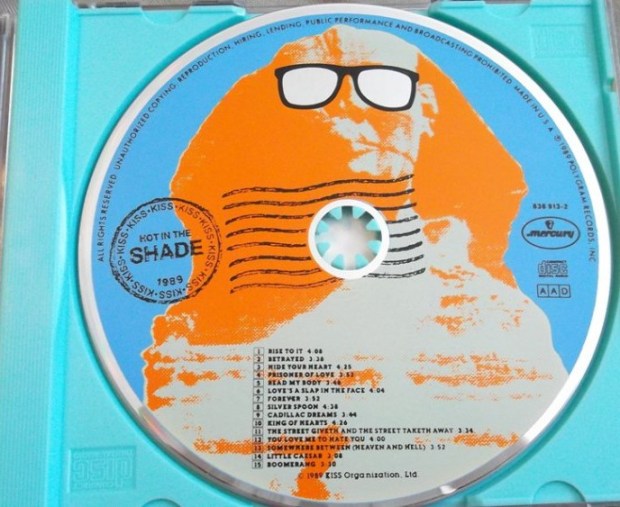
US picture CD
Gene’s “Boomerang” (written for Crazy Nights with Bruce) may be noteworthy as the closest Kiss have ever gotten to thrash metal. Another Gene tune, “Cadillac Dreams” has a horn section and electric slide guitars. Paul’s “Silver Spoon” is augmented by soulful female backing vocals. You have to give them credit for stretching out and trying new things, but keeping it rock and roll.
Then there is a slew of filler, stuff that would never be played live nor remembered fondly. Gene has a number of generic sounding songs, heavy but uninteresting: “Betrayed”, “Prisoner of Love”, “Love’s a Slap in the Face”, “The Street Giveth and the Street Taketh Away”, and “Somewhere Between Heaven and Hell”. Paul is also guilty of providing filler material. “Read My Body” isn’t bad, but sounds like his attempt to re-write “Pour Some Sugar On Me”. “King of Hearts” and “You Love Me to Hate You” both have good parts here and there, but not quite enough.
As unfocused as Hot in the Shade is, at least it was a step. Sure, adding horns and slides smacked of Aerosmith. Going almost-thrash was following, not leading. Musically, Kiss have never been leaders, but what they do is create their own confections from the ingredients of their best influences. Hot in the Shade represented a better mixture of ingredients, just without the discipline to mould them into 10 (just 10, not 15!) good songs.
Today’s rating:
1.5/5 stars
The story of the next three years in Kiss will be explored in a series of reviews on CD singles, live bootlegs, and solo releases. Don’t miss them!
November of 1989 was an historic moment in time. Three events collided in one day that I distinctly remember unusually well. Based on historical records, I almost can nail down the exact time I first heard Kiss’ then-new Hot in the Shade album that year. I can remember being on a bus for a school trip, sitting next to a German kid, as the news of the Berlin Wall coming down became the top story of the day. It was probably the 10th of November, a Friday.
It was huge news. I grew up in the tail end of the Cold War, and hope was finally on the horizon. I can remember in 1983, kids in the school yard talking about the Korean passenger liner that the Soviets shot down. “There’s gonna be a war,” one kid said, and it sure did seem like it. Every other year, it seemed like it. November of 1989 was a different kind of time, when fears suddenly melted away albeit briefly. Sitting next to that German kid on the bus, Mark, was the best place for me to absorb the greater meaning of it.
What were we doing sitting on that bus? We were on the way to Pickering, to visit the nuclear plant. Our names had to be submitted weeks in advance to get the clearances, but we were inside an operational nuclear facility! It wasn’t even my first tour of a nuclear plant, though it was the first time being inside one. When I was a youngster, the family took a tour of Bruce Nuclear’s grounds and visitor center on summer vacation one year. I remember being really small, and asked to try and lift some depleted rods of uranium. I couldn’t; it was far too heavy! This demonstration indicated the density of the nuclear fuel. “Did you have your Wheaties today?” asked the tour guide to the chuckles of the group. But in Pickering, we got to look right inside.
The Pickering plant was impressive. We had helmets on to go with our visitor badges. There were checkpoints everywhere, where you had to put your hands and feet in a scanner to make sure you didn’t pick up any radioactive dust. Once you were cleared, you could go into the next area. We saw the big rooms where the spent fuel is kept. Not surprisingly, everything was immaculately clean. Every surface gleamed, and all the equipment appeared new and in top condition. We were told that amount of radiation we were exposed to was about the same as an X-ray at the dentist. The trip was optional, and at least one kid opted out because he didn’t want to get zapped.
There was a more intensive scan at the end of the trip before we were allowed to leave. You had to pass a full body scan; if not they had to confiscate your clothes and send you home in paper hospital gowns. I had a brief moment of terror when my scanner refused to give me the green light. “Come closer” the damn machine kept saying to me. “I’m as close as I can get!” I retorted to the infernal contraption. A guide helped me get standing correctly and thankfully I passed the scan! No hospital gowns for me, which is especially good because the next stop on the trip was Pickering Town Center for lunch.
I ate a sandwich for lunch that my mom packed for me. She always made sure I had a lunch every day! We had time to kill at the mall so Mark and I hit up a record store. It was probably A&A Records and Tapes, though it certainly could have been an HMV. Either way, they had two new releases that I had my eyeballs on: Trouble Walkin’ by Ace Frehley, and Hot in the Shade by Kiss. I only had enough money for one, and Kiss had to take priority of solo Ace. I remember having a conversation with the guy at the counter about how Anton Fig was back playing drums for Ace. (And that right there is a lesson about customer service. That guy made an impression on me that lasted 28 years, just by mentioning Anton Fig on the off chance that I’d know who he was.)
So I walked out of there with Hot in the Shade in my Walkman, and I had a chance to hear the new Kiss album for the first time. I always enjoyed a first listen. I’d look at the song titles and try to guess which were Paul’s and which were Gene’s. I really liked the acoustic slide guitar that opened “Rise to It”. Bruce Kulick was proving his awesomeness, though I didn’t enjoy his tone on Hot in the Shade. It was only later that I learned Hot in the Shade was essentially a set of demos that were polished and finished for album release. That might explain why I felt the tone was so…flat.
Mark also encouraged me to listen to one of his tapes, a group called Trooper. “I bet you haven’t heard of Trooper,” he said, and I hadn’t, which was odd because they were Canadian. Trooper didn’t make any lasting impressions other than remembering that Mark was rabid for them. One thing I remember about Mark: he hated long songs. He liked songs in the three to four minute range, and that’s pretty much all of Trooper’s hits.
Our final stop was Lakeview Station, a huge and now defunct coal fire plant in Mississauga. “Don’t touch anything,” the teacher warned us before going in. “This place is covered in black coal dust. If you touch any, you’re going to get it all over the next thing you touch which will probably be your clothes.” And he was right. Every surface had coal dust on it. The tour was noisier and far grimier than the nuclear tour. This was intended to make an unsubtle point about the differences between the two.
We were all glad to get out of Lakeview and back on the highway home. I flipped sides on my Kiss tape and tried to get into the album. I was struggling with it. Some songs were really good, like the ballad “Forever” which was immediately discernible from the pack. Others made it seem like putting out an album with 15 new songs might have been a better idea on paper.
I listened to the album on my boombox when I got back home. I listened intently and tried to figure out what sounded “off”, and the only thing I could figure was the guitarist. “I don’t think Bruce Kulick’s tone is right,” I said with a twinge in my gut. Of this, I’m glad he proved me wrong by the next album Revenge.
What a memorable day that was. I’m just glad I didn’t come home radioactive and hot in the shade!
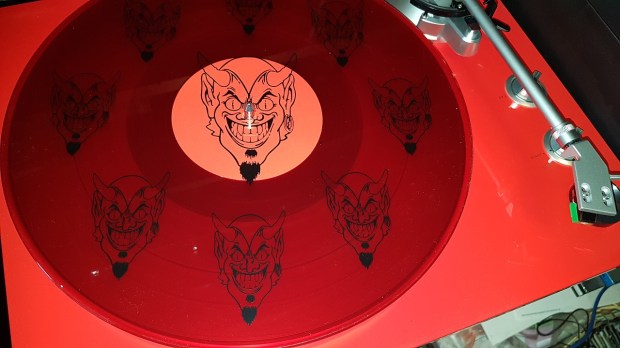
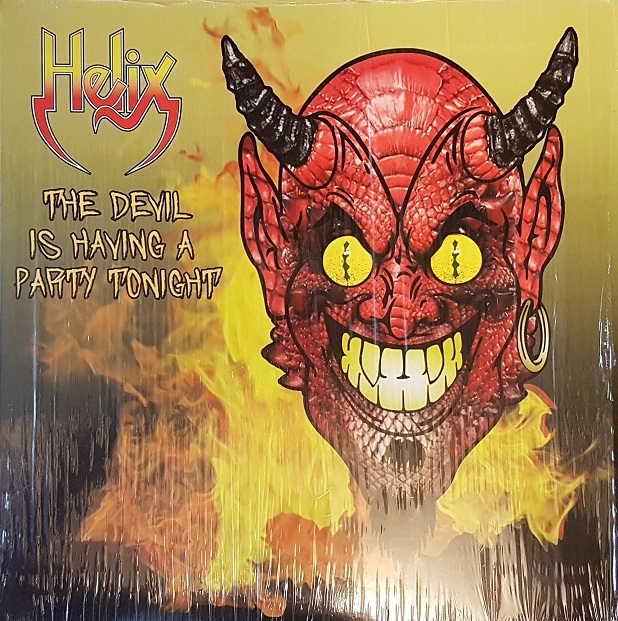
HELIX – “The Devil is Having a Party Tonight” / “The Tequila Song” (2017 clear red picture single)
It’s been love for Helix and I since…many years! Since Record Store Tales Part 2: Gimme An R, at least. As such, I may be a little biased when it comes to this band. Maybe. I truly believe their music deserves much more attention from the rock community, particularly the recent albums which are always excellent. Helix mainman Brian Vollmer maintains a reputation as the hardest working man in Canadian heavy rock. 2017 sees the release of not just a new Helix single (and a lavish one at that), but also his second solo album Get Yer Hands Dirty.
Helix today is Vollmer on vox, Daryl Gray on bass, Fritz Hinz kickin’ the drums, and newer members Kaleb “Duckman” Duck and Chris Julke. The inner sleeve is signed by all five members, which is just the kind of cool personal touch Helix are known for. Also noteworthy, all but Hinz wrote the single A-side “The Devil is Having a Party Tonight”. That makes it the first Helix song in years written solely by band members. “The Tequila Song” on the B-side is composed by mainstay collaborators Gord Pryor, Steve Georgakopoulos and Vollmer.
Great tunes, these are, both party songs. Each is a little heavier than you might usually expect from the Helix band. “Devil” is possessed by a heavy-as-a-tombstone riff, and some exotic guitar noodlings that recall the good stuff from the metallic 80s.
I think “The Tequila Song” is even better. I was known to drink tequila from time to time in my younger days, but I gotta say that Helix have written a better song about tequila than Sammy Hagar ever has. Stomp to that riff as you “lick it, bang it, suck it, tequila!” Even if you’re the designated driver, you’ll find the chorus infectious and party-ready.
Van Halen had some of the best videos of the 80s, bar none. After David Lee Roth, the visionary behind the videos, left the band, they refused to film any new clips for their first six singles with Sammy Hagar! They didn’t want the comparisons. Instead they released live versions of singles as videos. They finally filmed an actual studio video for the ballad “When It’s Love” in late 1988.
It seems Van Halen still can’t reconcile all the different singers from the past. That is obvious by the omissions from this disc. Go ahead and list the missing videos:
The excellently corny “Oh Pretty Woman”. “You Really Got Me”, the timeless Kinks cover. The live videos for “Unchained” and “So This Is Love”. All the live video clips are missing, even Sammy’s debut in “Why Can’t This Be Love”. As is Gary Cherone’s “Fire In The Hole”. “Feels So Good”, “Top of the World”, “Amsterdam”…all missing.
At least they included one Cherone video (“Without You”), but then again, he was the band’s current singer when this was released in 1998. It would have been weird if he wasn’t on it. He hasn’t made an appearance or even been mentioned on any Van Halen releases since.
For Van Halen to refuse to release those videos on DVD just indicates they’re scared of their own shadows. You can’t bury your past, you may as well celebrate it.
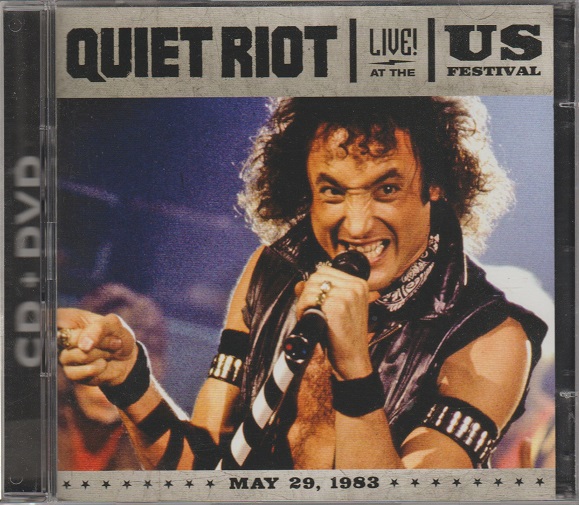
QUIET RIOT – Live at the US Festival (2012 Shout! CD/DVD set)
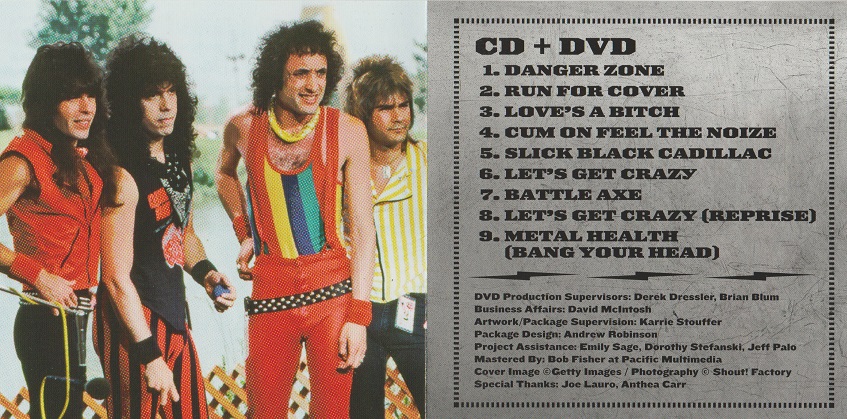
This was a long awaited release, since the US Festival was way back in 1983! The Holy Grail would be an official Van Halen release of their legendary performance, but I digress. There aren’t a lot of really great live Quiet Riot albums out there, with one called Extended Versions being the best package. Live at the US Festival is brief at just seven songs (plus a 4:38 guitar solo that also includes a sneak preview of a song called “Scream and Shout”). It does capture Quiet Riot at their peak, at a critical gig, and includes a DVD of the whole thing for the complete package. (Come on, Van Halen…)
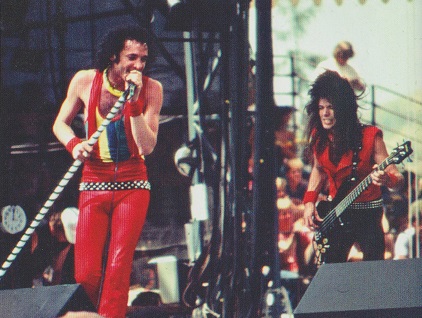
Let’s have a look at the DVD first. The crowd is vast, the costumes ridiculous, but there’s some kind of fire in the air. The atmosphere is electric and the band are absolutely great visually, particularly Rudy Sarzo. DuBrow is the consummate glam frontman, and an underrated one at that. Have a giggle at the old style giant screens displaying the band logo.
The CD itself sounds good, no complaints there, and the recording sounds untampered (evidenced by a messy Carlos Cavazo guitar solo in “Cum On Feel the Noize”). Sarzo’s bass is mixed nice and audibly. It would have been better if more of a booklet was included, but it’s just a simple fold-out with no liner notes. This set is sparse and just over 40 minutes long. A lot of that time is taken up by talking. You get the big hits though, and the non-album track “Danger Zone”.
Live at the US Festival is a pretty easy Quiet Riot purchase to justify because of the included DVD.
Make A Difference Foundation – Stairway to Heaven/Highway to Hell (1989 Polygram)
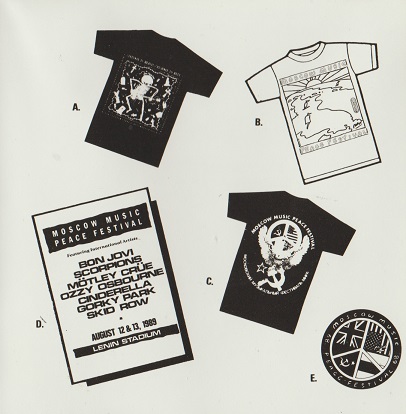
In 1989, I proudly sported my Moscow Music Peace Festival T-shirt in the highschool halls. It was cool to see the rock bands on the forefront of heavy metal bringing music to the Soviet Union. Scorpions, Bon Jovi, Motley Crue, Cinderella, Ozzy Osbourne and Skid Row joined Russian metal band Gorky Park in the name of peace and being drug free.
Drug free? Ozzy? It’s true that this was a little strange, but Motley were at least clean for the first time in their lives. The Scorpions had played behind the Iron Curtain before, and Sabbath were huge in Russia. Meanwhile Bon Jovi were one of the few bands to legally release an album in the USSR, and in return they brought Gorky Park to the US. I was lucky enough to have a girlfriend who recorded the televised part of the concert off MTV and sent me a copy. It was a pretty mindblowing video. Those Russians were going absolutely nuts, seeing their idols on stage.
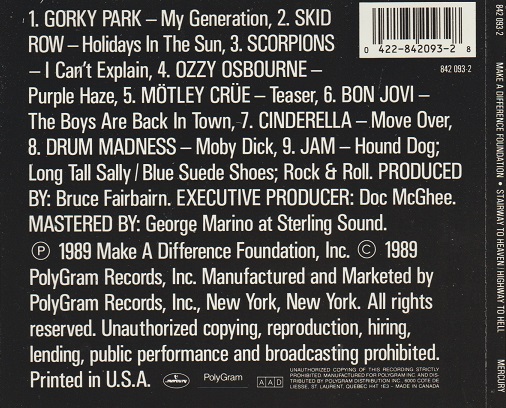
Later on, the bands each contributed a song to a compilation album called Stairway to Heaven/Highway to Hell, each covering an artist who had been touched by substance abuse. The CD was produced by the biggest name at the time, Bruce Fairbairn himself. The proceeds went to an anti-drug charity, for all the good “just saying no” does. The album itself was a pretty great compilation of mostly exclusive music. Though almost all of it is now available elsewhere, that wasn’t the case in 1989, making this a tempting buy.
Gorky Park, the up and comers, started off with “My Generation”. Some find it too putrid to stomach. It’s virtually an original song with only the lyrics recognizable. The riffs and melodies seem otherwise new. So give Gorky Park some credit for at least not attempting a carbon copy, but then you gotta take off some points for turning “My Generation” into a Bon Motley song. Unfortunately for Gorky Park, their momentum halted when singer Nikolai Noskov quit in 1990.
Skid Row surprised the hell out of everyone with the Pistols’ “Holidays in the Sun”. It was the first indication that Skid Row had punk roots. “Holidays” was very much a look ahead to where they would go on Slave to the Grind. They were on the punk bandwagon a full two years before Motley decided to cover the Sex Pistols. It’s always strange to hear flashy metal guitar solos on a Pistols song, but it’s sheer joy to hear Sebastian spitting and screaming up a storm.
Scorpions had a new compilation out called Best of Rockers ‘n’ Ballads. Another Who song, “I Can’t Explain” was taken from it to be used on this CD. It is by far the better of the Who covers, as Scorpions really made it their own. Next, Ozzy’s track is quite interesting. It’s the only studio recording of the lineup including Zakk Wylde, Randy Castillo, and Geezer Butler. Geezer quit the band shortly after, and this incredible lineup never recorded anything else. I consider it the strongest band that Ozzy had after Randy Rhoads. The quartet did a live sounding cover of “Purple Haze”, unfortunately not the greatest version. It is at least a showcase for Zakk Wylde to go nuts on the wah-wah pedal.
I will argue that the best track on this album came from the band that was riding a brand new high: Motley Crue. Clean and mean, they were incredibly strong in 1989. They the balls to choose an obscure Tommy Bolin (Deep Purple) solo tune: “Teaser”. Motley put on that Dr. Feelgood groove, and Mick Mars laid waste to the land with his slidey guitar goodness. It’s no surprise that “Teaser” has reappeared on Motley compilations several times since. It has balls as big as a bus!
Another strong contender is Bon Jovi’s take on Thin Lizzy. “The Boys are Back in Town” fits seamlessly with that small town New Jersey vibe that Bon Jovi used to have. Lynott must have had some influence on a young Jon Bon, because all his old tunes are about the boys – back in town! Dino’s bar and grill could be in Sayreville NJ. Of course, Bon Jovi are a competent enough band to be able to cover Thin Lizzy and do it well.
Another surprise: Cinderella doing Janis Joplin. Singer Tom Keifer suited Joplin, though you don’t immediately associate the two! “Move Over” takes advantage of that Keifer shriek that isn’t too far removed from Janis. From there on though, it’s filler. Jason Bonham, Tico Torres and Mickey Curry do a pretty boring “Moby Dick”. It’s funny how John Bonham sounds bigger on the original, than three drummers on this remake. Then it’s a bunch of live jams from the Moscow concert: “Hound Dog”, “Long Tall Sally”, “Blue Suede Shoes” and “Rock and Roll” (Bonham on drums again for the latter). Vince Neil is hopelessly out-screamed by Sebastian Bach on the Zep tune. All the singers participated, but Sebastian Bach and Tom Keifer blew ’em all away.
This disc has been out of print a while, but isn’t too hard to find. 80s rockers need to have it for its historical value.
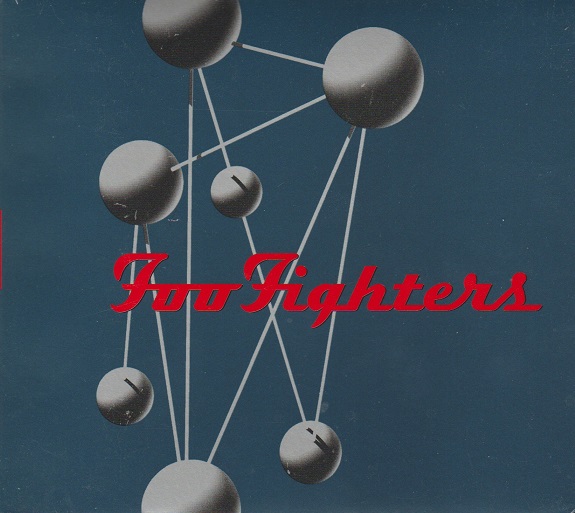
FOO FIGHTERS – The Colour and the Shape(Originally 1997, 2007 Sony Legacy edition)
Sometimes, an album is just perfect. Nothing needs to be added or taken away. It is simply right the first time.
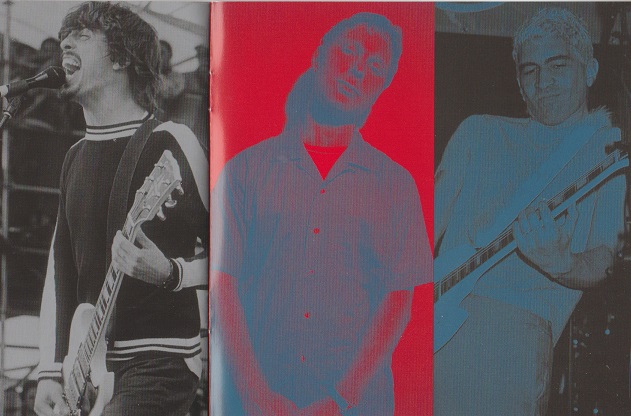
The Foo Fighters got it right the first time when they released The Colour and the Shape in 1997 At 47 minutes, it was already a bit longer than the average album, but what a towering 47 minutes they are! There is a reason that The Colour and the Shape is consistently the album that all others are compared to. It’s that one magical, flawless album that can never be equalled no matter what Dave Grohl & Co. come up with next.
The Colour and the Shape was a product of its time and all the things Grohl was going through. The drummer (William Goldsmith) was fired mid-way and Dave re-recorded all the drums himself, bar two ballads. Maybe that’s one reason that the album is so special. When Dave plays the drums, the energy level goes through the roof and comes out the speakers. That’s what happens on “Monkey Wrench”, “My Hero”, “Everlong”, “New Way Home” and “Hey, Johnny Park!”, five of the most exciting tracks. The energy simply cannot contained. The Law of Conservation of Energy dictates that it all comes out of your body as you rock to this album!
Of one were to give a negative critique to any of this album, it might be Grohl’s screaming on “My Poor Brain” and “Enough Space” among others. It is true: Grohl chips the paint with his voice from time to time. This works though, as an appropriate contrast to the soft melodies of “Walking After You” and “February Stars”. The album is well rounded. It joyfully careens from those heavy blasts, to quiet acoustic bits of pop glory.
The Colour and the Shape has the songs, it has the riffs, and mindblowing drums. It has the vibe, and it reeks of passion. Whatever Grohl was going through at this time, it ended up in the music. The production by Gil Norton is a bright contrast to the lo-fi of the debut album Foo Fighters. It simply cannot be improved upon. Even the lyrics go full circle. Listen to “Doll” and “New Way Home” and see if you catch it.
When Sony Legacy added seven bonus tracks, it beefed the album up to well over an hour. If you listen to the CD as a whole, it completely changes the listening experience, and not in a good way. It’s Coke vs. New Coke. Adding essentially a third side of B-sides doesn’t make it better. It would be advised to collect the original Foo Fighters singles from which these tracks were taken. And if you do, you’ll get more songs that weren’t included on the Sony Legacy, such as live and acoustic versions. Of the bonus tracks, the Gary Numan cover “Down in the Park” is particularly exceptional. The new liner notes by bassist Nate Mendel are quite cool.
The Colour and the Shape is one of the best albums of 1997, if not the very best of that year. It’s tough to beat and adding bonus tracks didn’t do the trick. Therefore, The Colour and the Shape gets two ratings:
Still On Fire – Dave Thomas & Anders Holm (1988 Melody Line)
In the 1980s, there were generally no Kiss books on the market. If you found one, you bought it. The only widely known Kiss book back then was 1978’s paperback Kiss by Robert Duncan. I was lucky to find Kiss Still On Fire in Stratford Ontario on December 27, 1990 in a great little store called The Book Vault. Still On Fire is very very unofficial, but it was unequalled in its time: 130 magazine sized pages, mostly in full colour, loaded with pictures, facts and a few errors.
Peppered with old interviews and article snippets, Still On Fire takes a balanced look at the band and isn’t afraid to get critical when it’s warranted. It also attempts to take a crack at who played what on some of those tracks where it wasn’t quite clear. For example, Ace Frehley is pictured on the front cover of Killers, but didn’t play on any of the new songs. Still On Fire quotes a Paul Stanley interview. Was it Bob Kulick playing lead on these tracks? “Bob did come out, yes, but he didn’t play. When I couldn’t handle things — and I don’t consider myself the ultimate lead player — another friend of ours came in and gave us a little help.” The book states this friend was Robbin Crosby of Ratt, a claim that is not backed up in other sources. Did Crosby play on Killers? Who knows, but according to this book, he did. Other books such as Julian Gill’s Kiss Album Focus claim Bob Kulick did play some on Killers. In other words, if you read something interesting in this book that contradicts what you’ve read elsewhere, take it with a grain of salt.
There’s a bit of content here about what Gene was doing in the 1980s outside of Kiss: producing bands such as Black & Blue and EZO. Gene was responsible for EZO’s fantastic single “Flashback Heart Attack”, co-written by James Christian of Simmons Record act House of Lords. Gene was also working on movies but was having trouble finding the time. Apparently Sergio Leone really wanted Gene Simmons for Once Upon a Time in America in the role of Max, ultimately played by James Woods. Can you imagine?
Besides the ample photos, the most impressive feature of Still On Fire is the discography. Though incomplete, Still On Fire attempts to document myriad Kiss bootleg recordings, including cover art. There are also interesting promo and foreign releases, such as the Special Kiss Tour Album and Kiss – The Singles. Side projects and solo albums are included, from major (Frehley’s Comet) to obscure (Bruce Kulick’s band The Good Rats). A variety of singles, picture discs and videos are on display, fully illustrated. All of this was completely new to me then. Not to mention the titles of unreleased songs! What the heck were “Don’t Run” and “The Unknown Force”? (The Elder demos.) This is also where you’ll find the most typos and spelling errors. (I really want to hear this song called “Pick It Up”.)
Still On Fire isn’t definitive nor is it definitely 100% accurate, but it should still prove to be a valuable resource for your Kiss library.
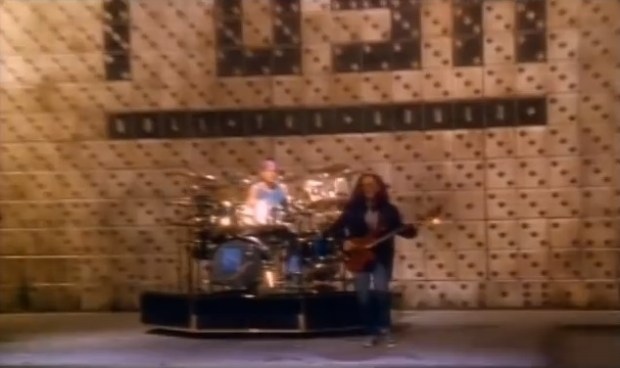
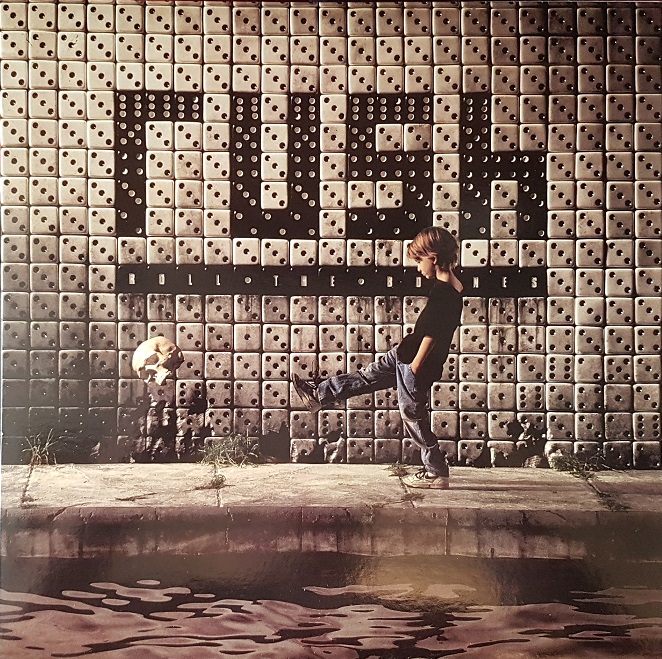
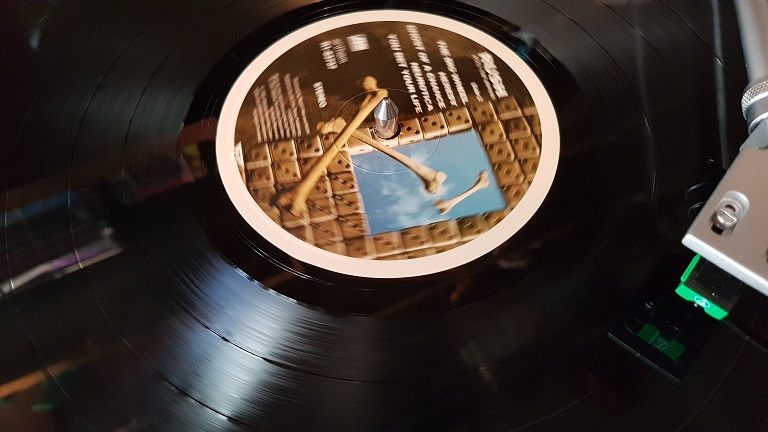
RUSH – Roll the Bones (1991 Anthem, 2015 remaster on 200 gram vinyl)
There was a period in the 1980s when, in some circles, Rush had lost the plot. Writers such as Martin Popoff have been very critical of this era, with its keyboards and shorter songs. In 1989, Rush began to turn the ship around with Presto. It and 1991’s Roll the Bones really ushered in the next phase of Rush, combining new and old. Fans (and Alex Lifeson) were happy that keyboards were toned down, at least in comparison to Hold Your Fire (1986).
The theme of the album is “take a chance”. Roll the Bones starts with a punch called “Dreamline”. Geddy Lee’s pulse pushes this into overdrive. The chorus goes into hyperspace. It’s hard to think of too many other Rush songs that are so concisely hot. “Dreamline” has it all: hooks, licks, force and grace.
Neil Peart is king on “Bravado”*, a sudden change of direction. His drumming, always hard, is unusually sharp. Yet it’s a slow song that might be termed a “ballad”. Whatever — it’s Rush. It’s incredible. It’s powerful in an understated, triumphant fashion. If you know somebody who says they hate Rush, play this.
The title track and first single is a Rush classic, but that rap section sounds dated today. That was always the danger of such an experiment, but fortunately the song is too strong for it to matter much. That’s Geddy rapping incidentally, with his voice lowered and effects added.
Side one also has “Face Up”; fast but not particularly memorable. But it also has “Where’s My Thing?”, a smashing instrumental featuring Geddy and Alex’s flying fingers. It’s subtitled “Part IV, ‘Gangster of Boats’ Trilogy” as a joke on past pretentiously prog-rock titles they’ve employed. Rush have always had a sense of humour, and also fun. “Where’s My Thing” is a fun instrumental, kept short and ever so slightly funky.
The second side of Roll the Bones isn’t as consistent as the first. “Ghost of a Chance” and “You Bet Your Life” are immediate standouts. An appropriate spectre-like keyboard part enhances “Ghost of a Chance” and justifies the use of the instrument. The other three songs (“The Big Wheel, “Neurotica” and “Heresy”) are fine for Rush deep cuts, but may or may not appeal to your specific tastes.
This 200 gram vinyl remaster is exquisite! Keyboard parts previously unnoticed are now audible, as if brand new. The drums have the punch missing on the old CD, and the bass hits the guts. Great dynamics and depth. If you are in the market for remastered Rush, these 200 gram vinyl reissues are pricey but a nice treat.
3.5/5 stars
*At 3:50 of the song, Peart performs a drum roll that I can only describe as pure ecstasy. Chills up the spine.
 – “Forever” (1990 Polygram EP)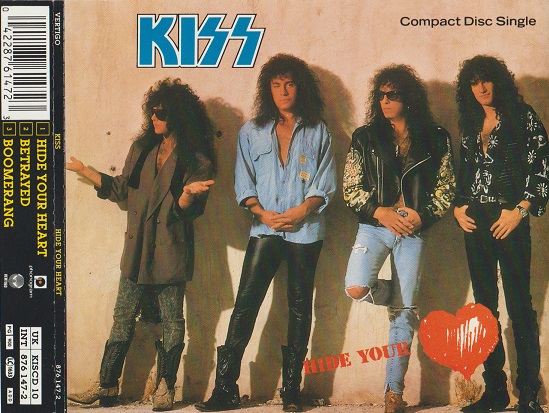
















 mikeladano.com