martin birch

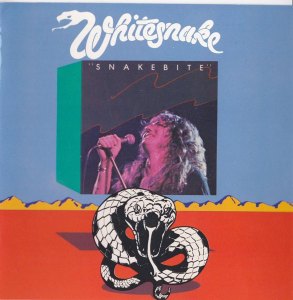
REVIEW: Whitesnake – Snakebite (album)

SNAKEBITE FRONT

WHITESNAKE – Snakebite (1978, released as both album and EP)

You gotta give David Coverdale some kind of credit for name-dropping two of his old Deep Purple Stormbringer classics right there in the first song on this album/EP, “Come On”.

“I’m just a SOLDIER OF FORTUNE,
Must be the GYPSY in me…”

Maybe David just wanted to remind people who he was, that this was not just some “new” band.  Either way, it’s a very solid outing, considerably more enjoyable than David’s first two albums as a solo artist.

SNAKEBITE FRONT BACK

Snakebite was originally a 4 song EP, under the name Whitesnake.  Over here in Canada, I knew it as a full album .  North America stuck on four of the better tunes from David’s solo album, Northwinds, and released it as an LP.

The EP, or side one of the album, was helmed by Purple producer Martin Birch.  He ensured a solid sound, and Coverdale & Whitesnake provided four solid tunes.

The aforementioned “Come On” sounds like a smoove Paul Rodgers prowl, and features three players who would stay through most of Whitesnake’s history: Neil Murray (bass), Bernie Marsden (guitar) and Mickey Moody (guitar). Track two, “Bloody Mary” is driven by a boogie piano, one of the best songs on the album.  My personal favourite of the album, anyway.  It’s just impossible not to move to this one.  David’s as naughty as ever in the lyrics:

“You know that Madam Palm and her five sweet daughters”
Couldn’t give her man what the doctor ordered”

Then Coverdale gets bluesy. “Ain’t No Love In The Heart Of The City”, previously a hit for Bobby “Blue” Bland, ended up becoming Whitesnake’s live centerpiece.  On the original EP, it is the last track, its position swapped with “Steal Away”.  “Steal Away” is a another highlight.  Moody’s slide guitar is just pure awesome sauce.  The only thing I dislike is some really cheesy sounding electronic toms.

NORTHWINDSSide two of the LP had the earlier Northwinds material, produced by ex-Purple bassist Roger Glover. Although Mickey Moody plays on these songs, he’s the only future Whitesnake member present. The tunes are decent enough.  “Keep On Giving Me Love” was funky, like the kind of stuff Glenn Hughes was always trying to push on Deep Purple.  It’s not really outstanding until you get to the chorus.  “Only My Soul” however is a stand out. Coverdale has often done these incredible soul-searching pieces, such as Purple’s “Soldier Of Fortune”, and Whitesnake’s later “Sailing Ships”. This time out we’re treated to some very appropriate violin, and Glover on synth.  The side is rounded out by “Queen of Hearts” and “Breakdown”, the raucious rocker written about the final demise of Deep Purple.

Although David Coverdale seemed to still be searching for direction after leaving Purple, the Snakebite album (or EP, whatever you happen to own) is an enjoyable listen from front to back. Some material really showed what David was capable of, and he certainly would deliver in full in the future. Whitesnake diehards should not do without Snakebite, as it provides an interesting set of snapshots as to what Coverdale was up to, between his bouts of fame and glory.

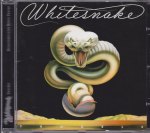
TROUBLEThere are numerous options today to get this music.  Not only is the Snakebite album still in print on CD in North America, but you can now also find the tunes remastered.  The Snakebite EP has been added as bonus tracks to Whitesnake’s debut album, Trouble.  You can also get David’s solo album, Northwinds, remastered with bonus tracks.  Or you could just get ’em on original vinyl!  The choice is yours, but I think any Whitesnake fan would enjoy this Snakebite.

4/5 stars

REVIEW: Whitesnake – Come An’ Get It (Remastered with bonus tracks)

“Like” the brand new LeBrain Facebook page!

WHITESNAKE FRONT

WHITESNAKE – Come An’ Get It (EMI 1981, 2007 remastered with bonus tracks)

Come An’ Get It is my favourite Whitesnake album.  Therefore it’s a bit of a surprise that I still haven’t reviewed it.  On the other hand it’s always nice to leave some goodies for later and cherish them, I suppose?

The first time I heard this album was in 1990.  I had ordered the cassette from Columbia House, and brought it with me on a trip to go visit my cousin and aunt in Calgary, Alberta.  I remember I brought two brand new (to me) albums with me from that Columbia House purchase; the other was School’s Out by Alice Cooper.  I ended up loving both, not a bad trip eh?  Driving through the mountains with “Lonely Days, Lonely Nights” by Whitesnake on the earphones was pretty fucking cool.

Come An’ Get It features this classic Whitesnake lineup, aside from David Coverdale himself:

  • Jon Lord – organ
  • Ian Paice – drums
  • Bernie Marsden – guitars
  • Mickey Moody – guitars
  • Neil Murray – bass

Basically, THE lineup of early ‘Snake.  In the liner notes, David says he finds this to be one of his most consistent efforts, and his favourite of the early band.

The incredible album kicks off with the flirtatious title track, Cov the Gov as cocky as ever, with this seasoned band behind him solidly grooving.  “If you want it, come an’ get it, I got something for you.”  And kids, I hate to break it to you, Coverdale’s “something” was not something innocent like candy or treats.

“Hot Stuff” is the second track, which changes up to a breakneck speed.  Lordy on the piano hammers away, keeping up with the furious pace of Paice and the 3 M’s – Moody, Marsden and Murray.  Another standout.

The single, “Don’t Break My Heart Again” is a bit more ominous, with Lord’s trademark Hammond organ carrying the song.  It’s a bit darker, a bit plaintive, David convincing us that he really is heartbroken, even though two songs ago he was begging some lovely lass to “Come An’ Get It”.  This is a standout song, with fantastically colourful solos and a memorable melody.  Shades of the Whitesnake to come.

The aforementioned blues, “Lonely Days, Lonely Nights” follows.  It’s this kind of song that David really sinks his teeth into.  Moody and Marsden throw in plenty of bluesy licks, Lord with his Hammond colouring the backdrop.  Once again, David will have you convinced that somehow, he really is lonely.  Lonely, even though the very next song talks about how much he loves “Wine, Women An’ Song”!

“Wine, Women An’ Song” is actually my favourite tune on the album.  Coverdale is as cheeky as ever:

“If I can make you smile, I will raise my glass,
But if you don’t like it, baby you can kiss my ass,
Yes indeed…
You can tell me it’s wrong, but I love wine women an’ song!”

This barroom piano bopper is irresistibly catchy.  I’ve always been a sucker for past piano tunes, that’s why I love Little Richard I guess!  David’s done a number of these over the years (“Bloody Mary”, “Bloody Luxury”) but this one is my favourite.  And that ended side 1.

WHITESNAKE INNER

Side 2 kicked off with one of David’s more philosophical songs, a style he also does well.  “Child of Babylon” starts slow and bluesy but soon becomes something a bit more menacing.  This is another triumph.  “Would I Lie To You” returns David to his cheekier side.  “Would I lie to you…just to get in your pants?  I think so,” winks Cov the Gov.  This is just a fun Whitesnake tune, catchy, danceable, tongues in cheeks (just not necessarily the cheeks of the tongue’s owner).

My least favourite song is the next one, the slightly funky “Girl”.  The liner notes compare it to Deep Purple; I don’t think so.  Yes, both bands forayed into funk.  I think Deep Purple did it better than this.  Much better is “Hit An’ Run”, which drives.  This song kicks.  David’s vocal is perfect, and there’s even a talk-box solo, and then a killer slide solo!  What more could you want?

The final song of the original album was “Till the Day I Die”, another one of David’s perfect philosophical album closers.  He seems to like to close his albums with tunes like this, or “Sailing Ships”, songs with some mood and thought to them.  “Till the Day I Die” is one of the best ever, a dramatic, sweeping number that goes from acoustic to epic in under five minutes.

Martin Birch produced Come An’ Get It, as he did many ‘Snake platters.  It has a workmanlike sound, powerful enough, sonically clear, with excellent performances.  Slide It In is more powerful in the long run, but this is a step on that road.

There are six bonus tracks to keep you satisfied after the main meal.  Think of this as dessert, as these are unfinished or rough mixes of album tracks.  There is nothing especially revelatory here, but as added value, it’s nice to have these bonus tracks.  There’s some unheard stuff here, such as Ian’s count-in to “Child of Babylon”, nothing mindblowing, just nice to have to fill out the CD.  Some alternate vocals, solos, and so on.

The liner notes by Geoff Barton are excellent, loads of photos, lots of text.  Coverdale shows up to offer his perspective, and illustrates a harmonious band firing on all cylinders.

Keep in mind that context is everything, especially when it comes to music.  I have powerful memories of this album.  For you, it might not be worth it, but for me:

5/5 stars

REVIEW: Deep Purple – Machine Head (40th Anniversary Deluxe Edition, vinyl, In Concert ’72 vinyl)

More Purple at mikeladano.com:

Live at Inglewood 1968Deep Purple (1969), Machine Head (40th Anniversary Deluxe Edition + vinyl + In Concert ’72 vinyl), Perks and Tit (Live in San Diego 1974), Stormbringer (35th Anniversary Edition), Come Taste the Band (35th Anniversary edition), Power House (1977), The Battle Rages On (1993), Shades 1968-1998, Collector’s Edition: The Bootleg Series 1984-2000 (12 CD), Listen, Learn, Read On (6 CD), Rapture of the Deep (2 CD Special Edition), “All the Time in the World” (2013 CD single), NOW What?! (2013) Record Store Tales Part 32: Live In Japan, STEVE MORSE BAND – StressFest (1996), ROCK AID ARMENIA – Smoke on the Water: The Metropolis Sessions.

DEEP PURPLE – Machine Head (EMI 40th Anniversary Deluxe Edition, vinyl, In Concert ’72 vinyl)

BLACKMORE 2_0002

For the record, Machine Head is not the perfect Deep Purple album.  I find both In Rock and Fireball to be superior.  Machine Head is, however, the best known Deep Purple album, and I guess that’s why it’s gotten such a grand reissue while the other two have to be content with simple single-disc reissues from the 1990’s.

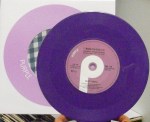
For the 40th anniversary, there have been a number of reissues made available.  First, there is the lovely 180 gram vinyl reissue, which includes a lyric sheet and a bonus 7″ of the first single, “Never Before” / “When A Blind Man Cries”.  Then, Peter Mew remixed the 1980 release In Concert ’72 at Abbey Road, which was re-released on purple vinyl.  This too came with a bonus 7″ single (also purple), “Lucille” and an unreleased rehearsal of “Maybe I’m A Leo”.

Finally, the crown jewel release is the five disc 40th Anniversary box set.  This includes all the stuff you got with the previous 1997 25th Anniversary edition, and more.  Packed inside is a lush 64 page hardbound booklet (including Roger Glover’s 1997 liner notes).  As an added surprise, even the CDs are printed in purple plastic.  I hope this is the last time I ever need to buy Machine Head!
SAM_2347

Disc One:  the 2012 remaster

Hey, I found the 1997 remaster just fine to my ears.  Is this one better?  Marginally, yes.  I imagine this sounds closer to the way it originally sounded if you bought a brand-new vinyl copy back in 1972.

Machine Head is a mere seven tracks, but almost all are winners.  The album kicks off with the adrenalized “Highway Star” (written and often performed during the Fireball tour), which is one of my personal favourites.  I still marvel today at Jon and Ritchie’s unison solos, like something out of a rock n’ roll speed race.  Gillan screams that nobody’s gonna take his car, and you believe him.  “Highway Star” is Deep Purple the way I often think of them:  fast, intricate, with banshee screams.

“Maybe I’m A Leo” takes the pace to a groove, with Ian Paice and Roger Glover holding it down.  This track is quite unlike anything from the previous two Deep Purple albums (except maybe “No No No”), featuring a more relaxed, comfortable band.   It is radio-ready hit material, and a concert staple.  But in case you too were getting comfortable, Ian Paice’s pounding intro to “Pictures Of Home” will wake you up.  This is clearly the most “heavy metal” of all the new songs, and that drum intro is reminiscent of Ian’s work on “Fireball”.  Gillan’s lyrics describe the “eagles and snow” of the Swiss scenery in which they recorded the album.

SAM_2352

In case you didn’t know, Machine Head was recorded at a hotel in Switzerland, by the Rolling Stones Mobile and Martin Birch.  The band occupied several suites, and managed to extract an incredible sonic quality from them.  According to the liner notes, it was simply too much work for the band members to walk through the various suites (needing to go outside onto balconies to do so, due to blocked doorways) down to the mobile to hear playback.  Instead, the band simply plowed through without hearing many of the playbacks, and the result is a spontaneous sounding album.

The first single “Never Before” is next, closing side one.  This is the one predicted to be the hit, only it wasn’t.  It’s not particularly a standout Purple track.  It’s short, simple and sweet but not nearly as powerful or memorable as the other six album tracks.SAM_2369
Side two opened with a track thought to be a mere throwaway, “Smoke on the Water”.  Completed after the infamous Frank Zappa gig at the local casino which resulted in the place burning down, Glover coined the title.  The rest of the band initially balked:  “Sounds like a drug song.”  Of course we know the song and title were the perfect match for each other.  This riff is the riff, the mother of all guitar riffs, never to be topped nor equaled by anybody, including Deep Purple.

“Lazy” was the band’s jam song, a sprawling seven minute stretch, greatly expanded upon live.  It begins with Jon Lord and Ritchie Blackmore playing off each other, a fun blues, until Gillan enters.  Ritchie’s solos are sublime, not to understate the greatness of Jon’s.

Side two closed with “Space Truckin'”, another song which was greatly extended live.  This is not one of my personal favourite album songs, but one cannot deny its importance.  It is an extended concert staple, but in its studio version it isn’t even a full 5 minutes long.

The disc ends with a bonus track, the sublime B-side “When A Blind Man Cries”.  This is a slow, mournful blues featuring some of Ritchie’s incredible six-string feel.  You can see why it wasn’t included on the album proper, as it is unlike anything else on Machine Head.  Restored to the CD as a bonus track, it is now a highlight.  Ian Gillan deserves special praise for his emotive delivery.

SAM_2348Disc two:  the 1997 Roger Glover remix

For the 25th Anniversary CD, Roger went back into the studio with the master tapes and built an alternate, remixed Machine Head.  This was done to provide added value, since no outtakes from the album existed.  This remix is not radically different.  What it is, is a fresh take on an album that I (and perhaps you) have played hundreds of times.  Glover incorporated alternate solos and unheard takes into the songs, making them sound new again.  In fact, this is my “go-to” version of “Smoke on the Water”, with my preferred alternate guitar solo and Ian’s “Break a leg, Frank!” restored to the end.  I tire of the original; this version sounds fresh to me.

Like the 1997 issued version, this also includes Roger’s remix of the B-side “When A Blind Man Cries”.  Missing are the Quad mixes of “Lazy” and “Maybe I’m A Leo” from the ’97 version, but they are included on another disc in the 40th Anniversary version.

SAM_2349Disc three:  Quad SQ stereo mix

Like many hit albums in the 1970’s, Machine Head was mixed in quadraphonic and released on a special LP.  Of course, nobody really has a quad setup at home anymore.  The interesting thing about many quad mixes, Machine Head included, is that it featured a very different mix, including alternate solos.  This version of the album has been mixed down to stereo and included for the sake of completion and historical value.

There are two bonus tracks on this CD, single edits of “Lazy” from a Japanese 7″, and a US edit of “Smoke on the Water”.  The Japanese reduced “Lazy” from almost 7 minutes to a mere 2:30!  I believe both single edits have been made available on box sets and compilations before, but they are included here to make this version of Machine Head the most complete ever assembled.
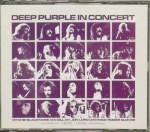
SAM_2350Disc four:  In Concert ’72, the 2012 remix

This album was previously available on CD, in a compilation that included BBC sessions from 1970 and 1972.  This set collects and remixes the 1972 recordings, complete, and restored to the correct running order.  Previously, “Smoke on the Water” was pushed to second-last in light of its later success.

This is a stunning live album, with clear sonic quality, and a powerful band playing almost all of Machine Head a month before its release!  “Pictures Of Home” is excluded, a song Ritchie did not want to perform live, and it is replaced by “Strange Kind of Woman”.
SAM_2372

Highlights for me include the aforementioned “Strange Kind of Woman”, complete with Ian and Ritchie’s interplay.  Lazy is quite a tour-de-force, and “Space Truckin'” is over 20 minutes long.  It is the full jam that folks would later come to know and love, with ample guitar, keyboard and drum solos.

The band were known to close their sets with Little Richard’s “Lucille” at the time, and it closes this BBC session as well.  There are a few versions of “Lucille” out there, this one is tame by comparison with some of them.  That’s not to say it’s inferior, as Ritchie’s solos are incredible, almost out-of-control, and Ian’s screams as powerful as ever.
SAM_2364

As I mentioned, the vinyl version of In Concert ’72 includes a bonus 7″ single.  This single is the only place you can get the previously unreleased “Maybe I’m A Leo” rehearsal.  It fades in on what seems like a bum note on Jon’s keys, and is a bit more laid back than the one that they played during the proper set.  Ian noticeably takes it a bit easier on the vocal, presumably saving his voice.  Ritchie plays a different solo.

For me, speaking as a collector, having this one rare track on such a cool looking colour single made it worth re-buying In Concert ’72 on vinyl like this.
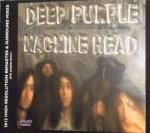
SAM_2351Disc five:  Original quad mix, 96/24 LPCM stereo version, bonus 5.1 mixes

For a lot of people, this DVD is the main reason to buy this box set.  For audiophiles, there’s a high resolution version of the stereo mix.  For completists and history buffs like myself, you can finally hear the quad mix like people heard it in the 1970’s.  The album has been converted to 4.1 surround so you can play it on your home theatre system.   I very much enjoyed hearing the album in this way, as opposed to the stereo version available on disc three.  The cool thing is, Peter Mew did the original 1972 quad mix, and here he helmed its transfer to 4.1!

The quad is interesting not only because it differs noticeably from the original, but also because of the instrument separation.  You obviously can’t judge a mix like this and compare it to a 5.1 mix of today.  It’s not as full, or powerful.  But it’s also an historical piece.

It’s cool to hear the quad version’s guitar solo on “Highway Star”, Blackmore making his guitar rev like an engine through the front speakers.  I like the way Gillan’s voice multiplies in the mix during “Maybe I’m A Leo”, and the alternate guitar solo on the same song is also cool.  Jon’s keys come from behind, a bit gimmicky by today’s standard, but probably astounding back then.  “Pictures of Home” features Ritchie’s guitar tracks split between different corners, allowing one to hear the separate parts clearly.  The separation of instruments on “Lazy” allow you to hear clearly each member’s playing as well.

As an added bonus, they remixed three songs in 5.1:  “When A Blind Man Cries”, “Maybe I’m A Leo”, and “Lazy”.  I’m sure a lot of people will complain that they didn’t do the entire album in 5.1.  Me, I’m sure they’ll save it for the 50th anniversary.  “Blind Man” is absolutely stunning; it shimmers.  New nuances can be detected.  “Maybe I’m a Leo” shakes the Earth with stomp, its clarity outstanding.  Blackmore’s solo sounds as if he is in the room.  Finally, “Lazy” is spacious and warm.  The different tones of Lord’s organ are incredible.

Conclusion:

I’m very satisfied with this box set.  As if all that music wasn’t enough, the booklet will keep you going for hours with its full-colour photos, liner notes and essays.  Yes, it can be a bit much, having four versions of one album in a single box set.  However, twice I listened to the whole thing in order, and didn’t find myself bored.  You know why?

It’s because Machine Head is a great album.

5/5 (highway) stars

R.I.P. Jon.
GUEST SHOT: 30 Albums that Uncle Meat Thinks You Should Visit (Or Re-Visit) Part 1

By Meat

Music fans love lists.  Maybe it’s the Ten Best Bass Lines of the 1990’s or a list of the songs you wish you lost your virginity to.  I have always been a lists guy as the whole Sausagefest Top 100 thing would attest to.  So here is yet another list.  The albums listed below are not my favorite albums of all time, even though many of my favorites are included.  The point of this list is to possibly introduce to, or maybe even remind, this blog’s readers of 30 albums that I think need to be heard.  Maybe an album that in my opinion was under-appreciated.  Perhaps even an album that inspired me in some way.   Anyways, here are 30 albums that Uncle Meat wants you to visit … or re-visit.  They are in alphabetical by album title.  Enjoy

A EULOGY FOR THE DAMNED  –  ORANGE GOBLIN (2012)

I could have easily listed several other Orange Goblin albums here, but their latest album is an absolutely killer album.  Almost fusing some Black Crowes into their brand of Metal, these British stoner-rockers put out maybe the best Metal album of 2012.  And considering that there are only 3 albums on this whole list that were released before the year 2000, it feels good to actually get some new content in here.  The album ends with the title track, which almost plays out like its own Rock N’ Roll Western.   The band finally tours Canada for the first time coming up in spring of 2013.  As the late Billy Red Lyons used to say, “Don’t ya dare miss it!”


ACT III  –  DEATH ANGEL (1990)

Death Angel’s first two albums are pretty sloppy, sound-wise and in song structure.  Some very heavy moments, but at times it just sounds annoying.   On their third release, Max Norman (Megadeth) got his hands on them and it resulted in a polished sound and the best album of their career.  Gone were the high-pitched shrieks of singer Mark Osegueda that littered their first two records.  It really does seem that the band simply matured.  One of the best Metal albums of the 90’s indeed.  Definitely among the most progressive metal albums I can think of.  A must-have album for every true Metal fan.


ARGUS  –  WISHBONE ASH (1972)

It is fair to say that Iron Maiden and Thin Lizzy would never have the musical identity they have, if it wasn’t for Wishbone Ash.   Innovators in twin- lead guitar harmonization, this band never really got its due.  Interestingly enough, the sound engineer on this record is none other than Martin Birch.  Coincidence?  Meat thinks not.  I remember this album sitting in front of my Dad’s stereo for years when I was very young, and then seeing Star Wars and thinking that Darth Vader looked a lot like the guy on the cover of Argus. Check this album out and discover a part of where it all came from.   When you listen to the beginning of the song-clip included here, “Throw Down the Sword, think “To Live is to Die” by Metallica.  Sounds like Lars and the boys were paying attention as well.


ARGYBARGY   –  SQUEEZE (1980)  

Think The Beatles meets The Clash.  The first two songs on this album are both stellar pop moments.  The melodies are McArtney-esque, and that is truly saying something.  “Pulling Mussels From a Shell” is pure song-writing genius“Another Nail in my Heart” is one of my favorite songs of all time.  Check out the incredible guitar solo in this song.  Funny enough, like the 2 previous albums listed, this was the band’s third album.  Maybe a trend is happening here.


BIG WORLD  –  JOE JACKSON (1986)

For Joe Jackson’s 8th release, he decided to go all out. An original studio album, recorded live in front of a New York City audience who were told to be silent throughout.  Capturing the excitement and spontaneity of a live performance, in which absolutely no post-recording mixing or overdubbing was done, this record is ambitious as it sounds.  It is all here.  You get Jazz, Pop, Punk and everything in between.  Jackson possesses one of the classic all-time voices.  When this double-album was released, it contained three sides of music, leaving the fourth side blank.  A landmark recording.


BLUE  –  JONI MITCHELL (1971)

This album came in at Number 30 on Rolling Stone’s Top 500 Albums of All-Time chart, the highest placing for any female artist.  So why is this album on this list?  Honestly because I still believe this album is truly under-appreciated.  Too many people do not realize how great this album is.  Simply, some of the best lyrics of all time are here.  If this album was any more personal it would contain a video of Joni Mitchell going to the bathroom.  Listen to this front to back when you want to feel like someone understands your pain.   A truly cathartic experience, when she played this album originally to Kris Kristofferson he was reported to respond, “Joni… You really should keep some of that to yourself”.  I am glad she didn’t take heed of his advice.


DOGMAN  –  KING’S X (1994)

It seems as soon as Brendan O’Brien (Pearl Jam/STP/Black Crowes) got his hands on King’s X, the band’s sound fattened up.  Thick, lush and pounding would be a good overall description of the sound on this album.  The songs are great too.  I saw King’s X at the legendary El Mocambo in Toronto and was standing literally beside Dimebag Darrell and the rest of Pantera.   While I love almost every song on this album, the title track is an absolute killer.  When the first Woodstock concert in 25 years began, it was King’s X who took the stage to kick it all off.  Check out this live performance from the old Jon Stewart show from back in the day and crank it.  One of my favorite youtube videos ever.


DUKE ELLINGTON & JOHN COLTRANE   –  DUKE ELLINGTON & JOHN COLTRANE  (1962)

This might be my favorite jazz album of all time.  Duke was 63 and Trane was 36 when this album was recorded.  With a running time of 35:05 this album is short and oh so very sweet.  Ellington’s “In a Sentimental Mood” starts this album off and it never lets up.   “Big Nick” is just a wonderfully happy shuffle.  True story: I once got so fed up with Metal that I became a Jazzatarian for a few months, listening to nothing but old school Jazz.  I started with John Coltrane and went from there.  I never did find a jazz artist after him that I enjoy more.


EL CORAZON  –  STEVE EARLE (1997) 

Simply put, this album is easily in my Top 3 albums of all time, of any genre.  True storytelling at its finest, El Corazon is a complete masterpiece.  It seems that sobriety allowed Steve Earle to realize how great of a songwriter he really is and on this album he branches out and removes any constraints of style.   Of all the 30 records included on this list, this is the one I am not asking you to check out, but I am TELLING you to check out.  Comparing the laid-back intensity of “Christmas in Washington” to the sheer power of “Here I Am” truly makes you appreciate the diversity of this record.   Steve Earle is THE man.  A lifetime Bro-mance going on here.


HEAD HUNTERS  –  HERBIE HANCOCK (1973)

Quite possibly the greatest jazz fusion record ever recorded. This record is a funk buffet.  Only 4 songs and all of them are great.  The YouTube clip here of “Watermelon Man” is the shortest song on the album, and is as original as it is velvety-smooth.  I find it hard not to do some sort of jig when this I hear this song.  “Chameleon”, “Sly” and “Vein Melter” complete one of the most influential jazz albums of all time.  Half of this album made 2012’s SausageFest countdown.  I suspect the other half will not be far behind.

Stay tuned for Part 2!

REVIEW: Iron Maiden – The Essential (2005)

Part 38 of my series of Iron Maiden reviews!

SAM_1658

IRON MAIDEN – The Essential (2005)

…And the era of Maiden compilations had begun.  And I did buy them all.

The Essential is a series.  I have The Essential Johnny Cash as well as others.   So, this one was not put together by the band.  There’s no Eddie on the cover, no exclusive content, no liner notes from Rod Smallwood nor Steve Harris.  Instead there are liner notes from Lonn M. Friend of RIP Magazine.  They’re aimed at newbies, but at least all songs get full musician and writing credits.

Much like 1996’s Best of the Beast, the tracks are reverse-chronological.  This time, it works better than on Best of the Beast.  The cool thing is that this means you start with the incredible epic “Passchendale” from Dance of Death.  What an opening.  Every album (studio and live) is visited, including four Blaze Bayley tracks.

Everybody bitches about what tracks should have been left off, and which should have been included.  Here’s mine:

1. I would have included no Blaze tracks, and instead included live versions of Bruce singing them.

2. Those are the only times I would have included live tracks.

3. I could do without “Holy Smoke” and “Bring Your Daughter”.  Give me “Tailgunner” instead.

4. Give me “Stranger In A Strange Land” instead of “Heaven Can Wait”.

But that’s about it.  You get a healthy mix of hits along with great album cuts such as “Wrathchild”, “Killers”, and glory be, “Phantom of the Opera”!  Those, plus “Passchendale”, make this a passable greatest hits disc.

Tracklist is below, but only you can decide if this one’s worth buying.  I bought it for “the collection”.  As far as a complete career-spanning set goes, this is about as close as it got without having to buy multiple sets.  However it’s now out of print, so the point is moot.

3/5 stars

Disc: 1
1. Paschendale
2. Rainmaker
3. The Wicker Man
4. Brave New World
5. Futureal
6. The Clansman
7. Sign Of The Cross
8. Man On The Edge
9. Be Quick Or Be Dead
10. Fear Of The Dark
11. Holy Smoke
12. Bring Your Daughter..To The Slaughter
13. The Clairvoyant
Disc: 2
1. The Evil That Men Do
2. Wasted Years
3. Heaven Can Wait
4. 2 Minutes To Midnight
5. Aces High
6. Flight Of Icarus
7. The Trooper
8. The Number Of The Beast
9. Run To The Hills
10. Wrathchild
11. Killers
12. Phantom Of The Opera
13. Running Free (Live)
14. Iron Maiden (Live)

REVIEW: Iron Maiden – Best of the Beast (1996 2 CD edition)

Part 22 of my series of Iron Maiden reviews!

IRON MAIDEN – Best of the Beast (1996)

I’m not sure what prompted Iron Maiden to put out their first greatest hits disc in 1996, but at least they did it in style.  Originally available as a limited edition 2 CD book set, it was pretty extravagant packaging for the time.   My only beef is by the nature of such packaging, the paper sleeves will always scratch your discs, 100% of the time.

This album was also available in a standard edition single disc, with the songs in a different running order.  I don’t have that one so I’m not going to talk aboot it.

The 2 disc version, perhaps to emphasize that Blaze Bayley is the current Maiden vocalist, starts at the present and then rewinds all the way back to the beginning, closing with The Soundhouse Tapes!  An interesting approach indeed.  As a listening experience I’m not sure that it works that well.

Since we’re starting at the present, the album kicks off with a new song.  “Virus” is 6:30 of same-old same-old X Factor Maiden, but not as good as anything on that album.   It drags and drags for three minutes before finally kicking into gear, but it is otherwise repetitive and boring until then.  Lyrically, it is another attack on the sicknesses in society, much like “Be Quick Or Be Dead” and “Justice of the Peace” were.

Then back in time one year, to “Sign of the Cross”, the dramatic 11 minute epic from The X Factor, as well as “Man on the Edge”.  (I would have preferred “Lord of the Flies” to “Man on the Edge”, but perhaps “Man” was the bigger single of the two.)

To bridge into the Fear of the Dark album, a new live version of “Afraid To Shoot Strangers” is featured, with Blaze Bayley singing.  It’s a good live version, but it’s immediately obvious that Blaze is no Bruce.

Bruce takes over on the next track, “Be Quick Or Be Dead”, and we’re back in the saddle.  Singles (including the popular live version of “Fear of the Dark”) and album tracks are counted down from 1993 to 1986’s Somewhere In Time album, ending disc 1 with “Wasted Years”, a great closer.  My beef here:  I would have preferred the single “Stranger In A Strange Land” to the album track “Heaven Can Wait” (but I know the Heavy Metal OverloRd doesn’t agree with me!)

Disc 2 is the glory years, if you will, everything from Live After Death to the beginning.  It begins with the epic “Rime of the Ancient Mariner”, a ballsy move for a greatest hits album, and the live version at that.  Chasing it is the live single version of “Running Free”.  Then we count them down, all the singles from Powerslave to “Run To The Hills”, plus “Where Eagles Dare” and  “Hallowed Be Thy Name” thrown in for good measure.

Then it’s the Di’Anno years, which are given an unfortunately brief expose.  “Wrathchild”, from Killers  is one of the best songs from that era, but the only included track from that album.  Maiden’s first epic, “Phantom of the Opera” and the single “Sanctuary” represent the debut Iron Maiden.  Finally, an unreleased track from The Soundhouse Tapes sessions (“Strange World”), and the rare Soundhouse version of “Iron Maiden” close the set.  To read my review of The Soundhouse Tapes and these tracks, click here.

There was also a 4 LP vinyl edition available, with 7 extra tracks:  “Seventh Son of a Seventh Son”,  “The Prisoner”, “Killers”, “Remember Tomorrow”, an exclusive live version of “Revelations” from the Piece of Mind tour, plus the final two songs from The Soundhouse Tapes, “Prowler” and “Invasion”. You can read a story about the 4 LP edition by clicking here.

And there you have it, Maiden’s first greatest hits set, with lots of the hits and plenty of rarities thrown in for the collectors.  I confess that I don’t listen to it often, and this time for this review was the first time in roughly two years.

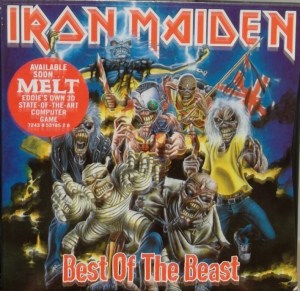
The cover art was once again by Derek Riggs, doing a sort of mash-up of his (and nobody else’s) Eddie’s.  It’s a suitably glorious piece of art for such a monument of metal.  The inside of the book is loaded with concert dates, lyrics, liner notes, and chart positions, as well as more Eddie’s and photos!

I still want to talk about the single, “Virus”, but I think that it should get an article of its own.  Check back soon for that!

Curiosity: the cover features an ad for the never-to-be Iron Maiden video game, Melt!  Maiden did eventually release a video game, but we’re not going there yet….

For the 2 CD edition of Best of the Beast:

4/5 stars

REVIEW: Cozy Powell – Over The Top (1979 Polydor)

Next in line of my reviews from Record Store Excursion 2012!  Check out the video below if you missed it.  This one bought at Sonic Boom Kensington.

MIKE AND AARON GO TO TORONTO

Let’s boogie!

The lineup is impressive enough:  Joining Cozy are Don Airey on keyboards/moog and Jack Bruce on bass.  Guitarists include Gary Moore, Bernie Marsden and Clem Clempson.   So, that’s all good.

But Over The Top starts with the disco-sounding “Theme I” (written by George Martin of all people).  There’s too much of Don’s dated sounding synth.  That continues into the next track, “Killer” featuring Gary Moore.  Don’s ray-gun keyboard are too much, although Gary is brilliant, and a highlight to the track.

Cozy expertly steps his way through every track,  sounding like nobody but Cozy.  But these cheesey keyboard anthems don’t lend themselves well to his style.  Too much disco, too much funk, too much boogie and not enough rock.  Jack Bruce is great, of course, very few can do what he does.  His bass here is articulate and precise but for me, too much jazz fusion and not enough anchor!

Most of this is progressive-based rock, but the dated synth echoes too many things that nobody really liked anymore.  The songs are not especially stiking, and Cozy doesn’t really go nuts until the final song, “Over The Top”.  The producer behind this mess?  None other than Martin Birch!

Best Song:  “El Sid” which has some groove and stomp to it, the keys are toned down while Jack plays some beautifully stretchy basslines, and Bernie Marsden throws in one of those bluesy solos that you know and love from early Whitesnake.  (Bernie wrote this one.)  Second best is “Sweet Poison” which has moments that smoke.

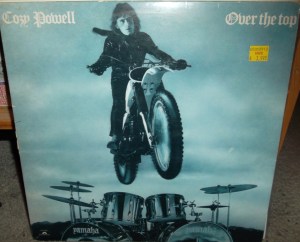
I dig the cover art with Cozy jumping his drums with his bike!  Sweet.

2/5 stars.  I think it likely that if Cozy were with us, hey’d probably regret the keyboard-saturated sound today.

TRACK LIST:

Side One – “Theme I”, “Killer”, “Heidi Goes To Town”, “El Sid”

Side Two – “Sweet Poison”, “The Loner”, “Over The Top”

REVIEW: Iron Maiden – A Real Live One (1993, plus single)

Part 16 of my series of Iron Maiden reviews!  NOTE:  This album was later reissued as part of A Real Live Dead One.

IRON MAIDEN – A Real Live One (1993)

And then the bombshell hit.  Just as Iron Maiden were releasing their next live album, Bruce Dickinson was leaving the band.

It was another in a string of major metal singer departures:  Vince Neil and Rob Halford in 1992, and now Bruce Dickinson.  Not to mention Dio splitting with Sabbath, again.  It was a very demoralizing time to be a metal fan.

Tattooed Millionaire was a big enough success to warrant a sequel.  On the advice of Maiden manager Rod Smallwood, Bruce was encouraged not to just do a half-assed sequel, but to really throw himself into the creative process.  What he came up with was very different and intriguing; Bruce likened it to early Peter Gabriel.  This triggered some soul searching.  What if this direction was to pursued?  What then?

Bruce approached Smallwood.  “As you can see, the music is very different, that’s the good news,” he started.  “The bad news is I’ve decided to leave the band.”

As a compromise, Bruce agreed to do the next tour, promoting the live album A Real Live OneA Real Live One was a document of the Fear of the Dark tour, and after it was mixed the band planned to hit the road again for a second leg.  Bruce did not want to jeopardize the tour, and Steve Harris agreed to do it as a farewell.  This was a decision that all parties would regret, but more on that later.  In the meantime, Maiden had a live album to promote, with a distinct black cloud over it.

Maiden had chosen to do two live albums.  First came A Real Live One, which covered music from 1986-1992.  Then, post-tour, A Real Dead One covering the early years was scheduled.  Splitting the live album into two may have proven to be a mistake, as it meant A Real Live One was lopsided and full of songs that many in North America did not care about:  “Heaven Can Wait”, “From Here To Eternity”, “Bring Your Daughter”, but nothing of the beloved earlier period previously covered on Live After Death.

And how do you top an album like Live After Death?  You can’t, so A Real Live One was doomed to be deemed inferior from the start.

Making matters worse, not only were Maiden releasing a live album that summer, but so did Kiss, Ozzy, and Van Halen.

The production seemed a little muddier (the first without Martin Birch since the early days).  The performances were fine, as expected, Maiden are nothing but professionals.  I don’t listen to this album often.  Later live albums that cover this material are superior, and it would have helped if the album had pre-1986 classics on it.  Although A Real Live One had four albums to draw upon, that period of Maiden is not the golden era, and the albums are undeniably less classic than the pre-’86 period.

I can understand their reasoning of doing the release like this.  I’m sure they felt that a live album without overlap with Live After Death was better value for the money.  And if you wanted those songs, you could get A Real Dead One later on.  But still, a Maiden live set without “The Trooper” or “Hallowed” or “Number” was a lopsided Beast indeed.

Worthy:  “Fear of the Dark”, “Afraid to Shoot Strangers”, “The Evil That Men Do”, “The Clairvoyant”.

Ugh:  a flat “Can I Play With Madness” & “From Here To Eternity”.

Missing:  “Wasted Years”.  That would have been a worthy addition to the set.

Derek Riggs returned to do the cover art for this and it’s a fun striking painting.  Nothing special, just another cool Eddie.

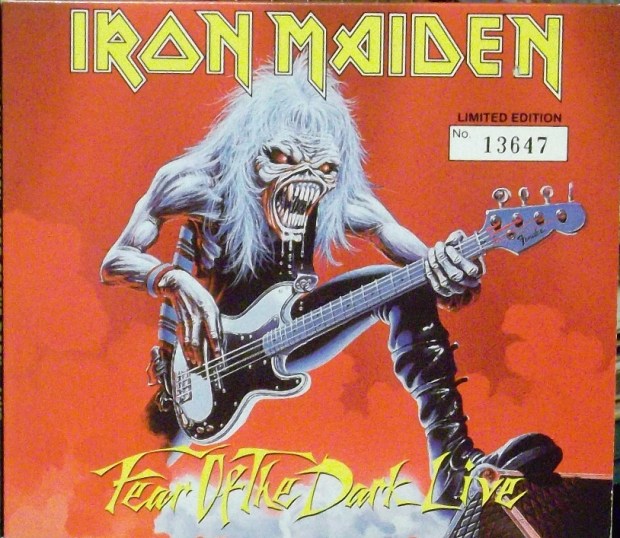
The single was the awesome “Fear Of The Dark”, live (which had a better cover than the album).  This had become a concert classic already, with a massive fan singalong.  The B-side was “Hooks In You” from the No Prayer album and tour.  I’ve never been a fan of this song, but I have no problem with Maiden issuing live B-sides of songs that are rarely aired live.  It’s good for documenting history.  It’s also available on the Fear of the Dark bonus disc edition.

2.5/5 stars

1. Be Quick Or Be Dead
2. From Here To Eternity
3. Can I Play With Madness
4. Wasting Love
5. Tailgunner
6. The Evil That Men Do
7. Afraid To Shoot Strangers
8. Bring Your Daughter…To The Slaughter
9. Heaven Can Wait
10. The Clairvoyant
11. Fear Of The Dark

REVIEW: Iron Maiden – Fear of the Dark (1992, 1996 bonus disc)

Part 15 of my series of Iron Maiden reviews!

IRON MAIDEN – Fear of the Dark (1992, 1996 bonus disc)

I remember staying up late one night, listening to Q107, waiting to hear the new Maiden track.  They promised it, and after airing “Burn” by Deep Purple, they debuted “Be Quick Or Be Dead”.

Nice riff, I said.  The song took a while to grow on me, because Bruce was still growling a bit too much for my taste.  If there was one thing I disliked about Maiden’s previous, No Prayer for the Dying, it was Bruce’s growl.  I’d rather hear him sing.  He was growling the verses, and singing the choruses.  And Nicko was doing some serious steppin’!  It was the Maiden writing debut of Janick Gers (with Bruce), and it was a rant on big business.  Maiden were the 99% in 1992!  I thought it was one of the best songs from the new album, Fear of the Dark.

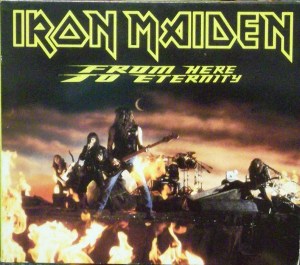
The second track, “From Here To Eternity” featured the return of Charlotte!  Harris wrote this one alone, and it too was a single.  It has a shout-along chorus, but too much rinky-dink bass way up high in the mix.  This song wouldn’t make my road tape, I never particularly cared for it.

Much, much better is “Afraid To Shoot Strangers”.  Steve wrote this one for the men and women who served in the Gulf War, who as Bruce said, “never wanted to kill anybody.”  I consider this song to be the birth of the “new” Iron Maiden.  The gentle guitar, with the melodic bass in the background, the keys…is it a ballad or an epic?  It’s both.   Then it picks up with some of the catchiest guitar parts Steve’s ever written.  There would be many many Maiden songs that followed this blueprint on albums to come, especially The X Factor.  (My friend Andy and I beat this song by a year.  In 1991 we wrote a Maiden-inspired tune called “Unleashed in the Middle East” about the Gulf War.  Fortunately, it remains unrecorded to this day.)

Did you also noticed Maiden getting more topical?  Big business…the Gulf War…it was the 90’s.

The Zeppish “Fear Is the Key” is next.  Bruce and Janick wrote this one, but again, I’m not too fond of it.  It has a great hook, and it’s technically accomplished, but Maiden and Zep don’t always mix.  I don’t think they ever played it live.  Do I hear a slide?

“Childhood’s End”, written by Steve, doesn’t seem to have anything to do with the Arthur C. Clarke novel.  It is rhythmically complex and melodic and powerful with a soaring guitar melody.  I don’t consider this one of Maiden’s greater songs in the canon, but it is one of the better songs on Fear of the Dark.

The triumphant ballad, “Wasting Love” closes side 1.  This one may have thrown people for a loop, both by the title and the music.  Maiden, singing about love?  More Scorpions sounding than Maiden, this one came from Bruce and Janick.

Maybe one day, I’ll be an honest man

Up til now I’m doing the best I can

Long roads, long days

of sunrise to sunset, sunrise to sunset

The song seems to be a reflection on infidelity on the road, but was there more between the lines?  “Maybe one day I’ll be an honest man…”

Yes, it’s a ballad, but it is not wimpy.  The guitar harmonies evoke mellow Thin Lizzy.  I think “Wasting Love” is among the three best songs on Fear of the Dark.  “Afraid to Shoot Strangers is another one, and we’ll get to the third in due time.

Side 2 opened with Steve’s “The Fugitive”.  It takes a long time to build.  It’s OK, nothing special.  Again, I doubt it was ever played live.  I don’t know if The Fugitive really needed to be made into a song, but Steve beat the movie adaptation by a year!

Bruce and Davey’s “Chains of Misery” follows.  I think it’s another OK song, again nothing special and again I doubt it was ever played live.  Nice shout-along chorus.

Another Zeppish song is next:  “The Apparition”.  Steve wrote this one with Janick.  See above comments:  OK song, never played live.  The lyrics start with promise, a ghost story perhaps, but then it turns into a series of pieces of advice from the apparition to the living.  Stuff like “You can make your own luck,” etc.  And Bruce is doing that annoying growl vocal!

Thankfully, “Judas Be My Guide” gets us out of this slump!  Ironically I always found this one to sound kind of Priest-like!  I like this tune.  Bruce wrote it with Davey, and to me this is the kind of song that Adrian Smith used to bring to the table.  Melodic, powerful, anthemic, sing-along metal.  I don’t think it was ever played live, but to me this one would have been single material.  I would have picked it over “From Here To Eternity”.

The mellow “Weekend Warrior” is one of the oddest on the album.  Bruce does his growl vocal (again!) but the song goes from acoustic section to electric section to acoustic again, and it’s quite unlike most Maiden songs.  The lyrics seem to be about football hooliganism.  I’m not sure if this was a topic that Iron Maiden needed to delve into, but there it is.

Finally, we have the Steve epic you have been waiting for:  “Fear of the Dark”.  It’s a little simple and repetitive compared to past epics, but it’s solid and has remained in the live set tour after tour after tour.  It is a fan favourite worldwide, and I think it’s great.  Although it’s simpler musically, I think in a lot of ways it’s one of Steve’s best epics.  It’s absolutely perfect live, it begs to be sung along with, and it goes from peak to valley so well!  I like big gothic opening riff.  The mellow sections, again, would serve as a blueprint for the next era of Iron Maiden.  Steve’s melodic bass, backed by quiet keys…

And that’s the album, a fat 12 songs, and although many are in the 3 minute range, there are several over 5 minutes this time.  It was a generous slice of studio music from Maiden, never before had they crammed so many songs onto a record.   It was also released on DAT, cassette, and CD.  The vinyl was a double, and very hard to find.  Vinyl was an import here in Canada:  Capitol stopped pressing vinyl here in early 1990.

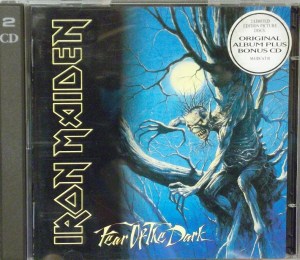
As I mentioned, there are moments here that musically look into Maiden’s future.  But changes were already afoot, and in a real way, Fear of the Dark is the first album of the new Maiden.   For the first time ever, Derek Riggs’ artwork was absent.  Maiden instead chose a painting by Melvyn Grant.  Gone were the Riggs trademarks, and a lot of fans reacted negatively to the new art.  Eddie looked more Nosferatu than Eddie, and the idea of Eddie being reborn from a tree was…weird?

This was also to be Martin Birch’s final production effort.  He retired after Fear of the Dark.  Happy retirement, Martin!  What can you possibly say bad about the man who produced Machine Head?  Nothing.  I will say though that this album, recorded digitally for the first time, sounds very thin.  I think it was immediately noticeable and this was rectified on future albums.

My 1996 reissue has a bonus disc chock full of B-sides.

“Be Quick Or Be Dead” came with the piano-infused joke boogie tune, “Nodding Donkey Blues”, an ode to plus-sized ladies.  It’s actually really great fun.  “Ahh, there should be some kind of guitar solo here!” says Bruce before the piano kicks in.

Also from the same single is Montrose’s “Space Station #5” – Sammy Hagar’s first and only writing credit on an Iron Maiden disc!  Maiden of course kick this song in the nuts.  What an awesome riff.  But wait — don’t turn it off.  The hidden track “Bayswater Ain’t A Bad Place To Be” is yet another hilarious roast of manager Rod Smallwood!

Second single, “From Here To Eternity” was an oddity of sorts, one of the few Maiden singles to not feature Eddie on the cover.  It’s B-sides included a Chuck Berry cover/ode to roadie Vic Vella called “Roll Over Vic Vella”.  There were also two live tracks from the previous tour:  “Public Enema Number One”, and “No Prayer For the Dying”.  Nice to have live versions of these songs, as I doubt they were played again after that tour.

“From Here To Eternity” also supposedly featured a remixed A-side — a “Triumph Mix”.  (The name “Triumph Mix” is only printed on the disc itself and not the back cover.)  I can’t tell the difference, so don’t get excited.  I also haven’t attempted to do a detailed comparison, so if you know more than I do, please comment.

The third and final single was “Wasting Love” which unfortunately had a terribly boring music video.  It’s just too 90’s!  It had three more live tracks, all from the previous tour:  “Tailgunner”, “Holy Smoke”, and “The Assassin”.  Same comment as above:  Nice to have live versions.  But note, none of these songs are on the 1996 reissue with bonus disc!  Not one!  And this is one of the rarest of Maiden singles.  Took me a while to find a copy at a decent price.

There was one bonus included on the 2 CD edition of Fear of the Dark, in lieu of the above:  “Hooks In You”, also live from the previous tour.  Probably my most hated of all Maiden tunes.  It’s actually from a later single, and I’ll get to that when I get to that album.

This was the last of the ten Iron Maiden 2 CD reissues from 1996.

So there you have it:  Fear of the Dark.  It’s superior to No Prayer, I believe.  Both the good songs and the filler are superior.  It pointed the way to some interesting new directions, mixing light and shade, and it proved that Janick Gers was an able songwriter in Iron Maiden.  He had also begun to gel with Dave Murray as guitar player.  Yet the album also had much filler, it would have been stronger at a traditional 9 or 10 tracks.   I still have a fond place in my heart for Fear of the Dark, for it was one of many albums that helped me get through the 90’s.

But if you thought the last couple Maiden albums were controversial among fans, you ain’t seen nothin’ yet.

3.75/5 stars

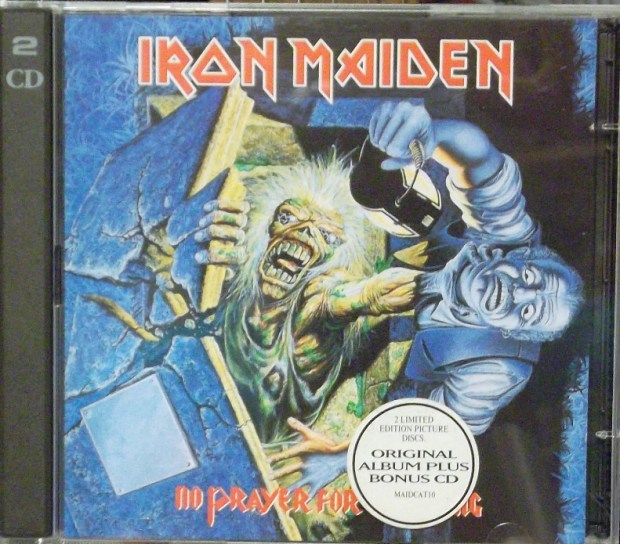
REVIEW: Iron Maiden – No Prayer For the Dying (1990, 1996 bonus disc)

Part 13 of my series of Iron Maiden reviews!

IRON MAIDEN – No Prayer For the Dying (1990, 1996 bonus disc)

Regrouping after a six-month break, Maiden returned to writing mode a changed Beast.

The Seventh Son of a Seventh Son album was artistically rewarding but the band were eager to return to their stripped down heavy metal roots and make a live-sounding album more like Killers or The Number of the Beast, without the production values and ten minute songs that were becoming the norm.

Both Adrian Smith and Bruce Dickinson were coming off solo albums (A.S.a.P.’s Silver and Gold featuring Zak Starkey (Oasis, The Who), and Bruce’s Tattooed Millionaire).  Bruce’s was successful commercially and critically, Adrian’s less so.   Still, it came as a complete shock to the fans when it was announced that Adrian Smith had left Iron Maiden.

Or, perhaps, been nudged out.  Steve Harris was worried that Adrian was becoming unhappy, and it was especially obvious during the writing sessions for the next album.  While Steve, Dave and Bruce were contributing heavy songs, the usually prolific Adrian had nothing but a song called “Hooks In You” that he had written with Bruce.  He was clearly unhappy that Maiden were not progressing down the road pointed to by Seventh Son, and were going heavier.  Steve took him aside.

When asked how into it he was, the answer came “about 80%”.  Steve has always had a simple policy for membership in his band — you had to be into it 110%, or it wouldn’t work.  The fans wouldn’t buy it, and Steve couldn’t look them in the eye knowing somebody on stage wasn’t completely into it.  Adrian was out.

The band already knew Janick Gers, and he and Bruce had developed a successful writing partnership on his Tattooed Millionaire solo disc.  Janick was nevertheless shocked when Bruce phoned him up and asked him to learn some Iron Maiden numbers.  Janick initially said no, because he assumed Bruce was talking about his solo project, and they had already agreed to do no Maiden numbers.  When Bruce explained it wasn’t for the solo band, it was for Maiden, Janick was horrified.

Janick Gers was really the only guy I can think of that was right for Maiden, also being from the era of the NWOBHM bands (White Spirit).  He’d also been in Gillan (the incredible Magic album) and worked with Fish.  The songs for the album were already written, all Janick had to do was head over to Steve’s farm, where they were recording the album, and learn the songs.

But that’s all just background, just context.  That’s all important, especially to this album, but what is also important is the bottom line.  And the bottom line is that this is the first time Maiden turned in something that was almost universally received as a disappointment.

While some fans were clamoring for a return to basic heavy metal songs, short and bangin’ and to the point, others preferred the epic scale of Seventh Son.  And it was clear that you can’t just replace Adrian Smith.  The songs on the new album, titled No Prayer For the Dying, seemed less finished and not quite up to standard.  Not to mention Janick and Dave hadn’t had time to properly gel together, and never quite sync up on this album the way Dave did with Adrian.

The opening song “Tailgunner” is good enough though, not quite an “Aces High” but certainly adequate.  Being tailgunner might have been the worst job on the Lancaster bomber, since it didn’t have a belly gunner! (Neither did Enola Gay, tailgunner was certainly the worst job on a B-29)!  But Steve and Bruce failed to really nail it lyrically, with lines such as “nail that Fokker, kill that son, gunna blow your guts out with my gun” not living up to past Maiden historic glories.

Steve and Bruce also wrote “Holy Smoke”, the first single.  This reckless fast number showcased a manic Janick Gers solo, demonstrating how different he was from Adrian.  Where Adrian used to compose solos with beginnings, middles and endings, Janick just went for it!  Dave was also somewhere between the two approaches.  Now, without Adrian’s melodic touch, the band were moving sharply to a more live and spontaneous guitar style.

“Holy Smoke” is about TV preachers, and while they always make a good target in heavy metal songs (I prefer Ozzy’s “Miracle Man”) this one also fails to excite.  As a song it doesn’t have much in terms of melody.  On No Prayer, Bruce is shouting as often as he’s singing, and with the songs’ new emphasis on raw power, there’s less memorable melody to go around.  Janick’s manic gonzo solo does fit the vibe of the song!

The title track is third, a number that tries to be an epic in under 5 minutes.  It does indeed have all of the trademark qualities of a Maiden epic except the length:  Multiple parts, multiple tempos, soul-searching Steve lyrics, and ample anthemic guitar melody.  Yet the song fails to nail it home like, say, “Hallowed Be Thy Name” did.

Better is the badly titled “Public Enema Number One”.  This Dickinson/Murray rocker is riffy, straightforward with some decent melodic bits.  But again Bruce is hoarsely shouting the verses, and the song careens from section to section that don’t feel like they quite all fit together probably.  Like other songs on No Prayer, the song sounds slightly unfinished.

And better again is “Fates Warning”, this time written by Steve and Dave.  The opening soft guitar part is a nice change of pace, and a great example of Dave Murray’s tremendous feel.  Perhaps in a past life he was a bluesman.  Nicko then kicks the song into gear while Steve’s lyrics question the seemingly random nature of life and death.  In the middle, is an old-school dual Maiden guitar lead, before Dave nails another perfect one of his own.

Side two begins with the stuttery “The Assassin”.  Written solo by Steve, it is rhythmically complex as it is propelled forward.  It has a fairly decent chorus but it doesn’t quite resolve itself nicely.  Some of the guitar and bass melodies are reminiscent of “To Tame A Land” from Piece of Mind.

This is followed by the superior “Run Silent Run Deep”  Submarine warfare is a good topic for a Maiden song, and the song chugs forward like those big diesel engines.  This is one of the better songs on No Prayer.  Steve and Bruce wrote it together, and Nicko’s precise drum fills accent the song perfectly.

Next is the worst song on the album:  Bruce and Adrian’s “Hooks In You”.  Lyrically this is one of the worst things ever on a Maiden album. Judging by the opening line, “Got the keys to view at number 22,” it sounds like Charlotte is back to her old tricks.  Unfortunately, the band subjected people to this song live.  I’ll admit it’s got a great little riff, but Bruce’s shout-growl vocals, lack of melody, and lack of any lyrical intelligence just sinks this one.

And then the baffling #1 single, “Bring Your Daughter…to the Slaughter”.  This Bruce song is actually an outtake from his solo project.  He recorded and released the original version with Janick Gers on the soundtrack to A Nightmare on Elm Street 5.  I seem to remember that soundtrack being panned as “the worst soundtrack of all time” at one point.  Steve heard the song, went nuts, and said, “Don’t put it on your solo album:  I want to save this one for Maiden.”

Somehow, Steve was right, as it went straight to #1 in the UK, the first and only time this has happened to Iron Maiden.  I don’t get it.  I don’t get what people like about this song.

“Mother Russia” ends the album on a sour note.  Lyrically simple, musically pretty good, “Mother Russia” is certainly not up to the standards of past Maiden album closers.  Although it tries to be an epic along the lines of “Seventh Son of a Seventh Son” (featuring a similar keyboard section in the middle), it’s just not as great as past epics.  At five and a half minutes, “Mother Russia” is the longest song on No Prayer.  It is made up of excellent components; I like the melody and the solos big time, but it’s just…not comparable in quality.

Nicko McBrain said on MuchMusic that No Prayer was “the best Iron Maiden yet.”  Steve said that the album’s biggest problem is that it didn’t sound live enough without an audience track.  I disagree with both.  I think the album has an abnormally high quantity of unfinished songs and filler.

Even the cover art was substandard.  To go with the live, stripped down sound, Riggs too stripped his artwork of the symbolism and fantasy.  Instead, Eddie goes for the throat of a groundskeeper as he emerges (once again) from the grave.  All hints to continuity are gone, as Eddie’s lost his lobotomy scar, cybernetic implants, and that bolt that kept his skull on!  He even has his hair back.  I guess somebody wasn’t happy with the artwork, because it was heavily tweaked for the 1998 remaster, repainting much of it and removing the groundskeeper.

The B-sides to the first single, “Holy Smoke” were the excellent “All In Your Mind” (a cover from somebody called Stray) and Golden Earring’s “Kill Me Ce Soir”.  Both songs are pretty damn good.  I prefer both to some of the album tracks!

“Bring Your Daughter” had two of its own B-sides:  “Communication Breakdown” and “I’m A Mover”.  Maiden tackle Led Zeppelin and Free less successfully than they did they other two B-sides.  “I’m A Mover” ain’t bad as it allows Maiden to get into a groove they normally wouldn’t, and Bruce seems to have fun with the vocal.

3.5/5 stars