JUDAS PRIEST – Priest…Live! (1987, 2001 Sony 2 CD remastered edition)
I have a long history with Priest…Live! My cassette was originally bought at Stedman’s in Kincardine Ontario, July 1987. An LP copy was sold to me by a co-worker named Chris from his own collection about a decade later. Finally I bought a 2 CD remaster which is the last version I hope I’ll need.
Priest…Live!was my first Priest live album. I got the albums out of order: Defenders, Screaming, Turbo, Priest Live. Then, after discovering the pre-Screaming songs for the first time, I slowly began expanding backwards: Point of Entry, British Steel, Unleashed, Rocka Rolla, Sad Wings…
Because of this album’s crucial role of introducing me to “old Priest”, I have a really hard time being critical about it. I will say this: This version of “Metal Gods” with the really melodic chorus is awesome. It’s my favourite version of this song, by a fair bit. I don’t know if that was live or overdubs or backing tapes or whatever. It sounds really cool.
Regardless of how I feel about “Metal Gods”, I can tell you that Priest Live covers pretty most all of the critical post-Unleashed numbers from 1980 (British Steel) to 1986 (Turbo). You get all the tracks you’d expect from the 1980’s: “Freewheel Burning”, “Turbo Lover”, “You’ve Got Another Thing Comin'”, “Living After Midnight”, “Heading Out To The Highway”. Clearly the concept here is to have no songs that overlap with the band’s previous live album, Unleashed in the East, a tactic used by other bands such as Kiss, on records like Kiss Alive II. While being fair to the fans economically speaking, as a live concert experience that means you’re missing out on “Green Manalishi”.
Luckily this remaster is now expanded to two CDs, and decked out with three bonus tracks including the crucial “Hell Bent For Leather”, but this remains the only holdover from the pre-1980 period. While the home video/DVD version of Priest Live contains “Green Manalishi”, that video was taken from just one show (Dallas, Texas) while the CD has songs from an Atlanta concert as well. Essentially the CD and DVD versions are two different things. In addition to “Green Manalishi”, the DVD also has “Locked In” and “Desert Plains”. Live versions of these songs do exist on Priest remasters, but they are different versions, not the Dallas recordings.
Live in Dallas, but not the version on the album.
I enjoy the running order. To begin the concert with the mellow and dramatic “Out In the Cold” was a really cool, daring move. It sets the stage for a dramatic concert. From there it’s pedal to the metal: “Heading Out to the Highway”, “Metal Gods”, “Breaking the Law”…
I know from an old Guitar World interview that KK and Glenn felt the album could have been mixed better, that too much time was spent “fixing it” in the mix. Sure enough the crowd noise sounds artificially enhanced and there are backing vocals that I am certain are not live. Otherwise, the record sounds pretty good! But that could just be the nostalgia talking. The guitars could have had more teeth; it was the 80’s though. Dave Holland’s snare sound is in the annoyingly high range, but these are not major concerns. Halford’s interaction with the crowd is more friendly than usual, which is nice especially after viewing something like the Rising in the East DVD. He does do a couple annoying sing-alongs, with the crowd…I’m sure it was fun to be there, they’re not fun to listen to on headphones.
One more nostalgic point: I remember buying this back in that summer of the 1987 and thinking, “Why did Priest change their logo?” I loved the old logo. I never really thought this was a good album cover. Very plain, which seemed to be the fashion in the late 80’s, a decade that Priest Live embraces without shame.
Welcome to PRIEST WEEK! It’s all Judas Priest, all week. Let’s go!
JUDAS PRIEST – Rocka Rolla (1974 Gull Records)
Years before the glory of Sad Wings of Destiny, Judas Priest was just another Birmingham bar band playing their version of the blues. Original lead singer and founder Al Atkins wrote a lot of the early material, with a variety of lineups. Atkins quit the band in the early 1970’s and “Bob” Halford was brought in, along with second guitarist Glen Tipton. Judas Priest as we know it was born.
I remember the next door neighbor George played me the song “Rocka Rolla” and I immediately loved it. It had a cool riff and a hypnotic chorus. Years later (1989) I walked into Sam the Record Man and bought my LP copy off the near-legendary Al King. Finding a copy on cassette was nigh on impossible so I bought an LP. Little did I realize that was a good move. I can still play the LP and it sounds great, whereas a cassette would be in a Thunder Bay landfill by now.
Unfortunately Rocka Rolla disappointed me. I didn’t like it when I got it in ’89 and I still find it kinda dull. The band wrote a lot of songs with Al Atkins, largely blues-based rock, and that’s what Rocka Rolla is: Leftovers from the Atkins era, slow blues jammers meandering along at a leisurely pace. There is precious little heavy metal here. “Run of the Mill” and the “Winter” suite, for example, run the gamut from hippy-dippy flower power love to amateur British bar blues. Yet, Jethro Tull these guys were not, and Rocka Rolla is strictly second rate. The drummer on Rocka Rolla was John Hinch, a musician that Tipton described as “inadequate” to play Priest’s more challenging material. Maybe that is one reason that Rocka Rolla lacks power.
There are a couple decent moments that keep this album from being a 1-star stinker. The title track is a fun proto-metal number, with a neat classic sounding riff. There is also the outro to “Dying to Meet You”, known as the “Hero, Hero” section which actually has some spark. “Never Satisfied” has some powerful moments. “One For the Road” is a good song. The rest is basically a band trying to find its direction, not sure whether it’s a jam band, a blues band, or a rock band, and excelling at none of those sounds.
There’s a bonus track on some CD versions, tacked-on but unrelated. This is the version of “Diamonds & Rust” from the Best Of album. Great song and great version, sounding totally out of place here. Also of note, there are two album covers. I prefer the soda bottle cap much more than that weird football player bomber guy.
Two years later, Judas Priest laid down one of my all-time favourite metal classics Sad Wings of Destiny. How they turned the ship around so drastically is beyond me. New songs, new chemistry? Let’s be grateful they did turn it around, for if this band failed to do so you never would have heard of them.
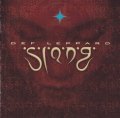
This is the second time I’ve reviewed a version of Def Leppard’s ill-fated Slang CD. As Joe Elliot says in the booklet inside, the band were considering calling it Commercial Suicide, such were the changes in sound. The mid 90’s was not a kind time for rock bands of Def Leppard’s ilk. Everybody had to adjust, and Leppard chose to do so by making their sound darker and more organic. That was fine with me. I’ve already reviewed Slang; a 4/5 star album in my books. For your convenience I’ll talk about the original Slang album at the end of this review. For now I just want to talk about the “Deluxe Edition” and the bonus tracks.
Like many Def Leppard albums before it, Slang produced a number of excellent B-sides. Some are on this CD. Some are only available on the iTunes version. I have all the singles anyway, but iTunes also have two exclusive unreleased tracks of their own. (You can buy these songs separately; you don’t have to buy all of Slang again to get them.) These two songs are early demos of “All I Want Is Everything” and “Move With Me Slowly,” the latter with Phil singing. While “Move With Me Slowly” is similar to its incarnation on CD 1, “All I Want Is Everything” is drastically different. It’s a much more standard “power ballad” at this stage, little resembling the song it would become. This take is not to be confused with the “first draft” of “All I Want Is Everything” on CD 2, which sounds a lot more like the album counterpart.
That’s one issue with the Deluxe Edition of Slang. There is a lot of repeat. Songs you will hear three times in one version or another include “All I Want Is Everything”, “Gift Of Flesh” (previously known as “Black Train”) and “Deliver Me” (previously known as “Anger”). Especially when you include all the different bonus tracks, the Deluxe can be a hard slog to listen to in entirety. I had to split it up over two nights.
But it is worth it. Although some demos barely differ from the album counterparts, some have different lead vocals by Phil or Vivian. There are some unreleased songs that I have never heard before. “All On Your Touch” is a nice ballad that was only finished in 2012. Then there’s Vivian’s funky-Zeppelin song “Move On Up” which is quite adventurous. Some of the demo versions, such as “Raise Your Love” (an early version of “Slang”) differ quite a bit from the album versions. Although listening to the Slang Deluxe is a long journey, it’s also a very interesting one in terms of hearing how Def Leppard wrote and recorded it.
Almost all the B-sides for Slang were included on one version or another, except for live B-sides. Songs included are the old-school sounding “When Saturday Comes,” and the instrumental “Jimmy’s Theme” which are only on the iTunes version. (See below for complete track listing including all iTunes bonus tracks.) “Move With Me Slowly” is a bluesy, ballady number that could have been a single in its own right. Ditto “Can’t Keep Away From the Flame” which could have been an acoustic single. “Burn Out” and “Worlds Collide” are also B-sides, but these two were not released until 1999 on the singles for “Goodbye”. Both are heavy, heavy rockers.
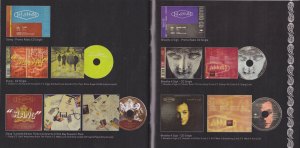
Let’s talk about the packaging. I’ve heard a lot of surprise and complaints when this CD arrived inside a big fat “double” CD case. That is kind of a surprise; you don’t even see these with 3 CD sets anymore let alone a double. The booklet inside is nothing to write home about. There are some words from Joe and lots of live photos, but nothing in the way of specific liner notes. If you’re wondering where these songs were recorded or released before, info inside is vague. There are track listings for all the Slang singles, but that only covers part of it.
As our friend the Heavy Metal OverloRd says, this probably doesn’t deserve the title “Deluxe Edition”. In fact, I asked HMO if he’d like to weigh in on this, since he has some strong opinions about it. For fun I asked him to comment in Scottish slang:
Def Leppard ur a bunch a fannybaws by the way. They hink the new edition of Slang is a “deluxe edition”. But it isnae. This widnae even huv been deluxe in 1995, never mind noo.
When it turned up I wis pure gutted. I thought the booklet had better be snazzy but it wisnae either. Just a wee hing where Joe tried tae mind stuff fae back in the day. Nae liner notes. Nae lyrics. Nuhin. Just some shite photies. My old copy had two discs, a slimmer case and lyrics. And some photies an aw! Gid wans. One of them oan a bus like they were aw goin doon the toon or somethin. How wis that no deluxe but this is deluxe? If they’d called it a “2CD Edition” that wid huv been awrite but they didnae. This is “deluxe”… cept it isnae. I don’t have a Scooby whit they’re playin at. Eejits.
Well said. Lastly, I want to leave you with a look at the actual original album, Slang. Here’s all the pertinent text from my previous review in case you’re too lazy to click the link. It’s a great album and I’m glad it’s getting a second look today.
DEF LEPPARD – Slang(1996)
“Truth?” is a thunderous opener, laden with modern sounding samples and rhythms. Even better is the hypnotic “Turn to Dust”. Although it moves slow, it has loads of exotic atmosphere and instrumentation. Neither of these songs sound like old Def Leppard. There are major changes, including acoustic drums, darker tones and a noticeable lack of shout-along gang vocals.
It’s still the same spirit though. There’s an obsessive attention to detail, layers of backing vocals, and tasty choruses. It’s just 1996’s version of those things. Listen to the title track, “Slang”, for example. It doesn’t sound like anything Leppard have done before, but you can see it as “Sugar” a decade later if you like.
“All I Want Is Everything” is another personal favourite, a great ballad but again unlike what Def Leppard has done before. It has a certain power to it, without being loud and obnoxious. It has a plaintive quality and a fantastic chorus.
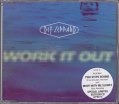
Next is “Work It Out” , a contribution from “new kid” Vivian Campbell. It is absolutely loaded with cool guitar squeeks and squonks, no wankery, but a new kind of guitar heroism. These little adornments are there in the mix waiting to be discovered, under suitably thick drones of rhythm guitars. I love this song, which really proved to me that Leppard had successfully adapted their sound to the mid-90’s. A shame it didn’t sell.
Phil’s “Breathe A Sigh” is one that threw a lot of people for a loop. Either Spin or Rolling Stone (I forget which) compared it to TLC. Indeed, loops make up a large part of the percussion parts, and the band seem to be trying R&B on for size. What keeps it Def Leppard are the layers of droney guitars in the back of the mix, and the immaculate vocal choirs.
Interestingly, Slang was stacked with four singles in a row, “Breathe A Sigh” being the final single. This does not mean the album is out of ammunition. “Deliver Me” brings back the heavy. Leppard In Chains? Def Temple Pilots? Not one of the best songs, “Deliver Me” at least balances some of the softer material. Better is “Gift of Flesh”, a driving riff rocker with some slammin’ drums from Rick Allen. Phil wrote this one. I bet it would have been smokin’ live if they ever played it.
This fades directly into a lush but quiet ballad called “Blood Runs Cold”. I could imagine some old-timey fans running away in fear that their nuts would shrivel, at the sound of this one. I love this song, but I’m not sure it needed to be followed by yet another ballad, “Where Does Love Go When It Dies”. Although not a single, “Where Does Love Go When It Dies” was recently dusted off by the band as part of their recent acoustic medley. It is more upbeat than the previous song, and has a folky campfire quality. It also gives the album a sense of flow: an upturn before the dramatic closer.
“Pearl of Euphoria” is that dramatic closer, which returns the listener to the dark, powerful tones that we began with. Leppard don’t often reflect a strong Led Zeppelin influence, but you can definitely hear some “Kashmir” here. Not only is Rick Allen laying down a Bonham-esque groove, but some of the guitar bits flying in and out of the speakers remind me of the sound collage section in “Whole Lotta Love”. It’s a great closing song.
4/5 stars
iTunes bonus tracks:
1. “Truth?” (Demo Version) – Previously on “Work It Out” CD single. 2. “Work It Out” (Demo Version) – B-Side from “Work It Out” with Viv singing and completely different from the other versions on the Deluxe. Viv referred to it as his “Crowded House” version. 3. “All I Want is Everything” (Demo Version) – Exclusive. 4. “Move With Me Slowly” (1st Draft) – Exclusive. 5. “When Saturday Comes” From the film When Saturday Comes and “All I Want Is Everything” single. 6. “Jimmy’s Theme” From the film When Saturday Comes and “All I Want Is Everything” single. 7. “Cause We Ended as Lovers” (Solo track by Phil) From the Jeff Beck tribute album Jeffology: A Guitar Chronicle and “All I Want Is Everything” single. 8. “Led Boots” (Solo track by Viv) From the Jeff Beck tribute album Jeffology: A Guitar Chronicle and “All I Want Is Everything” single.
We had just started repairing scratched CDs via a GTA-based third party contractor. They were able to remove a miniscule layer of plastic from the playing surface, rendering a smooth surface that would not deflect your CD player’s laser. The result was a playable, sellable CD, with a clouded appearance on the CD itself. The cloudy look was usually very minor, although it was sometimes enough to turn a customer off of buying the CD.
After repairing the scratched discs, they would be put in brand new CD cases and then on the shelves to sell. But we also had to mark each disc as “repaired” somehow, so that if any were returned as defective, we would know they had been fixed. We could then get the fee for fixing the disc credited back to us, or the contractor could try to fix it again and buff it deeper. Either way, we needed to mark them, somehow.
The best way to fix a surface scratched CD
We agreed that the least problematic way was to stamp the inner (usually blank and hidden) sleeve of the CD, the part underneath the plastic tray. We stamped it with our store logo. For most discs at the time, nobody would ever notice the stamp unless they pulled the case apart. The only problems were with discs that had inner picture sleeves under clear trays. We were forced to put the stamp directly on the artwork in those cases, a process that killed me every time. I hated defacing a CD. It’s not something I would ever do to my own property.
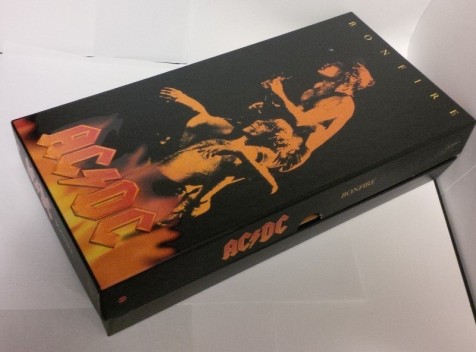
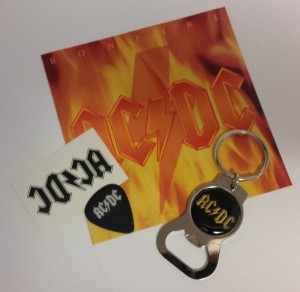
Around this time, AC/DC just released the luxurious Bonfire box set, a monolith of rock containing many separate additional treats: A pick, a bottle opener/keychain, a sticker, and a temporary tattoo. This was high on my priority list, so I put my name in our store’s computer reservation system for the first used copy that showed up.
It was only a few weeks before a used copy did show up. One of the higher-ups decided to work in my store that day. A man came to the counter with some CDs to sell, and the Bonfire box set. It was mint, complete, everything intact. However the higher-up didn’t consider the set as “mint” as I did; she determined that one of the CDs from the Let There Be Rock set was scratched. It had a tiny nearly invisible mark on it not even the size of a hair, but not a scratch. She dutifully stamped the inner tray and put the CD in the pile to be sent out and fixed.
I was disappointed that the tray had been defaced, but there was no way I was letting that disc get sent out and fixed. It would look worse, with the cloudy finish. I preferred the un-fixed finish with that tiny hairline mark that I could barely see. I can see the scratch even less today with my aged eyesight!
I bought the set but that stamp is still there. I covered it up with a white sticker, and was grateful that the box set didn’t have clear CD trays with artwork underneath.
That stamp still bugs me. I still see it there, and it still bugs me! How do you feel about things like this? Defects in the physical musical product that you love? I know I can’t be alone.
Postscript: Years later some damn rat kid stole the stamper. On my watch!!
For the uninitiated, get ready. You’ve never heard anything in your life like Mr. Bungle. Featuring the powerful pipes of Mike Patton, Bungle was his pre-Faith No More band which he admirably kept going through the 90’s before finally calling it a day. This album, produced by John Zorn and completely different than anything Bungle did after, is a challenging first listen for the musically timid. It is also acutely rewarding, and can only do good in expanding your musical vocabulary. If that ain’t your cup o’ tea, it also has lots of X-rated, adult only lyrics; words that will keep you laughing, disgusted or titillated all the way through. See: “Squeeze Me Macaroni” (sex with food) or “The Girls of Porn”.
Mr. Bungle squeezes multiple genres into single songs, often switching gears multiple times within a minute. Careening joyfully from breakneck-speed horn-laden funk, to death metal guitar with doo-wop vocals, to circus music and beyond, this is not for the meek. This is for the open minded. This is for the bored, those who can no longer handle the same damn songs on the radio all the time, the same keys, chords, time changes and instrumentation. And if you’re a Mike Patton fan already, but somehow missed this, prepare to have your mind blown.The production by John Zorn is perfect. How he managed to arrange all these instruments, samples, and voices together into coherent songs is nothing short of genius. The sound is gloriously crisp. This is Mr. Bungle’s magnum opus.
Highlights:
“Travolta” – Changed to “Quote Unquote” on later pressings for obvious legal reasons.
“Squeeze Me Macaroni” – “Hostess Ding Dong wrapped an eggroll around my wong / While Dolly Madison proceded to ping my pong”
“The Girls Of Porn” – “The urge is too much to take / All I can think about is playing with myself / It’s time to masturbate / I got my Hustler and I don’t need nothing else”
“My Ass Is On Fire” – A memorable shocker ending with Patton chanting “Redundant, redundant, reeeedundant, reDUNdant…”
“Stubb (A Dub)” – A song that questions, among other things, if a pet dog believes they will grow up into a human being.
Regardless of the contrasting styles and lightning fast changes, after a fashion the album flows, and cannot really be broken down into singles, or put on a mix CD. It needs to be listened to in its entirety, in sequence. And be careful, when turning up the volume during the quiet moments. You might want it louder to hear some bit of dialogue that’s mixed in too quietly. That’s just when they blast you with more guitar and horns!
If you don’t like this on first listen, don’t fret. You’ll love it by the 21st. Guaranteed*.
July 1990: A M.E.A.T. Magazine interview (issue #14) with Ronnie James Dio states that he was unhappy with Dream Evil, one of my favourite Dio albums. He felt the songwriting was unfinished, that the songs needed tightening up. Supposedly some of the changes he made were a response to that. If that’s indeed the case, then Lock of the Wolves came as a total shock. These songs feel even less finished than any Dio album before.
Dio had completely revamped his band. Craig Goldy (guitar) was the first one to leave. Apparently Vinnie Appice, Jimmy Bain and Claude Schnell didn’t care for Goldie, but they all ended up departing too. Ronnie was no longer happy with the writing process nor the dischord that had set into the making of Dream Evil. Because of these circumstances he was able to revamp the entire Dio lineup but not by choice.
Ronnie took on a young and international crew: Swedish Jens Johansson on keyboards (ex-Yngwie Malmsteen), new York kid Teddy Cook on bass, ex-AC/DC skin-pounder Simon Wright, and the young 17 year old Scot, Rowan Robertson as his new guitar wizard. Robertson won the role after a cattle-call resulted in 5000 tapes sent to Dio for his consideration. The end combination was a band of skilled players, but lacking in road-tested chemistry. Plus the pressure was certainly on Robertson, having guitarists like Vivian Campbell and Richie Blackmore writing the solos you were going to be playing.
About half the album was written when Bain and Appice were still in the band, and they appear on several writing credits. Robertson has a co-write on every song, and Jens Johansson has two, while new bassist Cook has one. Regardless of the numerous writers, the album is very singular in its direction. That is to say Lock Up the Wolves is a painfully sloooowww Dio album.
I was very disappointed that there are only a couple fast rockers to keep the blood pumping. The first track, “Wild One”, fools you into thinking this album will be a rocking good time full of tasty guitar hooks and wicked Dio lyrics. However, “Born On The Sun”, while boasting a great chorus melody, sags and droops. “Hey Angel” and “Between Two Hearts” are more of the same. I kept waiting for another fast song, or just something different to keep me awake. I had realized that Lock Up the Wolves is loaded with boring pseudo-bluesy riffs, slow to the point of coma-inducing.
The only slow tunes that really have spark of any kind are the monstrous title track (over 8 minutes of drama) and the ballady “My Eyes”. “My Eyes” is my personal favourite track on the album, and perhaps worth the price of purchase if you can find the album cheap. It’s also fun to play the game “How many of Dio’s other song titles are in the lyrics?” with this one. The CD-only bonus track “Why Are They Watching Me” is the only other serious fast rocker on the album, and I have no idea why it was the CD-only bonus track, because the album desperately needed a kick in the pants.
And that is Lock Up the Wolves in a nutshell. Approximately 50 minutes of slow, pseudo-bluesy guitar and dull rhythms. About 10 minutes of heavy metal. That’s it.
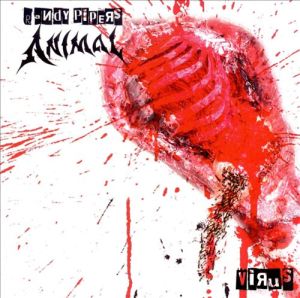
Randy Piper — not a household name, but astute (or old) metal fans will know the name from the first two W.A.S.P. albums. He had no writing credits on the W.A.S.P. albums, so I wondered what his band Animal would sound like. Chris Holmes, after all, has been known to drop a stinker album so why not Piper?
Whether by nature or design, Piper’s Animal at first sounds a hell of a lot like early W.A.S.P. on 2008’s Virus. I tend to think this is more by design, since producer/guitarist Chris Laney has writing credits all over the place too. Whatever the case may be, singer Rich Lewis evokes a young Blackie Lawless with his raw vocal stylings. The riffs tend to be very W.A.S.P.-like in spots. Then there are moments such as the dual guitar harmony outro on “Can’t Stop” that sounds nothing like W.A.S.P.
One song that sounds very little like W.A.S.P. is “Don’t Wanna Die”. Even though I can hear The Who at the beginning, and Blackie Lawless is heavily influenced by The Who, this sounds nothing like Blackie. Rich Lewis morphs his voice into something more individual with power to spare. His own voice starts to shine through on this pop rock number. But before the album is in danger of sliding into pop territory comes the song “Crying Eagle” which has more in common with Iron Maiden than W.A.S.P. Then, “Unnatural High” has the tinkling ivories of a Savatage song. Incidentally, that’s an awesome song.
The first song that I’m not really into is track 6, “Judgement Day”. Maybe it’s the “circus music” intro or the return to overly-W.A.S.P.-like songs, I find it a bit of a drop after the excellent “Unnatural High”. It does boast a solid chunky riff and some cooling rolling drums. “Who’s Next” is a bit of a low as well. It’s boasts some adventurous melodies but I’m just not feeling it.
Next up is the elephant in the room: “Zombie”. This is not a song about zombies, but in fact a Cranberries cover. The first time I heard it, I didn’t know it was coming, and I was sitting there thinking, “Cool sounding song, sounds familiar somehow.” Then a second later I realized what it was. So that initial impression remains with me. I see it as a really cool, dark metal song in this version. Maybe that’s the way it always should have been. If you can imagine W.A.S.P. meets “Zombie” (yes, such a thing can exist) then you might appreciate this song.
“Shoot To Kill” isn’t a standout song, but it does have a pretty good chorus. I don’t feel that the chorus fits the pounding riff, but the guitar solo is catchy and cool. The album ends with the very W.A.S.P.-ish title “L.U.S.T.”. This is a really cool song, with loads of melody and great vocals by Rich. It has a W.A.S.P. flavour to it, but with elements that Blackie never would have come up with.
I always like to give a little more info with my reviews, like background on the album or band, but I don’t have any. Jon from E-tainment News & Reviews knows a lot more about these guys, so I hope you don’t mind if I let him take it from here:
When this album finally came out, Randy had grown his ego huge and as he drinks like a fish he’s gotten paranoid, accusing Laney for taking all the profits for the 1st album, leaving him with nothing. Only there were no profits, Laney had actually borrowed money to make these albums and if it hadn’t been for the fact that Laney worked as a producer and engineer at Polar Studios alongside Lennart Östlund (who has worked with Stones, Zeppelin and ABBA), the album wouldn’t have sounded as good as it did.
This one was a gamble. It was not cheap to ship. All I had to go by was the non-descript B-side “Rocket” (Live). No indication of where or when. It could have been the live version previously released on the “Rocket” single back in ’88. Or more likely, it could be the live version later released on the Mirrorball CD. On that disc, recordings are noted as “Recorded at various points around the world, in the not so distant past.” Thanks for the specifics guys.
I don’t know what prompted me to hit the “buy” button given the uncertain B-side and price. Maybe it was instinct. Maybe it was that Mrs. LeBrain was out of the house. Either way, in a couple weeks I had this rare 12″ picture single in my hot little hands.
Unfortunately it’s not much to look at: a Def Leppard logo on a black background. On the other side…the track listing on a black background with a grey clover leaf! Somebody at Mercury Records had no concept of what a picture disc can be!
Anyway, music trumps packaging. I don’t care about the A-side. It’s a crap song, let’s be honest. It’s Def Leppard trying be T-Rex for the umpteenth time. I care about the B-side. Upon first listen it was immediately obvious that this is an otherwise unreleased live version of “Rocket” and a great one at that. Unlike the mere 4:29 version on Mirrorball, this one is the fully extended version that Def Leppard sometimes play.
This extended performance of “Rocket” features an excellent Vivian/Phil guitar duel. At one point, Viv is positively in “Holy Diver” territory. It’s brief but it’s there and it’s unmistakable. This series of solos demonstrates one of the things I love about the guitar players in Def Leppard: they can shred when they want to! Then, after a brief segue, Joe Elliot breaks out “Whole Lotta Love” just as he did on the ’88 live version.
For the B-side: 5/5 stars
For the A-side and picture disc: 2/5 stars
Average: 3.5/5 stars
Welcome back to the WEEK OF SINGLES 2! Each day this week we’re look at rare singles. Today, we’re looking at lots and lots of them! WARNING: Image heavy!
RECORD STORE TALES Part 269: CD Singles (of every variety)
Featuring T-Rev
I’m going to take the blame for this. It was I who got T-Rev into collecting singles in 1994-1995. Oasis kicked his addiction into gear big time, but it was I that sparked his interest in singles. According to Trevor today, “I suppose it was Oasis that started that ball rolling…then Blur taught me the tricks…Metallica helped mix the sauce…and then I was almost a pro, like you!”
T-Rev was already familiar with the dominance of singles in Europe. “They’re so much cheaper in England!” he told me then. “They have entire walls of them, like we do here with albums, but with them it’s singles.”
He had seen me go crazy for some of the singles that came into the store in the early days. He saw me plunk down my hard earned pay for CD singles by Bon Jovi, Def Leppard, and many more. He didn’t get why I was spending so much money on so few songs. CD singles are much rarer here and commanded (new) prices similar to full albums.
“Why do you buy singles?” he asked me one day. “I don’t get it. The song is on the album, they come in those little cases, and they’re expensive.”
“I buy them for the unreleased tracks,” I explained. “I don’t buy a single if it has nothing unreleased on it, but I want all the different songs.”
“But the unreleased songs aren’t usually any good, are they?” he continued.
“Sometimes,” I answered. “But check out this Bon Jovi single here.” I handed him a CD single that I had bought recently at an HMV store. “This one has ‘Edge of a Broken Heart’. It’s a song that was recorded for Slippery When Wet, but it didn’t make the album. Sometimes you find these amazing songs that are totally worth having. Sometimes you only get live songs or remixes, but I still collect those because I try to get everything.”
When Oasis came out with (What’s The Story) Morning Glory, there were ample new singles out there to collect with bonus tracks galore. T-Rev got me into the band very quickly. Oasis were known not just for their mouths, but also for their B-sides. Noel Gallagher was passionate about giving fans good songs as B-sides; he wanted them to be as good as the album. Oasis had a lot of singles from the prior album Definitely Maybe as well, and one non-album single called “Whatever” that was absolutely marvelous.
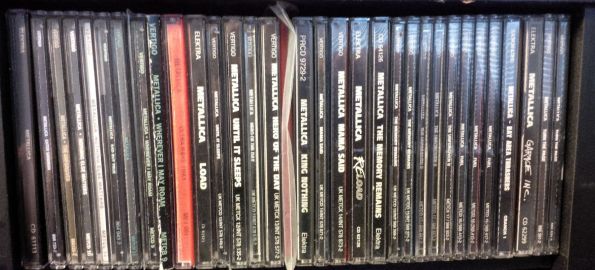
Once T-Rev got onto the singles train, he had his own rules about what he wanted to collect and what he didn’t. Packaging was important to him. He hated CD singles that came inside little cardboard sleeves. He couldn’t see them once filed on his CD tower, because there was no thickness to it; no spine to read from the side. It didn’t matter what was on those CD singles; if the packaging sucked T-Rev was not usually interested. This applied when we both started collecting old Metallica singles. I found an Australian copy of “Sad But True” with the rare B-side “So What” at Encore Records for $20. This came in a cardboard sleeve; T-Rev didn’t want it. (He also already had a live version via the Live Shit: Bing & Purge box set.) Oasis started releasing their old singles in complete box sets, but T-Rev was only really interested in collecting the UK pressings. There were a lot of variables to consider. If you can’t or don’t want to buy everything, you have to set rules and pick and choose.
Once we understood each others’ needs, we were able to keep an eye open for each other. T-Rev knew if it said Bon Jovi, Faith No More, or Def Leppard on it, that I’d be interested. If it was a Brit-pop band like Blur or Supergrass, he’d want it (as long as it didn’t come in a paper sleeve). Foo Fighters too, or virtually anything with Dave Grohl. Our collections grew prodigiously with rare tracks, EPs we never heard of before, and loads of Metallica. I believe at one point, T-Rev and I had nearly identical Metallica collections, duplicated between us. More than half was singles and rarities. We used to joke that there were probably only two copies of some of these things in town, and we had both of them in one apartment.
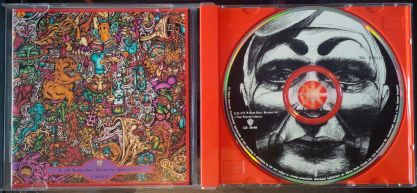
T-Rev sold a lot of his singles but not all. He still has some treasures. Highlights include a Steve Earle tin can “Copperhead Road” promo (that he got from local legend Al “the King”). There’s also Megadeth’s uber-rare “Sweating Bullets” featuring the in-demand “Gristle Mix” by Trent Reznor Then there was a Blur thing, some kind of “special collectors edition” signed by Damon Albarn, in a Japanese pressing. Trevor’s seen one sell for upwards of $100. Then there was another band called “A”. As Trevor said, “Remember these guys? It was like ‘Britpop punk’. I liked it anyway.”
Also still residing in his collection: a Japanese print of Oasis’ “Some Might Say” that has two bonus tracks over the domestic version, and two versions of Foo Fighters’ “Big Me”. One is from Canada, the other from the UK. Both have different tracks. I’d forgotten about these until I saw the pictures.
Those were the glory days of collecting. I miss collecting CD singles. I preferred hunting the stores downtown to get all the extra tracks to the way it is now. Now, often you need to buy an iTunes download and several “deluxe editions” to get all the songs. CD singles were just better, period. Even just for the cover art of those Oasis singles, singles were much more fun to collect. I miss those days!
MEGADETH – “Crown of Worms” (1994 Capitol promo CD single)
also known as the “Creepy Baby Head”
Here’s a real treasure that I acquired via T-Rev’s store for about $4. Lately this thing’s been going on Discogs for $36, which must be solely for the packaging. All the tracks have been available on various Megadeth collections for a long time now, although “Crown Of Worms” was originally a rare track. It’s a co-write between Dave Mustaine and Sean Harris from Diamond Head. It kicks some serious ass, but it’s no longer a song that’s worth $36. I think what makes this single command high prices is the bizarre baby head slip case. That and the fact that it was a promotional CD, meaning it was never intended for sale and only small numbers were made.
A while back I made a video explaining what a promo CD was, which featured the “Creepy Baby Head”. You can check out that video below. The head obviously ties into the Youthanasia album artwork but otherwise there’s nothing else externally to tie it to the band. No logo, no tracklist, just the serial number DPRO-79448.
As mentioned, “Crown of Worms” kicks some serious ass. I was a big fan of the Mustaine/Ellefson/Friedman/Menza lineup of Megadeth, and this song was not only album worthy but single worthy. Nick Menza sounds great on it, and the song just smokes from start to finish. Killer riff, too. Mustaine’s at his snarly best.
The other two tracks are both Youthanasia album songs: “Black Curtains” and the single “Train of Consequence”. “Black Curtains” is a lot more doomy, kind of like “Harvester of Sorrow” (perhaps). “Train of Consequence” seemed to alienate some fans back in ’94, but I think it’s a strong single if a bit more melodic then some would have liked. It still has a cool stuttery riff and a vintage Dave vocal. It’s rhythmically interesting and I think the guitar solo is ace.
There is no way I would pay $36 for this thing, and I’d advise you to keep searching the used CD shops. Promos were funny things. Record store and radio stations would be sent these things, and a lot of the time nobody gave a damn. They would end up in the hands of a non-fan and sold at a pawn shop or another CD store. While today some fans will pay a lot of money for this, you know that copies will end up in used CD stores without a $36 price tag. You just have to do the legwork and find it.




 Around this time, AC/DC just released the luxurious






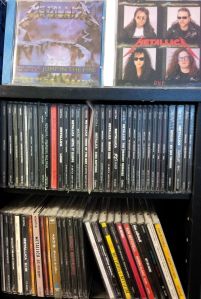
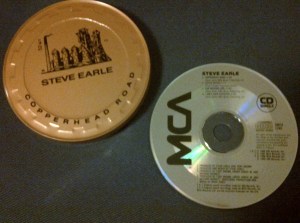 T-Rev sold a lot of his singles but not all. He still has some treasures. Highlights include a Steve Earle tin can “Copperhead Road” promo (that he got from local legend Al “the King”). There’s also Megadeth’s uber-rare “Sweating Bullets” featuring the in-demand “Gristle Mix” by Trent Reznor Then there was a Blur thing, some kind of “special collectors edition” signed by Damon Albarn, in a Japanese pressing. Trevor’s seen one sell for upwards of $100. Then there was another band called “A”. As Trevor said, “Remember these guys? It was like ‘Britpop punk’. I liked it anyway.”


 mikeladano.com