GRAB A STACK OF ROCK With Mike and the Mad Metal Man
🅻🅸🆅🅴 Episode
Episode 168: Tale of a Band with author Tim Durling and cohost Ashley Geisler
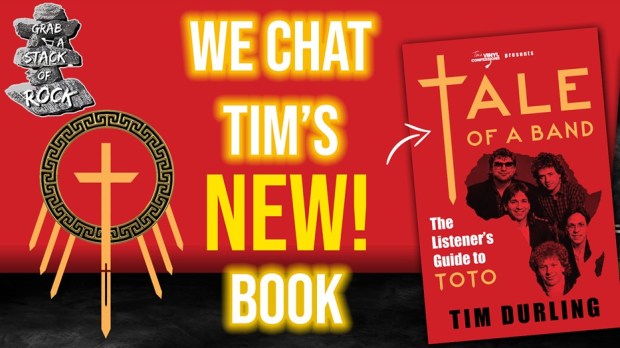
It’s your lucky Friday the 13th, because tonight we have author (and occasional guest host) Tim Durling from Tim’s Vinyl Confessions here to talk about his new book! It’s Tim’s 8th book in fact, and this time he’s not in Kansas anymore…this time he’s off to “Africa” to talk about Toto!
The hitmakers have a 50 year career to discuss and Tim covers it in his new book, which you can buy on Amazon. From their debut album to some strong latter-day albums, as always, you can expect a Durling book to cover the historic milestones, some great photos, and some strong opinions.
Joining tonight is co-host Ashley Geisler!
Hold the line, because tonight Tim and Ash will be on time to talk about a great band: Toto!
Frank Herbert’s seminal Dune is one of the most beloved and influential works of science fiction ever committed to paper. Despite its convoluted plot, world specific dialogue, and the presence of enough supporting characters to fill a football arena, readers have been captivated by the tale of lost humanity and political turmoil for over half a century.* The book’s epic length gave it the time it needed to develop compelling three-dimensional characters. Adapting such a complex story into a feature film proved to be so challenging that Arthur P. Jacobs, Alejandro Jodorowsky, and Ridley Scott all tried and failed to bring the book to the big screen. After three misfires, American surrealistdirector David Lynch was hired to helm the project in 1981. The film took three challenging years to produce, and upon completion, was a substantial critical and commercial failure.
In the years since its release in 1984, the film has developed a cult following, and for good reason. While it’s not everything a fan of the book would hope for, it’s certainly not as bad as it was made out to be upon its release. For people new to the series, the sheer amount of characters, alliances, and jargon can be overwhelming. Especially when Lynch was only given two hours with which to tell a five-hundred page novel. This is easily the weakest aspect of the movie. Much of the exposition is crammed in at the beginning of the film, and its delivery can best be described as clunky. The scene in which Emperor Shaddam IV explains his plan to destroy House Atreides to the Spacing Guild is so poorly written that it calls to mind a moment from Mel Brooks’ Spaceballs in which the evil Lord Helmet turns to the camera after excessive exposition and asks the audience if they caught it all.
The sloppy exposition is exacerbated by the literal interpretation of Frank Herbert’s use of internal dialogue. Lynch’s decision to literally adapt the book’s internal dialogue by having the actors narrate each character’s thoughts and motivations is belligerent and awkward. The film too often relies on this internal dialogue that robs the movie of surprise and subtlety for the sake of clarity that it ironically fails to bring. Much of the dialogue is used to further the plot, as opposed to developing the characters. Certain characters are simplified out of necessity due to the relatively brief runtime, such as the formidable Harkonnens of the novel being turned into the disgusting cartoonish characters seen in this film. However, at only one-hundred thirty-seven minutes, the story could have been much more incoherent and disjointed than it ultimately was, but that doesn’t excuse it from being an underdeveloped mess.
While the story falters somewhat in comparison to the novel, it works surprisingly well taken on its own. Many of the theological questions of the book remain unexplored in the film adaptation, but the complex themes of political strife, globalism, and corruption are all addressed in the conflicts between the many groups gifted with power. Each entity mistrusts the other, but must form uneasy alliances to stay afloat or to destroy common enemies covertly. The film balances these relationships remarkably well. Every group’s selfish motivation is made abundantly clear, yet each motivation prompts thought over their individual plans within plans.
Another area that the movie excels at is its tone. The novel had a very regal atmosphere, which the film captures in strides. It does a remarkable job at humanizing the bombast of the occasion. In a society where humans are trained more and more to act and perform like machines, the protagonist Paul Atreides triumphs with his innate sense of human morality and communal bonds with the Fremen. Kyle MacLachlan perfectly captures the innocence, the exuberance, and the pride of the character in the novel. Dune has a rich supporting cast including Max von Sydow, Patrick Stewart, and José Ferrer that help to elevate the material and capture its humanity.
Part of the film’s emotional success can be credited to the excellent score, contributed by Toto with one beautiful piece by Brian Eno. Toto fused orchestral arrangements with their instrumental rock prowess to create a hybrid score that is surprisingly exciting. It frames the most overblown scenes in a way that seems triumphant instead of pompous, and prevents the quiet emotional moments from buckling under the weight of the jargon. At the heart of all this technical jargon and political strife is a story about human characters, filled with human virtue, human emotions, and human desires. This score pulsates with humanity, and is something that Toto and Brian Eno should look at with pride.
The film also succeeds in its unique visual aesthetic that perfectly brings the spiritual and transcendental aspects of the novel to the screen with style. Thanks to the surrealistic tendencies of its director, this film is full of striking visual moments, particularly those that depict Paul’s prescient visions. The scene in which Paul takes the water of life in the desert and unlocks his full mental potential is especially breathtaking. It lacks the narrative depth of the novel, but makes up for it by explaining visually what the film’s clunky dialogue often failed to clarify on its own.
Dune is by no means a great film, and it doesn’t live up to the timeless reputation of the novel it’s based on. It is a cult classic from a decade known for producing its fair share of cult cinema. While many fans of the book and members of the general public look at this movie with disdain, I always walk away from it having been entertained, if left yearning for a better adaptation. We may get this adaptation now that Dennis Villeneuve is directing a new version of the film set to release in 2020. This 1984 version is flawed, and even its director calls it his worst film (I disagree; I think 1990’s Wild at Heart would take that position). The fact that I originally sought out the Dune novel because I was such a big David Lynch fan and wanted to read the book before seeing the film may paint me as a biased source, but I consider the positive attributes of the film Dune to (just barely) counteract the many negatives.
3/5 Sandworms
Author’s Note: Get the Blu-Ray if you’re going to watch it. It is a substantial improvement over any other version of the film. Dune was always a bit of an ugly duckling, but this Blu-Ray edition has gone the distance to clean up the visuals to present what is by far the best looking version of this film ever released. And whatever you do stay away from the 3 hour extended/T.V. cut that is so bad the director removed his name from the credits. It’s a butchered mess that mixes up the musical cues and needlessly edits material back in from the cutting room floor. The theatrical cut is the only version available on Blu-Ray, so it shouldn’t be too hard to avoid the bastardized extended version.
* Because of its generous detail and epic world-building – LeBrain
There were some pretty awesome picks this year. I have to give Scottie props for “Coming Home” by Iron Maiden, from the excellent Final Frontier album. I found some things a bit surprising, such as the overplayed-on-radio “Black Betty” by Ram Jam, placing so high.
“Thick As A Brick” was the live version, so just over 10 minutes. Other long bombers included all of “Supper’s Ready” by Genesis, which resulted in a tirade by Phil for just as long, about how much he thinks it sucks! (And he’s an old-school Marillion fan…surprising.) And of course there were several Maiden tunes that clock in well over 5 minutes.
For your edification, here is the official Sausagefest XII Countdown: 75 tracks, plus 35 tributes. One tribute for each person that submitted a list! 110 songs over one weekend! Awesome.


You must be logged in to post a comment.