Books

MOVIE REVIEW: 2001: A Space Odyssey (2008 blu ray)

Happy LeBrain Day! It’s my birthday. Sometimes on my birthday, I like to just spend an afternoon watching a favourite movie. This is one.


2001: A Space Odyssey (1968, from the 2011 Stanley Kubrick Visionary Filmmaker Blu Ray Collection, Warner Bros.)

Once upon a time, when the year 2001 seemed aeons away, director Stanley Kubruck (Dr. Strangelove) contacted author Arthur C. Clarke (Childhood’s End) to discuss making “the proverbial good science fiction movie”. Both were sick of films that passed for science fiction, but were actually monster movies set in space, or just replaced Β science with fantasy.

The result was 2001: A Space Odyssey, the film, and a companion book of the same name which is actually a completely different animal. The film — striking, innovative, visually engrossing, ambiguous, and scientifically solid — is as good today as it was in 1968, even if many of the “predictions” of the film have failed to come to pass.

Separated into four chapters (The Dawn Of Man, TMA-1, & Jupiter and Beyond the Infinite) complete with intermission, 2001 has no dialogue for the first quarter of the film. Beginning with a blank screen (and “Atmospheres”, by Ligeti), this is a film paradoxically anchored by both music and silence. The screen changes to the Earth rising over the moon, and the sun rising over the Earth (an important clue and recurring symbol) accompanied by “Thus Spoke Zarathustra”. We are then introduced to a tribe of pre-human apes (Australopithecus, perhaps), starving and on the verge of extinction. Other tribes are stronger and out-competing them for territory and resources. There is no dialogue, but the barking of the apes, yet that and the scenery speak volumes. Suddenly one morning, the game has changed: a mysterious black monolith has appeared. The apes are drawn to it, and soon find that they are now able to compete with predators thanks to a new discovery: weapons.

MONOLITH ACTION FIGURE!The second chapter, TMA-1, begins with what Clarke has called “the longest jump-cut in history”. Β We see that humanity has evolved into a space-going race. Orbital weapons platforms orbit Earth as a shuttle is making way to an under-construction space station. “The Blue Danube” plays as the spacecraft dance in calculated perfection. Our first main speaking character, Dr. Heywood Floyd, arrives on the station and we are given some tantalizing clues as to why he’s made this trip: Rumours of a plague outbreak on the moon. Yet this is just a cover story. As Floyd makes his way to the moon in another beautifully choreographed sequence, we learn that a magnetic anomoly was discovered in the crater Tycho (named after astronomer Tycho Brahe) — Tycho Magnetic Anomaly 1, or TMA-1. This discovery is potentially so important, that the cover story was created to keep everyone far away from Tycho.

We see that TMA-1 is another black monolith. Β We see echoes and ripples of past events lead to another jump forward in time. Β Midway though a mission of discovery to Jupiter, helmed by David Bowman (the perpetually young Keir Dullea) and Frank Poole (Star Trek’s Gary Lockwood). Β Their ship, the Discovery contains three sleeping astronauts and the most famous computer of all time, H.A.L. 9000. Β H.A.L. was flawelessly voiced by Stratford Ontario resident Douglas Rain. Β His eerie voice and Kubrick’s perfect framing shots help create the creepiest computer character ever seen.
HAL 9000The seemingly dull, sleepy daily routine is soon shattered. Β H.A.L. has detected a flaw in the ship’s main antenna. Β It will fail, unless one of the astronauts goes outside and repairs it. Β The antenna is their only link to distant Earth. Β  H.A.L., who controls the life support and every function of Discovery, then begins to show signs of what humans call stress — he makes an error, and acts strangely. Yet no 9000-series computer has ever failed, or found to be in error. Β The chapter closesΒ with H.A.L. singing the old song, “Daisy Bell (Bicycle Built for Two)”, surely one of the most haunting scenes in cinema.

After an intermission, Discovery finally arrives at Jupiter and its true mission is revealed. This section too has no dialogue, bringing us full circle to the way it began. David Bowman once again must venture outside the ship, and find out how the mysterious discovery on the moon relates to Jupiter. Β Perhaps even how it related to our millenia-dead ancestors.

What follows is one of the most baffling and strange sequences in movie history, one which will require a few patient viewings to appreciate. The beauty of this final sequence is that there is no right or wrong interpretation. While on the surface it may appear to be a psychedelic kaleidoscope of colour followed by a bizarre dialogue-free encounter with a being that seems to have no bearing on reality, it is Kubrick’s inventive way of showing the audience something that is beyond anyone’s imagination. Like the audience, David Bowman and humanity have come full circle.

2001_0004Lacking in what modern audiences call “action”, lacking typical space sound effects (there is no sound in space!), lacking dialogue for most of the movie, and lacking any sort of warm human characters (except maybe H.A.L. who is not human), this movie was a challenge to watch in 1968 and is still a challenge today. It is, however, a piece of art that transcends its genre and is a landmark in film making. Kubrick, always a visionary and always breaking through boundaries of what could not be done in film, outdid himself and made a science fiction film that still has not been topped over 40 years later. Nobody has made anything this epic, this beautiful, this deep or this scientifically sound since. The special effects — all practical effects and mostly in-camera, as CG did not yet exist — still stand up today. No movie buff will ever forget the rotating Discovery set that allowed one character to be seated while another seemingly walked on the “ceiling”.

Sure,we don’t have a moon base. We haven’t sent anyone to Jupiter. We do have a space station. We have created computers that can beat the best humans at chess and Jeopardy. This is not that far off. If they had named this film 2031: A Space Odyssey, we might be in the right ballpark. In the end, the year does not matter. You never see modern Earth in the movie anyway.

The blu-ray release is loaded with special features and has a beautiful transfer in 2.20:1, as Kubrick shot it and intended it to be. Both Dullea and Lockwood provide an audio commentary. There are documentaries about Kubrick, about the predictions of the film, and about the effects. The only thing missing is the vintage 1966 Arthur C. Clarke lecture from the first issue of the DVD. Β I still have that DVD copy because I like that old 1966 footage of Clarke. Β He’s my favourite author.

2001: A Space Odyssey is, without any doubt or any argument in my mind, the greatest science fiction film of all time. With Kubrick and Clarke now both gone, I doubt we will ever see anything like it again. 5/5 stars is meaningless, since this movie was (for its scale and stature) first, and the best, against everything in its genre.

I’ll rate it 200 billion stars, one for each star in our galaxy.

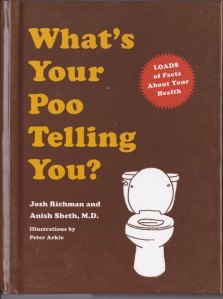
BOOK REVIEW: What’s Your Poo Telling You? by Josh Richman and Anish Sheth M.D.

POO

What’s Your Poo Telling You? by Josh Richman and Anish Sheth M.D.

Illustrated by Peter Arkle, Chronicle Books, 96 pages

If you’re like me, you probably enjoy a good read while droppin’ a deuce. Β And if you’re not like me, don’t judge; no, just take a look at all the Uncle John’s reader’s in the humour section of the local bookstore. Β Who’s laughing now? Β Uncle John, all the way to the bank!

Obviously, I’m Β not alone.

A Christmas gift from my lovely wife, Mrs LeBrain, What’s Your Poo Telling You? by Josh Richman and Dr. Anish Sheth, is an informative illustrated reference book. Β For health purposes. Β For example, let’s say you encounter the health problem knownΒ colloquiallyΒ as “Log Jam”. Β Turn to page 62: Β  lack of water and/or dietary fiber cause stool to be too hard to pass. Β Ahh! Β I see! Β Treatment: Β enemas or…ewwww!…”manual disimpaction”.

Other conditions or events covered in the book include: Β “Floaters vs. Sinkers”, “Rambo Poo”, “Number Three” (aka “Butt Piss”), the “Streak”, and many more. Β Each article includes health tips, a biology lesson of the gastrointestinal variety, and many are illustrated.

STREAK

There are also interesting factual articles to enjoy, such as a page on dinosaur droppings, and one on toilets owned by presidents and royalty.

For even more fun, be sure to check out the sequel, What’s My Pee Telling Me? Β This helpful tome includes content on farts, pee, and even more poo. Β New conditions discussed include “Itchy Poo” and “Poonami”.

I strongly recommended one or both of these books to concerned citizens everywhere.

5/5 stars

COMIC REVIEW: Transformers #14 w/ Bruce Springsteen / “Brick Springstern”

SAM_1952-1

I’d like to dedicate this unusual review toΒ Aaron who is the biggest Boss fan I know.

SAM_1944

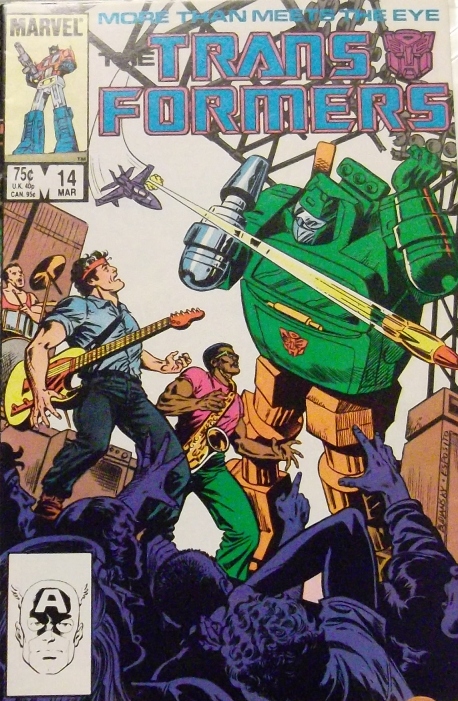
THE TRANSFORMERS – “Rock and Roll-Out!”Β  (Marvel comics, issue #14, March 1986)

Written by Bob Budianski

Remember that one outdoor Bruce Springsteen concert back in March of ’86, when the Autobots saved the day?…No?

Well, clearly you weren’t reading Marvel’s original Transformers comic series back then. Β Issue #14, March 1986, featured just such a mash-up, only with a slightly different twist. Β While some real-life people, most notablyΒ Richard Branson, had appeared on the pages as themselves, Bruce appeared as the similar-monikered Brick Springstern (also spelled “Springhorn” on one page!), with his Tenth Avenue Band. Β The band came complete with an afro-sporting Max Weinberg, and Clarence Clemons himself, going by his nickname the Big Man.

Brick’s songs included the smash hits:

  • “Dancing in the Night”
  • “Born in America”
  • Something referencing Margarita

…and presumably many more familiar sounding tunes!

In this issue’s tale, the Autobots are replenishing their ranks after the devastating events of issue #12. Β Optimus Prime has revived “memory engrams” of five Autobots: Β Hoist, Tracks, Skids, Smokescreen, and Grapple, and puts them in new bodies. Β Optimus sends four of the five (holding Grapple behind, in order to build Omega Supreme, who appears in issue #19) out with Bumblebee on a training mission.

It is while getting gas on this mission that Skids discovers that he loves the music of Brick Springstern/Bruce Springsteen! Β “This Springstern produces a most intriguing sound,” says Skids, as he sets his radio to the correct “coordinates”. Β Soon, however, the Autobots discover that Decepticon commander Shockwave plans on harvesting the sound energy from that night’s Springsteen…err, Springstern concert for his own evil uses! Β This unlikely plot serves to bring the Autobots closer to Springstern, by attending the concert themselves, in the parking lot!

Shockwave’s “energyΒ siphon” actually removes the sound from the concert, converting it into “energon cubes”! Β The audience isn’t happy! Β Hoist disconnects the siphon, triggering a Decepticon attack!

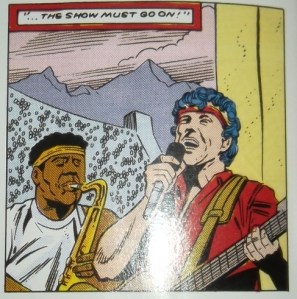
The autobots transform into robot mode to protect the audience from Decepticons Starscream, Skywarp and Thundercracker. Β Luckily the audience (improbably) thinks it’s all part of the show. Β Hoist instructs Bruce…err, Brick, to keep playing music to keep the audience from panicking! Β Brick and the Big Man launch into the next song, and the ploy works to keep the crowd enthralled and distracted from the missiles exploding over their heads. Β Even the arrival of Shockwave, in the form of a friggin’ 40 foot long laser gun, doesn’t seem to alarm the crowd. Β The Autobots defeat the bad ‘bots, and leave Brick to finish the concert. Β The show must go on…

The plot is loaded with massive holes. Β Earlier in the story, Autobot medic Ratchet is complaining that he doesn’t have enough spare parts, even gaskets, to keep the wounded ‘Bots from leaking to death. Β Then, a page or two later, there’s five brand new bodies built for the new Autobots, aka new toys that Hasbro had to sell. Β Then there’s the siphoning of the music from the concert to create energon, when the Decepticons could have just stolen the electricity itself.

Not a great issue, but since it introduced five new toys, as a kid I was happy with it.

2.5/5 stars

The comic has been reissued several times, notably by IDW As Transformers Generations #3, and again in the collection Transformers ClassicsΒ #2.

Motherlode of Christmas Rock!

I have 31 discs of music to listen to now. Β And a whole lotta other goodies. Β Here we go!

First up – books. Β Peter Criss’ Makeup To Breakup, and the latest from Ripley’s Believe It or Not and Guiness’ Book of World Records. Β  I’ve leafed through Peter’s book — all he seems to do is bitch about Paul and Gene. Β Review will come.

Next, Queen. Β A total of 8 discs of awesome remastered Queen to listen to: Β The Miracle, Jazz, A Night at the Opera, and Live Killers!

Next up, Rush. Β 6 discs in each of these two Sector box sets, including 2 DVD’s in 5.1 surround, plus 2 discs of 2112. Β Awesome. Β (I already have Sector 2 and have a review of that coming in the next few days.)

And the rest: Β The 4 disc Cult Love Omnibus Edition. Β Thin Lizzy’s Life Live (2 discs), Jon Lord’s Concerto for Group and Orchestra, and the new Rage Against The Machine XX edition (2 discs plus a DVD).

But that’s not all. Β Check out this Kiss lunchbox, these movies and vintage G1 Transformers 1988 “Bugly” action figure.

Lastly my folks got me this neat Joby camera tripod. Β This is going to come in handy when I make my next Transformers stop motion animated movie. Β I did a brief 15 second screen test — check that out too!


Hope your Christmas was filled with happiness, love, joy, and rock!

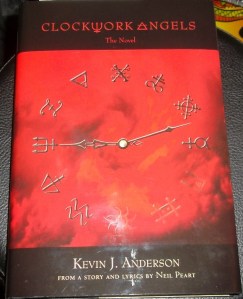
BOOK REVIEW: Kevin J. Anderson – Clockwork Angels

KEVIN J. ANDERSON – Clockwork AngelsΒ Β (2012 ECW)

From a story and lyrics by Neil Peart

It was bound to happen eventually.Β  Somebody had toΒ write a Rush concept album into book form.Β  I’m sure a lot of highschool kids in the 1970’s wrote their own short story versions of 2112.Β  Now in 2012, Kevin J. Anderson (the Dune spinoffs) has teamed up with Neil Peart to novelize Rush’s latest album, Clockwork Angels. The end result, according to Aaron, is a near total ripoff of Harlan Ellison’s Repent, Harlequin! Said The Ticktockman, but Rushified.Β  I’m sure both Peart and Anderson are familiar with the previous work, so their plaigarism is not forgiveable.

I found Clockwork Angels, the album, to have a sparse story that begged to be opened up in more detail.Β  There’s text in the CD packaging to help illustrate the story a bit more, but that only scratches the surface.Β  I had a hard time visualizing the world that these characters inhabited.

Like many novels of this ilk, the world of Clockwork Angels is Earth-like in some respects.Β  There’s a massive, unexplored eastern sea, a far away land called Atlantis, and a vast deserted land of wonders unimagined beyond that, all waiting for our hero Owen Hardy to explore.

Owen Hardy, an apple orchard manager from Barrel Arbor, Albion, is a dreamer.Β  (Hmmm…ever heard that setup before, in Rush songs past?)Β  He dreams of the faraway lands that he’s only read about in his mother’s books.Β  Their world is run by their loving Watchmaker, an ancient old man who has mastered the power of β€œcoldfire” and alchemy.Β  Using his mastery of these arts, he has created a clockwork society:Β  everything has its place, and every place has its thing.Β  Everything runs precisely, on time, and every person fulfills his or her role in society. Β It is a place where everyone is content. Β Everyone but the dreamer.

One night Owen Hardy suddenly departs Barrel Arbor for the wonders of the capitol Crown City, home of the Watchmaker and his Clockwork Angels. Β The Angels are glowing coldfire-powered mechanical beings that inspire awe in the citizens lucky enough to have a ticket to see them. Β Owen wishes to see them for himself, but the Angels would never be enough for this young dreamer.Β  Along the way Hardy meets colourful characters from airship pilots to carnies to the notorious pirates, the Wreckers.

Owen gets tangled up with a character called the Anarchist.Β  The Anarchist lies at the opposite extremeΒ from the Watchmaker.Β  Where the Watchmaker believes in rigid order to achieve happiness (called “The Stability”), the Anarchist believes that true happiness can only come with the freedom to do whatever you want and go wherever you please.Β  But both the Anarchist and Watchmaker have designs on young Mr. Hardy, an exceptional man because dreamers are rare.

Through it all, Hardy journeys to lands far away, glimpses parallel universes and discovered his own inner strength.Β  All the while, Kevin J. Anderson sprinkles his journey with Rush references.Β  β€œTough times demand tough hearts”.Β  Lyrics from songs past and present find their way into the text, and unfortunately I found this touch to be distracting.Β  I get it – a nod and a wink to the Rush fans who will buy the novel – but as a Rush fan, these references stick out like a glowing beacon of coldfire.Β  (Coldfire’s another one, by the way.)Β  This is a minor complaint; the novel soon took on a life of its own and was impossible to put down.

One of the best features of Clockwork Angels are the glorious illustrations by Rush cover artists Hugh Syme.Β  From steampunk airships to the glowing Seven Cities of Gold, Syme’s art helps the reader visualize this fascinating world that Peart and Anderson have created.Β  Clearly, Syme was in sync with the authors when he created these paintings.

While I enjoyed Clockwork Angels thoroughly, and this enjoyment only enhanced my appreciation of the album, its template is far from original.Β  The archetypes are familiar, as was the plot.Β  Having said that, Anderson and Peart successfully conjured up a vivid landscape, interesting characters, and a rollicking good story.

3.5/5 stars

Under piercing stars
I stand watching the steam-liners roll by

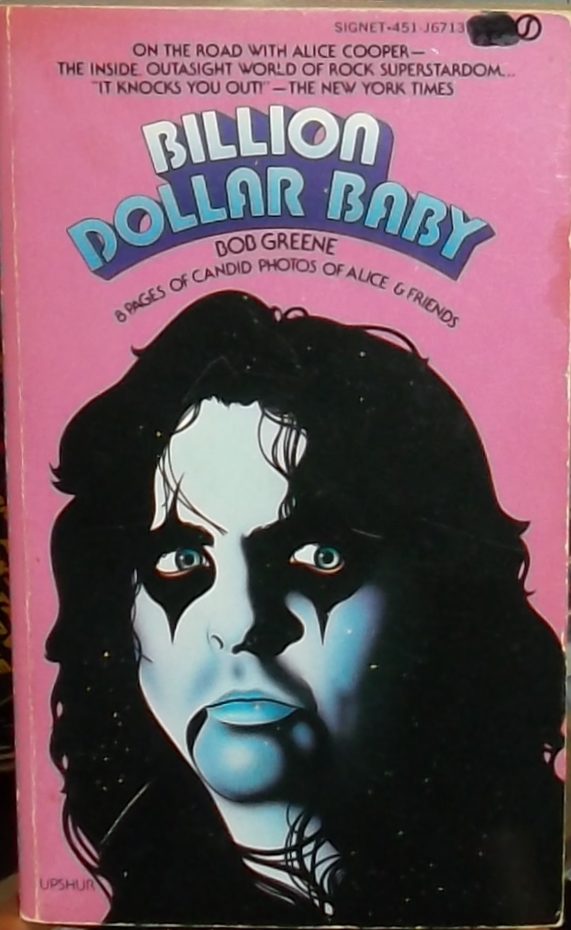
Part 139: VIDEO BLOG! Billion Dollar Baby (by Bob Greene)

RECORD STORE TALES PART 139: Β Billion Dollar Baby

Watch the vid for details on the book and where I got ‘er!

BOOK REVIEW: Dale Sherman – The KISS FAQ

I’ve had numerous requests for some rock book reviews.Β  So let’s start with a new release:Β  Dale Sherman’s The KISS FAQ!

DALE SHERMAN – The KISS FAQ – All that’s left to know about the hottest band in the land (2012 Backbeat Books)

Dale Sherman’s written two of the best unofficial Kiss books:Β  Black Diamond, and Black Diamond 2.Β  Both are noted for their almost OCD level accuracy, objectivity,Β attention to detail, and ample Eric Carr content.Β  Sherman was lucky enough to get some really excellent Eric Carr interviews, and his perspective is one that isn’t often reflected in Kiss written works today.

A new book from Sherman was very welcome to this fan.Β  According to the author, this book is about “the various topics that fans discuss at the hotel bar after a Kiss expo,” and that about covers it!Β  The minutaie.Β  The tall tales, mythsΒ and truths.Β  The who-played-what-when.Β  Lists, lists, and lists.Β  The albums, the personalities, and the personas.

There are also some nice black and white pictures of memorabilia and artifacts from the author’s collection.Β  The author seems to have a large collection, so there are plenty of pictures to leaf through.Β  Colour would have been nice, but then I wouldn’t be paying $22.99 for the book, would I?

Don’t expect writing with a lot of flare, but do expect encyclopedic knowledge.Β  My one beef is this.Β  I’ve already read Black Diamond and Black Diamond 2 numerous times, and there’s quite a bit of overlap between those and The KISS FAQ.Β  It’s not the same text, but the subject matter overlaps.Β  The compensation for this is that The KISS FAQ is up to date, where Black Diamond and Black Diamond 2 were both circa the reunion era.

As a Kiss fan who likes to pretend I already know it all, I enjoyed this book.Β  It was like a refresher course in Kiss.Β  There’s lots of obscure facts I’d forgotten about.Β  It was a helpful referenceΒ when I did my recent series of Kiss album reviews.Β  Recommended.

3.9/5 stars

BOOK REVIEW: KISStory

PartΒ 33 of my series of Kiss reviews, leading up to the release ofΒ Monster! Β By 1995, Kiss merchandising was in full gear.Β  This was its flagship release.

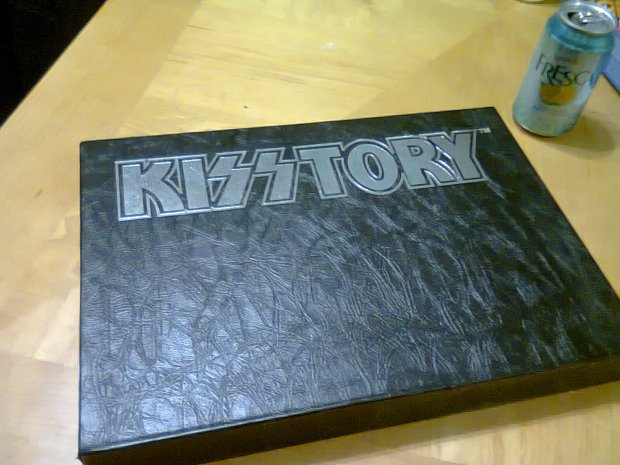
KISStory, Jeff Kitts, 1995 ($149.99 in 1995, currently $320.70 new/$263.24 used, on Amazon, in CAD)

I got KISStory back when it came out, inΒ earlyΒ 1995 or so.Β  I ordered it (or, rather, my mom ordered it for meΒ since she had the credit card in the house) back in July of 1994.Β Β  When it arrived, it took me a couple weeks to go through all theΒ content.

Early pressings were all signed by Eric Singer, Bruce Kulick, Paul Stanley, and Gene Simmons. The second pressing was signed by the original band. Personally I am happy with my copy, as I love the Revenge lineup of the band, which was much shorter lived than the original. As a side note, according to the Firehouse fanzine, Bill Aucoin (ex Kiss-manager) stated that a good number of the copies signed by the original band are actually autopen.Β  For that reason I’m glad I have the Revenge lineup, which was contemporary to the release of the book.

Also, early pressings had a lot of binding issues. Be careful. A friend of mine had his copy of KISStory repaired professionally because his binding fell apart. I have been very, very careful with my book and in the 15 years since, the binding is still OK.Β  But I treat this thing with kid gloves, people.

Each book is numbered and comes in a black case. The book is massive. Absolutely huge. It’s alwaysΒ funny when the advertizing for a book states that it weighs over 8 lbs.

Content wise, it is rich but flawed. There are numerous errors in the book. For example, the book states that five new songs were released on Kiss Killers. Well, we all know it was four new songs. The timeline is a bit mixed up at times, and the 80’s are not covered in enough depth.Β  But let’s face it, you don’t buy a book like this for text.Β  You buy it for the pictures.Β  Text is kind of like…a bonus track.Β  The best text is probably in old newspaper articles and concert reviews contained inside anyway.

Where the book succeeds, it succeeds like no other. However you have to remember, when this came out this was the only authorized Kiss book. Now there are lots, and much cheaper. At the time though, some of these photographs had never seen the light of day before. Newspaper articles, reviews, magazine covers, it’s all here, in massive quantities.

I think my personal favourite things were sketches of costumes and basses out of Gene’s personal sketchbook. Also, early lyrics for songs released and unreleased. There are costume sketches for outfits never made. There are drawings for stage shows that never saw the light of day. Everything you can imagine.

Yes, the price tag is hefty. However, if I sold my copy of KISStory today, I’d make aΒ goodΒ profit. This is an investment as much as a book, but I think you’ll want to hang onto yours.

4/5 stars.