THE FORREST WILLIAMS DEMOCRACY – “The Optimyst” (2023 single)
Forrest Williams, Scott Maybee, and Matt DeMatteo are back with their third single (check out the firsttwo if you missed ’em), and this is the best one yet. The Democracy play a hard-to-pigeonhole mixture of 90s and classic rock with a dose of progressive, among other elements. When these elements fuse, the molecules of music produced have been radiant. With three songs released to date, we can now track a trend: each song is better than the last, therefore the future is looking bright for The Democracy!
Fellow reviewer Jex Russell noted that “The Optimyst” reminded him of “Solsbury Hill” by Peter Gabriel, and I hear what he’s getting at. There’s something in that bright rhythm of the guitar part, and the uplifting vocal melody (verses by DeMatteo and choruses by Maybee, if the music video is to go by). But there’s so much more to this track than just the melodic. Listen to the drums! Williams makes creative use of toms and cymbals to form an integral part of the song’s landscape. The drums don’t distract, but they add a hell of a lot of depth and hookiness. They carve hills and valleys in the music.
The lyrics are uplifting and the message is universal. “‘Cause bad times will get better!” Don’t give up hope! “You feel hopeless, got to pay the Monday dues.” That’s pretty accurate! “I’m all fired up by Wednesday, it’s Friday soon…” Amen, brothers! I think most people will be able to relate to this song, and I hope they can feel its sunny vibes, to feel better about whatever is getting them down.
Everyone needs to hear “The Optimyst”, no matter what mood they’re in. It’s that good and it deserves to be heard far and wide. Positivity is often in short supply these days, so thank you to The Forrest Williams Democracy for bringing some sun in December.
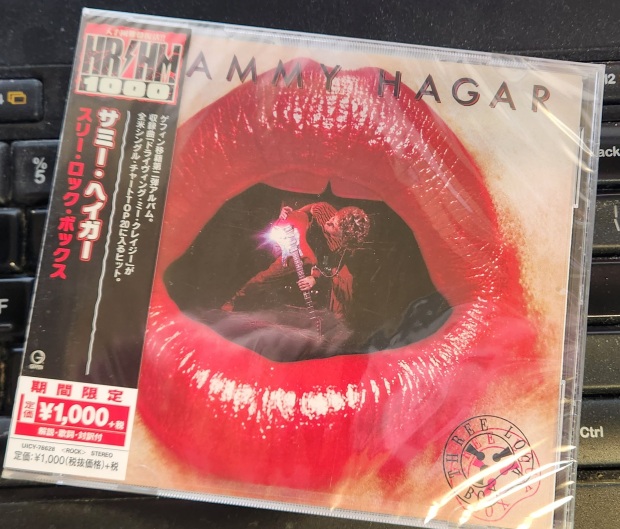
Sometimes it is fun to review an album on its first listen, so that’s what we’re doing today with Hagar’s Three Lock Box. I only know a handful of tunes so this will be mostly brand new to me. Released December 6, 1982, Three Lock Box was Sammy’s seventh solo album. Jon Cain (Journey) and Mike Reno (Loverboy) make guest appearances, and it contains Sammy’s biggest charting solo hit. Let’s give it a spin, on this fancy Japanese CD pressing.
The title track is familiar, with its slightly funky riff and rich organ backing. I don’t know why, but that refrain of “One, two, three lock box!” reminds me of the kind of melody and simplicity of a children’s song. But child’s play this is not! A couple minutes in, and the gears shift to full blown hard rockin’. This is a catchy and rhythmically clever little tune.
“Remote Love” might have a bit too much keyboard in the mix, but this is a cool laid back rock ballad. It sounds like something from a past age perhaps. Loud keyboards aside, there’s something purely classic about it, especially when you get to the soulful chorus.
Cain and Reno appear on “Remember the Heroes” (co-written by Cain). Very Journey-esque, but Mike Reno sounds absolutely brilliant! What a powerhouse singer, and when he and Sammy team up on the chorus, it’s mighty great! You could easily imagine Journey doing this song, and perhaps they should have.
“Your Love Is Driving Me Crazy” (#13 on Billboard’s Mainstream Rock songs) is clearly hit material. It’s all melody, smooth and polished. The production has the bells and whistles and the track is just really hard to resist.
A haunting tone enters on “In the Room”, a completely different vibe. It almost sounds like a lost Alice Cooper number from the same time period. “I’ve been caught in the room, that moment of sleep when you think you’re awake.” The lyrics match the music perfectly. This is one of those must-have deep cuts, a song that absolutely deserves more attention. It’s so different for Sammy. “Rise of the Animal” follows with spooky sounds, and then a synth pulse. “I just came out from the room…” sings Sammy, continuing his thoughts from the prior song. “I saw the rising of the moon. This ain’t no ordinary night! Look to my left, look to my right.” It starts slow and picks up the pace, and ends with some brilliantly frantic soloing from Sam.
Another great deep cut is the pop rocker “I Wouldn’t Change A Thing”. A radio-ready corker, it could have been a hit in an alternate universe. Let’s call it the Sammyverse. A universe where everything is bright, colourful and shiny. I wouldn’t mind hanging out in the Sammyverse, and “I Wouldn’t Change A Thing” could be its anthem. Wave your red flags high!
“Growing Up” has a highschool-tough sound, while Sammy sings of the girls in their summer clothes. The Sammyverse only has short skirts and high heels. It’s probably the filler track of the album, as it doesn’t seem to have the hooks of previous tracks. Fortunately “Never Give Up” is all hooks. Another pop rocker with memorably melodies and smooth guitars, it’s just a fun song. Easy singalong in the car. Speaking of cars, the Sammyverse is fond of ’em, and the closing track “I Don’t Need Love” races like one of Sammy’s Ferraris. It’s a brilliant rocker and probably the heaviest track on an otherwise pretty mainstream rock album.
Sammy Hagar albums don’t have a lot of pyrotechnics. They are often meat and potatoes, workmanlike and easily accessible. Three Lock Box has its strengths not in the production or flashy performance, but in the songs and the singing. It’s a satisfying listen and I understand why it is so well liked. It may not have a lot of edge, but it’s a fun, feel-good listen.
SAVATAGE! This Florida metal band reigned from 1979 to 2002, and is now back ready to unleash a new album called Curtain Call! They never received the recognition they deserved over the course of 12 mostly excellent albums. Let’s fix that here and now!
We begin our story with tragedy, but also triumph. Lead guitarist Criss Oliva was killed by a drunk driver, almost ending the band permanently, and shattering the soul of his brother Jon. Jon Oliva was not even a member of the band anymore, having abdicated the mountain king throne to new singer Zack Stevens a year prior. Undaunted, Oliva wrote and recorded almost all the instruments on the next Savatage album Handful of Rain. Even though bassist Johnny Lee Middleton and drummer Steve “Doc” Wacholz are pictured inside, they did not play. Jon did. Joining him on lead guitar was former Testament master-shredder Alex Skolnick. An immensely powerful team up. They produced a somber album, but not without power and thrills. The title track, available as a 5:25 extended edition or the standard 5:02 version, boasts acoustic verses and a powerful chorus that will stay with you for days.
The final Savatage epic from the final Savatage album. Jon Oliva was back on lead vocals. Zack Stevens departed to form his own band, Circle II Circle. This song utilizes a powerful, relentless riff and a host of backing singers taking care of a complicated vocal counterpoint. Different lyrics and melodies all overlap to form a cohesive and weighty segment of an already powerful song. With piano and guitars intertwined with equal emphasis, Savatage may have taken their new operatic metal style to its peak here. Though a comeback is planned, the band has remaining largely inactive ever since. Regardless, at least they finished their first life in style, and with masterful progressive metal music.
Though this song commences with a corny keyboard bit and a ballady melody, it is far from that! The battle grunts of the “warriors” soon join in with a sharp metal riff. An alloy of iron and titanium, “Warriors” boasts a relentless chorus. The verses are fun too. “Armed to attack! The soldiers react!” Not poetry, but it matters not when Oliva screams. This is simply heavy metal, down to the basics, and executed with youth and naivete. The thing is: it’s really good and catchy!
A shorty, at under four minutes. The tempered steel of Criss Oliva’s riff is the main hook. Much would improve later on, such as Jon’s lyrics and the band’s writing skills, but they had everything they needed from the get-go. There’s a slower breakdown in the middle that only serves to re-ignite the powerful riff later on. Oliva’s shrieking was already in place, fully formed and under his complete control. Because the song is so short, you just have to go back and play it one more time.
Producer/manager Paul O’Neill was working with a little band called Badlands in 1989, featuring former Black Sabbath singer Ray Gillen on lead vocals. He made a hell of an impression before Badlands as a backing vocalist on “Strange Wings” by Savatage! This song, which boasts a powerfully simple riff, contains one of Savatage’s mightiest choruses! A melancholy metal song with oodles of power, “Strange Wings” is one of Savatage’s top deep cuts. There are many to choose from, but Ray’s singing on this one sets it apart. His voice, mixed with Jon Oliva’s, offers a rare metal duet of stainless steel.
A classic Criss Oliva riff, backed by the haunting screams of brother Jon! This song introduced Savatage to the metal masses. Few songs can top the power of its mighty riff, or the unholy notes that Oliva hits on the chorus. Not overly complex, but neither is it simple. After Criss’ solo, Jon simply lets loose with the howls of a banshee gone mad! Many would rank this song much higher than #5. Perhaps the Metal Man is one. It is extremely difficult, since Savatage have so many songs of different flavours. Of their era of pure metal majesty, this song is tops.
4.“The Wake of Magellan” from The Wake of Magellan (1999)
Savatage have utilized counterpoint vocals numerous times on their albums from Handful of Rain to Poets and Madmen. It is arguable that “The Wake of Magellan” is their most effective use of the technique. Multiple vocal parts and lyrics overlap over each other, with uncountable Zacks singing complementary parts over each other. Fortunately, the melodies are strong enough to stand out in the storm! While the band and orchestra cooks behind, Zack Stevens sings all the parts, overdubbed for simultaneous power. The first layer: “Don’t see the storms are forming, don’t see or heed the warning, don’t hear the sound of tyrants, surrounded by the silence.” Then a second Zack joins, singing the same. A third Zack emerges overtop, singing the extremely fast and challenging lines: “Columbus and Magellan and De Gama sailed upon the ocean in a world of ignorance with thoughts so primitive. That men were killed with no more will than that they simply had the notion, but in this world of heartless men this thing they never did.” Imagine singing that live, which the band had to do, at machine gun speed! Another Zack doubles those lines. Then a fifth Zack joins: “Don’t hear it, don’t hear it…” Then another Zack: “Got to keep it underground, pretend you never heard a sound.” More Zacks join with the lines “If they find it, kill it, blind it,” and “Lord tell me what is to be,” until all the voices coalesce together in the line “They whisper, and I…” Has there ever been a more epic song in any genre?
New singer. New lease on life. Zack Stevens was sometimes compared to Geoff Tate when he first debuted in 1993 on Edge of Thorns. The first single from the first album of a new era, combining the metal of Savatage’s early years and the piano epics of the previous two records. The brilliant title track from Stevens’ debut still raises goosebumps on the arms. An apex of this style of metal, “Edge of Thorns” has no dull surfaces. Every edge cuts deep, the scarlet blood stains lingering in your heart forever. “I have seen you on the edge of dawn, felt you here before you were born. Balance your dreams upon the edge of thorns…but I don’t think about you anymore.” Yet he clearly does. This theme recurs through the album on songs like “Conversation Piece”. Another genius Criss Oliva guitar solo is the cherry on top. Few bands can meld their different styles from separate eras together like Savatage did on “Edge of Thorns”. A masterpiece of a song.
I’ll never forget hearing that opening piano figure. Loosely, Jon Oliva plays: “ding, ding, ding…” Then as he plays the notes become stronger and the tempo more steady. Suddenly the band crashes forth and “Gutter Ballet” careens through your stereo, into your soul. Savatage had never incorporated piano like this before, and by breaking new ground they broke down walls. No longer were they a simple heavy metal band. The doors to a whole new world of concept and drama had opened. Welcome to the Gutter Ballet. This track combines an epic piano melody with incendiary guitar riffs, an orchestra, and street-smart Oliva/O’Neill lyrics about the nasty gutters of New York City. “Balanced on their knives, little parts of lives, such a strange reality. Kill the unicorn, just to have its horn, soon he’s just a fantasy…” And the Criss Oliva guitar solo! A composition unto itself, backed by strings. Power, emotion, skill and fire combined together into one incredible song. An epic song that few bands could top. Few…except Savatage.
Within the context of the Streets story, the main character D.T. Jesus witnesses a luminous spirit emerge from a dying homeless man, that he follows up several flights of stairs to a roof of a building. D.T. opens his heart, and hears the voice of God. “Believe” is the perfect ending to an epic emotional journey. With all the power that Savatage can muster — overblown, dramatic, and pompous — “Believe” ends the rock opera (and this list) properly. Interestingly, it retains an epic section that was lifted directly from “When the Crowds are Gone”, as the two albums share a genesis. So epic is this segment, that Savatage had to re-use it. Then later, on the Savatage album Handful of Rain, part of it was re-used again, along with other parts of “Believe”. “Believe” ends this album on the bright up-note that you want a story to end with, your soul awash with light and musically uplifted. “I’ll be right there, I’ll never leave, and all I ask is believe”
Winters at the Record Store were messy! We had a little front vestibule – a glass enclosure that you had to enter before coming in the store. In the winter, it was always sloppy. Filled with slush, water, mud, dirt. It was impossible to keep clean for very long. Customers would come in, stamp the snow off their boots, and this would splatter snow and mud on the glass. In the winter time, as soon as you cleaned it, it would get filthy again. The mats in there were always soaked wet from slush and snow.
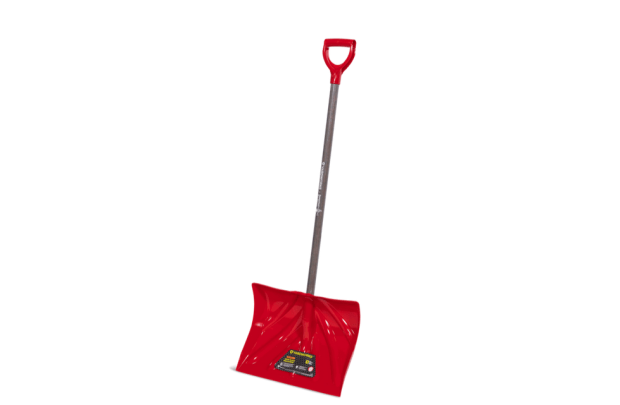
In that front vestibule was a snow shovel. We often had to shovel in front of the store after a bad snow. Pretty standard winter gear in Canada. The front vestibule was the sensible place to store the messy shovel during those times, rather than create a puddle of melting slush in the back.
I was working one afternoon when three to four aimless teenagers were killing time in the store. I hate to paint all teenagers with one brush, I was once one too, but I was never as snotty as the kids that I dealt with that day. Like most teenagers, they were just there to kill time. No money was spent.
I kept an eye on them on their way out, and saw one of them grab my shovel and make a break for it!
Who steals a shovel? A fucking shovel?
I ran outside into the cold and yelled.
“HEY! HEY YOU! BRING THAT BACK! THAT’S OUR SHOVEL!”
Having been busted, the kid turned around and said, “I was just trying to see how fast I could run…with a shovel…”
What what? A true WTF moment and one that had me lose faith in the next generation one more time.
I remember one other detail that must be relayed. I sometimes felt that the Big Boss Man did not have my back, and this was just one other incident. I called him and told him what happened, and his reaction was not what I expected. I expected a “Good job,” or “Thanks for keeping your eyes open.” Instead I received, “Mike…you probably shouldn’t have reacted that way.”
What? Now there are two WTF moments!
If the kid had stolen a $5 CD and got away with it, I’d be scolded for not paying attention. He tried to steal a $20 shovel, and I’m the one who got in shit?
I’ll never understand the upper management I dealt with for those years. And I’ve never had to deal with managers like that since. Tells you something.
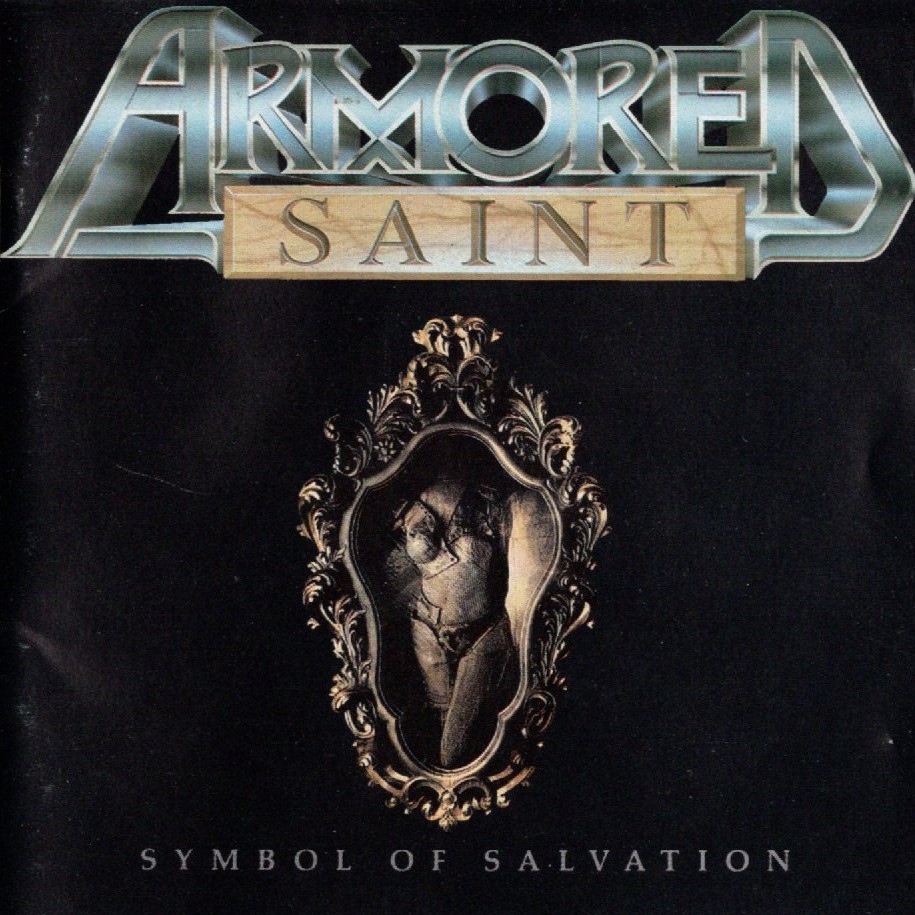
ARMORED SAINT – Symbol of Salvation (1991 Metal Blade)
In 1991, an hour-long album was becoming standard. In Armored Saint’s case, it’s all killer no filler.
It wasn’t an easy time for the metal pioneers. Founding guitarist and songwriter Dave Prichard died of leukemia far too young. He left behind a handful of songs on a 4-track demo. All but seamlessly, Jeff Duncan of Odin filled his spot, while original guitarist (and brother of drummer Gonzo) Phil Sandoval returned to the band. With lead vocalist John Bush, and bassist Joey Vera, this lineup is still current today…although the band obviously broke up when John joined Anthrax for Sound of White Noise!
Although Symbol of Salvation was a triumph and a fine tribute to Prichard, the band did split afterwards. It was 1991, and there was little future for a band like Armored Saint. Fortunately they made this one count.
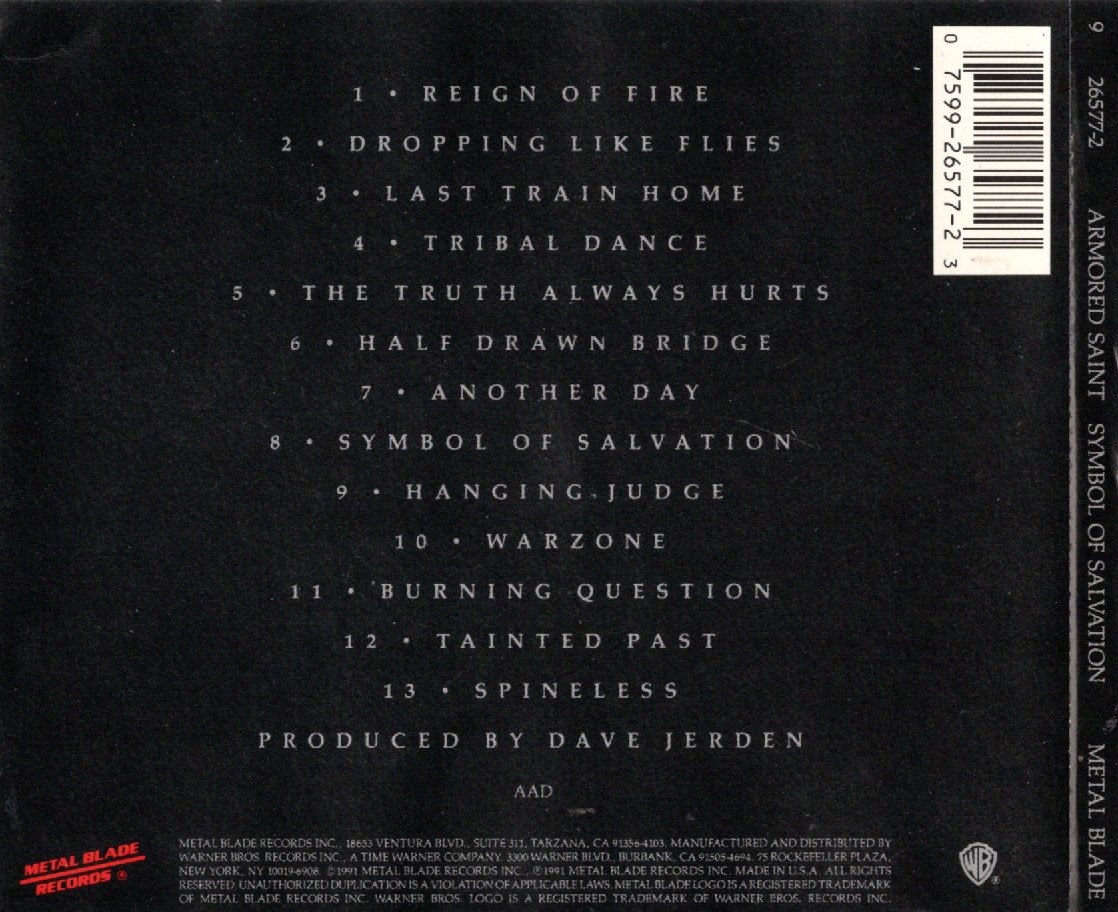
Symbol of Salvation is unrepentantly heavy. Opener (and lead single) “Reign of Fire” is notable for a number for things. 1) Its incredible heavy chug (written by Prichard). 2) John Bush’s voice, straining at the leash every time he screams. 3) Incredibly crisp and heavy production by Dave Jerden. 4) The very evil looking music video. 5) An awesome chorus! The album would be worth buying for this one song, but fortunately the other 12 are also great.
No less massive, “Dropping Like Flies” is melodic viciousness. Without the speed of “Reign of Fire”, it still retains that screamin’ heaviness. Another highlight is the more mainstream “Last Train Home”, an emotional and strong track that acted as second single. The indelible chorus is impossible to forget. This leads into the heavy “Tribal Dance”, spotlighting the percussion of Gonzo. Joey Vera’s bass work is also impressive here (as it always is). This is jungle metal, perhaps, a stomping romp through the bush with blades unsheathed.
One of the more divisive songs might have been “The Truth Always Hurts”. To these ears, the riff (P. Sandoval/J. Duncan) sounds like sleaze metal from two years prior. You could imagine Poison writing a song around it, though obviously not as heavy! Make no mistake, “The Truth Always Hurts” is heavy, but there are elements here that could work in other genres if stripped of the crunch.
Backwards guitar introduces “Half Drawn Bridge”, an ominous and progressive instrumental which introduces the ballad “Another Day”. It is unfortunate that this song never had a chance like Metallica ballads soon would. It is reminiscent of some of the ballads that Testament were known to do. In case you were worried, it picks up when it’s time for the solos!
The title track “Symbol of Salvation” is a riff monster. Perhaps Hetfield wishes he wrote a reptillian riff as lethal as this one. Brilliant heavy track; Bush at peak scream. Then, there’s a chugging guitar like “Street Justice” by Twisted Sister, which soon breaks loose into the main riff of “Hanging Judge”. Another riff, another chorus, another metal should-be classic. That is nothing compared to “Warzone”, like Iron Maiden on anabolic steroids. That is to say, it has the delicacy of some of Maiden’s work, but with the beefy pummelling of a boxing glove. “Warzone” could be the highlight deep cut – what soloing too!
There is still plenty of metal to go. In an earlier age, Symbol of Salvation would have been a double album (or at least a 3-sider!) but its length is not a weakness. “Burning Question” brings back the speed. It leaps and bounds, once again with brilliant solo work by Duncan/Sandoval. Yet it’s the riff you’ll keep coming back to (if not the chorus).
Perhaps the most impressive song from a technical point of view is “Tainted Past”, the only song with a Dave Prichard guitar solo. They painstakingly pulled his haunting and emotional solo from a demo cassette, and seamlessly used it in this track that Joey Vera wrote. It’s jazzy and progressive to start, before Gonzo’s rock beats begin. It’s definitely unusual and unlike any other song on the album. You could say it’s album epic, which suits, since it’s over seven minutes long.
An album like this deserves a memorable closer. That would be “Spineless”, a thrashing good time, and probably the fastest song on the album. Bookending the album with the fastest tunes, “Reign of Fire” and “Spineless”, was a cool move. It’s a neckbreaker for sure. “Spineless! That’s what you are!”
Every metal fan owes it to themselves to check this album out at least once. Do it.
4.5/5 stars
Don’t forget to check out John Clauser’s excellent album battle episode – Symbol of Salvation vs. Sound of White Noise!
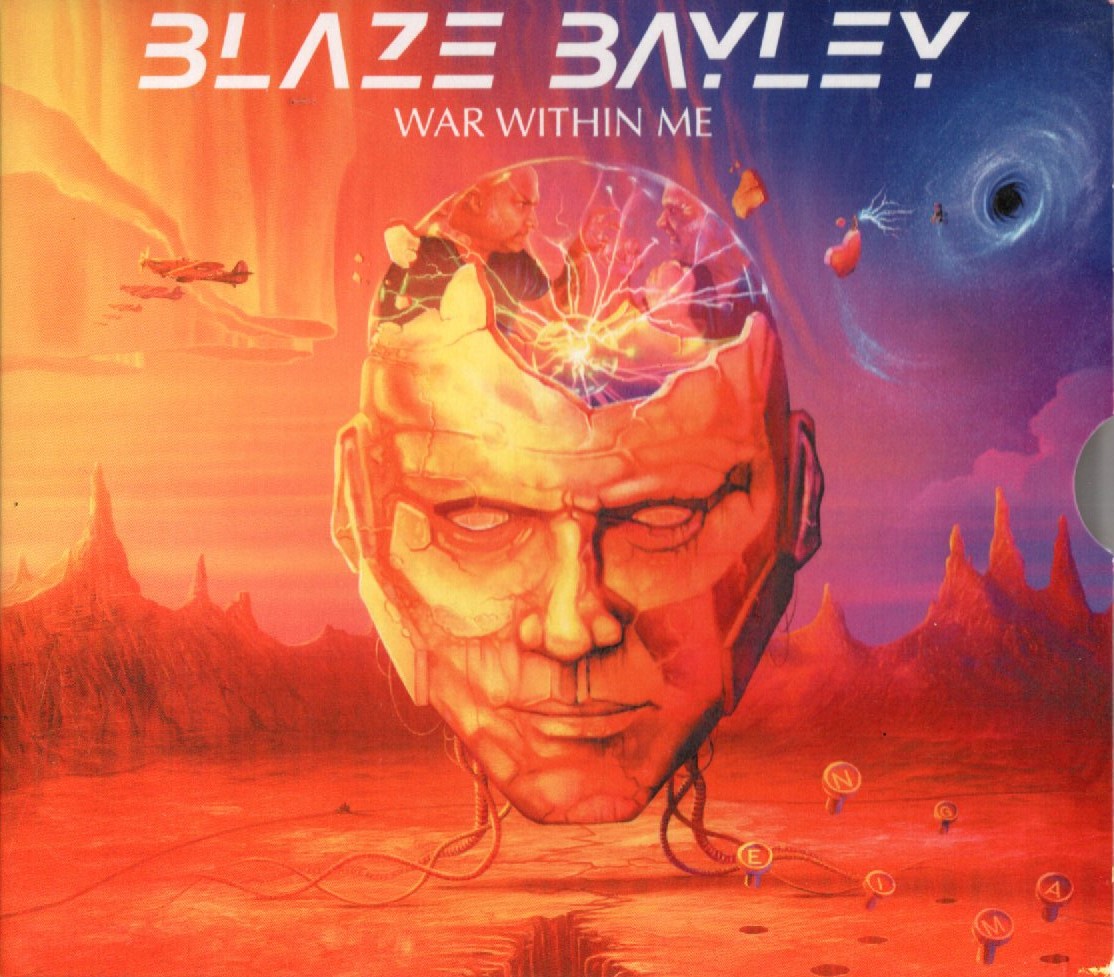
In 2021, Blaze Bayley released one of his finest solo albums, War Within Me. It was his 10th studio album and somehow it was also his best, rivaling his work with the inimitable Iron Maiden. It is also his most Maiden-esque, though heavier. Blaze fails to fall into lyrical cliches and presents a series of cutting riffs, elevating this album to apex predator status.
Opening with a blitzkrieg of battering drums and lightning fast riffing, the title track “War Within Me” is exactly what it sounds like. It is a battle for the mind! “Never give up, I won’t back down!” howls Blaze, singing as strongly as he did 30 years ago. “War within me, every day I fight!” What an opening! A mission statement from Blaze, with ribbons of guitars ensnared with cannon-blasts of beats.
Blaze takes us from the battle of the mind to the Battle of Britain of World War II. The RAF No. 303 squadron is the subject of “303”. Of course, this is a subject Blaze is familiar with, since Iron Maiden targeted the Battle of Britain with their own “Aces High”, one of Blaze’s top ten Maiden songs that he didn’t sing on. Like the opening track, this one too blasts forth with the throttle locked on full. Importantly, Blaze maintains a firm lock on vocal melodies and guitar harmonies. It’s very Maiden-esque, but cranked.
Blaze wisely slows things down on the third track, “Warrior”, one of the man’s very best songs of his whole career, before he speeds up once again. The guitar breaks are very Maiden-esque, perhaps even more like Bruce Dickinson’s latter-day solo work with Roy Z. This is tasty metal, sprinkled with explosive guitar spark. “I can be a warrior, with courage to rise up again!” growls Blaze like he means it. Along similar inspirational lines is “Pull Yourself Up”, a grinder that takes the tempo back a notch or two. The chorus on this one will eventually work its way into your skull like a drill. One of the riffs is very much like present day Maiden. The lyrics are obviously very personal to Blaze, with lines like “They said I could not sing.” This is something you see from those who don’t know.
Stop doubting yourself, Questioning yourself, Stop hating yourself, To believe in yourself. Control my own thoughts, Control my own mind, They said I could not sing, Come and sing with me!
“Witches Night” is one that takes a few listens to sink in. Once it does, the chorus sticks. The acoustic guitar segments add texture to the album, and again there’s a late Maiden quality to it. Then, “18 Nights” also takes a listen or three to hit properly. This is a simple tale of a South American tour – flights and earthquakes, oh my! “Evacuate to higher ground!” warns Blaze. “Stop the show!” A blazing winner – pardon the pun.
War Within Me has a semi-conceptual segment that I call the “scientist trilogy”. There are three parts: “The Dream of Alan Turing” about AI, “The Power of Nikola Tesla” about free energy, and “The Unstoppable Stephen Hawking” regarding his survival against the odds. “They only gave him three years to live, but Hawking defied them!” This track is all about not listening to those who say there is no hope. “They don’t know everything!” bellows Blaze. All three songs are excellent, each one different, but all three possessing a mighty Maiden-esque strength, heavier than that band but with similar flavours. Brilliant choruses on all three.
Appropriately, the album concludes with a ballad called “Every Storm Ends”. It’s about overcoming, which Blaze has certainly done. With War Within Me, Blaze has topped everything he released before under his own name. Not bad after 35 years making music.
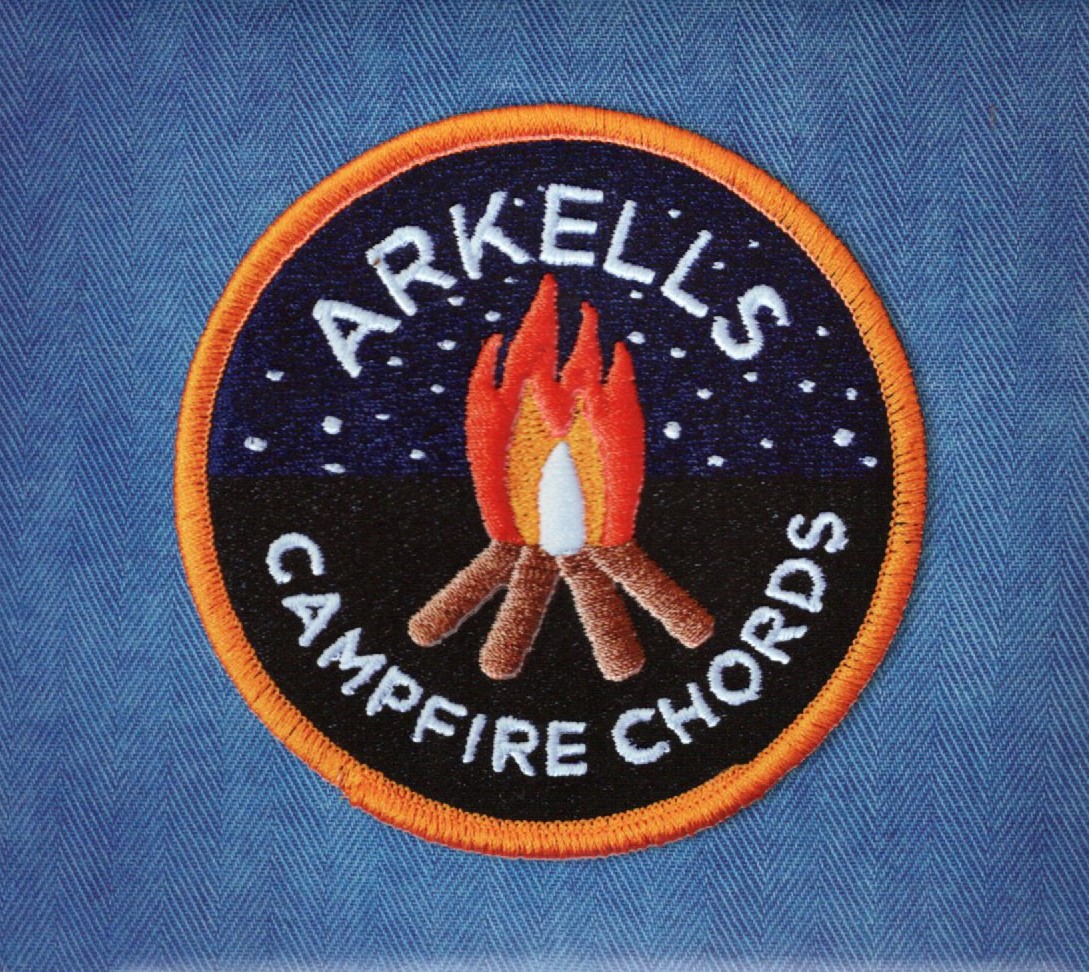
March, 2020: the world came to a sudden halt as the Covid-19 pandemic spread from city to city, nation to nation. We isolated in our homes and offices to keep our loved ones safe, and we waited it out. For bands, everything stopped. Gigs were cancelled, and recordings had to be done remotely from home. On the bright side, this resulted in some brilliant music from legacy bands. For the Arkells, it meant stopping all work on the next studio album (Blink Once) and separating for four months. At the encouragement of bassist Nick Dika, the band got down to their singer-songwriter basics with a series of stripped-down versions of the “greatest hits” (so to speak). Keyboardist Anthony Carone assembled the individual pieces into something cohesive, and Campfire Chords was born! The title refers to the “campfire test”: if a song sounds good done acoustically around a campfire, then it’s a good song. Bon Jovi have a similar philosophy.
Campfire Chords opens with a surprisingly somber “Knockin’ At Your Door”, which was more of an anthem in its single release. Souful backing vocals and pedal steel guitar gives it an entirely new feel. Although everything about the melody is the same, it feels like a new song.
Following this is a brand new song: “Quitting You”. This lovely acoustic country ballad is just a beautiful love song. Fiddles and acoustic guitars ring clean, while tambourines jangle in the background. “I thought of maybe quittin’…but there’s no quittin’ you.” Because it’s the Arkells, there are some cool “woah-oh-oh” singalongs too, because what’s a campfire without a singalong? An Arkells classic.
A second new song, “Years in the Making” opens with harmonica and a strong Max Kerman melody. This track later appeared on Blink Once in a vastly different arrangement. A true Arkells anthem, you can hear it on this stripped down version. It’s all about the melody, and then the hit of the chorus. The piano break in the middle is really nice.
One of their earliest hits, “Whistleblower”, is slowed down and intensified with soulful backing vocals and steel guitars. This one simmers, compared to the manic original. It has a different kind of intensity, but the tension is there. Another early hit, “Michigan Left” from the same album comes across really well acoustically. The “woah-oh!” chorus is intact, and though it’s slower, it’s just as uplifting. An even earlier song, from their debut album Jackson Square, called “I’m Not the Sun” comes next. It’s gentle and floaty, though the lyrics are dark. “So don’t let me be your guiding light, ’cause I’ll get you lost in the dark, I’m not the sun, there’s no guarantee, ’cause I burn out hard like a spark.” Returning to the present day, “Don’t Be A Stranger” from the Rally Cry album is a song that might be an improvement. Taking off the layers of polish, but leaving the string section in, it just breathes really smoothly now. It’s the same song, but it hits differently.
An absolute highlight of this album is the new version of “Comes to Light” from their best album High Noon. There’s a Bruce Cockburn feel to the guitars; quintessentially Canadian. This one just cuts clean through. The steel guitar is featured again, and the melodies shine. “And with my headphones on, as I fall asleep, you’re my barricade from intruding dreams.” While the original is hard to top, this one has magic to it that can’t be defined. A masterclass in re-imagining.
Another Arkells classic, “A Little Rain (A Song For Pete)” takes us to church! The Arkells go gospel, and do it like it’s second nature! The rich choir-like backing vocals lend it an undeniable authenticity, but Max Kerman absolutely nails it too. Not bad for a guy who, by the lyrics, “never tried religion”. A little rain ain’t bringing him down goes the chorus, and that feeling is washed upon the listener like a baptism. Pay attention to Nick Dika’s expressive and lyrical bass work.
Back to Rally Cry, the anthem “Eyes on the Prize” is stripped down to just acoustic and voice. Though it was written pre-pandemic, one lyric rings way more true from the perspective of 2020: “I think I’m done with the motherfuckin’ hiatus”! The choir returns with Max on the chorus, and a harmony chimes in, but the music remains mostly simple acoustic guitars and soulful singing.
Revisiting the early years again, the light and airy “Book Club” is a delight. The backing vocalists enhance its soulful feel, which was always there on the album version. Following this is the slow and moving “And Then Some” from Morning Report. One of the Arkells most beautiful love songs, it falls in the category of “personal favourite”. The original has a real pulse to it, and this one is quite different in that way, but there’s also a newly acquired softness to it. “Kiss Cam” from Michigan Left works well, given the lyrics. “This campfire won’t last forever, the Hip have only wrote so many songs.” Sadly true. “We can’t stay up north for the summer, head back to the city, find a job.” Can relate! Speaking of personal favourites, Jen loves “My Heart’s Always Yours” in particular. This acoustic version is transformed into much softer fare, like a dreamy morning anthem.
A steel guitar-laden version of the anthem “Hand Me Downs” is a back-end highlight. Then “11:11”, already a brilliant single in its own right, is enhanced by the acoustic treatment. This is another one that may in fact surpass the original. At the end of the day, it all comes down to personal taste. If you have more attachment to one version of another, that’ll colour what you prefer.
Finishing out the CD are the anthem “Relentless”, which always had a soul/R&B flavour. Here it simmers intensely like hot pavement. The closing track is the immortal “Leather Jacket” from High Noon, known to laymen as the “pay phone song”. Steel guitars take us out to the country and that’s where the album goes as it rides off in the sunset like some kind of Canadian cowboy driving a dusty pickup truck through the gravel. This is tagged by a lovely singalong (with horns) of the main hook, “You call me up from a pay phone, and I said who the fuck uses a pay phone! There’s a crazy New Orleans outro like you’ve never heard, and that’s it!
These kind of “re-imagining” albums (if you will) can be so hit and miss. I mentioned Bon Jovi earlier. Remember that atrocity they did, This Left Feels Right? It was so, so wrong. The Arkells made no such mis-step here. They key is…they didn’t have to take a left turn. They just needed to turn to a different side of their sound, and focus in like that for a whole album. The result is an acoustic album that has depth, variety, and in some cases, some versions that could top the originals.
You can’t get “Quitting You” anywhere else; to date this is its only release.
WHITESNAKE – Here I Go Again: The Whitesnake Collection (2002 Universal)
Back in the days before David Coverdale began lovingly curating his 80s catalogue with expansive box sets and assorted compilations, the record labels were doing it for him. And, all things considered, they were milking it pretty hard with very little in terms of added value to the fans who already had a decent collection. 2002’s Here I Go Again: The Whitesnake Collection might have been the first one really worth buying.
At its moment of conception, it was probable and perhaps likely that a large number of Whitesnake fans didn’t already own all three of the Geffen albums on CD. Perhaps they just owned Greatest Hits, or 1987. Rather than force fans to buy (or re-buy) a three disc set for all that material, Universal gathered 24-bit remasters of the three albums with some associated bonus tracks and released it all as more affordable two disc set. It offered good value for fans looking to get those albums digitally, or those just trying to acquire the bonus tracks.
Starting off with the rare “Radio Remix” of “Here I Go Again”, a familiar song leads the charge. This unusual version has Dan Huff on guitar, Denny Carmassi on drums, and Bill Cuomo on keyboards. It’s shorter without that long “keyboard heaven” opening. As a radio remix, it has choppier guitars, more keyboards, and prominent female backing vocals. Huff’s solo is refreshing after being used to Adrian Vandenberg’s for so long.
From there, the compilation delves into the albums, in their US mixes and running orders. Therefore, Slide It In kicks off with “Slide It In” just as I remember it. It will always be debated which version of Slide It In was superior, the original UK or the partially re-recorded US mix. I have long maintained that the US had more punch, and I still prefer it. John Sykes was a powerful force, and his modern guitar squeals helped push Whitesnake into the 80s (for better or for worse). From there the album runs through the big singles “Slow An’ Easy” and anthemic “Love Ain’t No Stranger”. These two songs alone are worth buying the album for, but the deep cuts are strong. “All or Nothing” and “Gambler” are darker, while “Guilty of Love has an upbeat rock singalong power. “Hungry For Love”, “Give Me More Time” and the cheeky “Spit It Out” are all memorable, but the dramatic “Standing In the Shadow Of Love” remains one of the most impressive Whitesnake closers to date.
There are no Slide It In-era bonus tracks included, but the next album 1987 is augmented with plenty. We already had the radio remix, so the disc dives in with opener “Crying In the Rain”, actually a re-recording of a track from Saints & Sinners, just like “Here I Go Again” itself. The CD runs through all of Side One of 1987 and partly into Side Two, with “Children of the Night” being the last song on the disc. This is the one and major flaw with The Whitesnake Collection: the oddly timed split between Discs One and Two. “Here I Go Again” (the album version) was meant to close Side One of 1987, but these things can’t be helped.
After you blast through that remarkable album and all the John Sykes guitar fireworks it contains, you are treated to a number of extras. UK-only songs “You’re Gonna Break My Heart Again” and “Looking For Love” should have been on the US album. One rocker and one ballad, they aren’t really like any of the other songs and could easily have strengthened an already mighty album. Then, for the fans that have always wanted to hear the one and only solo that Vivian Campbell recorded with Whitesnake, you are given the single mix of “Give Me All Your Love” (1988). An odd choice for a single originally when better songs were available, but significant due to Vivian’s tenure with the band. His solo is more whammy-inflected and shreddy, but it is still memorable and fitting. Weirdly, Campbell is not credited in the booklet though Sykes and Vandenberg are. The final bonus track of this era is the lovely keyboard ballad B-side “Need Your Love So Bad”, a re-recording of a Slide It In-era B-side. A song that could have even been a single! This showcase for David’s vocals features only keyboards and the man himself; no other instruments.
Some fans would stop the disc here and hit eject, for the controversial Steve Vai era is next with Slip of the Tongue. An acquired taste, or perhaps not acquirable at all, Slip of the Tongue was a left turn. Going even slicker and more modern, Coverdale eschewed the blues for the most part and took his band of pirates space truckin’. For Steve Vai fans, this album features his most commercial playing, for he didn’t write any of the songs. Adrian did, but was sidelined by injury. Now with Rudy Sarzo and Tommy Aldridge on bass and drums, the band was completely different from the 1987 version! David was pushing his voice into a higher register and it never quite sounded the same ever since. Though Slip of the Tongue was a powerful statement in the world of inventive guitar fireworks, it ultimately proved unpopular with those who preferred when David was singing the blues. Results may vary, but the perennial Vai-era bonus track “Sweet Lady Luck” closes the disc as it should. It does not have the Chris Lord-Alge remix of “Now You’re Gone”, but hey.
There are minimal liner notes and photos, and it’s amusing to read the notes from the perspective of a time when Whitesnake was no longer a band. (They reunited in 2003.) However the value here is getting all this music and relevant bonuses all in one place for a good price. It just made sense.
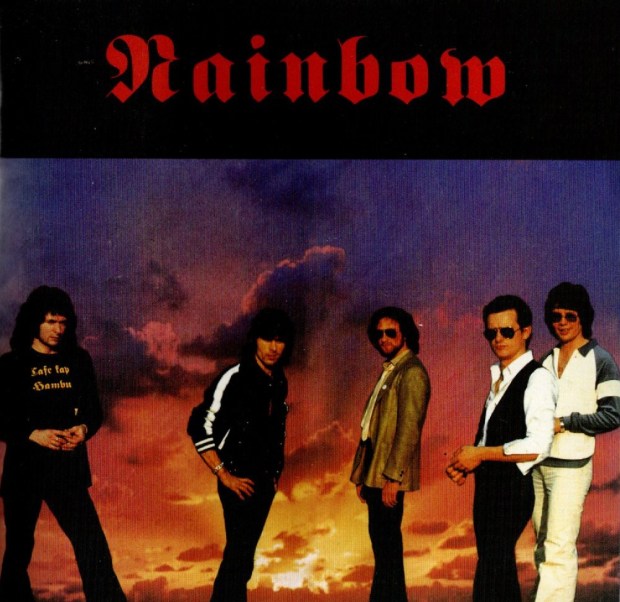
RAINBOW –Down To Earth Tour 1979 (2015 Purple Pyramid box set)
On the surface, this is quite a deluxe box set. It’s larger than than a typical CD case by an inch on either side, and it’s almost an inch deep. It has a beautiful hologram-style finish, shining and shimmery. There are three discs inside, one from each of three shows on the 1979 Rainbow tour: Denver, Long Island, and Chicago. Each CD comes in its own full colour sleeve, and there are other goodies packed inside, such as the obligatory booklet. It’s a loaded booklet, with loads of photos and text.
You might look at the track listing on the back and ask why there are only seven tracks per show (five for Chicago). Rainbow were only an opening act (for Blue Oyster Cult) on this tour, a source of frustration for the band. Also, the track listing is deceiving because “Lost In Hollywood” is a long bomber, over 20 minutes long on each disc, and contains lengthy solos and detours.
There are issues. First and foremost: the audio. It’s not great. None of the discs are particularly outstanding. They’re all different sounding; just a different variety of bad! People who buy bootlegs won’t mind so much, but when you look at a set this deluxe on the store shelves, you might be expecting more sonically. A lot more. That’s just the nature of these kinds of releases. They’re fine to play, but some people will dismiss them.
The other issue with the music would be that the tracks are repeated from show to show. The variety comes from the playing, not the setlist.
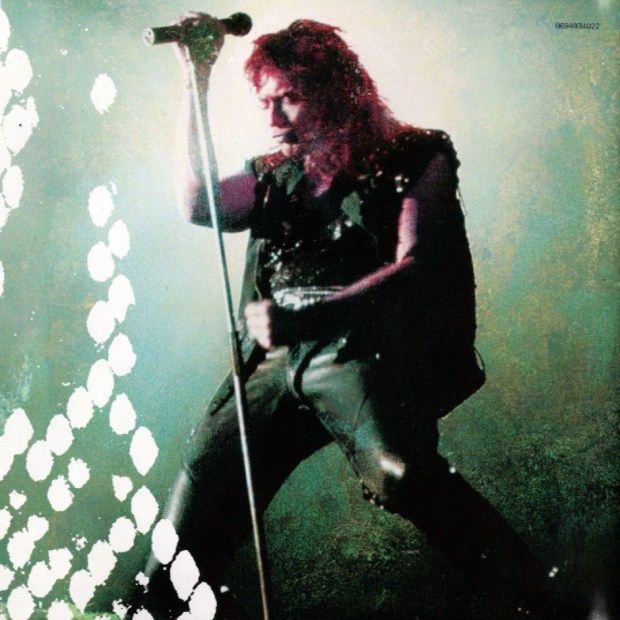
Speaking of playing, even though the band were tired of the opening slot, they don’t show it. The lineup was one of Rainbow’s best: Graham Bonnet on lead vocals, Don Airey on keyboards, Deep Purple alumnus Roger Glover on bass, the legendary Cozy Powell on drums, and of course the man in black Ritchie Blackmore on guitar. Everyone knows what to expect from a Blackmore guitar solo, but a Don Airey keyboard solo is less familiar territory. It’s part Doctor Who and part rock and roll. And Cozy, of course, slams. You only wish he were better recorded.
Rainbow were playing loads of new material on this tour, with only a handful of Dio-era classics. “Eyes of the World” is an interesting choice for opener, not an obvious selection. It causes the show to open with an electronic pulse, all atmospheric and sci-fi. It’s a change from the usual hit-em-hard kind of opener. Of course, the song does rock, but the intro is over a minute long. A second new song, the slower blues “Love’s No Friend” follows, another interesting choice. It’s rife with brilliant guitar work from Blackmore, and Airey compliments him perfectly. Continuing with new material, “Since You Been Gone” was the familiar single written by Russ Ballard, which closes with a load of solos from Blackmore and Airey, and the “Over the Rainbow” segment as well. “All Night Long” (which opened the Down to Earth album) works well to regain focus after all that meandering. I like how Graham changes the lyrics. He clearly sings “I need a girl who can give me head, all night long,” instead of “keep her head”! Unsubtle. The fifth and last of the new songs is the aforementioned scorcher “Lost In Hollywood”, bloated to 22 to 26 minutes from show to show. This is the track for the musicians in the audience, and for everyone else to take a pee. Fortunately for those who love great drum solos, Cozy has a spotlight moment. Unfortunately, not everyone loves drum solos.
The set closes with two Dio classics: “Man on the Silver Mountain” (long solo opening, and a bit of “Lazy”), and “Long Live Rock and Roll”. It’s hard for any singer to do Dio and here they sound like a Graham songs. I prefer Graham’s version of “Silver Mountain” to Joe Lynn Turner’s. Really, these are pretty good interpretations, as long as you can forget the mighty elf’s versions for a few moments. Graham had no issue with the range or power, just that he’s a completely different vocalist from Ronnie James Dio.
The Chicago set is missing “Since You’ve Been Gone” and “Silver Mountain”, which were not played that night.
The liner notes are excellent, except when printed in black ink over a blue background, rendering them extremely hard to read. It’s 28 pages with rare photos and ads. The set also includes a heavy metal bottle opener that you’ll never use, a Richie Blackmore guitar pick that you’ll never use, and a Rainbow button & patch that you won’t put on any jacket that you own.
This set is for diehards only; those that need as many Rainbow shows from as many lineups as they can get. For everyone else, it’s pure overkill.
Review written Nov 9 2009, rediscovered 2023, and posted unaltered.
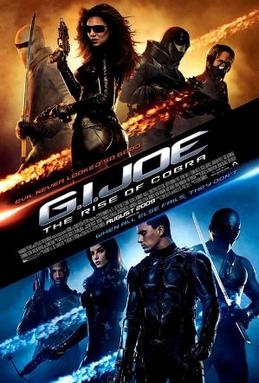
G.I. JOE: The Rise of Cobra (2009)
Directed by Stephen Sommers
I am a hardcore GI Joe fan, but only Real American Hero and its continuations. As such I am very critical of some of the liberties taken with the characters in this movie, but in the end I was pretty satisfied with the movie. Read on!
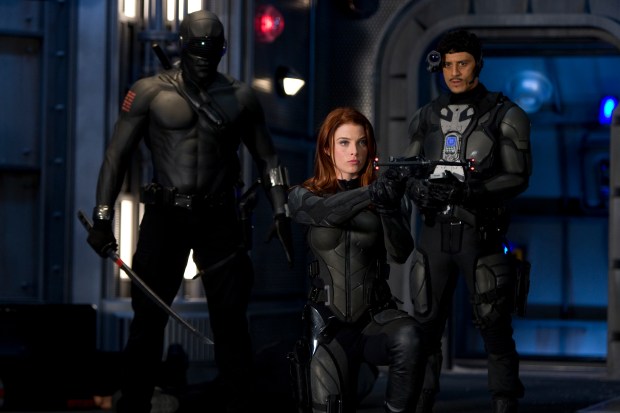
Rise Of Cobra is interesting in that Cobra and its commander don’t really exist for most of the movie. Instead, Destro and his M.A.R.S. organization are the heavies, with some support from the beautiful Baroness Anastasia DeCobray, the ninja Storm Shadow, and Zartan the master of disguise. Thus, this movie chronicles the rise of Cobra Commander and his terrorist organization determined to rule the world.
It is the “near future”. The original Marvel comic as written by Larry Hama was based on actual military tactics, history, and machines, while enhanced with lots of futuristic touches such as laser cannons and Jump-jet packs. This movie updates the franchise for the new millenium. New technology here include nanomites, accelorator suits, and other gadgets. Yet even so, updated versions of classic vehicles such as the Night Raven jet and V.A.M.P. jeeps appear. Basically, just as GI Joe was futuristic for the 80’s, this is futuristic for the now.
The acting here is bad bordering on terrible. This Channing Tatum guy can’t act at all. Dennis Quaid pours the cheeze-wiz on every line of dialogue that General Hawk delivers. Marlon Wayons (Rip Cord), Rachel Nichols (Scarlet), and Sienna Miller (Baroness) are passable. The heavies tend to get the best roles and the best actors: Arnold Vosloo (Zartan) steals every scene he is in, and Joseph Gordon-Levitt is surprisingly serpentine as Cobra Commander. Christopher Eccleston is good as the Scottish arms dealer Destro, just menacing enough while also dignified and cool. Also, it’s nice to see Jonathan Pryce in anything.
The direction, by that hack Stephen Sommers (The Mummy) is gawd-awful. He throws awkward flashback scenes in frequently with no real sense of flow. Check out The Watchmen for how to effectively do a flashback. His action scenes are pretty damn exciting, but you get a sense that a better director could have provided some more fluidity.
I’ll give you an example. The climactic sword fight between Snake Eyes and Storm Shadow is decent, and Ray Park of course is the best at what he does. However, when you compare what he does here as Snake Eyes to what he did as Darth Maul, it’s underwhelming. That’s because the director doesn’t know how to shoot a scene like this, that should be an epic monumental battle.
And speaking of Darth Maul, what’s with the blatant Star Wars ripoffs? “Stay on target! Eject!” Double-bladed sword fights, taking place in a room that looked a hell of a lot like like the one in Phantom Menace?
And what’s with Brendan Fraser’s cameo? Did he ever speak more than 4 words in a row, or was he basically just grunting?
Anyway, if you can ignore these quibbles what you have here is a sci-fi action film with some cool gimmicks and is very enjoyable. The die hard Marvel fas get a Larry Hama cameo, as well as nice touches like Breaker chewing some bubble gum and General Hawk in a wheelchair. Even Storm Shadow’s fate echoes back to what happened in the Marvel series, and I can’t wait to see it play out in the next movie. Even though I think Snake Eyes taking a vow of silence is beyond stupid.
DVD special features are pretty scarce even on this 2-disc edition. There are no deleted scenes so, unfortunately, I am certain that some sort of deluxe edition is coming. That scene from the trailer when Destro asks, “What did you say your unit was called again?” and Hawk responds, “I didn’t,” isn’t in the movie. There are definitely scenes out there that didn’t make the cut. You get the audio commentary track with the entertaining Sommers (I may not like his work but that doesn’t mean I don’t like him as a person) and two featurettes. I think this lack of extras is a bit of a ripoff and I could care less about the digital copy.
This movie is obviously the first of a franchise (Dennis Quaid is signed to three films) and it really whets the appetite for the next film. There’s even a cliffhanger/teaser ending. You only really get to know five or six Joes so I’m anxious to see who will depicted in the next film. My personal wishlist includes Stalker, and I hope Major Bludd shows up too.
If you’re a fan of action films and you don’t care about acting or realism, you’ll dig GI Joe. If you’re a diehard like me, you’ll love seeing some of the toys you owned flying around on screen. I would say that GI Joe was a more successful adaptation than the dreadful Transformers films.
3/5 stars. Very flawed, but acceptably entertaining.



















 mikeladano.com