Sunday Screening: Polychuck – “Exposure”

Thomas Polychuck is a hot new artist out of Montreal.  He’s a multi-instrumentalist with a “do it yourself” attitude.  He has a new EP out called Exposure, and Deke and I will be speaking to Thomas on the July 31 episode of the LeBrain Train.  Polychuck prides himself in his guitar shredding (since age 13!) and you can hear a bit of that on this track “Exposure”.

Let us know what you think of Polychuck and get your questions locked and loaded for our interview!


Storytime With Ryan Williams, Studio Wiz!

Great show today!  John from 2loud2oldmusic brought on engineer/mixer/musician/songwriter Ryan Williams for storytime.  Though his credits range from pop to metal, we tended to focus our discussion on rock and roll.  If you’re a fan of Stone Temple Pilots, Pearl Jam, Slayer, Staind, U2, Phil Collen of Def Leppard, Limp Bizkit, Velvet Revolver, Dave Navarro, or Kelly Clarkson then you’ll want to check this show out.

From starting out in Atlanta, to travelling the world recording epic performances, Ryan Williams has seemingly seen it all and done it all.  Recording music on a Tascam 4-track home studio, graduating to two synced 24-tracks machines, to the modern tools of today, Ryan has kept learning.  We talked about his beginnings, and working with Brendan O’Brien, all the way to the present day and the imminent release of a Stone Temple Pilots box set for Tiny Music.  Ryan even had a little bit of show and tell with some hand-written original Eddie Vedder lyrics.

Great show all around and thank you for watching.

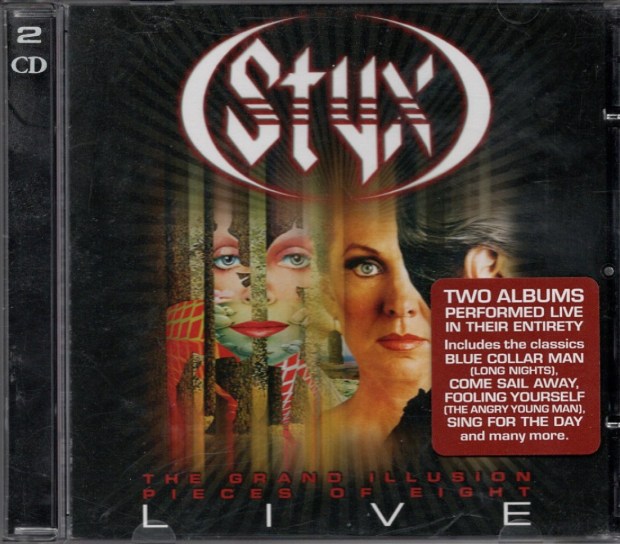
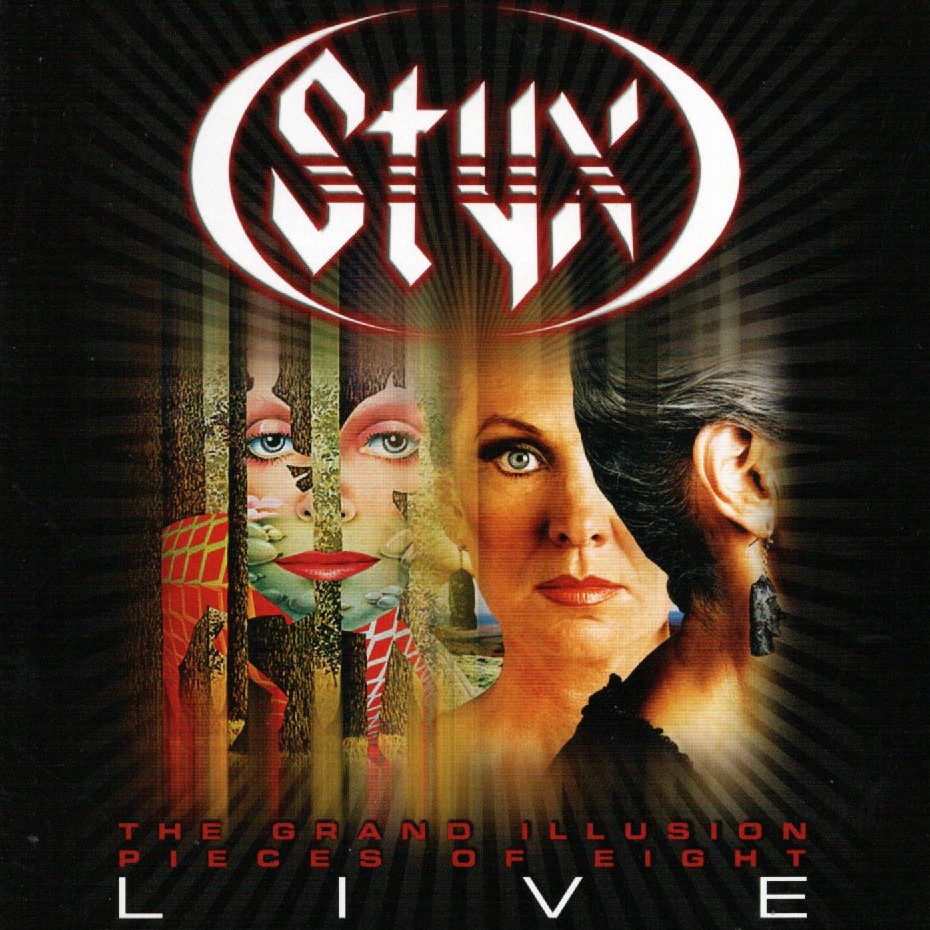
REVIEW: Styx – The Grand Illusion / Pieces of Eight Live (2011)

STYX – The Grand Illusion / Pieces of Eight Live (2011 Eagle Records)

Although legacy bands like Styx may not write and record new music as often as they used to, there have been a couple interesting effects from this.  Legendary discographies have been mined by a handful of classic bands, playing rare tracks live that haven’t been played on a stage in decades, if ever.  Sometimes, bands play full albums.  A few even play two!  Styx chose The Grand Illusion and Pieces of Eight for live resurrection.

Dipping back to 1977 and 1978, Styx picked two of their best records to perform.  Kind of the “sweet spot” between Tommy Shaw joining the band on Crystal Ball, and the drama with Dennis DeYoung on Cornerstone.  There are numerous of songs they never played live with Lawrence Gowan on vocals before, if at all!  They had to re-learn their own songs to put on this concert.  You can’t accuse them of taking the easy way out!

Tommy even tells you where the side breaks come!

With Todd Sucherman on drums, the songs are naturally heavier here.  Gowan’s voice lends a different sound to them too.  Bassist Ricky Phillips is rock solid as always, but original bassist Chuck Panozzo still comes out to play bass on the odd track live.  His rumble on “Fooling Yourself (The Angry Young Man)” is nice and prominent in the mix.

The songs have other notable differences, like more guitar solos.  James Young does Dennis’ old spoken word part on “Superstars”.  Some might wonder, “Why listen to this, when you can play the original albums with the original members any time you want?”  It would be unwise to compare the talents of Gowan and Dennis, but why can’t you just be a fan of both?  Some people want to hear Gowan singing “Come Sail Away”, and especially “Castle Walls” which was only played once before in 1978 and a handful of times in 1997.  There are many such songs on this recording.  “I’m OK” (which Gowan sings) was dropped after 1979, until this tour.  “Lords of the Rings” (James Young on vocals) was only played once in 1978.

There are stories, and songs for the diehards.  This isn’t a package for someone looking for greatest hits.  It’s also not the same as listening to an old album.  This is for the Styx fan who loves the past and present equally.

3.5/5 stars

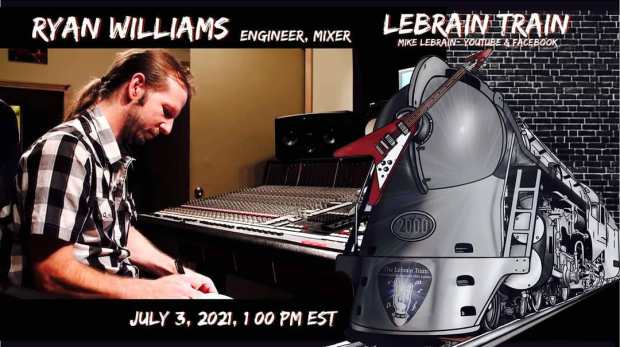
Engineer and Mixer Ryan Williams on the Saturday LeBrain Train

The LeBrain Train: 2000 Words or More with Mike and John Snow

Saturday July 3 – Episode 74 – Ryan Williams

Have you ever had anything with your name on it nominated for a Grammy award?  Ryan Williams has — for his work on Train’s Drops of Jupiter, Velvet Revolver’s Contraband, and Kelly Clarkson’s Stronger.  And we’ll be talking to him about it on Saturday’s LeBrain Train.

Join John Snow and I for this special Saturday episode with a very in-demand engineer.  How much demand?  Well, besides Stone Temple Pilots, he’s either engineered or mixed for Matt Nathanson, 3 Doors Down, Lifehouse, Linkin Park, Limp Bizkit, Pearl Jam, Outkast, Staind, Michelle Branch, The Panic Channel, Phil Collen’s Delta Deep, Korn, Static-X, Thirty Seconds to Mars, Biffy Clyro, 10 Years, Atreyu, Mastodon, Billy Idol, P!nk, Sugar Ray, Deftones, Adam Lambert, Coheed & Cambria, The Black Dahlia Murder, Bush, Neon Trees, and Beck.  He even has a co-write on a Kelly Clarkson song.  Is that enough demand for ya?

This is going to be a great chance for us to pick the brain of a guy who has literally worked with the biggest names in modern music.  You do not want to miss this one — catch it live so we can ask Ryan your questions!

Saturday July 3, 1:00 PM E.S.T. on Facebook:  MikeLeBrain and YouTube:  Mike LeBrain.

BOOK REVIEW: Gord Downie & Jeff Lemire – Secret Path (2016)

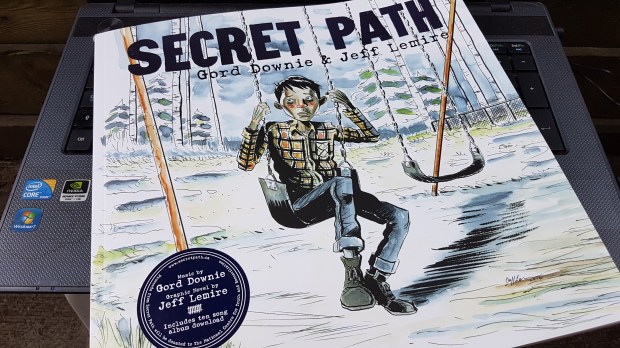
GORD DOWNIE & LEFF LEMIRE – Secret Path (2016 Simon and Schuster)

Residential schools are Canada’s shame.

History cannot be buried forever.  Eventually, atrocities are brought to light.  This terrible secret is no longer hiding in the dark.  It has shown the world that even the great nation of Canada has skeletons.  Tens of thousands of them.  Children, taken away from their families, and forced to assimilate.  Forced to lose their language, culture, and way of life.  All in the misguided and shameful effort to “civilize the savage” and “bring the heathens to God”.  Thus, “saving” them.

Thousands of these children never came home from the residential school system.  How many?  With bodies being unearthed daily, we may never know the true tally.  If Gord Downie were alive today, what would he have to say about these discoveries?

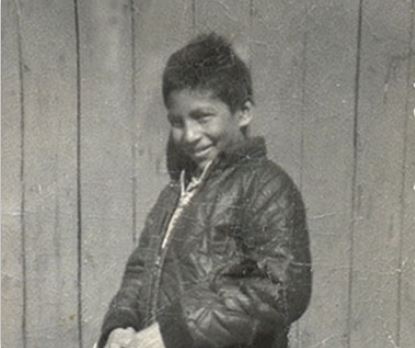
Downie and Jeff Lemire tried to tell us.  In 2016 they released Secret Path, a gorgeous and painful graphic novel to accompany the Downie album of the same name.  The book comes with a download code so you can listen along, and read the full lyrics.  It is the story of Chanie Wenjack, Anishinaabe by birth, raised in northern Ontario.  The residential school forced him to change his name to “Charlie”.  This is not ancient history.  This only happened in 1966.  The Beatles were the biggest band in the world.  Our parents were living normal lives.  Meanwhile, Wenjack and thousands like him were abused and tormented at residential schools all over the country, not even afforded the dignity of their own names.

At age 12, Wenjack ran away.  Home was 370 miles.  He never made it.  Secret Path is his story.


The book has no text other than the album’s lyrics.  Listening along is the best way to appreciate the rich images.  You must take time to study the lines and shading, for each page is rich with beauty and detail.

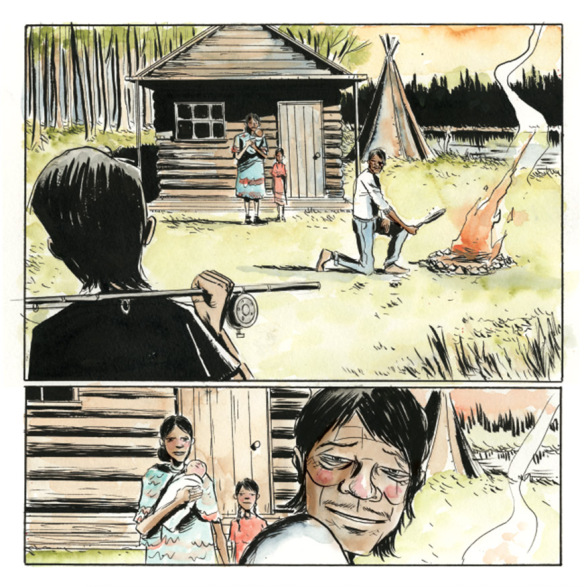
It was October of ’66 and the story begins with Chanie already on his way home.  Alone, following the train tracks, Wenjack is illustrated in stark black, blue and white.  The trees are bare, and ravens circle free overhead.  Chanie’s story is told in the form of flashbacks.   His thoughts go back to happier times, fishing with his father.  These memories are in full, beautiful watercolour.  Lemire captures the love in his drawings.

“My dad is not a wild man.  He doesn’t even drink.”

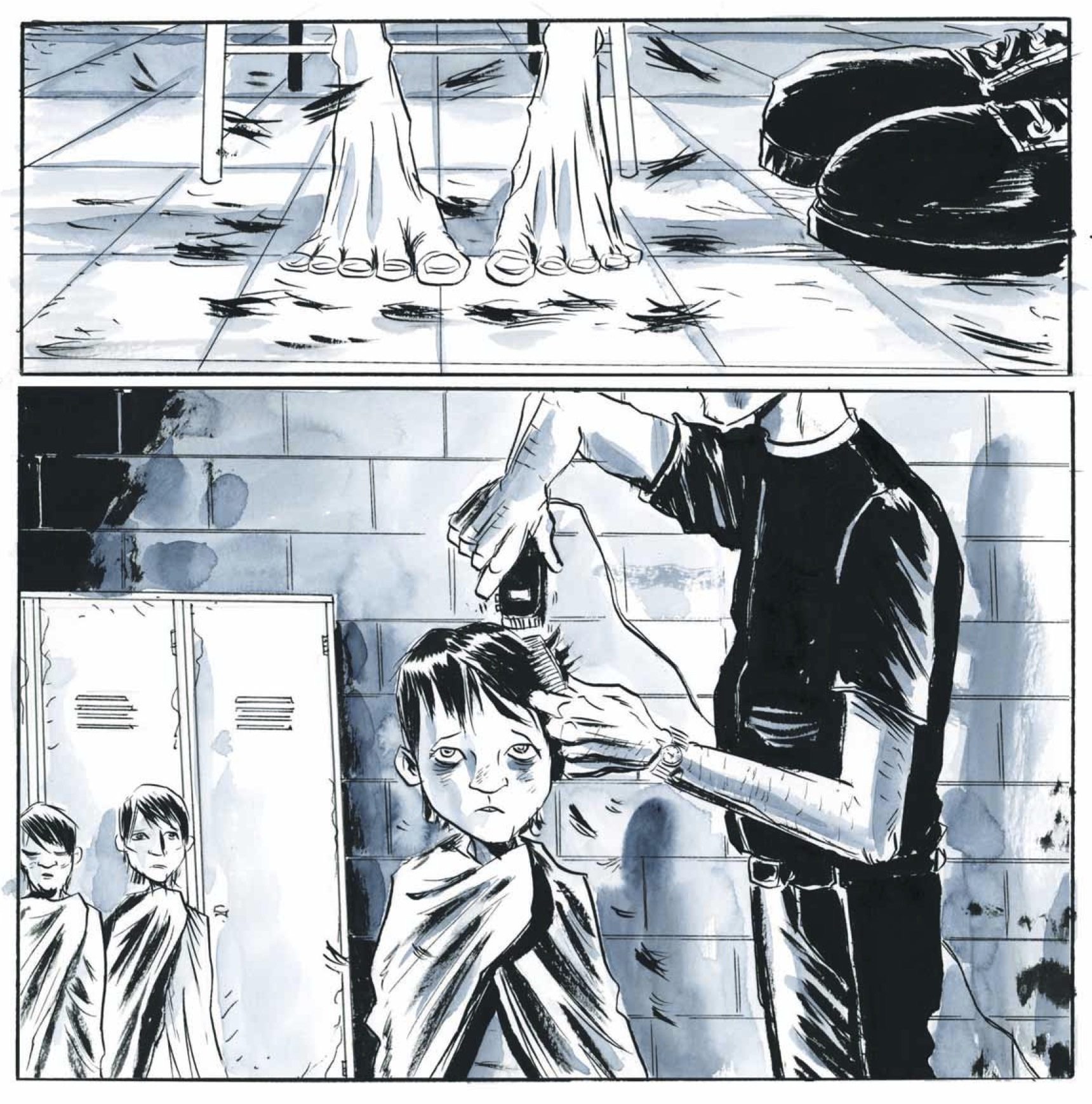
Chanie’s memories then go back to his first day at school.  Like a prisoner, he was issued a new haircut and new clothes.  His sorrow leaks through the pages.  He then thinks back to the morning of October 16.  Unable to tolerate any more abuse, Wenjack and two friends made a run for it.

“Now?”  “Not yet.”

“Now?”  “Now yes.”

They stayed briefly with the family of the other two boys, but Chanie wanted to return to his own home.  On his own, and only with a railway map, a windbreaker, and a jar with seven matches inside, Chanie followed the rail.  Only seven matches.

“And I kept them dry.  And as long as there were six, I’d be fine.”

“As long as there were five.”

“As long as there were four…”

His thoughts return once again to the school.  Sexual abuse is alluded to.  Chanie continues to run on his secret path, but he also tries to escape from his memories.  They are never far behind.  Only happy dreams of his father bring warmth, and they are gloriously painted in fall colours.  As he weakens, hallucinations manifest, both good and bad.  He wishes for revenge, and to see his father one more time.  The raven circles overhead.

“I’ll just close my eyes.  I’ll just catch my breath.”

While there is no way to really know the thoughts and feelings of Chanie Wenjack during his final walk, Secret Path is not a work of fiction.  It happened.  And now we know that Chanie is one of thousands.  Chanie Wenjack did not die on that train track from exposure to the elements.  He died of genocide.

If this book does not make you feel, then consult a doctor because something is wrong with your heart.

5/5 stars

#913: A Walk to the Mall 1988

RECORD STORE TALES #913: A Walk to the Mall 1988

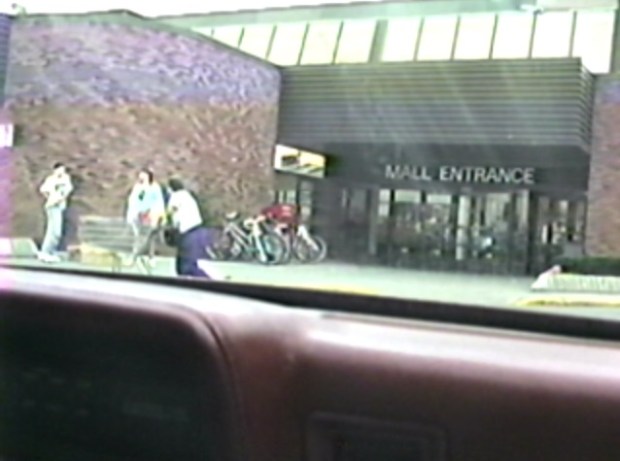
Bob and I went to the mall a lot.  Stanley Park Mall was kind of epicenter of the neighborhood.  Though it didn’t have a record store of the caliber of Sam the Record Man downtown, it had an A&A and a Zellers where you could find all the big releases and a few singles.  It had a grocery store, which meant just about every neighbour bought their supplies at the same place.  The Zellers store stocked anything else you needed.  There was a liquor store.  Two banks.  We didn’t need to go elsewhere very often.

It was a nice short walk.  We used to take a short cut through the apartments at the very end of Secord Ave.  But they fenced up the shortcuts.  Sometimes Bob and I would go that way and jump the fences just out of spite.

“They can’t stop us from going this way,” we said.

We were little assholes sometimes, but we had a good time doing it.

The Little Short Stop was an important store.  That’s where I would buy my rock magazines.  Hit Parader, every single month.  I never missed an issue from some time in 1987 through 1990.  One thing we loved doing was leafing through seeing ads for all the rock albums that were due to come out.  “New Ace Frehley!” I exclaimed upon seeing an ad for Second Sighting.  The ads would often tell you names of the forthcoming singles.  The ad for Open Up and Say…Ahh! by Poison highlighted the track “Good Love” as a song to watch for.  Maybe the marketing for that album changed midway?

I eventually stopped buying Hit Parader, and switched to other mags like Metal Edge.  The reason?  I always suspected there was something up with their interviews.  There was a sameness to them, no matter who was answering.  Then, Sebastian Bach from Skid Row got in some serious trouble when an audience member at a concert threw a bottle at him.  Injured and enraged, he made the incredibly stupid mistake of throwing the bottle back, and hitting an innocent girl instead.  Hit Parader fabricated an interview with Bach where he was quoted as saying “That’s why rock stars have lawyers, man” or something to that effect.  The quote was used against him in court.

Not to deflect blame for the incident away from Bach, but I couldn’t support Hit Parader any more after that.  Not to mention, I was disappointed to realize that many of the rest of their interviews also had to be fake.  I gave away my collection many years ago.

In 1988, however, Hit Parader was my Bible.  That, and WWF Magazine, which was equally fake.  I always left that store with both magazines if I could.  If I couldn’t, the Zehrs store often had the WWF Magazine issues that I needed.  Some pop and chips, and we were all set for Short Stop.

WWF Magazine was devious.  They had the monthly publication, but also many periodical specials, and I had to collect them all.  There was the official Wrestlemania book.  Another one for Summer Slam.  Royal Rumble.  Survivor Series.  My mom used to say that the World Wrestling Federation got a lot of money out of us!  I would also buy the Toronto Sun the day after a major wrestling event.  They had the most complete coverage, often with full colour photos.  I may still have an old Toronto Sun from that time.

Then we were off to browse the music at A&A.  We’d look at the charts and see if any bands we liked were up there.  Maiden’s Seventh Son of a Seventh Son was for about a week.  I was pleased when I saw Priest’s Ram It Down on the chart later that year.  We’d shop around, but I rarely had enough money for a new tape.  Bob did — he had a job.

But browse we did, usually looking for Kiss tapes that we had never seen in stock before.  Or Europe.  Or Ozzy.  Whitesnake, Cinderella, AC/DC, Def Leppard, all of our favourites.  Cassettes were like crack to us.  We were always searching.  Something “rare” would be a must-buy.

Bob would often save his money and buy five tapes at a time.  He took chances on stuff I never heard of, like Fifth Angel.  He would caution me and make sure I was making the right purchase.  He was somewhat surprised when I got into Bon Jovi and decided I wanted to buy Slippery When Wet.  He wasn’t really into them that much.  “Are you sure that’s what you want?” he asked me one night at the Zellers store.  I was sure.

“Have you ever seen this one before?” we would ask each other.  The Bon Jovi cassette single “Wanted: Dead or Alive” was one I had my eyes on for several months at that A&A store.  You just did not see it very often, so when I had the money, I grabbed it.  It was worth it for the incredible acoustic version of the song.  Bob didn’t buy singles as often.  He valued a full length for his money, but he made exceptions for bands like Iron Maiden.  You couldn’t find Maiden singles at A&A though.  You had to go to Sam’s for those.  Bob wold trek there on his bike.  Fortunately he sold his Maiden singles collection to me when he did finally let them go.

One of the most distinctive features of the old Stanley Park Mall that people remember is that it was shaped like a big “O”; like an oval.  We would walk around and around.  Just talking, looking at the magazines I had purchased.  Or the tapes he just bought.  Discussing everything going on in music, in the neighbourhood and at school.  Because the mall was such a central location for so many people, we’d always run into schoolmates or neighbours.  Sometimes a girl that I liked, but I never had the courage to talk to any.

The mall has changed so much and the “O” is gone.  All the good stuff is gone.  A harsh reminder of the passage of time.  But I can still retrace my steps.

Bob was a fast walker but I could keep up.  You didn’t waste a lot of time on your way home from the mall.  You wanted to get down to business of listening to the new music, or reading the new magazines.  That was a special kind of Saturday in old ’88.


#912: My First Guitar

RECORD STORE TALES #912: My First Guitar

Bob had a blue and yellow BMX bike, so I had to have a blue and yellow BMX bike.

Bob had a leather jacket, and so I had to have a leather jacket.

Bob had an electric guitar…so I had to have an electric guitar.

Early in 1988, Bob bought his first and only guitar.  It was a jagged, black Stinger with a whammy bar.   It had two double coil pickups.  He had strap locks so he could twirl his guitar over his shoulder if he wanted.  And I had to have all these things too.

Bob bought his guitar second-hand from a guy who said “it used to belong to the guy from Helix”.  Of course there was no way to verify this so we never treated it as fact.   The first weekend he had it, he invited me over to check it out.  How hard could a guitar be to play?  They used to teach sheet music in grade school, so I thought “piece of cake, I can play guitar”.

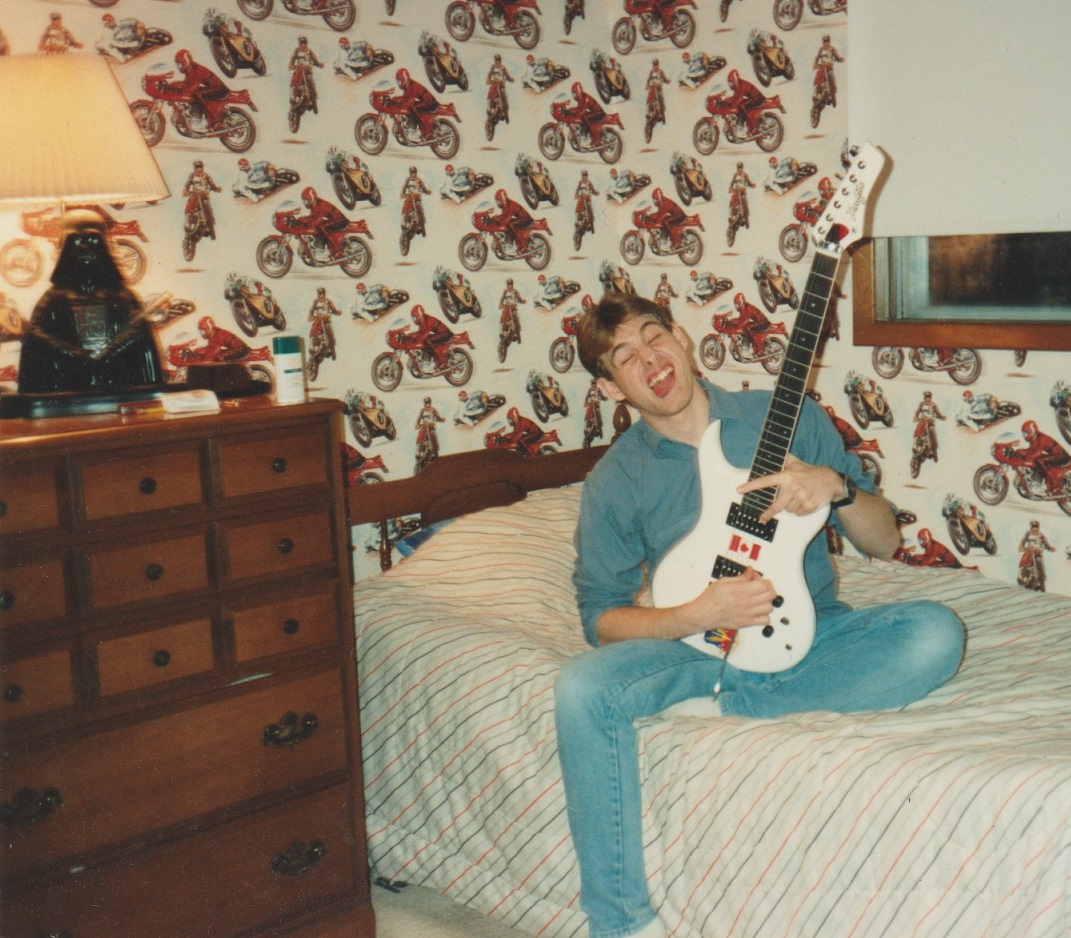
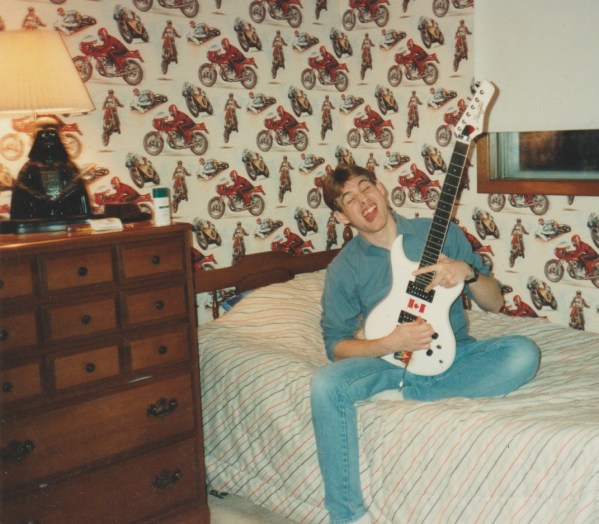
I told my parents that I was getting a guitar, and to them it was just another thing that Bob had, that I had to have too.  And since Bob was two years older and had a part-time job, they’d be paying for this guitar that I insisted I was getting.  Bob and I went out on our own one afternoon, to East End Music in downtown Kitchener.  We browsed, got the help of the man working (probably the owner) and I picked out a generic white guitar.  It had what I needed — the humbucking pickups and whammy bar like Bob had.

“The black and white guitars will be a cool contrast,” we both thought.

I really wanted that guitar.  I thought it was just meant to be.  Bob and I were going to form a band.  This was the first step.  We already had a few band names picked out.

“We’ll be back,” I told the guy as we left.  I was really excited.  Upon arriving at home, I proceeded with begging my parents for the guitar.  My dad wasn’t happy, especially when I explained to him that we already told the guy that I was coming back for it.

“Oh no,” he moaned.  But they agreed, as long as I took music lessons.  That seemed like a pretty sweet deal!  My dad got out his cheque book, asked the man, “What can you do for me here?” and bought me the white generic instrument that I couldn’t live without, at a slightly reduced price!  I was the only one who was happy with the outcome.

It was at this point that I discovered that guitar was really hard.
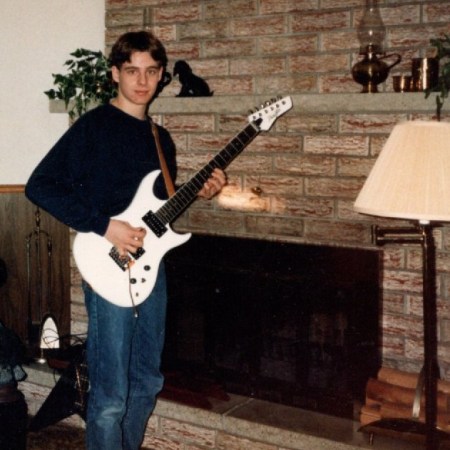
Look closely in this picture and you can see the black cardboard “air guitar” that I made, and our old Atari 2600 console.  

Sure, I could pick out the first six or seven notes of the “Detroit Rock City” solo, but not in time.  Bob and I figured out how to do a simple version of the “Wasted Years” intro, but couldn’t play the song any further than that.  I saw a kid at school playing acoustic guitar, and he did something with his fingers that I couldn’t.  He laid his index finger on the fretboard, and played multiple strings at once — the skill of chording that I had yet to learn.

My mom found a teacher that did housecalls.  It was perfect — my sister was learning keyboards from him.  Gary Mertz was his name, a keyboard player by nature but also able to teach guitar.  Bob would come over on Saturday mornings, and take his lesson after Kathryn and I had finished.  Gary could teach three lessons in one stop, and I believe there was a fourth kid in the neighborhood that he taught as well.  After lessons, sometimes Bob and I would hang out and listen to music, or go to the mall.

The first lesson I really learned about guitar is why you don’t want a whammy bar.  I spent most of my time tuning that thing, and replacing a set of strings was a nightmare.  “I’ll never buy another guitar with a whammy bar,” I said after buying a second guitar with a whammy bar.

The reason I bought that second guitar was due to an accident with the first.  I left it lying upright, leaning on a bench.  It got tangled in a cable, and when my sister got her keyboard out to practice, the cable yanked on the whammy bar.  The guitar hit the bench and the headstock broke in two.  It was made clear to me by both Gary and my parents that this accident was my fault.  But Gary found a guy who would fix it.

A broken guitar is never as good as it was brand new.  A couple years later I bought my Kramer flying V, which became my preferred instrument.  It too was a white guitar, and so I said to Bob:  “My gimmick is that every guitar I own will be a white guitar.”  He thought that was cool, because two of my favourite players, Adrian Smith and Phil Collen, frequently played white guitars.

The fact of the matter is, some people can play instruments, and some people can’t.  I went the full distance before admitting that I can’t.   I modified my first axe with some cool stickers. Bob and I both bought “super slinky” guitar strings thinking it would help us play fast.   For my guitar strap, I chose a cool faux-snakeskin thing.  (I didn’t want animal print — too 1984.)  I had an electronic tuner, a suitably heavy ancient tube amp with a reverb pedal, and a collection of different picks.  Gary tried to make my mom feel better about my difficulty.  “It’s not as easy as the keyboard,” he explained.  “If I dropped an ashtray on this key, it’s still going to make the right note.  A guitar won’t.”  But eventually, I called it quits.  It turns out that my sister got all the talent.

Bob didn’t think he was learning anything from Gary, and he quit several months before I did.  He had a new interest now:  sailboarding.

“Oh I suppose you’re going to want a sailboard now!” said my mom with a warning tone in her voice.

But I didn’t follow Bob this time.  Sailboarding was the first thing Bob was into, that I had no interest in.  I toiled away at guitar a little longer, thinking now I could be a solo artist.  I wrote some lyrics and recorded some ideas on cassette.  Half of my ideas were played on the keyboard using the “guitar” voice, because I just couldn’t play guitar.

My first guitar, the one bought in February 1988 at East End Music in downtown Kitchener, with the repaired headstock, was sold to an older lady that Gary was teaching.  I’m sure she was able to get more music out of it than I did.
 

REVIEW: Marillion – Unplugged at the Walls (1999)

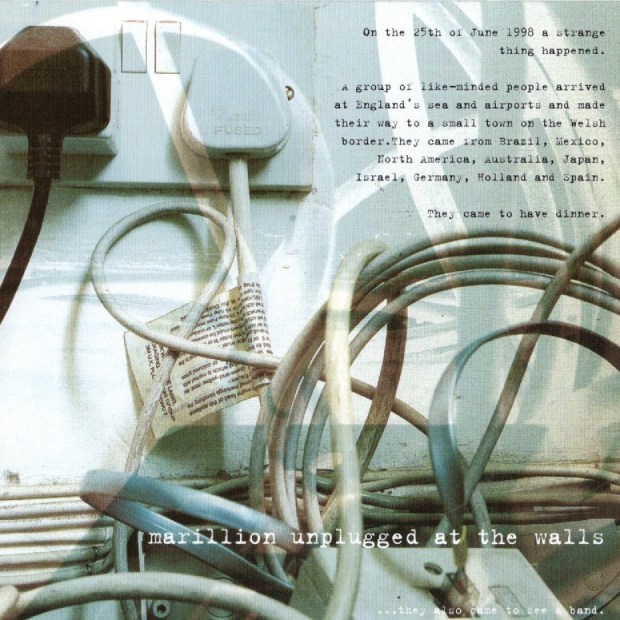
On the 25th of June 1998 a strange thing happened.

A group of like-minded people arrived at England’s sea and airports and made their way to a small town on the Welsh border.  The came from Brazil, Mexico, North America, Australia, Japan, Israel, Germany, Holland and Spain.

They came to have dinner.

…they also came to see a band.


MARILLION – Unplugged at the Walls (1999 Racket Records – Racket 10)

What’s your favourite acoustic album?

We all know the big “unplugged” performances, but between the cracks fell the web-only release Unplugged at the Walls by Marillion.  Only available via their website, this remarkable album was recorded while Marillion were working on their 10th record Radiation back in 1998.

While recording in Oswestry, Marillion struck a deal with the “best restaurant in town”, the Walls.  Now independent, every penny counted.  In exchange for free meals, Marillion agreed to play some acoustic sets at the Walls.  The idea grew and people came from all over the world to hear new songs and tunes that had never been played acoustically before.  They stripped down and re-arranged songs, added some surprises, and the result is one of the best Marillion live albums ever made.  Out of over 100!

Sampling tracks from the five Hogarth-era albums, no oldies were to be found.  Plenty of singles though:  “Easter”, “Alone Again in the Lap of Luxury”, “Hooks in You”, “Eighty Days”, and “Beautiful” which opens the set.

While Marillion have always been top-notch musicians, in an unplugged setting such as this, Steve Hogarth is the standout performer.  Whether whispering or letting it all out, Hogarth is never less than spellbinding.  He is always in complete command, with every ear on him.

The highlights are many, but Marillion’s version of Radiohead’s “Fake Plastic Trees” may surpass the original.  That’s all because of Hogarth.  Nobody can touch him.  He gets more intense as the song builds.  When he sings “I could blow through the ceiling,” you truly believe it.  The track is so good that they eventually used it as the B-side to “These Chains”.

“Abraham, Martin and John” (Marvin Gaye) is a track Marillion have since released on other live albums, but this gentle version is fantastic.  This one sports some beautifully warm electric guitar tones courtesy of Steve Rothery.  Marillion also cover “Blackbird” (The Beatles, but you knew that) and do a damn respectable job of it.  Instead of birds chirping, you get the sound of diners cheering!

The new songs premiered that night were the already-acoustic “Now She’ll Never Know”, and “The Answering Machine” which, over the years, has been popular both electrically and acoustically.  “Now She’ll Never Know” is the quietest song of the night.  “Answering Machine” meanwhile is one of the most upbeat.

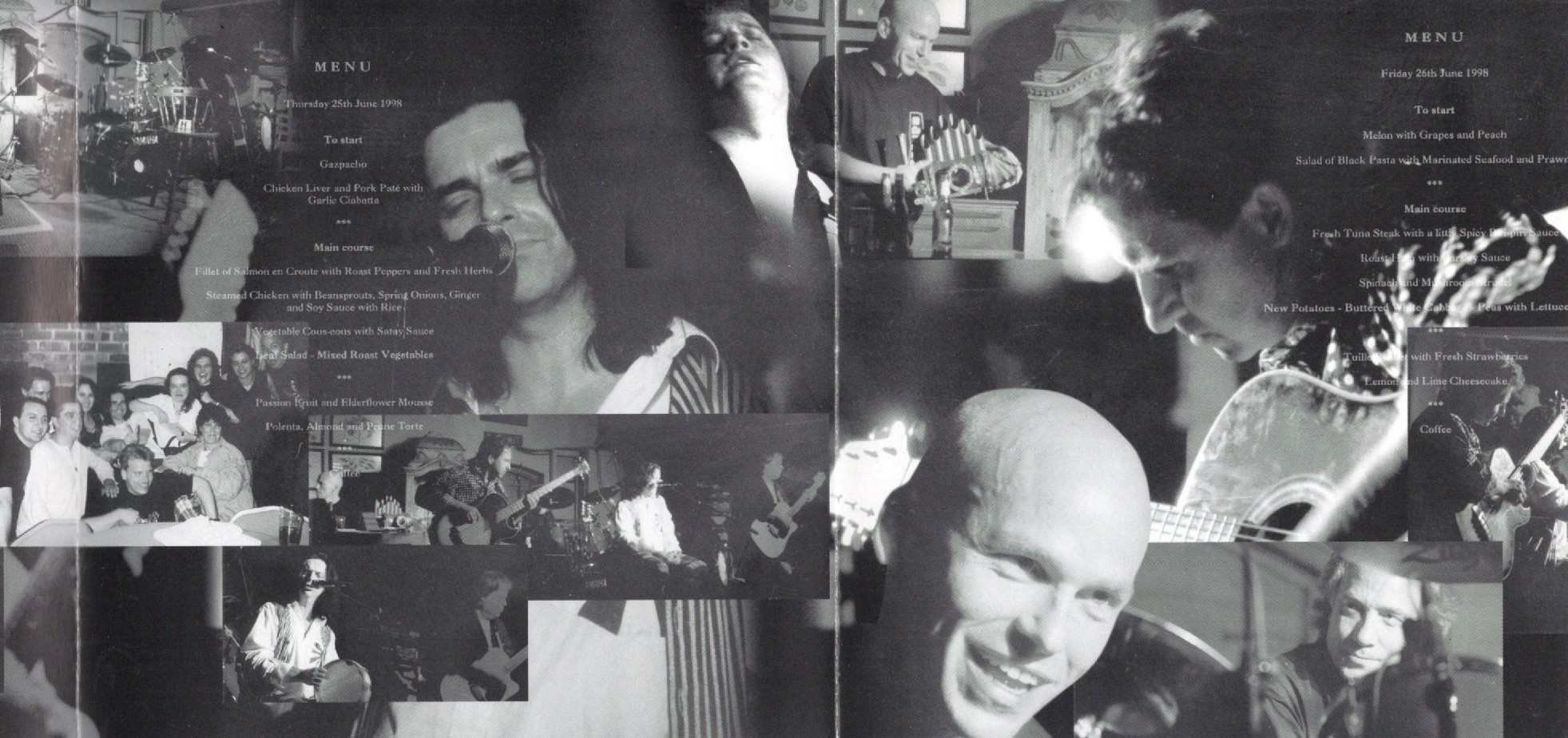
They also tackled the surf-rocker “Cannibal Surf Babe” which did just fine unplugged and stripped to the basics.  “The Space” received a completely new, jazzy arrangement.  They played this version many times over the year, but it’s a bit of a slog compared to the rest.  The closer “Eighty Days” is jaunty and receives a massive response from the crowd, as does “Gazpacho”.  Appropriately enough, the Walls had gazpacho on their menu that night.

Speaking of which, the menu is included as part of the booklet.  It does indeed sound like the best restaurant in town!  “Salad of black pasta with marinated seafood and prawns.”  Wow!

This album was reissued in 2018, giving everybody a chance to get one.  You should.

5/5 stars


Sunday Chuckle Screening: Styx – “Love is the Ritual” (1990)

In 1990, Styx reunited — but without Tommy Shaw. Busy with Damn Yankees, Shaw would have to be replaced. And, let’s face it, it always seemed like most of the Styx friction was between Tommy Shaw and Dennis DeYoung. Needing someone to fill Tommy’s “Shooz”, they recruited young singer/songwriter/guitarist Glen Burtnik.

The DeYoung/Young/Burtnik/Panozzo/Panozzo lineup produced one album, Edge of the Century. It was heralded by lead single “Love is the Ritual”, a decidedly un-Styx-like attempt to break into the 1990 rock market after a seven year absence.

You could mistake it for Winger. With Burtnik front and center, Styx take a back seat in their own music video. Dennis is rarely seen, only needed when there’s a “Hey!” backing vocal.  Glen fronts the band with microphone in hand — no guitar. If ever there was a music video built to appeal to the young while trying to hide the age or identity of the band, it is “Love is the Ritual”. The clip is padded out with shots of women and a Fabio-like dude. Truly an awful video, and an embarrassing attempt to grab the brass ring one more time.

All About Suicide Star: Brian Hamilton and Rob Barton rock the LeBrain Train!

Suicide Star is the hot new band featuring singer Rob Barton, drummer Brian Hamilton, bassist Aki Maris, and guitarist Les Serran.  Metal with a modern twist — classic music, new songs, vital lyrics.  An album written and recorded during and of this time, but with an eye on the future.   A hard rocking, uplifting, heartfelt album aptly titled Isolation.

I had the pleasure of speaking to Brian and Rob about many topics.  Among them:

  • The genesis of the band
  • The making of the album (remotely)
  • The music video for “Mercy”
  • The next video
  • The meaning of the lyrics
  • The future of recording and playing live
  • Brian’s history with New Wave
  • To solo or not to solo?
  • New Storm Force

Check out the band on your favourite streaming services such as Spotify, Amazon, or buy the CD from the band.  As revealed in this interview, the CD version has additional content not available to stream.  Physical product!  Check them out on Facebook.

Big thanks to Rob and Brian for coming on the show with us music nerds, and congratulations on a wicked CD.

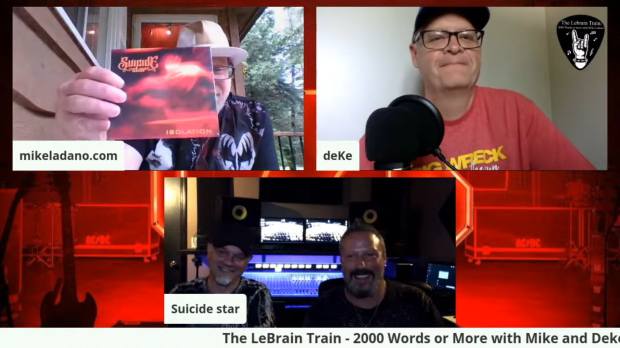
Another big thank-you to last Friday’s guest Robert Lawson, who sent me a signed copy of his book Razama-Snaz! The Listener’s Guide to Nazareth.  I opened the package near the start of the video.

I hope you enjoy this very special episode with Suicide Star, a great band that is going places.