Just because I left my old job at the Record Store didn’t mean I stopped journaling. It did slow down, but it’s interesting to review them today, having just completed the Record Store Tales. It’s fascinating to me how positive they are (in general) compared to the ones only 18 months prior. It’s also interesting how even over a year after leaving that place, certain people continued to terrify me. Even though the person I’ll call “the office bully” had no power over me anymore, I was still in the grips in fear at the mere thought. I’m seeing journal entries about this person haunting my thoughts over a year after my last encounter, and I’m reading words like “terror”. I didn’t realize how I’d been affected by the whole thing. I couldn’t see the forest for the trees. It took years for me to really put it all together, and I’m still doing that.
My journals after the store are pretty bland by comparison to the ones before. There are still some pretty funny ones, such as a review of the movie Transformers (2007) that is so stupidly positive that there is no way I will post it here, not even for comedic value! I would simply lose all credibility, so forget it. I remember dragging Jen out to see that stupid thing.
Of the journals I’ve re-discovered, one in particular jumped out at me as a great one to post first.
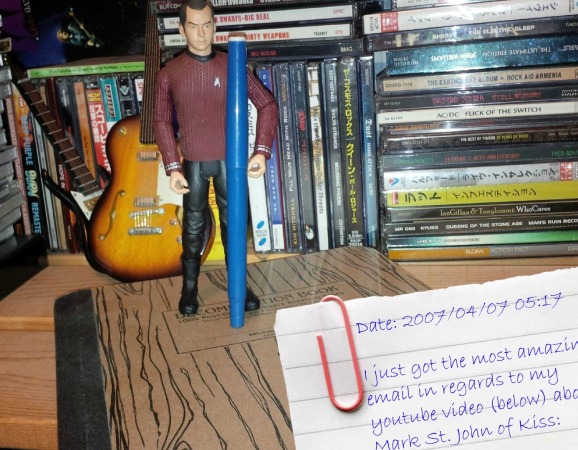
I won’t share the whole thing in its entirety as it includes a private email, but the first paragraph is pretty cool. I had made a video on Youtube back then regarding the passing of Mark St. John. I don’t have the video anymore, but it was pretty heartfelt and apparently others must have got that out of the video as well. This journal preserved an email that I received from a cousin of Mark:
Date: 2007/04/07 05:17
I just got the most amazing email in regards to my youtube video (below) [now gone] about Mark St. John of Kiss:
“Thank you so much for your tribute to Mark. He was my cousin. Mom called to tell me the bad news. She said Aunt Terry said to look him up online to see all the posts etc. on different sites. It was really cool of you to make your RIP video. [content edited] Thanks again for what you said….he will be greatly missed.”
Stuff like that video, I just threw it together. It was a first take with no edits. But apparently it really touched Mark’s cousin. This was yet another stepping stone in my realization that I should be online, talking about music. I think that was a good decision.
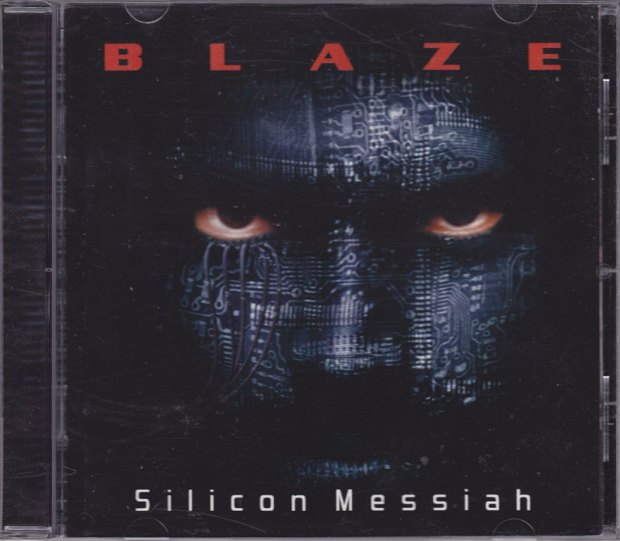
It took Blaze Bayley a couple years to bounce back with a new band and album, and given the fan reception to his work with Iron Maiden, I was skeptical. I didn’t shell out for the Japanese, but I did grab the domestic CD as soon as a copy arrived in our stores. I was pleasantly surprised, as Blaze’s debut solo release Silicon Messiah is a very heavy and memorable disc.
The weakness for some will be Blaze’s voice. You either like it or you don’t. Outside of the context of Iron Maiden, his deep vocals work better. The opening track “Ghost in the Machine” for example is a de-tuned chugger the likes of which Maiden wouldn’t do. Blaze’s vocals work better with this kind of low, growly metal. Fortunately there is still enough melody (on the killer chorus) and riffage to keep heads banging. And no wonder: the CD is produced by metal master Andy Sneap, who laid waste to several excellent Accept albums recently. Blaze wrote the music with his new eponymous band: Steve Wray and John Slater (guitars), Jeff Singer (drums), and Rob Naylor (bass). The band is somewhat faceless, aside from Blaze himself there’s nothing identifiable about the band.
If there is a weakness to Silicon Messiah, it’s that there is a certain sameness to the songs. It’s a bit homogeneous: grinding, de-tuned riffs, melodic choruses and solos, with powerful but low vocals. Fortunately Blaze has written some surprisingly decent lyrics to go with the songs, with several seeming to fit together into some kind of cyberpunk concept.
Highlights:
“Silicon Messiah”, perhaps the most Maiden-like track.
“Born as a Stranger”, also Maiden-like (think “Be Quick or Be Dead”); speedy goodness.
“The Brave”, another fast one that kicks all the asses in the room. “Fortune favours the brave” indeed.
“Identity” which boasts lots of tasty guitar bits along with loud and quiet parts.
“The Launch” which is essentially “Man of the Edge” by Iron Maiden re-written (but with a better chorus).
“Stare at the Sun”, your typical Maiden-inspired epic closer.
Blaze Bayley, his band and Andy Sneap created a pretty decent metal album here. It’s perfectly listenable throughout, if a bit anonymous sounding. Fans of Blaze will dig it.
“Mike!” he began. “They have a Europe album you don’t have down at Sam the Record Man. You should get it, but it’s only on record.”
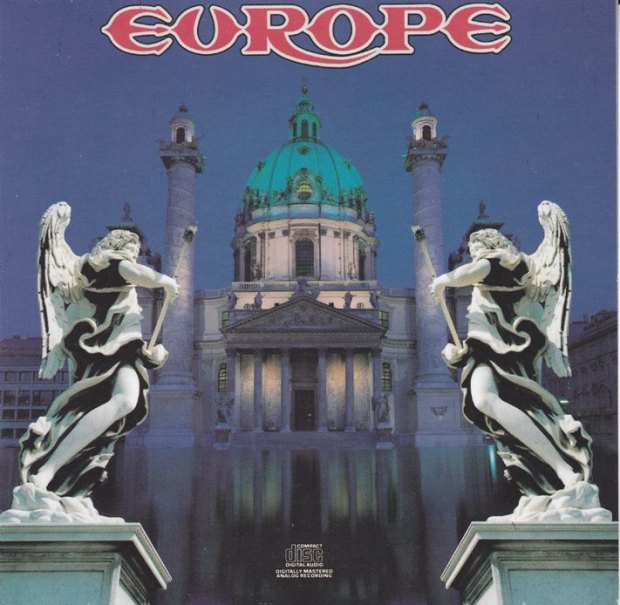
I knew Europe had albums prior to The Final Countdown, but I had never seen nor heard them. Since my primary format was cassette back then, I passed on the vinyl version. A few weeks later, Europe the album showed up in the new Columbia House catalog, so I ordered it on tape. I had reasoned out that this was their first album, but the 1989 date on the back made it look like a new release. In fact Martin Popoff even reviewed it as such in Riff Kills Man!, stating that the poodle hair and keyboards were “gone” and replaced by sheer heavy metal. He’s right about the heavy metal, even if he had the order of the albums wrong. Europe resembles the band of “Carrie” and “Rock the Night” only superficially. This is a metal album, and a damn fine one at that.
The regal, thunderous riff of “In the Future to Come” should warn away anyone expecting power ballads. This speedy UFO/Priest hybrid certainly took me by surprise. Singer Joey Tempest’s voice was not the soulful powerhouse it would later become, but he was just a kid at the time. The metal here is pure: no frills, no excesses, just steamhammer rhythm and a howling lead singer. Throw in some ace John Norum guitar work and you have something to talk about. His double-tracked solo might be reminiscent of Thin Lizzy.
“Farewell” is straightforward heavy metal, on the hard rock side of things. Some may be off-put by the flat lead vocals, but I say, “Hey, it’s rock n’ roll.” The song slams and the chorus is memorable enough for me. Then “Seven Doors Hotel” changes the scene with a haunting piano opening…but it’s merely a fake out. The speed metal riffing and wailing Norum are back. Norum makes his Les Paul howl like Joey does at the microphone. Even though there’s some neoclassical finesse to some of the music, I hear a bit of Phil Lynott in there too.
My favourite song then and now is probably “The King Will Return”. The lyrics aren’t very good, but English wasn’t Joey’s first language. I still enjoy the words, as it’s one of those medieval story-telling songs that I’m a sucker for. This softer song is still pretty epic and wouldn’t be considered wimpy by anyone. Side one was closed by the Norum instrumental song “Boyazont”. I don’t know what a “boyazont” is, but who cares? Norum instrumentals are usually ballsy and catchy, and this is no exception.
The second side is commenced by “Children of this Time”, which continues much in the vein of songs like “In the Future to Come”. Then for a respite, “Words of Wisdom” has an acoustic verse. That doesn’t make it a ballad! No, this picks up speed for the chorus and continues to storm the gates of Valhalla like the rest of the album. It’s a bit slower in pace, but the drums still hit like hammers while Joey howls at the thunder. I think I can even hear timpani. “Paradize Bay” (not sure why they spelled it with a z) is one of the album’s strongest cuts. It’s a relentless battering ram with a chorus that hints at the grandness of Europe in the future. Norum’s solo is sloppy but delicious. “Memories” then closes the album on a frenetic note. There are plenty of “woah woah” vocals to go around, and drummer Tony Reno seemingly pulverizes his kit. There’s another voice singing with Joey on the outro of the song; is this John Norum?
This album was self produced, and as such it sounds very raw. But heavy! Not all bands who self produced early in their careers managed to get results as good as those on Europe. For 1983 and just a bunch of kids, this is damn fine work! And it holds up. It’s a headbanger.
I spent this morning collecting and converting my video files from last Saturday’s Toronto trip, and I’m looking forward to making another video. Phase one of the video creation is done, the conversion of the files. I’ve imported all the files into my video editing software, and now all I need is some background music and I’m good to get going! Since I don’t have a finished video to show you, I thought instead I’d post yet another teaser. Yeah I suck.
These magic boxes were in Chinatown, $1.99 each, and are they ever cool:
Here are some cool Kill Bill Hallowe’en costumes we saw while stopping at Yorkdale to pee:
And here’s me, coffee in hand, beginning the long process of video file conversion! Cupface on!
We all end up with CDs that we no longer want or need. I very rarely sell my CDs anymore. I’d rather donate them to a new home, where I know they will be loved and appreciated. The money part is less important to me. The last time I decided to sell off some CDs, I decided to try Sunrise at Fairview Mall (now closed). I’d never tried selling there before, but I had bought plenty. Their pricing was more than fair, but the guy was very slow. He didn’t seem as knowledgeable as the people I was used to dealing with. For example, I sold him my original, non-remastered CD copy of Twisted Sister’s Stay Hungry. He asked me, “What is wrong with this CD?” It seemed he didn’t know what remastered vs. non-remastered was, only that the bar code he had punched in came up as something “discontinued”. So I had to explain the remastered vs. original thing to him. He ended up giving me $5 for the CD which was good, and I took store credit (which was a little bit more).
Still, it took him a lot of time. I only had a handful to sell that day (10 CDs if I remember) and it took the guy more than half an hour to look at them. It wasn’t a bad experience; I ended up with enough store credit to buy a some things. The money was good, about the same as I would have got at my old workplace. It was a comparable total, and I was happy with it, but the wait was a little excessive. I used the store credit to buy my friend Peter the new Metallica live set for his birthday.
I have also sold my discs (CD and DVD) at garage sales, an experience so memorable that I’ve written a future Getting More Tale about that story. Stay tuned! I’m saving that one. Let’s just say that serious garage sale people are an entire species to themselves; the cheapest people you will ever meet in your life.
I don’t need to do any more major purges of my music collection, currently. Any time I need to weed things out (usually an old version of a CD that I have upgraded) I can always find them a new home. You might say, “Sure, but money is better.” Maybe, but my friends return the favor in spades, so I can’t complain. I’m often the recipient of used CDs and movies that are sent to me in repayment for the discs I gifted earlier. Nobody ever asks for repayment, we just seem to have created circles of friends who share the wealth. In fact I’ve acquired some really great collectible stuff just due to the charity of friends. Thanks!
What do you do with your old CDs? Sell ’em, trade ’em, gift ’em? I’m curious so let me know in the comments!
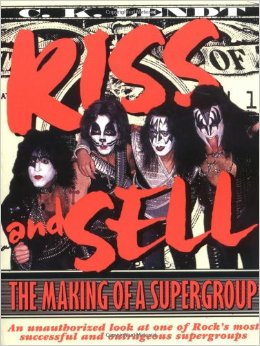
C.K. LENDT – Kiss and Sell: The Making of a Supergroup (1997 Billboard Books)
Chris Lendt used to be an accountant for Kiss’ management company (from ’76-’88), and according to him, quite close to the band. He spent a lot of time on the road, with the band, keeping track of the money. The story he tells is amusing at times, off-topic at others, but also often critical of his former bosses.
Lendt distills Kiss’ legacy to profit/loss diagrams. At the same time, he tells a lot of stories about excess, touring, and groupies, but not a lot about rock and roll. If you are looking for the nitty gritty details about Kiss and the music, this is not the book for you. For that book, check out Black Diamond by Dale Sherman. If you want one person’s account of the inner workings of the Kiss business, then read on.
Lendt describes parties, extravagent budgets, and stage shows. Where things get really interesting in this book is when things start to go sour for Kiss, right around the time of the Dynasty tour in ’79. He desribes Gene’s plan for “Kiss World”, a traveling amusement park that was to play outside of Kiss’ concerts on that tour. Needless to say it never happened, but it’s not something that’s well covered in other books, at least in this level of detail. He talks about recording budgets, about Ace Frehley building a gajillion dollar home studio that was never used (and later turned into a swimming pool), about wigs (Gene’s), about gurus (Paul’s), and about desperately copying every move Bon Jovi made when they hit it big in ’86, before his company was fired by Kiss in ’88.
He also spends a bit too much time talking about Diana Ross, whom his company was also managing. There are too many pages about investments, stuffy boardroom meetings, profit margins, and budgets. While this book is very insightful, covering many details that nobody else was privy to, it’s not enough about rock and roll. I can’t even tell if Lendt really likes rock and roll. Certainly, he liked working for Kiss in the early years, and the touring, but the later years are marked by constant criticism. (A bit like my own Record Store Tales, I guess.)
Pick up Kiss and Sell cheaply, read it and enjoy it; but please also pick up Dale Sherman’s Black Diamond, and Kiss’ own Behind The Mask. Both books are more about the music, and both books are actually surprisingly critical as well. All three together will be a very well rounded reading of the hottest band in the land.
3/5 stars. More if the author would stick to the topic!
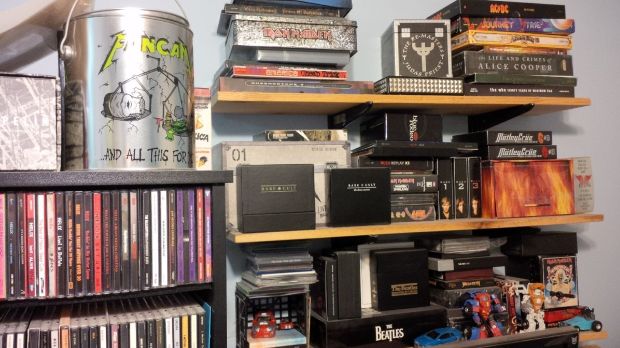
Nothing like getting a re-organizing project going, eh? Especially when you’re a music lover like we all are. Here are some pictures of things as they are now, before I begin. The reason there are so many piles of discs out is because I’m out of storage space. I will cleverly re-organize and create space, but the long term solution is that I’ll have more room when we move. That plan has been delayed due to Jen’s illness but we’ll get there.
In the meantime, organizing and handling the physical product is really a labor of love. It’s work too, but it’s a lot of fun. It gives me an excuse to spend time with some old friends for a few hours!
You’ll probably recognize a few of the titles visible below from recent reviews!
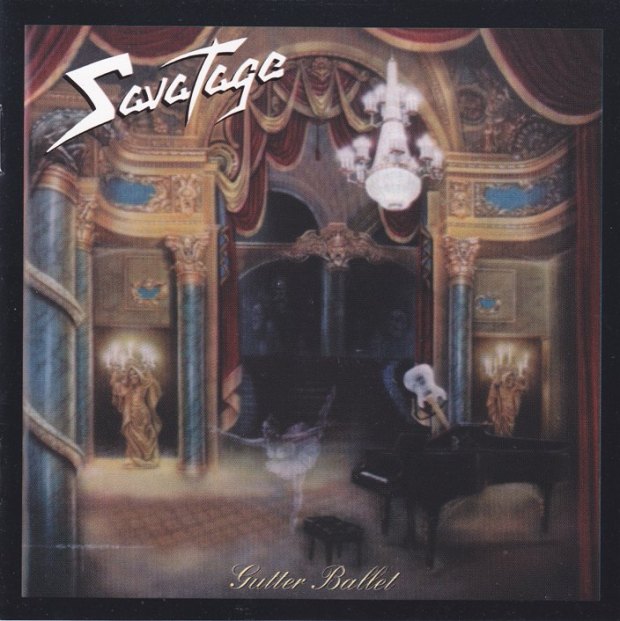
Having first latched onto Savatage in ’87 with “Hall of the Mountain King”, I was primed and ready for Gutter Ballet. What I didn’t expect was the heavy piano on the title track/first single. But that was a pleasant surprise: I was heavily getting into piano within the context of hard rock at the time. Savatage’s Jon Oliva has a tendency to write simple but very catchy piano parts. “Gutter Ballet” was inside my head on first mindblowing listen. All that was left for me to do was buy the album.
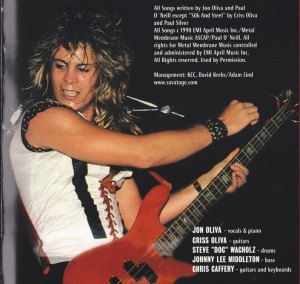
Savatage have reissued Gutter Ballet with different bonus tracks many times. I have the 2002 Steamhammer release (the Earmusic version) which has an extensive booklet with ample liner notes. Gutter Ballet was the post-rehab album for Jon Oliva, and this informs many of the lyrics (“Thorazine Shuffle” for example). Upon beginning the album, Jon and his brother Criss wrote heavy guitar based metal songs which were later included as bonus tracks on various releases. Not satisfied, producer/co-writer Paul O’Neill sent Oliva out to see Phantom of the Opera in New York. This changed everything. Meanwhile, the rehab stint ended up producing a three song mini-suite. The road to 1991’s Streets: A Rock Opera was now paved.
Gutter Ballet commences with “Of Rage and War,” the bass hook of which reminds of “24 Hours Ago” from the last album. It has one of those staggered Criss Oliva guitar riffs that I miss so much, and the unforgettable drum patterns of Steve “Doc” Wacholz. The lyrics are not profound, but they’re catchy enough (especially when Oliva starts shrieking). They’re also still relevant today.
You got Libya, you got the Russians You got civilian planes crashing to the oceans Airports full of terrorists, Nazi skins, anarchists When are you gonna learn?
Lyrics aside, the strongest thing about “Of Rage and War” is the guitar riffing. The six-string then takes a bit of a back seat (solo aside of course) on “Gutter Ballet” to the piano for the first time. Oliva’s simple melody is one of the first that I learned to play on keyboard and I still have my old cassette demo somewhere! A minute later things speed up and get dramatic. As good as the piano part is, the guitar riff that comes in to compliment it is just as stellar.
Could “Gutter Ballet” be Savatage’s best song? You could easily argue that, even though the band would later ramp up the drama and complexity on their albums. I think the song is completely without flaw. From Jon’s lyrics (inspired by a stabbing he witnessed while in New York) to the slightest piano accents, the track is perfect. And it even manages to maintain its balls, which I’m sure helped longtime Savatage fans adapt to the new sound.
First video with Chris Caffery.
“Temptation Revelation” is a 3:07 instrumental track that really only serves to bridge “Gutter Ballet” to another piano based hit, “When the Crowds are Gone”. The piano and guitar vibe is maintained throughout. “When the Crowds are Gone” is a very special song, and undoubtedly you could call it a ballad. It has heavy choruses, but the thrust of the song is based on Jon’s voice and piano. Jon sounds tiny at first before using his full throat. The song was first conceived by Paul O’Neill as part of the later Streets rock opera, a project he had cooking for many years. The song would have fallen after “A Little Too Far” on side one. I think it’s another one of Savatage’s best-ever compositions, and Jon’s screaming at the end seems to really embody the desperation of the lead character.
I never wanted to know, never wanted to see I wasted my time, till time wasted me Never wanted to go, always wanted to stay ‘Cause the person I am, are the parts that I play.
So I plot and I plan, hope and I scheme To the lure of a night, filled with unfinished dreams I’m holding on tight, to a world gone astray As they charge me for years I can no longer pay.
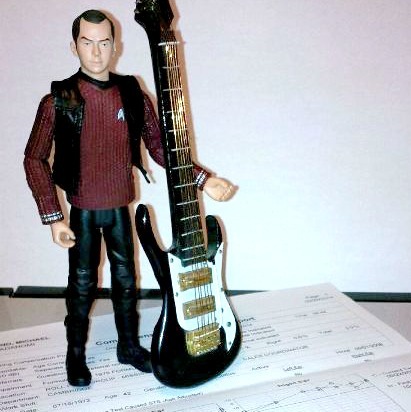
Note Doc Wacholz’s United Federation of Planets drum kit!*
Side one closed with an acoustic instrumental called “Silk and Steel” which is really a showcase for the underrated Criss Oliva. It’s just acoustic guitars — nothing else — for four minutes. Right on, and perfect for a side closer.
No punches are pulled whatsoever on side two. A bruising tune called “She’s In Love” boasts a chugging riff and those speedy Dr. Killdrums snare hits. As for Jon, he spends most of the song screaming in fury (but also in tune). Musically, think “Loss of Control” by Van Halen, but metalized. “Hounds” then opens with quiet picking, similar to Metallica’s “One”. This doesn’t last, and before too long it’s a regal metallic plod with a little bit of Sabbathy organ audible in the background. Then, “The Unholy”: a stampede of tricky licks and screaming vocals. There is no let up.
The aforementioned three-song mini suite is next, and it begins with “Mentally Yours”. The character of “Timmy” is introduced, a disturbed character. The insanity theme is immediately obvious by the piano intro where Jon sets the scene. Think Alice Cooper’s From the Inside album. This piano intro could even be considered a separate song, as it has nothing to do with “Mentally Yours” musically. Intro aside, this is another heavy metal bruiser, guitars on the prowl. It even changes to a speed metal thrasher by the end.
“Summer’s Rain” is the only thing resembling a ballad on side two. If so, it’s a heavy ballad without piano. It does feel spiritually connected to “When the Crowds are Gone” from side one. Still, the best tune of this trilogy is “Thorazine Shuffle” which has an ominous opening. Then the song really begins; a stuttering limping riff, evoking the Thorazine shuffle Oliva sings about. Gutter Ballet ends on an appropriately heavy note.
This remastered edition has two live bonus tracks; unfortunately they are just from the album Final Bell/Ghost in the Ruins. As such I’ve chosen not to talk about them, since I’d rather just review that album later on. So be aware, the Steamhammer remaster from 2002 doesn’t have any exclusive bonus tracks.
3.5/5 stars
* Savatage MUST be Trekkies. The next album, Streets, featured the following lyrics:
And who’s to say what it’s all about? When John Wayne took the last train out? And Spock and Kirk have had enough, And no one’s left to beam me up.
RECORD STORE TALES Mk II: Getting More Tale #328: Slowly Going Deaf?
I’ve been listening to music for as long as I can remember. I’ve been listening to rock music — and I’ve been told to turn it down — since I was 11 years old. That’s 30 years ago. Remember all those times your parents said, “Turn it down, or you’ll be deaf by the time you’re 40!” Let’s see if that’s true.
I’m not the concert-goer that a lot of you are. I’ve always had a thing about crowds, but I’ve definitely seen my share of loud shows: Black Sabbath & Motorhead, Helix and Deep Purple are not the kind of bands that turn it down. In 1972 Deep Purple were declared by Guinness to be the world’s loudest band! But I don’t enjoy the sheer earthquake noise levels you can get at a concert like that, so I’ve been using earplugs much of the time for almost 20 years. I started wearing them shortly after seeing Kiss in ’96. I find this cuts a lot of the noise, and renders the concert to a volume more akin to a loud home stereo.
Where I’m most guilty of playing it too loud is the car. Sometimes I don’t realize just how loud it is in there until I start the car in the morning, having left the stereo on at full blast. I seem to turn it up, turn it up, turn it up…and get used to it. Like a frog in cold water that you begin to slowly heat to boil, I become accommodated to the volume of the rock. So that would concern me, where hearing loss is concerned.
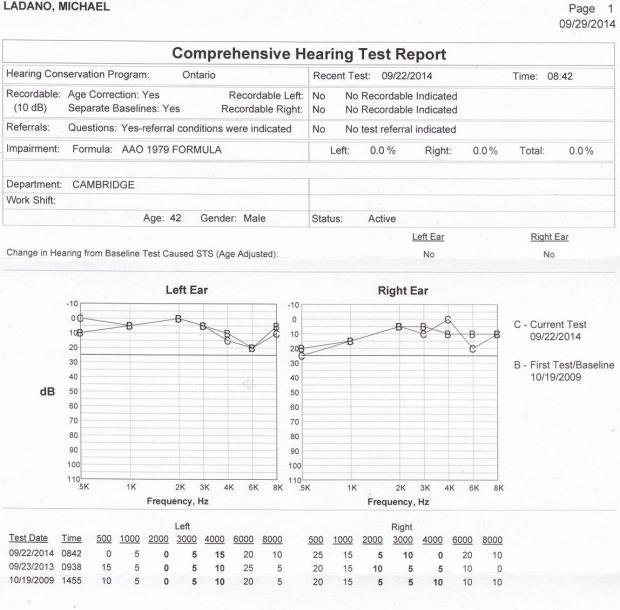
How much hearing have I lost? I completed a hearing test at work a short while ago, and have received the results. Using a 2009 baseline as the comparison, it looks like it’s barely changed at all!
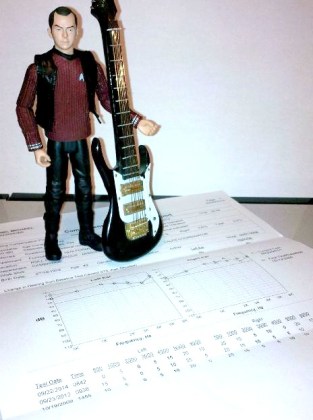
Here’s how the exam worked. A mobile hearing test truck pulls into the parking lot and we take the hearing tests six people at a time. Each one of us enters a soundproof booth, which look like we’re sitting in the escape pods of a spaceship, especially after we don our special noise-cancelling headphones. Unfortunately it’s not a perfect setup. I and several others could hear the beeping of forklifts and tow motors in the yard, through the booth and headphones. This doesn’t help when you’re supposed to push a little button at the sound of a beep in your ears. The test took about five minutes to complete and the results came back about two weeks later. And here they are. I don’t know what half this stuff means, but I’m told I have no major loss. Alright!
OZZY OSBOURNE – Under Cover (2005 Japanese CD/DVD set)
I want to know who thought this album was a good idea to release. Sure, we know Ozzy will do pretty much anything. He even appeared on a tribute album to Black Sabbath (Nativity In Black Vol. 2). So why not have Ozzy cover a bunch of songs that, by and large, the world didn’t need him to cover?
“SHARON!”
I’ve never thought much of this album, and I think you can gather why on the first track “Rocky Mountain Way” (Joe Walsh). Why did this song need to be redone, metalized, and howled upon by Ozzy Osbourne? It’s awful. The female backing vocals are totally out of place, the changes made to song are unnecessary, and the vocal is stale. The only positive thing I will say is that Jerry Cantrell (Alice in Chains) plays on Under Cover, and he’s the only thing redeeming it. His slide and talk box solos on “Rocky Mountain Way” are swampy and great.
Whether Ozzy covers the Beatles (a pukey echo-drenched “In My Life) or Cream (“Sunshine of Your Love”) or the Stones (“Sympathy for the Devil”), nothing of value is added to the song. It’s assembly line rock. There are no innovations or interesting slants. “Sunshine of Your Love” is altered to resemble Sabbath’s “N.I.B.” which doesn’t help matters at all. Ozzy even does two solo John Lennon songs (“Woman” and “Working Class Hero”). I get that Ozzy has a connection to the lyrics to “Working Class Hero” and is a huge fan of Lennon. That doesn’t mean he should try doing his own version. Most songs don’t benefit from being metalized. I’ve even heard a good metalized cover of “21st Century Schizoid Man” better than Ozzy’s.
Best tune (only good tune): “Fire” originally by the Crazy World of Arthur Brown.
Special guests: Leslie West plays some smokin’ axe on the cover of his own “Mississippi Queen”. Ian Hunter joins Ozzy on “All the Young Dudes” but doesn’t do much other than shout along. Others such as Gregg Bissonnette (David Lee Roth) and Joe Bonamassa are credited on the album, with no indication of what they did on which tracks. Maybe Bissonnette was hired solely to play cowbell. Who knows?
The final rip off to fans is that almost all of Under Cover was previously released on Ozzy’s Prince of Darkness box set earlier that year! Many Ozzy fans such as myself picked that one up for its numerous long-sought rarities. When Under Cover was released as its own album, four new recordings were added to make you buy it again: “Rocky Mountain Way”, “Sunshine of Your Love”, “Woman”, and “Go Now”. If you have Prince of Darkness, then you already own over 75% of Under Cover.
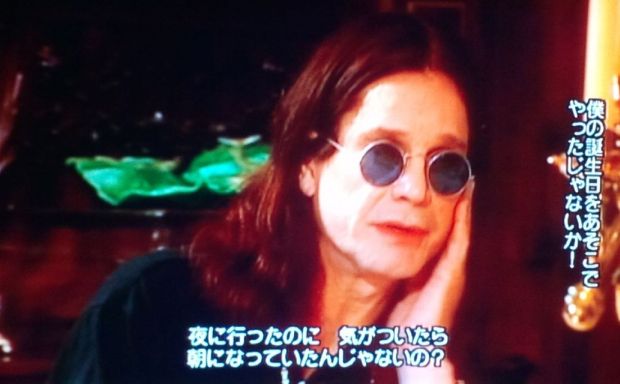
The Japanese bonus track was daughter Kelly Osbourne’s cover of Black Sabbath’s ballad “Changes”, with dear old dad singing with her, and lyrics adapted to suit. If you were one of those (I hope not) who bought Kelly’s 2002 album Shut Up, then you already have this. But like most Ozzy fans, I already have this song on the Prince of Darkness set. This version also comes with a bonus region 2 DVD: the music video for “In My Life” (whoop-de-do) and a long (about 45 minutes I think) feature called “Dinner with Ozzy and Friends”. You might recognize a couple of these friends. Road stories are shared, the funniest ones involving Ozzy being mistaken for Meat Loaf, and Lemmy for Willie Nelson. And there’s the infamous story of Zakk Wylde and a cork. Finally, the two sided DVD also has the entire album in “enhanced stereo”.





















 mikeladano.com