ROYAL BLOOD – Royal Blood (2014 Warner Music Japan, three bonus tracks)
Bass and drum duos are all the rage, but it’s all about the songs. You can do a lot with just those two instruments as it turns out. Royal Blood’s palette of sound is also of the bass and drum duo persuasion, and they have the songs too. Their 32 minute (43 minute on the Japanese with bonus tracks) debut album has enough good tunes that you won’t notice there are only two guys playing. The tunes are all short, tight and to the point.
Mike Kerr (bass, vocals) and Ben Thacker (drums) have been praised by luminaries such as Jimmy Page for this fine debut album. When someone like Jimmy Page excitedly declares he’s a fan, I don’t care who you are — you gotta check them out. Royal Blood composed a series of tightly arranged riffy songs, with some serious heft. Riffs such as the one on “Come on Over” sound nothing at all like bass. Kerr squeals high notes out of his bass like it’s nothing, all while pouring it all into his singing simultaneously. The dude possesses the pipes necessary to infect his songs full of angst.
Check out the tense “Figure it Out”, their best single so far. Thacker keeps himself busy on the drums, working with the song not against it. Everything these guy do serves the song. “Figure it Out” had to be one of the best rock singles of 2014, expertly crafted for maximum rigidity and plutonium hooks. Every song delivers sturdy riffs, understated vocal melodies, and plenty of taut rock action.
The songs are on such a level that only a few stand out above the others. “Figure it Out” is the obvious one, but a few others impress as highlights. “Little Monster” (also a single) isn’t forgettable, and “Ten Tonne Skeleton” immediately reminded me of Them Crooked Vultures. “Loose Change” shakes things up by going slightly funky with some electronic drum effects. These guys don’t waste their time farting around. They slam you with the riffage, bang bang bang, and they’re done. Of course with a band of this configuration, the songs are composed with plenty of space between the instruments, and that adds to the heft of it all.
When the CD ends after “Better Strangers” we are treated to three Japanese bonus tracks. “Hole” is from the first Royal Blood EP Out of the Black. Its slow Soundgarden-Nirvana grunge is notably less crisp sounding than the album at large, but holy cow — this is heavy shit! Right out of 1992. “You Want Me” was lifted from the single for “Come on Over”. This is upbeat hard rocking fun. The final track “Love and Leave it Alone” is from the “Figure it Out” single, and it may be one of the best songs here. It’s interesting that the bonus tracks offer more variety than the album itself, which is a good enough reason to own them. Each of these tracks is different and deliciously good.
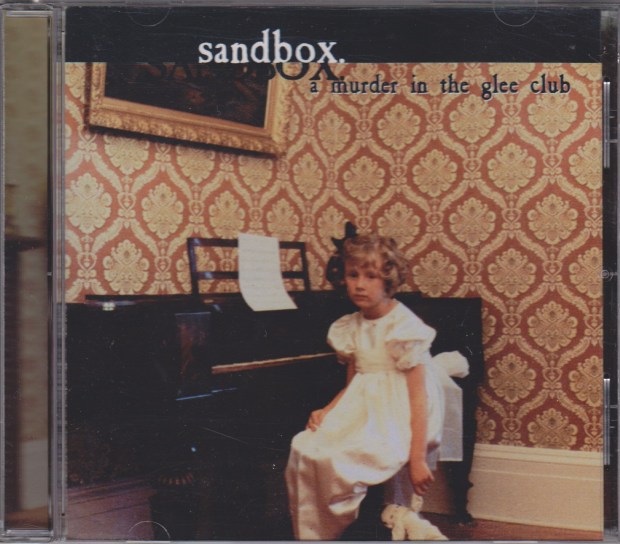
This is a fascinating album. Sandbox (parsed as “sandbox.” on the album) had come out with a successful enough debut, but what we didn’t know then was how much ambition they had. For their second CD, they did what most bands usually wait to do, much later on: the dreaded concept album! It is such a gamble to go for a concept album at all, let alone on your second record.
Setting the scene is the title track, “A Murder in the Glee Club”; but is all what it appears to be? The liner notes state:
“Recorded as in introduction to a play in 1932 by Freddie Corn and the Ohioans, the song has sat dormant on a shelf for the past 65 years. Shortly after it was recorded, the production was cancelled and the song was never released or published. The version you hear on this record is the original recording, sonically enhanced and embellished using mordern technology.”
Hmmm.
An online search for “Freddie Corn and the Ohioans” reveals only one hit: an old interview with Mike Smith from the University of Western Ontario, which is only quoting the liner notes.
I always wondered if Sandbox were trying to pull the wool over our eyes a little bit with those liner notes. You can draw your own conclusions but “A Murder in the Glee Club” does lull you in to the concept of the album: Altered states of consciousness and mental illness eventually lead to murder. Then, the murderer becomes haunted by the crimes he has committed. That “1932 recording” really sets the mood right.
“…to red” is the first proper song on the album, and this is lyrically connected to the final track on Sandbox’s first album, Bionic. It’s immediately obvious that the production, this time by Don Fleming, is far superior. “…to red” is a vast improvement sound-wise over anything on the first album. Performance-wise too; the band no longer sound stiff. Singer Paul Murray seems less shy, and willing to stretch out his voice. “…to red” is a fantastic up-beat start, with enough twangy-crunchy guitars to compensate for the pure pop that is the melody. “I woke up with a different life, I was wondering where I’d been,” and the disoriented lead character is introduced. This track was written by the uber-talented Mike Smith. “Spin”, by Jason Archibald continues the story. “I can’t believe you ran, I can’t believe you wanted out.” When the character sings, “The Devil was my name,” then I get a bad feeling. The music is darker, but driving. The excellent guitar chops of Sandbox really make it enticing. They leave a lot of space between the instruments so you can really hear what is going on.
“Spin” fades softly into “The Garden Song”, and it is clear that something bad has happened. “They found you in the garden, arranged smile stained your face.” While the lyrics are poetic it’s difficult to pay attention to them, because of the imagery they evoke. The music is absolutely lovely, almost uplifting at times, but this has to be the darkest moment in the story. “The Spectre”, faster and loaded with tasty backwards guitar, begins to deal with the haunted thoughts of the killer. This is a duet with Mike Smith on second vocals. You can picture this guy wandering through some a cold field somewhere, arguing with himself. It’s an electrifying song, leading into the blitzkrieg of “Melt”. This is the heaviest song Sandbox have ever done, blasting with a heavy chunk-tastic riff. “Better stories, a better plan, this guy thinks he’s Superman, I think I’d like to smash his face with Kryptonite.” I love that line. There’s an intense feeling of anger.
Forwarding the story, “If I Tell” reveals regret, and delusions. The killer now wishes he could bring his victim back, but he certainly isn’t willing to confess. He justifies this by saying that he’s just protecting those whose lives would be impacted by his confession, perhaps family or friends. Jason Archibald plays what sounds like electric sitar recorded backwards. Then, “Self-Contained”, the best track on the album steps forth with a powerful, catchy riff. This was the first song to really jump out on first listen. “I hate the way I’m self-contained,” sings Paul Murray, wishing he could escape the insanity. But the really crazy thing is, even though we know what’s gone on before, taken individually anybody can relate to the lyrics. “I wanna feel the rush, of an electric song, I wanna be in love, it turns me on.” On first listen, you’re not going to follow the concept of the album completely. This song jumped out at me, and I always loved the lyrics, even though I hadn’t pieced it together with the rest of the album yet.
“Carry” was a the lead single/video, and an upbeat pop rocker it is. Guitar jangle and steady beats provide what you need for a hit, only it wasn’t. (For shame.) Perhaps it just wasn’t edgy enough for rock fans in 1997, I don’t know and I don’t understand why Sandbox were not absolutely huge. Jason Archibald’s “Missed the Day” is a beautiful, softer ballad. The guitar and vocal melodies are ace, but I also like listening to the drums of Troy Shanks. Brilliant song with its own hit potential, untapped and wasted.
I remember visiting the Calgary Zoo when I was younger. The most haunting image in my mind was a polar bear named Snowball who paced back and forth, back and forth, back and forth…endlessly. (Read more here.) When Snowball finally died, I am sure I was not the only Canadian who believed that he was probably better off. Watching that bear, having long ago gone insane in that tiny enclosure, pacing back and forth was one of the most difficult lessons Young Me had to learn about our relationship with nature. “Bear Bear” was not inspired by Snowball, but by a similar bear at the Metro Toronto Zoo. It fits into the concept of the album only metaphorically. Musically, it’s quite jagged and drony, in a strangely catchy way. This is a powerful song!
According to the liner notes, “How I Feel” was written by Mike Smith, and was lyrically inspired by seeing the Spice Girls on Saturday Night Live one night. He pulls no punches: “I’ve been watching all the sheeple of the world, Masses flocking to the mindless shit they’ve heard.” Musically, it’s brilliant and very 1960’s in vibe. The electric piano brings me back a few decades. On this song, the lead character simply cannot connect with people — he is baffled by their behaviour, their words and beliefs. And he resents them. “Will you even notice when I go? I’ll be leaving here when I say so.”
The final track for this dark concept album is “A Question of Faith”, with sparse echoey guitars and a plaintive melody. What you hear and what someone else hears may be two different endings altogether. You decide what it all means. The song is brilliant, and emotionally heavy. Yet it also feels like release. A great weight lifting. “A Question of Faith” is as well crafted as everything else on A Murder in the Glee Club.
I have said in the past, that if I had only bought this album in the year 1997, it would have made my top albums list (published in our store newsletter) that year. Alas, I did not get it until early in the new year. If I had got the CD in time, it definitely would have been on that list. It’s truly a shame, but this second CD proved to be Sandbox’s last album. Mike Smith had no problem finding fame elsewhere, as his career as Bubbles from Trailer Park Boys has certainly skyrocketed!
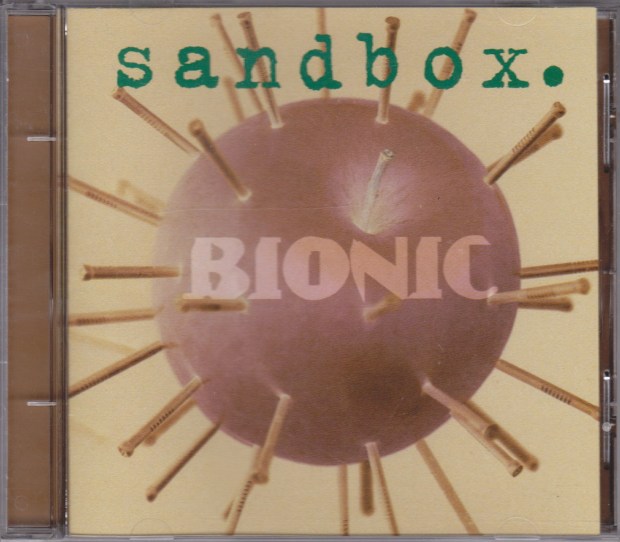
Because it was the 1990’s, and you had to do stuff like this, Sandbox referred to themselves as “sandbox.” with the period at the end. This being 2015, in this review we’re just going to call them Sandbox. Sandbox were very, very 1990’s with some melancholy music and an abstract album cover of an apple with nails in it. There is no reason for this that I can tell. It may well have just been, “Hey, let’s make this apple look like the guy from Hellraiser.”
Sandbox were from Nova Scotia, and have two really interesting connections. One, the lead singer Paul Murray is the nephew of Anne Murray, who made “Snowbird” a national treasure back in the 70’s. Two, the lead guitar player was a talented fellow named Mike Smith. Unless you’ve been living under a rock for the last 10 years, then you know Mike Smith as his Trailer Park Boys alter-ego, Bubbles. I saw these guys opening for the Barenaked Ladies back in 1996 and was impressed by the six tunes they played.
The big hit was “Curious” and it’s still fantastic once you get past the trendy 90’s-isms. (By that I’m referring to the watery, distorted vocals, lack of a solo, and simple construction.) But damn, what a song. All the right parts are there. The guitar riff works its way into your brain effortlessly, and the band provide all the necessary backing. Paul Murray is not a singer of remarkable range or power, but his voice works with the music to create a a wave that washes over you. Mike Smith and the band are more than capable of providing melodic backing vocals.
The problem with the Bionic album was that it had a couple really strong, powerful songs and a lot that didn’t have the same impact. “Collide” is a good song, but it plods along without enough excitement. It doesn’t get you moving. I think a few of these tunes worked better live. The studio can be a stifling environment, and it took Sandbox an album to really grow in the studio. “For You” boasts a strong chorus hook, but again not enough spark.
“Decisions”, dark quiet and slow, boasts a great chorus and impassioned lead vocals. It is augmented by a nice cello part, which works so well for dark tracks such as this. “Decisions” is a standout on the album, with a big part of that being due to the cello. More songs on Bionic would have done well with some augmentation like that. “Grief” is similarly dark, but edgy. I dig the backwards guitar solo, a touch I have always loved in rock music. “Three Balloons and a Trapdoor” is the kind of song title I find annoying, but the cello is back. It’s a sparse little acoustic song without much else going on with it besides the cello. It sounds like a side closer, and that’s the exact position it occupies on the CD running order. Coincidence? I don’t think so.
“Here and There” is the first song that rocks in a while, and it’s very welcome. It could have used more hooks, but it gets the job done well enough. It takes advantage of the jangling guitar chords of Mike Smith and Jason Archibald. Then, “Live” is a fantastic song. Where sometimes, Sandbox’s songs seem to lack sufficient passion and memorable melody, “Live” completely delivers. I feel the sadness, and I can swim in the melodic vocals like a river. “Flux” and “Weatherman” are both OK. “Flux” has a nice hard beat and a chorus I can get into. “Weatherman” is sparse, acoustic and intimate.
The last amazing tune, on a par with “Curious”, is the incredible “Lustre”. A simple guitar lick coupled with another killer chorus is all it takes. A classy acoustic guitar solo just makes it all so perfect. It’s hard to describe just what makes the song click, but it has clicked with me for almost 20 years, so there must be something good going on here.
The final track is the slow and dull “And the Mood Changes…”, followed by silence and then a strange distorted spoken word bit that always struck me as another 90’s gimmick. I was wrong, it is actually the first part of the second Sandbox album, which was a concept album called a murder in the glee club. This spoken word bit is meant to lead directly into the beginning of that album, a story of a killer who is tormented by what he has done. And speaking of that second album, what an album it was! Sandbox obviously benefited from the studio experience on Bionic, because what they achieved on a murder in the glee club was something quite special and fantastic. But that’s another review.
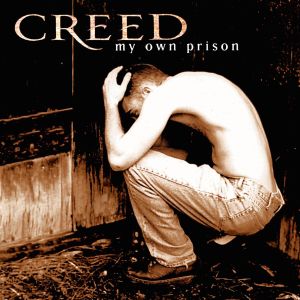
CREED – My Own Prison (1997 Wind-Up, originally Blue Collar)
Have you ever gotten flak for an artist or genre of music that you enjoy? Not a whole lot of fun, is it? Try to imagine that negative opinion not just as common, but as something resembling the general consensus. One that not only discounts anyone that disagrees, but actively mocks and ridicules them. Ask anyone you meet on the street: who are the “worst” musical artists of all time? Chances are, one particular scapegoat of late-90s’ rock will come up… To say that Creed is a controversial band is putting it lightly. Perhaps no group in the history of rock and roll has been a casualty of its own fame quite the same way the band composed of vocalist Scott Stapp, guitarist Mark Tremonti, drummer Scott Phillips and bassist Brian Marshall have. While the amount of fans often rivalled the number of critics in their heyday, as of 2015 the predominant word is negative. Whether it be from fans moving on or the band’s hiatus keeping them from speaking up for themselves, anything positive is rare. Case in point: Scott Stapp’s recent mental breakdown in December featured the most press coverage the frontman has had to endure since the turn of the millennium. EVERYBODY had something to say about it, oftentimes hateful. What of him now? He’s pulled himself back together and aside from his own personal PR, only one or two websites actually reported the news. I’m sure more than a few readers of this review will think he’s still whacked out on drugs, despite spending the last five months at home with his family.
Unfortunately, Creed’s status as something of a pariah maintains that I can’t just hop into the music and give you my personal take. If I were to do so, I’d likely have more than a few commenters simply reiterating age-old hate for the band or questioning the validity of my perspective because I’m not slinging feces. So let’s get to it: perhaps the most common strike against Creed is the idea that they’re heavily derivative of Pearl Jam. Um… have you ever listened to either of these bands? Generally speaking, Pearl Jam is angry garage rock with guitars that bite but don’t shred, and songs that are intended to coast primarily on the emotion conveyed in Eddie Vedder’s vocals and lyrics. Creed is arena rock with soaring pop hooks and beefy guitar riffs. Forgive me if I don’t find those two approaches to be all that similar. Not to mention the fact that Creed rarely ever treads the political ground that Pearl Jam does, and that the perspective of Pearl Jam’s material is often outward, with the Creed being much more introspective. To put it simply, Pearl Jam’s songs are often “you, you, you” while Creed’s are “me, me, me.” If you consider such a point-of-view as pretentious I understand, but I’d rather have someone pointing a finger at themselves than me or a hypothetical “them.”
Of course, this comparison between the bands primarily stemmed from the similarities in Vedder and Stapp’s vocal styles, specifically their employment of what’s known as “yarling” (which involves putting an ‘R’ sound behind enunciations). I’m not going to try and convince anyone that the two frontmen don’t sound similar, but there are important differences that even a cursory listen will highlight: Vedder has more range and is much more likely to yelp, with his voice cracking as he gets higher and more intense. Stapp has a richer timbre but over-pronounces his words in a somewhat silly manner that has become common fodder for haters that fancy themselves comedians. I understand the comparison, but postulating that Stapp “copied” Vedder isn’t wholly substantiated. Claiming that he sounds exactly like Vedder and applying that comparison to the whole band is outright lunacy. This didn’t make any sense to me when I only knew either band from their radio hits; having actually dug into each band’s body of work in subsequent years, it now strikes me as pure propaganda. The fact that the Pearl Jam comparison is blanketed over pretty much EVERY band of the so-called “post-grunge” era just confirms that suspicion.
The next common (and even more ridiculous) complaint is that Creed is somehow Christian rock. Come again? Creed isn’t Christian rock anymore than AC/DC is Satanist metal. Talking about God in a song does not make it religious in and of itself; Christian music involves God as the subject nine times out of ten, with some sort of message of hope through Him conveyed therein. With Creed, God is only ever mentioned as being there; Stapp’s lyrics allude to the Divine in the same way a person might speak of gravity. He’s not trying to convert or otherwise convince anyone of his religious convictions, he’s simply stating them as one might a fact of life. If you dislike this quality that’s fine but it doesn’t make Creed Christian music, even if some of the members are open about their religious convictions.
Even then, to properly interpret these allusions, one must also have some understanding of Stapp’s upbringing. He, like many youngsters, was born into a religious home. He had little interaction with his real father, and his mother remarried when he was still a kid. His stepfather Steven Stapp (from whom Scott took his last name) was a dentist by trade, but a zealot in practice. He made Scott study the Bible for several hours each day and conclude his time by writing essays about what he learned from the passages he perused (Scott later came to find that Steven was using his essays for Sunday school lessons). Think that’s bad? It’s not even the worst of it: whenever Scott messed up, he was physically beaten by Steven. As in abused. Steven also set a specific time each week that Scott was to be thrashed for sins that his stepfather “knew he committed but didn’t see.” Scott was also punished whenever Steven caught him listening to rock and roll, because it’s “the devil’s music.” To top it off, the doctrine advocated was of an unforgiving God that would damn a soul to Hell for the slightest trespass, lest they live a perfect life.
So why am I telling you all of this? Because personal experience naturally informs art, and if you were brought up in a household like this, chances are you’d address those feelings through song as well. It’s all in HOW one addresses these topics that informs the atmosphere. Scott didn’t write lyrics that concerned themselves with theology because he wanted listeners to believe it, he wrote them because HE didn’t know what to believe about the God he had shoved down his throat by his stepfather. It’s a fair assessment to assume that his childhood had a massive effect on his personality, not to mention the disparate reactions to the Creed’s music. It’s a wonder Stapp didn’t have a meltdown before 2014. Of the common complaints about this band, I consider the Pearl Jam point open for debate. Do the bands sound alike? To a degree; both play dour hard rock. There’s only so much variation one can attain within that template, after all. The Christian rock charge, however, is simply untrue. Overall, as far as I’m concerned, both of these sleights were coined not because of their accuracy, but moreso to knock the band off of their perch when they got huge. With the passing of time, these legends have become fact, and the legend is being printed. (As a final point, it behooves me to point out that the band was originally to be called Naked Toddler until Brian Marshall suggested the name be changed to Creed).
Finally, you have the general complaint of the era to contend with: Creed is most often resigned to the “post-grunge” monicker. I don’t care who you are or what you think about grunge, designating a bunch of later artists with a “post-” label when they make pretty much the exact same type of music as their forbears is ridiculous. Does that make Poison and Guns N’ Roses “post-hair metal” since they appeared relatively late in that particular cycle? I get that the so-called post-grunge bands are considered much less authentic than their precedents, but the problem with that line of thinking is that grunge didn’t really invent anything, nor were they all that “original.” Sure, grunge killed hair metal, but there’s a distinct difference between killing and conceiving. The faces of the sub-genre, Nirvana and Pearl Jam, are watered down punk with a hard rock flair. Think AC/DC is simplistic? Nirvana rocks three chord riffs like there’s no tomorrow. That “yarl” that is so often attributed to Eddie Vedder? He wasn’t even the first from the scene to use it, much less music at large. Layne Staley of Alice In Chains holds that dubious distinction for the grunge crowd. As far as the style’s far-reaching beginnings, Ray Charles, George Jones and Jim Morrison of the Doors all sung with such an affectation before Eddie Vedder was ever a glint in his father’s eye. Nevermind the fact that Stapp often cites Morrison as perhaps his most formative influence, along with Def Leppard and U2 (or that Scott honed his singing skills in black churches, whose members would frequently goad him to use “soul” as he sung (read: yarling)).
There are a variety of other diatribes against Creed, such as the band taking itself too seriously (didn’t Nirvana, Led Zeppelin and Black Sabbath, among others?), that Scott Stapp was an arrogant ass (John Lennon, Kurt Cobain, Axl Rose?) and that the band was too commercialized…sigh. This accusation has to be the MOST fragile of the stones thrown at these guys. Just because a song or album is mainstream does not in and of itself guarantee any sort of quality, good or bad. Anyone that attempts to postulate otherwise is too far up their own ass to give any other line of thought consideration. Sure, rock and roll has always had rebellion in its blood, so I can understand that the idea of a rock band NOT pushing such an image as odd. But let’s not forget that the most respected band of all time, the Beatles, was also the most commercial.
There’s also the charge that the band simply blended in with most of the other like-minded superstars of the time, with LeBrain’s popular line being to colloquially refer to them all as Theory of a NickelCreed. Maybe so, but if the band was so “generic” why are they singled out as one of the “worst of all time”? Just because they got big? And the only way to fight it was to backpedal 110% the other way? Politics, politics, politics… and that’s not even the worst of it. By far the most immature response to this band over the years has not been so much in terms of their output, but the fact that a disturbing amount of haters act like no one else has a damned right to enjoy this band. As if Creed deserves to be burned at the stake and obliterated from the public record along with anyone that admits to being a fan. If hold anything but contempt for them you’ve obviously been living under a rock and haven’t experienced the “good stuff” yet. Are you kidding me? Yeah, and Creed fans are the stupid ones.
Preamble over. Can we move on to the actual music now? That’s what we’re here to discuss, but my pen is pre-ordained to at least address these concerns beforehand, lest I be case out of the “elite” musical regime (which will probably happen anyway since, you know, my argument about Creed consists of more than the age old operandi “they suck because they suck.” Even now I feel readers skipping past my prose to the comments section to light their torches and take my ass to task for my “transgressions”).
Released in 1997 and selling over six million copies in the United States alone by 2002, My Own Prison heralded the arrival of Creed. According to a decent amount of the more casual fans and even some critics, this is their best album, and one after which many jumped ship in indignation. Why? Because of the first three records from the band, this one is decidedly the least commercial. The songs mostly just crunch and end, leaving the listener to sort out the details. Few are trying to be populist anthems. It’s not my favorite Creed album, but I can see why it’s a popular choice. The album weaves through mostly introspective stories of faith and loss, with slight forays into light political fair on “In America.” Overall, this is a moodier and less bombastic affair than the band’s subsequent albums.
Tremonti’s lead guitar ordains the album opener “Torn” with melancholy, and Stapp’s vocals maintain the atmosphere. “Peace is what they tell me/love, am I unholy?/Lies are what they tell me/Despise you that control me” he sings. The guitars crash in in full force on the word lies, underscoring the inherent evil of the practice. “The peace is dead in my soul/I have blamed the reason for/My intentions poor” goes the chorus. I love the atmosphere and passive, rather than assertive, anger conveyed with the lyrics and instrumental. Say what you will about this band but they know how to start an album (perhaps not coincidentally, “Torn” along with followup album Human Clay’s opening track “Are You Ready?” are my two favorite songs from this band).
Next comes “Ode”, a quintessential tune about being mistreated by others. Scott hints at his past here: “One step on your own/And you walk all over me/One head in the clouds/You won’t let go you’re too proud.” This track is a weaker standout, but still pretty good. The title track follows at number three. Perhaps I’m biased, but I consider the song “My Own Prison” to be a classic of ‘90s rock. The one feat Creed is rarely credited for is their knack for catchy and memorable hooks. There’s a reason they were so popular, and forgive me if I don’t think they’ve sold 40 million albums just because the general populace has “terrible taste.” Stapp is often cited for being too earnest with his lyrics and lacking subtlety; well, as far as I’m concerned life isn’t subtle, and he captures that aspect well. I consider the lyrics of “My Own Prison” to be pure poetry: “So I held my head up high/Hiding hate that burns inside/Which only fuels their selfish pride/We’re all held captive/Out from the sun/A sun that shines on only some/We the meek are all in one.” I’d be entertained just reading this stuff; can’t really say the same for “Lithium” or “Even Flow.” As a song, Tremonti and Marshall’s haunting guitar work and Phillips’ dejected drumming elevate the experience to another level.
The album hits something of a snag with the next few tracks in that none of them really stand out from one another (hey, I can make the case that this band is highly underrated but I never implied they were perfect; no artist is). “Pity for a Dime” is your typical “no one cares about me” song that never really distinguishes itself. The atmosphere of the album bolsters this track along with the other weak links, but otherwise it’s one that you skip when going for the meat. The melody is decent, but the point of the lyrics is quickly lost in their redundancy. Even then, the guitar work starting at 3:50 is a real treat and a standout of Tremonti’s contributions.
“In America” is caught in the same net as “Pity for a Dime”, essentially reprising the same theme. However, the twist is that Stapp is noting other opinions rather than his own. I’ve often felt the perspective that Stapp’s lyrics convey to be a hint of subtle genius; he’s merely playing the part of observer, not necessarily “judge” of the politics he addresses. While I think he’s overlooked as a lyricist, Stapp makes a crucial mistake in his treatment of the central conceit: the hook plays as “ONLY in America.” Even as someone that actively avoids politics and the news, I know that very few (if any) of the social issues brought up in this song occur solely in Uncle Sam’s domain. Even if the premise is flawed, the theme of being torn between two extremes is powerful. That military-esque drum beat at the beginning is a nice touch as well.
Two of the more intense tracks from My Own Prison are “Illusion” and “Unforgiven.” The former’s dissident fascination with the nature of life is engrossing. While I wouldn’t call it a standout, it’s also hard to dismiss. If anything, the song helps maintain the atmosphere and momentum, even if you probably won’t catch yourself reaching for this album solely to hear it. However, if you’re just letting the album play it certainly adds to the experience. As for “Unforgiven”, remember Scott’s stepfather and his violently fundamentalist ideas about God? Well, the title should speak for itself. Stapp bluntly speaks of his childhood and feelings about that time in his life. The music is appropriately menacing on this track and it’s a popular live song for the band despite not being released as a single. Tremonti’s guitar solo is especially striking, no doubt a major part of the song’s popularity.
“Sister” is next, perhaps my least favorite track from Creed’s debut. Interestingly, it maintains the theme of “Unforgiven”, with the focus shifted onto a sibling of Scott’s that endured similar treatment as he did. It’s still perhaps the weakest track, but I like the continuity and pondering of the idea of his younger sisters having not one role model as he did, but two (counting Scott himself). Who says Creed have no artistic merit? The instrumental and overall atmosphere of the song are much lighter than previous tracks, perhaps underscoring the love one feels for their immediate family.
The ninth slot is filled by a song called “What’s This Life For,” one of the four monster singles from this album. This is another favorite of fans, myself included. I appreciate the passion in this track and the yearning for answers. Call me a sap, but haven’t we all wondered this exact thing at SOME point in our lives? Sure, it’s not exactly profound nor does the song really offer anything resembling a solution, but I like it. Shoot me. (Side note: some assessments of the song I’ve read cite the “don’t have to settle no Goddamn score” part as eliciting giggles. Am I alone in wondering just what might be funny about that part? Just because Scott says “Goddamn”? Note that this word is omitted from the single version; it was 1997 after all).
I like to think the entire album is summed up with the final track “One.” Stapp reprises that poetic quality from before: “Society blinded by color/why hold down one to raise another” he sings. Relevant in 2015, don’t you think? “One, oh one/the only way is one” he imparts on the chorus, backed up by another bright riff from Tremonti. The song goes on to note the aforementioned prison the narrator finds himself in, as well as the desire to escape and the likelihood of it happening. To be honest, songs like this remind me much more of U2 than Pearl Jam, with that “save the world” vibe coming in full force. As such, the song falls prey to some of the same problems that ilk does by sweeping the more intricate complications of these social issues under the rug, but it’s hard not to appreciate the intent behind the song. I especially like the “flying” effect at 3:16, where the sound circles between speakers, as if to “unite” them once the song kicks back in, just as the band wishes for the world to be united.
Well, if you’ve read this far, I trust that I have your full attention and that you’ve been at least slightly entertained by my ramblings. A little known fact about this album is that two different versions exist. Recorded for a meager $6,000, My Own Prison was originally published through Blue Collar Records, a label founded by Creed to get their music out. The band received some airplay with this version in their native Florida before attracting the attention of major labels. An exact figure of their pre-fame sales is hard to find, but My Own Prison is quoted as shifting several thousand units before it was bought and reissued by Wind-Up records. Creed were then called back in to re-record parts of the album, while the rest was remixed to make for a more polished listening experience. I picked up one of the original copies on eBay a few years ago for about $50. Back in the day, these things were known to go for a few hundred. So how do the tracks compare?
Well, the first thing you notice is the lack of dynamic range. Sure, Creed’s albums have always been among the numerous victims of the loudness wars, in that they’re mixed to blow your head off with sheer noise. However, believe it or not, the dynamics seem more stylized on the Wind-Up version when compared to the original. The opening seconds are a perfect example of this: whereas the first strains of “Torn” are a bit quieter before the song crescendos in the re-release, the original is pretty much the same volume throughout. This goes for all of the tracks to some degree, with certain parts louder and softer given the version. On a related note, the bass is non-existent on the original version, similar to how it was missing from Metallica’s …And Justice For All. The remix brings it out a bit more, though ultimately the lead guitar and vocals mostly overpower the other parts.
The re-recorded material mostly amounts to some vocals. On certain song choruses of the “official” version, Stapp and Tremonti can frequently be heard singing in multiple keys at the same time. Here, it’s mostly just one at a time. It sounds to me like an additional acoustic part was added to “In America” as well. Reverb was also applied to the remix, which I feel adds to the overall atmosphere of the recordings. Some songs also start at different points, with the odd note or two being cut off, as with “My Own Prison.” The biggest and most noticeable change is the omission of the original intro to “What’s This Life For”, a quiet little melody that appears nowhere else in the song. Tremonti is known to play it at concerts when performing, but it’s completely missing from the Wind-Up version.
Overall, if you resent the commercial tendencies of Creed, you might do well to seek out the original mix of this album. This is the band at their rawest. However, I wouldn’t recommend a purchase unless you’re actually a fan as prices are frequently steep and the remix isn’t THAT different when all is said and done. I have one because I’m a collector and completist, as well as a curious listener. I also have an inkling that as this album nears its 20th anniversary, we might see something of a special edition that features both mixes on separate discs (the perfect gimmick). Not that I urge you to wait for a hypothetical re-release, but it’s a thought. Wind-Up released a vinyl compilation celebrating the label’s 15th anniversary in 2013, with the original version of “What’s This Life For” featured. They obviously have access to the masters and might put it to use at some point. All in all, the rawer mixes can readily be found on YouTube if you are so inclined to seek them out but don’t want to pay collector prices for an original copy.
For those interested, there’s also a bonus track version of the Wind-Up issue featuring an 11th song by the name of “Bound & Tied.” The bonus track version was available in Central America and Europe, though it might be a little harder to find these days. For U.S. listeners, the song was made available via the soundtrack to the 1998 film Dead Man on Campus. If you can get your hands on the bonus track version of My Own Prison for a reasonable price, I’d say go for it. “Bound & Tied” is a forgotten gem from Creed, with an intriguing into in which each instrument comes in at a different point, gradually intensifying the sound. I especially like the vocal effects, as well as the menacing guitar riff from Tremonti. The lyrics are also much more ominous than most Creed songs: “Tongue-tied, restless and wanting/Looks like you might bite, you might bite/Breathin’ in, breathin’ out, you’re weakened/The poisons hit your mind, your mind/Time’s ticking and it’s got you thinking/You’re happy with your life.” The band seems to be commenting on the double-edged sword that is fame; you seek it, yet can’t escape it once it’s attained.
In conclusion, if you actually made it this far (scanning or skipping doesn’t count!), my final verdict is that this album is solid. Classic? Perhaps at times, but it’s not anything resembling horrible, either. If your standards are so lofty that a slightly generic album of solid hard rock is your idea of “horrible” music, I envy your musical taste. Here’s hoping that My Own Prison and Creed as a whole are subject to a re-evaluation of sorts at some point in the future. If you can listen past your gut reaction to the name and pay attention to the music, you’ll probably find something to like.
Rating: 3.5/5
Thanks for reading, guys! Thank you, Mike, for the opportunity to do this! LeBrain has given me the option to review Creed’s discography, so if you want more let us know in the comments! (P.S. I take no responsibility for the band’s music videos. They’re atrociously dated and corny, at least for the next two albums, and if your only exposure to Creed is of the visual kind I don’t blame you for thinking they’re garbage.)
No sir, thank you Mr. Acca Dacca for a very thought-provoking review! I really appreciate the time and effort he put into this monster of a review. I have definitely opened my ears to this band. – LeBrain
When Edwin left I Mother Earth for a solo career, many fans (myself included) were disappointed with his wishy-washy not-rock of his solo debut, Another Spin Around the Sun. Sure the song “Alive” was incredible and epic, but the rest of the album was so middle-of-the-road and lukewarm. It was with great relief that I Mother Earth only went from strength to strength by hiring on unknown singer Brian Byrne to replace him.
I Mother Earth didn’t scale the top of the charts with Blue Green Orange, but what an album it is! Byrne has enough of the rasp and power that Edwin possesses, so he is a natural fit and the sound is pure IME. The opener “Love Your Starfish” immediately proclaims that the band are back! Back to playing longer, more complex song structures with interesting drum patterns, bellowing vocals, and riffs.
But it’s not all just hammering away. “All Awake” brings back the spacey, quiet side of I Mother Earth. The psychedelic textures and exotic percussion are reminiscent of a song like “So Gently We Go” from the first album. Drummer Christian Tanna is joined by longtime I Mother Earth percussionist Daniel Mansilla, and Armando Borg on additional percussion. Jagori Tanna remains one of the most underrated and interesting guitarists to come from the Great White North, and his work here is exemplary. His willingness to explore reminds me of other progressive players such as Steve Rothery.
“Gargantua” is one of the shortest songs at 4:34. Most of them are in the five to six minute range. Appropriately “Gargantua” is the most radio-friendly. Its pop melodies and straightforward beats make it the most immediate, all it lacks is a great chorus. For that, go for the ballad “When Did You Get Back From Mars?” I don’t know if we can call it a “ballad” but it’s a quieter acoustic tune with a plaintive chorus.
Video edit version of “Summertime in the Void”
You wouldn’t usually pick out a track that is seven minutes long for a first single, but that’s “Summertime in the Void”, one of the best tunes on the album. It’s also one of the most rocking, though like all I Mother Earth tunes it’s full of twists and turns including loads of percussion. I’m a big fan of Bruce Gordon’s intricate bass. Even so, I do have a favourite bass player in the world, and that’s Geddy Lee. And guess who turns up on the song “Good for Sule”? Geddy frickin’ Lee! (Alex Lifeson played on the previous IME album, Scenery & Fish.) “Good for Sule” may well be the best tune on the album. Gentle piano helps make it the most laid back track on the disc.
I’ll stop here — I don’t want to review Blue Green Orange song by song, because it’s all variations of “wicked guitars”, “awesome percussion”, and “challenging twists and turns”. Blue Green Orange is not an instant pleasure, but one that reveals layers the more you listen. As such it’s my second favourite I Mother Earth album, after Dig. Reception was mixed at the time however. Some fans did not embrace the new album, others preferred the old singer.
The packaging for this CD is cool. You could choose between blue, green or orange covers. The inside booklet is layered with pages of different sizes and lyrics for all the songs. Packaging like this on a standard edition CD is something we collectors appreciate.
ROCK STAR SUPERNOVA – Rock Star Supernova (2006 Epic)
It’s no wonder this band came and went, with Lukas Rossi now toiling in obscurity once again. Even Jason Newsted didn’t want to tour with this band. (Why would he, when he had better stuff going on like VoiVod? He was replaced by Black Crowes bassist Johnny Colt.) Tommy Lee and Gilby Clarke have stated that they really wanted to have two singers, Rossi and Dilana, but the TV execs wouldn’t allow it. That shows you how much integrity is contained herein. Even the name of this band sucks.
Butch Walker (ex-Southgang) created a faceless, generic, dull sounding record with all the modern bells and whistles that scream “ProTools”. He deserved plenty of the blame since he co-wrote all the songs but one. The drums barely sound like Tommy Lee; the band has no identity. There is not one bonafide great song on this CD. There are a couple decent moments on some of the rockers such as “It’s On!”, but this is 40 minutes you won’t get back.
One of the main issues with the album is Lukas Rossi himself, a generic singer with no real identity. He sounds like any number of glam rock vocalists with nothing unique or special. The other musicians are rendered faceless by a batch of songs that are too lame for most Motley Crue albums. But come on — if you have a TV series about finding your new singer, find somebody memorable, you know?
If you bought this, you simply supported the same-old-same-old, plastic, processed, fake, and commercial music that has been rammed down the throats of the world since the advent of reality TV. Really, this just gives rock a band name, because people see this and think it’s actually rock music. It’s not. This is prefab music designed to generate hype and sales. It’s also suspect when I read multiple drummers’ names in the credits. Thankfully people saw through it and the sales tanked (except in Canada where Rossi is from).
Don’t spend a penny on this music. If you like these musicians and you want to hear them do something cool and different that you probably haven’t already heard on the radio, pick up the following:
If you support Rock Star Supernova, you just twisted the knife a little bit deeper into the back of rock and roll.
1/5 stars, and one big stinky piece of cheese.
1. “It’s On”
2. “Leave the Lights On”
3. “Be Yourself (and 5 Other Cliches)”
4. “It’s All Love”
5. “Can’t Bring Myself to Light This Fuse”
6. “Underdog”
7. “Make No Mistake… This Is the Take”
8. “Headspin”
9. “Valentine”
10. “Social Disgrace”
11. “The Dead Parade”
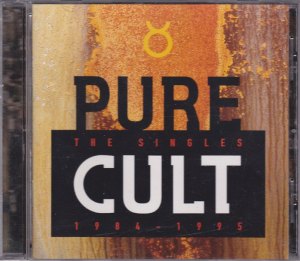
For today’s installment of THE BEST FUCKING COLLABORATION WEEK EVER, Aaron and I are actually reviewing different albums. Sort of. He’s doing Pure Cult: For Rockers, Ravers, Lovers, and Sinners. I’m doing Pure Cult: The Singles 1984-1995. Same album, different versions thereof with slightly different tracklistings. Dig in!
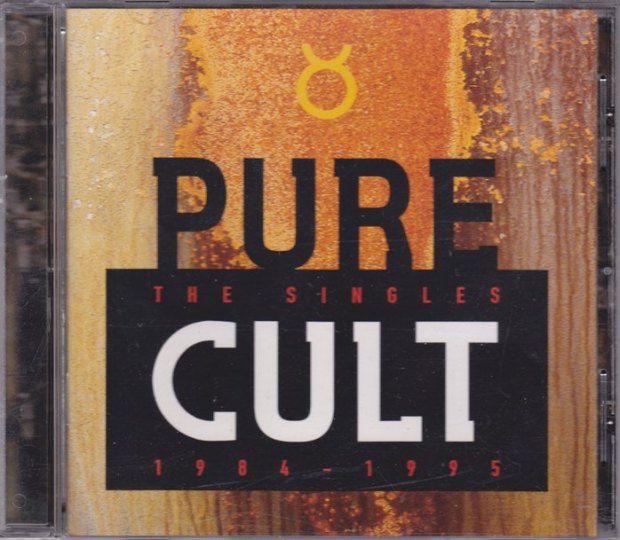
THE CULT – Pure Cult: The Singles 1984-1995 (2000 Beggars Banquet)
The original 1993 Pure Cult was great. It didn’t need to be updated only seven years later, but given the chance to remaster and repackage something must be irresistible to cigar-chewing execs.* The remastering ushered in a series of Cult reissues, coinciding with a reunion tour. There was also an issue with an unauthorized UK compilation from 1996 called High Octane Cult. That CD, which contained an exclusive new song called “In the Clouds”, was discontinued and replaced by this new Pure Cult, which re-released “In the Clouds” on its tracklist.
“In the Clouds” is a smashing song, heavy as a really heavy thing, from 1995. It was recorded for a potential followup to 1994’s The Cult, but released on High Octane Cult when the band split up. The sound points towards the heavy metal direction of 2001’s Beyond Good and Evil. The hard hitting snare of drummer Garret is deliciously snappy. Although “In the Clouds” isn’t particularly memorable on its own, I love when the Cult go really heavy. That makes this an unsung classic.
As for Pure Cult: The Singles, “She Sells Sanctuary” still opens affairs as it did on the old Pure Cult. It remains as shimmery as it was in the glow of the 1980’s. Ian’s irresistible howl doesn’t remind me of Morrison one bit actually, but let’s not forget Billy Duffy and his big white Gibson. Duffy has always been about his guitar sound, which changes from album to album. It seems his guitar sets the tone for the album, and “She Sells Sanctuary” benefits from his echo-laden Edge-isms.
The first six songs on the CD are the same running order as the original. I have always been fond of the Cult’s Sonic Temple period, and “Fire Woman” has aged remarkably well. Say what you will about Bob Rock, his production has stood up on this track. Back then, he was trashed for glossing up the Cult’s sound too much. By today’s standards, this is a sparse production! But if you like it basic, “Lil’ Devil” produced by Rick Rubin is excactly what you need. The Electric period is universally celebrated by Cult diehards as a high point, and you can see why on “Lil’ Devil”.
I dig Dreamtime‘s “Spiritwalker”, but I think “The Witch” is really cool. Produced once again by Rick Rubin but going in a completely different direction, “The Witch” brought electronic dance beats to the Cult giving them an industrial edge. “The Witch” was released on the soundtrack to a movie called Cool World in 1992, but it received wider exposure the following year on the original Pure Cult. Regardless of a strong chart performance for the song, the Cult chose not to go with Rick Rubin for their next album and instead returned to Bob Rock! “The Witch” remains a cool experiment and a great song.
Love‘s “Revolution” is still one of my favourite Cult ballads, and it helps you come down from the rush that is “The Witch”. The “Love Removal Machine” and “Rain” keep the classic momentum brewing, but this is the first deviation from the original Pure Cult running order. “Wild Hearted Son”, a hard rocker from 1991, has been moved to the end of the album, though it originally fell after “Revolution”. Then “In the Clouds” takes us fully into heavy modern Cult territory. 1994’s “Coming Down (Drug Tongue)” represents the alterna-Cult that responded to the grunge onslaught. These two newer songs don’t replace any others at this point on Pure Cult; rather they are inserted between “Rain” and “Edie (Ciao Baby)”. Ceremony‘s “Heart of Soul” follows “Edie” for over eight minutes of power balladry, but since it’s The Cult we are going to let it slide.
The song “Love” has been deleted from the running order, and we go straight into the classic “Wild Flower”. Every bit as good as “Love Removal Machine”, these hits are still slamming today. “Star” from 1994 is unnecessarily inserted into the track list here, a forgotten single that nobody really cares about. “Go West” and “Resurrection Joe” from Dreamtime are flipped in order; now “Resurrection Joe” comes first. I like the jittery early Cult, but it’s stunning how they change from album to album. “Sun King” is an interesting choice from Sonic Temple, though I do love the song, it wasn’t that well known as a single. “Wild Hearted Son” is dropped in here, in single edit version without the intro. Finally “Sweet Soul Sister” closes the CD, in its music video mix which is a nice track to have since it wasn’t even on the CD single. Unfortunately the original ass-kicking closer “Earth Mofo” has been deleted! That is truly a shame, since it is such a rush of a rock song.
Ultimately Pure Cult: The Singles 1984-1995 has one more track overall compared to the original release. Unfortunately I don’t think it’s quite as good.
4.5/5 stars
*This CD was followed by the release of the 7-disc box set Rare Cult (a review of which is coming this year), and a compilation called Best of Rare Cult!
RECORD STORE TALES Mk II: Getting More Tale #334: Tyler and LeBrain – episode one – “Nickelback”
Please welcome fellow Sausagefester, Dave FM listener, and lover of leather-clad blues-infested classic rock and roll: Tyler. We’ve decided to team up for musical commentary on a few different topics. Today’s subject:
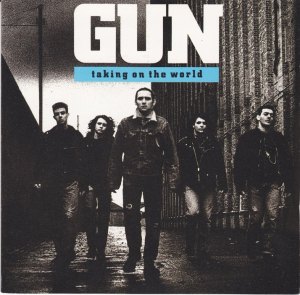
Haven’t heard of Gun? That’s OK, I hear that a lot. You might know Gun best from their 1994 cover of Cameo’s “Word Up” which was a minor hit here on MuchMusic.
I first read about this band in 1990, and first picked up the debut CD in ’96. I don’t actually know a lot about them except that they are Scottish and this is the first of several albums. “Better Days” was the first single I heard. Its bright, sparse rock wasn’t quite what was happening with the mainstream in 1989. It’s very melodic, but in an unconventional way for hard rock bands at the time. The vocals of Mark Rankin were unlike other rock singers on the scene at the time; he’s understated. They also had an unusual image feature two short haired dudes and a frontman with his hair in a ponytail — you didn’t see that in 1989 unless you were INXS. Musically too, they kind of rode a line between hard rock and 80’s alternative. These are some of the qualities that attracted me to the band in the first place. “Better Days” is a stand-out track, possessing a rhythmic base, a chorus that kills and a soulful vibe that helps sell it.
Second in line is “The Feeling Within” which is harder. It still has the sparse vibe and understated vocals, but with a harder guitar riff. It too boasts a winning chorus (reminding me of late-80’s Rush actually). Once again I think Rankin is a highlight of the song, and he is accompanied on the chorus by Sharleen Spiteri, of Texas fame. Then “Inside Out” takes us to an upbeat, sunshiny place. While Gun remain undoubtedly guitar based, the guitars are not oppressive like most hard rock, and the song has plenty of room to the breathe. It’s another standout song.
The first song that I dislike is “Money (Everybody Loves Her)”. It has a vibe similar to “Way Cool, Jr.” by Ratt, but without any balls. I’ll pass on this one. Fortunately the best song is next: the title track “Taking on the World”. Quiet acoustics back Rankin’s laid-back voice. Outstanding melody and song construction here! It gradually picks up steam, electric guitars slowly drawing in. The bass provides a steady pulse as the song builds. It closes side one on a strong note.
“Shame on You”, side two’s opener, is similarly constructed upon the pulse of the rhythm section. It has a drone-y but catchy riff, not to mention chorus. Darker tones shade “Can’t Get Any Lower”, still a good song, but lacking the punch of a memorable chorus. Unfortunately the title “Something to Believe In” is well overused, and this isn’t really a great song. It’s probably the weakest so far, though it does have some great vocal moments. But then there’s the funky “Girls in Love” which I have a strong dislike for. At least it’s the shortest song, but this sounds like a bad Bootsauce song or something. After a couple tunes like these, you need a strong album closer. Gun fail to deliver with “I Will Be Waiting”. It’s too laid back. It would have been better elsewhere on the disc, but it’s not that strong.
In summation, Taking on the World has a pretty damn good first side, but takes a hard slide on the second. Too bad. There’s enough goodness here to warrant:















 mikeladano.com